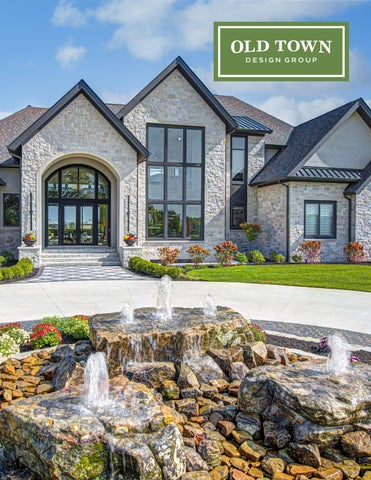
Old Town Design Group
HEADLINE: OLD TOWN DESIGN GROUP:
OLD TOWN DESIGN GROUP BU QUALITY FROM THE GROUND U Through careful site selection, detailed planning and a team of specialists, the Central Indiana homebuilder connects custom design with lasting construction quality. Written by Dawn Killough Produced by Oscar Orozco
2 I oldtowndesigngroup.com
Old Town Design Group
UILDING UP
oldtowndesigngroup.com I 3
Old Town Design Group
For Matt Huffman, a conversation about a custom home should begin before the buyer purchases the land. A lot may offer an appealing view or a convenient address, but its development requirements can reshape the budget before construction starts. The president of Old Town Design Group has seen buyers discover those costs after committing to a property. He would rather meet them on the site first, explain what the land will support and help them understand what it will take to build there. “Get this consultation before you purchase a lot,” Huffman said. That early involvement reflects how the Carmel, Indiana-based builder approaches
4 I oldtowndesigngroup.com
its work. The company brings site knowledge, residential design and construction management into the same conversation, giving homeowners a clearer understanding of their choices before those choices become expensive to change. Old Town Design Group builds custom homes,
Old Town Design Group
curated homes and high-end townhomes across Central Indiana. Its communities include locations in Carmel, Westfield, Zionsville and West Lafayette, alongside opportunities to build on a client’s own lot. The business is part of a broader Old Town organization that also includes development and commercial construction capabilities.
at a time when established companies were struggling and the market offered little certainty. The experience taught them that building homes alone would not necessarily provide a dependable pipeline. Competing with large national builders meant finding opportunities where a smaller company could apply its knowledge of the local market and control more of its future.
Across those residential offerings, Huffman and co-founder Justin Moffett describe a consistent “We knew that if we were going to have a expectation: the product can change, but pipeline of opportunity, we had to learn to be the construction standards should remain developers too,” Moffett said. dependable. The company expanded as those lessons Learning to develop accumulated. Old Town Design Group remained the residential homebuilding Old Town’s beginnings were shaped by the business, while related operations developed economic downturn. Moffett and fellow cocapabilities in commercial construction, real founder Jeff Langston entered homebuilding estate development and asset management.
oldtowndesigngroup.com I 5
Old Town Design Group 100 YEARS OF PELLA. BUILT TO LAST. DESIGNED FOR WHAT’S NEXT.
CHOOSE THE RIGHT PELLA PRODUCT FOR YOUR HOME
READY TO FIND THE RIGHT FIT?
VINYL
WOOD
Smart performance. Everyday value.
Timeless design. Elevated detail.
ALUMINUM
FIBERGLASS
Modern lines.
Strength you can feel. Style you can see.
Expansive views.
WHY HOMEOWNERS CHOOSE PELLA Built for new construction and replacement projects. From custom builds to whole-home window upgrades, Pella helps bring your vision to life.
Designed for comfort and efficiency Help improve natural light, energy performance, and year-round comfort.
Explore window and door options for your new build, renovation, or replacement project.
Pella. Built to Last. SCAN THE QR CODE TO CONNECT WITH A PELLA EXPERT.
6 I oldtowndesigngroup.com
Old Town Design Group Moffett’s responsibilities grew with that organization. As founder and CEO of Old Town Companies, he works with the executive team on strategic direction, development opportunities and the organizational structure needed to support them. Residential execution rests with Huffman and the team at Old Town Design Group. Huffman joined the company in 2013 and advanced from construction operations leadership to president. His background as a framer still influences how he works. Alongside evaluating new communities and coordinating with the development business, he visits the field to discuss the construction details that define an Old Town home. His role combines decisions about the company’s direction with attention to how its homes are actually built. Conversations with field managers give him a way to reinforce expectations and connect leadership priorities with daily practice. Having worked in the trades, he understands the importance of discussing quality with the people responsible for producing it.
“Get this consultation before you purchase a lot.” Matt Huffman, President, Old Town Design Group
Moffett described that division of responsibility as an important stage in Old Town’s development. The founders have been able to broaden the organization because other leaders have grown into roles with meaningful
authority. Huffman’s progression illustrates how experience accumulated within the homebuilding business can support its next phase.“I have a love for building and I have a love for construction,” he said.
Choosing the right locations As Old Town has grown, its approach to land selection has become more systematic. Moffett said the original emphasis on outstanding locations relied heavily on the founders’ judgment. Today, the team evaluates sites against factors including walkability, access to amenities and proximity to employment corridors. The land also informs the housing. Rather than applying the same product to every opportunity, Old Town considers what buyers want and what a particular site can accommodate. Design and sales professionals help inform those decisions through their conversations with customers. Their understanding of buyer preferences becomes part of the development discussion, connecting a possible location with the homes people are looking for. Purchasing and estimating staff contribute another perspective, examining products and costs that will influence what the team can deliver. That approach has supported a progression from fully custom houses to semicustom offerings and boutique townhome developments. Different formats allow the company to respond to changing demand while creating continued opportunities for its employees.
oldtowndesigngroup.com I 7
Old Town Design Group
8 I oldtowndesigngroup.com
Old Town Design Group “We customize developments and product type around the land that’s available to us,” Moffett said. He sees substantial housing demand in the northern Indianapolis suburbs, but demand does not remove the practical challenges of delivery. Huffman pointed to rising land and commodity costs, the time and expense involved in creating buildable lots, and a shortage of skilled tradespeople. Finding enough people who can deliver the expected quality remains a particular concern. Old Town’s response includes diversifying its offerings and recruiting experienced professionals, while recognizing that additional housing formats do not eliminate the underlying cost pressures.
Creating a lot and constructing a home are related but separate constraints. Municipal requirements and development expenses affect when land can become available, while the capacity of qualified trade partners affects how quickly houses can follow. For a builder seeking to maintain consistent workmanship, a strong sales market must still be matched with the people and preparation needed to serve it. The company continues to work primarily in the premium market. Expanding the range of homes gives buyers more choices within that positioning, with design and construction standards carried across the portfolio.
Making decisions before construction
oldtowndesigngroup.com I 9
Old Town Design Group
10 I oldtowndesigngroup.com
Old Town Design Group For a custom-home client, the first task is establishing whether the intended house and the selected lot fit together. Old Town offers a complimentary site walk with construction leadership and a sales consultant, including for prospective buyers who have not yet chosen a builder. Huffman said that visit can reveal development costs a buyer has overlooked. It can also expose a mismatch between the desired home and the terrain. A homeowner may want a walkout basement, for example, without realizing that the lot’s grade makes that choice difficult.
“We knew that if we were going to have a pipeline of opportunity, we had to learn to be developers too.” Justin Moffett, Founder and CEO, Old Town Companies
The purpose is to establish realistic expectations while there is still time to reconsider the property or revise the design. Once a client proceeds, the design team begins with how the household will use the main floor. That layout becomes the basis for developing the basement, any upper floors and the exterior elevations. Huffman described a process that may involve several meetings, with the number determined by the work needed to reach agreement. The team also uses completed models to explain finish levels and help buyers connect their
preferences with a practical price point. Those discussions lead to detailed plans and specifications that can be sent out for pricing. The more clearly the team defines the work, the better positioned it is to establish a contract that reflects what the client expects. The specifications translate design conversations into a defined construction scope. Homeowners can compare finish options against examples they have seen, and the builder can seek bids against a more precise description of the work. That preparation helps align the customer’s understanding of the home with the assumptions behind its price. The sequence also gives the homeowner an active role without requiring construction expertise. Clients explain how they want to live, respond to floor plans and guide the exterior appearance. Designers and construction professionals then work through the practical implications. The result depends on both parties taking time to resolve details while they remain on paper. Huffman acknowledges that change orders remain part of custom building, especially when homeowners revise their choices. His aim is to reduce changes caused by decisions that should have been resolved before construction. “We spend a lot of time on the front end,” he said. Old Town’s published custom-building process reinforces that approach, describing a firm, fixed price after the design and specifications are finalized. The commitment depends on clearly defining the home; it does
oldtowndesigngroup.com I 11
Old Town Design Group not remove the need to address subsequent client-requested changes.
A team that stays involved Old Town’s founders deliberately moved away from a model in which one builder handles every function. Moffett wanted people to concentrate on their individual areas of expertise, allowing design, estimating and construction management to develop as distinct capabilities. That structure connects to the company’s Core Team approach. Huffman described a sales consultant, construction manager and designer who remain involved with the homeowner throughout construction.
“We customize developments and product type around the land that’s available to us.” Justin Moffett, Founder and CEO, Old Town Companies
The team meets weekly to review each home and communicates with the client regularly about progress, selections and upcoming decisions. Keeping the sales professional involved helps maintain continuity between the original discussions and the work being delivered. That continuity matters because the homeowner’s concerns change as the project advances. Early discussions may focus on the floor plan and budget; later questions concern selections, progress and what comes next.
12 I oldtowndesigngroup.com
With the same core group remaining involved, those questions can be considered in the context of decisions already made. Huffman said the company learned that homeowners can become unsettled when they do not receive consistent information. Regular contact gives them an opportunity to understand what is happening and raise questions before uncertainty grows. The website identifies BuilderTrend as the digital system supporting that communication, bringing project documents, scheduling information and selection reminders together. It also describes vendor-studio visits with an Everything Home interior designer and a home orientation at completion. After closing, Old Town schedules walkthroughs at 45 days and 11 months, providing opportunities to address concerns as homeowners settle in. Together, those steps extend the relationship beyond the point at which the house is handed over.
Standards that carry across the portfolio Moffett credits Langston with establishing the construction discipline that underpins Old Town’s reputation. He described his co-founder as deeply interested in how buildings perform and committed to delivering quality for clients. That influence remains visible as the company develops different residential products. Moffett said its townhomes retain the integrity of its custom homes, even though the designs and delivery processes differ.
Old Town Design Group
“Our custom, semi-custom, and townhome product types have the same integrity in how we deliver,” he said.
to training, contractual expectations and industry guidelines as tools for holding partners accountable.
For Huffman, protecting that standard includes knowing when work should pause. Coldweather concrete placement is one example: schedule pressure should not override the specifications governing proper application. He wants the team to consider how a decision made during construction may affect the house years later. Correct installation and attention to conditions help protect the long-term result. Jobsite safety depends on coordination with established trade partners. Huffman said Old Town works with vendors that maintain strong safety programs, while Moffett pointed
Moffett said Old Town draws on its local builders association and agreed industry guidelines when establishing expectations. Contracts make responsibilities explicit, and training helps employees recognize whether work meets those requirements. The goal is to give field teams a basis for decisions that goes beyond simply keeping production moving. He also recalled customer interviews organized by the marketing team that included people who had built with Old Town more than once. Some had returned for a second, third or fourth home. The recurring themes, he said, were
oldtowndesigngroup.com I 13
Old Town Design Group
the experience of working with the company and the quality of the finished product. Those accounts gave employees a direct view of what customers valued in their work. The company’s long-standing trade relationships provide continuity, but expectations still need to be communicated and enforced. Field teams must understand both the standards of workmanship and the practices required to perform the work safely.
Building experience within the company Old Town competes for talent in several parts of the business. Designers, sales professionals and construction managers bring different
14 I oldtowndesigngroup.com
skills, while the shortage of people physically building the homes creates a separate capacity challenge. Huffman said the company’s range of work and quality expectations help attract experienced candidates. Moffett described recruiting beyond the local market, alongside developing people who have learned through years with the organization.
“We spend a lot of time on the front end.” Matt Huffman, President, Old Town Design Group
Old Town Design Group Character and integrity matter in that process. Industry experience provides a foundation, but employees also need time to understand how Old Town works and why its standards matter. Moffett believes transparency helps that learning. He described a culture in which employees can challenge an idea or identify a problem regardless of someone’s title. Leadership acknowledges its own gaps and depends on specialists to address them. He refers to lessons gained through mistakes as earned wisdom. People who have worked through difficulties with the company carry knowledge that cannot be supplied by a job title alone. Their experience helps newer colleagues understand why particular processes exist and where earlier approaches fell short. For Moffett, acknowledging those failures is
part of building trust. Employees need to see that leadership will listen when something does not work and recognize when another person’s expertise is needed. That openness allows the company to learn from its team as well as train it. “There’s no person or title that’s so sacred that you can’t tell them what doesn’t work,” he said. At the time of the interview, Moffett also described early planning for a transition toward an employee-led and employee-owned organization. He emphasized that the team would need to help shape that process. The ambition builds on a business already relying on experienced leaders to carry responsibility beyond its founders.
Giving construction a wider purpose
oldtowndesigngroup.com I 15
Old Town Design Group Old Town’s community involvement includes The Orchard Project, an employee-led philanthropic initiative funded in part through each home the company builds. Its work supports local needs and international housing and education efforts. The company reports that the initiative helps maintain housing for families facing homelessness through Family Hope Inc. Employees contribute practical work such as cleaning, painting and property care between residents. It also awards scholarships to students pursuing construction-related degrees. International partnerships support housing and school projects in Mexico and Costa Rica, among other efforts. Those activities give employees opportunities to apply the same interest in homes and communities beyond the company’s commercial work. For Old Town Design Group, the next stage of growth will continue to depend on connecting opportunity with execution. Selecting the right land, understanding the buyer’s priorities and developing capable teams all contribute to that task. The process returns to the lot walk Huffman encourages before a purchase. Taking time to understand the ground beneath a future home establishes the conditions for better decisions throughout the build. As Old Town broadens its residential offerings, that willingness to begin with the practical details remains central to the way it delivers.
16 I oldtowndesigngroup.com
Old Town Design Group
oldtowndesigngroup.com I 17
Old Town Design Group
18 I oldtowndesigngroup.com
Old Town Design Group
COMPANY INFORMATION Company Name: Old Town Design Group Country: United States Industry: Luxury residential design and construction Est: 2009 Premier Services: Custom homes, curated homes, luxury townhomes, site evaluation, home design and construction management President: Matt Huffman Co-founders: Justin Moffett and Jeff Langston Website: oldtowndesigngroup.com
oldtowndesigngroup.com I 19
OLD TOWN DESIGN GROUP 525 North End Drive, Suite 100 Carmel, Indiana 46032 Main Office: 317.816.3151 Sales Office: 317.805.1105