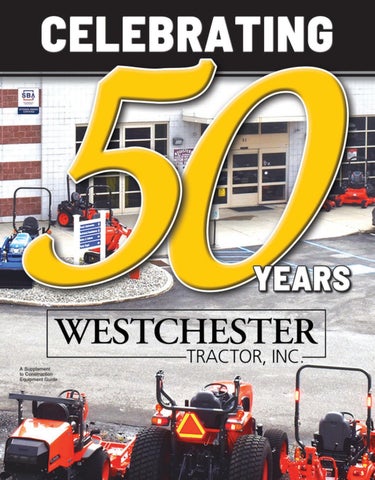
John Apple Reflects On 50 Years of Building Westchester Tractor Ford provided the financing necessary to establish Westchester Tractor, requiring Apple to contribute just $5,000 of his own money. Matt Apple (L), president and majority owner, and John Apple, founder, both of Westchester Tractor.
When John Apple opened Westchester Tractor in Goldens Bridge, N.Y., in 1976, he was just 27 years old. He had developed a reputation as a successful construction equipment salesman, but owning a dealership was an entirely different proposition. He had experience, ambition and a manufacturer willing to take a chance on him. What he didn’t have was much money. “I only had to come up with $5,000,” Apple said. “Ford lent me the rest of the money.” That arrangement launched a business that would grow and evolve through five decades of remarkable changes in the construction equipment industry. Along the way, Apple would witness the rise and fall of familiar equipment brands, major manufacturer acquisitions, changing customer demands and an entirely new generation of machinery. Today, as Westchester Tractor celebrates its 50th anniversary, Apple looks back on the decisions, opportunities and challenges that shaped the dealership.
From Salesman to Dealership Owner Apple’s career in construction equipment began in the Albany, N.Y., area, selling Case construction equipment for a company called Metrac. An opportunity eventually took him to Milford, Conn., where he joined Dave Olsen in a Ford tractor dealership known as S&S Tractors. Apple served as sales manager and quickly demonstrated his ability to sell equipment. When changes in the dealership’s ownership threatened its future, Apple was presented with an opportunity to take over the operation. The price, however, was beyond his reach. “If you can come up with $80,000, you can keep the tractor dealership going,” he recalled being told. Apple didn’t have $80,000, and the opportunity passed. Before he found himself unemployed, however, other equipment dealerships began recruiting him. He ultimately joined Wesco, owned by John Kerrigan, where his sales success continued. Apple was
Apple’s career in construction equipment began in the Albany, N.Y., area, selling Case construction equipment for a company called Metrac.
2
Westchester Tractor’s headquarters is in Brewster, N.Y.
(L-R) are Joseph Castellano, town supervisor of the town of Southeast; Donna Apple; John Apple; Matt Apple; Andrew Prusinowski, Assemblyman Matt Slater.
Assemblyman Matt Slater (R) recently celebrated Westchester Tractor Inc.’s official induction into the New York State Historic Business Preservation Registry after successfully nominating the equipment dealership for the statewide honor. Slater also presented the company with a New York State Assembly proclamation recognizing both its induction into the Registry and 50 years of serving customers throughout the Hudson Valley. (L-R) are Donna Apple, John’s wife; John Apple; Andrew Prusinowski; and Assemblyman Matt Slater.
making a mistake during the meeting. willing to travel considerable distances to Nevertheless, Ford liked what it saw. develop customers. He recalled driving from Clinton, Conn., to Dover to meet with a contractor and sell equipment, Building a Business demonstrating the persistence that would With Ford’s Backing become an important part of his business The agreement that followed was philosophy. unusual by today’s standards. His knowledge of the machinery also Ford provided the financing necessary distinguished him. to establish Westchester Tractor, requiring Apple remembered explaining to Apple to contribute just $5,000 of his own industry publications the advantages of money. Ford backhoe loaders, particularly their The arrangement combined a loan At the Glass House in Detroit, Don Peterson, with Ford’s ownership interest in the new hydraulic systems, which allowed operators (L-R): president of Ford Motor Company; John Apple; to achieve both speed and power. and Bob Moglia, president of Ford Tractor dealership. Ford also established Apple’s Those comments attracted attention at Operations, establish Westchester Ford Tractor, salary and a profit-sharing structure that which later became Westchester Tractor Ford Motor Company. allowed him to gradually purchase the At the time, Ford was looking for manufacturer’s interest. someone to establish a dealership serving the Westchester County “When there was profit, I would get 25 percent of the profit, but I’d market. Company representatives invited Apple to Detroit for an have to take half of that profit to buy stock,” Apple said. interview at Ford’s corporate headquarters, known as the Glass House. It took approximately seven years to complete that process. By 1984, For a young salesman, it was an intimidating experience. Apple had purchased Ford’s interest and Westchester Tractor had become Apple recalled sitting down with senior Ford executives, including an independently owned dealership. Phil Caldwell, during a formal luncheon. see page 6 “I was nervous as could be,” he said, remembering his concern about
3
KAGE® WING PLOWS
VERSATILITY FOR ANY SIZE MACHINE
One Machine for All Jobs
SnowFire Wing 7'–16' for 5k–15k lb Skid Steers, Loaders, and Tractors
SnowStorm Wing 7'–20'
for 15k–30k lb Loaders and Tractors
SnowDozer Wing 10'–35'
for 30k–50k lb Loaders and Tractors
Congratulations Westchester Tractor, Inc. on your 50th anniversary! www.kageinnovation.com 1-844-314-KAGE (5243)
Flail Mower Power Washer
Root Grapple
Leaf Blower
And Every Season
Congratulations on 50 years! To our dealer partner
www.westchestertractor.avantdealers.com 4
5
Westchester Tractor’s showroom in Brewster, N.Y.
Westchester Tractor offers a wide variety of replacement parts and attachments. A large assortment of replacement buckets and rubber tracks are available at Westchester Tractor in Brewster, N.Y.
Customers can expect a significant inventory of parts at Westchester Tractor in Bewster, N.Y.
Industry in Transition One of Apple’s strongest memories of the early years is just how important the backhoe loader was to the construction industry. In 1988, Westchester Tractor sold approximately 63 backhoe loaders, all to different customers. At the time, the Ford 555 was a familiar sight on construction sites throughout the region. But Apple could already see changes developing. Compact excavators were beginning to gain acceptance, skid steer loaders were becoming increasingly important, and contractors were discovering that smaller, more versatile equipment could perform work traditionally handled by larger machines. “The industry was changing, too, from the landscape tractor to the skid steer and the mini-excavator,” Apple said. Those changes accelerated throughout the 1990s. For Westchester Tractor, adapting meant finding manufacturers that could supply the equipment its customers increasingly wanted. Ford had discussed expanding its construction equipment lineup, including compact excavators and skid steers. Although some of those plans materialized, Apple believed progress was slower than the market required. That helped lead Westchester Tractor to Kubota in approximately 1987. The decision would prove to be one of the most consequential in the dealership’s history.
A New Holland skid steer is cleaned up in the company’s wash bay.
from page 3
The original business operated from a small building in Goldens Bridge, serving contractors, landscapers and other customers who depended on Ford tractors and construction equipment. In those early years, the dealership’s product mix looked considerably different from today’s. Westchester Tractor sold backhoe loaders, agricultural tractors and even garden tractors. Apple personally stayed at the dealership on Thursday evenings and Saturday mornings to accommodate customers. “In 1976 and 1977, we actually sold garden tractors,” he said. “We were open Thursday night. I used to do it myself.” As the dealership grew, however, its business increasingly shifted toward professional contractors and larger construction equipment.
Kubota Becomes Cornerstone When asked which manufacturer had been Westchester Tractor’s best partner over the years, Apple didn’t hesitate. “I’d say Kubota,” he said.
6
Seen here is Westchester Tractor’s original facility 50 years ago.
John Apple opened Westchester Tractor in Goldens Bridge, N.Y., in 1976, when he was just 27 years old.
Although the relationship experienced challenges, Apple credited Kubota with consistently developing its products and Westchester Tractor is headquartered in Bewster, N.Y. supporting dealer growth. “They’ve kept up with the product, and they have a great of which disappeared, merged with competitors or substantially changed advertising program that we participate in, and it’s been growing,” he their distribution arrangements. said. Among those brands were Fiat-Allis, Samsung, New Holland, Kubota eventually became one of Westchester Tractor’s largest- KOBELCO and Hitachi. selling equipment lines. Apple recalled particularly strong sales of Fiat-Allis crawler dozers, Apple believes the manufacturer’s willingness to continually improve which were popular with landscaping contractors. its compact equipment offerings has been especially important. “We sold a lot of dozers,” he said, noting that smaller machines were The transition toward compact excavators, skid steers and other especially successful. smaller machines fundamentally changed the dealership’s business. As compact excavators became more versatile, however, demand for Where customers once relied heavily on backhoes, crawler dozers and some traditional crawler equipment declined. conventional tractors, many now purchase compact equipment capable Samsung excavators represented another memorable chapter. of performing multiple tasks with greater efficiency. Apple recalled that Samsung offered a competitive product supported That evolution also created new opportunities for Westchester Tractor by a centralized inventory system in Pennsylvania, allowing dealers to to serve landscapers, utility contractors, municipalities and construction obtain machines without maintaining extensive inventories themselves. companies of all sizes. “We sold hundreds of them,” he said. When Volvo acquired Samsung’s construction equipment business, Navigating Manufacturer Changes Westchester Tractor’s substantial installed customer base presented an If there is one lesson Apple learned over five decades, it is that the important service consideration. construction equipment industry rarely stands still. The dealership subsequently operated under a sub dealer arrangement Westchester Tractor has represented numerous manufacturers, some see page 8
7
Westchester Tractor offers KOBELCO excavators for large projects.
Hitachi wheel loaders and KOBELCO excavators are available for sale or rent at Westchester Tractor.
Westchester Tractor carries Avant equipment.
Vibroscreen crushers and screeners available for sale and rent.
Kubota all-terrain vehicles are available at Westchester Tractor in Brewster, N.Y.
Westchester Tractor offers an large inventory of Kubota backhoes.
Kubota mini-excavators stand ready for customers’ next project.
Kubota remains an important part of Westchester Tractor’s business.
Apple also recognizes that the economics of selling and servicing equipment have changed. The dealership that once sold garden tractors and stayed open evenings for homeowners now concentrates primarily on professional equipment users, although smaller tractors and zero-turn mowers remain part of its business. Supporting that increasingly sophisticated equipment requires a very different organization from the small operation Apple established in 1976.
from page 7
to continue supporting equipment customers in its territory. For Apple, these experiences demonstrated the importance of maintaining strong customer relationships regardless of changes taking place among manufacturers. The dealership also experienced significant changes involving Ford, New Holland and Case, as the manufacturers’ ownership and distribution structures evolved. Apple acknowledged that some decisions were frustrating, particularly when dealerships invested in facilities or product support based on expectations that subsequently changed. “We built this building for New Holland Construction,” he said, explaining that the manufacturer’s plans ultimately developed differently than anticipated. Through those changes, Westchester Tractor continued adapting its product offerings rather than depending entirely on any one manufacturer.
Fifty Years of Perspective Looking back, Apple is struck by how few of the original industry players remain unchanged. Manufacturers have merged, equipment categories have evolved and dealerships have continually adjusted to new technologies and market conditions. For Apple, the story of Westchester Tractor is not simply about the brands the dealership has represented or the number of machines it has sold. It also is about the ability to recognize opportunities, make difficult decisions and adapt when circumstances change. From his early days selling Case equipment in Albany to the formal interview that brought him to Ford headquarters in Detroit, Apple built his career on understanding machinery and earning customers’ business. The young salesman who needed Ford’s financial backing to open a dealership in 1976 ultimately created a company that has served generations of contractors throughout the region. Fifty years later, Westchester Tractor’s anniversary offers an opportunity to reflect on the extraordinary changes Apple has witnessed and the business he built while navigating them. The equipment industry may look dramatically different from the one he entered, but the foundation of Westchester Tractor’s success remains rooted in the determination, product knowledge and entrepreneurial spirit that brought John Apple to Goldens Bridge half a century ago. CEG
Changing Equipment Business Today, Westchester Tractor’s equipment offerings reflect the industry’s evolution. Kubota remains an important part of the business, while KOBELCO excavators and Hitachi wheel loaders serve customers requiring larger equipment. Apple also reflected on the challenges of balancing sales across different equipment categories. With compact equipment generating considerable activity, sales representatives naturally devote substantial attention to those products. He suggested that having a salesperson dedicated specifically to larger excavators could create additional opportunities. “Maybe we ought to get a person, who sells nothing but excavators,” Apple said. The observation reflects the same practical approach to business that helped him establish the dealership 50 years ago: recognize where the opportunities exist and determine how best to pursue them.
8
Matt Apple Carries Westchester Tractor’s Family Legacy Into Its Next Chapter
For Matt Apple, Westchester Tractor has created expectations of much faster delivery. always been more than a place of business. It After high school, however, Matt did not has been part of his life for as long as he can immediately commit himself to the family remember. business. As the son of company founder John Apple, Instead, he enlisted in the United States Matt grew up watching his father build a Marine Corps, serving five years, primarily small Ford tractor dealership into a successful at Twentynine Palms, Calif., along with an construction equipment business. Today, as overseas assignment. president of Westchester Tractor, he carries He enjoyed his military experience but forward the family legacy that began in 1976. eventually began considering his longOne of his earliest memories goes back to a term future. At approximately 23 years old, Saturday morning when he was approximately he decided to leave the Marines, pursue a eight years old and his father brought him to business education and return to Westchester work. Tractor. “My job was to count the bolt bin,” Apple He enrolled at Western Connecticut State said. “I had to count all the nuts and bolts and University, where he earned a degree in washers.” business management in 2007. Throughout As the son of company founder John Apple, Matt Working alongside longtime parts manager, college, he continued working part time at the grew up watching his father build a small Ford Glenn Gordon, young Matt encountered dealership. tractor dealership into a successful construcsomething that puzzled him. Following graduation, he returned full time tion equipment business. Today, as president “I came across the lock washers, and I to the parts department. of Westchester Tractor, he carries forward the family legacy that began in 1976. thought they were all broken,” he said with Unlike some second-generation business a laugh, remembering that he didn’t yet owners who move quickly into management, understand why the washers were split. Matt spent years learning the daily operations It was an amusing introduction to a business that would eventually of the dealership. become his career. Growing up, Matt understood that running a dealership “If you count the time I worked here in high school, I spent about 30 required considerable dedication. Westchester Tractor operated six days years in the parts department,” he said. a week, and his father frequently traveled on business. That experience provided a valuable understanding of customer “He was always here or on a business trip,” Matt said. “But he always service, equipment support, inventory management and the relationships made time for me. He coached me in baseball. He also taught me how that keep customers returning. to ski as well as teaching me countless other sports and activities that I still enjoy today. My father also made sure we were able to enjoy family New Generation Takes the Lead vacations together.” Around late 2015 and early 2016, John Apple began gradually Those early years gave Matt an appreciation for both his father’s work transitioning toward retirement. ethic and his commitment to family. By that time, Andrew Prusinowski, who had joined Westchester Tractor in 2005, was taking on increasing administrative and operational Learning the Business From the Ground Up responsibilities. Matt’s first regular employment at Westchester Tractor began during Matt, meanwhile, remained closely involved in parts operations, not the summer following his freshman year of high school. moving fully beyond that department until the early 2020s. He returned each summer throughout high school, working primarily Today, Matt serves as president and majority owner, working closely in the parts department under Gordon. with Prusinowski, the company’s vice president and fellow owner. It was a very different operation from today’s computerized parts The two oversee a dealership employing approximately 31 people, departments. with responsibilities that extend well beyond equipment sales. “We were still using books and microfiche,” Matt said. “You’d be Matt describes his management philosophy as one built on trust and looking through these magnifying glasses trying to find parts. It was a allowing experienced employees to do their jobs. lot harder back then.” “Thank God we have the right people in the right places,” he said. “I He also remembers how customer expectations have changed. In don’t really need to micromanage.” those days, contractors and equipment owners often purchased several He also recognizes that a company of Westchester Tractor’s size sets of filters, belts and other replacement parts to keep on hand. requires personal involvement with employees. Today, improved distribution systems and electronic ordering have see page 12
9
Congratulations, Westchester Tractor
50 Years. Built on Trust.
For half a century, Westchester Tractor has built its reputation on quality equipment, dependable service and lasting relationships. We’re proud to have some of our leading equipment brands represented by Westchester Tractor, helping customers tackle everything from agriculture and landscaping to construction and property maintenance. Congratulations on 50 years of serving your customers and your community!
Proudly representing brands trusted by Westchester Tractor customers.
Find Out More About Our Products Scan the QR Code or contact at 845-278-7766 or visit wtractor.com
cummingsandbricker.com 10
11
provides stability in changing economic conditions. Matt estimates that municipal customers account for approximately half the company’s business when equipment sales, parts and service are considered together. Westchester Tractor’s commitment to serving its customers and community is also reflected in its veteran-owned business certifications. The company is certified as a Service-Disabled Veteran-Owned Business by New York State and also is certified as a Veteran-Owned Business by the U.S. Small Business Administration. For Matt, a Marine Corps veteran, these designations represent another meaningful connection between his military service and the family business he now leads. He also believes having multiple equipment brands allows Westchester Tractor to focus on what customers actually need rather than simply selling a particular manufacturer’s product. For Matt, the responsibility of leading Westchester Tractor is ultimately about preserving what made the company successful while adapting to a changing industry. His journey has taken him from counting washers as a child to working behind the parts counter, serving in the Marines, earning a business degree and eventually assuming the presidency. And while the equipment, technology and responsibilities have changed dramatically, the foundation remains the business his father established in 1976, which was built on customer relationships, dedicated employees and a willingness to adapt. Fifty years after John Apple opened the doors, the next generation is carrying that tradition forward. CEG
from page 9
“You have 31 employees and 31 different personalities,” he said. “You really need to speak to everyone from time to time.” That emphasis on people reflects one of the traditions established by his father. Westchester Tractor has a history of employees spending decades with the company, often advancing into new positions as opportunities develop. Matt points to longtime employees who began as mechanics or parts specialists before becoming sales representatives, department managers and supervisors. “I think Westchester Tractor has done a very good job of promoting from within and giving hardworking employees opportunities to grow,” he said. Building On a Strong Foundation As president, Matt faces an equipment industry considerably different from the one his father entered 50 years ago. Manufacturer consolidation, increased competition, changing customer expectations and the challenge of recruiting skilled technicians all influence the dealership’s future. But he believes Westchester Tractor’s diverse equipment offerings remain one of its greatest strengths. “When one market goes down, we always have another market we can rely on,” he said. The dealership’s ability to serve contractors, landscapers, property owners and municipal customers across numerous equipment categories
From Show & Tow, Andrew Prusinowski Rises to Westchester Tractor Co-Owner
When Andrew Prusinowski arrived at Westchester Tractor for a job interview in 2005, he was a recent Penn State graduate wearing a suit and tie, hoping to begin a career in the construction equipment industry. Twenty-one years later, Prusinowski is vice president and co-owner of the Brewster, N.Y., dealership, working alongside President Matt Apple to guide the business founded by Matt’s father, John Apple, in 1976.
12
When Andrew Prusinowski arrived at Westchester Tractor for a job interview in 2005, he was a recent Penn State graduate wearing a suit and tie, hoping to begin a career in the construction equipment industry. He had grown up around machinery on his family’s Pennsylvania farm and had developed an interest in equipment dealerships, but his professional experience was limited. What he found at Westchester Tractor was an opportunity that would ultimately shape his career. Twenty-one years later, Prusinowski is vice president and co-owner of the Brewster, N.Y., dealership, working alongside President Matt Apple to guide the business founded by Matt’s father, John Apple, in 1976. His progression from entry-level employee to dealership owner reflects both his willingness to learn and John’s commitment to developing people from within the organization. Unusual Beginning Prusinowski grew up in northern New Jersey and spent considerable time at his family’s farm in northeastern Pennsylvania, where he gained firsthand experience operating tractors, skid steers
and other equipment. accomplish. After graduating from Penn State in 2005, he began exploring “I know what this equipment can do,” he said. employment opportunities with equipment dealerships. Those lessons remain central to his approach to equipment sales and An online advertisement for a position described as “show and tow” customer relationships. caught his attention. “I had dealership interests,” Prusinowski said. “I thought show and Growing With the Dealership tow might be of interest.” When Prusinowski joined Westchester Tractor, Apple was already He arranged an interview with John Apple and traveled to Westchester planning a new facility in Brewster, N.Y. Tractor’s original Goldens Bridge location. Construction began during Prusinowski’s early years with the His mother accompanied him on the trip, dropping him off for the company, and the dealership relocated around 2007. interview while she visited friends in the area. By then, he had spent considerable time demonstrating equipment and Apple offered him the job almost immediately. developing relationships with customers. The position involved transporting He also recognized an opportunity to equipment to customers’ job sites, contribute in another area. demonstrating its capabilities and helping The dealership’s inside sales operation was Andrew Prusinowski prospective buyers understand how the becoming increasingly busy, and Prusinowski machines could improve their operations. believed additional support was needed. grew up in northern There was, however, one unusual He approached Apple about moving into an requirement. inside sales position. New Jersey and spent Apple wanted Prusinowski to take a Ford “I kind of convinced John to give me a raise F-350 pickup and equipment trailer home each and become an inside sales guy,” he said. considerable time at evening so he could travel directly to customer The move gave him greater exposure to the demonstrations the following morning. dealership’s daily operations, its manufacturers his family’s farm in Finding an apartment that would and the administrative side of equipment sales. northeastern accommodate the truck and trailer proved It also provided an opportunity to apply difficult. another personal interest: computers and Pennsylvania. Only one landlord agreed, and the apartment technology. was more expensive than Prusinowski had Prusinowski had always enjoyed working planned. with computers, experimenting with software When he explained the situation, Apple agreed to and developing basic programs. cover the additional expense. He began creating spreadsheets and electronic “He actually paid me the difference for that apartment,” Prusinowski pricing forms to replace traditional handwritten equipment quotations. said. The tools eventually became part of the dealership’s sales process. It was an early indication of the relationship that would develop As manufacturers and software providers introduced more between the young employee and the dealership’s founder. sophisticated dealership management systems, Prusinowski became increasingly involved in evaluating and implementing them. Learning Equipment From the Around 2010, he played an important role in upgrading the company’s Operator’s Seat business management system. One of Apple’s most valuable contributions to Prusinowski’s That work provided exposure to parts, service, sales, accounting and development was insisting that he learn equipment by actually operating other dealership functions. it. It also caught Apple’s attention. Although Prusinowski had experience with machinery from his family’s farm, he was unfamiliar with many of the products Westchester Path to Ownership Tractor sold. Prusinowski believes Apple began considering him for a leadership Apple came up with a practical solution. role well before discussing the possibility. He allowed Prusinowski to take rental equipment home to the One day, Apple approached him about the future of Westchester Pennsylvania farm on weekends, where he could operate it and learn its Tractor. capabilities firsthand. “He kind of just came into my office one day,” Prusinowski said. The farm was approximately two and a half hours from the dealership, Apple explained that Prusinowski’s knowledge of the dealership’s making each trip a considerable undertaking. departments, computer systems and overall operations made him a But Prusinowski believes those experiences provided knowledge that potential leader for the company. no sales training program could duplicate. Matt Apple, who had developed extensive experience in parts and “What it really helped me with, and I still use today, is being able to product support, also would be involved in the ownership transition. talk to customers because I’ve operated the equipment,” he said. The two men brought complementary strengths to the business. He learned which machines were appropriate for different applications, Matt understood the operational and service side of the dealership, how they performed and what customers could realistically expect. while Prusinowski had developed expertise in sales, administration and That knowledge became especially important when helping technology. contractors select equipment. Apple structured a transition that would allow both men to become Rather than simply recommending a machine based on specifications, owners without requiring substantial personal capital upfront. Prusinowski could discuss the actual work a customer needed to see page 14
13
many manufacturers using a consistent system. He also continually evaluates opportunities to improve efficiency. Several years ago, for example, the dealership sold its delivery trucks and began relying on outside transportation providers. After evaluating equipment costs, insurance, staffing and delivery schedules, Prusinowski concluded that using established transport companies offered greater flexibility. Instead of depending on one truck and driver, the dealership can coordinate multiple deliveries when customers need them. Technology also is changing customer communication and equipment service. Westchester Tractor has begun using artificial intelligence tools to assist service personnel with preliminary troubleshooting, helping identify questions to ask customers before technicians begin diagnosing problems. The dealership also introduced a centralized texting system that allows customer conversations to be transferred between departments while preserving the communication history. Prusinowski believes these tools can help a relatively small dealership operate more efficiently without sacrificing personal service. “The industry changes. We adapt to the industry,” he said.
from page 13
“He kind of made it work out that Matt and I both could lead the dealership into a profitable business,” Prusinowski said. During the transition, Prusinowski held the title of vice president of administration and technology, while Matt served as vice president of product support. Today, Matt is president and majority owner, and Prusinowski serves as vice president and co-owner. Their responsibilities remain largely divided along the same lines. Matt oversees much of the parts and service operation, while Prusinowski concentrates on sales, administration, human resources, insurance, technology and manufacturer relationships. Prusinowski also serves on Kubota’s Northeast dealer advisory board.
Advantages of Remaining Independent As the construction equipment industry has experienced widespread dealership consolidation, Westchester Tractor has maintained its singlelocation business model. Prusinowski believes that independence provides an important competitive advantage. Customers can speak directly with ownership, and decisions can be made quickly without navigating multiple layers of management. Recognizing 50 Years of Business “We’re a small, 30-person company that gives them the attention,” Westchester Tractor’s anniversary also brought recognition from New he said. Both owners work at the dealership daily and remain involved in York State. customer interactions. Following a discussion with Assemblyman Matt Slater concerning If sales representatives are busy, Prusinowski will assist customers equipment right-to-repair issues, Prusinowski mentioned that the himself, demonstrate equipment or answer questions. dealership was celebrating its 50th year. Slater subsequently nominated Similarly, Matt frequently steps into the Westchester Tractor for recognition parts or service operation when additional through the state’s historic business help is needed. program. Customers can speak “We can be an owner, but also work The dealership completed the in any department and help that customer application process and received official directly with ownership, out,” Prusinowski said. recognition, including a proclamation The dealership’s broad equipment presented by Slater. and decisions can be lineup also contributes to its success. Putnam County also recognized the Westchester Tractor serves company’s anniversary. made quickly without municipalities, contractors, landscapers, For Prusinowski, the milestone reflects agricultural customers and forestry both the company’s history and the navigating multiple operations. importance of preparing for its future. Its product offerings range from He and Matt Apple continue to build layers of management. compact tractors, mowers and skid steers on the foundation established by John to excavators, wheel loaders, chippers and Apple while introducing new technology, other specialized equipment. improving efficiency and maintaining the customer relationships that Prusinowski believes that diversity allows the dealership to adapt as have distinguished the dealership for five decades. customers’ needs and market conditions change. When asked where he sees Westchester Tractor 20 or 30 years from A landscaper facing slow mowing conditions, for example, might turn to excavation or property improvement work. Contractors responding to now, Prusinowski acknowledges that predicting the equipment industry’s future is difficult. storm damage might need chippers or other forestry equipment. “It’s hard to see what’s going to be tomorrow, let alone 20 years,” he Westchester Tractor can serve those changing requirements without said. customers needing to establish relationships with additional suppliers. But the approach that has guided his career remains consistent: learn the business, understand customers, embrace useful technology and Technology and the Future Prusinowski’s interest in technology continues to influence how adapt as circumstances change. For someone who arrived at Westchester Tractor in 2005 hoping for Westchester Tractor operates. He has expanded the electronic quoting tools he originally developed an opportunity to demonstrate equipment, helping lead the dealership so sales representatives can price equipment across the dealership’s into its next half-century represents a remarkable journey. CEG
14
One Summer Turns Into a Career:
Douglas Wood Reflects On 37 Years at Westchester Tractor
When Douglas Wood walked into Westchester Tractor in Goldens Bridge, N.Y., in the summer of 1989, he had no intention of making a career there. In fact, he was simply looking for temporary employment while waiting to be called back to his union mechanic’s job in Connecticut. Thirty-seven years later, Wood is still part of the Westchester Tractor family. “I was laid off, and back then you had to show unemployment that you were looking for work,” Wood said. “I saw an ad in the Penny Saver, came down and talked to Rick Palmesi (Westchester Tractor service manager) and applied.” Company founder John Apple offered Wood a position, but Wood initially declined, preferring to remain available for union work. Apple suggested a compromise: Come to work for the summer, with no obligation to stay if the union called. “And that never happened,” Wood said with a laugh. As it turned out, Wood found plenty of reasons to remain. The commute from his home in New Fairfield, Conn., was convenient, the
work was steady and, perhaps most importantly, he appreciated the way employees were treated. “I can’t remember ever asking John for something that I didn’t get,” Wood said. “And Rick was very fair. He treated everybody the same in the shop. It was a good atmosphere.” Over the years, Wood witnessed tremendous changes in both the equipment and the skills required to maintain it. When he arrived, Ford equipment, Kubota machines and JSW excavators were among the products being serviced. Today, technicians must understand an increasingly diverse equipment lineup, along with sophisticated electronic systems. “You’ve got to be a plumber, an electrician, an engine guy and a hydraulic guy,” Wood said. “And now you’ve got all the computer stuff. It’s a tough business. It takes a certain type of person.” Keeping pace with those changes requires continuous training, something Wood said has become increasingly demanding as manufacturers introduce new technologies. Now 72, Wood has gradually reduced his schedule and transitioned into a role that draws heavily on his experience. Rather than spending his days turning wrenches, he helps younger technicians troubleshoot problems, assists the service manager and performs quality-control inspections before repaired equipment is returned to customers. He particularly enjoys helping new technicians bridge the gap between classroom instruction and real-world experience. “School is not work,” Wood said, explaining that training environments cannot fully prepare students for the dirty, rusty and sometimes difficult conditions encountered in an actual repair shop. For Wood, the transition from full-time mechanic to part-time mentor has allowed him to remain involved in a business that has been part of his life for nearly four decades. And the reason he continues to return is much the same as the reason he stayed that first summer. “It’s been a good place to work,” he said. CEG
When Douglas Wood walked into Westchester Tractor in Goldens Bridge, N.Y., in the summer of 1989, he had no intention of making a career there. In fact, he was simply looking for temporary employment while waiting to be called back to his union mechanic’s job in Connecticut.
15
“I can’t remember ever asking John for something that I didn’t get,” Wood said. “And Rick was very fair. He treated everybody the same in the shop. It was a good atmosphere.”
A Kubota mini-excavator is serviced at Westchester Tractor’s service department.
John Brinkerhoff Reflects On 40 Years in Westchester’s Service Department
More than four decades later, John Brinkerhoff remains an important part of Westchester Tractor’s service department, having served as a mechanic, shop foreman, occasional service manager and, most recently, lead mechanic.
When John Brinkerhoff joined Westchester Tractor on May 29, 1984, the equipment business was a much different industry than it is today. Tractors were simpler, repairs were more straight-forward and a mechanic’s toolbox contained considerably fewer electronic diagnostic devices. More than four decades later, Brinkerhoff remains an important part of Westchester Tractor’s service department, having served as a mechanic, shop foreman, occasional service manager and, most recently, lead mechanic. His career provides a unique perspective on the dealership’s growth, particularly the changes that have taken place behind the scenes in its service operations. Brinkerhoff came to Westchester Tractor after attending SUNY Cobleskill, encouraged by someone he knew from college who was already working at the dealership. At the time, Ford tractors represented the heart of the business, and the service department was relatively small. “We had four in the shop, a working service manager and one road guy,” Brinkerhoff said. The equipment itself was considerably less complicated. “When we had Fords, they basically used the same platforms, engines, transmissions and axles,” he said. “From 35 horsepower up to 70 horsepower, there were a lot of similarities. You didn’t have to keep digging around for information because so many of the working parts were the same.” As Westchester Tractor expanded its equipment offerings, the service department gradually adapted to an increasingly diverse selection of machines. The introduction of manufacturers such as JSW and Fiat-Allis brought
16
Machines that once relied primarily on mechanical systems and relatively basic hydraulics now incorporate sophisticated electronics, sensors, computers and integrated hydraulic controls. This requires state-of-the-art service trucks and tooling.
new challenges, but Brinkerhoff said the transition was manageable because the dealership’s growth occurred gradually. “A couple of machines would show up, we’d figure them out, get them sold, work on them and learn their little quirks,” he said. “There would be service schools, training and information as necessary.” Over time, those experiences helped establish the technical knowledge necessary to support the dealership’s expanding customer base.
Nicholas Roberto, Parts Specialist
repairs safer and more efficient. “Back then, I was doing everything manually,” he said. “Now they can go out and work on tracks on a dozer and have a crane to help. I was doing that with come-alongs and sledgehammers.” Shop Built for the Future Another memorable milestone was Westchester Tractor’s move into its present facility, which provided a dramatically improved working environment for the service department. Brinkerhoff remembers the challenges of the dealership’s earlier locations, where limited indoor space frequently forced technicians to work outside regardless of weather conditions. “At the last two shops, we spent a lot of time working outside,” he said. “The last shop had a lot of mud. Once you brought two machines inside, you couldn’t bring any more in.” The newer facility changed that considerably. “Now everything comes inside,” he said. “Everybody has a large spot where they can bring machines in. You’re inside, it’s warm, you’re not being rained on and you have lighting.” He also remembers the support Westchester Tractor received from longtime customers during the relocation. Several customers in the trucking industry provided trailers and other assistance to help move equipment and materials. It was another example of the relationships the dealership had developed over the years. For Brinkerhoff, those relationships extend to the people he works alongside every day. Asked why he has remained with Westchester Tractor for more than 40 years, his answer was simple. “I like the work. I like the atmosphere,” he said. “I have no problem coming in and working on the equipment.” Then, with the humor that comes from a lifetime spent solving mechanical problems, he added one exception. “Unless it’s a wiring harness.” After more than four decades of turning wrenches, troubleshooting equipment and helping Westchester Tractor grow, Brinkerhoff’s commitment to his craft remains much the same as it was when he first walked into the shop in 1984. CEG
From Wrenches to Computers Perhaps the greatest change Brinkerhoff has witnessed is the transformation of the construction equipment technician’s job. Machines that once relied primarily on mechanical systems and relatively basic hydraulics now incorporate sophisticated electronics, sensors, computers and integrated hydraulic controls. “The new technology makes everything much harder,” he said. Fortunately, Brinkerhoff had the opportunity to learn as the technology evolved. “For me, it was easier because it’s been spoon-fed to me over the past 25 or 30 years,” he said. “As things started to advance, I was able to advance along with them.” Today’s technicians, however, must understand complicated systems almost from the beginning of their careers. Brinkerhoff believes a strong foundation in hydraulics and electronics is essential for anyone considering the profession. “If they can learn electronics and hydraulics, they come out ahead of everybody else,” he said. He emphasized that understanding how systems function is just as important as knowing how to perform a repair. “If someone doesn’t have the fundamentals of how systems work, it’s very hard to get deeper into a problem.” The evolution of technology also has changed the dealership’s field service operations. When Brinkerhoff started, a road technician typically operated from a Ford F-350 carrying basic tools and supplies. Brinkerhoff himself spent considerable time performing repairs in the field. Today, Westchester Tractor’s road service trucks are much larger and better equipped, with cranes and specialized tools that make difficult
17
Jeff Underhill Reflects On 45 Years of Growth, Change, Relationships When Jeff Underhill walked through the doors of Westchester Ford Tractor on Dec. 1, 1979, he had no idea that he was beginning a career that would span nearly 45 years. The dealership, founded just three years earlier by John Apple, was operating out of a modest facility in Goldens Bridge, N.Y. Ford tractors were the backbone of the business, supplemented by agricultural attachments, trailers, lawn and garden equipment and a growing selection of construction machinery. Underhill joined the company as a mechanic, having studied heavy equipment mechanics through BOCES during high school before attending SUNY Cobleskill for agricultural engineering. He enjoyed working on equipment and had every reason to believe his future would be in the service department. John Apple, however, apparently saw something else in the young mechanic. “I remember the first Christmas dinner we had,” Underhill said. “It was at a restaurant in Brewster, and I showed up in a three-piece suit. John looked at me and said, ‘Boy, you look good in a suit.’” At the time, Underhill thought little of the comment. But in 1981, Apple approached him about trying his hand at equipment sales. “I don’t know how that happened,” Underhill said with a laugh. “John needed another salesman, and I guess he thought I could do it. He kind of mentored me into sales.” At the time, Apple and veteran salesman, Hubie Green, handled much of the dealership’s selling. Underhill was assigned northern Westchester, Putnam and Rockland counties, while Green concentrated on southern Westchester. Green, who Underhill described as a successful, old-school salesman, became another important influence on his early career. What followed was a front-row seat to nearly five decades of extraordinary change in the construction equipment industry.
with Westchester Tractor as a supplier of Ford tractors and backhoes needed to be convinced that the dealership also could support larger earthmoving equipment. Underhill said competitive pricing helped open doors, but performance and the relationships the dealership had already established were equally important. The JSW excavators, he recalled, offered impressive fuel efficiency, allowing contractors to reduce operating expenses while purchasing equipment at prices substantially below some competing machines. “We had a rapport with our customers,” he said. “They would take a chance with us.” That willingness to trust Westchester Tractor became a recurring theme throughout Underhill’s career. As new manufacturers and products were added, the dealership could introduce equipment to customers who already knew its people and had confidence in its support. Recognizing Opportunities One of the most significant additions came in 1987, when Westchester Tractor became a Kubota dealer. Underhill remembers the early compact excavators attracting skepticism from people accustomed to much larger machines. “I remember driving past another dealership and seeing this little excavator sitting out front,” he said. “We were laughing, wondering who was going to buy those things.” It wasn’t long before he had his answer. Contractors discovered that compact excavators could perform jobs traditionally handled by larger equipment while offering greater maneuverability and easier transportation. “All of a sudden, people were buying these excavators,” he said. “They could dig a cellar, do the landscaping, put the machine on a trailer and take it to the next job.” Underhill believes Westchester Tractor was among the early dealerships to recognize the tremendous potential of the compact excavator market. Throughout his career, he particularly enjoyed introducing customers to equipment they might not have considered before. “I always enjoyed pioneering,” he said. “I liked selling the first one of something new that we took on. It was a pride thing, I guess.” That enthusiasm continued late into his career with Avant compact articulated loaders. Their versatility and wide selection of attachments gave Underhill opportunities to demonstrate applications customers had never considered. “You could go into a quarry and show them how this little machine could get into places their other equipment couldn’t,” he said. “With a snowplow, a sweeper or another attachment, there were so many different uses for it.” For Underhill, discovering a customer’s problem and finding the right piece of equipment to solve it was one of the most rewarding parts of selling.
Growing Along With the Industry When Underhill started selling, Westchester Ford Tractor served a diverse customer base that included municipalities, small contractors, farmers, landscapers and homeowners. Ford tractor-loader-backhoes were particularly important to the business, as were compact tractors equipped with loaders, backhoes and other attachments. Many were sold with trailers, providing small contractors and landscapers with complete equipment packages. But as the construction industry evolved, so did Westchester Tractor. Underhill remembers the introduction of larger construction equipment lines as a significant turning point in the company’s development. Among the most important were JSW excavators, manufactured by Japan Steel Works, and Fiat-Allis loaders and dozers. Samsung construction equipment would later become another important part of the dealership’s offerings. “JSW and Fiat-Allis really put us into the bigger contractor business,” Underhill said. Selling those machines presented a challenge. Contractors familiar
18
s s
“Brand matters somewhat, but you matter more,” he said. That philosophy extended beyond making the sale. Underhill takes pride in Westchester Tractor’s commitment to delivering equipment properly, explaining its operation and making certain customers understand how to use their new machines. “We’ve always tried to give people personal attention,” he said. “When we deliver a machine, we want to make sure the customer knows how to operate it. We don’t just drop it off, get a signature and leave.” More Than a Place to Work Over the course of Underhill’s career, Westchester Tractor expanded its facilities, broadened its equipment offerings and established itself as a supplier serving a wide range of construction, landscaping and municipal customers. He witnessed the transition from Ford tractors to Ford New Holland and New Holland equipment, the arrival and departure of numerous manufacturers and the increasing importance of compact equipment in an industry once dominated by traditional backhoes and larger machines. He also watched the dealership develop relationships with major equipment manufacturers, including Kubota, KOBELCO and Hitachi. Yet, when Underhill reflects on his career, it isn’t necessarily the machines or sales figures that come to mind first. It’s the people. He credits John Apple with creating a business environment that allowed employees to develop their own When Jeff Underhill walked through the doors of Westchester Ford Tractor on abilities, take on challenges and build lasting careers. Dec. 1, 1979, he had no idea that he was beginning a career that would span Underhill also appreciated the dealership’s independence nearly 45 years. He joined the company as a mechanic, having studied heavy and diverse product offerings, which allowed salespeople to equipment mechanics through BOCES during high school before attending SUNY recommend equipment based on individual customer needs Cobleskill for agricultural engineering. rather than being limited to one manufacturer’s lineup. “We could walk into just about any contractor’s business thinking we were going to sell one piece of equipment and Relationships Built Over Decades Municipal customers were another important part of Underhill’s walk out selling something completely different,” he said. That variety kept the job interesting, but the personal relationships career and of Westchester Tractor’s growth. Over the years, the dealership supplied highway departments and kept him coming back. “I think we’ve always been more of a family here,” Underhill said. public works operations with tractors, boom mowers, backhoes, wheel loaders, skid steers, compact excavators, wood chippers and other “You walk into the shop and see the same faces you’ve been seeing for the last 30 years.” specialized equipment. Like any family, he acknowledged, there were occasional Underhill remembers Westchester Tractor being among the early dealers to sell Alamo over-the-rail boom mowers, including a machine disagreements. “John put up with a lot from me, and vice versa,” he said with a laugh. delivered to the town of Somers. The municipal market changed considerably during his career, “But that’s like any family.” When Underhill retired in May 2024, he closed a chapter that had particularly as purchasing procedures evolved from individually prepared bid specifications to state contracts and cooperative purchasing begun in a small Ford tractor dealership in 1979 and continued through nearly half a century of growth and change. Looking back, he believes the programs. But one thing never changed, according to Underhill: the importance reason he stayed so long was relatively simple: he enjoyed the equipment, respected the people he worked with and valued the relationships he of personal relationships. “The secret to selling municipalities is showing up, supporting their developed with customers. For a man who started out turning wrenches and never expected to associations and being involved,” he said. “When they like you, they’re loyal. It doesn’t mean you’re guaranteed the business, but at least you get become a salesman, it proved to be quite a career. And for Westchester Tractor, Underhill’s story represents an important the phone call.” He believes customers frequently place as much importance on part of the company’s 50-year history, one built not simply on selling the individual salesperson and dealership as they do on the equipment equipment, but on earning the confidence and loyalty of customers, one relationship at a time. CEG manufacturer.
19
Rick Palmesi Reflects On 42 Years at Westchester Tractor Looking back, Palmesi considers his relationship with Apple the principal reason he remained with the company for more than four decades. When Rick Palmesi walked into Westchester Tractor in 1978, he wasn’t looking for a career in construction equipment. Fresh out of automotive technical school, the 19-year-old was simply stopping by to see his brother, who worked at the dealership. That’s when company founder John Apple offered him a job. “He asked if I wanted to work here, at least temporarily, until I found something else,” Palmesi said. That temporary job turned into a 42-year career, including approximately 38 years as service manager before his retirement in 2020. Palmesi began working on Ford tractors, backhoes, wheel loaders and agricultural equipment at the company’s original Goldens Bridge operation. With only a handful of mechanics, everyone handled a variety of responsibilities. “When I first started, I was the road service guy, which amounted to throwing a tray of tools in the front seat of a When Rick Palmesi walked into Westchester Tractor in 1978, he wasn’t looking pickup truck, maybe a quart of oil and going out to work on for a career in construction equipment. Fresh out of automotive technical equipment,” he said. school, the 19-year-old was simply stopping by to see his brother, who worked at the dealership. Although trained in automotive repair, Palmesi quickly discovered that construction equipment presented different challenges, particularly hydraulics. “It kind of blew me away,” he said. “An engine is an engine,” he said. “The biggest difference was the One of the biggest changes during his career came when Westchester hydraulics.” Over the years, he watched equipment become increasingly Tractor moved into its larger facility in 2007. The expanded shop sophisticated, with electronics and computer-controlled hydraulic provided considerably more room for equipment repairs, eliminating systems transforming service work. many of the space limitations that had complicated work at the previous He also witnessed the growing importance of product support. location. “Downtime is key in this business,” Palmesi said. “People get paid Looking back, Palmesi considers his relationship with Apple the when their equipment is running. When it’s not running, they’re not principal reason he remained with the company for more than four earning any income.” decades. His promotion to service manager came under unusual circumstances. “People ask me all the time what kept me in one place for 42 years,” After being stopped by police while driving a dealership vehicle displaying a license plate associated with a previously stolen trailer, he said. “I’m going to say this with all honesty: John is probably what kept me here.” Palmesi found himself taken to the police station. For Palmesi, what began as a temporary opportunity became a lifetime When Apple subsequently called him into his office, Palmesi feared he was in trouble. Instead, Apple offered him the service manager position. career and a front-row seat to Westchester Tractor’s evolution. CEG
20
Alamo-Industrial.com
Congratulations to Westchester Tractor's 50th Anniversary from your friends at M&T.
MantisPrimeMover.com
Equal Housing Lender. ©2026 M&T Bank. Member FDIC. mtb.com 21
Fifty Years of Friendship, Trust, Equipment: WD Excavation, Westchester Tractor When Bob Dubray of WD Excavation in Croton, N.Y., gets together with Westchester Tractor founder John Apple, the conversation inevitably turns to old equipment, memorable construction projects and nearly five decades of friendship. The relationship began around 1977, shortly after Apple established Westchester Tractor in Goldens Bridge. Bob’s father, William Dubray, was among the dealership’s earliest customers, purchasing Ford equipment for the family’s excavation business. In 1979, William and his son Billy established WD Excavation, continuing a family tradition of performing septic system installations, waterline construction and site work throughout Westchester County. Today, the company remains family operated, with another generation involved in the business. During a recent visit to a residential subdivision project in Yorktown, N.Y., Dubray and Apple reminisced about the equipment purchases and experiences that have connected their families. Among their earliest memories was a massive Fiat-Allis FL20 crawler loader purchased for a rock excavation project. L-R are Adee Dubray (Robert’s son); John Apple; and Robert Dubray. “The ground shook when you moved it,” Dubray said, laughing about the machine’s enormous size. Over the years, WD Excavation’s equipment fleet evolved alongside said. For a small, family-operated contractor, avoiding downtime can make the industry. Ford backhoes and crawler loaders eventually gave way to excavators, including JSW, Samsung and KOBELCO machines, along an enormous difference. The relationship also extended well beyond construction sites. The with Kubota compact equipment. Today, the company operates KOBELCO excavators, including two families traveled together to equipment shows, visited Las Vegas and 140s and a 210, as well as several Kubota machines purchased through shared experiences that became lasting memories. Westchester Tractor. Apple even recalled an occasion when he and Billy settled a $5,000 Dubray expressed particular satisfaction with the Kubota equipment. difference in an equipment deal by cutting cards. “Very, very happy with the Kubota products,” he said. “Very reliable.” “I won,” Apple said with a laugh. But when asked what has kept WD Excavation returning to Westchester Tractor’s founder also remembered WD Excavation Westchester Tractor for nearly 50 years, Dubray’s answer had little to do performing the site work at his own home in 1984. with equipment specifications or pricing. For Dubray, the relationship has always represented something more “Oh, it’s the person,” he said. “Since we met John back in ’77, there’s personal than a conventional dealer-customer arrangement. always been a connection.” “It’s been a friendship. It’s been a business,” he said. “We’re familyThat relationship has translated into practical support when equipment based. They’re family-based, and kind of one big family.” problems threaten to interrupt a job. As Westchester Tractor celebrates its 50th anniversary, the Dubray “If one of our machines broke down, the phone call was, ‘John, this is family’s loyalty offers a powerful example of the relationships that have broken. What do you got?’” Dubray said. Apple would arrange replacement equipment so the contractor could helped sustain the dealership. Nearly five decades after the first equipment purchase, the friendship continue working. “You never had to worry about being without something,” Dubray — and the business relationship — continues. CEG
22
50 years of making light work of heavy-duty jobs Congratulations, Westchester Tractor, on 50 incredible years of strength, dedication, and getting the job done. Here’s to many more years of making it look easy. KubotaUSA.com
The Industry’s Best Built Trailers When you invest in a Towmaster trailer, you invest in your business.
Detachable Gooseneck with Hydraulic Tail
Scan to Find Your Dealer & Get Moving Today!
From light loads to heavy hauls, Towmaster has the right trailer for the job: Drop Deck Drop Deck Tilt Deck Over Deck Over Tilt Rigid Gooseneck Hydraulic Tail Hydraulic Detachable Gooseneck
With a trusted dealer network, expert support, and an industry-leading Limited Lifetime Frame Warranty, Towmaster is the partner you can count on, job after job. Deck Over Tilt
Deck Over
61381 Hwy 12 Litchfield, MN 55355 towmaster.com
23