UTAH STATE EDITION
A Supplement to:
®
December 6 2020 Vol. VI • No. 25
“The Nation’s Best Read Construction Newspaper… Founded in 1957.” Your Utah Connection – 1-800-523-2200 – www.cegltd.com
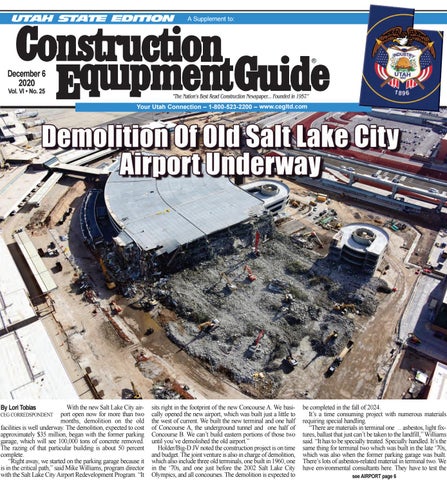
With the new Salt Lake City airport open now for more than two months, demolition on the old facilities is well underway. The demolition, expected to cost approximately $35 million, began with the former parking garage, which will see 100,000 tons of concrete removed. The razing of that particular building is about 50 percent complete. “Right away, we started on the parking garage because it is in the critical path,” said Mike Williams, program director with the Salt Lake City Airport Redevelopment Program. “It By Lori Tobias
CEG CORREDSPONDENT
sits right in the footprint of the new Concourse A. We basically opened the new airport, which was built just a little to the west of current. We built the new terminal and one half of Concourse A, the underground tunnel and one half of Concourse B. We can’t build eastern portions of those two until you’ve demolished the old airport.” Holder/Big-D JV noted the construction project is on time and budget. The joint venture is also in charge of demolition, which also include three old terminals, one built in 1960, one in the ‘70s, and one just before the 2002 Salt Lake City Olympics, and all concourses. The demolition is expected to
be completed in the fall of 2024. It’s a time consuming project with numerous materials requiring special handling. “There are materials in terminal one ... asbestos, light fixtures, ballast that just can’t be taken to the landfill,” Williams said. “It has to be specially treated. Specially handled. It’s the same thing for terminal two which was built in the late ‘70s, which was also when the former parking garage was built. There’s lots of asbestos-related material in terminal two. We have environmental consultants here. They have to test the see AIRPORT page 6
Page 2 • December 6, 2020 • www.constructionequipmentguide.com • Utah State Supplement • Construction Equipment Guide
SunRoc Corp Ground Breaks On New Utah State Makes Paving University Campus: Net-Zero Energy Progress on I-15
Eric Haymond/Sunroc Corp photo
Crews from Sunroc Corp perform paving work using a Weiler E2850 on I-15 North Cedar City to Summit project in Iron County.
Construction for a new Utah State University building in Moab broke ground on Nov. 19, 2020. USU’s new academic facility in Moab is a combustion-free building that includes solar energy and highlights the beauty of southern Utah’s natural landscape, according to the university’s website. Lianna Etchberger, the associate vice president of USU Moab, said this new campus building will help locals who would be unable to go to college so far away from home. “It’s really incredible to have in the statewide system that we have to be at these places where folks, they can’t just pick up and go to Logan,” Etchberger said. “It’s so important to be here and provide these opportunities to folks who can’t just pick up and go.” Not only will the building help locals and non-traditional students in south-eastern Utah continue their education, but it fits the highly sustainable environment that many locals maintain in Moab. Utah State University Moab’s campus building located south of the city “Moab is a green community; this com- of Moab will be a combustion-free, net-zero energy building, passively munity is very interested in being sustain- designed to harness southern solar energy through the use of thermal able and responsible,” Etchberger said. mass in the walls and floor. “And as I talk to folks like architects and other people about having a net-zero energy building is huge enjoy a campus reflecting Moab’s natural landscape, linking because most people don’t want to put that money upfront.” them to their broader ecosystem.” Building sustainability highlights include: Etchberger said it is USU’s first net-zero energy building, • USU’s first net-zero energy building; meaning it generates as much energy as it consumes in a • USU’s largest solar array placed in parking canopies that year. It will also include USU’s largest solar array and double as parking shade structures; ground-source heating and cooling. • Ground-source heating and cooling; “Utah State University Moabs new campus building • Reduced carbon footprint; located south of the city of Moab will be a combustion-free, • Designed to meet Silver-level LEED certification with net-zero energy building, passively designed to harness southern solar energy through the use of thermal mass in the enhanced energy performance; • PVC-free interior finishes, avoiding many red-list matewalls and floor,” according to the UVU web site. “Deep overhangs create a series of covered porches, allowing for rials and incorporating healthier alternatives, such as red-listindoor activities to spill outside. Students and visitors will free carpeting, mineral wood insulation, 100 percent recycled PET acoustic baffles, rammed earth real wood wall-coverings, minimal flooring (polished concrete throughout), low-VOC paint; • Water conservation measures including rain harvesting for permaculture gardens incorporating native plantings and low-flow, water-sense fixtures throughout;. • Biophilia focused, connecting people with nature by incorporating natural day lighting and views to the surrounding landscape throughout, as well as natural materials, patterns, textures, and colors in exterior and interior materials. For more information and current updates of the construction process visit statewide.usu.edu/moab/newcampus.
Construction Equipment Guide • Utah State Supplement • www.constructionequipmentguide.com • December 6, 2020 • Page 3
Page 4 • December 6, 2020 • www.constructionequipmentguide.com • Utah State Supplement • Construction Equipment Guide
Under New Proposal, Century-Old Structures to Be Razed SALT LAKE CITY (AP) Lacking the resources to properly maintain all of its historic properties, the Ashley National Forest is proposing to get rid of its two oldest structures, both dating back nearly to the birth of the U.S. Forest Service more than a century ago. The deteriorating, rodent-infested Indian Canyon Ranger Station, along with its outbuildings, are to be razed, under the proposal posted earlier in Septmber and that was open for public comment through Oct. 23. And the Stockmore Ranger Station, nestled on the Duchesne River confluence with its West Fork near Hanna, would be sold to the highest bidder without restriction. The Forest Service hasn’t had a use for these facilities in years and their locations aren’t well suited for the Ashley’s popular cabin rental program, according to Duchesne District Ranger Kristy Groves. Located just outside the forest boundary on State Route 35 where the road to the Grandview Trailhead meets the highway, the Stockmore station “helps portray the significance of early Forest Service administrative sites and how they helped the fledgling Forest Service manage broad swaths of public lands,” according to the proposal. Named for a fake town established at this location as part of suspected land fraud, it served as the headquarters for Ashley’s Hanna and Granddaddy districts. “In the past we reached out to organizations to see if they wanted to use it as a scout camp. The conditions of the buildings are in disrepair,” Groves said. “It's a hazard for employees to enter because of hantavirus (transmitted through rodents). It is an odd place for a rental cabin because it's surrounded by private homes.” Both ranger stations, added to the National Register of Historic Places in 1999, were built a few years after President Theodore Roosevelt established the Ashley National Forest in 1908, according to Cory Jensen, an architectural historian with the Utah State Historic Preservation Office.
“(The Forest Service) didn't get into a broader building program until the Civilian Conservation Corps helped build ranger stations during the Great Depression of the 1930s,” said Jensen, who wrote the National Register nominations for the two sites. “Both are completely different in their design because they didn't have a standard plan.” At the time of its construction in 1914, the Indian Canyon Station was in the Uinta National Forest and it soon became a vital outpost. Forest ranger Fred Johnson lived in the threeroom building and used the property as a base to manage national forest lands from Anthro Mountain to Indian Canyon, according to the Forest Service decommissioning proposal. As Utah’s road network improved, the station’s usefulness dwindled. By 1950, it was no longer used as a summer headquarters and the building hasn't been used at all for 50 years, although its pastures remained in use for several more years. The Forest Service resisted calls for demolishing the station because of its historic importance, yet put little effort into maintaining its structures even after the site was listed on the National Register. Flooding following the 2012 Church Camp Fire destroyed the station's barn. After decades of “benign neglect,” the station’s surviving buildings would require a complete rebuild to be preserved. “Its roof is collapsing (and) the floors are collapsing,” Groves said. “It is a safety hazard. People keep trying to break in there.” The Stockmore station is in better shape and officials hope a new owner will preserve its main single-story crossing structure and the bunkhouse. The station’s wood frame and drop siding construction rests on a foundation of fieldstone and mortar. Wood shingles, with their original distinctive green paint, cover the gable ends. Other than an addition off the rear and some interior modifications, “the building appears probably much as it did during the historic period.” Preservation had once been a goal for the Stockmore station. An agreement was reached with the Tabiona Natural
History Society to manage the property as a visitor center and museum back in the early 2000s. The group installed a new roof and repaired the foundation, but the funds never materialized to realize these plans and the society went defunct, according to the Forest Service. “Because the buildings and land no longer have an active use by the Forest Service, the land and buildings would best be managed as private property,” the proposal states. The Ashley National Forest team reviewed several options for the ranger station, and decided an unrestricted sale offers the best hope for saving the historic site. “Local interest in the property suggests that a private owner may purchase the property and repair and maintain the structures for their historic value and appearance,” the proposal states. “Because the Ranger Station is listed on the National Register, the potential owner would be eligible for tax incentives to repair and maintain the historic structures.” Still, no restrictions would be placed on how the building would be used. “The (new) land owner could potentially modify, remove or demolish the historic structures, therefore this alternative could potentially result in an adverse effect of the historic property,” the proposal cautioned. The Forest Service holds an 80-acre parcel straddling the highway. It would sell the 26 acres south of the road, and retain the acreage and newer facilities, known as the Tabiona Field Station, on the north side. The property has not been appraised, but its sale is expected to generate a decent windfall that the Forest Service will use to shore up other historic properties in the Ashley National Forest, according to Groves. These include Summit Springs and Colton ranger stations and the Trout Creek, Lake Fork and Paradise Park guard stations, which are already in the cabin rental program; the Yellowstone Ranger Station and Uinta Park Guard Station, which are to be added to the rental program; and the historic Altonah Ranger Station, which is used as a work center.
SR 158 Job: Pineview Reservoir to Powder Mountain Resort
Work is underway on S.R. 158 from Pineview Reservoir to Powder Mountain Resort. The project includes paving, guardrail replacement and new culverts to make the road smoother and help its longevity. Crews utilize a Cat 315F excavator and a Link-Belt 210 X4 excavator.
Construction Equipment Guide • Utah State Supplement • www.constructionequipmentguide.com • December 6, 2020 • Page 5
The Next Closing Date is December 23, 2020
FULL PAGE
1/2 PAGE
10.125”x10.625”
1/4 PAGE
10.125”x5.25” or 5”x10.625”
Open 13 Time $635 $590
Open 13 Time $525 $445
5”x5.25”
Open 13 Time $355 $330
UTAH PUBLISHING 2020/2021 Issue#
Closing
Publishing
1
December 23
January 3, 2021
3
January 20
January 31
Page 6 • December 6, 2020 • www.constructionequipmentguide.com • Utah State Supplement • Construction Equipment Guide
Crews Will Remove 100,000 Tons of Concrete From Garage
The joint venture of Holder/Big-D is performing demolition, which also includes three old terminals and all concourses. The project is expected to be complete by 2024. AIRPORT from page 1
facility and ensure anything that needs to be removed is removed before we demolish the structure. Many of the materials they used don’t degrade over time.” The demolition is taking place the “old-fashioned” way, primarily using track hoes with breaking hammers or jaws, he said. Crews use the equipment to break up the concrete and pull it down into piles of rubble. It’s then sorted, with the rebar removed to be recycled separately. “It’s not an exciting blast or implosion, just old-fashioned demolition,” Williams said. “One of the reasons for not using an implosion is because in the operating facilities there is sensitive equipment, like security equipment. It’s not only sensitive to vibrations, but also the dust. That’s why you use the traditional method. The Department of Environmental Quality and OSHA require you to hose down everything on the demolition site. We have to hose it down to keep the dust and debris down. At an airport, the last thing you want is foreign object debris — FOD — to get sucked into the jet engines. One of the biggest concerns at an airport is some debris getting on the airfield and damaging an engine.” They will salvage some technical equipment, as well as loading bridges and pre-conditioned air units, most of which will be used for parts. The airport got some assistance from an expected source — Covid-19, thanks to a reduction in traffic, which Williams said is down considerably. They originally expected they would need to use existing concourses until phase two was completed. “We sat down in March and said, well is there something we should do differently with phase two because of reduced traffic? We figured out how to open the first phase and with supplementing an operation where you park aircraft away from the facility and bus passengers to the concourse. The original phase two was very complicated, involving demolishing some, building some, demo’ing some, building some. Now, instead of taking the airport down in a sequenced manner, we could take it down all at once. It saved about two years in overall construction time.” CEG
The demolition is taking place the “old-fashioned” way, primarily using track hoes with breaking hammers or jaws.
Construction Equipment Guide • Utah State Supplement • www.constructionequipmentguide.com • December 6, 2020 • Page 7
NO HA HASSLES SS ES. NO H HIDDE IDDEN COSTS O S. NO O KIDDIN KID NG.
UTAH SALT LT LAKE L CITY Y 4343 Century Dr. Salt Lake City, UTT 84123 Phone: 801-262-5761 Fax: 801-262-5780
SPRINGVILLE 1350 South 2000 West Springville, UT 84663 Phone: 801-794-1463 Fax: 801-794-1414
LOGAN 453 North 1000 West Logan, UT 84321 Phone: 435-752-1533 Fax: 435-752-5722
All rights reserved. CASE is a trademark registered in the United States and many other countries, owned by or licensed to CNH Industrial N.V., its subsidiaries bsidiaries or affiliates.
Utah Board of Oil, Gas and Mining Taps New Member
La Vonne J. Garrison has been appointed to the Utah Board of Oil, Gas and Mining. She represents oil and gas interests. Garrison recently retired as assistant director for Oil and Gas at the Utah School and Institutional Trust Lands Administration (SITLA) where she had been employed since 2000. For 20 years prior to that position, she was the regional land manager of a Rocky Mountain oil and gas company headquartered in Salt Lake City.
Her past oil and gas experience also includes work as an independent landman, a geologic transcriber and work with a petroleum engineer. Garrison has a B.A. from the University of Montana at Missoula. She is a member of the American Association of Professional Landmen (AAPL), a past officer of the local chapter of AAPL and a retired member of the Public Lands Committee for the Interstate Oil and Gas Compact Commission (IOGCC).
CED DAR CITY 4822 North N Main Street Ceddar City, UT 84720 Phoone: 435-586-4406 Faxx: 435-586-2362 Email: del.maxedon@centuryeq.com
Page 8 • December 6, 2020 • www.constructionequipmentguide.com • Utah State Supplement • Construction Equipment Guide