PACIFIC NORTHWEST EDITION
A Supplement to:
®
November 22 2020 Vol. II • No. 24
“The Nation’s Best Read Construction Newspaper… Founded in 1957.” Your Pacific Northwest Connection – Patrick Kiel – 1-877-7CEGLTD – pkiel@cegltd.com
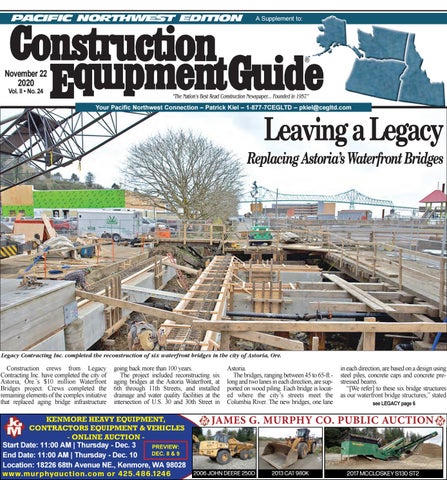
Leaving a Legacy Replacing Astoria’s Waterfront Bridges
Legacy Contracting Inc. completed the reconstruction of six waterfront bridges in the city of Astoria, Ore.
Construction crews from Legacy Contracting Inc. have completed the city of Astoria, Ore.’s $10 million Waterfront Bridges project. Crews completed the remaining elements of the complex initiative that replaced aging bridge infrastructure
going back more than 100 years. The project included reconstructing six aging bridges at the Astoria Waterfront, at 6th through 11th Streets, and installed drainage and water quality facilities at the intersection of U.S. 30 and 30th Street in
KENMO ORE HEA AVY VY EQUIPMENT, CONTRACTORS O EQUIPMENT & VEHICLES -O ONLINE AUCTION Start Date: 11:00 AM | Thursday - Dec. 3 PREVIEW: DEC. 8 & 9 End Date: 11:00 AM | Thursday T - Dec. 10 Location: 18226 68th A Avenue NE., Kenmore, WA 98028 w w w . m u r p h y a u c t i o n . c o m o r 4 2 5 . 4 8 6 .1 2 4 6
Astoria. The bridges, ranging between 45 to 65-ft.long and two lanes in each direction, are supported on wood piling. Each bridge is located where the city’s streets meet the Columbia River. The new bridges, one lane
in each direction, are based on a design using steel piles, concrete caps and concrete prestressed beams. “[We refer] to these six bridge structures as our waterfront bridge structures,” stated see LEGACY page 6
JAM MES G. MURPHY C O. PUBLIC AUCTION
2006 JOHN DEERE D 250D
2013 CA AT T 980K
2017 MCCLLOSKE O OSKE Y S130 ST2
Page 2 • November 22, 2020 • www.constructionequipmentguide.com • Pacific Northwest Supplement • Construction Equipment Guide
3D AUTOMAT TION INCREASES ASES YOUR PRODUCTION N • Dig to grade accurately urately without slowing down wn • No worry grading because ecause there is no over diggingg • The machine ine you have been waiting for: r: Big, Fast, Accurate te
www.modernmachinery.com
Kent, WA (800) 669-2425 Rochester, WA (800) 304-4421 Spokane, WA (800) 541-0754 Boise, ID (800) 221-5211 Pocatello, ID (800) 829-4450 Billings, MT (800) 735-2589 Kalispell, MT (800) 434-4190 Missoula, MT (800) 332-1617 Eugene, OR (800) 826-9811 Portland, OR (800) 950-7779
SUPP PORTED WITH PRIDE
Construction Equipment Guide • Pacific Northwest Supplement • www.constructionequipmentguide.com • November 22, 2020 • Page 3
Your new Doosan dealer in Idaho
RUN STRONG. Packed with the features that operators demand, D san® wheel loaders bring streng th to ever y job. Doo
See machine features and specs: DoosanEquipme ent.com/MyWheelLoader
Authorized Doos o an Dealer s
www.cascadetrader.net 1380 NW State Ave Chehalis, WA 98532 360-748-1182
53 W Boekel Road Hayden, ID 83835 208-762-5575
Doosan ® and the Doossan logo are registered trademarks of Doosan Corp. in the United U States and various other countries around the world. w ©2018 Doosan Infracore North America, LLC. All rights reserved. | 61137-4
Page 4 • November 22, 2020 • www.constructionequipmentguide.com • Pacific Northwest Supplement • Construction Equipment Guide
Washington State Convention Center Gets $1.6B Upgrade In second quarter, the 2019 Seattle, Wash., City Council reached agreement on funding the largest new development in the city’s history — a $1.6 billion expansion of the Washington State Convention Center. Joint venture Clark-Lewis (formed between Clark Construction and Lease Crutcher Lewis) was awarded a $960 million construction contract for the project. Garco Construction of Spokane, Wash., will complete initial foundation work for the 1,500,000 sq. ft. (139 354 sq m) convention center expansion. Garco recently acquired two additional Link-Belt cranes for the project: a 110-ton (100 t) TCC-1100 and a 200-ton (182 t) 248 HSL from Triad Machinery, the Pacific Northwest Link-Belt distributor. In addition to its crane purchases, Garco rents several other cranes from Triad Machinery including a 75-ton (70-t) TCC-750, 120-ton (110-t) TCC-1200, and 110-ton (100-t) 218 HSL. The cranes primarily lift rebar and forms on-site, with 218 HSL, TCC1100, and TCC-1200 and 248 HSL mainly used for the foundation – lagging with soldier piles and pouring
Multiple Link-Belt cranes work in downtown Seattle.
Garco has quickly put nearly 2,000 hours on its 248 HSL by running the crane six or seven days a week for 10 to 12 hours along with a night shift of 8 to 10 hours.
concrete for walls. The deepest point of excavation will be 75 ft. (22.8 m) below street level. “The 248HSL is pretty smooth functionwise for being a good-size crane — it functions fast, whether booming up, or booming down — and it swings really well. We do a lot of ironwork and with ironworkers it’s quick production. We have a 218, it’s like a Corvette, but this [248 HSL] is like a turbo boss. The winches are really nice, the motors, you can really dial it down, send out just a quarter of an inch of payout,” said Jerry Wilson, 248 HSL operator of Garco. “There’s a lot of consistency needed for keeping two different rebar companies and four carpenter crews busy — and that’s exactly what this crane has done for the last six months,” said Wilson. Garco has quickly put nearly 2,000 hours on its 248 HSL by running the crane six or seven days a week for 10 to 12 hours along with a night shift of 8 to 10 hours. “The TCC-1200 is a workhorse of a crane. It is super simple, and easy to use the Pulse system. It has a great chart for all types of applications. We use it to swing light loads of iron, and heavy CONEX boxes weighing see GARCO page 8
Construction Equipment Guide • Pacific Northwest Supplement • www.constructionequipmentguide.com • November 22, 2020 • Page 5
JET CITY EQUIPMENT
0% for 48 MONTHS ends December 31, 2020
OAK HARBOR (360) 675-4441
MARYSVILLE (360) 651-9079
WENATCHEE (509) 888-8181 (800) 292-4441 OFFICE@JETCITYEQUIPMENT.COM
Page 6 • November 22, 2020 • www.constructionequipmentguide.com • Pacific Northwest Supplement • Construction Equipment Guide
Legacy Contracting Replaces Six Aging Astoria Bridges
Demolition easily flowed into construction because as soon as the pilings were removed, sometimes up to 40, the new ones could be installed using the same equipment. LEGACY from page 1
the city web page for the project. “The waterfront bridges are of utmost importance to the city as they provide access to a critical portion of our waterfront. They provide both pedestrian and vehicular access to many businesses and attractions. In addition, they provide very important emergency vehicle access to the waterfront.” Ninety percent of the project’s funding was provided by the Oregon Department of Transportation’s (ODOT) through the Local Highway Bridge Program, with the remainder coming from the city. Construction, based on two winter shut downs, began in September 2018. “The bridges were beyond their useful lifespan, and had a limited load rating,” said Jeff Howell, Legacy Contracting’s project manager. “This project is in area of the city where a lot of the businesses depend on tourism to support them. So, it is extremely important to the city and the local business that the project keep the historical charm of the old downtown waterfront.” The project was designed by OBEC Engineering, with ODOT providing on-site management. Careful planning went into the selection of the building materials to maximize the lifespan of the new bridges. “The 10,150 linear feet of steel piling are connected to a zinc anode system to protect them from corrosion,” said Howell. “Each piece of the steel rebar in the concrete is electrically connected to allow for cathodic protection of the rebar. This required over 7,521 connections.” The traffic management plan was based
Phase 1 covered the bridges for the odd numbered streets (7th, 9th and 11th) and Phase 2, which started in October 2019, dealt with the even numbered streets (6th, 8th and 10th).
mize the impacts,” he added. “The existing 11th Street had an old discharge concrete structure running down the middle of it. When we brought the cranes onto the road way, it started sinking and the city had to strengthen the street so we could access the area. They put in micro- helical piers to support the roadway and old concrete walls.” It was a similar situation for the other streets, even when Legacy placed steel plates on top of the existing asphalt prior to the arrival of the cranes. “We still had some settlement in the roadway, and we had to strengthen and rebuild part of each road in order to get the equipment close enough to the work,” said Howell. “We preferred to work 10-hour shifts, but because of the tidal influxes and permit issues, sometimes we had to work in Ninety percent of the project’s funding was provided by the Oregon Department of the middle of the night. The tide changed Transportation’s (ODOT) through the Local Highway Bridge Program. every six hours. All of this caused us to on the closure of street ends during construcThe whole wharf system and part of the change our work schedule. “Our working relationship with the city tion and various lane restrictions. old bridges are built on dredge soils. and ODOT is good and we’re able to get Phase1 covered the bridges for the odd “You have a bunch of old buildings that issues resolved quickly,” he added. “There numbered streets (7th, 9th and 11th) and are not very stable,” said Howell. “We had to were some design complications because Phase 2, which started in October 2019, do a pre-survey of all the buildings prior to your building new structures tied into existdealt with the even numbered streets (6th, construction, vibration monitoring during ing ones. The trolley system was built in the 8th and 10th). the constructions, and then a post-construcearly 1900s and it’s a wood structure – there “We finished the paving for the approach- tion survey. We didn’t want to create any were a lot of unforeseen conditions with the es to each bridge, some of the railing and kind of excess vibrations when you drive a wood trestle, such as trying to match it, both punch-list items,” said Howell. pile right up against some of the buildings. in grade and material. There had been a lot The bridge replacement was complicated The design had some very large precast secof different repair to the structures over the because each bridge tied into the trolley line tions, but due to their weight and the conyears and you couldn’t really tell what was for a track that runs along the river. straints of access, you could not bring in a done until you started dismantling them.” “So, in addition to replacing the vehicular big enough crane to lift them. We had to For each phase, Legacy crews worked on bridge, we also replaced a portion of the trol- redesign some of the precast cap sections to three bridges simultaneously, with various ley trestle system at each bridge location,” make them smaller so that we could bring in crews moving from bridge to bridge to comsaid Howell. “The trolley system along this equipment that fit within the constraints of plete specific tasks. portion of the waterfront is all supported on the roadway and existing buildings. “We rotated our way through the cona wood pile supported trestle. So, we had a “Most of your work areas were tight – you struction,” said Howell, who noted that at challenge to match new construction into the were digging right next to buildings and we see LEGACY page 10 old existing structures.” tried to use the lightest equipment to mini-
Construction Equipment Guide • Pacific Northwest Supplement • www.constructionequipmentguide.com • November 22, 2020 • Page 7
OREGON TRACTOR Sales, Rentals, Service and Parts 360 DEGREES OF NO SURPRISES
0% for 36 MONTHS on NEW models Contact your local dealer www.hceamericas.com
6457 N.E. Columbia Blvd. Portland, OR. 97218 Ph. 503-282-7211 4373 Hwy. 99 South Roseburg, OR. 97470 Ph. 541-679-6211
Check us out at
Booth N11601 and Booth F6914 March 10th-14th, 2020
FOUR CAMERAS
Our AAVM system sports four cameras, 360-degree views, and motion detection. Because risk is easier to avoid when you see it coming.
OBJECT DETECTION
360º SEAMLESS VIEW
TOMORROWSEDGETODAY.COM
At Oregon Tractor, we have the expertise to help you with your equipment needs. We realize not everyone can justify new equipment, so we continue to provide job ready used equipment. Our service and parts departments are available to help keep your equipment running on the job.
Offering Flexible Equipment Financing
Page 8 • November 22, 2020 • www.constructionequipmentguide.com • Pacific Northwest Supplement • Construction Equipment Guide
Spokane-Based Garco Construction Completes Foundation GARCO from page 4
up to 30,000 lb. on a daily basis. We are working in a tight environment with limited space, so the ability to telescope the boom and walk around the jobsite has really increased efficiencies. Being able to move around the job site without worrying about outrigger pads makes production planning so much faster,” said Jared Neuert, TCC-1200 operator of Garco. The crew also is responsible for the logistics of Olive Way; the active downtown street rerouted around the perimeter of the project during construction. Upon completion, Olive Way will become a corridor running below the bottom floor of the new convention center. The convention center project is scheduled for spring 2022 completion. For more information, visit www.linkbelt.com. The cranes primarily lift rebar and forms on-site, with 218 HSL, TCC-1100, and TCC-1200 and 248 HSL mainly used for the foundation – lagging with soldier piles and pouring concrete for walls.
A joint venture of Clark-Lewis was awarded a $960 million construction contract for the project, a $1.6-billion expansion of the Washington State Convention Center.
Construction Equipment Guide • Pacific Northwest Supplement • www.constructionequipmentguide.com • November 22, 2020 • Page 9
PACIFIC NORTHWESTERN PUBLISHING 2021 Issue#
Closing
Publishing
2 4 6 8 10 12 14
Jan 06 Feb 03 Mar 03 Mar 31 Apr 28 May 25* Jun 23
Jan 17 Feb 14 Mar 14 Apr 11 May 09 Jun 06 Jul 04
Issue# 16 18 20 22 24 26
Closing
Publishing
Jul 21 Aug 18 Sep 15 Oct 13 Nov 10 Dec 08
Aug 01 Aug 29 Sep 26 Oct 24 Nov 21 Dec 19
Page 10 • November 22, 2020 • www.constructionequipmentguide.com • Pacific Northwest Supplement • Construction Equipment Guide
Construction Crews Replace 100-Year-Old Infrastructure LEGACY from page 6
each bridge site they had a crane setup. “We also had two vibratory and two diesel hammers on-site to keep production going. This allowed us to keep the project moving continuously.” Alternating between even and odd streets allowed local traffic to access business along the water front, which serves cruise ships and brings in a lot of tourism that is important for the local economy. Work was suspended between June and October to accommodate the tourist season, but that meant crews were working in inclement weather conditions that also coincides with the fish windows, which are time frames to limit distress to the wildlife. Monitoring also was required for local wildlife, primarily harbor seals and The new bridges, one lane in each direction, are based on a design using steel piles, concrete caps and consea lions. “They would have moni- crete prestressed beams. tors up to a mile away depending on the work activities we had to “Shutting down the trolley aided the condo,” said Howell. “If the seals came into the struction.” Demolition easily flowed into construcwork area, we would have to stop.” The bridges, which had trolley tracks tion because as soon as the pilings were between 60 to 70 ft. in length, were all removed, sometimes up to 40, the new ones demolished and reconstructed in a similar could be installed using the same equipment. manner. After removing the deck, beams and The new steel piles, pre-bored for the first 10 caps, the wood piles were removed with ft., ranged between 80 to 90 ft. depending on vibratory hammers without affecting adja- the bearing capacity and the tip of elevation of the individual bridge. cent buildings. The new bridges averaged around 21 “Then we were able to drive the steel pile for the new structures and complete them,” piles. “In some places we could place four piles said Howell. “Environmentally this is a sensitive work area, You had to be cognizant of a day and in others just one,” said Howell. the soil conditions to not create any erosion “A lot of it depended on the existing soil conproblems, and any time we did any impact ditions. In certain places we had hard pan pile driving, we had to use a bubble curtain materials, that required harder driving and to lessen the impact to the fish. A lot of the more pre-bore work.” Piles were brought in full length “as needbridges had been remodeled and added onto over the years, they were wood piled sup- ed.” “We set up a template so we could install ported structures, with some having concrete approach spans. We could take out a a truck load of pile at a time,” said Howell. bridge in two, sometimes three weeks, “On top of the piles we placed a precast cap depending on the amount of concrete with closure pours connecting them. We then did the connections between the precast involved.” Tides were a factor in the demolition and sections and did the pours for the plinths for reconstruction process. Each day Legacy the trolley tracks to set on. This was foltypically had two four-hour, low-tide work lowed by the precast slab decks and the periods. There was no access to the bridge beams and different bents.” The lines for the tracks were laid out in sites from the water as there was a wharf between the bridges and the water with advance. H&H Engineering, the subcontracvarious buildings, restaurants and brew- tor who installed the tracks, also removed the old ones. Once the new tracks were set to eries. “Barges could not be used,” said Howell. grade, the concrete pours commenced.
“He’s done a great job working with ODOT, the city and the local businesses to facilitate construction with as minimal impact to the local businesses as possible,” said Howell. Peak days had 15 to 20 Legacy and subcontractor personnel on-site, with Prairie Electrical for electrical, Bayview Transit for paving, H&H Engineering for rail track installation and LaDuke Construction for pipe work. The amount of materials from demolition of the bridges and excavation of nearby roads is still being tallied. “Since this was part of an old wharf system dating back a 100 years, the soils had contamination in them,” said Howell. “All the dirt was considered contaminatLegacy had two Manitowoc 222 100 ton crawler cranes ed and had to be hauled off.” and a Lima 75-ton truck crane on-site to drive pile and New materials brought in set precast concrete sections. includes 2,600 tons of concrete, 3,500 tons of asphalt, 875 tons of steel and 10,150 Lessons learned aided the bridge work. “Since the bridges were similar in design, linear ft. of 24-in. steel piling. Equipment-wise, Legacy also used three once you got over the learning curve on the first one, you increased your production on ICE pile hammers; four Cat excavators – 305s up to 313s; a Cat skid steer; and Cat the others,” said Howell. The use of cranes was of utmost impor- forklifts and skytracks. “We had to really watch our maintenance, tance in performance of the work. “We had a crane at each bridge location especially on the crane lines to make sure and for some bridges, where additional sup- that they were greased and serviced due to port was necessary, we could move one in,” the salt air,” said Howell. “General maintenance had to be kept up because of the rain said Howell. Legacy had two Manitowoc 222 100-ton and fog conditions – we experienced a lot of crawler cranes and a Lima 75-ton truck that. There was a Cat dealership 40 miles crane on-site to drive pile and set precast away in Longview, Washington, that could supply us with service and our mechanic concrete sections. “We moved them around as needed,” he lived an hour away and he would visit the site as needed. It wasn’t a continuous project, said. In addition to the drainage and water qual- so you had off-site time to make sure the ity facilities constructed at the intersection of equipment was ready to go for the next seaOR 30 and 30th Street, similar infrastructure son.” Legacy purchases and rents equipment was installed on the each of the streets that from dealerships such as Peterson CAT. led to the waterfront. “Every street had drainage going down International Construction Equipment (ICE) the middle and varied in depth between two is purchased from ICE directly, and cranes and 20 feet deep,” said Howell. “We ran into are purchased at auctions. ICE provided the issues because as you dig down, there were vibratory hammers and parts and servicing a bunch of tie rods going back into the exist- for the diesel hammers. “You develop a good relationship by geting buildings holding up the basements that went down into the street. We carefully ting to know the people,” said Howell. worked around them, but it wasn’t straight- “When dealership reps come out to visit you, forward. You had to be flexible in the place- we spend time to get to know them so they get to know our business and understand ment of the new pipes.” Assisting Howell is Russ Nunnelly, the what we are trying to accomplish so they can better service our needs.” project superintendent.
Construction Equipment Guide • Pacific Northwest Supplement • www.constructionequipmentguide.com • November 22, 2020 • Page 11
SEATTLE/TACOMA 253.722.5560 SPOKANE 509.534.1900 MT.VERNON 360.488.3948 PORTLAND 503.254.5100 BEND/PRINEVILLE 541.447.5293 EUGENE 541.342.7700
Premier Manufacturing Sets Online Record: New Website Since launching its redesigned website over the summer, Premier Manufacturing has seen website traffic climb to record numbers. Site traffic is up six-fold, according to Premier Director of Marketing Steve Hansen. The spike in site traffic is attributed to new built-in search engine optimization and increased social media activity with content marketing and search engine AdWords. “We’ve made numerous changes to www.premier-mfg.com to make the site more user-friendly and incorporating highresolution imagery that makes it easier for customers to search for the products they need,” Hansen said. Hansen said Premier also has updated its logo and branding images, as well as its territory and distributor maps. Each of these updates makes the new site more user friendly and enjoyable to visit. “Updating the logos and branding is a critical first step to the overall redesign,” said Hansen. “Now that the site is rebuilt and incorporates the updated brand, our focus has shifted to driving customers to the site.”
Notable updates to the site include the allnew 820ELA Saf-T-Latch, along with product filters for pintle hitches and jacks. Hansen said these product filters really help customers to select the correct part number based on their needs. “We’ve also added a ‘Get a Catalog’ feature where site visitors can view or download a digital version of the catalog,” said Hansen. “Of course, we will also send them a physical copy if that’s their preference.” For more information, visit Premier’s website, www.premier-mfg.com. About Premier Manufacturing Designing and developing trailer components since 1924, Premier Manufacturing offers couplings and pintle hitches, drawbar eyes and lunette eyes, hinge assemblies, front end assemblies, dolly jacks and accessories. Premier Manufacturing is driven by customer needs. Its designs cover a wide range of applications, whether heavy duty, medium duty or light duty.
Serving Oregon, Idaho, Wyoming, Montana & Northern California
Telehandler e s
We are an authorized Visit your local Pettib bo one dealer:
representative. 7625 N.E. Killingsworth St. Portland, Oregon e 97218
(800) 356-6243 www.landmark dmarkequipment.com
Page 12 • November 22, 2020 • www.constructionequipmentguide.com • Pacific Northwest Supplement • Construction Equipment Guide
L 586 XPower Wheel Loader
XPower is an innovative machine concept which combines performance, fuel efficiency, robustness and comfort. With their power split driveline, XPower wheel loaders work with the greatest level of efficiency in all applications.
18060 Des Moines Memorial Dr. Seattle, WA 98148 3909 NW Fruit Valley Rd Vancouver, WA 98660