PACIFIC NORTHWEST EDITION
A Supplement to:
ÂŽ
September 27 2020 Vol. V • No. 20
“The Nation’s Best Read Construction Newspaper‌ Founded in 1957.â€? Your Pacific Northwest Connection – Patrick Kiel – 1-877-7CEGLTD – pkiel@cegltd.com
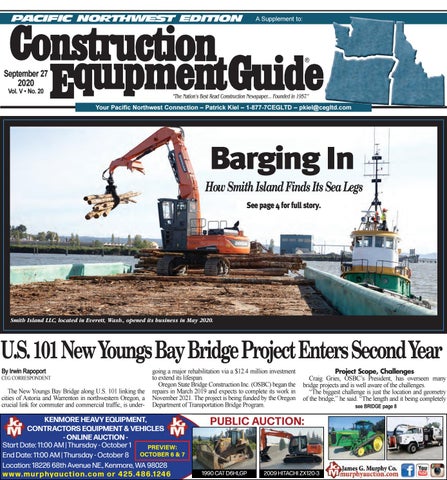
Barging In How Smith Island Finds Its Sea Legs See page 4 for full story.
Smith Island LLC, located in Everett, Wash., opened its business in May 2020.
U.S. 101 New Youngs Bay Bridge Project Enters Second Year By Irwin Rapoport CEG CORRESPONDENT
The New Youngs Bay Bridge along U.S. 101 linking the cities of Astoria and Warrenton in northwestern Oregon, a crucial link for commuter and commercial traffic, is under-
going a major rehabilitation via a $12.4 million investment to extend its lifespan. Oregon State Bridge Construction Inc. (OSBC) began the repairs in March 2019 and expects to complete its work in November 2021. The project is being funded by the Oregon Department of Transportation Bridge Program.
KENMORE HEA AV V Y EQUIPMENT T,, CONTRA C AC CTOR RS EQUIPMENT & VEHICLES S - ON NLINE AUCTION Start Date: 11:00 AM | Thursday - October 1 End Date: 11:00 AM | Thursday - October 8 Location: 18226 68th Avenue NE., Kenmor e e, W WA A 98028 w w w . m u r p h y a u c t i o n . c o m o r 4 2 5 . 4 8 6 .1 2 4 6
Project Scope, Challenges Craig Gries, OSBC’s President, has overseen many bridge projects and is well aware of the challenges. “The biggest challenge is just the location and geometry of the bridge,� he said. “The length and it being completely
PUB BLIC AUCTION:
1990 CA AT T D6HLLGP GP
2009 HIT TA ACHI ZX120-3
see BRIDGE page 8
Page 2 • September 27, 2020 • www.constructionequipmentguide.com • Pacific Northwest Supplement • Construction Equipment Guide
Construction Equipment Guide • Pacific Northwest Supplement • www.constructionequipmentguide.com • September 27, 2020 • Page 3
Your new Doosan dealer in Idaho
RUN STRONG. Packed with the features that operators demand, D san® wheel loaders bring streng th to ever y job. Doo
See machine features and specs: DoosanEquipme ent.com/MyWheelLoader
Authorized Doos o an Dealer s
www.cascadetrader.net 1380 NW State Ave Chehalis, WA 98532 360-748-1182
53 W Boekel Road Hayden, ID 83835 208-762-5575
Doosan ® and the Doossan logo are registered trademarks of Doosan Corp. in the United States and various other countries around the world. w ©2018 Doosan Infracore North America, LLC. All rights reserved. | 61137-4
Page 4 • September 27, 2020 • www.constructionequipmentguide.com • Pacific Northwest Supplement • Construction Equipment Guide
Smith Island Finds a Way to Thrive During Pandemic
After leasing land, Janicki worked with Star Marine, a company that owns and operates barges.
It’s rare that construction equipment has sea legs. Smith Island is a young company built to offer a solution to a specific problem. And it turned out that the solution meant making its machines comfortable working in a seaside location. The Pacific Northwest is well known for both logging and barge transport. This small business was able to find its own way to be a bridge between the two. Smith Island LLC, located in Everett, Wash., started in business in May 2020, in the midst of the global health pandemic. Owner Rob Janicki founded the company. It serves the logging community in Northwest Washington. Tools for Job After setting up their site and hiring a crew, Janicki and Dennis Buss purchased equipment for their operations. They invested in a Doosan DL550-5 wheel loader and a DX380LL-5 log loader from Cascade Trader, the local Doosan construction equipment dealer. The decision came after looking at the financing and previous experience with the brand. Before working for Smith Island, Buss managed an operation for FORMARK, his previous employer. It used Doosan equipment and Buss was impressed with the reliability, fuel economy and performance. The DL550-5 wheel loader is the secondlargest model that Doosan offers. It features a hydraulic locking front differential, which improves the machine’s traction. That’s something that comes in handy when operating in wet environments. Meanwhile, the DX380LL-5 log loader has a loading height
The DX380LL-5 log loader efficiently loads and unloads barges when the company has a shipment.
Smith Island’s Rob Janicki (L) and Dennis Buss.
of 38 ft. and 5 in., allowing plenty of room to stack logs. The wheel loader and log loader efficiently load and unload barges when the company has a shipment. The task sounds simple, but the heavy equipment has to traverse a narrow ramp. If the machines stray, they could end up in the water. The wheel loader and log loader also are used to transport and stack material in the staging area. Pandemic Pressure When the COVID-19 pandemic hit, many logging companies found themselves in a bind, including Janicki’s family’s business, Janicki Logging. Any harvested timber on nearby islands or wood meant for overseas transport was stuck. The effects on trade meant it had little to no way to get its timber moved. That is when Janicki realized he had
to do something. “We are working with the San Juan Island County residents to come up with ways to help them cost-effectively remove timber from their lands,” Janicki said. “All the barge loading and unloading facilities in the region went out of business when the tariffs on China started happening. So, we didn't have a place to land our barges. We decided we needed to go ahead and start a brand-new business in the middle of the worst pandemic since 1918.” After leasing some land, Janicki worked with Star Marine, a company that owns and operates barges. Together, with Janicki Logging Company providing financing, it built a ramp and set up the operations. It now has a staging area for loading and unloading barges and also offers temporary storage.
The People Janicki has been a part of the Washington forestry industry since he was young. His father, Stan, started Janicki Logging in 1957. Although Janicki made a detour to explore the computer business, he returned to the family logging business. The people pulled him back. “The people are really good in this industry,” Janicki said. “They’re down to earth and honest. You can trust them.” Another person who has been instrumental to the start of the business is Buss. Some people know him as the procurement manager of Smith Island. Others refer to him affectionately as the Timber Yoda. He met the Janicki family when he was running facilities at tree farms in Washington. The relationship kept up from there. In all, he has about 48 years in the industry. ‘Hold the Salt,’ Please In the past, barges weren’t always necessary for transporting timber. In fact, Buss remembers simpler times when boats towed rafted logs through the water. “We used to route logs all the time,” Buss said. “We’d dump logs in the water, and then we’d tow them from one place to the other, and it went on for years. Maybe 70 years we’ve been doing it, 80 maybe, and that’s the way it was done. But what we have see SMITH page 10
Construction Equipment Guide • Pacific Northwest Supplement • www.constructionequipmentguide.com • September 27, 2020 • Page 5
3D AUTOMAT TION INCREASES ASES YOUR PRODUCTION N • Dig to grade accurately urately without slowing down wn • No worry grading because ecause there is no over diggingg • The machine ine you have been waiting for: r: Big, Fast, Accurate te
www.modernmachinery.com
Kent, WA (800) 669-2425 Rochester, WA (800) 304-4421 Spokane, WA (800) 541-0754 Boise, ID (800) 221-5211 Pocatello, ID (800) 829-4450 Billings, MT (800) 735-2589 Kalispell, MT (800) 434-4190 Missoula, MT (800) 332-1617 Eugene, OR (800) 826-9811 Portland, OR (800) 950-7779
SUPP PORTED WITH PRIDE
Page 6 • September 27, 2020 • www.constructionequipmentguide.com • Pacific Northwest Supplement • Construction Equipment Guide
SEATTLE/TACOMA 253.722.5560 SPOKANE 509.534.1900 MT.VERNON 360.488.3948 PORTLAND 503.254.5100 BEND/PRINEVILLE 541.447.5293 EUGENE 541.342.7700
Premier Manufacturing Hires New Chief Operating Officer Premier Manufacturing’s reputation as the gold standard for trailer coupling components has helped the Oregonbased company land its new Chief Operating Officer. Matt Weinmann joins Premier with more than 30 years of experience across numerous manufacturing environments. “I found the opportunity to join a truly customer-focused company known for their best-in-class products very appealing,” Weinmann said. Weinmann has served in a variety of roles over the years, and comes from Testing Machines Inc, where he was President and VP of Global Operations. Premier Manufacturing was acquired by Minimizer Holdings LLC in January of 2020. The two companies are working to leverage each other’s strengths with a go-to-market strategy that satisfies fleets, OEMs and distributors, and Weinmann’s experience will help facilitate this expansion. “My experiences with business integrations and M&A activity will enable me to help drive and contribute to the integration between Premier and
“I found the opportunity to join a truly customer-focused company known for their best-in-class products very appealing.” Matt Weinmann
Minimizer to collectively accelerate our one company growth strategy,” Weinmann said. “Our goal is to be the dominant goto supplier in the commercial vehicle industry for all of our branded portfolio of products,” Minimizer Holdings, LLC CEO Christopher Thorpe said. “Matt will help us get there in transitioning the deep manufacturing knowledge from current president Paul Grycko, as he moves to his consulting and board position.” For more information about Premier Manufacturing, visit www.premiermfg.com.
About Premier Manufacturing Designing and developing top-ofthe-line trailer components since 1924, Premier Manufacturing offers the highest quality couplings & pintle hitches, drawbar eyes & lunette eyes, hinge assemblies, front end assemblies, dolly jacks, and accessories. Premier Manufacturing is driven by customer needs. Our innovative designs cover a wide range of applications, whether heavy duty, medium duty or light duty. Your success is what drives our business and we take this seriously. We are a customer-oriented, Matt Weinmann solutions-based company.
Construction Equipment Guide • Pacific Northwest Supplement • www.constructionequipmentguide.com • September 27, 2020 • Page 7
OREGON TRACTOR Sales, Rentals, Service and Parts 360 DEGREES OF NO SURPRISES
0% for 36 MONTHS on NEW models Contact your local dealer www.hceamericas.com
6457 N.E. Columbia Blvd. Portland, OR. 97218 Ph. 503-282-7211 4373 Hwy. 99 South Roseburg, OR. 97470 Ph. 541-679-6211
Check us out at
Booth N11601 and Booth F6914 March 10th-14th, 2020
FOUR CAMERAS
Our AAVM system sports four cameras, 360-degree views, and motion detection. Because risk is easier to avoid when you see it coming.
OBJECT DETECTION
360º SEAMLESS VIEW
TOMORROWSEDGETODAY.COM
At Oregon Tractor, we have the expertise to help you with your equipment needs. We realize not everyone can justify new equipment, so we continue to provide job ready used equipment. Our service and parts departments are available to help keep your equipment running on the job.
Offering Flexible Equipment Financing
Page 8 • September 27, 2020 • www.constructionequipmentguide.com • Pacific Northwest Supplement • Construction Equipment Guide
Crews Overcome Location, Geometry to Get Job Done BRIDGE from page 1
over water, access to the work is everything. One of OSBC and ODOT’s main goals is to minimize the traffic impacts. This means the usual way of getting the work, the road itself, is not accessible and this requires more inventive ways to get to the work. One way is ferrying the crews out by boat. This method works sometimes, but presents its own challenges. “Another issue is weather,” he added. “Astoria and the bridge itself are exposed to a very windy and rainy environment. This can make travel by boat too treacherous at times. This might mean the crews have to walk a little farther than normal. We have also purchased a small bus to take the crew out to the only parking spot on the bridge. This works well, but is also another task where social distancing cannot be achieved and requires special PPE due to COVID-19.” OSBC has minimized the amount of night work on this project by building access safe span scaffolding under the bridge that allows a majority of the work to be done during the day. “One task, epoxy injecting cracks in the concrete, requires traffic to be moved into a single lane to decrease vibrations,” said Scott Plummer, OSBC’s project manager. “We utilize large generators on the barge to power lighting on the safe span to illuminate the work areas. At the beginning it was discovered there was an electrical line buried in the bay that powers the drawbridge span, running alongside the entire length. OSBC and ODOT worked together to hire divers and locate the utility. Marker buoys were installed to make sure we didn’t have any conflicts during barge spudding operations. “On any project of this size and timeframe there are going to be issues, especially on repair/rehabilitation work,” he added. “We have found that just because the original plans show something, doesn’t mean that is exactly how they built it back in the 1960s. We and ODOT have worked to resolve these issues at the lowest level, but sometimes the original design team needs to come back in to provide direction. Resolving issues has definitely been an entire team effort.” A fair amount of specialized
equipment is being used, including various cranes placed on barges. “Two pieces of equipment are most vital to the work,” said Gries. “The first is the barges — probably the most important. It is not only what we use to install the access platform, but storage for materials and as a place to sit for the second most important piece of equipment, the NLB 225 ultra-highpressure water blaster which is critical to removing the old concrete that requires repair. Barges and boats are usually out at the bridge, but OSBC rents space from the Port of Astoria for sheltering the barge during storm events.” The work is far from easy and raising the lift span tower bracing above the high route clearance will require the removal and reinstallation of multiple cross braces at a higher elevation. “This will be done during 14 consecutive full nighttime closures,” said Gries. “We have closures, but they are not around the clock and the roadway needs to be re-opened each morning. This requires the work to be sequenced in a very specific order and we cannot remove more than we replace in one night time shift.” The replacement of the rocker bearings is ongoing. “This requires temporarily jacking the bridge to remove old steel rocker bearings and replacing them with new steel and reinforced elastomeric bearing assemblies,” said Plummer. “The work takes place at 14 of the 52 bridge piers and each location has four bearings. The challenge is the jacking of the bridge itself. This is required to remove the dead load from the bearings before they can be removed and replaced. The catch is that traffic is still cruising by up on the roadway. We need to lift it enough to do the work, but not so much that the travelling public can feel it.” The concrete repair is the core of the project and takes the most time, being the key to extending the bridge’s lifespan. “One of the challenges is actually finding where the work is to be done,” said Gries. “Delaminated or damaged concrete can be found by ‘sounding’ techniques, which is basically taking a small hammer and tapping the concrete and lis-
just and extra light and heat on a cold night, it is good to know that you can get what you need on short notice.”
“The biggest challenge is just the location and geometry of the bridge,” he said. “The length and it being completely over water, access to the work is everything,” said Craig Gries, OSBC’s president.
tening for that ‘hollow’ sound. Usually not too hard, but on a bridge that is almost a mile long, that means there is 275,000 square feet of surface area where every square inch needs to be tapped by a hammer.” OSBC relies on great teamwork to get the job done. “A project of this scope requires an entire team effort,” said Gries. “From ODOT’s management and design team, to our construction team down to the subcontractors and most importantly each individual crew member, everyone has to have the same goals of extending the life of this bridge and doing it on-time and on budget. The efforts of the crews have been outstanding. This is a tough job. When you are starting at Bent 1 with 52 to go and literally cannot see the end of the bridge, it is hard to see any light at the end of the tunnel. They have made really good progress so far and while it is still small, we are starting to see the light.” Peak days have 18 OSBC and subcontractor employees on-site, with the major subcontractors being HP Civil for concrete repair, Bergerson Construction for barge work and safe span installation, Cutting Edge Concrete for epoxy crack injection, and Aangels Traffic Control for flagging and pilot cars. Materials expected to be removed include 150 tons of concrete and 56 rocker bearings that will be recycled on other projects. New materials being brought are 150 tons of repair mortar, 5 tons of steel and 1,200 gallons of silane
sealer to coat the concrete. OSBC is using cranes — one Pole Cat barge-mounted crane, one barge-mounted boom truck; two barges, one tugboat and one Lark work boat; two 25kw Whisperwatt generators; a TH1056B Terex Reachlift; an NLB 225 high pressure water blasting system; and Genie manlifts — a 45S and an 80S. “The main wear and tear issues that come up are with the high pressure water blasting system,” said Gries. “Sending water out a tiny nozzle at 40,000 psi means we work our way through parts fairly quickly. NLB has been great at getting us the parts in a timely fashion, and the crews have gotten good at ordering what we will need in advance.” Mechanics are sent as needed. “Astoria and the project site is the definitely a marine environment — salt water, rain and wind storms can cause equipment to breakdown,” said Gries. “The keys are preventative maintenance and to make sure to clean equipment and tools on a regular basis.” OSBC purchases and rents equipment from NLB Corporation in Wixon, Mich., and Equipment Rental Services in Seaside, Ore. “NLB and ERS have been great,” said Gries. “If the hydro blaster breaks down, the entire job is shut down. NLB has been very responsive with wear parts and helping us to keep the job moving. On a project like this things always come up. It is nice having a local place like ERS that is only 15 minutes away to get us what we need. Whether it is another manlift or
Project Background “With more than 20,000 vehicles a day on average using it, the bridge connects Astoria with the other communities on U.S. 101 and is an important life line in Clatsop County,” said Lou Torres, an ODOT public information officer, Region 2 (Willamette Valley and Northwest Oregon). “This is an extensive bridge repair project. Making the necessary repairs enables the bridge to continue as a critical part of the North Coast transportation network.” From one causeway to the other, the two-lane bridge is just under 1 mi. long and has 52 spans. It was built in 1963 and has been impacted by growing traffic volumes, including larger and heavier trucks; deterioration caused by direct exposure to the elements; and rapid changes in temperature. “A bridge rehabilitation project like this one takes several years of planning,” said Torres. “It takes some time to determine the extent of the necessary work. The investment that we are currently making will extend the life of the bridge for many years. We do not have the funds to replace a bridge of this size, so this is critical infrastructure work for the North Coast.” The work includes raising the lift span tower bracing above the high route clearance requirement, replacing rocker bearings and damaged concrete with galvanic cathodic protection, and replacing compression joint seals. “ODOT bridge engineers designed the project with the idea that it would extend the life of the bridge for many decades,” said Torres, “and to also minimize traffic delays during construction. The bridge and U.S. 101 are an important connection between Astoria and Warrenton.” The full nighttime 14-day closure to occur in 2021 has not been scheduled yet. During the closure OSBC will be working on lift span bracing, with traffic to be detoured on U.S. 101 Business. “So far we have been able to keep the traffic impacts at a minisee BRDIGE page 10
Construction Equipment Guide • Pacific Northwest Supplement • www.constructionequipmentguide.com • September 27, 2020 • Page 9
PUBLIC AUCTION
2001 AUT TOCAR ACL64
1990 CAT D6HLGP
Kenmore Heavy Equipmeent, Contractorrs Equipment & V Vehicles ehicles - On Online nline Only
1999 KOMATSU PC120-6E
2009 9 HITACHI ZX120-3
2005 JCB 508C
1999 JOHN HN DEERE 8100T
JOHN DEERE 6330
NEW HOLLAND TS115A
1999 CASE 580 SUPER L SERIES 2
BLAW KNOX PF4410
2012 ELGIN
1997 FR REIGHTLINER FLD112
2010 JCB MIDI CX-4 -
2004 4 FORD F650
James G. G Murphy Co. murphyyauction.com d Online - 425.486.1246
Start Date: 11:00 AM | October 1
End Date: 11:00 AM | October 8
Preview: 8AM to 4PM | October 6 & 7 Location: 18226 68th A Avvenue NE., Kenmore, WA 98028
Page 10 • September 27, 2020 • www.constructionequipmentguide.com • Pacific Northwest Supplement • Construction Equipment Guide
Company Owner Hopes to Expand OSBC Expects Job Business to Rock Aggregate Material Completion in 2021 SMITH from page 4
found now, most of these mills have a CoGen plant or boilers that feed their fry kilns.” CoGen plants use the process of cogeneration to produce electricity and heat at the same time. It’s an efficient process that burns excess wood to produce the power. Unfortunately, saltwater can contaminate the wood and cause negative side effects. The salt will melt, coating the boiler and requiring an expensive cleaning process to remove the salt. And as the salt melts, it gives off an emission that pollutes the air. Shutting down the boiler and cleaning it of the salt is necessary. Transporting trees in Puget Sound’s water isn’t an option anymore if companies want to keep a product versatile. The trees can’t touch the salt water since, according to Buss, “as soon as the wood hits the water, it starts taking on salt like a cork.” This is where the barges come in.
By Land or Sea The decision to get into the barge business fell into place for Janicki and Buss. Being on a major coast and in a port, transportation by water makes a lot of sense. Not only does it give access to island locations, but traffic becomes less of an issue. “Trying to get a truck through Seattle or Tacoma, you get one truck a day through there going south,” Buss said. “And that’s a big problem considering today’s truck rates. As for rail, most of the local trains are unit trains that are going up to Canada with coal and coming back with fuel, so rail rates are tough too. The barge becomes the highway around all that traffic and puts it back on the water.” Pushing Past Pandemic Even though Smith Island just got going, Janicki already has a vision for what it can become.
“Our main initial product is logs, but over time we expect to be handling containers and rock aggregate chips, bark and topsoil,” Janicki said. “Pretty much any bulk product that people want to put on and off of the barge, we will have that capability. “We have a lot of land there in Everett [Washington] and I could envision us getting into a much bigger distribution opportunity that goes beyond barges,” Janicki said. “There could be a lot of synergy because there’s more than 100 acres of potential industrial land in this area.” Though the pandemic prompted the creation of Smith Island, Janicki and Buss and look forward to the future of the company. There is uncertainty, but there also is excitement for what they are achieving. “That’s why we’re so excited about it, because there hasn’t been any real barging done,” Buss said.
BRIDGE from page 6
mum,” said Torres. “Travelers know about the work and have been accommodating and understanding. We continue to urge drivers to slow down when they are in the construction zone for the safety of everyone.” In addition to the challenges of working on the bridge, OSBC crews and ODOT inspectors are complying with COVID-19 safety requirements. “They have been taking extra precautions to protect themselves and the community from COVID-19 while still being able to successfully perform their duties,” said Torres. “During preshift tailgate meetings workers do their best to maintain social distancing measures when not utilizing PPE. ODOT and our contractors have tried to limit our contact with people by bringing our own food or wearing masks when we go to stores or to pick up takeout. We have been taking the pandemic seriously when traveling and trying to do our part to stop the spread of the disease.” The work is proceeding along well into the second year of a three year initiative. “The contractor is making excellent progress in repairing the damaged concrete on at least 20 of the 53 spans so far,” said Torres. “Work will continue to be performed from a barge and ‘safe span’ decking underneath the bridge with occasional nighttime single lane closures for crack injection on the girders.” CEG
Pierce County Requests Removal of Electron Dam Serving Oregon, Idaho, Wyoming, Montana & Northern California
Telehandler e s
We are an authorized Visit your local Pettib bo one dealer:
representative. 7625 N.E. Killingsworth St. Portland, Oregon e 97218
(800) 356-6243 www.land dmarkequipment.com
SEATTLE (AP) A Washington state county announced its goal to remove the Electron Dam on the Puyallup River located roughly 42 mi. (68 km) southeast of Seattle following the pollution of the river by the dam's owners. Electron Hydro, the dam’s owners, polluted over 40 mi. (64 km) of the river with black crumb rubber commonly found in artificial turf, killing many fish in the area and threatening salmon spawning season, Pierce County officials said. The company improvised use of secondhand artificial turf in construction activities around the dam. The turf then broke loose and washed into the river, officials said. Pierce County Executive Bruce Dammeier said in a statement Monday that his goal is to remove the dam as soon as possible, citing “inexcusable environmental harm”' and “irresponsible management” by Electron Hydro. “The harm caused by this obsolete, 116year-old dam in a river that supports threatened salmon runs far exceeds any possible
benefit the owners might claim,”' Dammeier said. “Electron Hydro deliberately placed artificial turf full of crumb rubber into the river, and that's simply unacceptable. The damage to future salmon runs is impossible to measure.”' The dam generates electricity for about 20,000 people. Chris Spens, head of regulatory affairs for Electron Hydro, requested the opportunity to finish the project involved in order to make the dam safer for fish. He issued a statement Monday arguing that the project provides resources and economic benefits to the area's citizens. “Electron is dedicated to river clean-up and restoration as should be expected,”' Spens said in the statement. But, a stop-work order will remain in effect, Dammeier wrote in a letter to Electron Hydro. Puget Sound Energy alerted Electron Hydro it would cancel their contract if the company does not comply with state regulations, the Seattle Times reported.
Construction Equipment Guide • Pacific Northwest Supplement • www.constructionequipmentguide.com • September 27, 2020 • Page 11
NORTHWESTERN PUBLISHING 2020 Issue#
Closing
Publishing
22
October 15
October 25
24
November 12
November 22
26
December 10
December 20
Page 12 • September 27, 2020 • www.constructionequipmentguide.com • Pacific Northwest Supplement • Construction Equipment Guide
L 586 XPower Wheel Loader
XPower is an innovative machine concept which combines performance, fuel efficiency, robustness and comfort. With their power split driveline, XPower wheel loaders work with the greatest level of efficiency in all applications.
18060 Des Moines Memorial Dr. Seattle, WA 98148 3909 NW Fruit Valley Rd Vancouver, WA 98660