State Supplement sponsored by:
GEORGIA STATE EDITION
A Supplement to:
SHIP WITHIN 48 HOURS SAME DAY PARTS AVAILABILITY
®
24 HOUR TECHNICAL SUPPORT BACKED BY AN 85 YEAR BUSINESS
July 8 2026
Thousands in Service!
Vol. XXVIII • No. 14
“The Nation’s Best Read Construction Newspaper… Founded in 1957.” Your Georgia Connection: Rich Olivier, Atlanta, GA • 1-800-409-1479
Affordable Price. Premium Service.
CALL 800-367-4937 *On approved credit • Financing Available
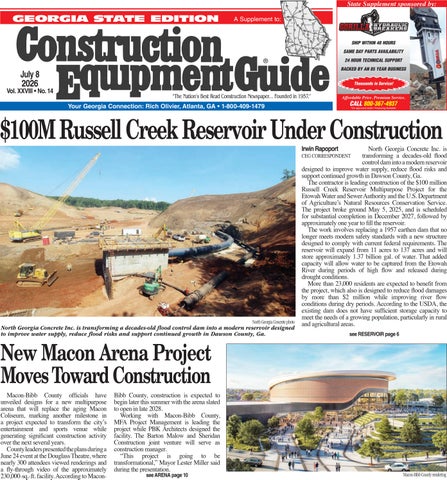
$100M Russell Creek Reservoir Under Construction
North Georgia Concrete Inc. is transforming a decades-old flood control dam into a modern reservoir designed to improve water supply, reduce flood risks and support continued growth in Dawson County, Ga. The contractor is leading construction of the $100 million Russell Creek Reservoir Multipurpose Project for the Etowah Water and Sewer Authority and the U.S. Department of Agriculture’s Natural Resources Conservation Service. The project broke ground May 5, 2025, and is scheduled for substantial completion in December 2027, followed by approximately one year to fill the reservoir. The work involves replacing a 1957 earthen dam that no longer meets modern safety standards with a new structure designed to comply with current federal requirements. The reservoir will expand from 11 acres to 137 acres and will store approximately 1.37 billion gal. of water. That added capacity will allow water to be captured from the Etowah River during periods of high flow and released during drought conditions. More than 23,000 residents are expected to benefit from the project, which also is designed to reduce flood damages by more than $2 million while improving river flow conditions during dry periods. According to the USDA, the existing dam does not have sufficient storage capacity to meet the needs of a growing population, particularly in rural and agricultural areas. Irwin Rapoport
CEG CORRESPONDENT
North Georgia Concrete photo
North Georgia Concrete Inc. is transforming a decades-old flood control dam into a modern reservoir designed to improve water supply, reduce flood risks and support continued growth in Dawson County, Ga.
see RESERVOIR page 6
New Macon Arena Project Moves Toward Construction Macon-Bibb County officials have unveiled designs for a new multipurpose arena that will replace the aging Macon Coliseum, marking another milestone in a project expected to transform the city’s entertainment and sports venue while generating significant construction activity over the next several years. County leaders presented the plans during a June 24 event at the Douglass Theatre, where nearly 300 attendees viewed renderings and a fly-through video of the approximately 230,000-sq.-ft. facility. According to Macon-
Bibb County, construction is expected to begin later this summer with the arena slated to open in late 2028. Working with Macon-Bibb County, MFA Project Management is leading the project while PBK Architects designed the facility. The Barton Malow and Sheridan Construction joint venture will serve as construction manager. “This project is going to be transformational,” Mayor Lester Miller said during the presentation. see ARENA page 10
Macon-Bibb County rendering
Page 2 • July 8, 2026 • www.constructionequipmentguide.com • Georgia State Supplement • Construction Equipment Guide
Next Issue Closes
August 20th
Construction Equipment Guide • Georgia State Supplement • www.constructionequipmentguide.com • July 8, 2026 • Page 3
MADE FOR
AMERICA SERVICE THAT’S
LOCAL SCHEDULE A
DEMO TODAY
sanyamerica.com
SY35U
©2023 SANY America, Inc.
770-819-6600 4240 MLK Jr. Drive SW Atlanta, GA 30336
centralatlantatractor.com
Page 4 • July 8, 2026 • www.constructionequipmentguide.com • Georgia State Supplement • Construction Equipment Guide
GPA’s Ocean Terminal Renovation Now 55 Percent Complete Renovations at the Port of Savannah’s Ocean Terminal have passed the halfway mark. The nearly $1.6 billion project will allow the 200-acre facility to grow its annual container capacity from 200,000 20-ft. equivalent container units to 1.75 million TEUs. “Growth in population and manufacturing across the Southeast means we must be ready to meet future demand,” said Griff Lynch, Georgia Ports president and CEO. “Improving Ocean Terminal now will allow us to continue the efficient flow of cargo between our docks and inland markets that customers rely on.” GPA has upgraded the first of two berths at Ocean Terminal. That dock space serves working ships, and as an optional staging area for Garden City Terminal. When a berth opens at Savannah’s main container port, the ship can move there right away. Work on the second berth was expected to be finished in late June 2026, accommodating two large vessels simultaneously. Upon completion, the docks will span a total of 2,650 ft. GPA will continue to work only smaller vessels at Ocean Terminal until the first phase of the container yard renovation is complete. The first half of the renovated yard will open in mid-fall 2027, with the entire yard completed by the end of 2028. Until the first half of the yard is ready, the docks will also be available as lay berths. From this staging area, vessels of any size can quickly move to open berths at the 1,500-acre Garden City Terminal, where cargo will be moved on and off. Truck access and traffic flow will also benefit from the Ocean Terminal renovations. The new gate structure is now 80 percent complete, with the first components open to traffic. By November 2026, the gate will feature 12 inbound and six outbound lanes. Port officials said the expanded gates improve efficiency, while a $29 million Georgia Ports–funded overpass now routes departing trucks directly to U.S. 17 and Interstate 16, bypassing neighborhood streets. Incoming trucks use a U.S. 17 offramp with a signalized intersection, providing uninterrupted interstate access between Savannah and Metro Atlanta. Truckers calling on Ocean Terminal use the new GPA Trucker app, which provides on-terminal container location data and sends push notifications when digital gate transaction tickets are issued, eliminating the need for paper documents at terminal gates. Other projects include equipment and yard enhancements, and buildings for operation.
Renovations at the Port of Savannah’s Ocean Terminal have passed the halfway mark.
Amid the construction, Ocean Terminal handled approximately 84,000 TEUs in calendar year 2025. Improvements to Ocean Terminal will bring the Port of Savannah’s overall annual capacity to 9 million TEUs by 2029.
Georgia Ports Authority photo
Lynch said the improvements at Ocean Terminal are part of GPA’s port master plan. He said over the next 10 years, Georgia Ports plans to invest $5 billion in capacity enhancements to support future supply chain requirements. For more information, visit gaports.com.
Georgia Ports Authority photo
The nearly $1.6 billion project will allow the 200-acre facility to grow its annual container capacity from 200,000 20-ft. equivalent container units to 1.75 million TEUs.
Georgia DOT Awards Resurfacing, Construction Projects The Georgia Department of Transportation (Georgia DOT) awarded a total of six projects valued at approximately $14.3 million at the monthly State Transportation Board meeting held in May. Contracts were awarded to the lowest qualified bidders on May 29, 2026. The largest single investment resurfacing project, valued at approximately $4.8 million, proposes 5.86 mi. of milling, inlay and plant mix resurfacing on U.S. Route 27/State Route (SR) 1 beginning north of Willis Drive and extending north of Fernwood Drive in Troup County. This contract and four other
resurfacing projects total approximately $13.2 million and represent 93 percent of the total funds awarded. The largest and only construction contract, valued at approximately $1.1 million, proposes 0.18 mi. of construction of a bridge and approaches on Lower Pateville Road (County Road 11) over Swift Creek tributary in Crisp County. This contract represents the remaining 7 percent of the total funds awarded. The Award Announcement list for May (includes deferred projects). Bids for Design-
Georgia DOT logo
Bid-Build projects were received on May 15, and contracts were awarded to the lowest qualified bidders on May 29, 2026.
The Supplemental Award Announcement (includes previously deferred projects that have now been awarded). Contracts were awarded to the lowest qualified bidder on May 28 and June 2. The May awards bring the total construction contracts for Fiscal Year 2026, which began on July 1, 2025, to approximately $2.4 billion. This total includes TIA, Design-Bid-Build, and locally administered projects. Fiscal Year 2026 concluded June 30, 2026. For more information, visit dot.ga.gov.
Construction Equipment Guide • Georgia State Supplement • www.constructionequipmentguide.com • July 8, 2026 • Page 5
YANCEY BROS. CO. CUMMING | COVINGTON
READY WHEN YOU ARE. New, used, or rental — we’ll help you find the right machine and terms that fit.
ASK ABOUT OUR COMPACT PRO PACKAGE AT (678) 718-6678
Page 6 • July 8, 2026 • www.constructionequipmentguide.com • Georgia State Supplement • Construction Equipment Guide
North Georgia Concrete Works to Build Reservoir RESERVOIR from page 1
Planning for the project began in 2005, with NRCS leading watershed studies and development efforts. Funding is being provided through the agency’s Watershed and Flood Prevention Operations program. Over time, downstream development increased the hazard classification of the existing dam, making replacement necessary to protect both lives and property. Brooke Anderson, general manager of the Etowah Water and Sewer Authority, said coordination among federal, state and local stakeholders has been essential to advancing the project. He noted that water infrastructure plays a fundamental role in community development. “Building a reservoir for our future is a big deal and takes time, commitment and transparency from all stakeholders,” Anderson told Construction Equipment Guide. “Water sets up everything else. Without it, nothing else can happen.” The project team includes engineers, environmental specialists and regulatory agencies such as the U.S. Fish and Wildlife Service, Environmental Protection Agency and Georgia Environmental Protection Division. Balancing engineering requirements with environmental protection has been a central challenge throughout design and construction, particularly because the project must protect several endangered species and sensitive habitats. The new dam will stand approximately 110 ft. high, more than doubling the height of the existing structure. It is designed to withstand a 500-year storm event and provide a service life exceeding 100 years. The project also includes construction of a principal spillway with a 110-ft. inlet structure, a 700-ft. pipeline and an auxiliary spillway to safely convey excess water around the embankment. Public amenities, including a fishing pier, boat ramp and access road, will be added once construction is complete. Design work was performed by WSP and Wiedeman and
North Georgia Concrete photo The contractor is leading construction of the $100 million Russell Creek Reservoir Multipurpose Project for the Etowah Water and Sewer Authority and the U.S. Department of Agriculture’s Natural Resources Conservation Service.
North Georgia Concrete photo
The project also includes construction of a principal spillway with a 110-ft. inlet structure, a 700-ft. pipeline and an auxiliary spillway to safely convey excess water around the embankment.
Singleton, which developed detailed plans for the complex system of structural and hydraulic components. Construction began with extensive site preparation that included clearing vegetation, removing the existing dam and preparing the foundation for the new embankment. Crews blasted a 350-ft. tunnel through the northwest abutment to support the new spillway system. Additional work included installing sand drains beneath the future dam and constructing a grout curtain to strengthen the rock foundation and reduce seepage. Tree clearing across the reservoir basin and surrounding work area was completed between October 2024 and April 2025. Much of the material generated during demolition and clearing was reused. Reinforcing steel from the original structure was salvaged, earthen material from the dam was incorporated into new construction and timber was repurposed where possible. Craig Weatherly, vice president of North Georgia Concrete, said strong collaboration among the contractor, design team and owner has played a key role in keeping the project on schedule. “We created a team atmosphere early by integrating contractor staff with engineers and the owner,” Weatherly told Construction Equipment Guide. “Clear communication and focus on critical tasks help keep construction moving despite daily challenges.” Land clearing operations relied on Tigercat equipment, including skidders, excavators fitted with grapples and attachments, feller bunchers and chippers operating across the roughly 190-acre site. see RESERVOIR page 8
Construction Equipment Guide • Georgia State Supplement • www.constructionequipmentguide.com • July 8, 2026 • Page 7
PAVINGb customers’ success the way for our
Page 8 • July 8, 2026 • www.constructionequipmentguide.com • Georgia State Supplement • Construction Equipment Guide
Earthmoving for Reservoir Embankment Under Way RESERVOIR from page 6
North Georgia Concrete photo
The project broke ground May 5, 2025, and is scheduled for substantial completion in December 2027, followed by approximately one year to fill the reservoir.
North Georgia Concrete photo
The work involves replacing a 1957 earthen dam that no longer meets modern safety standards with a new structure designed to comply with current federal requirements.
North Georgia Concrete photo
The new dam will stand approximately 110 ft. high, more than doubling the height of the existing structure.
With site preparation complete, crews turned their attention to the large-scale earthmoving effort required to build the new embankment. The dam design calls for three distinct classifications of soil, each placed in specific zones to meet engineering requirements. Class A material forms the impermeable clay core and consists primarily of red clay with minimal rock or silt content. Class B material is placed on the upstream side and contains more silt and smaller rock. Class C material, which makes up most of the embankment, contains a higher proportion of rock and silt and less clay. All materials are being sourced from on-site borrow pits rather than imported, which helps reduce costs and improve efficiency. Temporary haul roads constructed across the site allow trucks and equipment to move safely between excavation areas and placement zones. Approximately 25 pieces of heavy equipment are in operation on the project, including Komatsu excavators ranging from PC360LC to PC490LC models. These machines load articulated haul trucks capable of transporting about 40 tons per load. On productive days, trucks can complete up to 40 loads. Supporting equipment includes dozers, compactors and machines from SANY and Caterpillar used for specialized tasks. Weather conditions play a significant role in productivity, affecting haul routes and soil moisture levels needed for proper compaction. Jacob Garrison, the contractor’s assistant project manager, said crews must remain flexible to address changing conditions. “A constantly changing scope of work and heavy weather have been our biggest challenges,” Garrison told Construction Equipment Guide. “We also have significant groundwater, but we are managing and continuing to make progress.” To date, crews have excavated approximately 190,000 cu. yds. of material, including unsuitable soils, while placing about 160,000 cu. yds. into the embankment. Roughly 1,000 cu. yds. of rock has been removed as part of foundation preparation. Work on the project’s principal spillway has become a major focus. Crews completed the tunnel through the abutment and are finishing the intake and outlet structures that will allow water to be diverted through the system. Diverting flow through the spillway will allow embankment construction to accelerate. The reinforced concrete outlet structure required 4,500psi concrete and dense reinforcing steel placement. The riser structure is being constructed using similar materials and methods. Concrete pours are typically performed in the morning to ensure quality, and the material is designed to achieve full strength within 28 days. The spillway system includes a 700-ft. steel pipe lined with cement to improve durability. Individual pipe sections were welded together in the field and relined to create a continuous interior surface. A separate ductile iron pipeline was installed using gasketed joints to ensure watertight connections. Foundation construction required drilling and installing micropiles beneath the outlet and riser structures to transfer loads into stable rock. These piles extend about 45 ft. beneath the riser structure and about 10 ft. beneath the outlet. Drilling through fractured rock created challenges, particularly under the riser structure, where additional quality control measures were needed. see RESERVOIR page 10
Construction Equipment Guide • Georgia State Supplement • www.constructionequipmentguide.com • July 8, 2026 • Page 9
Page 10 • July 8, 2026 • www.constructionequipmentguide.com • Georgia State Supplement • Construction Equipment Guide
Despite Weather, Reservoir Remains On Schedule RESERVOIR from page 8
Crews also encountered difficulties installing tall reinforcing steel cages for the outlet structure due to design limitations, requiring additional bracing during formwork installation. A KOBELCO crawler crane has been used to lift heavy materials, including reinforcing steel, structural components and concrete forms, while excavators and loaders handle site preparation and material movement. Construction of the auxiliary spillway also is under way. This 780-ft. channel is designed to carry overflow water safely around the embankment. Because it lies within an active borrow area, crews are excavating materials while simultaneously shaping the channel. The spillway transitions from a nearly flat grade to a steeper downstream slope. Work has also begun on the outflow channel, which will be lined with articulated concrete block armor designed to prevent erosion. These interlocking precast blocks will be installed individually and secured with cables. Groundwater has complicated excavation in the outflow channel, requiring additional planning to prevent erosion and maintain stability. Daily operations typically involve 20 to 30 personnel from North Georgia Concrete and its subcontractors. Key subcontractors include North Georgia Pipeline for earthwork and drainage, Bradshaw for tunnel construction, Goettle for the grout curtain, Burkes Mechanical for pipeline installation and Russo for micropile construction. Project managers emphasize the importance of daily coordination. Crews meet each morning to review tasks, discuss safety and plan upcoming work activities. This level of communication allows the team to adjust quickly to changing conditions. The project has required substantial materials, including more than 250,000 lbs. of reinforcing steel and approximately 1,150 cu. yds. of concrete placed in permanent structures. Equipment reliability is critical due to the heavy production schedule. North Georgia Concrete relies on in-house technicians who perform regular maintenance and repairs rather than
keeping full-time mechanics onsite. Rental equipment from multiple suppliers supplements the company’s fleet, ensuring that additional machines can be mobilized quickly when needed. Despite challenges caused by weather and groundwater, the project remains on schedule. Crews are preparing to transition into full-scale embankment construction as spillway work advances. As construction progresses, activity is expected to increase
across the site. Final phases will include completion of the dam, auxiliary spillway and public access features before the reservoir begins filling. Once complete, the Russell Creek Reservoir will replace aging infrastructure with a modern system designed to provide reliable water supply, improved flood protection and environmental benefits. The project is expected to support continued growth in Dawson County while enhancing longterm resilience for the region. CEG
North Georgia Concrete photo
With site preparation complete, crews turned their attention to the large-scale earthmoving effort required to build the new embankment.
Arena Design Reveal Includes Extensive Site Improvements ARENA from page 1
The new arena will be built on the current Macon Coliseum property, primarily occupying existing surface parking areas near Second Street. Construction will be phased so the existing coliseum can remain operational throughout the project, according to the county. The project also includes extensive site improvements, including parking lot and drive lane reconfiguration, paving and hardscape enhancements. Two parking structures will be constructed as part of the development, including a 300-space VIP garage and a separate 500-space parking deck. Designed to accommodate a wide range of events, the arena will feature a flexible seating bowl capable of being reconfigured for concerts, sporting events, conventions, family
entertainment and community programming. Maximum capacity will reach 12,298 people during center-stage concerts utilizing the adjacent flex hall. The facility also will include premium seating options, including luxury suites, club suites and loge boxes. An approximately 30,000-sq.-ft. flex hall attached to the arena will provide additional event space for trade shows, conferences, high school athletic events and community programming. The space also has the capability to accommodate an additional ice sheet. Project designers emphasized creating strong sightlines throughout the venue. “There is not a bad seat in the house,” said Will Christenbury of MFA Project Management, noting that extensive sightline
studies were conducted to optimize seating locations and viewing angles. The design incorporates several architectural elements intended to reflect Macon’s identity. According to PBK Architects, flowing exterior lines represent the Ocmulgee River while the building’s alignment points toward Ocmulgee Mounds National Historical Park. Additional design features include architectural elements inspired by musical staff lines and vinyl records, recognizing Macon’s rich musical heritage. Viewed from above, the roof resembles a guitar pick. “Everything is purposeful and unmistakably Macon,” said Melvin Robinson of PBK Architects. The arena also will include permanent space dedicated to the Macon Sports Hall of
Fame, honoring the region’s athletic history. Beyond the building itself, the project includes outdoor plazas and gathering spaces designed for festivals, performances, watch parties and civic events. Mayor Miller said the new arena is intended to serve future generations while strengthening the community’s entertainment offerings and economic development efforts. The existing Macon Coliseum has served the region for nearly six decades, hosting concerts, sporting events, graduations, professional hockey, arena football and community events. County officials said the replacement facility is designed to meet modern expectations for performers, athletes, spectators and venue operations while positioning Macon to attract a broader range of regional and national events. CEG
Construction Equipment Guide • Georgia State Supplement • www.constructionequipmentguide.com • July 8, 2026 • Page 11
5710 Riverview Rd SE Mableton, GA 30126 (404) 696-7210
COWIN.COM | 1-800-239-2694
750 Hurricane Shoals Rd NE Lawrenceville, GA 30043 (770) 627-0910
Page 12 • July 8, 2026 • www.constructionequipmentguide.com • Georgia State Supplement • Construction Equipment Guide