
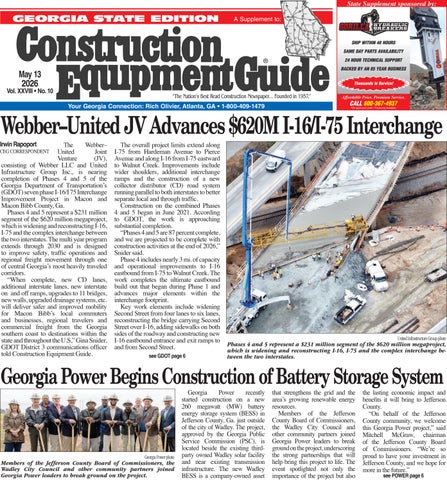
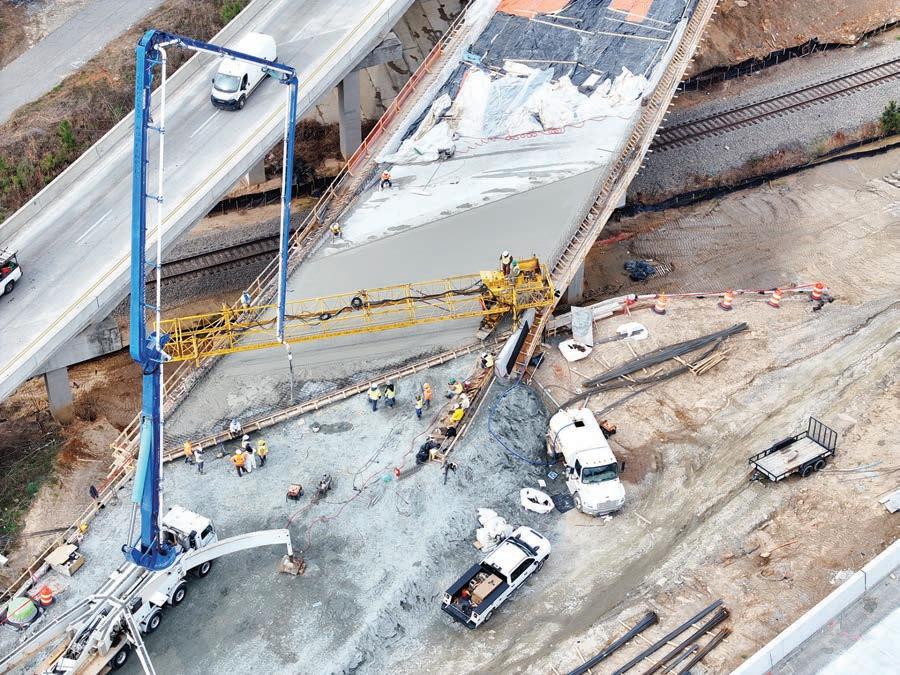
The Webber–United Joint Venture (JV), consisting of Webber LLC and United Infrastructure Group Inc., is nearing completion of Phases 4 and 5 of the Georgia Department of Transportation’s (GDOT) seven phase I-16/I 75 Interchange Improvement Project in Macon and Macon Bibb County, Ga.
Phases 4 and 5 represent a $231 million segment of the $620 million megaproject, which is widening and reconstructing I-16, I-75 and the complex interchange between the two interstates. The multi year program extends through 2030 and is designed to improve safety, traffic operations and regional freight movement through one of central Georgia’s most heavily traveled corridors.
“When complete, new CD lanes, additional interstate lanes, new interstate on and off ramps, upgrades to 11 bridges, new walls, upgraded drainage systems, etc. will deliver safer and improved mobility for Macon Bibb’s local commuters and businesses, regional travelers and commercial freight from the Georgia southern coast to destinations within the state and throughout the U.S,” Gina Snider, GDOT District 3 communications officer told Construction Equipment Guide.
The overall project limits extend along I-75 from Hardeman Avenue to Pierce Avenue and along I-16 from I-75 eastward to Walnut Creek. Improvements include wider shoulders, additional interchange ramps and the construction of a new collector distributor (CD) road system running parallel to both interstates to better separate local and through traffic.
Construction on the combined Phases 4 and 5 began in June 2021. According to GDOT, the work is approaching substantial completion.
“Phases 4 and 5 are 87 percent complete, and we are projected to be complete with construction activities at the end of 2026,” Snider said.
Phase 4 includes nearly 3 mi. of capacity and operational improvements to I-16 eastbound from I-75 to Walnut Creek. The work completes the ultimate eastbound build out that began during Phase 1 and advances major elements within the interchange footprint.
Key work elements include widening Second Street from four lanes to six lanes, reconstructing the bridge carrying Second Street over I-16, adding sidewalks on both sides of the roadway and constructing new I-16 eastbound entrance and exit ramps to and from Second Street.
GDOT page 6
Phases
and
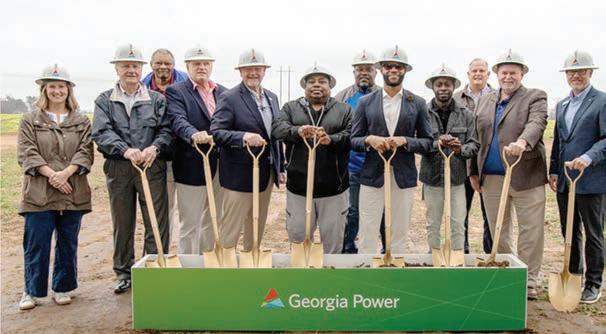
Georgia Power recently started construction on a new 260 megawatt (MW) battery energy storage system (BESS) in Jefferson County, Ga. just outside of the city of Wadley. The project, approved by the Georgia Public Service Commission (PSC), is located beside the existing thirdparty owned Wadley solar facility and near existing transmission infrastructure. The new Wadley BESS is a company-owned asset
that strengthens the grid and the area’s growing renewable energy resources.
Members of the Jefferson County Board of Commissioners, the Wadley City Council and other community partners joined Georgia Power leaders to break ground on the project, underscoring the strong partnerships that will help bring this project to life. The event spotlighted not only the importance of the project but also
the lasting economic impact and benefits it will bring to Jefferson County.
“On behalf of the Jefferson County community, we welcome this Georgia Power project,” said Mitchell McGraw, chairman of the Jefferson County Board of Commissioners. “We’re so proud to have your investment in Jefferson County, and we hope for more in the future.” see POWER page 6





Within the interchange itself, crews are constructing the remaining ramps and the north to east CD roadway that was initiated in Phase 2. These connections are intended to reduce weaving movements, improve sight distance and create more predictable traffic patterns for drivers navigating the interchange.
Second Street widening included reconstruction of the bridge over I-16, along with the addition of a 10-ft sidewalk on the east side and a 6-ft sidewalk on the west side. Pavement work consisted of a concrete bridge deck, concrete roadway approaches and concrete pavement consistent with GDOT urban arterial standards.
For the I-16 eastbound ramps, crews widened the exit ramp to three lanes at the Second Street intersection while maintaining a single lane entrance ramp.
“The first step was to widen the bridge,” Snider said. “The exit ramp becomes three lanes at the intersection for dedicated turns onto 2nd Street. The entrance ramp is one lane.”
Ramp construction included embankment placement, storm drainage installation, base and paving operations, barrier wall installation, striping and signage. Ramp work was closely coordinated with bridge reconstruction to reduce traffic disruptions and maintain safe access through the corridor.
Phase 5 covers 2.7 mi. of capacity and operational improvements to I-16 westbound from I-75 to Walnut Creek and completes several critical regional movements through the interchange.
The phase includes reopening the Spring Street loop ramp, eliminating the northbound Spring Street left turn lane to I-16 westbound and completing the west to north ramp that connects I-16 westbound to I-75 northbound through the interchange and CD system.
“This phase completes a key west to north regional movement connecting I-16 westbound, I-75 northbound and the collector distributor system,” Jorge Arteaga, assistant project manager of United Infrastructure Group told Construction Equipment Guide.
Reconstruction of the Spring Street loop ramp required grading, embankment work, drainage installation, asphalt paving and guardrail installation within a constrained urban footprint. The ramp was rebuilt as a safer single lane configuration with improved geometry and tie ins to local streets.
“The challenges were a limited footprint, maintaining access to downtown streets and tie ins to existing traffic patterns,” Arteaga said. “Phase 5 restores the loop ramp configuration while improving safety and geometry.”
Removal of the northbound Spring Street left turn lane to I-16 westbound eliminated weaving conflicts through pavement removal, grading, restriping, curb and gutter
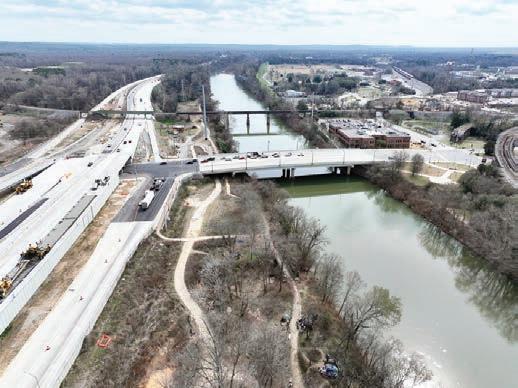
Given the interchange’s location within an active urban corridor, maintaining traffic flow was a central challenge throughout construction. The JV conducted both daytime and nighttime operations to accommodate traffic shifts, bridge beam placements, concrete pours and lane closures.
“[The JV] are very cooperative in making sure that shifts and transitions are smooth between the contiguous projects,” Snider said.
Traffic control and staging were carefully sequenced, with overlapping construction activities planned so that bridge reconstruction, ramp construction and roadway widening did not occur simultaneously in the same areas.
“Bridge reconstruction, ramp construction and roadway widening occurred in overlapping phases but were not all constructed simultaneously,” Arteaga said.
“Traffic switches allowed portions of new alignments to be opened while remaining work continued,” he added.
Work generally progressed from the outside edges of the corridor inward, allowing traffic to remain on existing alignments while new pavement, retaining walls, drainage systems and barrier walls were constructed.
Atlas Engineering and Design served as the designer for Phases 4 and 5 under GDOT oversight. Structures within these phases are designed for an 80-year service life.
“These structures are rated for an 80-year lifespan,” Snider said.
Arteaga noted that design and construction challenges were typical of large scale urban interstate reconstruction.
“Major design challenges included maintaining traffic during reconstruction of bridges and ramps, integration with previously constructed phases, coordination of collector distributor road systems, geometric improvements to eliminate left hand exits, structural tie ins to existing bridge infrastructure and utility conflicts within limited right of way,” he said.
Utility coordination was a significant component of the work, with crews encountering underground utilities not always fully reflected in original plans, as well as varying soil conditions that required undercutting and stabilization. High rainfall events also required temporary erosion control
measures.
“As typical with interstate reconstruction in an urban corridor, the project encountered existing underground utilities not fully reflected in original plans, varying soil conditions requiring undercut and stabilization and temporary erosion control measures due to high rainfall events,” Arteaga said.
Despite these challenges, the JV met major project benchmarks.
“Progress has been steady and significant,” Arteaga said. “Major structural elements including bridges, ramps and mainline widening have been constructed while maintaining traffic.”
Phases 4 and 5 utilized similar equipment fleets. Earthwork operations relied on Cat D4 dozers, Cat 320 excavators, Cat dump trucks and Cat 140 motor graders. Structural work required Link Belt and KOBELCO crawler cranes; Tadano GR 800 hydraulic cranes; ICE I 30 diesel hammer pile drivers; and Watson 4500CM drill shaft rigs. Paving crews used GOMACO GP 2400 slipform pavers; Cat AP400 asphalt pavers; Cat rollers; and Cat CS11 GC compactors.
Support equipment included Ford F750 2,000 gal. water trucks, Kubota SSV65 skid steers, JLG 660SJ telehandlers, Generac GP6500 generators and Allmand Night Lite E Series light towers.
Peak construction periods involved between 80 and 150 JV and subcontractor personnel on site. Local and regional contractors performed bridge construction, electrical work, striping and landscaping.
Demolition activities included removal of concrete pavement and bridge decks, asphalt milling and embankment excavation, while new materials placed included concrete pavement, asphalt, aggregate base, reinforcing steel, structural concrete and drainage pipe.
“Phases 4 and 5 include 21 bridge structures within the corridor improvements,” Arteaga said.
Equipment maintenance was managed through preventative maintenance schedules, vendor support and rental equipment from Herc Rentals and United Rentals, with rapid repair capability emphasized to maintain schedule performance.
Earlier phases of the program included Phase 1, a $70 million project completed in spring 2023, along with Phases 2 and 3, which delivered major operational improvements to I-75 and constructed key CD roadways.
Phase 6, the $135 million final phase, began in fall 2025 and focuses on I-75 northbound and southbound from the I-16 interchange to Pierce Avenue. Work includes construction of a 1,600 ft bridge carrying Norfolk Southern Railroad under I-75 and completion of the I-75 corridor north of the interchange. GDOT anticipates Phase 6 will be completed by 2030, marking the conclusion of the multi decade interchange transformation. CEG
POWER from page 1
Designed to quickly dispatch stored energy over a four-hour period, the 260 MW system will strengthen reliability and support the growing mix of renewable resources on Georgia’s electric system. At this battery and solar co-located facility, battery energy storage helps capture power generated by renewable
resources to use during peak demand periods, such as on cold winter mornings. These projects help to address the state’s growing power needs identified in the 2025 Integrated Resource Plan (IRP) in a cost-effective and strategic manner.
“At Georgia Power, our collaboration with the Georgia PSC and other stakeholders is
key to making necessary investments for a reliable and resilient power grid,” said Kerry Bridges, region executive of Georgia Power.
“With the construction of the 260 MW BESS in Jefferson County, we are able to better serve our customers today and support Georgia’s growth. As we expand our energy mix to include more renewable sources, these
batteries will play an invaluable role in helping ensure reliability and flexibility, particularly when renewable sources are not available.”
The Wadley BESS project, constructed by Burns & McDonnell, is expected to be completed in 2027.
For more information, visit georgiapower. com.