State Supplement sponsored by:
441
59
75
Cornella 19
Rome 85 27
Athens
GEORGIA STATE EDITION
A Supplement to:
441
Atlanta
20
Madison Augusta
85
20
Griffin 1
129
Milledgeville
75
La Grange
Macon
301
185 19
16
Dublin
Swainsboro Oak Park
Columbus
Statesboro
341 441 16
Lyons Americus
Savannah
McRae
301
1
Cordele
27 82
Dorchester
341
Cuthbert
75
Albany
84
Douglas Tifton
82
95
82
Blakely
Pearson 27 84
Moultrie
19 319
Bainbridge
84
Valdosta Thomasville
Waycross Brunswick 82
SHIP WITHIN 48 HOURS
1 441
®
SAME DAY PARTS AVAILABILITY 24 HOUR TECHNICAL SUPPORT BACKED BY A 75 YEAR BUSINESS
October 21 2020
Thousands in Service!
Vol. XXI • No. 22
“The Nation’s Best Read Construction Newspaper… Founded in 1957.” Your Georgia Connection: Rich Olivier, Atlanta, GA • 1-800-409-1479
By Irwin Rapoport CEG CORRESPONDENT
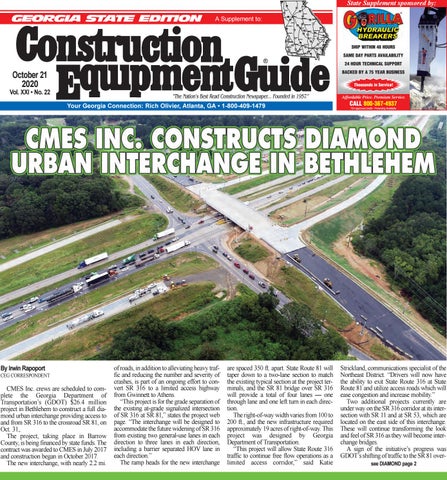
CMES Inc. crews are scheduled to complete the Georgia Department of Transportation’s (GDOT) $26.4 million project in Bethlehem to construct a full diamond urban interchange providing access to and from SR 316 to the crossroad SR 81, on Oct. 31,. The project, taking place in Barrow County, is being financed by state funds. The contract was awarded to CMES in July 2017 and construction began in October 2017. The new interchange, with nearly 2.2 mi.
of roads, in addition to alleviating heavy traffic and reducing the number and severity of crashes, is part of an ongoing effort to convert SR 316 to a limited access highway from Gwinnett to Athens. “This project is for the grade separation of the existing at-grade signalized intersection of SR 316 at SR 81,” states the project web page. “The interchange will be designed to accommodate the future widening of SR 316 from existing two general-use lanes in each direction to three lanes in each direction, including a barrier separated HOV lane in each direction.” The ramp heads for the new interchange
are spaced 350 ft. apart. State Route 81 will taper down to a two-lane section to match the existing typical section at the project terminals, and the SR 81 bridge over SR 316 will provide a total of four lanes — one through lane and one left turn in each direction. The right-of-way width varies from 100 to 200 ft., and the new infrastructure required approximately 19 acres of right-of-way. This project was designed by Georgia Department of Transportation. “This project will allow State Route 316 traffic to continue free flow operations as a limited access corridor,” said Katie
Affordable Price. Premium Service.
CALL 800-367-4937 *On approved credit • Financing Available
Strickland, communications specialist of the Northeast District. “Drivers will now have the ability to exit State Route 316 at State Route 81 and utilize access roads which will ease congestion and increase mobility.” Two additional projects currently are under way on the SR 316 corridor at its intersection with SR 11 and at SR 53, which are located on the east side of this interchange. These will continue transforming the look and feel of SR 316 as they will become interchange bridges. A sign of the initiative’s progress was GDOT’s shifting of traffic to the SR 81 oversee DIAMOND page 2
Page 2 • October 21, 2020 • www.constructionequipmentguide.com • Georgia State Supplement • Construction Equipment Guide
Pilot Tube Steering System Helps Crews Complete Job
Thus far, CMES has completed the following elements: construction of the SR 81 bridge; three MSE walls; six poured-in-place concrete walls; concrete paving for SE and NE ramps; and major sewer and water directional bores under the SR 316. DIAMOND from page 1
pass bridge over highway 316 on Sept. 22. Other milestones included last February’s opening of the relocated Exchange Boulevard (1 mi.), which provides access to businesses in the area. The interchange and associated infrastructure will be able to accommodate an average daily traffic count of 46,800 on SR 316 and 40,250 on SR 81 of cars and trucks by the year 2040. “There were no design or engineering challenges that were presented,” said Strickland. “The typical lifespan of a bridge is 50 years.” The traffic management plan is based on day and night time lane and shoulder closures, along with detours. Thus far, CMES has completed the following elements: construction of the SR 81 bridge; three MSE walls; six poured-in-place concrete walls; concrete paving for SE and NE ramps; and major sewer and water directional bores under the SR 316. The remaining work is focusing on concrete pours for SR 81 overpass bridge above SR 316 and the SW and NW ramps ties will be constructed during a 30-days closure. “SR 316 is a major highway which connects the University of Georgia at Athens and Athens, so there is a lot
of commute traffic during the construction,” said Siddharth Balar, CMES’s project manager. “We faced some utility challenges during the installation of the sewer jacks and bores, which were required to run 0.5 percent across SR 316. Throughout the project, our constant coordination and communication skills have provided CMES with a cooperative and highly proactive relationship with the GDOT’s District 1.” The work included the demolition of existing roads and concrete paving. The interchange contains one bridge (two lanes in each direction), two entrance and two exit ramps. “We used a special piece of equipment, a Pathfinder 500, a pilot tube steering system which we rented from a company in Ohio,” said Balar. “We poured 12,000 cubic yards of concrete for all four ramps and imported 500,000 cubic yards of dirt.” The major subcontractors brought in by CMES are McCarthy Building Companies for bridge improvement; Georgia Bridge and Concrete for paving; Bass Signal for new signals and ATMS; Peek Pavement Marking for marking the roads; ER Snell Contracting Inc. for asphalt paving; and Tricor Construction for MSE walls. see DIAMOND page 4
Materials removed from the site should total 3,000 sq. yds. of concrete and 6,000 tons of asphalt.
Construction Equipment Guide • Georgia State Supplement • www.constructionequipmentguide.com • October 21, 2020 • Page 3
4240 MLK JR Drive SW Atlanta, GA 30336 770-819-6600
Page 4 • October 21, 2020 • www.constructionequipmentguide.com • Georgia State Supplement • Construction Equipment Guide
CMES Inc. Demolishes Existing Roads, Concrete Paving
This project includes the grade separation of the existing at-grade signalized intersection of SR 316 at SR 81. The interchange will be designed to accommodate the future widening of SR 316 from existing two general-use lanes in each direction to three lanes in each direction. DIAMOND from page 2
Equipment Used: Excavators: Cat 314D, 345D Komatsu 138, 238 Hyundai 145, 235 300 Kobelco 500
Dozers: Cat D3G, D5K Komatsu D39, D51, D61 Wheel loaders: Komatsu WA200 Hyundai 940 Rollers: Hamm H7, H11 Hyundai HR120 Motor graders: Cat 12H, 140H
Hammers: Hyundai hydraulic models
Materials removed from the site should total 3,000 sq. yds. of concrete and 6,000 tons of asphalt. New materials being brought in should tally 24,000 tons of concrete, 16,000 tons of asphalt and 100 tons of steel The subcontractors brought in two rented cranes. “We like to perform preventive maintenance on time to cut down on unexpected repairs,” said Ian Thompson, CMES’s fleet manager. “When a repair is needed, we can have one of our field mechanics on the job usually within an hour or so, or if it is a larger repair, we can have one of our lowboy trucks take the machine to our shop where we have three full-time mechanics. We have more than 300 pieces of powered construction equipment, so if we need to replace a machine on the job, we can do it very quickly.” The firm purchases and rents equipment from local and regional dealerships. “In the last five years, we have purchased more than 150 pieces of brand new heavy construction equipment, as well as more than 150 new pieces of smaller equipment and new trucks,” said Thompson. “Because we purchase so much, we get very good service from the dealers that we use. We also take advantage of dealer provided preventive maintenance programs.” CEG
New materials being brought in should tally 24,000 tons of concrete, 16,000 tons of asphalt and 100 tons of steel.
Construction Equipment Guide • Georgia State Supplement • www.constructionequipmentguide.com • October 21, 2020 • Page 5
Page 6 • October 21, 2020 • www.constructionequipmentguide.com • Georgia State Supplement • Construction Equipment Guide
Construction Equipment Guide • Georgia State Supplement • www.constructionequipmentguide.com • October 21, 2020 • Page 7
Atlanta, GA 404.469.7210 Birmingham, AL 205.841.6666 Madison, AL 256.350.0006 Mobile, AL 251.633.4020 Montgomery, AL 334.262.6642 Oxford, AL 256.832.5053 Tuscaloosa, AL 205.848.4147 Pensacola, FL 850.479.3004
Page 8 • October 21, 2020 • www.constructionequipmentguide.com • Georgia State Supplement • Construction Equipment Guide
Awarding Contracts...
Local Company Succeeding to Be Among Older Bridges, Nation’s Top Black-Owned Building Firms Roads Will Be For nearly four decades, Charles David Moody of C.D. Moody Construction (CDM) has had a hand in constructing some of the most recognizable buildings in Atlanta. Headquartered in Lithonia, Ga., Moody’s successful firm also is considered one of the country’s top Black-owned construction companies. Whether a resident of Atlanta or a visitor to the city, chances are you have been to one of the many buildings his company helped build. The list of projects in the CDM portfolio is an extensive one and includes landmarks like Underground Atlanta, Centennial Olympic Stadium, the Maynard H. Jackson International Terminal at HartsfieldJackson Atlanta International Airport, Philips Arena, Mercedes-Benz Stadium, several buildings on the campus of Morehouse College and the Cyclorama painting. But Moody’s rise to the top of the construction industry wasn’t easy. He started his company in 1988 when there were only a handful of Black-owned construction companies in the nation, if not the world. “All I wanted out of life was a good job and to take care of my family. I never dreamed I’d be doing what I’m doing,” said the 1978 Morehouse College graduate. “I grew up during the Civil Rights Movement, so I never saw a Black builder. I never saw a Black architect. Those kinds of things didn’t exist. Plus, we were barely even having businesses.” Moody got his big break after several years of setbacks. After relocating to Atlanta in 1983, Moody and his wife of one year found themselves jobless after the company he came to work for went bankrupt after two months. “We were so broke,” said the father of two when asked why he started his own construction company. “We had nothing to lose.”
“It was scary — really scary — and we needed a second income,” said Carla Moody, who met her future husband when they were teenagers. “I got a job as a nurse to help support us until things got better. But I never thought it would get as big as it did.” CDM began to experience success four years into his entrepreneurship. “I would say, when we did the Olympic stadium, that’s when I realized this really might work out,” said Moody. Since then, Moody’s company has developed more than $2 billion worth of projects. With a staff made up primarily of African Americans, CDM has provided Black employees the opportunities of leadership and visibility while making a name for itself in Atlanta and the construction industry. Accolades, too, have come in for Moody. “In 1991, I was the first Black to win the small businessperson of the year award from the Atlanta Chamber of Commerce,” he said. “I’ve won many awards in my 32 years of business, but my greatest accomplishment is not all of the buildings. In 32 years, I’ve never missed a payroll and that’s not easy to do in business.” Among several other projects around the city, CDM is currently working with Morris Brown College to rehabilitate one of its historic dormitories. At 64 years old, Moody has no plans to retire. His love for construction, he explained, has shifted to “building people.” He enjoys mentoring students and young professionals, especially small business owners. His advice to entrepreneurs is simple. “Dream extremely big because I exceeded my dreams in ‘92,” said Moody. “I didn’t dream big enough.”
Georgia County Working With State DOT to Improve Unsafe Intersection in Bulloch County Less than a week after Bulloch County citizens launched a petition asking for the help of Georgia lawmakers regarding a deadly intersection, the county’s Board of Commissioners said Sept. 9 it is actively working with the state and officials from the Georgia Department of Transportation (GDOT) to fix the problem. The Bulloch County board announced that, with the assistance of Georgia State Rep. Jan Tankersley, it has been sharing concerns about the safety of the rural intersection of State Route 67 and Brooklet-Denmark Road south of Statesboro. In addition to increased traffic flow on the road, SR 67 also was recently expanded from two lanes to four. “We have known for several years before the SR 67 widening project that this intersection would become more dangerous without a traffic light,” explained Roy Thompson, chairman of the Bulloch County Board. “Our county staff has reached out to the GDOT District 5 staff in Jesup periodically about this issue since before the beginning of
the construction project, and I have been in frequent contact with Rep. Tankersley. We have offered whatever county resources that we have available to expedite a solution.” Where Brooklet-Denmark Road becomes Nevils-Denmark Road in southern Bulloch County, it also crosses SR 67 — a corridor connecting Statesboro with the smaller communities of Nevils and Brooklet, as well as nearby Interstate 16. For years, the connection point has been deemed “The Devil’s Triangle” due to several serious and fatal crashes. But as the area has grown, so too have the number of accidents, for reasons ranging from speed and heavy 18-wheeler traffic to intersection angles and even the sun impairing the vision of some motorists. As of Sept. 9, the county petition for redesigning the intersection had more than 3,400 signatures. Rep. Tankersley has assured county officials that the GDOT is giving immediate attention to the increasing safety concerns. “The District 5 office has recently
informed me the re-evaluation of the intersection is already in process,” she said. “A report may be issued as early as [the second full week of September] to include recommendations for consideration from a safety consultant. I have asked GDOT and Bulloch County to keep me informed on progress so that we all can be responsive to the concerns of our constituents on this matter.” According to Bulloch County Manager Tom Couch, signalizing a state-controlled intersection can be a lengthy process. Using the intersection at Veterans Memorial Parkway and Cypress Lake Road near Statesboro as an example, Couch stated that “it has taken over a year to get state approval and permits where a bid for construction is finally approved. A traffic study or evaluation on signalization that meets GDOT warrants or justification is needed first. After that, there is typically up to four additional levels of approval needed before bidding and construction.” The project will be completed as early as mid-December.
Reconstructed Contracts representing a nearly $7 million investment in southwest Georgia infrastructure were awarded earlier this summer by the Georgia Department of Transportation (GDOT) to replace old, outdated bridges and upgrade county road safety in three counties. The largest single contract awarded statewide will replace bridges along State Route 37 over the Pachitla Creek and two other creek overflows in Calhoun County. The approximately $6.3 million contract was awarded to Oxford Construction Co. in Bainbridge, Ga. The old structures are located about a mile west of the community of Dickey. They were built in 1921, widened in 1955 and no longer meet current design standards. Traffic will be detoured during construction, which is expected to be complete in the spring of 2022. Notice to Proceed orders were issued to the contractor in July, but substantial building had not yet begun as of Aug. 14, said the GDOT Two other contracts will benefit motorists who travel county roads in Berrien and Turner counties. Those upgrades include new highway signs, striping and pavement markings and will vary by road. The projects will be done at 25 locations in Berrien County and 21 in Turner County. Georgia DOT maintains state routes, while county governments are responsible for the upkeep of their roads. However, GDOT receives federal funding annually that allows for completion of 20 to 25 safety projects statewide on nonstate routes. These safety upgrades have been done in more than half of the 31 counties in the southwest Georgia area. “It’s important because 40 percent of overall crashes we have statewide are on off-system routes. We wanted to address that because our main goal at GDOT is to reduce crashes,” said Charity Belford, program manager of Georgia DOT’s local grant office in Tifton. “The sign and striping upgrades are where we can get the most bang for our buck.” Start dates have yet to be announced for the Berrien and Turner County contracts.
Construction Equipment Guide • Georgia State Supplement • www.constructionequipmentguide.com • October 21, 2020 • Page 9
True Power At Liebherr, we don’t just build machines. We custom-engineer them to perform as eႈciently as possible. Our PR 736 dozer is a perfect example. Its Tier 4F emissions system was designed from the ground up and it’s practically maintenance free. The hydrostatic drive system automatically adjusts to keep operators in the “sweet spot” — even when saving fuel in ECO mode. And like all our machines, the PR 736 is built to last with exclusive Liebherr components.
www.heavymachinesinc.com ATLANTA, GA 10110 Roberts Way Covington, GA 30014 844-532-1110 | 770-788-0888
Page 10 • October 21, 2020 • www.constructionequipmentguide.com • Georgia State Supplement • Construction Equipment Guide
GUCA Work Ready Program Hosts Inaugural Graduation
Francis Kwafo utilizes his newly-aquired blueprint reading skills on the job site.
GUCA Work Ready Graduates James Ross (center) and Francis Kwafo (2nd from R) receive their Certificate of Completion and Safety Certifications with Connecting Henry Staff.
Georgia Utility Contractors Association Inc. (GUCA) hosted the inaugural GUCA Work Ready Program Graduation in collaboration with Connecting Henry Inc. at the Henry County Chamber of Commerce, Sept. 24, 2020. GUCA’s Work Ready Program is a 10-week training program that includes 150 hours of classroom and worksite training that trains students in the safety and intrinsic parts of the underground utility construction industry. GUCA member Diversified Utility Services LLC hired Francis Kwafo and James Ross, who were enrolled in Connecting Henry’s Working to Achieve Greatness (S.W.A.G.) program, to gain on the job field experience and explore a career in utility construction. Part of the classroom training included certifications for
students in Competent Person Excavation and Competent Person Confined Space Entry; CPR, First Aid and AED Training; Pipelayer 1 & 2 Program; Flagging Program; Utility Damage Prevention; OSHA 10-Hour Construction Basic Safety Course; and, Southern Company Gas Plastic Pipe Fusing Techniques. GUCA Executive Director Vikki Consiglio said, “This year we partnered with Connecting Henry’s SWAG program in hopes to help with the utility construction industry’s workforce needs and to give those looking for a ‘CAREER’ the chance to succeed in that endeavor. In doing so, we were successful in helping students sign on and sign up for a career in utility construction.” For more information, visit www.guca.com.
James Ross locates underground utilities before excavation begins.
Construction Begins on Georgia SR 53 Highway Replacement Span Using its new and innovative design-build process, the Georgia Department of Transportation (GDOT) is taking a different approach to replacing the westbound twolane bridge across Lake Lanier on State Road 53 at the Chattahoochee River. Because of the accelerated approach to the construction, the new bridge is expected to be complete within the next 18 months. Cranes and barges were positioned along the existing structure and shore in mid-July to begin building the replacement for the westbound Jerry Jackson Bridge, originally built in 1956 when the lake was filled. The new westbound bridge will be constructed in between the current spans. “We’re anticipating a minimal amount of traffic disruption over the course of con-
struction,” said Katie Strickland in the District 1 office of the GDOT. “Because the replacement structure is being built between the eastbound and westbound bridges, traffic will be able to continue to use these two spans until the new westbound bridge is complete.” The replacement project, managed by GDOT’s Office of Innovative Delivery and using design-build techniques, is expected to be completed by December 2022. The design-build team consists of E.R. Snell Contractor Inc. as the contractor and Texasbased Atlas Technical Consultants as the designer. The eastbound lanes of SR 53, known locally as the Dawsonville Highway, were built in 1992. This span will continue to
transport eastbound traffic during and after the new westbound span is finished. Georgia Replaces Several Aging Lake Spans In the past five years, the GDOT has reconstructed other bridges across Lake Lanier. The Clarks Bridge on SR 284 was widened and rebuilt in 2015; the Boling Bridge on SR 53, constructed between 2016 and August 2018; SR 369’s bridges over Six Mile Creek and Two Mile Creek, both of which opened in 2019; and the Longstreet and Bells Mill bridges on SR 11/U.S. 129, completed earlier this year. Additionally, work on rebuilding the Browns Bridge, sometimes known as the Big Green Bridge, along SR 369, will have
its traffic shifted onto the new structure by the end of 2020. In Dawson County, SR 136 has a bridge that spans Toto Creek that will be replaced in the same footprint, causing a complete closure to traffic during construction. A detour for motorists will be established. The contract will be awarded to a contractor in June 2021, according to GDOT. “The new structures include shoulders, and a few were raised more than a dozen feet to accommodate boat traffic and the rising lake levels,” Strickland explained. “However, these new structures might be something folks have to get used to seeing. Gone are the days of the green metal bridges over Lake Lanier.”
Construction Equipment Guide • Georgia State Supplement • www.constructionequipmentguide.com • October 21, 2020 • Page 11
Page 12 • October 21, 2020 • www.constructionequipmentguide.com • Georgia State Supplement • Construction Equipment Guide