State Supplement sponsored by:
441
59
75
Cornella 19
Rome 85 27
Athens
GEORGIA STATE EDITION
A Supplement to:
441
Atlanta
20
Madison Augusta
85
20
Griffin 1
129
Milledgeville
75
La Grange
Macon
301
185 19
16
Dublin
Swainsboro Oak Park
Columbus
Statesboro
341 441 16
Lyons Americus
Savannah
McRae
Dorchester
341
Cuthbert
75
Albany
84
Douglas Tifton
82
95
82
Blakely
Pearson 27 84
Moultrie
19 319
Bainbridge
Waycross Brunswick 82
84
Valdosta Thomasville
SHIP WITHIN 48 HOURS
1 441
®
SAME DAY PARTS AVAILABILITY 24 HOUR TECHNICAL SUPPORT BACKED BY A 75 YEAR BUSINESS
July 3 2019 Vol. XX • No. 14
301
1
Cordele
27 82
Thousands in Service!
“The Nation’s Best Read Construction Newspaper… Founded in 1957.” Your Georgia Connection: Rich Olivier, Atlanta, GA • 1-800-409-1479
Affordable Price. Premium Service.
CALL 800-367-4937 *On approved credit • Financing Available
$973 Million Savannah Harbor Expansion On Time and Budget By Irwin Rapoport CEG CORRESPONDENT
Started in January 2015, the $973 million Savannah Harbor Expansion Project (SHEP) is on time and budget with the U.S. Army Corps of Engineers overseeing the initiative that is deepening the federally-owned channel from 42 to 47 ft. at low tide (54 ft. at high tide) from Garden City Terminal (GCT) throughout the entrance channel of the harbor, which extends 20 mi. out into the Atlantic Ocean via the Savannah River. The state of Georgia is contributing 25 percent of the cost towards the project, with the remainder being provided by the federal government.
The entire project is expected to be complete in January 2022. The Army Corps issued a $130 million contract in March 2015 to Great Lakes Dredge & Dock Co. (GLDD) for the entrance channel portion of the deepening. Work on the inner channel portion of the deepening is expected to begin this fall. The outer harbor, from the mouth of the Savannah River to the sea buoy at the entrance of the shipping channel, is now complete (including a 7-mi. extension to the channel). This constitutes half of the deepening project, while the remaining half covers the area from Fort Pulaski to the GCT. Once finished, SHEP plans to improve the operasee HARBOR page 4
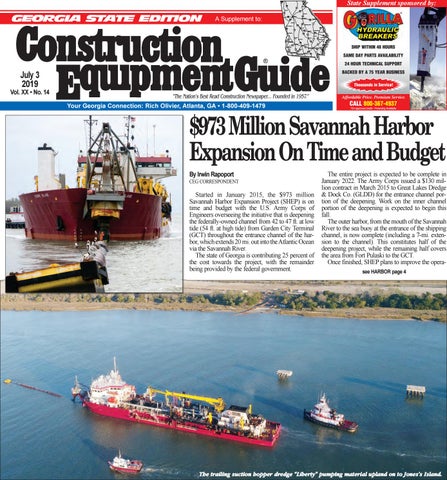
The trailing suction hopper dredge “Liberty” pumping material upland on to Jones’s Island.
Page 2 • July 3, 2019 • www.constructionequipmentguide.com • Georgia State Supplement • Construction Equipment Guide
Willow Lane Pairs Safety, Efficiency With Beautiful Landscapes By Debbie Townsley SPECIAL TO CEG
The Case TR340 compact track loader.
Marshall Postin of Willow Lane Landscaping and Rick Cloninger of Border Equipment.
Willow Lane relies on the CTL to perform a significant portion of the final grading on each home site.
Marshall Postin and his team at Willow Lane Landscaping in suburban Atlanta have a passion for transforming raw earth into beauty. Specializing in landscaping for residential new construction, Willow Lane provides customers with services that take a blank residential site, grade it, prep it for other tradesmen, and add all finishing landscapes and hardscapes. Postin grew up as a farmer in the Midwest before life brought him to Georgia. After doing some urban agriculture, he quickly realized the opportunity he had to make a living with dirt in the landscaping business. “You can come out and take something really nasty and make it pretty,” he said. “We do homes from $150,000 to $2 million and see something different every day, go somewhere different every day, and meet all different aspects of people.” Postin takes particular pride in not only site beautification, but also the speed and ease with which he is able to get his job sites to final grade so that he, and other tradesmen, can put the finishing touches on each home. He owned a different brand of loader for many years — he figured he operated almost 30 of them — before making the jump to Case after Border Equipment (Atlanta, Georgia) demoed him a Case TV380 compact track loader. He bought one immediately, and has since transitioned to the TR340 models, which operate at the same horsepower but weigh about 700 lbs. less. It also offers a radial lift pattern that is optimized for ground-engaging dirt work and generally provides better overall visibility than vertical lift machines. The speed and power of the TR340 have stood out to Postin as he’s constantly battling wet job sites, and the demands of homeowners and other trades. The TR340 is his primary earthmover, whether stockpiling wet materials or bringing the site to final grade with dry topsoil. “It doesn't matter if its wet or dry, you’re still going to produce,” he says. “Keeps you productive. Its very powerful, very fluid, it moves and flows really nice. It doesn’t hinder it when you get the tracks full of mud, it still keeps on keeping on and it doesn’t change horsepower. You can run them for three hours just as hard as can be and not get sluggish. This machine right here produces till you wanna go home.” Not only has it handled the brute strength required to work in wet and challenging conditions, but it’s also provided Postin speed and accuracy not possible with his previous machines — a factor that he believes help him complete more jobs, faster. “The other models we had are not as strong as this right here”, says Postin. “[The TR340] has enough power to grade and stay ahead of my employees as long as it’s within 18 inches
of grade. That makes it a plus for us when we can grade and make an extra dollar grading while we’re there doing landscaping. It’s creating more [business]. We’re getting done faster and we can move on to another one. “These machines are really responsive and do a lot of work,” he said. “It’s fun to operate and it gets me done sooner so I can go home and spend time with my family.” Old School Controls; Jobsite Visibility Postin is a bit more old school in how he’s outfitted his CTL: he still prefers hand and foot controls. While many manufacturers and operators have transitioned to almost solely joystick controls, he appreciates that Case still has hand and foot controls as an option on all skid steers and CTLs. “A lot of people say it’s [for] the old timers, but the old timers did a lot more than we did,” laughs Postin. “I guess I like the old school, and it’s bulletproof, and it’s pretty straight forward and simple.” Another thing that impressed Postin about the machine is its visibility. Radial-lift arm geometries generally provide improved visibility to the side of the machines, and the large cab with broad visibility to the front and rear allows he and his operators to always be aware of the location of other workers on site. “If we can see behind us and around us — because there’s probably fifteen other construction workers around us — if we can see where they’re at, that’s a big thing for me,” Postin said. “We want to be productive, but we want to be safe also.” Shake the Man’s Hand With 23 years of experience under his belt, Postin attributes some of his success to his relationship with Border Equipment. As an owner who’s very particular about the maintenance and upkeep of his machines, Postin trusts that the team at Border Equipment is reliable and will keep his fleet in-shape. “I’m only as good as the people above me, and anytime we call [Border Equipment] they’re responsive and get their part handled,” he said. As the kind of businessman who has built an operation and a reputation on handshake deals, Postin values a good partner, and what they bring to the table. “If I can’t trust you on a handshake, we don’t need to be doing business together. My daddy raised me that way, I got my first loan that way. If we tell [somebody] something, rain, snow, or shine, we’re there. We finish what we start. We don’t lead anybody on and we’re fair.” (Debbie Townsley is a product marketing manager for CASE Construction Equipment) CEG
Construction Equipment Guide • Georgia State Supplement • www.constructionequipmentguide.com • July 3, 2019 • Page 3
9
Page 4 • July 3, 2019 • www.constructionequipmentguide.com • Georgia State Supplement • Construction Equipment Guide
Ga. Ports Authority Expects 2022 Completion for SHEP
The container ship COSCO Glory, with a capacity of 13,100 20-ft. equivalent container units, passes the dredge Padre Island as it works the Savannah Harbor entrance channel. HARBOR from page 1
tions of the GCT, which handles 36 weekly container services — the most of any port situated on the United States’ East or Gulf coasts. Over the next 10 years, the Georgia Ports Authority will invest approximately $2 billion in new cranes and terminal infrastructure to handle expanding cargo volumes. “In Georgia, we’re making the investments necessary to support U.S. producers well into the future,” said GPA Executive Director Griff Lynch. “Similarly, SHEP is crucial to keep U.S.-made products competitive globally, because the heavier goods require deeper draft to take advantage of cost savings from Neo-Panamax vessels.” SHEP will allow the largest vessels calling on the port to take on heavier loads and to transit the river without having to wait for high tide. Since the opening of the Panama Canal in June 2016, the average size of the vessels calling on the port has increased by more than 30 percent, and the largest ship to call Savannah by 2016 was a 10,000-TEU vessel, and by May 2017, the COSCO Development was the first 13,000-TEU vessel. In September 2017, the GPA served its first 14,400TEU vessel, the CMA-CGM T. Roosevelt. More efficient Neo-Panamax vessels provide much lower container slot costs for U.S. exporters, which makes American-made goods more competitive overseas. The Army Corps noted that: “Savannah has the fastest growing container port in the nation but has the shallowest depth of its major worldwide trading partners. The harbor’s 42-ft. depth limits efficiencies and increases transportation costs. Deepening the harbor will lower transportation costs … Lower transportation costs can translate into lower consumer product costs. A deeper shipping channel allows larger and fewer ships to move the same amount of goods at a lower transportation cost. Unloading and reloading fewer ships would be faster, allowing goods to move in and out of the port more quickly. Fewer, larger ships also lessen congestion in the harbor. A deeper channel also means larger ships can enter and leave with less delay waiting for high tides.” The Army Corps estimates that the deepening’s net benefit in transportation savings for shippers and consumers would be $282 million per-year, setting expected total savings to the country over the course of 50 years at $14.1 billion. “From a business perspective, any time you can find an
opportunity where every dollar delivers that kind of return, it’s an investment worth making,” said GPA Board Chairman Jimmy Allgood. “That’s a massive benefit for taxpayers, unmatched by any other maritime infrastructure project in the country.” Projections in the Army Corps’ report indicate that the number of 20-ft. equivalent units (the standard measure for cargo containers) passing through the harbor will rise from 2.9 million in 2013 to 6.5 million by 2030, and that estimated annual transportation cost savings are $327 million per-year. For every dollar invested in the project, the nation will see $7.30 in return. SHEP was in the planning and research phase for about 15 years. The Army Corps’ Savannah district was responsible for designing the channel deepening project. “One challenging piece was the recovery of the Confederate ironclad CSS Georgia,” said Russell A. Wicke, chief of the Army Corps’ corporate communications office, Savannah district. “We did not complete our initial recovery effort in 2014 because the work was more complicated than we expected. The large tide range in the harbor means that there is only a small window of time when divers can safely work in the dark-water environment to rig the remnants of the vessel on the river bottom. Two sections of the vessel’s side [casemate] were found to be too large to remove with the cranes we had on site, and we could not obtain approval to break them into smaller pieces due to their historic value. We completed that work in the summer of 2017 with larger equipment that allowed us to raise those remaining sections of casemate onto a barge deck for documentation and collecting imagery.” The project benefits are measured on a 50-year life-cycle. “We’ve made great progress to date,” Wicke said. “The success of SHEP is possible because of great partnerships with the GPA, GDOT, resource agencies, and congress. We value our partnership with GPA and GDOT, and continue to work closely with them on this project.” The project received final approval in 2012, based on 64 engineering studies undertaken by the Army Corps, which included: ship simulations to aid in channel design; ship wake analysis to develop shoreline erosion estimates; soil borings for physical characterization of materials to be dredged; slope stability analysis to determine impacts to side slopes and banks; geologic field investigation/modeling to
determine groundwater impacts to the Floridan aquifer; and coastal erosion analysis to determine impacts to Tybee Island. To protect wilderness areas and wildlife, the U.S. Environmental Protection Agency, U.S. Fish and Wildlife Service, the National Oceanic and Atmospheric Administration, the National Marine Fisheries, state agencies in Georgia and South Carolina, and others worked together to develop an environmental mitigation plan based on three major steps: avoid impacts, reduce impacts and mitigate/compensate for unavoidable impacts. “The final report concluded that the environmental impacts of deepening the channel could be mitigated to an acceptable level,” Wicke said, “with mitigation features accounting for about half of the total project cost. Substantial coordination with the public also occurred through multiple meetings of a stakeholders evaluation group.” Protecting and restoring wetlands was crucial, with flow re-routing of freshwater into the Back River area on the South Carolina side of the river being a key element. “Without it,” said Wicke, “the harbor deepening would increase salinity in 1,177 acres of freshwater tidal wetlands, converting it to brackish marsh. However, with re-routing, the project only converted 223 acres of freshwater wetlands to brackish marsh. The additional freshwater may also convert 740 acres of salt marsh to brackish marsh. This conversion will be mitigated by the acquisition and preservation of 2,245 acres of freshwater wetlands for the Savannah National Wildlife Refuge. This land was acquired and transferred to USFWS in June 2017.” To compensate for the excavation of 16 acres of tidal brackish marsh to remove Back River tide gates (completed December 2017) and expand the Kings Island Turning Basin, 28 acres of brackish marsh will be restored on Onslow Island, a dredged material disposal site in the upper portion of the harbor. Other efforts include protecting spawning areas for striped bass; building a fish bypass at New Savannah Bluff Lock, Dam Harbor deepening to allow for additional saltwater to enter the harbor and travel farther upstream into areas currently used by endangered sturgeon species and others to reach historical sturgeon spawning grounds; and setting up and maintenance of a dissolved oxygen system consisting of two separate plants (one on see HARBOR page 6
Construction Equipment Guide • Georgia State Supplement • www.constructionequipmentguide.com • July 3, 2019 • Page 5
Thhis Wayy to
S MME SUM ER SA AVIN V NGS S
YanceyBr a ros.com m/summ mer ®
LEASE E A NE EW CA AT 303.5E AT 3303 5E E2 00 E AV EXCA VATOR VA TOR R FROM OM $475 $4475 P MONT PER M H*** H Right now, wee’re offering g 0% for 60 m months*on new n Cat® Skiid Steers, Compacct Track Load ders, Compa act Wheel Looaders and Mini M & Micro Excavaators with a 2-year 2 year stand dard warrantty**
www.Y YanceyBros.com/summer anceeyBros.com/summeer * Financing offers valid from June 1, 2019 to September 30, 2019. 0% for 60 months nths finance rate available only on the followin following new machines manufactured by Caterpillar Inc.: Cat mini excavators, compact ct track loaders, multi terrain loaders, skid steer loaders and compact mpact wheel loaders (903- 908 models only). Financing and published ished rate terms are subject to credit approval through Cat Financial for customers who qualify. Bu uyers are not guaranteed to qualify. Higher rates may apply for buyers with lower credit rating or qualifications. Offer availablee in Georgia only at YYancey Bros. Co. Flexible payment terms available to those who qualify. qualify Offer is available to customers in the USA and Canada only and cannot be combined with any other offers. Offer subject to machine aavailability. Offer may change without prior notice and additional terms and conditions may apply. Contact your Yancey Bros. Co. sales representative for full details. ** The 2-year standard warranty (2,000 hours or 24 months, whichever occurs first) applies only to new Cat mini excavators, compact track loaders, multi terrain loaders and skid steer loaders. *** Lease price e based on a 60-month lease with 500 hours useage each year. Sales and property taxes are not included in quoted price. Option ption to purchase at end of lease term at a predetermined Fair Market Value price. This offer is valid as long as inventory lasts. s. This offer is made based on current financial conditions at the time of publication and may be withdrawn, changed or altered at any time without notice. Photos of machines shown may not necessarily be the same models equipped as quoted. © 2019 Caterpillar. All Rights Reserved. CA AT T, CA ATERPILLAR, TERPILLAR, LET’S DO THE WORK, their respective logos, “Caterpillar YYellow,” the “Power Edgge” and Cat “Modern Hex” trade dress as well as corporate and product identity used herein, are trademarks of Caterpillar andd may not be used without permission.
Page 6 • July 3, 2019 • www.constructionequipmentguide.com • Georgia State Supplement • Construction Equipment Guide
11M Cu. Yds. of Clay, Sand Removed From Savannah Harbor HARBOR from page 4
to keep the channel stable.” and pumped it out. The materials were transported in a slurry Riehl was assisted by operations manager Kevin form and mixed with water from the ocean. We experienced Hutchinson Island and one near Plant McIntosh) which are Zimmerman, project engineer Dane Nelson, and quality con- a fair share of inclement weather off-shore at times.” nearing completion. GLDD self-performed all the work, which on peak days When the project is completed, a post-construction moni- trol systems manager Jack Lynn. “They were on site for the expertise and the execution of had between 100 and 120 people on site, along with managetoring period of 10 years will be initiated to allow the Army the plan,” Riehl said. “They have a lot of expertise on proj- ment and other salaried staff to track the work. Each vessel Corps to make adjustments to the plans as necessary. had two shifts, with up to five vessels used for the project. Great Lakes Dredge & Dock started the work in August ects like this.” In terms of materials removed — 11 million cubic yards The vessels, owned by GLDD, are based along the Atlantic 2015 and finished it in March 2018. A major challenge was of clay and sand — 90 percent was taken to the Ocean coast. Repairs to the onboard equipment were done by the layer of clay at the bottom of the channel. “It was hard to work through,” said Armand F. Riehl, Disposal Site (ODNVS) and 10 percent was pumped upland mechanics sent to them and by the crews themselves. Riehl was very pleased with the efforts of the crews. GLDD’s project manager. “We knew that going in and we onto the Jones Oyster Island Disposal Area. “The plan we put in place worked well,” Riehl explained. “They all know their job infinitely,” he said, “and trained planned accordingly, and got through it ahead of schedule. This limited production at times made it difficult to have an “The ships picked up the sand and other materials into the appropriately to achieve the work that was required day in even bottom. The shipping channel had different acceptance hopper inside the ships, which sailed to the disposal areas and day out. In terms of equipment, GLDD purchased dredging vesareas and at times we had sels from various shipyards. Other equipment used included multiple dredge and acceptDerrick barges, an anchor barge, multi-beam survey vessels, ance areas being dredged.” crew boats and 3,000 hp towing tugs. Communications and “We saw various general maintenance repairs during the coordination were crucial for length of the project taking anywhere from a few hours to the work as the channel was several days,” said Riehl. open to traffic throughout GLDD purchases equipment from regional and local dealthe project. erships in many parts of the country. “We communicated with Riehl has been involved with 12 dredging projects. the pilots on a daily basis,” “This was a relatively typical channel deepening project,” said Riehl, “and very suche said. “A lesson learned on this one was the power of partcessfully minimized delays nering with the Corps and local river users, such as the pilots to the job.” and the port. The Corps designed and led this project from The work was done prithe beginning.” CEG marily by specialized boats that were fully equipped, supported by laydown yards along the route and field offices. This was also a yearround, 24-hour operation that covered 18 mi. “We used two types of dredges,” Riehl said. “There were environmental windows for certain dredges. We used trailing suction upper dredges, which removed Cutter suction, or sand off the bottom with hydraulic, dredges are floating platforms dragonheads during the winter months and cutter section equipped with a rotating suction dredges during the cutter that excavates the sea floor by feeding the summer months, along with loosened material into a spider barges and disposal pipe and pump system scows. We sequenced the that typically transports work to finish one mile of the material and water channel at a time for one slurry up to 5 mi. away acceptance area.” from the site. Multi beam survey technology was employed to conduct daily conditional surveys and confirm dredge surveys for acceptance. The environmental restrictions were recognized and included in the planning process that occurred prior to the work, which was adjusted weekly and monthly based on benchmarks being completed. Relations with the Army Corps and the GPA were excellent. “Depending upon the scale, it could be an hour to find a resolution on something that was minor or within a week on bigger ticket items,” according to Riehl. “Regardless of the scale, avoiding delaying the project was always accom- Great Lakes Dredge & Dock Co.’s cutter suction dredge being passed by 10,000 TEU ship “the Benefactor” while plished. The Corps designed the depth and the natural slopes working on the the $973 million Savannah Harbor Expansion Project.
Construction Equipment Guide • Georgia State Supplement • www.constructionequipmentguide.com • July 3, 2019 • Page 7
We’re a World-Class Supplier of Portable Crushing and Screening Equipment Backed by IndustryLeading Product Support. 7330 Delta Cir, Austell, GA 30168 770-819-6600 centralatlantatractor.com
We Call It EXPERTISE. You Call It PEACE OF MIND.
Choose from Track- or WheelMounted Jaw, Cone, Closed-Circuit or Impact Crushers as well as Standard or Scalping Screeners.
Crush. Classify. Profit. www.irockcrushers.com 866-240-0201
Page 8 • July 3, 2019 • www.constructionequipmentguide.com • Georgia State Supplement • Construction Equipment Guide
Joey Martin Holds Fleet Reduction Sale in Carrollton, Ga.
J
oey Martin Auctioneers held a sale at its Carrollton, Ga., location on Friday, June 21. A big onsite and online presJorge Martinez (L) and Miguel Burrosero of RGM ence made for some serious competitive bidding in Paving, East Point, Ga., inspecting a LeeBoy 8616 of interest. vying for a terrific selection of construction machines and support equipment. The sale featured a massive volume of field service trucks and pickup trucks, including a fleet reduction of trucks from Thompson Cat. CEG
(L-R): Jeremey Yates and Danny Taylor, independent contractors from Woodland, Ala., and Tim Thompson, Thompson Grading & Clearing, Carrollton, Ga., check out a nice Case 130B excavator.
Putting a Komatsu PC138US to the test is Jason Lambert of Lambert Equipment, Sampson, Ala.
Bernard Gooden (L) and Hollis Goodwin of Lucky Liquidators, Wedowee, Ala., were out looking to buy some compact equipment and maybe a couple of service trucks.
Guy Selinka (L) of Streamline Financial Services and his company’s newest representative, Nathan Clark (R), talk to David Raum of McGrew Equipment, York, Pa., about Streamline’s equipment financing programs and offers.
He calls himself the Iron King, but everyone else knows him as Mike Clower of Mike’s Heavy Equipment, Douglasville, Ga. Clower has his work cut out for him as he inspects the 12 Bobcat S570s at the auction site.
Sean Kimberly (L) and Chris Gibbs of Chris Gibbs Restoration, Tallapoosa, Ga., roll around the auction yard in their Polaris and check out the quality paint and restoration work their company has done on some of the machines being auctioned.
If you couldn’t find a service truck or pickup truck to suit your needs here, there was a serious problem. The truck color choices were primarily white or white.
A permanent registration facility is now on the property of Joey Martin Auctioneers’ Carollton, Ga., location.
Construction Equipment Guide • Georgia State Supplement • www.constructionequipmentguide.com • July 3, 2019 • Page 9
Page 10 • July 3, 2019 • www.constructionequipmentguide.com • Georgia State Supplement • Construction Equipment Guide
Jefferson • Morgan • Pike • Warren • Burke • Lamar • Fannin • Walton • Fayette • McIntosh • Jenkins • Laurens • Lowndes • Coweta • Georgia... Calhoun • Quitman • Glascock • Walker • Tattnall • Ben Hill • Colquitt • Lumpkin • Randolph • Oglethorpe • Columbia • Gilmer • Bryan • Effingham • Putnam • Murray •Peach • Jefferson • Morgan • Pike • Warren • Burke • Lamar • Fannin • Walton • Fayette • McIntosh • Jenkins • Laurens • Lowndes • Coweta • Calhoun • Quitman • Glascock • Walker • Tattnall • Ben Hill • Colquitt • Lumpkin • Randolph Jefferson • Morgan • Pike • Warren • Burke • Lamar • Fannin • Walton • Fayette • McIntosh • Jenkins • Laurens • Lowndes • Coweta • Calhoun •
‘Peach State’ Highway Project Bids
The Georgia State Department of Transportation received bids for transportation-related improvement projects. Following is a list of some of the projects let.
Counties: Clinch and Lanier Proposal Number: 004 - B1CBA1900875-0 Location: On SR 37 beginning east of SR 11 and extending south of SR 37. Project: 13.979 mi. of milling, plant mix resurfacing and shoulder rehabilitation . Contractors and Bid Amounts: • The Scruggs Company — $2,797,556 • Reames and Son Construction Company Inc. — $2,854,162 • East Coast Asphalt LLC — $3,249,962 Counties: Cobb and Paulding Proposal Number: 005 - B1CBA1900823-0 Location: On SR 92 beginning north of Rosedale Drive and extending south of Old Burnt Hickory Road. Project: 8.380 mi. of milling and plant mix resurfacing. Contractors and Bid Amounts: • E. R. Snell Contractor Inc. — $2,619,397 • C. W. Matthews Contracting Company Inc. — $2,708,557 • Baldwin Paving Company Inc. — $3,941,982 County: Harris Proposal Number: 019 - B1CBA1901148-0 Location: On Fortson Road (CR 386) over Standing Boy Creek. Project: 0.161 mi. of construction of a bridge and approaches. Contractors and Bid Amounts: • Baldwin Paving Company Inc. — $2,114,946 • Scott Bridge Company Inc. — $2,148,295 • Georgia Bridge And Concrete LLC — $2,950,565 • Southeastern Site Development Inc. — $3,306,735 County: Richmond Proposal Number: 023 - B1CBA1901132-0 Location: On SR 56 beginning at the Burke County line and extending north of Black Road. Project: 4.867 miles of milling, plant mix resurfacing and shoulder rehabilitation. Contractors and Bid Amounts: • C And H Paving Inc. — $2,585,586 • Reeves Construction Company — $2,624,147 • E. R. Snell Contractor Inc. — $2,984,704 • ATC Site Construction LLC — $3,041,697 County: Whitfield Proposal Number: 025 - B1CBA1801624-1 Location: At various locations on U.S. 41 Bypass. Project: Bridge rehabilitation. Contractors and Bid Amounts: • Louis-Company LLC — $344,100 • Ram Construction Services of Michigan Inc. —
$372,979 • The Truesdell Corporation — $417,417 • The L. C. Whitford Company Inc. — $498,887 • Bridge Masters Construction LLC — $568,175 • Comanche Construction of Georgia LLC — $574,000 • Massana Construction Inc. — $594,720 • Georgia Bridge and Concrete LLC — $849,079 County: Harris Proposal Number: 028 - B3TIA1901115-0 Location: On U.S. 27/SR 1 beginning at Mulberry Creek and extending north of Hudson Mill Road. Project: 1.326 mi. of widening and reconstruction for passing lanes. Contractors and Bid Amounts: • C. W. Matthews Contracting Company Inc. — $1,936,555 • McCoy Grading Inc. — $1,998,516 • Southeastern Site Development Inc. — $2,051,092 County: Decatur Proposal Number: 027 - B3CBA1801551-1 Location: On SR 253 over Spring Creek. Project: 0.568 mi. of construction of a bridge and approaches. Contractors and Bid Amounts: • Southern Concrete Construction Company Inc. — $9,531,200 • Kiewit Infrastructure South Company — $10,075,886 County: Douglas Proposal Number: 009 - B1CBA1900865-0
Location: On SR 70 beginning north of Chattahoochee River and extending east of Chattahoochee River. Project: 5.640 mi. of milling and plant mix resurfacing. Contractors and Bid Amounts: • C. W. Matthews Contracting Company Inc. — $1,685,139 • E. R. Snell Contractor Inc. — $1,787,526 • Baldwin Paving Company Inc. — $2,570,666 Counties: Marion and Talbot Proposal Number: 029 - B3CBA1901109-0 Location: On SR 240 beginning south of SR 96 and extending to SR 127. Project: 12.141 mi. of milling, plant mix resurfacing and shoulder rehabilitation. Contractors and Bid Amounts: • Robinson Paving Company — $2,763,707 • C. W. Matthews Contracting Company Inc. — $3,362,824 County: Richmond Proposal Number: 032 - B1CBA1901036-0 Location: On I-520/SR 415 beginning east of Scott Nixon Bridge and extending east of CSX Railroad and on SR 232 beginning at Scott Nikon Memorial Boulevard (CR 579) and extending to I-520/SR 415. Project: 3.091 mi. of milling and plant mix resurfacing. Contractors and Bid Amounts: • C and H Paving Inc. — $2,624,314 • Reeves Construction Company — $2,765,473 • E. R. Snell Contractor Inc. — $3,174,127
Construction Equipment Guide • Georgia State Supplement • www.constructionequipmentguide.com • July 3, 2019 • Page 11
Page 12 • July 3, 2019 • www.constructionequipmentguide.com • Georgia State Supplement • Construction Equipment Guide