State Supplement sponsored by:
441
59
75
Cornella 19
Rome 85 27
Athens
GEORGIA STATE EDITION
A Supplement to:
441
Atlanta
20
Madison Augusta
85
20
Griffin 1
129
Milledgeville
75
La Grange
Macon
301
185 19
16
Dublin
Swainsboro Oak Park
Columbus
Statesboro
341 441 16
Lyons Americus
Savannah
McRae
301
1
Cordele
27 82
Dorchester
341
Cuthbert
75
Albany
84
Douglas Tifton
82
95
82
Blakely
Pearson 27 84
Moultrie
19 319
Bainbridge
84
Valdosta Thomasville
®
Waycross Brunswick 82
SHIP WITHIN 48 HOURS
1 441
SAME DAY PARTS AVAILABILITY 24 HOUR TECHNICAL SUPPORT BACKED BY A 75 YEAR BUSINESS
April 8 2020
Thousands in Service!
Vol. XXI • No. 8
“The Nation’s Best Read Construction Newspaper… Founded in 1957.” Your Georgia Connection: Rich Olivier, Atlanta, GA • 1-800-409-1479
Affordable Price. Premium Service.
CALL 800-367-4937 *On approved credit • Financing Available
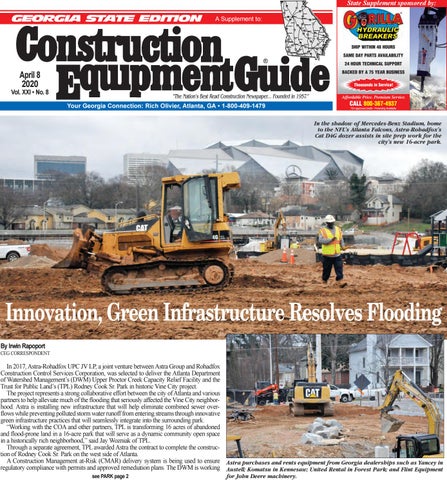
In the shadow of Mercedes-Benz Stadium, home to the NFL’s Atlanta Falcons, Astra-Rohadfox’s Cat D4G dozer assists in site prep work for the city’s new 16-acre park.
Innovation, Green Infrastructure Resolves Flooding By Irwin Rapoport CEG CORRESPONDENT
In 2017, Astra-Rohadfox UPC JV LP, a joint venture between Astra Group and Rohadfox Construction Control Services Corporation, was selected to deliver the Atlanta Department of Watershed Management’s (DWM) Upper Proctor Creek Capacity Relief Facility and the Trust for Public Land’s (TPL) Rodney Cook Sr. Park in historic Vine City project. The project represents a strong collaborative effort between the city of Atlanta and various partners to help alleviate much of the flooding that seriously affected the Vine City neighborhood. Astra is installing new infrastructure that will help eliminate combined sewer overflows while preventing polluted storm water runoff from entering streams through innovative green infrastructure practices that will seamlessly integrate into the surrounding park. “Working with the COA and other partners, TPL is transforming 16 acres of abandoned and flood-prone land in a 16-acre park that will serve as a dynamic community open space in a historically rich neighborhood,” said Jay Wozniak of TPL. Through a separate agreement, TPL awarded Astra the contract to complete the construction of Rodney Cook Sr. Park on the west side of Atlanta. A Construction Management at-Risk (CMAR) delivery system is being used to ensure Astra purchases and rents equipment from Georgia dealerships such as Yancey in regulatory compliance with permits and approved remediation plans. The DWM is working Austell; Komatsu in Kennesaw; United Rental in Forest Park; and Flint Equipment see PARK page 2
for John Deere machinery.
Page 2 • April 8, 2020 • www.constructionequipmentguide.com • Georgia State Supplement • Construction Equipment Guide
New Park in Atlanta’s Vine City Set for Summer Opening PARK from page 1 Movement. infrastructure, re-routing 1,100 LF of 96-in. combined trunk The expected lifespan of the new infrastructure is 100 sewer, extending a 48-in. storm drain to an existing system concurrently with TPL to build the park, while the National Monuments Foundation is scoped to raise funds for years. In addition to improving water quality by filtering at the Georgia World Congress Center parking lot, installing statues of historical figures connected to Vine City to be runoff of sediment and pollutants from the storm water, it pipeline and adjusting the grade of roadways in the project will capture storm water for reuse during periods of low pre- area, remediating soil and relocating Georgia Power transplaced throughout the finished park. mission utilities. “At TPL, our mission is to create parks and protect land cipitation. Key elements of Upper Proctor Creek Capacity Relief A major challenge was the bypass of the 108-in. combined for people, ensuring healthy, livable communities for generations to come,” Wozniak said. “Every park, playground and System, which saw major construction begin in October brick sewer system that ran through the middle of the site. A public space we create is an open invitation to explore, won- 2018, include a new capacity relief storage facility and green new 96-in. reinforced concrete pipe (RCP) was designed and constructed to tie into the existing der, discover and play.” combined sewer system at the east The Upper Proctor Creek Capacity and north edges of the project. To Relief project can manage 9 million-plus reduce costs and eliminate the need gallons of storm water through the instalfor bypass pumping, Astralation of a 2-acre retention pond with Rohadfox constructed doghouse innovative green infrastructures, includmanholes to allow the existing flow ing bio-retention, storm water planters, to continue unabated while the new rainwater harvesting cisterns and soil line was tied into the system. restoration. It also includes a pedestrian The design and engineering bridge spanning the pond, aerating water aspects of the project are closely features, separated storm drain pipelines, related to the construction. new sidewalks and roadway improve“We encountered contaminated ments. soils that had to be removed, in The $45 million project, which encomaddition to utility transmission lines passes the Rodney Cook Sr. Park site, will that had to be relocated,” said Tracy open this summer and includes a playLettsome-McNeill, Astra’s project ground, splash pad, picnic pavilion, permanager. “A high-pressure gas regformance plaza, courts for various sports ulator system was also required to activities and a fitness area. Plans also call be moved.” for a boardwalk, terraced pools and an The project is located at a low overlook. The park is named after point of the surrounding area, and Rodney Cook Sr., a former state representhe water table is high, which meant tative from Atlanta who strived to heal racial divides. It also recognizes Atlanta’s The $45 million Rodney Cook Sr. Park project in Atlanta’s historic Vine City neighborhood will that soil conditions were not ideal for construction. role as the birthplace of the Civil Rights open to the public this summer “From a construction viewpoint, the challenge involved several different trades performing different tasks to get it completed, working below the water table, laying the pipe 25 ft. deep and working around utilities and an apartment complex,” said Geory Cox, Astra superintendent. “This took several meetings for coordination, with all the subcontractors’ de-watering pumps running continuously.” Astra-Rohadfox performed de-watering operations almost throughout the duration of the entire project, as groundwater was an ongoing concern. Graded aggregate piers and helical piles were used extensively to support many of the retaining walls and junction boxes. To date, the Astra-Rohadfox team has completed the following elements: soil remediation of the site; the installation of water, sewer and storm lines on Elm, Thurmond and Maple streets; re-routing the 96-in. combined sewer line; tiein of the 48-in. storm line from the Georgia World Congress Center; and the construction of fountain features, walls, bridge superstructure foundations and columns, structural walls, storm drains and grading. The remainder of the work will focus on sidewalks, site finishes, landscaping, pond finishes and paving. The functional utility components enhance system operational efficiency and reliability, reduce the frequency and cost of corrective and emergency maintenance, provide essential capacity relief to the Beckwith combined sewer trunk and decrease the frequency and magnitude of flooding in the vicinity of the Upper Proctor Creek Capacity Relief project.
Work crews expect to remove 40,000 tons of earth and rock and 30 tons of concrete from the project site.
see PARK page 4
Construction Equipment Guide • Georgia State Supplement • www.constructionequipmentguide.com • April 8, 2020 • Page 3
Page 4 • April 8, 2020 • www.constructionequipmentguide.com • Georgia State Supplement • Construction Equipment Guide
Astra-Rohadfox Transforms Rodney Cook Sr. Park Site PARK from page 2
“The lessons learned through this project included conducting field walks to identify and investigate potential utility conflicts not identified on plan drawings,” LettsomeMcNeill stated. “We’ve been able to identify and determine constructability conflicts ahead of scheduling work to begin. The nature of the issue determined how quickly the challenges could be resolved. The city encouraged open communication to resolve issues once they were presented.” All requirements for deliveries of materials and removal of debris are the responsibility of the CMAR. AstraRohadfox has been fortunate to have sufficient space to store materials and equipment and set up offices at the project site. Upon completion, Astra-Rohadfox crews expect to remove 40,000 tons of earth and rock and 30 tons of concrete as well as adding 1,100 LF of watermain, about 4,000 LF of storm water pipe and approximately 2,400 LF of sanitary pipe. “The material removed was not used on site and will not be used on any other Astra projects,” Lettsome-McNeill said. “The infill, or material brought in, was recycled and came from a structured parking project at the historic Grant Park.” Throughout this project Astra-Rohadfox has utilized the services of several subcontractors such as Astra Grading & Pipe for remediation; New Gen Construction for structural concrete walls, stairs, foundations, columns and boardwalk; International Pools for hardscapes, fountain features and channels; BB&H for electrical; R.F. Knox for handrails and guardrails; Atlanta Paving & Concrete for paving; and Ed Castro Landscaping for landscaping. Equipment used on this groundbreaking project includes: The Upper Proctor Creek Capacity Relief project can manage 9 million-plus gallons of storm water through the 150- and 200-ton cranes; excavators — Komatsu (a PC490 installation of a 2-acre retention pond with innovative green infrastructures. and a PC390) and Cat (a 336 and 320 excavators), a Hitachi 670, and several others; dozers — a Komatsu D51, Cat (a D5 and a D4), and John Deere (a 750 and a 450); loaders — Komatsu (a WA 380 and a WA 270), and a Cat 930M; a Cat TL1255D lull; skid steers — a Takeuchi TL 10 and Cat (a 279, a 239, and a 289); a Cat CP56 compactor; and rollers — a Wacker Neuson trench roller and a Hamm 3307. “Repairs are done rapidly since Astra has a mechanic on staff who is responsible for visiting our job site depending on equipment repair needs,” Lettsome-McNeill said. Astra purchases and rents equipment from Georgia dealerships such as Yancey in Austell, Komatsu in Kennesaw, United Rental in Forest Park and Flint Equipment for John Deere machinery. “This project could not have been possible without the residents of Vine City, generous philanthropic donors and the city of Atlanta,” Wozniak said. “This partnership and its holistic approach are key in bringing the entire Rodney Cook Sr. Park in historic Vine City project to Graded aggregate piers and helical piles were used extensively to support many of the retaining walls and junction boxes. life.” CEG
Construction Equipment Guide • Georgia State Supplement • www.constructionequipmentguide.com • April 8, 2020 • Page 5
Page 6 • April 8, 2020 • www.constructionequipmentguide.com • Georgia State Supplement • Construction Equipment Guide
Massana Construction Lifts 11 Bridges in Five Counties By Irwin Rapoport CEG CORRESPONDENT
Punch list items are all that remain on the Georgia Department of Transportation’s (GDOT) $8 million rehabilitation of 11 bridges over Interstate 20 and Interstate 16, which raised the height of bridges in Newton, Green, Morgan, Taliaferro and Laurens counties. The contract, awarded to Massana Construction Inc., had three separate crews operating on parts of the state that were 60 miles from Atlanta and about 75 miles apart from each other between the outermost bridges. The work began in October 2018 and the last bridge was finished on February 29 of this year. Each crew was responsible for three steel beam bridges, and many of the crew members united for the raising of the concrete beam bridge. “The focus of the project was to raise all 11 bridges to increase the clearance for trucks underneath,” explained Steve Roeser, Massana’s project manager. “It was primarily a bridge jacking job and there was a multitude of incidental work that needed to happen once the bridge was raised — the guardrail, approach decks, wing walls and other road work.” The average length of the bridges was 262 ft. The steel beam bridges (four spans, two abutments and three piers) had one lane in
Massana Construction Inc. was awarded GDOT’s contract for the $8 million rehabilitation of 11 bridges over Interstate 20 and Interstate 16 in Newton, Green, Morgan, Taliaferro and Laurens counties.
each direction, while the concrete beam bridge (Almon Road over I-20: two spans, two abutments and one pier) in Newton County had two lanes in each direction, plus a center turn lane. Roeser was primarily dealing with three GDOT officials — Robert Rowland, the
assistant area engineer, Joe Champion, the project engineer, and Charles Smith, the onsite project inspector. “Some of the biggest challenges for this project were that the contractor had to jack each bridge simultaneously,” Champion stated. “If not, they risked damaging the
beams and bridge deck. Also, the contractor had to stage the construction to complete the work under traffic utilizing temporary traffic signals and lane closures. The expected lifespan of the bridge raising is for the life of the bridge or until the interstate clearance height is raised to where the new bridge heights are in conflict. Usually maintenance projects like these take about two years to go through the planning and design phase before being let for construction.” Roeser was well aware of the many challenges associated with the initiative. “One of the biggest hurdles was that for three of the bridges, when we raised them, the engineer called for the complete removal of the concrete caps,” he said. “We basically built a shoring tower around the piers, raised the bridges up, removed the caps and then poured new caps at an elevation that was approximately one foot higher.” Another issue for crewmembers was navigating traffic. “GDOT allowed us to shut down three bridges in Morgan County for 45 days,” Roeser said. “But for everything else, we had to maintain one lane of traffic. To solve that problem, we used portable traffic signals on either side of the bridge. In order to get done on schedule, we worked on three bridges at a time, and in one case, four. Each bridge took about 15 weeks to complete.” To maintain traffic on the open lanes, a see BRIDGES page 8
In addition to several types of jacks, work crews utilized a Cat 303.5 mini-excavator; Cat 289 tracked skid steer; two Cat 255 telehandler forklifts; Mack and Kenworth tractors and 40-ft. dove-tailed trailers for equipment moves and mobilization, among other machines.
Construction Equipment Guide • Georgia State Supplement • www.constructionequipmentguide.com • April 8, 2020 • Page 7
Page 8 • April 8, 2020 • www.constructionequipmentguide.com • Georgia State Supplement • Construction Equipment Guide
GDOT Raises Bridges for Better Overhead Truck Clearance BRIDGES from page 6
variety of techniques were employed. In one case, for a dirt/gravel road, GAB (Graded Aggregate Base) was used to build a ramp; for another, the paving subcontractor paved the wedges in; and for another, as the approach slabs came up, a ramp was placed on each end. “This all required extensive planning,” said Roeser, who noted that day shifts were only needed for 10 bridges. “For the concrete bridge, it was weekends only for the top work — the approach slabs removal and replacement, asphalt paving and final striping.” The concrete bridge required maintaining one lane in each direction, during weekend work. “The first phase of the work was the selective demolition of some of the backwalls and the second phase was raising the bridge that had 11 beams — we started at the abutment and moved to the center pier, and then the other abutment,” said Roeser. “It only came up 4 in. The whole bridge was jacked at one time, being raised incrementally between 0.5 in. to 1-in. per-hour.” Once raised, crews did some concrete work — replacing some of the backwalls and wing walls. After this was done, the work shifted to weekend work. “The approach slabs, asphalt paving, twopart epoxy overlay and final polyurea striping were done in five weekends,” Roeser said. “One of the biggest challenges was jacking the center pier. There was a concrete median, so we had to put a left-hand lane closure with barrier wall in each direction on
The average length of the bridges in this project is 262 ft.
I-20 and had 14 days to get it done. Once access was secured, we had to jack each end of the beams and we had 88 jacks on the center pier. We had to assemble our shoring system to give us a place to jack from. The bearing was only was only 2.5 in., so there was no daylight and it was real tight.” One common element for all the bridges was the application of a two-part epoxy
Each work crew was responsible for three steel beam bridges, and many of the crew members united for the raising of the concrete beam bridge.
overlay. The concrete bridge was one of the last to be completed. For the others, the plan of attack was similar, starting with the installation of the temporary traffic signals, select demolition work, access to shoring to set up the jacking systems, raising the bridge and once raised, all of the top work. “One of the important pieces of work was the installation of new steel bearings,”
Roeser said. “If the bridge was raised 10 in., we had to install 10-in. high bearings as well.” Each crew developed a good rhythm, which included taking nothing for granted and ensuring that safety was a priority at all times. One crew dealt with the bridges that required the cap removal and replacement, and the other two crews dealt with the steel beam bridges that were similar in their design. Each crew had about six Massana people — a superintendent, a foreman and four workers, along with some subcontractor employees. “For the concrete bridge, everybody pitched in and helped us get it done,” Roeser said. “Not every bridge was exactly the same. One jacking system was the shoring tower system; another was corbels that we could drill into the sides of the caps, which gave us a seat to jack from; another was more of a hanging system with high strength Coil Rod; and the most straightforward system was putting a jack on the existing caps or abutments and raising it up. “We had a field engineer, Jonathan Hopkins, on the job full-time and when we peaked out, we had 35 guys,” Roeser added. “I was fortunate to have good people and good help. I could not be everywhere all the time. We had good people on each of the bridges that could look after things.” Also assisting were Massana senior superintendents Jeff Fiscus, Tom Root and Michael Terrell. “It was a good team dynamic,” Roeser said. see BRIDGES page 10
Paving efforts along one of the 11 bridges rehabbed and lifted by Massana Construction.
Construction Equipment Guide • Georgia State Supplement • www.constructionequipmentguide.com • April 8, 2020 • Page 9
MOR M RE TH HAN N SANY A excavators are purpos se-built b ilt for the toughe toughest jobs. j
Visit centralatlanttatractor.com to see for yourself.
Central Atlanta Tractor Sales, Inc.
Page 10 • April 8, 2020 • www.constructionequipmentguide.com • Georgia State Supplement • Construction Equipment Guide
One of the challenges of this project was working around traffic. Workers congregated early in the morning to go over their daily tasks and review safety precautions.
Massana Crews Fan Out Over State to Tackle GDOT Job BRIDGES from page 8
Crews removed 200 tons of asphalt, 800 tons of concrete and 90 tons of steel and rebar. New materials consisted of 2,600 tons of asphalt, 900 cu. yds. of concrete, and 140 tons of steel and rebar. The scrap steel and rebar were sent to scrap yards for recycling and the concrete was repurposed as rip rap for erosion control. The subcontractors were C&H Paving for asphalt, The Sharon Company for guardrail, Oglesby Construction for final polyurea striping, Tidwell Inc. for thermoplastic markings, ABC Cutting Contractors for concrete cutting and C&G Concrete for the construction of the approach slabs. Equipment-wise, Massana used a Power Team hydraulic jacking pump system (10,000 PSI); Enerpac and Power Team 50and 100-ton pancake jacks; four ADDCO PTS-2000 portable traffic signals; a Cat 303.5 mini-excavator; Cat 289 tracked skid steer; two Cat 255 telehandler forklifts; Mack and Kenworth tractors and 40-ft. dove-tailed trailers for equipment moves and mobilization; a GMC dump truck; various hammers; and various air-compressors. Some work sites had on-site mechanics and other sites brought in mechanics as needed. “The biggest wear and tear was for some of our hammers and jacking systems,” Roeser said. “The trucks, which were instru-
mental to moving our heavy equipment, required quite a bit of maintenance to keep them moving.” Doug Shoemaker, Massana’s equipment manager, played a key role in assigning equipment and keeping an eye on the repairs and maintenance issues. “He was with us from start to finish,” Roeser stated. “Shoemaker and his team helped us through everything, and he would also get out and do repairs on-site himself if necessary.” Massana purchases its Caterpillar equipment from Yancey Bros. Inc. in Atlanta, while the jacks were purchased from Beerman Precision Inc. in New Orleans, La., which has an office in Birmingham, Ala., where jacks could be repaired. When equipment had to be rented, it was provided by Herc Rentals. “Yancey helped with repairs to some of the demolition hammers,” Roeser said. “Herc had a satellite office in Covington, which was very convenient due to the lengthy distances on the project. The dealerships expect us to communicate the problems that the equipment is having and at times we brought the equipment to them so they could have a good shop environment to make the repairs, instead of having their mechanics come into the field. What we expect are good repairs and good maintenance of our equipment.” CEG
The final product of the concrete beam bridge (Almon Road over I-20).
Construction Equipment Guide • Georgia State Supplement • www.constructionequipmentguide.com • April 8, 2020 • Page 11
Page 12 • April 8, 2020 • www.constructionequipmentguide.com • Georgia State Supplement • Construction Equipment Guide
{ Y o a , i M i , G
a Š ĂŠ ÂŁ Ă a ÂŁ ĂŠ Ć ¡ ˜ ÂŁ a Ăť ĂĽ ĂĽ Ă™ ĂŠ Ăľ
7UDFWRU (TXLSPHQW &RPSDQ\ KDV EHHQ SXVKLQJ WKURXJK WR WKH HQG IRU RXU FXVWRPHUV VLQFH 7KH 6DOHV 6HUYLFH 6XSSRUW WHDPV DW 7(& KDYH \RXU EDFN DW DOO WLPHV DQG LQ DOO SODFHV &RPH YLVLW RQH RI RXU ORFDWLRQV WKURXJKRXW $/ *$ )/ WRGD\
i Ä? ÄĽ Ä Ä&#x; Ĺś ˜ Ă™ Ă?