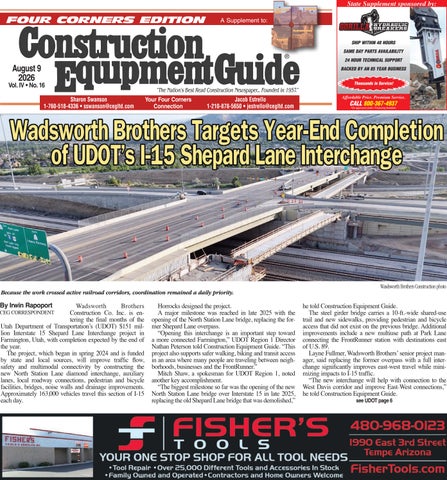
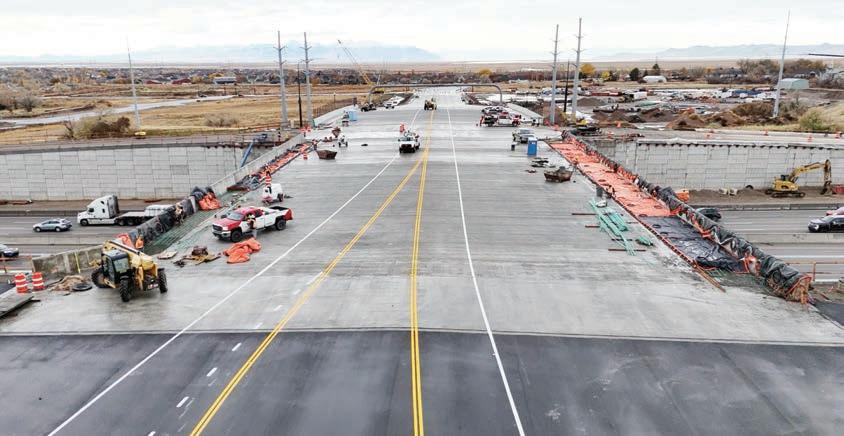
lion Interstate 15 Shepard Lane Interchange project in Farmington, Utah, with completion expected by the end of the year.
The project, which began in spring 2024 and is funded by state and local sources, will improve traffic flow, safety and multimodal connectivity by constructing the new North Station Lane diamond interchange, auxiliary lanes, local roadway connections, pedestrian and bicycle facilities, bridges, noise walls and drainage improvements. Approximately 163,000 vehicles travel this section of I-15 each day.
“Opening this interchange is an important step toward a more connected Farmington,” UDOT Region 1 Director Nathan Peterson told Construction Equipment Guide. “This project also supports safer walking, biking and transit access in an area where many people are traveling between neighborhoods, businesses and the FrontRunner.”
Mitch Shaw, a spokesman for UDOT Region 1, noted another key accomplishment.
“The biggest milestone so far was the opening of the new North Station Lane bridge over Interstate 15 in late 2025, replacing the old Shepard Lane bridge that was demolished,”
improvements include a new multiuse path at Park Lane connecting the FrontRunner station with destinations east of U.S. 89.
Layne Fullmer, Wadsworth Brothers’ senior project manager, said replacing the former overpass with a full interchange significantly improves east-west travel while minimizing impacts to I-15 traffic.
“The new interchange will help with connection to the West Davis corridor and improve East-West connections,” he told Construction Equipment Guide. see UDOT page 6
Wasdsworth Brothers Construction photo
FNF Construction Serves as Contractor... Work Under Way On $613M Loop 303 Southward Expansion in West Valley
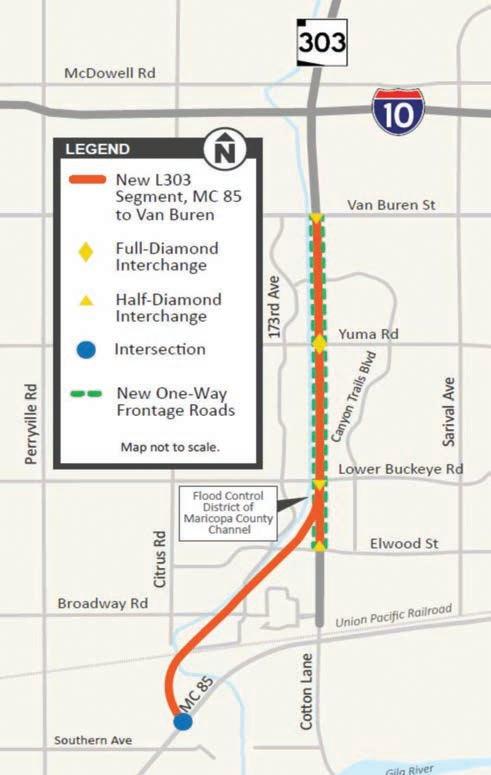
The Arizona Department of Transportation (ADOT) launched on June 15, 2026, a $613 million, approximately four-year project to extend Loop 303 southward in the West Valley from Van Buren Street to Maricopa County 85.
This improvement will set up an eventual connection with the planned State Route 30.
FNF Construction Inc. is the project’s general contractor.
Spanning approximately 4 mi., much of which will follow the current alignment of Cotton Lane, planned improvements will create three general purpose lanes in each direction between Van Buren Street and Lower Buckeye Road and two general purpose lanes in each direction between Lower Buckeye Road and MC 85.
The project includes completing the southern half of the Van Buren Street traffic interchange, creating a full diamond interchange at Yuma Road and creating a half diamond interchange at Lower Buckeye Road and Elwood Street. The freeway will be elevated over cross streets and the Union Pacific Railroad tracks.
One-way frontage roads will be built to maintain local access, and sound walls will be constructed where needed.
Initial work to clear the corridor began on June 15. Construction of a new northbound frontage road is scheduled to begin this fall. North- and southbound Cotton
Lane traffic will then be shifted onto this frontage road, so the major construction work can begin on the new freeway.
Periodic lane restrictions and closures will be needed on Loop 303 and Cotton Lane, Loop 303 ramps and cross streets. These restrictions will occur primarily during overnight hours and weekends to minimize traffic impacts.
Closures lasting up to 60 days will be needed at some cross streets.
Access to businesses will be maintained during the entire project.
The southern end of the Loop 303 extension will have a signalized intersection with MC 85. In the future, the new extension will connect with State Route 30 between the Loop 202 (South Mountain Freeway) and Loop 303.
This part of the Loop 303 extension project is set to begin in fiscal year 2027 at the eastern end between Loop 202 and 97th Avenue. Construction on the SR 30 segment connecting with Loop 303, between Loop 303 and Estrella Parkway, is scheduled to begin in fiscal year 2033.
The Loop 303 extension project is paid for through the Maricopa Association of Governments’ regional freeway plan, which includes funds from Proposition 400, a halfcent sales tax approved by Maricopa County voters in 2004.
An extension of the regional sales tax for transportation improvements was approved by voters in 2024.
First Segment of I-10 Wild Horse Pass Project Nears End
Construction on the first segment of Arizona Department of Transportation’s I-10 Wild Horse Pass Corridor Project between Phoenix and Casa Grande has entered its final phase and is nearing completion, according to the Arizona Department of Transportation.
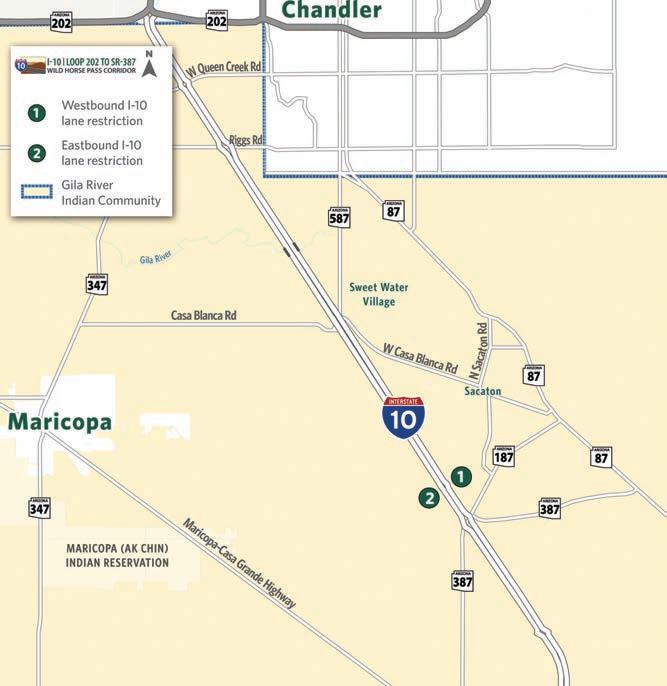
This summer, crews are working to complete two new Interstate 10 bridges over the Gila River. Located about 11 mi. south of the PhoenixChandler area, the completed bridges will widen the highway to three lanes in each direction.
Crews are pouring the concrete bridge deck as part of the new eastbound I-10 bridge. This section will connect to the portion of the eastbound bridge that was completed last year.
The new westbound bridge over the Gila River was also completed last year. The remaining construction work on the new eastbound I-10 bridge is expected to be completed this fall.
On another segment of the project, closer to Casa Grande, crews shifted traffic on I-10 in both directions to the outer lanes on a 10-mi. stretch of I-10 from State Route 387 to Gas Line Road. The shift allowed workers to place concrete barriers in the median, creating a safer and larger workspace to construct a third general-purpose lane in both directions.
Additional work in this segment includes reconstructing the Pinal Avenue/State Route 387 interchange, constructing a new interchange at
Seed Farm Road, and widening Gas Line Road bridge over I-10, as well as removing the Dirk Lay Rood bridge over I-10. Work on this segment began in January 2026.
Active construction on the third of four project segments, close to the Phoenix-Chandler area, is scheduled to begin by the end of the summer. This segment runs along I-10 for 11 mi. in both directions between the Loop 202 Santan/South Mountain freeways and the Gila River bridges.
In this segment, crews will add a third generalpurpose lane in both directions and reconstruct interchanges at Riggs Road, Wild Horse Pass Boulevard and State Route 347/Queen Creek Road.
Crews also will construct a new interchange at Koli Road between the Wild Horse Pass Boulevard and State Route 347. Additionally, high occupancy vehicle (HOV) lanes will be constructed in both directions between the Loop 202 Santan/South Mountain freeways and Riggs Road.
Once completed, the I-10 Wild Horse Pass Corridor Project will help reduce travel congestion and travel times through the area. This stretch of I-10 will be the last between Phoenix and Tucson to be widened from two three lanes in each direction.
The entire I-10 Wild Horse Pass Corridor Project is scheduled to be complete by late 2029.
Arizona Department of Transportation graphic A map of the portion of Interstate 10 under construction as part of the Arizona Department of Transportation’s I-10 Wild Horse Pass Corridor Project between Phoenix and Casa Grande.
Work Begins On $141M Weld Energy Center in Colorado
Platte River Power Authority photo
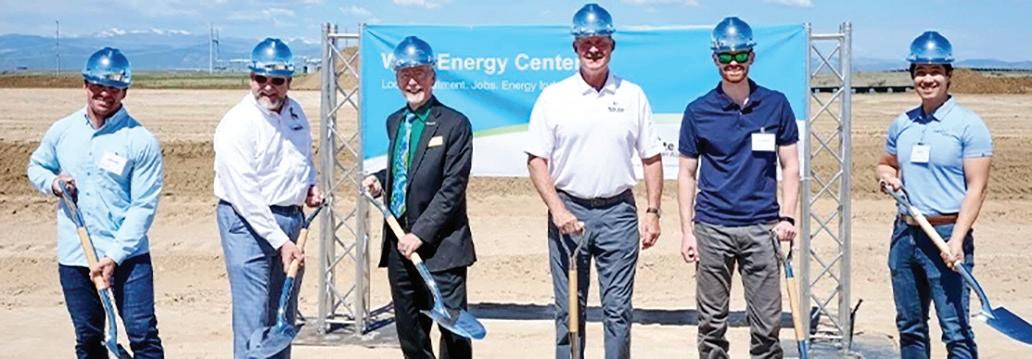
Local officials joined leaders from NextEra Energy Resources LLC and Platte River Power Authority on June 9, 2026, to break ground on the $141 million Weld Energy Center.
Local officials joined leaders from NextEra Energy Resources LLC and Platte River Power Authority on June 9, 2026, to break ground on the $141 million Weld Energy Center, Platte River’s first large-scale battery energy storage project.
The 100-megawatt (MW) battery energy storage facility in Weld County, Colo., will be owned and operated by Weld Energy Center LLC, a subsidiary of NextEra Energy Resources, America’s largest energy infrastructure developer and builder.
Weld Energy Center represents a significant investment in Colorado’s energy infrastructure, strengthening grid reliability by safely storing excess energy and delivering it when demand is highest, according to a Platte River Power Authority news release. The project will help meet growing energy demand while providing reliable, costeffective energy solutions when electricity is needed most.
years and more than 200 construction jobs will be created.
Tax revenues from the project will support schools, public safety and infrastructure improvements across Weld County. This impact is reinforced by using local contractors and suppliers during construction, supporting regional economic growth and local workforce development.
“Projects like this are essential to maintaining reliability and advancing our clean energy transition.”
Battery energy storage is also one of the fastest and lowest cost ways to add capacity to the electric grid, helping meet peak electricity demand without the need for new conventional generation resources. When completed, the project will add flexibility to the grid by balancing supply and demand during extreme weather and peak usage, supporting reliable electricity for homes, businesses and essential services.
Located near a solar facility serving Platte River and connected to its newest substation, the energy storage project will enhance the existing solar site while supporting greater energy integration, improving grid performance and providing a cost-effective solution to meet growing energy needs.
The project will offer 100 MW of battery energy storage capacity. More than $6.8 million in tax revenue is projected over 20
Jason Frisbie
Platte River Power Authority
Additionally, the land for the project is leased from the state of Colorado with 95 percent of all revenue going toward Colorado Public Schools.
“This project represents the kind of forward-thinking approach that has historically defined Platte River,” Platte River General Manager and CEO Jason Frisbie said. “As we approach the retirement of our flagship coal unit in 2029, projects like this are essential to maintaining reliability and advancing our clean energy transition.”
• Sand, stone & cement bin vibrators
• Dual auger cement metering
• Pump master auger with IBS bearing
• Work platform
From NextEra Energy Resources Vice President Dexter Liu: “Weld Energy Center represents the next generation of energy infrastructure in Colorado,” NextEra Energy Resources Vice President Dexter Liu said. “As electricity demand continues to grow, battery energy storage is playing an increasingly important role in maintaining reliability and supporting economic growth.”
• 360° Swivel scan to view more
Demolition, Shepard Lane Bridge Work Drive Final Phase
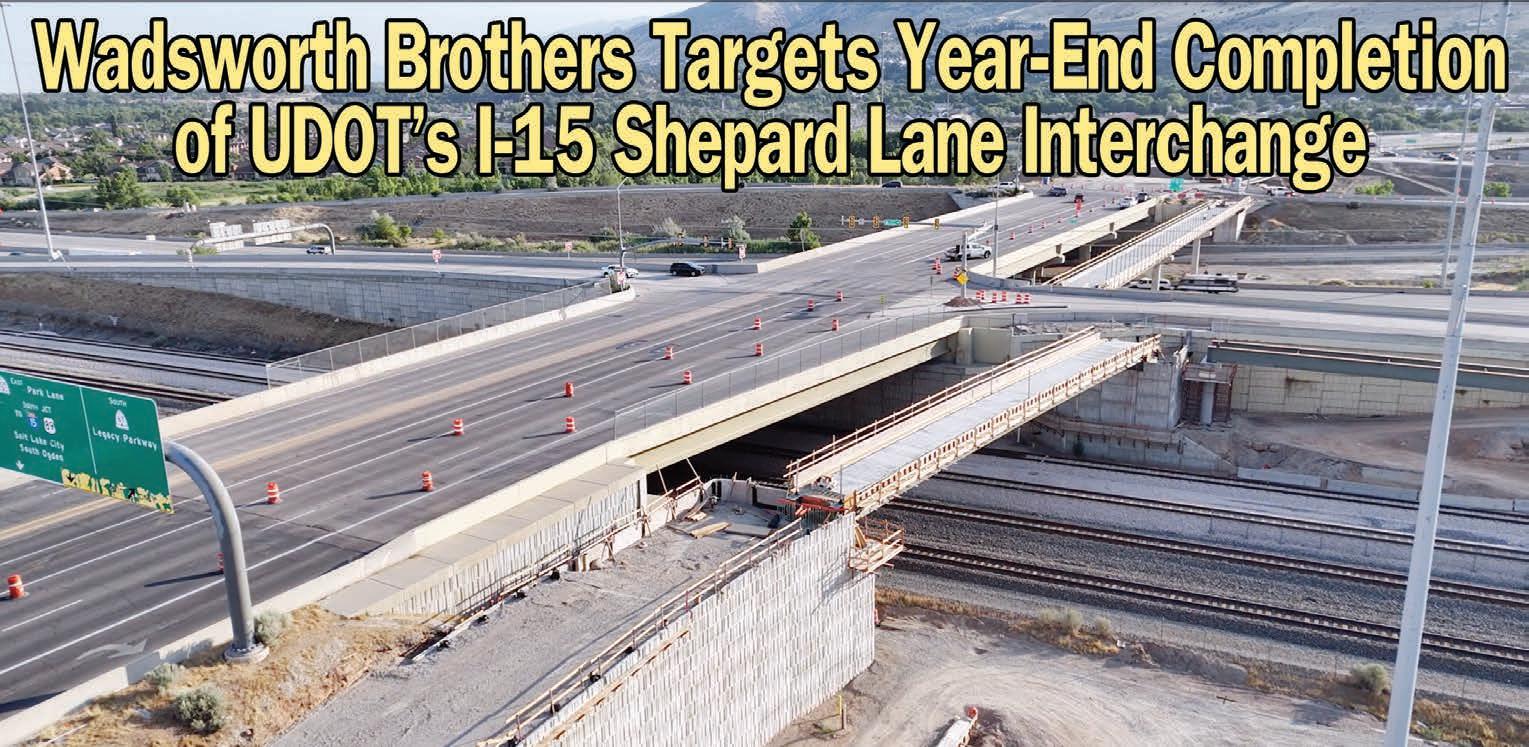
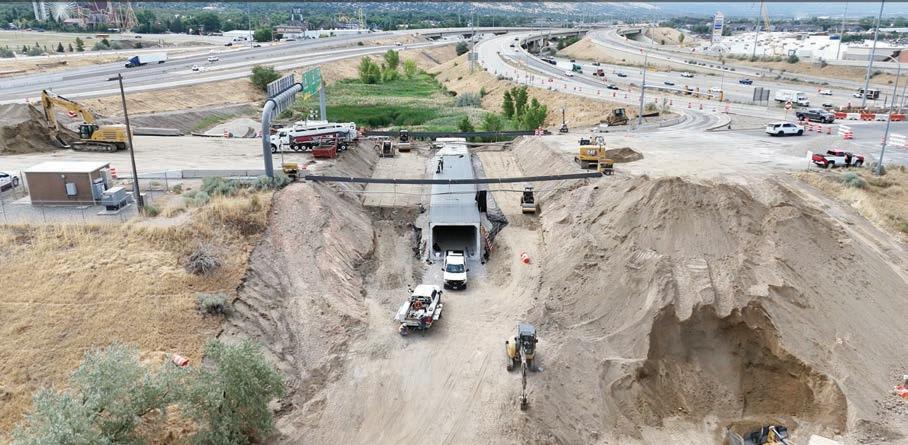
Wasdsworth Brothers Construction photo
Wadsworth Brothers Construction Co. Inc. is entering the final months of the Utah Department of Transportation’s (UDOT) $151 million Interstate 15 Shepard Lane Interchange project in Farmington, Utah.
UDOT from page 1
“The new diamond interchange alleviates pressure on surrounding local roads and improves traffic flow by providing direct connections to I-15, US-89, and Legacy Parkway,” he said. “Regarding connectivity, the overpass crosses over Union Pacific Railroad (UPRR) and Utah Transportation Authority (UTA) tracks, creating a smoother and more reliable route for drivers traveling through the growing Farmington area. The project promotes active transportation by adding new sidewalks and bike lanes, giving residents more ways to travel.”
Multiple Work Fronts
A June 26 project update reported the job was approximately 75 percent complete. Crews continue working simultaneously on several major components, including the southbound I-15 on-ramp at North Station, pedestrian bridges and underpass at Park Lane, final pavement work and median improvements. Local street reconstruction, utility relocations and remaining pedestrian facilities also are scheduled for completion this year.
Most construction takes place on weekdays, although night and weekend work is used for operations affecting traffic.
“We are using a temporary concrete barrier along I-15 to provide a protected work zone,” Fullmer said. “Traffic on I-15 is moving at regular speed through the work zone. There are minimum impacts to traffic. The project allows for lane closures during non-peak traffic hours, which allows us the opportunity to bring in the necessary materials and equipment.”
One of the project’s defining construction features has been the use of accelerated bridge construction and prefabricated bridge elements.
“By building bridge components off-site and maneuvering them into place during overnight closures, UDOT minimizes major travel disruptions,” Shaw said. “The core of the project’s efficiency is building new overpass segments (like the new North Station Lane bridge) off-site and shifting them rapidly into place. This drastically reduces freeway closures compared to traditional cast-in-place construction.
“Because the new North Station Lane interchange crosses
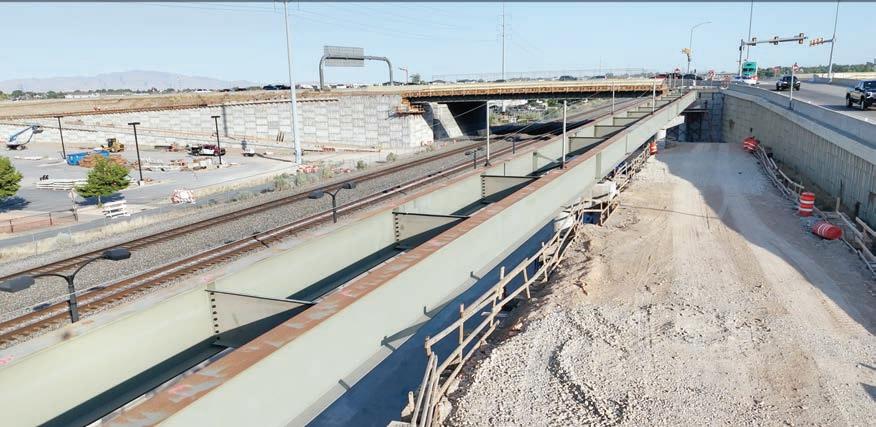
Wasdsworth Brothers Construction photo
The steel girder bridge carries a 10-ft.-wide shared-use trail and new sidewalks, providing pedestrian and bicycle access that did not exist on the previous bridge.
over busy UPRR and UTA tracks as well as I-15,” he added, “crews must safely maneuver large heavy bridge components in a very constrained area using precise overnight installations.”
Delays, Construction Challenges
The project has encountered several obstacles, including unknown utilities, design revisions and restricted work areas adjacent to the interstate and railroad corridors.
“The project encountered several unknown utilities and design errors, which extended the project by over a year,” Fullmer said. “Gaining access to the platform to construct the Trail E bridge was challenging. The work has been slow, but things are looking good to finish the project by the end of the year. The northbound and southbound sections, median and the bridges at Park Station have all had tight work zones. We’re also dealing with soil, water and utility issues.”
Fullmer noted that limited construction space along I-15 and the need to coordinate with the railroad added complexity throughout the project.
Demolition, Bridge Work Drive Final Phase
Replacing the existing Shepard Lane overpass required carefully sequenced demolition while maintaining traffic on I-15 and coordinating with UPRR and UTA operations.
Most demolition occurred during overnight weekend freeway closures.
“This is because we had to do most of the demolition on the weekend at night,” Dustin Belnap, Wadsworth Brothers’ project superintendent, told Construction Equipment Guide. “It was a phased demolition. We closed the freeway — closing the southbound direction one weekend night and the next weekend we shut down the northbound direction for a night to demolish.”
The demolition plan emphasized close coordination with the railroads and detailed sequencing for girder removal, crane operations and worker safety. Equipment included hydraulic excavators, wheel loaders, KOBLECO 250-ton cranes, forklifts, manlifts, support trucks and specialized cutting equipment.
A designated fire watch remained on site during torch-cut-
Utah Department of Transportation photo Bridge construction included epoxy-coated reinforcing steel and hundreds of concrete pours.
ting operations, while field mechanics provided backup support. Safety measures included 100 percent fall protection during deck and girder removal, daily safety meetings and exclusion zones around demolition activities.
With demolition complete, crews shifted their attention to bridge construction and roadway improvements.
“We had six pier caissons for the pedestrian bridges,” Belnap said. “Two of the pedestrian bridges have piers with one column.”
More than 7,200 linear ft. of steel beams, weighing approximately 3.3 million lbs., were installed.
“Several cranes from a 60-ton capacity to a 450-ton capacity were used,” said Belnap, “for both single picks and tandem picks.”
Bridge construction included epoxy-coated reinforcing steel and hundreds of concrete pours.
Because the work crossed active railroad corridors, coordination remained a daily priority.
“We had weekly meetings with Olsen and daily coordination with onsite UPRR flaggers,” Belnap said.
Materials, Workforce
Roadway construction continues with excavation, drainage installation and paving operations progressing together.
“We’re using borrow, granular backfill, untreated base course and asphalt,” said Fullmer, noting that the drainage systems — concrete and HDPE — are being installed as the roadwork progresses.
Earthmoving operations have generated approximately 30,000 cu. yds. of material. Construction has required approximately 1,698 tons of structural steel, 25,000 tons of asphalt, 2,500 precast concrete noise-wall panels and roughly 12,000 linear ft. of drainage piping. Another 300,000 tons of imported fill, base and gravel were used to build the interchange approaches and shared-use trail.
Wadsworth Brothers typically has about 80 employees and subcontractor personnel on site. The project team includes Assistant Project Manager Rob Dahl and Superintendents Dustin Belnap and Jason Thomson.
Major subcontractors include Suncore, Cache Valley Electrical, Comers Concrete, Harper Contracting, Granite Construction and Nucor Steel. CEG
LBX Names ReadyDig as Dealer Around Colorado
LBX Co. named ReadyDig as an authorized dealer for Link-Belt excavators in specified Colorado territories.
Through the new partnership, ReadyDig will provide sales, rentals, parts and service support for Link-Belt excavators and material handling equipment.
With existing locations in Hudson and Greeley, ReadyDig is positioned to expand Link-Belt’s presence throughout Boulder, Broomfield, Gilpin, Grand, Jackson, Larimer, Morgan, Routte and Weld counties.
Adding the Link-Belt product lineup supports ReadyDig’s continued growth strategy while reinforcing its commitment to delivering reliable equipment, responsive service, and dependable support to contractors across the region, according to an LBX press release.
“We are excited to partner with LinkBelt and bring its proven excavator lineup to our customers across Colorado. LinkBelt’s reputation for quality, reliability and dealer support aligns well with ReadyDig’s commitment to maximizing uptime and providing customers with dependable equipment and responsive local support,”
ReadyDIg/Link-Belt image LBX Co. named ReadyDig as an authorized dealer for Link-Belt excavators in specified Colorado territories.
said Jeff Saad, CEO of ReadyDig.
“We are very excited to welcome ReadyDig to our Link-Belt Excavator family,” said Kevin Roberts, director of North American sales. “Expansion of our dealer-covered territory is critical to our growth strategies. ReadyDig helps us fill a previously vacant territory, with opportunities to grow alongside Link-Belt excavator products. As a family-owned, customer-focused organization, ReadyDig is a great match as a dealer/partner.” For more information, visit ReadyDig. com.
Granite Wins West Davis Corridor Expansion Project
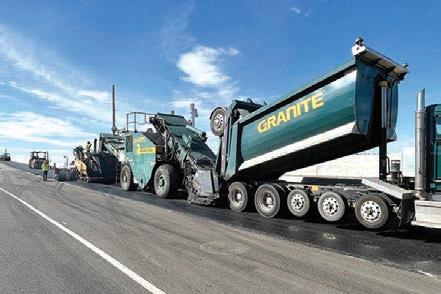
Granite announced on June 24, 2026, that it was awarded the West Davis Corridor (State Route 177) expansion project by the Utah Department of Transportation (UDOT).
The contract is valued at approximately $116.9 million.
Located in West Point, Utah, the project will:
• extend the recently completed West Davis Corridor by approximately 3 mi.;
• enhance mobility and connectivity for the northern Davis County area; and
• improve traffic flows in the corridor.
was awarded the West Davis Corridor (State Route 177) expansion project by the Utah Department of Transportation.
The project scope includes the construction of nine new bridges, two pedestrian crossings, approximately 70,000 tons of asphalt paving and the placement of more than 1 million cu. yds. of borrow material.
“This project represents an important step in continuing the buildout of the West Davis Corridor, improving access and mobility for the growing northern Davis County region,” said Jason Klaumann, Granite regional vice
president. “It aligns with our core strengths in structures, paving and materials, and our home market strategy.”
Granite’s Wells Pit will supply 400,000 cu. yds. of borrow and 350,000 tons of mechanically stabilized earth (MSE) fill, and Granite’s West Haven AC Plant will provide 70,000 tons of hot mix asphalt.
For more information, visit graniteconstruction.com.