State Supplement sponsored by:
FOUR CORNERS EDITION
A Supplement to:
SHIP WITHIN 48 HOURS
®
November 29 2026 Vol. IV • No. 24
Sharon Swanson 1-760-518-4336 • sswanson@cegltd.com
SAME DAY PARTS AVAILABILITY 24 HOUR TECHNICAL SUPPORT BACKED BY AN 85 YEAR BUSINESS Thousands in Service!
“The Nation’s Best Read Construction Newspaper… Founded in 1957.” Your Four Corners Connection
Jacob Estrello 1-210-878-5650 • jestrello@cegltd.com
Affordable Price. Premium Service.
CALL 800-367-4937 *On approved credit • Financing Available
Wadsworth Brothers Nears End of Provo Bridge Project By Irwin Rapoport
CEG CORRESPONDENT
Wadsworth Brothers Construction is nearing completion of the first phase of the Utah Department of Transportation’s (UDOT) $49 million University Avenue 920 South to 400 South Bridge Work project in Provo, Utah. The two-phase project is replacing an aging concrete girder bridge with a new steel girder structure, with final completion anticipated in 2027. The project involves demolishing and replacing the existing 890-ft.-long, 14-span bridge, which was originally built in 1966. The new structure will be 320 ft. long, consist of three steel girder spans and carry two lanes of traffic in each direction. Federal funding is financing the work. Utility relocation began in the summer of 2025, followed by the start of Phase 1 on Oct. 1, 2025. The first phase, which is expected to be completed in mid-December 2026, involves demolishing and rebuilding the west side of the bridge. Phase 2 will begin after that work is finished and will focus on the east side, with completion anticipated in fall 2027. The new bridge will feature 8-ft.-wide sidewalks on both sides, dedicated 6-ft. bike lanes in each direction and 10-ft.tall safety fencing. A 12-ft.-wide multi-use path on the west side will connect 500 South and 600 South. The improvements also will provide better sight lines and visibility for motorists. “[The new sidewalks will make] it easier, safer and more comfortable for people to walk across the bridge,” Wyatt Wooley, a UDOT spokesman, told Construction Equipment Guide. “[The bike lanes] create a safer experience for people on bikes. [The] safety fence over the Union Pacific Railroad property improves safety for both bridge users and the trains below. On the west side of the bridge, the current frontage road will become a 12-ft. multi-use path and will link 500 South and 600 South. “This wider path encourages walking, biking and access to transit and enhanced sight lines and better overall visibil-
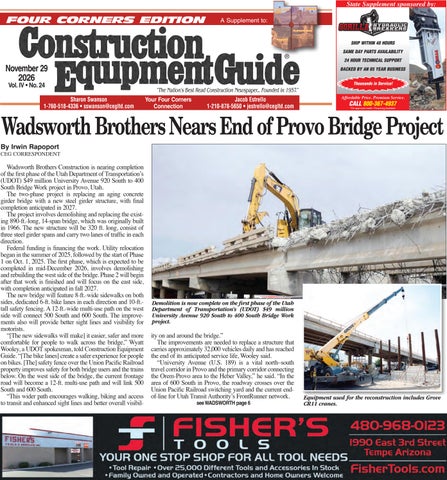
Demolition is now complete on the first phase of the Utah Department of Transportation’s (UDOT) $49 million University Avenue 920 South to 400 South Bridge Work project.
ity on and around the bridge.” The improvements are needed to replace a structure that carries approximately 32,000 vehicles daily and has reached the end of its anticipated service life, Wooley said. “University Avenue (U.S. 189) is a vital north–south travel corridor in Provo and the primary corridor connecting the Orem-Provo area to the Heber Valley,” he said. “In the area of 600 South in Provo, the roadway crosses over the Union Pacific Railroad switching yard and the current endof-line for Utah Transit Authority’s FrontRunner network. see WADSWORTH page 6
Equipment used for the reconstruction includes Grove CR11 cranes.
Page 2 • November 29, 2026 • www.constructionequipmentguide.com • Four Corners States Supplement • Construction Equipment Guide
Middle Mile Project Turner-FH Joint Venture Chosen to Build in Pima County $475M Hospital in Colo. for AdventHealth Gets Under Way
Pima County photo Pima County, Ariz., officials and partners broke ground on the Middle Mile project, a 134-mi. open-access fiber optic network.
Pima County, Ariz., officials and partners broke ground Sept. 24, 2026, on the Middle Mile project, a 134-mi. open-access fiber optic network designed to expand digital connectivity, support economic development and strengthen community resilience. The groundbreaking at Three Points Fire Station marks the first segment of the project’s two-year construction schedule. The fire station, located along the route, serves as an important community anchor institution. County officials and partners at a Sept. 24 groundbreaking for the five-year Middle Mile project. The project’s contractor is eX² Technology. The Middle Mile project is coordinated by the Office of Digital Inclusion (ODI), whose mission is closing the digital divide by linking communities to affordable, high-speed internet access, increasing access to devices and tools, and providing opportunities for digital skill building. ODI’s work is directed by the Connect Pima action plan, which aims to improve broadband, digital skill-building opportunities, and access to devices. “I’m thrilled to see us finally breaking ground on this project, and I can think of no better place to do it than Three Points,” said Pima County Board of Supervisors Chair Jennifer Allen. “Access to high-speed internet is not a privilege, it’s a right. It’s imperative that we close the digital divide for our rural residents so that internet service providers can focus on expanding service, speed and reliability.” The National Telecommunications Information Administration (NTIA) in 2023 awarded Pima County a five-year $30.3 million grant through the Infrastructure Investment and Jobs Act to create a 134-mi. open-access fiber optic ring around Pima County’s urban core. The Middle Mile network will provide infrastructure internet service providers can use to expand high-speed internet access to underserved areas of Pima County. The “Middle Mile” is the fiberoptic bridge between Internet Service Providers and local internet service connections. “Today’s groundbreaking represents a major milestone in advancing Arizona’s Middle Mile Strategic Plan and reflects years of collaboration between the ACA, ADOT and Pima County,” said Sandra Watson, President and CEO of the Arizona Commerce Authority. “This final segment of conduit completes a critical connection from Nogales to Tucson, leading to increased opportunities for families, students and businesses to access fast, reliable internet.”
Turner-FH Joint Venture announced on Oct. 15, 2026, that it was selected to lead the construction of the $475 million AdventHealth Hospital in Louisville, Colo. AdventHealth will build the new hospital within the Redtail Ridge development at U.S. 36 and Northwest Parkway in Louisville. The new 40-acre campus will deliver a 373,000-sq.-ft., five-story hospital that will expand care capacity and improve health care access across the region. The site offers improved access near a major highway interchange and provides space to meet the community’s long-term health care needs. The new location will significantly expand access to emergency care. Approximately 80,000 people must travel 17 minutes to reach an emergency department. The new location will shorten the drive to emergency care for more than 400,000 people, bringing care closer to home for a significantly larger portion of the surrounding community. The new inpatient facility is scheduled to break ground this fall, with completion anticipated in early 2029. The hospital is planned to include up to 150 beds, with the flexibility to expand as community needs evolve. “We are thrilled to continue serving Louisville and the surrounding communities,” said Lief Sorensen, CEO of AdventHealth Avista. “This investment reflects our commitment to the people who call this area home and will create a welcoming environment where patients and families can receive exceptional care with greater convenience and
AdventHealth rendering A rendering of the of the $475 million AdventHealth Hospital planned in Louisville, Colo.
peace of mind.” “We are honored to support AdventHealth’s mission to provide life-saving care through the construction of this stateof-the-art hospital,” said Scott Bustos, vice president, Turner. “This project represents a significant investment in the future of health care in Colorado, and we are proud to bring our 100 years of health care expertise to this transformative effort.”
Suffolk Lands $100M Contract to Build Cottonwood Canyons Transit Center Builder Suffolk announced on Nov. 10, 2026, that it was selected by the Utah Division of Facilities Construction and Management (DFCM) to build the Cottonwood Canyons Transit Center, an approximately $100 million parking structure at the base of Big Cottonwood Canyon. Suffolk said in a news release that it is redefining how complex construction projects are managed across the Mountain West by combining experienced local teams with advanced technology, artificial intelligence and data-driven processes. “Projects that shape how people move through Utah require more than a strong plan on paper, said John Kemp, chief operating officer, Mountain West, of Suffolk. “They require a team that understands the region, the demands of the ski industry and the discipline needed to deliver in a challenging environment. I have spent my career building in this region, and I am eager to show our clients and partners what Suffolk can do by pairing local
Utah Department of Transportation rendering Cottonwood Canyons Transit Center
knowledge with a highly collaborative team, advanced technology and a relentless focus on delivery.” Managed by DFCM for the Utah Department of Transportation (UDOT), the project will provide approximately 1,800 parking spaces and serve as a staging location for up to 50 buses. Located along Wasatch Boulevard, the mobility hub is intended to reduce pressure on the roads leading into Big Cottonwood Canyon while improving access to Utah’s ski areas and supporting the state’s travel and tourism economy. Suffolk has partnered with Wadsworth Brothers Construction on
the project. Wadsworth Brothers has completed numerous projects with UDOT and brings significant local transportation and self-performance experience to the team. “The Cottonwood Canyons Transit Center is a critical piece of our plan to improve transportation in the canyons,” said Devin Weder, project manager, UDOT Cottonwood Canyons Transit Program. “It will provide a central location for people to park and access transit, helping reduce congestion and making travel more reliable during the busy winter season. We look forward to working with Suffolk and Wadsworth Brothers to deliver a facility that meets the needs of the community and supports the long-term transportation goals for the Cottonwood Canyons.” Suffolk recently announced another project award in Utah, the new Trades and Technology Building at Dixie Technical Community College in St. George. It is building the $65.4 million, 91,700-sq.-ft. structure in collaboration with Zwick Construction.
Construction Equipment Guide • Four Corners States Supplement • www.constructionequipmentguide.com • November 29, 2026 • Page 3
RDO Equipment Expands Store in West Haven, Utah
RDO Equipment Co. photo RDO Equipment Co. recently celebrated the grand opening of an expanded facility in West Haven, Utah.
RDO Equipment Co.’s West Haven, Utah, team recently welcomed customers, employees, industry partners and community leaders to celebrate the grand opening of its expanded facility, marking a significant investment in construction equipment service and support for northern Utah. “Contractors have tight windows within which to get their work done, so access to responsive, knowledgeable service can make a meaningful difference,” said Marshall Anderson, RDO’s executive vice president of Mountain Construction. “This investment brings greater service capacity closer to our customers and strengthens the support available for equipment and technology throughout the region.” The larger, full-service location gives West Haven employees more resources to support contractors locally, including customers operating Wirtgen Group paving, compaction, milling and roadbuilding equipment. Previously, customers and employees often had to coordinate with the Salt Lake City team, adding logistical steps when equipment required service. The expansion transforms the West Haven operation from a shop with limited service capacity into a full-service equipment support hub. RDO’s West Haven team has grown from 10 to 31 employees, while the number of service technicians has increased from two to 10. The expanded shop provides technicians additional space to inspect, maintain and repair equipment and includes an indoor wash bay for equipment cleaning and inspection. Parts availability represents another major component of the expansion. The
store’s parts inventory has increased from approximately $600,000 to more than $2 million, giving the team greater access to frequently needed components and helping reduce delays associated with sourcing parts from other locations. The new parts area includes adjustable racking and automated vertical lift modules, which help employees organize inventory, retrieve parts efficiently and use the available warehouse space more effectively. The West Haven team also can build hydraulic hoses on site, providing another resource for customers facing time-sensitive repairs. Contractors can access surveying supplies, positioning technology, laser equipment and related support alongside the dealership’s construction equipment services. The combined approach helps customers coordinate more of their equipment and technology needs through one local team. “West Haven and the surrounding communities have grown significantly, and our customers have been at the center of that work,” Anderson said. “We want them to know that RDO is growing alongside them and committed to reinvesting in this community. This facility positions our team to be more responsive, build stronger relationships and support the work shaping northern Utah.” The investment comes as Weber County continues to experience residential, commercial and infrastructure growth. That development has increased demand for the contractors building roads, preparing sites and supporting expanding communities throughout the region.
mobile concrete mixers designed to boost your productivity and performance on the job site.
standard features • • • • •
AP- Touch™ Auto-Stow™ Auto-Washout™ High & Low flow admix tanks with digital flow meters Sand, stone & cement bin vibrators
• • • •
Dual auger cement metering Pump master auger with IBS bearing Work platform 360° Swivel
scan to view more
Contact us to customize your volumetric concrete mixer today 4RIVERSEQUIPMENT.COM
Page 4 • November 29, 2026 • www.constructionequipmentguide.com • Four Corners States Supplement • Construction Equipment Guide
Construction Equipment Guide • Four Corners States Supplement • www.constructionequipmentguide.com • November 29, 2026 • Page 5
Page 6 • November 29, 2026 • www.constructionequipmentguide.com • Four Corners States Supplement • Construction Equipment Guide
Active Railroads Present Challenge for Work Crews WADSWORTH from page 1
“The viaduct was originally built in 1966 and rehabilitated several times over the past 60 years, including repairs completed in late 2020. Based on previous rehabilitation efforts and recent routine inspections, the structure has reached the end of its anticipated service life. “Replacing the viaduct will provide a bridge that meets current design standards, improves visibility for drivers and safety for all users,” Wooley said. The replacement bridge is designed to provide approximately 75 years of service.
The contractor has sufficient space alongside and beneath the bridge to operate equipment and store materials. “Wadsworth is demolishing and rebuilding the bridge safely and switching traffic to the east side,” said Davies, “widening the structure to the west, shoring up the east side of the bridge. The utilities under the tracks have been dealt with, and the foundations are under construction.”
tractor, particularly with the use of lightweight cellular concrete. “The lightweight cellular concrete is temperamental, and strengths vary,” Davies said. The MSE walls feature precast concrete panels. Crews excavated trenches and installed concrete foundations to provide a stable base for the panels. Peak staffing has reached approximately 12 Wadsworth Brothers and subcontractor employees on site. Major subcontractors include Kenny Sang Construction and Comers Construction.
Planning, Construction Planning began several years before construction. UDOT conducted a traffic study in 2021, followed by coordination with Union Pacific Railroad (UPRR) between 2022 and 2024. The project design was completed in 2024. HDR served as the lead designer, working with Parametrix, Gerhart Cole and Cobb Fendley. One of the principal design challenges was accommodating construction above two active rail systems — UPRR and Utah Transit Authority (UTA). The design incorporates steel girders and lightweight cellular concrete (LCC) for the embankment. Mechanically stabilized earth (MSE) walls are being constructed on both sides of the new bridge. Wadsworth Brothers received the construction contract in May 2025. Advance planning helped the contractor move quickly into construction by establishing the supply chain, shipping equipment to the site and setting up field offices and a construction yard, Wooley said. Work completed during the first phase includes utility relocation beneath the UPRR tracks, pile driving, construction of approximately half the walls and demolition of the west side of the existing bridge. Remaining work includes completing the walls, installing the abutments and finishing the east-side reconstruction. The project presents several logistical challenges, particularly coordinating work with the railroads while maintaining traffic flow and access to nearby businesses. “Wadsworth is closely coordinating the construction and phasing with the UPRR, and dealing with traffic control and business access,” said Austin Davies, project superintendent of Wadsworth Brothers.
Demolition, Bridge Construction Demolition of the west side began in December 2025. Because of the active railroad facilities beneath the structure, crews had to install temporary support systems and coordinate the work with railroad operations. “We added shoring underneath the existing bridge while we demolished it, as well as track retention,” Davies said. “Excavators with hydraulic breakers and multiprocessors were used to place the material in the loaders. Saw-cut and slab grabbing of existing bridge deck over railroad tracks. Beams over the track were picked off by a 250-ton crane.” Wadsworth Brothers used Kobelco 250-ton cranes and Cat 330 excavators for the demolition. Additional Cat excavators also were deployed to the site. Reconstruction began with the foundations and pier caps, followed by the MSE walls and abutments. The new bridge consists of three spans measuring 100 ft., 97 ft. and 100 ft. The piers feature two 28-ft.-tall columns. “The piers were placed prior to the MSE walls being built,” Davies said. Each abutment incorporates six 88-ft.-long piles, with additional piles supporting the pier caps. Once the steel girders were installed, crews placed concrete deck panels between the beams before completing the reinforced concrete deck. “Crews placed epoxy-coated rebar and placed low-shrink fiber-reinforced concrete,” Davies said. “The bridge (deck) pour started at the beginning of September and was finished at the end of September.” Equipment used for the reconstruction included Grove CR11 cranes, Komatsu excavators, large and small dozers, rollers and other conventional construction equipment. The east-side demolition and reconstruction will follow a similar sequence, with traffic shifted as necessary to accommodate the work. The first phase also provided some lessons for the con-
Materials, Equipment Demolition and excavation during the first phase have generated approximately 65,000 cu. yds. of material. Rather than sending it to a landfill, Wadsworth Brothers transported the material to a recycling facility, where it will be processed into road base. “We sent the materials to a recycling center to produce road base,” Davies said. New materials brought to the site include approximately 33,000 cu. yds. of lightweight cellular concrete and 29,000 sq. yds. of 10-in.-thick concrete paving. The east-side reconstruction is expected to generate comparable quantities of demolition debris and require similar amounts of new materials. Maintaining the contractor’s equipment is an important part of keeping the project on schedule. “The main wear-and-tear issues cover general use, wear bars and skid plates,” Davies said. “Regular maintenance keeps everything moving.” Wadsworth Brothers has mechanics on call to handle daily repairs and routine maintenance. The company buys and rents equipment through Wheeler Caterpillar and Kobelco North America. With the west-side reconstruction advancing toward completion, Wadsworth Brothers is preparing to move into the second phase. The contractor will repeat much of the demolition and construction process while maintaining traffic access and coordinating closely with the railroads, working toward the project’s anticipated 2027 completion. CEG (All photos courtesy of the Utah Department of Transportation.)
An overhead view of the demolition work
The design incorporates steel girders and lightweight cellular concrete (LCC) for the embankment.
Demolition and excavation during the first phase have generated approximately 65,000 cu. yds. of material.
Construction Equipment Guide • Four Corners States Supplement • www.constructionequipmentguide.com • November 29, 2026 • Page 7
See how our solutions and technology can fast-track your productivity and profits.
www.foursightsolutions.com
Work Starts On $463M Memorial Hospital North Expansion Work is under way on UCHealth’s $463 million Memorial Hospital North expansion in Colorado Springs, Colo., according to gazette.com, with JE Dunn Construction serving as the general contractor. The nonprofit UCHealth will nearly double the size and scope of the hospital’s inpatient, surgical and specialty care services, along with other improvements. Officials at the Oct. 13, 2026, groundbreaking ceremony touted the plan as establishing more than just new infrastructure but also a “major long-term investment” in the community, according to gazette.com The project will last three years and “strengthen access to high-quality care and ensure patients throughout southern Colorado can benefit from the nationally recognized specialists and services offered across UCHealth,” UCHealth President and CEO Elizabeth B. Concordia said in a statement. The addition will tackle demand by boosting capacity to 190 beds — with further expansion to 320 beds possible, gazette.com reported. The project includes: • building a six-floor inpatient tower to the west adding 50 more beds; • renovating the main lobby; UCHealth rendering • adding four operating rooms, with four A rendering of a new inpatient tower at UCHealth Memorial Hospital North
more planned for a total of 18; • constructing a covered parking garage with 875 spaces on the campus’ east side; • expanding the kitchen and cafeteria; • adding 12 emergency department exam rooms; and • creating a larger laboratory. Work on a new parking garage is slated to start in December and be completed in spring 2028. The first phase also will include the new operating rooms, along with recovery rooms, emergency rooms and the remodeled cafeteria, according to gazette.com. All renovations are slated for completion by the summer of 2029. The expansion will increase the hospital’s workforce by approximately 300 employees. There already are approximately 1,200 employees and in southern Colorado, according to gazette.com Work began in May to relocate existing utilities to prepare for the vertical addition atop the hospital’s existing Sterile Processing Department, Jason Oltman, vice president of JE Dunn, told gazette.com. Oltman said the project is a challenging because the work needs to happen without disrupting daily hospital operations. At the height of the project, the contractor expects 200 to 300 workers on site.
Page 8 • November 29, 2026 • www.constructionequipmentguide.com • Four Corners States Supplement • Construction Equipment Guide
Issue# 26 2 4
Closing
Publishing
December 16 January 13 February 10
December 27 January 24 February 21