State Supplement sponsored by:
FOUR CORNERS EDITION
A Supplement to:
SHIP WITHIN 48 HOURS
®
November 1 2026
SAME DAY PARTS AVAILABILITY 24 HOUR TECHNICAL SUPPORT BACKED BY AN 85 YEAR BUSINESS Thousands in Service!
Vol. IV • No. 22
“The Nation’s Best Read Construction Newspaper… Founded in 1957.”
Sharon Swanson 1-760-518-4336 • sswanson@cegltd.com
Your Four Corners Connection
Jacob Estrello 1-210-878-5650 • jestrello@cegltd.com
Affordable Price. Premium Service.
CALL 800-367-4937 *On approved credit • Financing Available
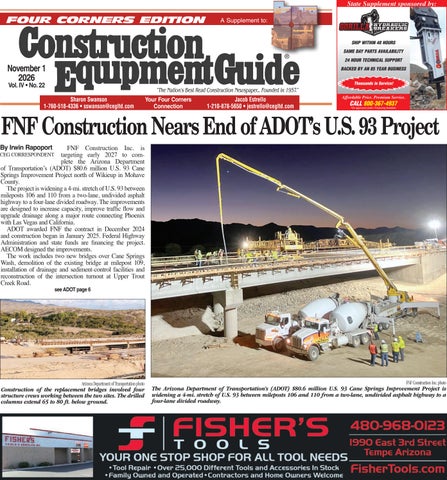
FNF Construction Nears End of ADOT’s U.S. 93 Project FNF Construction Inc. is targeting early 2027 to complete the Arizona Department of Transportation’s (ADOT) $80.6 million U.S. 93 Cane Springs Improvement Project north of Wikieup in Mohave County. The project is widening a 4-mi. stretch of U.S. 93 between mileposts 106 and 110 from a two-lane, undivided asphalt highway to a four-lane divided roadway. The improvements are designed to increase capacity, improve traffic flow and upgrade drainage along a major route connecting Phoenix with Las Vegas and California. ADOT awarded FNF the contract in December 2024 and construction began in January 2025. Federal Highway Administration and state funds are financing the project. AECOM designed the improvements. The work includes two new bridges over Cane Springs Wash, demolition of the existing bridge at milepost 109, installation of drainage and sediment-control facilities and reconstruction of the intersection turnout at Upper Trout Creek Road.
By Irwin Rapoport
CEG CORRESPONDENT
see ADOT page 6
Arizona Department of Transportation photo
Construction of the replacement bridges involved four structure crews working between the two sites. The drilled columns extend 65 to 80 ft. below ground.
FNF Construction Inc. photo
The Arizona Department of Transportation’s (ADOT) $80.6 million U.S. 93 Cane Springs Improvement Project is widening a 4-mi. stretch of U.S. 93 between mileposts 106 and 110 from a two-lane, undivided asphalt highway to a four-lane divided roadway.
Page 2 • November 1, 2026 • www.constructionequipmentguide.com • Four Corners States Supplement • Construction Equipment Guide
CMC Rock Expands Aggregates Production in Utah Privately-owned contractor and materials producer CMC Rock of Provo, Utah, announced that it strengthened its position in the Greater Salt Lake aggregates market by installing a new modular wash plant designed and engineered by washing experts CDE. The 400 tons per hour (tph) plant at the company’s West Mountain production facility is producing a range of in-spec sand and aggregates from a challenging, fines-heavy deposit, helping CMC respond to growing regional demand for washed construction materials. CMC Rock was founded in 2006 following the acquisition of Z Rock and Tru Crushing, two Utah-based companies that had produced aggregates and providing portable crushing services across the western United States since the early 1970s. Today, the company manages more than 3,500 acres of aggregate properties. In addition to its aggregate operations, CMC Rock operates three concrete batch plants to meet the growing demand for high-quality concrete products across the region. As a family-run business led by owner and President Todd Cusick, CMC Rock has extensive experience operating wash plants from a range of U.S.-based suppliers. For its new West Mountain operation, however, the company selected CDE’s M4500, which was delivered in partnership with Goodfellow Corp., to meet its urgent need for fast delivery, reliable performance and the ability to process difficult feed
The new CDE-built modular wash plant operated by CMC Rock of Provo, Utah.
A conveyer belt moves aggregate.
material. “With demand for washed concrete aggregates continuing to grow across the Greater Salt Lake area, we needed a wash plant that could help us bring high-quality material to market both quickly and reliably,” said Sam Cusick, operations manager at CMC Rock. The solution was developed following detailed analysis of CMC’s feed material, which showed high fines content and required a more sophisticated washing process. CDE’s M4500 E5 was configured with a dual pass EvoWash system, flat-
maintained the required production rate and product quality. The project is expected to bring approximately 800,000 additional tons of concrete aggregates to the Greater Salt Lake area each year, supporting CMC’s strategic expansion and helping address a supply gap in the local market. Within just a few months of the plant going live, CMC Rock secured profitable contract agreements for the entirety of its projected material production until the end of 2026. (All photos courtesy of CMC Rock.)
bottom cyclones and flexible sand blending capability to maintain C33 concrete sand specification while maximizing product yield. In addition, an AquaCycle A900 water management system provides an efficient alternative to water extraction from natural sources by recycling up to 90 percent of the process water for immediate recirculation and reuse by the system. Although the material proved more difficult to process than initial testing suggested, with fines content reaching around 15 percent at times, the plant has
Cat, Wheeler Machinery Showcase Cat Compact Experience Caterpillar Inc. and Wheeler Machinery Co. spotlighted Cat machines, their operators and the work behind world-class performance from Oct. 8-10, 2026, at Red Bull Rampage, a big mountain freeride mountain bike competition in Virgin, Utah. As an event sponsor, Caterpillar showcased Cat Compact, a new retail customer experience designed to better serve small contractors, owner-operators and growing businesses. Through dedicated locations and connected digital experiences, according to Caterpillar, the Cat Compact experience provides a simpler, more approachable way to access Cat machines, rental solutions, service and support. Cat Compact locations are paired with Cat Rentals and supported by local Cat dealers.
Red Bull Rampage is freeride mountain biking’s most distinctive test of skill, precision and control in the world, held in the rugged terrain of southwest Utah. For the last 25 years, the best riders in the world have dropped into the mountains of Utah, creating a legacy of progression in freeride history and human achievement. But before a rider or dig team arrives on site, there is work to do. Through its sponsorship of Red Bull Rampage, Caterpillar highlighted the preparation, equipment and people involved in complex projects and events. Cat machines help prepare production areas and build the infrastructure needed to bring a world-renowned freeride competition to life. Caterpillar’s collaboration with Red Bull is designed to reach customers where they already
spend their time and demonstrate what Cat machines and operators can accomplish in environments that demand problem-solving and performance. “The Cat Compact experience was designed to connect with a different type of customer, which means we have to approach marketing to them differently,” said Ashley-Brooke Winger, senior marketing consultant for Caterpillar. “Customers are forming opinions long before they enter the buying process, shaped by the people, experiences and communities they connect with. Our relationship with Red Bull gives us an opportunity to show up in those moments and let people experience Cat Compact for themselves.” For these customers, equipment is only one part of the equation.
Keeping jobs moving also requires access to service, parts, attachments, rental options and people who can help determine the right solution for the work at hand. Through participating Cat dealers, the Cat Compact experience brings together dedicated service, financing, and new, used and rental solutions in one connected experience designed around the needs of smaller equipment buyers. At Red Bull Rampage, Caterpillar used the Cat Compact experience to focus attention on the work behind the competition, including the people, equipment and processes involved in site preparation. As part of Caterpillar’s Red Bull Rampage presence, local Cat dealer Wheeler Machinery took the experience beyond the
competition itself. Wheeler Machinery sponsored and hosted the Heavy Iron Rodeo on Oc. 9, a day between the women’s and men’s competitions. The Heavy Iron Rodeo was an invite-only experience at a private, off-site venue that put athletes, creators and industry guests in the operator’s seat, testing the same skills Red Bull Rampage demands: control, precision and confidence. Participants ran the machines through an obstacle course with several competition stations going at once and prizes on the line. Wheeler equipment experts and Cat Compact representatives were on standby to assist and educate along the way. For more information, visit cat. com/catcompact or wheelercat. com.
Construction Equipment Guide • Four Corners States Supplement • www.constructionequipmentguide.com • November 1, 2026 • Page 3
New Tunnel Opens On I-40/ U.S. 93 Interchange Project
Arizona Department of Transportation map A map of the Interstate 40/U.S. 93 Interchange Project area
The Arizona Department of Transportation (ADOT) announced on Sept. 3, 2026, that it has opened a new tunnel as part of a project to construct a free-flowing interchange that will reduce delays on the main route between Phoenix and Las Vegas. This milestone comes as ADOT has reached 80 percent completion on the $106 million project to build a new connection between Interstate 40 and U.S. 93 in west Kingman. Fisher Sand & Gravel is the project’s contractor. The 239-ft.-long tunnel carries northbound Beale Street traffic from downtown Kingman and I-40 that is about to merge with northbound U.S. 93 on the way to Las Vegas. It is just one element of the project that will reduce delays with a new interchange that will eliminate the need for motorists to stop at a traffic signal on Beale Street at I-40. Instead, 1 mi. of new ramps will allow traffic to flow freely between I-40 and U.S. 93. This is the project’s second tunnel and the one that will handle the most traffic. The other tunnel, which opened in September 2025, serves local traffic using Fort Beale Drive and is 215 ft. long. The tunnel’s completion comes as ADOT
has also finished rock blasting along I-40 and wrapped up construction of sound walls along I-40. Work in progress includes paving the new mile-long ramps connecting I-40 and U.S. 93. Looking ahead, ADOT is preparing to install the final bridge girders on the flyover ramp that will connect southbound US 93 with eastbound I-40. That work is expected to take place in October. Construction is expected to continue into 2027, when the interchange will open with 6 mi. of widened or newly constructed roadway. The project includes five new bridges, two bridge widenings, four bridge rehabilitations and 2 mi. of sound walls. The project is creating a mile of new highway carrying traffic northwest of the existing interchange at I-40 and Beale Street. Other features include: • widening more than a mile of I-40 in both directions between the new interchange and Stockton Hill Road; • adding a merge lane on U.S. 93 northbound; • widening and/or rehabilitating four bridges on I-40; • building sound walls along a portion of I-40 to the west of Stockton Hill Road; and • constructing drainage features. ADOT began the project in July 2024.
mobile concrete mixers designed to boost your productivity and performance on the job site.
standard features • • • • •
AP- Touch™ Auto-Stow™ Auto-Washout™ High & Low flow admix tanks with digital flow meters Sand, stone & cement bin vibrators
• • • •
Dual auger cement metering Pump master auger with IBS bearing Work platform 360° Swivel
scan to view more
Contact us to customize your volumetric concrete mixer today 4RIVERSEQUIPMENT.COM
Page 4 • November 1, 2026 • www.constructionequipmentguide.com • Four Corners States Supplement • Construction Equipment Guide
Construction Equipment Guide • Four Corners States Supplement • www.constructionequipmentguide.com • November 1, 2026 • Page 5
Page 6 • November 1, 2026 • www.constructionequipmentguide.com • Four Corners States Supplement • Construction Equipment Guide
FNS Uses Three Asphalt Mixes for U.S. 93 Roadway “The plan was to ‘hammer’ the center span, then the two outer, followed by the support columns,” Sheets said. A Cat 336 excavator equipped with a hydraulic hammer worked alongside a Cat 325 excavator during demolition. The steel from the demolished bridge was recycled. Construction of the replacement bridges involved four structure crews working between the two sites. The drilled columns extend 65 to 80 ft. below ground. “Once the columns were drilled and poured,” Sheets said, “four structure crews worked between both bridges, allowing for subcontractors to do their work. The bridge columns were drilled to ranges of 65 to 80 ft. deep. Concrete beams with a strength of 9,000 psi, five per span, were placed, followed by a monolithic deck pour.” Crews used 4,500-psi concrete for the bridge decks, which average 8.5 in. thick. The concrete was wet-cured and reached the required strength in approximately 22 days. A Bidwell screed and 35/45 concrete pumps were used during placement. From installation of the columns, girders and abutments through completion of the deck pours, each bridge took approximately three months to construct.
ADOT from page 1
“The old bridge design includes a steep incline on the northbound lanes, causing backup due to commercial semitrucks,” FNF Senior Project Manager Jeremy Sheets told Construction Equipment Guide. “[We’re improving the situation] by creating a divided highway, as well as reducing road grade.” Addressing Safety, Construction Challenges The original 98-ft.-long bridge was completed in 1935. Although it remained structurally sound, its narrow lanes and steep approach created challenges for motorists, particularly commercial truck drivers. “When they did the studies in the wash basin for Cane Springs, there were several drill sites taken many years ago,” Stacy Hadley, an FNF project engineer, told Construction Equipment Guide. “When working with our subcontractor (Michels) for the 20 drilled shafts for NB/SB (72-in. and 66-in.) bridges, there were numerous times the drill crews hit obstructions that could not have been known, which slowed production down. Different bits had to be utilized than originally planned. “A major obstacle that hit us was Mother Nature. You are already working in a riverbed, so you take precautions…It felt like we downloaded every form of weather alert system to prepare for flash flooding and still didn’t get notices of all the flooding from storms that were miles away. At one point, the river flow was so intense that it almost eroded the existing U.S. 93 away, which would have closed the roadway down. Luckily, FNF was able to reinforce the embankment with equipment as to remedy that.” The replacement bridges and wider highway are intended to address longstanding safety concerns on U.S. 93, including narrow lanes, limited sight distances, restricted passing opportunities and insufficient areas for disabled vehicles. “While it was near its end, it still had no structural issues,” Hadley said. “However, with the narrow lanes and safety of the traveling public, the divided new four lanes of asphalt and two new bridges, we hope to never see it rebuilt in our lifespans. Asphalt will need to be updated in roughly 10 to 15 years. The bridges should last well into 100 years.” “The advantages that the traveling public will have are a safely separated and divided major highway that connects Phoenix to Las Vegas and California is more than words can say,” Hadley said. “U.S. Highway 93 is commonly referred to as one of the deadliest highways in the U.S. Past narrow lanes, no passing zones, limited sight distances and safety areas for broken-down vehicles and disabled drivers have been major issues of the past.” Roadway, Drainage Improvements FNF used three asphalt mixes — stone matrix asphalt (SMA), 416 and 409 — over an 8-in. base course. The finished roadway design includes two 12-ft. lanes in each direction, a 4-ft. inside shoulder and a 10-ft. outside shoulder. SMA, a gap-graded asphalt mix, is designed to withstand heavy traffic loads, resist rutting and perform under severe weather conditions. “This is a high-performance, gap-graded, HTO mix asphalt designed to resist deep ruts, heavy traffic loads and severe weather,” Sheets said. “SMA is a new product being used by Arizona,” Hadley said. “It replaces the older Asphaltic Concrete Friction Course [top rubber coat on asphalt.] This newer SMA makes the asphalt last longer through wear and helps control a
Arizona Department of Transportation photo
Crews used 4,500-psi concrete for the bridge decks, which average 8.5 in. thick.
smoother ride.” The two new lanes and a 100-ft.-wide median were constructed west of the existing highway. FNF built the southbound lanes first, then shifted traffic onto the completed roadway to reconstruct the northbound lanes along the existing alignment. “The plan was to construct the southbound lanes first and shift traffic onto the newly constructed roadway,” Sheets said. “Once traffic was moved, we would reconstruct the northbound lanes along the existing two-lane U.S. 93 alignment. Excavation began at the north end of the project limits and progressed through varying terrain conditions. The materials encountered consisted primarily of sand, gravel and rock. Crews excavated and placed more than 850,000 cu. yds. of embankment material. Roadway excavation totaled 753,901 cu. yds., with another 63,098 cu. yds. of over-excavation and 48,000 cu. yds. of drainage excavation. Native plants and cacti were salvaged before excavation, with some cacti replanted in the median to help control erosion and preserve the area’s appearance. Median drainage depths range from 4 to 9 ft. Drainage work included 5,587 linear ft. of corrugated metal pipe storm drain, 24 catch basin drain inlets, nine down drains and eight catch basins. Equipment used for drainage operations included Cat 340 and 325 excavators, a Cat CB2.5 utility compactor, a Cat 415 Gannon tractor, a Cat 420 backhoe tractor and a Cat 956 front loader. Two New Bridges The new northbound and southbound steel-girder bridges over Cane Springs Wash are approximately 385 ft. long. Each is a three-span structure designed to carry two lanes of traffic. FNF demolished the existing bridge in July 2026, completing the work in five days.
Final Work, Project Team Reconstruction of the Upper Trout Creek Road intersection turnout was completed in three phases over three months beginning in April 2026. The work involved excavating 25,000 cu. yds. of material, placing Class II aggregate base, installing concrete Ford walls and paving with 409 asphalt and 3,000-psi concrete. After nearly 21 months of construction, FNF’s grading and paving crews and four structure crews have completed the bridges, drainage culverts and structures, embankment excavation and grading, paving, guardrails and new rightof-way fencing. Remaining work includes road signs, lane striping, landscaping, erosion stabilization and installation of a safety barrier. “The main challenge of this project would be weather, material changes and location of the project,” Sheets said. “Having a plan and executing it helped solve many of the challenges. Maintaining a strict, well-planned schedule allowed the work to flow smoothly and ensured tasks were planned ahead of time.” Worker safety also has required attention to local wildlife. “Wikieup has some of the highest densities of rattlesnakes in Arizona,” Sheets said. “This was regularly discussed in our morning Tool Box talks as a safety concern, and the project did experience approximately 15 contacts with snakes.” Sheets leads the project with assistance from Martin Ramirez-Sponcer, Project Engineers Stacy Hadley and Chris Grade and Project Superintendent Alan Adcox. On busy days, approximately 65 FNF employees and more than 30 subcontractor employees work on-site. Major subcontractors include AZ Highway for guardrail, Precision Aggs for concrete supply, FPS Civil for landscaping, T-PAC for bridge girders, Michels Drilling for bridge columns, WSP for calcium sulfoaluminate cement and Paradise for steel rebar. New materials delivered to the project include 45,000 cu. yds. of aggregate base course, 76,000 tons of asphalt, 9,804 cu. yds. of concrete and 5,793 linear ft. of guardrail. FNF also recycled the existing asphalt into a new asphalt mix. FNF buys and rents equipment from Empire Cat, Pacwest Rentals, Ecco Equipment, Mertens Rentals and RDO (John Deere). CEG
Construction Equipment Guide • Four Corners States Supplement • www.constructionequipmentguide.com • November 1, 2026 • Page 7
See how our solutions and technology can fast-track your productivity and profits.
www.foursightsolutions.com
Rio Bravo Bridge Replacement Work Starts On Senoa Project Begins in Albuquerque Resort & Spa in Arizona The New Mexico Department of Transportation (NMDOT) announced the start of work to replace the east- and west-bound bridges on New Mexico 500 (Rio Bravo Boulevard) spanning the Rio Grande in Albuquerque within Bernalillo County. The $117.46 million project, which is in cooperation with the Federal Highway Administration (FHWA), is located on NM 500
New Mexico Department of Transportation map A map of the construction area on New Mexico 500
between New Mexico 314 (Isleta Boulevard SW) and New Mexico 303 (Second Street SW) and includes the two bridges crossing the Rio Grande and two bridges crossing the Middle Rio Grande Conservancy District (MRGCD) Albuquerque Riverside Drain. A contractor wasn’t named. Construction is expected to last into 2030. Rio Bravo Boulevard is a critical east-west route in Albuquerque’s South Valley and is one of seven Rio Grande crossings in the Albuquerque metro area. The purpose and need of the project is to address structural deficiencies while also reducing congestion and improving multi-modal transportation system connectivity within the project limits. The needs are based on the fact that the eastbound river bridge is in poor condition and requires replacement, pedestrian and bicycle facilities are discontinuous in the project limits and it has been determined that additional river crossing capacity is needed in the metro area. The civil construction project will include roadway widening and new pedestrian and bicycle infrastructure. Improvements will also include new sidewalks, trails and additional street lighting along the corridor.
R.D. Olson Construction recently broke ground on the $116 million, 70-room Senoa Resort & Spa on 11.5 acres in Sedona, Ariz., according to hotelnewsresource.com. The resort is expected to open in late 2028. The wellness resort at 150 Schnebly Hill Road will be villastyle. It is located minutes from downtown Sedona and includes desert and creekside areas, according to hotelnewsresource.com. R.D. Olson Construction will team up with R.D. Olson Development and Senoa Investment Partners to build the facility, while AO is the architect of record and WATG is the entitlement architect. The resort will feature 29 freestanding structures with sitesensitive materials, preserved sightlines and the salvaging of Soaptree yucca plants, according to hotelnewsresource.com. The resort is expected to create more than 150 jobs in hospitality,
health and construction. Amenities are slated to include a two-story creekside restaurant with indigenous menu choices, a Red Rock Saloon, an event lawn with green foliage and private creek access and a pool area. It also will feature a 5,500-sq.-ft. spa and a 3,200-sq.-ft. meetings and events space, according to hotelnewsresource.com. Guest accommodations will range from 600-sq.-ft. bedrooms and 720-sq.-ft. suites to a 1,300-sq.-ft. presidential suite. Room will feature indoor-outdoor layouts. There will be two phases of construction, according to hotelnewsresource.com. A first phase will include demolishing and remediating existing buildings, grading, drainage, utilities, site-work improvements and the certification of building pads. The final phase will include the construction of new villas and the final site work, according to hotelnewsresource.com.
Page 8 • November 1, 2026 • www.constructionequipmentguide.com • Four Corners States Supplement • Construction Equipment Guide
Issue# 24 26 2
Closing
Publishing
November 18 December 16 January 13
November 29 December 27 January 24