
Sharon Swanson
1-760-518-4336 • sswanson@cegltd.com
Sharon Swanson
1-760-518-4336 • sswanson@cegltd.com
By Irwin Rapoport CEG CORRESPONDENT
The Arizona Department of Transportation (ADOT) is investing $70 million to replace two aging bridges on U.S. 60 just east of the town of Superior in Pinal County.
Construction began in early 2024, with Ames Construction expected to deliver the project in the summer of 2028.
Ames has crews working on the two new structures between mileposts 227 and 229.5.
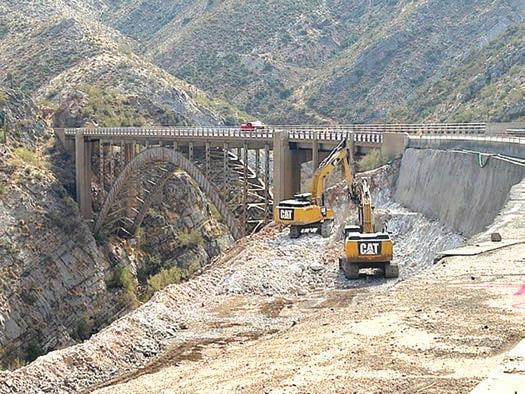
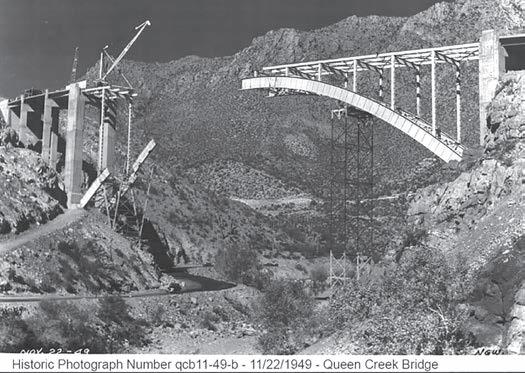
A new Queen Creek Bridge is being constructed just east of the existing steel arch bridge — 763 ft. long, one lane in each direction plus shoulders — which will be demolished once the new one is built.
The concrete Waterfall Canyon Bridge, supported by several concrete columns — 107 ft. long, one lane in each direction, east of the Queen Creek Tunnel — is being reconstructed into two box culverts to improve drainage, and will remain in its existing location. Guardrail replacement and other general maintenance work also is occurring within and near the Queen Creek Tunnel.
“The Queen Creek Bridge, built in 1949, and the Waterfall Canyon Bridge, built in 1929, were built to standards in those times,” the ADOT project web page said. “However, those standards no longer meet the current minimum bridge guidelines of ADOT or the Federal Highway Administration and the American Association of State Highway Transportation Officials. ADOT has completed multiple maintenance projects on the bridges to extend their lives; however, due to weather and continued traffic-induced vibrations, the structures have reached the
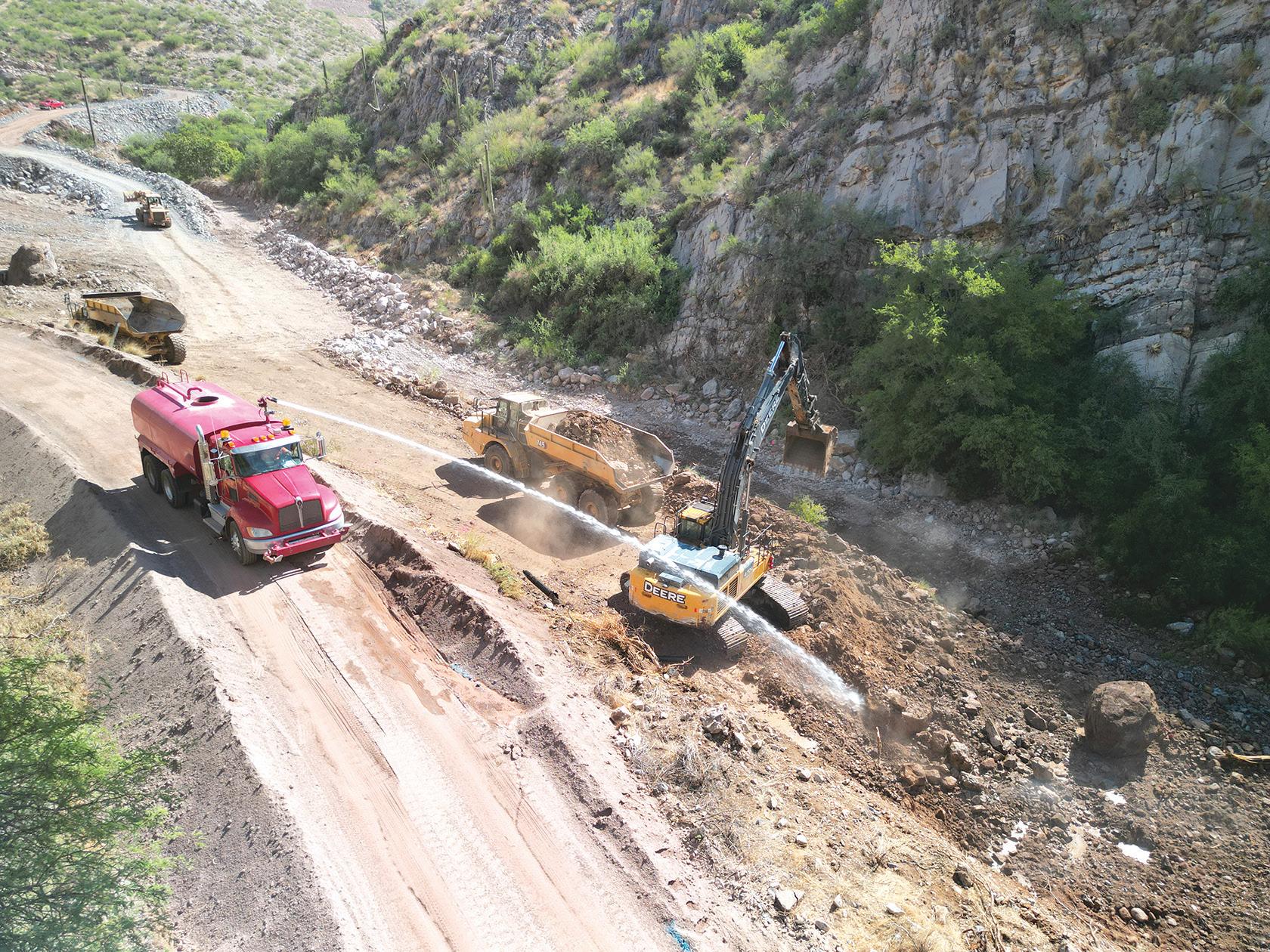
The Arizona Department of Transportation (ADOT) is investing $70 million to replace two aging bridges on U.S. 60 just east of the town of Superior in Pinal County.
Superior,” Garin Groff, an ADOT spokes man, told Construction Equipment Guide.
“Regionally, it reduces the detour through Winkleman by approximately 75 miles.”
The project’s scoping document was completed in 2017. An in-house ADOT team designed the project.
In 2023, 8,242 cars and trucks crossed the
blasting and removal from U.S. 60 to main tain traffic,” said Groff, “as well as the access road to build the bridge, the removal of the existing bridge and geotechnical conditions.”
The lifespan of the new bridge structures is 75 years.
The traffic management plan is based on
Ames Construction has completed the corridor safety improvements. Over the next year, efforts will focus on completing the new bridge substructure and beginning — and hopefully completing — the new bridge superstructure.
see BRIDGES page 6

For two straight weeks in the early 1980s, temperatures in Colorado’s San Luis Valley never rose above zero. The ground was frozen solid. Crews walked away. Machines failed.
One contractor kept digging.
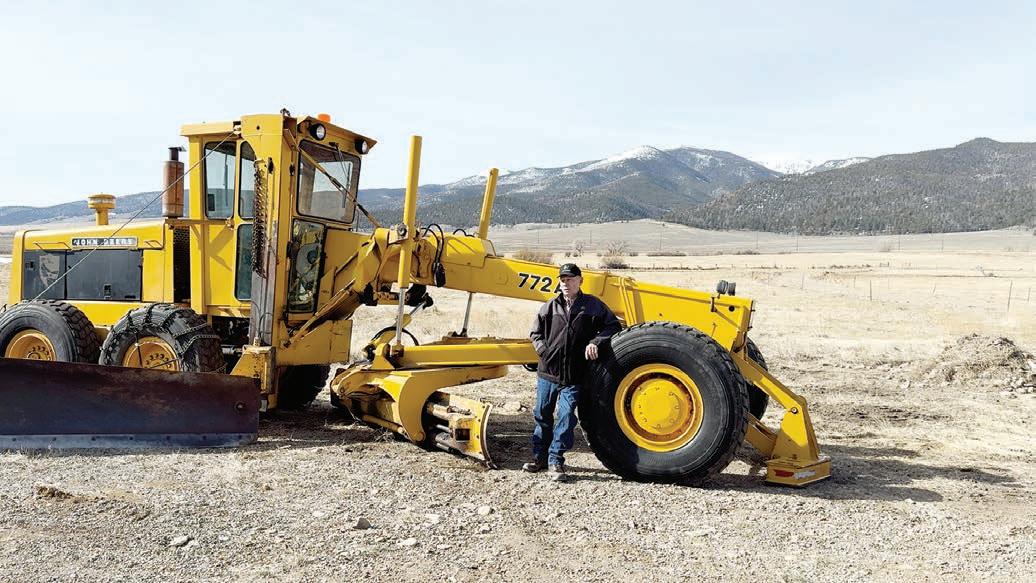
Richard Broders, then a one‑man operation, continued trenching electrical lines through several feet of frozen ground for the city of Colorado Springs — a job that would become emblematic of a career defined by grit, independence and staying power in some of Colorado’s most unforgiving conditions.
Today, Broders is 83 years old and marking 54 years as an independent contractor, a career that began in August 1971.
“I quit and came home with one paycheck and said, ‘We’re going into business,’” Broders said.
Working primarily at elevations above 8,500 ft., Broders built his livelihood across southern Colorado, carving roads, ditches and infrastructure that helped support rural communities throughout the San Luis Valley. For decades, he worked largely on his own — relying on persistence, mechanical know‑how and equipment he could depend on to survive long days, harsh weather and remote job sites.
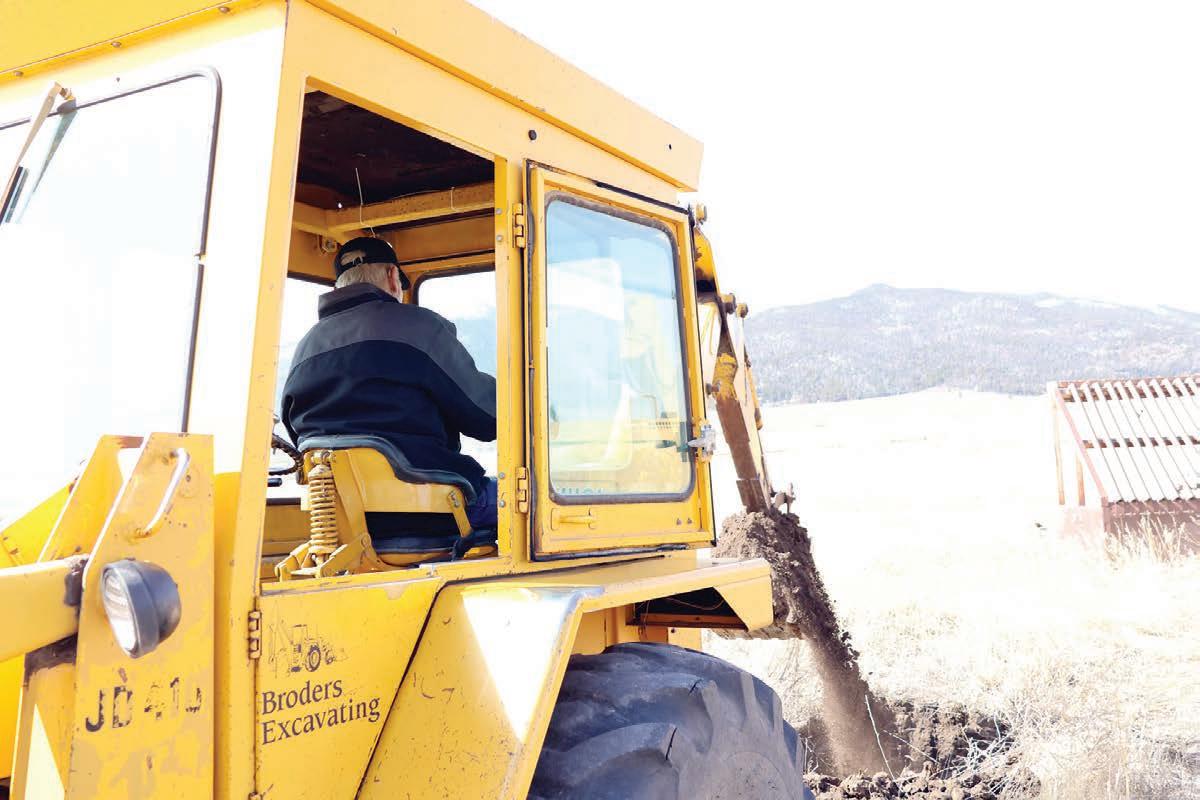
Among the machines he ran were a John Deere 310 backhoe he bought when starting out, followed later by a 772 motor grader, a 490 excavator and a 410 backhoe acquired in the early 1980s. He credits dependable equipment and consistent access to service and parts for allowing him to keep working when others couldn’t.
“I could always get what I needed to keep going,” Broders said. “That matters when you’re working by yourself, and the job has to get done.”
One moment that has stayed with him involved a cracked control valve on his excavator during a time when replacement parts were difficult to find. Getting the machine back into operation meant the difference between losing time — and income — or staying on schedule.
The parts workers at his local 4Rivers made calls, used all their available connections, and tracked down what Richard needed.
“That made a big difference,” he said. “I was able to keep working.”
Broders’ half‑century of experience reflects a bygone era of independent contracting — and highlights a challenge facing Colorado today. His career milestone comes as the state faces a shortage of skilled tradespeople, making his longevity and hands‑on expertise increasingly rare and
Despite briefly partnering with family early on, Broders spent most of his career working independently, building trust with communities through reliability rather than scale. He measures success not by expansion, but by endurance.
“I never had any trouble doing business,” he said. “I just
As Colorado looks for ways to preserve institutional knowledge in the trades, Broders’ story stands as a reminder of what long‑term commitment, craftsmanship and resilience look like on the ground — especially in rural regions like the San Luis Valley, where infrastructure depends on people
Salt Lake County, Utah, announced on April 3, 2026, that it entered Phase II of design and planning for the reconstruction of the Calvin R. Rampton Salt Palace Convention Center, marking a step toward a more modern, connected and visitor focused destination in downtown Salt Lake.
increment financing mechanisms designed to reinvest in the county’s convention and
Additionally, Salt Lake County announced a complete planning, architectural, and constructionteamtorealizethe transformation of the Salt Palace Convention Center by 2031. It will prioritize enriching the 50 acre district into a connected walkable vital section of downtown that will serve as a modernized gathering place focusing on entertainment, sport, conventions and culture.
The county finalized its project team with the addition of Jacobsen Construction and AECOM Hunt, chosen through a for the redevelopment.
The construction firms join local architectural firm MHTN Architects and global firm Populous, which specializes in stadium and venue design. Construction management services are provided by Construction Control Corp. and Rider Levett Bucknall (RLB).
“The creation of the Sports, Entertainment, Culture and Convention District (SECC) is a generational opportunity to reinvent a vital section of our state’s capital city,” Salt Lake County Mayor Jenny Wilson said.
“With strong support from our community partners and world class project team, we are confident this investment will result in a fundamentally reimagined section of downtown serving local residents, area business
adding a second full convention center that enables Salt Lake to host multiple major events simultaneously, something meeting planners have long requested, and competitors already offer.
This addition will help to generate an estimated $105 million in additional annual economic impact on top of the $300 million per year that the center already generates in its current form.
The facility will retain a similar square footage total while enhancing connectivity between levels to create better attendee flow, reduce congestion and improve the overall event experience.
Funding for the project is made possible through the Convention Center Revitalization Zone (CCRZ) and tax
The selected design concept will ensure the most cost effective path forward, maximizing the value of public investment while still achieving the features of a world class facility.
“When conventions thrive, our community thrives,” said Kaitlin Eskelson, president and CEO of Visit Salt Lake. “Tourism currently injects $6.1 billion into the Salt Lake County economy annually, and this modernization of our convention center improves our ability to better serve residents and visitors by offering a more seamless and connected experience in the area. It will also generate more hotel stays, more restaurant traffic and more tax revenue to reinvest in the county.”
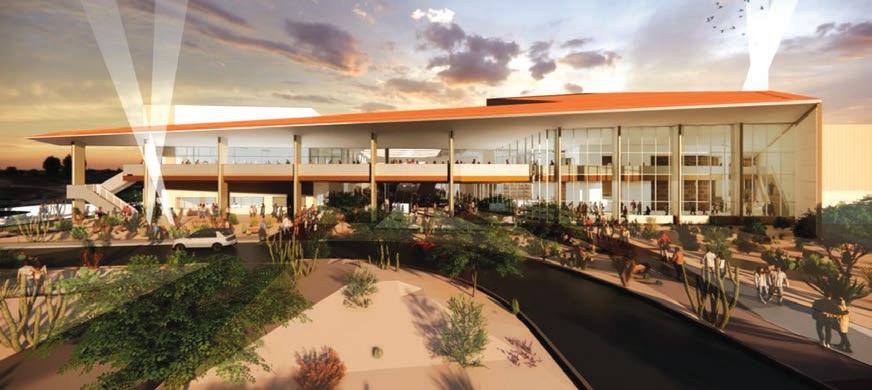
Architekton rendering
A rendering of the 91,000-sq.-ft. Cultural and Performing Arts Center now under construction in Coolidge, Ariz.
Central Arizona College broke ground on a 91,000-sq.-ft. Cultural and Performing Arts Center at its Signal Peak Campus in Coolidge on March 31, 2026.
The $102 million, ground-up facility is designed to restore and significantly expand performing arts opportunities for students and the surrounding community following the 2023 collapse of the Pence Center auditorium roof.
Located at 8470 N. Overfield Road, the new center is expected to be completed in fall 2027 and will serve as a cultural hub for Pinal County, blending performance, education and community engagement in a single destination.
“Today is about more than breaking ground on a building; it is about restoring a vital cultural and educational cornerstone for our college and the communities we serve,” said Jackie Elliott, president and CEO of Central Arizona College. “In the wake of the Pence Center loss, we saw an opportunity to reimagine what a performing arts facility could be. This new center will not only bring performances back to campus, but will expand access, elevate programming and create a space where creativity, collaboration and connection can thrive for generations.”
The facility’s south half will be anchored by a 1,000-seat theater designed to support professional-level productions. The venue will include a 95-ft.-tall fly tower, allowing scenery, curtains and lighting to be lifted and stored above the stage for rapid transitions and complex performances. A gridiron above the stage will support advanced rigging systems, while a 26-ft. proscenium opening will frame performances for optimal audience experience.
Additional theater features include a dedicated control room, accessible catwalks
for lighting and technical operations, dressing rooms, private STAR rooms for lead performers, a green room and a large scene shop for set construction.
The venue also is designed to accommodate touring productions, with loading areas that allow semitrailers to connect directly to built-in power systems for efficient setup.
Guests will be welcomed by a dramatic glass curtain wall entrance, as well as amenities including a concessions bar, box office and an acoustical system.
“The scale and sophistication of this project reflects Central Arizona College’s commitment to creating a facility that rivals professional venues while remaining deeply rooted in community access and student success,” said Barry Chasse, founder of CHASSE Building Team.
Designed by Architekton and constructed by CHASSE Building Team, the center extends beyond performance. Integrated classrooms and labs will support programs in entertainment industry technology, as well as ceramics and kiln operations, metals and welding, hospitality training and culinary arts.
A professional teaching kitchen will anchor the culinary program and support a second-floor banquet facility designed to host community events, meetings and private functions, creating a potential revenuegenerating asset for the college.

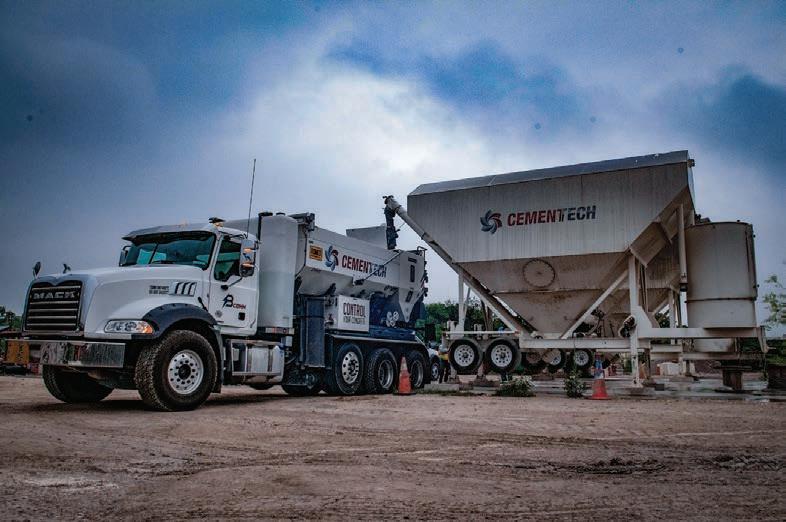
• High & Low flow admix tanks with digital flow meters
• Sand, stone & cement bin vibrators
• Dual auger cement metering
• Pump master auger with IBS bearing
• Work platform
At the heart of the building will be an interior courtyard, designed as a welcoming gathering space featuring cast-in-place seating, string lighting and shaded areas for students and visitors. Steel pedestrian bridges will connect the facility across landscaped portions of campus, further integrating the center into the broader Signal Peak environment.

• 360° Swivel scan to view more





The project has encountered a range of geological challenges.
“The team continues to assess these conditions and implement effective, engineered solutions to address each issue as they arise,” Zachary Taylor, Ames Construction’s senior project manager, told Construction Equipment Guide. “While the project has involved numerous challenges and unknown conditions, the team has worked diligently to overcome them. Progress continues steadily, with work advancing as efficiently as possible given the site conditions.”
“Despite the challenges inherent in the project, coordination and collaboration with ADOT have remained strong,” he added.
“The Ames project team and ADOT communicate proactively and work together to resolve issues efficiently, maintaining a positive and productive partnership.”
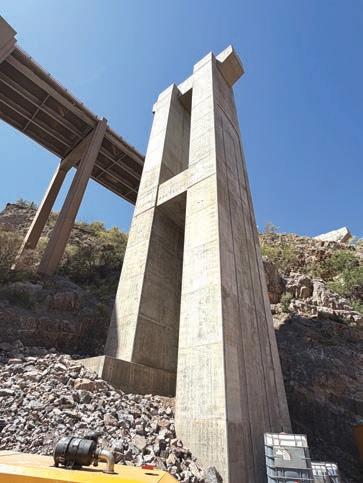
Construction of the new Queen Creek Bridge, a cast-inplace multi-steel-span structure, began in April 2024 and should be completed in June 2028.
“The challenging terrain and complex geological conditions have significantly influenced construction activities and added to the overall complexity of the project,” Taylor said. “One notable accomplishment has been the careful planning and execution required to remove an entire mountainside within a five-hour work window while still maintaining traffic access before and after operations.”
The temporary access road leading to the area beneath the existing bridge, as well as others, “had to be created to all the work areas to allow for safe travel and transport of equipment and materials,” Taylor said.
Materials for the bridge construction include ready-mix concrete and fabricated steel beams.
Careful planning for the demolition and reconstruction sequencing is making the bridge work more efficient.
The demolition plan for the existing bridge involves the controlled removal of the concrete deck and girders in sections, followed by the demolition of the remaining bridge components through planned blasting to a prepared working pad below.
The transformation of the Waterfall Canyon Bridge into two box culverts — 5-ft.-6-in. long that stretches across 160 ft. of three-lane roadway — started in October 2024 and should be completed in 2027.
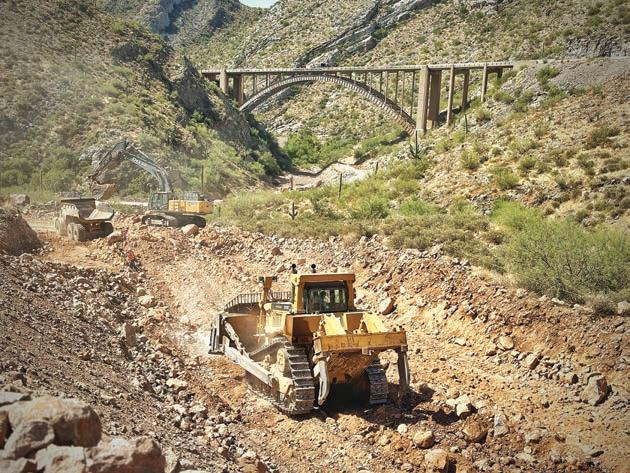
The Ames team developed and implemented a comprehensive blasting and blasting safety plan.
“This plan included required pre-activity safety meetings, the installation of physical and temporary barriers and constant communication among guards controlling all access points for both vehicle traffic and pedestrians,” Taylor said. “Following each blast, trained personnel conducted thorough visual and physical inspections to verify that the area was safe before allowing re-entry and reopening access.”
A temporary access road approximately 28-ft. wide was built to permit construction equipment and crews to access the support columns and substructure and store construction materials.
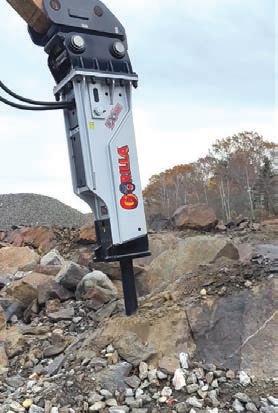
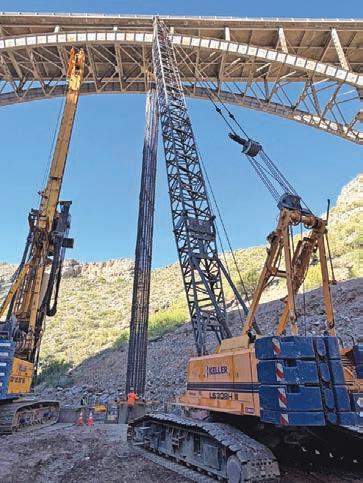
The project uses a range of heavy construction equipment, including a Cat D8 dozer, two Cat 336 excavators equipped with hydraulic hammers, three crawler cranes and two Cat 740 articulated haul trucks. Specialty equipment includes a Bauer BG 45 drilling rig, which is being used for drilled shafts.
The blasting operations targeted some of the steep slopes alongside the highway. Carefully planned and strategically placed charges were drilled and set at heights between 20 and 120 ft. above the road. The force of the blasts brought down large and small pieces of varying types of rock.
After the dust cleared and the landslides ended, excavators (Cat mini-excavators and large John Deere models) began to remove the debris along the road and the temporary accesses built along the slope. The road operations had large loaders, mini-dozers and Cat mini-excavators parked on either side of the blast areas and temporary access roads below the lanes.
“Blasting was required to address safety concerns related to overhanging rock ledges located too close to traffic at two locations along the project corridor,” Taylor said. “Removing the large volumes of rock necessary to mitigate these hazards could only be accomplished through controlled blasting. In addition, blasting was essential to create safe and workable access into the canyon, as other potential access routes were not feasible.”
The temporary access roads above and below the highway were created by blasting, followed by earthwork led by dozers and off-road trucks.
The guardrail replacement and other general maintenance work within and near the Queen Creek Tunnel will be done toward the end of the project.
“Tunnel repairs other than repainting have been completed at ADOT’s direction,” Taylor said.
Peak days have between 25 and 40 Ames and subcontractor personnel on site. Key subcontractor partners include Keller, GSI, Utah Pacific, TPAC, Endo Steel, Truesdell Corp. and Cactus Asphalt.
Earthwork operations have generated approximately 130,000 cu. yds. of material.
“Some earthwork materials have been able to be used to assist in roadway repair projects after storms in other parts of the ADOT district,” Taylor said.
The combination of the rugged terrain and materials removed by blasting, excavation and earthwork activities is taking a toll on the equipment.
“An area of extremely hard rock that could not be blasted for safety reasons due to its location caused some wear to our equipment,” said Taylor, who noted that having onsite mechanics helps to ensure rapid repairs and minimize downtimes. The keys to effective maintenance are knowing when to use the right machine for the right task.”
Ames Construction is aided in caring for its equipment by Empire CAT and, at times, rents machinery from United Rentals. CEG
(All photos courtesy of Ames Construction.)


technology
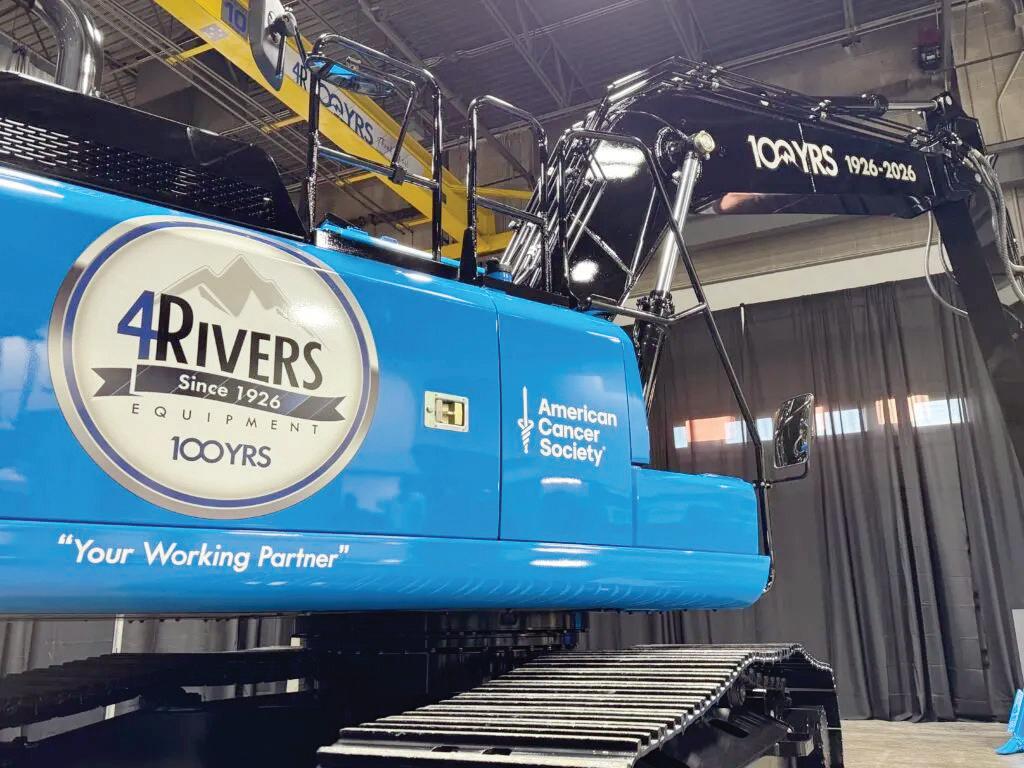
pace to surpass its original goal of $100,000 donated to the American Cancer Society.
In late January, 4Rivers invited employees, customers and partners to the unveiling of a specially painted blue John Deere 200G excavator. This machine serves a dual purpose: celebrating the company’s 100th anniversary while raising money to support families affected by cancer across Colorado

Civil construction company HEI Civil announced that its Colorado Division was honored with the 2025 William H. Feather Safety Award by the National Utility Contractors Association (NUCA).
This marks the second consecutive year that the Colorado Division received the award, which recognizes the team for achieving a safety record of more than 1 million manhours worked without a recordable incident, which the company said underscores its commitment to its foremost critical success factor, safety.
Partners who donate a minimum amount to “One Big Goal” have their decals added to the machine. The excavator also is making the rounds to each 4Rivers Equipment branch, where it will be displayed for two weeks at a time.
As of April 13, 4Rivers has raised $64,500 and plans to continue building momentum. Anyone interested in donating can do so at raiseyourway.donordrive.com/events/1752.
“Being recognized with the NUCAWilliam H. Feather Safety Award for the second consecutive year is a tremendous honor,” said Luis Uresti, HEI Civil’s Colorado safety manager. “Surpassing 1 million manhours without a recordable incident is a testament to our team’s dedication, vigilance and commitment to watching out for one another. We are proud of the hard work and care our team puts into creating a safe environment every day.”
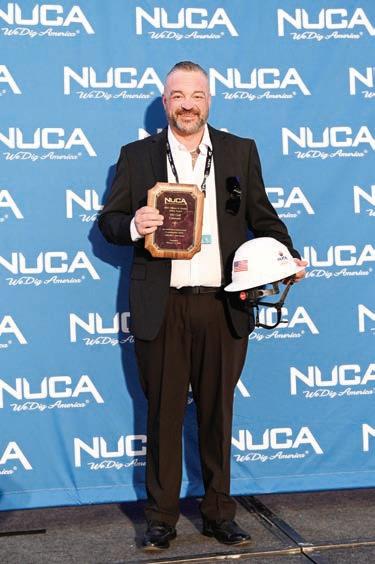
HEI Civil said the recognition speaks not only to its dedication to safety but “also to its core values of growth, raising the every individual is included in the shared goal of building safer, stronger results for clients and communities.”
HEI Civil was founded in 1973 and works across Colorado, Texas and North Carolina. For details, visit heicivil.com.