State Supplement sponsored by:
CALIFORNIA STATE EDITION A Supplement to: SHIP WITHIN 48 HOURS SAME DAY PARTS AVAILABILITY
®
December 28 2025
24 HOUR TECHNICAL SUPPORT BACKED BY AN 85 YEAR BUSINESS Thousands in Service!
Vol. VI • No 26
“The Nation’s Best Read Construction Newspaper… Founded in 1957.”
Your California Connection – Sharon Swanson – 1-760-518-4336 – sswanson@cegltd.com
Affordable Price. Premium Service.
CALL 800-367-4937 *On approved credit • Financing Available
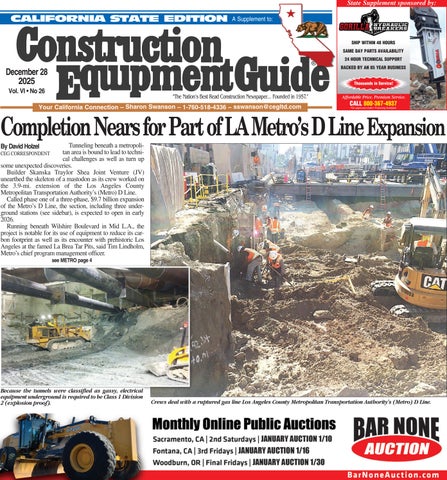
Completion Nears for Part of LA Metro’s D Line Expansion Tunneling beneath a metropolitan area is bound to lead to technical challenges as well as turn up some unexpected discoveries. Builder Skanska Traylor Shea Joint Venture (JV) unearthed the skeleton of a mastodon as its crew worked on the 3.9-mi. extension of the Los Angeles County Metropolitan Transportation Authority’s (Metro) D Line. Called phase one of a three-phase, $9.7 billion expansion of the Metro’s D Line, the section, including three underground stations (see sidebar), is expected to open in early 2026. Running beneath Wilshire Boulevard in Mid L.A., the project is notable for its use of equipment to reduce its carbon footprint as well as its encounter with prehistoric Los Angeles at the famed La Brea Tar Pits, said Tim Lindholm, Metro’s chief program management officer.
By David Holzel
CEG CORRESPONDENT
see METRO page 4
Because the tunnels were classified as gassy, electrical equipment underground is required to be Class 1 Division 2 (explosion proof).
Crews deal with a ruptured gas line Los Angeles County Metropolitan Transportation Authority’s (Metro) D Line.
Page 2 • December 28, 2025 • www.constructionequipmentguide.com • California State Supplement • Construction Equipment Guide
SoCal JCB Celebrates Opening of Sundt, Jacobs Finish Colton Headquarters With Open House
San Mateo Cuts Ribbon...
$597M Wastewater Treatment Upgrade
The front of SoCal JCB’s new headquarters in Colton.
California Water Boards photo
The recently upgraded San Mateo, Calif., water treatment plant
Federal, state and local leaders joined community members on Sept. 24, 2025, to cut the ribbon on San Mateo’s new Wastewater Treatment Plant, the largest component of the city’s $1 billion Clean Water Program. The upgraded facility replaces 75-year-old infrastructure, eliminates sewer overflows and introduces advanced treatment technologies that protect public health and safeguard San Francisco Bay for generations to come. Construction by Sundt (contractor), Jacobs (project and construction management) and HDR (design engineer), began in 2019 and was completed while the existing plant was working. Features include: • One of the largest BioActiflo systems in the world, enabling treatment of up to 78 million gal. per day during heavy storms. • A 5.3 million gal. underground flow equalization system (UFES) at the San Mateo Event Center — one of the largest wastewater storage facilities of its kind in California — preventing neighborhood flooding and protecting the bay. • Five-stage biological nutrient removal and membrane bioreactor systems, making it one of the most advanced treatment facilities in California. • A LEED Silver-certified administration building, one of the most sustainable treatment plants in the nation, plus new public pathways, landscaping and educational signage. “This project is first and foremost about clean water and sustainability. By investing in advanced treatment technologies, we’re protecting San Francisco Bay, reducing emissions and preparing for a changing climate, said Alex Khokikian, city manager. “At the same time, we wanted this plant to serve our community in more ways than one — not just as a critical piece of infrastructure, but as a public space with walking paths, art and educational features that connect residents to the importance of caring for our environment.” The plant is co-owned by the city of San Mateo and Foster City/EMID and also serves half of Hillsborough, the Crystal Springs County Sanitation District and parts of Belmont and unincorporated San Mateo County — serving more than 170,000 residents.
SoCal JCB opened the doors to its new Colton headquarters with a grand opening celebration on Nov. 19, 2025, at 2860 S. Iowa Ave. The event was open to the public and featured live music, lunch, giveaways, hands-on equipment access and appearances from key partners, including the monster truck DIGatron. The open-house-style event gave visitors the chance to explore the 13,000-sq.-ft. dealership and 3-acre lot that serves as the Southern California hub for JCB’s machinery and service. Live equipment demos showcased both the facility’s capabilities and the machines SoCal JCB provides to contractors, municipalities and businesses across the region. In addition to compact excavators and wheel loaders, SoCal JCB specializes in compact and versatile machines such as the Teleskid 3TS-8T and 3TS-8W. These are JCBexclusive models that combine the maneuverability of a skid steer with the reach and lift capabilities of a telehandler. These machines, with rated operating capacities of more than 3,600 lbs. are built to deliver high performance in tight job sites. Also on display will be mini excavators designed
SoCal JC photo
for precision work in confined spaces, part of JCB’s growing range of compact construction equipment. “This building represents more than just a new location,” said Caleb Wright, dealer principal at SoCal JCB. “It reflects how we do business; transparent, customer-focused and invested in making sure every machine we put on the job delivers value from day one.” The Colton location was built to JCB’s global prototype standards and includes an eight-bay service area, integrated retail space and extensive equipment yard. Its position along the Interstate 215 corridor — Southern California’s heavy equipment row — puts SoCal JCB in the center of the region’s construction and development activity. From its Colton and La Mirada locations, SoCal JCB serves customers from Ventura County south through Los Angeles, Orange, San Bernardino and Riverside counties, with service support extending into San Diego. The dealership is already preparing for future expansion to meet growing demand. For more information, visit socaljcb.com or call 866/5227225.
Cal Poly San Luis Obispo Wins 2025 DBIA Design-Build Student Competition California Polytechnic State University, San Luis Obispo, won the 2025 National Design-Build Student Competition, presented by the DesignBuild Institute of America (DBIA). The team’s innovative response to this year’s airport expansion challenge earned top honors among 33 participating teams from across the nation. The annual competition challenges student teams to apply “Design-Build Done Right” principles to a real-world project scenario, testing their ability to collaborate, innovate and deliver solutions that balance cost, schedule and quality. Seven regional winners advanced to the request for proposals phase, and the top three finalists presented their pro-
posals live during the Design-Build Conference & Expo in Las Vegas on Nov. 6 before a panel of industry experts. Winners 1st Place: D&T Construction — California Polytechnic State University, San Luis Obispo 2nd Place: Cypress Construction — University of Florida 3rd Place: Pioneer Design-Build — Alfred State College Best Individual Presenter: Asa Richards, University of Florida The Best Individual Presenter award recognizes the student who demonstrates exceptional communication, professionalism and mastery of their project during the final presentation
round. DBIA thanked Parsons Corp. for sponsoring this year’s student programming and HCSS for providing its cost-estimating platform to participating teams. “What we see in this competition each year is the future of our industry taking shape,” said Lisa Washington, DBIA executive director and CEO. “These students already understand how to align teams, manage complexity and deliver value. These are the skills that will make them immediate assets in a market demanding designbuild leadership.” For more information, visit dbia.org/student-engagement/studentcompetition/.
Construction Equipment Guide • California State Supplement • www.constructionequipmentguide.com • December 28, 2025 • Page 3
THE TELEH HANDLERS YOU’D MAK KE IF YOU MADE TEL LEHANDLERS
INTRODUC NTRODUC TRODUC CING THE AL ALL-NEW LL-NEW CAT® TELEHANDLERS DLERS – comple etely redesig redesigned around your y need for next ge en safety affetty fe features, eatu uress, ope perato erat ra ator ease, and low maintenance/imp a nan nce/im e/ mproved p d uupti uptim ptim me. Whether yo ou’ree looking okin ng g to to ® g you everything yo ou need. eed rent nt or add one to your you ur fleet fleet, your California Cat at dealer is herre to get SEE FULL LINEUP
haawthornecat.com San Diego 866
holtca.com Central Northern California
ppetersoncat.com Bay Area & Northern California, west Washington -4353
SINCE 1956
SINCE 1931
SINCE 1936
hawthornecat.com San Diego & Hawaii 866-703-7085
holtca.com Central Northern California 888-294-9778
petersoncat.com Bay Area & Northern California, Oregon, and Southwest Washington 844-349-4353
©2025 Caterpillar. All Rights Reserved. CA ATT, CA ATTERPILLAR, LET’S DO THE WORK, their respective logos, “Caterpillar Corporate Yellow,” the “Power Edge” and Cat “Modern Hex” trade dress, as well as corporate and product identity used herein, are trademarks of Caterpillar and may not be used without permission.
Page 4 • December 28, 2025 • www.constructionequipmentguide.com • California State Supplement • Construction Equipment Guide
Project Challenges Include Tar Sands, Oil Field Remnants
The La Brea Station is excavated below supported utilities. METRO from page 1
“We knew there was a strong possibility of uncovering fossils. So, we had to operate our machinery with extra caution to avoid damaging anything buried beneath the surface,” Lindholm said. “During construction, more than 500 fossils were unearthed, including some dating back to the Ice Age.” Skanska, Traylor and J.F. Shea brought “a talented and experienced team,” to the project, Lindholm said. They previously worked together on “large, complex infrastructure projects across the country.” The builders maintained traffic, utilities and business access in the tight urban environment. Anomalies, Safety Measures Lindholm noted the difficult ground conditions the builders faced — tar sands, methane zones and undocumented oil-field remnants. The tunnels were classified as “gassy.” In a first, the team used horizontal directional drilling and magnetometer surveys to identify hazards before discovering them during tunneling, Additional safety measures included “vapor-extraction systems, targeted dewatering to manage groundwater and continuous settlement-monitoring along the corridor,” Lindholm said. “We’ve encountered a few surprises during construction, with the tunnel boring machines [TBMs] specifically when we were looking for oil wells that may have been within the tunnel alignment,” he added. One surprise was the steel anomalies found at tunnel depth at two locations. “At the east end, directional drilling and a magnetometer located a potential casing within the tunnel alignment; this anomaly was avoided by steering the TBMs around it,” he said. “The anomalies at the west end proved to be more of a challenge. These anomalies, at the intersection of Wilshire and San Vicente, were too close to the Wilshire/La Cienega station to steer around and needed to be removed.” Working with Metro, Skanska Traylor Shea Joint Venture JV installed chemical grout blocks around the anomalies to stabilize the soil. Then, at 1-ft. increments, hand mined in front of the TBMs to locate the anomalies. “The anomalies, while not oil wells, were steel beams that would have severely damaged the TBMs,” Lindholm said.
A Gradall XL4200 excavator works underground.
The presence of the La Brea Tar Pits presented a unique challenge.
That never happened. The anomalies were removed and tunneling to La Cienega was completed.
designed to run at lower operating temperatures than traditional equipment,” he said. The team piloted a zero-emission Volvo EC230 Electric excavator at the La Brea station to test the capabilities of a battery-powered excavator to perform excavation work. “We also piloted a zero-emissions electric compaction roller at the Fairfax station for the compaction of subgrade and crushed aggregates,” Lindholm said. For the tunneling, other electrical equipment with zero emissions include: backfill grout batching plant, conveyor systems, ventilation systems (tunnel and stations), cooling plant and compressed air plant.
Zero Emissions The construction of the first phase of the D Line extension was an opportunity to test innovative equipment that would decrease the carbon footprint on construction sites, Lindholm said. Because the tunnels were classified as gassy, electrical equipment underground is required to be Class 1 Division 2 (explosion proof). “We utilized a highly specialized fleet of equipment consisting of small excavators, track loaders and Gradalls, all
see METRO page 6
Three Stations Under Construction Segment 1 of LA Metro’s D Line Expansion includes three new underground stations that connect to the existing Wilshire/Western station: Wilshire/La Brea, Wilshire/La Cienega and Wilshire/Fairfax, according to Tim Lindholm, Metro’s chief program management officer. The stations are 450 ft. long with center platforms. The station boxes extend approximately 800 to 1,000 ft. long to accommodate equipment rooms at each end of the stations and the crossover structures at La Brea and La Cienega, he said. Each station features one-of-a-kind artwork by local artists, with themes representing the specific area, Lindholm said. “Final design and construction of the three stations was by STS using cut-and-cover methods for station construction,” he said.
A steel girder is moved into place.
Construction Equipment Guide • California State Supplement • www.constructionequipmentguide.com • December 28, 2025 • Page 5
From loaders to excavators, N&S Tractor has all your CASE Construction equipment needs covered. Visit one of our locations today and put power, reliabilit y, and performance to work for you.
CALIFORNIA COLUSA ay 20 1960 Highway Colusa, CA 95932 Phone: (530) 458-21666 DIXON 793 N First Street C 95620 Dixon, CA (916) 649-0096 Phone: (9 DOS PALOS 2173 Blossom Street Dos Palos, CA 936200 Phone: (209) 392-21661 MERCED ay 59 600 S. State Highway Merced, CA 95341 Phone: (209) 383-5888
REDDING 2535 Ellis Street Redding, CAA 96001 Phone: (530) 245-9000 STOCKTON ay 1340 W. Charter Way Stockton, CAA 95206 Phone: (209) 944-5500 ATFORD STRAT 20280 Main St. C 93266 Stratford, CA Phone: (559) 947-3301 TURLOCK 1215 West Glenwood AAvve Turlock, CAA 95380-5703 Tu Phone: (209) 634-1777
WILLOWS 827 North Te Tehama St Willows, CA 95988 Phone: (530) 934-3382 YUBA CITY ay 3056 Colusa Highway Yuba City, CA C 95993 Phone: (530) 923-7675 NEVADA O/SPA PARKS RENO Ave. 1455 Glendale Av Sparks, NV 89431 Phone: (775) 358-5000
OREGON HARRISBURG Avenue 230 Sommerville Av R 974 7446 Harrisburg, OR Phone: (541) 995-2262 HILLSBORO 185 W Main St. Ext. Hillsboro, OR R 97123 Phone: (503) 648-4178 MADRAS 36 NW A Street 741 Madras, OR 9774 Phone: (541) 475-2253
RIC CKREALL 90555 Rickreall Road Rickkreall, OR 97371 Phoone: (503) 363-2332 WO OODBURN 29229 N. Pacific Highway ay Wooodburn, OR R 97071 Phoone: (503) 981-0151
888 8-246-0892 NSTR RACTOR.COM
Page 6 • December 28, 2025 • www.constructionequipmentguide.com • California State Supplement • Construction Equipment Guide
Tunnel Boring Machines Encounter Steel Anomalies
Excavation proved tricky with everything from mastodon skeletons to methane zones encountered. METRO from page 4
At one point, the team needed a specialized ventilation system operating 24 hours a day to remove contaminated air and ensure safety for workers. Avoiding Tar Pits The La Brea Tar Pits (actually, it’s asphalt that oozes up from pools) is located near Wilshire Boulevard and the Section 1 route. According to Lindholm, tunneling along the alignment presented a unique challenge. “Historic open-face tunneling machines could not safely be used due to the gases present in the ground. As a result, Metro required a pressurized face TBM,” either
Called phase one of a three-phase, $9.7 billion expansion of the Metro’s D Line, the section, including three underground stations, is expected to open in early 2026.
The second and third phases of the D Line extensions are under construction as well.
Slurry Pressure Balance or Earth Pressure Balance. Back in 2015, STS undertook laboratory testing for both SPB and EPB TBMs, Lindholm explained. “The results showed that, with an SPB, separating the tar from the bentonite slurry would be nearly impossible, but the tar impacted material could be transformed into an earth paste for use with an EPB TBM using specially modified soil conditioners — engineered by Traylor’s in-house soil conditioning lab, Boraid,” he said. “These tests, along with geotechnical information, led to the selection of an EPB TBM and the use of conveyors for muck extraction.” The second and third phases of the D Line extensions are under construction. Work began on the second phase
in 2017 and is 85 percent complete. The third phase extension began in 2018 and is 75 percent complete. Both are scheduled to open in 2027 in time for the 2028 Olympic and Paralympic Games. According to Lindholm, remaining work on the second phase of the D Line extension includes completing the Century City and Beverly Drive Stations, as well as track installation and operational systems testing. For the third phase of the project, completion of construction of the two underground stations in West LA and at the VA hospital are still under way as is trackwork and systems installation, testing and commissioning. CEG (All photos courtesy of Alexandra Garcia of LA Metro.)
Newsom Announces $1.1B for Infrastructure Upgrades Gov. Gavin Newsom announced on Dec. 9, 2025, that the California Transportation Commission (CTC) approved $1.1 billion to fund new zero-emission buses, charging stations and related infrastructure, as well as investments to restore aging bridges, improve highway safety and increase mobility on local streets. Guided by the governor’s Build More, Faster — For All infrastructure agenda, these improvements will make California communities safer and more climate resilient, according to a governor’s office news release. “We are investing in zero-emission transit, safer roads and resilient infrastructure,” Newsom said. “That's what Build More, Faster is all about: good-paying jobs and investments in our communities while delivering on our world-leading climate goals. Californians won’t wait for Washington to get its act together. We're moving forward.” Notable state projects include: • $15 million to replace the historic Seventh Street Bridge in Modesto. • $13 million to restore parts of State Route 38 in San Bernardino County damaged by the El Dorado fire. • Approximately $18 million in SB1 funding for emergency allocations toward
slope stabilization, roadway and guardrail repairs and rock catchment fencing following multiple slides caused by winter storms in 2024 and heavy rains in 2025 on Route 36 east of Swimmers Delight in Humboldt County. • Approximately $16.5 million in SB1 funding for emergency allocations toward roadway repairs, drainage improvements and the construction of a retaining wall on Route 1 near Rockport in Mendocino County. • $10.8 million allocated toward Interstate 80 in Pinole at the Appian Way Overcrossing (west) Bridge No. 28-0146R. This project will repair columns, provide a full seismic evaluation and reconstruct bents and foundations, identified during inspection. • $28,48 million allocated toward State Route 1 near Point Reyes Station, at Lagunitas Creek Bridge No. 27-0023 and Lagunitas Creek Overflow Bridge No. 270024, to replace Lagunitas Creek Bridge No. 27-0023 and upgrade the bridge rail at Lagunitas Creek Overflow Bridge No. 270024. • Excelsior Expressway II. This Fresno County project will widen State Route 41 from a 2-lane conventional highway to a 4-
lane expressway in Fresno and Kings County, from 6 mi. north of Lemoore to 1 mi. north of Elkhorn Avenue. The full funding allocation is $50.94 million, including an IIJA funding allocation of $41.41 million and an SB1 funding allocation of $4.16 million. • Delano SR 155 Rehab. This Kern County project will rehabilitate the roadway, widen shoulders, upgrade facilities to Americans with Disabilities Act (ADA) standards, rehabilitate drainage systems and install complete streets elements with transit shade structures and landscaping on State Route 155 in Delano, from Fremont Street to west of Browning Road. The full funding allocation is $19.12 million, with IIJA funding of $17.3 million and an SB1 funding allocation of $1.82 million. • Fresno SR 41 Rehab. This Fresno County project will rehabilitate pavement, install Transportation Management System (TMS) elements and replace signals on State Route 41 near the cities of Fresno, Caruthers, Camden and Riverdale, from the Kings County Line to north of East Elkhorn Avenue. The full funding allocation is $18.65 million, including an IIJA allocation of $16.51 million and a $2.14 million in SB1 funding.
• Kettleman Roundabout. This Kings County project will construct a roundabout near Kettleman City on State Route 41 from 0.1 mi. south to 0.2 mi. north of Bernard Drive. The full funding allocation is $11.32 million, with IIJA funding of $11.14 million and SB1 funding of $174,000. • $55.2 million to widen State Route 138 and State Route 18 in Llano from two lanes to four lanes. Of the total allocation this month, $463 million has come via Senate Bill (SB) 1, the Road Repair and Accountability Act of 2017, and $190 million came from the 2021 federal Infrastructure Investment and Jobs Act (IIJA). SB 1 has invested approximately $5 billion annually toward transportation projects since 2017. It provides funding split between the state and local agencies. Road projects progress through construction phases more quickly, depending on the availability of funds, including those partially funded by SB 1. California is expected to receive nearly $42 billion in federal infrastructure funding over five years. These investments will upgrade the state's roads, bridges, rail, public transit, airports, ports and the electric vehicle charging network.
Construction Equipment Guide • California State Supplement • www.constructionequipmentguide.com • December 28, 2025 • Page 7
Next Issue Closes January 14th
Page 8 • December 28, 2025 • www.constructionequipmentguide.com • California State Supplement • Construction Equipment Guide
The JCB Teeleskid is four machines in one and the world’s only skid steer with a telescop pic boom. Imagine what th hat does for efficiency. Actually, don’t imagine it. Instead, give the Tele e eskid a try and see how much more youu can accomplish. Visit JC CB.com to learn more.
N&S Tractor 1960 Highway 20 Colusa, CA 95932 (530) 458-2166 2173 Blossom Street Dos Palos, CA 93620-2313 (209) 392-2161
600 S. State Highway 59 Merced, CA 95341-6928 (209) 383-5888
20280 Main St. Stratford, CA 93266 (559) 947-3301
1340 W. Charter Way 1215 West Glenwood Ave Stockton, CA 95206 Turlock, CA 95380-5703 (209) 944-5500 (209) 634-1777 www.nstractor.com
SoCal JCB 827 North Tehama St Willows, CA 95988 (530) 934-3382 3056 Colusa Highway Yuba City, CA 95993 (530) 923-7675
2860 S. Iowa Ave. Colton, CA 92324 (866) 522-7225 14480 Alondra Blvd. La Mirada, CA 90638 (866) 522-7225 www.socaljcb.com