

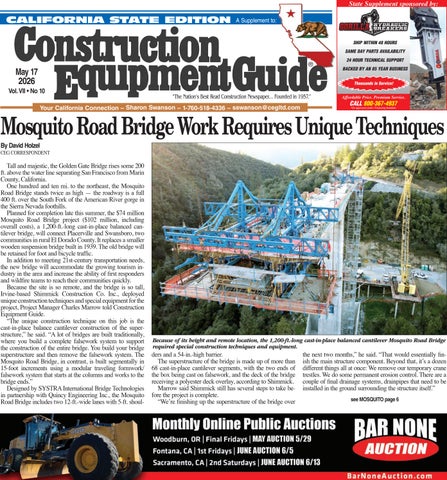
By David Holzel CEG CORRESPONDENT
Tall and majestic, the Golden Gate Bridge rises some 200 ft. above the water line separating San Francisco from Marin County, California.
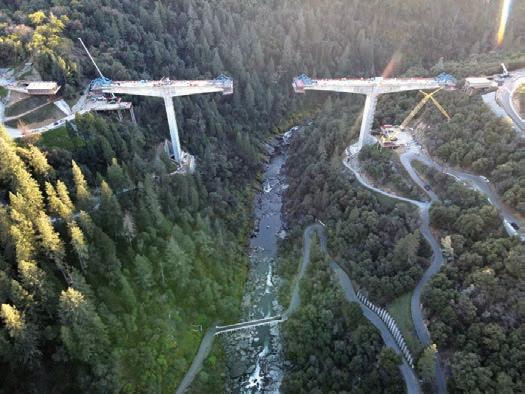
One hundred and ten mi. to the northeast, the Mosquito Road Bridge stands twice as high — the roadway is a full 400 ft. over the South Fork of the American River gorge in the Sierra Nevada foothills.
Planned for completion late this summer, the $74 million Mosquito Road Bridge project ($102 million, including overall costs), a 1,200-ft.-long cast-in-place balanced cantilever bridge, will connect Placerville and Swansboro, two communities in rural El Dorado County. It replaces a smaller wooden suspension bridge built in 1939. The old bridge will be retained for foot and bicycle traffic.
In addition to meeting 21st-century transportation needs, the new bridge will accommodate the growing tourism industry in the area and increase the ability of first responders and wildfire teams to reach their communities quickly.
Because the site is so remote, and the bridge is so tall, Irvine-based Shimmick Construction Co. Inc., deployed unique construction techniques and special equipment for the project, Project Manager Charles Marrow told Construction Equipment Guide.
“The unique construction technique on this job is the cast-in-place balance cantilever construction of the superstructure,” he said. “A lot of bridges are built traditionally, where you build a complete falsework system to support the construction of the entire bridge. You build your bridge superstructure and then remove the falsework system. The Mosquito Road Bridge, in contrast, is built segmentally in 15-foot increments using a modular traveling formwork/ falsework system that starts at the columns and works to the bridge ends.”
Designed by SYSTRA International Bridge Technologies in partnership with Quincy Engineering Inc., the Mosquito Road Bridge includes two 12-ft.-wide lanes with 5-ft. shoul-
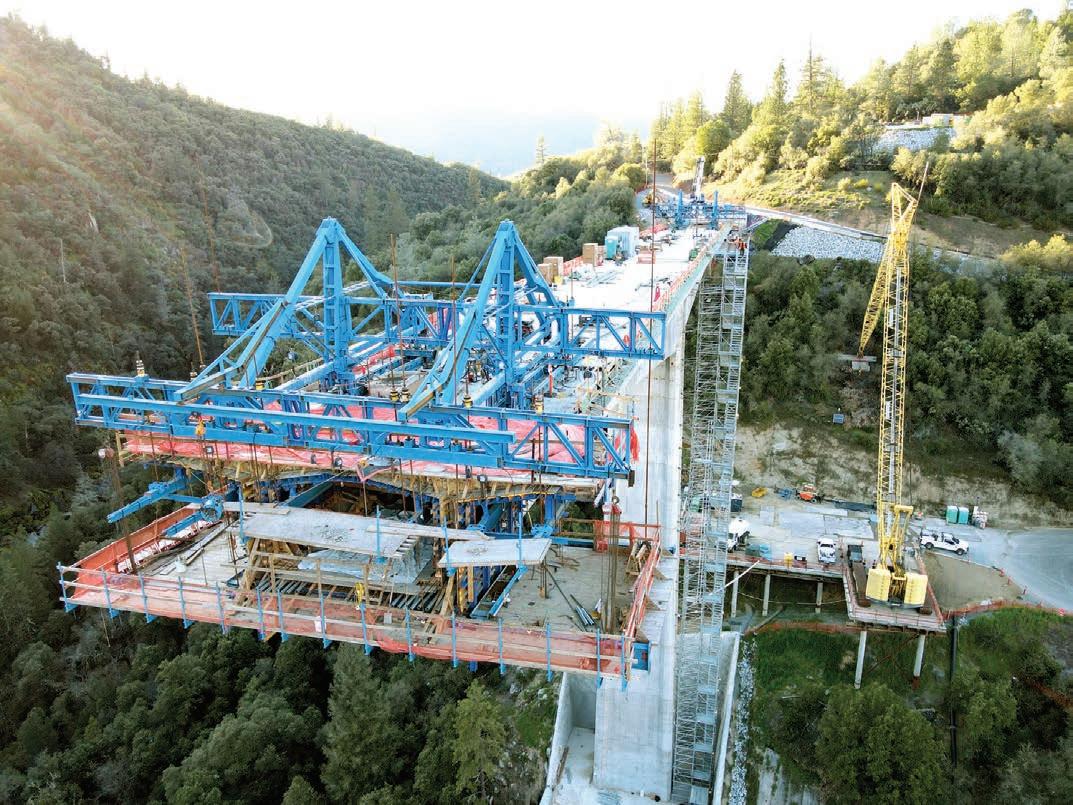
Because of its height and remote location, the 1,200-ft.-long cast-in-place balanced cantilever Mosquito Road Bridge required special construction techniques and equipment.
ders and a 54-in.-high barrier.
The superstructure of the bridge is made up of more than 68 cast-in-place cantilever segments, with the two ends of the box being cast on falsework, and the deck of the bridge receiving a polyester deck overlay, according to Shimmick.
Marrow said Shimmick still has several steps to take before the project is complete.
“We’re finishing up the superstructure of the bridge over
the next two months,” he said. “That would essentially finish the main structure component. Beyond that, it’s a dozen different things all at once: We remove our temporary crane trestles. We do some permanent erosion control. There are a couple of final drainage systems, drainpipes that need to be installed in the ground surrounding the structure itself.”

Global construction and development firm Skanska announced on Feb. 11, 2026, that it secured the Vincent Thomas Bridge Deck Replacement Project contract for $534 million from the California Department of Transportation (Caltrans) in Los Angeles, through a joint venture with California Engineering Contractors (CEC).
The three-year project will involve a phased deck replacement on the iconic Vincent Thomas Bridge. The bridge will be closed for 16 months along this portion of State Route 47, a vital freight and commuter corridor serving the Port of Los Angeles.
The Vincent Thomas Bridge spans the main channel of the Los Angeles Harbor, serving as a critical freight and commuter corridor for the Port of Los Angeles and the South Bay region.
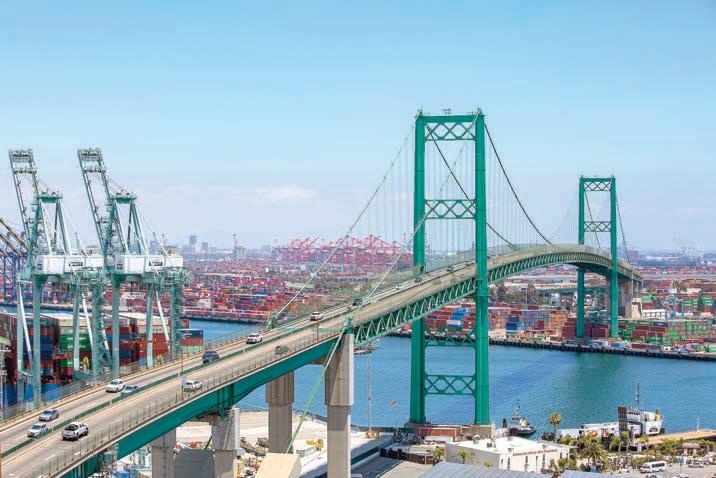
The modernization effort will replace the aging bridge deck with durable precast, prestressed concrete deck panels, which are engineered for extended service life, improved load capacity and resilience against harsh marine conditions such as saltwater spray and corrosive coastal winds.
“Delivering this critical infrastructure allows us to apply advanced engineering solutions that improve safety for the traveling public, modernize essential bridge components, and help Caltrans maintain a vital economic corridor serving
Terminal Island,” said James Bailey, executive vice president of Skanska USA Civil’s West Coast operations.
“CEC looks forward to working with our partner Skanska to successfully complete this complex project. The CMGC process allowed the Skanska-CEC Joint Venture to work closely with Caltrans during the preconstruction phase
Granite announced on April 1, 2026, that it was awarded Segment 4E North of the Highway 101 Carpinteria to Santa Barbara construction manager/general contractor
Boulevard, a new teardrop roundabout will help improve traffic flow at the intersection with Highway 101 northbound ramps.
This project is the seventh and final mainline segment in the Highway 101 Carpinteria to Santa Barbara CM/GC
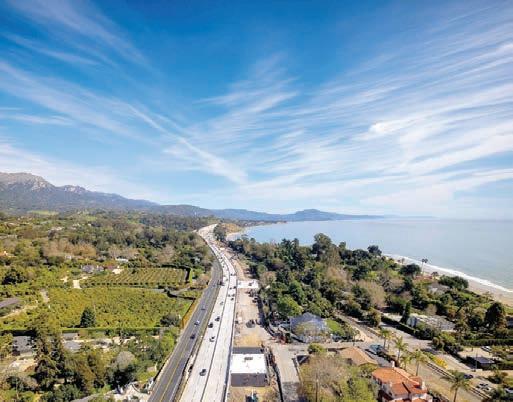
The Carpinteria to Santa Barbara CM/GC is a major, multi-year program to increase safety and reduce congestion along U.S 101 in Santa Barbara County.
Segment 4E North will replace existing lanes and add a new peak-period carpool lane in each direction between Hermosillo Road and Salinas Street. The Cabrillo Boulevard interchange will be reconstructed with two new bridges and right-hand freeway ramps, replacing existing left-hand ramps and improving highway safety. On Cabrillo
“Granite was selected as the CM/GC in 2018 and construction on the first segment began in 2020,” Granite Regional VP Larry Camilleri said. “Over the last seven years, Granite has reached agreement on 13 construction contracts — seven mainline and six ‘parallel’ projects. We are proud to be part of this landmark effort with Santa Barbara County Association of Governments and Caltrans to complete the final mainline segment in the 11-mile corridor.”
Granite’s Santa Paula Hot Plant will provide 15,700 tons of hot-mix asphalt, and Granite’s onsite batch plant will produce approximately 7,000 cu. yds. of concrete with aggregates from the company’s Bee Rock quarry. Granite also will produce approximately 30,000 tons of recycled aggregate base onsite with a portable crusher. The project is planned to begin in April 2026 and is expected to conclude in December 2028.
of the project to develop innovations and technical engineering solutions, which resulted in a customized project plan that best serves the community while maintaining safety, quality and schedule during every phase of the project,” said Wahid Tadros, president of California Engineering Contractors.
The project scope includes:
• removal and replacement of the existing deck;
• installation of new expansion joints and corrosion-protection systems;
• integration of real-time structural health monitoring technology; and
• use of high-performance precast prestressed concrete deck panels designed for heavy freight loads and marine exposure.
Leveraging the construction manager/general contractor (CMGC) delivery model, Skanska and CEC will employ precision demolition, modular deck installation, advanced scheduling and environmental controls to reduce noise and air quality impacts. These strategies ensure efficient delivery while safeguarding surrounding communities and ecosystems. Work is scheduled to begin in spring 2026 and is expected to be completed by March 2029, with the bridge reopening to traffic in the first half of 2028.
Skanska announced that it has been awarded the $102 million contract for the port of Los Angeles Avalon pedestrian bridge and promenade gateway project in Los Angeles, Calif., by the port of Los Angeles.
The Avalon pedestrian bridge and promenade gateway project is community-focused and will enhance accessibility, safety and public use of the promenade gateway while supporting the port of Los Angeles’s broader waterfront revitalization efforts.
“This project reflects our commitment to delivering infrastructure that strengthens communities,” said James Bailey, executive vice president of Skanska USA Civil’s West Coast operations. “By creating a safe, gradeseparated connection over an active rail corridor, we’re giving the community easy access the Wilmington waterfront promenade and the public spaces that continue to transform this area. The delivery of the pedestrian bridge will showcase our technical expertise to complete a project that not only enhances pedestrian safety and mobility but also supports the port of Los Angeles’ long term vision for a more connected, resilient and accessible waterfront.”
The project will transform twelve acres of former industrial land into open space that features a landscaped entry plaza, historic walk and overlook, an open terrace seating area, pedestrian pathways, community gathering areas, two parking lots, one restroom and a 40-ft.-tall architectural sundial.

The pedestrian bridge is planned as a signature concrete cable-stayed arch bridge and will offer a safe crossing point over working rail operations. This project will directly connect to the recently completed Wilmington waterfront promenade.
The project began in March of 2026 and is expected to be completed in August 2028.
For more information, visit skanska.com.


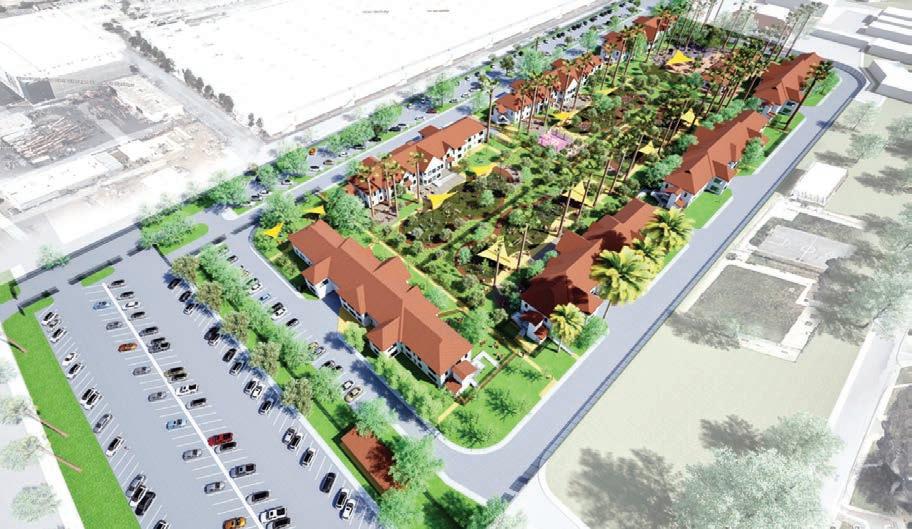
Gov. Gavin Newsom on March 6, 2026, announced the groundbreaking of the Los Angeles County Care Community, a behavioral health campus that will transform six vacant buildings into a unified mental health and housing community providing 162 housing and treatment beds.
The Los Angeles County Care Community on the Metropolitan State Hospital Campus project in Norwalk is being designed and built by a team that includes GRG Architecture and NC Construction Inc. The project is a design-build contract facilitated by the County of Los Angeles Department of Public Works.
The project is supported by a $65 million investment through the Behavioral Health Infrastructure Bond Act under Proposition 1. The effort advances Mental Health for All, California’s initiative to build a stronger behavioral health system. This comes after Newsom announced $291 million in funding for housing and behavioral health services statewide.
“Californians voted for action to address our mental health crisis with Proposition 1 — and we’re delivering. We’re turning vacant
buildings into places of care, adding treatment and housing beds, and helping people get off our streets and into the support they need.,” Newsom said.
The campus will include:
• Two subacute psychiatric facilities (32 beds) funded by the
Behavioral Health Continuum Infrastructure Program (BHCIP) for young adults ages 18–25 with significant mental health needs.
• A 70-bed interim housing facility with wraparound mental health services.
• Two permanent supportive
housing buildings with 60 apartments for adults exiting homelessness.
• A shared community building for case management, wellness services, and onsite supports.
“Today marks a critical milestone in our commitment to transforming
California’s behavioral health system,” said California Health and Human Services Agency Secretary Kim Johnson. “Through these investments, we are creating bold, community-driven solutions that expand access to care, promote equity and meet people where they are. These projects reflect our values and vision for a healthier, more compassionate California.”
In 2024, Newsom signed SB 1336, allowing Los Angeles County to lease vacant buildings at Metropolitan State Hospital and clearing the way for this project.
“This project represents a long-term, 30-year investment in expanding treatment and recoveryfocused care,” said DHCS Community Services Division Chief Marlies Perez. “It ensures that this site continues to evolve with the community, offering support, stability and opportunity for the people who need it most.”
The project also supports California’s Path and Purpose initiative, which supports mental health, connection, and opportunity for young men and boys. One of the campus’ secure subacute facilities will specifically serve young men ages 18-25.
The Associated General Contractors of California (AGC of California) unveiled its membership survey, offering a snapshot of contractor sentiment for the year ahead, with results showing that contractors entered 2026 with measured confidence, reporting positive expectations for business activity, revenue and hiring.
Compared to last year’s survey, overall demand expectations remain steady, while expectations for revenue growth, hiring and profitability have moderated slightly in 2026, reflecting a cautiously optimistic outlook for California’s construction industry.
“This survey provides valuable insights from contractors across California,” said Peter Tateishi, CEO of AGC of California. “It equips us to advocate for workforce and policy solutions that remove barriers to building and support the delivery of critical infrastructure projects. By understanding the challenges and opportunities contractors face, we can better align our efforts to drive innovation, improve efficiency, and ensure the construction industry continues to meet the state’s growing needs.”
• Nearly 62 percent of respondents anticipate growth or a moderate increase in overall construction activity across California in 2026, while another 17 percent expect activity to remain strong or expand further, signaling sustained demand statewide, even as growth expectations remain measured.
• A majority of contractors (81 percent) expressed confidence in their own companies’ performance this year. Most respondents project revenue increases in 2026, with firms expecting slight to moderate gains, indicating continued project activity alongside tempered growth expectations.
• About 52 percent of firms plan to increase hiring in 2026 as they prepare to meet project demand, even as skilled labor remains a priority.
• Profit expectations remain generally positive, with approximately 54 percent of respondents forecasting net profit growth in 2026 and another 25 percent expecting stable performance, reflecting cautious optimism amid continued margin pressure.
Contractors in highway/transportation and utility/infrastructure markets report steadier expectations tied to public-sector programs and essential infrastructure investment, with 66 percent of highway/ transportation firms and 69 percent of utility/infrastructure firms expecting strong or moderate activity in 2026.
Revenue expectations in infrastructureheavy markets are more mixed (60 percent of highway/transportation firms and 48 percent of utility/infrastructure firms expect revenue growth), even as workforce needs remain elevated (more than half of highway/transportation firms and 72 percent of utility/infrastructure firms plan to increase hiring).
Building-focused firms report comparatively stronger activity expectations, with nearly 80 percent anticipating strong or moderate activity, alongside more moderate revenue growth expectations (57 percent) and continued hiring plans (69 percent), reflecting cautious confidence shaped by
private-market conditions.
Contractors continue to point to persistent challenges heading into 2026.
Two-thirds (66 percent) of respondents cited demand for skilled labor, reinforcing the need for stronger workforce pipeline development. Regulatory compliance remains a concern for 58 percent of firms, while rising wages and employee benefits added pressure for 45 percent of participants. Workforce pipeline development was identified as a priority by 25 percent of respondents, underscoring the need to nurture and train the next generation of talent.
Tateishi emphasized that workforce concerns remain a top priority as contractors prepare for steady work ahead.
“That’s why our workforce development initiatives are focused on building a stronger, more reliable talent pipeline for California’s construction industry,” he said.
The findings point to an industry preparing for continued demand in 2026 while navigating workforce pipeline needs, regulatory hurdles and cost pressures.
From loaders to excavators, N&S Tractor has all your CASE Construction equipment needs covered. Visit one of our locations today and put power, reliability, and performance to work for you.
CALIFORNIA
COLUSA
1960 Highway 20
Colusa, CA 95932
Phone: (530) 458-2166
DIXON
793 N First Street
Dixon, CA 95620
Phone: (916) 649-0096
DOS PALOS
2173 Blossom Street
Dos Palos, CA 93620
Phone: (209) 392-2161
MERCED
600 S. State Highway 59
Merced, CA 95341
Phone: (209) 383-5888
REDDING
2535 Ellis Street
Redding, CA 96001
Phone: (530) 245-9000
STOCKTON
1340 W. Charter Way
Stockton, CA 95206
Phone: (209) 944-5500
STRATFORD
20280 Main St.
Stratford, CA 93266
Phone: (559) 947-3301
TURLOCK
1215 West Glenwood Ave
Turlock, CA 95380-5703
Phone: (209) 634-1777
WILLOWS
827 North Tehama St
Willows, CA 95988
Phone: (530) 934-3382
YUBA CITY
3056 Colusa Highway
Yuba City, CA 95993
Phone: (530) 923-7675
NEVADA
RENO/SPARKS
1455 Glendale Ave.
Sparks, NV 89431
Phone: (775) 358-5000
HARRISBURG
230 Sommerville Avenue
Harrisburg, OR 97446
Phone: (541) 995-2262
HILLSBORO
185 W Main St. Ext.
Hillsboro, OR 97123
Phone: (503) 648-4178
MADRAS
36 NW A Street
Madras, OR 97741
Phone: (541) 475-2253
RICKREALL
9055 Rickreall Road
Rickreall, OR 97371
Phone: (503) 363-2332
WOODBURN
2929 N. Pacific Highway
Woodburn, OR 97071
Phone: (503) 981-0151
888-246-0892
NSTRACTOR.COM
The El Dorado County Board of Supervisors awarded the building contract to Shimmick in May 2022. Groundbreaking took place that September.
Of the site’s two sides, the south side is the more accessible — about 10 mi. from Placerville, the county seat. For its concrete supply on the south side, Shimmick contracted with Folsom Ready Mix.
The north side was another matter. With no commercial contractors in the area and access only by logging roads, transporting materials from Placerville to the north side would have added an extra hour, Nick Berger, Shimmick’s field engineer on the Mosquito Road Bridge project, told Construction Equipment Guide.
“The difficult terrain made us think outside the box,” he said.
Added Marrow, “The logistical addition of building in a canyon, in a remote area — it basically adds an extra step of planning and an extra step of troubleshooting. We had to figure out how to get equipment here. How to deploy it.”
The solution was to erect a batch plant owned by Shimmick on the project’s north side to manufacture concrete.
“It took a couple of weeks to mobilize this thing,” Marrow said. “There were some logging roads that went through the mountains. So, we had to find these logging roads and get [the batch plant] in, one big piece at a time.”
“It was a pretty intense operation,” Berger said, recalling the crew having to pick up a
trailer to allow the 100-ft.-by-40-ft. structure to make it around a curve.
The batch plant was 2 or 3 mi. as the crow flies from the project site on the north side, Marrow said.
The new bridge is the largest capital project in El Dorado County, local publication the Mountain Democrat wrote in 2024. “Because of funding acquired through the federal Highway Bridge Program, the full cost of the undertaking is set to be reimbursed to the county.”
“The project includes contractor-led design and installation of multiple access roads, along with two corresponding temporary crane trestles on either side of the river,” according to Shimmick.
Shimmick worked with Colorado-based McNary Bergeron & Johannesen on the modeling for the bridge.
“The bridge has two main piers that are more than 230 feet tall from top of footing to bridge deck. The piers are founded on 36-inch CIDH piles and a set of 9-foot-thick footing slabs approximately 50 feet by 60 feet in dimension. The piers require the footings to be embedded in the mountain side, requiring over 10,000 square feet of soil nail and ground anchor retaining wall,” Shimmick continued.
The Mosquito Road Bridge superstructure was built starting at each column and working its way to the center and ends.
“Every time you pour, this structure leans,” Berger said.
Added Marrow, “Cantilever segmental construction is one of those methods where you construct your columns and then you build out. We’ve been working our way
“They are, essentially, our segmental bridge engineer. They modeled how this structure would react,” Marrow said. “They added our construction loading, and they really helped us to understand how this thing would act.
“This thing is moving,” he continued. “So, they have to model it in every phase to understand where the bridge needs to be. It’s called geometry control. It’s like a typical construction survey on steroids.
“Geometry control determines where we’re going to pour the next segment,” Berger said.
“And we have to alternate, north-south, north-south, because the system has to be balanced,” Morrow said. “And when we’re getting far out with our cantilever construction and that column is actually flexing, we survey every day. And we track how much that column leans back and forth.”
McNary Bergeron and Johannesen analyzed the structure and “provided us with what is called the ‘Geometry Control Plan,’” Marrow said. “This plan adds permanent design camber into the regular structure, ever so slightly raising the structure so in 27 years [of settling] it achieves the ‘perfect’ geometry.”
“Creep” is the official term for “settling,” Marrow said. “Concrete flexes and creeps as it pushes down on itself and, over time, this creep changes the shape, but only by a few inches here and there. Unnoticeable to drivers.
“So, 27 years from now,” he added, “this bridge will have settled a little bit and be — quote unquote — perfect.”
Project subcontractors included: Alta Engineering Group Inc. of San Francisco; Folsom Ready Mix of Rancho Cordova, Calif.; Tyrrell Resources Inc. of Redding, Calif.; Drill Tech Drilling & Shoring Inc. of Antioch, Calif.; Roll N Rock Construction Inc. of Mt. Shasta, Calif.; Dees Burke Engineering Constructors LLC of Ontario, Calif.; Vintage Paving Co. Inc. of Winters, Calif.; K&G Concrete Pumping of Roseville, Calif.; and Grass Roots Erosion Control, of Lotus, Calif.
Prime contractor consultants included Krew Cos. of El Dorado Hills, Calif.; McNary Bergeron and Johannesen of Broomfield, Colo.; GeoEngineers of Redmond, Wash.; and JTW Consulting Engineers of Sacramento, Calif. CEG (All photos courtesy of Shimmick Construction Co. Inc.)
Gov. Gavin Newsom announced on March 25, 2026, that the California Transportation Commission (CTC) allocated nearly $900 million to advance mass transit systems, expand pedestrian and bicycle options and improve freight movement.
The commission also approved plans for new investments in California’s transportation infrastructure in the coming years. The CTC approved the 2026 State Highway Operation and Protection Program (SHOPP), which invests $17.9 billion over the next four years in the state highway system for new safety features, more access for bicyclists and pedestrians and repairs of pavement and bridges.
“We are making the investments in world-class transit, freight and transportation technology that will keep California workers and communities at the forefront of innovation and ahead of our competition,” Newsom said.
“The significant allocations made support a sensible balance between immediate project needs with funding for long-term improvements that continue to shape the future of our transportation system,” said Caltrans Director Dina El-Tawansy.
This announcement includes investments funded by two bipartisan sources. The funding includes $47 million from the federal Infrastructure Investment and Jobs Act of 2021 (IIJA) and $405 million from California Senate Bill 1 (SB 1), also known as the Road Repair and Accountability Act of 2017.
California has received an annual investment of approximately $16.7 billion in infrastructure funding since IIJA’s passage. That includes investments to upgrade the state’s roads, bridges, rail, public transit, airports, electric vehicle charging network, ports and waterways.
The remaining investments are supported by SB 1, which has provided nearly $5.5 billion annually for transportation projects since 2017. SB 1 calls for splitting the money between state and local agencies. Road projects progress through construction phases more quickly based on the availability of funds, including projects partially funded by SB 1.
Notable project investments include:
• next-generation tail technology — Bay Area and Southern California: $273 million to deploy cutting-edge technology to rail systems currently under construction, in-
cluding an expansive tunnel connecting downtown San Jose to Santa Clara as part of BART’s regional expansion;
• Port of Long Beach freight expansion: $33 million to expand rail freight operations, strengthening California’s position as the nation’s premier gateway for trade and commerce;
• Los Angeles rail power stations: $35 million to complete the design and construction of rail power infrastructure in Los Angeles;
• Sacramento EV charging facility: $33 million to build a major public-access electric vehicle charging facility on a 118-acre parcel, advancing California’s clean transportation future;
• Del Mar Bluffs stabilization: $3 million to protect eroding coastal bluffs in San Diego County, building upon prior investments to secure critical coastal rail infrastructure from the impacts of climate change; and
• vehicle collision prevention technology: $1.5 million in seed funding for an automated communications system that tracks moving vehicles to prevent collisions — a solution modeled on air traffic control technology.

The JCB Teleskid is four machines in one and the world’s only skid steer with a telescopic boom. Imagine what that does for efficiency. Actually, don’t imagine it. Instead, give the Teleskid a try and see how much more you can accomplish. Visit JCB.com to learn more.
www.socaljcb.com N&S Tractor 1960 Highway 20 Colusa, CA 95932 (530) 458-2166 2173 Blossom Street Dos Palos, CA 93620-2313 (209) 392-2161 600 S. State Highway 59 Merced, CA 95341-6928 (209) 383-5888 1340 W. Charter Way Stockton, CA 95206 (209) 944-5500