CALIFORNIA STATE EDITION
A Supplement to:
January 17 2021 Vol. II • No. 2
“The Nation’s Best Read Construction Newspaper… Founded in 1957.” Your California Connection – Sharon Swanson – 1-760-518-4336 – sswanson@cegltd.com
Crews Stabilize Deteriorating Bluffs Near Torrey Pines
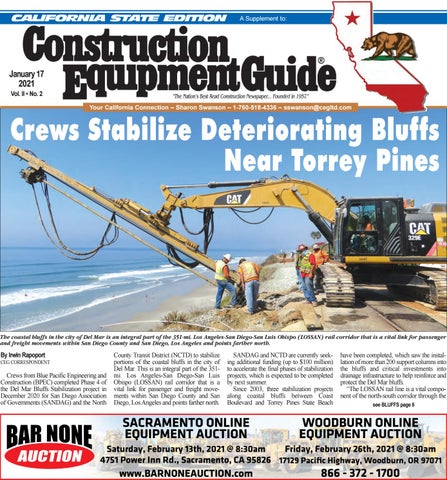
The coastal bluffs in the city of Del Mar is an integral part of the 351-mi. Los Angeles-San Diego-San Luis Obispo (LOSSAN) rail corridor that is a vital link for passenger and freight movements within San Diego County and San Diego, Los Angeles and points farther north.
By Irwin Rapoport CEG CORRESPONDENT
Crews from Blue Pacific Engineering and Construction (BPEC) completed Phase 4 of the Del Mar Bluffs Stabilization project in December 2020 for San Diego Association of Governments (SANDAG) and the North
County Transit District (NCTD) to stabilize portions of the coastal bluffs in the city of Del Mar. This is an integral part of the 351mi. Los Angeles-San Diego-San Luis Obispo (LOSSAN) rail corridor that is a vital link for passenger and freight movements within San Diego County and San Diego, Los Angeles and points farther north.
SANDAG and NCTD are currently seeking additional funding (up to $100 million) to accelerate the final phases of stabilization projects, which is expected to be completed by next summer. Since 2003, three stabilization projects along coastal bluffs between Coast Boulevard and Torrey Pines State Beach
SACRAMENTO ONLINE EQUIPMENT AUCTION
have been completed, which saw the installation of more than 200 support columns into the bluffs and critical investments into drainage infrastructure to help reinforce and protect the Del Mar bluffs. “The LOSSAN rail line is a vital component of the north-south corridor through the see BLUFFS page 6
WOODBURN ONLINE EQUIPMENT AUCTION
Friday, February 26th, 2021 @ 8:30am Saturday, February 13th, 2021 @ 8:30am 4751 Power Inn Rd., Sacramento, CA 95826 17129 Pacific Highway, Woodburn, OR 97071
www.barnoneauction.com | (866) www.BARNONEAUCTION.com 866 372 - 372- -1700 1700
Page 2 • January 17, 2021 • www.constructionequipmentguide.com • California State Supplement • Construction Equipment Guide
Fontana:
909-822-2200 •
Santa Fe Springs:
562-777-0775
NEW EQUIPMENT. Finance program Option 1: Low rate financing (0.9% for 60M) + 3 year 5,000-hour powertrain and hydraulics extended warranty
Doosan DL200
Option 2: Low rate financing (0.9% for 36M) + 5 year 7,500-hour powertrain and hydraulics extended warranty
Scott Equipment 14635 Valley Blvd. Fontana, CA 92335 909-822-2200
10918 Shoemaker Ave. Santa Fe Springs, CA 90670 562-777-0775
Construction Equipment Guide • California State Supplement • www.constructionequipmentguide.com • January 17, 2021 • Page 3
®
RE ENT CA AT. A T T. RE ENT MORE.
Whether you are loooking to supplement your current fleet or trying out a new piece e of equipment hour Cat® and before you buy, thee Cat Rental Store® offers the best selection of late model, low-h Allied brand equipm ment, and power generation systtems available. With every renta al, you will know you are usingg the best piece of equipment avvailable for your job. Visit us online today to view our full inventory of loow hourr,, late model machines available for immediate rental.
SAN DIEGO COUNTY 800-750-4228 www w.hawthornecat.com .hawthornecat.com h h
The Cat® Rental Store App is available now for both iOS and Android.
CEENTRAL NORTHERN CALIFORNIA 888-381-9940 www.holtcat.com h l
NORTHERN CALLIFORNIA 503-280-1899 899 www.petersonncat.com
CENTRAL NTRAL & SOUTHERN CALIFORNIA 888-225-8800 www w.qrs-cat.com .qrs-cat.com
© 2020 Caterpillarr.. All Rights Reserved. CA CAT, T, CA ATERPILLAR, TERPILLAR, LET’S DO THE WORK, the their eir respective logos, “Caterpillar Yellow”, Y the “Power Edge” and Cat “Modern Hex” trade dress as well as corporate and product identity used herein, are trademarks of Caterpillar and may not be used without permission. www.cat.com / www.caterpillar.com
Page 4 • January 17, 2021 • www.constructionequipmentguide.com • California State Supplement • Construction Equipment Guide
Restoration of LA County Wetlands Receives Approval The telescoping grapple saw is safer for the workers and reduces the need for workers to climb trees.
Construction Crews Use Grapple Saw Advanced Technology: Tree Removal Construction crews, in conjunction with the California Department of Transportation, have started to utilize a new technology that will make their jobs a lot easier. Starting in Alameda County, construction workers have begun to use an automated system for the removal of deteriorating trees in the California area. “Some of these trees are determined to be dead, dying, diseased or structurally deficient and are marked for removal,” said Chicanda Davis, public information officer of Caltrans. “California has suffered a major drought, which has impacted the trees throughout California. Caltrans Bay Area is doing something to prevent the future damages by removing these trees before they become a hazard.” This new technology will allow crews to reduce project time Removing these trees has allowed Caltrans to use a significantly. It no longer has to put a construction worker new technology that provides cost savings and is faster in a bucket or a tree. than methods in the past. “The telescoping grapple saw is safer for the workers and the tree, safely brings it down to the chip crews to chip.” With this new technology, a tree can be gripped and sawed reduces the need for workers to climb trees to take them down,” Michael Sisson, TGS trainer of Arborworks, said. all in one motion. All without risking injury to workers who “This new technology will allow crews to reduce project would otherwise have to perform the same duties as a graptime significantly. It no longer has to put a guy in a bucket or ple saw. “This new technology allowed Caltrans to keep our a tree. We can now utilize this equipment. It’s safer to take a tree down. That truck does it all in one. It grabs the tree, cuts workers safe on the ground,” Jones said.
Some of these trees are determined to be dead, dying, diseased or structurally deficient and are marked for removal.
Removing these trees has allowed Caltrans to use a new technology that provides cost savings and is faster than methods in the past.
The project aims to restore the ecological function of 566 acres of the reserve, which lies between the Santa Monica Bay community of Playa del Rey and sprawling Marina del Rey.
LOS ANGELES (AP) A plan to restore the largest coastal wetlands complex in Los Angeles County has received state approval as it advances through a lengthy process. The California Department of Fish and Wildlife said that it has certified the final environmental impact to restore the Ballona Wetlands Ecological Reserve. The project aims to restore the ecological function of 566 acres of the reserve, which lies between the Santa Monica Bay community of Playa del Rey and sprawling Marina del Rey. The area once included 2,000 acres of marshes, mud flats, salt pans and sand dunes, but currently only 577 acres remain, according to Fish and Wildlife. The department said the wetlands has been hugely degraded by human impacts, and the restoration will not only preserve sensitive habitat but build in resilience against sea level rise. Restoration planning by Fish and Wildlife and partners has been under way for years and will now proceed toward a final design, but will still need an estimated two and a half years to win a permit from the U.S. Army Corps of Engineers and complete a federal environmental review document, the department said. Other approvals, including by the California Coastal Commission, also are required.
Construction Equipment Guide • California State Supplement • www.constructionequipmentguide.com • January 17, 2021 • Page 5
Virtual Design, Construction Driving California Projects Virtual Design and Construction (VDC) has seen rapid growth across the construction industry in the last decade. With contractors everywhere racing to build up their VDC capabilities, there’s constant talk about new technology. Drones that can scan buildings for heat loss, 4D scheduling (time being the fourth dimension) and using VR goggles to walk through a life-size virtual design model — all of these innovations just scream “cool.” Still, the cool factor for employee-owners is saving clients time and money. In uncertain economic times, when owners are under pressure to maximize every dollar, there is no substitute for having an experienced, field-proven team of VDC professionals. Measure Twice, Cut Once, Back-Check With Laser Scanner The in-house VDC team that serves Sundt’s Building Group, California District, is used to people calling their number. With involvement in business development, preconstruction, construction and quality control, the team touches all stages of each California building project. Senior Virtual Construction Engineer Howard “Howdy” Atkinson and his team are known for their hands-on approach when it comes to both planning and checking for quality. “We do BIM [Building Information Modeling] shop drawings all the way up to owner-furnished equipment, and The Ridge at Paradise Valley Estates project kicked off with earth work on an 80-acre sloped lot. Sundt’s then we back-check all of our work,” said California VDC team provided the site civil crew a faster cut-and-fill Atkinson. “The reason is that we’ve seen what can analysis by combining topographic surveying data from a total happen when a mistake goes unchecked. We’d station and a drone. rather avoid major cost overruns and delays by catching problems before they become bigger issues.” This exact scenario happened earlier this year with a misplaced support steel for owner furnished equipment that, without a back-checking process, could have impacted trade scopes down the line. “We do clash detection, but here there was no clash,” said Atkinson. “The 3-D scan overlaid on the 3-D shop drawing model showed that the support steel was in the right column bay, but just a couple of feet off. Through this process, we avoided a schedule delay. No one would have realized it until the owner furnished boom for the exam rooms Senior Virtual Construction Engineer Howard were being installed. Atkinson stands with a 3D Laser Scanner at the Basically, we would have needed to rework Modern-Sundt Oroville Hospital Expansion. The above ceiling systems and the medical air system to new five-story tower will double the square Senior Project Superintendent Shane Henry using his “BIM Box” out make it work and that would have caused a delay.” footage of the current hospital and is projected to in the field, equipped with Wi-Fi and centrally located on the third With VDC’s help, the project team was able to add nearly 700 new jobs when completed in 2022. floor of what will be the new Oroville Hospital tower. communicate quickly and address the situation instead of “falling into” a change order. “Mistakes are option for safer, faster inspections at heights, capturing asinevitable,” said Atkinson. “Any honest builder will own up builts within hours instead of days, and expediting cut-andto that. What matters is when and how you handle them, and fill workflows for site work.” whether you’re actively working to mitigate risks.” Whether it’s drones, laser scanners, total stations, 3-D take-offs or a combination of several technologies, the ‘Tools are Cool’ But Experience Wins the Day California VDC team’s work is creating a much bigger picThe higher level of project involvement from Atkinson ture than just digital models on a screen. It’s building a and his team stems from their level of expertise. “All of these process that gives project stakeholders confidence. Betterpeople have at least 10 years in the industry, much of which informed decisions keep schedules on track, and lead to a is field experience,” said Atkinson. “When someone underhigher-quality end product. stands how these elements are built in real life, they can tell According to Atkinson, VDC is really about breaking whether or not they’re constructible in a digital environdown silos of information, including within the owner-archiment.” tect-contractor relationship, with subcontractors, and among The same concept applies to understanding the real bene- (L-R): A “paper-free” work zone: framer, electrician fit of certain technologies. Take drones as an example. “I and Senior Project Superintendent Shane Henry pre- project teams themselves. “We want people to get the most wasn’t fully sold on drones until all of the different applica- plan using 3D drawings on iPads. All pipe for this elec- out of this new technology — not the other way around. tions began proving their worth,” said Atkinson. “It was a trical room was prefabricated based on BIM shop They count on us to find answers quickly. That’s a responsibility we take on with great pride.” quick shift from ‘this takes pretty pictures’ to a whole new drawings.
Page 6 • January 17, 2021 • www.constructionequipmentguide.com • California State Supplement • Construction Equipment Guide
Stabilization Job Will Protect Bluffs From Seismic Events BLUFFS from page 1
San Diego region,” said John Haggerty, SANDAG director of engineering and construction. “The NCTD COASTER commuter rail service, Amtrak’s Pacific Surfliner intercity service and BNSF Railway freight service all rely upon this segment of track to serve a combined 7.6 million passengers a year and $1 billion in goods and services that are supported by rail line reliability. In 2019, these services relied upon 44 passenger trains and six freight trains. By 2030 these numbers will have increased to 78 passenger trains and 22 freight trains, only further illustrating the need for rail line reliability. SANDAG is currently commissioning an in-depth analysis of the economic impacts of LOSSAN rail corridor to the San Diego region. “This stabilization effort is especially critical in protecting the bluffs in the event of an earthquake or large storm event,” he added. “Stabilizing the bluffs will increase safety and service reliability for passengers and freight by minimizing the chances of track damage due to bluff retreat and seismic events. Directing storm water runoff more effectively across the bluffs will help lower the potential for erosion during large storm events. The installation of support columns will further help to protect the track bed from erosion.” Construction Progress Phase 4, which began in March 2020, installed smaller support columns that are now stabilizing localized areas and sea walls; constructed a drainage channel on top of the bluffs; repaired concrete channels and storm drain outfalls; and stabilized existing headwalls. The project was funded through a combination of state, federal and local sources. Additional funding is being sought for ongoing stabilization over the next 30 years to preserve the track-bed support. The Del Mar Bluffs stabilization effort is an ongoing, multi-phase initiative to maintain a stable track bed along the coastal bluffs and protect the railroad from erosion, landslides and seismic events. Phase 4 was designed by HNTB Corporation. “Uncontrolled storm runoff from the streets to the east overtop the upper bluffs caused localized failures of the bluffs and flooding of the track bed,” said Haggerty. “Major channels were replaced with splash walls added to control and direct storm runoff away from the slopes. Retaining structures were placed on the upper bluff to support undermined drainage channels. In order to construct the walls with limited access and workspace, soldier pile foundations were drilled from the top of the bluff using small drilling equipment. Precast concrete lagging panels were used to easily complete the retaining structures. “The existing sea walls along the beach were constructed in the early 1960s using steel rail as the structural supports,” he added. “New soldier pile supports were added to replace the deteriorated rail supports. Small drill rigs were used to drill the foundations and place steel pile supports, allowing for placement of individual elements of the support system over multiple work periods. All repair structures were completed using a concrete mix designed to withstand the marine envi-
Phase 6, expected to cost around $35 million, will cover the area from Coast Boulevard to the Torrey Pines Overhead Bridge in the city of Del Mar (1.6 mi.).
There are gaps between these existing soldier pile. Phase 5 will include the installation of new soldier piles to fill in these gaps to provide support to the railroad tracks.
Crews from Blue Pacific Engineering and Construction (BPEC) completed Phase 4 of the Del Mar Bluffs Stabilization project last December ($5.8 million).
ronment and all of the new steel H piles were galvanized to provide a 100-year service life for the materials. The Phase 4 work had a limited impact on rail operations, but much of it was performed adjacent to homes and businesses and, to a certain extent, limited access to the beach. “The contractor and construction manager worked closely with the community to communicate construction activities,” said Haggerty. “Environmental monitors identified all sensitive habitat on site and Since 2003, three stabilization projects along coastal bluffs between protective fencing was placed prior to start of conCoast Boulevard and Torrey Pines State Beach have been completed, struction. There were multiple work areas within the which saw the installation of more than 200 support columns into the bluffs and critical investments into drainage infrastructure.
see BLUFFS page 10
Construction Equipment Guide • California State Supplement • www.constructionequipmentguide.com • January 17, 2021 • Page 7
PIRTEK Long Beach
PIRTEK Power Inn
PIRTEK San Leandro
PIRTEK SFO
3299 Walnut Ave Signal Hill, CA 90755
4191 Power Inn Road, Suite D Sacramento, CA 95826
1997 Burroughs Ave San Leandro, CA 94577
San Francisco, CA
562-426-9219
916-737-7777
510-568-5000
650-532-9200
Page 8 • January 17, 2021 • www.constructionequipmentguide.com • California State Supplement • Construction Equipment Guide
California Construction Projects Gualala Downtown Streetscape Enhancement District 1 Caltrans, in partnership with MCOG, proposes an enhancement project on State Route 1 (SR 1) through downtown Gualala in Mendocino County (post mi. 0.6 to 1.0). The current design of the downtown area of Gualala has several deficiencies that could increase conflicts between motorized users, cyclists, and pedestrians. The purpose of the proposed project is to create safe, comfortable facilities for pedestrian and bicycle travel, and to improve traffic flow in the project area. The project is also intended to improve Gualala’s visual character by incorporating landscape and hardscape features. The total project cost estimate will be determined once a preferred alternative is selected. To date, MCOG has programmed $1.82 million for project development. Supplemental funding for project development and construction in the form of an Active Transportation Program grant is currently being pursued.
North Canyon TMS Improvement Project District 2 The California Department of Transportation (Caltrans District 2), in conjunction with Cal Electro Inc., has begun work on the North Canyon TMS Improvement Project in Siskiyou and Shasta Counties. The $2.3 million project, which is funded in part by Senate Bill 1, will be constructing a microwave communications hub and access at Mt. Bradley, approximately 3 mi. west of Interstate 5 near Dunsmuir, along with making traffic management system improvements at these areas along Interstate 5 and State Route 89: • Construction of new microwave tower at Abrams Lake Overcrossing on Interstate 5 in Siskiyou County • Construction of new Closed-Circuit Television (CCTV) and Roadside Weather Information System (RWIS) on State Route 89 near Pondosa Way in Siskiyou County. • Upgrade of CCTV and RWIS on State Route 89 near Snowman Summit in Siskiyou County. • Paving of maintenance vehicle turnouts at these locations.
Cap City Corridor Project District 3 The Cap City Corridor (State Route 51 and adjacent streets) is the most congested corridor in the region. In 2016, SR 51/Cap City experienced more than 2,050,000 vehicle hours of delay at a $27.5 million cost to users and had five of the region’s top 10 bottlenecks. The California Department of Transportation (Caltrans), in cooperation with the city of Sacramento, Sacramento Area Council of Governments, Sacramento County, Sacramento Regional Transit and Sacramento Transportation Authority proposes to make improvements on SR 51/CapCity between post mi. 1.0 to 4.4 in Sacramento County. The proposed project would widen the existing roadway, extend the existing bus/carpool lanes, construct auxiliary lanes, improve intelligent transportation system elements, construct a new Class I bike path on the American River Bridge and widen or replace existing structures within the project limits.
SM 101 Express Lanes Project District 4 Caltrans is constructing express lanes on U.S. 101 from the San Mateo County/Santa Clara County Line to I-380 in South San Francisco. Construction is expected to be completed in mid-2022 with the full lanes opening to traffic late-2022. Existing carpool lanes will be converted to express lanes between the San Mateo/Santa Clara County line and Whipple Avenue (blue solid line) and new express lanes will be constructed between Whipple Avenue and I-380 (red stripped line). This will result in 22 mi. of express lanes in each direction of U.S. 101. The Project will create 22 mi. of express lanes in both directions on U.S.101 from the San Mateo County/Santa Clara County Line to I380 in South San Francisco. The San Mateo 101 Express Lanes will
seamlessly connect to the express lanes being constructed in Santa Clara County.
Corralitos Creek Bridge ADA District 5 The California Department of Transportation (Caltrans) proposes to improve pedestrian infrastructure along the eastbound side of State Route 152 across Corralitos Creek Bridge in Santa Cruz County. The existing pedestrian pathway must be updated to be accessible to persons with disabilities in compliance with all State and Federal Americans with Disabilities Act (ADA) standards. The purpose of the project is to improve pedestrian infrastructure along the eastbound side of State Route 152 across Corralitos Creek Bridge and to make the existing path of pedestrian travel accessible and Americans with Disabilities Act compliant. The project is needed to make existing pedestrian pathways accessible to persons with disabilities in compliance with all state and federal Americans with Disabilities Act standards.
I-5 Panoche Capital Preventative Maintenance District 6 The California Department of Transportation (Caltrans) proposes to resurface and rehabilitate the northbound and southbound lanes, shoulders and on-ramps and off-ramps on Interstate 5 in Fresno County. The project would begin 1.9 mi. north of the Three Rocks Road undercrossing to 0.2 mi. south of the Panoche Road overcrossing at post mi. 37.20 to 48.80. The purpose of this project is to extend the life of existing pavement on the northbound and southbound lanes on Interstate 5 beginning 1.9 mi. north of the Three Rocks Road undercrossing to 0.2 mi. south of the Panoche Road overcrossing. There is a considerable amount of distress on the existing pavement, and cracking along and across the pavement has deteriorated the pavement to the extent that rehabilitation is needed. Due to previous overlays, hydraulic capacity of the existing asphalt concrete dikes within the project limits have been significantly reduced. Therefore, asphalt concrete dikes and asphalt concrete spillways will be removed and replaced.
SR 2, Terminus Project District 7 The Glendale Freeway (SR 2) was originally planned and constructed in 1959 to connect with the Hollywood Freeway (U.S.-101) through the neighborhoods of Silver Lake and Echo Park. In 1962, as a result of local community opposition, the full build-out plan was rescinded and construction was terminated at the present SR 2 terminus near Glendale Boulevard and Duane Street. Since then, commuter traffic coming of and on to SR 2 has passed through the community, primarily along Glendale Boulevard and Alvarado Street and has contributed to congestion. A Federal Transportation Equity Act for the 21st Century (TEA-21) and a High Priority Highway Project Authorization grant were provided to upgrade the southern terminus of SR-2 and help manage the flow of traffic and address safety concerns. The purpose of this project is to develop a balanced transportation system that better serves local and regional transportation needs through improved management of traffic flow; enhanced pedestrian and non-motorized accessibility and safety at the SR 2 terminus; and creation of a context sensitive designed community open space in the immediate vicinity.
The 60 Swarm Projects District 8 The 60 Swarm is an impressive undertaking of two projects along State Route 60 (SR 60) passing through the San Bernardino and Riverside counties: The Pavement Rehabilitation Project and the Three Bridges Replacement Project. SR 60 is a heavily traveled east-
west corridor for commuters and goods movement in Southern California. The $134.5 million Pavement Rehabilitation Project, which includes $16.9 million in SB-1 funding, is re-paving the main line, shoulders and the on and off-ramps for a 16-mi. stretch of SR 60 in both directions. The project passes through five cities beginning in Riverside at the 60/91/215 interchange and crossing through to Euclid Avenue in the cities of Chino and Ontario. The pedestrian sidewalks at the end of the ramps are being upgraded to ADA standards and new metering fixtures will be installed at the end of the ramps. The condition of the existing pavement is poor with a high percentage of third-stage cracks and corner cracks in the two outside lanes, including damaged pavement in various location in other lanes of traffic. The $23 million Three Bridges Replacement Project, which includes $10.4 million in SB-1 funding, will repair deteriorated slabs and replace three bridges along SR-60 for improved structure safety and increased vertical clearance. The bridges include: Pipeline Avenue, Monte Vista Avenue and Benson Avenue.
North Sherwin Shoulders Project District 9 The purpose of the North Sherwin Shoulders Project is to update the highway design by widening the paved highway shoulders and improving sight distances around curves. The proposed project would widen the existing shoulders to 10 ft.; install retaining walls; flatten soil slopes next to the highway; replace or install guardrails; upgrade drainage systems; install skip rumble strips between travel lanes and shoulders; and add a bicycle right turn pocket at U.S. 395 and Lower Rock Creek Road.
Merced Seismic Retrofit District 10 The California Department of Transportation (Caltrans) proposes to seismically retrofit seven bridges in Merced County to increase their structural integrity in case of a seismic event and upgrade deficient bridge railings to current standards. The bridges were identified as seismically vulnerable by the Office of Earthquake Engineering, and the Office of Structure Maintenance and Investigations identified a need to upgrade the non-standard bridge railings at each project location. The bridges are vulnerable to collapse during an earthquake if not retrofitted to withstand a maximum credible earthquake event.
SR 111 Niland Geyser Mitigation Project District 11 A natural-occurring geyser, in existence since 1953, is moving toward SR 111 and is likely to reach the highway. As the geyser moves west and beyond the temporary road, Caltrans will then rebuild SR 111. Caltrans will tie-in the ends of the newly-built roadway to the existing SR-111 when the geyser water reaches the sheet pile walls located east of the highway. The temporary roadway will serve as a detour around the geyser.
SR 22 Safety Enhancement Project District 12 Due to a number of factors, there is a significant number of collisions on Eastbound State Route 22 between State Route 39 and Interstate 5 when compared to similar stretches of California highways. Most notably, the high volume of traffic contributes to an increase in the difficulty and delays that drivers face on this portion of infrastructure. The SR 22 Safety Improvement project proposes to shorten the length of the collector-distributor road and reconfigure Eastbound SR22 at the Horseshoe connector. This work is the most recent in Caltrans’ efforts to improve the conditions on SR 22.
Construction Equipment Guide • California State Supplement • www.constructionequipmentguide.com • January 17, 2021 • Page 9
Granite Construction Opens New California Facility in Arvin Granite recently opened their Solari aggregate plant in Arvin. Solari will safely and sustainably provide aggregate and asphalt to private and public customers in the Bakersfield market. The new facility sits on 700 acres. Designed with efficiency and sustainability in mind, Granite said automated plant controls maximize the plant feed rate and crusher production. Also, a new wash plant produces concrete aggregate while minimizing the demand for fresh water with its engineered three-stage water management system. Both variable-frequency drives and plant automation, which staggers large motor startups, reduce the facility power demand. “The new facility is Granite’s 77th mate-
rials facility,” said Brad Estes, vice president, construction materials of Granite. “We’re excited to open another facility supporting Granite’s vertically integrated business in the Bakersfield market.” Exploration of the Solari aggregate deposit began in 2006. Permitting began in 2008 and facility construction began in September 2019. Aggregate production began in December 2020 and asphalt production will begin during the second quarter this year. Granite’s construction materials business stretches across the western United States, specializing in aggregate plants, asphalt plants and recycling operations that supply external customers and support Granite’s vertically integrated business.
Keep Up With All the Industr y News Subscribe to
800/523-2200
Construction Equipment Guide Today! Toll Free
Semi - Custom Rebuilt Vocational Trucks
2011 KOBELCO SK350 LC-8…$52,000 W001427, EROPS, Quick Coupler, Tier III
2012 International DuraStar 4300 …$46,000 W002771, 2,500 Gallon Tank, Automatic
2014 Freightliner Business Class M2 106…$60,000 W003144, New 16’ Dump Bed, 6 Speed, 250 HP
2017 NEW HOLLAND U80C…$64,000 W002806, Skip Loader, 556 Hrs
Two locations in California to Serve You!
14635 Valley Blvd. Fontana, CA 92335
909.822.2200
10918 Shoemaker Ave. Santa Fe Springs, CA 90670
www.scottequip.com
C A L L U S T O D AY !
562.777.0775
Page 10 • January 17, 2021 • www.constructionequipmentguide.com • California State Supplement • Construction Equipment Guide
Final Phases of Project to Be Complete By Next Summer The drainage improvements proposed in Phase 5 include channels, ditches and underground storm drains within the railroad right-of-way and the corresponding outlets to the beach.
BLUFFS from page 6
entire project, but the number of work areas under construction at the same time was limited. Soldier pile walls and supports were used to allow foundation drilling, placement of concrete and placement of steel in one operation, minimizing the overall time for each work area. Where new walls were placed, precast panels or wood lagging panels were used to expedite the construction. A significant portion of the work was completed from the beach. All equipment and materials were removed from the beach daily to lessen impact to beach goers.” Phase 5 The design for Phase 5, which is being conducted by HNTB Corporation, began in early 2020 and should be completed in late spring/early summer of 2021. The project, which is expected to cost $65.2 million, has already secured $19.9 million and will be funded by the California Natural Resources Agency, Federal Railroad Administration, State of Good Repair Transit and the Intercity Rail Capital Program. Phase 5 will see the installation of additional columns to support the railroad; reinforce the bluffs and install retaining walls; and drainage improvements, including outlets to the beach and other stabilization and erosion control measures on the upper bluffs. A public tender for the contract is expected to be issued in summer 2022. HNTB Corporation also is designing Phase 5. “Previous phases of the Del Mar Bluffs stabilization effort included soldier pile walls to support the railroad,” said Haggerty. “There are gaps between these existing soldier piles and Phase 5 will include the installation of new soldier piles to fill in these gaps
SANDAG has initiated a $3.2 million study to evaluate alternative strategies to move the tracks completely off the bluffs.
Previous phases of the Del Mar Bluffs stabilization effort included soldier pile walls to support the railroad.
to provide support to the railroad tracks. Similar to Phase 4, soldier pile foundations will be drilled from the top of the bluff for Phase 5. Construction of the soldier piles would require a drill rig and crane located on or just east of the track and the piles would need to be located within reach of conventional drilling equipment. In addition to the drilling equipment, a delivery truck would be needed to transport the steel H piles and a ready-mix concrete truck and pump would be needed at each site for placement of con-
crete. “While the methodology is well understood within the construction industry and is not highly susceptible to unforeseen site conditions, the primary concern is the potential of encountering a buried object during the drilling for the piles or for the tieback anchors,” he added. “It is anticipated that the installation of solider piles cannot happen when the rails are in use. Most of the soldier pile drilling would occur at night and early morning when train traffic is much lower
than during the day. Up to three drill crews could operate concurrently.” Several of the soldier piles placed in earlier phases also are nearing the end of their service life. Phase 5 will extend the service life of these piles by adding tieback anchor rods to these piles and infilling the exposed area between piles with lagging panels at the face of the bluff. The drainage improvements proposed in Phase 5 include channels, ditches and underground storm drains within the railroad right-of-way and the corresponding outlets to the beach, which would be constructed using a combination of cut and cover and pipe jacking technology. “The drainage channels and ditches would be constructed during regular working hours with limited impact to railroad operations,” said Haggerty. “The repair of drainage features at the end of the city streets, would include access from the roadways, adjacent to homes and businesses. Construction of components on the beach would be completed during regular day time hours independent of train operations but should avoid the summer months.” Phase 6 Phase 6, expected to cost approximately $35 million, will cover the area from Coast Boulevard to the Torrey Pines Overhead Bridge in the city of Del Mar (1.6 mi.). “It will continue to provide long-term rehabilitation and stabilization work, including protecting the base of the bluffs against additional bluff retreat,” said Haggerty, “and simultaneously ensure the long-term viability of the corridor.” SANDAG has initiated a $3.2 million study to evaluate alternative strategies to move the tracks completely off the bluffs. CEG
Construction Equipment Guide • California State Supplement • www.constructionequipmentguide.com • January 17, 2021 • Page 11
NEXT ISSUE CLOSES: February 4, 2021
Page 12 • January 17, 2021 • www.constructionequipmentguide.com • California State Supplement • Construction Equipment Guide
EXTRE T EME S STRE ENGT TH Central California Power JCB 19487 Broken Ct, Shafter, CA 93263 (661) 589-2870 www.ccp-jcb.com
SoCal JCB 14675 Valley Blvd., Fontana, Ca. 92335 866-522-7225 www.socaljcb.com
N&S Tractor 1960 Highway 20 Colusa, CA 95932 (530) 458-2166 2173 Blossom Street Dos Palos, CA 93620-2313 (209) 392-2161 600 S. State Highway 59 Merced, CA 95341-6928 (209) 383-5888 1340 W. Charter Way Stockton, CA 95206 (209) 944-5500 20280 Main St. Stratford, CA 93266 (559) 947-3301 1215 West Glenwood Ave Turlock, CA 95380-5703 (209) 634-1777
The all-new JCB X-series ex exccaavvaattors are here, delivveering the perffo ormance yo you need to get the job done and the dependability you need to drive down costs. Longer service intervals, eff fffo orrttless con o trro ol and industry-leading operaattor comffo orrtt are just parrtt of the new JCB X-series experience … backkeed by a naattionnwide dealer and n parts distribution network yo you can count on. To learn more about the new JCB X-series exca To ava vators visiit w w w.jcb.com or contact your JCB dealerr..
827 North Tehama St Willows, CA 95988 (530) 934-3382
/JCBNA
@JCBNA
w.jcb.com .jcb.com j JCBNA www
5405
3056 Colusa Highway Yuba City, CA 95993 (530) 923-7675 www.nstractor.com