State Supplement sponsored by:
ARIZONA STATE EDITION
A Supplement to:
SHIP WITHIN 48 HOURS SAME DAY PARTS AVAILABILITY
®
June 23 2019
24 HOUR TECHNICAL SUPPORT BACKED BY A 75 YEAR BUSINESS Thousands in Service!
Vol. III • No. 13
“The Nation’s Best Read Construction Newspaper… Founded in 1957.”
Affordable Price. Premium Service.
CALL 800-367-4937
Your Arizona Connection – Debbie Hansen – 1-702-239-0348 – dhansen@cegltd.com
*On approved credit • Financing Available
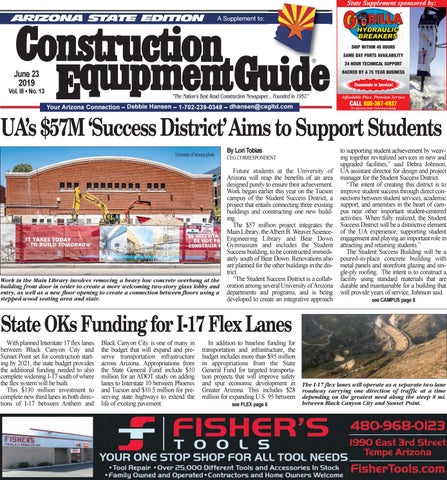
UA’s $57M ‘Success District’ Aims to Support Students University of Arizona photo
Work in the Main Library involves removing a heavy low concrete overhang at the building front door in order to create a more welcoming two-story glass lobby and entry, as well as a new floor opening to create a connection between floors using a stepped-wood seating area and stair.
By Lori Tobias CEG CORRESPONDENT
Future students at the University of Arizona will reap the benefits of an area designed purely to ensure their achievement. Work began earlier this year on the Tucson campus of the Student Success District, a project that entails connecting three existing buildings and constructing one new building. The $57 million project integrates the Main Library, the Albert B. Weaver ScienceEngineering Library and Bear Down Gymnasium and includes the Student Success building, to be constructed immediately south of Bear Down. Renovations also are planned for the other buildings in the district. “The Student Success District is a collaboration among several University of Arizona departments and programs, and is being developed to create an integrative approach
to supporting student achievement by weaving together revitalized services in new and upgraded facilities,” said Debra Johnson, UA assistant director for design and project manager for the Student Success District. “The intent of creating this district is to improve student success through direct connections between student services, academic support, and amenities in the heart of campus near other important student-centered activities. When fully realized, the Student Success District will be a distinctive element of the UA experience, supporting student engagement and playing an important role in attracting and retaining students.” The Student Success Building will be a poured-in-place concrete building with metal panels and storefront glazing and single-ply roofing. The intent is to construct a facility using standard materials that are durable and maintainable for a building that will provide years of service, Johnson said. see CAMPUS page 6
State OKs Funding for I-17 Flex Lanes With planned Interstate 17 flex lanes between Black Canyon City and Sunset Point set for construction starting by 2021, the state budget provides the additional funding needed to also complete widening I-17 south of where the flex system will be built. This $130 million investment to complete new third lanes in both directions of I-17 between Anthem and
Black Canyon City is one of many in the budget that will expand and preserve transportation infrastructure across Arizona. Appropriations from the State General Fund include $10 million for an ADOT study on adding lanes to Interstate 10 between Phoenix and Tucson and $10.5 million for preserving state highways to extend the life of existing pavement.
In addition to baseline funding for transportation and infrastructure, the budget includes more than $95 million in appropriations from the State General Fund for targeted transportation projects that will improve safety and spur economic development in Greater Arizona. This includes $28 million for expanding U.S. 95 between see FLEX page 6
The I-17 flex lanes will operate as a separate two-lane roadway carrying one direction of traffic at a time depending on the greatest need along the steep 8 mi. between Black Canyon City and Sunset Point.
Page 2 • June 23, 2019 • www.constructionequipmentguide.com • Arizona State Supplement • Construction Equipment Guide
Last Girder Set for South Mountain ADOT Extends I-11 Freeway Interchange in West Phoenix Draft EIS Comment Period to July 8 closures and traffic restricTwo years after construction tions are still needed to began on an interchange concomplete some of the necting Interstate 10 and the remaining work, including Loop 202 South Mountain pouring bridge decks and Freeway, crews have placed installing barrier wall. the final bridge girders needed The South Mountain for this huge Arizona Freeway is scheduled for Department of Transportation full completion in 2020, project in west Phoenix. although traffic is expectThe milestone occurred ed to be using the freeway when Connect 202 Partners, earlier. It will provide a the developer of the South long-planned direct link Mountain Freeway, placed 21 between the East Valley concrete support beams, measuring up to 128 ft. long and To create the interchange’s five flyover ramps, large and West Valley and a weighing 115,000 lbs. apiece, cranes have set 186 bridge girders above I-10 during much-needed alternative to I-10 through downtown for a flyover ramp that will weekend closures. Phoenix. Approved by carry HOV lanes. Maricopa County voters in 1985 and To create the interchange’s five fly- to westbound I-10). Building the 22-mi. South Mountain again in 2004 as part of a comprehenover ramps, large cranes have set 186 bridge girders above I-10 during week- Freeway requires placing approxi- sive regional transportation plan, the end closures. These ramps, which will mately 1,000 girders, all of which have South Mountain Freeway will complete the Loop 202 and Loop 101 freecarry traffic seamlessly between the been manufactured locally. While the final girders are in place way system in the Valley. freeways, range in length from 115 ft. For more information, visit (westbound Loop 202 to eastbound I- for the interchange in west Phoenix, 10) to 1,565 ft. (westbound Loop 202 several overnight and weekend I-10 SouthMountainFreeway.com.
Former Empire Southwest President John O. Whiteman Passes Away at 79 John O. Whiteman, former president and chairman of Empire Southwest Co., passed away on May 30, 2019 at age 79. He is survived by his wife Betty, son Jeff Whiteman (Holly), daughter Christy Wilson (Jim), son Eric Whiteman (Sarah), stepsons Stephen Taylor (Todd), Christopher Taylor (Jenny), 16 grandchildren and 5 great-grandchildren and sister Jinx Patterson. Mr. Whiteman was born in Pendleton, Ore. His father, Jack, moved the family to Arizona in the 1950s where he founded Empire Southwest, the region’s Caterpillar equipment dealership. Mr. Whiteman grew Empire Southwest into one of Arizona’s largest private companies. Empire sells and rents heavy equipment for the construction, mining and paving industries. His career at Empire spanned 40 years, including eight as CEO and five as chairman. He will be remembered for his philanthropy and leadership of the Whiteman foundation, through which he established the Arizona Museum for Youth — now known as the i.d.e.a. Museum, a hands-on museum for children — and Educare Arizona, a preschool in the Balsz Elementary School district in Phoenix. “He had a genuine desire to help other people,” said son Jeffrey Whiteman, who succeeded his father in 2002 as CEO of Empire Southwest told AZCentral. “That's what he was
John O. Whiteman
all about — helping people and making things better.” According to AZCentral, Mr. Whiteman, who earned a degree in sociology at Arizona State University, served on various boards, including those of the Mesa Chamber of Commerce, the Phoenix Art Museum and the Arizona Community Foundation. He also supported other groups including ASU and Girl Scouts of America. CEG
Additional information that is part of the draft environmental document for the proposed Interstate 11 corridor, stretching from Nogales to Wickenburg, has been released. To provide sufficient time for community review of the entire draft environmental impact statement, the public comment period has been extended to July 8, providing a full 90 days of review from the draft’s initial release. The additional information, called the errata, for the Draft Tier 1 Environmental Impact Statement for the proposed I11 corridor, was made available on April 26. This additional information, as well as the entire Draft Tier 1 Environmental Impact Statement, can be found online at i11study.com/Arizona and at all locations where copies of the environmental document are available for review or purchase. As a Tier 1 Environmental Impact Statement, I-11 is a concept far from construction. No funding has been identified or proposed to move to Tier 2 studies on any segments of the corridor. Those Tier 2 studies would identify specific alignments for a roadway, within a selected build corridor alternative. In all, the Recommended Corridor Alternative identified in the Draft Tier 1 Environmental Impact Statement is 2,000 ft. wide. Specific alignments, as would be identified in Tier 2 studies, would be about 400 ft. wide. Prepared by the Arizona Department of Transportation and the Federal Highway Administration over the course of three years, the Draft Tier 1 Environmental Impact Statement describes the study process, completed in compliance with the National Environmental Policy Act. It proposes a Recommended Corridor Alternative, with analysis of other alternatives and a no-build option. Kicking off next week is a series of six public hearings on the Draft Tier 1 Environmental Impact Statement for the 280-mi. proposed I-11 corridor. Meetings will be held in Buckeye, Wickenburg, Casa Grande, Nogales, Tucson and Marana. Each meeting provides the same forum for learning about the project and providing formal comments, which will be used by the study team to guide development of the Final Tier 1 Environmental Impact Statement. There are several ways to submit comments on the Draft Tier 1 Environmental Impact Statement, including online, in person at a public hearing, and by email, U.S. postal mail and a bilingual telephone hotline. In addition to providing verbal or written comments at a public hearing, members of the community can submit comments or questions through July 8 using the following methods: Online: i11study.com/Arizona Email: I-11ADOTStudy@hdrinc.com Bilingual Phone: 1.844.544.8049 Mail: I-11 Tier 1 EIS Study Team, c/o ADOT Communications, 1655 W. Jackson St., Mail Drop 126F, Phoenix, AZ 85007 In 2015, the Fixing America’s Surface Transportation Act, or FAST Act, formally designated I-11 in Arizona. The designation doesn’t include funding but identifies I-11 as a highpriority corridor eligible for federal funding. For more information, visit i11study.com/Arizona.
Construction Equipment Guide • Arizona State Supplement • www.constructionequipmentguide.com • June 23, 2019 • Page 3
Page 4 • June 23, 2019 • www.constructionequipmentguide.com • Arizona State Supplement • Construction Equipment Guide
Four ADOT Projects Receive Partnering Excellence Awards To address pavement damage from many harsh winters, the Arizona Department of Transportation engaged a contractor to rebuild a total of 10 mi. of Interstate 40 west of Williams near Devil Dog Road. In addition to the complexity of removing and replacing 5 mi. of freeway in each direction, challenges included minimizing impacts on travelers and communities while finishing as soon as possible around a winter hiatus when the weather made work impossible. ADOT and Fann Contracting Inc. navigated these challenges along with others that weren’t anticipated, such as weather, fire restrictions and unsuitable and unstable soil conditions, to deliver the improvement on time while maintaining two-way traffic throughout. Contributing to this success was a defined process called partnering through which the agency, contractors and stakeholders including area governments and utilities agree to goals, a communication structure and a way to resolve issues that arise. For its efforts on this $34 million improvement, which was completed last fall, the project team, including ADOT personnel and Fann Contracting, recently received an Arizona Transportation Partnering Excellence Award. The I-40 Devil Dog award, one of nine given at the Arizona
The I-40 Devil Dog award, one of nine given at the Arizona Conference on Roads & Streets in Tucson, was for projects worth more than $25 million.
Conference on Roads & Streets in Tucson, was for projects worth more than $25 million. Each year, the Arizona Transportation Partnering Excellence Awards recognize teams of contractors and other organizations that have used partnering to foster productive relationships and successfully complete projects through communication, commitment, cooperation and continuous improve-
ment. In addition to ADOT, the awards are sponsored by the Associated General Contractors Arizona Chapter, Arizona Public Works Association, American Council of Engineering Companies, Associated Minority Contractors of Arizona, Arizona Transportation Builders Association, Federal Highway Administration and Maricopa County Department of Transportation. The Arizona Transportation Partnering
Excellence Awards for 2018 honored three other ADOT projects: • For projects worth more than $25 million: ADOT and Ames Construction Inc., I19 Ajo Way traffic interchange. • For projects between $5 million and $25 million: ADOT and Nesbitt Contracting Co. Inc., State Route 88 improvements between Apache Junction and Tortilla Flat. • For projects under $5 million: ADOT and Fann Contracting, I-40 Twin Arrows traffic interchange. “Successful partnerships reduce delays, develop positive and effective relationships and help partners identify and solve problems as quickly as possible,” said Michael Carter, ADOT partnering administrator. “Partnering allows ADOT to deliver projects on time and cultivate better working relationships with contractors and stakeholders.” In 1991, before its partnering program began, ADOT faced 60 legal actions resolved through mediation, arbitration or litigation at a cost of $39.8 million. Today, almost no disagreements over projects give rise to legal actions involving stakeholders, and an ADOT legal team that once handled those actions no longer exists. For more information, visit azdot.gov/Partnering.
ADOT SMF Update: Construction Progresses Along 59th Avenue With all bridge girders in place, frontage road construction under way and an overpass built over railroad tracks, among other milestones, Loop 202 South Mountain Freeway construction continues advancing along the 59th Avenue alignment south of Interstate 10 (Papago Freeway) in west Phoenix. In the first half of 2019, crews working on this Arizona Department of Transportation project have made significant progress along the Papago segment between Interstate 10 and Lower Buckeye Road, including: • Placing the last bridge girder, measuring 97 ft. long and weighing 83,000 lbs., for the Van Buren Street traffic interchange. • Starting construction on the 59th Avenue northbound frontage road between Buckeye Road and Van Buren Street that is slated to open late this year. • Opening the future 59th Avenue southbound frontage between Van Buren Street and Buckeye Road to carry two-way traffic until the northbound frontage road is completed. • Pouring the concrete bridge deck for the Lower Buckeye Road interchange. The Buckeye Road and Van Buren Street interchanges are next in line for similar work. • Building an overpass over the Union Pacific Railroad tracks.
The South Mountain Freeway will include 2.5-mi. frontage roads to maintain northbound and southbound access to businesses and residences adjacent to the freeway between Roosevelt Street and Lower Buckeye Road. These one-way frontage roads will have two travel lanes in each direction and traffic signals at each major intersection. With various lane closures still in place along 59th Avenue for final construction between I-10 and Lower Buckeye Road, motorists should consider alternate routes such as 51st and 67th avenues until late 2019. While business access is being maintained at all times, the potential for delays will continue. Motorists should slow down and obey the speed limit and allow extra travel time. The South Mountain Freeway is scheduled for full completion in 2020, although traffic is expected to be using the freeway earlier. It will provide a longplanned direct link between the East Valley and West Valley and a much-needed alternative to I-10 through downtown Phoenix. Approved by Maricopa County voters in 1985 and again in 2004 as part of a comprehensive regional transportation plan, the South Mountain Freeway will complete the Loop 202 and Loop 101 freeway system in the Valley. For more information, visit SouthMountainFreeway.com.
Loop 202 South Mountain Freeway construction continues advancing along the 59th Avenue alignment south of Interstate 10 in west Phoenix.
Construction Equipment Guide • Arizona State Supplement • www.constructionequipmentguide.com • June 23, 2019 • Page 5
NEXT ISSUE CLOSES JULY 11, 2019
3 3 3 3 3 3 3
empirecat.com/eloy / l | 520-582-2900 520 582 2900
Page 6 • June 23, 2019 • www.constructionequipmentguide.com • Arizona State Supplement • Construction Equipment Guide
Site Prep Continues on UA Campus CAMPUS from page 1 that will enable students to collabora- ers and units; a tight construction site; Work in the Main Library involves tively design and fabricate physical and working in occupied buildings on a removing a heavy low concrete over- digital creations as part of the learning busy campus; transforming an historic building; and navigating through years hang at the building front door in order process. While there are numerous chal- of underground utility development,” to create a more welcoming two-story glass lobby and entry, as well as a new lenges, most are common to a project Johnson said. “The University is using the design-build design and construcfloor opening to create a connection of this scale. tion delivery method, and the between floors using a steppeddesign-build team is implementing wood seating area and stair. a thoroughly developed plan.” In the Weaver ScienceThe University is aspiring to Engineering Library, a new lobby gain LEED Silver certification and stair will be added on the east with sustainability goals on side to introduce a new entry in numerous levels. In addition to the the heart of the District and create contributions the project will more architectural interest in what make, it also will benefit from is currently a blank five-story resources such as connectivity to a brick wall. central plant for efficient use of The new Student Success utilities, access to alternative Building will feature a connection modes of transportation and camto the Bear Down Gym via a University of Arizona photo pus recycling programs. physical bridge and through pro$57 million project integrates the Main Equipment on site includes a grammatic integration between The Library, the Albert B. Weaver Sciencethe two facilities. The gym will Engineering Library and Bear Down tower crane, concrete pumps, conundergo transformational design Gymnasium and includes the Student Success crete trucks, an excavator, loader, to spatially interconnect the three building, to be constructed immediately backhoe, forklift, dump trucks, drill rig, mobile crane and a skid stories of student-centered servic- south of Bear Down. steer. es, programs and activity spaces. “Projects of this scale on a Completion is scheduled for October In addition to the collaborative learning spaces, the district will include University campus always have many 2021 with intermediate occupancies tutoring services, health and well-being challenges, such as coordination of occurring as each component is comresources, and cutting-edge technology multiple University clients, stakehold- pleted. CEG
I-17 Flex Lanes Will Ease Congestion FLEX from page 1
Yuma and Yuma Proving Ground, that region’s largest employer. There is $20 million to help build two Interstate 40 interchanges needed to accommodate growth in Kingman, with the city providing the remainder of the funding required. ADOT has been working to advance projects to improve traffic flow and safety along 23 mi. of I-17 between Anthem and Sunset Point north of Phoenix. More than $190 million was already committed to building flex lanes north of Black Canyon City as well as adding 7 mi. of a third southbound lane directly south of that project. Investing an additional $130 million over three years will allow ADOT to complete all sections of new third lanes. Combined with the flex lanes, this increased capacity will enhance safety and help address traffic flow challenges and backups that occur due to crashes and when many drivers are traveling to or from Arizona’s high country on summer weekends. The Maricopa Association of Governments is providing $50 million in regional funds to help fund the widening of I17 between Black Canyon City and Anthem. The I-17 flex lanes will operate as a separate two-lane roadway carrying one direction of traffic at a time depending on the greatest need along the steep 8 mi. between Black Canyon City and Sunset Point. With gates at each end and separated by concrete barrier from the current southbound lanes, the flex lanes will be able to carry heavier northbound traffic on a Friday or southbound traffic on a Sunday. They
also can keep traffic moving if there is a closure in that stretch. Required environmental studies for the I-17 corridor are scheduled to be completed by this summer, with the projects scheduled for completion by 2023. The budget commits $10 million from the State General Fund to an ADOT study, in collaboration with the Maricopa Association of Governments and Gila River Indian Community, on adding a lane in each direction and improving interchanges on I-10 between Phoenix and Casa Grande. Completing a design concept report and environmental study will determine needs and costs, and establish how the improvements will be phased. This process is on track to begin this year with an accelerated 18-month timeline. The $51.1 million in funds, including $10.5 million in additional funding from the State General Fund, will allow ADOT to preserve the road surface along more miles of state highway through treatments known as fog seals and chip seals. These investments are critical to extend the life of existing pavement by sealing road surfaces against the ravages of weather, heavy use and time. The budget’s other transportation infrastructure investments from the State General Fund include: • $18 million for counties and cities and towns; • $10 million for local aviation projects; • $6.5 million for Mesa to construct a State Route 24 bridge over Ellsworth Road; and • $2.8 million for Globe to repair or replace the Jesse Hayes Road over Pinal Creek.
Infrastructure Grants...
USDOT Announces $21M for Projects at 17 Airports in State By Katherine Devlin CEG EDITORIAL ASSISTANT
On June 5, the U.S. Department of Transportation (USDOT) announced more than $840M in grants awarded by the Federal Aviation Administration (FAA) to improve infrastructure at airports throughout the country. This includes more than $21M to 17 airports throughout Arizona. The Airport Improvement Program (AIP) issues grants to public agencies and private owners for infrastructure improvement projects. This is the first allocation of $3.19 billion to be awarded, according to the USDOT press release. “This significant investment in airport improvements will fund construction and rehabilitation projects that will help maintain high levels of safety in U.S. aviation,” said U.S. Department of Transportation Secretary Elaine L. Chao. Grants have been issued for projects that include runway rehabilitation, runway construction, maintaining taxiways, aprons and terminals. According the USDOT, “the construction and equipment supported by this funding increase the airports’ safety, emergency response capabilities, and capacity, and could support further economic growth and development within each airport’s region.” The list of Arizona projects awarded in this round are: • Eric Marcus Municipal Airport: $673,844 to install perimeter fencing • Bagdad: $209,438 for runway reconstruction • Benson Municipal: $600,000 to install perimeter fencing • Buckeye Municipal: $1,690,907 to rehabilitate the taxiway • Chandler Municipal: $367,842 to update airport master plan study • Cottonwood: $300,000 to update airport master plan study • Bisbee Douglas International: $397,652 to reconstruct runway lighting • Holbrook Municipal: $150,000 for runway reconstruction • Kayenta: $200,000 to rehabilitate the apron • Phoenix-Mesa Gateway: $6,555,468 to reconstruct the taxiway • Nogales International: $850,735 to reconstruct the taxiway and rehabilitate the Runway • Phoenix Sky Harbor International: $3,699,500 to reconstruct the apron • Polacca: $394,289 to reconstruct the runway • Ernest A Love Field: $807,500 to reconstruct taxiways A, B4 and C • Scottsdale: $850,000 to rehabilitate runway lighting • Sedona: $200,332 to reconstruct the apron • Window Rock: $3,127,911 to reconstruct the runway CEG
Construction Equipment Guide • Arizona State Supplement • www.constructionequipmentguide.com • June 23, 2019 • Page 7
Pros Kno Pros Kno ow! w!
®
T Those in the know w,, know Takeuchi Take euchi
Takeuchi of o ffers a wide range of compact excavatorss to help you get your tougheest tasks comppleted. PUT A TAKEUCH A HI TO WORK ON O YOUR JOBSITE AN ND EXPERIIENCE THE DIFFEREN NCE!
www.ditchwitchaz.com
4028 S 36th Street Phoenix, AZ 85040 (602) 437-0351 6975 N Camino Martin Tucson, AZ 85741 (520) 579-0261
takeuch hi us.com hi-us.com
Expediting Project Delivery...
FHWA Approves Full NEPA Assignment for Arizona DOT A memorandum of understanding signed between the Federal Highway Administration and the Arizona Department of Transportation on April 16 allows the state to assume decision-making and legal responsibilities for meeting National Environmental Policy Act requirements for federal highway projects. The Arizona DOT noted it already has responsibility for NEPA decisions known as categorical exclusions involving projects found to not have significant environmental impacts under a separate agreement finalized with the FHWA in early 2018. The expanded NEPA authorization that FHWA is now providing to Arizona — valid for five years, with the option to renew, while reviewing compliance through audits and monitoring — makes it the seventh state to achieve full NEPA assignment approval.
“In keeping with the U.S. Department of Transportation’s ongoing mission to help expedite project delivery for our state partners, this memorandum of understanding will enable Arizona to assume the most complex federal highway environmental responsibilities,” said FHWA Deputy Administrator Brandye Hendrickson in a statement. The Arizona DOT noted that attaining full NEPA assignment responsibilities will help it complete required environmental studies more efficiently while maintaining the same degree of rigor required for projects receiving federal funding, including local projects administered by the agency. Congress originally authorized NEPA assignments — formally called the “Surface Transportation Project Delivery Program” — as pilot projects under the Safe, Accountable, Flexible, Efficient
“This is an opportunity to move forward with transportation projects in a more consistent and streamlined fashion.” Brandye Hendrickson Federal Highway Administration
Transportation Equity Act: A Legacy for Users or SAFETEALU passed in 2005 and then allowed such assignments to be used more broadly on a permanent basis with the Moving Ahead for Progress in the 21st Century Act or MAP-21signed into law in 2012. NEPA assignments recognize that states are able to comply with federal environmental requirements on their own, allowing them to streamline processes — saving
time and money — while waiving their sovereign immunity in relation to federal court jurisdiction. For example, the California Department of Transportation reported a 30 percent time savings in project delivery after receiving NEPA assignment authority, while the Texas Department of Transportation estimated that it gained time savings of 25 percent The U.S. Department of Transportation also issued a final
rule last year to “rationalize and streamline” the environmental review process across railroad, transit, and highway projects alike. “We anticipate increased project efficiency and the elimination of confusion for multimodal projects. The rule also updates some of our environmental rule policies and ensures greater consistency, reducing duplicative efforts, and reiterating the ability to produce a single environmental document,” noted FHWA’s Hendrickson during an October conference call regarding the benefits of the new rule. The rule also provides for greater flexibility on projects that take place entirely within the operational right-of-way though the use of categorical exclusions, she added. “This is an opportunity to move forward with transportation projects in a more consistent and streamlined fashion,” Hendrickson said.
Page 8 • June 23, 2019 • www.constructionequipmentguide.com • Arizona State Supplement • Construction Equipment Guide
Public Auction held the 2nd Saturday of every month. Preview Every Monday - Friday 7am - 4pm Consignments Welcome Western Sales Management, Inc 1616 S 67th Ave. Phoenix, AZ 85043
623-936-3300 wsmauctioneers.com wsmauctionbiz@yahoo.com
Next Auction July 13, 2019
File Photo