State Supplement sponsored by:
ARIZONA STATE EDITION
A Supplement to:
SHIP WITHIN 48 HOURS SAME DAY PARTS AVAILABILITY
®
April 28 2019
24 HOUR TECHNICAL SUPPORT BACKED BY A 75 YEAR BUSINESS Thousands in Service!
Vol. III • No. 9
“The Nation’s Best Read Construction Newspaper… Founded in 1957.”
Affordable Price. Premium Service.
Your Arizona Connection – Debbie Hansen – 1-702-239-0348 – dhansen@cegltd.com
CALL 800-367-4937 *On approved credit • Financing Available
South Mountain Freeway on Track for 2020 Completion By Chuck Harvey CEG CORRESPONDENT
The Loop 202, Arizona’s South Mountain Freeway, will add 22 mi. of freeway to the existing Phoenix metropolitan transportation system, easing traffic congestion and connecting the east and west valleys. Major construction began in early 2017. The project is scheduled for full completion in 2020, although traffic is expected to be using the freeway earlier. Most construction occurs on weekdays, although some construction activities will require work every day and overnight. Approximately $1.7 billion was provided for the Maricopa Association of Governments Regional Transportation Plan in fiscal years 2016-2020 for the South Mountain Freeway. The amount includes design, right-ofway, construction, utility and administrative costs. It is the largest single highway project in Arizona history. Freeway Links Two Valleys The South Mountain Freeway will provide a long-planned direct link between the East Valley and West Valley and a much-needed alternative to I-10 through downtown Phoenix. Approved by
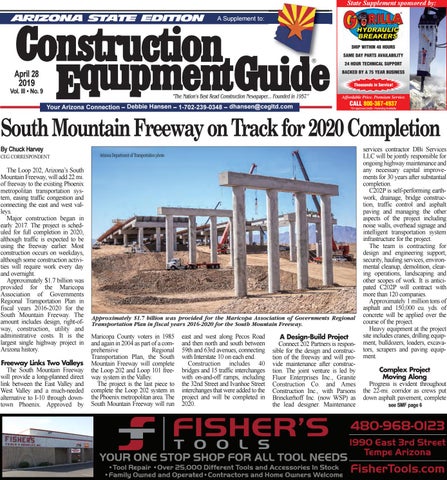
Arizona Department of Transportation photo
Approximately $1.7 billion was provided for the Maricopa Association of Governments Regional Transportation Plan in fiscal years 2016-2020 for the South Mountain Freeway.
Maricopa County voters in 1985 and again in 2004 as part of a comprehensive Regional Transportation Plan, the South Mountain Freeway will complete the Loop 202 and Loop 101 freeway system in the Valley. The project is the last piece to complete the Loop 202 system in the Phoenix metropolitan area. The South Mountain Freeway will run
east and west along Pecos Road and then north and south between 59th and 63rd avenues, connecting with Interstate 10 on each end. Construction includes 40 bridges and 15 traffic interchanges with on-and-off ramps, including the 32nd Street and Ivanhoe Street interchanges that were added to the project and will be completed in 2020.
A Design-Build Project Connect 202 Partners is responsible for the design and construction of the freeway and will provide maintenance after construction. The joint venture is led by Fluor Enterprises Inc., Granite Construction Co. and Ames Construction Inc., with Parsons Brinckerhoff Inc. (now WSP) as the lead designer. Maintenance
services contractor DBi Services LLC will be jointly responsible for ongoing highway maintenance and any necessary capital improvements for 30 years after substantial completion. C202P is self-performing earthwork, drainage, bridge construction, traffic control and asphalt paving and managing the other aspects of the project including noise walls, overhead signage and intelligent transportation system infrastructure for the project. The team is contracting for design and engineering support, security, hauling services, environmental cleanup, demolition, clearing operations, landscaping and other scopes of work. It is anticipated C202P will contract with more than 120 companies. Approximately 1 million tons of asphalt and 150,000 cu. yds. of concrete will be applied over the course of the project. Heavy equipment at the project site includes cranes, drilling equipment, bulldozers, loaders, excavators, scrapers and paving equipment. Complex Project Moving Along Progress is evident throughout the 22-mi. corridor as crews put down asphalt pavement, complete see SMF page 6
¤ ¤ ~ YOUR ONE STOP SHOP FOR ALL TOOL NEEDS ÝKggd I]hYaj ÝFn]j ;a^^]j]fl Kggdk Yf\ 8[[]kkgja]k @f Jlg[c Ý=Yeadq Fof]\ Yf\ Fh]jYl]\Ý:gfljY[lgjk Yf\ ?ge] Fof]jk N]d[ge]
~ <Ykl j\ Jlj]]l K]eh] 8jargfY
=ak`]jKggdk [ge
Page 2 • April 28, 2019 • www.constructionequipmentguide.com • Arizona State Supplement • Construction Equipment Guide
R&J Utility Teams Up With Westrax for Equipment Needs
Currently, R&J Utility is working on the Verrado housing development in Buckeye, Ariz. This development started around 10 or 15 years ago and has seen tremendous growth thus far.
John Petersen, vice president of Glendale, Ariz.-based R&J Utility, was in a bind. With a slew of projects building up, R&J was in desperate need for a few water trucks. “We were three months into business, and we were struggling to find some water trucks,” said Petersen. “I spoke to one of the local equipment dealers who said he didn’t have any, but said he might know of a company that did.” That company was Westrax Machinery, a Southern Californiabased dealer that had just recently opened a location in Phoenix. Petersen called Westrax’s Marcel Gerits and had the trucks delivered that day. Within a week of receiving a pair of water trucks, R&J had another project: a difficult trench dig coming up that required the versatility of an excavator. They immediately thought to call Westrax. “We had gotten such a quick response before, they were the first ones we thought of,” said Peterson. Again, Westrax came through with flying colors: within a few short hours R&J had a Hitachi wheel loader and a Kobelco 50,000-lb. and 75,000-lb. excavator delivered to the site. Another crisis averted. No stranger to struggles, Petersen had originally opened up for business in 1996, but due to recession, had to close in 2008. “It was rough,” he said. “The building sector was down, the economy was down, we had no choice but to step back.” Fast track to 2016. The market had rebounded and there was a tremendous amount of opportunity in Phoenix and the surrounding areas. Roberto Arteaga, president
R&J Utility officially opened its doors for business in October 2017 and specializes in laying and repairing of sewer, water and storm drains for residential developments in Maricopa County.
(L-R): Marcel Gerits of Westrax Machinery; Roberto Arteaga, president R&J Utility; and John Petersen, vice president R&J Utility.
of R&J Utility, having previously worked with Petersen, approached him about starting a new company together. Petersen thought it was a great idea, and in November 2016, he reinstated his license. They officially opened their doors for business in October 2017 and specialized in laying and repairing of sewer, water and storm drains for residential developments in Maricopa County. Currently, the company is working on the Verrado housing development in Buckeye, Ariz. This development started around 10 or 15 years ago and has seen tremendous growth thus far. So far they’ve only experienced a few hiccups.
“We did have some hard digs on a parcel out there,” Petersen said. “The ground was tough, deep and rocky. We had to call Westrax and get larger excavator with a heavier bucket to get through that stuff. Other than that, everything is running really smoothly.” Rain also has caused a few minor delays, but even with that, Petersen expected the job to be done on schedule. While most of the technology has stayed the same, some things have changed in the industry for Petersen and Arteaga since their original start-up. Staffing is more of a challenge than it used it be. “We’ve been pretty fortunate so
far,” said Arteaga. “A lot of the original guys that worked with us at the last company came back as soon as we opened up R&J Utility. Because of our years in the business, we were lucky to get guys with 10 to 15 years of experience. That really comes into play when bidding.” “More local competition as well,” added Petersen. As R&J Utility has now grown to 35 employees, its need for more equipment has grown, as well. The relationship with Westrax has only gotten stronger. “At any given time we have about eight to 10 of their pieces of equipment on our job sites,” Arteaga said. “We have never considered going anywhere else. They’ve got a great selection at
competitive rates. Whether it’s an excavator, loader or another piece of equipment, we’ve never been disappointed. They take real good care of us.” Arteaga is looking toward the future with confidence. “From the beginning, we’ve committed to giving our customers the best service we can,” he said. “Getting the job done right and on schedule. Making sure that our response time is generally within 24 hours. As long as the market stays strong, we’ll just keep looking for new business and opportunities.” For more information about R&J Utility, call 623/266-9585. For more information about Westrax Machinery, call Marcel Gerits at 602/397-8173. CEG
R&J Utility uses a Kobelco SK230 excavator to dig a sewer service trench for a new home at Verrado, Ariz.
Construction Equipment Guide • Arizona State Supplement • www.constructionequipmentguide.com • April 28, 2019 • Page 3
Pros Kno Pros Kno ow! w!
®
T Those in the know w,, know Takeuchi Take euchi
Takeuchi of o ffers a wide range of compact excavatorss to help you get your tougheest tasks comppleted. PUT A TAKEUCH A HI TO WORK ON O YOUR JOBSITE AN ND EXPERIIENCE THE DIFFEREN NCE!
www.ditchwitchaz.com
4028 S 36th Street Phoenix, AZ 85040 (602) 437-0351 6975 N Camino Martin Tucson, AZ 85741 (520) 579-0261
takeuch hi us.com hi-us.com
ADOT, Tribes Launch Forum on Transportation Issues To strengthen working relationships with American Indian tribes, who are key stakeholders in the state highway system, the Arizona Department of Transportation has launched a series of forums to share ideas and provide information on agency resources. Offered in partnership with the Inter Tribal Council of Arizona, the Tribal Transportation Working Group connects agency representatives with transportation officials and other representatives from 22 tribes on matters ranging from enforcement of weight restrictions on state highways to sharing information from industry conferences. “We want open communication with tribes, and we want them to see us as a partner,” said Charla Glendening, statewide planning manager of ADOT. “This working group also is an opportunity to highlight ADOT resources that can benefit tribes.” The working group has a format similar to one ADOT uses with local councils of government around Arizona, providing a single forum for all to exchange ideas rather than
having sessions with individual tribes. “Meeting as a group brings the tribes the same consistent message and the latest news in transportation,” said Ermalinda Gene, ADOT’s Tribal Planning Program manager and a tribal liaison. At the group’s first meeting in February, ADOT representatives provided a summary of the Arizona Rural Transportation Summit held in the fall and had Enforcement and Compliance Division officers explain mobile checkpoints that make sure large trucks obey laws on proper permits and allowable weight. Maria Dadgar, executive director of the Inter Tribal Council of Arizona, said that bringing together transportation experts and leaders from the tribes to meet regularly with ADOT helps all involved quickly identify and respond to opportunities. “Through the Tribal Transportation Working Group, tribal representatives have direct input to voice concerns and to work cohesively with ADOT to develop positive outcomes toward improving transportation for all,” Dadgar said.
TM
Skid Steer Box Blade Precision Laser Grader r
1BUFOUFE 2VBE3PE MJOLBHF: rigid, accurate and responsive
r
)BSEJ-VCF CVTIFT: sealed & lifetime lubricated never need greasing
r
3FUSBDUJOH GSPOU XIFFMT: use like a dozer, trim up to edges, short transport length
r
"EKVTUBCMF IJUDI QMBUF: ultimate rigidity & accuracy forwards & reverse
r
6OEFSTMVOH XBMLJOH CFBN: reduces wheel scuff in turns
Now available at:
1411 N. 27th Ave, Phoenix AZ 85009 Aaron Armenta 602 501 5062 aaron.armenta@titanmachinery.com
www.sharpgrade.com
Page 4 • April 28, 2019 • www.constructionequipmentguide.com • Arizona State Supplement • Construction Equipment Guide
Hudbay Makes Plans for Early Works Program at Rosemont
Rosemont, located in Arizona, is one of the world’s best undeveloped copper projects. Rosemont is expected to produce approximately 127,000 tonnes of copper annually over the first 10 years of operations.
Hudbay Minerals Inc. announced that its Board of Directors has approved an early works program at its Rosemont project, and provided its annual mineral reserve and resource update. “We are pleased to be moving forward at Rosemont and look forward to carrying out the early works in parallel with financing activities for the project,” said Alan Hair, Hudbay’s president and chief executive officer. “We continue to drive momentum across our business with the Lalor mine’s successful ramp up to 4,500 tonnes per day, extending 777’s mine life into 2022 and moving Rosemont forward in a prudent manner.” Rosemont Project The permitting process at Rosemont concluded with the receipt of the Section 404 Water Permit from the U.S. Army Corps of Engineers and the Mine Plan of Operations from the U.S. Forest Service in March 2019. Hudbay is now in a position to move the project forward with development. Hudbay’s agreement to acquire United Copper & Moly
The permitting process at Rosemont concluded with the receipt of the Section 404 Water Permit from the U.S. Army Corps of Engineers and the Mine Plan of Operations from the U.S. Forest Service in March 2019.
LLC’s 7.95 percent interest in Rosemont provides Hudbay with greater strategic flexibility with respect to capital structure and project financing alternatives. Hudbay intends to evaluate a variety of options, including the addition of a new, committed joint venture partner for the development of Rosemont. The company expects to carry out this process in parallel with advancing the initial development of Rosemont, with the objective to ultimately hold an approximate 70 percent interest in the project while maintaining operatorship. As part of the initial development plans, Hudbay’s Board has approved an early works program with spending of $122 million over and above the $20 million of Rosemont spending previously included in 2019 growth capital expenditure guidance. The early works program will be funded from cash on hand of $515 million as at Dec. 31, 2018. The $122 million early works program is part of Rosemont’s total project capital cost estimate of $1,921 million as disclosed in the National Instrument 43-101 technical report dated March 30, 2017 (“2017 Technical Report”) for
Rosemont and will fund the following activities: • Funding the construction of a water pipeline and power transmission line to site, which are critical long-lead items that are necessary to initiate heavy civil works at site. • Advancing critical path engineering and geotechnical work to support long-lead procurement and de-risk the project schedule and cost estimate. • Archaeological site work to prepare key areas for construction. • Spending on permit-related mitigation activities and owner’s costs. Hudbay plans to move ahead with early works and financing activities in parallel in 2019 and expects to seek Board approval to commence the construction of Rosemont by the end of the year; this would enable first production by the end of 2022. Rosemont, located in Arizona, is one of the world’s best undeveloped copper projects. Rosemont is expected to produce approximately 127,000 tonnes of copper annually over the first 10 years of operations.
Study of I-10 Improvements South of Valley Moves Forward The Arizona Department of Transportation and partner agencies are taking an essential step toward widening and other improvements along 23 mi. of Interstate 10 between Phoenix and Casa Grande. In collaboration with the Maricopa Association of Governments and the Gila River Indian Community, where this stretch is located, ADOT has issued a request for proposals for a design concept report and environmental study on adding a lane in each direction and improving existing interchanges. The study, required for projects that receive federal funding, will have an accelerated timeline of 18 months when it launch-
es later this year. “Through this partnership advanced by the Maricopa Association of Governments in conjunction with the Gila River Indian Community, we are developing a vision and strategy to provide the capacity that I-10 needs today and tomorrow in this corridor,” said John Halikowski, ADOT director. “As ADOT has made significant investments to increase capacity between the state’s two largest metropolitan areas, we must respectfully work with all governments and citizens affected by plans for I-10.” The Maricopa Association of Governments, the regional transportationplanning agency, has allocated about $65.5
million toward I-10 improvements in Maricopa County, $5.9 million of which is in ADOT’s current Five-Year Transportation Facilities Construction Program for study, coordination and design of additional lanes. These funds are from the voter-approved Proposition 400 program, the dedicated transportation sales tax in Maricopa County. In late 2019, after ADOT completes two widening projects under way between Earley Road and Interstate 8 in Casa Grande and between Eloy and Picacho, I-10 will be three lanes in each direction between State Route 387 near Casa Grande and Tucson. That will leave I-10 across the Gila River Indian Community, between Queen Creek
Road and State Route 387, as the only remaining stretch with two lanes in each direction. That is the area this study will assess. Widening I-10 across the Gila River Indian Community has been a longer-term ADOT priority requiring an agreement with tribal leaders and significant funding. While funding for initial improvements is tentatively planned for fiscal year 2023, the study will determine when construction would begin and establish the time frame for improvements. ADOT is committed to identifying additional funding for I-10 improvements elsewhere in this Key Commerce Corridor.
Construction Equipment Guide • Arizona State Supplement • www.constructionequipmentguide.com • April 28, 2019 • Page 5
Page 6 • April 28, 2019 • www.constructionequipmentguide.com • Arizona State Supplement • Construction Equipment Guide
Driving Times Should Improve Via SMF in Phoenix Area SMF from page 1
bridges, build artistic sound walls and install message boards above the future travel lanes. “Construction and design are more than two-thirds complete,” said Dustin Krugal, ADOT public information officer. Crews have now installed 20 mi. of drainage pipe; laid 107,000 tons of asphalt pavement; moved 9.9 million cu. yds. of dirt; and used 10,800 tons of steel rebar for bridges, walls and other structures. In 2019, construction will ramp up, Krugal said. Some of the 2019 construction highlights include: • Paving the entire 8-lane freeway.
With so much Loop 202 construction to come in 2019, motorists should be prepared for periodic roadway closures and extended traffic shifts around the work zones. A 6-mi. section of Pecos Road will be permanently closed and be repurposed into a 6mi.-long shared-used path between 17th Avenue and Desert Foothills Parkway.
Arizona Department of Transportation photo
Heavy equipment at the project site includes cranes, drilling equipment, bulldozers, loaders, excavators, scrapers and paving equipment.
An Innovative Plan For the largest project in state history, ADOT partnered with private developer Connect 202 Partners to design, build, and maintain the freeway for 30 years. The design-build-maintain delivery model is an innovative approach
Arizona Department of Transportation photo
When it opens by the end of 2019, the long-planned link between the East Valley and West Valley is projected to deliver an immediate savings of 15 million hours of travel time, worth $200 million, over the course of the year.
The Loop 202, Arizona’s South Mountain Freeway, will add 22 mi. of freeway to the existing Phoenix metropolitan transportation system, easing traffic congestion and connecting the east and west valleys.
• Completing 40 bridges throughout the corridor, including two half-mile-long spans over the Salt River. • Constructing two flyover HOV ramps in the I-10 median for the I-10 and Loop 202 interchange. • Shifting Pecos Road traffic onto portions of the freeway mainline through Ahwatuk. • Moving 59th Avenue traffic onto newly-constructed Loop 202 frontage roads between the I-10 Papago Freeway and Lower Buckeye Road. • Completing construction of Arizona’s first two diverging diamond interchanges at Desert Foothills Parkway and 17th Avenue. • Building five multi-use underpasses in the Center segment (51st Avenue to 32nd Lane) providing people and wildlife access to and from South Mountain Park.
used nation-wide to efficiently reduce the cost to taxpayers without sacrificing quality. Connect 202 Partners continues to make progress along the future 22-mi. corridor. Upon completion, the developer will be responsible for maintaining the freeway and ensuring the safety of the traveling public for 30 years. Benefits The freeway, which was twice approved by voters in Maricopa County, will provide a direct link for commuters traveling between the East Valley and West Valley, and much-needed alternative to taking Interstate 10 through downtown Phoenix. The South Mountain Freeway also is the last piece to complete the Loop 202 and Loop 101 freeway system necessary for high-quality regional
mobility. In addition, the South Mountain Freeway is designed to save both time and money for a fast-growing region. When it opens by the end of 2019, the long-planned link between the East Valley and West Valley is projected to deliver an immediate savings of 15 million hours of travel time, worth $200 million, over the course of the year. When it opens to traffic, the long-planned link in the Phoenix metropolitan area is expected to improve living and business conditions, including economic growth. Pedestrian Bridge The pedestrian bridge will be designed and constructed by Connect 202. Public art also will be incorporated into the pedestrian bridge in coordination with the city of Phoenix Office of Arts and Culture.
Dust Control Dust control is a priority for the construction team. Keeping the soil moist during ground-disturbing activities is the most effective means for preventing dust. Water spraying and soil stabilization materials will be used in all construction areas. Water will be sprayed on the dirt before, during and after the construction activity. Track out devices will be used at the construction site entrances and exits to reduce the amount of dirt vehicles track out onto adjacent streets. When possible, the number of vehicles in the construction area will be minimized. The city of Phoenix Street Transportation Department will conduct a traffic study to evaluate the potential impacts of construction on local traffic and residential neighborhoods between Pecos Road and Chandler Boulevard
from 17th Avenue to I-10. Additional focus will be placed on the intersections at 40th Street and Cottonwood Lane; 17th Avenue and Chandler Boulevard; and Liberty Lane at 24th Street and 32nd Street to understand the possible anticipated traffic patterns due to the change of Pecos Road to a State highway. Noise Two primary sources of noise are being addressed: equipment engine noise and back-up alarms. The construction team understands these alarms are disruptive to the adjacent residents. Because back-up alarms have proven to reduce the number of construction fatalities, the Occupational Safety and Health Administration requires the alarms to be used and that they be audible above the surrounding construction noise. CEG
Construction Equipment Guide • Arizona State Supplement • www.constructionequipmentguide.com • April 28, 2019 • Page 7
NEXT ISSUE CLOSES MAY 16, 2019
3 3 3 3 3 3 3
empirecat.com/eloy / l | 520-582-2900 520 582 2900
Page 8 • April 28, 2019 • www.constructionequipmentguide.com • Arizona State Supplement • Construction Equipment Guide
Public Auction held the 2nd Saturday of every month. Preview Every Monday - Friday 7am - 4pm Consignments Welcome Western Sales Management, Inc 1616 S 67th Ave. Phoenix, AZ 85043
623-936-3300 wsmauctioneers.com wsmauctionbiz@yahoo.com
Next Auction May 11, 2019
File Photo