Huntsville
20 Decatur
State Supplement sponsored by:
231
65
72 Florence
2
72
565 59
43 231
31
5
ALABAMA STATE EDITION
431
Gadsden
78 59
A Supplement to:
Anniston
20
Birmingham Bessemer
82 Tuscaloosa
65 280
20 82 Auburn
80
85
Selma
Phenix City
Montgomery
82 65
231
43 84 431 331
84
84 52
SHIP WITHIN 48 HOURS
Dothan
31
45 65 98
SAME DAY PARTS AVAILABILITY
Mobile
10
®
September 22 2021
24 HOUR TECHNICAL SUPPORT BACKED BY A 75 YEAR BUSINESS Thousands in Service!
Vol. XXIII • No. 19
“The Nation’s Best Read Construction Newspaper… Founded in 1957.” Your Alabama Connection • Rich Olivier, Atlanta, GA • 1-800-409-1479
Affordable Price. Premium Service.
CALL 800-367-4937 *On approved credit • Financing Available
Ala. Builds New Artificial Reefs in Gulf Waters Already the largest in the nation, if not the world, Alabama’s artificial reef zones recently got even larger with the addition of 110 sq. mi. of Gulf of Mexico bottom. As part of an overall $8.135 million expansion of the Alabama Artificial Reef Program, the Alabama Department of Conservation and Natural Resources (ADCNR) and its Marine Resources Division (MRD) recently received federal authorization for two additional permit areas from the U.S. Army Corps of Engineers. Craig Newton, MRD’s artificial reef coordinator, said additional grants from the National Fish and Wildlife Foundation’s Gulf Environmental Benefit Fund, established with criminal fines after the Deepwater Horizon Oil Spill in 2010, will enable his crews to deploy artificial reefs in both nearshore and offshore reef zones. “We have expanded the 6- to 9-mi. reef zone,” Newton said. “Originally, we had about 30 square miles in that reef zone. We’re expanding by 23 square miles near Gulf Shores and Fort Morgan and another 24-square-mile area offshore of Orange Beach that is between eight and 15 miles offshore.” The largest of the new zones is 13 to 25 mi. south of Dauphin Island and adds 63 sq. mi. for the 110-sq.-mi. total of new water bottom for constructing artificial reefs. Getting the zones approved was a lengthy process to ensure historical resources and artifacts were not impacted by the new reefs. The cost associated with the permitting process was $742,000, according to MRD. “We had to do bottom surveys that were required by the National Historical Preservation Act to ensure that cultural see REEF page 6
DBI photo
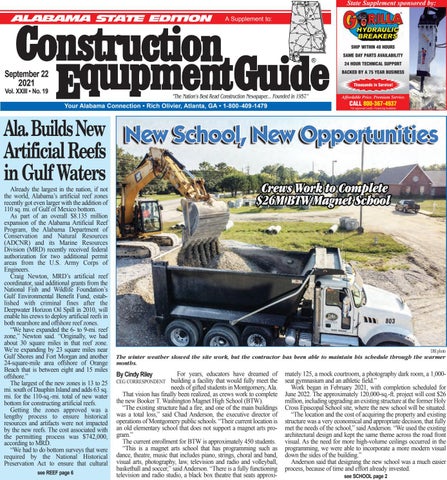
The winter weather slowed the site work, but the contractor has been able to maintain his schedule through the warmer months.
For years, educators have dreamed of building a facility that would fully meet the needs of gifted students in Montgomery, Ala. That vision has finally been realized, as crews work to complete the new Booker T. Washington Magnet High School (BTW). “The existing structure had a fire, and one of the main buildings was a total loss,” said Chad Anderson, the executive director of operations of Montgomery public schools. “Their current location is an old elementary school that does not support a magnet arts program.” The current enrollment for BTW is approximately 450 students. “This is a magnet arts school that has programming such as dance, theatre, music that includes piano, strings, choral and band, visual arts, photography, law, television and radio and volleyball, basketball and soccer,” said Anderson. “There is a fully functioning television and radio studio, a black box theatre that seats approxi-
By Cindy Riley
CEG CORRESPONDENT
mately 125, a mock courtroom, a photography dark room, a 1,000seat gymnasium and an athletic field.” Work began in February 2021, with completion scheduled for June 2022. The approximately 120,000-sq.-ft. project will cost $26 million, including upgrading an existing structure at the former Holy Cross Episcopal School site, where the new school will be situated. “The location and the cost of acquiring the property and existing structure was a very economical and appropriate decision, that fully met the needs of the school,” said Anderson. “We used the existing architectural design and kept the same theme across the road front visual. As the need for more high-volume ceilings occurred in the programming, we were able to incorporate a more modern visual down the sides of the building.” Anderson said that designing the new school was a much easier process, because of time and effort already invested. see SCHOOL page 2
Page 2 • September 22, 2021 • www.constructionequipmentguide.com • Alabama State Supplement • Construction Equipment Guide
School Construction Back On Track After Wet Winter, Spring DBI photo
Work began in February 2021, with completion scheduled for June 2022.
DBI photo
Underground plumbing, underground retainage and electrical work already have been completed, along with slabs for magnet arts, the black box theatre and cafeteria. SCHOOL from page 1
“Fortunately, the architect had completed programming with the school a few years prior to the fire and was able to update the existing programming very quickly. In all, the planning was approximately four to six months, with a construction contract in place at eight to nine months.” The unfortunate blaze in 2018 had a silver lining in that new construction will better serve student needs. “Most definitely, this will be a definite bright spot for the school system and will propel BTW to new heights in the academics and arts of the school,” said Anderson. Currently, students are attending classes at the former Hayneville Road Elementary School. Reaction to construction at the new site has been extremely positive. “There has been a tremendous amount of curiosity, anticipation and excitement,” said Anderson. “The buildings are really taking shape, and the school community is eager to enter the new location. This structure will bring new life to an area that hasn’t seen a lot of development over the past 20 years.” He added that the new campus will provide opportunities for the students and staff at BTW that have not existed in the program's history, with plans for expansion, should the need arise to house more students.
Amason & Associates photo
The project calls for 61,300 cu. yds. total unclassified excavation, 12,500 cu. yds. total offsite waste material and 21,100 cu. yds. imported engineered fill for undercuts at the buildings.
DBI photo
This structure will bring new life to an area that hasn’t seen a lot of development over the past 20 years.
“Also, there is a plan for a full performing arts facility that can hopefully be addressed once the critical needs around the district are taken care of. Currently, we are in the process of a district-wide facility audit, which will be concluded by a district-wide capital plan to kick off sometime in the new year. Our hope is that this project will be the catalyst for great things throughout the district.” Anderson said the length of the project has been the biggest challenge. “With insurance money having a time requirement, it has been difficult to have that portion completed in the allotted time.” Underground plumbing, underground retainage and electrical work already have been completed, along with slabs for magnet arts, the black box theatre and cafeteria. CMU for the magnet arts and black box theatre are well under way, and structural steel and decking are being installed on the magnet arts. Due to the soil conditions, the slab areas were excavated and better soil was filled in those areas. Most of the excavated soil was utilized on the site. The project calls for 61,300 cu. yds. total unclassified excavation, 12,500 cu. yds. total offsite waste material and 21,100 cu. yds. imported engineered fill for undercuts at the buildings.
The completion of the underground retainage has been the most challenging piece completed so far, and by the end of September, all the building slabs will be completed. Construction crews have yet to finish the athletics slab, the CMU walls and brick masonry. Work remains on the roof, mechanical systems and interiors, while renovation of the existing building requires HVAC, electrical, lighting, roof, paint, flooring, the creation of science labs and expansion of the library. Classroom construction involves electrical load and finishing for specific programming. Audio/visual consultants provided expertise to the architects to design the black box theatre’s acoustics, with faculty providing input as to how the structure will be utilized. It has high-volume ceilings with the main purpose of instruction in the arts, but can be used to stage small performances with a crowd capacity of roughly 125. Main equipment required on the project includes lulls to move masonry, earthmovers, concrete trucks and masonry tools, Caterpillar backhoes and dozers, cranes for metal work and scaffolding for masonry. Concrete, block masonry, brick and structural metal are among the chief materials being used. see SCHOOL page 6
DBI photo
The approximately 120,000-sq.-ft. project will cost $26 million.
Construction Equipment Guide • Alabama State Supplement • www.constructionequipmentguide.com • September 22, 2021 • Page 3
Atlanta, GA 404.696.7210 Birmingham, AL 205.841.6666 Madison, AL 256.350.0006 Mobile, AL 251.633.4020 Montgomery, AL 334.262.6642 Oxford, AL 256.832.5053 Tuscaloosa, AL 205.848.4147 Pensacola, FL 850.479.3004
Page 4 • September 22, 2021 • www.constructionequipmentguide.com • Alabama State Supplement • Construction Equipment Guide
Construction Equipment Guide • Alabama State Supplement • www.constructionequipmentguide.com • September 22, 2021 • Page 5
Page 6 • September 22, 2021 • www.constructionequipmentguide.com • Alabama State Supplement • Construction Equipment Guide
Artificial Reef Expansion Under Way to Protect Coast REEF from page 1
resources are not compromised,” Newton said. “These cultural resources could be shipwrecks, Civil War artifacts and areas that early inhabitants used as campsites or mounds thousands of years ago. “During eras of sea level transgressions, water bottoms near the Alabama coast would have been exposed. The sub-bottom profiler [scanning equipment] data identifies natural levees of bayous, rivers and creek banks where early inhabitants would have made campsites and used for hunting grounds thousands of years ago. In the end, Newton said, only a few areas of the sea floor were identified as places to avoid. With permits secured and contracts executed, MRD started deploying artificial reefs in the new reef zones on July 30. A total of 1,203 juvenile reef fish shelters are being deployed at numerous locations in the 6- to 9-mi. reef zones, with three to 10 shelters per site as part of a $2.4 million contract, Newton said. Each one is made up of a quartet of 4.5-ft.-diameter concrete discs placed on a pedestal and embedded in a concrete slab. “Our monitoring and research have shown that these type modules are extremely effective for providing habitat for juvenile reef fish, particularly gray triggerfish,” he explained. “Young red snapper, gray snapper and lane snapper will also use these structures. Since we have been deploying a significant amount of adult-size reef structures, we felt that adding these juvenile structures will help facilitate the recruitment of juveniles to the larger reefs farther offshore.” At the larger offshore reefs, ADCNR Commissioner Chris Blankenship executed a $4.9 million contract to deploy 456 pyramid-shaped modules, each 25 ft. tall and made of concrete and limestone. • At the new reef zone south of Dauphin Island, 164 modules will be used to create 123 reefs. Some of the sites will have two modules and others a single module. • In the 24-sq.-mi. zone off Orange Beach, 64 of the pyr-
amids will be used to create 48 reef sites. • At points offshore 35 mi. and beyond, 228 pyramid modules will be used to create 172 new reef sites. Those sites will see the deployment of single and double models that will provide additional structure to existing small pyramids that
were deployed in 2004 and 2005. GPS coordinates for the new reef sites will be published later this year after all the reefs have been put in place. “Generally, a wide variety of reef fish will be utilizing the larger pyramids,” Newton said. “Farther offshore, these structures will provide quality habitat for not only red snapper but also amberjack, vermillion snapper and groupers too. “The juvenile reefs will help provide a connective link between the fish utilizing the inshore habitat and the fish moving to the offshore habitat,” he added. Blankenship said he constantly brags about Alabama’s Artificial Reef Program and the new project is just going to make it better. “With the expansion of the reef zones and the new reefs we are building, we will ensure continued great fishing off the coast of Alabama for decades to come,” he noted. “I appreciate the partnership with the National Fish and Wildlife Foundation to assist in funding the multimilliondollar construction of these reefs.” Blankenship said he cannot wait to take advantage of the improved fishing opportunities himself. “The fishing this year has been great when the weather has allowed for boats to get out and enjoy it. Red snapper fishing is always great, but the last two years have really seen the resurgence of gray triggerfish. Since the triggerfish season reopened [on Aug. 1], I have seen some great ‘trash can’ size triggerfish photos on Facebook harvested in the Alabama Artificial Reef Zones. “I hope to get down to Dauphin Island and catch some [triggerfish],” he continued. “With greater amberjack, red snapper and triggerfish seasons all open right now, it is a great time to wet a hook on some of the productive reefs off the coast of Alabama.” With the additional 110 sq. mi., the Alabama Artificial Reef Program now encompasses more than 1,136 sq. mi. of water bottom in the Gulf of Mexico.
New Magnet School to Be Ready for Students in 2022 SCHOOL from page 2
Anderson said the elements have been a concern for crews. “There has been a tremendous amount of rain this winter, spring and summer. The winter weather slowed the site work, but the contractor has been able to maintain his schedule through the warmer months.” Anderson also noted that the existing site was somewhat prepared for expansion. “Holy Cross had plans to expand the site, but could not justify the expansion. We also purchased some adjacent property where the soccer field is being located, and this is where much of the extra dirt was moved.” For BTW principal Quesha Starks, the project is long overdue, but well worth the
wait. “BTW Magnet High School is known for overcoming challenges, including having limited access to facilities that other performing arts schools have on site. For years, BTW has led creative excellence with leaking ceilings in dance studios requiring dancers to navigate around trash cans filled with water. We’ve raised funds to rent facilities to present annual talent showcases in community venues due to the lack of a performing arts center, and relied on community stakeholders, including the BTW FAME Foundation, to advocate for students and programs. “The BTW fire was a tragic moment in our school’s history; however, the love that
people around the nation demonstrated and our move to a more adequate facility demonstrate that our perseverance through challenges and difficulties has produced a remarkable return. We will not only be able to serve our students, but also students in our city and state who will have access to our school. We are not moving to our campus alone. We are taking the community with us.” Starks said the construction site has brought tears to her eyes. “I became principal of BTW 18 years ago and prayed and hoped that one day we would move to a facility that would reflect the talents of our faculty, students and alum-
ni. The vision has come to fruition, and every day that I am on the construction site, I remember my mother's words: ‘You will see your vision of a new school during your leadership; do not ever lose sight of the vision.’” As for the eventual transfer to the new campus, Starks welcomed the hard work ahead. “BTW has mastered working under pressure. Just as the community embraced us following the fire, we know that the community will return to help us relocate. Montgomery, Alabama, has a way of coming together to make a positive difference under challenging circumstances.” CEG
Construction Equipment Guide • Alabama State Supplement • www.constructionequipmentguide.com • September 22, 2021 • Page 7
210 West Blvd Montgomery AL 36108
1797 Fulton Springs Rd Alabaster AL 35007
1-844-786-6373 www.stoneequipmentco.com
Page 8 • September 22, 2021 • www.constructionequipmentguide.com • Alabama State Supplement • Construction Equipment Guide