Huntsville
20 Decatur
State Supplement sponsored by:
231
65
72 Florence
2
72
565 59
43 231
31
5
ALABAMA STATE EDITION
431
Gadsden
78 59
A Supplement to:
Anniston
20
Birmingham Bessemer
82 Tuscaloosa
65 280
20 82 Auburn
80
85
Selma
Phenix City
Montgomery
82 65
231
43 84 431 331
84
84 52
SHIP WITHIN 48 HOURS
Dothan
31
45 65 98
SAME DAY PARTS AVAILABILITY
Mobile
10
®
August 12 2020
24 HOUR TECHNICAL SUPPORT BACKED BY A 75 YEAR BUSINESS Thousands in Service!
Vol. XXI • No. 17
“The Nation’s Best Read Construction Newspaper… Founded in 1957.” Your Alabama Connection • Rich Olivier, Atlanta, GA • 1-800-409-1479
Affordable Price. Premium Service.
CALL 800-367-4937 *On approved credit • Financing Available
State, USACE Will Deepen Port of Mobile see ALDOT page 8
The Mobile Harbor deepening and widening project received its Record of Decision last September, following an extensive four-year environmental impact and economic feasibility study.
The state of Alabama and the U.S. Army Corps of Engineers (USACE) have entered into a Project Partnership Agreement to deepen and widen the Port of Mobile to 50 feet by late 2024 or early 2025. Army Col. Sebastien P. Joly, Commander of the USACE’s Mobile District, and John C. Driscoll, director and CEO of the Alabama State Port Authority, signed the agreement, which allows the USACE to move into contracting and construction phases of the approximately $365.7 million project, with work set to begin by the end of this year. see MOBILE page 4
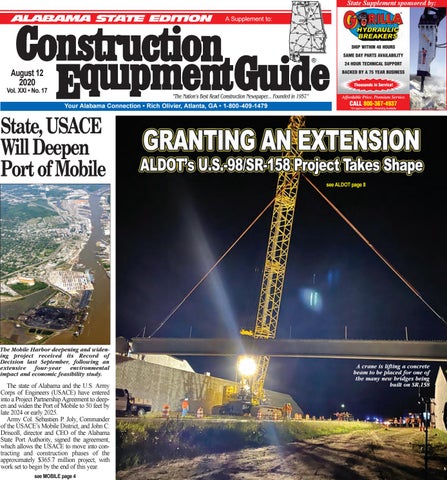
A crane is lifting a concrete beam to be placed for one of the many new bridges being built on SR 158
Page 2 • August 12, 2020 • www.constructionequipmentguide.com • Alabama State Supplement • Construction Equipment Guide
First-Of-Its-Kind...
Birmingham Hwy. New Dashboard Highlights Benefits Interstate Project of Highway Investment in Alabama Spurs New Study When the I-20/I-59 corridor through Birmingham, Ala., was demolished and rebuilt over a period of 12 months in 2019, travel became a nightmare for thousands of truckers, daily commuters and other travelers. But where most people saw chaos and frustration, a pair of University of Alabama at Birmingham (UAB) researchers found inspiration. UAB School of Engineering professors Andrew Sullivan and Virginia Sisiopiku specialize in transportation engineering. For them, the massive effort to reroute traffic away from such a major artery presented an opportunity to reexamine how 21st-century drivers are consuming information regarding detours. “A 1.5-mile segment of interstate that carries 160,000 vehicles per day was closed for one year, so the impacts were regional,” Sullivan said of the Birmingham project. “Local agencies put out a lot of information about detour routes, but it wasn’t clear how that information was being used. We want to better understand how motorists make detour decisions in this era of in-vehicle route guidance and multiple informaAndrew Sullivan tion sources.” UAB School of Engineering To that end, Sullivan and Sisiopiku are working to create a methodology for detour-route planning that will include recommendations for best practices for long-term construction. Using the I-20/I-59 project as a case study, Sullivan and Sisiopiku will compare the plans and communication strategies used by the Alabama Department of Transportation (ALDOT) and the city of Birmingham to the actual routes used by motorists. To do this, the engineers are pulling information from multiple sources. In addition to administering a motorist survey, they also are using traffic counts provided by ALDOT and travel-speed data collected from mobile phones. All that data combined should give a fair indication of how closely drivers adhered to recommended detour routes. The resulting picture should help guide future strategies — not only for planning detour routes but also for planning which channels to use to deliver information to audiences. “We are already seeing that strategies used for commercial vehicles may need to be different from those used for private motorists,” Sullivan said. “The goal is to help managing agencies allocate their limited resources as efficiently as they can.” The project is being conducted through the Southeastern Transportation Research, Innovation, Development and Education Center (STRIDE). UAB is one of nine STRIDE partner institutions. Additional funding is provided by ALDOT.
“The goal is to help managing agencies allocate their limited resources as efficiently as they can.”
A first-of-its-kind interactive tool that provides the public and elected officials a clear look at how and where U.S. states invest their transportation tax dollars has revealed that Alabama leveraged $731.4 million in federal funds to advance $902.6 million in highway improvements during fiscal year (FY) 2018. The American Road & Transportation Builders Association’s (ARTBA) “Highway Dashboard: A 50State Guide to the Benefits of Federal Investment” displays information on more than 367 Alabama projects that moved forward in FY 2018. Based on Federal Highway Administration (FHWA) data, the dashboard provides the same information for all states. The top five projects receiving federal funding in Alabama during 2018 included: • Interstate 65 add lanes from State Route 3 (U.S. Highway 31) to County Route 52, Phase 2. • Pavement rehabilitation on I-459 from south of CR 52 at McCalla to north of SR 150. • A SR 8 (U.S. 80) replacement bridge, and relief bridges over Little Uchee Creek. • The SR 158 extension from east of Lott Road (SR 217) to the Schillinger Road grade, drain, base pave and bridge. • The I-85 pavement preservation and preventive maintenance from Alabama SR 8 (the U.S. 80 East Bypass at Exit 6) to SR 8 (U.S. 80, Exit 11 at Mitylene, Ala).
“This dashboard helps shift the conversation from how much each state gets to specific outcomes and benefits,” ARTBA President Dave Bauer said. “Such transparency and accountability will help residents better understand the value they are getting from infrastructure investments.” The current federal FAST Act surface transportation law expires Sept. 30. As Congress continues working on a new long-term bill, the dashboard will help members of Congress and their staffs to learn more about projects and how federal funds are being utilized in their respective states, ARTBA said in a press release. “The dashboard spotlights the important role the federal highway program plays in our state,” added Tom Layfield, executive director of the Alabama Road Builders Association. (ARBA). “Passage of a long-term bill by Congress with increased investment is the right medicine to significantly boost our economic recovery from the COVID-19 pandemic.” In FY 2018, 74 percent of projects costs were for reconstruction or repair work on existing highways, according to the ARTBA analysis. Added capacity (13 percent of funds), planning, design and construction engineering (4 percent) and right of way purchases (2 percent), are among 12 ways the state spent its transportation dollars. For more information, visit https://www.artba.org/economics/federal-investment/.
Route 68 Bridge Upgrades Under Way Motorists who regularly must travel on Alabama Route 68 between Sand Rock and Leesburg will benefit from a construction/upgrade now in progress. Summer work on the road project began in June. The highway site between the two communities is situated on a north-south line in Cherokee County in northeastern Alabama, just west of the Georgia state line. The construction project will replace the narrow, curved bridge that was built in 1941 over the then Tennessee-Alabama-Georgia Railroad bed. Nearby residents, frequent travelers on the highway, the Alabama Department of Transportation (ALDOT) and law enforcement personnel urge drivers to use extreme caution when driving along the eighttenths of a mile construction site. The
speed limit in the area is 35 mph, and speeding fines are doubled when workers are present. Visibility is limited as drivers travel up and down a mountain ridge along the route. During working hours, there are workers’ vehicles and heavy construction machinery on both sides of the highway. Actual work began in March, with the first stage being the relocation of gas and water lines that had been in place near the highway right-of-way for many years. Trees also had to be cut for several yards on each side of the roadway. Seth Burkett, public information specialist of ALDOT’s North Region, said the project is expected to be completed by the end of the year. “The contract actually lists 175 workdays,” he added. Burkett and Cody Adams, in ALDOT’s district office in Etowah
County, said the bridge currently over the old railroad bed will be replaced with a giant culvert. A detour road is also under construction. After that temporary road is completed, the old bridge will be demolished, and the culvert put into place. The current roadbed will be raised 12 ft., greatly increasing visibility of oncoming traffic by drivers traveling both up and down the mountain. The $3.03 million project was contracted by the ALDOT to IKAROS LLC, a bridge and highway contractor from Tuscaloosa. Burkett said the Alabama Route 68 project is not being funded through the state’s new gas tax, but with revenue from the pre-existing gas tax. Twenty percent of the monies came from the state, with the federal government providing the remaining 80 percent.
Construction Equipment Guide • Alabama State Supplement • www.constructionequipmentguide.com • August 12, 2020 • Page 3
Page 4 • August 12, 2020 • www.constructionequipmentguide.com • Alabama State Supplement • Construction Equipment Guide
Character Being Restored to Historic 19th Century Birmingham Building Atlanta-based Engineering Design Technologies (EDT) currently is hard at work renovating one of downtown Birmingham’s oldest existing buildings. The three-story Taylor Building is located on the edge of the city’s historic theater and retail district along 19th Street North. After its original construction in 1890, the Taylor was a neighbor to dozens of grand old movie palaces, shops and restaurants. EDT, a minority-owned engineering and design company formed in 1993, purchased the Taylor Building more than 10 years ago. But during the last week of April, the firm began making a series of repairs to restore the luster of the old structure and update it to 21st century standards. That includes both structural and cosmetic restoration inside and out, as well as a modernizing of its systems. While the work proceeds, EDT’s Birmingham’s office occupies the second floor of the building; the first floor is leased to another company. With the city’s popular McWane Science Center just across the street, EDT’s goal is that the renovated Taylor Building will once again become a part of Birmingham’s vibrant downtown scene when the restoration is finished in about a year. After years of deterioration, the Taylor Building was in serious need of work if it were to remain safe and functional. EDT is spending close to $600,000 on the renovations, which include repairing water damage to much of the third floor.
In addition, engineers and crews are rebuilding part of the roof and installing new mechanical systems. Plans also call for putting in new fire exits, giving a facelift to the façade, replacing bricks on the outside and, over this summer, doing an extensive paint job on both the exterior and interior. EDT was able to fund the renovation of the Taylor Building, in part, due to historic tax credits from both the state and federal government. The incentive is for companies like EDT to keep the character of old buildings intact by repairing and modernizing them, rather than consigning them to the wrecking ball. In fact, a perfect example of 19th Century character can still be seen on the triangular piece of the façade at the top of the Taylor Building, where E.G. Taylor had the original builder install his initials. Taylor’s idea for the building was to house offices for doctors, gas companies and land developers, but over the years, it also was occupied by milliners, shoe shops and clothing stores. During the mid-20th Century, a clothing boutique operated in the building for 33 years. After that, the building began to steadily slide into disrepair. Still, the Taylor Building has been in good enough condition to function as office and meeting space even today. The three-story Taylor Building is located on the edge Now, however, EDT will upgrade the structure to a new of the city’s historic theater and retail district along 19th Street North. grandeur by mid-2021.
Harbor Modernization Project Will Begin After Four-Year Study MOBILE from page 1
The Mobile Harbor Modernization program received complete federal funding in February upon passage of the Energy & Water Development and Related Agencies Act. Under the Act, approximately $377.6 million is available to qualifying projects in Alabama and two other U.S. states. Key features of the program will explore innovative ways of executing dredging in a logical, sequenced manner, unconstrained by more traditional project-specific, account-specific or single-year work plans. U.S. Sen. Richard Shelby of Alabama lauded the final step that allows the USACE to move forward on construction. “Today’s signing of the Mobile Harbor Project agreement is yet another milestone in the process of the deepening and widening of the Port of Mobile,” he said. “The completion of this historic project will transform Alabama, expanding economic opportunities throughout our state and the region. Further, the modernization of Alabama’s primary port will increase the United States’ competitiveness in the global market.” The Mobile Harbor Modernization project also received state funding commitments in March 2019 when the Alabama legislature passed, and Gov. Kay Ivey signed into law, the Rebuild Alabama Act, designed to allocate a portion of state fuel-tax proceeds to support
approximately $150 million in bonds to meet the federal cost-share requirements for the harbor project. “I have been proud to support the Mobile Harbor Modernization project, and I look forward to watching the growing benefits our port will have in the years to come,” Ivey said. “The Port of Mobile is now poised to become a major hub for export activity, and this is yet another giant step forward in supporting our industries in the Americas and beyond.” The Mobile Harbor deepening and widening project received its Record of Decision last September, following an extensive four-year environmental impact and economic feasibility study. With both federal funding and the state’s match secured, the project can now leverage ongoing terminal investments in Alabama’s only seaport to ensure economies of scale and competitive rates for the seaport’s mining, manufacturing, agribusiness and retail/distribution shippers. Just this past year, the Port Authority completed a $50 million, Phase 3 expansion that added 20 acres of container handling yard and extended the dock to allow the simultaneous berth of two massive Post-Panamax-sized ships. That project complemented prior investments totaling $450 million in marine and rail container intermodal facilities.
Col. Sebastien Joly (L) and John Driscoll, director and CEO of the Alabama State Port Authority, sign the project agreement to take the Port of Mobile to 50 ft. (Alabama Port Authority photo)
Construction Equipment Guide • Alabama State Supplement • www.constructionequipmentguide.com • August 12, 2020 • Page 5
Experience the Progress.
True Power At Liebherr, we custom-engineer every machine to perform as efficiently as possible. The Tier 4F emissions system in our PR 716 is practically maintenance free, designed from the ground up. The electronic drive system automatically adjusts to keep operators in the “sweet spot” – even when saving fuel in ECO mode. And like all our machines it is built to last with exclusive Liebherr components.
www.heavymachinesinc.com
BIRMINGHAM, AL 825 31st Street N Birmingham, AL 35203 844-344-8658
MOBILE, AL 7651 Theodore Dawes Rd. Theodore, AL 36582 844-891-6480
Page 6 • August 12, 2020 • www.constructionequipmentguide.com • Alabama State Supplement • Construction Equipment Guide
Construction Equipment Guide • Alabama State Supplement • www.constructionequipmentguide.com • August 12, 2020 • Page 7
Page 8 • August 12, 2020 • www.constructionequipmentguide.com • Alabama State Supplement • Construction Equipment Guide
Construction Crews Hope to Finish Highway Job By 2023 By Irwin Rapoport CEG CORRESPONDENT
Work on the estimated $115 million U.S.-98/SR-158 Extension Project in Ala. began in September 2017 and is expected to be completed by 2023. Thus far the DOT has awarded four of the seven contracts for the road and bridge infrastructure construction that is taking place in Mobile County. More contracts are expected to be signed in the next few years. “ALDOT has continued working to complete designs, secure environmental clearances and purchase right-of-way to resume construction of the SR-158 extension that will connect to the new U.S.-98 that is partially completed,” according to ALDOT. “Due to BP funding, ALDOT has been able to move forward with the U.S.-98 and SR-158 project plans for con-
structing a two-lane facility from Schillinger Road to the Mississippi State Line. “The project scope will include building the foundation and performing the earthwork for four lanes, paving two lanes and creating interchanges,” it added. “ALDOT will pursue the ultimate divided four-lane design with fully functional freeway type interchanges as funding becomes available.” Katelyn Turner, ALDOT public information officer of the Southwest Region stressed the importance of the project. “It will alleviate the heavy volume of large commercial vehicles, tourists and local traffic that frequent this route from neighboring states to reach I-10,” she said. The first segment extended the 366-ft. long, four span, Eastbound Bridge on U.S.-98 over Big Creek — a $5.5 million contract that was awarded to Tanner Inc and finished in October 2018. This work added 1,350 linear ft. of bridge, which was equipped with a runoff containment system and tall barrier rail for water quality and watershed improvement purposes. The second section, beginning east of SR-217 (Lott Rd.) to Schillinger Road (1.5 mi.) in Semmes, started in April 2018 and is
nearing completion. The $16 million contract was awarded to John G. Walton Construction Company Inc. The project (80 percent federal and 20 percent state funds) involved grading, drainage, pavement, and the construction of the two bridges over Seabury Creek and Rodgers Road. The 2.7-mi. segment ($26.8 million) from East of Glenwood to West of Lott Rd. is being built right now by H.O Weaver and Sons Inc. Construction for the Lot Road Overpass and Jug Handle element, $16.8 million, was awarded to McInnis Construction LLC whose crews started work in May 2020 “The department plans to take bids for the construction of the Wilmer-Georgetown Road Interchange as well as the Glenwood Road Overpass in year 2021, depending on funding availability,” according to ALDOT. “The department has applied for a $25 million BUILD Grant through USDOT.” The building of the 250-ft. long, two-lane bridge on Glenwood Rd. is anticipated to be let in November 2021 and construction of the $11.1 million, 281-ft. long, two-lane bridge on Wilmer-Georgetown Rd. over U.S.-98 with Jug Handle will be let November 2020. ALDOT is expected to let the final segment — Mississippi Line to 0.5 miles east of Glenwood — in September 2021. see ALDOT page 10
This aerial photo captures the terrain where crews are engaged in excavation activities. The area is home to the gopher tortoise, an endangered reptile. Before work could start, a check had to be made to remove tortoises so they could be relocated.
Excavators and dozers have been crucial work horses in preparing the miles of new highway. This section is ready to receive its subbase.
Cranes have played a key role in the placing of steel as part of the new highway construction on SR 158.
Construction Equipment Guide • Alabama State Supplement • www.constructionequipmentguide.com • August 12, 2020 • Page 9
Atlanta, GA 404.469.7210 Birmingham, AL 205.841.6666 Madison, AL 256.350.0006 Mobile, AL 251.633.4020 Montgomery, AL 334.262.6642 Oxford, AL 256.832.5053 Tuscaloosa, AL 205.848.4147 Pensacola, FL 850.479.3004
Page 10 • August 12, 2020 • www.constructionequipmentguide.com • Alabama State Supplement • Construction Equipment Guide
Crews Have No Problem Overcoming Sandy Terrain Work ALDOT from page 8
ALDOT, to keep the public more involved and better informed about the project, established a Community Outreach Group. “This group of private citizens has volunteered to work with ALDOT to ensure we are headed in the right direction,” stated the project web page. “[They] assist us in providing feedback to plans, suggesting alternatives, asking pertinent questions and keeping the community informed. The group was recommended by an independent panel including members from Mobile County Government, Fish and Wildlife and the Chamber of Commerce. The creation of this Community Outreach Group and their independent selection is part of our continued commitment to a Safe98.” Johnny Walton, owner and president of John G. Walton Construction Company Inc., is pleased with the work that his crews put into the second segment. “We paved the two lanes and the bridges have been built,” he said. “All but the striping is done.” Michael Gibson, the firm’s project manager, noted that one of the challenges was the environmental restrictions at Seabury Creek to protect vegetation and the endangered gopher tortoise from construction activities. “We had to put up a fence along the right-of-way for either side to keep the tortoises from entering the work site,” he said. “We ended up catching 10 to 15 tortoises. ALDOT’s environmental officer out of Montgomery searched for tortoise burrows and set up traps to catch them. We had to check the project every day to make sure we didn’t find any new burrows. The tortoises were relocated to a safe area through an environmental center to save them.” The work site was located in a sandy terrain, which posed no problems for the excavation and construction of the lanes. “The rain didn’t affect us because the soil was so sandy,” said Walton, “unless it was pouring down rain. We just about worked every day there. About 500,000 cubic yards of borrow fill went into the project. We had slopes to contend with,
but we had a real good erosion subcontractor in Parker Grassing Co. that sodded the slopes. They kept right behind us as we built the slopes, so we had very little erosion.” The bridge over Seabury Creek is 344 ft. long and one over Rodgers Road is 122 ft. long. “It went smoothly,” said Walton. “We had McInnis Construction LLC doing the bridges and they did a good job
With tons of earth being excavated, loaders are constantly on the move to receive material to be taken to other areas of the work site to be recycled.
Heavy rains have impacted the construction, but crews are pressing forward. With so much equipment on-site, project managers and superintendents have to keep a close eye to ensure that the work follows daily plans.
for us.” The deck pours for the concrete structures were done at night due to the hot temperatures. “We did this so the concrete would not crack or dry up,” said Gibson. Earth work was a major element of the work and this was aided by a Komatsu 210LCi excavator and a Komatsu D51i dozer that have built-in GPS systems. “Building the model and using GPS equipment really sped the job up,” he said. “We spent less time with layout and staking that saved a lot of time.” Average days had approximately 15 John G. Walton Construction Company and subcontractor employees on site. The subcontractors were C&H Construction for signs and guardrails, Ozark Striping Co. for striping, TurnerWilson Fence Company for the tortoise fencing, T.K. Peavy & Son for concrete work, and McInnis Construction for the bridge work. “McInnis was awarded the next job and has a big bridge to build and we’re doing the grading work for them,” said Walton, who pointed out that Rusty Goff is serving as the project superintendent The company also employed a Volvo ECR235 DL excavator; a John Deere 310L backhoe; a Cat 416E backhoe; a Volvo L90 loader; rollers — a Hamm H11X and a Dynapac CC624HF; a Wirtgen 2000i milling machine; a Vogele 5203 paver; a Weiler E1250 BFV material transfer vehicle; a Komatsu GD655-7 motorgrader; a Superior DT-80J selfpropelled broom; a Finn B-70 hay blower; a Ford F750 water truck; and a New Holland TN55 farm tractor. “We had mechanics from our shop, but we didn’t have any major equipment issues on this job,” said Walton. “Most of the equipment was new.” John G. Walton Construction purchases and rents equipment from Tractor and Equipment Company (Komatsu), Thompson Tractor Co. Inc (Cat), Beard Equipment Co. (John Deere) and Cowin Equipment Co. (Volvo). CEG
A John Deere excavator is clearing a green field for a new section of highway.
Construction Equipment Guide • Alabama State Supplement • www.constructionequipmentguide.com • August 12, 2020 • Page 11
Page 12 • August 12, 2020 • www.constructionequipmentguide.com • Alabama State Supplement • Construction Equipment Guide
{ Y o a , i M i , G
a Š ĂŠ ÂŁ Ă a ÂŁ ĂŠ Ć ¡ ˜ ÂŁ a Ăť ĂĽ ĂĽ Ă™ ĂŠ Ăľ
7UDFWRU (TXLSPHQW &RPSDQ\ KDV EHHQ SXVKLQJ WKURXJK WR WKH HQG IRU RXU FXVWRPHUV VLQFH 7KH 6DOHV 6HUYLFH 6XSSRUW WHDPV DW 7(& KDYH \RXU EDFN DW DOO WLPHV DQG LQ DOO SODFHV &RPH YLVLW RQH RI RXU ORFDWLRQV WKURXJKRXW $/ *$ )/ WRGD\
i Ä? ÄĽ Ä Ä&#x; Ĺś ˜ Ă™ Ă?