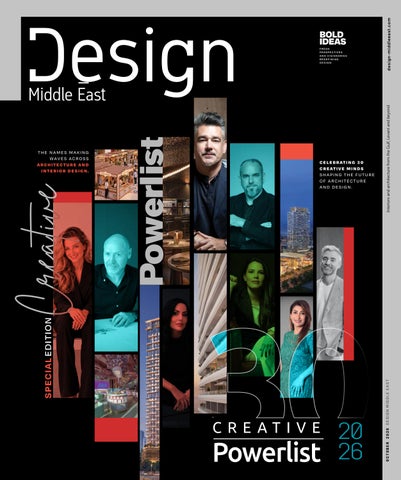
20 Powerlist 26 CREATIVE
design-middleeast .com Interiors and architecture from the Gulf, Levant and beyond
C E L E B R AT I N G 3 0 C R E AT I V E M I N D S SHAPING THE FUTURE OF ARCHITECTURE AND DESIGN.
SPECIAL EDITION
Creative
THE NAMES MAKING WAVES ACROSS ARCHITECTURE AND INTERIOR DESIGN.
Powerlist
FRESH PERSPECTIVES AND VISIONARIES REDEFINING DESIGN.
OCTOBER 2026 DESIGN MIDDLE EAST
BOLD IDEAS
Press pause on the busy office
Bay Work Pod is Herman Miller’s solution for hybrid and open floor plans. An office booth that does it all – privacy for phone calls, flattering aesthetics during video meetings and a space for focus – all within an already established floorplate.
Scan to get in touch
hermanmiller.com
© 2025 Herman Miller
OCTOBER 2026
1
12
OP-ED Designing for People in the Age of AI SABRINA DURLING-JONES, Assistant Professor of Design with AI at HERIOT-WATT UNIVERSITY DUBAI, explores why human judgement, cultural context and lived experience remain central to design in an AI-driven world.
walked its streets, experienced its landscape or understood how life there might unfold?
66
INTERVIEW Where Comfort Meets Connection
DESIGN MIDDLE EAST
|
24 GHAITH DALATI, General Manager of NOVOTEL SUITES & IBIS MALL AVENUE Dubai, on creating distinct guest
20 Powerlist 26 CREATIVE UNVEILING THE 2026 CREATIVE POWERLIST RECOGNISING THE PIONEERS DEFINING THE FUTURE OF THE REGION
14
FEATURE How housing becomes community beyond the building For World Architecture Day 2026, AECOM’S architecture and urban-design specialists explore why creating successful communities requires more than simply building homes
18
experiences through space, design, music, and community.
70
WORKPLACE DESIGN The Hidden Value of the Spaces Between How transitional spaces can shape connection, wellbeing and workplace performance
SUN SIYAM IRU FUSHI has reimagined its water villas as the
Some of the most important moments in the workplace happen while people are moving between destinations.
centrepiece of its move into the group’s Luxury Collection. Group CEO DEEPAK BOONEADY tells Design Middle East why these interiors were designed to be felt as much as seen.
74
DÉCOR REVIEW Calm Above the Lagoon
PICK OF THE MONTH An Invitation to Sit Back and Relax 62
POINT OF VIEW The New Language of Luxury: Designing Belonging Before Arrival What makes us connect with a place before we have
UK-based premium furniture retailer Honeypot Furniture UAE has opened its first Dubai showroom in Al Quoz, offering customers a dedicated space to explore custom furniture and work directly with the team.
design-middleeast.com
SUITE TREAT Step into a world of opulence when you book a Suite at Raffles Doha. Experience the added luxury of QAR 750 credit to spend on dining in the hotel, and QAR 500 towards any Spa treatment. Children aged 12 and below are welcome to indulge in the enchantment of complimentary dining. Rates starting from QAR 3,500 per night
For reservations, please call +974 4030 7100 or email reservations.doha@raffles.com
Raffles Doha, Iconic Towers, Marina District, PO BOX 4747, Lusail, Qatar
EXTRAO R D I NARY PRIVATE POOLS | 30 + AME N ITIES | PR IME LOCATION S
Escape to a home where urban sophistication meets resort tranquility.
BU ILT FO R M O MENTS THAT MAT TER 800-SAMANA | WWW.SAMANADEVELOPERS.COM
DIS COVER REFI N ED
living
*Ranking as per the H2025 1 sales volume data of property monitor for Dubai
Rediscover Inspiration at Le Méridien Dubai Hotel & Conference Centre A serene sanctuary at the heart of the city’s dynamic landscape, Le Méridien Dubai Hotel & Conference Centre redefines the art of urban hospitality. Set across 15 acres of immaculately landscaped gardens, the hotel offers an elegant retreat just moments from Dubai International Airport, placing guests within effortless reach of the city’s most iconic districts, from Dubai Mall and Burj Khalifa to the storied charm of the Gold Souk and Dubai Creek. With 580 beautifully appointed rooms and suites, the property invites travellers into a world where contemporary design meets the timeless sophistication of the Le Méridien brand. The distinguished 196 rooms in the Le Royal Club wing elevate the experience with spacious, light-filled rooms, and refined club privileges, while select ground-floor accommodations in the main building open directly onto lush gardens and tranquil pools, offering a resort-like ambience rarely found in the city. C
M
Y
CM
Well-being is woven into the hotel’s DNA. Guests may indulge in five swimming pools, unwind in serene outdoor enclaves, or train at one of Dubai’s most expansive and advanced fitness facilities, staffed by expert coaches and equipped with cutting-edge technology to nourish mind, body, and spirit.
MY
CY
CMY
K
At the heart of the property lies an extraordinary culinary journey. Housing 18 acclaimed restaurants and bars, Le Méridien Dubai is home to some of the city’s most storied dining institutions. From the ever-legendary Seafood Market, celebrated for its market-style freshness, to Casa Mia, Dubai’s pioneering Italian restaurant, each venue reflects a passion for authenticity, craftsmanship, and memorable dining artistry. A beacon for global meetings and events, the hotel features more than 44,000 sq. ft. of versatile event spaces, comprising 24 impeccably designed venues outfitted with modern audiovisual capabilities. Whether orchestrating a grand celebration for 1,750 guests, hosting an international exhibition, or curating an intimate executive gathering, the hotel’s specialist events team and award-winning culinary experts bring each vision to life with impeccable precision and creative flair. From inspired dining to world-class event facilities, and from resort-style relaxation to unmatched convenience, Le Méridien Dubai Hotel & Conference Centre stands as a destination where cosmopolitan energy and cultivated luxury converge, inviting every guest to unlock a stay that is truly memorable.
8
Editor's note "The best way to predict the future is to create it."
DESIGN MIDDLE EAST
|
OCTOBER 2026
G
reat design has a way of making us stop, look twice and appreciate the thought behind it. And when you work in an industry surrounded by so much creativity, there is always something that surprises you. Our October edition is particularly close to my heart. The Creative 30 Powerlist celebrates the designers and architects who are shaping the region, each with a different story, perspective and approach to design. What I love most about putting this list together is discovering names we haven’t featured before, alongside familiar faces who continue to inspire us with their creativity and remarkable work. There is something genuinely exciting about seeing people build their careers, take creative risks and make a name for themselves. Some are already familiar faces, while others are just beginning to get the recognition they deserve. And that, for me, is what makes this edition so special. And just as we wrap up this power-packed issue, all our energy shifts towards the Design Middle East Awards 2026, taking place this November in Dubai. Now, if only you knew what goes on behind the scenes! Months of planning, endless meetings, hundreds of emails, last-minute changes, countless phone calls and, of course, those inevitable sleepless nights. There are moments of absolute madness, but also tremendous excitement. And then comes that one magical evening when we walk into a ballroom filled with the industry's finest, see everyone celebrating, cheering, and genuinely enjoying themselves. Oh, what a feeling! Suddenly, every sleepless night seems worth it. Those smiling faces are our biggest reward. So, Dubai, get ready for the biggest celebration of
CEO WISSAM YOUNANE
wissam@bncpublishing.net MANAGING DIRECTOR RABIH NAJM
rabih@bncpublishing.net GROUP PUBLISHING DIRECTOR JOAQUIM D’COSTA
jo@bncpublishing.net +971 50 440 2706 COMMERCIAL DIRECTOR ANDREA MOCAY andrea@bncpublishing.net COUNTRY MANAGER KSA AMJAD FAKHOURI
amjad@bncpublishing.net +966 54935 4430
design! Nominations are now open, and we cannot wait to see what this year's talent brings to the stage. And once the final award has been presented and the ballroom lights go down, I have a very simple plan: kick off my heels, sink into the Luca Swivel Chair by Honeypot Furniture, featured in this issue's Pick section, and do absolutely nothing! Until then, see you in the ballroom!
Roma Arora Editor roma@bncpublishing.net @romaarora_
EDITOR ROMA ARORA roma@bncpublishing.net ART DIRECTOR SIMONA EL KHOURY MARKETING EXECUTIVE AARON JOSHUA
aj@bncpublishing.net
DIGITAL REPORTER REEBA ASGHAR reeba@bncpublishing.net DIGITAL MEDIA PRODUCER EDUARDO BUENAGUA
Eduardo@bncpublishing.net
SUBSCRIBE subscriptions@bncpublishing.net PO Box 502511 Dubai, United Arab Emirates T +971 4 420 0506 | F +971 4 420 0196
For all commercial enquiries related to Design Middle East, contact our Group Publishing Director JOAQUIM D’COSTA jo@bncpublishing.net | T +971 504402706
FOLLOW US ON /designmideast
/designmiddleeast
/designmiddleeast
@designmiddleeast
All rights reserved © 2026. Opinions expressed are solely those of the contributors. Design Middle East is exclusively licensed to BNC Publishing. No part of this magazine may be reproduced or transmitted in any form or by any means without written permission of the publisher. Images used in Design Middle East are credited when necessary. Attributed use of copyrighted images with permission. Printed by UPP
design-middleeast.com
10 News
NUTRO studio Designs a Chinese Restaurant in Dubai with Red Marble
of individual finishes. A lattice-cut wooden ceiling cassette, inscribed with Chinese characters, adds a distinctive cultural detail to the space.
|
OCTOBER 2026
Lighting is treated as a spatial material in its own right. Rather than flooding the room, NUTRO uses soft, localised, directional sources that leave zones in shadow: stone is lit from within, fabric panels are traced along their edges, and tabletops collect discrete pools of warm light, a lighting strategy that produces contrast and depth rather than legibility.
DESIGN MIDDLE EAST
The bar anchors the room: a solid block of red marble, engraved with a dragon motif and lit from below, its legs carved from the same stone into sculptural dragon forms. Above it, a wooden pagoda-form frame suspends stemware overhead, giving the counter both mass and lightness in a single gesture.
NUTRO studio creates a warm, tactile Chinese restaurant in Dubai, pairing red marble, timber and contemporary cultural details.
design-middleeast.com
N
UTRO studio has completed the interior of a Chinese restaurant in Dubai, bringing together wood, natural red marble, rattan, bamboo, leather and woven cord in a warm, tactile palette. The materials are conceived as a cohesive, monolithic volume rather than a collection
Entry is marked by a cylindrical red marble reception desk and tall banana plants set in rattan planters, a compressed threshold sequence before the room opens out. The main dining hall centers on a live-edge communal table in solid wood, lit by an alabaster pendant in a blackened metal frame, surrounded by oak two- and four-tops, leather-woven seating, and freestanding marble dragon sculptures that recur as a sculptural motif throughout.
Beyond the main hall, a series of niche and private tables is treated as a distinct spatial register: carved wood dragon reliefs, latticed timber screens etched with Chinese script, and alabaster pendants mounted on bamboo posts define smaller, enclosed pockets within the larger volume, architecture legible at both the scale of the room and the scale of the individual table. “The aesthetic of the East is read here as a contemporary interpretation of ancient tradition — restrained, dignified, and quietly intriguing,” says Danylo Honcharenko, Creative Director and Co-founder of NUTRO studio.
11
Herman Miller Introduces Byne Meeting Tables Across APAC and MEA
Byne Meeting Tables empower teams with a versatile, design-forward solution that adapts seamlessly to both contemporary and classic meeting spaces. Available in rectangular and boat-shaped configurations, the collection supports everything from small huddles and touchdown sessions to larger meetings and hybrid collaboration. As an extension of the Byne portfolio, Byne Meeting Tables integrate seamlessly with existing Byne Systems products, helping architects, designers and organisations create a unified floorplate across workstations, meeting spaces and collaborative
OCTOBER 2026 |
Across APAC and MEA, organisations are placing greater emphasis on meeting and collaboration spaces that support a variety of workstyles without compromising design. Yet many meeting table requirements have historically been addressed through customised solutions or imported products. Byne Meeting Tables close that gap, providing a scalable solution that combines flexibility, functionality and aesthetic cohesion in a single platform.
zones. Four distinctive leg styles, multiple material options and premium veneer finishes provide the freedom to create spaces that align with both functional requirements and design intent. Supporting today’s technology-enabled workplaces, the collection also features integrated power access, discreet cable and wire management, and concealed routing that reduce visual clutter while keeping connectivity easily accessible. The result is a meeting solution that is equal parts flexible, functional, and visually cohesive. Byne Meeting Tables are now available across Asia Pacific and the Middle East through Herman Miller’s contract sales channels.
Byne Meeting Tables create seamless, unified workspaces across meeting and collaborative zones.
DESIGN MIDDLE EAST
H
erman Miller introduces Byne Meeting Tables across Asia Pacific, the Middle East, and Africa, giving organisations greater flexibility to create collaboration spaces tailored to their teams, workplaces and ways of working.
design-middleeast.com
12 OP-ED
Designing for People in the Age of AI DESIGN MIDDLE EAST
|
OCTOBER 2026
SABRINA DURLING-JONES, Assistant
design-middleeast.com
Professor of Design with AI at HeriotWatt University Dubai, explores why human judgement, cultural context and lived experience remain central to design in an AI-driven world.
W
hile design remains focussed on responding to the people who will experience it, AI has extended the discipline's possibilities. Human-centred design begins from an empathetic understanding of who the work is for, with culture, memory, language and place shaping how it is encountered. The designer gives these elements of encounter a point of reference that generative systems lack. AI can recommend design choices, but the designer brings the situated knowledge needed to judge whether those possibilities align with the design brief's context. As generative systems are increasingly integrated into different aspects of creative practice, the designer has taken on the role of creative director. It is the designer who establishes the intention of the work and directs how that intention is conveyed, from the way people might move through built spaces, to how content is framed and lit, to the placement of cameras on set. The same judgement
continues when evaluating what AI generates and deciding whether a prototype should be further developed, substantially altered, or altogether rejected. Training data inevitably influences this relationship because commercial AI platforms are built from enormous bodies of material that designers interfacing with them cannot meaningfully inspect. Design knowledge implied by a generated output should never be mistaken for lived understanding. A model can reproduce a recognisable visual language associated with a place while having no connection to how people who live there experience it. It is the designer who must bring that understanding from outside the model, through research grounded in the context of the project and through direct engagement with the people the work is intended to reach. The data on which AI systems have learned already contains human choices, historical biases and omissions, and the designer adds another layer of human judgement affecting what is circulated as reality. Across MENA, this relationship becomes especially complex because design moves through communities with very different histories and relationships to place. A generated representation of a place or a culture may
13
| DESIGN MIDDLE EAST
look immediately familiar but in truth relies on visual conventions that have little or no connection to how specific communities understand themselves. Designers engaging with AI to produce culturally specific assets need enough cultural knowledge to recognise when likeness has been mistaken for specificity. It comes from understanding who the work is designed for and remaining alert to the distance between a convincing misrepresentation and an experience grounded in the lives of the people being represented. The experiences designers create contribute to the visual record through which places and communities will become understood over time. While designers may have limited control over the training data behind rendered visual materials, their role as creative directors gives them control over what to publish and reproduce. When the same visual shorthand is presented on repeat, it can begin to stand in for a much more complex reality. For communities whose histories have already been unevenly documented, those accumulated representations can influence what later appears to be typical or authentic. The longer-term challenge is to create design practices where communities have a stronger role in shaping the records made about them, so that future archives of data carry more than the version of a place or culture that was produced by generalised systems trained on non-curated data. AI-supported design also carries a material cost that sits largely outside the interface because genAI depends on substantial space, electricity and water use. The designer as creative director can judge when high volumes of compute power contribute something meaningful to design projects and when serial rendering stops producing effective outputs. Computational capacity expands what designers can create, while its physical cost becomes another condition of the process that cannot be separated from the design choices being made. It is becoming increasingly clear that AI is not the end of design. Its ability to generate new visual aesthetics does not replace the situated judgement that designers bring to a project. As a tool, AI expands the creative landscape, but it is through human-centred practice, with designers acting as creative directors, that its outputs remain connected to the people they are intended to serve. The designer remains responsible for judging what the technology contributes, where it falls short and what is ultimately allowed to enter the world. Designing for humans in the age of AI means keeping the people and contexts the work is made for in view, alongside the consequences of the technologies used to produce it.
OCTOBER 2026
AI-supported design also carries a material"cost that sits largely outside the interface because genAI depends on substantial space, electricity and water use.
design-middleeast.com
AECOM on Building Communities Beyond Homes
14 Feature
How housing becomes
DESIGN MIDDLE EAST
|
OCTOBER 2026
community beyond the building
For World Architecture Day 2026, AECOM’s architecture and urbandesign specialists explore why creating successful communities requires more than simply building homes
T communities.
he theme for World Architecture Day 2026 on October 5, ‘Housing is a Human Right. Build It’, is deliberately direct. Yet what should be built, and how, becomes considerably more complex when housing is viewed not simply as a collection of buildings, but as the foundation for
This is particularly relevant in rapidly developing regions such as the Middle East, where new communities are being created at scale and expectations of what constitutes a successful development are changing. The region has already moved beyond an earlier focus on architectural spectacle, notes Ghamlouch Mohamed, Concept Architecture Lead at AECOM. “It is not just about ‘wow’ buildings like they used to. Now it is a bit deeper. Community and servicing, even access, has become something to look at as a new type of
design-middleeast.com
luxury versus just an expensive building,” he says. The shift places greater emphasis on what happens between buildings and on the experiences that allow residents to develop a sense of connection and belonging.
FINDING THE ‘THIRD PLACE’
Mohamed identifies what he calls the ‘third place’ as a crucial link between housing and community. “We are working on some developments where we are trying to bring some of these elements back,” he explains, describing a current project where the team is working at a micro scale to recreate the feeling of a neighbourhood. The challenge is also to avoid creating developments that could exist anywhere. Mohamed points to the proliferation of identical global retail and commercial environments, arguing that cities can become generic when familiar brands and spatial arrangements replace local identity. His response is local regionalism, drawing on qualities that existed in traditional communities and adapting them for contemporary needs. “We do not really need to invent anything. We just need to readapt some of the older things that existed,” he says.
L E A R N I N G F R O M P L A C E S T H AT G R E W O R G A N I C A L LY
For AECOM Senior Associate: Urban Design Aarathi Muralidharan, the lessons of older communities are particularly relevant. Having grown up in Dubai, she remembers relatively simple neighborhoods where every day needs were close by and people often stayed for many years. The challenge for contemporary masterplanning is to bring some of those qualities into new developments without simply reproducing the past. Muralidharan describes current work aimed at breaking away from the ‘cookie cutter’ approach and creating moments that make a community feel as though it has already been lived in. One of the most important lessons, she argues, is that communities should not necessarily be built in their entirety from day one. A phased approach allows them to develop alongside their populations and respond as markets and residents’ needs change. “Allowing the community to grow along with the requirements of the people living there can produce something closer to the organic communities that existed previously.”
T H E VA L U E O F M E M O R Y
For AECOM Senior Director and Head of Architecture, Vladimir Jovanovic, creating communities means balancing environmental and project needs with the social factors that help people and places thrive over the long term. “However intelligent, sustainable, performance-driven or culturally responsive a development may be, design alone >>> cannot create a community,” he says. “What ultimately gives
DESIGN MIDDLE EAST
|
OCTOBER 2026
15
RIGHT IMAGE: Vladimir Jovanovic
a place its identity is memory: people accumulating shared experiences in the same place.” Architecture can establish the conditions for this process, but it cannot manufacture it instantly. Successful housing must therefore be designed to endure and adapt, allowing communities to develop a genuine sense of identity and belonging. In this sense, time is not simply what follows design; it is an essential part of sustainability itself.
AFFORDABLE HOUSING STILL NEEDS TO BE A COMMUNITY
The same principles apply across different housing segments. AECOM’s experience spans high-density housing, commercial residential developments, employee and worker housing, affordable housing and national housing. “No matter how much it is expensive or exclusive, or it is basically accessible, the common pattern between all of them is we try to optimise a spatial experience for all,” says Mohamed. Muralidharan describes recent work involving affordable housing developed through a joint venture with government. Whatever the housing segment, the objective should still be to
create a complete community, including amenities, commercial components and access to transport. National housing presents another challenge. Where standardised, low-density housing is required, how can designers introduce identity and place-making rather than producing one interchangeable development after another? For Jovanovic, the distinction between luxury and affordable housing can ultimately be misleading.
CONNECTING HOUSING TO THE WIDER CITY
“Designing affordable housing can be more demanding than designing a high-value commercial development,” Jovanovic says. “It must achieve efficiency while still providing comfort, dignity, environmental performance and social sustainability. Whatever market segment we are designing for, the ambition should remain the same: to create a good place in which to live.” The aim is not simply to provide different levels of product, but to create good places for people regardless of the segment being served. design-middleeast.com
16 Feature
That thinking extends beyond the boundaries of an individual development. Mohamed points to his experience in Hong Kong, where transport infrastructure allows people to move efficiently between different parts of the city. Transit-orientated development, he argues, can make housing more accessible by opening locations beyond the most affluent areas. If communities are well connected to employment and other destinations, there is greater scope to provide housing without tying it exclusively to high-value locations. He sees the growing interest in compact, connected and ‘15-minute-city’ approaches in the region as a positive development, alongside the integration of digital technologies into urban systems.
DESIGN MIDDLE EAST
|
OCTOBER 2026
BRINGING ARCHITECTURE INTO THE MASTERPLAN
For AECOM, this is where architecture, urban design, infrastructure and masterplanning need to work together. “We are lucky that we get exposed to the whole scale,” notes Mohamed. This whole-scale approach is reflected in AECOM Vision Architecture, an initiative that brings architectural thinking into the masterplanning process much earlier. Rather than developing a masterplan at macro scale and introducing buildings later, the approach considers building spaces, façades and the interaction between buildings and streets alongside the wider plan. This allows potential identities and experiences to emerge while the masterplan is still being shaped. The approach also allows clients to see the potential of a development while it is still a work in progress, rather than waiting for the masterplan to be completed before architecture is introduced. For Mohamed, it is part of AECOM’s ability to work across the full development cycle: “We are trying to do the full cycle from the beginning to end.”
DESIGNING FOR CHANGE
Climate change, resilience and changing patterns of work and mobility add another layer of complexity. The experience of coronavirus demonstrated how quickly assumptions about the way people live and work can change, while hybrid working has challenged traditional relationships between where people live, work and spend their leisure time. For Mohamed, that raises a fundamental question of what happens if a building’s identity changes. Designing for future adaptability means considering factors from the urban grid and structural systems through to materiality, so buildings can accommodate different uses over their lifetimes. Jovanovic takes the argument further, viewing longevity as a form of sustainability. Buildings should be designed not only to reduce embodied carbon and perform efficiently, but also to remain useful, adaptable and valued over time. If a building can accommodate changing needs throughout its life, the environmental and material resources invested in its construction can continue to deliver value rather than being lost through premature obsolescence.
design-middleeast.com
Muralidharan similarly argues that masterplans need to be agile as mobility systems, patterns of work and demographics change. “We need to design with change in mind,” she points out. That means resisting the temptation to over-provide infrastructure for a future that may not look like the present.
F R O M E X E C U T I N G TA S K S T O C U R AT I N G I N F O R M AT I O N
Technology is changing how designers can respond to these challenges. AECOM’s teams are increasingly using data and digital tools to test scenarios, assess design options and understand the potential consequences of decisions before they are implemented. For Mohamed, this represents a shift in the architect’s role from executing tasks to “curating information”. Digital tools can rapidly generate models and test scenarios, but professional judgement remains essential to determining which options will work.
Ghamlouch Mohamed
Aarathi Muralidharan
“A L L O W I N G T H E C O M M U N I T Y T O G R O W A L O N G W I T H T H E R E Q U I R E M E N T S OF THE PEOPLE LIVING THERE CAN PRODUCE SOMETHING CLOSER TO THE O R G A N I C C O M M U N I T I E S T H AT E X I S T E D P R E V I O U S LY. ”
“We can easily identify which ones will work and which ones not,” he says, referring to the experience accumulated by professionals working in the industry over many years. For AECOM, data and technology therefore complement rather than replace architectural and urban-design expertise.
A R C H I T E C T U R E A S A C U R AT O R OF SYSTEMS The conversation ultimately returns to a broader definition of architecture – one that encompasses infrastructure, mobility, landscape, public space, economics, demographics, technology and the everyday experiences of the people who live in a place. For Jovanovic, that also means asking whether every development needs to be new and what resources should be committed to creating new communities. Technology and data can help test the options, but human
DESIGN MIDDLE EAST
|
OCTOBER 2026
17
intelligence and professional judgement remain central to determining the appropriate balance. Mohamed sees this as part of architecture’s broader historical role. “Architecture has been diluted at least in the past couple of decades. Historically, architects were ‘curators of systems’, organising complex relationships at scales ranging from the city to the building and even individual objects.” A line drawn on a plan can influence how someone moves through a city; a street can shape whether neighbours encounter one another; and the positioning of a building can affect access to daylight, views, transport and public space. The World Architecture Day theme therefore poses a challenge that extends well beyond the provision of shelter. Housing may be the starting point. Architecture’s greater task is to help create the conditions in which communities can grow, adapt and endure. design-middleeast.com
DESIGN MIDDLE EAST
|
OCTOBER 2026
18 Décor Review
CALM ABOVE THE
LAGOON BY V I B H A M EH TA
design-middleeast.com
DESIGN MIDDLE EAST
|
OCTOBER 2026
19
design-middleeast.com
DESIGN MIDDLE EAST
|
OCTOBER 2026
20 Décor Review
SUN SIYAM IRU FUSHI has reimagined its water villas as the centrepiece of its move into the group’s Luxury Collection. Group CEO Deepak Booneady tells Design Middle East why these interiors were designed to be felt as much as seen.
T
he first thing you notice is the colour. There is no bright tropical turquoise fighting for attention here. Soft greens and muted, sandy tones sit quietly against the walls, and the lagoon outside does the rest. The new water villas at Sun Siyam Iru Fushi are restful in a way that takes a moment to register, and that is the intention. “For me, luxury is a feeling,” says Deepak Booneady, Group CEO of Sun Siyam. “It is not simply about how beautiful a villa is, how expensive the materials are, or how many facilities a resort offers. True luxury is about how we make our guests feel, from the moment they arrive until the moment they leave.” Seventy-five villas, one mood The redesign covers 75 overwater villas in three categories: 40 Water
design-middleeast.com
Villas with Pool at 123 sqm each, 16 Horizon Water Villas with Pool and 19 Sunset Horizon Water Villas with Pool, both at 128 sqm. Together they lead the resort’s transformation into Sun Siyam’s Luxury Collection. The interiors are the work of London-based StudioSixty7, led by Founders and Creative Directors Lee McNichol and Jose Rivero. Their approach is tactile and deliberately understated. Walls are finished in gently imperfect plaster that catches the light differently through the day. Natural textures run throughout, and breathable linen softens the rooms. Nothing is glossy, and nothing asks to be photographed before it is enjoyed. “Every element has been chosen to feel grounded and sensorial, inviting guests into a deep sense of calm,” say Lee and Jose. Rooms that open to the water The layout is open-plan, so the eye travels straight from the bed to the horizon. The bathrooms are generous, with a bathtub placed to look out over the lagoon. It turns a daily routine into one of the best seats in the villa. Outside, the deck is planned as a series of lounging zones instead of a single terrace. There is a hammock suspended over the water, and a 22 sqm private pool with sunken seating that lets you sit at water level with the ocean stretching out ahead. It is easy to lose a morning here.
21
A partnership built over time The studio is now a regular collaborator across the group. Its portfolio includes the new F&B outlets at Sun Siyam Olhuveli and, most recently, the Ocean Signature Villas and reimagined Nautilus Bar at Sun Siyam Vilu Reef. “Choosing the right design partner is about much more than creative capability,” says Deepak. “We look for partners who take the time to understand our brand, our guests and the destinations in which we operate.” “Having collaborated on multiple projects, they have developed a deep understanding of our vision, enabling them to create spaces that feel distinctive to each property while remaining true to the values of the Sun Siyam brand,” he adds.
The property is a tranquil escape, designed for relaxation, serenity, and complete relaxation.
OCTOBER 2026
sophisticated luxury market. It is an investment in both the guest experience and the long-term value of the brand.” The industry has taken note. Sun Siyam Iru Fushi was recognised for Hotel Suite Interiors at the International Property Awards Asia Pacific 2026, while sister property Sun Siyam Pasikudah in Sri Lanka won for Hotel Interiors. Both were realised with StudioSixty7.
|
Design with a purpose For Deepak, the villas are a business decision as much as a creative one. “For us, design is much more than visual appeal. It influences how guests feel, interact with a space and ultimately remember their stay,” he says. “Thoughtful design creates stronger guest satisfaction, encourages repeat visits and helps us remain competitive in an increasingly
DESIGN MIDDLE EAST
“In the Maldives, nature is our greatest luxury, so our approach is to work with it rather than compete with it,” says Deepak. “Whether it is a hammock suspended above the lagoon, a private pool designed for slow mornings, or a bathroom that opens seamlessly onto the ocean, every element should strengthen the connection between our guests and the island rather than distract from it.”
Proudly Maldivian What stands out about the villas is their restraint. They do not borrow the language of city hotels or try to look like a global brand, and that is intentional. “We do not want to imitate international luxury brands,” says Deepak. “We want to create our own expression of luxury, one that is proudly Maldivian, deeply personal and emotionally memorable.” That sense of place carries beyond the villa door. Signature experiences such as Maldivian
design-middleeast.com
DESIGN MIDDLE EAST
|
OCTOBER 2026
22 Décor Review
“WE SEE THE FUTURE OF LUXURY HOSPITALITY BEING SHAPED BY AUTHENTICITY, SUSTAINABILITY AND PERSONALISATION.” - DEEPAK BOONEADY
Roots, which celebrates local cuisine and culture, sit alongside marine conservation initiatives and locally inspired wellness. “Today’s luxury traveller is no longer impressed by beautiful surroundings alone,” he says. “The Maldives already gives us extraordinary natural beauty; what truly makes the difference is how we make our guests feel.” What comes next The water villas are only the start. At Iru Fushi, the Deluxe Water Villas are due for refurbishment and a new beach club is planned. Elsewhere, Sun Siyam Olhuveli will gain a new Italian restaurant, beach club and spa, and the Dolphin Villas
design-middleeast.com
at Sun Siyam Iru Veli are being redesigned with StudioSixty7. “We see the future of luxury hospitality being shaped by authenticity, sustainability and personalisation,” says Deepak. “These investments reflect our commitment to continually evolving our resorts while respecting the natural beauty and cultural identity of each destination.” As the group looks to grow beyond the Maldives, Iru Fushi will serve as its calling card. “We do not want to simply export a resort concept,” he says. “We want to export the Sun Siyam feeling.” Back on the deck, with the hammock swaying over the lagoon and the light moving across the plaster walls, that feeling is easy to understand. “When design creates emotion, it creates memories,” says Deepak. “And when guests leave remembering not only what they saw, but how they felt, that is when we have created something truly special.”
WHERE PROJECTS MEET CAPITAL AND BUYERS
24
DESIGN MIDDLE EAST
|
OCTOBER 2026
PRESENTS
design-middleeast.com
Here’s to the talent transforming the region’s design scene! The Creative 30 Powerlist celebrates bold thinking, fresh perspectives, and the people pushing boundaries. It’s exciting to see new names rise alongside established leaders, bringing fresh energy and ideas to the industry. Congratulations to everyone making their mark and shaping the future of design.
26
CREATIVE
20
Powerlist 26
1
Ignacio GOMEZ GLOBAL DESIGN PRINCIPAL AEDAS
| THE MAKING OF A CREATIVE
Moving between Spain, Sweden, and the Middle East gave Ignacio Gomez different perspectives on how cities are built and how architects work. Since arriving in Dubai in 2006, he has worked across infrastructure, hospitality, residential and urban projects, learning from mentors including Brian Johnson, Ricus van Zyl, and Keith Griffith. Those experiences have shaped an approach based on questioning assumptions and learning from each project. They have also changed his
understanding of what it means to lead a practice. As Global Design Principal at Aedas, his responsibilities extend from individual design decisions to building teams and helping people develop their own judgement. He sees that as part of the creative work. A strong team needs room to question an idea, the confidence to suggest another and the responsibility to carry it forward. His role is to give that process direction, while making space for ideas he would not reach alone.
| NAVIGATING THE
OCTOBER 2026
T
DESIGN MIDDLE EAST
|
UNKNOWN
| WORK THAT MATTERS For Ignacio Gomez, each project adds another book to a library of experiences that informs the next. Dubai Metro Route 2020 demonstrated the responsibility of designing infrastructure woven into everyday life. His current work on a major transport infrastructure project in the UAE continues that contribution to the evolution of public transport in the region. The Red Palace in Riyadh raised the question of how to give a building new purpose while preserving its history and national significance. At Souq Mina Zayed in Abu Dhabi, his work with Modon explores how souqs can evolve while retaining their place in the city’s daily memory. The value lies in sustaining the activity and character that make these places matter. The Four Seasons at Diriyah Gate brings another lesson: understanding the spatial principles of Najdi architecture and translating them for contemporary hospitality. Together, these projects keep changing how he thinks about architecture, place and the people using it.
design-middleeast.com
he industry has seen its share of uncertainty and change this year. What has this period taught you about creativity, leadership and resilience, and what lessons will stay with you? Regional uncertainty has made Ignacio Gomez more conscious of the different pressures people carry into work. Members of the same team may be experiencing the same events very differently, depending on where their families are and what is happening at home. For him, leadership starts with recognising that. Clear communication matters, including being honest about what is known and what remains uncertain. People need enough direction to keep working and enough trust to raise concerns or suggest a change of course. Creativity also depends on being able to adapt. When circumstances change, a team needs to be willing to revisit its assumptions and reconsider decisions. The lesson he takes forward is that resilience is built through everyday actions: listening, sharing information and helping one another make sound decisions. His responsibility is to maintain focus while giving proper attention to the people doing the work and the pressures they are facing.
27
| What Comes
Next
Creek Night Veiw – Rixos Al Reem Residence
BEYOND THE DRAWING BOARD Off the clock | I
SWITCH OFF BY SURFING. GIVE ME A BEACH WITH GOOD WAVES. On my bookshelf | DELIRIOUS NEW YORK BY REM KOOLHAAS IS A BOOK I KEEP RETURNING TO. IT REMAINS FUNDAMENTAL TO HOW I THINK ABOUT ARCHITECTURE AND THE CITY. A city I love | MANHATTAN. I’M FASCINATED BY HOW A SIMPLE GRID AND A CLEAR SET OF RULES CAN SUPPORT SUCH RICHNESS, VARIETY AND COMPLEXITY IN THE LIFE OF A CITY.
|
Dubai Metro Expo 2020 Interior
DESIGN MIDDLE EAST
Room balcony overlooking the pool of Four Seasons Hotel Diriyah
OCTOBER 2026
F
or Ignacio Gomez, the growing use of artificial intelligence brings a question into focus: what should architects spend more time thinking about? He sees an opportunity to give greater attention to the decisions that shape daily life, from shade and comfort to water, energy and the relationship between buildings and public space. Traditional environments offer useful lessons here. Their responses to climate, materials and resources deserve close study, particularly as the Middle East explores new building types and ways of living. He wants to explore how that knowledge can inform contemporary design without reducing it to a recognisable visual language. The challenge is to understand why a place works and which principles remain useful today. His practice will continue to develop through these questions. Technology can expand the possibilities, but architects still need to decide which are worth pursuing, and what they will mean for the people using a place.
Design obsession
| I KEEP RETURNING TO REM KOOLHAAS AND OMA, AS MUCH FOR THEIR RESEARCH, PUBLICATIONS AND ATTITUDE TOWARDS ARCHITECTURE AS FOR THE BUILDINGS THEMSELVES. Words to live by | WORK, WORK AND THEN WORK.
design-middleeast.com
28
CREATIVE
20
Powerlist 26
2
Joe TABET
FOUNDER & MANAGING DIRECTOR JT+PARTNERS
| THE MAKING OF A CREATIVE
DESIGN MIDDLE EAST
|
OCTOBER 2026
Joe Tabet is an architect and design leader with over 25 years of professional experience in the international architecture and construction industry. He is the Founder and Managing Director of JT+Partners, an architectural and engineering consultancy established in 2015 and operating across the UAE, Lebanon, Saudi Arabia, and Egypt.
Under Joe’s direction, JT+Partners has grown into a multidisciplinary practice of 200+ professionals from 16 nationalities, delivering over 160 projects across 17 countries.
BEYOND THE DRAWING BOARD Off the clock | WHEN I COMPLETELY SWITCH OFF FROM WORK, I LIKE TO RECONNECT
WITH NATURE AND SURROUND MYSELF WITH THE PEOPLE I LOVE. WHETHER BY THE SEA, IN THE MOUNTAINS OR TRAVELLING SOMEWHERE PEACEFUL, SPENDING TIME WITH FAMILY AND CLOSE FRIENDS HELPS ME FIND BALANCE. On my bookshelf | I’M READING L’OPPORTUNITÉ DE VIVRE BY ANDRÉ COMTE-SPONVILLE, WHICH REFLECTS ON LIFE, PHILOSOPHY AND THE IMPORTANCE OF PUTTING THINGS INTO PERSPECTIVE. A city I love | BEIRUT HAS ALWAYS INSPIRED ME THROUGH ITS LAYERS, CONTRASTS, IMPERFECTIONS AND INCREDIBLE RESILIENCE—A CITY WHERE HISTORY AND MODERN LIFE CONSTANTLY OVERLAP. Design obsession | I KEEP RETURNING TO THE INTELLIGENCE OF TRADITIONAL MEDITERRANEAN AND MIDDLE EASTERN ARCHITECTURE, PARTICULARLY THE WAY IT RESPONDS TO CLIMATE, LIGHT, MATERIALS AND HUMAN BEHAVIOUR. Words to live by | LEAVE MORE THAN YOU TAKE.
| WORK THAT MATTERS The firm’s work spanning hospitality, residential, mixed-use, healthcare, and large-scale master planning has collectively earned 110+ regional and international awards, including recognitions from Cityscape Awards, MEA Awards, Arabian Property Awards, UAE Business Awards, and UAP Dubai. Joe believes that giving back can take many forms. As architects, we can give back through the places we create— spaces that improve people’s lives, respect their surroundings and leave something meaningful for future generations.
Sunset Desert Resort by JT+Partners redefines luxury through a seamless blend of architecture and desert landscapes.
| NAVIGATING THE
T
UNKNOWN
his year brought its share of challenges, but what stood out was how people remained calm, adapted to changing circumstances and continued working together towards the bigger picture. For Joe, it reinforced the importance of resilience, clear communication and collective responsibility. Challenges also remind us that leadership is not just about making decisions, but about supporting teams, maintaining perspective and finding a way forward together.
| What Comes Next
W
hat fascinates Joe is how traditional architectural wisdom can be reinterpreted through technology, innovation and contemporary design. With AI transforming the way architects think, design and create, he believes the industry is being pushed to raise the bar, challenge conventions and think beyond the expected. AI can generate endless possibilities, but Joe believes architects must bring what technology cannot replace: intuition, emotion, cultural understanding and a sense of humanity. design-middleeast.com
30
CREATIVE
20
Powerlist 26
| WORK THAT MATTERS
DESIGN MIDDLE EAST
|
OCTOBER 2026
The projects that matter most to Michael are those where a strong idea survives the journey from first sketch to built form, and where there is a real sense of trust in being asked to shape something significant. The Palm Tower remains particularly meaningful, both for the responsibility of contributing to such a major development and for its place on Dubai’s skyline. More recently, Nobu Hotel & Residences Saadiyat has given Michael the opportunity to follow a project from his earliest sketches through design development and now onto site, as RSP leads LDC. Armani Hotel & Residences Diriyah represents another defining moment. Seeing his initial “Tower of Light” sketch evolve into a competition-winning concept, selected by Giorgio Armani himself, is something that will never get old. The BAPS Hindu Mandir Complex stands apart again, reflecting the trust and responsibility involved in delivering a first-of-its-kind project for the region.
3
Michael MAGILL
GLOBAL DESIGN LEAD & MANAGING DIRECTOR RSP DUBAI
| THE MAKING OF A CREATIVE
Michael Magill has built his career around the belief that memorable architecture begins with a strong idea, and that the role of the architect is to protect that idea from the first sketch through to the final experience. Today, as Managing Director of RSP Dubai and Global Design Lead, Michael leads the design direction of an international practice, while continuing to design, sketch and develop ideas himself, working directly with project teams from the earliest concept through to the evolution of the architecture. Over the years, that approach has established Michael as
design-middleeast.com
Michael’s exceptional sketching skills shine through in the BAPS Hindu Mandir Complex, a first-ofits-kind project for the region.
a recognised design voice in the region, earning multiple Architect of the Year titles and, more significantly, the personal trust of clients who have specifically sought him out to design for them. This has included commissions as personal as a US$200 million private estate in Malaysia for the Regent of Johor. Despite that progression, his process remains remarkably analogue. Michael still sketches extensively, using drawing to interrogate ideas, communicate instinctively with his teams and reduce complex projects to the single thought that should define them.
31 | NAVIGATING THE UNKNOWN
T
Armani Hotel & Residences Diriyah marks another milestone, with Michael’s “Tower of Light” sketch evolving into a competition-winning concept selected by Giorgio Armani himself.
OCTOBER 2026
he past year has been a reminder of how quickly circumstances can change, particularly in a region that has experienced significant uncertainty. For Michael, it has reinforced the importance of adaptability, both in leadership and in design. Architecture is inherently long-term. Buildings and communities may take years to design and deliver, and are ultimately created to serve people for generations. Yet the social, economic and environmental conditions around them can change remarkably quickly. Good design therefore needs a strong underlying idea, but also enough flexibility to respond as circumstances, priorities and the needs of people evolve. It has also reinforced the value of perspective. The lesson Michael carries forward is to remain adaptable, communicate openly and avoid taking stability for granted. For him, resilience is ultimately about people: trusting teams, supporting one another through uncertainty and continuing to look forward with purpose.
| What Comes Next
DESIGN MIDDLE EAST
|
F
or Michael, the future is closely connected to what RSP has already built. As 2026 marks the 70 year anniversary of the practice, he is conscious of the responsibility that comes with carrying that legacy forward while continuing to evolve. Michael built RSP’s Middle East office from the ground up, growing it from its beginnings into a studio of more than 120 people today. More recently, Dubai has evolved into RSP’s Global Design Studio, extending that journey beyond the region and creating stronger connections across the practice’s international network. Having built the studio, his focus now is on what it can become next: strengthening its design culture, developing the next generation of talent and pursuing projects that continue to challenge the practice creatively. As Global Design Lead, his ambitions are increasingly collective. He wants to connect talent and ideas across RSP’s studios, while ensuring that a 70-year practice continues to evolve, building on its experience and legacy while remaining ambitious about what comes next.
Another significant project, Nobu Hotel & Residences Saadiyat, has seen Michael take his ideas from initial sketches through design development and now onto site, with RSP leading LDC.
BEYOND THE DRAWING BOARD Off the clock | EXERCISE GIVES ME THE SPACE TO SWITCH
OFF AND THINK CLEARLY. I LOVE SWIMMING, CYCLING AND GOING TO THE GYM, AND THIS YEAR I HAVE SET MYSELF THE CHALLENGE OF COMPLETING MY FIRST TRIATHLON. On my bookshelf | I AM CURRENTLY READING PROJECT HAIL MARY BY ANDY WEIR—A SCIENCE-FICTION NOVEL THAT EXPLORES FIRST CONTACT, HUMAN INGENUITY AND SURVIVAL. A city I love | BARCELONA. I LOVE ITS EXTRAORDINARY BLEND OF HISTORIC AND CONTEMPORARY ARCHITECTURE, AS WELL AS THE VARIETY OF EXPERIENCES IT OFFERS—FROM THE BEACH AND LA RAMBLA TO THE GOTHIC QUARTER AND GAUDÍ’S REMARKABLE BUILDINGS. IT IS A CITY WHERE ARCHITECTURE, CULTURE AND EVERYDAY LIFE COME TOGETHER BEAUTIFULLY.Design obsession | I CONTINUALLY RETURN TO THE WORK OF ITALIAN ARCHITECT CARLO SCARPA. I ADMIRE THE WAY HE BRINGS NATURAL MATERIALS TOGETHER THROUGH BEAUTIFULLY CONSIDERED CRAFTSMANSHIP AND REFINED DETAILING. HIS BUILDINGS FEEL BOTH TIMELESS AND DEEPLY HUMAN. Words to live by | WORK CREATIVELY TOGETHER TO ACHIEVE A SHARED VISION.
design-middleeast.com
32
CREATIVE
20
Powerlist 26
DESIGN MIDDLE EAST
|
OCTOBER 2026
| THE MAKING OF A CREATIVE Born in New York to French parents, Bruno Guélaff’s path to design began unusually, with sociology and an early fascination with people, behaviour and the way environments influence experience. That perspective became the foundation of his philosophy of “design with empathy.” At NYSID, Bruno developed his architectural language further, earning the inaugural B.F.A. Travel Prize and using travel as an education in culture, craftsmanship and the different ways people inhabit space. After moving to Dubai in 2008, he founded Studio Bruno Guélaff as a deliberately personal, multidisciplinary practice. Today, Bruno remains closely involved in the creative process, from the earliest sketch to materials, lighting and final details. His leadership encourages curiosity rather than formula, challenging his team to approach every project as a blank page. Being named Architect of the Year in 2026 reinforces an approach that has always prioritised people, emotion and experience over a recognisable signature style.
4
Bruno GUÉLAFF FOUNDER & DESIGN DIRECTOR STUDIO BRUNO GUÉLAFF
| WORK THAT MATTERS For Bruno, the projects that matter most are not necessarily defined by size or visibility, but by what they reveal about architecture and the people experiencing it. The Chedi Private Residences represents a defining milestone, challenging Studio Bruno Guélaff to translate the philosophy of an established hospitality brand into an entirely residential experience. Architecture, interiors, landscape, lighting and amenities were considered as one continuous language, with restraint and longevity taking precedence over spectacle. Villa Elyra explores those same principles at a far more intimate scale. Conceived around the relationship between earth, greenery, water and light, the residence allows landscape to become part of the architecture itself rather than something surrounding it. Together, the projects have reinforced Bruno’s belief that there should be no predetermined studio aesthetic. Meaningful architecture responds to context, personality and lifestyle, creating spaces remembered less for how they looked than for how they made people feel.
BEYOND THE DRAWING BOARD Off the clock | DRIVING INTO THE DESERT WITH MY FAMILY, LEAVING THE MARKED ROADS BEHIND AND SEEING WHERE THEY TAKE US. On my bookshelf | BOOKS ON VINTAGE FURNITURE AND OBJECTS FROM THE 1970S — OLD-SCHOOL REFERENCES THAT STILL INFLUENCE SO MUCH CONTEMPORARY DESIGN TODAY. A city I love | DUBAI. AFTER NEARLY TWO DECADES HERE, ITS AMBITION, CONSTANT EVOLUTION AND SENSE OF POSSIBILITY STILL INSPIRE ME. Design obsession | SANTIAGO CALATRAVA. HIS WORK HAS ALWAYS PUSHED MY IMAGINATION SOMEWHERE A LITTLE WILDER AND REMINDS ME THAT ARCHITECTURE CAN STILL SURPRISE. Words to live by | “THIS AIN’T NO DISNEYLAND.”
design-middleeast.com
33 | NAVIGATING THE UNKNOWN
P
eriods of uncertainty have
Villa Elyra, Pearl Jumeirah — Layered terraces, natural materials and uninterrupted views allow the architecture to recede, extending the experience of the home toward the water and horizon.
| What Comes Next
OCTOBER 2026
W
hat excites Bruno most about the next chapter is the opportunity for Studio Bruno Guélaff to move fluidly between radically different scales without losing the intimacy of its design process. The studio continues to develop highly individual private residences while simultaneously moving into increasingly ambitious architecture, including a new tower on Sheikh Zayed Road pushing 100 storeys. For Bruno, however, scale itself is never the objective. The opportunity lies in taking the same attention normally given to a private home and asking how that thinking can inform a major vertical project, from the skyline and architecture to arrival, interiors, landscape, lighting and the smallest human details. Technology and AI will inevitably become increasingly embedded in the process, but Bruno sees them as tools rather than creative substitutes. The ambition remains fundamentally human: to create architecture with greater precision, stronger ideas and enough restraint to remain relevant long after trends have disappeared.
|
Villa Elyra, Pearl Jumeirah — Conceived as a dialogue between earth, greenery, water and light, the residence creates a private sanctuary where architecture and landscape become inseparable.
DESIGN MIDDLE EAST
reinforced Bruno’s belief that creativity requires resilience, patience and, perhaps most importantly, clarity of purpose. Architecture is inherently a long process, while the world surrounding a project can change remarkably quickly. Clients evolve, markets shift, technologies advance and expectations continue to rise. The challenge is knowing what should adapt and what should remain protected. For Bruno, that means staying close to the work and preserving the strength of the original idea without becoming rigid about how it is achieved. It also means collaborating earlier, questioning decisions more carefully and recognising that sometimes the strongest design move is to remove rather than add. That mindset has also shaped how he leads Studio Bruno Guélaff. Creativity cannot simply be directed; it needs an environment where people feel confident enough to question, experiment and occasionally fail. Resilience comes from remaining curious and moving forward without allowing uncertainty to dilute the integrity of the work.
The Chedi Private Residences — A layered arrival experience where architecture, landscape, light and bespoke detailing come together to create a sense of calm, warmth and belonging.
The Chedi Private Residences — Expansive volumes, framed views and a restrained material palette translate The Chedi’s philosophy of understated luxury into an intimate residential experience.
design-middleeast.com
34
CREATIVE
20
Powerlist 26
5 James KIRKPATRICK VICE PRESIDENT, URBANISM + PLANNING, BUILDINGS+PLACES
AECOM MIDDLE EAST & AFRICA
DESIGN MIDDLE EAST
|
OCTOBER 2026
| THE MAKING OF A CREATIVE
Two key moments have fundamentally shaped James Kirkpatrick’s career. The first occurred during his initial degree in landscape architecture. Growing up in a small town in Canada with limited exposure to the broader design world, that foundational year opened his eyes to career possibilities he had never imagined. The second pivotal moment came a few years into his career in Toronto, when James decided to embark on an international journey by moving first to New York, then London, Hong Kong and eventually the Middle East. This global trajectory enabled James to build significant connections and cultivate a deep understanding of diverse perspectives. This is an attribute he considers essential when collaborating with multifaceted teams and clients across the industry today.
design-middleeast.com
| WORK THAT MATTERS James has been fortunate to work on high-profile projects globally, including the Toronto Waterfront, Hudson Yards in New York, West Kowloon in Hong Kong, Saadiyat Island and the Dubai International Finance Centre (DIFC) district in the UAE. All these profound projects shaped his global outlook, however, the project he consistently revisits as his most significant is his first master plan, the Bridgepoint Hospital Development in Toronto. As an ideal training ground for urban design, this compact project presented a full spectrum of complexities, including heritage preservation, natural systems, community consultation and detailed development considerations. It taught James to immerse himself entirely in the unique context of every site, prioritizing its history, culture, environment and client needs.
BEYOND THE DRAWING BOARD Off the clock | I’VE GOT
THREE YOUNG CHILDREN, KEEPING THEM ENTERTAINED TAKES UP MOST OF MY FREE TIME! On my bookshelf | I AM REVISITING MARSHALL MCLUHAN’S ‘MEDIUM IS THE MASSAGE’, A CLASSIC CANADIAN TEXT ON CULTURAL THEORY THAT HAS RENEWED APPLICATION WITH OUR CURRENT AI ENVIRONMENT. A city I love | TORONTO IS A CITY THAT I CAN ALWAYS FIND A REFERENCE FOR ANY TYPE OF PROJECT WE ARE WORKING ON. MY FRIENDS AND FORMER COLLEAGUES WHO STILL LIVE AND WORK THERE CONSTANTLY COMPLAIN ABOUT IT, BUT I THINK IT STACKS UP TO ANY GLOBAL CITY. Design obsession | CLAUDE CORMIER, A CANADIAN LANDSCAPE ARCHITECT, IS A PERSONAL FAVOURITE, HIS LANDSCAPES ARE A FANTASTIC COMBINATION OF FUNCTIONALITY AND PLAYFULNESS WHICH IS SORELY LACKING IN THE INDUSTRY. Words to live by | MY MENTOR AND FORMER DESIGN PARTNER CHRIS CHOA ALWAYS SAID TO ME WHEN I GOT FRUSTRATED, JUST SMILE AND BE NICE TO OTHER PEOPLE. I THINK THIS HAS GUIDED ME WELL AND HELPED FOSTER A LOT OF LONG-STANDING RELATIONSHIPS IN THE BUSINESS.
35
RAK masterplan vision beyond developments
The Yards beyond development vision masterplan
| NAVIGATING THE
J
DESIGN MIDDLE EAST
ames's leadership style is defined by clarity of vision, consistency of purpose and a long-term perspective. Throughout periods of industry change, James and his practice have maintained a consistent core philosophy. As a landbased consultancy, the focus remains on unlocking maximum value for every site, always delivering value for clients, creating a legacy for local communities and enhancing the natural environment. This steadfast commitment to quality has enabled James’s studio to remain resilient and continue growing, regardless of broader market fluctuations. By applying this same rigor, whether designing high-profile, mixed-use destinations like DIFC, nationally significant tourism hubs like Saadiyat Island, or infrastructure studies, James ensures the practice can support a wide array of sectors and partners.
|
UNKNOWN
OCTOBER 2026
West Kowloon Terminus Hong Kong
| What Comes Next
J
ames is optimistic that the rapid advancement of digital tools will shift the industry’s focus away from routine production and toward deeper design exploration and collaboration. He envisions a future where technology gives practitioners more time to leverage collective expertise alongside clients and colleagues. AECOM's continued investment in developing proprietary digital and AI-powered tools is helping to reshape how his team works. By combining leading technology with human ingenuity, these tools are enhancing decision-making, improving project outcomes and creating more time for collaboration, innovation and design excellence across the business. Moving forward, James remains dedicated to continuous learning and mentoring. For him, the studio's true success is measured by the growth of its team. This strong, supportive culture is best reflected in the leadership group itself, many of whom have worked alongside James for over 15 years.
design-middleeast.com
36
6
Paolo TESTOLINI GLOBAL DESIGN DIRECTOR
ERA-CO (PART OF THE 7C NETWORK)
| THE MAKING OF A CREATIVE My journey as a creative has been shaped by movement, curiosity and a fascination with how cities work. An Erasmus year in the United States broadened my perspective on place and culture, while working nights offered an unusual insight into the nighttime economy. After graduating from the Welsh School of Architecture, I moved to London, which became my gateway to international opportunities, eventually taking me to China and shaping my global approach to design.
DESIGN MIDDLE EAST
|
OCTOBER 2026
| What Comes
Next
A
rchitecture is entering a new technological revolution, with artificial intelligence transforming how we think, create and communicate. I see AI not as a replacement for creativity, but as a tool for extending human imagination and accelerating exploration. As possibilities expand, storytelling, curation and human intuition will become increasingly important. I am excited to explore how technology can create richer experiences, new forms of space and compelling narratives through a dialogue between creativity and technological possibility.
Siranna is a stunning coastal hotel where natural beauty, thoughtful design and luxury come together on the Gulf of Aqaba.
| NAVIGATING THE
P
UNKNOWN
eriods of uncertainty have taught me that when disruptors themselves are disrupted, the strength of the team becomes fundamental. From the global financial crisis to COVID-19, adaptability and resilience have been essential. I learned that leadership is not about having every answer, but creating the conditions for others to contribute, question and innovate. Strong, diverse teams can challenge assumptions, respond quickly and uncover opportunities, making creativity a collective act when navigating an uncertain future.
| WORK THAT MATTERS Each stage of my career has shaped my understanding of architecture’s wider purpose. During 12 years in London, I worked on the Building Schools for the Future programme, reinforcing my belief in design’s social impact. PFI hospitals deepened my understanding of architecture and complex infrastructure, while more recent work on futuristic projects in NEOM has challenged established assumptions. Together, these experiences have shown me that architecture can respond to, influence and ultimately shape society.
BEYOND THE DRAWING BOARD Off the clock | I ENJOY STILLNESS. IN A WORLD THAT IS CONSTANTLY MOVING, SWITCHING OFF AND ALLOWING MYSELF MOMENTS OF QUIET IS INCREASINGLY VALUABLE. On my bookshelf | I’M CURRENTLY READING A BRIEF
HISTORY OF INTELLIGENCE BY MAX S. BENNETT, WHICH EXPLORES THE EVOLUTION OF INTELLIGENCE AND THE RELATIONSHIP BETWEEN BIOLOGY, TECHNOLOGY AND THE FUTURE. A city I love | LONDON AND VENICE. LONDON INSPIRES ME THROUGH ITS CONSTANT EVOLUTION, CULTURAL DIVERSITY AND ABILITY TO REINVENT ITSELF. VENICE IS ALMOST THE OPPOSITE—A CITY DEFINED BY HISTORY, ATMOSPHERE AND ITS EXTRAORDINARY RELATIONSHIP BETWEEN ARCHITECTURE, WATER AND MOVEMENT. BOTH CONTINUE TO INFLUENCE HOW I THINK ABOUT CITIES. Design obsession | I KEEP RETURNING TO SPACES WHERE ARCHITECTURE, ATMOSPHERE AND EXPERIENCE BECOME INSEPARABLE. Words to live by | “STAY CURIOUS.”
design-middleeast.com
37
Inspired by the layered landscapes of the Jura Mountains, Jura Terraces takes shape through sculpted volumes and cascading terraces that echo the natural rhythm of the terrain.
VALCARCE ARCHITECTS
| THE MAKING OF A CREATIVE
Moving to China early in her career gave Alina the opportunity to work on ambitious masterplans and large-scale developments from a young age. Her later experience in Southeast Asia, particularly in hospitality, deepened her belief in design that connects people with nature. Founding Valcarce Architects brought these influences together. Today, leading an international practice continues to shape her not only as a creative, but as a leader who empowers others.
| NAVIGATING THE
U
UNKNOWN
ncertainty has taught Alina that resilience is not simply about enduring change, but responding to it with clarity, adaptability and purpose. As a leader, she has learned to trust her team, make difficult decisions without losing sight of the wider vision, and protect creativity even under pressure. The experience reinforced her belief that challenges often create unexpected opportunities and that strong relationships, open communication and shared ambition are essential to moving forward.
| What Comes
Next
|
Alina VALCARCE FOUNDER & DESIGN DIRECTOR
A
lina is most excited by architecture’s evolving relationship with nature, technology and material innovation. She believes creativity grows when designers remain curious about what is emerging from new construction systems and intelligent materials to more responsive, sustainable ways of building. Looking ahead, she wants Valcarce Architects to continue creating places that feel deeply connected to their landscapes, while embracing technologies that expand what design can achieve without losing its emotional and human dimension.
DESIGN MIDDLE EAST
7
Alina’s journey spans large-scale masterplans and high-rises in China, hospitality developments across Southeast Asia, and an extensive portfolio in the Middle East. Seeing resorts such as Dream Do Son and Ixora come to life in Vietnam transformed her approach, revealing the power of architecture, interiors and landscape conceived as one experience. More recently, completing the studio’s first residential projects in Dubai has marked another significant chapter in her creative evolution.
OCTOBER 2026
| WORK THAT MATTERS
BEYOND THE DRAWING BOARD Off the clock | I LOVE SPENDING TIME WITH MY FAMILY AND CHILDREN SLOWING DOWN OVER BARBECUES AND RELAXED DINNERS AT HOME. On my bookshelf | THE EYES OF THE SKIN: ARCHITECTURE AND THE SENSES A city I love | BARCELONA FOR ITS EXTRAORDINARY URBAN PLANNING, ALTHOUGH DUBAI INSPIRES ME THROUGH ITS AMBITION AND FORWARD-THINKING SPIRIT. Design obsession | ZAHA HADID’S IMAGINATION AND NORMAN FOSTER’S PRECISION THE COMBINATION HAS GREATLY INFLUENCED MY APPROACH. Words to live by | EVERYTHING HAPPENS FOR A REASON. TRUST THE JOURNEY.
design-middleeast.com
38
CREATIVE
20
Powerlist 26
| THE MAKING OF A CREATIVE At around the age of three, Henrique Dias dreamed of building a house for his grandmother, with a garden and a dog. That is still where architecture starts for him: with people. Working in Portugal, China, and the Middle East taught him to look beyond familiar approaches. Leading Hospitality and Mixed-Use Design at DLR Group challenges him to bring different disciplines together, support his team, and carry the design idea through to delivery.
T
his year has reminded Henrique how important it is to stay clear about what matters when priorities change. He has learned to have difficult conversations earlier, listen to views, and give his team room to find solutions. For him, resilience means moving forward with confidence while protecting work quality. The lesson is to stay flexible, support each other, and keep asking what is right for the project.
Henrique DIAS PRINCIPAL & MIDDLE EAST HOSPITALITY
BEYOND THE DRAWING BOARD Off the clock |
I ENJOY TIME WITH MY KIDS, TRAVELING, COOKING, AND GOOD FOOD, ESPECIALLY WHEN THEY BRING FAMILY AND FRIENDS TOGETHER. On
& MIXED-USE DIRECTOR DLR GROUP
A live, work, and play destination shaped by place, identity, and connection at SUMOU Center, Al Khobar.
my bookshelf
| ÁLVARO SIZA VIEIRA, ARQUITETO DE SONHOS. A
DESIGN MIDDLE EAST
|
OCTOBER 2026
8
| NAVIGATING THE UNKNOWN
city I love |
TOKYO. I’M DRAWN TO ITS ENERGY, INTIMATE SPACES, AND ATTENTION TO EVERYDAY DETAIL AND RITUALS. Design
obsession |
| What Comes Next
| WORK THAT MATTERS Liwan Najd, SUMOU, and MAAD have each shaped Henrique’s work at DLR Group. SUMOU brings together commercial needs and the way people live. MAAD takes its direction from Makkah’s mountains and spiritual importance. Liwan Najd stands out for him. Looking closely at Saudi traditions and understanding the reasons behind them reinforced a simple belief: good design starts with understanding people and place, and that understanding should carry through every detail.
design-middleeast.com
H
enrique is excited by places that make people feel better, whether through comfort, light, materials, or a connection with nature. He sees technology helping designers understand how spaces work and making the guest experience easier. Alongside larger projects, he would like to explore smaller retreats with a local character. He wants his work to become more thoughtful with experience, creating places that work well and stand the test of time.
PETER ZUMTHOR. I RETURN TO THE PRECISION OF HIS DETAILS AND THE WAY MATERIALS MEET TO CREATE ATMOSPHERE.
Words to live by | UNDERSTAND WHO YOU ARE DESIGNING FOR, AND GIVE EVERY DECISION A REASON.
| What Comes Next
Jason BURNSIDE MANAGING DIRECTOR GODWIN AUSTIN JOHNSON
P
UNKNOWN
eriods of uncertainty have reinforced Jason’s belief that strong leadership comes from clarity, planning and looking ahead. He values setting clear priorities, maintaining momentum and making considered decisions early enough to keep projects on course. For him, resilience is built through preparation, open communication and the ability to adapt without losing sight of the bigger picture. The lesson is to plan carefully, respond calmly and keep moving with clear purpose.
BEYOND THE DRAWING BOARD Off the clock | MAINLY CYCLING
BUT I LIKE TO BE ACTIVE AND OUTDOORS
On my bookshelf | NORTH BY
NORTHWEST: THE LIFE AND WORK OF LIAM MCCORMICK A city I love | LONDON Words to live by | KEEP IT SIMPLE!” IT APPLIES EQUALLY TO ARCHITECTURE AND LEADERSHIP: CLEAR THINKING, CLEAR DECISIONS AND CLEAR COMMUNICATION USUALLY LEAD TO STRONGER OUTCOMES AND MORE ENDURING WORK OVERALL.
| WORK THAT MATTERS For Jason, the most significant work improves everyday experience while responding thoughtfully to context. Education has been particularly influential, with more than 30 schools shaping his understanding of how architecture can support learning and community. Projects such as the Jafar Centre reinforced the value of sustainable, passivefirst design, while cultural and hospitality work across the region has strengthened his belief that architecture should be purposeful, contextual and built to endure.
Godwin Austen Johnson creates a refined, contemporary residential experience at Serenia Living, Palm Jumeirah.
OCTOBER 2026
Jason Burnside’s journey began in the UK, where studying architecture shaped his appreciation for precision and creative vision. Moving to the Middle East more than 25 years ago proved pivotal, as the region’s ambition, scale and cultural depth influenced his approach. Since joining Godwin Austen Johnson, he has progressed from project architect to Managing Director, shaping a leadership approach that balances vision with delivery, creativity with accountability and long-term direction.carry the design idea through to delivery.
| NAVIGATING THE
|
| THE MAKING OF A CREATIVE
DESIGN MIDDLE EAST
9
J
ason is excited by architecture that responds practically to its context. His approach is contemporary but grounded in how buildings are used, where they sit and how they perform over time. Sustainability, digital tools and advanced visualisation will continue to shape the practice, but he believes technology should support, not replace, good judgement. The next chapter is about creating work that is relevant, efficient, contextually responsive and built to endure.
40
CREATIVE
20
Powerlist 26
10
Mahmoud SHAHIN
DESIGN GROUP DIRECTOR P&T GROUP
| THE MAKING OF A CREATIVE
DESIGN MIDDLE EAST
|
OCTOBER 2026
Born in Cairo, Mahmoud has spent more than 20 years working across the Middle East, Asia and Africa. Exposure to cultures and contexts broadened his view of architecture beyond form and function. Now Design Group Director at P&T Group MEA, he guides the studio’s creative
Waterfront mixed-use development in Dubai
direction and mentors’ architects. His current role continues to reinforce his belief that leadership means providing clarity, encouraging collaboration and giving others confidence to contribute.
| NAVIGATING THE
BEYOND THE DRAWING BOARD Off the clock | SPENDING TIME WITH FAMILY AND SWIMMING On my bookshelf | BLACK BOX THINKING BY MATTHEW SYED A city I love | BUENOS AIRES, THE
CITY HAS GREAT ARCHITECTURE, GRAND BOULEVARDS, PUBLIC LIFE AND THE RICHNESS OF ITS URBAN FABRIC, ON THE SOFT SIDE, IT IS A VERY ROMANTIC CITY. Design obsession | HARPA IN REYKJAVÍK, IS A BUILDING I VISITED FEW TIMES AND ATTENDED PERFORMANCES. ITS FACETED GLASS FAÇADE CONSTANTLY CHANGES WITH NORDIC DAYLIGHT, PRODUCING REFLECTIONS, SHADOWS AND VARIATIONS IN TRANSPARENCY THROUGHOUT THE FOYER. Words to live by | SUCCESS COMES ONLY WHEN ONE EXPERIENCES FAILURE
| WORK THAT MATTERS Mahmoud’s work on FIVE Palm Jumeirah, Burj Rafal, the Security Forces Medical Centre (SFMC) Grande Mosque and PIXEL DHCC reflects his varied career. PIXEL DHCC began as a Grade A office brief but evolved into a wider question of workplace wellbeing. Designed to achieve LEED Platinum certification, its interlocking volumes, shaded edges, planted terraces and generous daylight demonstrate how architecture can balance environmental performance, human experience and commercial value.
T
UNKNOWN
his period has reminded Mahmoud that creativity becomes valuable when circumstances are uncertain. It requires confidence to adapt, reconsider priorities and find alternatives without compromising the purpose of the work. For him, leadership has meant remaining calm, communicating honestly and giving teams clarity when answers are not immediate. The lasting lesson is that resilience is built through patience, trust and a willingness to keep moving forward, even when plans change.
| What Comes Next
M
ahmoud wants to see buildings designed and delivered to stand the test of time and improve human experience. He believes in setting measurable targets for embodied and operational carbon, comfort, health and adaptability from day one, then protecting them through procurement and construction. His practice will focus on early testing, smarter materials and post-occupancy learning, using evidence from buildings to ensure each project performs better for people and the planet.
design-middleeast.com
41 | WORK THAT MATTERS
| THE MAKING OF A CREATIVE Christian Merieau’s creative journey has been shaped by four decades of working across cultures, disciplines and continents. A Swiss apprenticeship gave him an instinct for craftsmanship and how ideas become reality; experience within the hotel industry brought a deep understanding of clients’ ambitions and the life unfolding behind every guest experience. That international outlook continues to inspire his work at MMAC. Today, as Co-Founder and Creative Director, he is discovering another dimension of creativity: shaping a shared vision, nurturing individual talent and giving a studio the confidence to venture beyond what it already knows.
11
Christian’s seaside resort projects for Tribute Portfolio by Marriott, The Luxury Collection, Kempinski and Rove Al Marjan share a setting, but each has a distinct personality. Their significance lies in the challenge of creating a different experience for every destination, shaped by its surroundings, its guests, and its own story. Together, they have reinforced his belief that memorable hospitality comes from carrying a clear identity through every space and detail, balancing creative ambition with an instinctive understanding of how people feel, move, and connect.
Emirates First Class Lounge, Dubai International Airport PHOTO CREDIT: EMIRATES
OCTOBER 2026
Christian MERIEAU FOUNDING PARTNER
| What Comes Next
C
hristian sees MMAC’s next chapter in the exchange between experience and fresh perspectives. With a focus on mentoring, creative direction and fewer, deeper opportunities, he hopes to create work rooted in place and human experience, while helping the studio’s imagination grow with every generation.
DESIGN MIDDLE EAST
|
MMAC
BEYOND THE DRAWING BOARD Off the clock | CYCLING OR RIDING THROUGH DUBAI’S
| NAVIGATING THE UNKNOWN
S
uccessfully leading Samuel Creations Middle East and MMAC Design through the last two financial crises, Covid and the current war has shaped Christian’s understanding of leadership. Uncertainty calls for difficult decisions, clear communication, and confidence to keep looking ahead. It has also reinforced his belief that a strong company culture is essential to a studio’s resilience. The lesson he carries forward is simple: when people trust one another and share a sense of purpose, they find the courage to adapt, create, and move forward together.
DUNES, TRAIL RUNNING IN FRANCE, SHARING WINE WITH FRIENDS, OR SIMPLY SITTING IN MY GARDEN LISTENING TO THE WIND IN THE TREES. On my bookshelf | JUPITER’S TRAVEL BY TED SIMON & DAVOS MAN: HOW THE BILLIONAIRES DEVOURED THE WORLD BY PETER GOODMAN A city I love | I LOVE ISTANBUL’S SOPHISTICATED CULTURAL TAPESTRY, WHERE ASIA EMBRACES EUROPE, ANCIENT DOMES MEET BOLD MODERN ARCHITECTURE, AND CLASSICAL ELEGANCE MINGLES WITH DARING DESIGN AN ENDLESSLY INSPIRING INTERPLAY OF CONTRASTS. Design obsession | I OFTEN RETURN TO BANGKOK’S TENFACE FOR ITS PLAYFUL BLEND OF THAI MYTHOLOGY, CRAFTSMANSHIP AND CONTEMPORARY DESIGN, SHOWING HOW CULTURE CAN GIVE HOSPITALITY SPACES A DISTINCTIVE SOUL. Words to live by | “THE CURE FOR BOREDOM IS CURIOSITY. THERE IS NO CURE FOR CURIOSITY.” ELLEN PARR AND “YOU CANNOT GO VERY FAR BY GOING STRAIGHT AHEAD” BY ANTOINE DE SAINT-EXUPÉRY design-middleeast.com
12
Govind SHEPLEY CREATIVE DIRECTOR & FOUNDER
Shio Gensui – JLT, Dubai | Osaka-born ramen brand’s first Middle East location
TWENTYONE06
| THE MAKING OF A CREATIVE Govind’s journey has been shaped by refusing to separate creative ambition from commercial intelligence. As Founder and Creative Director of TwentyOne06, he has evolved from designing spaces to building the business behind them, leading projects, clients and a growing team. Expanding into Design Project Management marked an important step in that journey, strengthening both project delivery and business resilience. Today, leadership is pushing him to think beyond individual projects towards people, relationships and long-term impact.
| NAVIGATING THE UNKNOWN
OCTOBER 2026
U
DESIGN MIDDLE EAST
|
ncertainty tested Govind as both a creative leader and business owner. During a challenging regional and global environment, TwentyOne06 retained its team, protected salaries, awarded bonuses and reached its AED 4.6 million annual revenue target three months early. Expanding Design Project Management addressed a market opportunity while creating greater commercial resilience. The experience reinforced that creative ambition needs commercial discipline, adaptable thinking and a team that feels secure, valued and trusted to perform.
| What Comes Next
| WORK THAT MATTERS From Salino and Amama at Al Gurm Plaza to DoubleTree by Hilton, REIF Kushiyaki and a Lewis Hamilton retail concept, Govind’s portfolio reflects growing range, scale and ambition. Working across different brands, operators and experiences has reinforced his belief that successful design must balance creative identity with operational and commercial realities. Managing international studios without a regional presence has further shaped his approach, bridging global creative thinking with local expertise to turn design intent into successful regional outcomes.
design-middleeast.com
G
ovind sees the next era of design as bolder, more culturally intelligent and increasingly connected to commercial success. His ambition is to establish TwentyOne06 as a defining creative force, taking greater responsibility from strategy and design through delivery and post-design supervision. By pursuing more impactful projects, expanding Design Project Management, collaborating with global talent and developing the next generation of designers, he aims to turn the studio’s momentum into regional influence and international recognition.
BEYOND THE DRAWING BOARD Off the clock | I
ENJOY BUILDING TEAMS, DEVELOPING TALENT AND CONNECTING CREATIVE MINDS. On my bookshelf | I’M CURRENTLY READING NEVER SPLIT THE DIFFERENCE FOR LEARNING AND RED RISING FOR FUN. A city I love | I’M A LONDONER AT HEART, AND I REMAIN INSPIRED BY THE CITY’S EVERCHANGING CREATIVE SCENE. Design obsession | I AVOID RECURRING DESIGN REFERENCES BECAUSE I BELIEVE EVERY PROJECT DESERVES SOMETHING NEW. Words to live by | MY PHILOSOPHY IS “BOUNDARIES OF COMPETENCY” — KNOWING WHEN TO CONTRIBUTE, WHEN TO LISTEN AND WHEN TO LEARN.
43 | WORK THAT MATTERS
| THE MAKING OF A CREATIVE Anil’s journey has evolved from hands-on practice to design leadership. Early experience in joinery and woodworking developed his respect for craft and detail, while architecture and postgraduate interior design studies broadened his perspective. Leadership roles across hospitality projects led to co-founding MMAC. His career spans projects across Asia, the Middle East, Africa and Europe, including complex, large-scale developments. As Managing Director, he now balances creative ambition with operational discipline, team leadership and long-term practice-building.
13
Projects including The Luxury Collection in Aqaba and Marriott Hotel & Apartments in Kampala were defining milestones, reinforcing Anil’s belief that hospitality design should respond to context and culture while remaining contemporary. Leading complex developments, including the four-hotel Hilton mega-project in Madinah, broadened his perspective on scale and coordination. Work with clients such as Emirates Group and the United Nations further strengthened his analytical approach, versatility and leadership of multidisciplinary teams.
Hotel Principessa Forte dei Marmi, Autograph Collection PHOTO CREDIT: MARTIN ROBERT BUCKLEY & DEAN RYAN MCDAID
OCTOBER 2026
Anil MANGALAT MANAGING PARTNER
| What Comes Next
T
ihe next chapter for Anil is about building a more focussed, agile and intentional practice. As Managing Director, he is looking beyond design alone to strengthen project delivery, operations, teams and long-term growth. For MMAC, this means going deeper into hospitality and creating work that connects design narrative with context, culture, operations, and guest experience. His evolving role is translating creative ambition into consistent execution and lasting value for clients and collaborators.
DESIGN MIDDLE EAST
|
MMAC
BEYOND THE DRAWING BOARD Off the clock | I LOVE MUSICAL RABBIT HOLES, WITH A
| NAVIGATING THE UNKNOWN
T
his period has reinforced Anil’s belief that resilience means adapting without losing perspective. Regional disruption has encouraged greater flexibility in collaboration, communication, and digital working, while highlighting the importance of maintaining human connection and supporting teams through change. The experience has strengthened his belief in staying measured, adaptable, and focused on quality, while recognizing that difficult market cycles are temporary, and businesses must remain prepared for the recovery that follows.
SPRINGSTEEN DOCUMENTARY RECENTLY LEADING TO WEEKS OF LISTENING. PADEL IS MY OTHER ESCAPE – COMPETITIVE, IMMERSIVE AND COMPLETELY ABSORBING. On my bookshelf | DARING GREATLY BY BRENE' BROWN. A city I love | SIENA, FOR ITS OLD-WORLD CHARM, AND MONTREAL, FOR SEAMLESSLY BLENDING ARCHITECTURAL HERITAGE AND NATURAL BEAUTY WITH CONTEMPORARY URBAN DESIGN. Design obsession | FIND INSPIRATION IN ART INSTALLATIONS AT MOMA, TATE MODERN AND BEYOND, WHERE UNCONVENTIONAL IDEAS OFFER FRESH PERSPECTIVES ON DESIGN. Words to live by | I CONNECT WITH NIETZSCHE’S “THERE ARE NO TRUTHS, ONLY INTERPRETATIONS.” IT REMINDS ME TO LOOK BEYOND MY OWN PERSPECTIVE.
design-middleeast.com
44
RAW Design shapes contemporary luxury through a refined design language.
DESIGN MIDDLE EAST
|
OCTOBER 2026
| THE MAKING OF A CREATIVE
Ranjit Prasad’s defining creative turning point came in 2012, when he founded RAW Design and chose entrepreneurship as his path. Working across almost ten countries broadened his perspective, transforming his role from architect into storyteller, mentor and creative leader. Today, as RAW expands into the United States, he is learning to lead across distance, empower his team with ownership, and remain curious while building a practice across cultures and markets.
14
Ranjit PRASAD FOUNDER & PRINCIPAL ARCHITECT RAW DESIGN
| WORK THAT MATTERS Several projects mark important chapters in Ranjit Prasad’s journey. Same Day Dental Clinic helped launch RAW Design, while Lane 88 and Discovery Loop reflect the studio’s evolution in scale and ambition. Kraken, however, transformed his creative approach. Its journey from the deep sea to the exosphere shaped sequencing, materiality and lighting, reinforcing his belief that a concept should never merely decorate a design; it should generate every decision within it.
| NAVIGATING THE UNKNOWN
O
perating between the UAE and United States has reshaped Ranjit Prasad’s understanding of leadership. Leading teams across locations and time zones has taught him to communicate clearly, trust deeply and give people ownership. Creatively, unfamiliar environments have encouraged him to question established assumptions. His enduring lesson is that resilience is not about resisting change, but remaining flexible enough to evolve while staying anchor.
BEYOND THE DRAWING BOARD Off the clock | FAMILY, FAITH AND A GOOD WORKOUT HELP ME RESET. I TRY TO SWITCH OFF FROM DESIGN, ALTHOUGH I INEVITABLY FIND MYSELF STUDYING THE LIGHTING, DETAILS AND SPACES AROUND ME. On my bookshelf | THE BIBLE. WHAT FASCINATES ME IS HOW A TEXT WRITTEN ACROSS CENTURIES CAN STILL SPEAK TO
THE DEEPEST PARTS OF THE HUMAN CONDITION. I CAN RETURN TO THE SAME PASSAGE YEARS LATER AND DISCOVER SOMETHING I WAS NOT READY TO SEE BEFORE. TO ME, IT FEELS LESS LIKE REREADING A BOOK AND MORE LIKE THE BOOK IS READING ME. A city I love | NEW YORK. I’M ONLY BEGINNING TO DISCOVER IT, WHICH IS PERHAPS WHAT MAKES IT SO EXCITING. ITS ARCHITECTURE, CULTURES, CONTRADICTIONS AND ENERGY MAKE EVERY NEIGHBOURHOOD FEEL LIKE A DIFFERENT STORY. FOR SOMEONE INSPIRED BY OBSERVATION, THE CITY OFFERS SOMETHING NEW EVERY TIME I STEP OUTSIDE. Design obsession | DETAILS — ESPECIALLY THE ONES PEOPLE MAY NEVER CONSCIOUSLY NOTICE, BUT SOMEHOW FEEL. I’M FASCINATED BY HOW A FEW MILLIMETRES, A SHADOW GAP OR THE WAY TWO MATERIALS MEET CAN COMPLETELY CHANGE A SPACE. Words to live by | “TO WHOM MUCH IS GIVEN, MUCH WILL BE REQUIRED.” — LUKE 12:48. FOR ME, IT IS A REMINDER THAT OPPORTUNITY, TALENT AND SUCCESS ULTIMATELY COME WITH RESPONSIBILITY.
design-middleeast.com
45
15
Jorge FERRER SENIOR DESIGNER KEO - DESIGN
| THE MAKING OF A CREATIVE
T
Next
W
OCTOBER 2026
UNKNOWN
he last few years reinforced a belief Jorge has held for a long time: certainty is overrated. Architecture often teaches designers to seek control, yet the profession increasingly demands adaptability. He believes resilience is less about endurance than curiosity; the willingness to rethink assumptions when circumstances change. As a leader, he learned that transparency builds stronger teams than confidence alone, and that creativity often emerges not despite constraints, but because of them.
| What Comes hat excites Jorge most is not technology itself, but what it frees designers to focus on. As automation transforms routine processes, architecture has an opportunity to become more human, not less. He is interested in how design can create richer experiences, stronger communities, and more sustainable cities. Looking ahead, he hopes to contribute to projects that balance innovation with cultural authenticity, while helping shape a generation of designers comfortable with both complexity and change.
| NAVIGATING THE
|
Onyx Tharwa Residential Tower, Dammam, KSA
DESIGN MIDDLE EAST
Jorge González Ferrer never saw architecture as the design of buildings alone. His career has been shaped by a fascination with how people experience cities, culture, and public space. Working across Europe, China, and the Middle East challenged his assumptions and taught him that good design is never universal: it is always local. Today, leadership has become another design discipline for him, one focused on creating the conditions for others to do their best work.
| WORK THAT MATTERS The projects Jorge values most are not necessarily the largest, but those that changed his perspective. Cultural buildings, airports, and major international competitions taught him to think at scale, but leading his own studio for a decade had the greatest impact. It shifted his focus from architecture as authorship to architecture as collaboration. That experience convinced him that the strength of a project rarely comes from a single idea, but from the collective intelligence behind it.
BEYOND THE DRAWING BOARD Off the clock | I SWITCH OFF BY TRAVELLING, WALKING THROUGH UNFAMILIAR CITIES, AND SPENDING TIME OUTDOORS. FEW THINGS INSPIRE ME MORE THAN GETTING LOST WITHOUT A PLAN. On my bookshelf | THE FOUNTAINHEAD, AYN RAND. A city I love | SHANGHAI. ITS CONTRADICTIONS, ENERGY, AND CONSTANT REINVENTION MAKE IT ENDLESSLY FASCINATING. Design obsession | ÁLVARO SIZA. HIS WORK PROVES THAT RESTRAINT CAN BE MORE POWERFUL THAN SPECTACLE. Words to live by | “THE ANSWER IS IN THE QUESTION.” THE BETTER THE QUESTION, THE BETTER THE DESIGN.
design-middleeast.com
46
CREATIVE
20
Powerlist 26 | What Comes
16
Next
C
Carla CONTE FOUNDER & CREATIVE DIRECTOR BRAND CREATIVE
Jeddah Duty Free blends sculptural forms and lighting with Saudi cultural identity
| WORK THAT
DESIGN MIDDLE EAST
|
OCTOBER 2026
MATTERS
| THE MAKING OF A CREATIVE Carla Conte’s career began 27 years ago with an internship at Toronto’s top design agencies. She spent every available hour learning, observing and making herself part of the studio. That commitment led to her first role immediately after university and, years later, an opportunity in Dubai as a large-scale retail design specialist. Today, leading teams across different countries and cultures continues to shape her perspective, leadership and creative practice.
For Carla, the most defining projects are those that challenge her team to think beyond the brief and deliver at scale. Jeddah Duty Free and AROYA Cruise Ship stand out as two significant milestones in her career, involving every stage of the process, from concept and research to technical development and site delivery. Both projects also deepened her fascination with consumer psychology. Understanding how people behave within an airport or aboard a cruise ship reinforced the importance of research, culture and human behaviour in shaping successful retail environments.
arla is excited by the increasingly global direction of her studio. With teams in Dubai, India and Cape Town, new opportunities are emerging across markets and disciplines. She sees this international reach as an important part of Brand Creative’s future, opening the studio to new places, people and perspectives. After years of building towards this point, she is eager to travel further, explore unfamiliar markets and create work across an increasingly international landscape.
| NAVIGATING THE UNKNOWN
P
eriods of uncertainty have reinforced Carla’s belief in the value of relationships. Connections built across the region over two decades have provided support, opportunity and genuine solidarity, including among industry peers and competitors. Within her teams, open communication and transparency remain central to her leadership, ensuring people know where they stand and know they have support in uncertain times.
BEYOND THE DRAWING BOARD Off the clock | I LOVE COLLECTING VINTAGE RECORDS. WHENEVER I TRAVEL, ESPECIALLY TO A MAJOR CITY, I
ALWAYS SEEM TO FIND A RECORD SHOP AND SPEND FAR TOO LONG THERE. I LOVE THE RITUAL OF CHOOSING A RECORD, PUTTING IT ON AND SITTING DOWN TO REALLY LISTEN. MUSIC HAS ALWAYS BEEN A BIG PART OF MY LIFE. On my bookshelf | I’M CURRENTLY READING THE UNEXPECTED JOY OF THE ORDINARY BY CATHERINE GRAY. I LOVE THE IDEA BECAUSE IT FINDS HAPPINESS AND MEANING IN THE EVERYDAY MOMENTS WE OFTEN OVERLOOK. WITH SO MUCH TRAVEL, MOVEMENT AND CREATIVE STIMULATION IN MY WORK, I’M DRAWN TO ANYTHING THAT ENCOURAGES YOU TO SLOW DOWN AND BE PRESENT. A city I love | LONDON. EVERY TIME I’M THERE, I FEEL COMPLETELY IMMERSED IN ITS HISTORY, ARCHITECTURE AND CULTURE. GROWING UP IN CANADA, LONDON FEELS STRANGELY FAMILIAR, WITH ITS BRITISH ARCHITECTURAL INFLUENCE. I LOVE HOW EACH NEIGHBOURHOOD HAS ITS OWN IDENTITY, WHILE ART, DESIGN, ARCHITECTURE AND DIFFERENT CULTURES COME TOGETHER ACROSS THE CITY. Design obsession | ZEITZ MOCAA IN CAPE TOWN REMAINS DEEPLY PERSONAL TO ME. I FIRST EXPERIENCED IT DURING AN IMPORTANT CHAPTER OF MY LIFE, AND ITS BRUTALIST ARCHITECTURE HAS STAYED WITH ME EVER SINCE. I EVEN HAVE MONUMENTAL PHOTOGRAPHS OF THE BUILDING AT HOME. WHENEVER I RETURN TO CAPE TOWN, I ALWAYS MAKE TIME TO VISIT. Words to live by | “YOU MISS 100% OF THE SHOTS YOU DON’T TAKE.” — WAYNE GRETZKY
design-middleeast.com
47
Nikki Bisker Design Studio transforms EL&N into a playful, pink-hued destination where design and indulgence beautifully meet.
17
Nikki BISIKER FOUNDER
NIKKI BISIKER DESIGN STUDIO
| THE MAKING OF A CREATIVE Establishing her studio in Dubai was a defining decision for Nikki Bisiker, bringing multicultural perspectives into the design process. Recruiting exceptional talent added new skills and a wealth of experience, expanding the studio’s creative possibilities. Her role now challenges her to listen more closely, mentor her team and bring out their best. She is also learning to set clear time boundaries for individual tasks, strengthening both her leadership and creativity.
| NAVIGATING THE UNKNOWN
T
his period has taught Nikki that leadership begins with staying positive and creating a sense of calm for her team. People need reassurance about their work, but they also need to feel supported personally when circumstances are uncertain. Resilience calls for better planning, a broader mix of projects and the confidence to adapt creatively. With AI making design imagery and ideas more abundant, she is also developing marketing that shows what genuinely sets the studio apart: its experience, judgement and ability to turn ideas into spaces that work.
BEYOND THE DRAWING BOARD
|
N
ikki is excited by the opportunities AI offers to speed up parts of the design process, expand knowledge and create room for growth. At the same time, her experience has shown her the value of personal connection: understanding a client, seeing a site first-hand and attending to the smallest and refined details needed to execute a project . Every residential or commercial project has its own demands, and those details become clear through close involvement on site. She is keen to explore developing materials while creating spaces with a sense of place, people and soul. Looking ahead, her practice is moving towards lifestyle, experiential and wellness projects already in development. She is also looking forward to bringing a furniture brand to fruition
Several projects have expanded Nikki’s approach to design. Working with established UK brand EL&N marked her entry into hospitality. Renovating a palace showed her what confidence and a capable team can achieve, while a complete yacht redesign opened another creative world. A historic Italian villa called for deep research into its setting and style. Together, these projects taught her to research each brief thoroughly, expand her creative thinking and keep functionality central, whatever the project’s purpose.
DESIGN MIDDLE EAST
| What Comes Next
OCTOBER 2026
| WORK THAT MATTERS
Off the clock | I DANCE TANGO FOUR
TIMES WEEKLY AND TRAVEL TO DANCE FESTIVALS; I ALSO PLAY TENNIS, PADEL, TWICE A WEEK ZUMBA ONCE A WEEK AND GOLF LESSONS ONCE A WEEK . GYM THREE TIMES A WEEK. I PLAY THE PIANO WHEN I CAN READ ON A SUNDAY AFTERNOON ! On my bookshelf | I’M READING AMERICA BEFORE BY GRAHAM HANCOCK, ALONGSIDE IKIGAI. THE JAPANESE SCRETE TO A LONG AND HAPPY LIFE A city I love | ROME’S HISTORY, LYON’S ARCHITECTURE AND SEVILLE’S RELAXED RHYTHM—AND FOOD! Design obsession | I LOVE ANOUSKA HEMPEL’S LAYERED WARMTH AND SYMMETRY, AND JEAN MARTIN’S SCULPTURES Words to live by | THINK BIG. TAKE RISKS. STAY FOCUSSED.
design-middleeast.com
48
CREATIVE
20
Powerlist 26
| WORK THAT MATTERS
| THE MAKING OF A CREATIVE Natasha Abbas has built her career around bridging the gap between design creativity and real-world build and delivery. As Director of North 51 Consulting, she leads projects across interior design, project management, cost and construction, bringing multiple disciplines together under one vision. Working across hospitality, high end prime and super prime residential and creative spaces has shaped her belief that strong design leadership is not only about ideas, but understanding how those ideas can be built, experienced and sustained.
Natasha ABBAS DIRECTOR
NORTH 51 CONSULTING
DESIGN MIDDLE EAST
|
OCTOBER 2026
18
From delivering China Tang at The Lana, Dorchester Collection to leading CMPLX Al Quoz, White House Villa in Al Wasl and luxury residential projects in Al Barari, Natasha’s portfolio spans distinctly different environments. China Tang was particularly significant, requiring close coordination between creative vision, design intent, technical execution, budgets and stakeholders through to completion. It reinforces an approach she carries across projects today: enhance and protect the design intent while constantly considering buildability, functionality, commercial realities and the enduser experience.
| What Comes Next
N
atasha is excited by a future where the boundaries between design, construction, hospitality, wellness and community continue to blur. Projects such as CMPLX have strengthened her interest in spaces that serve multiple purposes and evolve with the people using them. Going forward, she hopes to explore more adaptive reuse, experience-led environments and integrated design-and-build projects, while growing North 51’s approach of bringing creative design, commercial understanding, technical engineering build and delivery expertise together from the outset at project inception.
BEYOND THE DRAWING BOARD Off the clock | PILATES AND YOGA CLASSES EVERYDAY, READING AND PLAYING WITH MY CAT ZACK JR. On my bookshelf | I’M CURRENTLY READING PACHINKO BY MIN JIN LEE. A city I love | SEOUL, SOUTH KOREA Design obsession | THE LATE ZAHA HADID AND SIR NORMAN FOSTER, SINGAPORE CHANGI AIRPORT. Words to live by | QUALITY IS NOT AN ACT; IT IS A HABIT - ARISTOTLE
| NAVIGATING THE UNKNOWN
F
or Natasha, uncertainty has reinforced the importance of adaptability without compromising build quality. Projects rarely unfold exactly as planned, and leadership often means making informed strategic and technical decisions while managing challenging timelines, costs, stakeholders and site realities. She has learned that resilience comes from anticipating challenges ahead of occurrence rather than simply reacting to them. Creativity in the built environment, equally, is not confined to design, it is often found in solving constraints intelligently, mitigating risks while keeping teams aligned and vision intact.
design-middleeast.com
49
BEYOND THE DRAWING BOARD
Off the clock | DESIGNING AND PRINTING WITH MY BAMBU LAB 3D PRINTER. On my bookshelf | MINDSET BY CAROL DWECK, A REMINDER THAT A GROWTH MINDSET TURNS EVERY CHALLENGE INTO LEARNING. A city I love | ISTANBUL, WHERE HISTORY AND EVERYDAY LIFE ARE LAYERED TOGETHER. Design obsession
| FILMS LIKE DUNE AND BLADE RUNNER, ENDLESS INSPIRATION FOR ARCHITECTURE'S FUTURE.R. Words to live by | SPEED AND EFFICIENCY. AS SHEIKH MOHAMMED
Khadije HAMAD ASSOCIATE DIRECTOR AEDAS
| THE MAKING OF A CREATIVE Khadije Hamad joined Aedas as an intern 10 years ago, receiving one-on-one mentorship from Global Design Principal Ignacio Gomez, which shaped how she designs, thinks and takes responsibility. As an Arab woman in masterplanning, she sees her perspective as a strength. Now Associate Director, she focuses on ensuring Aedas’s growth does not dilute knowledge transfer, giving graduates the same attention, trust and mentorship that shaped her journey.
|
Dubai Metro Expo 2020 Interior
| What | WORK THAT
MATTERS
Khadije finds architecture inspiring and humbling when connecting a city’s past with its future. Souq Mina Zayed remains significant for its authentic Abu Dhabi identity, rooted in research into traditional architecture and generations of community life. Dubai Metro’s Route 2020 offered the opposite perspective: futuristic interiors shaping how global visitors encountered Dubai’s future, showing how everyday spaces can express the ambition of an entire city.
| NAVIGATING THE UNKNOWN
F
or Khadije, this year's uncertainty showed resilience is built before it is tested. When circumstances shift, teams rely on open communication, clear priorities and confidence to act without perfect information. She focussed on younger members, staying visible and accessible as they learned how experienced architects stay calm, adapt and keep moving forward. Creatively, shifting briefs and timelines reinforced that constraints demand sharper thinking. Uncertainty cannot be controlled; preparation can.
Comes Next
K
hadije is most excited by who will shape architecture’s future in the region. A growing generation of young Arab architects, many of them women, has the talent and ambition to design for their communities, and she wants to help them lead sooner. As AI accelerates design, judgement, cultural understanding and confidence still come through mentorship. She is developing Aedas’s graduate programme and hopes to be measured by who she helps design next.
DESIGN MIDDLE EAST
19
OCTOBER 2026
BIN RASHID SAYS: "EVERY MORNING, THE GAZELLE WAKES UP AND MAKES SURE IT OUTRUNS THE FASTEST LION, AND THE LION MAKES SURE IT OUTRUNS THE SLOWEST GAZELLE. IN DUBAI, IT DOESN'T MATTER IF YOU ARE THE LION OR THE GAZELLE. WHEN YOU WAKE UP, YOU BETTER START RUNNING.”
design-middleeast.com
50
CREATIVE
20
Powerlist 26 | WORK THAT MATTERS | THE MAKING OF A CREATIVE Leali Ezzat’s growth as a designer has been shaped by hands-on experience, particularly the challenges encountered on site and through working closely with clients. These experiences have pushed her to think more creatively, find practical solutions and continuously refine her approach to design. Her perspective has evolved alongside the market, drawing on the diverse projects, clients and challenges ELE Interior has taken on over the years. A perfectionist by nature, Leali approaches every stage of a project with close attention to detail, constantly questioning how the design can be developed and improved further.
One of the most significant projects in Leali’s career was a private residence on Jumeirah Bay Island, a new-build villa developed in close collaboration with the architect. The client had a very clear vision, with a strong emphasis on quality, craftsmanship and attention to detail. The project required extensive research into materials, furniture, lighting and international brands, giving Leali a deeper understanding of how different manufacturers and suppliers influence the quality and final outcome of a design. From natural marble and porcelain to lighting and furniture, every specification required careful consideration. This experience became a turning point in how Leali and the ELE Interior team approach material selection, supplier relationships and product specifications.
20 Leali EZZAT
FOUNDER & DESIGN DIRECTOR ELE INTERIOR DESIGN Villa Cielo, a luxury villa renovation in Warqa, Dubai, by ELE Interior for an Emirati family.
| NAVIGATING THE UNKNOWN
T
he recent regional conflict has encouraged ELE Interior to explore new opportunities and continue building its international portfolio. Leali doesn't see borders as a limitation to where the studio can work and grow. The trust ELE has built with its clients, together with the hard work and dedication of the team, gives the studio the confidence to pursue these opportunities, even during uncertain times.
| What Comes
Next
BEYOND THE DRAWING BOARD Off the clock | SPENDING QUALITY TIME WITH MY FAMILY.
Leali Ezzat and her talented team.
design-middleeast.com
BECOMING A MOTHER HAS CHANGED MY PRIORITIES AND THE WAY I APPROACH EVERYDAY LIFE. I APPRECIATE THESE MOMENTS MORE THAN EVER. On my bookshelf | ALONGSIDE MY DESIGN BOOKS, YOU’LL NOW FIND PLENTY OF BOOKS ON PAEDIATRIC CARE, PARENTING AND CHILD DEVELOPMENT. MOTHERHOOD HAS BROUGHT A WHOLE NEW AREA OF LEARNING INTO MY LIFE. A city I love | PORTO, PORTUGAL. I LOVE THE WAY ITS HOUSES ARE BUILT AND HOW TRADITIONAL MATERIALS ARE WOVEN INTO THE CITY’S ARCHITECTURE. THERE’S A SENSE OF CONTINUITY THAT MAKES IT ALL FEEL BEAUTIFULLY CONNECTED. Design obsession | STUDIO MCGEE, FOR ITS SIGNATURE AMERICAN DESIGN STYLE, GENEROUS PROPORTIONS AND TIMELESS, CLASSIC ELEGANCE. Words to live by | LET’S GO STEP BY STEP.
L
eali believes design is increasingly about lifestyle and how people want to feel in their homes. People are spending more time at home, and the home is no longer simply a place they pass through between other destinations. It has become a sanctuary. Her focus moving forward is on creating homes that offer a genuine sense of comfort and reflect the way people want to live.
51
| THE MAKING OF A CREATIVE Starting her professional journey in engineering, working on the refurbishment and regeneration of Liverpool’s historic Albert Dock, Sandra Woodall saw that architecture brought together the elements that interested her most: creativity, people and complex problem-solving. Seeing derelict industrial buildings transformed into active places filled with people, culture and new purpose showed how architecture could change how people experience a place and contribute to the transformation of entire cities and set her creative path.
DESIGN PRINCIPAL TANGRAMMENA
| What Comes Next
S
andra is excited by architecture’s capacity to connect locally inherited climate intelligence with emerging technology and wellbeing to create liveable, regenerative cities. Through her work in Next Gen developments, she is exploring how future urbanism can support healthier, more resilient communities. Sandra is progressing her Hospital Without Walls thinking to shape city development itself, and. sees the profession evolving through research, collaboration and shared learning,
| NAVIGATING THE UNKNOWN
T
his year has reinforced Sandra’s belief that resilience is built through relationships, shared expertise and clarity of purpose. As uncertainty reshapes briefs and programmes, creativity depends on the willingness to question assumptions and find new possibilities and innovation within constraints. Her role is to listen, make difficult decisions and protect the values behind the work. The lasting lesson is collective: strong practices grow by strengthening the people and partnerships that sustain them.
BEYOND THE DRAWING BOARD
OCTOBER 2026
Early reviews of Al Ain’s city masterplan and regeneration work in Sharjah’s historic Arts and Heritage area taught Sandra that climate, culture, landscape, infrastructure, resources and community are inseparable. Living and working in the UAE while traditional urban fabric and its knowledge remained ignited a lifelong commitment to broadening an understanding of desert urbanism and the delivery of regionally significant schemes that respect and respond to local environmental, and cultural sustainability needs.
|
Sandra WOODALL
| WORK THAT MATTERS
DESIGN MIDDLE EAST
21
Sandra Woodall is working on the refurbishment and regeneration of Liverpool’s historic Albert Dock, bringing new life to one of the city’s most iconic landmarks.
Off the clock | SWIMMING IN THE WATERS OF THE GULF On my bookshelf | SALT, A WORLD HISTORY BY MARK KURLANSKY A city I love |
LIVERPOOL, A CITY WITH HISTORY AND INNOVATION Design obsession | THE SHARJAH ART MUSEUM, MY FIRST COMPLETED BUILDING THAT I WAS EVER DRAWN BACK TO. Words to live by | ARCHITECTURE IS ABOUT PEOPLE, AND SUSTAINABILITY IS ABOUT LIFE
design-middleeast.com
52
Design Matter’s Aster Hospital – Mankhool addresses the UAE’s growing demand for specialised healthcare facilities.
DESIGN MIDDLE EAST
|
OCTOBER 2026
| WORK THAT MATTERS
22
The projects that changed Fabidha’s thinking were cross-disciplinary: large Saudi schemes where she worked alongside engineering, architectural and facade teams. Facade taught her most. Interior designers usually inherit the envelope (its daylight, thermal load and views) and design around decisions made without them. Those projects put her on the other side of that conversation. She now treats the skin and the interior as one problem, not two.
Fabidha S. RAHMAN DESIGN DIRECTOR DESIGN MATTER
| THE MAKING OF A CREATIVE
Fabidha Safar-Rahman’s journey has been defined by reinvention - across countries, roles and eventually entrepreneurship. After studying interior design in 2005, she worked in the U.S. before moving to the UAE and freelancing across sectors gaining critical experience. Founding Design Matter in 2017 became the defining decision of her career, transforming a nervous first-time entrepreneur into a leader shaped by resilience, ambition, financial discipline and the realities of building a team. Running a boutique practice, she says, has taught her more than any role before it.
| NAVIGATING THE
| What Comes
esign Matter took on fewer projects this year, and larger ones — sixteen schemes, 385,000 square metres. This was a deliberate choice. Fabidha credits her team, clients and collaborators for holding the line through a difficult stretch, and the region's leadership for setting the tone. It wasn't a year of more. It was a year of clarity.
D
D
UNKNOWN
Next
esign Matter's next markets are India and the United States, alongside more visible work. Fabidha sees AI without romance: useful where it extends human judgement, dangerous where it substitutes for it. She expects the tools to become extraordinary. Her concern is whether the thinking behind them stays as demanding — and whether buildings still end up feeling like somewhere to belong.
BEYOND THE DRAWING BOARD Off the clock | LONG WALKS TO RESET, AND WHATEVER MY KIDS ARE INTO — COOKING, BASKETBALL, SKETCHING. THEY SEE WITH WONDER; I BORROW IT. On my bookshelf | CURRENTLY INTO BOOKS ON CULTURE, RELIGION AND HISTORY. THERE’S A HALF DOZEN BOOKS I NEED TO FINISH. A city I love | CHICAGO. I SPENT TIME THERE THIS SUMMER: A CITY WHERE ORDINARY PEOPLE ARGUE ABOUT BUILDINGS. I LOVED IT.
Design obsession | THE MET AND MOMA. BETWEEN THEM, BOLD IDEAS AND CAREFUL PRESERVATION. I NEED BOTH. Words to live by | NO MUD, NO LOTUS. GET IN THERE AND GET YOUR HANDS DIRTY.
design-middleeast.com
53
23 Elodie DAVOIGNEAU FOUNDER & CREATIVE DIRECTOR ELLY CONCEPT DESIGN
Projects for iconic destinations and luxury brands, including the Museum of the Future, Cartier or Boulevard World in Riyadh have been defining milestones in Elodie’s career. Each has challenged her to balance creativity with functionality, brand identity and visitor experience. The Museum of the Future has been particularly significant, reinforcing her belief that design should go beyond aesthetics: it should create emotion and transform the way people experience a space thought visual immersion and physical experience.
| THE MAKING OF A CREATIVE Elodie’s creative journey began in Paris, shaped by a background in fashion and design, before evolving through London and Dubai. Her experience in luxury retail, including her role in head of Store Design at Richemont refined her understanding of craftsmanship, strong brand identity storytelling and high-end customer experience. Founding Elly Concept Design allowed her to bring these disciplines together, while entrepreneurship continues to shape her into a more intuitive, resilient and decisive creative leader.
R
| What Comes Next
OCTOBER 2026
MATTERS
ecent uncertainty has reinforced Elodie’s belief that creativity is often strongest when constraints are present. Running an independent studio has taught her to adapt quickly, particularly through cancelled or unapproved projects. These experiences have strengthened her confidence in herself and in the value of her work, teaching her not to be discouraged by setbacks but to keep moving forward. Remaining responsive to clients while maintaining momentum through slower periods has become an essential lesson in resilience, flexibility and protecting the integrity of her creative vision.
|
| WORK THAT
| NAVIGATING THE UNKNOWN
E
lodie is excited by a future where architecture, retail and experience design become even more interconnected. She sees spaces becoming increasingly emotional, interactive and story-driven, sometimes unexpected, daring or completely out of the box, blending generations, disciplines and architectural contrasts. With technology supporting rather than replacing human experience, she hopes to take Elly Concept Design into larger-scale international projects, immersive installations and collaborations across hospitality, culture and luxury retail, while continuing to blur the boundaries between interiors, art, visual merchandising and brand storytelling.
DESIGN MIDDLE EAST
Elodie is currently designing the entire Spain and Portugal areas at Boulevard World in Riyadh.
BEYOND THE DRAWING BOARD Off the clock | I STAY CONSISTENT WITH PILATES AND LOVE GOING TO BALLET PERFORMANCES, ESPECIALLY
ON MY OWN. I ALSO ENJOY TRAVELLING AND DISCOVERING INSPIRING PLACES, EXHIBITIONS AND CREATIVE SPACES THAT FUEL MY CURIOSITY AND IMAGINATION. On my bookshelf | I’M ALWAYS DRAWN TO BOOKS AND MAGAZINES ABOUT DESIGN, FASHION, ART AND CREATIVE MINDS ALWAYS READING AD MAGAZINE AND VOGUE FOR INSPIRATION ROUTINE. A city I love | PARIS IS MY HOMETOWN AND I LOVE ITS EFFORTLESS BLEND OF FASHION, ARCHITECTURE AND CREATIVITY. LATELY, I’VE ALSO FALLEN IN LOVE WITH CAIRO, ESPECIALLY ITS MIX OF RICH HERITAGE AND A NEW GENERATION OF EGYPTIAN ARTISTS AND DESIGNERS. Design obsession | TI’M INSPIRED BY WES ANDERSON’S COLOUR AND STORYTELLING, AND ANTONI GAUDÍ’S ORGANIC FORMS AND VIBRANT MOSAICS. I LOVE REINTERPRETING THEIR JOYFUL USE OF COLOUR THROUGH UNEXPECTED PALETTES, PATTERNS AND FORMS IN MY OWN DESIGNS. Words to live by | ALWAYS STAY CURIOUS, TRUST YOUR INSTINCT AND NEVER STOP CREATING. THERE’S SIMPLY NO TIME TO BE BORED IN THIS WORLD WHEN INSPIRATION IS EVERYWHERE.
design-middleeast.com
54
CREATIVE
20
Powerlist 26 | WORK THAT MATTERS
| THE MAKING OF A CREATIVE When Sophie Newcombe founded Soul Road, she was determined to build a different kind of design practice, one where people are treated with respect, individuality is celebrated and nobody has to become a corporate version of themselves to succeed. Leading with authenticity, openness and vulnerability has shaped both her leadership and creativity. The result is a team built on genuine trust, with people who feel deeply connected to Soul Road and what it represents.
Sophie NEWCOMBE MANAGING DIRECTOR SOUL ROAD Sienna Views Villa by Soul Road blends refined interiors, thoughtful planning and contemporary design within Jumeirah Golf Estates.
| NAVIGATING THE UNKNOWN
T
his year reinforced for Sophie that creativity cannot be separated from how people feel. It is difficult to be creative when you feel uncertain, and equally difficult to ask creativity of someone who has had a difficult night or is worried about the future. Her biggest leadership lesson has been to acknowledge that reality. Bringing people into difficult conversations, listening to their perspectives and trusting them with the truth has proved far more powerful than trying to protect them from it.
DESIGN MIDDLE EAST
|
OCTOBER 2026
24
Sophie’s career has been deliberately varied. Working on major workplaces for Google and Facebook revealed the extraordinary depth of workplace strategy, while post earthquake projects in New Zealand meant designing homes and schools for communities dealing with loss and a genuine fear of construction. From parks and homes to pet shops and car showrooms, every project has reinforced her belief that good designers can design almost anything, provided they listen deeply, remain curious and truly understand the people they are designing for.
| What Comes
Next
S BEYOND THE DRAWING BOARD Off the clock | ROCK CLIMBING. I LOVE THE TOTAL
FOCUS IT DEMANDS, BEING OUTDOORS, CALCULATED RISK AND EXPLORING NEW PLACES. On my bookshelf | THE VERY HUNGRY CATERPILLAR, GIRAFFES CAN’T DANCE AND BIG YELLOW DIGGER. I HAVE A ONE YEAR OLD SON, SO I’M READING MORE THAN I HAVE IN YEARS, ALTHOUGH THE LITERATURE HAS CHANGED SOMEWHAT. A city I love | EDINBURGH – CULTURE, ARCHITECTURE, WEATHER AND HAGGIS. Design obsession | BRUTALISM, MID CENTURY AND ART DECO. I LOVE THE TENSION BETWEEN RAW HONESTY AND RICH EXPRESSION. Words to live by | IF YOU WANT TO BE A REALLY GOOD DESIGNER, LEAVE YOUR EGO AT THE DOOR.
design-middleeast.com
ophie is excited by a future where technology makes the value of genuinely human design even clearer. AI is an incredibly useful tool, but it cannot replace empathy, intuition or the experience of truly understanding another person. Soul Road deliberately takes time to understand how clients live, think and feel, creating a deeply personal journey alongside the finished space. As the world becomes increasingly automated, she believes that human connection will become more valuable, not less.
25 | THE MAKING OF A CREATIVE
55
Dilara AJUN CREATIVE DIRECTOR ATI
EXPRESSING CREATIVITY THROUGH ABSTRACT PAINTING ON UNEXPECTED MATERIALS On my bookshelf | THE STORY OF MODERN ART. A city I love | ISTANBUL, FOR ITS RICH HISTORICAL LAYERS, DYNAMIC BLEND OF CULTURES, AND URBAN CHARACTER. Design obsession | MIMAR SINAN’S BOUNDARYPUSHING APPROACH TO HIS ERA. Words to live by | "ICONIC STRUCTURES GIVE A CITY ITS SKYLINE, BUT EVERYDAY ARCHITECTURE GIVES IT A SOUL. BOTH ARE EQUALLY ESSENTIAL FOR THE URBAN FABRIC."
R
ecent industry shifts reinforced that true resilience stems from adaptable leadership and value-driven design. Navigating uncertainty taught her that constraints often spark the highest creativity, pushing teams to rethink traditional approaches. By fostering collaboration and an unwavering "nothing is impossible" mindset, she learned that keeping a clear foundational vision while remaining flexible allows design leaders to turn market changes into meaningful opportunities for growth.
| What Comes Next
T
he shift toward Resource-Generative Architecture fuels her vision for the future. She aims to expand into emerging global markets while advancing sustainable, tech-integrated design systems. As her practice evolves, she continues pushing boundaries so buildings move beyond efficiency, acting as active guardians of resources and setting new benchmarks for community-focused architecture.
OCTOBER 2026
Off the clock |
| NAVIGATING THE UNKNOWN
|
BEYOND THE DRAWING BOARD
DESIGN MIDDLE EAST
Dilara Ajun’s journey began at Istanbul Technical University, followed by a Master’s in real estate development. A pivotal milestone was winning the Young Talent of the Year award in 2021. Now a Dubai Municipality Accredited Unlimited Licensed Architect and Creative Director at ATI, leading diverse global developments challenges her to balance bold design visions with community impact, continuously refining her adaptive leadership and creative direction.
ATI’s confidential twin-tower project blends hotel hospitality with sophisticated residential living.
| WORK THAT MATTERS Her most defining work centers on large-scale community developments, educational campuses, and healthcare facilities. These transformative, user-centric projects shifted her approach to design, proving that architecture must extend beyond aesthetics. Designing environments that directly elevate daily well-being, integrate cultural identity, and respect environmental context reshaped how she conceptualizes spatial experiences, cementing her commitment to creating purposeful spaces that meaningfully serve their communities.
design-middleeast.com
56
Xiangyang Aquatic Center
DESIGN MIDDLE EAST
|
OCTOBER 2026
| WORK THAT MATTERS
26
He had the fortune to lead the design team for Xiangyang Eco City in Hubei, China, a masterplan stitching landscape and local history into a diverse retail district, with a government forum and aquatics center at its heart. Biomimetic planning, massing, and facades shaped an impressive built result. He also led the team behind Six Senses Dubai Marina, a supertall tower still rising, its story to be told as construction nears completion.
Matthew RICHARDSON DESIGN DIRECTOR OLSEN& PARTNERS
| THE MAKING OF A CREATIVE
A maker and polymath by nature, Matthew comes from a diverse creative and DIY background. In his late teens, he was a musician and songwriter. At university, he turned to experimental film and landscape photography. To support himself, he repaired antique motorcycles, then became a carpenter and detail-obsessed joiner. Eventually, he found architecture and interior design. These pursuits, visual and lyrical in equal measure, still drive him as he crafts narratives for natural, humane landscapes.
| NAVIGATING THE
B
UNKNOWN
efore Dubai, he met many talented people in foreign lands, people who packed up their lives to work overseas. There is something compelling about seekers and adventurers who navigate the unknown, building futures in adopted countries. For those who stayed in town and worked through the current conflict, there is comradeship, daring, and resolve, a buckling up for the adventure. He salutes them and marvels at their collective bravery.
| What Comes
Next
F
or years, Matthew has shaped large-scale projects across China and the UAE, crafting visions within a broad context. Now that AI makes such work accessible to anyone, he has turned to smaller structures, focusing now on luxury villas. Here, detail and materials lead to something more intimate and tactile. As he and the world embrace AI as a new tool, he also relishes a return to old-school craftsmanship and careful attention to detail.
BEYOND THE DRAWING BOARD Off the clock | HELPING MY KIDS LEARN AND GROW – IT’S CAPTIVATING AND REWARDING TO SEE THEM FIND THEMSELVES. On my bookshelf | LIKE OTHER CINEPHILES, I AM REFRESHING ON THE ODYSSEY BY HOMER AND ENJOYING JEZ BUTTERWORTH: PLAYS TWO. A city I love | ANNAPOLIS Design obsession | EERO SAARINEN Words to live by | NEVER LET THE BASTARDS GRIND YOU DOWN.
design-middleeast.com
57
27
Henry DUCK
MANAGING DIRECTOR STUDIOCREATE
| THE MAKING OF A CREATIVE Ellington Beach House by Studiocreate
Off the clock | FOR ME, COOKING IS ONE OF THE BEST WAYS TO COMPLETELY
DISCONNECT FROM WORK. GOOD FOOD WITH FRIENDS AND FAMILY CAN’T BE BEATEN.
On my bookshelf | I’LL HAVE TO CONFESS, I’M NOT A READER! FOR THE LAST FEW
EVENINGS, I’VE BEEN READING THE THREE ROBBERS WITH MY SEVEN-YEAR-OLD SON. IT’S A GREAT READ. A city I love | I WAS RECENTLY FORTUNATE ENOUGH TO VISIT TOKYO AND FOUND IT TRULY INSPIRING. THE WAY LANDSCAPE HAS BEEN INTEGRATED INTO SUCH A DENSE AND URBAN CITY IS INCREDIBLE. Design obsession | THERE ARE TOO MANY WONDERFUL BUILDINGS AND SPACES TO PICK A FAVOURITE! MY MUM’S COUNTRY GARDEN BACK IN SUSSEX IS A PRETTY SPECIAL PLACE FOR ME. IN TERMS OF DESIGNERS, THE ONES THAT MATTER MOST TO ME ARE THE ONES I AM LUCKY ENOUGH TO COLLABORATE WITH EVERY DAY AT SCLA.
| WORK THAT MATTERS Henry has been fortunate to work on so many incredible projects since arriving in Dubai back in 2013, and he openly admits it would be very hard to pick a favourite. Although he’s aware it sounds a little bit clichéd, he sees every project as genuinely unique, with each design and creative vision becoming special in its own way. Henry prefers to consider every project as an individual piece of a much bigger puzzle, which continues to redefine how he approaches landscape architecture and leads the team at SCLA.
2
UNKNOWN
026 to date has indeed been very challenging for the region. Like most studios, SCLA has been fortunate enough to maintain business operations throughout, with Henry and his dedicated team working tirelessly to support each other, as well as their clients and fellow consultants, through challenges that were considerably different from those faced during COVID. One thing Henry has learnt this year is that the UAE and wider GCC have nurtured a unique sense of drive, hunger and ambition, and the people who choose to live and work here in the creative profession truly are the best of the best.
OCTOBER 2026
BEYOND THE DRAWING BOARD
| NAVIGATING THE
|
leadership have gradually been added over time through collaborating with talented colleagues and clients who continue to inspire Henry to keep pushing to achieve more.
DESIGN MIDDLE EAST
The key moment that shaped Henry Duck’s journey was when he started working in landscape construction at the age of twelve. This laid the foundations and illustrated the blueprint for everything that followed in his career, igniting a strong work ethic and entrepreneurial spirit that led him to where he is today. The layers of creativity and
| What Comes Next
F
or Henry, what he finds most exciting about the future of design is how more and more projects continue to be landscape-led. He has never seen as many opportunities to design meaningful landscapes in our cities as there are now, and this is a huge motivator for him and his team. Personally, Henry’s focus is to continue to grow the SCLA brand and deliver creative and unique landscape solutions alongside his wonderful team. The main areas of evolution at SCLA over the next year or so will be seeing many of their early projects from 2022 onwards reach completion and handover. This will really make Henry and his team feel complete as a studio.
design-middleeast.com
58
20
CREATIVE
Powerlist 26
| THE MAKING OF A CREATIVE Ibrahim El Sharif’s journey began in interior architecture but evolved through a refusal to see design as a single discipline. Across hospitality, residential and branded real estate, he moved from designing spaces to shaping complete experiences, connecting architecture, interiors, CGI, storytelling and marketing. At IRTH, that broader ownership has sharpened his leadership: setting a clear creative vision, challenging convention, protecting design integrity, and giving teams the direction and trust to deliver it.
| NAVIGATING THE UNKNOWN
T
his year taught Ibrahim that when things are uncertain, a leader’s job is to keep the direction clear. He has learned that he does not need to control every detail or have every answer. Instead, he needs to set the vision, make priorities clear, trust the team and adjust when needed. For him, resilience means staying focused, making decisions under pressure and moving forward without losing the original idea behind it.
28 Ibrahim EL SHARIF IRTH GROUP
Upresso Cafe at HQ by Rove
DESIGN MIDDLE EAST
|
OCTOBER 2026
CREATIVE DIRECTOR
| What Comes Next
I | WORK THAT MATTERS Some of Ibrahim’s most significant work has come through Rove, from shaping hospitality and residential projects at Emaar to reinterpreting the brand through Rove Home and HQ by Rove at IRTH. That evolution changed how he approaches design: not as a collection of spaces, but as an experience shaped by architecture, interiors, community, storytelling and emotion. Haus of Tenet pushed that thinking further, allowing him to create a more distinct, authored identity.
design-middleeast.com
brahim is excited by a future where architecture, design and storytelling work closely together. He wants to explore new tools without losing the human side of design, using technology to support ideas rather than replace them. At IRTH, he hopes to build stronger creative teams, push more distinctive projects and create work with a clear identity. His goal is simple: to make places that feel relevant, memorable and connected to people.
BEYOND THE DRAWING BOARD Off the clock | MY MIND IS
ALWAYS BETWEEN IDEAS AND EXECUTION, SO WHEN I SWITCH OFF, I ENJOY SOLITUDE, VIDEO GAMES, WATCHING THE SKY OR EVEN SIMPLE, REPETITIVE TASKS LIKE FOLDING SOCKS. On my bookshelf | I COLLECT BOOKS MORE AS AN ARCHIVE OF HISTORY, THOUGHT AND CULTURE. I’M NATURALLY DRAWN TO CINEMA, MOVING-IMAGE STORYTELLING AND POSTAPOCALYPTIC WORLDS LIKE SILO, ESPECIALLY HOW PEOPLE PRESERVE KNOWLEDGE AND REBUILD WHEN EVERYTHING FAMILIAR DISAPPEARS. A city I love | THERE’S NO ONE CITY I ALWAYS RETURN TO. FLORENCE HAS STAYED WITH ME, BUT BERLIN RECENTLY RESONATED DEEPLY — HISTORIC, CHAOTIC, UNPREDICTABLE AND RESILIENT. I’M ALWAYS LOOKING FOR THE NEXT PLACE THAT SPEAKS TO ME. Design obsession | I’M FASCINATED BY HOW GAUDÍ CHALLENGED STRUCTURE AND GRAVITY, CREATING WORK THAT CONTINUES BEYOND HIS LIFETIME. LEONARDO DA VINCI INSPIRES ME FOR THE SAME REASON — HE CROSSED DISCIPLINES AND FOLLOWED CURIOSITY WITHOUT PUTTING CREATIVITY IN A BOX.Words to live by | “THE ECHO I CREATED WILL OUTLAST MY LAST BREATH.” A FIONA APPLE LYRIC I CONNECTED WITH SO DEEPLY THAT I HAD IT TATTOOED ON MY HAND. TO ME, IT’S ABOUT THE RIPPLE EFFECT OF OUR ACTIONS — WHAT WE SAY, CREATE AND SET IN MOTION CAN MOVE THROUGH PEOPLE, PLACES AND TIME. IT’S A REMINDER TO BE CONSCIOUS OF WHAT I PUT INTO THE WORLD.
29
59
Revolver restaurant at The Opus ME Dubai, designed by Y Design Interior.
Yasmin FARAHMANDY FOUNDER & CREATIVE DIRECTOR Y DESIGN INTERIOR
Caesars Palace marked Yasmin’s first hospitality project after founding Y Design Interior, giving her confidence in the studio’s potential. Creating the Revolver flagship later deepened her approach, with bespoke details spanning the façade, lighting and interiors. The project reinforced her belief that a memorable hospitality experience depends on every element working together. Today, she approaches each space with an overarching concept that informs decisions from the architecture to the details.
T
his year has taught Yasmin to remain flexible while staying committed to her vision. She sees creativity as an openness to change and leadership as giving her team confidence through uncertainty. Based in Dubai, she feels fortunate to work in a city that offers tremendous opportunity and encourages ambition. Her lasting lessons are to support her people, remain resilient and embrace the possibilities that emerge when plans take unexpected turns.
|
| NAVIGATING THE UNKNOWN
| WORK THAT MATTERS
DESIGN MIDDLE EAST
Yasmin’s ambition to design restaurants began long before founding Y Design Interior. Her experience at HBA and Gensler built her foundation, while establishing her studio gave her the freedom to develop a distinctive creative voice. Today, bold F&B concepts define much of its portfolio. As a founder, she is learning to champion others, mentoring young women and emerging creatives with the confidence and opportunities to realise their own creative ambitions.
OCTOBER 2026
| THE MAKING OF A CREATIVE
BEYOND THE DRAWING BOARD Off the clock | I SWITCH OFF WITH A SPA VISIT. On my bookshelf | I’M READING IKIGAI: THE JAPANESE SECRET TO A LONG AND HAPPY LIFE. A city I love | I LOVE MILAN, ALONGSIDE TUSCANY, PORTOFINO AND LAKE COMO; EACH HAS ITS OWN CHARACTER. Design obsession | I TURN TO FASHION
FOR INSPIRATION, TRANSLATING ITS COLOURS, TEXTURES AND UNEXPECTED COMBINATIONS INTO INTERIORS. Words to live by | “SLOWLY BUT SURELY.” I BELIEVE IN TRUSTING MY VISION, STAYING FOCUSED AND TAKING CONSISTENT STEPS TOWARDS THE LIFE I WANT TO CREATE.
| What Comes Next
Y
asmin is excited to take Y Design Interior into larger hospitality projects regionally and globally, creating destinations people are drawn to for their energy, character and sense of community. Her focus is on how the concept, space and people come together to create a distinctive vibe. She envisions places that feel authentic and alive, where people can be themselves, connect with others and always find a reason to come back.
design-middleeast.com
60
CREATIVE
20
The Plinth House, a private coastal villa in Abu Alhusaniya, Kuwait, designed by Cambra Buró.
Powerlist 26
30
Alicia CAMBRA FOUNDER
CAMBRA BURÓ
| THE MAKING OF A CREATIVE
DESIGN MIDDLE EAST
|
OCTOBER 2026
Two key decisions shaped Alicia Cambra’s career. The first was moving to London, where she gained valuable experience working with some of the industry’s leading practices. The second was moving to the Middle East, joining one of the region’s largest companies and leading major projects across different sectors. These experiences gave her the confidence to establish her own practice, where she continues to seek new challenges and larger, more ambitious projects.
| WORK THAT MATTERS
| What Comes Next
H
er vision is to take Cambra Buró into its next stage of growth, building a stronger team and positioning the practice for larger, more ambitious projects. Her focus is on developing strategic B2B partnerships and expanding into key markets, particularly Spain and the UAE. With a clear direction and growing international recognition, she sees great potential for the practice to strengthen its presence and take on increasingly significant projects.
| NAVIGATING THE UNKNOWN
T
his year has reminded her how quickly things can change. Facing unexpected challenges has reinforced the importance of reacting quickly, finding alternatives and adapting the practice to new circumstances without losing its direction. For her, resilience is about being flexible, making decisions when needed and finding ways to turn difficult situations into opportunities. She has learnt that being prepared is what allows you to navigate the biggest waves.
design-middleeast.com
One of Alicia’s most significant projects was leading the design of a 500-key Club Med resort in the Caribbean. It challenged her to develop every space creatively while ensuring the project felt cohesive. It also taught her how to organise a project of that scale and deliver it on time. That experience shapes how she leads today: setting the creative direction and bringing out the best in her team.
BEYOND THE DRAWING BOARD Off the clock | I LOVE EXERCISING, YOGA AND HOLISTIC TREATMENTS. ! On my bookshelf | HAPPY CITY BY CHARLES MONTGOMERY. IT OFFERS AN INTERESTING PERSPECTIVE ON URBANISM IN CITIES TODAY, CONSIDERING DIFFERENT VIEWPOINTS AND LOCATIONS, WHICH MAKES IT THOUGHT-PROVOKING. A city I love | ROME IS ONE OF MY FAVOURITE CITIES. Design obsession | I’VE ALWAYS BEEN FASCINATED BY BENEDETTA TAGLIABUE AND ENRIC MIRALLES’ SANTA CATERINA MARKET IN BARCELONA Words to live by | DON’T BE AFRAID TO TAKE ON CHALLENGES YOU’RE NOT ENTIRELY READY FOR. THAT’S USUALLY WHEN YOU GROW THE MOST.
Inspiring Solutions For Tomorrow
IDEAL STANDARD MENA T + 97148042400 | E idealstandardgulf@idealstandard.com IDEAL STANDARD DESIGN & SPECIFICATION CENTRE Building 7, Happiness Street, City Walk, Dubai, UAE | T + 97143096000 www.idealstandardgulf.com
62 Point of View
THE NEW LANGUAGE OF
LUXURY
DESIGNING B E LO N G I N G B E F O R E A R R I VA L
DESIGN MIDDLE EAST
|
OCTOBER 2026
BY BRETT STEPHENSON
design-middleeast.com
WHAT MAKES US CONNECT WITH A PLACE BEFORE WE HAVE WALKED ITS STREETS, EXPERIENCED ITS LANDSCAPE OR UNDERSTOOD HOW LIFE THERE MIGHT UNFOLD?
63
F
or those of us involved in creating and communicating destinations, it is one of the most interesting questions we can ask. A destination begins to exist in people’s minds long before it exists physically. Before someone walks through a neighbourhood, experiences its landscape or understands how the spaces around them will work, they have already formed an idea of what life there might feel like. For destinations that are still being built, imagination can therefore become the first experience of the place.
People rarely connect emotionally with a masterplan; they connect with the life it makes possible. That creates a different brief for destination marketers. Rather than simply communicating what has been designed, we need to understand why those decisions were made and what they allow people to experience. The strongest destination stories are rarely invented after the fact. They are already embedded in the design decisions that shape the place. Making scale feel human Palm Jebel Ali illustrates this challenge at an extraordinary scale. Nakheel’s destination spans seven islands and 16 fronds, with more than 90 kilometres of beachfront. These figures communicate ambition, but scale alone does not explain what it will
|
feel like to live there. That comes through in the choices made around the experience of the destination, from the relationship with the shoreline and the integration of green spaces to the way neighbourhoods are planned around connectivity, movement and everyday convenience.
DESIGN MIDDLE EAST
This is particularly relevant to the way we think about luxury. Luxury has traditionally been communicated through scale, specification, scarcity and exclusivity. These still matter, but they are no longer enough to define the experience. Increasingly, luxury is found in things that are harder to quantify: privacy, landscape, wellness, thoughtful design, ease and the relationship between a home and its surroundings. The most meaningful distinction is not necessarily having more, but having an environment that feels more considered and more closely aligned to how you want to live.
OCTOBER 2026
That perception is shaped by design, but increasingly, it is also shaped by how design is translated into a story. The role of marketing is not simply to generate desire around a finished product. It is to understand the thinking behind a place and make that thinking tangible, allowing people to connect with an experience before they can physically have it.
A shoreline that becomes part of an everyday routine, green spaces that create opportunities to walk and cycle, and public spaces that encourage people to spend time within their community are not simply features to be listed in marketing materials. They are expressions of how a place is intended to be lived. The role of marketing is to recognise these choices, understand what they communicate and bring them together into an identity that people can understand and connect with. This becomes particularly important when communicating a destination of such scale. The larger and more complex a place >>>
design-middleeast.com
DESIGN MIDDLE EAST
|
OCTBER 2026
64 Point of View
becomes, the greater the risk that its identity is reduced to a collection of statistics, amenities and visual statements. The challenge is to make that scale feel human by showing what it means at the level of everyday experience. A distinctive destination also needs a language that could only belong to that particular place. If every premium development adopts the same vocabulary around wellness, nature, privacy and lifestyle, those qualities quickly lose their meaning. The identity needs to come from the place itself and from the way its architecture, landscape, public realm and wider planning come together. When luxury becomes personal Jumeirah Residences Asora Bay by Meraas provides a very different expression of the same principle. Its architecture is integrated into the stepped landscape of the La Mer Peninsula, creating a relationship with the coastline that is deliberately more intimate. Stone and terracotta façades respond to the surrounding landscape, while homes are positioned around privacy and nature.
design-middleeast.com
Residents can also select their own landscaping style, creating a more personal relationship between home and environment. Wellness and intuitive hospitality further shape the experience as considered elements of how the destination is intended to be lived. The result is a different interpretation of luxury from a destination defined by scale. Here, the experience is shaped by intimacy, materiality, nature and personal choice. That distinction matters because the way people experience luxury is increasingly personal. What feels exceptional to one person may be very different from what resonates with another, which makes a destination’s underlying identity more important than simply communicating a checklist of premium features. The lesson is not that every luxury destination should talk about wellness, nature or personalisation. In fact, the opposite is true. If every destination speaks the same language, very few develop a distinctive voice. A successful destination needs to understand what makes its experience
different and allow that difference to inform everything from its physical design to the way it is communicated. From design to identity This is where design and marketing become closely connected. Materiality communicates before it is explained. Landscape can signal whether a place is designed for privacy, interaction or exploration. The transition between public and private space can shape how a community feels, while the relationship between architecture and coastline can reveal how a destination understands its natural setting. These decisions create meaning, and marketing should not
People rarely connect emotionally with a masterplan; they connect with the life it makes possible. That creates a different brief for destination marketers.
65
We are increasingly communicating not simply homes, buildings or amenities, but future experiences. That means understanding a destination from the outset and protecting the clarity of its identity as it moves from vision to reality.
The marketing challenge is to connect these individual decisions into a coherent identity without reducing their complexity. This requires a close understanding of the thinking behind the destination from the outset, rather than approaching the design as something that exists separately from its eventual story. That also requires restraint. Artistic renders and superlatives may capture initial attention, but they cannot create lasting desire on their own. People want to understand what makes a place distinctive, how it might fit into their lives and whether the experience being presented feels authentic. The strongest communication does not simply tell people that a destination is exceptional. It gives them enough of the underlying story to understand why it might be exceptional to them. Designing belonging before arrival This is perhaps the most significant shift for marketers working in destination development.
This also changes how we think about belonging. Belonging is not created by a tagline. It comes from the accumulation of decisions that make a place feel considered for the people who will use it. It is the difference between seeing a destination and being able to picture yourself within it.
| DESIGN MIDDLE EAST
overwrite that meaning with a generic promise. It should make it legible. A shaded pathway, for example, is not simply a practical response to climate. It can communicate how a community expects people to move through it. A landscape designed around privacy can express a particular interpretation of luxury. A carefully considered arrival sequence can establish a sense of place before someone reaches their front door.
In that sense, marketing is not simply creating a promise. It is helping establish a bridge between what people imagine and what they eventually experience. The first impression of a destination may happen through an image, a film, a piece of editorial or a conversation long before someone physically arrives. The responsibility is therefore to ensure that the identity being communicated is not manufactured for the purpose of marketing but rooted in the decisions that have shaped the place itself.
OCTOBER 2026
Creating desire before delivery depends on making a future experience feel both distinctive and believable. The story people encounter before arrival inevitably shapes their expectations of the place. If that story is disconnected from the physical experience, the gap will become apparent when people arrive. If it accurately reflects the thinking behind the destination, it can help people recognise and connect with that experience when they finally encounter it.
For luxury destinations, that may ultimately become one of the most important measures of successful design and marketing. The question is no longer simply whether a destination looks exceptional, but whether people can understand what makes it exceptional to them and imagine how it could become part of their lives. Architecture gives a destination physical form. Landscape gives it context. Design shapes how it is experienced, while marketing gives those choices a coherent language that allows people to understand and connect with the place before they arrive. When these elements work together, a future destination can stop feeling like an abstract proposition and begin to feel real in people’s minds. And that is how a place can begin to feel like home long before the first door is opened. design-middleeast.com
66 Interview
DESIGN MIDDLE EAST
|
OCTOBER 2026
NOVOTEL SUITES focusses flexibility and family-friendly comfort at the heart of the guest experience.
Where Comfort Meets Connection GHAITH DALATI, General Manager of Novotel Suites & ibis Mall Avenue Dubai, on creating distinct guest experiences through space, design, music, and community.
design-middleeast.com
67
Novotel Suites champions longer, more balanced stays, creating spaces that support guests’ well-being today and more sustainable ways of travelling for the future.
| DESIGN MIDDLE EAST
H
ow would you describe the positioning of Novotel Suites and ibis Mall Avenue Dubai, and what makes each property distinct for today’s traveller? The two hotels complement each other very well because they respond to different ways people travel today. Novotel Suites Mall Avenue Dubai is centred around space, flexibility and longer, more comfortable stays. The spacious suites and family-friendly set-up make it particularly relevant for families and guests who want more room to live, work and unwind while travelling. ibis Mall Avenue Dubai, on the other hand, is more energetic and straightforward. It offers the essentials today’s traveller values – comfort, connectivity, convenience and a social atmosphere – while staying true to the accessibility and personality of the ibis brand. What connects both is their location and a shared understanding that today’s guest wants an experience that feels easy, relevant and suited to their individual reason for travelling.
What are some of the key design features and spaces within the properties that help create a memorable experience for guests? For Novotel Suites, the suites themselves are an important part of the experience. Their size and flexible layouts immediately create a sense of comfort, particularly for families and longer-stay guests. Across the hotels, we also place a lot of importance on the shared spaces. These are the areas where guests move from simply staying in a hotel to actually experiencing it – whether that is over breakfast, meeting someone, relaxing after a day in Dubai or spending an evening at McG’s. McG’s by McGettigan’s is a particularly good example. It has its own personality, energy and sense of place, which gives both our guests >>>
OCTOBER 2026
How do design and space shape the guest experience across both hotels, particularly Novotel Suites’ spacious and family-friendly accommodation? Space has a significant impact on how comfortable a stay feels, particularly for families and guests staying for more than just a night or two. At Novotel Suites, the generous room layouts allow guests to use the space in different ways throughout their stay. There is room to relax, spend time together and still have a degree of personal space, which becomes especially valuable when travelling as a family. At ibis, the approach is intentionally more efficient. Spaces are practical, comfortable and uncomplicated, with the social areas playing an important role in extending the experience beyond the guestroom. Across both properties, we look at design not simply from an aesthetic perspective, but in terms of how well a space works for the guest.
design-middleeast.com
“FOR ME, A BRAND SHOULD BE SOMETHING THE GUEST EXPERIENCES R AT H E R T H A N S O M E T H I N G W E S I M P LY C O M M U N I C AT E . "
DESIGN MIDDLE EAST
|
OCTOBER 2026
68 Interview
design-middleeast.com
and the surrounding community another reason to engage with the hotels. Both brands cater to different audiences and travel needs. How do you ensure that the identity and brand pillars of Novotel Suites and ibis come through clearly in the guest experience? For me, a brand should be something the guest experiences rather than something we simply communicate. At Novotel Suites, longevity is an important part of that philosophy – creating stays that support guests’ well-being today while encouraging a more balanced and sustainable way of travelling for the future. That comes through in an environment that supports balance, family time and flexibility. The spacious accommodation, approachable service and overall ease of the experience
are important expressions of
very clear personality.
the Novotel brand. With ibis, there is a stronger emphasis on energy, social connection and music. It should feel contemporary, accessible and lively, and we bring that personality into the way guests interact with our spaces and our teams. Operationally, we manage both properties together, but from a guest perspective, it is important that each retains a
With music at the heart of the ibis brand, how does this come alive through the design, atmosphere and entertainment experience at McG’s by McGettigan’s? McG’s gives us a very natural platform to bring the ibis music pillar to life. Music is not treated as an occasional activation; it forms part of the atmosphere of the venue. Through live entertainment,
69
At ibis Mall Avenue Dubai, social spaces, music and an energetic atmosphere create a lively guest experience.
OCTOBER 2026
ibis Mall Avenue Dubai brings together comfort, connectivity and social energy for today’s traveller.
|
McG’s has evolved beyond a traditional hotel outlet into a neighbourhood destination. What has been key to creating this strong sense of place and attracting both hotel guests and the local community? The biggest factor has been treating McG’s as a destination in its own right rather than simply as a hotel outlet. We have focussed on consistency in the atmosphere, entertainment, food and beverage offering, and the reasons we give people to return. From live sport and music to quiz nights, social occasions and regular promotions, there is always something happening, but it still feels like one recognisable McG’s experience. That consistency has helped us build a regular local audience alongside our hotel guests. When people begin choosing a venue because they identify with it, rather than simply because they happen to be staying nearby, that is when you know you are building a genuine sense of place.
we see potential to build further on our strengths around families, longer stays and flexible living. At ibis, there is an opportunity to continue developing the social and music-led experience and creating stronger connections between the hotel and the local community. Across both properties, we will continue looking at how our spaces, technology, F&B concepts and service can work together more seamlessly. For me, evolution does not always mean adding more. Often, it is about understanding what guests value most and making those parts of the experience simpler, stronger and more memorable.
DESIGN MIDDLE EAST
music-led evenings and a relaxed pub environment, we have created a space where people can meet, stay longer and enjoy themselves. The design supports that experience as well. McG’s feels deliberately social and informal, so whether someone is coming down from their room, meeting colleagues after work or joining friends for the evening, the transition feels natural. It allows the ibis personality to extend beyond the guestroom and become something guests can genuinely experience.
As guest expectations continue to evolve, what opportunities do you see to further enhance the spaces, offerings and overall experience at Novotel Suites and ibis Mall Avenue Dubai? The opportunity is to keep making the experience more relevant to how people actually travel and socialise today. At Novotel Suites,
design-middleeast.com
DESIGN MIDDLE EAST
|
OCTOBER 2026
70 Workplace Design
VALUE THE HIDDEN
OF THE SPACES
BETWEEN HOW TRANSITIONAL SPACES CAN SHAPE CONNECTION, WELLBEING AND WORKPLACE PERFORMANCE BY SRDJAN VIDAKOVIC
GLOBAL ACCOUNTS | CREATIVE DESIGN ASSOCIATE DIRECTOR AT JLL
design-middleeast.com
LEFT PAGE JLL’s Brussels office fosters a more connected and engaging workplace through thoughtfully designed spaces.
Srdjan feels that circulation spaces can shape how people interact. Narrow corridors, poor lighting, and uninspiring transition zones often prompt people to move through quickly, with little engagement with others.
OCTOBER 2026
Supporting informal interaction Research into workplace behaviour has consistently highlighted the value of informal interaction in supporting collaboration, innovation and knowledge sharing.
|
and amenity spaces. Increasingly, however, organisations are recognising the value of the spaces between them. Corridors, staircases, lift lobbies and transition zones can influence how people connect, move, think and feel throughout the day. Historically, these areas were designed primarily for efficiency. Their purpose was to move people from one location to another as quickly as possible. As organisations continue to rethink how workplaces support culture, performance and employee experience, transitional spaces present an opportunity to create environments that feel more connected, energised and humancentred.
DESIGN MIDDLE EAST
S
ome of the most important moments in the workplace happen while people are moving between destinations. A conversation that begins on the way to a meeting. A chance encounter on a staircase landing. A brief pause in a corridor that sparks a new idea or reconnects colleagues who rarely work side by side. These interactions often sit outside formal workplace planning, yet they can play an important role in how people experience the office. Workplace design conversations have traditionally focused on destinations such as workstations, meeting rooms, collaboration hubs
71
Srdjan believes thoughtful material choices can soften spaces, create visual pauses and reduce fatigue.
design-middleeast.com
72 Workplace Design
DESIGN MIDDLE EAST
|
OCTOBER 2026
JLL Singapore’s entrance feels bright, open, and welcoming.
Many meaningful exchanges happen outside scheduled meetings through spontaneous conversations, moments of visibility and brief social interactions. Circulation spaces can either support or discourage these behaviours. Narrow corridors, poor lighting and visually disengaged transition zones often encourage people to move through quickly and independently. In contrast, spaces that feel open, comfortable and intentionally designed may encourage people to slow down, acknowledge one another and engage more naturally. While these interactions may seem small, their cumulative effect can strengthen workplace culture and help ideas move more fluidly across teams. Designing the experience of movement The experience of moving
design-middleeast.com
through a workplace can have a subtle but lasting impact on comfort, focus and energy throughout the day. Lighting, materiality and spatial rhythm all contribute to how a space is perceived, particularly in circulation areas that are frequently internal and disconnected from natural daylight. Long corridors with flat lighting and repetitive finishes can feel static and transactional. More layered lighting approaches, combined with carefully balanced colour temperatures, may introduce depth, rhythm and variation that make movement through a space feel more intuitive and engaging. Materiality also shapes perception. Changes in texture, tone or finish can soften long sightlines, create moments of visual pause and reduce fatigue without disrupting flow. These interventions are often subtle, yet they can influence whether a
workplace feels merely functional or genuinely considered. Extending biophilia beyond amenity spaces The relationship between biophilic design and wellbeing is now well established across the workplace sector. Exposure to natural elements has been associated with reduced stress, improved
cognitive restoration and stronger emotional connection to space. While biophilic features are often concentrated in breakout areas or hospitality-focused environments, their integration into transitional spaces may be equally valuable. Corridors and staircases are high-frequency environments, creating repeated opportunities for small moments of sensory engagement throughout the day. Planting, natural materials and nature-inspired textures can soften harder architectural edges and introduce warmth into spaces that might otherwise feel purely functional. Over time, these
interventions may contribute to a greater sense of comfort, balance and wellbeing across the workplace experience. Creating identity through visual focus Visual experience also influences how people engage with transitional spaces. Environments with little visual interest can feel impersonal, while overly complex environments may create distraction and cognitive fatigue. Achieving balance is essential. Curated artwork, graphics and focal elements can help create identity and moments of connection without overwhelming the space. Selective placement often has greater impact than filling every surface, allowing visual engagement while maintaining clarity and ease of movement. These elements may also offer a more authentic expression of organisational culture. Rather than relying solely on formal messaging, workplaces can communicate personality, values and creativity through the everyday experience of movement. Staircases as connective spaces Among all circulation spaces, staircases can play a particularly influential role in workplace experience. Active design strategies suggest that visible, accessible staircases may encourage movement and support physical wellbeing
JLL Dubai’s workspace balances contemporary design with a welcoming, collaborative atmosphere.
throughout the day. At the same time, staircases can create natural opportunities for interaction across teams and floors. Unlike corridors, they tend to slow movement down. Landings, directional changes and visual connections can create moments for conversation, observation and informal exchange. In many workplaces, staircases have evolved beyond functional infrastructure to become social anchors that support connection, visibility and energy across the wider environment. Rethinking workplace value Employees spend a considerable portion of their day moving through the workplace. As organisations continue to evaluate how office environments support performance, culture and wellbeing, the quality of these everyday journeys may become increasingly important. The spaces between may not be where work is formally assigned, but they can shape how people experience work itself. When designed with intention, transitional spaces can support movement, encourage interaction and strengthen connection across the workplace. In a workplace increasingly defined by experience, the spaces between may become some of the most valuable spaces of all.
DESIGN MIDDLE EAST
|
OCTOBER 2026
74 Pick of the Month
An U Invitation to Sit Back and Relax
K-based premium furniture retailer Honeypot Furniture UAE has opened its first Dubai showroom in Al Quoz, offering customers a dedicated space to explore custom furniture and work directly with the team. Since developing its UAE offering in 2024, the brand has expanded from custom sofas to made-to-order furniture for residential and commercial spaces, combining personal guidance, local manufacturing and transparent pricing.
design-middleeast.com
Customers can personalise dimensions, designs, configurations, comfort levels, fabrics and colours, adapt existing pieces or share inspiration images to create furniture suited to their spaces and lifestyles. A custom sofa estimator helps clarify pricing and costs. Honeypot prioritises internal construction, frames, cushioning and materials to ensure lasting comfort and performance. Local UAE manufacturing enables close production oversight, with each piece checked against agreed specifications before delivery. Selected custom pieces can be completed within 14 days, depending on design and materials. For family homes where comfort and connection matter, the Luca Swivel Lounge Chair offers an inviting seat designed to make everyday living feel a little more special. honeypotfurniture.ae
@AEDLERLogistikSolutions WWW.ALS.AERO info@als.aero
INNOVATIVE CAR PARK SOLUTIONS
ELEGANCE.
BUILT INTO EVERY CORNER. At IDWORKS, your dream space becomes a reality you can live in every day.We blend comfort, style, and thoughtful design to create interiors that feel personal and timeless. Choose IDWORKS for interiors that don’t just look good, but truly work for your lifestyle.
www.idworkglobal.com