irish construction news M A G A Z I N E
constructionnews.ie
D I G I T A L
S O C I A L
September/October 2026
ISSN 3088-6562 Vol 06 No 05
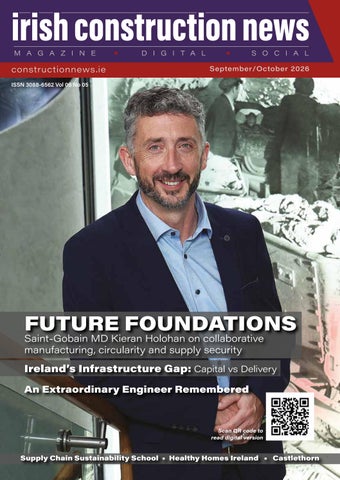
FUTURE FOUNDATIONS Saint-Gobain MD Kieran Holohan on collaborative manufacturing, circularity and supply security
Ireland’s Infrastructure Gap: Capital vs Delivery An Extraordinary Engineer Remembered
Scan QR code to read digital version
1
Supply Chain Sustainability School • Healthy Homes Ireland • Castlethorn irish construction news July/August 2026
REGULATORILY-CERTIFIED
MODULAR BUILDING SOLUTIONS
THAT DELIVER BENEFITS Faster Delivery High Quality Cost Certainty Less Distruption BER A-Rated BCAR-Certified Sustainable Lease / Purchase
OFFICES
CLASSROOMS
Contact us for a discussion about your requirements
CLINICS
RESIDENTIAL
MORE++
041-9882656 info@instaspace.ie
WWW.INSTASPACE.IE
irish construction news M A G A Z I N E
D I G I T A L
constructionnews.ie
S O C I A L
September/October 2026
NEWS 4 4 4 6 8 8
H&MV Engineering to create 1,000 jobs in US grid expansion Glanua launches US operations amid global water infrastructure expansion Kirby Group doubles its South Africa workforce Construction leaders welcome record Budget 2027 Meehan Green rebrands as KEO in Ireland Consortium appointed to Iarnród Éireann’s Major Rail Consultancy Framework 12 Castlethorn secures €100m Avenue Capital deal
4 NEWS
FINANCE
14 What happens to your ARF when you die? – Darragh Hogan, Milestone Advisory
LEGACY
18 An Extraordinary Engineer – Declan Phillips remembers Leslie Earl Robertson, visionary lead structural engineer on the World Trade Center
INTERVIEW
22 Saint-Gobain’s blueprint for next-generation construction – Kieran Holohan, Managing Director, Saint-Gobain Ireland
OPINION
22 INTERVIEW
28 Ireland has the capital, now it needs to deliver – Paul O’Neill, KPMG 32 How AI is transforming tendering, estimating and bid management – Paul Lynch, 8020 Consulting 34 Why Dublin office rents will need to reach €80 per sq ft – Paul Scannell, HWBC 36 Fake invoices and supplier questionnaires: What smaller construction firms should have in writing – Dave Buckley, Treora Technologies
SECTOR FOCUS 41 43 44 44 45
Mitsubishi Electric Ireland unveils inaugural Harmony Awards shortlist Cork Builders Providers Overall Winner at 2026 Octabuild Awards Engineers Ireland appoints new director general WorldSkills Ireland 2026 Engineers call on EU to overhaul construction regulations for a circular future 45 Celebrating 21 years of cool: IRI Industry Awards 2026 46 Construct Innovate supporting Ireland’s housing ambitions
28 OPINION
SUSTAINABILITY
47 Schooling the Sector: How SCSS Ireland is Reshaping Construction – Dr Derek Sinnott, Supply Chain Sustainability School Ireland 50 Is the push for airtight homes creating an indoor air quality crisis? – Yvonne Power, Radon Services Ireland 52 Upskilling for Health: Ireland’s retrofit revolution must put indoor environmental quality at its core – Susan Vickers, Healthy Homes Ireland 54 Sustainability Common Assessment set to streamline supply chain reporting 54 Compostable shoe covers drive ESG impact on building sites 55 European leaders chart new vision for circular economy and e-waste reform 55 National biodiversity strategy needed to accelerate development
52 SUSTAINABILITY
PRODUCTS AND SERVICES 56 The latest products and services news
irish construction news 1
September/October 2026
Main Contractor
|
Design & Build
|
CSA Contractor
Globe Logistics Park, Naas, Co. Kildare
|
Fit-Out
Woodlands Grove, Blackrock, Dublin
Furniture Centre, Carrigline, Cork
Rás an Mhuillín, Macroom, Co. Cork
Cork 2 irish construction news
|
September/October 2026 www.visioncontracting.ie
Dublin
Holywell Apartments, Swords, Dublin
|
Limerick
|
Kerry info@visioncontracting.ie
E D I TO R I A L
PUBLISHER Foundation Media Ltd 1 Northumberland Place, Dún Laoghaire, Co Dublin. Tel: +353 (0)1 677 3157 EDITOR Robbie Cousins robbie@foundationmedia.ie DESIGN Joanne Birmingham CONTRIBUTORS Darragh Hogan, Paul Lynch, Declan T Phillips, Paul O’Neill, Paul Scannell, Dave Buckley, Susan Vickers PRINTER WG Baird Ltd ADVERTISING SALES Joe Connolly joe@foundationmedai.ie Tel: +353 (0)86 396 6158 ADVERTISING AND PROMOTIONAL OPPORTUNITIES To advertise in Irish Construction News or on www.constructionnews.ie, or to request a ratecard or details of promotional opportunities, contact Joe Connolly at joe@foundationmedia.ie CONNECT WITH US ON SOCIAL MEDIA LinkedIn: ConstructionNews.ie SIGN UP FOR OUR E-NEWSLETTER To get the latest news, articles and offers related to the Irish construction industry to your inbox sign up to our free e-newsletter at www.constructionnews.ie ISSN 3088-6562 Vol 06 No 05 © All contents copyright Foundation Media Ltd While every effort has been made to ensure that the information contained in this publication is correct, the publisher cannot not accept responsibility for any errors, omissions or discrepancies. Views expressed in this publication are not necessarily those of the publisher. The contents of this publication are copyright. No part of this publication may be reproduced or transmitted in any form or by any means mechanical, electronic (including photocopying) or digital without the prior consent of the publisher.
From the editor W elcome to the latest issue of Irish Construction News. As the industry evaluates the wide-ranging implications of record capital allocations under Budget 2027, the overwhelming consensus across the sector is clear: while substantial funding commitments provide a solid foundation, flawless execution and sustainable project delivery remain the ultimate test for stakeholders nationwide. Furthermore, navigating these shifting economic tides requires unprecedented collaboration between developers and public agencies, ensuring agile, forward-thinking enterprises continue to play a vital role in maintaining economic momentum across Ireland’s rapidly evolving built environment. This issue of Irish Construction News brings together essential market analysis, technical guidance and policy updates spanning every corner of the sector. Industry representative bodies – CIF, CIOB and SCSI – react to the landmark €8.65bn Budget 2027 package, welcoming critical allocations for Uisce Éireann and transport while raising pressing concerns over planning capacity, housing supply constraints and dereliction measures. Marking nine decades of continuous manufacturing in Ireland, Saint-Gobain Ireland’s managing director Kieran Holohan discusses the importance of having local supply chain security and Saint-Gobain’s innovative ‘Future Foundations’ initiative. We report on Castlethorn securing a landmark €100m deal with Avenue Capital Group to double its housing output. Additionally, drawing on KPMG’s Infrastructure Outlook 2026, KPMG CoHead of Infrastructure Paul O’Neill explores investor sentiment, structural delivery barriers and the reforms needed to boost Ireland’s infrastructure competitiveness. Our Sector Focus examines how
Construct Innovate is supporting Ireland’s housing ambitions through modern methods of construction and digitalisation, and we speak with Supply Chain Sustainability School Ireland chair Dr Derek Sinnott about green education, decarbonisation and commercial resilience. Declan Philips, University of Limerick, remembers his friend Leslie Earl Robertson, lead structural engineer on the World Trade Center, whose groundbreaking designs saved thousands of lives on 9/11. HWBC’s Paul Scannell details why Dublin prime office rents must hit €80 per sq ft to unlock the new development pipeline. Whether you are navigating regulatory compliance, integrating MMC or using artificial intelligence to optimise bid strategy, 8020 Consulting’s Paul Lynch provides some insights on how to use AI to provide the vital intelligence needed to stay ahead in a competitive market. On the sustainability front, read expert contributions on indoor air quality (IEQ). Healthy Homes Ireland chair, Susan Vickers, writes about IEQ in deep energy retrofits, and, in an interview, Yvonne Power, founder of Radon Services Ireland, discusses retrofit radon risks. We also bring you all the winners of the Institute of Refrigeration Ireland Awards and the Octabuild Builders Merchant Excellence Awards.
NEVER MISS AN UPDATE
Stay connected with Ireland’s leading construction news service. Simply scan the QR code on this page or visit our website to subscribe to our free newsletter delivered directly to your inbox. Robbie Cousins
irish construction news 3
September/October 2026
NEWS
Glanua launches US operations amid global water infrastructure expansion
W
H&MV Engineering CEO PJ Flanagan and Ken Gilmartin, EVP US, pictured with John Forde, Consul General of Ireland in Austin and H&MV colleagues and clients, cut the ribbon at the firm’s new North American headquarters at 3131 McKinney Avenue, Dallas, Texas.
H&MV Engineering to create 1,000 jobs in US grid expansion
L
imerick-based H&MV Engineering plans to create 1,000 jobs in the US over the next five years to deliver critical power infrastructure for AI, data centres and expanding grid capacity. The high-voltage engineering specialist has established its North American headquarters in Dallas, following its acquisition of Texasbased Cooke Power Services earlier this year. H&MV designs, builds, and energises high-voltage substations and grid connections (138kV to 345kV) for tech hyperscalers, utilities, and energy developers, with Texas and Louisiana serving as its primary markets. CEO PJ Flanagan noted that surging demand across AI, renewables, and battery storage is driving the need for new highvoltage infrastructure. The US expansion supports H&MV’s rapid global scaling, which has seen revenues rise from $70m in 2020 to over $1.1bn today, backed by over 1,900 employees across three continents.
4 irish construction news
September/October 2026
ater and wastewater engineering specialist Glanua has opened its first US office in Radnor, Pennsylvania, targeting North America’s booming life sciences and advanced manufacturing sectors. The office, near Philadelphia, marks a major international milestone for the Galway-headquartered contractor, expanding operations beyond Ireland, the UK and continental Europe. The US business will focus on the engineering and design of specialist treatment systems for pharmaceutical, life sciences and food manufacturing facilities, planning a North American workforce of over 200 personnel. Chemical engineer Mark McKeever has been appointed US operations director to head the rollout, drawing on Glanua’s European designbuild, modular construction and plant-operation experience. Karl Zimmerer, Group Managing Director, said: “The scale of US investment in pharmaceutical and advanced manufacturing is creating strong demand for specialist water engineering expertise. Our practical experience allows us to develop solutions that reduce delivery and operational risk for clients.” Supported by Enterprise Ireland, the expansion coincides with recent rapid growth. Glanua’s headcount increased from 545 to over 750 employees, while its 2025 revenue reached
Glanua US Operations Director Mark McKeever and Group Managing Director Karl Zimmerer. €155m and is projected to exceed €200m. Backed by a €900m order book running to 2030, the firm aims to reach €400m in annual revenue by 2028. Alongside its US entry, Glanua continues scaling its Irish and UK infrastructure portfolios under Uisce Éireann and AMP8 framework programmes. Meanwhile, its Lisbon engineering hub has expanded to over 20 professionals, supporting broader growth across industrial water reuse and advanced bioresource technologies.
Kirby Group doubles its South Africa workforce
Pictured (l - r): Doreen McKeown, Director for Sub-Saharan Africa, Enterprise Ireland; Austin Gormley, Irish Ambassador to South Africa; Jimmy Kirby, Executive Chairman, Kirby Group; Western Cape Premier Alan Winde; Henry McCann, CEO, Kirby Group; and Shamiela Solomons, Office Manager/HR Lead, Kirby Group South Africa.
L
imerick-headquartered Kirby Group Engineering is doubling its South African workforce by opening a second office in Cape Town’s northern suburbs. The company is creating 50 new jobs, bringing its total headcount in the country to over 110 employees. Recruitment is open across several disciplines, including mechanical, electrical, MEP, commissioning and structural engineering. First established in South Africa in 2023, the firm’s growth highlights strong local
opportunities. Executive chair Jimmy Kirby emphasised that the expansion reflects confidence in the region’s skilled talent pool. To nurture future engineering talent, Kirby collaborates with institutions such as the University of Pretoria and the University of Cape Town through scholarships, sponsorships, and graduate development programmes. Founded in 1964, Kirby now employs over 1,900 people globally across Ireland, the UK, Europe, the Nordics and South Africa.
BUILDING SECURE PENSIONS CPAS is a construction industry specific pension provider. Whether you are an employer seeking to provide benefits for your employees or planning your own retirement, CPAS has the right solution for you. Our dedicated team are here to support you, whether you are starting your business, growing your business, or planning for your future. For more information, please get in touch today. info@cpas.ie or T 01 407 1400
www.cpas.ie
Scan me!
Construction Workers Sick Pay Trust
construction 5 Milestone Advisory DAC t/a Milestone Advisory is regulated by irish the Central Bank ofnews Ireland. September/October 2026
NEWS
Construction leaders welcome record Budget 2027 infrastructure spend, but warn 'delivery is the real test'
Andrew Brownlee, CEO, CIF.
F
ollowing the announcement of Ireland’s €8.65bn Budget 2027 package – comprising €7bn in additional spending and €1.65bn in tax measures – key construction industry representative bodies have issued a mixed response. While welcoming sustained capital investment under the €275.4bn National Development Plan (NDP), industry leaders from the Construction Industry Federation (CIF), the Chartered Institute of Building (CIOB), and the Society of Chartered Surveyors Ireland (SCSI) emphasise that converting record funding into completed homes and infrastructure remains the paramount challenge. STRATEGIC INVESTMENT IN WATER AND TRANSPORT The government’s commitment to critical enabling infrastructure received broad endorsement across the sector. Budget 2027 allocates €2.3bn to Uisce Éireann, including €1.5bn in capital funding to progress over 400 water and wastewater projects, alongside major strategic infrastructure such as the Eastern and Midlands Water Supply Project and the Greater Dublin Drainage Scheme. Transport also secures substantial funding, with €5.5bn for the Department of Transport, €4.2bn under the NDP for DART+, BusConnects, and Cork Area Commuter Rail, and €6bn pledged between 2027 and 2030 to advance MetroLink. Andrew Brownlee, CEO, CIF, welcomed the continued NDP investment to strengthen national resilience amid economic and geopolitical uncertainty. He stated: “Water, wastewater, energy and transport infrastructure are critical to unlocking land, enabling development and increasing housing supply at the scale required,” describing the Uisce Éireann funding as “precisely the type of enabling investment required”.
6 irish construction news
September/October 2026
Joseph Kilroy, Policy and Public Affairs Manager for Ireland, CIOB. Echoing these views, Joseph Kilroy, Policy and Public Affairs Manager for Ireland at CIOB, noted that high-level transport and utility investment is vital to supporting compact growth and regional connectivity. However, Kilroy cautioned that funding alone is insufficient without expanding capacity within planning and procurement agencies to avoid project delays. HOUSING PACKAGE AND DEMANDSIDE CRITIQUE In housing, Budget 2027 commits €9.4bn, including €3bn for social housing – targeting 11,250 new-build homes – and over €1bn for starter home and affordability supports. First-time buyers see the Help to Buy scheme limit increased from €30,000 to €35,000. Additionally, the Rent-a-Room relief threshold rises from €14,000 to €16,000, extending to detached auxiliary units, while Renters’ Tax Credits increase by €150 for individuals and €300 for couples. While the CIF welcomed the Help to Buy expansion as a positive step for homeownership, Brownlee expressed disappointment that VAT reductions were not extended to all apartment typologies, including duplexes. Both CIOB and SCSI raised concerns regarding an over-reliance on demand-side measures. Kilroy argued that expanding Help to Buy increases purchasing power without tackling underlying supply constraints, urging a stronger focus on land activation and site servicing. Similarly, SCSI president Tomás Kelly noted that while the €5,000 Help to Buy increase assists buyers struggling with deposit requirements, the government missed an opportunity by failing to index support scheme thresholds to construction cost inflation. FRUSTRATION OVER DERELICTION AND VIABILITY MEASURES The SCSI expressed clear disappointment
Tomás Kelly, President, SCSI. over the lack of targeted incentives to tackle larger vacant and derelict buildings across the state. While welcoming the introduction of a 7% Derelict Property Tax and a preliminary register set for September 2027, Kelly stressed that existing grant structures fail to bridge the viability gap for complex, large-scale refurbishment projects. Furthermore, while the SCSI welcomed the reduction in standard Capital Gains Tax (CGT) from 33% to 31%, it strongly criticised the explicit exclusion of development land from this reduction. SCSI also called for an extension of development levy and utility connection charge waivers – which can reduce delivery costs by approximately €17,500 per home in the Greater Dublin Area – to improve financial viability and accelerate approvals through An Coimisiún Pleanála. CLIMATE POLICY, SKILLS, AND THE FOCUS ON DELIVERY On sustainability, Budget 2027 provides over €650m through the SEAI for residential energy retrofits, solar PV, battery grants and a boiler scrappage scheme. However, CIOB raised questions regarding fiscal consistency, criticising the decision to reduce carbon taxes on home heating fuels to 2023 levels and freeze them for the government’s term. CIOB also reiterated calls for VAT reforms that incentivise building renovation over demolition. To address chronic labour shortages, the budget allocates €150m over three years from the National Training Fund for AI and technology reskilling. CIOB stressed that this must be paired with sustained investment in traditional construction apprenticeships and technical workforce development. Ultimately, industry consensus highlights that Budget 2027 provides a strong fiscal framework, but success hinges entirely on execution. As CIF’s Brownlee concluded, “The priority from here must be delivery.”
It’s pretty black and white Always check for gas pipelines before you break ground
Visit www.gasnetworks.ie/dig
irish construction news 7
September/October 2026
NEWS
Meehan Green rebrands as KEO in Ireland
I
rish sustainability consultancy, Meehan Green, will operate under the KEO Group name from October, completing its integration into KEO Group. Meehan Green joined KEO Group in 2025 and has continued to trade under its own name since then. During that time, the team has paired its regional expertise and reputation in sustainable building practices with KEO’s global scale, innovation and technical capabilities. Adopting the KEO identity reflects how closely the teams already work together and brings the Irish business fully in line with the wider group. The change is in name only. Ownership and structure are unaffected; the local team remains in place, and all services, client relationships, projects and commitments will continue as before. Operating under the KEO name will strengthen KEO’s presence in Ireland and support its continued growth across Europe. Dorothy Maguire, Director of Sustainability, KEO, said: “Joining KEO has given our clients access to a much broader range of expertise, and taking on the KEO name is a natural next step. Our team, our commitment to sustainable building and the
way we work with clients all stay the same. What changes is that we can now bring the full strength of an international group to every project in Ireland.” Christian Millar, Managing Director, Sustainability + Environment, KEO, said: “Ireland is an important market for KEO, and the Meehan Green team has built an outstanding reputation for sustainability expertise. Bringing the business under the KEO name reflects how closely we already work together and positions us to grow our presence in Ireland and across Europe, while keeping the local knowledge and
relationships that clients value.” A highly integrated and agile creative AEP/PMCM enterprise where innovation is a way of life. KEO, together with its allied practices, is an independent, multidisciplinary firm, recognised for excellence. It has been performing professional services as a trusted partner for 60+ years. From shaping iconic skylines to crafting sustainable communities, KEO serves clients and builds legacies for a better tomorrow. Its highly talented multinational professionals operate across two continents in 14 offices.
Consortium appointed to Iarnród Éireann’s Major Rail Consultancy Framework
I
arnród Éireann (Irish Rail) has appointed a four-company consortium comprising Egis, WSP, O’Connor Sutton Cronin (OCSC) and DB Engineering & Consulting to its new MultiParty Framework for Project Multi-Disciplinary Consultancy Services. The agreement gives Irish Rail streamlined access to specialist technical, advisory and design expertise as the nation accelerates investment in its rail infrastructure. The framework primarily covers Project Management Procedures (PMP) Phases 1 through 5, encompassing initial feasibility, planning and detailed design for priority rail projects across Ireland. Additionally, the contract includes options to extend into Phases 6 and 7, covering construction supervision and project close-out. Specific consultancy packages will be awarded through defined calloff processes. Combining international capabilities with local expertise, the consortium brings together multidisciplinary design, civil and rail engineering, programme delivery, and infrastructure advisory services. The joint partnership will support Irish Rail in delivering a safer, more efficient, and sustainable network for passenger and freight operations. Commenting on the appointment, Julien Phan Hoang, Rail Director, Egis in Ireland, said: “We are proud to contribute to Iarnród Éireann’s ambition for a stronger rail network. This framework brings together world-class multidisciplinary expertise to deliver safe and sustainable infrastructure that will benefit communities across Ireland.” Andrew Doyle, WSP Country Director for Ireland, added that the framework provides an important platform to bring engineering and delivery expertise to future projects, helping to “improve capacity, connectivity, and long-term outcomes for passengers and freight customers.”
8 irish construction news
September/October 2026
Representatives from Egis, WSP, OCSC and DB Engineering & Consulting following the appointment of the consortium to Iarnród Éireann’s Multi-Party Framework for Project Multi-Disciplinary Consultancy Services. Representing local engineering capabilities, Martin McGrath, Managing Director, OCSC, said: “We look forward to contributing our civil engineering and multidisciplinary design expertise to help deliver rail infrastructure that supports connectivity and long-term growth across Ireland.” Stefan Geisperger, Managing Director, International Markets and Consulting at DB Engineering & Consulting, highlighted the consortium’s track record, building on previous work with Irish Rail on the Train Protection System and New Fleet Operational Readiness programmes. Image courtesy of DepositPhotos
BUILT ON STRONG FOUNDATIONS.
BUILT TOGETHER. INNOVATION. PARTNERSHIP. PROGRESS.
THEN
NOW
NEXT
CRAFT. HERITAGE. TRUST.
PERFORMANCE. PEOPLE. PARTNERSHIP.
INNOVATION. PROGRESS. FUTURE AMBITION.
www.gyproc.ie
irish construction news 9
September/October 2026
WA S T E
Think Before You Skip It: Waste-Saving Steps for Builders For small and medium builders, better materials planning can cut skip costs, reduce waste and show clients that a site is being managed professionally.
C
onstruction and demolition waste is Ireland’s largest waste stream, with approximately 7.9 million tonnes generated in 2024. Much of this material has value, but that value is quickly lost when reusable items, timber, plasterboard, metals, packaging and general waste are mixed together in one skip. MyWaste’s Think Before You Skip It campaign encourages builders, trades and renovation contractors to take a simple step before disposal: ask whether an item can be kept, reused, returned, donated, sold or recycled. Plan before the skip arrives A short pre-start conversation with the client can prevent good materials being damaged or discarded. Identify items such as cabinets, doors, flooring, sanitary ware, timber and surplus materials that could remain in the home, be reused on another job, returned to a supplier, donated or sold.
KEEP VALUABLE MATERIALS SEPARATE • • • •
Timber: Keep good lengths, doors, pallets and clean offcuts separate for reuse, donation or supplier take-back. Plasterboard: Order carefully, cut efficiently and keep offcuts dry and separate from mixed waste. Mixed waste: Avoid using the skip as a catch-all. Separate cardboard, metals, plastics and packaging where possible. Tools, batteries and electrical items: Keep these out of skips and bring them to appropriate collection points, civic amenity sites or participating retailers.
10 irish construction news
September/October 2026
QUICK SITE CHECKLIST •
Walk the job with the client and agree what can be kept or reused. • Order accurately and store materials clean and dry. • Separate timber, plasterboard, metals, cardboard, plastics, batteries and electrical items. • Check supplier take-back options for pallets, packaging and surplus materials. • Use authorised collectors and keep waste receipts. Good waste management is good business. It helps control costs, reduce downtime, improve site presentation and show clients that valuable materials are being handled responsibly. Before anything goes into the skip, ask: Can this be reused, returned, recycled or kept in use? Find out more: Download MyWaste’s builder-friendly posters and practical guides at MyWaste.ie.
BUILDERS Check if you can:
REUSE RECYCLE RECOVER Mixed Waste
Always segregate waste streams where possible.
Timber
Explore reuse options and take-back schemes.
Plasterboard
Plan early and order to size.
Battery Packs and Power Tools
Recycle only.
For more information check mywaste.ie irish construction news 11
September/October 2026
NEWS
Castlethorn secures €100m Avenue Capital deal to accelerate Greater Dublin housing pipeline Backed by an initial €100m capital commitment from Avenue Capital, housebuilder Castlethorn is expanding its Dublin footprint with plans to fund strategic land acquisitions and double its annual housing delivery over the next four years. phase of its development pipeline. While the current vehicle is capitalised to deliver the agreed business plan, scope remains for further capital deployment.
PLANNING CERTAINTY AND PIPELINE PROGRESS
Luttrellstown Gate development by Castletorn.
C
astlethorn has established a landmark strategic agreement with global investment firm Avenue Capital Group, backed by an initial €100m capital commitment. The deal sees Avenue Capital take a minority stake in a newly established, Castlethorncontrolled vehicle designed to scale up residential development across the Greater Dublin Area. Building on Castlethorn’s completion of 1,150 homes in 2025, the capital commitment forms the bedrock of an ambitious growth strategy aimed at doubling the group’s annual housing delivery by 2028.
STRATEGIC CAPITAL DEPLOYMENT AND ACQUISITION GROWTH
The newly established funding vehicle will underpin a total residential pipeline exceeding 7,000 homes, subject to statutory planning, phasing, and prevailing market dynamics. The overarching portfolio incorporates sites currently within Castlethorn’s control that hold capacity for roughly 4,000 homes, alongside a concerted expansion drive into new land acquisitions capable of supporting a further 3,000 units across the region. Castlethorn has confirmed that the initial €100m commitment is earmarked principally to fund these strategic site acquisitions, driving the next expansion
12 irish construction news
September/October 2026
A crucial foundation of the portfolio is its advanced planning positioning, particularly against a backdrop of wider industry concerns regarding statutory delays and legal challenges. Castlethorn has confirmed that over 1,200 homes within the portfolio already hold full planning permissions, offering an immediate shovelready foundation to progress construction. Furthermore, none of the sites within the portfolio are currently subject to judicial review proceedings. The remaining units across the 7,000home vision are at various stages of the planning and pre-planning lifecycle. Castlethorn intends to leverage its established in-house capability, utilising detailed site assessments, early preplanning engagement and extensive experience in securing consents for complex developments to navigate statutory processes for the remaining portfolio.
NAVIGATING INFRASTRUCTURE AND SUPPLY CHAIN REALITIES
Expanding output to such a scale requires addressing structural hurdles in the broader housebuilding landscape. Castlethorn identifies the timely availability of enabling infrastructure— specifically road networks and utility connections—as the primary operational delivery challenge facing the portfolio. In this context, the recent approval of relevant infrastructure projects under the State’s Housing Infrastructure Investment Fund represents a vital boost to unlocking capacity across controlled landbanks. Regarding broader supply chain and market pressures, Castlethorn continuously monitors construction labour and material availability, though neither currently represents a binding constraint on portfolio execution.
DELIVERY MODELS AND TENURE FLEXIBILITY
Castlethorn is maintaining a flexible approach to tenure allocation across its pipeline rather than establishing fixed
rigid proportions. The core portfolio focus remains firmly on delivering homes for private sale to individual purchasers, with standard Part V obligations fulfilled on a development-by-development basis. For larger-scale apartment schemes, the developer will consider strategic partnerships with State entities and Approved Housing Bodies where appropriate. Castlethorn has also highlighted the positive role of State support mechanisms such as Croí Cónaithe in enhancing scheme viability and accelerating apartment schemes for individual buyers. Castlethorn currently has three Croí Cónaithe-supported schemes progressing outside of this joint venture portfolio, unlocking developments that might otherwise present viability challenges.
INSTITUTIONAL ENDORSEMENT AND LONG-TERM STRATEGY
Spanning more than 35 years in the Irish property sector, Castlethorn has built an integrated operational model covering land acquisition, planning, infrastructure delivery, construction, and long-term stewardship. The partnership with Avenue Capital underscores institutional investor confidence in Castlethorn’s execution track record and residential delivery strategy. Joe O’Reilly, Chief Executive, Castlethorn, noted that the commitment from Avenue Capital reflects strong market confidence in the company’s team and portfolio quality, providing additional balance sheet capacity to progress schemes in a measured, disciplined manner. He commented: “Castlethorn has always focused on delivery – bringing together land, planning, infrastructure and construction expertise to create well-designed residential communities. This commitment from Avenue reflects confidence in our track record, our team and the quality of our portfolio, and gives us additional capacity to continue progressing residential schemes in a measured way.” Echoing this perspective, Padraig Moore, Co-Head, Avenue Europe Funds, Avenue Capital Group, expressed delight in supporting Castlethorn’s residential programme, highlighting Castlethorn’s proven track record and clear focus on delivery as key pillars of the joint partnership.
DATA CENTRES
WE’RE ENGINEERED FOR THIS.
WHEN UPTIME ISN’T NEGOTIABLE EXPERIENCE ISN’T OPTIONAL
designergrp.com irish construction news 13
September/October 2026
D ATA C E N T R E S I R E L A N D
DataCentres Ireland 2026 Exhibition & Conference DataCentres Ireland Exhibition & Conference returns to the RDS this November 18 - 19, uniting the entire Irish data centre and those responsible for other critical environments under one roof.
W
hether you’re designing, building, operating, or investing in infrastructure, this is the must-attend event for anyone driving innovation and growth in the sector. The Exhibition – Features over 170 individual exhibition stands featuring over 200 Suppliers and Solution providers. This is your opportunity to see the latest product, solutions, technologies, and service providers that can assist you in creating secure and resilient critical infrastructure.
KEY AREAS ON DISPLAY INCLUDE: • • • • • •
Power & Standby Generation Cooling and Environmental Control/Management Cabling Energy Efficiency & Management Security & Access Control Sustainability and the Circular Economy
A CONFERENCE THAT DELIVERS REAL INSIGHT
Our multi-streamed conference programme dives into the trends, challenges and innovations shaping the future of data centres in Ireland and beyond: Strategic Stream: Explore the big picture – from regulatory impacts to sustainability, AI, energy strategy, and Ireland’s role in the global digital landscape. Operational Stream: Tackle the day-to-day – discover practical solutions to optimise your infrastructure for efficiency, resilience, and security. To register for your FREE ticket, follow the link https://datacentres-ireland.registrationdesk.ie/
SHOWCASE YOUR BUSINESS TO A QUALITY AUDIENCE
DataCentres Ireland 2026 isn’t just about learning – it’s about connecting. With more than150 companies exhibiting this year and thousands of high-quality attendees, this is your chance to: • Build your pipeline
14 irish construction news
September/October 2026
• • • •
Meet key decision-maker Launch new product Strengthen relationship Grow your brand in Ireland’s data centre sector
To secure your space, contact the team on +44 (0)1892 570513 or visit www.datacentres-ireland.com Don’t miss Ireland’s biggest data centre event of the year To register for your FREE ticket, follow the link https://datacentres-ireland.registrationdesk.ie/
E RK
A M R
E
ME
T
OU Y T
RDS, Dublin: 18-19 Nov 2026
Infrastructure • Services • Solutions DataCentres Ireland combines a dedicated exhibition and multi-streamed conference to address every aspect of planning, operating and managing your Data Centre, Server/ Comms room and Digital storage solutions – Whether internally, outsourced or in the Cloud.
Entry to ALL aspects of DataCentres Ireland is FREE • Market Overview
DataCentres Ireland is the largest and most complete event in the country. It is where you will meet the key decision makers as well as those directly involved in the day to day operations.
• Power Sessions
EVENT HIGHLIGHTS INCLUDE:
• Resilience and Operational Readiness
• Regional Developments • Updating Legacy Data Centres • Renewable Energy
Multi Stream Conference
• Standby Generation
25 Hours of Conference Content International & Local Experts 60+ Speakers & Panellists
Invest the time... Benefit from the experience
140+ Exhibitors Networking Reception
Ticket & Registration Sponsor
Lanyard Sponsor
Bag Sponsor
For the latest information & to register online visit
www.datacentres-ireland.com
irish construction news 15
September/October 2026
PENSIONS
What Happens to Your ARF When You Die? Retirement planning is often focused on building a pension fund and creating an income for later life. However, an equally important part of financial planning is understanding what happens to your retirement assets when you die.
F
or holders of an Approved Retirement Fund (ARF), the tax treatment on death can vary considerably depending on who ultimately receives the money. Understanding these rules and planning for them in advance can help ensure that more of your accumulated wealth reaches the people you intend to benefit.
IF YOUR SPOUSE OR CIVIL PARTNER INHERITS
A surviving spouse or registered civil partner has favourable options. They can generally take ownership of the ARF and keep the money invested. No CAT arises on the transfer, although future withdrawals will be subject to Income Tax, PRSI and USC in the hands of the surviving spouse or civil partner.
WHAT HAPPENS WHEN CHILDREN INHERIT?
The position is different for children, and age is particularly important. Where a child under 21 receives the proceeds of an ARF, the payment may be subject to CAT at 33% on amounts exceeding the available Group A threshold. For a child aged over 21, the treatment changes. CAT does not apply to the ARF payment, but a flat 30% income tax charge applies instead. Children receive the value or proceeds of the ARF rather than inheriting the ARF itself. This distinction is important when parents are considering how their pension assets fit into their wider estate and inheritance plans.
16 irish construction news
September/October 2026
OTHER BENEFICIARIES CAN FACE A SIGNIFICANT TAX BILL
Tax can become more complicated when an ARF is left to someone other than a spouse, civil partner or child. The fund may first be payable to the estate after Income Tax, PRSI and USC. The beneficiary may then also face CAT on the net inheritance, depending on their relationship with the deceased and the relevant CAT threshold available to them.
COULD A SECTION 72 POLICY HELP?
One potential planning solution is a Section 72 life assurance policy. A qualifying Section 72 policy is specifically designed to provide funds towards an inheritance tax liability arising on death. Importantly for ARF planning, qualifying Section 72 policy proceeds can be used towards tax arising on an ARF, including the 30% tax liability where an ARF passes to a child over 21. Of course, a Section 72 policy will not be appropriate in every situation. The amount of cover, cost, beneficiaries, structure of the estate and likely future tax liability all need to be considered. Starting this conversation earlier can provide more options than leaving inheritance planning until later life.
PLANNING AHEAD MATTERS
ARFs should form part of your overall estate plan, alongside your home, savings, investments, other pensions and life assurance. A valid Will, reflecting your current wishes, is a vital part of the estate planning process. If you die without leaving a Will, your estate will be divided in accordance
Darragh Hogan, Financial Services Consultant, Milestone Advisory. with the Succession Act. You should talk to a solicitor if you do not have a valid Will or if your Will needs to be updated. Tax rules, thresholds and personal circumstances can change. Current rules should always be confirmed before taking action. Speaking with a financial advisor can help you understand how your ARF fits into your wider estate, identify potential tax exposures and assess whether solutions such as Section 72 cover may be appropriate.
HERE TO HELP YOU NAVIGATE YOUR WAY TO FINANCIAL SECURITY
Good financial planning is not simply about accumulating wealth. It is also about having a clear plan for passing that wealth to the next generation as efficiently as possible. The Milestone Advisory team are qualified financial services consultants. We specialise in helping professionals in the construction sector and related industries. Our team will work with you to review your finances, explaining your options in clear English. No jargon – just the facts. For more information, contact Darragh Hogan (darragh@milestoneadvisory.ie).
I’ll sort it. Later... You build projects, lead teams and hit deadlines. Sorting out your own finances and investments rarely makes it to the top of the list. That’s where we help. We work with construction professionals every day, taking the important financial jobs off the long finger and explaining the options in plain English. So you can focus on what matters. Start the conversation. No jargon. Just facts.
Scan here to start the conversation
T: 01-4068020 E: info@milestoneadvisory.ie www.milestoneadvisory.ie Milestone Advisory DAC t/a Milestone Advisory is regulated by the Central Bank of Ireland Milestone Advisory is an operating division of CPAS irish construction news 17 September/October 2026
REFLECTION The Twin Towers of the World Trade Center, New York.
An Extraordinary Engineer Decades after standing in awe beneath the World Trade Center, DECLAN T PHILLIPS reflects on his unexpected friendship with Leslie Earl Robertson – the visionary lead structural engineer whose groundbreaking designs saved thousands of lives on 9/11, and whose warmth and humanity defined his greatest legacy.
F
or many people, the Twin Towers are remembered only through the events of September 11th, 2001. But my connection with the World Trade Centre began many years earlier, on a hot summer day in 1987. At the time, I was a structural engineering student. Along with four classmates, I travelled to the United States for the first time. The morning after we arrived in New York, there was one place we were determined to visit: the Twin Towers. It’s easy to forget just how extraordinary the Twin Towers were. When they opened in 1973, they were the tallest buildings on the planet. Even more extraordinary was the fact that the engineer selected to design their revolutionary structure was only thirty-five years old, an age when most people’s careers are only beginning to take shape. As we approached the towers, their scale seemed almost impossible to comprehend. Like thousands of visitors before us, we joined the queue for the observation deck on the 107th floor of the South Tower.
18 irish construction news
September/AOctober 2026
As the line slowly wound around the base of the building, I stepped away from my friends and stood in the shade between the tower’s massive aluminium-clad columns. Leaning against the cool metal, my eyes followed the endless vertical lines of the structure as they disappeared into a brilliant blue sky. Clouds drifted overhead, creating a strange illusion. For a moment, it seemed as though the tower itself was moving. Standing there, two thoughts crossed my mind. First, what would it be like to meet the engineer who designed these remarkable structures? Second, what would happen if the towers ever collapsed? At the time, these felt like impossible questions. Yet life would eventually answer both. By autumn 2005, I had joined the University of Limerick, where we were launching a new civil engineering programme, and I had an idea for a guest speaker to come and talk to our students.
I called the New York office of LERA, the engineering firm of Leslie Earl Robertson, the lead structural engineer for the Twin Towers. I introduced myself to the receptionist and asked if Mr Robertson might be available. To my surprise, within moments I heard a warm voice say, “Hi, this is Les Robertson.” I invited him to Ireland to speak about his remarkable career and the responsibilities that come with being an engineer. To my delight – he agreed. That phone call marked the beginning of a friendship that has profoundly enriched my life. Over the years, our conversations ranged far beyond engineering. Les was a natural storyteller. Before becoming one of the world’s most respected engineers, he had raced stock cars, operated filling stations and washed dishes in diners. He spoke about those experiences with the same enthusiasm he brought to discussing skyscrapers and bridges. But what impressed me most was not his technical brilliance. It was his humanity.
REFLECTION Born in Los Angeles in 1928, Les overcame a difficult childhood marked by family separation, instability and poor experiences at school. At sixteen, he dropped out of school and lied about his age to be admitted to the US Navy. His future seemed uncertain. But that decision opened an unexpected door. After leaving the service, still in his early twenties, he attended the University of California, Berkeley through the GI Bill. There, his fortunes changed and an extraordinary engineering career began. Les Robertson was the kind of engineer who treated steel the way a master chef treats ingredients: use only what you need and make every bit count. Long before “innovation” became a corporate buzzword, Les was already pushing boundaries. In the early 1960s, he was putting IBM computers to work to speed up the design process, at a time when many engineers still trusted a pencil, a slide rule and a strong cup of coffee. He was also among the first to use wind tunnel testing to understand how much the Twin Towers would sway on one of Manhattan’s breeziest sites. Not content with that, he built a custom motion simulator and conducted experiments to figure out how people would actually feel hundreds of metres above the streets of New York. The result was a patented damping system designed to make the towers feel steadier for those working high above the city. And because Les seemed determined to think of everything, he even considered the possibility of an airliner striking the buildings. His calculations were based on the largest commercial jet of the day, a Boeing 707. Not a rogue missile, but a passenger plane lost in fog while trying to find JFK or LaGuardia Airport. What makes the story even more remarkable is where it began. Before taking on the challenge of designing two 110-storey skyscrapers that would redefine the New York skyline, Les Robertson’s firm’s experience of high-rise design topped out at a comparatively modest 20-storey IBM building in Seattle. It was on that project that he first met architect Minoru Yamasaki, the man who would become his partner in creating one of the most recognisable landmarks of the twentieth century. But the hardships of his early life never left him. Neither did his disdain for war. The loss of friends during his military service shaped his lifelong commitment to peace. The attacks of September 11th left a profound mark on Les. As the lead structural engineer, he found himself thrust into the global spotlight and relentlessly questioning every design
Declan Phillips and Leslie Earl Robertson, on the occasion of Les’ 80th birthday. decision he had ever made. Yet the engineering community was clear in its judgement: Les Robertson’s pioneering “tube” design, coupled with the massive rooftop space-frame structures that bound each tower together, helped keep the buildings standing far longer than many thought possible. Even after the aircraft severed numerous load-bearing columns, those innovations allowed forces to be redistributed through the structure, buying precious time for thousands to escape. Without them, the towers would almost certainly have collapsed much sooner, and the loss of life could have been far greater. Les dedicated much of his life campaigning against war and promoting understanding between people of different backgrounds and beliefs. A small peace pin was rarely absent from his jacket. He frequently gave these pins away, hoping others might join his cause. He believed that, despite their differences, the world’s great faiths shared common values of peace, justice, truth and compassion. During his visit to the University of Limerick in 2007, I was proud to see Engineers Ireland recognise his extraordinary contribution to the profession by awarding him its highest honour, Fellowship of the Institution. Les was always generous with his time. At my request, he visited my local primary school in Tramore and gave a wonderfully inspiring talk about his career designing towers. As the children were being collected after school, one excited young lad ran up to his mother and announced, “Mam, the engineer for the Twin Towers was in our school today!”
“He was not!” she replied It was probably the quickest false factcheck in Tramore history. Les Robertson passed away in February 2021, one day before his 93rd birthday. When people remember the Twin Towers, they often think of their destruction. When I remember them, I think of standing in their shadow on a hot summer’s day in 1987, gazing up at the sky and wondering about the man who had designed them. I was fortunate enough to meet that man. And while he designed some of the tallest structures on earth, his greatest legacy may well be the example he set as a human being. An Extraordinary Engineer was first broadcast on RTE Radio 1’s ‘Sunday Miscellany’ on 13 September, 2026, on a programme marking the 25th anniversary of the 9/11 attack on New York. Scan QR code to listen
ABOUT THE AUTHOR
Dr Declan Phillips is an associate professor and formerly the inaugural course director for the civil engineering and construction management and engineering programmes at the University of Limerick (UL). He has been with the University since it first launched programmes in the built environment in 2005. He was responsible for designing UL’s programme in civil engineering, a programme that adopts a learning-bydoing philosophy.
irish construction news 19
September/October 2026
PIPELIFE
Pipelife launches indoor R290 heat pump designed for Irish apartments
P
ipelife Ireland is launching a new indoor monoblock heat pump this July that it says has been designed from the ground up for the realities of Irish apartment construction and stress-tested to reflect how such buildings are actually built, rather than idealised lab conditions. The Inova indoor heat pump houses the fan, coil, compressor and expansion valve in a single unit installed entirely within the dwelling, drawing and exhausting air via ducts. It runs on R290 (propane), the ultralow global warming potential refrigerant, with a fully sealed charge of just 450 grams, keeping it within the limits for indoor installation. Safety features include a gas separator to prevent refrigerant entering the water circuit, and an internal gas sensor that ramps the fan to 100 per cent to dissipate any leak to outside. But the detail likely to catch the eye of building services engineers is how the unit was tested. All of Pipelife’s published performance figures are predicated on the unit sitting 10 metres from an external wall, with three 90-degree bends in the ductwork, a deliberately punishing worstcase scenario. If we could be a little less specific, engineers will design to 10m if they know it can. Good design is to reduce the distance, but if required we can go up to 10m. We can enforce that it has been stress tested to the realities of Irish apt design. “Nobody’s going to put a heat pump on an external wall — architects have to balance daylight regulations along with everything else, so they won’t have the space to do it,” said [Eoghan Considine, Specification Manager], of Pipelife Ireland. He contrasted this with the industry habit of publishing fan curves measured on a bench: “This is everything at a worst-case scenario, not a best-case scenario. We restricted the unit — we stress-tested it.” The unit delivers 3.2 kW of heating capacity [3.2KW at 35C, 3.14 at 55C,
20 irish construction news July/August 2026
SCOP of 4.7 at 35C, datasheet attached.], is app-enabled, and is tested to EN 14825, with EN 16147 hot water performance data also available. It pairs with a separate hot water cylinder, pre-plumbed at Pipelife’s Little Island facility in Cork, with an inline version to follow that will visually read as a single column. Keeping the cylinder separate was a conscious wholelife decision, Considine said: cylinders typically outlast heat pumps, so the heat pump -- or individual components such as the fan or compressor, all accessible from the front of the unit -- can be replaced without disturbing the store. It also makes it far easier to manoeuvre the equipment through a finished apartment block. Equally deliberate is what the Inova doesn’t do. Unlike exhaust air heat pumps, it makes no attempt to combine heating and ventilation, and its performance is not dependent on warm extract air, or on occupants leaving wall vents open. “The best heat pumps on the market just function as heat pumps. The best ventilation systems just function as ventilation systems,” said Considine. “Why combine things to make them a little bit worse?” Pipelife instead pairs the unit with its own MEV or MVHR systems, supplied as complete packages including ductwork — an approach it says is cost-competitive with combined exhaust air units, while allowing each system to be specified, commissioned and serviced on its own merits. For passive house apartment schemes, the company argues the Inova opens up a simpler route: a conventional monoblock heat pump strategy plus MVHR, at a lower cost than compact combined heat pumpventilation units, and using a heating approach familiar to Irish contractors. The launch draws on considerable experience. Pipelife has been supplying heat pumps to the Irish market since 2009, with more than 10,000 units sold, alongside a fast-growing mechanical ventilation business. The Inova was developed to Pipelife’s own specification with its manufacturing partner, informed by the company’s combined knowledge of heat pumps and ventilation, Irish apartment design guidelines and F-gas regulations. “Restrictions have driven innovation,” said Considine. The heat pump also lands amid a wider sustainability push at the group, part of Wienerberger’s Pipelife division, which manufactures in 28 countries. The Cork operation -- an amalgamation of indigenous firms Quality Plastics, Cork Plastics and MFP -- used 7,000 tonnes of recycled material in 2025, with plans to more than double this to 15,000 tonnes
by 2030. The company has published seven environmental product declarations to date, and aims to have EPDs for everything it manufactures by 2028, with a group target that 75 per cent of products manufactured or sold support net zero construction. The company buys 100 per cent renewable electricity, with on-site solar generation planned. Servicing of the Inova is carried out entirely from within the apartment, supported by installer training held fortnightly in Dublin and Cork, and the unit will ship with a dedicated plain-English homeowner manual alongside the engineering documentation.
SOMETHING NEW IS COMING…
Designed for the Future. Built to Perform. Designed specifically for Irish apartments R290 heat pump with a capacity of 3.2kw Connected by 150mm round ducting or 220mm x 90mm flat pack ducting Flexible design – position up to 10m from the outside wall Fully app enabled Comes with a 200ltr pre-plumbed cylinder
Another Game Changer from
Discover our full service portfolio at
irish construction news 21 www.pipelife.ie July/August 2026
INTERVIEW Kieran Holohan, Managing Director, Saint-Gobain Ireland.
Building tomorrow: Saint-Gobain’s blueprint for next-generation construction As Saint-Gobain Ireland marks 90 years of manufacturing heritage, Managing Director Kieran Holohan speaks to ROBBIE COUSINS about domestic supply security, collaboration, sustainability and innovation, and how the company is reshaping the future of how it does business in Ireland.
I
n 2026, Saint-Gobain Ireland marks a historic milestone: 90 years of continuous manufacturing, mining, and innovation on the island of Ireland. From its origins in 1936 as a Gypsum mine and facility producing plaster and plasterboard in Kingscourt, Co Cavan, the enterprise has grown into a multi-brand building materials powerhouse. Today, as part of the global Saint-Gobain group, its portfolio includes market-leading brands such as Gyproc, Isover, Saint-Gobain Glass, Vetrotech, Weber, K Rend and K Systems. The next phase for Saint-Gobain Ireland is about bringing those capabilities together more deliberately, moving beyond individual products and brands to provide customers with integrated Saint-Gobain solutions that respond to the performance needs of the complete building. To celebrate nine decades of operation and map out the next chapter of growth, Saint-Gobain Ireland hosted its ‘Future Foundations’ initiative throughout September. Opening the doors of its
22 irish construction news
September/October 2026
manufacturing facilities in Kingscourt, the company welcomed hundreds of key stakeholders – ranging from architects and specifiers to main contractors, subcontractors and builders’ merchants, as well as journalists, for a series of curated plant tours and collaborative feedback sessions. Following these sessions, Kieran Holohan, Managing Director of SaintGobain Ireland, sat down to discuss the company’s history, its integrated supply chain model, changing building regulations, and its strategy for driving sustainable construction in Ireland.
ORIGINS
Kieran Holohan briefly explains the company’s history: “In 1936, the Gypsum & Bricks company started the production of plaster and plasterboard in Kingscourt. And, 90years later, that very same natural resource remains the foundation stone of our operations in Ireland.” Over the decades, the business evolved
through major corporate chapters, joining the BPB (British Plaster Board) Group before being acquired by Saint-Gobain in 2005. “When Saint-Gobain acquired BPB around 2005, it brought together a deeprooted Irish manufacturing heritage with the technical scale and global innovation of Saint-Gobain,” Holohan notes. “Gyproc and Isover became the anchor of Saint-Gobain’s presence on the island. Everything we have built since – expanding into insulation, external wall renders, acoustic ceiling systems and construction chemicals – rests on that 90-year manufacturing and mining legacy.”
AN INTEGRATED FOOTPRINT ACROSS THE ISLAND OF IRELAND
Today, Saint-Gobain employs over 500 people across the island of Ireland, spanning various operations and technical specialities. “Across the island as a whole, we employ
INTERVIEW over 500 people,” Holohan explains.“That includes roughly 250 people in our Gyproc plaster and plasterboard operations, over 161 within the K Rend & K Systems business, and 96 people in our Dublinbased Life Sciences operations, alongside dedicated teams across sales, commercial, and technical services.” Unlike sales offices that import finished products from overseas, Saint-Gobain operates a complete end-to-end industrial model within Ireland. “What makes our setup unique is the sheer diversity of skills we maintain locally,” Kieran Holohan emphasises. “We employ geologists, chemists, mining engineers, process engineers, quality management specialists, R&D professionals and field technicians, as well as commercial, finance and marketing teams. The entire lifecycle – from extracting the raw rock out of the ground to processing, formulation, manufacturing, technical testing, distribution and job-site support – is managed right here on Irish soil.”
SUPPLY CHAIN SECURITY
In the wake of global disruptions caused by the Covid-19 pandemic, geopolitical tensions and shipping bottlenecks, supply chain security has become a central priority for main contractors and housing developers. “The pandemic and subsequent global supply chain shocks opened everyone’s eyes to the vulnerabilities of relying entirely on international supply chains,” Kieran Holohan observes. “When you are trying to meet ambitious national targets for housing, schools and healthcare facilities, project managers need certainty that materials will arrive on site on schedule.” Because over 90% of the raw material used in Gyproc plasterboard is natural rock extracted from its domestic quarry in the Monaghan/Cavan border region, SaintGobain offers supply chain resilience that few can match. “Over 90% of the raw rock for our plasterboard comes directly from our own quarry here in Ireland,” he explains. “We are not importing the base material on container ships across global trade routes. We mine the rock, process it in our plant, supply it through Irish merchant networks and support contractor installation on site. Because we act as the complete custodian
Liz Ryan, Marketing & Customer Experience Director, Saint-Gobain Ireland; and Barry Hennessey, Commercial Sector Director, Saint-Gobain Ireland, welcoming guests to a Future Foundations event. of the product – from cradle right through to grave and back again – we eliminate foreign supply vulnerabilities. Our primary market is the Irish market, and our entire operational footprint is structured to guarantee domestic supply security.”
ENVIRONMENTAL PRODUCT DECLARATIONS
This local custody also allows Saint-Gobain to offer fully verified Environmental Product Declarations (EPDs), traceable carbon accounting, and system performance warranties backed by Irish testing. The company currently has EPDs for 95% of its Irish product range.
‘FUTURE FOUNDATIONS’: RETHINKING THE PLANT TOUR AS COLLABORATIVE DIALOGUE
Throughout September, Saint-Gobain welcomed hundreds of industry professionals to its Kingscourt facility for its ‘Future Foundations’ initiative. Rather than offering a standard promotional factory walkthrough, the company designed the experience to gather direct feedback and foster industry collaboration. “When you invite someone to a factory tour, the initial reaction might be, ‘I’ve seen a manufacturing line before, why do I need to visit again?’” Holohan reflects. “We wanted to completely reinvent that concept. Future Foundations was designed not as a passive tour, but as a collaborative workshop where we showcased where the
SAINT-GOBAIN’S INTEGRATED IRISH SUPPLY CHAIN 1. Local Mining Extracting 90%+ local gypsum rock in Monaghan
2. Manufacturing Processing plasterboard & insulation in Ireland
3. Merchant Network National distribution channel to market
4. Closed-Loop Recycling Recycling offcuts & waste back into production
5. On-Site Support System warranties & technical sign-off
6. Contractor Installation Installed in residential & commercial builds
industry is heading, presented our latest system developments, and actively asked our partners to challenge us.” To keep discussions focused, tour groups were kept to approximately 20 participants per session, tailored specifically to distinct industry sectors. “A main contractor, an architect, a fire specifier, a structural engineer and a builders’ merchant all interact with our products differently, and they each face unique operational pressure points,” adds Holohan. “For architects and specifiers, the focus was on building compliance, detailing, acoustics, circularity and EPD verification. For merchants, the conversation centred on delivery turnaround times, stock availability and supply security. For contractors, it was speed of installation, offsite compatibility and system warranties.” By tailoring each visit, Saint-Gobain gathered direct feedback to guide its future product roadmap. “The feedback was overwhelmingly positive because visitors felt heard,” Holohan reports. “They saw that we weren’t just lecturing them on our products; we were asking, ‘What are your daily pain points on site, and how can we co-design solutions to solve them?’ That is what genuine industry partnership looks like.”
NAVIGATING REGULATORY DEMANDS: COMPLIANCE, TESTING, AND CERTIFICATION
With building control regulations in Ireland requiring ever-higher standards of fire safety, acoustic performance, and structural integrity, product certification has become a critical focal point for designers and contractors. “The regulatory landscape in Irish construction has transformed dramatically over the past decade,” Kieran Holohan notes. “Designers and building control
irish construction news 23
September/October 2026
INTERVIEW
At Future Foundations, customers and colleagues discussed how collaboration, innovation and insight can help deliver exceptional customer experiences and build stronger partnerships for the future. officers no longer accept isolated component testing. They demand robust, fully tested system assemblies where every element – plasterboard, metal studs, insulation, fixings, and sealants – has been tested together as a complete unit.” Saint-Gobain tests its wall, floor, and ceiling assemblies at accredited fire and acoustic testing facilities, providing full system performance guarantees. “If a contractor swaps out one approved component in a fire-rated partition for an unverified alternative, the entire test certification becomes invalid,” Holohan cautions. “That introduces major legal and structural risk. We provide fully certified, warrantied systems. When specifiers choose a Saint-Gobain solution, they receive complete compliance documentation, transparent EPDs and direct support from our technical support team to ensure peace of mind at sign-off.”
SUSTAINABILITY AND CIRCULARITY: DECARBONISING THE BUILT ENVIRONMENT
As the construction sector targets rapid carbon reductions, Saint-Gobain is aligning its operations with net-zero carbon objectives. Sustainability was a central theme throughout the September plant visits. “Sustainability is no longer a corporate buzzword or a secondary consideration; it is an absolute requirement for doing business,” Kieran Holohan asserts. “Because we manage the process from extraction through to manufacturing, we have direct control over reducing our operational carbon footprint.” Key sustainability initiatives across SaintGobain’s Irish operations include: • Lower carbon manufacturing: Investing in energy-efficient ovens and furnaces, heat-recovery systems, and renewable electricity contracts across processing plants. • Circular gypsum recycling: Diverting clean plasterboard offcuts from
24 irish construction news
September/October 2026
construction sites back into the manufacturing process in Kingscourt, substituting virgin raw rock with recycled gypsum. • Third-party verified EPDs: Publishing EPDs across core product ranges, giving architects transparent data on embodied carbon for LEED, BREEAM, and Home Performance Index certifications. • Thermal Insulation Performance: Developing high-performance Isover glass mineral wool insulation products made with high recycled glass content to lower operational heating demands in new builds and retrofits. “Gypsum is inherently an endlessly recyclable material,” Kieran Holohan highlights. “Our goal is to expand closedloop waste take-back schemes across major commercial construction sites in Ireland, taking clean plasterboard waste and feeding it directly back into our production line. That reduces landfill waste while conserving natural resources.”
INNOVATION
The tour presented guests with many innovative new and existing add-on services that Saint-Gobain Ireland provides. Two in particular stood out. For Saint-Gobain innovation is not only about developing new products. It is about combining products with technical advice, tested systems, logistics, digital tools and circular services to solve a broader customer need. For example, Saint-Gobain Ireland has rethought the way pallets are being used across the construction industry. Partnering with CJ Sheeran and The Pallet LOOP, a circular economy pallet supplier, the company is aiming to remove single-use pallet waste from the market. As the first building materials manufacturer and distributor in Ireland to make the switch, Gyproc and Isover are now delivering plaster, plasterboard and insulation on instantly recognisable,
green-coloured LOOP pallets, which will be removed from site by its partners, while at the same time paying customers for each pallet removed. “This programme is radically reducing the avoidable waste caused by unsustainable pallet disposal, Kieran Holohan explains. The upcoming ‘Custom-Cut’ service, ideal for smaller contractors, will deliver small orders of plasterboard cut on the factory floor to exact project dimensions. By eliminating the need for long-term on-site storage and manual board cutting, this service will reduce labour requirements, keep sites neater and reduce plasterboard waste.
INVESTING IN THE NEXT GENERATION: SECURING THE FUTURE OF DOMESTIC INDUSTRY
Reaching a 90-year milestone provides an opportunity to reflect on past achievements, but Kieran Holohan stresses that SaintGobain’s primary focus remains firmly on future investment. A major demonstration of this longterm strategy is the ongoing development and sod-turning of Gyproc’s new opencast quarry extension in Monaghan. The multimillion-euro project includes extensive site preparation, environmental engineering, site access improvements and modern quarrying infrastructure. “The new quarry extension project represents a major reinvestment in local industrial infrastructure,” says Holohan. “But the quarry is not the whole story; it is where the story begins. This natural local resource has powered Irish building, skilled regional employment, and manufacturing innovation for 90 years. Securing this supply ensures we can support Irish construction for generations to come.” Alongside industrial investment, SaintGobain maintains deep ties with the local community in Monaghan and Cavan, supporting sports facilities – such as the redeveloped pitches for Magheracloone Mitchells GFC – and maintaining a 10year national charity partnership with Barnardo’s Ireland. “Building a sustainable business means being a responsible neighbour and community partner,” Kieran Holohan notes. “Whether supporting local community infrastructure or helping Barnardo’s renovate their national hub in Dublin to support vulnerable children and families, our commitment to Ireland extends far beyond manufacturing materials.”
LOOKING AHEAD: INNOVATION AND MODERN METHODS OF CONSTRUCTION As the Irish construction industry
INTERVIEW
The Future Foundations tour included a behind-the-scenes visit to the Kingscourt factory, showcasing a commitment to sustainability and circularity, alongside recent warehouse expansions designed to support a broader product range and enhanced availability. evolves toward modern methods of construction (MMC), offsite timberframe manufacturing, light-gauge steel frameworks, and digital BIM integration, Saint-Gobain is developing systems tailored for prefabrication. “The way buildings are designed and assembled in Ireland is changing rapidly,” Kieran Holohan concludes. “We are seeing a clear shift toward offsite manufacturing and industrialised construction methods to address skills shortages and accelerate project delivery.” Saint-Gobain’s R&D teams are developing high-performance drywall, acoustic and thermal systems designed specifically for factory installation. “Ireland is also playing a growing role within Saint-Gobain’s wider European strategy. We have recently established a European data-centre solutions capability, led from Dublin, bringing together expertise from across the Group to support customers with integrated solutions across structures, façades, walls, ceilings, insulation and glazing. It is a strong example of our Lead & Grow strategy in action: combining local market knowledge with Saint-Gobain’s wider technical capability to address a rapidly developing European sector. “Our role is to support the industry through these transitions,” he states. “By combining 90 years of local manufacturing experience with Saint-Gobain’s global technical network, we will continue to pioneer lighter, safer, more sustainable, and higher-performing building systems for the next ninety years.”
IN CONCLUSION
For 90 years, Saint-Gobain Ireland has been a bedrock of the national building sector, evolving from its Co Cavan roots into an innovation powerhouse powered by 700 skilled professionals across the island. Today, that rich legacy serves as a launching pad for the future.
The Future Foundations tour provided an opportunity to explore some of the newest products and innovations from Saint-Gobain Ireland, demonstrating its commitment to delivering better solutions for customers.
A highlight of the Future Foundations tour was the unveiling of the new custom cut service, providing made to measure plasterboard solutions to help customers improve efficiency and reduce waste on site. Through strategic initiatives like this year’s ‘Future Foundations’ dialogue, Saint-Gobain is actively collaborating with specifiers, contractors, engineers and merchants to co-design the next era of sustainable construction. By pairing deep local heritage with forward-looking R&D and industry-wide partnerships, the company remains uniquely positioned to solve the modern sector’s toughest challenges.
“Reaching 90 years of heritage in Ireland is a major milestone, but our focus is firmly on what comes next,” reflects Kieran Holohan. “Engaging directly with our partners through Future Foundations ensures that as we build on our legacy, we are driving the innovation and practical solutions the Irish construction industry needs to thrive,” he concludes.
irish construction news 25
September/October 2026
GRANT
Peter Darcy, R&D Manager at Grant.
Grant’s QR Hot Water Cylinder Range A response to changes in Irish housing and heating
L
eading heating technology manufacturer Grant has developed its new QR cylinder range in response to the changing requirements of Irish homes and heating systems, as new-build and deep retrofit projects increasingly incorporate heat-pump-led, low-temperature heating. As homes become more energy efficient and heating technologies evolve, the way domestic hot water is generated and stored also needs to be considered as part of overall system design. For Grant, this changing landscape helped inform the development of a new cylinder range specifically designed for modern heat pumps. The range is designed and manufactured at Grant’s expanded manufacturing facilities in Birr, Co. Offaly, following an €8m investment in cylinder development and production. The investment forms part of the company’s wider focus on developing integrated heating technologies for the changing Irish housing market. Explaining the thinking behind the development, Peter Darcy, R&D Manager at Grant, said: “Our objective was to ensure domestic hot-water storage no longer limits the performance of modern heat pump systems. Many conventional cylinders were designed for higher-temperature oil or gas boilers. When used with a heat pump, insufficient heat-transfer capability can result in slower recovery and reduced system efficiency.” This presented Grant’s R&D team with a clear challenge. Rather than adapting a conventional cylinder design, the QR range was developed specifically around the
26 irish construction news
September/October2026
requirements of low-temperature heating systems, with the aim of supporting effective heat transfer and integrated system performance. Developing the range involved an extensive R&D programme. From initial concept and design through to prototype manufacture, laboratory testing, product refinement, certification and manufacturing validation, the process was focused on achieving the required heattransfer performance while maintaining reliability and practicality for installation. For developers, contractors and specifiers, cylinder selection is an important consideration because the performance of the finished heating system depends on more than the heat pump alone. Cylinder capacity, heat-transfer capability, controls and wider system design all need to be considered. Featuring high-efficiency heat exchange coils and optimised internal design, the QR cylinders are designed to support effective heat transfer at the lower primary flow temperatures associated with heat pumps, alongside rapid hot water recovery and consistent hot water availability. Factors including coil construction and surface area, insulation performance and internal cylinder design were considered as part of the development process. The range is available in capacities from 150 to 300 litres and across Standard, Slimline, Smart Pre-Plumbed and Smart Integrated configurations, providing options for different property types and project requirements. The QR cylinders were developed in parallel with Grant’s award-winning
Aerona R290 heat pump, allowing the company’s R&D team to consider the interaction between the heat pump and cylinder, including heat transfer, recovery and system controls. Installer feedback also informed development, particularly around ease of installation, factory-fitted components and servicing. Manufacturing the range in Birr represents a significant expansion of Grant’s Irish manufacturing capability. The €8 million cylinder programme has included investment in product development and production facilities, supporting the company’s long-term strategy of developing and manufacturing heating technologies for Ireland and wider markets. Grant also provides support throughout the heating project journey. This includes its free Heating Design & Specification Service, ongoing technical assistance during installation and commissioning of Grant heat pumps. This helps ensure the individual technologies within a system are correctly sized and specified to operate together. As Ireland’s housing stock and heating requirements continue to evolve, Grant’s QR cylinder development reflects a wider shift in the industry towards considering heating as an integrated system, rather than a collection of individual products. Visit www.grant.ie for more information on Grant’s range of innovative heating solutions. Follow Grant on Facebook @GrantIRL, Instagram @grant_irl, LinkedIn @GrantEngineeringULC and YouTube @GrantEngineeringIE.
Smarter installation starts here The Grant Smart Quick Recovery cylinders are pre-plumbed and pre-wired with factory-fitted components designed to support quicker, simpler installation. Optimised for seamless integration with the Grant Aerona R290 heat pump system.
Uflex underfloor heating
www.grant.ie
Aerona Smart Controller
Remote monitoring
Discover the QR Cylinder Range irish construction news 27
September/October 2026
OPINION
Ireland has the capital, now it needs to deliver Drawing on findings from KPMG’s Infrastructure Outlook 2026 survey, PAUL O’NEILL, Co-Head of Infrastructure, KPMG in Ireland, explores investor sentiment, the structural barriers affecting infrastructure delivery and the reforms required to improve Ireland’s competitiveness.
I
reland retains many of the characteristics sought by infrastructure investors: a stable economy, sustained demand, significant public investment commitments and opportunities across several growing sectors. So why is our competitive position under pressure and why does the market still not fully buy into our roadmap for infrastructure delivery? KPMG has undertaken a recent survey to examine current market sentiment, the principal challenges affecting delivery, and the priorities shaping investment and growth over the coming years. Drawing on insights across the infrastructure market, including developers, housebuilders, contractors, funders and industry bodies, the report reflects views from across the infrastructure ecosystem, spanning housing, energy, water, transport and digital infrastructure. The overarching theme emerging from the survey is one of cautious confidence, tempered by delivery constraints. Ireland’s underlying infrastructure needs are significant, activity is expected to increase, and appetite to invest and deliver remains strong. However, confidence in delivery timelines and pipeline visibility is more measured. It is fair to say that optimism about the scale of the opportunity is stronger than confidence in Ireland’s ability to convert policy ambition and available investment into projects delivered predictably, quickly and at scale. Nearly two-thirds of respondents believe that other European markets are becoming more attractive for infrastructure growth and investment, although more than one-third still view Ireland as broadly comparable with, or more attractive than, alternative jurisdictions. The principal differentiators are not the underlying quality of Irish projects or the availability of capital. They are policy and regulatory certainty, efficient planning and consenting, visible project pipelines and confidence in delivery timelines. Simply put, we need to do more to show the market that we are serious about tackling our infrastructure deficit and serious about making the necessary decisions to enable this.
STRUCTURAL DELIVERY BARRIERS
The report’s central finding is that infrastructure delivery is being constrained primarily by structural and system-wide barriers, rather than by a lack of demand,
28 irish construction news
September/October 2026
Paul O’Neill, Co-Head of Infrastructure, KPMG Ireland. investment appetite or industry ambition. Respondents repeatedly identify lengthy planning and consenting processes, limited utility and connection capacity, policy uncertainty, procurement delays and weak coordination among public bodies as the most serious constraints. Many of these issues sit outside the direct control of developers, contractors and project sponsors. Addressing them will require coordinated action by government departments, regulators, local authorities, utilities, delivery agencies and industry. The market is not seeking another broad statement of ambition; it wants implementation, accountability and measurable outcomes. The leading priorities are: • Faster planning and permitting, supported by clearer processes and statutory timelines • Greater transparency over the timing and status of the project pipeline • Better coordination between infrastructure investment, utilities and land-use planning • Increased investment in workforce skills, apprenticeships and delivery capabilit • More collaborative procurement and contracting arrangements • Improved risk allocation, governance and programme certainty Planning reform is the clearest priority. Respondents regard delays and uncertainty as significant barriers to housing and wider infrastructure delivery, and identify faster
permitting as one of the strongest potential enablers of sector growth. Infrastructure coordination is equally important. Government departments, agencies, utilities and local authorities need to sequence investment more effectively so that transport, energy, water and development programmes reinforce one another. This would help move land from being merely zoned to being fully serviced and ready for development. The market also favours procurement models that involve contractors earlier and promote greater collaboration. Early contractor involvement, frameworks, term contracts and two-stage design-and-build approaches are preferred because they can improve constructability, risk allocation, cost management and programme certainty. Reform therefore needs to address not only policy and planning but also the practical ways projects are designed, procured, governed and delivered. Importantly, the government has listened, with a renewed focus on infrastructure spending and delivery through the National Development Plan and a clear willingness to tackle much-needed reforms head-on. The establishment of the Accelerating Infrastructure Taskforce marked a key change in government policy with a comprehensive programme of reforms to speed up the pace of infrastructure delivery in Ireland. The taskforce reforms are wideranging and comprehensive, and we are already starting to see tangible outputs, including the publication of the Critical Infrastructure Bill and key regulatory changes. Momentum is building, and many of the enabling conditions for investment and delivery are beginning to improve. This matters because Ireland is competing internationally for capital, specialist skills and supply chain capacity. Other markets have moved to provide greater certainty through more credible project pipelines, more collaborative forms of contracting and more balanced approaches to risk. Ireland’s strong economic fundamentals, growing population and substantial investment requirements remain compelling, but those advantages alone will not secure the capacity needed to deliver.
HOUSING AND ENABLING INFRASTRUCTURE
Housing demonstrates particularly clearly how infrastructure constraints interact.
OPINION
“Success will require the government and industry to translate the National Development Plan and the taskforce reforms into a credible pipeline of deliverable projects.” Respondents identify labour availability, financing pressures and policy uncertainty as major impediments to increased supply, alongside utility connection limitations. Land availability and planning permissions alone are not sufficient: zoned land must also have water, wastewater, electricity, transport and other enabling infrastructure before development can proceed at scale. The report consequently argues that housing delivery cannot be addressed in isolation. Housing policy must be integrated with investment in transport, utilities and serviced land. Better alignment between land-use planning and infrastructure programmes would increase the supply of genuinely development-ready sites. The government’s renewed focus on infrastructure-led housing delivery is broadly welcomed, but respondents remain cautious about how quickly it will produce additional homes.
PIPELINE VISIBILITY AND MARKET OUTLOOK
Market participants are broadly optimistic about future activity. Most organisations expect their involvement in Irish infrastructure to increase during the next one to three years, reflecting the depth of national needs and the scale of planned investment. Strong tendering activity for public-sector-led housing also indicates that the private sector remains willing to participate. However, visibility of future opportunities
is mixed. Many organisations do not have sufficient certainty about when projects will enter planning, procurement or construction. This limits long-term decisions on recruitment, supply-chain commitments, financing and investment in delivery capacity. The report stresses that improving transparency may be as important as increasing the headline level of expenditure. Organisations generally plan to grow organically, supported by strategic partnerships and collaborative delivery models. This indicates that the industry sees opportunities but recognises that scale, specialist capacity and cooperation will be required. Sustaining this confidence depends on moving a sufficient number of projects through the delivery system. If visible progress does not materialise, Ireland risks losing investor attention, skilled personnel and contractor capacity to competing markets. Private capital can also make a significant contribution alongside public expenditure. Investors and lenders remain willing to support viable projects where long-term revenues, procurement arrangements and delivery programmes are credible. However, capital availability by itself will not produce infrastructure. A visible, investable pipeline is needed so funders can engage earlier, and organisations can commit resources, build teams and develop specialist capability. I would always argue that public investment leads the way, but there is a place for private capital, and we should be moving from an ad hoc approach to private investment towards a more transparent, long-term programme of investable projects.
OVERALL CONCLUSION
Ireland has a compelling infrastructure opportunity and a market prepared to invest, tender, collaborate and expand. The central risk is not insufficient ambition or capital, but a delivery system that lacks sufficient speed, certainty, coordination and capacity. The country is approaching an important
inflection point: reforms and investment commitments have created momentum, but stakeholders now expect evidence that projects are progressing. Success will require the government and industry to translate the National Development Plan and the taskforce reforms into a credible pipeline of deliverable projects. Faster decisions, serviced land, coordinated utilities, stronger skills, transparent programmes and collaborative procurement would allow Ireland to retain capital and capability while meeting its housing, energy, transport, water and digital needs. The opportunity remains substantial, but Ireland’s competitiveness and market confidence will ultimately be determined by execution. Ireland is therefore approaching an important inflection point. While it remains too early to assess the full impact of the government’s reforms and the Accelerating Infrastructure Taskforce action plan, signs are encouraging, and market confidence remains positive. Next year will be critical and needs to be defined by visible delivery outcomes. If progress does not become evident, there is a risk that industry and investor confidence will weaken, making it more difficult to retain and build the capacity required to realise the opportunities ahead. The challenge for policymakers, investors and industry alike is to convert these improved conditions into a credible, deliverable pipeline and bring the domestic and international infrastructure industry with us on that journey. As always, I remain optimistic that we will get there. We have no choice. To access the KPMG Infrastructure Outlook 2026 and other reports, visit www.kpmg.ie or scan the QR code
irish construction news 29
September/October 2026
I N S TA S PA C E Sligo College of Further Education.
Understanding and navigating quality and compliance in modular construction Instaspace Modular – Design and Manufacture of Regulatorily-Compliant Modular Buildings – Quality, compliance & innovation in off-site construction
T
he construction landscape is undergoing a structural shift toward modern methods of construction (MMC). As demand accelerates across the education, healthcare, residential accommodation and corporate sectors, modular buildings have emerged as the premier solution for rapid, scalable, and high-performance space delivery. However, as the market expands, a critical challenge is making sense of the broad, indiscriminate classification of vastly different products under a single umbrella term of “Modular Buildings”.
engineering, structural integrity, durability and user experience exist in completely different realms.
THREE TIERS OF VOLUMETRIC MODULAR BUILDINGS •
SEEING THE MODULAR MARKET STRUCTURE AS A PYRAMID
To navigate the market effectively, clients and specifying authorities must understand the clear tiering that defines off-site construction. At first glance, a 3D volumetric modular unit may seem like a straightforward assembly, leading some to assume that high-spec facilities are simply comprised of “a few containers”. However, in reality, comparing lowertier units to top-tier modular structures is akin to comparing a budget economy car to a high-performance model – both fall under the definition of a “car”, but their
30 irish construction news
September/AOctober 2026
•
•
Tier 1 (The Instaspace Tier): Fully Regulatory-Compliant 3D Volumetric Modular Buildings (Top-Tier): Highlyengineered, bespoke multi-storey structures designed for long design lifetimes. Fully compliant with all Building Control Regulations (BCAR), Fire Safety Certification, Thermal Performance (NZEB) and Electrical Standards. They typically have highend aesthetic finishes, superior acoustic insulation, and robust structural integrity. Tier 2: Integrated Site Welfare Accommodation (Mid-Tier): Temporary or semi-permanent stackable units designed for shortterm / fixed-duration operational site support (for example – for construction projects), featuring variable compliance levels, basic finishes, and limited structural flexibility. Tier 3: Converted Shipping Containers (Lower-Tier): Low-cost, commoditised units often non-compliant with
standard building regulations. Frequently lacking proper fire ratings, insulation or certified electrical systems. The end-use application will ultimately dictate the category of modular product which is needed to fulfil it. If the requirement is for short-term/temporary usage, Tier-2 or, in some cases, Tier3 products can be appropriate – but if a modular building is intended for permanent occupation and must comply with planning law, Tier-1 products will ensure compliance with regulatory standards, safety, and the ability to secure building insurance.
ADVANTAGES OF TOP-TIER MODULAR BUILDINGS
Unlike traditional bricks-and-mortar construction - or lower-tier temporary structures - fully compliant volumetric modular buildings engineered by industry leaders like Instaspace offer three distinct operational advantages: 1. Factory-Controlled Quality: The precision, automation and processes of a factory environment allow RegulatoryCompliant modular buildings to be constructed under controlled conditions
I N S TA S PA C E
“When investing in modular facilities, clients must look beyond initial cost estimates and scrutinise structural specifications, fire safety engineering, electrical compliance and statutory certification capability.” and to very high-quality standards. Quality issues, if they exist at all, are detected and corrected by specialists before the building leaves the factory. 2. Speed of Delivery & Handover: Concurrent off-site manufacturing and site preparation drastically reduce project timelines, enabling rapid client occupancy without compromising quality. As an example, Instaspace Modular constructed and certified a 2-storey, 910 square metre, 50-bedroom residential accommodation block in just 12 weeks – a process which would take over a year for a traditional (non-modular) build 3. Scalability (Vertical & Horizontal): High-grade structural steel frameworks allow modular facilities to expand seamlessly up or out as operational needs evolve.
INSTASPACE CASE STUDIES •
Education Sector: Sligo College of Further Education & Training Client: Mayo, Sligo & Leitrim Education & Training Board Area: 719 square metres Timeline: 20 weeks (2023) Instaspace designed, manufactured, installed and commissioned a state-ofthe-art single-storey facility featuring specialist healthcare and nursing suites, art & design rooms, veterinary studies rooms, classrooms, and offices. Built with extensive daylighting, high-spec acoustics, extra-wide corridors, and an external connecting canopy, the project delivered complete regulatory compliance within 20 weeks. • Residential Sector: 50-Bedroom Residential Accommodation Block
Client: Confidential Area: 910 square metres Timeline: 12 Weeks (2025) To address an urgent accommodation need, Instaspace delivered a 910-sq-metre two-storey residential block in just 12 weeks. Featuring 50 private, climatecontrolled bedrooms, desk study spaces and high-capacity sanitary facilities, this rapid-build project highlights Instaspace’s ability to execute fully compliant, secure, and comfortable residential projects for workforce, healthcare or student accommodation.
ASSURING CLIENT QUALITY, FUTURE-PROOFING ASSETS
When investing in modular facilities, clients must look beyond initial cost estimates and scrutinise structural specifications, fire safety engineering, electrical compliance and statutory certification capability. By manufacturing exclusively at the apex of the market pyramid, Instaspace Modular guarantees clients long-term asset value, complete legal and insurance compliance and uncompromised build quality. Instaspace Modular – Design and Manufacture of Regulatory-Compliant Modular Buildings - Quality, Compliance & Innovation in Off-Site Construction For more details, phone 041-9882656, email info@instaspace.ie, visit www.instaspace.ie or scan the QR code
Fifty-bedroom residential accommodation block located on the outskirts of Dublin.
irish construction news 31
September/October 2026
OPINION
Winning more work: How AI is transforming tendering, estimating and bid management As competition tightens across construction sectors, AI is helping contractors refine estimates, mitigate risk and lower tendering costs. PAUL LYNCH of 8020 Consulting explores how AI transforms pre-construction and whether it can realistically boost tender win rates by 20–30%.
T
he tendering process remains one of the most resource-intensive activities within any construction business. Across Ireland and the UK, contractors invest significant management time evaluating opportunities, reviewing tender documents, developing estimates, identifying risks and preparing submissions, often with no certainty of success. For many organisations, tendering remains heavily dependent on manual reviews, spreadsheets, individual expertise and historical experience. Bid managers spend countless hours interrogating specifications. Estimators manually compare scope documents across multiple revisions. Commercial teams review contract conditions looking for risk exposure. Senior management must decide which opportunities justify investment and which should be declined. Despite these efforts, many organisations still struggle with low bid conversion rates, inconsistent pricing strategies and limited visibility into why tenders are won or lost. Artificial intelligence (AI) is beginning to change this model. Rather than replacing estimators, commercial managers or bid teams, AI enables organisations to analyse larger volumes of information, identify risks more quickly and improve the consistency and quality of decision-making throughout the bid process. As AI capabilities continue to mature, leading contractors are increasingly exploring how intelligent tendering systems can support bid/no-bid decisions, automate tender reviews, enhance estimating accuracy, improve competitor intelligence and strengthen overall proposal quality. The question is no longer whether AI will influence the bidding process. The question is how quickly organisations can adopt it to gain a competitive advantage.
BID/NO-BID ANALYSIS: IMPROVING OPPORTUNITY SELECTION
One of the most significant causes of poor tender performance is pursuing opportunities that were never a strong strategic fit in the first place. Construction businesses frequently invest considerable
32 irish construction news
September/October 2026
resources in bids where the likelihood of success is low due to client relationships, project type, location, procurement route, technical capability or commercial risk. AI can help introduce greater objectivity into the bid/no-bid process. By analysing historical bid data, previous win rates, project characteristics, client behaviour, sector trends and commercial outcomes, AI systems can identify patterns that may not be immediately obvious to management teams. For example, a contractor may discover that projects above a certain value, within a particular geographic region or involving a specific procurement route consistently generate superior margins and higher win rates. Conversely, opportunities sharing characteristics with previously unsuccessful bids can be flagged before significant resources are committed. The objective is not to allow AI to make the decision. The objective is to provide leadership teams with better information and greater confidence when deciding where to focus finite tendering resources. Organisations that bid more selectively frequently achieve improved conversion rates while simultaneously reducing overall tendering costs.
AUTOMATED TENDER REVIEWS
Modern tender documentation can be extensive and highly complex. A single opportunity may contain hundreds or even thousands of pages comprising employer requirements, technical specifications, design information, contract conditions, schedules, appendices and supporting documentation. Reviewing this information manually is timeconsuming and increases the risk that important issues may be overlooked. AI-powered document analysis tools can rapidly review tender packages, extract key information and highlight areas requiring management attention. Contract qualifications, unusual contract clauses, onerous liabilities, insurance requirements, liquidated damages, programme constraints and compliance obligations can all be identified more quickly. Rather than spending days reviewing
Paul Lynch, CEO, 8020 Consulting. documentation line by line, bid teams can focus their efforts on evaluating the commercial and operational implications of the issues identified. The value is not simply speed. The value lies in improving consistency and reducing the likelihood that critical contractual risks remain undetected until after contract award.
AI-ASSISTED ESTIMATING
Estimating remains one of the most important drivers of tender success. Underpricing erodes margins and increases project delivery risk. Overpricing reduces competitiveness and lowers the likelihood of winning work. Many organisations continue to rely heavily on historic rates, manual take-offs and estimator judgement. While experience remains essential, AI can significantly enhance estimating capability. By analysing historical project data, costs, productivity outputs, procurement records and market trends, AI can identify relationships and pricing patterns that support more accurate forecasting. Quantities extracted from BIM models, drawings and specifications can increasingly be linked to estimating systems capable of rapidly generating cost scenarios. Estimators can then evaluate alternative construction methodologies, labour assumptions, productivity rates and procurement strategies with greater speed and confidence. The result is not fully automated estimating. The result is augmented estimating, where intelligent systems support experienced professionals by handling large volumes of information and delivering actionable insights.
OPINION COMPETITOR ANALYSIS AND MARKET INTELLIGENCE
Winning tenders is not solely about delivering the lowest price. Successful contractors understand clients, procurement strategies, market conditions and competitor behaviour. Historically, competitor intelligence has relied heavily on industry knowledge and informal networks. AI introduces a more structured and data-driven approach. Publicly available information, historical award notices, project pipelines, sector investment patterns and procurement trends can all be analysed to identify emerging opportunities and competitive positioning. AI may help identify which competitors are most active within specific sectors, regions or project values. It can also highlight changing market conditions that are influencing pricing behaviour, capacity availability and tender competitiveness. For leadership teams, this creates a sharper understanding of where opportunities exist and how winning strategies may need to evolve.
RISK PRICING AND COMMERCIAL DECISIONMAKING
One of the most challenging aspects of tendering involves determining whether risks have been appropriately priced. Contract clauses, programme constraints, supply-chain volatility, labour shortages, design maturity and client-specific requirements all create potential commercial exposure. AI can support risk identification by comparing tender conditions against historical projects, previous claims, contract disputes and known risk events. The system may highlight areas where unusually high exposure exists or where previous projects encountered delivery challenges. Importantly, AI can also help quantify potential impacts by modelling different scenarios and analysing historical outcomes. Commercial teams can then make more informed decisions regarding contingencies, qualifications and risk allowances. The objective is not to eliminate risk. Construction projects will always involve uncertainty. The aim is to ensure that risk is identified earlier, understood more clearly and reflected appropriately within the pricing strategy.
PROPOSAL GENERATION AND BID QUALITY
The final stage of the tender process often involves producing significant volumes of written content. Method statements, executive summaries, quality submissions, social value responses, sustainability strategies and technical narratives can consume substantial
resources. AI is increasingly being used to accelerate proposal development. Draft responses can be prepared based on approved company content, previous submissions, project-specific information and tender requirements. Rather than developing every response from scratch, bid teams can focus on refining content, enhancing differentiation and ensuring client-specific alignment. This can significantly reduce preparation time while improving consistency across submissions. Most importantly, it allows experienced bid professionals to spend more time developing compelling win strategies and less time performing repetitive administrative tasks.
CAN AI INCREASE TENDER WIN RATES BY 20-30%?
This is the question many construction leaders are now asking. The honest answer is that AI alone will not increase win rates by 20-30%. Poor client relationships, weak project delivery capability, inadequate resources or ineffective commercial strategies cannot be overcome through technology. However, organisations that combine strong bid processes with effective AI adoption can potentially achieve significant improvements. The greatest gains typically come from: • Better opportunity selection • Improved estimating accuracy • Stronger risk management • Faster tender turnaround • Higher proposal quality • More consistent bid governance • Improved management visibility
For some contractors, these improvements may translate into materially higher win rates. For others, the primary benefit may be improved margins, reduced tendering costs and better-quality work selection. Either outcome can create significant competitive advantage.
THE STRATEGIC OPPORTUNITY
The real value of AI in tendering extends beyond automation. The most successful contractors will use AI to create a more intelligent business development and bidding capability that connects market intelligence, estimating, commercial management, project delivery and organisational learning. Every completed project generates valuable information about costs, productivity, risks, procurement, subcontractor performance and client expectations. AI can help organisations capture this knowledge and apply it continuously to future opportunities. As competition intensifies and project complexity continues to increase, the ability to make faster, better-informed bid decisions will become an increasingly important differentiator. The future of tendering is therefore not about replacing estimators, commercial managers or bid leaders. It is about equipping them with better information, stronger insights and more effective decision-making tools. Contractors that successfully develop this capability will not simply bid more efficiently. They will position themselves to win more of the right work, improve margins and compete more effectively in an increasingly data-driven marketplace.
irish construction news 33
September/October 2026
OPINION
Why Dublin office rents will need to reach €80 per sq ft to unlock new prime development PAUL SCANNELL, Director and Head of Offices, HWBC, writes that higher rents will be required to deliver the next generation of prime buildings in Dublin, with significant pre-lets expected to return and developments within the traditional core well placed to benefit.
D
ublin’s office market has entered a new phase. Much of the commentary in recent years has centred on vacancy levels, hybrid working and whether the city has too much available space. This position is changing as the supply of high-quality, energy-efficient offices tightens. Prime rents have already reached around €67.50 per sq foot and are expected to hit €70 by the end of 2026. Over the next three to five years, rents will need to rise further to around €80 per sq ft to justify the construction of the next wave of prime office developments. An increase to that level would be significant, but the economics of new office development have changed. Costs have increased, development finance has become more constrained, and developers are producing greener, higher-specification buildings with five-star tenant amenities. Rents, meanwhile, have seen limited growth in real terms over the past five to ten years. The current supply figures show how the market is changing. Only around 800,000 sq feet of new office space is under construction in Dublin’s Central Business District (CBD), with more than 60% already reserved. There is no new office space under construction in the suburbs, and limited space is on site for delivery in 2027.
34 irish construction news
September/October 2026
SUPPLY SQUEEZE MEETS RESILIENT DEMAND
Occupier demand remains resilient. Take-up reached 1.05 million sq feet during the first half of 2026, with another 900,000 sq feet of reserved transactions expected to complete before the end of the year. Full-year take-up is likely to reach between 2.3 million and 2.5 million sq feet, broadly in line with the long-term average for the Dublin market. Significant lettings during the first half included State Street at 2 Grand Canal Quay, MetroLink at Coopers Cross, Asana at The Sidings and Rippling at 1 Cumberland Place. Demand is coming from a diverse mix of State bodies, technology companies, financial institutions and professional services firms.
ESG DRIVERS AND THE RETURN OF LARGE PRE-LETS
The strongest activity continues to be concentrated on new A-rated space in the CBD. The overall vacancy rate of 13.5% includes older offices with weaker energy credentials and does not fully reflect the availability of the buildings most in demand among major corporate occupiers. Energy efficiency and sustainability are increasingly central to many property decisions. Companies are moving to newer offices to manage, measure and report their
Paul Scannell, Director and Head of Offices, HWBC carbon footprints, while occupier demand is focused on buildings offering strong energy credentials and high-quality tenant amenities. Recent prime developments, including 4&5 Park Place, One Charlemont, The Shipping Office and 2 Grand Parade, have benefited from increased tenant activity over the past six months and are expected to be substantially leased or reserved by year-end. As the remaining prime standing stock is absorbed, competition for the best floors will increase. This will bring further upward pressure on headline rents and a hardening of tenant incentives and lease flexibility.
THE AI SECTOR AS A NEW GROWTH CATALYST
Large pre-lets are expected to return as a market trend over the coming months. Professional services companies with lease events over the next three to five years are likely to seek to secure the best-located sites to upgrade and expand their office footprints as the supply of prime standing stock tightens. The rapid growth of artificial intelligence (AI) companies could add a further source of demand. Anthropic, OpenAI, Cognizant, Klavio, F5 and Core42 have all been active in the Dublin market. Some AI companies are taking shortterm fitted and serviced space to establish operations and scale quickly. Others are moving to the next stage of growth. OpenAI, for example, is taking 88,000 sq feet at the former TikTok offices in the Tropical Fruit Warehouse in the South Docks. Dublin is an established technology hub with a large base of highly skilled technology
OPINION workers. It is well placed to attract further investment and demand for office space from the fast-expanding AI sector.
SPILLOVER TO THE DOCKS, CITY FRINGES AND SUBURBS
These demand pressures are also expected to lead more occupiers to consider cityfringe and suburban locations. Quality developments capable of accommodating larger requirements are already attracting interest. One Le Pole Square in Dublin 8 offers a range of tenant amenities in a campus-style development close to Grafton Street and St Stephen’s Green. Coopers Cross and The Highmark in the North Docks can provide large floorplates and best-in-class energy credentials. The North Docks has traditionally lagged other parts of the city in occupier demand, rental levels and capital values. It is now well placed to benefit as the supply of A-rated space in the traditional core is absorbed. Suburban locations should also see greater activity. Cherrywood recorded transactions involving the HSE and OUTsurance during the first half of the year, while Sandyford, Blanchardstown and East Point have A-rated space available.
PRIME SITES KEY TO NEXT WAVE There are projects in the development pipeline, although the potential for largescale delivery in the CBD has been reduced by the removal of Camden Yard on Kevin Street. The partially built mixed-use scheme, with capacity for around 407,000 sq feet of office space and 199 apartments, has been purchased by Dublin City Council.
Other projects are progressing. Union Investment is upgrading the former Meta offices at 4&5 Grand Canal Square to provide 250,000 sq feet in 2027. Aran Street is refurbishing 2 Ballsbridge Park to provide 55,000 sq feet of A-rated and LEED Gold office space. There are also several ready-to-go prime sites in Dublin 2 that could begin construction over the next 12 months to
OFFICE STATS H1 2026 Take-Up H1 2026 New Completions H1 2026 Under Construction CBD Suburbs
1.05m sq ft 870k sq ft (85% reserved on completion) 800k sq ft (60% currently reserved) 0
HEADLINE OFFICE RENTS (JUNE 2026) CBD (Grade A) Suburban (Grade A) Car spaces; City Suburbs
€65.00 - €67.50 per sq. ft €28.00 – €35.00 per sq. ft €4,000 - €4,500 pa per car space €1,750 - €2,000 pa per car space
meet demand from professional services firms and the growing AI sector. IPUT has planning permission for 196,000 sq feet of new offices at the corner of Earlsfort Terrace, which is due to be vacated by Deloitte by the end of 2026. Kennedy Wilson is due to obtain possession of Stokes Place on St Stephen’s Green, which has permission for approximately 440,000 sq feet of offices. These projects and other developmentready sites give Dublin the capacity to meet growing demand and deliver the next generation of prime office space. To download HWBC’s Dublin Office Review and Outlook H1 2026, visit www.hwbc.ie/insights-research or scan the QR code to download
TOP 10 OFFICE DEALS (H1 2026)
TENANT
SECTOR
1. 2 Grand Canal Quay, D2. 2. Sandwith Court, D2. 3. Building 1 Cherrywood, D18. 4. B2 Coopers Cross, North Docks, D1. 5. 1 Cumberland Place, D2. 6. 4&5 Park Place, Harcourt Road, D2. 7. 4&5 Park Place, Harcourt Road, D2. 8. The Sidings, South Docks, D2. 9. One Charlemont 10. Bindery House, Sth. Frederick Street, D2.
State Street Iconic HSE MetroLink Rippling Orix Aviation Metlife Asana Bloomberg Cantor Fitzgerald
Finance Serviced Offices State / Health State / Transport Technology Aviation Insurance Technology Finance / Media Finance
78,000 65,000 60,000 50,100 32,500 21,500 21,000 27,750 25,500 20,000
irish construction news 35
September/October 2026
OPINION
Fake invoices and supplier questionnaires: What smaller construction firms should have in writing With invoice redirection fraud costing Irish SMEs millions and cybersecurity questionnaires becoming a standard tender requirement, DAVE BUCKLEY of Treora Technologies outlines five simple, written procedures small construction firms and subcontractors can implement to protect their cash flow and satisfy main contractors.
T
he email looks like every other one from that supplier. Same address, same signature, the invoice you were expecting. The only difference is a line at the bottom: they’ve moved bank, so please use the new details. The payment goes through, and a week later the supplier rings looking for their money. This is invoice redirection fraud, and it is costing Irish businesses a lot. FraudSMART, the fraud awareness campaign run by Banking & Payments Federation Ireland, says small and medium firms lost almost €19m to email scams over the past two years, with invoice redirection the biggest single cause. The average loss for each business hit was more than €22,000. Construction suits the fraudsters well. Payments are big and regular, there are plenty of suppliers and subcontractors on the books, and a lot of emails get read on a phone in the van. A fake request timed around a stage payment doesn’t look out of place. Few small firms have much in place to stop it. When Munster Technological University and the National Cyber Security Centre surveyed 894 Irish small and medium businesses in 2025, 67% had no written cyber security policy and 78% had no plan for what to do if they were hacked.
ONE RULE STOPS MOST OF IT
Never change a supplier’s bank details, or pay someone new, on the strength of an email or an invoice alone. Ring them first on a number you already have, not one from the email, and check with someone you know.
36 irish construction news
September/October 2026
The fraudster may control the email. They don’t control the phone at the supplier’s office. To make it stick: • Write it down and give it to everyone who pays bills • Tell your suppliers you work this way, so a genuine supplier expects the call • For big payments, have a second person sign off before the money goes • Treat pressure as a warning sign. “This needs to go today” is exactly what a fraudster will say Many of these scams start with a real email account that has been broken into, which is why the emails look right. The other big fix is two-step login on every email account, so a stolen password isn’t enough on its own. It comes at no extra cost with Microsoft 365 and Google Workspace.
THE QUESTIONNAIRES ARE COMING THE SECOND CHANGE IS PAPERWORK.
Main contractors and large clients are sending security questionnaires to the firms they work with, and similar questions can turn up in tender documents. Part of the reason is an EU law known as NIS2, which requires organisations in sectors such as energy, water, transport and health to manage security risks in their supply chains. Ireland’s own version has been slow to arrive, but those clients are already asking, and the questions are reaching the firms who build and maintain their sites.
OPINION The forms vary, but the same questions keep coming up: Do you have a written IT security policy? Is two-step login switched on for email? Are your files backed up, and have you ever tested getting them back? • What would you do if you were hacked, and who would you tell? • How are the phones, tablets and laptops used on site protected? If you can answer clearly and show something in writing, you look like a safer firm to work with. • • •
FIVE DOCUMENTS THAT ANSWER MOST OF THE QUESTIONS
A small firm doesn’t need a binder full of policies. Five short documents cover most of what clients and insurers ask for: 1. An IT security policy. One or two pages of house rules: who is responsible, passwords, two-step login, keeping devices updated. 2. A payment check procedure. The phone-back rule above, written down, with who signs off big payments. 3. A plan for if you’re hacked. One page: who to ring, what to do in the first hour, and when to tell your insurer, your clients and the Data Protection Commission. 4. A phones, laptops and leavers policy. How site devices are protected, no shared logins and a checklist for when someone leaves. 5. A backup and recovery plan. What’s backed up, how you check it works, and how you’d keep jobs moving if systems were down for a week. Put real names in them, not “the IT department” if you don’t have one, and look at them once a year. You don’t need a consultant to start. Write down the phone-back rule this week and switch on two-step login for everyone’s email. Those two steps deal with the things most likely to cost you money.
68 irish construction news May/June 2026
Dave Buckley, Founder, Treora Technologies.
ABOUT THE AUTHOR
Dave Buckley is a Cork-based IT operations and security leader with more than 20 years’ experience across multinational and regulated businesses, including leading ISO 27001 certification and PCI DSS audits. He is the founder of Treora Technologies, which provides written cybersecurity policies for small businesses. To learn more, visit www.treora.ie
irish construction news 37
September/October 2026
VELUX launches Standard glass rooflight for flat roof projects A new mid-range glass rooflight designed to bridge the gap between plastic domes and premium glass.
V
ELUX has been transforming spaces for more than 80 years, creating better living environments for people around the world, using daylight and fresh air. The VELUX Standard glass rooflight is built for the middle of the market. Suited to residential renovations, extensions, public buildings and spaces where premium glass is unnecessary and plastic domes feel like a compromise. It’s from the same brand installers already trust, comes with the same fit-andfinish expectations — at a price point that makes glass a realistic recommendation rather than an aspirational one. For many years, homeowners have been asking installers if there’s an alternative to the plastic dome, and while the answer has been yes, installers have known that the quote for the glass option wouldn’t fit the budget. Previously, the two VELUX rooflight options for flat roofs were at either end of the spectrum. At one end, the plastic dome was familiar, easy to fit and priced
38 irish construction news
September/October 2026
to suit most jobs. At the other was highperforming, premium glass, positioned at a much higher price point.
NO KERB, NO WASTED TIME
The VELUX Standard glass rooflight doesn’t have a kerb, so there’s less work required around the opening and installations are cleaner and faster. On a two-rooflight project, that can be the difference between finishing the project that day and coming back the next morning.
STEP UP IN PERFORMANCE
When compared with a plastic dome, the new Standard glass rooflight delivers an uplift in thermal performance and sound reduction. The glass isn’t premium and it’s not pretending to be — it’s positioned for spaces where the priority is an improvement on the dome without pushing the quote into high-end territory. It’s the upgrade a homeowner notices and mentions to their neighbour, which is how installers pick up their next job.
AN UPGRADE THAT’S EASY TO SAY YES TO
The VELUX Standard glass rooflight is compatible with the VELUX blind range, so the project discussion doesn’t have to end with the rooflight itself. Homeowners who have opted to switch from plastic to glass are likely to be open to adding blinds. By including them as an option on the initial quote, they can be fitted at the same time as the rooflights, avoiding the need for a separate visit and the additional fitting charge.
THE NEW FLAT ROOF DEFAULT
Installers are hearing “more glass, less plastic” and homeowners are being more intentional with their design choices – even on modest extensions. The VELUX Standard glass rooflight is now available. Full specifications, compatible blinds and installation information can all be found on the VELUX website. It’s worth a look before the next flat roof project — because the default option has changed and the quotes that reflect that will be the ones homeowners say yes to.
irish construction news 39
September/October 2026
WAV I N
Why a waterless trap makes sense for MVHR condensate drainage With more MVHR units being installed in attic spaces, Wavin explains why a waterless valve like HepvO offers a practical advantage over conventional traps when managing condensate drainage. WHY DOES MVHR CONDENSATE DRAINAGE NEED PARTICULAR CONSIDERATION?
MVHR systems generate condensate when warm, moisture-laden extract air is cooled as it passes through the heat exchanger, and that condensate needs to be safely drained away. Technical Guidance Document F – Ventilation (TGD F), which provides guidance on complying with Part F of the Irish Building Regulations, states that installed heat-recovery units should have condensate drains fitted and the pipe insulated. The particular challenge with MVHR is that condensate production is not constant. During warmer summer periods, when internal and external air temperatures are closer, significantly less condensate may be generated. At the same time, attic temperatures can rise considerably, increasing the risk that the water in a conventional trap evaporates.
WHY CAN A TRADITIONAL U OR P TRAP BE A WEAK POINT? Traditional traps depend on standing water to maintain the seal between the foul drainage system and the MVHR unit. Many MVHR units are located in attic spaces, which can become particularly warm during summer. A combination of higher attic temperatures and periods of low condensate flow can cause the water held within a conventional trap to evaporate gradually. Once that water seal is lost, foul or contaminated air can travel back through the condensate connection towards the MVHR unit and into the living space. There is also a practical maintenance issue. An MVHR unit located out of sight in an attic can easily be forgotten, so a traditional trap that requires checking and refilling may not receive regular attention.
WHAT MAKES HEP VO SUCH A STRONG SOLUTION? Wavin HEPv O removes the reliance on standing water. Its selfsealing elastomeric membrane opens to allow condensate to
discharge and then closes to create an airtight seal. There is therefore no water seal to evaporate and no requirement to keep a conventional trap topped up simply to maintain that barrier. For an MVHR unit installed out of sight in an attic, that removes a potential maintenance issue that might otherwise be easily overlooked. HEPv O has also been performance tested under negative-pressure conditions and demonstrated suitability as an air lock for heat-recovery condensate drainage at negative pressures up to -4 kPa.
WHAT SHOULD INSTALLERS CONSIDER?
Attic installations bring winter considerations too. Any condensate pipe passing through an unheated void or area that could fall below 4°C should be insulated to prevent freezing. Wavin angled adaptors feature a 2.5° angle to help maintain the required fall. Wavin HEPv O can also be installed horizontally or vertically. Where space is restricted, horizontal installation provides a compact option and is usually preferred for maximum space saving. Wavin also recommend flushing the valve through before installation. The valve requires a minimum of 50-100mm head of water to open the valve on its first flush, after this first flush, only 15mm of water is required to open the valve, in standard operating conditions.
CAN HEP VO BE USED IN OTHER CONDENSATE APPLICATIONS? Yes. Applications include HVAC, airconditioning, mechanical ventilation, heat-recovery systems, dehumidifiers and condensate drainage from boilers.
For more, see Wavin.ie or scan the QR code.
40 irish construction news
September/October 2025
S E C TO R F O C U S
Mitsubishi Electric Ireland unveils shortlist for Harmony Awards 2026 Twelve categories, dozens of trailblazing projects and one clear mission: celebrating innovators pushing the boundaries of sustainability, automation and HVACR performance.
M
itsubishi Electric Ireland has announced the finalists across 12 categories for its inaugural Harmony Awards 2026, recognising technical achievement, sustainability, and innovation in HVACR, building services, and automation. An independent judging panel evaluated entries based on energy efficiency, carbon reduction, and system integration. Panel Chair Pat Lehane noted the “exceptionally high standard of industry expertise and collaboration”. Ciaran Moody, President of Mitsubishi Electric Ireland, praised the exceptional entry volume and quality for the inaugural Harmony Awards, congratulating all finalists and thanking the independent judging panel. The winners will be revealed at the ceremony on 19 November 2026.
LIVING ENVIRONMENTAL (LES) COMMERCIAL CATEGORIES
Excellence in HVRF System Installation This recognises projects demonstrating exceptional design, installation quality, commissioning and operational performance of HVRF systems. The shortlisted finalists are Mastertech (Chatham House); Eagle Air Conditioning (Trinity East Portal); and EcoCool Refrigeration Ltd (Pharma Manufacturing Facility). Sustainable Retrofit Project Award This celebrates projects that have transformed existing buildings through innovative low-carbon technologies and improved energy performance. The shortlist comprises Premier HVAC Services (Clayton Hotel); Harmon Group (One Grand Canal Parade); and Hoctor Refrigeration (Clochan House). Outstanding Hospitality Project Award This recognises excellence in hospitality environments where comfort, efficiency, guest experience and sustainability are paramount. The shortlist is Airflow Services (River Lee Hotel); Brian Scully Services (Europe Hotel & Resort); and Air Cool Engineering NI (Da Vinci Hotel). Outstanding Retail Project Award This category celebrates retail environments that showcase innovation, efficiency and customer comfort while delivering measurable operational benefits. The shortlisted finalists are Aherne Air Conditioning (Weir & Sons); Tech Refrigeration & AC (McCabes Pharmacy); and Anglo-Irish Refrigeration (Applegreen).
LES RESIDENTIAL CATEGORIES
Mitsubishi Electric Ireland Harmony Awards 2026 Judging Panel with President, Mitsubishi Electric Ireland: (l to r) Dr Keith Sunderland, Pat Lehane, Laura McMahon, Ciaran Moody, Paul Martin and Eamonn Sheils. meaningful benefits to communities through improved energy efficiency, reduced carbon emissions and enhanced living conditions for residents. The shortlisted finalists are Finn Heat Pumps Ltd (Cluid Housing Retrofit); Allbrite (Beaufort Energy Retrofit Programme) ; and Sola Energy Solutions (The Mall & Church Avenue Social Housing Retrofit Programme).
LES APPLIED SYSTEMS CATEGORIES
Commercial Decarbonisation Excellence Award This category celebrates organisations leading the decarbonisation of commercial buildings through innovative heating, cooling and energy solutions. The shortlisted finalists are Crossflow (Bank of Ireland); Greentherm (RDS Anglesea Stand Redevelopment); and Burlington Engineering (Cisco). CO₂ Heat Pump Pioneer Award This recognises projects that demonstrate leadership in the adoption of CO₂ heat pump technology and low-carbon heating innovation. The shortlisted finalists are EcoCool Refrigeration Ltd (Central Hotel); Astech Air Conditioning (UCC Brookfield); and TagAir (Loftline Apartments). Applied Systems Design Award This award celebrates excellence in system design, engineering integration and project execution across complex commercial and public sector applications. The shortlisted finalists Greentherm (Moxy Hotel); Astech Air Conditioning (Biomarin Laboratory Extension); and Quinn Downes (Portmarnock Residential Care Home).
AUTOMATION & ROBOTICS CATEGORIES
Innovation in Residential Sustainable Heating This recognises installers who have embraced innovative sustainable heating solutions to improve comfort, efficiency and environmental performance. The shortlisted finalists are EVHACS (Ratoath); Heat Pumps Ireland (Fairview, Dublin 3); Kereen Building Services (Waterford).
Robotics Excellence Award This award recognises robotics solutions that demonstrate innovation, productivity improvement, operational efficiency and engineering excellence. The shortlisted finalists are Ward Automation (Medical Device Manufacturer); AIR Sligo (Pharma Production Robotics Solution); and Ashdale Engineering (Pharma Manufacturer).
Climate Action Leadership Award This category honours projects making a significant contribution to decarbonisation and climate action through the adoption of low-carbon technologies and sustainable building practices. The shortlisted finalists are Allbrite (Beaufort Energy Efficiency Retrofit); Finn Heat Pumps Ltd (Cluid Housing Association Retrofit); and Beltech (Dundalk Golf Course).
Automation Solution Award This award celebrates automation projects that have successfully improved operational performance, productivity and sustainability through intelligent engineering and control systems. The shortlist comprises Ashdale Engineering Ltd (Glenmore Farm Anaerobic Digestion Plant); MPAC (Commercial Sawmill); and ECN Technologies Ltd (Regional Water Utility Area).
Social & Public Housing Retrofit Award This award recognises retrofit programmes that have delivered
To view the full shortlist, visit les.mitsubishielectric.ie/harmonyawards
irish construction news 41
September/October 2026
6 irish irish construction construction news news 42
July/August 2025 2026 September/October
S E C TO R F O C U S
Cork Builders Providers named Overall Winner at 2026 Octabuild Awards Construction and merchant sector leaders gathered at Dublin’s Mansion House as Cork Builders Providers took top honours at the all-island Octabuild Builders Merchant Excellence Awards 2026.
C
ork Builders Providers, Togher, has been crowned the overall winner of the Octabuild Award for Excellence 2026, alongside securing the Munster Regional Award. The prestigious accolade was presented during an industry gala event in the Round Room at the Mansion House, Dublin, hosted by broadcaster and sports presenter Jacqui Hurley. More than 350 guests from across the Irish builders merchant and construction supply chain joined Octabuild’s eight manufacturing member companies — Bostik, Etex Ireland, Glennon Brothers, Grant, Gyproc, Irish Cement, Keystone, and Kingspan Insulation — to celebrate the businesses and individuals driving standards across the sector.
FLAGSHIP EXCELLENCE AND CAREER MILESTONES
Selected from four regional champions, Cork Builders Providers stood out to the independent judging panel – comprising Phil Derby, Steve Collinge, Brian McIntyre and Lorraine Higgins – for its operational standards and company ethos. Judges Phil Derby and Steve Collinge praised the Togher operation for its strong leadership, exceptional product availability, and customer-first focus. They drew particular attention to the branch’s culture of internal career development alongside ongoing capital investment in digital services and sustainable practices. The evening proved doubly significant for Cork Builders Providers as industry veteran Dan Twomey received the Lifetime Achievement Award, acknowledging an outstanding career spanning nearly five decades in the builders merchant trade.
SECTOR RECOGNITION AND SUPPLY CHAIN IMPACT
Guest of Honour Jack Chambers TD, Minister for Public Expenditure, Infrastructure, Public Service Reform and Digitalisation, commended the finalists and highlighted the economic weight of the sector. “Builders merchants play an important role in Ireland’s construction sector, supporting economic activity, employment, and communities across the country,” Minister Chambers stated. “These awards are an opportunity to recognise the businesses and people who contribute to the strength of the sector and its
Octabuild & Munster Regional Award winners: Mike Glennon, Octabuild Chairperson and event host Jacqui Hurley with Dan Twomey and his team from Cork Builders Providers, Togher, winner of the Octabuild Award for Excellence 2026 and the Munster Regional Award. Dan was also awarded the Lifetime Achievement Award in recognition of his five decades in the industry. continued development. Octabuild’s member companies each have a strong manufacturing base in Ireland, supporting jobs and helping to strengthen the Irish supply chain serving our construction industry.” Octabuild Chairperson Mike Glennon noted that the expanded 2026 awards program attracted the highest volume of entries in the event’s history. “We expanded the awards this year to recognise excellence right across the sector, from how businesses are evolving to the contribution of the people behind them,” Glennon remarked. “This year attracted the highest number of entries in Octabuild Awards history, reflecting strong engagement from builders merchants across the island of Ireland.”
EXPANDED CATEGORIES HIGHLIGHT DIGITAL AND GREEN TRANSITION The 2026 awards introduced several new categories to reflect evolving commercial realities, including digital transformation, environmental performance and local sourcing commitments. Stakelums Home & Hardware, Thurles, achieved dual honours by taking home the Sustainable Business Excellence Award and the Digital Excellence Award (1–5 branches). Meanwhile, Chadwicks Robinhood Road was recognised twice, winning the Digital Excellence Award (6+ branches) and the Octabuild Supporting Irish Award, sponsored by Guaranteed
Irish. Individual contributions were highlighted through the Rising Star Award, presented to Sarah Topley of Haldane Fisher Lisburn, and the inaugural Unsung Hero Award, awarded to Billy McIvor of Murdock Builders Merchants.
2026 OCTABUILD AWARDS: FULL ROLL OF HONOUR • • • • • • • • • • • •
Octabuild Award for Excellence 2026 (Overall Winner): Cork Builders Providers, Togher Munster Regional Award: Cork Builders Providers, Togher Leinster Regional Award: Chadwicks Sallynoggin Connacht/Donegal/Monaghan/Cavan Regional Award: Ganly’s Athlone Northern Ireland Regional Award: JP Corry Springfield Road, Belfast Sustainable Business Excellence Award: Stakelums Home & Hardware, Thurles Digital Excellence Award (1–5 branches): Stakelums Home & Hardware, Thurles Digital Excellence Award (6+ branches): Chadwicks Robinhood Road Octabuild Supporting Irish Award (Sponsored by Guaranteed Irish): Chadwicks Robinhood Road Rising Star Award: Sarah Topley, Haldane Fisher Lisburn Unsung Hero Award: Billy McIvor, Murdock Builders Merchants Lifetime Achievement Award: Dan Twomey, Cork Builders Providers
irish construction news 43
September/October 2026
S E C TO R F O C U S
Engineers Ireland appoints Áine Myler as Director General
E
ngineers Ireland has appointed Áine Myler as its new director general. Áine succeeds the outgoing director general Damien Owens, who will retire in December following 16 years with Engineers Ireland. Damien joined the organisation as registrar before becoming director general in 2022. With extensive leadership experience in professional and representative organisations, Áine Myler joins Engineers Ireland following more than four years as chief executive of the Charities Institute, the representative body for Ireland’s fundraising charities. She previously served as director general and registrar of the Society of Chartered Surveyors Ireland, where she worked closely with its board and council to strengthen professional standards, governance, and member engagement. Áine spent much of her earlier career as a chartered surveyor, working within the built environment alongside engineers, planners, and policymakers on infrastructure and development projects. Welcoming Áine Myler’s appointment, Dave Murphy, President, Engineers Ireland,
said, “Áine brings significant experience leading professional organisations operating in the public interest, together with a strong understanding of the built environment and infrastructure sectors. Her experience working with governing bodies, strengthening professional standards, and engaging with members will be a valuable asset to Engineers Ireland.” Commenting on her appointment, Áine Myler said: “Engineering touches every part of our lives and is fundamental to Ireland’s future – from the infrastructure and technology we rely on every day to our ability to innovate, compete and respond to some of society’s biggest challenges. “I am delighted to join Engineers Ireland at a time when the skills, expertise, and leadership of engineers have never been more important. I want to help ensure that engineering, across all its disciplines, has the profile and influence it deserves – that we continue to attract and develop the next generation of engineers, support the highest professional standards, and make the strongest possible case for engineering to be at the heart of decisions about Ireland’s
Áine Myler, Director General, Engineers Ireland. education, infrastructure, and economic future. “I look forward to working with council, the team, and our members to build on Engineers Ireland’s strong foundations, champion the profession and ensure that its collective voice is heard.”
Inspiring tomorrow’s engineers: WorldSkills Ireland 2026
W
orldSkills Ireland 2026 concluded at the RDS Simmonscourt in Dublin, with 40,000 students attending across its three days, 16 –18 September, showcasing technical careers and ways to tackle Ireland’s industrial skills shortage. The event featured over 160 finalists competing in 31 live National Skills competitions across key sectors including engineering, manufacturing, construction, automotive, and digital technology. Attendees explored hands-on “Try a Skill” interactive exhibits while engaging directly with major industry partners such as SISK, ESB Networks, and Irish Rail. The showcase reflects broader momentum in Ireland’s technical education sector, where registered apprenticeships have reached 31,169 across 88 specialised programmes. Employer participation has scaled to 10,400 companies, with female enrolment rising to nearly 10%. By benchmarking technical excellence on a national stage, WorldSkills Ireland serves as a critical bridge between industry and education, equipping the next generation of engineers and technicians with industry-ready capabilities.
44 irish construction news
September/October 2026
Stonemasonry competitor, Megan Pepper.
S E C TO R F O C U S
Engineers call on EU to overhaul construction regulations for a circular future
T
he European Federation of Engineering Consultancy Associations (EFCA) has published a position paper urging European policymakers to accelerate the transition toward a circular economy in the infrastructure and construction sectors. Emphasising that consulting engineers hold the key to reducing carbon footprints and material consumption, EFCA warns that full implementation will remain out of reach without urgent regulatory reforms, common standards, and enhanced digital tools across the continent. “By introducing circular approaches from the planning and design, consulting engineers have a huge impact on the use, performance, and resilience of the built environment. There is an urgent need for better regulation, digital tools and common standards to fully realise the potential of circularity in the infrastructure sector and contribute to Europe’s strategic autonomy and competitiveness,” commented Inés Ferguson, President of EFCA, on the publication of the paper. Infrastructure and housing account for around half of global material extraction. EFCA therefore argues that circularity is essential not only for Europe’s environmental objectives, but also for its resource
Inés Ferguson, President, EFCA. security, resilience and competitiveness. A successful transition requires circularity
to be embedded across the full lifecycle of the built environment, from planning and design through to construction, operation, renovation and deconstruction. The paper highlights persistent barriers to implementation, including fragmented regulation, limited market demand, insufficient data and procurement practices that prioritise lowest upfront cost over longterm value. EFCA calls for a clear mitigation hierarchy that prioritises reduction, reuse, repair, refurbishment and life extension before recycling or replacement. “Circularity in the built environment is not just about recycling. The biggest gains come from a hierarchy that prioritises extending asset life, reducing material demand, and reusing materials before recycling. Consulting engineers are crucial to putting these principles into practice,” said Elina Kalliala, Chair of EFCA’s European Green Deal Committee. Consulting engineers are key to translating circular economy policy objectives into practical solutions, integrating circular principles into design, asset management and project delivery. With the right regulatory framework, market incentives and digital tools, circularity can become a driver of resilience, competitiveness and long-term resource security across Europe.
Celebrating 21 years of cool: IRI Industry Awards 2026
O
n Friday, 02 October, the Institute of Refrigeration Ireland (IRI) marked a significant milestone by hosting its bi-annual industry awards dinner at the Grand Hotel, Malahide, celebrating 21 years of the organisation. In the programme notes, IRI President Margaret Rafter welcomed guests and reflected on two decades of growth, evolution and innovation driven by the dedication and collaboration of members and industry partners. The gala evening highlighted exceptional projects, products and individuals across several competitive categories, backed by prominent industry sponsors. The IRI Project Innovation Award, sponsored by Daikin and presented by Liam Kirwan, was won by Powertech Refrigeration. The IRI Energy & Environmental Award, sponsored by CAREL Ireland and presented by David Killalea, was awarded to Aubren Limited, with Powertech Refrigeration also receiving a highly commended citation. In the product category, the IRI Product Innovation Award, sponsored by Akrivis and presented by Geoff Johnston, was secured by Thermo King, with Seamus
Kerr accepting on their behalf, while Mitsubishi Electric Ireland earned high commendation. The IRI Heat Pump Project of the Year, sponsored by Bronz-Glow Ireland and presented by Frank Frayling, recognised Crossflow as the winner, alongside Hevac Ltd as highly commended. The Apprentice of the Year Award, sponsored by RDL and presented by Derek Cummins, celebrated emerging talent by honouring Cúan Mac Giolla Chomhaill (2024/25) and Sean Anthony O’Driscoll (2025/26). A standout moment of the evening was the presentation of the Contribution to Industry Award, sponsored by RSL Group and presented by Seamus Kerr. This prestigious honour was awarded to David Killalea of CAREL Ireland in recognition of his outstanding dedication, leadership and profound impact on the sector. As the IRI moves forward, the 2026 awards successfully celebrated the people and innovations shaping a sustainable, efficient, and dynamic future for the refrigeration and building services industry.
David Killalea of CAREL Ireland receives his Contribution to Industry Award from Seamus Kerr.
irish construction news 45
September/October 2026
S E C TO R F O C U S
From innovation to delivery: How Construct Innovate is supporting Ireland’s housing ambitions
I
reland’s housing challenge is not simply about building more homes. It is about delivering them faster and more affordably while maintaining quality, safety, and sustainability. The government’s Delivering Homes, Building Communities 2025–2030 plan sets a target of 300,000 new homes by 2030 and places greater emphasis on activating supply, strengthening delivery capacity and using an industrialised construction approach. Against this backdrop, Construct Innovate, Ireland’s National Research Centre for Construction Technology and Innovation, provides a platform where industry, researchers and public-sector stakeholders can work together to address practical barriers to housing delivery.
MODERN METHODS OF CONSTRUCTION
Modern methods of construction (MMC) is one of the clearest areas where this collaboration can make a difference. Construct Innovate’s STANDARDIZE project responds to industry demand for a clearer, more consistent route to compliance with light-gauge-steel panelised systems. Working with NSAI, the project team is developing and testing open-source standardised construction details across key building-regulation performance areas. The aim is straightforward: provide robust evidence and reusable details that can reduce repeated testing, lower the time and cost associated with certification and make it easier for a broader range of compliant MMC systems to enter the market. In parallel, METRICS4MMC is developing Ireland-specific metrics to quantify the level of MMC used in projects, with the potential to give clients and the government a more transparent basis for procurement and comparison across different MMC approaches.
DIGITALISATION OFFERS A SECOND ROUTE TO BETTER PRODUCTIVITY, QUALITY, AND DELIVERY
Through its innovation portfolio and its 2025 Productivity and Digitalisation Funding Call with the Department of Housing, Local Government and Heritage, Construct Innovate is supporting practical digital solutions across the housing lifecycle. One example is (A)I-COMPLI initiative, led by Technological University Dublin with Evercam Construction Cameras, which is exploring how computer vision and machine learning can support construction
46 irish construction news
September/October 2026
compliance inspections by automatically identifying potential issues for further review. Other work includes digital tools to assess the wider impacts of proposed housing developments, research on 3D concrete printing and data-led approaches to resource efficiency. Together, these projects show how digital technologies can support faster decision-making and construction while also improving consistency and quality. Insight to outcome Industry involvement is critical to turning that innovation into usable solutions. The 3D Concrete Printing Height Optimization to Accelerate Housing project, for example, connects University College Dublin research with Harcourt Technologies Ltd and live industrial-scale printing trials. Construct Innovate is also examining commercial barriers to MMC through an automated predictive estimation project with Evolusion Innovation Ireland and the Etex R&D Innovation Centre. Using historical data from more than 1,000 MMC projects, the work aims to improve the accuracy and speed of tender estimates. For companies, more reliable early-stage costing can reduce uncertainty when bidding, support faster commercial decisions, and help build a stronger pipeline of viable MMC and industrialised construction projects, creating better conditions for investment and scale.
RETROFITTING EXISTING HOUSINGSTOCK
Innovation is equally relevant to Ireland’s existing building stock. Construct Innovate funded projects on the reuse of existing and traditional buildings examine perceived and actual Building Regulation barriers and are developing evidence-based recommendations to support greater reuse. This broadens the housing conversation beyond new-build supply and connects it with circularity, retrofit and the need to reduce the environmental impact of the built environment. The Centre’s Knowledge Hub and webinar programmes further extend this work by making innovation, tools and practical experience accessible to companies, designers, policymakers and other sector stakeholders.
Ultimately, the value of construction innovation lies in whether it changes what happens on real-world projects. Construct Innovate’s model brings companies, researchers and policymakers into the same innovation process, allowing sectors to shape research and give new approaches a route to testing, evidence and wider adoption. Construct Innovate’s 2026 MMC webinar series reinforces that exchange, with contributors from government, industry, professional bodies and research examining standardisation, certification, off-site manufacturing, platform design and the barriers that still limit MMC and wider industrialised construction adoption. As Ireland moves to deliver the ambitions of Delivering Homes, Building Communities, this connection between innovation and real-world delivery can help novel but proven solutions move into mainstream construction and support a housing system that is more productive, competitive, sustainable and capable of delivering at scale. Scan the QR code to watch Construct Innovate’s 2026 MMC webinar series
S U S TA I N A B I L I T Y
Schooling the Sector: How SCSS Ireland is Reshaping Construction With 50% of members reporting improved bid quality and 94% actively cutting carbon emissions, the Supply Chain Sustainability School Ireland is proving the commercial value of green education. ROBBIE COUSINS speaks with Chairperson Dr Derek Sinnott about the platform’s impact, regional expansion, and growing partner network.
T
he Irish construction sector has been undergoing a profound structural shift as regulatory mandates, climate commitments and supply chain due diligence reshape how building projects are specified, tendered and delivered. In this rapidly evolving landscape, sustainability has shifted from an optional badge of corporate responsibility to an essential prerequisite for commercial survival and market competitiveness. One organisation that aims to be at the centre of this transformation is the Supply Chain Sustainability School Ireland (SCSS Ireland), an industry-led, collaborative platform established to build critical sustainability skills, knowledge and operational capacity across the entire built environment ecosystem.
ORIGINALLY ESTABLISHED IN THE UK IN 2012, THE SUPPLY CHAIN
Sustainability School model expanded into Ireland in January 2024 to address accelerating local regulatory demands, net-zero targets and strict supply chain due diligence requirements. Governed by a dedicated board and led by Operations Manager Pam Sheridan and independent Chair Dr Derek Sinnott – appointed in October 2025 – the Irish platform adapts learning materials to reflect Irish statutory frameworks, standards, and commercial realities. The School operates on a unique model funded through partner co-investment from major main contractors, semi-state bodies, and key industry stakeholders. This financial structure allows the platform to provide free, accessible sustainability education at the point of use for suppliers, subcontractors, and main contractors across Ireland. According to the Supply Chain Sustainability School Ireland 2026 Annual Impact Report, which gathered data from member organisations between December 2025 and January 2026, the platform is experiencing unprecedented engagement. The survey demonstrates how sustainability has matured from a niche compliance obligation into a core driver of operational resilience, bidding success, and client alignment.
DEMOCRATISING UPSKILLING ACROSS THE CONSTRUCTION HIERARCHY
One of the platform’s core strengths is its ability to break down traditional barriers to professional development, making highquality sustainability training accessible to businesses of every scale – from multinational main contractors down to sole traders. Within the Irish construction industry, smaller subcontractors and trade suppliers often lack the internal resources, dedicated ESG teams or training budgets required to navigate complex environmental regulations and carbon reporting standards. The Supply Chain Sustainability School directly resolves this disparity through its aggregated funding model. “The unique piece about it is that it is free for everybody to take a course at a level that suits them,” explains Dr Derek Sinnott, Chair of SCSS Ireland, who brings a dual perspective from academia and industry, alongside his role as Executive Director and board member of Lean Construction Ireland. “The school is there to help the construction industry and supply chain become more informed about sustainability, not just within the narrow context
Dr Derek Sinnott, Chairperson, Supply Chain Sustainability School Ireland. of environmental ESG, but the long-term resilience of these businesses in terms of supporting their supply chain to do better for them. Industry leaders are the main partners at the vanguard of supporting the supply chain to increase knowledge and awareness at various levels.” This co-funded partnership framework ensures that Tier 1 contractors and large semi-state bodies invest in the platform so that lower-tier suppliers and smaller subcontractors can benefit without financial strain. “It’s open to them all: that’s what the partnership model does,” Dr Sinnott points out. “The likes of a Sisk or an H&MV cover the cost so that the ‘man in the van’ can access this stuff. Where we struggle is raising awareness around the fact that these programmes are free to everybody. All small subcontractors need to do is register, and they can access all these resources without any costs or commitments.” For larger organisations, the school offers an exceptionally costeffective mechanism for upskilling their extensive supply networks. Developing bespoke internal training modules on specialised sustainability subjects can require significant capital outlay for an individual firm. By pooling partnership contributions, the school aggregates industry funding to design, publish, and maintain standardised, high-quality learning content that aligns directly with the collective needs of Irish industry leaders. Partners also
irish construction news 47
September/October 2026
S U S TA I N A B I L I T Y • • • • •
73% of member organisations now clearly understand their company’s environmental and social impacts. 68% have successfully embedded sustainability practices into their day-to-day business processes. 67% have successfully engaged executive leadership on the commercial value of green operations. 58% reported increased collaboration across project teams, and 56% built stronger relationships with key suppliers. 54% successfully mitigated reputational risks, while 52% achieved direct cost savings through site operational efficiencies.
ETHICAL SUPPLY CHAIN MANAGEMENT
Andrew Wilson, Programmes Manager, opens the Annual Supply Chain Sustainability School Summit 2026 at UCD’s O’Reilly Hall. receive tailored direct support, including specialised workshops and internal engagement sessions delivered directly by the school’s operational team. Rather than serving as a rigid academic institution, the platform functions as an adaptable learning ladder. “Because I am in academia, the way I think of it is as a pathway or a ladder,” Dr Sinnott notes. “For people on the journey, it can be a catalyst for them to go off and pursue more formal training elsewhere thereafter if they want to.” Offering everything from beginner-level introductory modules up to advanced operational courses, the platform provides flexible, short-format learning that people can fit around active site schedules and demanding workloads.
TENDERING SUCCESS AND COMMERCIAL VALUE FOR SUPPLIERS AND CONTRACTORS
While environmental stewardship remains a vital objective, engagement with the SCSS Ireland is becoming increasingly driven by commercial necessity and tender competitiveness. Major private clients and public sector bodies across Ireland now embed stringent sustainability criteria, carbon reporting mandates and social value metrics into their procurement protocols. Subcontractors and suppliers who cannot demonstrate verified sustainability competencies risk being excluded from high-value supply chains. The school’s 2026 Annual Impact Report confirms that engagement with the school delivers tangible commercial returns, particularly for small and medium-sized enterprises (SMEs) seeking to win work with main contractors and semi-state clients. Half of all surveyed members (50%) reported an improvement in their overall bid quality after utilising the platform’s learning resources, while 42% explicitly confirmed that engaging with the school directly helped them win new business contracts. Furthermore, 70% of responding organisations stated that the school enabled them to better assist clients in achieving strategic sustainability goals. Dr Sinnott emphasises that upskilling lower-tier suppliers directly enhances the overall bidding power of main contractors and joint ventures during competitive tenders. “We’re on a journey to having impact, but it’s about raising organisations’ knowledge and awareness. When it comes to tendering, if a contractor’s supply chain has taken part in these courses, they are able to leverage that potentially as part of the tendering process. That is ultimately where we want to get to.” Beyond tender performance, active participation in the school yields notable internal operational benefits. According to the report findings:
48 irish construction news
September/October 2026
Ethical supply chain management and social compliance have also seen high levels of attributed impact. An impressive 83% of surveyed members stated that the school helped them manage modern slavery and worker exploitation risks, while 81% reported an improved understanding of responsible material sourcing. Additionally, 66% credited the platform with deepening their understanding of Diversity, Equity, and Inclusion (DEI), and 72% noted measurable improvements in workforce wellbeing initiatives.
DRIVING DECARBONISATION AND ENVIRONMENTAL PROGRESS ON SITE
The practical necessity of measuring and mitigating environmental impact is clearly reflected in the 2026 survey data. An overwhelming 94% of member organisations are actively working to reduce their carbon emissions. Carbon footprint measurement has experienced rapid year-on-year growth, with 78% of members measuring their organisational carbon footprint over the past 12 months, compared to 69% in the 2024–25 reporting period. A primary catalyst for this accelerated progress is the adoption of localised, industry-specific digital tools. Usage of the Construction Industry Federation (CIF) Carbon Calculator jumped dramatically from 13% to 34% among school members within a single 12-month period, illustrating how accessible education accelerates tool adoption on active sites. This educational engagement translates into verifiable improvements across key site-level environmental metrics: • Air Quality: 44% of members reduced their negative impact on local air quality, up from 31% in the previous period. • Waste Reduction: 56% achieved direct reductions in total site waste generation, compared to 47% in 2024–25. • Biodiversity: 67% of responding organisations took direct sitelevel action to protect or enhance local ecology and biodiversity. • Community Engagement: 70% increased their structured engagement with local communities, up from 63% previously.
CONVERTING EDUCATION INTO ROI: FREEFOAM CASE STUDY
The practical, financial and operational benefits of structured sustainability learning are demonstrated by Cork-headquartered Freefoam Building Products Ltd, a leading manufacturer of PVC architectural building products. Operating within the plastics manufacturing sector, Freefoam chose to treat proactive environmental management as a commercial differentiator rather than a passive compliance burden. Joining the Supply Chain Sustainability School in 2024, Freefoam team members logged over 42 hours of platform learning and completed 51 distinct learning resources. The business utilised the school’s CPD-accredited modules to identify internal knowledge gaps and formulate robust corporate sustainability policies. This targeted training directly informed practical operational modifications across its Irish and UK production facilities, including packaging re-engineering, refined waste hierarchy protocols, and targeted energy and water conservation campaigns. To verify and quantify their operational progress, Freefoam
S U S TA I N A B I L I T Y
Governance panel discussion at the Annual Supply Chain Sustainability School Summit 2026. installed sub-meter energy monitoring devices across individual factory machinery. Practical solutions – such as retrofitting thermal lagging jackets onto machine heater bands – substantially reduced baseline energy consumption, improved thermal consistency during manufacturing, and lowered ongoing maintenance requirements. The case study illustrates how accessible, highquality learning enables manufacturers and suppliers to convert high-level environmental goals into verified ROI, cost savings, and operational resilience.
BROADENING THE CURRICULUM: LEAN, DIGITALISATION AND SOCIAL VALUE
The school’s activity footprint grew significantly over the 12-month financial window ending March 2026. Backed by 30 industry Partners – up from 24 in the previous cycle – the platform currently supports 475 active companies and 2,126 active individual learners across Ireland. By mid-2026, partner support expanded further to 33 committed organisations, including industry leaders such as SISK, BAM, Cairn Homes, Collen, Glenveagh, ESB, Gas Networks Ireland, Úisce Éireann, Dublin Port Company, Iarnród Éireann, Enterprise Ireland, Arup, and Kingspan. During the reporting period, members accessed 17,367 total learning resources (up sharply from 10,625 the previous year) and completed 5,473 CPD-accredited e-learning modules. Furthermore, 1,584 professionals attended live training webinars, interactive workshops, and virtual conferences. User satisfaction remains exceptionally high: 99% of attendees rated live training content as ‘Excellent’ or ‘Good’, and the platform earned an average member recommendation score of 8.59 out of 10. Looking ahead to the 2026–27 financial year, the school is expanding its core curriculum to reflect the evolving needs of the Irish construction market. Direct feedback from Irish construction professionals indicates that the top four requested topics are Sustainable Procurement (56%), Sustainability Strategy (55%), Environmental Management (49%), and Energy and Carbon (48%). To meet this demand, the school is introducing new localised modules covering social value implementation, inclusive recruitment for smaller businesses, air quality management for plant equipment, and sustainable labour sourcing. Importantly, the school is broadening its definition of sustainability to encompass wider organisational efficiency. “We are expanding in the context of what sustainability is, because it is much broader than just environmental ESG,” explains
Dr Sinnott. “We are looking at organisational sustainability, which brings in operational excellence, Modern Methods of Construction (MMC), and digitalisation. We are going to enhance the number of topics we cover as part of the school so that we have a broader reach and broader interest across the sector.” The integration of Lean construction principles represents a major upcoming addition to the platform’s offer. “The Lean content hasn’t been launched yet, but we are going to bring that on board,” Dr Sinnott notes, highlighting the natural operational synergy between waste elimination, efficiency and carbon reduction. Guided by an Operational Leadership Group composed of active industry practitioners, the school continuously adapts its content pipeline to address real-world site challenges.
REGIONAL OUTREACH AND STRATEGIC FUTURE VISION
A central priority for the school’s leadership team is expanding its physical presence beyond Dublin into Ireland’s key regional construction hubs. Recognising that subcontractors and regional suppliers operate across every county, the school is ramping up inperson regional engagements. “We are starting to do more regional, in-person events to get outside the Pale,” says Dr Sinnott, citing recent regional workshops held in Cork. “We want to have our presence known more regionally over the coming period. For example, we just ran a specialised C-suite event focusing on the topic of accelerating infrastructure. Our focus there is examining how the school can directly support leadership teams in delivering the national Accelerating Infrastructure Action Plan.” As the Irish built environment sector faces increasingly strict decarbonisation deadlines and expanding EU sustainability reporting mandates, SCSS Ireland is positioning itself as an indispensable national asset. The platform’s leadership has set ambitious long-term growth targets to meet this industry-wide demand. “We have an internal strategy to double our partner network over the next three to five years, and we are well on track to achieving that,” concludes Dr Sinnott. By combining free, accessible learning for lower-tier suppliers with aggregate investment from industry leaders, the Supply Chain Sustainability School Ireland provides a practical, proven roadmap for building a competitive, resilient, and sustainable construction supply chain.
irish construction news 49
September/October 2026
S U S TA I N A B I L I T Y
Is the push for airtight homes creating an indoor air quality crisis? As Ireland’s deep energy retrofit revolution gathers pace, sealing buildings against heat loss risks trapping radioactive radon gas indoors. Yvonne Power, Director, Radon Services Ireland (RSI), speaks with ROBBIE COUSINS about why indoor air safety must become a non-negotiable metric of modern construction quality.
A
cross Ireland, the national push toward deep energy retrofits is moving at full throttle. Driven by ambitious government targets under the National Retrofit Plan and supported by Sustainable Energy Authority of Ireland (SEAI) grant schemes, the goal is clear: complete deep retrofits on 500,000 homes by 2030 while upgrading thousands of commercial buildings to top-tier Building Energy Ratings (BER). Concrete blocks are being wrapped in thick insulation, old drafty windows replaced with triple glazing, and building envelopes sealed tight against air leaks. Yet, as the nation moves swiftly to retain heat and cut carbon emissions, building scientists and environmental safety experts highlight an inadvertent side effect beneath our feet. By systematically sealing off natural drafts without examining groundgas pathways, are we making our buildings energy-efficient while trapping invisible, naturally occurring radioactive radon gas inside the spaces where we live and work? For Yvonne Power, Director, Radon Services Ireland (RSI), this issue lies at the heart of modern Irish construction. Operating at the intersection of building physics and occupant safety, Power is leading a campaign to reframe how the sector views indoor air quality. Her focus is not on discouraging energy upgrades, but on making healthy indoor air a standard metric of construction quality rather than an afterthought.
A HOLISTIC VIEW ON BUILDING SCIENCE
RSI is a family-run enterprise providing ground-gas risk management across Ireland. Servicing residential, commercial, and public facilities, RSI handles everything from long-term laboratory testing and diagnostic assessments to pre-purchase Passive radon detectors.
evaluations and the physical installation of passive and fan-assisted active radon sumps. However, as Yvonne Power explains, RSI’s core identity lies in bridging the gap between environmental testing and broader building science. “What makes RSI different is our holistic approach,” she explains. “We do not see radon gas as a standalone issue. Instead, we view it as an integral piece of the wider building-performance puzzle. In our work, radon protection is analysed alongside airtightness, mechanical ventilation, moisture control, energy efficiency, and overall occupant health. Our goal is to provide contractors, architects and owners with clear, highly practical, and actionable information so they can make informed decisions about their structures and health.”
AIRTIGHTNESS V INDOOR AIR QUALITY
Historically, drafty Irish homes provided passive ventilation that diluted indoor radon. Deep retrofits eliminate these draft pathways to maximise energy efficiency, but altering internal pressure dynamics can draw soil gas inside through unsealed floor penetrations. Without natural ventilation, radon rapidly accumulates. “A low-energy building is not automatically a healthy building,” warns Yvonne Power. “We firmly believe that airtightness and indoor air quality must be engineered and considered together from day one.” Power stresses that sealing a building without managing ground-gas pathways risks trapping harmful pollutants indoors. To combat this, she advocates making postretrofit diagnostic testing standard practice. “Where significant airtightness improvements have been made, long-term radon testing is a must after the retrofit works are completed,” Power emphasises. “The construction sector needs to adopt a straightforward mindset: post-retrofit radon testing should become a routine, standard quality-assurance step.”
POLICY AND REGULATION: ALIGNING ENERGY AND HEALTH Ireland maintains valuable radon mapping through the Environmental Protection
50 irish construction news
September/October 2026
Yvonne Power, Director, Radon Services Ireland (RSI). Agency (EPA). However, as building envelope performance standards tighten, questions remain about whether building control compliance has kept pace with modern retrofit mechanics. Currently, Technical Guidance Document (TGD) Part L mandates airtightness testing for compliance sign-off. Conversely, post-occupancy radon testing – verifying protection against a known Class A carcinogen – remains largely voluntary for property completion. “Ireland already has valuable radon data through the EPA, but we believe there is a strong case for a more comprehensive and regularly updated representation of radon gas levels in new and existing buildings, retrofitted properties and areas undergoing major development,” Power comments. She points to digital data aggregation as a practical path forward. “Practically, this could be achieved if accredited testing providers submitted anonymised results to a secure, central database. This would allow us to identify construction-type performance, regional patterns, and trends, all while completely protecting individual property privacy.” Yvone Power believes health sign-offs should carry equal regulatory weight to energy performance metrics. “We also believe we should seriously examine whether post-occupancy radon gas testing should form a mandatory part of the completion and sign-off process for new
S U S TA I N A B I L I T Y Radon fan system – installed to reduce radon levels in your home.
builds and major deep retrofits,” she asserts. “Right now, we mandate airtightness testing because it affects building performance; we must ask why we do not mandate radon testing, which directly affects occupant health. This isn’t about adding unnecessary red tape or bureaucracy. It is about ensuring that the high-performance buildings we construct are both highly efficient and safe to occupy.”
FOSTERING INDUSTRY DATA COLLABORATION
Maximising national protection requires breaking down data silos across private companies, local authorities, academic researchers, and state bodies. Combining datasets could yield critical insights into how specific insulation materials, wall assemblies, and mechanical ventilation systems interact with sub-slab pressures. “At RSI, we actively use our test data to spot localised patterns, evaluate the longterm effectiveness of mitigation systems and refine our diagnostic procedures,” Power explains. “There is massive potential in wider industry collaboration. The opportunity lies in taking that data and actively using it to improve building design. If research and test results are not shared in a timely manner, they quickly lose their utility. Ireland simply cannot afford to fall behind in how we manage radon gas.” To navigate commercial sensitivity, Power recommends establishing an independent governing body. “The hurdles, of course, are data standardisation, commercial sensitivity, and governance,” she acknowledges. “The most effective model would be to establish a neutral body that brings together the EPA, academic research institutions, and industry representatives. Independent oversight is essential to build trust and encourage competing service providers to pool their findings.” This approach would ensure national mitigation standards evolve alongside modern construction methods. “While our fundamental testing and mitigation principles remain robust, there is a strong case for reviewing how
Coring of radon sump beneath floor slab.
Ireland collects data, measures mitigation performance, and integrates modern building and retrofit practices into our national radon management.”
DEMYSTIFYING REMEDIATION: LOW DISTURBANCE, HIGH EFFICIENCY
Yvonne Power refutes the myth that radon remediation requires invasive concrete works or high financial outlay. “This is one of the biggest misconceptions in the industry,” Power states. “People assume remediation requires tearing up concrete floors. In reality, the work is far less disruptive.” Techniques depend on building age: • Pre-1998 Buildings: “We typically create a radon sump beneath the existing concrete floor slab from outside, allowing the radon gas to be safely extracted from under the building and vented outside.” • Post-1998 Buildings: Resolving issues often involves activating an existing passive sump by retrofitting a small, low-wattage inline fan. Most installations happen externally with minimal internal disruption. “Our objective is never just to mount a fan on a wall; it is to deliver a measured, verified reduction in radon gas exposure, giving the property owner complete confidence that the air they breathe is safe,” Power concludes.
CLEAR RISK COMMUNICATION WITHOUT ALARM
Radon is invisible, odourless and tasteless, making risk communication delicate. Prolonged exposure is the leading cause of lung cancer among non-smokers in Ireland. However, alarmist public messaging often triggers anxiety or causes property owners to ignore the issue entirely. Power emphasises framing radon awareness around manageable solutions. “Public communication is vital, but it must be carefully framed,” Power explains. “Because radon represents a long-term health risk rather than an immediate acute threat, the objective must always be to
encourage proactive testing, not to spark panic. If national agencies are unable to provide highly localised communication, local authorities or an independent body – such as a future ‘Radon Council’ – could step in to help coordinate targeted awareness campaigns in high-risk areas.” The focus must remain on accessible diagnostics and straightforward remedies. “The goal must be informed action, not alarm,” Power stresses. “We find that people are far more likely to test their properties when they understand that radon is entirely measurable, manageable, and, in almost every case, highly fixable. The core message should always emphasise that testing is straightforward, inexpensive, and that highly effective, non-invasive solutions are available if a problem is detected.”
A CALL TO ACTION FOR THE CONSTRUCTION INDUSTRY
As Ireland advances its retrofit targets, energy efficiency and occupant safety must be addressed as interdependent goals. Sealing buildings without managing ground-gas risks creates serious indoor air quality issues. “Radon protection must be considered alongside ventilation, airtightness and moisture management from the outset of a design, rather than a late-stage afterthought,” Yvonne Power outlines. She calls for close cooperation across government, construction, and health sectors, emphasising that radon remains the leading cause of lung cancer among non-smokers. Yvonne Power concludes with a clear directive for building leaders: “Consider radon early, test at completion, verify outcomes and treat indoor air quality as a core measure of building quality. Healthy buildings should never be an optional luxury. As we upgrade Ireland’s housing stock and build new homes for a low-carbon future, clean indoor air must be considered a fundamental, non-negotiable metric of construction quality.” To learn more, phone 083 3872806 or visit www.rsi.ie/
irish construction news 51
September/October 2026
S U S TA I N A B I L I T Y
Upskilling for Health: Why Ireland’s retrofit revolution must put indoor environmental quality at its core As Ireland accelerates its national renovation drive, SUSAN VICKERS, Chair of Healthy Homes Ireland, writes that the retrofit revolution must look beyond carbon savings to place Indoor Environmental Quality, industry upskilling and occupant wellbeing at its core.
W
hile recent fluctuations in energy prices have highlighted Ireland’s vulnerability to external shocks, they have also reinforced the importance of energy renovation as one of the most effective long-term solutions for reducing energy bills, improving comfort, and strengthening national resilience. The good news is that Ireland has spent recent years building an ambitious national retrofit programme while simultaneously developing capacity across the construction industry. This investment is essential not only from a climate and cost-of-living perspective, but also for another benefit: our health and wellbeing. Too often, discussions about retrofit focus primarily on return on investment and carbon savings. Yet the quality of our homes has a profound impact on our physical and mental health. Research consistently shows that living in a cold home is one of the most damaging housing deficiencies from a health perspective, contributing to respiratory and cardiovascular illnesses,
52 irish construction news
September/October 2026
increased hospital admissions, and poorer overall wellbeing. By contrast, warmer, more energy-efficient homes can improve health outcomes, enhance comfort, and reduce pressure on our healthcare system.
THE AIRTIGHTNESS DILEMMA: WHY WARMTH ALONE IS NOT ENOUGH
However, warmth is only part of the story. As homes become more airtight through insulation upgrades, improved airtightness measures, and window replacements, the management of ventilation becomes increasingly important. A well-insulated home that lacks adequate ventilation can unintentionally create new problems, including condensation, mould growth and poor indoor air quality. However, ventilation is about far more than design standards or installation quality. The performance of many mechanical or passive ventilation systems depends, at least in part, on how they are used and maintained by occupants. As our homes become
increasingly airtight and energy efficient, helping residents understand the role they can play in creating and maintaining a healthy indoor environment is almost as important as investing in the physical upgrades themselves.
DEFINING INDOOR ENVIRONMENTAL QUALITY
This points to a broader issue that receives far too little attention in discussions about housing, health and retrofit: Indoor Environmental Quality (IEQ). IEQ encompasses the factors that shape our experience of the spaces where we spend most of our lives, including air quality, exposure to pollutants, thermal comfort, daylight and acoustics. Yet despite its profound impact on health, wellbeing and quality of life, it remains largely absent from public debate and policy discussions.
UPSKILLING THE SECTOR
The challenge is not a lack of technical solutions, nor is it a lack of regulation.
S U S TA I N A B I L I T Y Effective ventilation, moisture management strategies and low-emission building products are readily available, while building regulations and policies have been significantly strengthened in recent years. The real challenge is ensuring that everyone involved in delivering and occupying homes, from designers, contractors and housing providers to residents themselves, understands the importance of IEQ and the practical steps required to achieve it. Creating healthy homes is not simply a matter of technology or compliance; it requires awareness, education and a shared commitment to making indoor environments healthy. Encouragingly, significant progress has been made in recent years. Education and Training Boards (ETBs), higher education institutions, and industry bodies have expanded their training and educational offerings on energy efficiency and ventilation. Awareness is growing across the sector. However, more needs to be done. First, IEQ must be fully integrated into apprenticeships, third-level programmes, and continuing professional development courses across the construction, housing and property sectors. There is also a need for more multidisciplinary learning. Healthy buildings require building designers, contractors, tradespeople and housing providers to work together towards shared outcomes. Short, practical training programmes that bring these groups together could help establish a common understanding of IEQ
BRIDGING THE PERFORMANCE GAP: COMMUNICATION AND SOFT SKILLS
However, technical skills alone will not solve the problem. One of the most persistent challenges in building performance is the gap between design intent and actual operation. Even the most efficient home can fail to deliver its intended health, comfort, and cost-saving benefits if residents do not understand ventilation, how to manage moisture, or use newer heating technologies such as heat pumps effectively. This is where so-called “soft skills” become critical. Housing providers, retrofit professionals, installers, and contractors must communicate effectively with residents. Clear explanations, practical demonstrations, and ongoing support can make the difference between a home that performs as intended and one that underperforms despite significant investment.
PRACTICAL SUPPORT: THE HHI ‘HOME USER GUIDE’
The recently developed Home User Guide template is a practical tool that can help
Susan Vickers, Chair, Healthy Homes Ireland. bridge this gap. Written in plain English, the guide can be freely adapted by home builders, developers, housing providers and retrofit organisations to help residents understand and confidently operate their new or newly renovated homes. It provides clear and accessible information on topics such as ventilation and heating systems, helping occupants maximise comfort, wellbeing, and energy performance. Organisations interested in learning more are invited to join a free online session on 11 November from 12:00 to 13:00, which will explore the guide and demonstrate how it can be tailored to suit different projects and residents’ needs. Alternatively, they can contact the Irish Green Building Council for further information.
FOSTERING A CULTURAL SHIFT THROUGH PUBLIC AWARENESS
While tools such as the Home User Guide can play an important role in supporting residents, they can only reach those moving into new or recently upgraded homes. Improving IEQ requires a broader cultural shift in how we understand and value our indoor environments. Many people remain unaware of the relationship between ventilation, indoor air quality, energy efficiency and health. A coordinated national public awareness campaign could help bridge this knowledge gap, empowering households across the country to make informed choices and adopt behaviours that support healthier homes.
A ONCE-IN-A-GENERATION OPPORTUNITY FOR PUBLIC HEALTH
Let us be clear: no single intervention will solve this challenge. Improving Indoor Environmental Quality requires a coordinated package of actions, including workforce upskilling, multidisciplinary collaboration, effective resident engagement, practical guidance, and public awareness. The scale of Ireland’s retrofit programme represents a once-in-a-generation opportunity not only to decarbonise our housing stock, but also to improve our health and wellbeing.
IN CONCLUSION
Ultimately, the success of Ireland’s retrofit revolution cannot be measured solely in kilowatt-hours saved or carbon tonnes offset. True success lies in the health, comfort, and wellbeing of the people living inside these transformed spaces. By embedding IEQ into industry training, encouraging multidisciplinary collaboration, and empowering households with practical guidance, we can ensure that our transition to net-zero is equally a triumph for public health. Organisations interested in learning more are invited to join a free online session on 11 November from 12:00 to 13:00,
irish construction news 53
September/October 2026
S U S TA I N A B I L I T Y
Sustainability Common Assessment set to streamline supply chain reporting
F
ollowing two years of intensive collaboration, seven of Ireland’s leading construction firms have launched the Sustainability Common Assessment (SCA). Developed by BAM Ireland, Cairn, Collen, John Paul Construction, JJ Rhatigan, Sisk and Walls Construction – with Supplyo as delivery partner – this landmark initiative standardises sustainability reporting across the supply chain to drive lasting sector-wide transformation. Launched in July, the SCA initiative directly targets a persistent operational bottleneck: suppliers and subcontractors being repeatedly required to fill out varied, time-consuming questionnaires for different customers. By introducing a standardised, central framework, the SCA eliminates unnecessary duplication. Operating on a
practical shared-cost model, suppliers pay a nominal subscription fee of €360 plus VAT annually. In return, they maintain a single, live sustainability profile that can be updated continuously and securely shared with all participating main contractors, delivering significant time and cost savings. Importantly, the SCA is structured as a supportive, developmental mechanism rather than a pass/fail grading exercise. It assists suppliers in establishing their current sustainability maturity, recognising core strengths and identifying realistic opportunities for continuous operational improvement. As sustainability criteria become decisive commercial factors in winning tenders and executing contracts, the platform ensures suppliers are well-equipped with the robust, verified evidence needed to fulfil evolving client expectations.
Founding Partners at the launch of the Sustainability Common Assessment at The Aviva Stadium in June.
For main contractors, the SCA provides a consistent, reliable and transparent standard to measure supply chain maturity. It offers clear data insights that help contractors satisfy demanding client requirements, demonstrate verified sustainability performance, comply with evolving reporting mandates, and manage project risks effectively across Ireland’s building sector. Keith O’Flynn, Group Supply Chain Sustainability Manager, Sisk comments: “As sustainability requirements continue to grow, the SCA provides a reliable approach to measuring supply chain performance across multiple sustainability metrics, while reducing the burden of multiple assessments for suppliers. It delivers valuable insights for Founding Partners and gives suppliers a recognised benchmark to demonstrate innovation, best practice and continuous improvement.” By replacing fragmented, repetitive questionnaires with a scalable, industry-led solution, the SCA strengthens commercial relationships, reduces administrative friction and positions Ireland’s entire construction supply chain for long-term competitiveness and sustainable growth. For further information and registration details, visit www.sustainabilitycommonassessment.com
Compostable shoe covers drive ESG impact on building sites
W
hen Irish enterprise HaPPE Earth set out on its mission to eliminate single-use plastic protective wear, its primary focus was clinical healthcare settings. However, true innovation often creates impact in unexpected places. Recognising an urgent, shared need for sustainable site solutions, forward-thinking leaders across the construction sector reached out to the team, quickly becoming wonderful champions and passionate supporters of the homegrown green business. Sisk worked with HaPPE Earth to help them develop the product, and has shown, by swapping out conventional single-use plastic shoe covers for HaPPE Earth’s fully compostable bio-alternatives across active building projects, that modest operational changes can yield significant environmental wins. Dr Mary O’Riordan, Co-Founder and CEO, HaPPE Earth, explains: “It’s great when you find unexpected champions along the journey of innovation. Sisk and the construction industry were willing to make a simple change from plastic shoe covers to fully compostable bio ones instead. It has meant so much to us as a small business.” Engineered and manufactured directly in Ireland, HaPPE Earth’s certified compostable shoe covers tackle the daily site frustration of flimsy plastic booties that rip almost instantly. Designed specifically for demanding trade environments, these heavy-duty bio-shoes deliver rugged durability and superior non-slip traction, ensuring enhanced worker safety on wet and hazardous floors.
54 irish construction news
September/October 2026
Because these innovative covers withstand entire shifts without tearing, trade crews wear significantly fewer pairs every day. This extended product lifespan creates a powerful compound effect: it dramatically cuts physical skip waste heading to landfill while delivering tangible procurement savings for budget-conscious site managers. Proving that high-performance durability and circular responsibility can seamlessly align, HaPPE Earth enables construction partners to elevate daily site safety standards while effortlessly advancing their corporate ESG commitments and Scope 3 emissions reduction targets. To learn more, visit www.happeearth.com
S U S TA I N A B I L I T Y
European leaders chart new vision for circular economy and e-waste reform in Dublin
E
urope’s e-waste future takes centre stage at international Dublin WEEE Forum Co-hosted by WEEE Ireland at Clontarf Castle, Dublin, in September, the WEEE Forum International Conference 2026 – “From Challenge to Change” – brought together European delegates during Ireland’s EU Council presidency. High-level sessions addressed key priorities for the electronics value chain, including critical raw material security, European industrial resilience, the proposed “e-waste levy” as a new EU own resource, and the upcoming Circular Economy Act. During the conference, senior representatives from the European Commission’s Directorate-General for Environment highlighted the importance of ensuring that future WEEE collection targets properly account for long-life equipment, such as PV panels, heating and ventilation equipment. The current placed-on-market calculation can distort performance where equipment remains in use for many years before becoming waste. This issue is expected to be addressed in the new WEEE framework, with greater recognition of product lifetimes in how targets are calculated. Closing the event, Pascal Leroy, Director General of the WEEE Forum, synthesised eight vital takeaways for Extended Producer Responsibility (EPR): extending product stewardship to embrace broader societal responsibility; driving legislative reform, mutual recognition across the EU Single Market, and robust state enforcement; fostering cross-value-chain partnerships, notably between battery and WEEE sectors; addressing structural manufacturing hurdles; adapting strategic mindsets to global geopolitics; ensuring financial viability for circular models;
Pascal Leroy, Director General of the WEEE Forum, delivers his closing remarks in Clontarf Castle, Dublin. motivating positive consumer choices; and implementing total system tracking. By bringing international delegates, policymakers, and industry pioneers together, the conference translated complex regulatory and geopolitical challenges into actionable solutions. Leveraging Ireland’s local compliance achievements to inform EU governance, the event established a decisive mandate for cross-sector collaboration, robust enforcement, and enhanced resource resilience.
National biodiversity strategy needed to accelerate development, coalition urges
A
broad coalition representing Irish developers, planners, architects, housing providers, and ecological experts has issued a joint letter calling on the government to establish a coordinated national approach to integrating biodiversity into future housing, building, and infrastructure planning. The letter, addressed to Minister for Housing, Local Government and Heritage James Browne and copied to An Taoiseach Micheál Martin, argues that a consistent framework will eliminate planning delays,
Lime Tree Avenue at Glencairn. Image courtesy of Park Development
increase delivery certainty, and streamline the construction of much-needed homes. The group is advocating for a national framework structured around the traditional mitigation hierarchy: avoiding, minimising, restoring and enhancing biodiversity impacts. To achieve this, the coalition outlines three core priority actions: • National Framework: Develop a unified policy combining biodiversity with built environment planning. • Standardised Measurement Tool: Adopt a common metric for assessing biodiversity across sites zoned for development. • Practical Toolkits & Guidance: Create standardised master-planning templates, covering aspects such as urban lighting, tree planting, hedgerow preservation, and landscape maintenance. Matt Hague, Chair of the Irish Green Building Council’s (IGBC) “Biodiversity in the Built Environment” working group, highlighted the urgency of the moment: “The review of county and city development plans over the coming years presents a unique opportunity to embed a consistent national approach to biodiversity across the planning system. By investing in practical
tools, common standards and clear guidance now, the government can reduce uncertainty, support faster delivery of homes and infrastructure and deliver better outcomes for nature.” By establishing early clarity for developers, local authorities, and local communities, the group aims to align national housing targets with long-term climate resilience and nature restoration. The initiative is supported by key industry bodies including the Irish Green Building Council (IGBC), the Royal Institute of the Architects of Ireland (RIAI), the Society of Chartered Surveyors of Ireland (SCSI), Engineers Ireland, the Irish Planning Institute (IPI), the Irish Council for Social Housing (ICSH), the Housing Alliance (HA), Natural Capital Ireland (NCI), the Irish Landscape Institute (ILI), and the Chartered Institute of Ecology and Environmental Management (CIEEM). Signatories include Jason Reeves (CIEEM), Cian O’Dowd (Engineers Ireland), Susan Vickers (HA), Catherine McGillycuddy (ICSH), Pat Barry (IGBC), Nuno Costa (ILI), Dr Seán O’Leary (IPI), Deirdre Lane (NCI), Pranash Ramanundh (RIAI) and Edward McAuley (SCSI).
irish construction news 55
September/October 2026
PRODUCTS AND SERVICES
Kelly Phillips appointed CEO of Moy Group
H
igh-performance roofing materials specialist Moy Group has begun an exciting new chapter by naming Kelly Phillips as its new CEO. Phillips has been promoted to CEO from her prior role as chief growth officer, and current CEO Cathal Quinn will continue to serve the company as Chairman. Moy has become a trusted roofing partner to some of the world’s leading blue-chip companies, from hyperscale data centre operators to pharmaceutical manufacturers, all of which rely on dependable and resilient waterproof roofing solutions. At the heart
of Moy’s success has been its end-to-end approach, providing specialist advice, system design and specification, supply, installation support and technical assurance. This ensures critical facilities are protected to the highest standards throughout the lifecycle of the building, helping safeguard the continued delivery of mission-critical infrastructure services. Speaking about the appointment, Cathal Quinn commented: “Kelly is an extraordinary leader whose impact on Moy has been immense since she joined us. She is deeply connected to our clients, people and
Pictured (l to r): Brian Conroy, CIO, Moy Group; Kelly Phillips, CEO, Moy Group; and Cathal Quinn, Chairman, Moy Group.
partners, understands our markets and has played a central role in shaping the growth strategy. Collaborating with Kelly has been an incredible partnership, and there is no better person to lead Moy into its next phase of global growth. I am excited to continue supporting her as chairman, with my focus moving towards the long-term opportunities for Moy and our industry.” Speaking about her appointment, Kelly Phillips said: “It is an honour to build on the incredible legacy that Cathal and our CIO Brian Conroy have achieved. Our clients count on us to protect their critical operations as if those facilities were our own. That will always be who Moy is.” Founded in 1979, Moy Group has grown its footprint from its roots in Ireland to an international presence in 19 countries across EMEA and North America. It provides high-performance, end-to-end roofing and waterproofing systems designed to meet the standards of critical infrastructure projects. Each solution is designed to deliver longterm watertight protection, exceptional durability, and reliable performance under demanding conditions. Caption: Pictured (l to r): Brian Conroy, CIO, Moy Group; Kelly Phillips, CEO, Moy Group; and Cathal Quinn, Chairman, Moy Group.
Rethinking the roof window: How Velux two panes are outperforming three
F
or decades, the push for energy efficiency has meant adding more glass. Double glazing gave way to bulky triple-glazed units, bringing thermal gains alongside heavier profiles, structural strain, and aesthetic compromises – a challenge particularly acute for roof windows subject to high structural loads. VELUX’s latest breakthrough, unveiled at the DACH+HOLZ trade fair in Cologne, flips this paradigm on its head. Developed in partnership with Guardian Glass, their new vacuum insulating glass (VIG) technology achieves the gold standard of triple-glazed thermal performance using just two panes. By replacing traditional argon or krypton gas fills with a vacuum, heat transfer is dramatically reduced without adding physical bulk. Separated by a subtle pattern of micro-spacers, the single vacuum glazing variant measures a slim 11.5 mm thick – a stark contrast to the unwieldy 38 mm required for standard triple glazing. At up to 5 kg lighter per MK06 unit, it lightens structural burdens and simplifies installation while achieving an impressive Uw-value of 1.0 W/(m²K). Debuting in 2026 across Ireland and the UK within the VELUX Heritage range, this ultra-thin design enables historic properties to boost thermal comfort without sacrificing slender, authentic architectural lines. Beyond spatial and structural advantages, VIG represents a significant step forward in low-carbon design. The single vacuum unit reduces the glass component’s carbon footprint by approximately 30%. For projects with even stricter targets, VELUX has introduced a hybrid variant that combines vacuum double glazing with a gas-filled third pane. Delivering a Uw-value of 0.83 W/(m²K) and 38 dB of acoustic
56 irish construction news
September/October 2026
Vacuum insulating glass (VIG) technology achieves the gold standard of triple-glazed thermal performance using just two panes.
reduction, it matches the company’s highest-performing conventional glazing while cutting total window carbon emissions by 5% (and 12% for the glass alone). Speaking following the launch, Tina Mayn, Executive Vice President for Products & Innovation, VELUX Group, commented: “We are very pleased to introduce this product innovation at DACH+HOLZ. It demonstrates our ongoing commitment to sustainable construction and living and confirms that our product innovations are future-proof, designed to meet even the most stringent upcoming requirements for window thermal insulation values.”
www.constructionnews.ie irish construction news E M A G A Z I N
cons
ISSN 3088-6562 Vol 06
Keep up to date with all the latest Irish construction news, features and much more on our website
S O C I A L
D I G I T A L
Septe mber /Octo
truc tionn ews .ie
ber 2026
No 05
DATIONS RE FOUN FUTU han on collaborative bain MD Kieran Holo Saint-Go rity larity and supply secu manufacturing, circu
Ireland’s Infrastruc
ture Gap: Capital vs
Engineer Rememb An Extraordinary
constructionnews.ie
Delivery
and social media platforms
ered
Scan QR code to read digital version
1
ly Chain Susta Supp construction news
inability School •
d Healthy Homes Irelan
• Castlethorn
irish
July/August 2026
Scan QR code to sign up for free E-newsletter
@constructionnews.ie
Scan QR code to subscribe to Irish Construction News
Constructionnews.ie
Constructionnews.ie
Creating places for future generations
Talk to us today to see how we can exceed your expectations at every step on your project journey - from social value to digital innovation and beyond.
sisk.com
With a turnover of over €2.6bn, we have the size, scalability and experience to support the creation of your project.