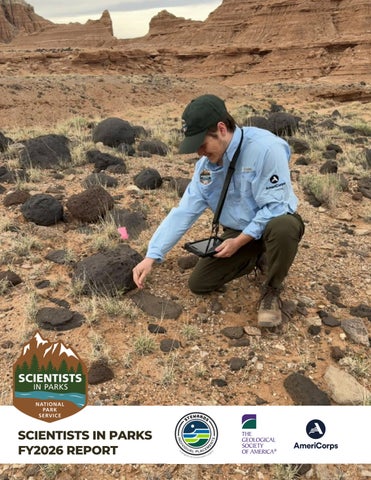
SCIENTISTS IN PARKS FY2026 REPORT
Table of Contents EXECUTIVE SUMMARY
3
STATEMENT OF PURPOSE
4
PROGRAM OBJECTIVES
4
TYPES OF POSITIONS
4
PROGRAM SUMMARY
5
PROGRAM FUNDING
5
SUPPORT OF EXECUTIVE and DOI SECRETARY ORDERS
6
COORDINATING ORGANIZATIONS
6-7
LIST OF SIP PARTICIPANT POSITIONS
8-20
FEDERAL HIRES
21
PROGRAM ACHIEVEMENTS
22-27
PUBLICITY HIGHLIGHTS
22
PROFESSIONAL CONFERENCES
22
SIP HIGHLIGHTS (Margaret Haun, Jacqueline Ouelltte, Olivia Williams, Preston Ford, Jackson McPhedran)
23-27
SIP PROGRAM EVALUATIONS AND DEMOGRAPHICS
28-29
HOW DID YOU FIRST HEAR ABOUT THIS SIP POSITION?
28
AGE DISTRIBUTION OF SIPS
29
EDUCATIONAL STATUS OF SIP PARTICIPANTS
29
SURVEY QUESTIONS AND QUOTES
31-33
ACKNOWLEDGEMENTS
34
CONCLUSION
35
Scientists in Parks Annual Program Report Fiscal Year 2026 National Park Service, Geologic Resources Division P.O. Box 25287 Denver, CO 80225-0287 October 1, 2026 U.S. Department of the Interior National Park Service Natural Resource Stewardship and Science
Hydrology SIP Jay Mrazek holds a prism pole next to a robotic total station during a survey of the Belle Fourche River at Devils Tower National Monument. (NPS Photo) Cover Photo: SIP Justin Rapp in the field collecting data for a cactus demographic monitoring project at Capitol Reef National Park (NPS Photo)
2
Executive Summary In the federal fiscal year (FY) 2026 from October 1, 2025 to September 30, 2026 the Scientists in Parks Program (SIP) facilitated 232 positions for 224 participants in 123 park units across the country. These accomplished participants supported the National Park Service (NPS) mission by completing essential natural resource science projects in parks while providing the participants with experience to further their professional prospects. All positions supported natural resource management park needs and focused on multi-disciplinary approaches including interpretive programs, data collection and analysis, wildfire management, and more. As of September 4, 2026, fiscal year 2026 SIP participants contributed 141,340 service hours toward natural resource science needs for the NPS. The NPS obligated $6.9 million to fund the program. Funding for nine positions came from NPS cooperating associations listed in the conclusion of this report. The vast majority of SIP participants were between the ages of 21 and 35 and had completed a bachelor’s degree. Sixteen SIPs were hired into federal positions. This report describes aspects of the program structure, lists all FY 2026 positions, highlights some selected positions, and includes SIP participant feedback from final evaluation reports. The SIP program is run in partnership with NPS Natural Resource Stewardship and Science Directorate, Stewards Individual Placements (a program of Conservation Legacy), and The Geological Society of America.
SIP, GIS Assistant, Hope Phillips edits a map at her desk at Shiloh National Military Park. (NPS Photo)
3
Statement of Purpose The Scientists in Parks (SIP) Program is administered by the National Park Service (NPS) Natural Resource Stewardship and Science Directorate (NRSS) and several non-governmental partner organizations. The SIP Program provides a mechanism by which NPS parks, networks, regions, and programs can host non-federal participants to undertake projects that address natural resource management issues. Simultaneously, the SIP Program provides SIP participants a high-quality experience that inspires and develops the next generation of park stewards and fosters a life-long connection to the National Park System. SIP positions may vary considerably in complexity, length, discipline, and skill set, in accordance with the needs of NPS units and abilities of the SIP participants. SIP manages two seasons of positions with start dates year-round that contribute to natural resource management in biological sciences, physical sciences, social sciences, and education. Positions in these disciplines must address one or more natural resource management categories, including, but not limited to, air quality, geology, hydrology, night skies, paleontology, and soundscapes.
Program Objectives Meet park natural resource management needs Provide participants with meaningful natural resource management experience that supports parks and the NPS mission and can enhance their career potential.
Types of Positions SIP participant positions are best for entry- to mid-level skill sets. Positions are 12-52 weeks in length during either the summer or winter season. Participants receive a one-time relocation allowance of $450 ($1,100 for Alaska, Pacific Islands, and Caribbean positions) plus a weekly stipend of $600 if park housing is provided, or $700 if park housing is not provided. Participants are eligible to earn hours toward the Public Lands Corps Hiring Authority and an AmeriCorps Segal Education Award if they successfully complete their term.
SIP Lauren Badinger collaborating with an Arizona Conservation Corps Crew to install a wattle fence at Fort Bowie National Historic Site, AZ. (NPS Photo)
4
Program Summary In FY2026, the SIP program was administered through NPS Cooperative Agreements P22AM00148 and P22AM00151 with Conservation Legacy, and funded through annual task agreements. These agreements are authorized under either the Public Lands Corps Act (16 U.S.C. § 1723(c) or 54 U.S.C. Cooperative Agreements, Cooperative Research and Training). The SIP participants are affiliated with AmeriCorps, a program that engages individuals in intensive community service with the goal of helping others and meeting critical community needs. Because all SIPs are AmeriCorps Members, positions are open to U.S. citizens and legal residents. Upon successfully completing their position, SIPs are eligible for an AmeriCorps Segal Education Award valued at $1,956 to $7,395 (pre-tax). The award amount is dependent upon several factors such as the length of their term, successfully obtaining the minimum required AmeriCorps hours by the end of their term, and whether they have received prior AmeriCorps Education Awards. This Award can be used for paying back student loans, continuing the participant’s higher education, or for other qualifying educational expenses. Position distributions equated to 83 positions at 1,700 hours (52 weeks), 15 positions at 1,200 hours (36 weeks), 38 positions at 900 hours (26 weeks), 37 positions at 675 hours (20 weeks), and 59 positions at 450 hours (12 weeks). In addition to the AmeriCorps affiliation, SIP participants that serve 52 weeks are eligible to opt in for health insurance, provided by The Corps Network, at no cost to the participant.
Program Funding The National Park Service obligated $6,940,265 in FY2026 to support park operations and resource management activities. The obligation includes full or partial funding for ~106 positions for a total of 6,144 service weeks. In addition, individual park cooperating associations partnered with the NPS to provide 9 SIP positions for 248 weeks.
SIP Mara Reed inspects the crater of Dark Cavern Geyser, Norris Geyser Basin at Yellowstone National Park, WY (NPS Photo)
5
Support of Executive and DOI Secretary Orders The program supports the Executive Orders and Department of Interior Secretary’s Orders. Below are several position outcomes and how they align with the priorities. EO 14303 Restoring Gold Standard Science Ecology Assistant, Siwa (Eve) Allred, assisted park staff in conducting reef and marine surveys at National Park of American Samoa. She then compiled and organized the data so the park’s Marine Program could make scientifically-informed decisions. In order to be transparent and promote public awareness, she created content to share the findings with the community and educate on the park’s aquatic ecosystem. EO 14308 Empowering Commonsense Wildfire Prevention and Response SIP Natural Resource Management Assistants, Tiffany Nash, Thomas (Gunnar) Kehrt-Reese and Grant Gerhardts served at the Intermountain Regional Office, based in Lakewood, Colorado. They assisted park resource and technical staff, in conjunction with fire staff, in the creation of written resource protection guides. These guides will be accompanied with geospatial products specific to wildland fire and all-hazard preparedness. Through extensive research, database creation and collaboration, they are building strategic partnerships that will help provide new capabilities, resources and guidance to protect parks during emergencies. SO 3426 Ensuring National Parks Are Open and Accessible SIP George Pharris served as a Geomorphology Assistant at Yosemite National Park, CA and updated the Yosemite Rockfall Database to be published as a USGS Data Series. George also collaborated with USGS colleagues and University of Milano computational modelers to further the unstable slope assessment projects across the park. These efforts will assist in producing an updated publication of the Yosemite Rockfall Database and will help park managers strategically address safety and mitigation through evaluations of potential geohazards and ensure parks can remain open to the public.
Mia Dela Cruz answers information calls from visitors about travel planning and park details. (NPS Photo)
SIP George Pharris carefully opening a bucket for precipitation monitoring in Yosemite National Park. (NPS Photo)
Coordinating Organizations National Park Service, Natural Resource Science and Stewardship Directorate The NPS Natural Resource Stewardship and Science Directorate (NRSS) provides scientific, technical, and administrative support to national parks for the management of natural resources. NRSS has a strong commitment to providing science-based on-the-ground youth career development opportunities through the management of the Scientists in Parks Program. For more information about SIP: https://go.nps.gov/sip Kiersten Jarvis, Scientists in Parks Program Manager l kiersten_jarvis@nps.gov l 970-658-6826 Chelsea Bitting, Scientists in Parks Partnership Lead l chelsea_bitting@nps.gov l 303-819-8933 Melanie Wood, Scientists in Parks Financial Assistance Lead l melanie_wood@nps.gov l 970-267-2198 6
Coordinating Organizations Stewards Individual Placements Stewards Individual Placements (Stewards) is a program of Conservation Legacy. It offers land and water management agencies and other non-profit organizations opportunities to accomplish specific projects by providing Individual Placements (AmeriCorps Service Terms) on public lands. Stewards is responsible for the position advertisement system, the SIP website and administering the SIP Program once the participants have been selected. This includes but is not limited to enrollment, stipend, travel, and relocation disbursements, AmeriCorps compliance and reporting, general program expectations, mentor and member support, and preparation of the annual SIP report. For more information about Stewards: https://www.stewardslegacy.org/ Geoff Elliot, Executive Director l gelliot@conservationlegacy.org l (970) 946-1320 Emma Savely, Program Director l emma@conservationlegacy.org l (970) 903-5763 Ali Jones, Program Coordinator l ajones@conservationlegacy.org l (970) 382-1947 Morgan Hassey, Program Coordinator l mhassey@conservationlegacy.org l (970) 946-4952 Andre Nguyen, Program Coordinator l anguyen@conservationlegacy.org l (970) 946-9523 Ash Adkins Irons, Program Coordinator l aadkinsirons@conservationlegacy.org l (970) 844-4152 Nicole Cabral, Program Coordinator | ncabral@conservationlegacy.org | (970) 382-1947 Cassie Sebas, Program Coordinator | csebas@conservationlegacy.org | (970) 880-4709
The Geological Society of America (GSA) The Geological Society of America (GSA) is a global professional society with a growing membership of more than 20,000 individuals in more than 100 countries. GSA provides access to elements that are essential to the professional growth of earth scientists at all levels of expertise and from all sectors: academic, government, business, and industry. The Society unites thousands of earth scientists from every corner of the globe in a common purpose to study the mysteries of our planet (and beyond) and share scientific findings. GSA is responsible for advertising, recruiting, and managing the application process for the SIP Program. The GSA Foundation annually supports multiple positions in Alaska. For more information about GSA: https://geosociety.org Lesley Petrie, Education & Outreach Program Coordinator l lpetrie@geosociety.org l (303) 357-1097 Samira Rosario Martinez, Center for Professional Excellence Program Coordinator | srmartinez@geosociety.org | (303) 357-1000
SIP Zoie Andre among the cattails while conducting fieldwork at Voyageurs National Park (NPS Photo)
Emma Doherty helping to set fish traps in Hot Springs National Park. (NPS Photo)
7
List of SIP Participant Positions Table 1. SIP positions that started their position in FY2026 NPS Unit
Position Title
Participant Name
ID #
Acadia National Park
Ecology Assistant
EJ Holm
4236
Acadia National Park
GIS Assistant
Gregory McHale
4445
Appalachian National Scenic Trail
Ecology Assistant
Neena Goldthwaite
4188
Assateague Island National Seashore
Ecology Assistant
Morgan Thomas
4247
Assateague Island National Seashore
Biology Assistant
Harmony Cecil
4256
Badlands National Park
Natural Resource Management Assistant
Heather Barrett
3951
Badlands National Park
Paleontology Assistant
Samantha Khatri
4459
Badlands National Park
Paleontology Assistant
Casey Thater
4460
Big South Fork National River and Recreation Area
Geology Assistant
Alexander Brant
4257
Big Thicket National Preserve
Paleontology Assistant
Chalfant Conley
4314
Big Thicket National Preserve- Fire Management Office
Natural Resource Management Assistant
Kristian Merrell
4191
Biscayne National Park
Natural Resource Management Assistant
Ethan Rosillo
4177
Biscayne National Park
Natural Resource Management Assistant
Willow Kessel (term 2)
4176
Biscayne National Park
Natural Resource Management Assistant
Valeria Marquez
4299
Biscayne National Park
Ecology Assistant
Bella McCracken (term 2)
4378
Biscayne National Park
Ecology Assistant
Abigail Van Slyke
4376
Biscayne National Park
Ecology Assistant
Nico Varrato
4377
Biscayne National Park
Ecology Assistant
Jeremy Irsik (term 2)
4567
Biscayne National Park
Ecology Assistant
Nika Dassatti (term 2)
4379
Blue Ridge Parkway
Biology Assistant
Gracie Murray
4396
8
List of SIP Participant Positions (cont.) NPS Unit
Position Title
Participant Name
ID #
Buffalo National River
GIS Assistant
Raviyah Anderson
4415
Buffalo National River
Natural Resource Management Assistant
Jessica Gibbins
4433
Cabrillo National Monument
Natural Resource Management Assistant
Brandi Sanchez
4322
Cape Cod National Seashore
Ecology Assistant
Annalicea Melite
4194
Cape Cod National Seashore
Ecology Assistant
Kathryn Holland
4248
Cape Cod National Seashore
Science Communication Assistant
Madelyn Lewis
4195
Cape Cod National Seashore
Ecology Assistant
Catherine Rocheleau
4401
Cape Cod National Seashore
Ecology Assistant
Kathryn Holland (term 2)
4474
Cape Hatteras National Seashore
Biology Assistant
Aubrey Rutz
4265
Cape Hatteras National Seashore
Biology Assistant
Teresa Gutierrez
4453
Cape Hatteras National Seashore
Biology Assistant
Madison Richter
4387
Cape Hatteras National Seashore
Biology Assistant
Kira Hollinbeck
4388
Cape Krusenstern National Monument
Natural Resource Management Assistant
Julia Lambert
4414
Capitol Reef National Park
Planning Assistant
Justin Rapp
4294
Central Alaska Inventory & Monitoring Network Fairbanks
Biology Assistant
Adan Kooken
4300
Central Alaska Inventory & Monitoring Network Fairbanks
Hydrology Assistant
Elise Ryan
4371
Chattahoochee River National Recreation Area
GIS Assistant
Chloe Pryor (term 3)
4172
Chesapeake & Ohio Canal National Historical Park
Ecology Assistant
Kira Moss
4413
Chihuahuan Desert Inventory & Monitoring Network
Ecology Assistant
Emma Lankford
4131
9
List of SIP Participant Positions (cont.) NPS Unit
Position Title
Participant Name
ID #
Chihuahuan Desert Inventory & Monitoring Network
GIS Assistant
Hannela Jane
4119
Chihuahuan Desert Inventory & Monitoring Network
Ecology Assistant
Abigail Juarez (term 2)
4234
Chihuahuan Desert Inventory & Monitoring Network
Ecology Assistant
Thomas Valenzuela
4458
Chiricahua National Monument
Natural Resource Management Assistant
Henry England
4185
Chiricahua National Monument
Natural Resource Management Assistant
Kaya Eklund
4184
Climate Change Response Program
Planning Assistant
Macey Dvorak
4030
Colonial National Historical Park
Natural Resource Management Assistant
Ryo Murasaki
4281
Colorado National Monument
Ecology Assistant
Bridget Hyde
4358
Congaree National Park
Ecology Assistant
Lizzie Fleming
4181
Coronado National Memorial
Natural Resource Management Assistant
Raven Rooney
3958
Coronado National Memorial
Natural Resource Management Assistant
Julio Alas Del Conte
4361
Coronado National Memorial
Natural Resource Management Assistant
Maxwell Schiller
4360
Cumberland Island National Seashore
Collections Assistant
Morgan Vervaeke
4222
Cumberland Island National Seashore
Collections Assistant
Morgan Vervaeke (term 2)
4428
Cumberland Piedmont Inventory & Monitoring Network
Biology Assistant
Lillian Puckett
4418
Cumberland Piedmont Inventory & Monitoring Network
Biology Assistant
Shelby Shartzer
4417
Cuyahoga Valley National Park
Ecology Assistant
Iris Sorrell
4233
Cuyahoga Valley National Park
GIS Assistant
Tara Sefchick
4431
Cuyahoga Valley National Park
Ecology Assistant
Eva Andersen
4400
10
List of SIP Participant Positions (cont.) NPS Unit
Position Title
Participant Name
ID #
Dartmouth College
Ecology Assistant
Miranda Mordue
4189
Death Valley National Park
Hydrology Assistant
Misha Toor
4182
Death Valley National 18 13Park
Education Assistant
Mia Dela Cruz
Denali National Park and Preserve 60
Acoustic Assistant
Elliott Ruebush
4354
Denali National Park and Preserve
Science Communication Assistant
Stefania DiPrampero
4254
Denali National Park and Preserve
Geology Assistant
Kaya Troyer
4253
Dinosaur National Monument 204
Paleontology Assistant
Nikki Simon (term 3)
Dry Tortugas National Park
Natural Resource Management Assistant
8 Jordan (term 2) Able
4216
Dry Tortugas National Park
Natural Resource Management Assistant
Madison Jajko
4310
Dry Tortugas National Park 55.6%
Natural Resource Management Assistant
Sammy Brown
4309
41.7% Effigy Mounds National Monument
Natural Resource Management Assistant
Rachel Scruby
4457
El Malpais National Monument
Cave and Karst Assistant
Gino Buencamino
4288
El Malpais National Monument
Cave and Karst Assistant
Grace Trombley
4454
Fire Island National Seashore
Ecology Assistant
Austin Lisowski
4429
Fire Island National Seashore
Ecology Assistant
George Thomson
4389
Florissant Fossil 89.9% Beds National Monument
Natural Resource Management Assistant
Katherine Quinlan
4276
Fort Matanzas National Monument
Natural Resource Management Assistant
Isabelle Smits
4190
Gates of the Arctic National Park & Preserve, stationed at UC Davis - Poulin Research Group 10.1%
Biology Assistant
Amna Qureshi
4456
Gila Cliff Dwellings National Monument
Night Skies Assistant
Abby Mead
4313
4323
170
48
4327
11
List of SIP Participant Positions (cont.) NPS Unit
Position Title
Participant Name
ID #
Glacier National Park
Natural Resource Management Assistant
Theresa Ciraolo
4179
Glacier National Park
Biology Assistant
Mia Henriquez
4355
Glacier National Park
Astronomy Assistant
Paige Haworth
4315
Glen Canyon National Recreation Area
Collections Assistant
Ava Luksis
4307
Golden Spike National Monument
Geology Assistant
Jack Holinstat
4410
Grand Canyon National Park - Flagstaff Office
Ecology Assistant
Kelly Anderson
4357
Grand Canyon National Park - South Rim
Education Assistant
Lakin Epaloose (term 3)
4193
Grand Canyon National Park - South Rim
Interpretive Assistant
Caroline Grass
4375
Grand Teton National Park
Ecology Assistant
Avery Blumenthal (term 2)
4101
Grand Teton National Park
Biology Assistant
Kym Sutton
4117
Grand Teton National Park
GIS Assistant
Abigail Watts
4296
Grand Teton National Park
Natural Resource Management Assistant
Jackson McPhedran
4260
Grand Teton National Park
GIS Assistant
Aidan Antonienko
4275
Grand Teton National Park
Geomorphology Assistant
Julianne Gonzalez
4295
Grand Teton National Park
Ecology Assistant
Avery Blumenthal (term 3)
4406
Grand Teton National Park
Biology Assistant
Maria Quiroz Gonzalez
4407
Great Basin National Park
Astronomy Assistant
Margaret Haun
4304
Great Basin National Park
Cave and Karst Assistant
Brad Hoole
4439
Great Basin National Park
Cave and Karst Assistant
Evan Bowen
4438
Great Basin National Park
Astronomy Assistant
Katherine Carver
4303
12
List of SIP Participant Positions (cont.) NPS Unit
Position Title
Participant Name
ID #
Great Lakes Inventory & Monitoring Network
Ecology Assistant
Aidan Kingsbury
4237
Great Sand Dunes National Park
Natural Resource Management Assistant
Carsten Kirkland
4383
Greater Yellowstone Inventory & Monitoring Network
Ecology Assistant
Maria Makman
4267
Greater Yellowstone Inventory & Monitoring Network
Ecology Assistant
Daniel Beyda
4381
Gulf Islands National Seashore
Natural Resource Management Assistant
Rachel Lapensee
4450
Gulf Islands National Seashore -Davis Bayou Area
Natural Resource Management Assistant
Bryan Dadson
4422
Gulf Islands National Seashore -Davis Bayou Area
Natural Resource Management Assistant
Jane Ruggles
4421
Harpers Ferry National Historic Park
Ecology Assistant
Daniel Medeiros
4241
Hawaii Volcanoes National Park
Biology Assistant
Raven Cziglenyi
4235
Hawaii Volcanoes National Park
Education Assistant
Serena Massrey
4443
Heartland Inventory & Monitoring Network
Ecology Assistant
Anna Wootton
4232
Hot Springs National Park
Hydrology Assistant
Emma Doherty
4316
Ice Age National Scenic Trail
Natural Resource Management Assistant
Scout Noble
4380
Isle Royale National Park
Natural Resource Management Assistant
Emily Weiss
4324
Jimmy Carter National Historic Site
Natural Resource Management Assistant
Nicholas Wood
4334
Joshua Tree National Park
Biology Assistant
Miles Campos
4183
Joshua Tree National Park
Astronomy Assistant
Sophia Truex (term 2)
4180
Joshua Tree National Park
Astronomy Assistant
Margaret Haun (term 2)
4308
Lava Beds National Monument
Cave and Karst Assistant
Caitlin Payne
4306
13
List of SIP Participant Positions (cont.) NPS Unit
Position Title
Participant Name
ID #
Lava Beds National Monument
Cave and Karst Assistant
Kenzie Givens
4305
Lewis and Clark National Historical Park
Natural Resource Management Assistant
Meredith Klinzing
4366
Mammoth Cave National Park
Biology Assistant
Maddie Seppi
4258
Marsh-Billings-Rockefeller National Historical Park
Education Assistant
Della Johnson
4320
Mesa Verde National Park
Natural Resource Management Assistant
Colman Lee
4341
Mississippi National River and Recreation Area
Natural Resource Management Assistant
Hayley Zemeski (term 3)
4242
Mojave Desert Inventory & Monitoring Network
Ecology Assistant
Angela McTammany
4178
Mojave National Preserve
GIS Assistant
Isabel Bernal
4252
Montezuma Castle National Monument & Tuzigoot National Monument
Paleontology Assistant
Claire Hauser
4343
Mount Rainier National Park
Geomorphology Assistant
Zoe Zawol (term 2)
4285
Mount Rainier National Park
Natural Resource Management Assistant
Katrina Doerflinger
4455
Mount Rainier National Park
Geomorphology Assistant
Zoe Zawol (term 3)
4297
Natchez National Historical Park
Biology Assistant
Jolie Linhart
4302
National Capital Inventory & Monitoring Network
Ecology Assistant
Charlotte Clark
4227
National Capital Inventory & Monitoring Network
Ecology Assistant
Megan Roth
4228
National Park of American Samoa
Ecology Assistant
Natasha Ripley
4289
National Park of American Samoa
Ecology Assistant
Siwa Allred
4569
Natural Resource Stewardship and Science Directorate, stationed at University of Minnesota
Ecology Assistant
Zoie Andre
4218
Natural Resource Stewardship and Science Directorate, stationed at University of Minnesota
Ecology Assistant
Micah Sharer
4403
14
List of SIP Participant Positions (cont.) NPS Unit
Position Title
Participant Name
ID #
Natural Resources Stewardship & Science Directorate- Ft Collins
Ecology Assistant
Brooke Bellmar (term 2)
4219
Natural Resources Stewardship & Science Directorate- Ft Collins
Ecology Assistant
Owen Brown
4402
Natural Sounds and Night Skies Division
GIS Assistant
Jacob Adams
4345
Natural Sounds and Night Skies Division
Natural Resource Manager Assistant
Edder Antunez
4356
Nez Perce National Historical Park
GIS Assistant
Nathan Winiarski
4266
North Cascades National Park
Ecology Assistant
Lena Beckley
4268
North Cascades National Park
Interpretive Assistant
Jane Christopherson
4367
North Coast and Cascades Inventory & Monitoring Network
Natural Resource Management Assistant
Samantha Beaton (term 2)
4340
North Coast and Cascades Inventory & Monitoring Network
Ecology Assistant
Andrew Schwartz
4344
Northeast Coastal and Barrier Network
Science Communication Assistant
Michaela Compo (term 3)
4076
Northeast Coastal and Barrier Network
Science Communication Assistant
Audrey Brown (term 3)
4121
Northern Colorado Plateau Inventory & Monitoring Network
Ecology Assistant
Kimberlyn Pace (term 3)
4187
Northern Great Plains Inventory & Monitoring Network
Hydrology Assistant
Adele Kimball
4250
Northern Great Plains Inventory & Monitoring Network
Hydrology Assistant
Jay Mrazek (term 2)
4251
Northern Great Plains Inventory & Monitoring Network
Biology Assistant
Nick Johnson
4346
Northern Great Plains Inventory & Monitoring Network
Natural Resource Management Assistant
Sydney McCallie
4370
NPS Alaska Region Office - Anchorage
GIS Assistant
Cassandra Drazen
4198
NPS Alaska Region Office - Anchorage
Visitor Use Management Assistant
Olivia Creighton
4463
NPS Alaska Regional Office - Fairbanks
Ecology Assistant
Nishita Dashpute
4272
15
List of SIP Participant Positions (cont.) NPS Unit
Position Title
Participant Name
ID #
NPS Alaska Regional Office - Fairbanks
Ecology Assistant
Mahika Rao
4273
NPS Denver Service Center
Geology Assistant
Robin Bresolin
4337
NPS Intermountain Regional Office
Natural Resource Management Assistant
Grant Gerhardt
4283
NPS Intermountain Regional Office
Natural Resource Management Assistant
Gunnar Kehrt-Reese
4284
NPS Intermountain Regional Office
Natural Resource Management Assistant
Tiffany Nash (term 2)
4282
NPS Intermountain Regional Office
Ecology Assistant
Abraham Luedtke
4278
NPS Inventory and Monitoring Division
Interpretive Assistant
Ben Scambler
4409
NPS Northeast Regional Office
Ecology Assistant
Jacqui Ouellette
4279
NPS Water Resources Division
Natural Resource Management Assistant
Lydia Mussack (term 2)
3928
NPS Water Resources Division
Hydrology Assistant
Maya McCain
4399
NPS Water Resources Division
Hydrology Assistant
Becca Bruss
4385
Obed Wild & Scenic River
GIS Assistant
Preston Ford
4200
Olympic National Park
Education Assistant
Maeve Cain
4206
Olympic National Park
GIS Assistant
Matthew Donaldson
4287
Olympic National Park
Astronomy Assistant
Ben Dubin
4318
Olympic National Park
Interpretive Assistant
James Jackson
4317
Olympic National Park
Interpretive Assistant
Sophia Hammerle
4342
Oregon Caves National Monument and Preserve
Science Communication Assistant
Quinn Riordan
4197
Oregon Caves National Monument and Preserve
Natural Resource Management Assistant
Jacob Burns
4196
16
List of SIP Participant Positions (cont.) NPS Unit
Position Title
Participant Name
ID #
Pacific Island Inventory & Monitoring Network
Ecology Assistant
Olivia Ponchin (term 2)
4212
Pacific Island Inventory & Monitoring Network
Ecology Assistant
Kawehi Cabuzel
4330
Pictured Rocks National Lakeshore
Ecology Assistant
Alex Edwards
4353
Pictured Rocks National Lakeshore
GIS Assistant
Michael Silvernail
4432
Point Reyes National Seashore
Biology Assistant
Maya Churi
4311
Redwood National Park
Natural Resource Management Assistant
Justin Hill
4332
Redwood National Park
Natural Resource Management Assistant
Sara Spence
4331
Rocky Mountain Inventory & Monitoring Network
Ecology Assistant
Cali Rivera
4202
Rocky Mountain National Park
Natural Resource Management Assistant
Justine Endo-Ferguson
4442
Rocky Mountain National Park
Education Assistant
Madeline Washburn
4298
Rocky Mountain National Park
Interpretive Assistant
Mya Chier
4384
Rocky Mountain National Park
Interpretive Assistant
Ally Chorun
4468
Saguaro National Park
Ecology Assistant
Thomas Narramore (term 3)
4271
Saint Croix National Scenic Riverway
Planning Assistant
Liz Muko (term 2)
4213
Saint Croix National Scenic Riverway
Natural Resource Management Assistant
Jessica Peterson
4259
San Francisco Bay Area Network
Biology Assistant
Alli Shields
4203
San Francisco Bay Area Network
Interpretive Assistant
Clair Sapilewski
4416
San Juan National Historic Site
Natural Resource Management Assistant
Keishla Rondon Mercado
4246
San Juan National Historic Site
Natural Resource Management Assistant
Mariela Gomez Ortiz
4244
17
List of SIP Participant Positions (cont.) NPS Unit
Position Title
Participant Name
ID #
San Juan National Historic Site
Natural Resource Management Assistant
Olivia Turner
4245
San Juan National Historic Site
Natural Resource Management Assistant
Stephanie Malave Hernandez
4243
San Juan National Historic Site
Interpretive Assistant
Keishla Rondon Mercado (term 2)
4467
San Juan National Historic Site
Biology Assistant
Mariela Gomez Ortiz (term 2)
4312
San Juan National Historic Site
Forestry Assistant
Stephanie Malave Hernandez (term 2)
4465
San Juan National Historic Site
Ecology Assistant
Olivia Turner (term 2)
4466
Santa Monica Mountains National Recreation Area
Ecology Assistant
Katie Pinkerton
4207
Santa Monica Mountains National Recreation Area
Ecology Assistant
Yssy Wallace-Wells
4208
Saratoga National Historic Park
GIS Assistant
Pip Mostern
4264
Scotts Bluff National Monument
Paleontology Assistant
Olivia Williams
4420
Sequoia & Kings Canyon National Parks
Ecology Assistant
Allie Arnfield
4230
Sequoia & Kings Canyon National Parks
Ecology Assistant
Payton Bovee
4229
Sequoia & Kings Canyon National Parks
Biology Assistant
Adelaide Cravens
4449
Shenandoah National Park
Education Assistant
Sydney Sherbitsky
4186
Shenandoah National Park
Astronomy Assistant
Sarah Lorenzi
4349
Shenandoah National Park
Astronomy Assistant
Stephanie Schrader
4348
Shiloh National Military Park
GIS Assistant
Hope Phillips
4262
Sleeping Bear Dunes National Lakeshore
Natural Resource Management Assistant
Alice Maas
4215
Sleeping Bear Dunes National Lakeshore
Natural Resource Management Assistant
Olivia Goulet
4214
18
List of SIP Participant Positions (cont.) NPS Unit
Position Title
Participant Name
ID #
Sleeping Bear Dunes National Lakeshore
Biology Assistant
Emily Walker
4441
Sonoran Desert Inventory & Monitoring Network
Ecology Assistant
Lou Bellinghausen
4364
Sonoran Desert Inventory & Monitoring Network
Education Assistant
Jack Ericksen (term 2)
4365
Sonoran Desert Inventory & Monitoring Network
GIS Assistant
Anabel Fletcher
4368
Southeast Alaska Inventory & Monitoring Network
Natural Resource Management Assistant
Gabrielle Davy
4451
Southern Plains Inventory & Monitoring Network
Ecology Assistant
Katie Barlow
4326
Southern Plains Inventory & Monitoring Network
Ecology Assistant
Kenedi Edmunds
4325
Tallgrass Prairie National Preserve
Natural Resource Management Assistant
Max Francisco
4338
Tallgrass Prairie National Preserve
Ecology Assistant
Juni Norton
4339
Valley Forge National Historic Park
Natural Resource Management Assistant
Eliza Kirsch
4444
Waco Mammoth National Monument
Paleontology Assistant
Griffen Fallwell (term 2)
4286
Waco Mammoth National Monument
Paleontology Assistant
Juno Jones
4464
Wilderness Stewardship Division
Natural resource Management Assistant
Chris Egyed (term 2)
4461
Wrangell - St. Elias National Park & Preserve
Interpretive Assistant
Anna Wright
4425
Wrangell - St. Elias National Park & Preserve
Interpretive Assistant
Jillian Peslak
4426
Shenandoah National Park
Astronomy Assistant
Stephanie Schrader
4348
Shiloh National Military Park
GIS Assistant
Hope Phillips
4262
Sleeping Bear Dunes National Lakeshore
Natural Resource Management Assistant
Alice Maas
4215
Sleeping Bear Dunes National Lakeshore
Natural Resource Management Assistant
Olivia Goulet
4214
19
List of SIP Participant Positions (cont.) NPS Unit
Position Title
Participant Name
ID #
Yellowstone National Park
Hydrology Assistant
Eliza Lawrence (term 2)
4204
Yellowstone National Park
Geology Assistant
Mara Reed
4239
Yellowstone National Park
Geology Assistant
Margery Price
4238
Yosemite National Park
Biology Assistant
Willow Moseley
4221
Yosemite National Park
Geomorphology Assistant
George Pharris (term 2)
4231
Yosemite National Park
GIS Assistant
Nick Gammal
4220
Zion National Park
Visitor Use Management Assistant
Bea Kaskie
4436
SIP Annalicea Melite (left) and her supervisor/mentor, Sophia Fox (right), dissecting an oyster at Cape Cod National Seashore for the SCC project to be sent in for isotopic/metal analysis. (NPS photo)
SIP Isabelle Smits at Fort Matanzas beach after marking her first sea turtle nest. (NPS photo)
20
Federal Hires Table 2. List of SIPs who were hired into the federal workforce from the FY2026 cohort. Note: This list includes those who disclosed their plans in final reports submitted prior to September 4. There may be additional federal hires that were unreported to the SIP Program.
SIP Name
Federal Agency
Park Unit or Location
Position Title
GS Level
Abigail Watts
National Park Service
Grand Teton National Park
Physical Science Technician
GS- 7
Bridget Hyde
National Park Service
Colorado National Monument
Biological Science Technician
GS- 6
Chris Egyed
National Park Service
Colorado NationaL Monument
Biology Technician
GS- 6
Eliza Lawrence
National Park Service
Denali National Park
Physical Science Technician
GS- 7
George Pharris
National Park Service
Yosemite National Park
Physical Science Technician
GS- 7
Heather Barrett
National Park Service
Badlands National Park
Interpretation Ranger
GS- 5
Jolie Linhart
National Park Service
Natchez National Historical Park
Seasonal Maintenance Worker
WG - 4749-5
Liz Muko
National Park Service
Glen Canyon National Recreation Center
Biological Science Technician
GS- 5
Maeve Cain
National Park Service
Canyonlands National Park
Education Technician
GS- 5
Mahika Rao
National Park Service
Artic Inventory and Monitoring Network
Biological Science Technician
GS- 6
Margery Price
National Park Service
Yellowstone National Park
Science Technician
GS- 7
Matthew Donaldson
National Park Service
Olympic National Park
Native Plant Nursery Technician
GS- 5
Nick Gammal
National Park Service
Yosemite National Park
Biological Sciences Technician
GS- 6
Olivia Goulet
Bureau of Land Management
unreported
Natural Resource Specialist
GS- 5
Sophia Truex
National Park Service
Shenandoah National Park
Spanish Interpretation Range
GS- 5
Theresa Ciraolo
National Park Service
Glacier National Park
Wildlife Biological Science Technician
GS- 6
21
SIP Participant Hayley Zemeski smiling with clipboard in a prairie during monarch site surveys at Mississippi National River and Recreation Area. (NPS Photo)
Program Achievements Publicity Highlights Jillian Peslak, a Scientists in Parks Interpretive Assistant published a social media highlight for Wrangell St Elias National Park and Preserve, AK contemplating proper PPE https://www.instagram.com/p/Da3_oyeDMID/?utm_source=ig_web_copy_link Emma Lankford, Scientists in Parks participant speaks about her experience as an Ecology Assistant at the Sonoran Desert Network in Tucson, AZ in this short video. https://www.nps.gov/media/video/view.htm? id=BADBD773-5445-43B7-83E2-C84071EA13B6 Brandi Sanchez, a Scientists in Parks Natural Resource Management Assistant at Cabrillo National Monument, CA enjoyed putting together this comprehensive website to help the public learn about native bees at the National Monument. https://randombirdlover.github.io/beescabr/ Elliott Ruebush, a Scientists in Parks Accoustic Assistant at Denali National Park, AK completed a soundscape website with recordings collected over the years, cataloging natural soundscapes of the Alaska region. Immerse yourself here at at https://mertensia.github.io/alaska_acoustic_highlights/
Professional Conferences All SIP participants and alumni are encouraged to attend and present at professional conferences and especially those hosted by our partners. The program advertises information for two annual meetings, The Geological Society of America Connects Annual Conference and the Ecological Society of America Annual Meeting. These conferences, in addition to others personally identified by the participants, offer an opportunity for scientists to share their research and connect with fellow experts in their field. It is a valuable experience for SIPs to network, present their findings, and further their early career development. 22
SIP Highlights Margaret Haun Astronomy Assistant Great Basin National Park, Nevada 5/17/2026-8/7/2026 During her 12-week service term, Scientists in Parks member Margaret Haun brought science, wonder and connection to hundreds of visitors at Great Basin National Park through telescope programs, constellation talks, dark sky monitoring, and cave tours. Margaret’s astronomy program, Scoping Out ’Scopes, became a highlight of her term. Presented six times to over 600 total visitors, the program explored what telescopes do and how they have evolved, while encouraging visitors to share the excitement of looking beyond our own world. She also helped launch Constellation Talks; a new weekly interpretive program held outside the Great Basin Visitor Center. Across six events, an average of about 40 visitors per evening gathered to learn about the night sky without the aid of telescopes. “I'm incredibly proud of the work we did pointing out constellations, telling stories of the sky, and communicating the science behind what we were seeing.” said Margaret of her time leading these interpretive programs. Her projects extended beneath the surface as well. She guided tours at Lehman Caves, leading a total of 34 tours. Despite entering the season with limited knowledge of the subject, she quickly became well-versed in their history and geology and earned praise for her approachability and poise.
Margaret Haun places traps for biomonitoring research in Lehman Caves. (NPS photo)
In addition to educating the public, Margaret developed tools to support her coworkers, including a detailed observation-list spreadsheet for future astronomy programs and instructions for a new dark-sky measurement device. Her monitoring data contributed to Great Basin’s continued efforts to protect its International Dark Sky Park status. According to Margaret, protecting these landscapes isn’t just about astronomy, it’s about preserving a rare opportunity for people to experience the natural world. “National Parks make up some of the last places in the country where we can go and experience the night sky in all of its glory. It's important to me that we protect our public lands for generations to come so that they may experience the wonder of the natural world as we do.” Her SIP service term confirmed a career vision that brings together public engagement and professional astronomy. Her next step will take her to Joshua Tree National Park as a Scientists in Parks Astronomy Assistant, where she hopes to continue building connections between astronomers, the public, and parks. For Margaret, her passion lies not only with the science, but also with helping people look up, ask questions, and experience the wonder of a night sky worth protecting. Margaret Haun takes a photo of herself in the mirror of one of Great Basin National Park’s CPC1100 11-inch telescopes. (NPS photo)
23
SIP Highlights Jacqueline Ouellette Ecology Assistant Northeast Regional Office, Massachusetts 2/9/2026 - 2/5/2027 Jacqueline "Jacqui" Ouellette spent her summer supporting fire ecology and fire management planning across National Park Service units throughout the Northeast and Southeast. Based in Hadley, Massachusetts with the NPS Northeast Regional Office, Jacqui helped park managers further their understanding of how changing weather conditions may influence future wildfire activity. Her projects supported the tools parks use for fire preparedness, response, recovery, and long-term resource management planning. As a Fire Ecology Assistant, Jacqui developed wildfire season reports, using R programming, GIS, and geospatial analysis tools, that can be easily updated and replicated in future years. These automated reports generate maps, graphs, tables, and written summaries of wildfire occurrence, acres burned, seasonal fire patterns, and lightning activity across parks and ecoregions. She also produced regional maps highlighting fire incidents, National Park Service units, and ecological boundaries, creating resources that staff can continue to use long after her term. Additionally, Jacqui analyzed historical fire patterns and examined how fire frequency, weather conditions, and drought trends have changed over time which involved extensive data management, spatial and temporal analysis, statistical modeling, and GIS mapping.
Jacqui measuring snow depth at a tree plot in Fairbanks, Alaska. (NPS Photo)
One of the most valuable aspects of Jacqui's SIP experience has been the opportunity to strengthen both her technical and professional skills. Entering the position with limited experience in coding and statistics, she developed proficiency in R, ArcGIS Pro, automated reporting workflows, and ecological data analysis and created a strong foundation for a future career in ecological research and natural resource management. Reflecting on her experience, Jacqui shared, "Being a fire ecology SIP and working for NPS with a supervisor that works for the USFS is a great way to learn about interagency collaboration in concrete terms and provide regional NPS units with support for their fire planning." Through her projects, Jacqui changed complex ecological and climate data into practical tools that support informed decisionmaking and strengthen fire resilience across national parks.
Attending a fire ecology lecture focused on major historical events and boreal ecosystems at Denali National Park. (NPS photo)
24
SIP Highlights Olivia Williams Paleontology Assistant Scotts Bluff National Monument, Nebraska 5/18/2026 – 8/7/2026 Throughout her time with Scotts Bluff National Monument, Olivia Williams gained valuable technical, scientific, and professional experience as a Paleontology Assistant ultimately strengthening her understanding of paleontology a field and the National Park Service (NPS) as a whole. Olivia’s service term expanded her knowledge of the paleontological history of western Nebraska, particularly Eocene and Oligocene mammals. Through fieldwork and research, she improved scientific skills while gaining a greater appreciation for the role of the NPS in protecting and managing fossil resources. Learning about the agency's policies, resource management practices, and curation protocols provided valuable insight into careers within the National Park Service. The opportunity to independently develop research questions and contribute to a field-based project helped strengthen Olivia’s research skills, critical thinking, and project management abilities. The experience also fostered professional growth by encouraging creativity, independent problem-solving, and scientific decision-making.
Olivia poses during an interpretive walk on the Daemonelix trail at Agate Fossil Beds (NPS Photo)
Olivia emphasized that the Scientist in Parks program provides invaluable opportunities for students to gain practical and essential experience while contributing meaningful work that supports the National Park Service's mission. In her own words, “Positions like these are vital for students wanting to be involved with conservation or the NPS. They allow unique opportunities to develop skills while also learning fundamentals of the NPS and their policies.” Continued investments in this program will benefit both emerging professionals and the stewardship of the nation's natural and cultural resources.
SIP Olivia Williams at Badlands National Park working with a field jacket containing a prehistoric horse skull (NPS Photo)
Olivia poses with some fossils during field project time in the Badlands (NPS Photo)
25
SIP Highlights Preston Ford GIS Assistant Obed Wild and Scenic River 2/9/2026-8/7/2026 Situated in the rugged terrain of Tennessee’s Cumberland Plateau, Preston Ford served his SIP term in the landscapes of the Obed Wild and Scenic River and Big South Fork National River and Recreation Area. These areas have long tested travelers, first challenging prehistoric cultures and early settlers on foot, and later confounding cartographers seeking to capture their deeply cut gorges and sandstone bluffs. During his term as a GIS Assistant, Preston Ford had a modern take to this challenge by transforming decades of fragmented historical maps, records, and legacy data into cohesive, accessible geospatial resources. Preston served as an essential bridge between raw archival history and modern stewardship. With park boundaries encompassing numerous oil and gas wells documented across shifting regulatory eras, he evaluated and standardized data of widely varying accuracy. Through diligent digital analysis and field verification, Preston cataloged between 500 and 1,000 historical records and georeferenced 130 archival maps. His efforts directly supported interdisciplinary park initiatives, streamlining workflows for cultural resource managers, oil and gas regulatory partners, and fellow Scientists in Parks (SIP) participants tackling parallel resource management projects. Beyond the database, Preston expanded park functionality by developing, field-testing, and deploying an operational Cultural Resources Site Field Form in ArcGIS Survey123. Demonstrating a strong commitment to education and public service, Preston instructed wildland fire personnel in core GIS principles at the Arkansas Wildland Fire Academy, shared technical workflows with staff at Mill Springs Battlefield National Monument, taught foundational map-reading skills to Youth Conservation Corps crews, and represented the National Park Service at regional high school career fairs.
SIP Member Preston Ford
Grounded by a deep appreciation for public lands, Preston is committed to expanding his public sector experience at the state and local levels before pursuing a long-term career within the federal service. His SIP term leaves behind a tangible cartographic legacy ensuring park managers are better equipped to protect and interpret these irreplaceable natural and cultural resources.
Preston at the Oneida Special School District job fair, demonstrating Park Service and SIP opportunities to prospective middle and high school students. Preston presenting Map Gallery awards as the Map Gallery Coordinator at the Tennessee Geographic Information Council's 2026 conference (NPS Photo)
26
SIP Highlights Jackson McPhedran Grand Teton National Park Natural Resource Management Assistant 2/9/2026-5/1/2026 This summer, Jackson made a significant contribution to a conservation project focused on Grand Teton National Park’s native bighorn sheep. His projects began with creating a geodatabase that mapped the ascent and descent routes of roughly 150 winter backcountry users, then comparing those routes with areas where they overlapped sensitive habitat and winter wildlife closure zones for bighorn sheep. He also conducted extensive outreach with external partners—including local conservation groups, ski guides, and biologists—to help refine the Park’s messaging around bighorn sheep stewardship. Through these strategic conversations, Jackson and the interpretation team developed an informed outreach plan that included creating brochures showing common ski runs alongside bighorn sheep winter closures and habitat zones. The brochures will help skiers make wildlife-aware decisions when planning routes. Thanks to Jackson’s efforts, this brochure is now readily available to the public.
Jackson at the Taggart Lake trailhead in Grand Tetons National Park fixing a bighorn sheep awareness sign. (NPS Photo)
Further, Jackson oversaw the monitoring and intentional placement of seven trailhead signs featuring information about bighorn sheep natural history, their movements throughout the park, and how visitors can respect those movements— particularly in sensitive habitat areas frequented by winter backcountry users. Reflecting on his projects Jackson shared, “This experience solidified for me that I’d like to be involved in some type of conservation work throughout my career. It feels really satisfying to be working to help conserve, or be a steward of, a truly remarkable native species.” Jackson truly valued the team he collaborated with and hopes to return to Grand Teton National Park for future seasonal projects.
Jackson conducting a parking lot car count survey, to assist the Social Science branch at the park. (NPS Photo)
Jackson at the Science and Resource Management office in Moose, WY (Grand Tetons National Park), creating a geodatabase on a computer. (NPS Photo)
27
SIP Program Evaluations and Demographics SIP Participants were asked to complete pre-position and post-position evaluations, to help the NPS understand the participants’ backgrounds, experiences, and to collect feedback to further enhance the program in future years.
How did you first hear about this SIP Position? A large portion of selected candidates heard about the program through the Scientists in Parks website at twenty-eight percent (28% or 66 total) and another noteworthy source was the NPS in general (websites, employees, experiences, etc.) at nineteen percent (19% or 44 total). Chart 1. How participants heard about program
Clair Sapilewski in the forest of Point Reyes National Seashore, photographing Northern Spotted Owl fledglings. (photo by Jessica Weinberg)
SIP Chloe Pryor (left) with former SIP Kai Spriggs (right) assisting with spring seeps and springs fieldwork carrying gear at Island Ford unit of the Chattahoochee River National Recreation Area
28
Age Distribution of SIPs Ninety-three percent (93%) of SIPs were between the ages of 21-35 (215 total) with just three percent (3%) of SIPs in the 35 and older age range (7 total) and four (4%) of SIPs between the ages of 18-20 years old (9 total). Chart 2. Age distribution of SIP participants
Educational Status of SIP Participants Just over five percent of participants reported to be undergraduate students while the majority, about seventy-six (~76%) of SIP participants, reported to have received a bachelor’s degree. Almost twenty percent (16%) percent of the participants reported receiving a master’s degree. Chart 3. Educational Status of SIP participants
29
SIP Participant Isabel Bernal poses at an education table in Mojave National Preserve Headquarters Information Center (NPS Photo)
SIP Participant Kaya Eklund applies lime plaster for historic preservation at Fort Bowie National Historical Site (NPS Photo)
SIP Participant Valeria Marquez holding a training python while participating in a Burmese Python Capturing training in Homestead, FL. (NPS Photo)
30
Participant Quotes Please describe your favorite aspect of your experience as an SIP participant. “My SIP term would not have been the same without the Grand Teton team! Getting to know them and become part of the park community was fantastic. I feel really lucky to have had a supervisor who assigned me fulfilling projects and SIP peers who shared about their projects as well.” - Aidan Antonienko, Grand Teton National Park, GIS Assistant “My favorite aspect of my experience as a SIP participant was getting to work in so many different national parks as a member of Mojave Desert Inventory and Monitoring Network. SIP gave me a paid opportunity to work with the species I want to dedicate my life to working with, while visiting landscapes that inspired and amazed me every week. Through this position, I got to travel to so many places and meet so many phenomenally dedicated individuals who are so knowledgeable about the different park units. I got training for future bat work while actively contributing to the mission of the national park service. I am so grateful this position exists, and that I had this experience.” - Angela McTammany, Mojave Desert Inventory & Monitoring Network, Ecology Assistant “I am most proud of being pushed out of my comfort zone and constantly learning new things. I have grown tremendously since starting in February and I feel as though I have improved my ability to collaborate with others and accept help when needed. I've struggled to speak up and ask for help in the past, which I am proud to say I've improved my ability to do so.” - Annalicea Melite, Cape Cod National Seashore, Ecology Assistant “This position came to me at the perfect time and has been incredible already. Even if this position was only 6 months and I walked away right now, I think that I would be a much more competitive candidate for most of the jobs I want, and a much stronger scientist. To be able to point at my project(s) and take credit for my part in them is an incredible step up early in my career.” - Iris Sorrell, Cuyahoga Valley National Park, Ecology Assistant “I believe this to be the best opportunity I have ever had. I am learning an incredible amount, doing and leading fulfilling work, surrounded by supportive mentors and advocates. Overall, I love it here and hope to continue this type of work.” - Della Johnson, Marsh-Billings-Rockefeller National Historical Park, Education Assistant
Do you feel as if your projects made a contribution towards the mission of the National Park Service? How so or why not? “I absolutely feel that my service contributed towards the mission of the NPS. My service directly went towards the conservation of a truly native species, that has never been extirpated and still carries its original genetics. My service helped a longstanding effort to preserve the integrity of Rocky Mountain Bighorn Sheep in the American West.” - Jackson McPhedran, Grand Teton National Park, Natural Resource Management Assistant “Part of the NPS mission is to preserve natural and cultural resources for the “enjoyment, education, and inspiration of this and future generations.” A large part of my role at Olympic National Park was educating local elementary and middle school students about different facets of the natural world. This type of learning is centered on the students having a positive experience outside and learning something new about the ecosystems in their backyard. This aspect of the education programs here feels particularly important because many of these local students haven’t had the chance to get into the park, even if it is close to their home. It is always extremely encouraging as an educator to watch curiosity and excitement bubble to the surface as students share a new experience outside.” - Maeve Cain, Olympic National Park, Education Assistant
“Absolutely. I took a database that was slow and overencumbered by too much data and redesigned it to be up-scalable by multiple orders of magnitude. I took data that was split among multiple locations and organized it into a central location with a more reasonable naming convention. The results of my project will support wildlife conservation and management efforts for potentially decades to come.” - Nicholas Gammal, Yosemite National Park, GIS Assistant “I feel like my work made significant contributions towards the mission of the National Park Service. All of the many projects that I contributed to and completed benefit the conservation and survival of native plants in Grand Teton, which is central to the continuity and survival of the ecosystems and natural resources of the park. This is a core part of the mission of the National Park Service, and the survival of native plants, and wildlife as a result, allows continued enjoyment of Grand Teton by the people.’”Avery Blumethal, Grand Teton National Park, Ecology Assistant
31
Participant Quotes (cont.) “Yes, I feel as though my projects made a contribution towards the mission of the National Park Service by supporting the conservation and preservation of natural resources so that the educational experiences, enjoyment, and inspiration outlined in the National Park Service’s mission can continue to be possible. By participating with the habitat restoration program as a coral restoration assistant, I had the opportunity to support both direct coral restoration initiatives, and greater ecosystem enhancement initiatives which together work to restore Biscayne’s coral reefs...... I hope that in the long term, the coral restoration activities I participated in help to restore Florida's coral reefs, specifically in Biscayne, so they persist into the future for the benefit of nature and humans. ” - Nika Dassatti, Biscayne National Park, Ecology Assistant If you could make one recommendation to the Director of the National Park Service on how the NPS can better connect with young people/adults what would you say? “I would recommend investing more time and money in interpretive rangers and educational materials (for example replacing old interpretive signs and updating graphics on the signs, and hosting programs in house such as backpacking and climbing trips). Young people want to engage in the outdoors but find it very daunting to start, most people are under the impression that you must purchase more items to start a new hobby. I believe that investing in social media (and having it run by someone such as a young person within the targeted demographic range) is the best place to start engaging with younger people at a very low cost.” - Katie Pinkerton, Santa Monica Mountains National Recreation Area, Ecology Assistant “I would like Sr. Officials in NPS to know that the Scientists in Parks program is an absolute lifeline. The reality of the paleontology field right now is that opportunities are drying up and doors are closing. This program gave me a real way to stay in the field, hone my skills, and keep doing the work I love when other options just weren't there. Beyond that, I want them to know the impact we're having on the public. Getting to take young girls out to active dig sites and showing them that women belong in STEM is something I’ll never forget. It truly saves careers and inspires the next generation” - Nikki Simon, Dinosaur National Monument, Paleontology Assistant
“I believe that young people and young adults would engage with and connect with the NPS more if there are activities that they can sign up for. During my time at Capitol Reef, numerous high school aged young people volunteered at the park and loved their experience, often saying their experiences were transformative. Furthermore, the Capitol Reef Field Station gets frequent use from college groups for activities and weekend-long courses. Young people are more likely to connect with the NPS if they can feel like they are a part of a group and are making a difference.” - Justin Rapp, Capitol Reef National Park, Planning Assistant “I would recommend that the Director of the NPS can connect with young people by explicitly prioritizing science and research in our national parks. Young people see national parks not just as recreation opportunities, but as valuable strongholds of both wilderness and research. Funding research, protecting long term datasets, and job security for the people involved would greatly increase my and my peers' faith in the National Park Service.” - Mahika Rao, Fairbanks Alaska Regional Office, Ecology Assistant
Why are the national parks important to you? “National parks are important to me because of the rich history of their founding and how they preserve natural landscapes. As a scientist it is an incredible opportunity to test hypotheses about the natural world in a place that has not been disturbed by humans in the same way many other field sites have been. I also think it's so valuable to have designated public land that people can come and visit.” - Eliza Lawrence, Yellowstone National Park, Geology Assistant “The parks are a safe haven for many people to recreate in nature, including me, but most importantly, it's a safe haven for nature- wildlife have maximum protection, plant species are left untouched for years compared to outside the boundary - Theresa Ciraolo, Glacier National Park, Natural Resource Management Assistant
32
Participant Quotes (cont.) “The National Parks are very important to me, giving me continuous awe and inspiration of nature and the history behind its protection, growth, and development. I have some of my best memories in national parks, and I have learned and gained so much from them. Being a part of this program, I have gotten to see more of the behind-the-scenes work, and the sheer number of people who truly care about national parks, and the amount of joy and inspiration the parks give to visitors.” - Olivia Turner, San Juan National Historic Site, Natural Resource Management Assistant “National parks are the thing I have the most pride in as an American citizen. Among national parks are the most astonishing, immense, and inspiring landscapes I can fathom..... They are critically important to me because of the habitats, wildlife, and national history they protect, conserve, and preserve. Despite pavement and trails through parks, most parcels contain some of the most rugged, inaccessible, and wild terrain, of which it is of the utmost importance to keep undeveloped, as a balance and juxtaposition to allowing easy viewing to some of the most iconic vistas in the world. National parks are important to fund protection, conservation, and study of the natural world. They protect endemic and endangered animals..... For me, being in an area where there is not excessive human development is where I feel most connected to my humanity, and the planet. In the backcountry of national parks, I feel free.” - Angela McTammany, Mojave Desert Inventory & Monitoring Network, Ecology Assistant What do you want senior officials in the National Park Service to know about your experience? “I want senior officials in the National Park Service know that opportunities like this program and other AmeriCorps offerings are essential to understanding the next steps I would like to take. Through programs like this I am able to grow and learn from mentors while identifying if the NPS is where I would like to stay or if I would like to work with one of the many partner organizations making a difference in the special places that NPS stewards. I hope that they continue having programs like this so that others can learn and grow in a safe space and work on becoming an emerging professional. I also want them to know the value of the passionate driven staff that they have employed at the park service. My experience through this program would not be the same without the mentors and staff I work with. I feel so glad that I am able to work around hard-working individuals.” - Serena Massrey, Hawai’i Volcanoes National Park, Education Assistant
“I would say that the best way to encourage young people to engage with the park service is to foster local connections. Even in Colorado, where I grew up, I knew plenty of people who had never visited most of the National parks in our state. I grew up loving outdoor activities, and yet I still wasn’t aware of smaller park service units within a couple of hours of where I lived. If parks are given greater funding or more flexible frameworks in regards to local community engagement, they can provide more information, host or attend events with a park presence, and the communities will show up for their parks. Many people who live near Colorado National Monument view the park as part of their backyard. Every local I’ve spoken to has a positive opinion of the park and most express gratitude for the staff who operate and maintain it.” - Bridget Hyde, Colorado National Monument, Ecology Assistant “I think the NPS does an excellent job connecting with young people given the resources at its disposal. Children I have seen while working with the NPS always seem happy to be in the parks and taking in what’s around them, even if some are too young to understand fully. Furthermore, classic programs like the Junior Ranger initiatives are amazing experiences for kids, and I remember these personally as being very fun. I think it should be easier and more accessible for young people to get jobs directly with/in partnership with the NPS; it is not lost on me how lucky I am to have had such an opportunity, but also how this is unfortunately not fully in the Park Service’s control.” - Daniel Beyda, Greater Yellowstone Inventory & Monitoring Network, Ecology Assistant “There are hundreds if not thousands of us in our 20s and early 30s from both undergraduate and graduate backgrounds or even coming from career pivots that are hungry and passionate to help the NPS and other public land agencies recover over the coming years. I can speak for myself in saying that I moved countries back to the US specifically to join the NPS or any public land agency and contribute what I could to safeguarding our natural and cultural resources to protect them and share them with the public, as outlined in the NPS mission.” - Thomas Kehrt-Reese, Intermountain Regional Office, Natural Resource Management Assistant “I would like to emphasize how my SIP position has given me valuable skills and experience for working as a scientist in federal roles. There are numerous aspects of federal employment that I have become aware of and gained experience in, which I believe will be invaluable as I continue further into my career.” George Thomson, Fire Island National Seashore, Ecology Assistant
33
Acknowledgements Scientists in Parks would like to acknowledge the contributions of the 224 outstanding Scientists in Parks participants! Every SIP provided valuable research, analyses, and essential natural resource science work that furthers the goals and objectives of the NPS and grows each participant professionally. NPS is also incredibly grateful to the outstanding supervisors/mentors who provided essential support for the program by identifying positions, overseeing the participant’s projects, ensuring participant success, and providing mentoring and guidance to help SIPs thrive in their current and future career opportunities. In FY2026, nine SIP positions were supported by park associations. The SIP program would like to thank the Badlands Natural History Association, Great Basin National Park Foundation, Grand Canyon Conservancy, and the Shenandoah National Park Association.
SIP Participant Bridget Hyde inspecting a tinaja (natural rock basin holding water) at Colorado National Monument in Monument Canyon for the possibility of dragonfly larvae presence. This is part of the USGS Dragonfly Mercury project. (NPS Photo)
SIP Carsten Kirkland digging underneath a flume with others to level it in order to help water flow through it at Great Sand Dunes National Park, CO (NPS photo).
The NPS Youth and Young Adult Programs provide wonderful insight, and the SIP Team is always grateful. Thank you for your help! The SIP Program would graciously like to thank leaders of the Natural Resource Stewardship and Science Directorate and the Cultural Resources Stewardship, Partnerships, and Science Directorate Joy Beasley, Stephanie Gaswirth, and Jason Kenworthy for their ongoing encouragement, support, and guidance of the program.
Abe Luedtke, an SIP with the Intermountain Regional Office in Colorado, conducting fire effects monitoring, measuring litter and duff depths. (NPS Photo)
34
Conclusion
SIP Participant Nika Dassatti reattaching corals along the fort wall at Dry Tortugas National Park, FL (NPS Photo)
The Scientists in Parks Program managed 224 participants in 123 parks and offices in every DOI region. Scientists in Parks participants provided demonstratable benefits to NPS units, program participants, and the public by completing critical natural resource management needs in parks while furthering the NPS mission as well as Executive and DOI Secretary’s Orders. They also received the benefits of a paid internship which included on-theground experience in a park setting and professional development opportunities. The SIP Program’s Coordinating Organizations strive to create a better experience each year for all participants and supervisors/mentors who utilize the program. In the future, we plan to continue these efforts by creating resources and guides to share with supervisors/mentors on how to create an encouraging, developmental, and successful experience between the SIP participant and the park.
35
https://www.scientistsinparks.org/