CONSERVATION LEGACY FY2026 REPORT NATIONAL PARK SERVICE
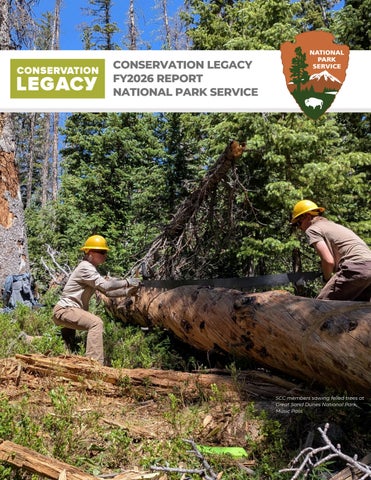
SCC members sawing felled trees at Great Sand Dunes National Park, Music Pass
1
INTRODUCTION TABLE OF CONTENTS CONTACT INFORMATION page two ACKNOWLEDGEMENTS page two MESSAGE FROM THE PRESIDENT page three CONSERVATION LEGACY OVERVIEW pages four and five FUNDING AMOUNTS (INCLUDING OTHER SOURCES) page five PURPOSE OF THE PROGRAM page six PROGRAM MODELS pages seven and eight PROJECT AND PROGRAM HIGHLIGHTS pages nine through sixteen STORIES OF IMPACT pages seventeen and eighteen DEMOGRAPHIC INFORMATION page nineteen and twenty CONCLUSION page twenty-one APPENDIX A-D pages twenty-two through twenty-nine
CONSERVATION LEGACY NATIONAL PARK SERVICE FY2026 REPORT Report Term: October 2025–September 2026 CONTACT INFO FOR CONSERVATION LEGACY: Joey Ruehrwein SVP of External Affairs 701 Camino del Rio, Suite 101 Durango, Colorado 81301 Email: joey@conservationlegacy.org Phone: 970-401-2381 Amy Sovocool, President 701 Camino del Rio, Suite 101 Durango, Colorado 81301 Email: amy@conservationlegacy.org Phone: 970-903-3022
FOR NATIONAL PARK SERVICE Ernestine M. White National Youth Employment Programs Coordinator 21CSC, Vets, YMCA, BGCA) 1849 C Street, NW Mail Stop: 2355 Washington, D.C. 20240 202-570-5628 cell
Crew 399 of Arizona Conservation Corps removing invasive plant species at Grand Canyon National Park South Rim.
ACKNOWLEDGMENTS Conservation Legacy extends our sincere thanks to the National Park Service staff, Cooperators, and Partners who continue to support our shared vision of protecting and restoring our nation’s treasured lands. We are deeply grateful for your dedication, without which our mission would not be possible. We would especially like to acknowledge the following National Park Service offices, Corps, and regional offices for their support: Department of the Interior NPS STAFF AND UNITS: NPS Washington Office NPS Youth Office NPS Rivers and Trails Conservation Assistance Program NPS Historic Preservation Training Center Region 1 North Atlantic Appalachian Region 2 South Atlantic Gulf Region 3 Great Lakes Region 4 Mississippi Basin Region 5 Missouri Basin Region 6 Arkansas Rio Grande Texas Gulf Region 7 Upper Colorado Basin Region 8 Lower Colorado Basin Region 9 Colombia Pacific Northwest Region 10 California Great Basin Region 11 Alaska Region 12 Pacific Islands We would also like to thank the local and regional partners who help make our programming a success, as well as the youth, veterans, and young adults who participate in our Corps and contribute to the 2 conservation of public lands.
MESSAGE FROM THE PRESIDENT DEAR PARTNERS AT THE NATIONAL PARK SERVICE, At Conservation Legacy, we believe service is one of the most powerful ways people can connect to our nation's lands, history, and communities. Every year, young adults, veterans, and emerging professionals step forward to serve in partnership with the National Park Service, contributing to meaningful conservation and preservation work while developing the skills, confidence, and sense of purpose that will guide them throughout their lives. It is an honor to share the impact of that service and the partnership that makes it possible. This year has been especially meaningful as our country commemorated the 250th anniversary of the United States. As a proud partner of America250, Conservation Legacy embraced the opportunity to connect our mission to a broader national story of service. Across our programs, participants carried forward a legacy that stretches back generations, helping preserve historic and cultural resources, restore trails and landscapes, improve visitor experiences, support interpretation and education efforts, and strengthen connections between people and public lands. Together, these efforts demonstrate that service remains one of the most enduring ways Americans contribute to something larger than themselves. As we reflect on this milestone year, I am reminded that America's legacy is not simply found in the places we protect, but in the people who continue the work of protecting them. The accomplishments highlighted throughout this report demonstrate what is possible when the National Park Service and Conservation Legacy invest in service, stewardship, and leadership together.
An A250 sign at Independence Hall where Conservation Legacy members gathered this year for their National Early Service Training with NPS officials and CL staff.
On behalf of Conservation Legacy, thank you for your continued partnership, mentorship, and commitment to creating opportunities for individuals to serve. We are proud of what we have accomplished together in 2026 and look forward to continuing this work in the years ahead. Sincerely,
Amy Sovocool President, Conservation Legacy
3
OVERVIEW
ABOUT CONSERVATION LEGACY Conservation Legacy is a national network of locally-led conservation corps committed to empowering individuals through service to improve public lands, protect natural and cultural resources, and enhance communities across the United States. Our mission is to engage future leaders who protect, restore, and enhance our nation’s lands through community-based service. With a focus on local leadership and decision-making, Conservation Legacy supports a network of diverse and regionally specific Corps divisions that address local conservation priorities. Through this federated structure offering both team-based crew experiences and individual placements, we provide participants with highquality, immersive experiences in conservation, personal growth, and career development. Through these opportunities, Conservation Legacy cultivates the next generation of conservation leaders, offering training in natural resource management, technical skills, and environmental education. Federated Structure Conservation Legacy’s federated structure is unique in the industry. It combines the local focus and responsiveness of smaller corps with the organizational capacity and reach of a national corps. Each local corps is led by an executive director based in the communities they serve, with local program staff administering day-to-day operations. This model ensures high levels of engagement with youth and partners, allowing Corps to be nimble and adapt to community needs. At the same time, Conservation Legacy’s national coordination enables local corps to participate in large-scale national Corps and meet performance outcomes that require broad collaboration. This structure provides the flexibility and innovation of a community-based program while delivering the consistency and resources of a national organization.
Conservation Legacy operates eight branded Corps, each designed to meet the specific needs of the communities and landscapes they serve: Ancestral Lands Conservation Corps (ALCC) – ALCC engages Indigenous youth and young adults in conservation projects that restore public lands, while reconnecting participants with their ancestral heritage. The program emphasizes cultural resurgence and environmental stewardship, offering hands-on experiences in trail building, habitat restoration, and cultural site preservation across sacred Indigenous landscapes. Appalachian Conservation Corps (ACC) – ACC serves the Appalachian region, focusing on the restoration of forests, waterways, and trails. With projects in the Shenandoah Valley and surrounding areas, ACC provides young adults with opportunities to engage in conservation work while addressing local environmental challenges such as habitat degradation and invasive species management. Arizona Conservation Corps (AZCC) – AZCC mobilizes young adults and veterans to complete conservation projects throughout Arizona. Participants work on a variety of initiatives, including trail maintenance, habitat restoration, and wildfire mitigation, contributing to the long-term health of Arizona’s diverse ecosystems and public lands. Conservation Corps New Mexico (CCNM) – CCNM addresses critical conservation needs across New Mexico and adjacent regions. Through hands-on service, participants engage in projects that focus on restoring public lands, preserving natural resources in areas like the Gila Wilderness and White Sands National Park. Conservation Corps North Carolina (CCNC) – CCNC works to conserve the natural and cultural resources of North Carolina. The program partners with local and national organizations to engage youth in projects that improve public lands, protect waterways, and restore native ecosystems, while fostering environmental stewardship and leadership development. Southeast Conservation Corps (SECC) – SECC serves the southeastern United States, focusing on environmental restoration, trail maintenance, and community resilience. The program works in national parks, forests, and other
4 (cont.)
OVERVIEW public lands across the region, offering participants the chance to develop skills in conservation and public service while addressing pressing environmental issues. Southwest Conservation Corps (SCC) – SCC operates in Colorado and New Mexico, engaging young adults and veterans in projects that restore ecosystems, improve recreational access, and protect cultural resources. SCC’s focus on habitat restoration, trail building, and fire mitigation ensures the protection of critical natural areas in the Southwest. Stewards Individual Placements – Stewards Individual Placements offers unique conservation resource assistantships with public land agencies and conservation partners across the U.S. Participants work individually in placements that focus on scientific research, cultural resource management, public education, and other areas that contribute to the stewardship of public lands. Each of these programs plays a critical role in the broader mission of conserving public lands and cultural heritage while preparing participants for careers in conservation and public service. Conservation Legacy’s collaborative approach enables national partnerships with agencies like the National Park Service, while also promoting strong relationships with local stakeholders, ensuring that the benefits of conservation work are felt across the country. FUNDING AMOUNTS Program AZCC ALCC ACC CCNC CCNM SECC SCC STEWS
Project Value 423,559 2,685,515 1,313,449 291,856 175,468 788,597 732,799 4,236,471
NPS 306,014 1,918,467 1,007,130 203,530 88,446 571,220 709,000 3,106,189
In-kind 127,113 639,489 306,319 88,326 87,022 190,407
Total
$10,647,714
$7,909,996
$2,690,956
121,998 1,130,282
Stewards Individual Placement Grace Anderson during a trash pick-up event at the National Mall and Memorial Parks with NPS staff.
5
Cultural Steward IP, Cameron provided support for the threeday Sail250 (affiliate) event in Yorktown, VA to help commemorate America’s 250th birthday.
PURPOSE The partnership between Conservation Legacy and the National Park Service serves to advance critical land management priorities while offering young adults structured, educational opportunities that foster personal growth, professional development, and public land stewardship. Through this collaboration, participants engage in hands-on projects that help preserve both natural ecosystems and cultural heritage, while addressing pressing issues such as wildfire prevention and mitigation, recreation and accessibility to public lands, trail maintenance, etc. This partnership also plays a pivotal role in safeguarding the cultural and natural resources of these treasured spaces for future generations. By promoting infrastructure improvements, safety and access, and beautifying parks, Conservation Legacy supports the broader mission of the NPS to ensure the long-term preservation of public lands. Central to this effort is a commitment to fostering partnerships with local communities and conservation organizations, while also preparing participants for meaningful careers in conservation and public service. Through our programs and Corps, young adults and veterans develop essential life skills and gain access to career opportunities, all while enriching visitor experiences, and contributing to impactful improvements to our beloved national parks and historic sites.
PROGRAM SUCCESS HIGHLIGHTS FOR OVER 25 YEARS, CONSERVATION LEGACY AND THE NATIONAL PARK SERVICE HAVE BEEN UNITED IN THEIR MISSION TO PRESERVE AND PROTECT OUR NATION’S MOST TREASURED RESOURCES. As the NPS continues to safeguard the natural and cultural assets of the National Park System for future generations, we are honored to have been a consistent partner in this critical work for more than two decades. In 2026, we collaborated with the NPS to engage over 963 youth, young adults, and veterans from diverse backgrounds. Through our Corps across the country, participants connected with public service and conservation careers while deepening their understanding of the natural and cultural legacy that our public lands represent. Our long-standing partnership with the NPS ensures that each participant receives high-quality training, personal development opportunities, and meaningful on-the-ground experience.
OUTCOMES AS RELATED TO DEPARTMENT OF INTERIOR’S PRIORITIES Ensuring National Parks Are Open and Accessible Making the District of Columbia Safe and Beautiful Restoring Truth and Sanity to American History Strengthening Coordination with Gateway Communities Implementation of the Expanding Public Lands Outdoor Recreation Experiences Act
Appalachian Conservation Corps staff attend the 2026 CHBA Gateways Annual Partner Meeting.
The following project highlights from each of our Corps will focus on how our service work supports the DOI’s priorities of ensuring our National Parks are open and accessible, making DC safe and beautiful, restoring and preserving American History, strengthening coordination with gateway communities, and implementation of the expanding public lands outdoor recreation experiences act, as well as highlighting how our members helped commemorate America’s 250th birthday. In our member quotes and IP evaluations, participants report feeling more prepared and confident in pursuing careers in natural and cultural resources and with NPS and other federal government land management agencies.
6
PROGRAM MODELS NATIONAL PROGRAM MODELS Community Volunteer Ambassador The Community Volunteer Ambassador (CVA) program is a 50-week professional resource apprenticeship experience managed in partnership by the National Park Service and the Stewards Individual Placement Program. CVA members support volunteer Corps by expanding volunteerism, service-learning, community engagement efforts, and increasing the sustainability of established Corps. Ambassadors focus on a number of core objectives, including building enduring relationships with local communities, increasing park volunteerism opportunities, improving disaster response processes, and helping to organize community stewardship days. Veterans Fire Corps The Veterans Fire Corps program provides the opportunity for post-9/11 era Veterans to work and live alongside other vets, while receiving training and on-the-job experience in wildland firefighting and natural resource management. This program prioritizes Veterans who are looking for a way to transition from military to civilian service, building upon the knowledge and leadership skills gained while serving in the armed forces. Veterans are able to regain the sense of purpose and pride felt in the military, while refocusing their mission to protecting our communities and public lands from the threat of wildfire.
Veteran’s Fire Corps member serving at an NPS site.
Scientists-in-the-Park The Scientists in Parks (SIP) Program places college students, recent graduates, and early-career professionals in paid positions across the National Park System to support natural resource management. Opportunities vary by location and focus, with past projects including dune mapping, cactus surveys, and sea turtle conservation. Through partnerships with the National Park Service, SIP connects individuals ages 18-35 to short-term resource assistantships involving research, GIS and mapping, monitoring, inventorying, impact mitigation, science communication, and environmental education.
Historic Preservation Training Center The Historic Preservation Training Center (HPTC) and Stewards Individual Placement Program partnership provides training and experience for young adults and veterans interested in the historic preservation trades. Members gain skills while helping to preserve the historic structures, monuments, and memorials throughout the park system, as well as addressing the backlog of deferred maintenance projects. Through three signature programs— the Traditional Trades Advancement Program, and the Preservation Work Experience and the Maintenance Action Team, the HPTC and Stewards are helping to train a future workforce in specialized building trades and historic preservation.
HPTC members repaint railings on top of the roof at Independence Hall.
7
PROGRAM MODELS Traditional Trades Advancement Program (TTAP) offers entry-level opportunities for young adults and veterans, providing hands-on training in essential trade skills such as masonry, carpentry, and wood crafting. Designed to address maintenance needs in national parks, TTAP prepares participants for careers in historic preservation and related fields by focusing on land and cultural resources. Through this program, members gain practical experience and specialized training, equipping them for successful careers in both the public and private sectors while contributing to the preservation of our nation’s heritage.
Youth Empowerment Stewards (YES) Launched in 2021, the Stewards Youth Empowerment Program positively impacts the country’s recreation and tourism economy by expanding park entry for visitors. YES members serve at NPS host sites, providing park units with the capacity to identify and make public lands and visitor services more welcoming for all. By working directly with park units, YES members support an array of park projects aligned with DOI priorities. The objective of this partnership is to complete important conservation projects that create recreation access and ensure public safety while providing young adults with structured and challenging service and educational opportunities through experiences that promote personal growth, economic opportunity, the development of life skills, and an ethic of natural resource stewardship. Conservation Legacy and Stewards Individual Placements work towards consistently making these opportunities available to young people and veterans.
Historic Stewards/Maintenance Action Teams (MAT) are immersive resource apprenticeships focused on addressing critical preservation needs through hands-on projects for individuals with prior experience or education in trades. Individual Placements work alongside National Park Service (NPS) staff in specialized fields such as masonry, carpentry, and wood crafting, gaining advanced skills that prepare them for careers in historic preservation or related trades. By serving directly with NPS staff, Individual Placements contribute significantly to the maintenance and restoration of historic structures. This program provides essential capacity support for parks by enabling teams to attend to deferred maintenance needs, ensuring the long-term preservation of our nation’s historic resources.
Build Up Technical Resource Apprenticeship: The Build Up Technical resource apprenticeship Program offers technical Resource Apprenticeships in fields such as engineering, architecture, and project management. Individual Placements shadow NPS teams on large-scale projects, acquiring specialized expertise in their respective fields while contributing to effective park planning and facilities maintenance. Through hands-on experience, participants support efficient recordkeeping, continued park recreation, and the creation of digital media and reports. This program not only enhances technical skills but also ensures the sustainable management and preservation of national park resources.
Mariah Namingha and Tyrel Kewanwyma TTAP members serving at Tuzigoot Montezuma Castle National Monument.
8
PROJECT HIGHLIGHTS
APPALACHIAN CONSERVATION CORPS Rock Creek Park IP's Beautifying Washington, D.C. EO 14189 - Celebrating America’s 250th Birthday On Friday June 12th, hundreds of service members in Corps programs across the region met in Washington, D.C. to participate in the 11th annual Great Outdoors Day of Service. This was a particularly special one for ACC, as multiple capital-region-based Individual Placements were part of the planning and facilitation of this event; from volunteer coordination to photo coverage. Participants divided into working groups to complete landscaping, invasive species removal, and other maintenance projects at different sites nearby the park. The timing of this event preceeded America's 250th Birthday Celebrations in Washington, D.C., and the goal of these projects were to help bring community members together to help beautify the city for visitors to enjoy and celebrate. Two ACC IPs helped lead operations this year — our Youth Engagement IP Sophie and our Biological Sciences IP Usha, both serving at Rock Creek Park. "Planning for the event began way back in February, so it was so cool seeing it finally come to fruition," Sophie said. "I loved getting to meet the Individual Placements and crew members from different parks! Some were folks that I’ve connected with over email but not yet met in person, and it was really great to all be in one place working together. Seeing new bonds form between IPs was really sweet too!" Sophie said park staff put a significant amount of planning toward heat safety for this year's event. With a temperature high in the upper 90s, group leaders encouraged volunteers to take frequent breaks throughout the day and drink plenty of fluids (water coolers were provided at each work site). By the end of the day, everyone managed to stay safe in the heat and successfully complete the planned projects.
ACC members join the 11th annual Great Outdoors Day of Service in Washington, DC.
After exiting our program, Sophia will be continuing GIS projects, this time with Stewards East supporting the Southeast Region of the NPS.
At least ten member organizations of The Corps Network traveled from multiple states to have staff and/or Corps members represented at the event. Around a dozen Conservation Legacy IPs attended, and we were excited to see some faces from ACC in the crowd. The 2026 Day of Service also coincides with the observance of National Service and Conservation Corps Day. A bipartisan resolution was introduced in the U.S. House of Representatives and the U.S. Senate this year to officially recognize the second Friday in June as National Service and Conservation Corps Day. This is a day to celebrate Corps and the thousands of young people who serve in Corps every year across the country.
Biological Sciences IP Usha Hippenstiel recieving the ROCR award pictured here with NPS staff member. 9
PROJECT HIGHLIGHTS
ANCESTRAL LANDS CONSERVATION CORPS Training the NPS Workers of Tomorrow While Preserving History and Improving Parks EO 14278 – Preparing Americans for High-Paying Skilled Trade Jobs of the Future SO 3426 – Ensuring National Parks Are Open and Accessible ALCC placed 8 Traditional Trade Advancement Program (TTAP) Individual Placements (IPs) at Bandelier National Monument, Chicahua National Monument, Mesa Verde National Park, and Yosemite National Park in partnership with the Historic Preservation Training Center (HPTC) program. TTAP participants train and work alongside experienced NPS employees to preserve cultural resources and crucial infrastructure while learning the fundamentals of historic preservation and receiving onthe-job training in a traditional trade, such as masonry, carpentry, monuments, and wood crafting. Participants gain practical, hands-on experience and the foundation for a career in historic preservation.
TTAP Individual Placement -Jarae Simpliciano at Kaloko-Honokōhau National Historical Park fabricating a boardwalk for park visitors.
Supporting Local Wildfire Preparedness EO 14308 – Empowering Commonsense Wildfire Prevention and Response ALCC crews and IPs worked with NPS units to remove hazardous fuels, invasive species, create fire breaks, and complete other projects that support local wildfire preparedness and response, reduce wildfire risk, and protect natural and cultural resources. An ALCC Crew worked at Tonto National Monument to create a fire break; removed invasive species at Bandelier National Monument, Carlsbad Caverns National Park, Chaco Culture National Historical Park, Chiricahua National Monument, Glen Canyon National Recreation Area, Hawaii Volcanoes National Park, and Saguaro National Park.
“Part of what brought me to ALCC was the wonderful reputation for Conservation Legacy from my experience with ALCC IPs from the park side! They do a great job!“ – Shannon Lobb, former Training Specialist ELMA/O
ALCC HFRI crew member removing hazerdous fuels.
10
PROJECT HIGHLIGHTS
ARIZONA CONSERVATION CORPS
Crew 396 serving at Pecos National Historical Park.
AZCC Crews Advance Wildfire Prevention at Pecos National Historical Park EO 14308 – Empowering Commonsense Wildfire Prevention and Response For the fifth consecutive year, Arizona Conservation Corps (AZCC) crews partnered with Pecos National Historical Park to support critical conservation, fuels reduction, and resource stewardship efforts. While the park sits hundreds of miles from AZCC's home base, the enduring partnership reflects a shared commitment to preserving cultural landscapes, protecting natural resources, and developing the next generation of conservation professionals. Throughout the season, Flagstaff-based Crew 396 completed a wide range of projects that improved park infrastructure, enhanced visitor safety, and increased landscape resilience. Much of the crew's work focused on fuels reduction and wildfire prevention. Crew members thinned juniper and piñon vegetation along roadways, historic routes, and fence lines, creating and maintaining strategic fuel breaks designed to reduce wildfire risk and protect park resources. Across multiple project hitches, the crew completed more than 12 acres of thinning, established approximately 1.2 miles of firebreak, and removed large volumes of vegetative material for chipping and disposal. In addition to wildfire mitigation, the crew supported ongoing land management and preservation initiatives. Members thinned a historic pasture to prepare the area for future soil moisture research, helped maintain the historic Pecos-Santa Fe route, repaired more than 2,100 feet of fencing, and removed invasive vegetation across park grounds. They also prepared high-visibility visitor areas ahead of a community festival by clearing invasive weeds around historic buildings, helping ensure the park remained both welcoming and accessible for visitors. Equally impactful was the opportunity for hands-on learning and professional development. Through their close collaboration with park staff, crew members gained experience in vegetation management, fencing, ecological restoration, and park operations.
A particularly meaningful aspect of the partnership has been the mentorship provided by park biologist Eric Lassance, who has worked closely with AZCC crews over the years. Beyond sharing technical expertise, Eric has offered career guidance and insight into public land management, helping members better understand pathways into conservation and National Park Service careers. The partnership between Arizona Conservation Corps and Pecos National Historical Park continues to demonstrate how conservation service programs can deliver lasting benefits for public lands while developing a skilled and passionate conservation workforce. Through their dedication and hard work, Crew 396 helped protect historic resources, strengthen ecosystem resilience, and ensure that future generations can continue to experience the unique cultural and natural heritage preserved at Pecos National Historical Park.
Crew 396 performed Juniper thinning to create a fuel break in Pecos Historical Park in New Mexico. The crew finished 4.09 acres of thinning along roadways. All cut material was loaded into dump trailers for removal.
11
PROJECT HIGHLIGHTS
CONSERVATION CORPS NEW MEXICO CCNM Crews Beautify White Sands National Park EO 14314 – Making America Beautiful Again by Improving Our National Parks SO 3426 – Ensuring National Parks Are Open and Accessible SO 3435 – Implementation of the Expanding Public Lands Outdoor Recreation Experiences Act Conservation Corps New Mexico (CCNM) operates conservation service programs across New Mexico, western Texas, and Oklahoma that engage individuals and strengthen communities through service and conservation. Since 1998, Arizona Conservation Corps has worked on projects throughout southern New Mexico. With Conservation Legacy's commitment to supporting locally-based programs and communities, southern New Mexico programming and projects transitioned to locally-based Conservation Corps New Mexico operations out of Las Cruces, NM, in order to best serve local communities, young people and landscapes in this region. In 2026, CCNM crews worked alongside WHSA staff to protect and restore critical riparian habitat at White Sands National Park. The crews treated 40 acres and 1.2 miles of waterways while contributing 2,170 hours of service. The primary species targeted was tamarisk (Tamarix), a non-native species that is quickly spreading throughout the park, transforming the world’s largest gypsum dune field and threatening the native flora and fauna it supports. The removal of exotic plants not only prevents them from spreading across the park but it also helps preserve the natural viewshed of the internationally renowned snow-white dunes. This project aligns with numerous Executive and Secretarial Orders, including EO 14314, SO 3426, and SO 3435 by protecting America’s natural and cultural resources, improving the enjoyable and safe experience of national park visitors, and ensuring that our public lands remain open and accessible.
CCNM crew members smile for a photo at White Sands National Park. Beyond ecological restoration, the project provided young adults with hands-on conservation experience while improving the long-term health and resilience of park resources. Working under the intense sun and winds of southern New Mexico, Crew 583 developed practical field skills, strengthened teamwork, and built a deeper connection to public lands stewardship.
CCNM crew members performing trail restoration at White Sands National Park.
12
PROJECT HIGHLIGHTS
CONSERVATION CORPS NORTH CAROLINA Strengthening Recovery, Stewardship, and Visitor Engagement Along the Blue Ridge Parkway SO 3426 – Ensuring National Parks Are Open and Accessible SO 3434 – Strengthening Coordination with Gateway Communities Through Conservation Corps North Carolina's partnership with the Blue Ridge Parkway, three crews and four Individual Placement participants helped advance critical park priorities spanning land management, infrastructure planning, public engagement, and visitor safety. Two placements focused on data science and planning support, helping the Parkway increase efficiency in permitting and project planning related to hurricane recovery, transportation improvements, utility projects, and right-of-way management. Corps members consolidated historical records from both physical and digital sources into searchable GIS databases, creating valuable tools that support acquisition and disposition decisions, infrastructure management, and long-term resource planning. Among these participants was Colin Kane, a Data Automation Specialist who has made significant contributions by organizing years of biological data and improving accessibility for park staff. His work not only streamlines internal operations but also strengthens the Parkway's ability to use data in resource management and decision-making. During his service, Colin also joined field staff conducting bog turtle surveys, gaining firsthand experience with the conservation efforts supported by the datasets he helps manage.
Colin Kane, a Data Automation Specialist at Blue Ridge Parkway.
A second team of placements supported the Parkway's communications and visitor engagement goals. Working alongside National Park Service staff, participants developed multimedia content, educational materials, and interpretive resources that connect visitors with the Parkway's landscapes, stories, and current initiatives. Their efforts included creating new videos and informational displays for the visitor center while supporting park-wide visitor awareness and safety campaigns. Together, these placements advanced National Park Service priorities by strengthening connections with gateway communities through participation in the multipartner Blue Ridge Rising initiative and by supporting efforts to ensure the Blue Ridge Parkway remains accessible, welcoming, and well understood by the public. Through their service, participants not only contributed meaningful capacity to the Parkway but also gained handson experience in public lands stewardship, conservation technology, and public engagement, helping prepare the next generation of conservation professionals.
Trail Crew 808: NPS - Blue Ridge Parkway, Summer 2026.
13
PROJECT HIGHLIGHTS
SOUTHEAST CONSERVATION CORPS Fort Pulaski: Walls Can’t Talk, But We Can Interpret EO 14253 – Restoring Truth and Sanity to American History
Off the coast of Savannah, Georgia, Fort Pulaski has been standing guard for over 150 years on Cockspur Island. Fort Pulaski played a crucial role in the Civil War, earning its declaration as a National Monument in 1924. We’ve had the honor of partnering with the National Park Service for Individual Placements since 2019.
Fort Pulaski walls captured by Harrison Carter.
Harrison Carter interpreting at Fort Pulaski.
Two years ago, we first welcomed Harrison Carter as a Volunteer, Partnerships & Community Engagement Individual Placement. During his first term, Harrison assisted in planning Fort Pulaski’s 100th anniversary. He worked closely with community partners and helped facilitate representation for every corner of the local community. After serving two terms with us, Harrison joined the National Park Service for his first season as a Park Guide at Fort Pulaski in September of 2026.
Darcy said “For 100 years, we’ve seen the positive impact conservation corps have had on Fort Pulaski National Monument. The Civilian Conservation Corps brought a new life to Fort Pulaski in the early 1900’s, and today, SECC is honored to help keep this rich history alive for future generations.” We are proud of Harrison and excited to see him continue his journey with Fort Pulaski!
“Without the work I did in parnerships, community engagement, and interpretation through SECC, I would not have been lucky enough to discover what I’m supposed to be doing and actually get to do it.” -Harrison Carter, Former SECC IP & Current NPS Park Guide Our Executive Director, Darcy Welch had an opportunity to visit Harrison during the Centennial Celebration at Fort Pulaski National Monument. Part of the celebration encouraged visitors to reflect on the work the Civilian Conservation Corps put in 100 years ago to restore Fort Pulaski from an overgrown state. For Darcy, this was a full circle moment!
Darcy Welch, SECC Executive Director, with Harrison Carter at Fort Pulaski. 14
PROJECT HIGHLIGHTS
SOUTHWEST CONSERVATION CORPS SCC Members Serving at Sand Dunes National Park EO 14308 Empowering Commonsense Wildfire Prevention and Response EO 14314 Making America Beautiful Again by Improving Our National Parks SO 3426 Ensuring National Parks Are Open and Accessible
Each year, SCC-Los Valles partners with Great Sand Dunes National Park by providing trail, wilderness, saw, and herbicide crews and Individual Placements throughout the summer and fall. While treatments have wrapped up for the 2026 season, monitoring by youth crews will continue into 2027. The SCC-Los Valles Red Crew turned invasive species blue by safely and effectively using blue-dyed herbicides to treat invasive plants in support of Great Sand Dunes National Park and Preserve's Integrated Pest Management Plan. Across two hitches, the crew treated more than 85 acres of cheatgrass, a Colorado Class C noxious weed. Cheatgrass (also known as downy brome) is a nonnative grass that outcompetes native plants, creates highly flammable fuel loads, and provides poor forage for wildlife. By removing cheatgrass, and creating 5.25 miles of firebreak, crews help native vegetation recover, reduce wildfire risk, and prevent the spread of wildfire. For 16 days, the crew traveled the sandy, rocky road with backpack sprayers securely in tow, applying Rejuvra, a pre-emergent herbicide that reduces the viability of the cheatgrass seed bank remaining in the soil. The work required incredible attention to detail, and the crew quickly developed an expert eye for spotting cheatgrass.
SCC Los Valles Red Crew serving at Great Sand Dunes National Park this summer.
Serving as an Interpretation Assistant at Great Sand Dunes National Park & Preserve helped SCC member Marion Carini strengthen their commitment to stewardship and public engagement while gaining experience across multiple park operations and helping visitors connect with public lands.
“My favorite part of the day is definitely presenting programming. It's a great feeling when you get the audience to connect to the material, or they give a big reaction to something you said." Crew 253 at Great Sand Dunes National Park felling and bucking downed trees.
-Olivia, Individual Placement serving as an Interpretation Assistant with Great Sand Dunes National Park & Preserve 15
PROGRAM HIGHLIGHTS
STEWARDS INDIVIDUAL PLACEMENTS CREATING PATHWAYS TO CAREERS IN PUBLIC LANDS The Stewards Individual Placement Program (Stewards) is a national initiative that places young adults and veterans in conservation and community-focused positions, offering hands-on experience and professional development opportunities. Divided into Stewards East and Stewards West, this initiative connects participants with public lands, cultural resources, and local communities across the United States, while creating a direct career pathway into National Park Service offices and other federal agencies. Each area is tailored to the unique environmental and cultural needs of its respective region.
37 PARTICIPANTS CONVERTED TO FEDERAL HIRES IN 2026
Stewards East focuses on land restoration, cultural resource management, poverty alleviation and environmental education, primarily in the eastern U.S. Stewards West, covering the western U.S., emphasizes wildfire prevention, public lands conservation, and healthy ecosystems. Participants work on impactful projects while gaining the skills and networks needed to secure longterm roles within the National Park Service and beyond. By providing meaningful work experiences, Stewards helps individuals build pathways to careers in conservation and resource management, with the ability to place members in all 50 U.S. states and U.S. territories.
Vasquez Billin, an Individual Placement on a Stewards Maintenance Action Team performs hands-on historic preservation work at Independence Hall in Philadelphia.
Community Volunteer Ambassador Luis Fina Diaz educating young park visitors at San Juan National Historic Site. 16
STORIES OF IMPACT STEWARDS INDIVIDUAL PLACEMENTS EAST Dedicated to Service at Acadia National Park SO 3426 - Ensuring National Parks Are Open and Accessible After serving at Fort Frederica National Monument, Robyn Smyth continued her national service journey as a Youth Empowerment Stewards (YES) member at Acadia National Park. As Robyn prepares to complete her current term and begin a new service position at Mammoth Cave National Park this October, one theme has remained constant throughout her service—helping connect more people to parks and park resources. At Fort Frederica, Robyn supported interpretation, education, and community engagement efforts, including helping develop a youth fishing program and assisting with school programs, living history activities, and community events. One of her favorite moments came when students she had met during Georgia History Day later recognized her during a park visit and shared what they had learned. At Acadia, Robyn has focused on improving access to visitor information by researching and creating online trail descriptions, helping develop resources for visitors with a variety of needs, and supporting staff with tools and materials that make park information more accessible. Through both service experiences, Robyn has developed skills in communication, project planning, interpretation, and visitor engagement while supporting opportunities for more people to experience and enjoy their national parks. After completing two impactful service terms, Robin looks forward to continuing her service journey at Mammoth Cave National Park, where she will build on her experience in visitor engagement and accessibility while supporting new opportunities for people to connect with public lands.
Three individual Placements support preservation efforts at Shenandoah National Park.
Stewarding Federal Historic Assets at Fredericksburg & Spotsylvania National Military Park EO 14278 – Preparing Americans for High-Paying Skilled Trade Jobs of the Future This season, John Storke and Catherine Lovall at Fredericksburg & Spotsylvania National Military Park hosted three Stewards members: Paulina Caro (Build Up Facility Management Member), Hope Young (Traditional Trades Advancement Program Member), and Logan MacGregor (Water Lab & Utility Shop Member). By hosting Stewards members in a variety of HPTC positions, the team at Fredericksburg has created a cohort with access to a broad range of opportunities both within the park and through participation in projects at nearby sites. In July, all three members joined a project at Shenandoah National Park hosted by Alex Lochart to support preservation efforts at a cabin near the historic Skyland Lodge. Through this project, members gained hands-on experience with preservation techniques, including assisting with reframing portions of the structure, removing water-damaged sheathing, installing protective materials, and helping install new cedar shingles under staff guidance. This collaboration across park sites provided a memorable professional development opportunity and gave members valuable exposure to preservation practices they may not have otherwise experienced.
At Fort Frederica, Robin supported interpretation, education, and community engagement efforts at Acadia National
17
STORIES OF IMPACT STEWARDS INDIVIDUAL PLACEMENTS WEST Strengthening Wildfire Preparedness Across National Parks • EO 14308 – Empowering Commonsense Wildfire Prevention and Response • EO 14278 – Preparing Americans for High-Paying Skilled Trade Jobs of the Future Jacqueline "Jacqui" Ouellette spent her summer supporting fire ecology and fire management planning across National Park Service units throughout the Northeast and Southeast. Based in Hadley, Massachusetts with the NPS Northeast Regional Office, Jacqui helped park managers further their understanding of how changing weather conditions may influence future wildfire activity. Her projects supported the tools parks use for fire preparedness, response, recovery, and long-term resource management planning. As a Fire Ecology Assistant, Jacqui developed wildfire season reports, using R programming, GIS, and geospatial analysis tools, that can be easily updated and replicated in future years. These automated reports generate maps, graphs, tables, and written summaries of wildfire occurrence, acres burned, seasonal fire patterns, and lightning activity across parks and ecoregions. She also produced regional maps highlighting fire incidents, National Park Service units, and ecological boundaries, creating resources that staff can continue to use long after her term. Additionally, Jacqui analyzed historical fire patterns and examined how fire frequency, weather conditions, and drought trends have changed over time which involved extensive data management, spatial and temporal analysis, statistical modeling, and GIS mapping. One of the most valuable aspects of Jacqui's SIP experience has been the opportunity to strengthen both her technical and professional skills. Entering the position with limited experience in coding and statistics, she developed proficiency in R, ArcGIS Pro, automated reporting workflows, and ecological data analysis and created a strong foundation for a future career in ecological research and natural resource management. Reflecting on her experience, Jacqui shared, "Being a fire ecology SIP and working for NPS with a supervisor that works for the USFS is a great way to learn about interagency collaboration in concrete terms and provide regional NPS units with support for their fire planning." Through her projects, Jacqui changed complex ecological and climate data into practical tools that support informed decision-making and strengthen fire resilience across national parks.
Jacqui measuring snow depth at a tree plot in Fairbanks, Alaska at Denali National Park
“I have really enjoyed my position so far and have learned a lot both from my projects and also my professional development opportunities such as my statistics in R course and fire effects monitoring trip to New River Gorge.” -Jacqui Ouelette, Fire Ecology Assistant Individual Placement
Leaving New River Gorge National Park after setting up plots with the Shenandoah fire effects monitoring crew.
18
PARTICIPANT DEMOGRAPHICS TOTAL PARTICIPANTS: 963
13.4%
42.5%
44.1%
58.4%
12.25%
9.4%
50 76 382
217
High school graduate or GED 24% 382 133
19
PARTICIPANT DEMOGRAPHICS
41
24 108
18-20 12%
745
(1.6%) (1.7%)
(.2%)
(.1%)
(.4%) ,4%)
20
CONCLUSION For generations, conservation corps have connected young people and veterans to meaningful service on America’s public lands while building the skills, experience, and confidence needed to pursue careers and continue serving their communities. In 2026, Conservation Legacy’s partnership with the National Park Service continued this tradition, bringing together corps members, Individual Placements, NPS staff, local communities, partner organizations, and regional conservation corps to care for the places that belong to all Americans. Through this partnership, participants gained hands-on professional experience while addressing important needs across National Park Service sites. Their service supported public safety and visitor access, trail maintenance and construction, vegetation and natural resource management, historic preservation, wildfire prevention and mitigation, and other priority projects. Just as importantly, these opportunities provided young people and veterans with practical skills, mentorship, career exposure, and pathways to continued service and employment. Conservation Legacy is grateful for the National Park Service’s continued investment in this work and for the dedication of the staff, partners, communities, and participants who make these projects possible. We remain committed to providing the coordination, administrative infrastructure, and programmatic support that allow locally driven partnerships to thrive while expanding opportunities for the next generation to serve and steward our nation’s public lands.
Emerson, a Stewards Individual Placement member serving at Oregon Caves National Park, demonstrates use of equipment used to monitor bat populations throughout the NPS site.
As we look ahead, Conservation Legacy is proud to continue our partnership with the National Park Service. Together, we can build on the accomplishments of 2026, strengthen the workforce needed to care for America’s public lands and historic resources, and create meaningful opportunities for young people and veterans to develop skills through service. By investing in people and places together, this partnership helps ensure that our national parks remain accessible, resilient, and cared for for generations to come.
21
APPENDIX A: PARTNER AND PARTICIPANT QUOTES Participant Testimonials: “We started this hitch by thinning Juniper trees in a meadow to meet the partners goal of assessing juniper trees impact on the water table within the meadow. When the ground became too muddy in the meadow, we moved to clearing overgrown junipers along the highways and adjacent fences. I’m very grateful that we’ve been able to serve on multiple projects with Pecos. During the hitch, the partners provided us a tour of the ranch house where were given a presentation on the history of the ranch and how the park was able to acquire the land”— Velazquez, Pecos National Historic Park, July 20, 2026, AZCC “This was my first conservation service project ever, and I was able to spend time learning about what it takes to work in conservation. During the week, our crew removed invasive cheat grass, worked in the greenhouse sanitizing pots and watering seedlings, distributed mulch around park facilities, and watered established plants around Desert View and park lodges. As I adjusted to the long days of work and persevered through the weather, I found the experience to be unique and meaningful while getting to make a lasting impact on the park.”—Vera, Grand Canyon National Park, June 6, 2026, AZCC
“I was given a large amount of opportunities for professional development, interdepartmental training, project freedom, and an amazing team of coworkers — Holdaway, Guilford Courthouse National Military Park, STE “My term at CEBE was excellent. I couldn't have asked for a better park to serve at. Servicewide Changes from the administration made this a histroically difficult year for the NPS, and it impacted my term.”— Schonekas, Community Volunteer Ambassador, STW “This season with the Hiking Club showed how gentle guidance and time outdoors can change lives. Children who started the program distant from nature and their culture slowly opened up: they tried new things, built confidence, and learned to enjoy being outdoors. By fostering a caring, encouraging space and engaging them through trails and activities, we created meaningful bonds that supported their social and emotional growth.”—Andrea & Cooper, Isleta Hiking Club Leaders, ALCC
“Speaking to tens or hundreds of visitors daily was enlightening and really gave me a good grasp of park information that is not as well communicated as it should be. I remember speaking to a few women about access concerns, as their companion walked with the aid of a cane. I talked to them about the most accessible areas of the park, and what the barriers could be. Later, I found out that they had met my site supervisor and given praise, which my supervisor relayed to me. It was an easy task for me to do, but I got to hear about how it positively affected the visitors and made them more comfortable on their trip. And naturally, it made me feel good to hear positive feedback from my supervisor. I felt successful anytime someone asked about access and I could accurately describe the trail conditions and terrain to ease their worries.”— Wilhide, YES Member at New River Gorge National Park, STE “The best part of my service was receiving ppportunities to get experience through my work and feel like I was making a difference.”— Gruwell, Gulf Islands National Seashore - Florida, STE
Southeast Conservation Corps Crew 958 performing trail work at Great Smoky Mountains National Park.
22
APPENDIX A: PARTNER AND PARTICIPANT QUOTES Participant Testimonials: “This means an incredible amount to me. The ability to contribute to the National Park Service's mission on a daily basis has transformed my life in a few ways. I find myself reflecting on how grateful I am to be able to serve to protect, conserve, and support the natural resources at Rock Creek through community engagement and support from the public. I found myself as being part of a community at the end of this term, not just within NPS, but within my local community and my volunteers - the Weed Warriors. This work gives an opportunity to reflect on the history of the area, the context of where and when we are now, and a question of how we can best move forward in ensuring its grandness continues for the future generations.”— Hippenstiel, Rock Creek Park | Biological Sciences Individual Placement, ACC “National Service to me means serving my community. With my work, I’ve helped increase the visibility of sites that shape the economy, conservation, and health of the Chesapeake Bay Watershed. By doing so, they’re able to gain more traction and attention from not only residents and visitors, but also from other partners. They’ve been able to create connections with each other to elevate each other and gain benefits from being a part of the network. Thus helping the entirety of the Chesapeake Bay Watershed community. It feels great to be a part of a community that uplift each other”— Cobb, Chesapeake Gateways Ambassador Individual Placement, ACC “I gained many new opportunities during my internship, particular the ability to develop research skills.”— Ackerman, Fort Donelson National Battlefield, STW
“Within my work, I have seen how the restoration projects I have helped with at Monocacy have not only helped to preserve the park’s unique ecology, but have also improved the visitor experience. The restoration work at one of our pollinator habitats have helped to restore a previously overgrown viewshed, one that would have been a prominent feature during the battle. Our meadow restoration has helped to improve the diversity of wildflower species, a sight which visitors have remarked as improved compared to previous visitations. These restoration projects have also been publicized on our parks social media pages, which are helping to inform the public of our projects, which will hopefully improve support of our stewardship. To be a part of the movement means to take a part of the aforementioned aspects of national service, and to make it your own. For me, that part that I adopted was invasive species management and habitat restoration, which I served in this position and wish to continue to. It also means to share your enthusiasm of your piece of national service. This can look like answering questions about this, sharing news about projects, or however else you wish to express it.” — Hjembo, Monocacy National Battlefield, Ecological Monitoring Individual Placement, ACC “My crew and I performed various tasks on the Palo Verde trail. I learned a lot of new and exciting information and skills about trail work, like the various tools and terminology that are important to know about when working on a trail. It was awesome to see the steps we replaced on the trail, and it felt very rewarding”— Cleaver, Organ Pipe Cactus National Monument, March 17, 2026 AZCC
“This service is different from all the other terms I’ve done. It took a lot of self-discipline. I think I’ve grown as a self-starter, and learned to be able to manage my time, as well as taking initiative on projects. I would do this again, 100%.”—Smyth, Youth Empowerment Steward, Acadia National Park, STE
“This hitch, we worked on strategies to mitigate erosion impacts within the park. We built one rock dams, laid out erosion blankets, and dispersed seed balls to promote new growth in areas that had been affected by erosion and soil disturbance. I found meaning in doing restorative work using materials we found in the area to construct the one-rock dams. Navigating off trail was exciting!”— Montano, Chiricahua National Monument, AZCC
“Being a YES VISTA has given me the unique opportunity to be the only VISTA member in service to America at the moment doing what I'm doing . . . through my work, I'm supporting disabled people's access to the cultural and natural resources I see every day. As a disabled person myself, this is even more meaningful.”— Greenstein, YES VISTA at NAMA, STE
“I believe this to be the best opportunity I have ever had. I am learning an incredible amount, doing and leading fulfilling work, surrounded by supportive mentors and advocates. Overall, I love it here and hope to continue this type of work.” — Johnson, MarshBillings-Rockefeller National Historical Park, Education Assistant, Scientists in Parks, STW 23
APPENDIX A: PARTNER AND PARTICIPANT QUOTES Partner Testimonials: “The crew did a great job brushing and clearing out the mesquite bosque around Quitobaquito! I am really grateful for their hard work.” — Mills, Park Botanist, Organ Pipe Cactus National Monument “Marissa took over as crew lead, and she did an amazing job managing the crew! The crew was able to install the final erosion control measures as part of a three-year watershed restoration project at Fort Bowie National Historic Site.” — Garcia, Physical Scientist, Chiricahua National Monument “Overall, the crew was prepared, they arrived on time and worked professionally each hitch. The crew completed all work assigned and was prepared for each task. The crew managed to work through rough weather without hiccups. Emily has been a great leader for her crew, obviously experienced enough to stay calm through challenging situations. She has been one of the better leaders I've worked with from AZCC. The Assistant Crew Leader Leo has been good too, she is newer but has done well at adjusting to crew life it seems. AZCC has been wonderful to work with this summer, and I'm hopeful to continue that into the fall. The crew was a pleasure to work with, they got the project work done, and I’ve been happy to have them, or happy to work with any AZCC crew again. — Lassance, Pecos National Historic Park “It was lovely working with this specific crew. It's sometimes hard to find crews with a good work ethic but this specific crew had a great work ethic. I was happy with their work and appreciated the crew lead’s guidance, leadership and independence. They built the best wood piles ever!" — Julie Long, Biologist, Flagstaff Area Monuments, ALCC “[The ALCC] crew that worked at Wupatki March 17-24 was one of the best crews that I've ever worked with in my 12 years here! They were extremely hard working, very dedicated, and wanted to achieve the best work possible, going the extra mile to make sure the project was a complete success. They worked efficiently, safely, and they were very respectful to the land and to NPS staff and visitors.” — Mark Szydlo, Biologist, Wupatki National Monument, ALCC
“Sarah made a lasting impact on the park, and her work will continue to benefit the organization moving forward. By creating clear and thoughtful how-to guides, she prepared future staff, interns, and volunteers for success and ensured continuity beyond her service term. The alternative text she created has made a significant portion of the park’s photo collection accessible and ready for publication. These images can now be shared with the public through the park website and used by volunteers and staff to create social media and interpretive content. Her work strengthened both accessibility efforts and volunteer infrastructure across multiple programs.” — Kirkendall, site mentor for Sarah Guyer at Homestead National Historical Park “Lakin's work outperformed our expectations. He is very methodical in the way he approaches planning and challenges presented in the workplace. Lakin’s efforts gave life to work that might not have been done if it was left to just the NPS. With his help, the voices of many Tribal members found purchase and these people gained a sense of pride working with him.” — Dan Pawlak, Cultural Demonstrator Program Manager, Grand Canyon National Park, ALCC “Brient Phillips recently ended a 14-week term at Hovenweep National Monument, serving as a Park Ranger. Brient’s sky talks taught visitors about constellations from his Diné culture, telling of the stars' importance, how constellations were created, and what they mean. Brient says of his experience: "My coworkers have helped improve my life. They opened my eyes and help me see things from a new perspective. I can't help but feel like this is exactly where I need to be. Since working here, I felt a sense of purpose. I have a new perspective on life and how to live it. Being out with Nature and talking with people, I felt growth within and began to be happier and more open. I recommend doing ancestral work to heal the soul.” — Hovenweep National Monument Park Ranger, ALCC “I’m so proud of where we’ve come as far as the accessibility on our website. It’s been a very productive partnership with Conservation Legacy, and together we’ve made such a difference for park visitors. We loved having Robyn and will miss her terribly!” — Interpretive Media Specialist, Acadia National Park, Jay R Elhard
24
APPENDIX B: FULL PROJECT LIST Site: Agency Site Location
Program
Acadia National Park Adams National Historical Park Air Resources Division Alaska Public Lands Information Center Andersonville National Historic Site Antietam National Battlefield Appalachian National Scenic Trail Arches National Park Assateague Island National Seashore Badlands National Park Bandelier National Monument Bering Land Bridge National Preserve Big Cypress National Park & Preserve Big Thicket National Preserve Bighorn Canyon National Recreation Area Biscayne National Park Blue Ridge Parkway Boston Harbor Islands National Recreation Area Buck Island Reef National Monument Cabrillo National Monument Camp Nelson National Monument Cape Cod National Seashore Cape Hatteras National Seashore Capitol Reef National Park Capulin Volcano National Monument Carlsbad Caverns National Park Casa Grande Ruins National Monument Catoctin Mountain Park Cedar Creek & Belle Grove National Historical Park Central Alaska Inventory & Monitoring Network Cesar E. Chavez National Monument Chaco Culture National Historical Park Chamizal National Memorial Channel Islands National Park Chattahoochee River National Recreation Area Chesapeake & Ohio Canal National Historical Park Chihuahuan Desert Inventory & Monitoring Network Chiricahua National Monument Christiansted National Historic Site Climate Change Response Program Colonial National Historical Park Colorado National Monument Congaree National Park Coronado National Memorial Cumberland Island National Seashore Cumberland Piedmont Inventory & Monitoring Network Cuyahoga Valley National Park Death Valley National Park Delaware Water Gap National Recreation Area Denali National Park and Preserve Dinosaur National Monument Dry Tortugas National Park Eastern Rivers and Mountains Inventory & Monitoring Network Effigy Mounds National Monument
STW STW STW STW STW STW, ACC STW STW STW STW STW STW STW STW STW STW STW STW STW STW STW STW STW STW STW STW STW STW STW STW STW STW STW STW STW STW STW STW STW STW STW STW STW STW STW STW STW STW STW STW STW STW STW STW
Program Everglades National Park Federal Hall National Memorial Fire Island National Seashore First Ladies National HIstoric Site Flagstaff Area National Monuments Fort Frederica National Monument Fort Larned National Historic Site Fort Sumter National Monument Gates of the Arctic National Park and Preserve Gateway National Recreation Area - Sandy Hook Unit Glacier National Park Golden Gate National Recreation Area Grand Canyon National Park - Flagstaff Office Grand Teton National Park Great Basin National Park Great Lakes Inventory & Monitoring Network Great Smoky Mountains National Park Greater Yellowstone Inventory & Monitoring Network Guilford Courthouse National Military Park Gulf Coast Inventory & Monitoring Network Gulf Islands National Seashore - Florida Haleakala National Park Hawaii Volcanoes National Park Heartland Inventory & Monitoring Network Homestead National Historical Park Hopewell Culture National Historical Park Hot Springs National Park Independence National Historical Park Isle Royale National Park Jewel Cave National Monument Joshua Tree National Park Juan Bautista de Anza National Historic Trail Kaloko-Honokōhau National Historical Park Keweenaw National Historic Park Lake Mead National Recreation Area Lassen Volcanic National Park Lava Beds National Monument Lewis and Clark National Historical Park Little Bighorn Battlefield National Monument Little River Canyon National Preserve Lowell National Historical Park Lyndon B. Johnson National Historical Park Mammoth Cave National Park Manassas National Battlefield Park Marsh-Billings-Rockefeller National Historical Park Medgar and Myrlie Evers Home National Monument Mediterranean Coast Inventory & Monitoring Network Mesa Verde National Park Mid-Atlantic Inventory & Monitoring Network Missouri National Recreational River Mojave Desert Inventory & Monitoring Network Moores Creek National Battlefield Mormon Pioneer National Heritage Area Mount Rainier National Park National Capital Area Invasive Plant Management Team National Capital Parks - East National Interagency Fire Center (NPS)
STW STW STW STW STW STW STW STW STW STW STW STW STW STW STW STW STW STW STW STW STW STW STW STW STW ALCC STW STW STW STW STW STW STW STW STW STW STW STW STW STW STW STW STW STW STW STW STW STW STW STW STW STW STW STW STW, ACC STW STW
25
APPENDIX B: FULL PROJECT LIST Site: Agency Site Location
Alaska Public Lands Information Center Badlands National Park Craters of the Moon National Monument and Preserve Golden Gate National Recreation Area Gulf Islands National Seashore Independence National Historical Park Jean Lafitte National Historical Park and Preserve Kaloko-Honokohau National Historical Park Lake Roosevelt National Recreation Area Lassen Volcanic National Park Little River Canyon National Preserve Medgar and Myrlie Evers Home National Monument Moores Creek National Battlefield Mount Rainier National Park National Capital Parks-East National Parks of Boston New River Gorge National Park and Preserve North Cascades National Park Complex Olympic National Park Oregon Caves National Monument and Preserve Pinnacles National Park Point Reyes National Seashore Prince William Forest Park Pu'uhonua o Honaunau National Historical Park Pu'ukohola Heiau National Historic Site Redwood National and State Parks Steamtown National Historic Site The White House and President's Park Virgin Islands Coral Reef National Monument Virgin Islands National Park Whiskeytown National Recreation Area Wilson's Creek National Battlefield Wright Brothers National Memorial Yosemite National Park
Program STW STW STW STW STW STW STW STW STW STW STW STW STW STW STW STW STW STW STW STW STW STW STW STW STW STW STW STW STW STW
ALCC crew conducting historic preservation work at Casa Grande Ruins National Monument.
Program South Florida/Caribbean Inventory & Monitoring Network Southeast Coast Inventory & Monitoring Network Southern Colorado Plateau Network Southern Plains Inventory & Monitoring Network Southwest Alaska Inventory & Monitoring Network St. Croix National Scenic Riverway Ste. Genevieve National Historic Park Steamtown National Historic Site Stones River National Battlefield Stonewall National Monument Tallgrass Prairie National Preserve The White House and President's Park Timpanogos Cave National Monument Timucuan Ecological & Historic Preserve Ulysses S. Grant National Historic Site Upper Delaware Scenic and Recreational River Valles Caldera National Preserve Valley Forge National Historic Park Virgin Islands National Park and Virgin Islands Coral Reef National Monument Waco Mammoth National Monument War in the Pacific National Historical Park Weir Farm National Historic Site Whiskeytown National Recreation Area White Sands National Monument Wilson’s Creek National Battlefield Wind Cave National Park Yellowstone National Park Yosemite National Park Zion National Park
STW
Aztec Ruins National Monument Bandelier National Monument Captain John Smith Chesapeake National Historical Trail Carlsbad Caverns National Park Casa Grande Ruins National Monument Chaco Culture National Historical Park Chiricahua National Monument Colonial National Historical Park Coronado National Monument Crew Project El Malpais National Monument El Morro National Monument Flagstaff Area Monuments Gila Cliff Dwellings National Monument Glen Canyon National Recreation Area Grand Canyon National Park Hawai’i Volcanoes National Park Historic Preservation Training Program Hovenweep National Monument Mesa Verde National Park Montezuma Castle National Monument Navajo National Monument Organ Pipe National Monument Pecos National Historical Park Petrified Forest National Park Petroglyph National Monument Saguaro National Park Salinas Pueblo National Monument Tonto National Monument Tuzigoot National Monument Walnut Canyon National Monument Wupatki National Monument Zion National Park
ALCC ALCC ALCC ALCC ALCC ALCC ALCC ALCC ALCC ALCC ALCC ALCC ALCC ALCC ALCC ALCC ALCC ALCC ALCC ALCC ALCC ALCC ALCC ALCC ALCC ALCC ALCC ALCC ALCC ALCC ALCC ALCC ALCC
STW STW STW STW STW STW STW STW STW STW STW STW STW STW STW STW STW STW STW STW STW STW STW CCNM STW STW STW STW STW
APPENDIX B: FULL PROJECT LIST Site: Agency Site Location Designation
Program
Organ Pipe Cactus National Monument Tonto National Monument Chiricahua National Monument Pecos National Historic Park Grand Canyon National Park Walnut Canyon National Monument Sunset Crater Volcano National Monument Glen Canyon National Recreation Area Navajo National Monument Agua Fria National Monument Antietam National Battlefield Chesapeake & Ohio Canal National Historical Park Captain John Smith Chesapeake National Historic Trail Maggie L. Walker National Historic Site Rock Creek Park Monocacy National Battlefield National Capital Regional Office / Invasive Plant Management Team sites Chesapeake Bay Office / Chesapeake Gateways network Werowocomoco (NPS-managed site) Colonial National Historical Park Blue Ridge Parkway
AZCC AZCC AZCC AZCC AZCC AZCC AZCC AZCC AZCC AZCC ACC ACC ACC ACC ACC ACC ACC ACC ACC ACC ACC ACC ACC ACC CCNC
Program Cumberland Gap National Historical Park Congaree National Park Chattahoochee River National Recreation Area and Fort Frederica National Monument Vicksburg National Military Park Big South Fork National River and Recreation Area Cowpens National Battlefield Great Smoky Mountains National Park Natchez Trace National Scenic Trail Mesa Verde National Park Great Sand Dunes National Park and Preserve Washington Support Office Harper’s Ferry Center Prince William Forest Park National Mall and Memorial Parks Independence Hall New Orleans Jazz National Historic Park Medgar & Myrlie Evers Home National Monument New River Gorge National Park and Preserve Virgin Islands National Park Homestead National Historical Park Keweenaw National Historical Park
SECC SECC SECC SECC SECC SECC SECC SECC SCC SCC STE STE STE STE STE STE STE STE STE STE STE
Southwest Conservation Corps crew members stargazing at Great Sand Dunes National Park.
27
APPENDIX C: INDIVIDUAL PLACEMENT BIOS Rachel Fink — Rachel graduated with her Master's in Environment and Sustainability in 2024. During her 2025-26 YES service term she gained experience in measuring the accessibility of public lands and communicating accessibility information. After completing her term she received a promotion at her current job, curating and delivering environmental education programs to kids in the Washington DC area. Sarah Guyer — Sarah served at Homestead National Historical Park fresh off of a master's degree in English from Auburn University. While at Homestead, she helped to catalogue and generate alternative text for internal photographs, and transcribe legal homesteading case files from the 1700s and 1800s, deepening a focus on making primary documents accessible to folks who implement alternative text. After service Sarah accepted a role in circulation for the Talking Book and Braille Service of the Nebraska Library Commission. Karen Isabel Luna — Karen was a recent high school graduate when she accepted the position as a YES Individual Placement at National Mall and Memorial Parks (NAMA), specifically for the FDR Memorial. She supported the volunteer program by improving access, developing volunteer trainings, and expanding communications. Throughout the AmeriCorps service term, Karen Isabel Luna gained invaluable professional experience and made a lasting contribution during her service. After service, she went on to study Finance at the University of Maryland. Jill Muraski — Jill Muraski served as the Youth Empowerment Steward (YES) Member at Keweenaw National Historical Park. She recently graduated with a Master of Science in Industrial Heritage and Archaeology from Michigan Technological University and it was there that she built a deep relationship to Keweenaw National Historical Park. During her term, Jill gained skills in accessible communication of information. She is currently the archeologist at Isle Royale National Park. Marc Wallace — Marc was a Youth Empowerment Steward (YES) Member at the Medgar & Myrlie Evers Home National Monument. During his service term, Marc collaborated with park staff on providing ADA and accessibility support through sign language. Additionally, Marc was involved in various tasks beyond ADArelated work. After his service term ended, Marc went on to take a position in the New England area.
Ashawn-taedo Phillips — After graduating from the University of the Virgin Islands, Ashawn-taedo accepted a YES position at Virgin Islands National Park. Prior to taking on this AmeriCorps service term, he had gained experiences in guiding visitors on tours of various St. Thomas Island sites. Currently Ashawn-taedo's service includes interpretation and community engagement, along with redesigning the Junior Ranger book for the Virgin Islands National Park. He has gathered and drafted updated content and activities for the booklet. During his YES term, he has reported gaining interpretation skills, managing the rear of hikes, operating procedures for the visitor center, and utilizing data collecting devices. Robyn Smyth—While at Acadia National Park, Robyn Smyth’s service has included efforts to increase the public's understanding of Acadia's accessible offerings, including trail information, website updates, and inclusive interpretive programming. Prior to accepting a YES service term at Acadia, Robyn served an Interp. & Edu. AmeriCorps term at Fort Frederica National Monument and prior to that she had worked at various environmental education organizations for the past 6 years. Robyn graduated in 2024 from Western Carolina University, with a B.S. in Parks and Recreation Management. During this YES service term, Robyn is gaining skills and experience in Visual Media, Interpretations, and experiencebased education. Sarah Jane Wilhide—Sarah Jane is serving as a YES Member at New River Gorge National Park and Preserve alongside the interpretive rangers. With a background in biology, she is using scientific communication techniques to create accessible programs on the natural history of the area. Her projects include a sensory nature trail guide, assessments of the trails and overlooks for access concerns, and interactive plant identification programs. This is Sarah Jane’s third season with Conservation Legacy, having previously served on a trail crew of Appalachian Conservation Corps.
Nora Burnett — Nora Burnett graduated from Virginia Commonwealth University with a major in Communication Arts, concentrating on scientific illustration. Prior to accepting a YES term of service at Harper’s Ferry Media Center, Nora was working in animal care at her local nature center and doing illustration contract work. Working at Harpers Ferry Media Center has given her knowledge on accessibility standards and experience in drawing diagrams to aid in communication messaging. Katie Greenstein — Katie is a recent YES and VISTA alum and is now a first-year History PhD student at UNC-Greensboro where her studies focus on disability history during Reconstruction. Katie's experiences as a Washingtonian during her BA and MA at American University, focusing on disability public history, led to her interest in advancing accessibility in the volunteer program at the National Mall and Memorial Parks. During her term, Katie gained experience in volunteer management, accessibility policies like Sections 504 and 508, and developed her public history skills through attending Organization of American Historians and working with volunteers during the semi-quincentennial celebrations and the opening of the Lincoln Memorial Undercroft museum.
YES Individual Placement Robyn Smith served at Acadia National Park helping to improve their interpretation programming.
28
APPENDIX D: PRESS AND MEDIA 2026 Corpsmember of the Year – Tiana Cachini (The Corps Network) https://corpsnetwork.org/conference-news/2026-corpsmember-of-theyear-tiana-cachini-ancestral-lands-conservation-corps/ Grand Canyon Speaks Podcast (NPS) https://www.nps.gov/podcasts/grand-canyon-speaks.htm? season=0&maxrows=10&hiderightrail=true&sortby=datedesc&reinit=false&startrow=11 Grand Canyon's North Rim undergoes rehabilitation https://www.azcentral.com/picture-gallery/news/local/arizonawildfires/2026/08/23/grand-canyon-north-rim-undergoesrehabilitation/91014069007/ Fossil Discovery in the Shadow of Washington’s Birthplace (NPS) https://home.nps.gov/articles/fossil-discovery-in-the-shadow-ofwashington-s-birthplace.htm National Park Foundation Invests Nearly $5.5 Million to Support Service Corps Projects Nationwide https://www.prnewswire.com/news-releases/national-park-foundationinvests-nearly-5-5-million-to-support-service-corps-projectsnationwide-302854292.html Community Volunteer Ambassadors: National Early Service Training Held at National Parks of Boston https://www.nps.gov/articles/000/community-volunteer-ambassadorsnational-early-service-training-held-at-national-parks-of-boston.htm Stewards Individual Placements HPTC Water Lab & Utility Shop https://corpsnetwork.org/corps-impact-story-stewards-individualplacements-hptc-water-lab-utility-shop/
AZCC crew 109 smile for a photo while serving at Pecos National Historic Park.
29
Thank you
www.conservationlegacy.org