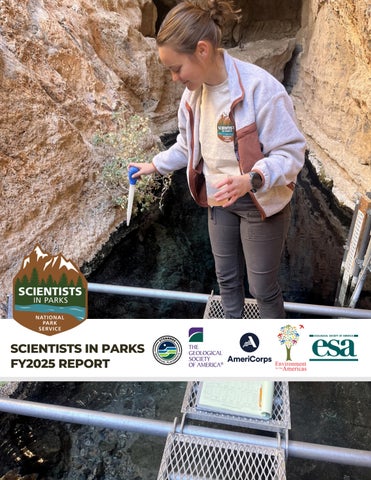
SCIENTISTS IN PARKS FY2025 REPORT
Table of Contents EXECUTIVE SUMMARY
3
STATEMENT OF PURPOSE
4
PROGRAM OBJECTIVES
4
TYPES OF POSITIONS
4
PROGRAM SUMMARY
5
PROGRAM FUNDING
5
SUPPORT OF DOI STRATEGIC PRIORITIES
6
COORDINATING ORGANIZATIONS
6-7
LIST OF SIP PARTICIPANT POSITIONS
8-16
FEDERAL HIRES
17
PROGRAM ACHIEVEMENTS
18
PUBLICITY HIGHLIGHTS
18
PROFESSIONAL CONFERENCES
18
SIP HIGHLIGHTS (Ishan Merkel, Katie Cartee, Shea Slonkosky, Georgia Houde)
19-22
SIP PROGRAM EVALUATIONS AND DEMOGRAPHICS
23
HOW DID YOU FIRST HEAR ABOUT THIS SIP POSITION?
23
AGE DISTRIBUTION OF SIPS
23
EDUCATIONAL STATUS OF SIP PARTICIPANTS
23
VETERANS
23
SURVEY QUESTIONS AND QUOTES
25-26
ACKNOWLEDGEMENTS
27
CONCLUSION
28
Scientists in Parks Annual Program Report Fiscal Year 2025 National Park Service, Geologic Resources Division P.O. Box 25287 Denver, CO 80225-0287 October 1, 2025 U.S. Department of the Interior National Park Service Natural Resource Stewardship and Science
SIP Avery Blumenthal planting a native shrub in a restoration area at Grand Teton National Park, WY. (NPS Photo)
Cover Photo: Reece Lynch doing field work in DEVA, feeding Devil’s Hole pupfish.
2
Executive Summary In the federal fiscal year (FY) 2025 from October 1, 2024 to September 30, 2025 the Scientists in Parks Program (SIP) placed a total of 160 participants in 92 park units across the country. These accomplished participants supported the National Park Service (NPS) mission by completing essential natural resource science work in parks while providing the participants with experience to further their professional prospects. All positions supported natural resource management park needs and focused on multi-disciplinary approaches including citizen science, interpretive programs, data collection and analysis, collections management, and more. Many projects directly align with DOI interim strategic priorities. As of September 1, 2025 (when this report was prepared), fiscal year 2025 SIP participants contributed 100,790 service hours toward natural resource science needs for the NPS. The NPS obligated just over $4.7 million to fund the program. Funding for 10 positions came from NPS cooperating associations. The vast majority of SIP participants were between the ages of 21 and 35 and had completed an undergraduate degree. Twelve SIPs were hired into federal positions. This report describes aspects of the program structure, lists all FY2025 positions, highlights selected positions, and includes SIP participant feedback from final evaluation reports. The SIP program is run in partnership with NPS Natural Resource Stewardship and Science Directorate, Stewards Individual Placements (a program of Conservation Legacy), The Geological Society of America, The Ecological Society of America.
SIP Participant Addy Pletcher working in the Alaska Regional Office. (NPS Photo)
SIP Participant Clara Morrison removing lint and dust from soda straws above the tour trail in Lehman Caves for 2025 “Lint Camp” at Great Basin National Park, NV.
3
Statement of Purpose The Scientists in Parks (SIP) Program is administered by the National Park Service (NPS) Natural Resource Stewardship and Science Directorate (NRSS) and several non-governmental partner organizations. The SIP Program provides a mechanism by which NPS parks, networks, regions, and programs can host non-federal participants to undertake projects that address natural resource management issues. Simultaneously, the SIP Program provides SIP participants a high-quality experience that inspires and develops the next generation of park stewards and fosters a life-long connection to the National Park System. SIP positions may vary considerably in complexity, length, discipline, and skill set, in accordance with the needs of NPS units and abilities of the SIP participants. SIP manages two seasons of positions with start dates year-round that contribute to natural resource management in biological sciences, physical sciences, social sciences, and communication & education. Positions in these disciplines must address one or more natural resource management categories, including, but not limited to, air quality, geology, hydrology, night skies, paleontology, and soundscapes.
Program Objectives Meet park natural resource management needs Provide participants with meaningful natural resource management experience that supports parks and the NPS mission and can enhance their career potential.
Types of Positions SIP Individual Placement positions are best for entry- to mid-level skill sets. Positions are 12-52 weeks in length during either the summer or winter season. Participants receive a one-time relocation allowance of $400 ($1,050 for Alaska, Pacific Islands, and Caribbean positions) plus a weekly stipend of $565 if park housing is provided, or $665 if park housing is not provided. Participants are eligible to earn hours toward the Public Lands Corps Hiring Authority and an AmeriCorps Segal Education Award if they successfully complete their term. SIP DHA Participants positions target upper-level undergraduate or graduate students who are interested in natural resource science careers with the federal government. These are rigorous positions that develop the participant’s technical and creative thinking abilities, leadership skills, and problem-solving capabilities. The positions last 12 weeks during the summer are eligible for Direct Hire Authority. SIP DHA Participants receive a weekly stipend of $760.
SIP Reilly Blackwell Reilly replaces the cap that measures water quality at Tunnel Spring in Hot Springs National Park, AR. (NPS Photo)]
4
Program Summary In FY2025, the SIP program was administered through an NPS national youth cooperative agreement (P22AM00148), and funded by annual task agreements, with Conservation Legacy (P25AC00814 & P24AC00435). These agreements are authorized under the Public Lands Corps Act (16 U.S.C. § 1723(c)). The SIP participants are affiliated with AmeriCorps, a program that engages individuals in intensive community service work with the goal of helping others and meeting critical community needs. Because all SIPs are AmeriCorps Members, positions are open to U.S. citizens and legal residents. Upon successfully completing their position, SIPs are eligible for an AmeriCorps Segal Education Award valued at $1,565 to $7,395 (pre-tax). The award amount is dependent upon several factors such as the length of their term, successfully obtaining the minimum required AmeriCorps hours, and whether they have received prior AmeriCorps Education Awards. This Award can be used for paying back student loans, continuing the participant’s higher education, or for other qualifying educational expenses. Position distributions equated to 44 positions at 1700 hours (52 weeks), 12 positions at 1200 hours (36 weeks), 30 positions at 900 hours (26 weeks), 42 positions at 675 hours (20 weeks), 30 positions at 450 hours (12 weeks), and 2 positions at 300 hours (10 weeks). In addition to the AmeriCorps affiliation, SIP participants for positions that serve 52 weeks are eligible to opt in for health insurance, at no cost to the participant.
Program Funding The National Park Service obligated $4,700,067 in FY2025 to support park operations and resource management activities. The funding includes fully or partially funding 128 of the 160 FY25 SIP positions for a total of 4,393 weeks. In addition, individual park cooperating associations partnered with the NPS to provide 10 SIP positions for 287 weeks.
SIP Griffen Fallwell cleaning a fossil specimen at Waco Mammoth National Monument, TX. (NPS Photo)
5
Support of DOI Strategic Priorities Below are some examples of how the SIP program supports the Department of the Interior Draft Strategic Priorities. Priority 3: Management and Delivery of Water SIP Reece Lynch, a Hydrology Assistant at Death Valley National Park, participated with the hydrology monitoring program to provide better spatial coverage, and to respond to increasing threats to water resources from rapidly shifting environmental conditions and groundwater pumping. Her efforts towards this project will allow park managers to identify trends that will inform water management at the park. Priority 4: Safety and Protections for our People, Property, and Resources SIP Zoe Zowal, a Geomorphology Assistant at Mount Ranier National Park (MORA), participated in projects that directly benefited ongoing efforts by the MORA Geology and Imminent Threats Program to analyze geomorphic processes across various physical and temporal scales. She did so by analyzing data collected from field geomorphic mapping, elevation surveys, stream discharge surveys, and installation of remote sensing equipment and other specialized equipment. Her contributions to these projects will help inform glacier responses to the rapidly changing environmental conditions. Priority 6: Conservation of Lands, Waters, Species, and Heritage SIP David Harrison, a Biology Assistant at Big Thicket National Preserve, focused their efforts on collecting data on populations of rare and imperiled plant species in the park through field surveys and literature review. His contributions to these projects will help develop tools to aid the park in restoration, monitoring, and mitigating impacts of park operations on rare plants.
Coordinating Organizations National Park Service, Natural Resource Science and Stewardship Directorate The NPS Natural Resource Stewardship and Science Directorate (NRSS) provides scientific, technical, and administrative support to national parks for the management of natural resources. NRSS has a strong commitment to providing science-based on-the-ground youth career development opportunities through the management of the Scientists in Parks Program. For more information about SIP: https://go.nps.gov/sip Kiersten Jarvis, Scientists in Parks Program Manager l kiersten_jarvis@nps.gov l 970-658-6826 Chelsea Bitting, Scientists in Parks Partnership Lead l chelsea_bitting@nps.gov l 303-819-8933 Melanie Wood, Scientists in Parks Financial Assistance Lead l melanie_wood@nps.gov l 970267-2198 Sam Olivares-Mejia, Scientists in Parks Park Support Lead l Samantha_Olivares-Mejia@nps.gov
Stewards Individual Placements Stewards Individual Placements (Stewards) is a program of Conservation Legacy. It offers land and water management agencies and other non-profit organizations opportunities to accomplish specific projects by providing individual placements (AmeriCorps Service Terms) on public lands. Stewards is responsible for the position advertisement system, the SIP website and administering the SIP Program once the participants have been hired which includes but is not limited to enrollment, stipend, travel, and relocation disbursements, AmeriCorps compliance and reporting, general program expectations, mentor and member support, and preparation of the annual SIP report. For more information about Stewards: https://www.stewardslegacy.org/ Geoff Elliot, Executive Director l gelliot@conservationlegacy.org l (970) 946-1320 Emma Savely, Program Director l emma@conservationlegacy.org l (970) 903-5763 Ali Jones, Program Coordinator l ajones@conservationlegacy.org l (970) 382-1947 Morgan Hassey, Program Coordinator l mhassey@conservationlegacy.org l (970) 946-4952 Andre Nguyen, Program Coordinator l anguyen@conservationlegacy.org l (970) 946-9523 Gillian Watson, Program Coordinator l gwatson@conservationlegacy.org l (970) 902-0634
6
Coordinating Organizations The Ecological Society of America (ESA) is a nonpartisan, nonprofit organization of scientists. Their mission is to advance the science and practice of ecology and support ecologists throughout their careers. They envision a future where people embrace science to understand and foster a thriving planet. Central to ESA’s work is the mentoring of young scientists in the field. ESA organizes activities during its annual meetings to help students review their resumes, hone their interviewing skills, and share tips to succeed as scientists and professionals in all sectors. ESA is the engagement partner for the SIP program where they support affinity groups, produce the SIP Scoop newsletter, coordinate social media posts, conduct site visits, host virtual science talks, as well as coordinate a session highlighting SIP projects and organize participant travel to the ESA Annual Meeting. For more information about ESA: https://esa.org Teresa Mourad, Director, Education Programs l teresa@esa.org Joey Moreno, Education Programs Assistant l joey@esa.org Mary Joy Mulumba, Education Programs Assistant l mary@esa.org The Geological Society of America (GSA) is a global professional society with a growing membership of more than 20,000 individuals in more than 100 countries. GSA provides access to elements that are essential to the professional growth of earth scientists at all levels of expertise and from all sectors: academic, government, business, and industry. The Society unites thousands of earth scientists from every corner of the globe in a common purpose to study the mysteries of our planet (and beyond) and share scientific findings. GSA is responsible for advertising, recruiting, and managing the application process for the SIP Program. GSA Foundation annually supports multiple positions in Alaska. For more information about GSA: https://geosociety.org Elizabeth Long, Director, Center for Professional Excellence l elong@geosociety.org l (303) 357-1000 Lesley Petrie, Education & Outreach Program Coordinator l lpetrie@geosociety.org l (303) 357-1097
SIP, Kara Taylor posing in the Big Cypress National Preserve during a wet-walk through a cypress swamp. (Both photos courtesy of NPS.)
SIP Alivia Mayes measuring, weighing and inspecting a Hypentelium nigricans, the northern hogsucker, for any disease or deformities in the Heartland Inventory and Monitoring Network.
7
List of SIP Participant Positions Table 1. SIP positions that started in FY2025
8
NPS Unit
Position Title
Participant Name
ID #
Appalachian National Scenic Trail
Ecology Assistant
Aiesha Parmar
4110
Assateague Island National Seashore
Biology Assistant
Cira Seyer-Ochi
4029
Badlands National Park
Paleontology Assistant
Jacob Yoder (Term 2)
4157
Big Cypress National Park & Preserve
GIS Assistant
Nathaniel Belles
3907
Big Thicket National Preserve
Biology Assistant
David Harrison
3869
Bighorn Canyon National Recreation Area
Ecology Assistant
Betsy Finn
4005
Biscayne National Park
Ecology Assistant
Nika Dassatti
4050
Biscayne National Park
Ecology Assistant
Jeremy Irsik
4051
Boston Harbor Islands National Recreation Area
Natural Resource Management Assistant
Xiony Rodriguez
3923
Boston Harbor Islands National Recreation Area
Science Communication Assistant
Tori Young
3925
Boston Harbor Islands National Recreation Area
Ecology Assistant
Liz Halasz (Term 3)
4120
Buck Island Reef National Monument
Natural Resource Management Assistant
Ajani Saldana
3975
Camp Nelson National Monument
Paleontology Assistant
Emily Jackson
3961
Cape Cod National Seashore
Science Communication Assistant
Kathryn Perrault
3864
Cape Cod National Seashore
Natural Resource Management Assistant
Lena Beckley
3910
Cape Hatteras National Seashore
Biology Assistant
Margaret Knight
4040
Casa Grande Ruins National Monument
Biology Assistant
Paulina Goping
4037
Central Alaska Inventory & Monitoring Network
Ecology Assistant
Noah Guyton
3813
Chaco Culture National Historical Park
Night Skies Assistant
Jennie LaComb
2597
List of SIP Participant Positions (cont.) NPS Unit
Position Title
Participant Name
ID #
Chattahoochee River National Recreation Area
GIS Assistant
Chloe Pryor (Term 2)
3868
Chattahoochee River National Recreation Area
Biology Assistant
Kai Spriggs
3867
Chihuahuan Desert Inventory & Monitoring Network
Ecology Assistant
Zoe Garver
3978
Chihuahuan Desert Inventory & Monitoring Network
Ecology Assistant
Braulio Sanchez
3979
Colonial National Historical Park
GIS Assistant
Andre Alquiza
2620
Colorado National Monument
Ecology Assistant
Clair Czadzeck
4152
Colorado National Monument
Natural Resource Management Assistant
Haley Freeborn (Term 2)
4154
Colorado National Monument
Biology Assistant
Evelyn Stephens
3828
Congaree National Park
Ecology Assistant
Megan Herrmann
3963
Congaree National Park
Natural Resource Management Assistant
Loren Rhodes
3834
Coronado National Memorial
Natural Resource Management Assistant
Shea Slonkosky
3833
Coronado National Memorial
Natural Resource Management Assistant
Lauren Badinger
3957
Coronado National Memorial
Natural Resource Management Assistant
Jordan Williams
4155
Cumberland Island National Seashore
Natural Resource Management Assistant
Ray Jalbert (Term 2)
4090
Cuyahoga Valley National Park
Hydrology Assistant
Reece Lynch
3887
Death Valley National Park
Education Assistant
Julianna Cannato
3841
Death Valley National Park
Education Assistant
Nathalie Lai
3840
Death Valley National Park
Science Communication Assistant
Quinn Pearson
3839
Denali National Park and Preserve
Science Communication Assistant
Quinn Pearson
3839
9
List of SIP Participant Positions (cont.)
10
NPS Unit
Position Title
Participant Name
ID #
Denali National Park and Preserve
Natural Resource Management Assistant
Sarah Martin
3872
Denali National Park and Preserve
Science Communication Assistant
Mariana Perez (Term 2)
3879
Denali National Park and Preserve
Science Communication Assistant
Joseph Norvilas
3936
Denali National Park and Preserve
Natural Resource Management Assistant
Zoe Bates
3898
Denali National Park and Preserve
Natural Resource Management Assistant
Kris Jovag
3897
Denali National Park and Preserve
Geology Assistant
Eliza Lawrence
4048
Denali National Park and Preserve
Acoustic Assistant
Adam Kosinski
3970
Dinosaur National Monument
Paleontology Assistant
Emma Boeman
3836
Dinosaur National Monument
Collections Assistant
Anna Jordan
3842
Dinosaur National Monument
Paleontology Assistant
Gaia Orchard (Term 2)
3835
Dry Tortugas National Park
Natural Resource Management Assistant
Sofia Arias
3860
Dry Tortugas National Park
Natural Resource Management Assistant
Maddie Tiemann
3861
Eastern Rivers and Mountains Inventory & Monitoring Network
Ecology Assistant
Hannah Cabell
3962
Eastern Rivers and Mountains Inventory & Monitoring Network
Ecology Assistant
Sara Thiessen
4010
Effigy Mounds National Monument
Paleontology Assistant
E Vigil
4126
Fire Island National Seashore
Ecology Assistant
Rachael Harris
3915
Fire Island National Seashore
Ecology Assistant
Meredith O'Donnell
4099
Gates of the Arctic National Park and Preserve
Ecology Assistant
Megan Tomerlin (Term 2)
3881
List of SIP Participant Positions (cont.) NPS Unit
Position Title
Participant Name
ID #
Gates of the Arctic National Park and Preserve
Biology Assistant
Alexa Busby
3856
Glacier National Park
Biology Assistant
Whitney Formon
4054
Golden Gate National18Recreation Area 13
Ecology Assistant
Ethan Ostraff
4113
Grand Canyon National Park 60
Education Assistant
Emily Jennings
3849
Grand Canyon National Park
Education Assistant
Sydney Woodward
3848
Grand Canyon National Park
Science Communication Assistant
Leah Flake
3971
Grand Teton National 204 Park
Visitor Use Management Assistant
Israel Montiel
3896
Great Basin National Park
Cave and Karst Assistant
Clara Morrison
3885
Great Lakes Inventory & Monitoring Network
Ecology Assistant
Kate Roberts
3826
Great Smoky 55.6% Mountains National Park
Biology Assistant
Oliver Wood
3968
41.7% Gulf Coast Inventory & Monitoring Network
Geomorphology Assistant
Alisa Glenewinkel-Meyer
4039
Gulf Islands National Seashore - Florida
Natural Resource Management Assistant
Saige Matolka
3943
Gulf Islands National Seashore - Florida
Natural Resource Management Assistant
Felix Roy
3942
Gulf Islands National Seashore - Florida
Natural Resource Management Assistant
Robin Marvel
2667
Hawai‘i Volcanoes National Park
GIS Assistant
Brianna Ninomoto
3880
89.9% Hawai‘i Volcanoes National Park
Biology Assistant
Braxton Igne
3935
Hawai‘i Volcanoes National Park
Ecology Assistant
Olivia Ponchin
3977
Hawai‘i Volcanoes National Park 10.1%
Biology Assistant
Searrah Bierker (Term 2)
4011
170
48
8
11
List of SIP Participant Positions (cont.)
12
NPS Unit
Position Title
Participant Name
ID #
Heartland Inventory & Monitoring Network
Ecology Assistant
Philip Duchild
3874
Heartland Inventory & Monitoring Network
Ecology Assistant
Alivia Mayes
3891
Hot Springs National Park
Hydrology Assistant
Reilly Blackwell
3875
Hot Springs National Park
Hydrology Assistant
Amahra Matthai
3965
Isle Royale National Park
Natural Resource Management Assistant
Sarah Wyrick
4023
Jewel Cave National Monument
Cave and Karst Assistant
Forest Rocks
3934
Joshua Tree National Park
Biology Assistant
Jacob Eader
3882
Joshua Tree National Park
Ecology Assistant
Anita Garg
3939
Joshua Tree National Park
Astronomy Assistant
Joseph Green (Term 2)
3854
Joshua Tree National Park
Ecology Assistant
Emma Marcus (Term 2)
4173
Joshua Tree National Park
Astronomy Assistant
Jason Beal
4026
Kaloko-Honokōhau National Historical Park
Biology Assistant
Rachel Nunley
3916
Kaloko-Honokōhau National Historical Park
Biology Assistant
Katie Cartee
3946
Kaloko-Honokōhau National Historical Park
Biology Assistant
Katie Cartee (Term 2)
4072
Lassen Volcanic National Park
Natural Resource Management Assistant
Mila Opalenik
4125
Lyndon B. Johnson National Historical Park
Astronomy Assistant
Chelsea Hill
2673
Marsh-Billings-Rockefeller National Historical Park
Education Assistant
Nathalie Lai (Term 2)
3920
Mediterranean Coast Inventory & Monitoring Network
Ecology Assistant
Gabriella Busalacchi
3901
Mediterranean Coast Inventory & Monitoring Network
Ecology Assistant
Lindsay Filgas
3899
List of SIP Participant Positions (cont.) NPS Unit
Position Title
Participant Name
ID #
Mount Rainier National Park
Geomorphology Assistant
Zoe Zawol
3933
Mount Rainier National Park
Interpretive Assistant
Chloe Baumann
4017
National Interagency Fire Center (NPS)
Science Communication Assistant
Nikolai Belikov (Term 2)
3937
North Coast and Cascades Inventory & Monitoring Network
Geology Assistant
Samantha Beaton
3895
Northeast Coastal and Barrier Inventory & Monitoring Network
GIS Assistant
Audrey Brown (Term 2)
3909
Northern Colorado Plateau Inventory & Monitoring Network
Biology Assistant
Tiffany Nash
3911
Northern Great Plains Inventory & Monitoring Network
Biology Assistant
Torin O'Brien (Term 2)
3913
NPS Air Resources Division
Ecology Assistant
Jeremy Brady (Term 2)
4122
NPS Biological Resources Division
Ecology Assistant
Dante Chea Robiou
3922
NPS Climate Change Response Program
Natural Resource Management Assistant
Daniela Daniele
3850
NPS Geologic Resources Division
Geology Assistant
Emily Sotelo Edwards
3945
NPS Geologic Resources Division
Paleontology Assistant
Everly Jazi (Term 3)
4074
NPS Geologic Resources Division
Geomorphology Assistant
Briana Reagan
4134
NPS Inventory and Monitoring Division
Ecology Assistant
Brooke Bellmar
4148
NPS Inventory and Monitoring Division
Biology Assistant
Lee Walker
4115
NPS Inventory and Monitoring Division
Science Communication Assistant
Olivia Porter (Term 2)
4000
NPS Natural Resource Stewardship & Science Directorate- Denver
Science Communication Assistant
Sander Moffitt (Term 2)
3883
NPS Natural Resource Stewardship & Science Directorate- Ft Collins
Hydrology Assistant
Eileen McGinnity
3884
13
List of SIP Participant Positions (cont.)
14
NPS Unit
Position Title
Participant Name
ID #
NPS Water Resources Division
Hydrology Assistant
Rose Weisgerber (Term 2)
3940
NPS Water Resources Division
Natural Resource Management Assistant
Lydia Mussack
3932
NPS Water Resources Division
Natural Resource Management Assistant
Madelyn Lewis
3929
NPS Alaska Regional Office
Geology Assistant
Dan Wexler
3947
NPS Alaska Regional Office
Geology Assistant
Addy Pletcher (Term 2)
3852
NPS Alaska Regional Office
Natural Resource Management Assistant
Georgia Houde
3889
NPS Alaska Regional Office
Ecology Assistant
Lauren Hintenlang (Term 2)
4140
NPS Alaska Regional Office
Ecology Assistant
Mia Taylor
4147
NPS National Capital Regional Office
Ecology Assistant
Jacob Cohen
3905
NPS Midwest Regional Office
Ecology Assistant
Kyla B O'Hearn
4086
Olympic National Park
Education Assistant
Ishan Merkel (Term 2)
3865
Olympic National Park
Astronomy Assistant
Elizabeth Orlando
4092
Oregon Caves National Monument and Preserve
Natural Resource Management Assistant
Katie Collins (Term 2)
3917
Ozark National Scenic Riverways
GIS Assistant
Hanna Mohammed
3931
Pictured Rocks National Lakeshore
Natural Resource Management Assistant
Rachel Dietz
2722
Point Reyes National Seashore
Natural Resource Management Assistant
Corinne Johnson
4153
Redwood National Park
Natural Resource Management Assistant
Katelyn Blaylock
4025
Redwood National Park
Natural Resource Management Assistant
Eloise MacLean
4024
Rocky Mountain Inventory & Monitoring Network
Ecology Assistant
Christina Appleby (Term 2)
4071
List of SIP Participant Positions (cont.) NPS Unit
Position Title
Participant Name
ID #
Rocky Mountain National Park
Interpretive Assistant
Rayna Carner
3843
Rocky Mountain National Park
Education Assistant
Katie Caperton
3955
San Antonio Missions National Historical Park
Hydrology Assistant
Laura Hoyt
4129
San Francisco Bay Area Inventory & Monitoring Network
Biology Assistant
Vienna Rist
4103
Sequoia & Kings Canyon National Parks
Biology Assistant
Benjamin Kintner
3853
Shenandoah National Park
Education Assistant
Eliana Hernandez (Term 2)
3904
Shenandoah National Park
Astronomy Assistant
Sophia Truex
4036
Shenandoah National Park
Interpretive Assistant
Meredith Wall
4038
Sleeping Bear Dunes National Lakeshore
Hydrology Assistant
Jay Mrazek
3876
Sleeping Bear Dunes National Lakeshore
Natural Resource Management Assistant
Elize Budziak
4089
Sonoran Desert Inventory & Monitoring Network
Ecology Assistant
Kaitlin Koster
4130
Southern Plains Inventory & Monitoring Network
Ecology Assistant
Sydney Hedberg
2766
Southern Plains Inventory & Monitoring Network
Ecology Assistant
Emily Fitzpatrick
4064
Southwest Alaska Inventory & Monitoring Network
Ecology Assistant
Kimberlyn Pace (Term 2)
3888
Stones River National Battlefield
Science Communication Assistant
Ellie Hennessy
4070
Tallgrass Prairie National Preserve
Natural Resource Management Assistant
Odalys Espino-Picazo
3892
Waco Mammoth National Monument
Paleontology Assistant
Griffen Fallwell
4044
White Sands National Park
Paleontology Assistant
Ashton Fowler
3894
White Sands National Park
Paleontology Assistant
Victor Perez Jr (Term 3)
3893
15
List of SIP Participant Positions (cont.) NPS Unit
Position Title
Participant Name
ID #
Yellowstone National Park
GIS Assistant
Rachel Solorio
3890
Yellowstone National Park
Natural Resource Management Assistant
Devlin Rutherford (Term 2)
3906
Yosemite National Park
GIS Assistant
Cara Whalen
3921
Yosemite National Park
Biology Assistant
Jocelyn Stansberry
3903
Yosemite National Park
GIS Assistant
Michelle Andruss
3878
Yosemite National Park
Geomorphology Assistant
George Pharris
3862
Yosemite National Park
GIS Assistant
Mietron Shahbodaghloo
3902
Zion National Park
Night Skies Assistant
Sydney Gaylor
3825
SIP Participant Forest Rocks testing a rock to determine its composition at Jewel Cave National Monument, SD.]
16
SIP Participant Zoe Zawol changing a Longmire seismic station memory card at Mount Rainier National Park, WA. (NPS Photos)
Federal Hires Table 2. List of SIP Interns who were hired into the federal workforce from the FY2025 cohort. Note: This list includes those who disclosed their plans in final reports submitted prior to September 1. There may be additional federal hires that were unreported to the SIP Program.
SIP Name
Federal Agency
Park Unit or Location
Position Title
GS Level
Anita Garg
National Park Service
Division of Sea Turtle Science and Recovery at Padre Island National Seashore
Wildlife Technician
GS-04
Cara Whalen
Bureau of Land Management
Rock Springs Wyoming Office
GIS Specialist
GS-11
GS-06
Ishan Merkel
National Park Service
Olympic National Park
Seasonal Biological Science Technician of Aquatics and Wildlife
Jennie LaComb
National Park Service
Grand Canyon National Park
Recreation Fee Clerk
GS-04
Jocelyn Stansberry
National Park Service
Yosemite National Park
Wildlife Technician
GS - 05
Joseph Green
National Park Service
Mount Rainer National Park
Interpretive Ranger
GS-05
Joseph Norvilas
National Park Service
Cape Code National Seashore
Seasonal Interpreter
Unreported
Mariana Perez
National Park Service
unreported
Biological Science Technician Fire Effects Monitor
GS-06
Megan Tomerlin
National Park Service
unreported
Biological Science Technician
GS-06
Mila Opalenik
US Forest Service
unreported
Forestry Technician
GS-05
Sarah Martin
National Park Service
Denali National Park
Fire Effects Monitor
GS-05
Sydney Gaylor
National Park Service
Mount Rainier National Park
Interpretive Ranger
GS-05
Samantha Olivares-Meija
National Park Service
NPS Geologic Resources Division
SIP Park Support Lead
GS-07
17
[SIP Participant Loren Rhodes caving with her fellow Scientists in Parks and Individual Placements participants. (NPS Photo))
Program Achievements Publicity Highlights Katy Perrault published multiple NPS articles about her time at Cape Cod. Titles below: Surprises in Scat: Studying the Eastern Coyote population within Cape Cod National Seashore, Parkwide and Multisystem, Cape Cod Ecosystem Monitoring, Coastal Shores Monitoring, Coastal Uplands, Estuaries and Salt Marshes Monitoring, Wildlife Monitoring Cape Cod National Seashore Facebook post and Instagram post featuring SIP participant, Caitlin Sughrue, written and photographed by SIP participant, Katy Perrault NPS Article published by SIP participant Clara Morrison titled “Cave Climates of Great Basin National Park” NPS Article highlighting Justin Sontag, Naomi Friedman, Annika Munson, and Bryn Callie, titled “Sonoran Desert Network Scientists in Parks Interns: Summer 2024 – Summer 2025”
Professional Conferences All SIP participants and alumni are encouraged to attend and present at professional conferences hosted by our partners. Each partner hosts an annual meeting for scientists to share their research and connect with fellow experts in their field. It is a valuable experience for SIPs to network, present their findings, and further their early career development. This year, the Ecological Society of America Annual Meeting was hosted in Baltimore, Maryland, August 10–15, 2025 and the Geological Society of America Connects Annual Conference will be held in San Antonio, Texas, October 19–22, 2025.
18
SIP Highlights Ishan Merkel Education Assistant — Olympic National Park, WA As a Scientists in Parks participant at Olympic National Park, Ishan Merkel developed and ran educational programs to engage students of all ages and share with them the value of the National Park Service and what park biologists do on a daily basis. A major focus of Ishan’s SIP project was the park's Snow Science education program, which brought local 7th grade students to Hurricane Ridge in the winter to learn about the importance of the winter snowpack. In addition to supporting the Snow Science program, Ishan also assisted in conducting snow surveys at remote sites across the park. Ishan’s supervisor, Dean Butterworth, reflected on Ishan’s valuable contributions during his time at Olympic, “Ishan was a great addition to the education team at Olympic National Park. We wouldn't have been able to successfully deliver the Snow Science program without his contributions. He also developed a hands-on and engaging activity for a family STEAM night for a local elementary school that showcased his creativity and interest in connecting students to science.”
Ishan Merkel servicing a weather monitoring station in Olympic National Park. (NPS Photo)
Ishan spoke about his time in the SIP program influencing his career goals, stating, “My goal is to become an ecologist for the National Park Service. I have experience as a scientific technician for the National Park Service, but being an ecologist for a public-facing agency also requires skills in public speaking, education, interpretation, and the human dimensions of ecology. This internship allowed me to build and practice those skills. I found this dimension of working for the NPS equally fulfilling, which reaffirmed my career goal of working for the NPS.” Presently, Ishan is living out that career goal! After completing his Scientists in Parks term, Ishan transitioned to a GS-6 federal position as a Biological Science Technician (Aquatics and Wildlife) at Olympic National Park.
[Ishan Merkel stands behind a table setup for Olympic National Park at a school science fair. (NPS Photo)]
19
SIP Highlights Katie Cartee Biology Assistant—Kaloko-Honokōhau National Historical Park, HI At Kaloko-Honokōhau National Historical Park on the Island of Hawai‘i , home to active volcanoes and rich ocean coastlines, Katie Cartee served as a Biology Assistant where her service focused on one of the island’s most unique resources—anchialine pools. These brackish pools of water, which are connected to the ocean through underground lava tubes, are home to native species found nowhere else in the world. Katie’s main project involved conducting the first-ever assessment of anchialine pools within the park. Starting from scratch, she helped develop data collection tools in ArcGIS FieldMaps, used Global Navigation Satellite System technology for mapping pool locations, and created standard operating procedures for use by future park staff. Over her six-month term, Katie helped survey 364 anchialine pools, including 110 that had never before been mapped! This information was compiled into a comprehensive report with maps, photographs, and supplementary data that will guide future management practices. Katie also contributed with other management efforts including conducting surveys on invasive little fire ants, resulting in positive results that informed treatment plans, as well as helping protect endangered Hawaiian monk seals during public haul-outs. She also helped with public outreach and education: Katie helped create a board game about anchialine pools that was presented at local cultural festivals, reaching hundreds of local students with engaging lessons about the importance of native species.
[SIP Participants Katie Cartee (left) and Rachel Nunley (right) at Kaloko-Honokōhau National Historical Park in Kailua-Kona
Katie’s supervisor, Kaile‘a Annandale, believes Katie is doing lasting wonders for the Big Island’s unique natural areas, “Katie’s project has a great impact to the park and community, ensuring that these natural areas are protected for future generations”. For Katie, the experience confirmed her passion for the National Park Service, “I am most proud of finding new pools and documenting the flora, fauna, and cultural sites associated with them. That leaves a legacy in the park that now can be maintained and cared for with future management.” What lies in Katie’s future? Another Scientists in Parks term! Katie is continuing this work into a second term at KalokoHonokōhau National Historical Park, where she will help develop a management plan aimed at preserving anchialine pools for decades to come.
20
Katie Cartee surveying an anchialine pond.
SIP Highlights Shea Slonkosky Natural Resource Management Assistant — Coronado National Memorial, AZ Coronado National Memorial, near the US-Mexico border within the Madrean Archipelago, preserves significant varieties of species and natural resources in the United States. Rapidly changing environmental conditions are adversely affecting resources, including biospheres, wilderness, and landscape. As a Scientists in Parks Natural Resource Management Assistant, Shea was able to contribute to a variety of projects related to hydrology, caveclimate monitoring and restoration, bat surveys, social trail mapping, and erosion/slope stability monitoring. To help reestablish a stream morphology project that had been inactive for the past 10 years, Shea reviewed and improved the previous protocol, analyzed prior data, and relocated measurement points in the field. Shea was also heavily involved in bat surveying and assisted with setting up nets and equipment to count bats. Surveys recorded when bats leave their favorite roosting place in the park and recording each type of bat observed.
SIP Participant Shea Slonkosky
When asked why the national parks are important to her, Shea answered, “The national parks are important to me because they are a way to get people out in nature in an educational and sustainable way. They teach people the importance of protecting and preserving ecosystems and inspire people to be involved in environmental conservation. Personally, they allow me to explore pristine environments with minimal impact, conduct important scientific research, and learn about America’s rich history.”
SIP Shea Slonkosky and a fellow caver pose in a cave near Coronado National Memorial. (NPS Photo)
SIP Shea Slonkosky crawling through a tunnel in a cave near Coronado National Memorial (NPS Photo)
21
SIP Highlights Georgia House Natural Resource Management Assistant — Alaska Regional Office, AK Wildland fire is one of the most widespread and significant disturbances in Alaska’s boreal forests. Fire reinvigorates ecological processes, restarts successional sequences, and contributes to a complex mosaic of vegetation communities throughout Alaska. The National Park Service Fire Ecology Program has been collecting and analyzing data on affected landscapes, fire behavior, short and long-term vegetation change related to fire management actions for several decades, and Georgia was able to contribute to this important, long-standing research. Georgia began by re-structuring how projects and their associated documentation were stored and archived in the fire ecology resource drive, helping get the park and its projects organized. This included everything from planning documentation and logistics planning, GIS data and maps, field data, protocols, analyses and accompanying reports and all documentation associated with any given project. The standardization of file structure allowed for increased efficiency of locating necessary project data and documentation for anyone who intends to utilize the information associated with these expansive and long-term fire ecology projects.
Georgia in front of the NPS Fairbanks Administrative Center
Georgia also created an outreach resource in ArcGIS Online Experience Builder that helps communicate the impact of collecting these long-term data and carrying out this extensive research to the community. The project Georgia chose to highlight is the McCarthy University Subdivision shaded fuels break. The knowledge gained from these projects will help inform how we maintain natural ecological processes while protecting communities from the effects of extreme fire behavior. When asked if this experience during her SIP term influenced her career goals Georgia answered: “I feel even more encouraged to keep pursuing the field of forest and fire ecology research and communication. This experience solidified my desire to be doing collaborative and impactful work in this field. I am thankful most of all to the people who supervised and mentored me. They are incredible and have kept this feeling of hope an inspiration for me to continue a life based in forest and fire ecology research. My supervisor, Jennifer Mcmillan, is deeply supportive and her mentorship has meant so much to me in a moment that felt foundational in thinking of my future and how I will continue forward in this field.” After her service, Georgia will bring her experience and skills back to her position at the University of Alaska Fairbanks completing Forest Inventory Analysis and other vegetation surveys, as well as a Renewable Resources Extension Act Forestry Communication position with the University. 22
Georgia developing maps using ArcGIS Pro. (NPS Photo)
SIP Program Evaluations and Demographics SIP Participants were asked to complete pre-position and post-position evaluations, to help the NPS understand the participants’ backgrounds, experiences, and to collect feedback to further enhance the program in future years. Note: The following charts show data for 150 SIP Participants who concluded their position prior to September 1, 2025.
How did you first hear about this SIP Position? Thirty-nine percent (39%) of SIP Participants learned about the program through various NPS outlets such as their websites, NPS employees, etc. The second highest outlet for selected SIP participants to hear about the program was from job boards and listservs at eighteen percent (18%).
Age Distribution of SIPs Ninety-seven percent (97%) of SIPs were between the ages of 21-35 (155 total) with just three (3%) of SIPs in the 35 and older age range (4 total) and just 1 SIP between the ages of 18-20 years old.
Educational Status of SIP Participants Just over five percent of participants reported to be undergraduate students while the majority, about seventy-five (~75%) of SIP participants reported to have received a bachelor’s degree. Almost twenty percent (20%) percent of the participants reported receiving a master’s degree. Chart 1. Educational Status of selected SIP participants
Veterans In FY2025, one veteran participated in the SIP program. The SIP program is once again proud to host veterans at national parks throughout the year and wants to thank Christina Appleby for her service!
23
SIP Participant Kyla Tuazon presenting her poster “Deliminating Areas in the National Park Infested with the Little Fire Ant (Wasmannia auropunctata)” at the Mariana Islands Conservation Conference, War in the Pacific National Historical Park, Guam (NPS Photo)
SIP Participant Parker DePond checking samples for data proofing at Wind Cave National Park, SD. (NPS Photo)]
[SIP Participant Fernanda Arevalo evaluating a tree during vegetation monitoring at Monocacy National Battlefield, MD. (NPS Photo)]
24
Participant Quotes Please describe your favorite aspect of your experience as an SIP participant. “Most interesting to me has been working from the perspective of a data manager rather than a researcher or lab technician. I have historically approached projects from a laboratory or scientific point of view, but being able to work from this new perspective has allowed me to see the effects of different field or lab protocols on data collected in a significantly clearer way. These are lessons I will surely remember in future roles”—Jacob Cohen, National Capital Regional Office, Ecology Assistant “I feel incredibly fulfilled that I can use my skill set and past experience to contribute to Grand Teton’s mission in a way that would not have been accomplished as readily without my involvement as an SIP. It is the mentorship of my site supervisor that made each aspect of that work possible and thoroughly enjoyable.” —Israel Montiel, Grand Teton National Park, Visitor Use Management Assistant “I have rarely been able to contribute so directly to communicating data to people actively making management decisions. Using science to inform management is exciting to me, and it’s been exciting to get to use and develop my skills in a way that facilitates that. I’ve been involved in data collection for a long time, and I’ve been developing graphing, analysis, and reporting skills more slowly on the side. It was great to have a position with this much time devoted to practicing those skills, and it’s especially nice that I was able to do that in a way that was useful for real world land management purposes.”— Mary Tomerlin, Gates of the Arctic National Park and Preserve, Ecology Assistant “My favorite aspect of my experience was the freedom that I had working on this project! It felt like while there were some overall goals, I had quite a bit of space as to how I structured things, side quests I wanted to go on, how I structured my day, that sort of thing. It helped me grow a lot when it came to figuring out how to move through complex project in an efficient way.”—Kimberlyn Pace, Southwest Alaska Inventory & Monitoring Network, Ecology Assistant
Do you feel as if your projects made a contribution towards the mission of the National Park Service? How so or why not? “My project made a contribution to the mission of the National Park Service because I worked with schools to inspire youth and educate them on the cultural history and natural aspects of the park. I assisted with lesson planning and game building which revolved around the science curriculum and Grand Canyon National Park."—Sydney Woodward, Grand Canyon National Park, Education Assistant “I very much feel that my project made a contribution to the mission of the NPS. I documented resources within a park that had, until now, only been mentioned in passing. The staff here knew of very few fossils within the park; only to find out that there are fossils everywhere within Camp Nelson National Monument, they just didn't know it. Now they're capable of teaching visitors here the same way, and they hope to grow the educational programs about Camp Nelson National Monument paleontology and geology after my departure”—Emily Jackson, Camp Nelson National Monument, Paleontology Assistant “ “Certainly! I ended every snowshoe tour by talking about Leave No Trace Principles, and the idea that the existence of the National Parks allows for future generations to enjoy our public lands and the same way that we have today.”—Rayna Carner, Rocky Mountain National Park, Interpretive Assistant If you could make one recommendation to the Director of the National Park Service on how the NPS can better connect with young people/adults what would you say? “Outreach directly to schools is an effective way to engage young people with the work of the NPS, and is a worthwhile endeavor to continue investing in.” — Ishan Merkel, Olympic National Park, Education Assistant “To better connect with younger audiences, I recommend expanding the NPS’s online presence through interactive activities. Offering virtual tools to explore parks, such as online tours or interactive features, could engage a younger, tech-savvy audience. Additionally, there’s an opportunity to enhance in-person programs. While the Junior
25
Participant Quotes Ranger program is fantastic for children, expanding similar interactive experiences for teens and young adults, through hands-on activities or talks focused on issues important to them, would help make national parks more appealing to this age group. Combining online and in-person engagement could create a more dynamic and seamless way for younger people to connect with the parks”—Rachel Nunley, KalokoHonokōhau National Historical Park, Biology Assistant Why are the national parks important to you? “Growing up, my parents couldn't afford to take us very far for spring or winter break, but when they could take us on a vacation, it was always to a national park. National parks are valuable spaces, they are beautiful and provide everyone opportunities to escape and to learn about the natural world and its importance for maintaining our health. I learned so much visiting these parks as a kid, enough that it influenced my education as an adult, enough that it made me hope to hold a park ranger job so that I could be the one helping kids realize their love for the environment too.”—Emily Jackson, Camp Nelson National Monument, Paleontology Assistant "I love the national parks because they are a great mix of science, human interaction, conservation and nature, and pride in the work that the people do. I loved working with the NPS because everyone was so passionate about what they were doing and that is really reflected in the experience that visitors receive and the work we create."—Clara Morrison, Great Basin National Park, Cave and Karst Assistant "The national parks are important to me as I have so many fond memories of visiting them on family vacations. Now, I’m getting to deepen those relationships by working and living in them too! I really think there’s something so meaningful about the national parks as they seek to protect the beautiful places by granting people access."— Nathalie Lai, Death Valley National Park, Education Assistant “National parks are important to me because state and national parks were some of the first places I remember getting outside and feeling in awe of nature and continue to be some of my favorite places to do so. I think we all could use some more awe of nature in our lives. Having worked at a national park now, they're especially important to me after seeing
26
the many dedicated people working to protect, preserve, and share that awe (of both natural and cultural resources) with others”—Kathryn Perrault, Cape Cod National Seashore, Science Communication Assistant
What do you want senior officials in the National Park Service to know about your experience? "My career goal is to become an ecologist for the National Park Service. I have experience as a scientific technician for the National Park Service, but being an ecologist for a public-facing agency also requires skills in public speaking, education, interpretation, and the human dimensions of ecology. This internship allowed me to build and practice those skills. I found this dimension of working for the NPS equally fulfilling, which reaffirmed my career goal of working for the NPS."—Ishan Merkel, Olympic National Park, Education Assistant “I think opportunities such as Scientists in Parks are essential to getting people into the park service. I grew up in Boston where I currently am serving, and I didn't even realize that the site is within the National Park Service. In fact, my first visit to a national park was in college, where I was provided the opportunity to go out and explore. Programs such as Scientists in Parks are critical to providing opportunities to understand the careers within this field”—Xiony Rodriguez, Boston Harbor Islands National Recreation Area, Natural Resource Management Assistant
“The work that young people do and the perspective they bring is vital to the National Park Service mission. Creating avenues for there to be more permanent jobs where young people can build into this work with benefits and stability is important for sustaining the energy and creativity brought by younger people in this organization.”—Georgia Houde, Alaska Regional Office, Natural Resource Management Assistant
Acknowledgements Scientists in Parks would like to acknowledge the contributions of the 160 outstanding Scientists in Parks participants! Every SIP provided valuable research, analyses, and essential natural resource science work that furthers the goals and objectives of the NPS and grows each participant professionally. NPS is also incredibly grateful to the outstanding supervisors/mentors who provided essential support for the program by identifying positions, overseeing the participant’s projects, ensuring participant success, and providing mentoring and guidance to help the participants thrive in their current and future job opportunities.
SIP Participant Rachel Harris Participating in tick dragging surveys at Fire Island National Seashore, NY. (NPS Photo
In FY2025, 10 SIP positions were supported by park associations. The SIP program would like to thank the Badlands Natural History Association, Rocky Mountain Conservancy, Grand Canyon Conservancy, Shenandoah National Park Association, Sally and Bob Newcomb, Glacier National Park Conservancy, Hawai'i Pacific Parks Association, and the National Park Foundation. The NPS Youth and Young Adult Programs provides great insight and the SIP Team is always grateful. Thank you for your help! The SIP Program would graciously like to thank leaders of the Natural Resource Stewardship and Science Directorate and the Cultural Resources Stewardship, Partnerships, and Science Directorate Ray Sauvajot, Guy Adema, Joy Beasley, Stephanie Gaswirth, and Jason Kenworthy for their ongoing encouragement, support, and guidance of the program.
[SIP Participant Joseph Green looks through a telescope while hosting an educational program in Black Rock Campground at Joshua Tree National Park, CA. (NPS Photo)]
27
Conclusion
[SIP Participants Gaia Orchard (left) and Emma Boeman (right) preparing for work on the quarry wall of the Quarry Exhibit Hall in Dinosaur National Monument, UT. (NPS Photo)]
The Scientists in Parks Program managed 160 participants in 92 parks and offices in every DOI region. Scientists in Parks participants provided demonstratable benefits to NPS units, program participants, and the public by completing critical natural resource management needs in parks while furthering the NPS mission. They also received the benefits of a paid internship which included on-the-ground experience in a park setting and professional development opportunities. The SIP Program Coordinating Organizations strive to create a better experience each year for all participants and supervisors/mentors who utilize the program. In the future, we plan to continue these efforts by creating resources and guides to share with supervisors/mentors on how to create an encouraging, developmental, and successful experience between the SIP participant and the park.
28