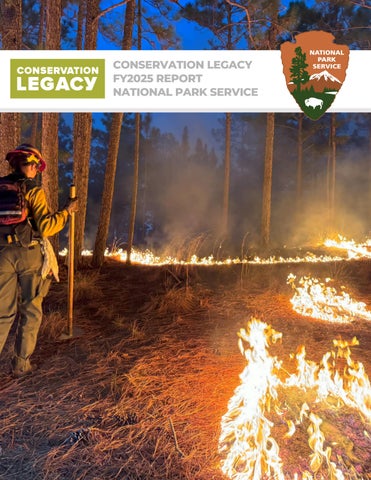
CONSERVATION LEGACY FY2025 REPORT NATIONAL PARK SERVICE
INTRODUCTION TABLE OF CONTENTS CONTACT INFORMATION page two ACKNOWLEDGEMENTS page two MESSAGE FROM THE PRESIDENT page three CONSERVATION LEGACY OVERVIEW pages four and five FUNDING AMOUNTS (INCLUDING OTHER SOURCES) page five PURPOSE OF THE PROGRAM page six PROGRAM MODELS pages seven and eight PROJECT AND PROGRAM HIGHLIGHTS pages nine through sixteen STORIES OF IMPACT pages 17 and 18 DEMOGRAPHIC INFORMATION page nineteen CONCLUSION page twenty APPENDIX A-D pages twenty-one through twenty-seven
CONSERVATION LEGACY NATIONAL PARK SERVICE FY2025 REPORT Report Term: October 2024–September 2025 CONTACT INFO FOR CONSERVATION LEGACY: Joey Ruehrwein SVP of External Affairs 701 Camino del Rio, Suite 101 Durango, Colorado 81301 Email: joey@conservationlegacy.org Phone: 970-401-2381 Amy Sovocool, President 701 Camino del Rio, Suite 101 Durango, Colorado 81301 Email: amy@conservationlegacy.org Phone: 970-903-3022
FOR NATIONAL PARK SERVICE Ernestine M. White National Youth Employment Programs Coordinator 21CSC, Vets, YMCA, BGCA) 1849 C Street, NW Mail Stop: 2355 Washington, D.C. 20240 202-570-5628 cell
2
Secretary Burgum with Ancestral Lands Conservation Corps at Pecos National Historical Park
ACKNOWLEDGMENTS Conservation Legacy extends our sincere thanks to the National Park Service staff, Cooperators, and Partners who continue to support our shared vision of protecting and restoring our nation’s treasured lands. We are deeply grateful for your dedication, without which our mission would not be possible. We would especially like to acknowledge the following National Park Service offices, Corps, and regional offices for their support: Department of the Interior NPS STAFF AND UNITS: NPS Washington Office NPS Youth Office NPS Rivers and Trails Conservation Assistance Program NPS Historic Preservation Training Center Region 1 North Atlantic Appalachian Region 2 South Atlantic Gulf Region 3 Great Lakes Region 4 Mississippi Basin Region 5 Missouri Basin Region 6 Arkansas Rio Grande Texas Gulf Region 7 Upper Colorado Basin Region 8 Lower Colorado Basin Region 9 Colombia Pacific Northwest Region 10 California Great Basin Region 11 Alaska Region 12 Pacific Islands We would also like to thank the many local and regional partners who help make our programming a success, as well as the youth, veterans, and young adults who participate in our Corps and contribute to the conservation of public lands.
MESSAGE FROM THE PRESIDENT DEAR PARTNERS AT THE NATIONAL PARK SERVICE, Our commitment to young people and our national parks— to ensuring young Americans who want to serve to protect and preserve these places can thrive—is at the core of all our corps work. Commitment to service and to preserving and protecting these unique places is something that I take great pride in. I, along with the entire Conservation Legacy team, have the great honor of sharing our successes and the dedication of our participants to these places. Growing up in a gateway community near Acadia National Park, I knew parks were an important way of life, to local economies, and to outdoor activities. It wasn’t until I started my career journey serving in parks in the West that I also realized the power these places have to transform individuals. Service in parks develops a deep and indelible sense of purpose, grit, tenacity, and awe for our public lands that is irreplicable. As we reflect on the accomplishments of this year and look to the future, there is an opportunity to celebrate the unique history of our parks and the people who have continued to protect these places and landscapes. As we approach our nation’s 250th birthday, we are proud to recognize the critical role parks have played in our nation’s history. As demonstrated on the following pages, this service and work are critical to keeping this history alive. From safeguarding these incredible places from fire to the management of heritage Hereford cattle, the projects are diverse while the need is universal. I hope you enjoy and appreciate the impact demonstrated in this report. Each project highlighted requires significant commitment, support, mentorship and guidance from dedicated NPS staff. I want to recognize and thank all of these individuals for their role in ensuring our young people can serve, grow, and contribute to the incredible legacy of our national parks. Appalachian Conservation Corps Fire Crew member felling a tree at Shenandoah National Park
Sincerely,
Amy Sovocool President, Conservation Legacy
3
OVERVIEW
ABOUT CONSERVATION LEGACY Conservation Legacy is a national network of locally-led conservation corps committed to empowering individuals through service to improve public lands, protect natural and cultural resources, and enhance communities across the United States. Our mission is to engage future leaders who protect, restore, and enhance our nation’s lands through community-based service. With a focus on local leadership and decision-making, Conservation Legacy supports a network of diverse and regionally specific Corps divisions that address local conservation priorities. Through this federated structure offering both team-based crew experiences and individual placements, we provide participants with highquality, immersive experiences in conservation, personal growth, and career development. Through these opportunities, Conservation Legacy cultivates the next generation of conservation leaders, offering training in natural resource management, technical skills, and environmental education. Federated Structure Conservation Legacy’s federated structure is unique in the industry. It combines the local focus and responsiveness of smaller corps with the organizational capacity and reach of a national corps. Each local corps is led by an executive director based in the communities they serve, with local program staff administering day-to-day operations. This model ensures high levels of engagement with youth and partners, allowing Corps to be nimble and adapt to community needs. At the same time, Conservation Legacy’s national coordination enables local corps to participate in large-scale national Corps and meet performance outcomes that require broad collaboration. This structure provides the flexibility and innovation of a community-based program while delivering the consistency and resources of a national organization.
Conservation Legacy operates eight branded Corps, each designed to meet the specific needs of the communities and landscapes they serve: Ancestral Lands Conservation Corps (ALCC) – ALCC engages Indigenous youth and young adults in conservation projects that restore public lands, while reconnecting participants with their ancestral heritage. The program emphasizes cultural resurgence and environmental stewardship, offering hands-on experiences in trail building, habitat restoration, and cultural site preservation across sacred Indigenous landscapes. Appalachian Conservation Corps (ACC) – ACC serves the Appalachian region, focusing on the restoration of forests, waterways, and trails. With projects in the Shenandoah Valley and surrounding areas, ACC provides young adults with opportunities to engage in conservation work while addressing local environmental challenges such as habitat degradation and invasive species management. Arizona Conservation Corps (AZCC) – AZCC mobilizes young adults and veterans to complete conservation projects throughout Arizona. Participants work on a variety of initiatives, including trail maintenance, habitat restoration, and wildfire mitigation, contributing to the long-term health of Arizona’s diverse ecosystems and public lands. Conservation Corps New Mexico (CCNM) – CCNM addresses critical conservation needs across New Mexico and adjacent regions. Through hands-on service, participants engage in projects that focus on restoring public lands, preserving natural resources in areas like the Gila Wilderness and White Sands National Park. Conservation Corps North Carolina (CCNC) – CCNC works to conserve the natural and cultural resources of North Carolina. The program partners with local and national organizations to engage youth in projects that improve public lands, protect waterways, and restore native ecosystems, while fostering environmental stewardship and leadership development. Southeast Conservation Corps (SECC) – SECC serves the southeastern United States, focusing on environmental restoration, trail maintenance, and community resilience. The program works in national parks, forests, and other
4
(cont.)
OVERVIEW public lands across the region, offering participants the chance to develop skills in conservation and public service while addressing pressing environmental issues. Southwest Conservation Corps (SCC) – SCC operates in Colorado and New Mexico, engaging young adults and veterans in projects that restore ecosystems, improve recreational access, and protect cultural resources. SCC’s focus on habitat restoration, trail building, and fire mitigation ensures the protection of critical natural areas in the Southwest. Stewards Individual Placements – Stewards Individual Placements offers unique conservation resource assistantships with public land agencies and conservation partners across the U.S. Participants work individually in placements that focus on scientific research, cultural resource management, public education, and other areas that contribute to the stewardship of public lands. Each of these programs plays a critical role in the broader mission of conserving public lands and cultural heritage while preparing participants for careers in conservation and public service. Conservation Legacy’s collaborative approach enables national partnerships with agencies like the National Park Service, while also promoting strong relationships with local stakeholders, ensuring that the benefits of conservation work are felt across the country. FUNDING AMOUNTS Program AZCC ALCC ACC CCNC CCNM SECC SCC STEWS Total
Project Cost 718,317 2,095,471 1,830,875 307,013 165,835 495,809 199,867 9,818,235 $15,631,422
NPS 538,738 1,571,603 1,373,156 230,260 124,377 371,857 149,900 7,363,677 $11,723,567
In-kind 179,579 523,868 457,719 76,753 41,459 123,952 49967 2,454,559 $3,907,856
Southwest Conservation Corps Watershed Strike team member testing samples by the Dolores River.
Stewards Individual Placements CVA at Grand Canyon National Park.
5
PURPOSE The partnership between Conservation Legacy and the National Park Service serves to advance critical land management priorities while offering young adults structured, educational opportunities that foster personal growth, professional development, and environmental stewardship. Through this collaboration, participants engage in hands-on projects that help preserve both natural ecosystems and cultural heritage, while addressing pressing issues such as the national energy emergency, public safety, and economic development.
PROGRAM SUCCESS HIGHLIGHTS
This partnership also plays a pivotal role in safeguarding the cultural and natural resources of these treasured spaces for future generations. By promoting infrastructure improvements, conserving wildlife, and improving access, Conservation Legacy supports the broader mission of the NPS to ensure the long-term preservation of public lands.
In 2025, we collaborated with the NPS to engage over 1,098 youth, young adults, and veterans from diverse backgrounds. Through our Corps across the country, participants connected with public service and conservation careers while deepening their understanding of the natural and cultural legacy that our public lands represent.
Central to this effort is a commitment to fostering partnerships with local communities, Tribes, and conservation organizations, while also preparing participants for meaningful careers in conservation and public service. Through our programs and Corps, young adults and veterans develop essential life skills and gain access to career opportunities, all while contributing to improved public safety, recreation and access in our beloved national parks and sites.
Our long-standing partnership with the NPS ensures that each participant receives high-quality training, personal development opportunities, and meaningful on-theground experience. Our Corps and programs not only contribute to the preservation of our parks but also foster the next generation of environmental stewards who are committed to safeguarding public lands for future enjoyment.
FOR OVER 25 YEARS, CONSERVATION LEGACY AND THE NATIONAL PARK SERVICE HAVE BEEN UNITED IN THEIR MISSION TO PRESERVE AND PROTECT OUR NATION’S MOST TREASURED RESOURCES. As the NPS continues to safeguard the natural and cultural assets of the National Park System for future generations, we are honored to have been a consistent partner in this critical work for more than two decades.
OUTCOMES AS RELATED TO DEPARTMENT OF INTERIOR’S PRIORITIES Job readiness and skills development Recreation access Public safety Disaster response
Southeast Conservation Corps Youth Crew repairing the boardwalk in the Cherokee National Forest.
6
The following project highlights from each of our Corps will focus on how our service work supports the DOI’s priorities of providing job readiness and skills development for youth and young adults, while also improving recreation access, public safety and disaster relief for communities across the nation. In our member quotes and IP evaluations, participants report feeling more prepared and confident in pursuing careers in natural and cultural resources and with NPS and other federal government land management agencies. The projects reported also increase public safety and access for recreation opportunities through maintaining and building trails, removing hazardous fuels, improving overall ecosystem health, and preserving structures and buildings on NPS lands.
PROGRAM MODELS NATIONAL PROGRAM MODELS Community Volunteer Ambassador The Community Volunteer Ambassador (CVA) program is a 50-week professional resource apprenticeship experience managed in partnership by the National Park Service and the Stewards Individual Placement Program. CVA members support volunteer Corps by expanding volunteerism, service-learning, community engagement efforts, and increasing the sustainability of established Corps. Ambassadors focus on a number of core objectives, including building enduring relationships with local communities, increasing park volunteerism opportunities, improving disaster response processes, and helping to organize community stewardship days. Veterans Fire Corps The Veterans Fire Corps (VFC) engages recent-era veterans on priority hazardous fuels and prescribed burn projects while developing the next generation of wildland firefighters.
HPTC Water Lab and Utility Shop program member performing system checks at Point Reyes National Seashore
Scientists-in-the-Park The Scientists-in-the-Park (SIP) program works with partners to match college students and recent graduates aged 18 35 years old with short-term, paid resource assistantships with the National Park Service. Participants may assist with research, synthesis of scientific literature, geologic mapping, GIS analysis, site evaluations, resource inventorying and monitoring, impact mitigation, developing brochures and informative media presentations, and educating park staff and park visitors. Historic Preservation Training Center The Historic Preservation Training Center (HPTC) and Stewards Individual Placement Program partnership provides training and experience for young adults and veterans interested in the historic preservation trades. Members gain skills while helping to preserve the historic structures, monuments, and memorials throughout the park system, as well as addressing the backlog of deferred maintenance projects. Through three signature programs— the Traditional Trades Advancement Program, and the Preservation Work Experience—the HPTC and Stewards are helping to train a future workforce in specialized building trades and historic preservation. HPTC member rebuilding an old cabin in Yosemite NP
7
PROGRAM MODELS Traditional Trades Advancement Program (TTAP) offers entry-level opportunities for young adults and veterans, providing hands-on training in essential trade skills such as masonry, carpentry, and wood crafting. Designed to address maintenance needs in national parks, TTAP prepares participants for careers in historic preservation and related fields by focusing on land and cultural resources. Through this program, members gain practical experience and specialized training, equipping them for successful careers in both the public and private sectors while contributing to the preservation of our nation’s heritage.
Youth Empowerment Stewards (YES) Launched in 2021, the Stewards Youth Empowerment Program positively impacts the country’s recreation and tourism economy by expanding park entry for visitors. YES members serve at NPS host sites, providing park units with the capacity to identify and make public lands and visitor services more welcoming for all. By working directly with park units, YES members support an array of park projects aligned with DOI priorities. The objective of this partnership is to complete important conservation projects that create recreation access and ensure public safety while providing young adults with structured and challenging service and educational opportunities through experiences that promote personal growth, economic opportunity, the development of life skills, and an ethic of natural resource stewardship. Conservation Legacy and Stewards Individual Placements work towards consistently making these opportunities available to young people and veterans.
Historic Stewards/Maintenance Action Teams (MAT) are immersive resource apprenticeships focused on addressing critical preservation needs through hands-on projects for individuals with prior experience or education in trades. Individual Placements work alongside National Park Service (NPS) staff in specialized fields such as masonry, carpentry, and wood crafting, gaining advanced skills that prepare them for careers in historic preservation or related trades. By serving directly with NPS staff, Individual Placements contribute significantly to the maintenance and restoration of historic structures. This program provides essential capacity support for parks by enabling teams to attend to deferred maintenance needs, ensuring the long-term preservation of our nation’s historic resources.
Build Up Technical Resource Apprenticeship: The Build Up Technical resource apprenticeship Program offers technical resource apprenticeships in fields such as engineering, architecture, and project management. Individual Placements shadow NPS teams on large-scale projects, acquiring specialized expertise in their respective fields while contributing to effective park planning and facilities maintenance. Through hands-on experience, participants support efficient recordkeeping, continued park recreation, and the creation of digital media and reports. This program not only enhances technical skills but also ensures the sustainable management and preservation of national park resources.
Ancestral Lands Conservation Corps team studying black bear populations in the Chuska Mountains on the Navajo Nation
8
PROJECT HIGHLIGHTS
APPALACHIAN CONSERVATION CORPS
ACC Veteran Fire crews serving at New River Gorge NP PROVIDING CAREER OPPORTUNITIES FOR VETERANS New River Gorge National Park and Nature Preserve has become a foundational partner for our program over the last few years. During this reporting period, ACC ran a Veteran’s Fire Corps program, and Pathways to Fire, a trails program funded by the National Park Foundation, and another trails program funded and outlined by the Legacy Restoration Fund-Maintenance Action Team (MAT) program. Across these four projects, ACC has had 24 individuals serve over 6,500 hours. JOB READINESS AND SKILLS DEVELOPMENT The two fires crews treated over 225 acres preparing prescribed burn area, created 6.5 miles of fire break, and maintained an additional 8 miles. These crews worked directly with the NERI Fuels crews alongside CUVA staff when working in Cuyahoga Valley National Park. They earned Wilderness First Aid, S-130/190, S-211, and S-212 Certifications either through ACC or through NERI. These crews were positioned to support NPS staff on AD if there was a wildfire incident during their season, and both crews were able to work directly on prescribed fires to gain valuable experience before heading graduating the program and beginning their careers with Federal and State land management agencies.
For our Fire Crews, these positions give them direct skills and experience to transition into Federal and State Fire Management careers. Throughout our time in this partnership, we have had multiple members and leaders hired directly into seasonal jobs at New River Gorge, along with fire and natural resource jobs with other Park Units and Land Management Agencies. The trail crew that was working on the MAT project was helping support and maintain vital trail infrastructure on the Kaymoor Miners Trail which sees some of the highest public usage in the National Park. This crew worked directly alongside NPS staff to replace decking and support structures for the large Kaymoor Staircase that leads down the trail with the goal of making the trail safer for its user groups.
The two trail crews served a total of 2,292 hours of service. They maintained or built over 37 miles of trail and tackled a large infrastructure project on the Kaymoor Miners Trail, along with maintaining a bulk of the trails through the National Park in preparation for visitor usage throughout the year. These crews had the opportunity to sit down with NPS staff and talk about USA Jobs and careers with the National Park Service.
“The mission of pairing veterans with a fire position is amazing and we plan on putting as much effort into the program for years to come.”
ACC Veteran Fire crews serving at New River Gorge NP
9
PROJECT HIGHLIGHTS
ANCESTRAL LANDS CONSERVATION CORPS IMPROVING ACCESS AND PUBLIC SAFETY ALCC Crews worked with the Maintenance Action Team (MAT) from El Malpais National Monument and the Historic Preservation Training Center to improve 3.12 miles of the Big Tubes Trail, building cairns and clearly designating the trail to improve visitor safety. This project targets the goals and values outlined under the Legacy Restoration Fund- Maintenance Action Team, a service-wide facility maintenance program which will support, engage, and stimulate maintenance and preservation trades work while providing transferrable skills training and an ethic of resource stewardship to program participants. This project directly addresses the deferred maintenance backlog at small and medium sized National Parks. with meaningful historic preservation trades experience, develop a foundation in cultural and natural resources protection, and foster lifelong connections to the NPS. This project motivated youth and young adult involvement with cultural, natural, and historical resource protection locally and nationally by providing participants with hands-on, skills-based training in these fields. These trade skills are highly sought after in both private and public industry and allow for expanded employment opportunities for participants who complete the program. Exposure to this work and skill development will foster a resource stewardship in participants. The NPS receives the indirect benefit of completing cultural, natural, and historical resource protection projects through this project activity. HAZARDOUS FUEL REDUCTION ALCC crews worked with Walnut Canyon National Monument staff to remove hazardous fuel loads from around 25 sensitive and rich archaeological sites that date back 900-years. The crew learned from NPS staff about the parks natural and cultural resources. They learned how to assess fuel loads, operate and maintain chainsaws, and how to administer first aid in a wilderness setting. SKILL-BUILDING AND PROFESSIONAL DEVELOPMENT ALCC partnered with Mesa Verde National Park to select three individual placements, some from Pueblos and Tribes who trace their lineage to the park’s original inhabitants, to participate in the Park’s Interpretive Rangers program, gaining skills and work experience by serving as part of Mesa Verde National Park’s Interpretation and Education team. Participants shared and interpreted their cultural connection to the park while assisting park visitors. The project strengthened relations with tribal partners and provided visitors with more opportunities to see the depth of Mesa Verde’s story. Participants were connected to potential careers with the National Park Service and their heritage and cultural values.
“This experience has been to me, life changing. In a way it was like going home.” 10
ALCC TTAP IPs building a trail (top) and serving at Mesa Verde NP
PROJECT HIGHLIGHTS
ARIZONA CONSERVATION CORPS In the fall of 2024, AZCC Crew 382 performed work primarily with Flagstaff Area National Monuments working with the within the Department of Interior’s “Seeds of Success” Program. Seeds of Success (SOS) is the national native seed collection program in partnership with a variety of federal agencies and non-federal organizations. SOS’s mission is to collect wildland native seed for research, development, germplasm conservation, and natural area restoration. The long-term conservation outcome of the SOS program is to support the native plant materials development process, by which the BLM increases the quality and quantity of native plant materials available for restoring and supporting resilient natural areas. JOB READINESS AND SKILLS DEVELOPMENT The crew learned about resource management in the national parks and was exposed to career opportunities with public agencies, while gaining skills in native plant conservation, botany, seed collection and curation, habitat restoration, and plant materials production. PROTECTING NATURAL RESOURCES WHILE PROMOTING PARK ENJOYMENT They directly contributed to the conservation of native plants for the enjoyment of the public, further promoting the purposes of the NPS supporting the protection of natural and cultural resources for the enjoyment of future generations. The projects fostered an understanding of botany and ecology for the crew and informed their understanding of habitat restoration techniques. This work fostered an ethic of stewardship and developed skills that crew members will be able to take with them into their communities and beyond.
AZCC member collecting seeds for the Department of Interior’s “Seeds of Success” Program
AZCC member collecting seeds for the Department of Interior’s “Seeds of Success” Program
“It makes me happy knowing the seeds we collect will be used for future restoration initiatives. I’m also grateful that I am learning plant identification, skills, ArcGIS skills, and leadership skills. I’m learning so much about plant identification in the different life stages they go through. I feel like I’ve gained valuable knowledge of several native plant species.”
AZCC members serving at Flagstaff Area National Monument
11
PROJECT HIGHLIGHTS
CONSERVATION CORPS NEW MEXICO IMPROVING RECREATION THROUGH LAND STEWARDSHIP At White Sands National Park, Conservation Corps New Mexico Crew 572 conducted road work, extracted weeds, disposed trash, and fence emplacement for the benefit and enjoyment of park goers. The 6-person crew worked 480 hours, treated 1.30 miles of public trails, cleared 6,867 feet of corridor, and removed 20 Mesquite trees. David Bustos, NPS Integrated Resource Manager assisted the crew with placing new signs for visitors to learn about the wildlife that can be found in White Sands National Park. The crew removed mesquite trees, which are native to the Chihuahua Desert and thus native to White Sands National Park; however, the over-expansion of cattle grazing in the late 19th century spread them from stream-side areas to the large desert floor, transforming desert grasslands to desert shrublands. INSTALLING NEW SIGNAGE FOR IMPROVED PARK ACCESS White Sands National Park is one of the most visited national parks in the United States due to its unique field of dunes, plants, and wildlife. Therefore, new signs were put in place to capture the attention of visitors and educate them on fun facts about the plants and animals that live in White Sands National Park.
“It’s places like this that makes it worth it and helps you put things into perspective.”
CCNM crew members install a trail marker at White Sands NP
CCNM crew members performing trail restoration at White Sands NP
Restored trail at White Sands National Park
12
PROJECT HIGHLIGHTS
CONSERVATION CORPS NORTH CAROLINA
CCNC winter chainsaw crew members serving in the Croatan National Forest and on the Outer Banks with NPS IMPROVING PUBLIC SAFETY AND TRAILS ACCESS IN THE WAKE OF NATURAL DISASTER The NPF Outer Banks Visitor Experience Improvement crew worked across the Outer Banks Group National Park sites to address critical deferred maintenance needs resulting from storms impacting coastal North Carolina. Project work included hazard tree mitigation, facilities repair, and vegetation management. This crew experience was designed to train members on skills needed for future employment with the National Park Service and to improve the visitor experience across these sites. This project made a significant impact across Cape Hatteras National Seashore. In Buxton, our crew cleared over five and a half miles of trail and three acres of brush, significantly improving public safety and trail access. They also felled dead trees resulting from past storms and turned them into firewood, which the park put to good use. At Ocracoke, the team built a cedar log walkway, cleared access roads, prepped space for storage containers at the pony pens, and built eight new picnic tables. In Nags Head, they took down seven snags and five old inlet markers and hauled them over 120 yards to a drop point.
“I always had the idea that I would have a job working outside whether that’s with the forestry service, NPS, or other government services but my recent experience has made me want to pursue working for NPS.”
JOB READINESS AND SKILLS DEVELOPMENT The season gave our crew real, hands-on experience and a chance to build job-skills and confidence. They started with Wilderness First Aid and chainsaw training, before jumping into service. By the end of the season, they were leading brush clearing, felling trees, and building trail infrastructure. Members very much appreciated the variety of tasks, which really helped the crew stay motivated. Members also shared how much more confident they felt working with saws and being in the field.
CCNC winter crew restoring a trail at Croatan National Forest and on the Outer Banks with NPS
CCNC winter crew restoring a trail at Croatan National Forest and on the Outer Banks with NPS
13
PROJECT HIGHLIGHTS
SOUTHEAST CONSERVATION CORPS IMPROVING VISITOR EXPERIENCE AND ACCESS SECC, in partnership with Natchez Trace National Scenic Trail, supported a 4-person trail/saw crew from March 25, 2025 – May 6th, 2025. This crew consisted of one Non-AmeriCorps Crew Leader, and three AmeriCorps Crew Members. This is SECC’s 10th year partnering with the Natchez Trace, continuing to rehabilitate the scenic trail to protect resources, improve visitor experience, and reduce deferred maintenance. This project specifically has the support from The Corps Network, who completed the project scope of work for the Natchez Trace Scenic Trail.
“My experience with SECC has given me a sense of empowerment and confidence that continues on past my service, leading me to complete my dream of hiking the AT and opening new paths through conservation and education.”
DISASTER RELIEF THROUGH TRAIL MAINTENANCE This crew served their season in Maddison County, MS, completing various trail rehabilitation projects on the Yockanookany segment of the Natchez Trace National Scenic Trail. This section spans 25 miles and is used for hiking and equestrian purposes but has suffered damage from storms and equestrian use, making much of the trail unsafe. Damage has occurred to the trail tread, the trail bridges, and other structures, such as boardwalks. The NATR maintenance staff cannot keep up with the other operations and maintenance requirements associated with the NATT asset inventory of buildings, roads, and utility systems, as well as the combined 65 miles of the NATR. The crew’s season consisted of trail repair, board walk demo, clean up of downed trees, and culvert installation. This includes building 70 feet of board walk and the removal of 62 downed trees. JOB READINESS AND LEADERSHIP DEVELOPMENT SECC’s Crew Leader Development program is a crew model with the intention of coaching individuals to eventually lead future crews with SECC. This crew specifically started their season spending two weeks with SECC and Conservation Legacy staff, gaining certifications in Wilderness First Aid and Chainsaw A Faller/Bucker. The members of the crew each had an opportunity to be an assistant crew leader, learning not only the skills necessary to lead other individuals, but the opportunity to coordinate and manage projects. All three crew members from this crew have taken their experience from their season and have continued to serve with SECC during the summer/fall of 2025 in a leadership capacity. The rehabilitation and restoration of the Yockanookany trail section within Natchez Trace National Scenic Trail is vitally important due to the historical background of the trail and the visitor experience the trail provides.
SECC crew member serving at Natchez Trace National Scenic Trail
14
SECC crew member serving at Natchez Trace National Scenic Trail As one of the oldest transportation routes in America, from around 8,000 BCE, this trail has had centuries of American Indian use and has provided several different use types for Americans, including US postal routes and sites for Civil War battles. Over the past six years, the parkway has attracted over 6 million visitors each year who are eager to navigate the trails in the park. This project will reestablish the Yockanookany trail, which has fallen into disuse and disrepair from the impacts of weather events, equestrian damage, and everyday use. This project will restore the trail tread and structures along the trail to operational conditions, allowing visitors the ease of use and safe travel. The execution of this project will begin a reversal of deterioration to the surrounding fences and provide for the long-term preservation of this historic resource.
PROJECT HIGHLIGHTS
SOUTHWEST CONSERVATION CORPS IMPROVING RECREATIONAL ACCESS AND PUBLIC SAFETY The “Youth Individual Placements for Cyclic Maintenance of Ancient Aztec Cultural Landscape” project was developed to provide eight weeks of projects for youth and young adult crews to improve the condition of the Ancient Aztec Maintained Landscape. This work increased recreational access and public safety, positively impacting the community in increasing access to and maintaining historic sites for current and future recreational visitors. Throughout the project, crews were able to clear 21 rooms in the Aztec Ruins Monuments of weeds. Public trails were maintained with limbs and other debris removal. The site was weeded with seeding of native plants completed to reinvigorate native plant life and habitat. Tumbleweeds, dead sage, and other hazardous fire materials were removed for fuel reduction.
SCC crew member looking out over Mesa Verde National Park
The MEVE Youth Crew was a continuation of a project that began in 2024. The purpose was to complete general maintenance, brushing, weeding, and upkeep in the vicinity of Moorefield Campground. During their one week hitch, the crew cleared corridor on multiple trails, maintained tread, prepared the Step House site for preservation, and weeded Chapin Amphitheater to prepare for an Indigenous Ceremonial Dance. SKILLS DEVELOPMENT AND JOB PREPAREDNESS This project helped with recreation access at the Moorefield Campground and the work on the trail corridors helped with public safety. Additionally, as this hitch was used during our Youth Crew Leader Training, the project was used to support skills development, and job preparedness.
“Being able to work in an ancestral Pueblo site was an honor and a privilege. We learned about the energy and efforts that are needed to preserve and maintain a place as special as Aztec Ruins.”
SCC crew members serving at Aztec Ruins National Monument
SCC crew member using loppers to help clear the Aztec Ruins National Monument of weeds
SCC crew member serving at Aztec Ruins National Monument
15
PROGRAM HIGHLIGHTS
STEWARDS INDIVIDUAL PLACEMENTS CREATING PATHWAYS TO CAREERS IN PUBLIC LANDS The Stewards Individual Placement Program (Stewards) is a national initiative that places young adults and veterans in conservation and community-focused positions, offering hands-on experience and professional development opportunities. Divided into Stewards East and Stewards West, this initiative connects participants with public lands, cultural resources, and local communities across the United States, while creating a direct career pathway into National Park Service offices and other federal agencies. Each area is tailored to the unique environmental and cultural needs of its respective region.
PARTICIPANTS CONVERTED TO FEDERAL HIRES Historical Preservation Training Center: 15 Traditional Trades Advancement Program: 9 Water Lab and Utility: 1 Build Up Technical Resource Apprenticeship: 2 Historial Stewards/Maintenance Action Teams: 3 Youth Empowerment Stewards: 4 TOTAL: 34
Stewards East focuses on land restoration, cultural resource management, and environmental education, primarily in the eastern U.S. Stewards West, covering the western U.S., emphasizes wildfire prevention, public lands conservation, and climate resilience. Participants work on impactful projects while gaining the skills and networks needed to secure longterm roles within the National Park Service and beyond. By providing meaningful work experiences, Stewards helps individuals build pathways to careers in conservation and resource management, with the ability to place members in all 50 U.S. states and U.S. territories.
Stewards Individual Placement conducts research inside a cave while serving with the NPS in the Pacific Northwest Region
16
Individual Placement from the Stewards East YES program uses a level and measuring tape to collect data on a trail’s width and cross-slope; the data collected with help all visitors do better informed trip planning
STORIES OF IMPACT STEWARDS INDIVIDUAL PLACEMENTS EAST Enhancing Recreation and Enjoyment of Public Lands Ian Phillips served a 13 week term with the Outer Banks Group. This was Ian’s second service term with Stewards Individual Placements. During his first term, Ian learned valuable skills in collecting and sharing data from PAIR assessments. He has taken that information and skills to his term with the Outer Banks as he completed more PAIR assessments on sites within the Outer Banks Group; the information gathered from the PAIR assessments will be shared with the public so that individuals can benefit from better-informed trip planning for themselves and their family. Disaster Response While in service with OUBA, a beach house collapsed at Rodanthe, and Ian was quick to spring into action with disaster clean-up efforts. Ian, along with other team members from OUBA, quickly removed trash and house debris from the beach, preventing refuse from being swept into the ocean. After service, Ian obtained his PLC status and is currently working at Redwood National and State Parks as a seasonal employee before utilizing his AmeriCorps Education Award to return to school in pursuit of a master’s degree.
Ian Phillips assists with clean-up efforts in Rodanthe after a house collapsed at a beach; his efforts helped to greatly reduce the amount of materials and trash that would be swept away into the ocean with the rising tides
Maddi Whiting is standing in a stream at Prince William Forest Park while holding a camera and video equipment to capture footage at Prince William Forest Park
Highlighting Natural Resources and History Maddi Whiting served a 20-week term with Prince William Forest Park. During her service term, Maddi was tasked with two primary goals: 1) to update the park’s existing digital media to ensure Section 508 compliance, and 2) to produce a new video for the park which highlights the site’s natural resources, history, and points of interest. To accomplish these goals, Maddi wrote transcripts of oral histories, created an audio-described version of the park brochure, added closed captioning and audio descriptions to park videos, hiked various locations throughout the park to capture new video footage, created a script for the new video, collaborated with another YES member (Ian Philips) for the voiceover/narration of the video, edited the video and added it to the park’s website. After service, Maddi also obtained her PLC status and secured a fulltime position as a Visual Information Specialist at Gateway National; Maddi credits a lot of her current success to her time, experience, and networking as a YES member Science Tech.
17
STORIES OF IMPACT STEWARDS INDIVIDUAL PLACEMENTS WEST
Individual Placement Bailey McLendon with a herd of Hereford cattle at Lyndon B. Johnson National Historic Park
Stewards West: Historic Preservation on the Range Conservation Legacy member Bailey McLendon spent some time down on the range this year completing a 52-week term as a Ranching and Resource Management Assistant with Lyndon B. Johnson National Historic Park. LBJ National Historic Park is home to the “Texas White House” complex and LBJ Ranch, where Bailey served as an AmeriCorps member focused on keeping history alive through the park’s herd of heritage Hereford cattle. With little prior experience in agriculture, Bailey developed skills like natural resource management, branding, crop production, machinery operation, and animal husbandry – all while connecting with the park’s many visitors and sharing the rich history of President Johnson’s Texas home. Through rain or shine, freezing temps, and days well above 100 degrees, Bailey was committed to the care of some V.I.C....very important cattle. The one hundred Herefords on the ranch today are descendants of the same cows owned by President Johnson and their history, along with the history of LBJ’s life and presidency, drive the public’s educational experience. In Bailey’s own words, “Unlike most other ranches, this one is public and operated within the historical context of the 1960s. This was like working on a ranch, but with the opportunity to educate the public on ranching duties and history pertaining to the land and President LBJ. The project I am most proud of is an interactive exhibit I built in the LBJ Ranch Show Barn about horn branding.” Through preservation, context and firsthand perspective, exhibits like the one Bailey created connect modern-day visitors with the storied agricultural past of Texas. Clint Herriman, NPS Program Manager and Bailey’s mentor, had this to say about Bailey’s growth during his time in the program, “Bailey has intentionally gained a lot of professional experience and learned new tangible skills during his time here at the park.” There is no doubt that Bailey’s time with the NPS supported essential work to maintain the integrity and longevity of LBJ’s legacy and to inspire future generations of visitors. 18
Individual Placement Bailey McLendon at Lyndon B. Johnson National Historic Park
“I feel that Bailey will leave this position with a much better understanding of what it means to work for Federal Land Management agencies and will have a better idea of what direction he wants his career path to go.”
Individual Placement Bailey McLendon working with a Hereford cow at Lyndon B. Johnson National Historic Park
PARTICIPANT DEMOGRAPHICS TOTAL PARTICIPANTS: 1,098 Gender 600 500
458
505
Education Level
400 Some College 12.9%
300
Associates Degree 2.9%
200 100
72
70
Professional/Graduate Degree 8.4%
re sp on d
y Pr ef er
no tt o
N on -b in ar
M al e
Fe m al e
0
BA/BS Degree 52.7%
Ethnicity 1000 873
High School Diploma / GED 19.4%
800 600 400 200
142
85
N on -H is pa ni c/ N on -L at in o H is pa ni c/ La Pr tin ef o er no tt o an sw er
0
Age Under 18 1.4%
Race 800
26+ 32%
708
600 400 200
19
63
68
25
37
5
18-25 66.7%
A m
er ic an
In di an
or W A hi la te sk an N at iv e O Pr th ef er er R no ac tt e o re Tw sp o on or B la d m ck N or /A at e iv ra fr e ic ce H an s aw A ai m ia er A n ic si or an an O A th m er er Pa ic an ci fic Is la nd er
0
173
19
CONCLUSION
CONCLUSION Participation in corps programming has a storied history of success, equipping young individuals with invaluable professional and life skills while also deepening their understanding of environmental and resource stewardship. These activities align seamlessly with the mission and vision shared by both the National Park Service and Conservation Legacy. The unwavering support, both in terms of resources and dedication, from the National Park Service, Individual Placements, crews, communities, partner agencies, staff, and collaborating conservation corps has been nothing short of extraordinary. In partnership with fellow corps, Conservation Legacy humbly acknowledges the ongoing journey of growth and learning. Together, we remain steadfast in our commitment to provide essential systems, administrative support, and coordination services. These efforts serve to bolster the local capacity to engage youth and young adults with our public lands, thereby contributing to the collective betterment of our future. With great enthusiasm, Conservation Legacy eagerly anticipates the continuation of its partnership with the National Park Service. This collaboration promises to expand opportunities for young individuals to serve on our public lands, delivering much-needed services in vital areas such as improving public safety and access, trail maintenance and construction, vegetation management, historic preservation, wildfire prevention, professional development and skill-building for young people, and other pressing needs. Appalachian Conservation Corps Crew 721 members deployed on a wildfire at New River Gorge National Park
20
APPENDIX A: PARTNER AND PARTICIPANT QUOTES “[Parks are] important because they hold the history of my ancestors’, including our migratory paths.” – Andre Lomaintewa, 2025 NCC, ALCC “[Parks] ensure the continued existence of natural spaces and set precedent for the protection of the natural world” – Aiden Lomayestewa, 2025 NCC, ALCC “National parks are important to me due to many of them being the ancestral homelands of Tribes from all over” – James Pawesiewma, 2025 NCC, ALCC “[Parks are] important because it’s the land that we are supposed to be taking care of” – Tristian Coochise, 2025 NCC, ALCC “Our first hitch we went to the Grand Canyon. It was a moment to remember because we met a whole bunch of people from different tribes who were all so funny and just because it was such a blast, we had so much fun” – Tristian Coochise, 2025 NCC, ALCC “I learned a lot about plants and rock layers while on the GCY river trip” – James Pawesiewma, 2025 NCC, ALCC “Being outside and having something good to do” – Aiden Lomayestewa, 2025 NCC, ALCC “[This experience has] changed me spiritually because being able to express myself now helped me connect more with my culture by learning how to pray in my own language. This experience changed me mentally and physically and it means a lot to me because I now have a stronger relationship with mother earth.” – Isiah Begay, NCC Crew Member, ALCC “Going to the Grand Canyon River trip has changed how I see myself, being around the different crews like the Hopi and SCC made me realize how much I missed out on my own peoples culture. Because there were other Navajos there, and I learned a lot about my own culture. I’ve never known before because I was never really taught about it. I want to learn more about my Navajo side as well as my Eastern Shoshone side. I feel like a piece of me is barely waking up and still in two pieces with loose strings keeping it together. I just couldn’t help but when seeing these other people like so in touch with their culture but to feel like an imposter amongst them and being in a place that means something and still holds meaning to my Navajo side like I wasn’t meant to be there. But some of the other Navajos shared some of their medicine with me so I could give an offering too when I prayed in front of the waterfall it felt so good, I felt lighter and more safe there. I do want to continue leaning about the traditions, language, and community my parents are from because I don’t want my future kids not knowing or feeling so out of place wherever they go. “ – Mel Day, NCC Crew Member, ALCC “We put in some good hard work ont he trails and it was worth every minute.” - Jerric Aguilar, ALCC Assistant Crew Leader “I'm learning to connect with the land better while gaining experience with the tools and methods.” – Jules Joe, ALCC Crew Member “It’s inspiring to see young people from all around willing and able and even happy to do this kind of work, if the opportunities are there.” – Ryan Dugger, ALCC Crew Leader
“This week we worked on seed collection at the end of Wupatki, where we primarily focused on Muhlenbergia porteri. We changed the collection method which then raised our goal weight, but we ended up hitting the collection goal. We also re-weighed our seeds and saw that our sporobolus airoides seeds have lost some water weight, so we recollected more seeds to make sure our goal has been hit. This project is meaningful because we have been able to look at the lifecycle of these plants. Seeing their necessity in this area has been a great learning experience. It’s been really cool to see how the plants change as well. This project has been challenging because we’re at the mercy of the plant cycle so most of our days are predicting what would be the best time to collect. I learned how to predict the lifecycle of the plant as well as learn how different a species of plant can be from each other.” Hunter Brikerhoff, AZCC Crew 382 “This hitch we collected side oat seeds and met our weight goal within two days! That means we’ve completed our weight goal for three species. We started collecting from additional species and finalizing our data on these plants we’ve collected so far. It makes me happy knowing the seeds we collect will be used for future restoration Initiatives. I’m also grateful that I am learning plant identification, skills, arc GIS skills, and leadership skills. It can be difficult to identify what plants and tasks we should prioritize due to the time sensitive nature of the seeds. I’m learning so much about plant identification in the different life stages they go through. I feel like I’ve gained valuable knowledge of several native plant species” — Brooke Sarrazin, AZCC Crew 382 “It was lovely working with this specific crew. They were always on time and followed breaks. The crew leaders, Curtis and Cass kept it together. Working on tamarisk removal can be challenging but this crew (especially the crew lead) remained positive and worked hard. They built the best wood piles ever!” —Julia Long – Biologist, Flagstaff Area National Monuments It's sometimes hard to find crews with a good work ethic but this specific crew had a great work ethic. I was happy with their work and appreciated the crew leads guidance, leadership and independence"—Julia Long – Biologist, Flagstaff Area National Monuments “We worked in 4 different locations within Organ Pipe Cactus National Monument. During the hitch, we removed invasive species, primarily buffelgrass, with hand tools and manual pulling. The work was challenging for me physically as it involved a lot of hiking off-trail on slopes to find and remove the grass. I was able to learn new and scientific names for the different species of plants we encountered. We also got to work at Quitobaquito Pond, a protected area with endangered species. I had done previous work at the pond, and it was great to see the plants we had planted previously growing and blooming.”—Rue Reno, Crew 199 “The crew had a great attitude despite very cold and windy weather. They were organized, patient, and listened well - asking clarifying questions when needed. It was a pleasure to work with them, and we appreciate all the buffelgrass they removed and their work at Quitobaquito Spring!”—Megan Stan, Partner “This is a good program. It has effective leadership and support, meaningful work and positive community. It helped me build emotional intelligence and resilience as well as social and leadership skills.” – Sabella Thompson, SECC Crew Member, Crew 941, 2025.
21
APPENDIX A: PARTNER AND PARTICIPANT QUOTES “The work I have completed with this resource apprenticeship means the world to me and I am forever thankful for it. One word that I keep in mind everyday is GRATITUDE. There is so much to be grateful for and those things are what keeps me going. My family, my Indigenous community, my team, Grand Canyon, this resource apprenticeship, and so much more. Being able to connect and get to know peoples' stories really has impacted me and inspire me to continue with the work I am doing. For example, I have met many talented Indigenous artists who are painters, carvers, silversmiths, and more who are using their art to tell their stories and also provide a living for themselves. Many of them do not get the exposure or recognition I feel like they deserve. Additionally, with the Grand Canyon Speaks! podcast, we have been able to interview individuals of the Grand Canyon associated tribes and get to know their connections with the canyon. They share a lot about the cultural connections and stories that have so much meaning. Through these Corps that GCNP has, we are able to give a voice and an opportunity for these individuals to be heard by so many visitors daily. Here we are able to educate and allow people to understand we are still here. It is really exciting to see how Corps such as these are also being incorporated in other national parks. The impact is great and I am beyond happy to be apart of it!” Meranden Numkena, AZCC, Grand Canyon National Park Individual Placement “White Sands is a very special, unique, and fun place, so having the chance to help preserve the health of the native plant life here is neat. I am from New Mexico and White Sands in my own backyard, so I’ll get to see the difference we make here last for a long time.” – Kristen Chavez, CCNM crew member and student at New Mexico State University. “When I started with SECC in 2022 I had no idea what amazing adventure was in store. I met incredible people who never allowed me to doubt my ability to do something or to overcome an obstacle. The first crew I was on gave me a chainsaw certification, something that felt so intimidating and that I thought I'd never learn. But through the support of my team, I was cheered on as I learned this new skill. My experience with SECC has given me a sense of empowerment and confidence that continues on past my service, leading me to complete my dream of hiking the AT and opening new paths through conservation and education.” – Lily O’Connell, SECC Crew Leader, Crew 941, 2025. “This is a good program. It has effective leadership and support, meaningful work and positive community. It helped me build emotional intelligence and resilience as well as social and leadership skills.” – Sabella Thompson, SECC Crew Member, Crew 941, 2025. "We’re happy that you want to partner with us on these upcoming projects. We appreciate all the work the crews have done over the years and enjoy having them at the park!” – Christina E. Smith, Partner, Chief Resource Management, Natchez Trace Parkway, National Park Service, 2025. "We’re happy that you want to partner with us on these upcoming projects. We appreciate all the work the crews have done over the years and enjoy having them at the park!” – Christina E. Smith, Partner, Chief Resource Management, Natchez Trace Parkway, National Park Service, 2025.
22
“The mission of the particular program of pairing veterans with a fire position is amazing and we plan on putting as much effort into the program for years to come.”—ACC Michelle Faherty (Project Partner, Fire Management) When asked about service and this opportunity: “Pretty much service is doing something above yourself for bettering yourself and the community that you’re a part of. It’s important to me… you want to better wherever you’re living at and everything, be somebody your community can rely upon.” — ACC Kalatir (Kal) Roark, Wheeling, West Virginia, Marines 19K Tanker “We were specifically working to manage invasive plants to improve the native ecology at these sites, but people that live in these neighborhoods that came to talk to us about the work generally saw it as the park service caring about them and the space they call home,” Veronica said. “To be a part of this is to care not only about environmental stewardship, but about community awareness and betterment.” ACC, IP “Our camaraderie grew and the difficult field work became bonding experiences,” ACC member Veronica said. “We learned to anticipate each other’s needs and work extremely well together, and I felt like I was a valuable part of a well-oiled machine.”—ACC, IP “The partner took really good care of us and gave us free passes to check out the actual caves, which looked like a world on another planet.” – Emily Rosenvold, CCNM crew leader.
“Yes, I would recommend this to others. A lot of new skills and connections can be made in such a short period of time. The work is fun, fulfilling, and helps a countless number of people.” – Oliver Wood, CCNC member “The CCNC crew was awesome! Everyone was really impressed with their work and positive attitude. The have made a lasting, positive impact on our site.” — Partner Quote – Scott Babinowich, Chief of Interpretation, Education, and Visitor Services “The 7 person VFC was very motivated and hardworking. Once clear directions and expectations were established, the crew leaders were able to complete tasks with minimal supervision. The crew traveled well and represented the organization and themselves well. Some of the crew members were identified as possible future hires. The group worked well with all the burn crew. The crew remained flexible and willing to work throughout the season, despite many challenges. I’m hoping to hose another crew next season!” – Gary Shreffler, Park Ranger, Big South Fork NRRA, 2025. “When I started with SECC in 2022 I had no idea what amazing adventure was in store. I met incredible people who never allowed me to doubt my ability to do something or to overcome an obstacle. The first crew I was on gave me a chainsaw certification, something that felt so intimidating and that I thought I'd never learn. But through the support of my team, I was cheered on as I learned this new skill. My experience with SECC has given me a sense of empowerment and confidence that continues on past my service, leading me to complete my dream of hiking the AT and opening new paths through conservation and education.” – Lily O’Connell, SECC Crew Leader, Crew 941, 2025.
APPENDIX B: FULL PROJECT LIST Site: Agency Site Location Designation: Individual Placements
Program
Acadia National Park Adams National Historical Park Air Resources Division Alaska Public Lands Information Center Andersonville National Historic Site Antietam National Battlefield Appalachian National Scenic Trail Arches National Park Assateague Island National Seashore Badlands National Park Bandelier National Monument Bering Land Bridge National Preserve Big Cypress National Park & Preserve Big Thicket National Preserve Bighorn Canyon National Recreation Area Biscayne National Park Blue Ridge Parkway Boston Harbor Islands National Recreation Area Buck Island Reef National Monument Cabrillo National Monument Camp Nelson National Monument Cape Cod National Seashore Cape Hatteras National Seashore Capitol Reef National Park Capulin Volcano National Monument Carlsbad Caverns National Park Casa Grande Ruins National Monument Catoctin Mountain Park Cedar Creek & Belle Grove National Historical Park Central Alaska Inventory & Monitoring Network Cesar E. Chavez National Monument Chaco Culture National Historical Park Chamizal National Memorial Channel Islands National Park Chattahoochee River National Recreation Area Chesapeake & Ohio Canal National Historical Park Chihuahuan Desert Inventory & Monitoring Network Chiricahua National Monument Christiansted National Historic Site Climate Change Response Program Colonial National Historical Park Colorado National Monument Congaree National Park Coronado National Memorial Cumberland Island National Seashore Cumberland Piedmont Inventory & Monitoring Network Cuyahoga Valley National Park Death Valley National Park Delaware Water Gap National Recreation Area Denali National Park and Preserve Dinosaur National Monument Dry Tortugas National Park Eastern Rivers and Mountains Inventory & Monitoring Network Effigy Mounds National Monument
STW STW STW STW STW STW, ACC STW STW STW STW STW STW STW STW STW STW STW STW STW STW STW STW STW STW STW STW STW STW STW STW STW STW STW STW STW STW STW STW STW STW STW STW STW STW STW STW STW STW STW STW STW STW STW STW
Program Everglades National Park Federal Hall National Memorial Fire Island National Seashore First Ladies National HIstoric Site Flagstaff Area National Monuments Fort Frederica National Monument Fort Larned National Historic Site Fort Sumter National Monument Gates of the Arctic National Park and Preserve Gateway National Recreation Area - Sandy Hook Unit Glacier National Park Golden Gate National Recreation Area Grand Canyon National Park - Flagstaff Office Grand Teton National Park Great Basin National Park Great Lakes Inventory & Monitoring Network Great Smoky Mountains National Park Greater Yellowstone Inventory & Monitoring Network Guilford Courthouse National Military Park Gulf Coast Inventory & Monitoring Network Gulf Islands National Seashore - Florida Haleakala National Park Hawaii Volcanoes National Park Heartland Inventory & Monitoring Network Homestead National Historical Park Hopewell Culture National Historical Park Hot Springs National Park Independence National Historical Park Isle Royale National Park Jewel Cave National Monument Joshua Tree National Park Juan Bautista de Anza National Historic Trail Kaloko-Honokōhau National Historical Park Keweenaw National Historic Park Lake Mead National Recreation Area Lassen Volcanic National Park Lava Beds National Monument Lewis and Clark National Historical Park Little Bighorn Battlefield National Monument Little River Canyon National Preserve Lowell National Historical Park Lyndon B. Johnson National Historical Park Mammoth Cave National Park Manassas National Battlefield Park Marsh-Billings-Rockefeller National Historical Park Medgar and Myrlie Evers Home National Monument Mediterranean Coast Inventory & Monitoring Network Mesa Verde National Park Mid-Atlantic Inventory & Monitoring Network Missouri National Recreational River Mojave Desert Inventory & Monitoring Network Moores Creek National Battlefield Mormon Pioneer National Heritage Area Mount Rainier National Park National Capital Area Invasive Plant Management Team National Capital Parks - East National Interagency Fire Center (NPS)
STW STW STW STW STW STW STW STW STW STW STW STW STW STW STW STW STW STW STW STW STW STW STW STW STW ALCC STW STW STW STW STW STW STW STW STW STW STW STW STW STW STW STW STW STW STW STW STW STW STW STW STW STW STW STW STW, ACC STW STW
23
APPENDIX B: FULL PROJECT LIST Site: Agency Site Location Designation: Individual Placements
National Mall and Memorial Parks National Park of American Samoa National Park Service (NPS) WASO National Parks of Boston Natural Sounds and Night Skies Division New River Gorge National Park and Preserve North Cascades National Park North Coast and Cascades Inventory & Monitoring Network Northeast Coastal and Barrier Network Northern Colorado Plateau Inventory & Monitoring Network Northern Great Plains Inventory & Monitoring Network NPS Biological Resources Division NPS Geologic Resources Division NPS Inventory and Monitoring Division NPS Natural Resources Stewardship & Science Directorate- Denver NPS Natural Resources Stewardship & Science Directorate- Ft Collins NPS Region - Alaska Regional Office NPS Region - Pacific West Regional Office NPS Region 1 - National Capital Regional Office NPS Region 2 - Southeast Reg NPS Region 3,4,5 - Midwest Regional Office NPS Region 6,7,8 - Intermountain Regional Office NPS Rivers, Trails, and Conservation Assistance Program NPS Water Resources Division Ocmulgee Mounds National Historical Park Olympic National Park Oregon Caves National Monument and Preserve Ozark National Scenic Riverways Pacific Island Inventory & Monitoring Network Padre Island National Seashore Paterson Great Falls National Historic Park Pecos National Historic Park Perry's Victory & International Peace Memorial Petersburg National Battlefield Petroglyph National Monument Pictured Rocks National Lakeshore Pinnacles National Park Point Reyes National Seashore Pullman National Historical Park Redwood National Park Rock Creek Park Rocky Mountain Inventory & Monitoring Network Rocky Mountain National Park Saguaro National Park Salinas Pueblo Missions National Monument San Antonio Missions National Historical Park San Francisco Bay Area Network San Francisco Maritime National Historical Park San Juan National Historic Site Santa Monica Mountains National Recreation Area Sequoia & Kings Canyon National Parks Shenandoah National Park Shiloh National Military Park Sierra Nevada Inventory & Monitoring Network Sleeping Bear Dunes National Lakeshore Sonoran Desert Inventory & Monitoring Network
24
Program STW STW STW STW STW STW STW STW STW STW STW STW STW STW STW STW STW STW STW STW STW STW STW STW STW STW STW STW STW STW STW CCNM STW STW STW STW STW STW STW STW STW STW STW STW STW STW STW STW STW STW STW STW STW STW STW STW
Program South Florida/Caribbean Inventory & Monitoring Network Southeast Coast Inventory & Monitoring Network Southern Colorado Plateau Network Southern Plains Inventory & Monitoring Network Southwest Alaska Inventory & Monitoring Network St. Croix National Scenic Riverway Ste. Genevieve National Historic Park Steamtown National Historic Site Stones River National Battlefield Stonewall National Monument Tallgrass Prairie National Preserve The White House and President's Park Timpanogos Cave National Monument Timucuan Ecological & Historic Preserve Ulysses S. Grant National Historic Site Upper Delaware Scenic and Recreational River Valles Caldera National Preserve Valley Forge National Historic Park Virgin Islands National Park and Virgin Islands Coral Reef National Monument Waco Mammoth National Monument War in the Pacific National Historical Park Weir Farm National Historic Site Whiskeytown National Recreation Area White Sands National Monument Wilson’s Creek National Battlefield Wind Cave National Park Yellowstone National Park Yosemite National Park Zion National Park
STW
Crews
Program
Petrified Forest National Park Tumacacori National Historic Park Flagstaff Area National Monuments Bandelier National Monument Saguaro National Park Chiricahua National Monument Petrified Forest National Park Organ Pipe Cactus National Monument Wupatki National Monument Casa Grande Ruins National Monument Pecos National Historic Park Pipe Spring National Monument Bandelier National Monument Canyon de Chelly National Monument Chaco Culture National Historical Park El Malpais National Monument El Morro National Monument Flagstaff Area Monuments Glen Canyon National Recreation Area Grand Canyon National Park Historic Preservation Training Program Mesa Verde National Park Navajo National Monument National Historic and Scenic Trails System
AZCC AZCC AZCC AZCC AZCC AZCC AZCC AZCC AZCC AZCC AZCC AZCC ALCC ALCC ALCC ALCC ALCC ALCC ALCC ALCC ALCC ALCC ALCC ALCC
STW STW STW STW STW STW STW STW STW STW STW STW STW STW STW STW STW STW STW STW STW STW STW CCNM STW STW STW STW STW
APPENDIX B: FULL PROJECT LIST Site: Agency Site Location Designation: Individual Placements
Crews
Program
Petrified Forest National Park Petroglyph National Monument Saguaro National Park Southwest Invasive Plant Management Team Tuzigoot National Monument Vanishing Treasures Program Walnut Canyon National Monument Wupatki National Monument Zion National Park NERI, CUVA, SHEN CATO SNP CUVA, NERI, SHEN CUVA SHEN NERI NPS National Capital Region Office Rock Creek Park National Capital Region Office Shenandoah National Park Chesapeake and Ohio Canal National Historical Park Captain John Smith National Historic Trail Rock Creek Park and C&O Canal Blue Ridge Highway Petersburg National Battlefield Maggie Walker National Historic Site Chesapeake Bay Gateways Captain John Smith National Historical Trail Chesapeake and Ohio Canal NHP Carlsbad Caverns National Park
ALCC ALCC ALCC ALCC ALCC ALCC ALCC ALCC ALCC ACC ACC ACC ACC ACC ACC ACC ACC ACC ACC ACC ACC ACC ACC ACC ACC ACC ACC ACC ACC ACC CCNM
Program Wright Brothers National Memorial Outer Banks Group Parks (Cape Hatteras National Seashore, Fort Raleigh National Historic Site, Wright Brothers National Memorial) Cape Hatteras and Cape Lookout National Seashores Natchez Trace Parkway Big South Fork National River and Recreation Area; Various NPS sites in Region 2 (Southeast Region) Vicksburg National Military Park, Medgar and Myrlie Evers National Monument, Fort Frederica National Monument, Cumberland Island National Seashore MEVE Aztec Ruins National Monument Great Sand Dunes National Park and Preserve
CCNC CCNC CCNC CCNC CCNC SECC SECC
SECC SCC SCC SCC
Southeast Conservation Corps
Southwest Conservation Corps crew members at Mesa Verde National Park
25
APPENDIX C: INDIVIDUAL PLACEMENT BIOS Jackie Cullen is currently serving her second term with Springfield Armory National Historic Site; her first term with SPAR was 25 weeks from 2/10/25 – 8/1/25, and she started her second term on 8/4/25, which is anticipated to end on 10/3/25. While at a natural resource career event for local high school students, Jackie additionally shared with students her own personal career path into NPS via AmeriCorps service opportunities and the benefits of PLC hiring status. Ian Phillips served a 13 week term with the Outer Banks Group. This was Ian’s second service term with Stewards Individual Placements. During his first term, Ian learned valuable skills in collecting and sharing data from PAIR assessments. After service, Ian obtained his PLC status and is currently working at Redwood National and State Parks as a seasonal employee before utilizing his AmeriCorps Education Award to return to school in pursuit of a master’s degree. Natalie Chiapperi served a 20-week term with Acadia National Park. During her time, Natalie completed an assessment of more than 30 locations within the park – noting information related to parking, restrooms, and pathway surface material(s). Natalie is now working at Grand Teton National Park as the lead Biological Science Tech.
Maddi Whiting served a 20-week term with Prince William Forest Park. During her service term, Maddi was tasked with two primary goals: 1) to update the park’s existing digital media to ensure Section 508 compliance, and 2) to produce a new video for the park which highlights the site’s natural resources, history, and points of interest. To accomplish these goals. After service, Maddi also obtained her PLC status and secured a full-time position as a Visual Information Specialist at Gateway National; Maddi credits a lot of her current success to her time, experience, and networking as a YES member.
Katherine Mangione is serving as a Water Lab and Utility Shop AmeriCorps Member with the NPS Historic Preservation Training Center at Point Reyes National Seashore. New to working with water systems, Katherine has jumped into a variety of work around the park, including monitoring and maintaining chlorine levels, bacterial testing, daily maintenance of multiple park water systems, and major main water line repairs. This vital work contributes to the park's visitors and stewards alike having access to clean, reliable water with minimal disruption of the park's natural landscape. Katherine is currently working to complete her wastewater operator certification and has plans to seek federal employment in the water systems field.
Derin Roberson serves as an HPTC Maintenance Action Team Individual Placement at Gulf Islands National Seashore. Derin has contributed to projects at a variety of historic structures as part of a traveling NPS crew for deferred maintenance sites. These projects have included the cleaning and restoration of doors on Battery Cooper and Batter 234 at Fort Pickens, the refurbishing of exterior components of siding, trim, roofing, windows, structural beams, handrails and molding on 518 Auburn at MLK Jr. National Historical Park. After his term ends, Derin is currently planning to continue his career in preservation and seek employment with the National Park Service or US Fish and Wildlife.
Mae Haggie serves as a Build Up Aspiring Architect with the NPS Historic Preservation Training Center in Frederick, MD. In her Architecture focused role, Mae has gained extensive knowledge of the preservation field and its processes, especially as it relates to the survey, documentation, and project management associated with the preservation of historic structures. Mae's findings and documentation will be utilized to recommend treatment options and significantly shape project trajectory and the building’s eventual use. Mae has also had the opportunity to engage in conversations with others in the field about the types of experience that are valuable and their experiences with graduate school. She will complete her service term with a deeper understanding of the profession, a broader network of connections, and new goals for the future.
Lena Miller served a 40-week service term as a geographic information systems (GIS) Individual Placement at the Blue Ridge Parkway (BLRI). During her service, Lena completed numerous mapping and GIS projects related to Hurricane Helene response and recovery. Lena also furthered storm recovery with her ability to explain GIS to others, such as setting up map layers in ArcGIS Pro and how to use new GIS field data collection techniques, for the improvement of response projects. Lena gained first-hand insight into the importance of GIS data for use during an extreme weather event and the response and recovery efforts after.
Harrison Simmons served as an AmeriCorps member with HPTC’s Traditional Trades Advancement Program at Yosemite National Park. Harrison contributed to a variety of meaningful restoration projects, including work on the Big Oak Flat Ranger Station, Wilson Cabin, and the Yosemite Valley Historic Railroad Caboose and Locomotive. These projects provided valuable hands-on experience in preserving the park’s rich cultural heritage.After the end of his term, Harrison was hired as a WG-5 seasonal worker with Yosemite’s historic preservation crew.
26
APPENDIX D: PRESS AND MEDIA Cape Cod National Seashore Hosts Veteran Fire Crew https://www.nps.gov/caco/learn/news/cape-cod-national-seashorehosts-veteran-fire-crew.htm Connection and Conservation in the Grand Canyon https://www.nps.gov/grca/learn/news/npf-grant-native-conservationcorps.htm Ancestral Lands Conservation Corps Continues to Improve Trails at El Morro National Monument - El Morro National Monument (U.S. National Park Service) https://www.nps.gov/elmo/learn/news/ancestral-lands-conservationcorps-continues-to-improve-trails-at-el-morro-nationalmonument.htm AmeriCorps Return on Investment Study: Ancestral Lands Conservation Corps https://appalachiancc.org/news/appalachian-conservation-corps-internselected-by-the-corpsnetwork-as-2022-corpsmember-of-the-year All Native Field Crew Strengthens Ties to Ancestral Land https://www.taosnews.com/news/environment/all-native-field-crewstrengthens-ties-to-ancestral-land/article_45cfeade-1074-51d1-80826024378a35e4.html Notes from the Field - Southeast Conservation Corps https://www.instagram.com/p/DHHfFMJTqR5/?img_index=1 Hiring Post - Southeast Conservation Corps https://www.instagram.com/p/DCnQUiNxHzV/?img_index=1 Natural Resources in Prince William Forest Park https://fronterasdesk.org/content/1857242/interior-departmentannounces-funding-indigenous-youth-Corps-arizona Landscape Change & the Blue Ridge Parkway: Hurricane Helene Blue Ridge Parkway https://www.nps.gov/blri/learn/nature/landscape-change-the-blueridge-parkway-hurricane-helene.htm Meet Your Ranger; Madison Grigsby https://obxforever.org/2023/03/23/meet-your-ranger-madison-grigsby/ Enhancing Accessible Recreation at Hydropower Projects https://www.river-management.org/enhancing-accessible-recreationat-hydropower-projects
Southwest Conservation Corps crew members at Mesa Verde National Park
27
www.conservationlegacy.org