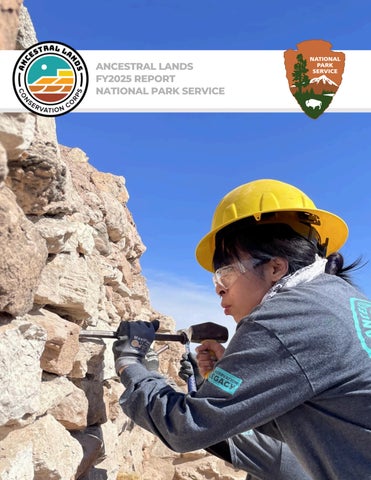
ANCESTRAL LANDS FY2025 REPORT NATIONAL PARK SERVICE
INTRODUCTION TABLE OF CONTENTS CONTACT INFORMATION page two ACKNOWLEDGEMENTS page two and three MESSAGE FROM THE EXECUTIVE DIRECTOR page four EXECUTIVE SUMMARY AND PURPOSE page five CORPS PARTNERS, PROJECTS AND FUNDING AMOUNTS page five PROGRAM SUCCESS AND TRAINING PROVIDED pages six through eight PROJECT HIGHLIGHTS pages nine and ten PARTICIPANT DEMOGRAPHICS page eleven FUTURE PROJECTS page twelve CONCLUSION page thirteen APPENDIX A: PARTNER AND PARTICIPANT QUOTES page fourteen APPENDIX B & C: PRESS & MEDIA, PROJECT LIST page thirteen
CONSERVATION LEGACY NATIONAL PARK SERVICE FY2025 REPORT Report Term: October 2024–September 2025 CONTACT INFO Chas Robles Ancestral Lands Conservation Corps Executive Director Email: chas@conservationlegacy.org www.ancestrallands.org
Meranden and Lakin with Teiyanknei Chee ALCC IP Program Coordinator
2
Grand Canyon National Park IPs - Meranden Numkena and Lakin Epaloose pictured Grand Canyon National Park Rangers
ACKNOWLEDGMENTS Ancestral Lands Conservation Corps, Conservation Legacy, and our partners would like to thank the National Park Service staff, Cooperators, and Partners who have helped make our programs a continued success. We could not do this without your support! Additionally, we want to acknowledge our Tribal and Community partners, and specific NPS partners, listed below: NPS WASO Leadership NPS WASO Youth Programs Division Staff NPS WASO Agreements Staff NPS CIRCLE NPS Staff at all our Project Sites Corps Partners: Arizona Conservation Corps American Youth Works Southwest Conservation Corps Tribal Partners: Cocopah Indian Tribe Colorado River Indian Tribes Hopi Tribe Kewa Pueblo Navajo Nation Pueblo de Cochiti Pueblo of Acoma Pueblo of Isleta Pueblo of Jemez Pueblo of Sandia Pueblo of Santa Clara Pueblo of Zuni San Carlos Apache Tribe White Mountain Apache Tribe
ACKNOWLEDGEMENTS Community Partners: Albuquerque Community Foundation Bears Ears Partnership Bernalillo County Open Space Division Bureau of Indian Affairs (BIA) BIA Southwest Region BIA Western Region Bureau of Land Management Canyon of the Ancients National Monument (BLM) Carson National Forest Chamiza Foundation Cibola National Forest City of Albuquerque Coconino National Forest Colorado Plateau Foundation Conservation Lands Foundation Friends of Valle de Oro National Wildlife Refuge Grand Canyon Conservancy Grand Canyon Youth Hopi Cultural Preservation Office Hopi Education Endowment Fund Hopi Foundation Hopi Tutskwa Permaculture Institute Kaibab National Forest La Plazita Institute Los Jardines Institute McCune Foundation National Fish and Wildlife Foundation National Parks Foundation National Forest Foundation New Mexico Foundation New Mexico Outdoor Recreation Division Santa Fe National Forest Southwest Invasive Plant Management Team United States Fish and Wildlife Service United States Forest Service Valle de Oro National Wildlife Refuge
Canyon De Chelly overview of thinning project
Saw work at Canyon De Chelly National monument
Project Locations Bandelier National Monument Canyon de Chelly National Monument Chaco Culture National Historical Park El Malpais National Monument El Morro National Monument Flagstaff Area Monuments Glen Canyon National Recreation Area Grand Canyon National Park Historic Preservation Training Program Mesa Verde National Park Navajo National Monument National Historic and Scenic Trails System Petrified Forest National Park Petroglyph National Monument Saguaro National Park Southwest Invasive Plant Management Team Tuzigoot National Monument Vanishing Treasures Program Walnut Canyon National Monument Wupatki National Monument Zion National Park
3
MESSAGE FROM THE EXECUTIVE DIRECTOR Legacy in the Land: A Personal Discovery While searching online for information about my grandfather, Arthur Robles, I recently came across a 1940 Census record. It listed him, his parents—my great-grandparents Gregoria and Timoteo—and his siblings. Their occupations were also included: my great-grandparents were beet field laborers, and my grandfather was working at a CCC (Civilian Conservation Corps) Camp. I already knew that my family had a history of migrant farm work. My grandmother often spoke about the grueling labor and the strong community built amongst the field workers. I also knew that my grandfather served in the Pacific during WWII. But I had never known that before enlisting, he had spent 10 weeks in 1939 working with the CCC, earning $6.50 a week conserving America’s public lands during the Great Depression. The CCC, created in 1933 as part of FDR’s New Deal, employed over 3 million young men in conservation work. Among them were more than 77,000 Latinos, 85,000 Native Americans, and 200,000 African Americans. There was even a dedicated division for Native American men—the Indian Emergency Conservation Work Division (IECW)—which included both conservation and cultural programs. My grandfather passed away in 1982—just four months before I was born. I never met him, but I grew up hearing stories about his character, humor, and how much I resembled him. My grandfather’s service in the CCC connected me to him in a deep way because I’ve spent the past 19 years working in conservation corps. Programs like the ones I’ve worked for are direct descendants of the CCC. Today’s corps reach a wide range of young people from all backgrounds and continue the mission of land stewardship through education, service, and connection. In learning about my grandfather’s time with the CCC, I found a powerful reminder of why this work matters— and how long this journey has been in motion. At ALCC, we carry that legacy forward with pride. We draw on the values our elders passed down—to care for all living things, to protect them for future generations, and to recognize our deep connection to the lands we serve. As we launch a new season with incoming crews and Individual Placements, we’re training the next generation of caretakers. They’ll work in places like Chaco Culture National Historic Site, Mesa Verde National Park, and the Grand Canyon National Park—landscapes that hold stories, memories, and meaning. They’ll follow in the footsteps of their ancestors, honoring the past while building a future rooted in respect, resilience, and purpose. Thank you to all our NPS partners who support our work by directly mentoring the next generation of conservation professionals.
Sincerely,
Chas Robles Executive Director, ALCC
4
OVERVIEW EXECUTIVE SUMMARY
PURPOSE OF THE PROGRAM
Ancestral Lands Conservation Corps (ALCC) has centered Indigenous youth and young adults, Tribal communities, and Indigenous lifeways in its programming since our founding in 2008 in the Pueblo of Acoma. From the beginning, our mission has focused on reconnecting young people to land, culture, and heritage—as caretakers and stewards of the places that have sustained our communities for generations.
The Ancestral Lands Conservation Corps (ALCC) program, in partnership with the corps organizations represented in this report, engages Indigenous youth and young adults in critical natural and cultural resource projects on public lands—primarily within National Parks. These projects not only address high-priority conservation and maintenance needs but also provide meaningful learning experiences that directly benefit both participants and the public.
Over the past 17 years, ALCC has grown and evolved, expanding conservation corps and community-based opportunities to include the Pueblos of Zuni, Isleta, and Santa Clara; the Navajo Nation; the Hopi Tribe; urban Indigenous youth in Albuquerque, NM; and a nationwide Individual Placement program. This program places Indigenous participants with Tribes, as well as with federal, state, local, and nonprofit partners across the country. Through these efforts, we continue to deliver high-quality programming that prepares participants for careers in natural and cultural resource management by developing strong, relevant, and technical skills.
A core objective of ALCC is to reconnect Indigenous young people with their ancestral lands, many of which are now managed by the National Park Service, including sacred and culturally significant sites. Through service work, participants gain firsthand knowledge of ecology, geology, conservation practices, cultural and historic preservation, and public land management.
As ALCC has grown, so has its commitment to collaboration—partnering with Tribes, communities, and corps programs nationwide to share best practices, lessons learned, funding strategies, and technical assistance. These partnerships are helping to seed and strengthen new programs that center Indigenous youth and community priorities. One example of this work is a partnership with American YouthWorks, which supported two Individual Placements at Hopewell Culture National Historical Park—an initiative reconnecting displaced Indigenous communities with ancestral and culturally significant lands now managed by the National Park Service.
The program is designed to deliver structured, safe, and challenging work opportunities that promote personal and professional growth. Participants develop essential life and job skills while cultivating a strong ethic of stewardship for natural and cultural resources. ALCC also prioritizes job readiness and skills development by offering industry-recognized certifications, positioning participants for careers in conservation, resource protection, forestry, and related fields. Through this work, the ALCC advances both conservation goals and Indigenous workforce empowerment, fulfilling the dual mission of resource stewardship and community investment.
ALCC also helped launch a monthly Indian Youth Service Corps (IYSC) Working Group and Advisory Council. Now in its fourth year, the IYSC continues to catalyze opportunities for corps programs to expand and deepen their engagement with Indigenous youth—reconnecting them to ancestral lands, sacred places, and the intergenerational knowledge of their communities. As this movement grows, it is critical that we continue to rise to the moment in ways that honor our people, the landss that shaped our identities, and the ancestors who guide our work. This year, funding from the National Park Service’s Youth Program supported the reconnection of 295 participants from 14 Tribes to their ancestral lands now stewarded by the National Park Service—demonstrating the growing impact of intentional, culturally grounded programming.
Meranden and Lakin pictured with Dance group at Grand Canyon National Park
5
OVERVIEW Introducing our Corps Partners and Projects Ancestral Lands Conservation Corps — Native Conservation Corps ALCC ran two Native Conservation Corps youth crews out of Albuquerque and Hopi communities in the summer of 2025. The crews learned about park history and resource management, gained professional advice from NPS employees, and assisted units with deferred maintenance. Parks visited include: Grand Canyon National Park, Glen Canyon National Recreation Area, and Petroglyph National Monument. The highlight of the NCC experience was a 10-day motorboat trip on the Colorado River in the Grand Canyon National Park. During this trip, the youth learned about risk management, and Indigenous identity, all while contributing to scientific sample collection projects related to water quality and wildlife populations. Additionally, ALCC supported 15 Individual Placements positions partnering with the Historic Preservation Training Center’s (HPTC) Traditional Trades Advancement Program (TTAP). IPS served at 10 National Park units including Aztec Ruins National Monument, Bandelier National Monument, Casa Grande National Monument, Flagstaff Area National Monuments, Mesa Verde National Park, Montezuma’s Castle National Monument, Pecos National Historical Site, Tuzigoot National Monument, Wupatki National Monument, and Yosemite National Park.
Southwest Conservation Corps – Indigenous Youth Crew In 2023, SCC’s Four Corners office in Durango piloted the Indigenous Youth Crew, our first affinity space for local Indigenous High School Students. This crew was created at the request and leadership of Indigenous members and leaders who wanted a space for Native students to work together while preserving and maintaining their ancestral lands for the future generations. SCC’s affinity crews foster an inclusive, more comfortable learning environment where participants can maximize their opportunities to grow and develop, propelling them into a career in environmental stewardship. After another successful year in 2024, we increased recruitment efforts and offered two Indigenous Youth Crews in 2025.
FUNDING AMOUNTS Crew P25AC00735 P24AC01525 P23AC00676 Total
Spend YTD $46,312.96 $257,741.14 $43,246.67 $347,300.77
Arizona Conservation Corps – Indigenous Communities Program Arizona Conservation Corps’ Indigenous Communities Program (ICP) model is rooted in the culture and heritage of local tribal communities. The power and impact of AZCC’s Native programming is due to the community investment and support for each program, tribally and locally, combined with a network of operational support from AZCC. ICP programs consist of conservation crews and individual placements/interns. AZCC ICP Crews can be day crews who go home each night, overnight crews who spend a few nights a week camping at the project site, or backcountry crews who strike out and spend most nights in field camping. American Youth Works American YouthWorks provides young people with opportunities to build careers, strengthen communities, and improve the land, water, and air through education, on-the-job training, and service to others. American YouthWorks Conservation Corps programs are an experience of purpose, service to the community, and education. People with differing levels of experience and backgrounds protect the land, water, and air, build leadership skills, and care for others. Participants engage in conservation projects across the Central Southern United States. 6
ALCC Navajo crew at Canyon De Chelly
PROGRAM SUCCESS Ancestral Lands Conservation Corps: ALCC operated three Hiking Clubs this year in the Pueblos of Acoma and Isleta as well as an inaugural program on Diné Bikeyah (Navajo Nation). ALCC Hiking Clubs engaged over 50 Indigenous youth, promoting environmental awareness, healthy living, while reconnecting them to cultural practices and sacred lands. The program brings in elders and traditional knowledge keepers to help the participants reconnect with their history, share stories associated with the lands they are interacting with, and to help show the youth their long-standing connection to the public lands their ancestors once inhabited. The program removes barriers to accessing public lands by providing gear and equipment (water bottles, backpacks, etc.), food, and transportation for par participants.
Number of participants converted to Federal Hired: 23 (7.8%)
ALCC ran two Native Conservation Corps youth crews out of Albuquerque and Hopi communities in the summer of 2025 and partnered with Southwest Conservation Corps to include their Indigenous Youth Crew on the annual Grand Canyon River Trip. The crews learned about park history and resource management, gained professional advice from NPS employees, and assisted units with deferred maintenance. Parks visited include: Grand Canyon National Park, Glen Canyon National Recreation Area, and Petroglyph National Monument. The highlight of the NCC experience was a 10-day motorboat trip on the Colorado River in the Grand Canyon National Park. During this trip, the youth learned about risk management, and Indigenous identity, all while contributing to scientific sample collection projects related water quality and wildlife populations.
Outcomes as Related to Department of Interior’s Priorities Job readiness and skills development Recreation access Public safety Disaster response
ALCC supports DOI’s priorities of providing job readiness and skills development for youth and young adults. Our participants report feeling more prepared and confident in pursuing careers in natural and cultural resources and with NPS and other federal government land management agencies. The projects reported also increase public safety and access for recreation opportunities through maintaining and building trails, removing hazardous fuels, improving overall ecosystem health, and preserving structures and buildings on NPS lands.
ALCC Navajo Crew member at Canyon De Chelly
7
PROGRAM SUCCESS Training Provided Participants gain valuable training and experience while participating in ALCC, including chainsaw use and maintenance, herbicide application, wilderness first aid and first responder, CPR, leadership development, risk management, communication, financial literacy, plant identification, cultural preservation, and community building.
“I'm learning to connect with the land better while gaining experience with the tools and methods.” Jules Joe, ALCC Crew Member
ALCC Acoma crew with Secretary of the Interior, Doug Burgum at Pecos National Historical Park
8
ALCC Navajo crew member with Deandra Jones working together on the black bear population research project at Chuska Mountains
Meranden and Lakin hosting an activity table at Grand Canyon National Park
PROJECT HIGHLIGHTS El Malpais National Monument Maintenance Action Team (MAT) Big Tubes Trails: ALCC Crews worked with staff from El Malpais National Monument and the Historic Preservation Training Center to improve 3.12 miles of the Big Tubes Trail, building cairns and clearly designating the trail to improve visitor safety. This project targets the goals and values outlined under the Legacy Restoration Fund- Maintenance Action Team, a service-wide facility maintenance program which will support, engage, and stimulate maintenance and preservation trades work while providing transferrable skills training and an ethic of resource stewardship to program participants. This project directly addresses the deferred maintenance backlog at small and medium sized National Parks. with meaningful historic preservation trades experience, develop a foundation in cultural and natural resources protection, and foster lifelong connections to the NPS. This project motivated youth and young adult involvement with cultural, natural, and historical resource protection locally and nationally by providing participants with hands-on, skills-based training in these fields. These trade skills are highly sought after in both private and public industry and allow for expanded employment opportunities for participants who complete the program. Exposure to this work and skill development will foster a resource stewardship in participants. The NPS receives the indirect benefit of completing cultural, natural, and historical resource protection projects through this project activity.
ALCC Zuni conducting trail and masonry work at El Morro National Monument’s Headlands Trail
ALCC Zuni Crew member reshaping Stones for trail curbing on the Headlands Trail
9
PROJECT HIGHLIGHTS Mesa Verde Interpretive Rangers Individual Placements: ALCC partnered with Mesa Verde National Park to select three individual placements, some from Pueblos and Tribes who trace their lineage to the park’s original inhabitants, to participate in the Park’s Interpretive Rangers program, gaining skills and work experience by serving as part of Mesa Verde National Park’s Interpretation and Education team. Participants shared and interpreted their cultural connection to the park while assisting park visitors. The project strengthened relations with tribal partners and provided visitors with more opportunities to see the depth of Mesa Verde’s story. Participants were connected to potential careers with the National Park Service and their heritage and cultural values. Walnut Canyon National Monument Fuels Reduction: ALCC crews worked with Walnut Canyon National Monument staff to remove hazardous fuel loads from around 25 sensitive and rich archaeological sites that date back 900-years. The crew learned from NPS staff about the parks natural and cultural resources. They learned how to assess fuel loads, operate and maintain chainsaws, and how to administer first aid in a wilderness setting.
Thomas Maddux presenting for park visitors
10
MEVE IPs - Satchel Martin, Thomas Maddux, and Shantel Israel at Mesa Verde National Park
Thomas Maddux leading visitors during a guided tour at MEVE National Park
0
2.7% 8
50
0 ha ve
200
164 55.6% 123
in no H tg ig h ra Sc du ho at ol ed or H gr a ig G ad h ED Sc ua ho pr te d og ol H o ra ig re m h ar Sc ne ho d ol a G or ED ea rn ed a G ED so m e Co lle C ge G ol ra l eg du e at de e gr Sc ee ho ol or hi gh er
en ro lle d
Gender
Ethnicity
89.9% 265
200
150
100
10.1%
30
W or hi A te la sk an N at iv e O th Pr er ef er R ac no e tt B la o ck re /A sp N on fr at ic iv d an e H A aw m er ai ic ia A si an n an or A O m th er er ic Pa an ci fic Is la nd er
50 cu rr en tly
41.7%
In di an
250
re sp on d
18
er ic an
no tt o
26-35 6.1%
A m
300
Fe m al e
100
at in o
Pr ef er
M al e
150
H is pa ni c/ L
N on -H is pa ni c/ N on -L at in o
BY THE NUMBERS
DEMOGRAPHICS 295 PARTICIPANTS
Age 15-18 4.4%
Education Level
200
Under 15 20.3%
13 57.6% 170
60 150
100
50
19-25 69.2%
0
250
50
25
0
8.5%
16.6% 49
204 2.7% 8
13 4.4%
4.4%
16.3% 48
6.1% 18 .7% 2
Race
84.7%
250
200
150
100
63
1%
.7%
.7%
3
2
2
11
FUTURE AND PILOT PROGRAMS ALCC has continued to grow and expand opportunities for Indigenous young people to connect to NPS and other ancestral lands through our Hiking Clubs, High School and Adult Crews, Individual Placement Program, and Traditional Farm Corps. We are continuing to expand the Farm Corps to the Pueblos of Isleta and Zuni and are working to support the Pueblo of Santa Clara’s work to protect agricultural traditions. This fall, ALCC is excited to pilot our first Wildland Fire Fighting Training Program, partnering with the US Forest Service. The program will provide all required certifications to enter wildland fire fighting careers while protecting communities and National Forests from risks of wildfires. This program could easily involve NPS sites, further protecting public lands and resources and neighboring communities while preparing participants for careers and supporting their job readiness and skills development.
ALCC Zuni conducting trail and masonry work at El Morro National Monument’s Headlands Trail
“I learned a little about archeology thanks to our projects partners at Petroglyph. An archeologist was kind enough to come out to the work site and share the knowledge he had on the area we were working at.” – Javen Poncho, ALCC Crew Member 12
ALCC Acoma Crew Leader conducting repointing work on the dwelling walls of Pecos National Historical Park
CONCLUSION The corps industry traces its roots to the Civilian Conservation Corps created by President Franklin Roosevelt in 1933 in response to the Great Depression. This visionary program was created to provide conservation and natural resource jobs to young men and to help provide relief to struggling families in one of our country’s darkest times. The legacy of the CCC lives on in today’s Conservation Corps programs, including ALCC. Today, young people connect to the natural world while also developing hard skills that prepare them for professional and financial success while also finding a place where they can belong. They also explore and recreate in our country’s best idea, National Parks. Land that is protected not only for current and future generations to enjoy but also for the benefit of the natural areas and life they contain. The National Park Service, and many of the federal agency partners ALCC works with, have shown strong support and commitment to completing this work, as the impacts of the work that are highlighted in this report attest. ALCC’s participants, staff, and community partners look forward to continuing the work that lays ahead of us in way that honors our ancestors and the lands and waters we work in community with.
ALCC Acoma Crew Member spraying and adding motor mix to the walls at Pecos NHP
Tyrel Kewanwyma, at Tuzigoot National Monument, Traditional Trades Advancement program (TTAP) IP
13
APPENDIX A: PARTNER AND PARTICIPANT QUOTES Participant Testimonials: Why are National Parks important to you?
“Being outside and having something good to do” – Aiden Lomayestewa, 2025 NCC
“[Parks are] important because they hold the history of my ancestors’, including our migratory paths.” – Andre Lomaintewa, 2025 NCC “[Parks] ensure the continued existence of natural spaces and set precedent for the protection of the natural world” – Aiden Lomayestewa, 2025 NCC “National parks are important to me due to many of them being the ancestral homelands of Tribes from all over” – James Pawesiewma, 2025 NCC “[Parks are] important because it’s the land that we are supposed to be taking care of” – Tristian Coochise, 2025 NCC
“[This experience has] changed me spiritually because being able to express myself now helped me connect more with my culture by learning how to pray in my own language. This experience changed me mentally and physically and it means a lot to me because I now have a stronger relationship with mother earth.” – Isiah Begay, NCC Crew Member
“Our first hitch we went to the Grand Canyon. It was a moment to remember because we met a whole bunch of people from different tribes who were all so funny and just because it was such a blast, we had so much fun” – Tristian Coochise, 2025 NCC “I learned a lot about plants and rock layers while on the GCY river trip” – James Pawesiewma, 2025 NCC “Going to the Grand Canyon River trip has changed how I see myself, being around the different crews like the Hopi and SCC made me realize how much I missed out on my own peoples culture. Because there were other Navajos there, and I learned a lot about my own culture. I’ve never known before because I was never really taught about it. I want to learn more about my Navajo side as well as my Eastern Shoshone side. I feel like a piece of me is barely waking up and still in two pieces with loose strings keeping it together. I just couldn’t help but when seeing these other people like so in touch with their culture but to feel like an imposter amongst them and being in a place that means something and still holds meaning to my Navajo side like I wasn’t meant to be there. But some of the other Navajos shared some of their medicine with me so I could give an offering too when I prayed in front of the waterfall it felt so good, I felt lighter and more safe there. I do want to continue leaning about the traditions, language, and community my parents are from because I don’t want my future kids not knowing or feeling so out of place wherever they go.” – Mel Day, NCC Crew Member
14
“This experience has been to me, life changing. In a way it was like going home. For my people, the Zuni Tribe, it’s our place where we emerged from and is the start of our story. To also experience this with other natives or indigenous people couldn’t have been better. With people who knew the significant value it had, we were able to see the Grand Canyon in its fullest but still have respect for it. Seeing, sleeping, eating and going in the Grand Canyon is a jaw dropping thing to get to feel and experience. The walls of the canyon all around you, with the Colorado River in the back slowly but quickly carving through the canyon. Providing the own canyon with natural white noise to fall asleep after a long day on the river and stopping at the different places, either to explore or do some work. Just breathing in the air was a whole different feeling. The freshness of the air compared to dirty smoggy air above us is something you can only experience there. With having all the rock layers, it was like going back in time. A time where Earth and the land wasn’t hurting from our greed, but existing in a natural state. The colors changing from one to another was like seeing a painting or post card of the canyon you see in the stores. I was never able to wrap my head around it with each day feeling like a dream. A dream I didn’t want to leave. It has changed me as a person, making me think of what the land gives us. Making me think of my tribe and how close we are to the Hopi Tribe in Arizona. As we both have our emergence story in the Grand Canyon and having similar dances, kachinas, and story’s and almost the same emergence spot.” — Luke Othole, NCC Crew Member
APPENDIX B: PRESS AND MEDIA Connection and Conservation in the Grand Canyon https://www.osprey.com/stories/activismcommunity/connection-conservation? srsltid=AfmBOoppTSbj4Fo5Txu1YevDGQLinOwzV2c3wtVoQ WbtvDCA_YMnP9E8 Ancestral Lands Conservation Corps Continues to Improve Trails at El Morro National Monument - El Morro National Monument (U.S. National Park Service) https://www.nps.gov/elmo/learn/news/ancestral-landsconservation-corps-continues-to-improve-trails-at-el-morronational-monument.htm AmeriCorps Return on Investment Study: Ancestral Lands Conservation Corps | PHENND — Philadelphia Higher Education Network for Neighborhood Development https://phennd.org/update/americorps-return-oninvestment-study-ancestral-lands-conservation-corps/ Native Conservation Corps on the Colorado River https://www.instagram.com/reel/DMIfC4upPih/ All-Native field crew strengthens ties to ancestral land | Environment | taosnews.com https://www.taosnews.com/news/environment/all-nativefield-crew-strengthens-ties-to-ancestralland/article_45cfeade-1074-51d1-8082-6024378a35e4.html
Please see separate attachment for Individual Placement evaluations.
APPENDIX C: PROJECT LIST Petroglyphs National Monument Trails Crew 613 Crew 620 Hovenweep National Monument Historic Preservation Crew 661 Petrified Forest National Park Fence Construction Crew 661 Aztec Ruins National Monument and Chaco Culture National Historic Site Preservation Crew Project Crew 660 Bandelier National Monument Hazardous Fuels Reduction Crew 620 Bandelier National Monument Invasive Species Removal Crew 620 Chaco Culture National Historic Site Trails Grand Canyon National Park Vegetation Management Crew 645 HPTC MAT El Malpais Natonal Monument Big Tubes Trails Crew Project Crew 600 Native Conservation Corps High School Crews Pecos National Historic Site Historic Preservation Crew 600 Southwest Invasive Plan Management Team Crew 660 Tuzigoot National Monument Irrigation and Historic Preservation Crew 662 Glen Canyon National Recreation Site Vegetation El Moro National Monument Headlands Trail Crew 663 Crew 620 Navajo National Monument Trails
Zuni Crew member reshaping Stone for trail curbing at ELMO Headlands Trail
15
www.ancestrallands.org
www.conservationlegacy.org