1
Museum |
Details
Objectives Together with his family, CSC alumnus Ken Ogdon identified a need for a museum dedicated to the history of Connors State College. He then donated the necessary funding to accomplish the task. Once Russell Hall - an offline dormitory on the Warner Campus - renovations were complete, the wheels began to turn for the museum’s development. Because square footage was limited to one wing of Russell Hall, but the history was broad, one objective of the museum was to incorporate freestanding kiosks for visitors to browse a plethora of information and photos at their leisure. The kiosks would need to access a new website, which would also link three separate
campus Halls of Fame and historical displays, and allow visitors to read inductee bios and history, view photos, and more. A second objective of the museum was to be a new home for the Alumni & Friends Association Hall of Fame inductee plaques, which were allbut-forgotten on the wall of a library entrance. A third objective was to incorporate a display for recognition of employees who had provided 10 or more years of distinguished service to the college. These individuals had been honored with plaques after their retirement, which, again, went unseen in the hallway of an administration building. A fourth objective of the museum
was to incorporate Native American artwork, as the museum is housed adjacent to a new Title III Native American Success and Cultural Center, and to show diversity within the history of the student population. A fifth objective was to display historical artifacts and photographs directly linked to the history of the college, to include influential faculty and staff, lettermen jackets and athletic jerseys, trophies, farm implements, campus newspapers, presidential dinnerware, and more. A sixth objective was to provide a space for connecting with future and current students, as well as alumni.
Ken & Joyce Ogdon at the opening of the Ogdon Family Connors State College Museum, April 29, 2017.
2
Museum |
Details
Audience The audience for the Ogdon Family Connors State College Museum is extremely diverse. From traditional students to alumni, and from college supporters and donors to prospective students, we hope the museum will appeal to the various demographics who will visit it in person, within our service area. A bonus, secondary audience for the museum is virtual, online. Displayed on two freestanding kiosks, a component of the museum is a live website, housing the college history, historical photos, as well as biographies of inductees to the Athletic, Agriculture and Alumni & Friends Halls of Fame. This website -- ConnorsGiving.com -- is available to browse via the web. There, it also shows visitors images of inside the museum, to entice an upcoming, in-person, visit. As it launched in conjunction with the museum opening on April 29, 2017, and has not yet been marketed, statistics for the site are not yet available. Details about our service area are listed below: Connors State College (CSC or Connors) is a public, two-year community college located in the heart of eastern Oklahoma’s Native American region. Originally named Connors State School of Agriculture (after the State Board of Agriculture’s first chairman, John Connors), the institution came into existence shortly after the establishment of Oklahoma Statehood in 1907. The College has grown from a secondary school of agriculture with an enrollment of 15 students and 4 faculty members in 1909 to an accredited community college serving more than 3,100 students annually, more than one third of whom are Native American (37%), with 55 full-time faculty members. The main campus of CSC is in the
town of Warner (pop. 1,323), a rural, agricultural community located at the junction of U.S. Highway 64 and Interstate 40 in eastern Oklahoma. CSC also has a campus in Muskogee (pop. 39,052), located 18 miles north of Warner which houses CSC’s popular Nursing program. Through very trying times, the institution has remained committed to a mission of “continuously providing affordable, accessible and effective learning environments for the lifelong educational needs of the diverse communities it serves.” CSC’s seven-county primary service area (4,563 sq. mi.; pop. 317,186) is predominantly rural with a high percentage of socioeconomically disadvantaged, low-income and poorly educated residents. More than one third (36.6%) of area families are low-income, 19.7% of residents live in poverty, and the median household income is just $42,251. Also within CSC’s service area, only 18.1% of adults have a bachelor’s degree and almost one out of every six adults has not completed high school. (Source: U.S. Census, ACS 2014) Our service region encompasses two Native American Nations (Cherokee and Creek); 17.2% of all service area residents are Native American with some counties showing more than 38% Native American residents. Disadvantaged characteristics are accentuated among this population with 22.8% living in poverty, only 15% having a college degree, and 16.1% without a high school diploma. Despite many challenges, CSC’s commitment to the success of its students has resulted in this Native American Serving Institution being ranked number 13 among the nation’s top 100 two-year colleges in Native American students attending and
3
receiving degrees and certificates (Community College Week, June 2012). And, in 2015, Diverse Magazine ranked Connors State first in the nation for healthcare programs for Native Americans. Healthcare and, more specifically, Nursing programs, which have long been high performing at CSC, present excellent career opportunities for our students. Economically, Muskogee County (home to CSC’s campus which houses the Nursing program) is a regional healthcare hub. With 204 healthcare employers, healthcare represents the largest employment sector, responsible for 19% of the county’s workforce. Local healthcare providers often find it difficult, if not impossible, to hire and retain adequate numbers of qualified healthcare professionals to meet the local demand. According to the Bureau of Labor Statistics (2015), the county faces a 3% healthcare workforce shortage, translating to $500,000 in annual lost payroll. Local healthcare jobs are expected to grow by 11% over the next decade, or an added 598 skilled positions, which could lead to even greater workforce shortages, or to tremendous opportunity for local residents if a sustainable “grow our own” healthcare workforce development and retention strategy is employed. Statistics for our region as a whole are even more severe. All seven of our service area counties are classified as Medically Underserved and Health Professional Shortage areas by the U.S. Department of Health and Human Services. Approximately 18 high schools from our service area provide more than 80% of our students. On average, among those 18 high schools, 65% of students are free/reduced lunch eligible and 43% are Native American (Office of Educational Quality & Accountability, 2014).
Museum |
Details
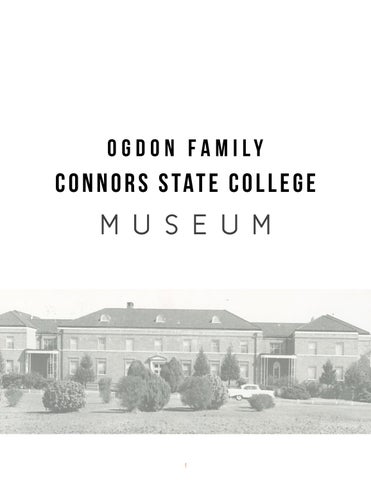
Results Through the generosity of the Ken Ogdon family and the guiding curation of Dr. Ryan Blanton, VP for External Affairs and Director of the Connors Development Foundation, and Stacy Pearce, Director of College and Community Relations, the Museum was developed inside the north wing of a former dorm – Russell Hall, which had long since been abandoned for use. In a span of four short months of work, as of April 29, 2017, the museum is open to the public. Within the walls of the museum, there are five locking trophy cases filled with photos, working tools and memorabilia; while the walls are full of framed photos and Native American artwork. One wall is dedicated as the new home of the Alumni & Friends Association Hall of Fame, and another to a new display in recognition of employees who have provided distinguished service to the college.
Two 50” freestanding kiosks allow visitors to browse a plethora of information and photos at their leisure. The kiosks access a brand new website developed specifically for the museum during the spring of 2017 -www.ConnorsGiving.com. The website links three separate campus Halls of Fame and three historical displays in other campus buildings – the McPeak Agriculture Hall of Fame, the Alumni & Friends Hall of Fame, the Athletic Hall of Fame, and Legacy Hall. The site and kiosks allow visitors to read inductee bios and history, view photos, give directly to the Connors Development Foundation, scholarship programs, and more. Now, the museum is a destination for the recruiting department’s campus tours with prospective students – as a showcase that provides recruits with an opportunity to connect to the college history. The museum provides a hub for alumni receptions and builds
4
connections with those who have not been on campus in a number of years. This fall, both the space and the website will become a destination for college orientation classes, providing new students with insight into the Cowboy past. The components of this museum were discussed, developed, designed, produced and executed solely by Dr. Ryan Blanton and Stacy Pearce. The pair utilized and assisted one website freelancer, one carpenter, one print company, one photo print company, and one company to install an orange glass wall. Two pieces of art were commissioned specifically for the museum by reknowned Native American artists. The museum will continue to expand and evolve through the years, under the direction of a faculty member – Lori Palmer.
Photos |
5
Before
Photos |
Before
6
Photos |
7
Before
Photos |
After
8
Photos |
9
After
Photos |
After
10
Photos |
11
After
Photos |
After
12
Photos |
13
After
Photos |
After
14
Photos |
15
After
700 College Road • Warner OK 74469 www.connorsstate.edu
16