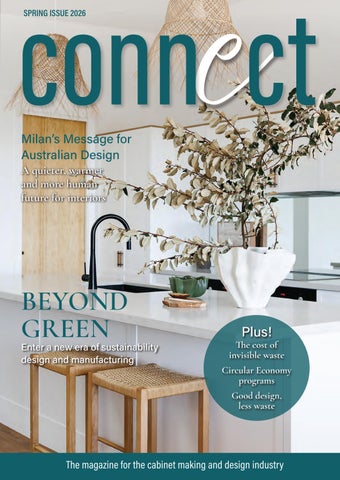
conn ct SPRING ISSUE 2026
Milan’s Message for Australian Design A quieter, warmer and more human future for interiors
BEYOND GREEN
Enter a new era of sustainability design and manufacturing
Plus!
The cost of invisible waste Circular Economy programs Good design, less waste
The magazine for the cabinet making and design industry
Movement made easy
Blum cabinet solutions make everyday living more ergonomic by improving movement, access, and comfort throughout the home. Smooth running hinges, lift systems, drawers, and motion technologies reduce strain from reaching and bending, while lasting quality ensures effortless use at any stage of life.
BLUM.COM
Editor's Letter
From the editor
W
elcome to issue 8 of Connect magazine!
For our major theme this issue “Sustainability & Design Trends” we look towards a future where sustainability is more than material specification and is one where resilience, transparency and adaptability will be the keys to a successful, sustainable business. My sincere thanks to Kate St James and Michael Blick from Progressive Building for their esteemed input.
Continuing this theme, Pam Kershaw investigates how materials and processes will reshape the future of sustainability and specification, while Selina Zwolsman shares her thoughts on how thoughtful planning and accurate documentation can reduce waste long before construction begins. We also have an insightful article from Ben Fewtrell that explores the waste that hides in plain sight for many businesses and Bob Ditessa takes us backstage into the Circular Economy programs of Winya and the University of Melbourne — it’s a fascinating read. Don’t miss another excellent update from the HIA Economics team on how the data behind renovation activity provides insight into the future of our industry. Plus, catch up on our report from Salone del Mobile.Milano as EuroCucina and the International Bathroom Exhibition reveal a quieter, warmer and more human future for interiors. On a personal note, it was an absolute pleasure to chat to Pat Flanagan who was announced as the winner of Australia’s Next Top Designers at the recent Design Show Australia. And I’d like to thank Byron Stanley for walking us through the history of supervisory skills in our industry. As always, we must thank and acknowledge our wonderful industry suppliers who support our magazine and, by extension, our association. Please recognise their contribution to a stronger, more resilient industry by letting them know how much this support means to you and your business. Most importantly, we want to know what you think! Help us improve this magazine as a resource to our industry and give us feedback on content ideas or ways we can improve. We value any and all feedback from our readers. Plus, all survey respondents go into the draw to win a $100 VISA card — scan the QR code to complete the survey. Enjoy!
Connect magazine is published by the Australian Cabinet & Furniture Association. ABN 80 000 071 787 Publisher: Dean Brakell, CEO, ACFA Editor: Melanie Gardener Advertising Sales: Fiona Joynes Art Director: Liza Jane Smith, liza@monava.com.au Contributing Writers: Rob Ditessa, Pam Kershaw, Selina Zwolsman, Ben Fewtrell, Byron Stanley, Dean Brakell, Glen Qi (HIA) Printer: Neo Pty Ltd Correspondence to: PO Box 157, Gosford NSW 2250 Front cover: Progressive Building Pty Ltd Subscriptions: Connect magazine is produced as a hard-copy print publication as well as an online digital magazine. If you wish to subscribe please visit connectmagazine.com.au
@connectmagazineaus @connect-magazine-aus Copyright © Connect magazine (Property of the Australian Cabinet and Furniture Association). All rights reserved. The magazine or any part thereof may not be copied or reproduced without written permission from the publisher. Any specifications and/or claims here within are those of the manufacturer and/or supplier. Disclaimer: Statements by advertisers, expressed editorial opinion and/ or contributors’ comments are not necessarily representative of those of ACFA Ltd or its members unless expressly stated. The publisher and editor assume no responsibility for errors or omissions or any consequence of reliance on this publication. The Australian Cabinet and Furniture Association Ltd is a trade association that represents the interests of the cabinet making, kitchen, design, joinery, furniture, fit-out, and other wood, timber, stone and panel processing industries. Membership and advertising enquiries are welcome.
conn ct
3
Contents INDUSTRY NEWS 34 Professional Indemnity Design & Construct Insurance Introducing a new insurance option from Cabinet Makers Insurance Brokers 36 Smarter Production Systems SURTECO Australia: circular manufacturing in action 38 The People Behind Every Project At its heart, the cabinet making industry has never been about software, machinery, or technology. It's about people 40 System-Led Surface Solutions Great interiors are built on more than individual products. They're built on systems that work together
FEATURES 6 Beyond Green The interiors and cabinetry industries are entering a new era, one where sustainability is no longer simply about materials, but about resilience, transparency, adaptability and long-term thinking. By Melanie Gardener 14 Material Innovation Sustainability drives innovation as materials and processes are reshaped for the future. By Pam Kershaw 20 The Hidden Sustainability of Good Design Some of the most significant environmental savings occur long before a project reaches the factory floor. By Selina Zwolsman 24 Full Circle A deep dive into the Circular Economy programs of Winya and the University of Melbourne. By Rob Ditessa 30 A Sustainability Conversation The most expensive waste is the waste you can’t see. By Ben Fewtrell 81 The Last Word: Sustainability Starts Before the First Sheet Is Cut ACFA’s position is simple: our industry deserves clear, reliable and transparent product information. By Dean Brakell
4
conn ct
42 One Lock Range, Every Sector: KitLock as the go-to for cabinet makers One locking range built for schools, offices, government, end-of-trip and sporting facilities 44 The Hidden Costs of Cheap Tooling Leitz experts explain why purchase price is only part of the tooling equation 46 The Key to Design Success Why good ergonomics in the kitchen is the quiet upgrade that changes everything 47 Australian Craftsmanship and Manufacturing Contempo & Co celebrates 22 years of designing and manufacturing premium Australian-made furniture for the hospitality industry
Contents ASSOCIATION UPDATES 66 Bigger Homes Without Changing Address The rise and rise of renovations driving activity within the industry. By Glen Qi, HIA economist 68 Opinion: Revisiting Post-Trade Training A historical perspective on supervisory skills in the furnishing industry. By Byron Stanley 70 When Motion Meets Meaning 2026 winner of Australia’s Next Top Designers, Pat Flanagan, on engineering calm through kinetic design 48 Beyond the Tape Measure The digital shift driving joinery profits 49 CABINET VISION Wizard Award Celebrating the unsung innovators behind manufacturing excellence 50 Elevated Lighting Illuminating design possibilities with the Magic Lighting range 52 Introducing Modar® Storage A new standard in kitchen functionality 54 Elegance Becomes Form The new ARENA pure collection by Kesseböhmer has been designed to complement contemporary kitchen architecture
72 Milan’s Message for Australian Design EuroCucina and the International Bathroom Exhibition reveal a quieter, warmer and more human future for interiors. By Melanie Gardener 78 Product Update Give your next project a lift with our editor’s pick of the latest appliances as seen at EuroCucina 2026 80 Updated Award Snapshots Award rates changed in July 2026: is your business on top of the new requirements? 82 Index
Produced by industry, for industry
56 The Stones Left Behind Why rejection is the real art of stone selection for Cav’art Designer Stone 58 New Zircon Finish A sophisticated new colour brings timeless style and more sustainable manufacturing to the GRASS Nova Pro Scala drawer system 60 Concelo® 1×35L Shallow Depth Laundry Hamper Hideaway Bins expands its Concelo range with the introduction of the Concelo 1×35L Shallow Depth Laundry Hamper 61 Cabinetti Panels Cabinetti Panels is proud to bring Latho Components’ natural and engineered timber veneers from Italy to Australia 62 Nover’s 2026 Handle Collection The finishing touch that defines every project 64 Cabinetrylabels.com.au Your go-to site for cabinet makers
conn ct
5
Progressive Building Pty Ltd
Beyond Green The interiors and cabinetry industries are entering a new era; one where sustainability is no longer simply about materials, but about resilience, transparency, adaptability and long-term thinking By Melanie Gardener
T
en years ago, sustainability in the interiors industry was relatively straightforward. Specify FSC-certified timber, choose low-VOC finishes, install energy-efficient lighting and promote a project’s environmental credentials. Sustainability largely existed at the product level as a series of material selections or optional upgrades attached to an otherwise familiar business model. As we look forward from 2026, that definition feels increasingly incomplete.
6
broader: a measure of whether a business can remain viable, trusted and resilient in a rapidly changing world. The conversation is no longer simply about being “green." It is about how businesses respond to material scarcity, workforce shortages, energy costs, regulatory pressure, supply-chain instability and shifting client expectations. It is about whether our industry can continue operating in the same way it has for decades or whether an entirely different model is beginning to emerge.
Today, clients are asking harder questions: Where was this product manufactured? Who made it? How far did it travel? Can it be repaired? Can it be recycled? What happens to it at end-of-life? What is the embodied carbon footprint? And perhaps most significantly, is the business itself operating sustainably?
In many ways, sustainability is becoming less about image and more about survival.
For designers, cabinet makers, builders and manufacturers, sustainability is rapidly evolving from a marketing exercise into something much
Over the past decade, the term has appeared across everything from laminate ranges to luxury fit-outs, often with little explanation of what sits
conn ct
The end of sustainability as a marketing term Few words in the building, cabinet making and interior design sectors have been stretched further than “sustainable."
Sustainability behind the claim. As sustainability has become commercially valuable, it has also become increasingly difficult for clients and specifiers to distinguish between meaningful action and carefully constructed branding.
Kate St James Design
That ambiguity is beginning to wear thin. Across architecture, interiors and manufacturing, there is growing scepticism around vague environmental language. Terms such as “ecofriendly”, “green”, “natural” and “environmentally conscious” are facing greater scrutiny from both regulators and consumers. Increasingly, clients want measurable information rather than aspirational messaging. For manufacturers and suppliers, this shift is changing the nature of product conversations. Environmental Product Declarations (EPDs), lifecycle assessments, traceability documentation and chain-of-custody certifications are becoming more important in commercial specification. Transparency is beginning to carry more weight than storytelling. This change reflects a broader shift away from performative sustainability and towards accountability. Businesses are being asked not only what they sell, but how they operate, who they source from and what systems sit behind their environmental claims. For smaller workshops and independent studios, that pressure can feel daunting. Yet many are also discovering an advantage: authenticity. Businesses with transparent local supply chains, long-standing craftsmanship traditions and durable manufacturing practices often already embody principles that larger corporations are now trying to retrofit into their operations. Kate St James Design
The challenge is not simply in becoming sustainable, but in proving it. Kate St James is a qualified interior designer with more than 40 years’ experience in the industry and has long been a champion of sustainability in our sector. She is also the author of several books on sustainable design, including her soon-tobe-released The Conscious Edit which explores how beauty, longevity and sustainability can work together to create enduring interiors. “For me, sustainability isn’t simply about protecting the environment,” she explains. “It’s about understanding the consequences of every choice, from where a material is sourced to how a product is manufactured, how long it will last, whether it can be repaired, and ultimately what happens to it when its useful life is over. “Over my career I’ve seen sustainability evolve from a niche topic to a key issue across all industries,” she adds. “Yet, despite increased awareness, I believe we’ve only just begun to grasp what sustainability truly means." Michael Blick is the director of Progressive Building, which holds the title of 2025 HIA Australian GreenSmart Home of the Year for its Dee Why project. He says that a truly sustainable business has to work on three levels at once: the building itself (does it last, is the embodied carbon in the materials accounted for, or will it need to be ripped out in 15 years?), the people (are we paying and treating our trades and staff in a way that keeps skilled people in the industry?), and the business (can we remain active, profitable and paying our trades on time through the next downturn?). “Ten years ago, sustainability in our industry meant picking FSC-certified timber and hitting an energy rating,” he adds. “That box-ticking version
conn ct
7
Sustainability Kate St James Design
Progressive Building Pty Ltd
“I’m encouraged by the growing adoption of circular thinking,” says Kate. “For decades we’ve operated within a mostly linear economy: take, make, dispose. That model is no longer sustainable and the future depends on designing products that can be repaired, adapted, reused and eventually recycled. It involves creating buildings that can evolve with changing lifestyles; it also values craftsmanship over disposability and permanence over novelty." This largely linear model is increasingly being questioned. And, for design, cabinetry and joinery businesses, this has profound implications. Modular systems, demountable joinery, replaceable components and adaptable detailing are becoming increasingly relevant. Designers are exploring how materials can be separated at endof-life rather than permanently bonded together. Manufacturers are reconsidering how products can be repaired rather than discarded.
Circular design and the rise of the long-life interior
The implications extend beyond waste reduction. Circular thinking also changes the commercial relationship between businesses and clients. In the future, some companies may shift from simply selling products to managing ongoing material lifecycles including maintenance, upgrades, refurbishment and take-back programs.
One of the most significant changes shaping the interiors industry is the growing move toward circular thinking.
The greenest kitchen, increasingly, may not be the one made from the most sustainable material but the one that never needs to be fully replaced.
Progressive Building Pty Ltd
hasn’t disappeared but it’s now the entry price, not the answer."
8
conn ct
Sustainability Progressive Building Pty Ltd
“The question used to be a general ‘is this sustainable?’ and a confident answer was usually enough,” explains Michael. “Now clients and specifiers want documentation — where the timber was grown, what the embodied carbon figure is, whether packaging is recyclable and whether a supplier can produce a chain-of-custody certificate. And that’s a good thing as it reinforces rigour into a part of the industry that ran on assurances for a long time."
Waste begins long before the factory floor When conversations around sustainability arise in manufacturing, waste is often discussed in terms of offcuts, packaging or recycling systems. Yet some of the industry’s greatest inefficiencies begin much earlier in the process. Over-specification, trend-driven design cycles and disposable consumer culture all contribute to environmental impact long before a panel reaches a CNC machine. Social media has accelerated aesthetic turnover across interiors. Spaces are redesigned more frequently, driven by rapidly changing visual trends and a constant demand for novelty. Commercial and retail environments are refreshed to remain visually competitive. Residential clients increasingly
approach interiors through a fashion lens rather than a long-term investment mindset. The result is an industry that often demolishes and replaces well-functioning spaces years before the end of their usable life. “Our biggest challenge is that the industry is still largely priced on lowest-cost tendering which pushes everyone toward materials and methods that are cheapest today rather than best over the life of the building,” says Michael. “In cabinetry and interiors specifically, that shows up as high fit-out waste — offcuts, packaging, and laminates that can’t be recycled — and a supply chain that’s too fragmented for most of us to genuinely trace where materials come from." This raises difficult questions for designers and manufacturers alike. Can an interior truly be considered sustainable if it is designed around short-term trends? Is durability becoming more important than novelty? And what responsibility does the industry hold in shaping client expectations around longevity? Kate knows that designers hold significant sway over people’s choices and is firm that with influence comes a duty to make responsible recommendations. “Each specification or product
conn ct
9
Sustainability we choose has a ripple effect that goes well beyond the project at hand,” she says. “I also believe sustainability has become inseparable from quality. The most sustainable products are rarely those designed to be replaced in five years. They are the pieces that are beautifully made, thoughtfully considered, and valued enough to remain in our homes for decades." She adds that longevity is one of the most powerful sustainability strategies we have. Some practices are already responding by focusing on timeless detailing, flexible layouts and materials designed to age gracefully rather than require replacement. Others are using digital fabrication and advanced software to minimise production waste through improved nesting, precision manufacturing and better inventory management. Kate St James Design
Kate St James Design
Technology is helping reduce waste, but many argue the bigger challenge is cultural. The industry may need to reconsider not only how products are made, but why so many are discarded in the first place.
A sustainable business also sustains people Environmental performance is only one part of the sustainability equation. Across the building, interiors and manufacturing sectors, labour shortages, burnout and skills gaps are becoming critical business concerns. Workshops are struggling to attract apprentices. Experienced tradespeople are leaving the industry. Designers are navigating increasing workloads and tighter timelines. Mental health challenges remain widespread across construction and manufacturing environments. In this context, the definition of sustainability is expanding beyond carbon emissions and material choices to include the long-term wellbeing of the people behind the work. A business cannot realistically claim sustainability while exhausting the workforce that sustains it.
Kate St James Design
10
conn ct
This has prompted many companies to rethink workplace culture, training pathways and operational expectations. Flexible work arrangements, investment in apprenticeships, safer workshop practices and stronger attention to mental wellbeing are increasingly viewed not as optional benefits, but as essential components of a resilient business.
Progressive Building Pty Ltd
There is also growing recognition that craftsmanship itself carries sustainability value. Skilled makers who understand repair, longevity and material stewardship possess knowledge that is becoming increasingly important in a resourceconstrained future. The challenge facing the industry is not simply attracting new talent, but ensuring the profession remains viable, respected and sustainable for the next generation entering it. Michael adds that incremental, well-chosen adaptations that hold up commercially make for good business decisions. “Workforce wellbeing is actually part of the same equation,” he says. “Fair pay, safe sites and secure work are what keeps skilled trades from leaving the industry, and a business that can’t retain people isn’t resilient no matter how green its materials are."
Technology, AI and the future sustainable workshop Technology is often framed as being at odds with sustainability. Yet in many areas of manufacturing and design, advanced technology may become one of the industry’s most powerful sustainability tools. Artificial intelligence, automation and digital manufacturing systems are already reshaping production environments. AI-assisted design tools can improve material efficiency and reduce unnecessary iterations. Automated nesting software minimises sheet waste. Smart inventory systems help reduce over-ordering and surplus stock. Digital twins and predictive maintenance systems can extend machinery lifespan and improve operational efficiency. For manufacturers operating on tight margins, these efficiencies are becoming increasingly important. At the same time, technology introduces its own complexities. AI systems require significant energy consumption. Automation raises concerns around workforce displacement. Digital production environments can contribute to rapid consumption cycles if not implemented thoughtfully. The question for the industry is no longer whether technology is sustainable. It is whether sustainable businesses can remain competitive without embracing it. The workshops that thrive over the next decade may not necessarily be the largest or
most automated, but the ones that successfully combine technological efficiency with human expertise, adaptability and craftsmanship.
The supply chain reckoning Global instability over recent years has exposed the fragility of modern supply chains. Shipping delays, timber shortages, geopolitical tension and rising freight costs have forced many businesses to reconsider how and where they source materials. At the same time, growing awareness around embodied carbon has intensified scrutiny on products transported across multiple international borders before reaching Australian projects. This has renewed interest in local manufacturing and sovereign capability. For some businesses, sourcing locally is no longer simply a branding exercise; it is becoming a risk management strategy. Local suppliers can offer shorter lead times, greater transparency and reduced exposure to global disruption. Clients are also increasingly drawn to locally manufactured products that support domestic industry and reduce transport emissions. However, localisation is not always simple. Australian manufacturing continues to face challenges around cost competitiveness, labour availability and material access. Balancing affordability with ethical and environmental responsibility remains one of the industry’s most complex tensions.
conn ct
11
Sustainability Progressive Building Pty Ltd
Progressive Building Pty Ltd
become one of the most overused terms in business, often applied to products or practices that don’t genuinely merit the label."
Sustainability as business resilience Perhaps the most important shift occurring across the industry is the recognition that sustainability is no longer separate from commercial strategy.
“This is a hard conversation that’s worth having,” says Michael. “A product that is shipped halfway around the world under a green certification isn’t automatically more sustainable than an uncertified local equivalent." Once freight is factored in, he says a local product can easily come out ahead on genuine environmental impact, even without the paperwork to prove it. “This is the kind of nuance a lot of ‘sustainable’ marketing skips over,” he adds. “Complex global supply chains only add to the confusion,” says Kate. “A beautiful piece of furniture might be made responsibly but where did the timber come from? How far has it travelled? Were the people involved paid fairly? These questions aren’t always easy to answer." The era of “cheap at any cost” appears to be fading. Increasingly, businesses are recognising that the lowest upfront price may carry hidden environmental, operational and reputational risks. Kate understands that one of the biggest challenges in our industry is figuring out who and what to trust. “Consumers have become much more environmentally conscious but they’ve also endured years of greenwashing,” she says. “Sustainability has
12
conn ct
For years, sustainability initiatives were often viewed as aspirational add-ons; worthwhile, but secondary to profitability. Today, that distinction is becoming harder to maintain. Energy efficiency reduces operational costs. Waste reduction improves margins. Durable products strengthen client trust. Ethical supply chains reduce reputational risk. Skilled staff retention improves long-term stability. Transparent business practices increasingly influence procurement decisions. In other words, sustainability is becoming deeply connected to resilience. “You can’t greenwash your way out of a business that isn’t profitable and you can’t call a business sustainable if it’s burning out the people in it,” Michael states bluntly. “We treat environmental initiatives the same way we treat any other investment decision — it has to survive a bad year, not just look good in a good one." The businesses most likely to succeed in the coming decade may not be those making the loudest environmental claims, but those building operations capable of adapting to economic, environmental and technological change. That adaptability will likely define the next generation of successful building, design and manufacturing businesses.
Sustainability Kate feels strongly that transparency is vital. “Customers are increasingly asking better questions, and rightly so,” she says. “They want to know where products originate, who made them and what values underpin the business they support. That’s a positive development. Companies that embrace openness, rather than fear it, will foster trust that goes far beyond a single transaction."
Looking ahead The interiors industry is entering a period of significant transformation and Kate feels the next decade will be driven by two major forces: regulation and expectation. “Governments worldwide are already implementing tougher measures on carbon reporting, waste reduction and producer responsibility,” she states. “But, while regulation will drive change, I suspect consumers will drive it even faster. A sustainable business in 2034 won’t need to tell people it’s sustainable; its actions, products and the trust it earns will speak for themselves." Over the next decade, concepts such as embodied carbon reporting, circular procurement, material passports and mandatory sustainability disclosure are likely to become increasingly normalised. Clients will continue demanding greater transparency. Regulatory pressure will intensify. Resource efficiency will become more commercially important. “A mandatory embodied carbon standard under the National Construction Code, targeted for 2028, is the big structural change on the horizon,” says Michael. “It will force every business in the supply chain to actually measure what they’ve been estimating or ignoring." But, he says, alongside that he expects to see a wider use of engineered and mass timber as lower carbon materials become more cost competitive, plus a growth in prefabrication and off-site manufacturing to cut on-site waste, better digital tracking of materials and carbon data becoming standard rather than a competitive edge.
buildings are almost always the ones that already exist. This doesn’t mean we stop renovating; it means we start by asking different questions and build on existing foundations while honouring the building’s history and the resources already invested in it." Michael would like to see the industry change from awarding work reflexively to the lowest quoted price towards a tender being judged on whole-of-life value including durability, embodied carbon and fair labour costs. “This would see ‘sustainability’ no longer a premium option but a baseline specification,” he adds. “And allow us to more strongly focus on how well homes actually perform day-to-day including water management, ventilated wall systems and cavities, not just what they are built from." For designers, cabinet makers and manufacturers willing to rethink traditional models, sustainability offers more than compliance or branding. It offers a framework for building businesses that are more resilient, more transparent and ultimately more valuable in a rapidly changing world. “Businesses that invest in transparency, ethical sourcing, and long-term thinking won’t just stand out; they’ll become the brands that people genuinely seek,” says Kate. “Trust is rapidly becoming one of the most valuable assets any brand can develop." The question facing the industry is no longer whether sustainability matters. It is what kind of businesses will still be relevant when sustainability is no longer optional. ■ Photo Credits Progressive Building Pty Ltd — 2025 HIA Australian GreenSmart Home of the Year. Photos: Simon Whitbread Kate St James Design — Hazelbrook Passive House, Blue Mountains NSW. Photos: Marian Riabic
Kate expects we will see a growing appreciation for durability and that, while technology will help with the flow of information, she says the biggest change will be cultural. “Without hesitation, I would dispute the idea that every renovation must start with demolition,” she opines. “The most sustainable
conn ct
Kate St James Design
13
Limestone House by John Wardle from John Wardle Architecture featuring Hydrowood.
Material Innovation Sustainability drives innovation as materials and processes are reshaped for the future By Pam Kershaw
C
ork and bamboo are making a sophisticated comeback, far removed from their 1970s image. Rare native timber is being reclaimed from the depths of Tasmanian lakes, recycled denim is finding new life as stylish flooring, while wood waste, discarded particleboard and packaging waste are being transformed into premium joinery products. Sustainability is no longer simply about reducing environmental impact. It’s driving innovation in materials, manufacturing and design, fuelled by climate-responsive thinking, circular economy principles, increased resource recovery and growing demand for healthier, lower-impact spaces. NSW’s reDirect Wood Recycling Recovery, a closedloop waste management program, is diverting timber waste that traditionally would have gone to landfill. Timber offcuts, pallets, crates and laminated particleboard benchtop offcuts are collected, shredded and transported to manufacturers before taking on new life as engineered timber products.
14
conn ct
Raw, melamine and laminate-finished particleboard offcuts are also collected from customers of polytec (both companies are part of the sustainability champion Borg group) and repurposed into new particleboard by polytec. “By participating in this program, our customers contribute to a more circular economy and support more sustainable manufacturing practices, ensuring timber is used efficiently while minimising environmental impact across the supply chain,” says Katrina Boyd, sustainability manager of polytec. polytec supplies benchtops, decorative boards, doors, panels and wall linings used in kitchens, bathrooms, wardrobes, commercial fit-outs and furniture.
Low-emission substrates Its decorative boards and benchtops are manufactured using low-emission substrates produced from responsibly sourced plantationgrown timber. Many products are certified to Global GreenTag GreenRate Level A and can also be
Sustainability specified with Responsible Wood and PEFC Chain of Custody certification, enabling cabinet makers to maintain Chain of Custody certification throughout their supply chain. polytec products report their environmental impacts through independently verified Environmental Product Declarations (EPDs). EPDs demonstrate that eligible polytec substrates have a negative upfront embodied carbon value. “Specifying products with negative upfront embodied carbon can help reduce the overall upfront embodied carbon of a project, depending on project design and material selection,” Katrina says.
New advanced manufacturing systems The company will next year open a new Mount Gambier facility to increase production capacity for MDF and particleboard. It will feature advanced automated manufacturing systems, closedloop water recycling technology, recycled timber processing systems, low-emission manufacturing processes and high-efficiency production equipment designed to improve resource efficiency and reduce waste.
“It’s virgin reclaimed timber,” says Michael Lee, manager of Hydrowood. “Reclaimed timber normally comes with a connotation that it was an old bridge or building that’s been pulled down, and there will be nail holes, rot or rust. “These are essentially brand-new logs reclaimed from the bottom of the lake which we are sawing up into boards.”
World-first underwater logging technology Using world-first underwater logging technology, only trees that were alive when flooded are selected from depths of up to 26 metres. Logged under strict environmental procedures, they are cut off above the lakebed so the subsoil is not disturbed. Hydrowood has seen a resurgence of interest in myrtle, which was used as flooring in Tasmania until the 1950s and 1960s. Now popular for floors and stairs, it’s also encouraging cabinetry in the same material. “Blackwood has always been popular, but celery top pine is having a run at the moment, especially in bathrooms and wet areas,” Michael says.
“Choosing Australian-made decorative board products, such as those offered by polytec, supports local manufacturing, provides confidence in product traceability and certification, and reduces reliance on increasingly complex international supply chains,” says Christina Elvin, head of polytec. “For customers, sustainability should be practical, transparent and supported by credible evidence. This means having access to products that perform well, endure over time and are backed by independently verified environmental information.”
Virgin reclaimed timber from Tasmanian lakes For more than a decade, Hydrowood has been recovering rare Australian native timbers from the depths of Tasmania’s Lake Pieman, retrieving celery top pine, blackwood, myrtle, sassafras and Huon pine in pristine condition. Coveted for building and cabinetry, the timber has been standing in the lake since vast stands of ancient Tasmania rainforest were flooded when Lake Pieman was created following Hydro Tasmania’s damming of the Pieman River in the 1980s.
Limestone House by John Wardle from John Wardle Architecture featuring Hydrowood.
conn ct
15
Sustainability While plantation pine runs on a 30–35-year rotation, bamboo can be harvested in three to five years, then every following year. Clumping bamboo, which only grows where it’s planted, is a predictable grass crop. The range is designed in Australia and manufactured in China, home to some of the world’s leading engineered bamboo manufacturers. Jennifer is drawing on that expertise to bring new opportunities to the Australian market. Engineered bamboo behaves like a dense hardwood on the bench: heavy, hard-wearing and stable enough for structural, flooring and joinery work, provided it’s treated and installed correctly. It resists mould, fungal growth and termites, and the manufacturing process locks in the low-VOC (volatile organic compounds) content, so it is extremely stable and safe to use.
Bamboo product options Kustom Timber Lisbon cork flooring
Hydrowood recovers approximately 500 to 600 cubic metres of timber each month and still has thousands of cubic metres to harvest in Lake Pieman. Lake Mackintosh, where a better range of sassafras and greater quantities of blackwood and eucalypt exist, and the huge Lake Gordon are other potential sites. Hydrowood timber carries PEFC Responsible Wood Chain of Custody certification.
Bamboo’s contemporary renaissance Once a signature staple of 1970s bohemian style, bamboo has evolved from a retro trend into a high-performance material for interiors, including cabinetry.
Laminated bamboo: built from strips glued either horizontally or vertically, giving a choice of grain pattern. Composed of 99 per cent bamboo fibre to one per cent resin binder, boards are dried to six to eight per cent moisture content to minimise expansion and contraction once installed. It has a Group 3 fire rating, an EPD, FSC and Level A GreenTag certification, so stands alongside quality hardwood in specifications calling for sustainability documentation. Strand-woven bamboo: the culm (bamboo stem) is shredded into fibrous strands, woven, then compressed under extreme heat. The
House of Bamboo was launched in that era, and is now run by the founder’s daughter, Jennifer Snyders, who became interested in it after studying architecture. The business makes engineered bamboo and rattan products that feature in facades, panelling, feature walls, ceilings, furniture and flooring. “Bamboo is a highly sustainable product,” Jennifer says. “It locks up carbon quickly thanks to its fast growth, and because it’s cut off above ground, carbon stays both in the bamboo used in the building and in the rhizome root system left in the soil.”
16
conn ct
Lico Australia recycled denim flooring. C&A store in Switzerland
House of Bamboo
composition is 87 per cent bamboo fibre to 13 per cent phenolic-based resin. The result is noticeably harder underfoot than laminated bamboo (Janka hardness around 15.5kN) putting it on par with many hardwoods. It has a Group 3 fire rating, an EPD and FSC certification. Both can be used in most applications. Laminated is comparable to oak, while strand-woven is comparable to super-dense tropical hardwood. Bamboo ply and veneer: lightweight and structurally reliable, these options are ideal for joinery, decorative elements, intricate CNC detailing, and soft curves. Both have rich, warm tones.
Handcrafted rattan “Hand-crafted rattan, woven by families who have supplied House of Bamboo for many years, is still popular for furniture, cabinets and cupboard panels. We’re also seeing people using the ceiling as a fifth wall, with bamboo panelling or framed rattan,” Jennifer says. “Rattan can be bought in a roll, and we also make frames in-house so they’re quick to install.” Jennifer’s’ architecture background has resulted in collaborations with Australian universities, testing the mechanical properties of engineered bamboo, its performance as a structural material for sustainable building construction and fire performance. Continued development training sessions are run for architects. Joiners and cabinet makers are welcome to sign up to gain knowledge of applications, understand properties and learn how bamboo performs in different conditions. The curved bamboo ceiling at Melbourne’s Marvel Stadium is one example: timber couldn’t deliver the degree of curve required, and the brief called for panels that didn’t need metal fixings. House of Bamboo worked in consultation with designers Hassell to create curved sections of engineered bamboo that slotted together in a Japanese-style joint. “For joiners and carpenters, engineered bamboo works much like hardwood: it’s stable, easy to machine, and uses the usual fixings and detailing. It’s well suited to today’s ‘build to deconstruct’ approach, where panels and linings can be re-used and reconfigured instead of ending up in landfill,” Jennifer says.
Cork flooring reimagined Back in the 1970s, cork flooring in a limited range of colours was having a moment, particularly in kitchens. It’s making a comeback as a natural and sustainable flooring which is low-VOC, antimicrobial and hypoallergenic. Cork flooring now comes in a wide range of colours and, provided low-VOC coatings and adhesives are used in manufacturing and installation, it’s a very eco-friendly option. Alexis Arapoglou, marketing coordinator of cork flooring importer Kustom Timber, says the company sources its cork from sustainable cork growing regions in Portugal. “It’s harvested cyclically from regenerative bark of the cork oak tree without any damage to the tree. It’s a completely regenerative and sustainable product which we purchase from third-generation Portuguese manufacturers. “The company produces cork wine stoppers, then uses the waste from that process to make virtually zero waste flooring. Because the tree isn’t cut down, harvesting actually increases carbon absorption over its lifetime, as the cork continues to store that carbon once it’s made into flooring,” Alexis adds.
conn ct
17
Sustainability shredded waste is compressed and heated. The soft plastic in the packaging becomes the glue and there are no other additives. There is zero manufacturing waste as all cut-offs or reject boards are shredded and reprocessed. saveBOARD meets all obligations under the Australian Building Code for products which include internal boards and joinery.
House of Bamboo. MPA – Rusty Crawshaw Photography
Kustom Timber offers two ranges: the traditional ‘Harvest’ range in three natural cork shades – dark, light and natural — with colours resulting from the harvesting time of the bark. The ‘Artisan’ range of 14 colours uses a compressed cork veneer fused on to a cork base with resin made from the sap of the cork tree. Low-VOC stains create shades ranging from cream, grey and whitewash to light, medium and dark browns. “Cork flooring is ideal for commercial and domestic applications, particularly in home theatres, media rooms, apartments and offices where sound absorption is important,” Alexis says. “Its honeycomb structure traps small pockets of air, making it naturally insulating, sound absorbing and easy underfoot. It’s antistatic, so it’s resistant to dust, allergens and toxins. “Cork also works particularly well in kitchens because it’s antimicrobial and naturally resists moisture and bacteria without chemical treatments.”
“Cabinet makers are using betterJOINERY, which comes with an exposed or laminated finish for joinery, CNC, doors and panels,” says Paul Charteris, founder and CEO. “But by far the most popular product is the exposed internal lining which has been used in some houses as feature walls, as well as in major retail outlets.”
Exposed board features shredded waste The exposed products showcase the shredded and compressed composite packaging core through a transparent facing sheet. The colour comes directly from recycled consumer packaging which is sorted into colour groups before manufacturing. Companies can also use their own packaging waste to create a unique corporate look: one company included their old brochures with corporate colours on a boardroom wall. saveBOARD’s paperfaced internal wall and ceiling lining has a core of shredded and compressed composite packaging, with paintable recycled facing paper on both sides. This impact-resistant lining is an eco-friendly alternative to traditional plasterboard and can accept direct screwing to the surface.
Packaging waste becomes joinery and internal boards saveBOARD, a New Zealand company which has been operating in Australia for three years, is building a circular economy by turning composite packaging waste into boards, joinery and other low-carbon construction materials which can be returned at end-of-life for reprocessing into new boards. Packaging waste, including milk cartons, ingredient bags, coffee cups and soft plastics are collected from various sources such as container deposit schemes, recycling agencies and supermarket soft plastic bins. Using patented technology, the
18
conn ct
saveBOARD
Sustainability What do these credentials mean?
Hydrowood oak vanity by Ingrain Furniture. Photo: Adam Gibson
The Declare label is available for all saveBOARD products, and the exposed and paperfaced internal lining and betterJOINERY all have EDPs. saveBOARD products can earn or contribute towards earning Green Star credits in a number of Green Star categories.
Recycled denim flooring treads lightly Millions of pairs of jeans are dumped in landfill every year, but an Australian company is now distributing large flooring tiles created from recycled denim and ethical cork. Lico Australia is the exclusive supplier of Swissmade Lico flooring, which is layered with an insulating cork underlay, solid PEFC-certified Hydrowood core, durable recycled denim, natural prints and a nontoxic topcoat free from VOCs and formaldehyde. The flooring is safe for moisture-prone areas, because the Hydrowood core replaces traditional high-density fibreboard to resist swelling. It utilises a UniClick locking system, eliminating the need for glue, according to Asad Khan, Lico business development manager. Digital printing creates hyper-realistic stone and concrete textures on the recycled denim surfaces. “Printed designs are customisable, and clients can order any design they want based on a minimum quantity of tiles,” Asad says. The floor tiles, measuring 650mm by 450 mm, carry PEFC certification for the Hydrowood core, and the German Cork Association’s Das KorkLogo® certification for the use of genuine cork. Lico Australia also markets cork dryback flooring and cork Hydrowood flooring. The latter offers enhanced water resistance and structural stability for kitchens and bathrooms because of the Hydrowood core. ■
Global GreenTag: develops certifications including GreenRate. The GreenRate Level A demonstrates the product has satisfied the highest level of GreenRate’s independent, multicriteria sustainability assessment, including health, ecotoxicity and corporate social responsibility. It acts as a certification pathway of products in global green building frameworks, including LEED, WELL, Green Star ™, BREEAM, MyHIJAU (Malaysia) and LOTUS® (Vietnam). Responsible Wood (PEFC Responsible Wood): The international Programme for the Endorsement of Forest Certification (PEFC), is a global alliance of national forestry certification systems and the authority on sustainable forest management and responsible supply chains. In Australia, Responsible Wood is the national governing body for PEFC providing a certification scheme via rigorous third-party assessment, ensuring relevant Australian Standards are adhered to for forest management and chain of custody tracking wood products from source to customer. Forest Stewardship Council (FSC): is an international non-profit organisation that promotes the responsible management of the world’s forests. FSC Australia and New Zealand operates a voluntary certification scheme for chain of custody that tracks timber and paper products from forests to consumer store shelves. Environmental Product Declaration (EPD): is a third-party verified, registered document that provides transparent, comparable information about life-cycle environmental impacts, resource use, waste and output flows of products. It acts as a verification pathway of products in global green building frameworks, including Green Star. Declare: a voluntary product transparency label for building materials that self-discloses exact chemical ingredients, manufacturing locations and end-of-life options. Owned and managed by the International Living Future Institute, it’s a verification pathway of products in global green building frameworks, including LEED, WELL, and Green Star.
conn ct
19
Business & Finance
Designed & made by: SpaceCraft Joinery Photography: Jonathan van der Knaap Styling: Jess Sisto
The Hidden Sustainability of
Good Design
Some of the most significant environmental savings occur long before a project reaches the factory floor By Selina Zwolsman
S
ustainability isn’t just about recycled materials, low-VOC finishes or environmentally certified substrates. From accurate documentation and thoughtful layouts to smarter manufacturing and fewer site variations, good design has the potential to eliminate waste at every stage of the process. And it could be argued that waste avoided is equally, if not more, sustainable than waste recycled, right? So, what is sustainable design? If you ask someone to describe a sustainable kitchen design, they’ll likely list recycled timber, energy-efficient appliances and lowcarbon benchtops. But sustainability doesn’t start with products. It begins with decisions. Long before appliances are ordered, cabinetry is manufactured, or the first delivery truck leaves
20
conn ct
the warehouse, thoughtful planning and careful decisions determine how much material, labour, energy and time a project will ultimately consume.
Sustainability starts with planning, not products Over-designing a space goes against the principles of sustainable design. Short-term planning, unnecessary demolition, excess cabinetry and oversized islands all lead to unnecessary material consumption and wasted resources. A little predesign preparation can go a long way towards avoiding this waste and achieving a more sustainable outcome.
Avoiding short-term planning — designing for longevity Taking an interest in Universal Design will help you be a better designer for long-term living solutions. The concept is about creating spaces that are accessible and usable by all people at
Sustainability most stages of life — to the best extent possible — without needing extensive adaptation down the track. In a kitchen, this could mean: •
Installing kitchen joinery using modular components that allow for easy removal or modification of individual units, rather than reconstructing the entire joinery layout.
•
Selecting contrasting colours for benchtops and cabinetry to assist the visually impaired.
•
Ensuring the kitchen has a minimum width of 2700mm (with 1550mm clearance between benches).
Of course, for a kitchen to last long enough to adapt to the changing needs of the homeowners, it must be built with quality materials that can stand the test of time. Genuinely sustainable products should have a low-impact life cycle (from raw material extraction to end-of-use waste) while remaining durable and easy to maintain while actually in service. When recommending and specifying materials, consider their long-term feasibility from the outset. Naturally, the aesthetics should be timeless, too. Avoiding hyper-specific fads is essential, and designing interiors that suit the home’s architecture establishes a cohesive visual dialogue. When materials, scale and detailing honour the original architecture, the design is more likely to transcend passing trends. Matching finishes and fixtures to the home’s era (e.g. restoring mid-century modern timber panelling or highlighting Victorian cornices) celebrates the building’s history. Likewise, incorporating materials native to the home’s construction (such as exposed brick, local timber or specific stone) creates a seamless transition between the exterior and the interior and a long-term design resolution.
Avoiding unnecessary demolition If the client has a perfectly intact cabinet carcass or a well-built walk-in pantry that will work with their new layout, avoid the temptation to tear them out. While this may require a little more care at the demolition stage, it can minimise landfill and avoid waste of new materials.
Resisting the urge to use excess cabinetry If sustainability matters to you and your client, encourage them to undertake a full kitchen audit before the project hits the drawing board. By ridding the kitchen of rarely used utensils, clunky gadgets, lidless plastic containers and unopened recipe books, you’ll get a clearer sense of the actual storage needed. This could mean fewer overhead cabinets (and allow for stylish open storage instead). It could also mean removing what will ultimately be ‘junk drawers’ and including in-kitchen seating instead. Resisting the urge to fill the space with cabinetry will minimise material waste and open up options for ‘breathable’ (and beautiful) design.
Being sensible about super-sized islands The oversized-island trend is at its tail end, with homeowners reassessing their need for a huge kitchen centrepiece. While it works for some, most people soon realise that enormous islands mean many more steps around the kitchen and awkward cleaning stretches when it’s time to wipe down benches. If your clients aren’t catering for big families or in-kitchen gatherings, consider paring back the island’s size and opting for slabefficient construction.
Every mistake has a footprint (and a dollar cost) When documentation standards are high, the likelihood of costly mistakes will always be lower. A missing or mistaken dimension might seem minor on paper, but it can quickly become another sheet of board, an extra delivery, one more site visit, and another week’s delay. Poor documentation can result in: •
Recuts and material waste
•
Over- or under-ordered hardware
•
Additional freight
•
Installer return visits
•
On-site modifications and
•
Trades standing idle (while labour costs rise)
Designers who value detailed documentation will help manufacturers achieve their sustainability and profitability goals.
conn ct
21
Sustainability Experience is an environmental asset Designed & made by: SpaceCraft Joinery Photography: Jonathan van der Knaap Styling: Jess Sisto
Have you considered how experience in kitchen design can be an environmental asset? Experienced designers consider and anticipate: •
Appliance Clearances: ensuring energy-efficient appliances can work effectively in their designated space
•
Service Requirements: minimising service relocations where possible can save time, money and valuable resources
•
Ergonomic Issues: designing for long-term living (i.e. allowing clients to age in place) reduces the need for future renovations or relocations
•
Sequencing: understanding the order of works helps projects run more efficiently
•
Maintenance: real-life experience with maintenance requirements of a range of materials helps with product longevity
Case Study: Thoughtful Design That Stands the Test of Time The team at Adelaide’s SpaceCraft Joinery are experts in timeless design. In this awardwinning project (pictured above and previous page), they’ve demonstrated that sustainable design is often less about making environmental statements and more about making enduring decisions. Rather than creating a fashionable kitchen destined to date, the design was conceived to sit comfortably within the home’s architecture while celebrating the owners’ existing mid-century furniture collection. FSC-certified Tasmanian oak veneer was custom-stained to match treasured pieces, while bespoke cat’s-eye timber handles echoed the detailing of the original furniture, creating a cohesive interior that is far less likely to be renovated again in years to come. The project also highlights the value of thoughtful planning and collaboration. Three disconnected rooms and an outdoor deck were transformed into a single, highly functional living space, requiring extensive engineering, repeated site measurements and close coordination among the designer, manufacturer and trades. Existing structural challenges — including concealed steel beams — were resolved by incorporating striking overhead planter boxes, which turned a construction constraint into a defining design feature. Integrated appliances, generous hidden storage, durable finishes and carefully considered circulation all contribute to a kitchen designed not only for the way the homeowners live today but also for how they will continue to enjoy their home well into the future.
22
conn ct
Sustainability Likewise, experienced manufacturers anticipate:
Sustainability by design: five questions to ask before construction begins
•
machining efficiencies
•
nesting optimisation
•
assembly and installation issues
•
transportation considerations
Building the following five questions into your design process can help you incorporate basic sustainable principles from the get-go.
Well-planned projects minimise waste and inefficiency because experienced people solve problems before they arise. That’s sustainability.
Collaboration reduces waste Sustainable design solutions are best achieved through early collaboration among all parties. When a designer liaises with a manufacturer early in the project, a few simple conversations can prevent significant waste later on. •
•
•
Board and Slab Sizes: When a designer has a better understanding of board and slab sizes, they can design cabinets and benchtops in the most material-efficient way. Construction Methods: gaining a clear understanding of site-specific construction methods can help the designer plan for practical and seamless installations. Trade Co-ordination: when each trade has a clear picture of the overall design concept, they can better plan the execution of their contribution. For instance, when complex design details (such as the dressing of end panels, the construction of bulkheads, or the finishing of exposed tile edges) are resolved early, time and material waste are minimised.
A simple conversation can prevent significant stress and avoid unnecessary material waste later. Perhaps the most sustainable kitchen isn’t the one with the most environmental credentials.
1.
Can any existing cabinetry or services be retained?
2.
Is every cabinet genuinely needed?
3.
Have dimensions and documentation been independently checked?
4.
Has the manufacturer reviewed the design for production efficiency?
5.
Will the client still love this layout in 15 years?
•
It’s the one that was carefully considered from the outset
•
The one that didn’t require three redesigns
•
The one that arrived at the factory with clear documentation
•
The one that fitted first time
•
The one that didn’t generate skip bins of unnecessary waste
•
The one the client still loves 20 years later.
Sustainability isn’t always visible. More often than not, it’s found in the decisions made before construction begins — in the conversations between designer and manufacturer, the accuracy of the documentation, the efficiency of the production process, and the expertise that prevents waste before it can arise. ■
Selina Zwolsman CKD Au, CBD Au is a qualified interior designer and experienced writer specialising in design and building-related content. She produces technical and editorial content for industry and training organisations, and assists small to medium business owners with web and media copy, email marketing campaigns and more. Selina has shared many design-related presentations with trade and consumer audiences and loves to promote the work of Australia’s best designers and manufacturers. Contact Selina via her website at nicelysaid.com.au.
conn ct
23
Sustainability
Full Circle A deep dive into the Circular Economy programs of Winya and the University of Melbourne By Rob Ditessa
W
inya and the Furniture and Equipment Reuse Service at the University of Melbourne have each developed exemplary Circular Economy programs to help reduce Australia’s mountain of commercial furniture waste. According to government statistics, each year Australia generates 30,000 tonnes of commercial furniture waste. The Circular Economy is “an economic model that promotes sustainable and efficient use of resources
Image credit: Melbourne University Available stock
24
conn ct
Image credit: Winya Lucinda x Winya collection
as a way to support environmental, economic and social outcomes. It shifts away from the current linear ‘take, make, dispose’ consumption approach to one that maintains a circular flow of materials by recovering, retaining or adding to their value” (2024 Circular Economy Ministerial Advisory Group: Final Report, Department of Climate Change, Energy, the Environment and Water).
University of Melbourne Samuel Barber manages the University of Melbourne’s Reuse Service. He explains to Connect how his predecessor, Nick Swan, established the service in 2012 as a pilot program, and tirelessly developed it to see it work in combination with Campus Assist, the lifting and shifting service, “to create a single efficient team. Campus Assist is engaged for all small removals of furniture, and kept informed of larger projects, allowing the team to seamlessly identify and redirect furniture for recycling and reuse. Prior to the establishment of the service, furniture was not only being thrown out, it was also being placed into storage with an uncertain future, occupying valuable space, resulting in inefficient use of space and reduction in value of furniture kept on hand.”
Sustainability Initially, the reuse service was funded by charging departments a small fee for reused and rehomed items. Later, the service’s fee was absorbed by a common charge imposed on all departments by the university. Additionally, an enhanced website has facilitated quicker listing and displaying of available stock, and communication between staff and the service. These developments have seen a significant increase in the volume of work carried out by the reuse service. Samuel points out that through this program, which now broadly encompasses refurbishing, recycling, renovating, and remodelling pieces of furniture, “we’ve saved over 1160 metric tonnes from landfill, redeployed more than 57,000 items, and saved the university around $28 million based on replacement retail value. Our best year was 2024, with more than $2.5 million saved, 110 metric tonnes saved from landfill, and more than 7000 items rehomed,” he says.
Winya Winya’s website says it specialises in providing a comprehensive service, “managing every stage of commercial furniture projects, from consultation and space planning to production, delivery, installation, and post-occupancy support." It has supplied commercial furniture for large-scale fit-out projects for big corporates including ANZ and CommBank, as well as state and federal governments. “For Winya, as an Indigenous-owned business, the idea of stewardship over resources is very closely aligned with cultural values around Caring for Country,” Kylie Monteleone tells Connect. Kylie is Winya’s NSW business development manager and Indigenous engagement manager. The Circular Economy programs, she explains, grew naturally from that caring perspective. Rather than seeing furniture purely as a product to be sold, Winya sees it as part of a material lifecycle that should be respected and managed responsibly. Kylie says Winya’s take-back and repurposing programs allow clients to return furniture at the end of its first lifecycle so that Winya can assess, repair, refurbish, or responsibly recycle it rather than send it to landfill. The desk take-back program primarily focuses on commercial workstations, desks, and tables.
Image credit: Winya Naarm Boardroom Table in-situ render
Many commercial desks have a structural lifespan far longer than the tenancy or project they were specified for. In these cases, Winya often recovers the steel frames, modifies dimensions, replaces tops, and redeploys them to new fit-outs. Kylie says, “We work with our supply chain to repair and refurbish core components of our products to extend their longevity and life cycle. Where possible, we prioritise refurbishment over recycling because retaining the original product, and extending its life generally has the lowest environmental impact." Typical refurbishment work includes replacing worktops on existing metal-frame desks, resurfacing melamine worktops to create new boards for furniture manufacture, re-finishing solid timber components, re-upholstering seating, replacing mechanical components such as gas lifts, castors or armrests on seating, and powdercoating metal frames. For example, says Kylie, “a set of height-adjustable workstations with damaged work tops might be replaced, effectively returning them to as-new condition while retaining the original structural components. Winya collected 200 electric workstations and some tables from an office fitout in Sydney. We were able to re-use these on a project for Lendi through Amicus Workplace. This was a very successful example of the client and project manager working together to source a furniture supplier who can supply re-purposed workplace products". She says that, with timber products in particular, there is significant opportunity to recover valuable
conn ct
25
Sustainability a consistent quality standard across the program. For large national clients, the program can also operate as a portfolio-wide circular strategy, where furniture from one site can potentially be redeployed to another project. “Most assessment work is undertaken by our team, and the refurbishment and re-manufacturing work is done in collaboration with trusted partners.” Image credit: Melbourne University Available stock
material. High-quality hardwoods and veneers often outlast the original design brief, and Winya is able to re-machine, re-finish, or reinterpret these into new furniture pieces.
Assessment In the evaluation procedure, furniture is collected and assessed either on site or at regional workshops, says Kylie. Each piece of furniture is assessed based on structural integrity, material quality, refurbishment complexity, potential for reuse in future projects, and material and component recyclability. This approach allows Winya, explains Kylie, “to minimise transport impacts while still maintaining
Samuel, on the other hand, works within the environment of one university. In one recent project he removed 15 corner desks with electric sitand-stand desk frames that had non-compliant desktops. “I’ve taken them in, removed and recycled the non-compliant tops. At the same time, a corresponding number of corner desks came in with less desirable fixed frames. I’ve re-configured the sit-and-stand frames with the tops from the fixed-frame desks in creating 15 electric sit-andstand corner desks that can be used anywhere in the university, and I’ve dismantled and reconfigured the fixed frames from those corner desks to be used with previously rescued straight desktops, for which there’s still a demand, and reducing the amount of disposal to a minimum. “We have a centrally managed maintenance service, and you can request their services, say for example, to cut down and re-edge a desktop.”
Supply and demand Image credit: Melbourne University Available stock
How do these two enterprises balance supply and demand, and manage traditional consumer urge for new out-of-the-box product? Kylie answers simply: “When refurbishment is done well, with new finishes, new upholstery, or refreshed detailing, the result can be indistinguishable from a new product. For many clients, the environmental benefits and cost efficiencies make the decision quite straightforward. Architects and designers, in particular, are increasingly interested in specifying circular solutions, especially where projects have strong environmental, social and governance, ESG, or sustainability targets.”
26
conn ct
Sustainability purchasing new furniture and getting involved in a big project. Samuel offers a quicker solution, by giving them a more usable workspace, storage, and compliant desks and chairs. “These jobs often get the most demonstrative appreciation from the users and makes a significant difference to staff across the university,” he says proudly.
Entrance of the Sydney showroom. Image credit: Shyam Sreekantan
Samuel says that as demand is high, and supply is limited, he keeps a ‘waitlist’, and attitudes to recycling are changing. There are, of course, times when departments need to order specific items from new suppliers, and some individuals have particular needs for new rather than reused furniture, but, on the whole, people would much rather save their department’s budget for use on things other than furniture and equipment. He offers only pieces that are fully functional and meet the university’s OH&S compliance. He says, “Aesthetics can vary. It’s part of my job to make sure that the right things are being ordered for the right places. For example, a student-facing area of the Law building would require things to be in a newer condition than say an engineering workshop, where functionality is more important than out-of-the-box new looks.”
Measures of success When a job has been completed, Samuel will close the ticket in the request system which will generate a feedback form for the user to fill in. Answers are used to evaluate a user's satisfaction, a Net Promoter Score (NPS) with the service. Samuel has achieved a NPS score of 98 per cent positive. The only negative feedback has come for not having on hand what people want, which is simply due to a lack of supply of pieces he can rescue.
A few years ago, when a student housing block was being demolished to make way for a new part of the medical precinct, Samuel was engaged by the project’s development team, at late notice, to find homes for all the furniture before it was discarded by the builders. He found homes for the vast majority of pieces from more than 100 student apartments. Tables, chairs, and washing machines were rehomed across the local campus. With the logistics help from the project team, Samuel rehomed beds and mattresses to one of the rural campuses. Kylie says Winya’s programs have gained popularity as more clients look for circular solutions. A successful outcome has been the shift in conversations with clients to broader discussions about lifecycle, sustainability and responsible design which creates deeper collaboration with architects, designers and organisations. This shift is reflected in volume of furniture diverted from landfill, material recovery rates, number of products refurbished or redeployed, client participation across projects, and economic value retained through reuse. Additionally, says Kylie, “We also consider the social impact dimension, as our broader mission includes supporting Indigenous employment and economic participation within the supply chain.” Luci Yanada Image Credit: Group GPT
He suggests the greatest value is often in the smaller-scale jobs he undertakes for individuals, and he regards any item that is rescued and rehomed as a success. For example, he says, someone has been working in an outdated office with unsuitable equipment. Because the wheels perhaps are moving badly, they are on the way to
conn ct
27
Sustainability opting instead to breathe new life into their existing assets.
Drum Table Photo credit: Winya
Winya’s collaboration with the Darwin Convention Centre perfectly illustrates the unexpected value of moving beyond a standard procurement model, continues Kylie. By leveraging Winya’s Circular Economy Program, the centre avoided the landfill, and hefty carbon footprint of new manufacturing,
The project’s true novelty, she says, however, lies in the integration of the House Artist Program, which transformed these refurbished pieces into cultural touchstones. By reupholstering the soft seating units with vibrant fabrics designed by local Larrakia artists, the furniture ceased to be just a place to sit, becoming a medium for storytelling (pictured previous page). “This circular approach didn’t just save costs. It bridged the gap between sustainable commercial practice and authentic Indigenous representation, proving that the most sophisticated solution is often the one you already own,” she adds.
The workshop challenge Kylie adds that refurbishment often requires creative problem-solving for the workshop. “Unlike manufacturing a new product from standardised components, refurbishment involves understanding
Factory Photo credit: Winya
28
conn ct
Sustainability
Image credit: Melbourne University Available stock
Image credit: Melbourne University Available stock
how an existing piece was originally constructed and determining the best way to extend its life.”
The future Looking to the future, Samuel says, “We’ve been approached by other universities in the past, and we have shared knowledge based on what we have set up. It has encouraged other institutions to set up their own similar systems, but there is no current plan in place to integrate our service with that of other educational institutions. When we’ve taken in items which haven’t shifted for some time, for whatever reason, often due to changing OH&S standards at the university, we will work with charities, schools, and not-for-profits, to donate whatever is possible to avoid the items being disposed of.” Kylie reflects, “In practice, there will always be materials that reach the end of their usable life. However, the goal of the Circular Economy is to dramatically reduce waste by keeping materials in use for as long as possible. If furniture is designed, manufactured, and managed with lifecycle thinking in mind, we can move much closer to that ideal. We see the Circular Economy not as a trend, but as an essential evolution of the furniture industry.” ■
A spokesperson for the Department of Climate Change, Energy, the Environment and Water told Connect, “As a major purchaser, the Australian Government can use its buying power to drive change and improve circular and environmental outcomes, including in the furniture sector. From 1 July 2025, procurements of furniture, fittings and equipment (valued at $1 million or more) must comply with the Environmentally Sustainable Procurement Policy. Suppliers are required to demonstrate how they will deliver climate, environmental and circularity outcomes through their procurements. This will drive market demand for more circular products and services, including, but not limited to, those that are reused, refurbished, repairable, recyclable, made from recycled content, or supported by take-back schemes. “The Australian Government is also leading by example through its own operations. Govtree is an online platform that enables Commonwealth entities to share surplus and refurbished furniture, keeping it in use for longer and out of landfill. In one example, the Department of Climate Change, Energy, the Environment and Water reused excess furniture from IP Australia, saving approximately $300,000 and an estimated reduction of 44 tonnes of greenhouse gases.”
conn ct
29
Furniture
A Sustainability
Conversation The most expensive waste is the waste you can’t see By Ben Fewtrell
W
hen we talk about sustainability, we usually think about recycling, materials and landfill. But after coaching hundreds of Australian businesses, I’ve come to believe the biggest source of waste isn’t what gets thrown away. It’s everything that quietly consumes resources without creating value. Walk through almost any manufacturing business and you’ll eventually find the skip bin. It sits there as a visible reminder of waste. Offcuts of board, damaged panels, packaging and broken pallets. Materials that cost money to buy but will never become part of a finished product. It’s understandable that sustainability conversations often start there. Reduce material waste, recycle more, buy responsibly and send less to landfill. They’re worthwhile goals, and
30
conn ct
your industry has made genuine progress. Better materials, smarter manufacturing and responsible sourcing all play an important role in reducing your environmental footprint. But I don’t think the conversation should end there. After more than 20 years of coaching Australian businesses, I’ve come to believe the biggest waste rarely ends up in the skip. In fact, the most expensive waste is usually invisible. Imagine a custom cabinet arriving on site only to discover it’s 20 millimetres too wide. The obvious cost is the cabinet itself. New material needs to be ordered. A replacement has to be manufactured. The hidden cost starts immediately. Drawings are checked. Measurements are questioned. Phone calls begin. Emails are sent. The production schedule is disrupted while an urgent
Business The same thing happens when information isn’t where people expect it to be. A customer rings asking about an installation date. One person heads to the factory. Someone else checks the whiteboard. Another picks up the phone. Eventually the answer is found. It feels like work because everyone is busy. But being busy and creating value aren’t always the same thing. Waiting for approvals. Waiting for hardware. Waiting for drawings. Waiting for another job to come off a machine. Waiting for the one person who knows the answer. replacement is squeezed into the queue. The delivery vehicle makes another trip. Installers return to site. Other customers are pushed back while the workshop fixes yesterday’s mistake instead of building today’s work. The team stays back late to catch up.
Waiting has become so common in many businesses that we almost stop noticing it. Yet every hour spent waiting still consumes wages, equipment, electricity and workshop space. The meter keeps running even when nothing productive is happening.
Meanwhile, the customer has rearranged their own schedule, perhaps delayed another trade or postponed a handover. Their confidence takes a hit, even if the replacement is handled professionally. By the time it’s all over, the sheet of board that ended up in the skip was probably one of the smallest costs involved. I’ve seen this scenario play out countless times, and the material is almost never the biggest cost.
Poor communication creates its own version of waste. Instructions are misunderstood. Changes don’t reach the workshop. Customers assume something different from what was agreed. Everyone is trying to do the right thing, yet the business still ends up doing the same work twice.
The most sustainable cabinet isn’t simply the one made from sustainable materials. It’s the one that’s built right the first time, delivered once, installed once and never has to come back to the factory. The real waste wasn’t the material. It was the time, the interruptions, the transport, the energy, the stress and the lost opportunity to be doing something that actually created value. It quietly becomes part of how the business operates. I’ve coached businesses where highly skilled tradespeople spend the first 20 minutes of every morning looking for parts, checking where jobs are up to or trying to work out who knows the answer to a question. Twenty minutes doesn’t sound like much until you multiply it across 10 people, five days a week and 50 weeks a year. Suddenly you’ve lost weeks of productive time without throwing away a single piece of timber.
Rework has a remarkable ability to disguise itself as normal business. One pattern I’ve seen time and time again while coaching businesses is that people become remarkably good at working around recurring problems instead of eliminating them. They doublecheck paperwork because they’ve learned not to trust it, make extra phone calls “just to be sure” and keep spare materials because mistakes have become expected. Experienced staff become walking memory banks, knowing where everything is and how to avoid the traps everyone else falls into. Those workarounds feel efficient simply because they’ve become familiar. In reality, they’re hidden waste wearing the disguise of experience. Perhaps that’s where sustainability deserves a broader definition. When we hear the word, we naturally think about protecting resources. Materials are resources,
conn ct
31
Business but so are people, time, knowledge, vehicles, machinery, electricity and customer trust. None of them are unlimited. Every unnecessary trip across town burns fuel. Every replacement panel consumes another sheet of material that never should have been needed. Every machine running a replacement job uses electricity that could have been avoided. Every hour spent fixing preventable mistakes is an hour that can’t be invested somewhere more valuable. Even customer relationships are resources. A missed enquiry isn’t just a lost sale. It’s marketing dollars already spent bringing someone to your business, only for the opportunity to quietly disappear because nobody followed it up quickly enough. But something valuable was still wasted. One thing working with hundreds of businesses has taught me is that the businesses improving profitability are often the same businesses improving sustainability. Not because they’re chasing it as an environmental initiative, but because they’re simply wasting less. Fewer mistakes mean fewer replacement materials. Better planning reduces unnecessary deliveries. Clear communication cuts down repeat site visits. Efficient workflows reduce overtime and unnecessary energy consumption. Reduce hidden waste and material waste usually falls with it. That’s why I think the sustainability conversation has become much more interesting than it used to be. It’s no longer just about what we buy or what we recycle. It’s about how well we use everything we’ve already got. The businesses that impress me most aren’t necessarily the ones with the newest equipment or the biggest factories. They’re the ones where the work flows. People know what’s happening. Information is easy to find. Questions are answered before they become problems. Visitors describe them as organised. I simply think they’re wasting less. Less movement. Less confusion. Less waiting. Less rework. Less waste. Less frustration. None of this diminishes the importance of reducing material waste. Every offcut avoided, every product recycled and every smarter material choice
32
conn ct
contributes to a more sustainable industry. But if the conversation stops there, we’re only seeing part of the picture. The invisible waste is usually much larger. It hides inside conversations that never happened. Jobs completed twice. Customers who quietly went elsewhere. Machines sitting idle. Vehicles making unnecessary trips. Good people spending their day solving problems that shouldn’t have existed in the first place. The irony is that hidden waste rarely feels like waste. It simply feels like another busy day. Maybe that’s why it’s so easy to miss. The next time you walk past the skip bin, have a look inside. Then look around your business. Watch where people wait. Notice where they search. Pay attention to the conversations that happen because something wasn’t clear the first time. After more than 20 years coaching businesses, I’ve learned that the biggest opportunities are rarely hidden in the skip bin. They’re hidden in the everyday habits we’ve stopped noticing. Reducing material waste will always matter. But building it right the first time, communicating clearly and making the best possible use of every resource you already have might be the most sustainable thing any business can do. ■ Max My Profit maxmyprofit.com.au Ben Fewtrell is the co-founder and managing partner at MaxMyProfit. With more than 20 years of experience in business growth, Ben is also the co-creator of the "Business Exceleration™ Blueprint" and co-hosts the Max Your Business Podcast. He’s known for his dynamic presentations and effective business coaching, helping companies boost their sales and efficiency.
Supporting Australia’s Cabinetmakers, Designers and Suppliers. Membership to support your business with trusted advice, inspiration, practical resources, industry expertise, professional development and valuable networks to help you strengthen your business, grow your skills and succeed within a more connected industry.
Workplace Related Expertise Inquiries
Connect Through Local and National Events
Industry & Technical Support and Advice
Direct access with our HR advisors for guidance on awards, employment contracts, employee matters and compliance, helping you navigate workplace complexities.
Build valuable relationships with cabinetmakers, designers, suppliers and industry peers. Share ideas, discover new products and learn from others across the industry.
Access practical guidance, technical support and industry information from a team that understands the cabinet making, joinery and design sectors.
WITH 100+ MEMBER BENEFITS AVAILABLE DISCOVER THE POWER OF BEING A MEMBER ONLINE TODAY *Workplace advice inclusions vary depending on membership category. SUPPORT
www.acfa.net.au
PROTECT
PROMOTE
33 conn ct www.kbdi.org.au
Business Services
Professional Indemnity Design & Construct Insurance Introducing a new insurance option from Cabinet Makers Insurance Brokers own PI Insurance policies while some state-based regulations require contractors to take out and maintain PI Insurance. More importantly, customers are becoming increasingly aware of their rights to pursue construction entities where they believe those entities are responsible for a loss they have suffered in relation to poor or inadequate design. Key Coverage components:
Professional Indemnity Design & Construct Insurance is for businesses that provide design, drafting, specification or technical advice of a professional nature to their customers during the course of their construction activities. Professional Indemnity Insurance can help protect businesses against claims of negligence or breach of duty arising from an act, error or omission in the delivery of your professional services. Also known as PI D&C, these policies provide the appropriate coverage against claims for financial loss as well as injury or damage. Notably, Public & Products Liability policies which provide injury or damage cover typically exclude cover for any claims arising out of professional services for which a fee is charged. A large proportion of construction contracts require contractors to take out and maintain their
34
conn ct
•
Faulty designs, inaccurate specification or advice
•
Breaches of consumer legislation
•
Unintentional breaches of intellectual property rights
•
Mitigation Costs
•
Defence and Inquiry Costs
CMIB Facility Benefits: •
Competitive premiums
•
Simplified industry-specific proposal form
•
Blanket Contractual Liability also available on request to satisfy Builder's Contracts
•
Extended Continuity coverage included, making it easier to switch if you currently have coverage in place elsewhere
CMIB provides specific insurance products across Property & Consequential Loss (Industrial Special Risks), Public & Products Liability, Professional Indemnity, Management Liability, Contract Works and Equipment Breakdown. ■
Cabinet Makers Insurance Brokers (CMIB) info@cmib.com.au cmib.com.au
REVIEW YOUR INSURANCE COVERAGE TODAY If you’re a cabinet maker, shopfitter, joiner or in associated industries, you know that your work requires precision, skill, and attention to detail. Unfortunately, even the most careful craftsman can run into unexpected problems on the job. That’s why it’s important to have the right insurance coverage in place. Cabinet Makers Insurance Brokers is the best insurance broker for the joinery industry, and here’s why: • • • •
Broader Industry Specific Coverage Greater Premium Savings Personalised Service Claims Management Support
cmib.com.au
info@cmib.com.au
conn ct
03 9797 2903
35
Materials
Smarter Production Systems SURTECO Australia: circular manufacturing in action Sustainability in manufacturing is no longer measured simply by using recycled materials. Increasingly, the focus has shifted towards circular manufacturing, an approach that keeps valuable resources in use for as long as possible by reducing waste, reusing materials and designing manufacturing processes that minimise environmental impact. For Australian manufacturers, circular manufacturing is becoming both an environmental responsibility and a competitive advantage. By recovering production waste, incorporating recycled materials and reducing reliance on virgin resources, manufacturers can lower waste, improve efficiency and create more sustainable products without compromising quality. At SURTECO Australia, these principles are embedded into the manufacturing process. As Australia's only local manufacturer of ABS edgebanding, SURTECO Australia has invested in production systems that maximise material efficiency while maintaining the premium quality expected by the furniture, joinery and cabinet making industries. Approximately 70 per cent of production waste generated during the manufacturing process is recovered and reused within the business. Rather than being discarded, this material is reintroduced into production, reducing the demand for new raw materials and significantly lowering manufacturing waste. The remaining material is supplied to another Australian plastics manufacturer, where it becomes raw material for new products instead of ending up in landfill. This circular approach extends to the products themselves. ABS is a highly durable and recyclable thermoplastic, making it well suited to a circular manufacturing model. Its long service life helps extend the lifespan of finished furniture, while its recyclability supports more sustainable resource management at the end of its use. The environmental benefits extend beyond waste reduction. Local manufacturing reduces transport distances compared with imported products,
36
conn ct
helping lower associated emissions while supporting Australian jobs, skills and manufacturing capability. Producing edgebanding domestically also allows SURTECO Australia to respond quickly to customer requirements, reducing unnecessary inventory and improving production efficiency. Sustainability does not come at the expense of design. SURTECO combines its Australian manufacturing capability with more than 130 years of global expertise in decorative surfaces and design development. The result is a comprehensive range of edgebands, decorative surfaces and coordinated finishes that allow manufacturers to achieve seamless, high-quality furniture designs while selecting responsibly produced products. Innovation also plays a critical role in the company's circular manufacturing strategy. Continuous investment in manufacturing technologies and production processes enables SURTECO Australia to improve material utilisation, maintain consistent product quality and identify new opportunities to reduce waste throughout the manufacturing cycle. These ongoing improvements ensure environmental performance continues to evolve alongside product performance. As manufacturers across Australia look for practical ways to reduce their environmental footprint, circular manufacturing is an essential part of the conversation. Recovering materials, minimising waste and designing products with longevity in mind are no longer niche initiatives; they are standard expectations. By combining local manufacturing, recyclable materials and closed-loop production practices, SURTECO Australia demonstrates that sustainability and premium manufacturing can work handin-hand. ■
SURTECO Australia 02 9421 0300 info@au.surteco.com surteco.com/au
BUY SURTECO AUSTRALIA BUY AUSTRALIAN MADE German technology, Australian know-how. SURTECO Australia are committed to creating the highest quality product through local design, materials and manufacturing for the Australian climate. We are a one-stop-shop. www.surteco.com/au | www.shop.au.surteco.com
conn ct
37
Software
The People Behind Every Project At its heart, the cabinet making industry has never been about software, machinery, or technology. It's about people It's about the designer transforming a customer's vision into reality. The tradesperson carefully crafting every detail. The production team keeping projects moving. The business owner balancing quality, deadlines, and profitability. Every successful project begins and ends with the skill, dedication, and hard work of people. For more than 40 years, this understanding has been at the core of CabMaster Software. Established in 1982, CabMaster has grown alongside the Australian cabinet making and joinery industry as one of the world's original cabinet making software solutions. While technology has changed dramatically over the past four decades, one thing has remained constant: CabMaster’s belief that software should support people, not replace them. That belief shapes not just the software itself, but the entire experience of working with CabMaster. Businesses need more than a product; they need a partner. That's why CabMaster's support model is built around genuine human interaction. Customers can pick up the phone and speak directly with a member of the support team; not a chatbot or an email queue, but a real person who understands the industry and knows the software.
That hands-on commitment extends further still. CabMaster's team travels onsite to help businesses configure the software around their specific way of working, including performing machine links or setting up the software to export directly to a workshop's CNC machinery. Personalised training sessions are also available for entire teams, ensuring every person who uses the software feels confident and capable from day one. Underpinning all of it is a simple question that CabMaster's philosophy begins with: How can the company help? It drives every software enhancement, every support interaction, and every innovation the team develops. The objective isn't simply to create software, it's to help cabinet makers spend less time on repetitive tasks and more time applying the skills and expertise that make their businesses successful. ■
CabMaster Software 03 9040 2000 cabmastersoftware.com
38
conn ct
Furniture
Progress. Processes. Performance.
SINCE 1982 SINCE 1982
Real People. You’re part of our community with 03 9040 2000
www.cabmastersoftware.com.au
Introducing...
Efficient true shape nesting
Why Ibex?
Colour-coded automatic tool paths Part labels for mistake-free assembly Generate G-code for your CNC Local phone & email support available
The Clean, New CAD/CAM Solution
O3 9O4O 2OOO
www.cabmastersoftware.com.au
Software plans from only $57 per month
conn ct
39
Materials
System-Led Surface Solutions Great interiors are built on more than individual products. They're built on systems that work together polytec brings together an extensive portfolio of decorative vertical and horizontal surface solutions designed to support every stage of a project, from initial specification through to fabrication and installation. By offering coordinated products across residential and commercial applications, polytec gives architects, designers, cabinet makers and specifiers the flexibility to create connected interior environments while meeting the functional demands of every space. Designed as an integrated system, polytec products extend beyond kitchens and cabinetry to support applications throughout entire projects. In residential environments, Decorative Board, Laminate, Thermolaminated Doors and Panels, Compact Laminate and Xenolith® provide coordinated solutions for kitchens, bathrooms, laundries, wardrobes, living areas, home offices, furniture and custom joinery. Decorative Wall Linings, including Steccawood or Easycraft’s range of Contour Timber Linings, Ikara Prefinished Lining Boards and Classic Easycraft Panels, introduce texture, warmth and architectural detail to feature walls, ceilings and integrated joinery, creating additional opportunities to carry material selections throughout the home. The same system-led approach extends into commercial environments. Across workplace, retail, hospitality, education, healthcare-adjacent and multi-residential projects, Decorative Board, Laminate, Compact Laminate, Partitioning Systems and Wall Linings provide solutions for joinery, workstations, shelving, wall features, amenities and high-use wet areas. By offering coordinated
40
conn ct
products across multiple applications, polytec simplifies specification while giving designers greater flexibility to respond to both functional and aesthetic requirements. Developed as complementary product ranges rather than standalone materials, polytec surfaces are available in an extensive palette of contemporary colours, authentic timber designs, natural stone patterns and tactile finishes. Designers can confidently combine Woodmatt® timber-inspired finishes with solids or natural stone inspired colours, introducing contrast, warmth and texture while maintaining continuity throughout a project. Whether specifying cabinetry, wall linings, benchtops, partitioning or furniture, materials are designed to work together across the built environment. Performance is equally important. polytec decorative surfaces are engineered to withstand the demands of everyday living and high-traffic commercial environments. Compact Laminate and Partitioning Systems provide exceptional durability in wet areas, while selected decorative surfaces feature certified antibacterial protection to support applications where hygiene and ease of cleaning are important, including healthcare, aged care and education. Supporting this integrated approach is Australian manufacturing, national distribution, technical expertise and dependable warranty support. Rather than sourcing products from multiple suppliers, designers and specifiers can specify a coordinated polytec surface system with confidence, knowing every product has been developed to perform together across a broad range of interior applications. From residential homes to large-scale commercial projects, polytec delivers system-led surface solutions that combine design versatility, practical performance and manufacturing expertise, making specification simpler from concept through to completion. ■
polytec 1300 300 547 polytec.com.au
41
conn ct
conn ct
41
Hardware
One Lock Range, Every Sector: KitLock as the go-to for cabinet makers One locking range built for schools, offices, government, end-of-trip and sporting facilities Keyless locking has become standard spec across a wide range of applications. Schools, government departments, hospitals, mining, corporate offices, end-of-trip facilities and gyms are all eschewing traditional key-based access control and instead turning towards the simplicity and user experience that comes with coded locking solutions. However, the challenge is that each of these sectors tends to want something slightly different from the same locker or cabinet. KitLock by Codelocks is built around that reality: one family of locker locks that flexes across sectors and applications, rather than a single product pitched at one use case. So, when it comes to specifying and building cabinets and lockers, manufacturers don't need to spend time searching for locks; they can instead focus on delivering the best-fit products for customers.
KitLock in action Schools, government departments and offices often prioritise low-maintenance and reliability over smart features. The KitLockFoundation KL10 covers this well: a durable, compact mechanical combination lock with no batteries, wiring or software. Its robust design and simple operation make it suited to everyday, high-volume use in staff rooms, storage and personal lockers. Where keypad access is preferred over a combination lock dial, the electronic KitLockClassic KL1000 offers the same straightforward operation. EOT facilities place unique demands on locker systems, with users moving quickly through showers and changing rooms before and after work. Reliable keypad or combination access
42
conn ct
ensures lockers are easy to use, minimising delays and keeping people moving. Gyms and sporting clubs are where KitLock's timer-based models earn their keep. The KitLockClassic+ includes built-in autounlock timers that release the lockers after a set period, solving the "locker hogging" problem that gym operators raise constantly. In sports and leisure facilities where lockers need to be available outside staffed hours, the KitLockFlex KeyPad offers added convenience with a built-in time and clock function. When operating in Public Function, lockers can automatically unlock at scheduled times, ensuring they are ready for the next users without manual intervention.
KitLock is the go-to range for cabinet makers For cabinet and locker manufacturers, KitLock makes specification and sales simpler and stronger: one trusted solution that fits almost any brief. The range boasts mechanical and electronic, standard and timer-based, and it doesn't require you to relearn everything you know or hunt down the right product every time the end users' needs change. Instead, you can take on any brief, leaving customers satisfied and supported — using locks that balance convenience and control. Ready to simplify your next locker project? Specify KitLock and quote every brief with confidence. ■
Codelocks codelocks.com.au
Furniture
conn ct
43
Tools & Equipment
The Hidden Costs of Cheap Tooling Leitz experts explain why purchase price is only part of the tooling equation
For 150 years, Leitz Tooling Systems has helped manufacturers look beyond the purchase price and focus on total tooling value. Founded in Germany in 1876 and operating in Australia since 1992, Leitz combines global engineering expertise with local manufacturing and service support to help customers maximise productivity and profitability. In today’s cabinet making and furniture manufacturing industry, every business is under pressure to do more with less. Margins are tighter, material prices are rising and customers continue to expect exceptional quality and fast turnaround times. When costs are under scrutiny, tooling can sometimes become a purchasing decision based purely on price. But, while cheaper tooling may save money at the point of purchase, the real cost often appears elsewhere in the manufacturing process. The first sign is usually tool life. Lower-quality tooling is often manufactured using lower-grade carbide and less precise grinding techniques. Cutting edges wear faster, resulting in more frequent tool changes, increased downtime and higher tooling consumption over time. What initially seemed like a saving quickly becomes an ongoing expense. Finish quality can also suffer. Chipping on laminated panels, tear-out on timber, burn marks and rough edges all lead to rework, wasted materials and lost production time. In a competitive market, every rejected component affects profitability. Many manufacturers also overlook the impact tooling has on the machine itself. Poorly balanced cutters can create excessive vibration, increased spindle loads and accelerate wear on bearing and machine components. Considering the investment required for modern machinery, protecting that asset should be a priority. Then there is productivity. Cheap tooling often struggles to maintain performance at higher feed rates, forcing operators to slow machines to maintain cut quality. Longer cycle times mean fewer components produced each day and ultimately, higher production costs.
44
conn ct
One example is the Leitz Australian Made Carbide Router Cutter range, manufactured in Melbourne and specifically developed for the demands of Australian CNC nesting and panel processing. While premium tooling can require a greater initial investment, these cutters are designed to deliver longer tool life, consistent cut quality and improved machining efficiency. Importantly, Leitz tooling is designed for longevity and multiple resharpening, extending service life and significantly reducing the cost per metre machined. This is especially important in an environment of extreme carbide price increases. Manufacturers can maximise their investment through Leitz’s professional, global-standard sharpening services. Sustainability also plays an increasing role in modern manufacturing. Through the Leitz carbide recycling program, worn carbide tooling is recovered and recycled, helping reduce waste while returning valuable raw materials back into the manufacturing cycle. Perhaps the great difference, however, is support. Tooling is only one part of the equation. Application expertise, machining advice, servicing and process optimisation all contribute to better outcomes on the factory floor. After 150 years in the industry, one lesson remains unchanged: the cheapest tool is rarely the lowestcost solution. The businesses that achieve the best results are those that consider the complete picture through quality, productivity, serviceability and long-term value. ■
Leitz Tooling Systems Pty Ltd 1300 135 127 leitz.com.au
Leitz Tooling Systems Leitz Tooling Systems Australia and New Zealand Australia and New Zealand Precision tools for woodworking and advanced material Precision tools for woodworking and advanced material processing processing
We WeShape ShapeThe TheFuture. Future. For 150 years,Leitz Leitzhas hasbeen beenhelping helpingmanufacturers For 150 years, manufacturers cut smarter. cut smarter. Trusted by cabinetmakers, furniture makers and joinery businesses worldwide, Leitz Trusted by cabinetmakers, furniture makers and delivers CNC tooling, sawblades, clamping joinerypremium businesses worldwide, Leitz delivers systems and more, alongsawblades, with expertclamping sharpening and premium CNC tooling, practical support. systemstechnical and more, along with expert sharpening and practical technical support.
PARKLAND RESIDENCE
sales@leitz.com.au
1300 135 127 sales@leitz.com.au
1300 135 127
leitz.com.au conn ct
45
leitz.com.au
Hardware
The Key to Design Success Why good ergonomics in the kitchen is the quiet upgrade that changes everything A kitchen can look stunning and still be difficult to live with. Too many steps, awkward reaches, cluttered work zones, heavy doors, and storage that forces the user to crouch, stretch, or “dig” for everyday items can turn routine cooking into a slow, frustrating (and sometimes painful) experience. That’s why designing the kitchen around real human movement matters as much as materials and aesthetics. Ergonomics done well is the hidden key to design success. The user shouldn’t notice the background planning; the kitchen simply works as they move naturally from storage and preparation, to cooking and clean up without obstacles or wasted motion. Items are where they are expected to be. Doors and drawers open easily. Everything is visible and accessible. Your client stops “fighting” the kitchen and starts using it fluidly and intuitively.
through daily use. For architects, designers, cabinet makers and joiners, that translates into fewer compromises between form and function. Kitchens should be designed around reallife workflows: •
Allocate zones/workflow: Define clear areas for provisioning, preparation, cooking, and cleaning so storage aligns with tasks and reduces unnecessary steps.
•
Full-extension drawers such as TANDEMBOX, MERIVOBOX and LEGRABOX over base cupboards: Improve visibility and access by bringing contents out to the user, minimising bending, reaching, and rummaging.
•
Effective drawer organisation with ORGA-LINE and AMBIA-LINE: Use internal dividers/inserts so everything has a dedicated place, stays stable, and is easy to find and return.
•
AVENTOS lift systems for overhead storage: Use upward-opening lift fronts to avoid door swing into the work zone and provide safer, clearer access at eye level.
•
Motion technology: Soft-close BLUMOTION and assisted-opening solutions such TIP-ON and SERVO-DRIVE reduce effort, noise, and wear, supporting smoother operation especially when hands are full or in high-use kitchens.
In practical terms, good ergonomics reduces: •
Bending and kneeling to reach deep, low shelves
•
Overreaching into tall cabinets or back corners
•
Lifting strain from heavy fronts, sticking drawers, or unstable storage
•
Work interruptions caused by cluttered zones and poor organisation
•
Accidents from awkward handling, slamming fronts, or blocked pathways
Create ergonomic kitchens without compromising on design Blum products support ergonomic outcomes by enabling storage that is more accessible, motion that requires less effort, and cabinetry that maintains its performance
46
conn ct
Blum ergonomic solutions help translate these principles into consistent, repeatable outcomes because the user experience is as much engineered into the hardware as in the layout. Just as importantly, Blum products undergo rigorous testing to ensure reliable performance and durability, helping the kitchen operate smoothly for the lifetime of the furniture. ■
Blum Australia
blum.com/au/en
Furniture
Contempo & Co: Australian Craftsmanship & Manufacturing In 2026 Contempo & Co celebrates 22 years of designing and manufacturing premium Australianmade furniture for the hospitality industry. Specialising in custom banquette seating, tables, chairs, stools, benches and bespoke lighting, the company has earned a reputation for combining exceptional craftsmanship with practical, enduring design. Manufacturing from its facility in Minto, south-west Sydney, Contempo & Co offers the advantages of local production, quality control and flexibility. In-house capabilities including metal fabrication, metal spinning, timber machining and French polishing enable the team to deliver tailored furniture solutions for every project. Working closely with architects, interior designers and venue owners, Contempo & Co customises its extensive product range to suit each client’s vision while meeting the demands of commercial environments. While the Contempo & Co brand celebrates 22 years, its manufacturing heritage extends
more than 80 years. Its origins trace back to Dolan Spinning, established in Sydney in 1946 by Reg Dolan. Across three generations, the Dolan family built extensive expertise in metal spinning, fabrication and furniture manufacturing, providing the foundation for today’s business. This legacy is reflected in an impressive portfolio of projects including Opera Bar, a’Mare at Crown Sydney, Elysium Noosa, Maison Bâtard Melbourne, The Shack Byron Bay, Barangaroo House, Hugo’s Manly, Sails on Lavender Bay, Salty’s Bondi Beach, Treehouse Byron Bay and Armorica Grande Brasserie (pictured below — photography Jennifer Soo). Combining generations of manufacturing expertise with contemporary design, Contempo & Co continues to create locally made furniture that enhances Australia’s leading hospitality destinations. ■
Contempo & Co 02 9820 6111 contempoco.com.au
conn ct
47
Products
Beyond the Tape Measure: The Digital Shift Driving Joinery Profits In custom joinery, the costliest mistakes don't happen on the shop floor; they happen on-site with a tape measure. Traditional site measuring remains a notorious bottleneck, where hidden structural variances, out-of-square walls, and human error lead to recuts that erode a job's profit margin. As materials skyrocket and skilled labour thins out, relying on manual data transfer to drive high-precision CNC machinery is no longer just inefficient; it is a financial liability. The industry is rapidly shifting toward end-toend digital integration. Forward-thinking joinery companies and cabinet makers are replacing manual measuring with the Flexijet 3D laser
measuring system, completely transforming how site data is captured. By creating a dynamic 3D CAD drawing directly on-site, it strips hours out of the measuring phase and guarantees a millimetreaccurate digital CAD file. The data then flows seamlessly into your design software, entirely removing the risk of manual transposition errors. Adopting the Flexijet 3D laser measurement system drastically reduces labour costs, cuts material waste from rework down to zero, and allows your team to focus on production rather than fixing errors. In today’s competitive landscape, precision is your baseline profit driver. It is time to retire the tape measure, protect your margins, and invest in a flawless digital workflow. ■
Flexijet Australia 1300 077 977 flexijetaustralia.com
Measures and automatically creates a 3D or 2D on-site CAD drawing in real time with an accuracy of under 1mm. 48
… the next generation measuring solution
conn ct
Awards
CABINET VISION Wizard Award Celebrating the unsung innovators behind manufacturing excellence Few people have had the opportunity to see the evolution of the Australian CABINET VISION community as closely as the Planit national service manager, Gordon Guppy. Over more than a decade with Planit Australia, Gordon has worked alongside manufacturers across the country, first as an integrator helping businesses implement CABINET VISION, and now as national service manager supporting users as they continue to grow and refine their operations. Gordon Guppy, national service manager, Planit Australia
Throughout that journey, he has witnessed countless examples of innovation, ingenuity and problem-solving. "What I've seen over the years is the incredible evolution of the CABINET VISION user," Gordon says. Many start by learning the fundamentals of the software and applying it to their day-today operations. Over time, however, something remarkable happens. Knowledge deepens, processes become more refined, and users begin creating sophisticated systems that drive consistency, efficiency and confidence throughout their businesses.
That's what inspired the Planit Australia Wizard Award. The award celebrates the creativity, expertise and practical innovation that exists within the CABINET VISION community. It's an opportunity to recognise the people who are finding smarter ways to solve challenges, simplify complexity and unlock greater value from their systems. Whether it's a clever automated process, a unique workflow, or a solution that has made a meaningful impact on day-to-day operations, the Wizard Award is designed to showcase the ideas and achievements that help move the industry forward. As Gordon explains, "It's not about perfection. It's about innovation, impact and sharing the ideas that inspire others." If you've developed a solution you're proud of, or know someone whose work deserves recognition, now is the perfect time to put it forward. Learn more and enter today — scan the QR code below for more information.
Planit Australia 1300 855 411 planitaustralia.com.au/planit-australia wizard-award
These are the people who move beyond simply using software. They develop intelligent workflows, embed logic into their processes and create automation that supports their teams every day. Their work often becomes the foundation of smoother production, reduced errors and more scalable manufacturing operations. Yet much of this innovation happens behind the scenes. While the results are seen across workshops and production floors, the individuals responsible are often modest about their achievements, focused more on continuous improvement than recognition.
conn ct
49
Lighting
Elevated Lighting Illuminating design possibilities with the Magic Lighting range Lighting has become one of the most important elements in modern furniture and interior design. Beyond simply illuminating a space, it enhances materials, highlights architectural details, improves functionality and creates atmosphere. As expectations for personalised and connected living continue to grow, integrated lighting is increasingly being used to elevate both the look and experience of furniture. To support this evolution, Hettich Australia offers the Magic Lighting range, a comprehensive collection of intelligent lighting solutions developed in partnership with Halemeier. Combining European engineering, innovative technology and design flexibility, the range provides solutions for kitchens, wardrobes, bathrooms, living spaces and commercial environments. "The role of lighting within furniture design has changed dramatically in recent years," says Aaron Steen, senior category manager at Hettich Australia. "Consumers now expect furniture to deliver both functionality and atmosphere. The Magic Lighting range has been developed to help designers and manufacturers create spaces that are practical, visually appealing and tailored to the way people live." At the heart of the range are Versa LED strips, designed to deliver maximum flexibility across a wide range of applications. Available in both standard and flexible versions, Versa can be cut to size and adapted to suit straight lines, curves, corners and compact spaces. Whether used for task lighting, feature lighting or ambient illumination, Versa enables designers to create customised solutions that enhance the overall design of a space. Complementing the LED strip range are ChannelLine profiles, which provide seamless integration and a premium finish. Their opal diffusers eliminate visible LED dots and reduce glare, ensuring smooth, even light
50
conn ct
distribution and a refined aesthetic. For applications requiring more focused illumination, the Magic Lighting range also includes innovative spotlight solutions such as CircleLite, LitePanel and IrisLight. These compact fittings provide targeted lighting effects while maintaining a clean and minimalist appearance, making them ideal for display cabinetry, shelving, wardrobes and feature furniture. Supporting the lighting range is a complete ecosystem of switches, sensors, dimmers, remote controls, power supplies and accessories. Together, these components provide designers and cabinet makers with the flexibility to create tailored lighting experiences while ensuring reliable performance and ease of installation. To further enhance the customer experience, Hettich has recently introduced new Magic Lighting One-Code Kits. Designed to complement the broader range, these kits simplify the specification and ordering process by combining all essential components required for common lighting applications under a single product code. "The new One-Code Kits are about making great lighting even more accessible," Aaron says. "They provide a simple, convenient solution for customers who want the benefits of integrated lighting without the complexity of selecting multiple individual components." With energy-efficient low-voltage LED technology, Zigbee smart-home compatibility and a comprehensive range of lighting options, Magic Lighting offers a complete solution for modern furniture design. Combined with the convenience of the new One-Code Kits, the range makes it easier than ever to create spaces that are functional, inviting and beautifully illuminated. See the Magic Lighting range on display at the Hettich Experience Centre or showrooms around the country. ■
Hettich Australia designwithhettich.au/showroom-appointment
conn ct
51
Hardware
Introducing Modar Storage ®
A new standard in kitchen functionality As kitchen design continues to evolve, storage is no longer just about capacity, it’s about how seamlessly it integrates into the overall aesthetic. Introducing the Modar® Storage Range: a designled collection developed with careful attention to detail for contemporary kitchen fit-outs. Featuring soft-square profiles and solid metal sides, the range offers a refined balance between durability and visual softness. The modern matte white finish delivers a clean, crisp aesthetic, blending effortlessly into white cabinetry or creating a subtle, sophisticated contrast in darker designs. The result is a cohesive storage solution that brings clarity, movement, and efficiency to spaces designed to work beautifully. Made to support designers, specifiers and cabinet makers, the Modar® Storage Range combines flexibility with a consistent design language across a wide variety of cabinet configurations. From tall pantry systems to base units and corner applications, each solution is engineered to maximise every available centimetre while maintaining a streamlined, considered look. At its core, the range focuses on efficient, highly usable storage. Systems such as the Pull-Out Pantry deliver high-capacity performance (up to 80kg total load) with adjustable basket configurations, allowing layouts to be tailored to suit individual project requirements. Corner cabinetry, often one of the most challenging elements in kitchen design, has been reimagined through solutions such as the Universal Magic Corner and Corner Swing Tray systems.
52
conn ct
Smooth extension, independent tray movement and full visibility of contents transform traditionally underutilised areas into functional, accessible zones that enhance overall workflow. For tighter footprints, Slim Pull Out and Side Pull Out systems are engineered to unlock narrow spaces, with configurations suitable for cabinetry as small as 150mm. Integrated dividers and adjustable baskets create structured, highly organised storage without compromising aesthetics or usability. A standout feature across the entire collection is the inclusion of integrated non-slip liners — a key differentiator that protects basket surfaces while keeping items securely in place during use. Combined with soft-close functionality, 3D adjustability and precision-engineered components, the range supports both installation efficiency and long-term performance on site. Backed by a 10-year warranty, the Modar® Storage Range reinforces its commitment to quality, durability and considered design. As a complete, newly released offering, Modar sets a fresh benchmark for integrated kitchen storage, delivering a cohesive balance of form and function for modern kitchen specification. Available exclusively at Lincoln Sentry. ■
Lincoln Sentry 1800 551 919 lincolnsentry.com.au/page/kitchen-and laundry-fitout#modar-new-product-range
K I TC H E N STO R A G E R A N G E OPTIMISE YOUR SPACE WITH SMART STORAGE SOLUTIONS DESIGNED FOR MODERN LIVING.
Developed with careful attention to detail, the Modar ® range offers design-led solutions for contemporary kitchen fit-outs and a variety of cabinet configurations. Featuring solid metal sides for a sleek, durable finish, each system is built to last. The modern matte white finish delivers a clean, crisp aesthetic that blends seamlessly into white cabinetry or creates a striking contrast in darker kitchen designs. Modar ® Storage Solutions bring clarity, movement and efficiency to spaces designed to work beautifully. EXCLUSIVELY BY LINCOLN SENTRY
www.lincolnsentry.com.au
Hardware
Elegance Becomes Form The new ARENA pure collection by Kesseböhmer has been designed to complement contemporary kitchen architecture Dispensa 30cm pure — anthracite Silkeborg Model
Beautiful kitchens are about far more than finishes and colour palettes. Increasingly, it's what's happening behind the cabinetry that defines how well a kitchen performs. Intelligent storage solutions not only maximise every available centimetre but also improve accessibility, organisation and the overall user experience. At the heart of many premium storage systems is ARENA pure, a tray and basket system that combines contemporary minimalism with understated elegance. Designed to complement today's streamlined cabinetry, its clean aesthetic is matched by durable craftsmanship and highly functional organisation. Everyday items remain visible, accessible and neatly arranged, while quality construction delivers the strength and longevity expected in modern kitchens. For pantry storage, Tandem III with ARENA pure offers a practical solution that makes full use of the cabinet height while providing effortless access to every shelf. Contents are easy to see at a glance, reducing clutter and eliminating the frustration of forgotten items hidden at the back of the cupboard. Its companion, Tandem Side III, transforms pantries into valuable storage, using smooth pull-out functionality and adjustable shelving to create flexible, high-capacity organisation. ARENA pure Tandem
54
conn ct
The Dispensa pantry system takes efficiency a step further by utilising the full width and
depth of the cabinet. Adjustable ARENA pure trays and baskets can be reconfigured to suit changing household needs, ensuring every centimetre works harder. For slimmer applications, the globally successful Dispensa Junior delivers the same convenient pull-out access in a compact footprint, making it ideal for storing spices, oils and everyday pantry essentials. Corner cabinetry has traditionally been one of the most challenging areas to design effectively, but modern engineering has transformed these once awkward spaces into highly functional storage zones. The LeMans system uses organically shaped shelves that glide completely out of the cabinet, increasing usable storage space by up to 70 per cent compared to conventional corner configurations. Magic Corner employs an ingenious mechanism that brings shelves smoothly out of the cabinet as the door opens, making deep storage areas remarkably accessible. Meanwhile, Carousel 270 maximises corner capacity with rotating shelves that provide excellent visibility through a generous 270-degree opening, while Revo 90 offers a contemporary alternative with rotating, height-adjustable trays that place stored items comfortably within reach from every angle. Kesseböhmer products are available through Häfele Australia. ■
Häfele Australia Pty Ltd 1300 423 353 hafele.com.au ARENA pure Tandem III 60cm pure — anthracite Silkeborg Model
Furniture
HÄFELE LED LIGHTING SOLUTIONS CATALOGUE
OUT NOW INFO@HAFELE.COM.AU
1300 423 353
WWW.HAFELE.COM.AU
Materials
The Stones Left Behind
Why rejection is the real art of stone selection for Cav’art Designer Stone To the casual observer, it might appear that the business of selecting natural stone is simply about finding beautiful materials and bringing them to market. But, for every natural stone slab that reaches an Australian showroom, dozens of others have been examined, assessed and ultimately rejected. While customers naturally focus on the stone they can see, experienced natural stone importers know that the materials they choose not to import are often what truly defines their brand.
The search begins at the source The process starts long before a slab arrives in Australia. Natural stone buyers spend years building relationships with quality quarry owners, trusted processors and suppliers across Italy, Brazil, Turkey, Greece and other major stone-producing regions. These relationships provide access to new materials before they reach the broader market. When evaluating a potential stone, beauty is only one consideration. A natural stone importer must determine:
A natural stone that photographs beautifully may perform poorly in the real world. Experienced stone suppliers understand that their customers are not just purchasing a slab; they are purchasing confidence and integrity.
The Australian test Every market has its own requirements, and Australia presents unique challenges and expectations. The country’s harsh UV exposure, temperature fluctuations and growing emphasis on durability for the way we live demands careful material selection. Natural stone suppliers must evaluate not only whether a stone is beautiful, but whether it is appropriate for the way Australians build and live. This often eliminates otherwise attractive materials from consideration.
The power of a curated collection
•
Is the material structurally sound?
This is where differentiation occurs.
•
Can it withstand Australian climatic and conditions?
•
Will it perform in residential and commercial applications?
•
Can supply remain consistent over time?
•
Is the quarry owner and stone processor capable of maintaining quality standards?
A curated stone collection reflects years of experience, technical knowledge and market understanding. Every rejected stone represents a deliberate decision to prioritise quality over quantity, long-term performance over short-term trends, and customer outcomes over immediate revenue.
•
Will designers and homeowners continue to specify it in five years’ time?
Beyond the first impression Natural stone is inherently variable. That uniqueness is part of its appeal, but it can also present challenges.
Studio Jenka + Sebastian Mrugalski
56
between blocks, making project continuity difficult. Certain materials are more prone to staining or unexpected weathering.
Some stones contain excessive natural movements and fissures. Others may exhibit dramatic colour variation
conn ct
Over time, these decisions shape the stone supplier’s reputation, and they become known not simply as a seller of stone, but as a trusted advisor. And in an industry where reputation can take decades to build and only moments to lose, that willingness to reject may be the strongest competitive advantage of all. Because ultimately, a natural stone suppliers’ identity is not defined by every slab they import. It is defined by every slab they choose to leave behind. ■
CAV’ART Designer Stone cavart.com.au
cavart.com.au
The home of beautiful natural stone conn ct
57
Interior design: Anita Nader Interior Design Photography: Simon Whitbread
Hardware
New Zircon Finish
A sophisticated new colour brings timeless style and more sustainable manufacturing to the GRASS Nova Pro Scala drawer system design trends, Zircon has been developed as a timeless finish that integrates effortlessly across a wide range of interior styles.
When it comes to contemporary cabinetry, the smallest details often make the biggest impact. Drawer systems are no longer simply functional components hidden behind cabinetry; they are increasingly becoming an integral part of the overall design language. Recognising this shift, GRASS has introduced Zircon, a striking new standard finish for its acclaimed Nova Pro Scala drawer system, now available in Australia. Featuring a rich anthracite tone with a subtle metallic shimmer, Zircon has been developed for designers and cabinet makers seeking a refined, understated aesthetic. The muted finish complements the clean lines of minimalist interiors while adding a depth and sophistication that elevates the drawer itself into a considered design feature. The introduction of Zircon reflects GRASS's longstanding philosophy of creating products that stand the test of time. While exceptional durability, smooth movement and reliable functionality remain hallmarks of the Nova Pro Scala system, the company recognises that colour and surface finishes also play an important role in how furniture is experienced. Rather than following short-lived
Its softly textured matte surface and mineral-inspired appearance create a calm, contemporary look that pairs beautifully with timber, stone and other premium materials. Whether specified in kitchens, bathrooms, wardrobes or living spaces, the finish offers a sophisticated alternative to traditional drawer colours while reinforcing the minimalist aesthetic increasingly sought by clients. Beyond its visual appeal, Zircon also reflects GRASS's commitment to more sustainable manufacturing practices. The finish is produced using an advanced powdercoating process that employs solvent-free, lowtemperature coatings, reducing both energy consumption and curing times during production. The manufacturing process also recovers overspray powder that would otherwise be wasted, allowing coating material to be reused rather than discarded. The result is a more resourceefficient production method that helps reduce environmental impact without compromising quality or durability. For designers, architects and cabinet makers looking to specify products that combine premium aesthetics with responsible manufacturing, Zircon offers an attractive new option. Now available across the GRASS range through Häfele Australia, Zircon demonstrates that exceptional furniture hardware can deliver not only outstanding performance but also timeless design and a more sustainable future. ■
Häfele Australia Pty Ltd 1300 423 353 hafele.com.au
58
conn ct
Introducing Zircon. Timeless. Refined. Contemporary. Zircon is a sophisticated anthracite finish with a subtle metallic shimmer, designed to bring a sleek, modern edge to contemporary furniture. Its understated colour palette, combined with a finely textured matte surface, creates a calm, elegant aesthetic that transcends passing trends. Paired with Nova Pro Scala, Zircon transforms drawer systems into striking design features, delivering a premium look with enduring appeal.
info@hafele.com.au
1300 423 353
www.hafele.com.au
conn ct
59
Products
Concelo® 1×35L Shallow Depth Laundry Hamper Hideaway Bins expands its Concelo range with the introduction of the Concelo 1×35L Shallow Depth Laundry Hamper, developed specifically for cabinetry where depth is limited. Built on a 350mm runner, this new model is perfect for space-restricted bathrooms, wardrobes, and small laundries. The lightweight removable 35-litre hamper promotes airflow with integrated ventilation that allows damp fabrics to dry naturally, helping to reduce odour and mildew, while a solid base contains any residual drips. Moulded from virgin polypropylene, the hamper is durable, fully recyclable, and will never rust. The shallow-depth hamper features the innovative Clip’n’Clean tray. This fully removable tray eliminates the common dirt trap between the
hamper frame and door front, allowing the area to be wiped clean with ease. Performance and movement are delivered by the Häfele Matrix premium softclose 35kg runner. The aluminium drawer profile further protects the runner system, concealing the hardware while adding long-term rust resistance to humid spaces. Installation is equally well considered with six-way concealed door adjustment for precise alignment, along with six locking bolts that minimise the need for on-site readjustments. ■ Hideaway Bins hideawaybins.com.au Concelo products are available via Hideaway Bins' distribution partners, Häfele and Nover.
NEW
SHALLOW DEPTH LAUNDRY HAMPER
Designed for cabinetry where space is limited. A fully concealed 35L hamper on a 350mm runner, delivers smooth soft‑close performance and easy clean. A refined design for bathrooms, wardrobes and laundries. Engineered to withstand moisture and corrosion.
Available from Hafele and Nover. hideawaybins.com.au Joiners Magazine Ad AU - 2026 05 14.indd 1
14/05/26 10:21
Materials
Cabinetti Panels
Image credit: Huey Makes Joinery featuring Milled Milano Oak. Photography: Grace Picot.
Anticipating the Australian market’s requirements for high-quality materials with an amazing design aesthetic, Cabinetti Panels is proud to bring Latho Components’ natural and engineered timber veneers from Italy to Australia. The Milled collection features many available profiles that can be applied to substrates. This is solid and engineered timber at its finest, with stock available in oak and walnut. Thinner and even more flexible, the profile designs in the Move collection are
made from natural and engineered timber in a wide variety of patterns/designs and colours. Both Milled and Move collections feature many available profiles on custom substrates with natural timber and engineered veneer skins. Available in oak, walnut and various engineered veneer finishes, both collections can be individualised for each project. The Sydney showroom is open from 10am-4pm, Monday to Friday; appointments are recommended. Request a sample pack via the website today. ■
Cabinetti Panels cabinettipanels.com.au
Natural Milled + Engineered Timber Veneers from Italy to Australia Exclusive distributor for LATHO COMPONENTS
CABINETTIPANELS.COM.AU
conn ct
61
Hardware
The Finishing Touch That Defines Every Project In contemporary interiors, the smallest details often have the greatest impact. Handles are no longer simply functional hardware — they are an essential design element that brings character, cohesion and sophistication to every space. Created with architects, interior designers and specifiers in mind, Nover's 2026 Handle Collection brings together an extensive range of premium handles, knobs, and architectural hardware to suit residential, multi-residential and commercial projects. From sleek edge pulls and minimalist profiles to warm timber designs and bold statement pieces, the collection offers solutions for every design direction. A carefully curated palette of finishes, including matte black, brushed brass, stainless steel and natural timber, allows designers to create seamless connections across cabinetry, wardrobes, bathrooms and living spaces. Featuring renowned European brands such as Furnipart, the range combines contemporary design with the quality and durability demanded by today's projects.
2026 HANDLE COLLECTION The new catalogue provides an extensive selection of styles, finishes and sizes suitable for a broad range of residential and commercial applications. Contact us to get your copy today! 1300 668 371
62
conn ct
More than a catalogue, the 2026 Handle Collection is a valuable specification tool, helping design professionals confidently select hardware that enhances both form and function. Whether creating a refined residential kitchen or specifying for a large-scale commercial fit-out, Nover provides the flexibility, quality and design versatility needed to bring every vision to life. ■ Nover 1300 668 371 sales@nover.com.au nover.com.au
Hardware
ENHANCING SKILLS IN OUR INDUSTRY Industry-Based Apprenticeship Training Training held at your factory
Flexible Delivery
Enrol Anytime
WORKPLACE BASED TRAINING
One-On-One Training
Industry Specialised Trainers
Nationally Recognised Qualifications
ACFA takes pride in empowering the next generation of our industry through Certificate III apprenticeships and school-based apprenticeship programs, while also providing pathways for existing workers to upskill. ACFA’s workplace-based training model provides a personalised and flexible approach designed to support each student’s learning and development. We foster strong relationships between apprentices, supervisors and our trainers, enabling them to work together to build practical, industry-relevant skills and support successful training outcomes.
MSF30322 CERTIFICATE III IN CABINET MAKING AND TIMBER TECHNOLOGY Delivered as both Full-Time Apprenticeships and School-Based Apprenticeship Programs
For full fees & funding information, including available state subsidies, visit: acfa.net.au/training/fees-and-funding SUPPORT
acfa.net.au/training RTO: 90432
PROTECT
PROMOTE
conn ct
63
*ACFA does not guarantee employment on completion of training
Products
Your Go-To Site for Cabinet Makers rely on with straightforward categories, practical info, and a layout built for speed. It’s now quick and easy to find the right labels for your business. Every label featured is the result of long-term industry experience and ongoing feedback from real workshops. The mini site puts that knowledge in one focused place — giving you a simple way of ordering for the first time or reordering the products you love. All About Labels has spent years working directly with cabinet makers, and that insight drives every product the company creates. All About Labels understands the pressure of tight schedules, the need for clear identification, and the value of labels that simply do their job without fuss. Its focused mini site — cabinetrylabels.com.au — brings together the products that cabinet makers
Once products are selected and you’re ready to finalise your order, checkout is completed securely through the main All About Labels website, keeping the process simple and familiar. Jump in and check it out! ■ All About Labels 1300 762 603 cabinetrylabels.com.au
<Proudly
Australia & New Zealand’s leading
REMOVABLE LABELS Manufacturer for the Cabinetry & Joinery Industry 1300 762 603
allaboutlabels.com.au cabinetrylabels@allaboutlabels.com.au
64
conn ct
Business & Finance New Supervisor Course As the industry evolves to demand greater efficiency, safety and leadership accountability, the role of the supervisor has never been more critical.
Promoted For Your Trade Skills? Never Trained To Lead the Team? The ACFA Supervisors Course gives future leaders the practical tools, confidence and legal know-how to manage people, safety and productivity without the guesswork.
WHAT’S COVERED Eight practical modules covering the real-world challenges faced by supervisors in cabinet & furniture manufacturing settings. 1. Stepping into Supervision
Roles, responsibilities & leadership mindset
2. Leadership & Communication
5. Coaching & Managing Performance Feedback, goals & trust building
6. Lean Manufacturing Principles
Effective supervision in trade environments
3. Effective Time Management
Planning, prioritising & delegation
4. Creating a High-Performing Team
Workflow & waste reduction for workshops
7. Continuous Improvement Problem-solving & teamwork
8. Leading & Managing Change
Motivation & team development
MEMBER PRICE
NON-MEMBER
$299
$399
Confidence & compassion through change
SCAN TO ENROL ON
INTERACTIVE FORMAT
PACE
CPD POINTS
OUTCOME
Online | PDF | VIDEO
Your own time, your own pace
3 Points
Certificate of Completion
conn ct
65
Economics
Bigger Homes Without Changing Address The rise and rise of renovations driving activity within the industry
W
By Glen Qi, HIA economist hile broader inflation remains elevated, the cost of house building materials has been comparably contained. CPI increased by 4.1 per cent in the year to March 2026, much higher than the target band of 2-3 per cent, while the cost of house building inputs increased by a more modest 2.5 per cent, right in the middle of the target band. For almost three years, house building input costs have grown slower than broader inflation. PPI data continues to show significant divergence across different building materials. China's prolonged weakness in the residential sector has reduced global demand for steel and related products. This has flowed through to Australian
66
conn ct
construction costs, moderating overall input costs. The price of steel products declined by 1.9 per cent in the quarter to be 4.6 per cent lower over the previous year and only 16.9 per cent higher compared to pre-pandemic, much lower than the 39.4 per cent change in all groups. Recent changes to the National Construction Code have reduced the amount of lead permitted in products used for drinking water. Copper, one of the most energy-intensive materials to produce and a commodity facing strong global demand, recorded quarterly price growth of 14.5 per cent and remaining 25.0 per cent higher than a year earlier and more than double (+114.1 per cent) its pre-pandemic price — the biggest cost increase of any input.
Economics Energy-intensive materials continue to experience some of the strongest growth in prices. Fibrous cement products, electrical equipment such as cable and conduit, and household appliances such as stoves have all recorded annual growth exceeding 6.0 per cent. As the data extends only to March 2026, any impacts from recent geopolitical tensions in the Middle East are yet to be fully reflected in these prices and may contribute to short-term volatility. Despite higher interest rates, renovation activity remains remarkably resilient. Three cash rate increases in 2026 have added to borrowing costs, yet many households continue to invest in their existing homes rather than relocate. The combination of housing shortages, affordability challenges and high transaction costs has made renovations an increasingly attractive alternative. Rising house prices have also boosted household equity, providing owners with greater capacity to finance larger projects. Lending for alterations and additions in the 12 months to March 2026 was 169.8 per cent higher compared to the 12 months to June 2020, highlighting sustained and elevated levels of renovation demand. The nature of renovation activity also appears to be evolving. Since 2020, the integration of workfrom-home arrangements has increased demand for larger and more flexible living spaces. Rather than focusing solely on cosmetic upgrades, many households appear to be investing in
more ambitious projects which create additional bedrooms, home offices or multipurpose areas. Price movements within joinery products provide some clues about these changing preferences. Historically, cupboard prices tracked by the PPI moved broadly in line with overall joinery costs. However, since 2020, stronger growth in timber windows and doors has increasingly driven the broader category. The stronger performance of these products suggests households are undertaking more substantial alterations, such as extensions and structural upgrades, rather than simply renovating kitchens or interior finishes. The story within the data is no longer one of runaway building costs, but of changing priorities. While overall home building materials costs have been contained since the pandemic, households continue to invest heavily in their existing homes. As Australia grapples with persistent housing shortages, rising property values and evolving patterns of work, the demand for additional space appears unlikely to fade anytime soon. If current trends persist, future renovation activity may be shaped less by the cost of materials and more by the value that homeowners place on flexibility, liveability and staying put. For many households, the next bedroom, study or extension is more attainable than the next house. ■ Housing Industry Association hia.com.au
conn ct
67
Revisiting Post-Trade Training A historical perspective on supervisory skills in the furnishing industry By Byron Stanley
T
he recent article in Connect magazine (Issue 7 — Winter 2026) on the new supervisory skills course prompted me to reflect on the long and complex journey of post-trade training within the Australian Furnishing Industry; an industry I have been part of since 1970. The conversation about supervisory capability is not new; in fact, it has been evolving for more than four decades.
Early foundations: recognising the need (1984–1987) In 1984, Victoria took the first significant step toward structured post-trade training. Mr Donald Chapman and Mr Hendrikus Berkers, both educators in RMIT’s Furniture Technology Department, together with Mr
Graham Rhodes from the RMIT Education Unit, were commissioned (under the guidance of the Victorian Furnishing Industry Training Advisory Board Council) to investigate the feasibility of post-trade training for the furnishing industry. Their findings made one thing clear: the need for training extended well beyond Victoria. A national approach was essential. The priority was to support those already employed in the industry, with the potential to later expand to fulltime students. At this time, online learning was not yet a possibility. In 1985, RMIT responded by developing the Advanced Certificate in Furniture Production, aiming for implementation in 1987. The qualification focused on preparing production supervisors and technicians capable of planning, supervising, and maintaining furniture production across diverse manufacturing environments.
Expanding scope and professionalisation (1987–1994) By 1987, RMIT had refined the qualification further, broadening its aims to include design, planning, quality control, marketing, supervision, and middle-management skills. The intention was to create a para-professional workforce that could support managerial staff and strengthen
68
conn ct
Opinion the competitiveness of Australian furniture manufacturing, including in export markets. In 1994, following advice from the State Training Authority and the ALMITAB and VFITB boards, RMIT undertook a formal review of the qualifications. The resulting rewrite shifted the balance toward design content, likely influenced by the design background of the lead writer and the growing prominence of design-focused qualifications across the sector. This shift coincided with the rise of the Diploma of Arts (Furniture Design), developed by Box Hill Institute of TAFE and delivered across multiple institutions nationally. Its influence further shaped the direction of post-trade training.
Industry pressures and national training packages (1995–2005) In 1995, the Furniture Industry Association of Australia (FIAA) delivered a project centred on Continuous Improvement and Lean Manufacturing, using five pilot companies, including Moran of Melbourne and Coringle Furniture, to demonstrate the potential for operational enhancement. By the early 2000s, imported furniture had begun to significantly impact the Australian market. In response, the LMF02 Furnishing Training Package was developed and implemented nationally in 2002–2003. While pre-trade and trade-level training progressed, post-trade qualifications proved more challenging due to differing priorities between states. A breakthrough came in 2005, when Bob Cooper of Bob Cooper & Associates successfully redeveloped the post-trade qualifications at Certificate IV, Diploma, and Advanced Diploma levels. The industry recognised this as the final opportunity to secure these qualifications, and consensus was achieved.
Rationalisation and the rise of the designer/maker (2007–2015) In 2007, RMIT’s School of Design introduced the AD007 Associate Degree in Design (Furniture), a federally funded TAFE-delivered qualification combining strong theoretical and practical components.
Design into a single qualification. This aligned with the growing designer/maker movement, and many providers used the merged qualification to support this emerging cohort. The earlier Diploma of Arts (Furniture Design), a Victorian-accredited qualification, was eventually superseded by the national training package structure, leaving the sector reliant on LMF02/MSF qualifications. As early as 2009, MSA’s work had signalled that the Diploma of Furnishing Technology had reached the end of its lifecycle.
A new chapter: addressing a longstanding gap Against this backdrop, the Australian Cabinet and Furniture Association (ACFA — the publisher of this magazine) has taken a bold and timely step in revisiting supervisory training; a long-recognised gap in the industry’s capability framework. The new supervisory skills course directly addresses real-world challenges faced by today’s furnishing businesses. The eight modules reflect contemporary industry needs: •
Stepping into Supervision
•
Supervision, Leadership and Effective Communication
•
Effective Time Management
•
Creating a High-Performing Team
•
Coaching, Feedback and Managing Performance
•
Principles of Lean Manufacturing
•
Continuous Improvement
•
Leading and Managing Change
This initiative represents a meaningful and muchneeded investment in the future of the furnishing industry; one that reconnects with the original vision of the 1980s while responding to the realities of a modern, competitive, and increasingly complex manufacturing environment. ■
Between 2007 and 2015, Manufacturing Skills Australia (MSA) undertook continuous improvement reviews to keep qualifications current. However, by 2015, government-driven rationalisation led to the merging of Furniture Technology and Furniture
conn ct
69
Profile
When Motion Meets Meaning 2026 winner of Australia’s Next Top Designers, Pat Flanagan, on engineering calm through kinetic design That observation sparked a new challenge: how could he recreate that feeling in an object suitable for everyday interiors? "I wanted to bring that calmness into people's living rooms, hallways and offices. The movement from Spun Through My Mind does that," he explains. The result is a beautifully balanced kinetic artwork that bridges sculpture and interior design, proving that movement can become as much a design element as colour, texture or form. While the finished piece appears effortless, achieving that simplicity required a deep understanding of materials and engineering. Pat's background as a fitter and turner has been instrumental in developing his practice, allowing him to approach each design with equal parts creativity and technical precision.
W
hen Pat Flanagan unveiled Spun Through My Mind at this year’s Design Show Australia, he wasn't simply presenting an object — he was inviting people to experience a feeling. The mesmerising kinetic sculpture, which earned him the title of 2026 winner of Australia’s Next Top Designers (ANTD), captivated judges and visitors alike with its graceful movement and quiet elegance. More than an impressive feat of engineering, the piece demonstrated how thoughtful design can influence emotion, transforming movement into a sense of calm. His winning piece evolved from an earlier largescale sculpture called Orb, which he had exhibited at music festivals and public events. While audiences admired its craftsmanship, it was their emotional response that stayed with him.
70
conn ct
“Since making my sculpture Orb, I've learnt that movement brings calm. Even as we speak, my desk lamp is slowly rotating, stretching shadows across the wall. I found that research supports this too, showing that gentle movement and shifting shadows can have a calming effect on the mind,” Pat says. “Kinetic design turns a luxury object into a functional tool for mindfulness and wellbeing. Movement can transform passive spaces into places of decompression, from a desk lamp bringing calm to a stressful workday, to a piece in a medical waiting room gently soothing an overwhelmed child,” he adds. The larger sculpture is fabricated primarily from 10mm aluminium rod, chosen for several practical reasons. "It's easy to bend, it absorbs light rather than reflects it, and it's easily machined for the bearing and shaft assembly," Pat says. When creating the smaller version, however, the engineering became more complex. Weldable aluminium wasn't available in the smaller diameter he required, prompting a change in material to stainless steel. As Pat explains: “The biggest technical challenge was designing the bearing assembly, as I initially thought I would need a single
Profile On Kinetic Art before going to work as a fitter and turner and thinking, 'Hmmm, I really know what I'd rather be doing,'" he laughs. Winning Australia's Next Top Designers has provided more than industry recognition. After years of quietly refining his craft, the award has reinforced his belief that he's on the right path. Today, Pat is turning that aspiration into reality. His next ambitious venture, affectionately known among friends as the ‘Big Tree Project’, promises to be his most ambitious work yet. While details remain closely guarded, it will involve several kilometres of steel rod, a significant amount of fire, and now, thanks to his ANTD prize money, the resources to bring the vision to life. For Australia's community of designers and makers, Pat's success is a reminder that exceptional design often emerges where craftsmanship, technical skill and creative curiosity meet. His work demonstrates that engineering can evoke emotion just as powerfully as aesthetics, and that thoughtfully designed objects have the ability not only to fill a space but to change how people feel within it. ■
thrust bearing to handle the force being applied parallel to the shaft. This was going to be complex to make, and I wasn't sure how to make it as strong. “My breakthrough came while installing a Ute crane, where I noticed the crane’s boom rotated smoothly on two radial bearings. I hadn't originally thought that setup would work for my lamp and seeing it in action inspired me to adapt a similar dual radial bearing assembly, which worked perfectly!” he adds.
Australia's Next Top Designers is proudly presented by Workshopped in partnership with Design Show Australia. The competition is supported by Meir Australia, Darren Palmer, Hans Galutera and Flexmirror Australia, with Axolotl supplying the winner's trophy. Pat Flanagan Design patflanagan.design IG: @patflanagan.design
Even the smallest details received careful consideration; for Pat, engineering isn't simply a means to an end, it's an integral part of the artistic process. Every material choice supports both the movement and the experience of the finished piece. His creative journey has also been shaped by internationally renowned kinetic artist Reuben Margolin, whose work inspired Pat long before he became a recognised designer himself. "I remember watching Reuben Margolin's video
conn ct
71
Show Report
Milan’s Message for Australian Design EuroCucina and the International Bathroom Exhibition reveal a quieter, warmer and more human future for interiors
By Melanie Gardener
This year’s biennial exhibitions, EuroCucina and International Bathroom Exhibition, delivered a clear message: design is becoming softer, more sensory and more deeply centred around the user experience.
The shift from statement to substance One of the most noticeable changes across the fair was the retreat from overtly theatrical design gestures. Bright metallics, glossy finishes and hardedged minimalism have given way to quieter luxury; interiors that feel refined rather than performative. Scavolini Flair is a soft language of curves, tactile textures and balanced proportions. Curved profiles contribute to the usability of the space as well as help manage the transition between areas of the home.
E
very year in April, the global design industry turns its attention to Milan; and for good reason. What began in 1961 as a trade fair designed to promote Italian furniture to the world has evolved into the largest and most influential design event on the planet. Today, it spans close to 200,000 square metres of exhibition space, attracts hundreds of thousands of visitors, and transforms the entire city into a living design laboratory through the sprawling cultural phenomenon known as Milan Design Week, which comprises Salone del Mobile.Milano (the furniture fair) and Fuorisalone (the offsite events in Milan’s eight Design Districts). For Australian interior designers and cabinet makers, Milan remains more than a source of inspiration; it is an early indicator of where interior design is heading globally, and which ideas are likely to resonate locally. Yet the real value lies not in copying trends wholesale, but in understanding which concepts can realistically translate into Australian projects, manufacturing methods and client expectations.
72
conn ct
Metallic finishes were everywhere, but not in the highly polished forms that dominated previous years. Instead, brushed, burnished and softened metallic surfaces were paired with timber, stone and textured materials to create warmth and depth. The emphasis was less about shine and more about material honesty. For designers and cabinet makers this evolution is particularly relevant in Australian interiors, where natural textures and relaxed sophistication already dominate residential and commercial design.
Volare, from ARAN Cucine and designed by Ulisse Narcisi, features lightened volumes and precisioned proportions to provide elegance and versatility.
Show Report This year’s standouts demonstrated how manufacturers are focusing on flexibility, functionality and personalisation. Collaborations between appliance manufacturers blurred the lines between cooking, preservation and storage, reinforcing the growing importance of multifunctionality in contemporary kitchens. A particularly strong direction was the move toward invisible or integrated technology with solutions that demonstrated how appliances are increasingly becoming architectural elements rather than standalone products. Kora from Arclinea was designed by Antonio Citterio and celebrates form in motion with a curved island that acts as a sculptural, singular presence balanced by the organically shaped table.
For Australian designers and cabinet makers, this presents both opportunity and challenge. As appliances become more integrated, joinery precision, ventilation planning and material coordination become increasingly important. The kitchen is no longer simply housing appliances; it is being designed around them as part of a complete experience.
Natural neutrals dominate Colour palettes across both kitchen and bathroom exhibitions continued the industry’s move toward warmer, nature-inspired tones. Gone are the high-contrast statements and sharp monochromes that defined much of the previous decade. In their place were muted greens, indulgent ochres, caramel tones, earthy purples and softened browns — colours that create comfort and emotional connection rather than visual drama. The new Levante kitchen from L’Ottocento features a boiserie finished in glossy Verde Inglese lacquer with a distinctive wave pattern against stunning Noce Canaletto Silky Brown cabinetry for a soft and elegant finish.
These palettes were consistently paired with tactile materials including timber veneers, textured ceramics, natural stone and softly honed metals.
Clever lighting integration also played a major role, with layered illumination used to soften transitions, create shadow lines and define spaces without relying on heavy visual contrast.
Importantly, this shift reflects more than aesthetics alone. There is an increasing desire for interiors that feel grounded, authentic and human in response to a world increasingly dominated by digital perfection and artificial imagery.
The result is interiors that feel calmer, more tactile and emotionally engaging.
Kitchens designed around the user Perhaps the strongest overarching theme from EuroCucina was the continued elevation of usercentred design. Technology is still advancing rapidly, but innovation is no longer being presented as spectacle. Instead, appliances and systems are being designed to integrate more seamlessly into everyday life.
Natural materials (particularly those that celebrate irregularity and imperfection) provide a sense of emotional familiarity. Veining in stone, grain in timber and handcrafted texture all contribute to spaces that feel more personal and psychologically comforting. For Australian designers and cabinet makers, this direction aligns naturally with local preferences for relaxed, nature-connected interiors and a strong indoor-outdoor relationship.
conn ct
73
Show Report
Rastelli Beluga, designed by Ferruccio Laviani, makes the most of metal tubular structures paired with thermally treated oak doors for material depth and tactile richness.
The Zum Zeri kitchen from SCIC is designed around a large, central island. The illuminated recessed channel enhances the sculptural volume of the island, while rounded corners soften the overall composition.
Curves continue to soften interiors Curves remained one of the defining visual languages of the fair, but this evolution now feels more mature and purposeful than trend driven. Rounded edges, softened corners and organic forms appeared across kitchens, bathrooms and furniture collections alike. Importantly, these shapes are no longer being used simply as stylistic flourishes. Instead, they contribute to a broader movement toward interiors that feel nurturing and emotionally supportive. There is also a practical dimension to this shift. Advances in manufacturing technologies and joinery capabilities mean curved forms with varying radii are now more achievable across cabinetry, furniture and architectural detailing. In kitchens especially, softened geometry helps counterbalance the inherently linear nature of cabinetry and appliances. Curves introduce visual relief and humanise spaces in what are often the hardest-working rooms in the home. Zazzeri Z316 and Z316 Xtreme, designed by architect Roberto Innocenti, the first collection for the company made entirely of stainless steel.
74
conn ct
The post-pandemic influence remains evident here. After spending unprecedented amounts of time inside our homes, clients increasingly expect
Show Report interiors to provide comfort, calm and emotional wellbeing alongside functionality.
Bathrooms embrace wellness and tactility The bathroom sector continued to strongly reinforce the industry’s move toward sensory design and wellnessfocused interiors. Texture played a starring role, extending far beyond tiles into Rituale del Vapore is a new wall systems, tapware, steam shower system from basins and furniture Gessi which takes the idea of elements. Stone, private wellness to the next level. Available in two versions — Pure concrete, ceramics Steam and Steam + Intenso and timber finishes Flow for a truly personalised sensory experience. created layered tactile experiences designed to deepen the user’s emotional engagement with the space. Organic forms dominated here as well, with monolithic basins, sculptural vanities and softened silhouettes appearing throughout the exhibition halls. These forms created more dynamic sight lines while contributing to the calming atmosphere many brands were seeking to achieve. Technology also continued its expansion within the bathroom, though once again with a stronger emphasis on experience rather than novelty. Wellness integration, immersive bathing environments and emotionally responsive spaces were recurring themes.
X-Line from Itlas features a pantographed timber texture that is available as wall panels as well as cabinet fronts for an authentically tactile sensation.
Fluted finishes, heavily textured stone, ribbed surfaces and sculptural wall treatments appeared consistently throughout the fair. These applications were rarely excessive; instead, they were carefully controlled and strategically positioned to create understated elegance.
The bathroom is increasingly being positioned not simply as a functional room, but as a restorative retreat within the home.
Texture becomes immersive Across kitchens, wardrobes and living spaces, texture emerged as one of the most important design tools on display. Vertical surfaces in particular received significant attention, with designers using material variation and layered finishes to create depth, character and tactile engagement.
Touchy from Fiora has a stone-effect external surface that makes touch an integral part of the design experience, contrasted by the soft, matte interior. Its organic contours contribute to the physical and sensorial experience.
conn ct
75
Show Report
Palace, from Kreoo, designed by Christophe Pillet, is a tribute to master carvers. Hand crafted from a block of marble, the collection includes the washbasin and bath with threedimensional textured effect.
For designers and cabinet makers, this emphasis on tactile detailing presents opportunities to elevate joinery beyond flat-plane minimalism. Materiality and craftsmanship are becoming increasingly visible components of luxury interiors.
Modular functionality gains momentum Another strong direction was the continued growth of modular workstation systems within kitchens and living environments.
The new Maui collection of countertop washbasins from Inda features a round or oval tray, all carved and milled from a single block of marble.
76
conn ct
AXOR Archivio is a new collection from design studio Barber Osgerby and focuses on the handle as an object of beauty that bridges past and present with a soft silhouette and flowing contours.
European manufacturers showcased highly adaptable solutions that allow designers to configure storage, preparation and utility functions according to individual client needs. This approach aligns particularly well with Australian residential and commercial design, where customisation and tailored joinery solutions
Sciapo, designed by Prospero Rasulo for Valdama, has a satin finish and a design shape that emphasises the proportion between diameter and depth.
Show Report
Cubik from Ideagroup embraces the minimalist language of design with the collection’s signature 45-degree edge which is repeated across the new open base and wall units for perfect visual continuity.
The Infinity Bio bathtub is manufactured in Italy and made from Cristalplant, an eco-friendly plant-derived resin. Its smooth flowing lines evoke the same shape as the infinity symbol while its generous dimensions comfortably accommodate two people.
remain central to the market. Rather than imposing rigid layouts, these systems provide designers with flexible toolkits that can adapt to varying project requirements. The emphasis is ultimately on enabling better daily living; a recurring theme throughout the entire fair.
Calix.up is a new furniture collection from Novello that can be customised in a range of finishes, with options for shelving and storage, new mirrors and new washbasins.
And perhaps that is why Milan continues to matter so much. Beyond the trends and exhibitions, it offers insight into how design is evolving to meet changing human needs — something that will always remain universally relevant. ■
Designing for emotion If there was one defining takeaway from this year’s Milan exhibitions, it was that successful interiors are no longer judged purely by appearance. Today’s most compelling spaces engage multiple senses simultaneously. They create emotional responses through texture, warmth, lighting, acoustics, ergonomics and material authenticity. Functionality itself has become part of this sensory equation; particularly in kitchens, where seamless usability now sits alongside visual appeal as an essential component of good design. For Australian designers and cabinet makers, the relevance is clear. The global movement is not toward excess or spectacle, but toward thoughtful, highly personalised environments that prioritise how people feel within a space.
Pypeline from Antrax IT, designed by Victor Vasilev, is a modular product capable of generating a wide range of configurations. Each module is 5cm in diameter and available in lengths of 20cm, 30cm or 40cm repeated in a staggered, non-linear sequence.
The Nuvola at-home sauna from Ronal Bathrooms is versatile in its made-to-measure approach with thin horizontal timber slats and a special fully glazed front with glass corner.
conn ct
77
Products Falmec Jolie Falmec’s Jolie features The Dialogue System which allows the user to control hood functions directly from the hob through its integrated touch control and wireless radio frequency connection. As seen here with a new printed glass finish that is applied to the underside of the ultra-matte glass-ceramic finish. falmecau.com
UNOX Casa x Fhiaba A collaboration between UNOX Casa and Fhiaba has produced a new multifunctional blast chiller that’s designed to match the Model 1S ovens to produce a multi-functional column that cleverly combines cooking and preservation.
Product Update unox.com/au_au
Give your next project a lift with our editor’s pick of the latest appliances as seen at EuroCucina 2026
Abimis refrigerated drawer This new refrigerated drawer from Abimis is crafted from 304-grade stainless steel and features easy-to-organise trays, high-end aesthetics and professional-grade preservation performance. It can also be configured as a food waste container to improve kitchen hygiene. abimis.com
V-ZUG CookTop The V-ZUG CookTop V6000 Integra transforms the countertop into a single, continuous mineral surface with a powerful, yet invisible, induction system underneath and a tactile control element that brings haptics back into the kitchen. Photo: Michela Pedranti Dsl Studio. vzug.com/au/en
78
conn ct
Products BORA QVac Move The stylish BORA QVac Move is available as a freestanding or built-in appliance that vacuum seals food to preserve, marinate and flavour food and drink, as well as prepare food for sous vide cooking. bora.com/en-au Fisher & Paykel Wine Care State-of-the-art wine care extends to a modular approach to cellaring and serving with Fisher & Paykel’s Column Wine Cabinets. They recede seamlessly into cabinetry while featuring intelligent controls, considered lighting and smooth-running shelves with oak detailing.
Urbantech Touch from Fulgor Milano These innovative ovens deliver high performance with a simple, immediate interface that combines traditional functions with advanced modes for professional finishes. The range is available in matte black metal as well as a refined stainless finish. Distributed by Worldwide Appliances. wwa.com.au
fisherpaykel.com/au
GlemGas AURA The GlemGas AURA oven reimagines technology as infrastructure with discreet intelligence seamlessly integrated into the unit. The absence of knobs and superfluous elements enhances the cleanliness of the lines while the black surface is interrupted only by the distinctive handle. glemgas.com/en/aus
SMEG Isola Designed by Stefano Boeri, Isola from SMEG combines induction hobs with integrated hoods, as well as induction hobs with suspended hoods, that pair with a sophisticated lighting rail finished in Inox anodised aluminium and black glass for a discreetly elegant finish. smeg.com/au
conn ct
79
Association Update
Updated Award Snapshots Award rates changed in July 2026: is your business on top of the new requirements?
K
eeping up with workplace laws, wage increases and compliance obligations can be time consuming. ACFA monitors legislative changes, interprets what they mean for your business and provides practical advice and resources to help you stay compliant.
Updated Award Snapshots now available •
Building and Construction and General On-site Award Snapshot
•
Clerks Private Sector Award Snapshot
•
Commercial Sales Award Snapshot
•
General Retail Award Snapshot
•
Joinery and Building Trades Award Snapshot
•
Manufacturing and Associated Industries and Occupations Award Snapshot
•
Road Transport and Distribution Award Snapshot
•
Storage Services and Wholesale Award
•
Timber Industry Award Snapshot
Allowances A number of Modern Award allowances are expressed as a percentage of the 'standard rate', linked to the wage rate of a specific classification in the award. These may have increased in line with the increase in the standard rate.
salary intended to cover their award entitlements, the increase may mean that the salary no longer covers everything it's supposed to. Worth running a quick check against the new rates before assuming last year's salary still stacks up. •
Payday Super: From 1 July 2026, super must be paid at the same time as wages, replacing quarterly super payments. Review your payroll processes to ensure that you're ready for the new requirements.
•
Paid Parental Leave Increase: For children born or adopted from 1 July 2026, government-funded Paid Parental Leave increased to 26 weeks (130 days). The Government will also pay 12 per cent superannuation on Parental Leave Pay.
•
NSW Members, WHS Codes of Practice: From 1 July 2026, approved Codes of Practice have become the legal benchmark for WHS compliance in NSW. If your safety systems differ from a Code, you must be able to demonstrate they provide an equivalent or higher standard of health and safety. Now is a good time to review your WHS policies and procedures. ■
Members can access the updated award snapshots by logging into the member portal.
Also in effect from 1 July 2026
80
•
Award & Minimum Wage Increase: Modern award wages increased by 4.75 per cent, and the National Minimum Wage rose by 6 per cent to $1004.90 per week ($26.44 per hour) from the first full pay period on or after 1 July 2026. With the National Minimum Wage now exceeding $1000 per week for the first time, it's a good time to review your pay rates to ensure compliance.
•
Check all-inclusive and annualised salaries: If you pay staff an all-inclusive or annualised
conn ct
ACFA Member Portal acfa.powerappsportals.com/Shop
Last Word
Sustainability Starts Before the First Sheet Is Cut By Dean Brakell
S
ustainability in the cabinet, furniture, kitchen and bathroom industries is no longer a “nice to have”. It is becoming a practical business issue linked to material choice, compliance, waste, quality, reputation and future procurement expectations. For ACFA, KBDi and AWISA members, the conversation needs to move beyond slogans. A product is not sustainable simply because it is marketed that way. We need to know where it came from, what it is made from, whether it is legal, whether it is fit for purpose, and whether it can be used efficiently in Australian manufacturing conditions. This is especially important when it comes to imported board products. Price will always matter, but it cannot be the only consideration. If the origin, specifications, legality, emission rating or performance of a board product is unclear, the risk does not disappear. It simply moves down the supply chain — often to the manufacturer, designer, installer or client. ACFA’s position is simple: our industry deserves clear, reliable and transparent product information. Members should not be left guessing about the products they are expected to manufacture, specify or install. Australia’s illegal logging framework reinforces this point. Businesses involved in timber and timberbased products are expected to take reasonable steps to understand product origin and legality. That means asking better questions of suppliers, keeping suitable records and ensuring products are backed by credible documentation. In a market where supply chains are increasingly global, “we assume it is fine” is no longer good enough.
resources and support a more circular economy. However, recycled does not automatically mean suitable. Products still need to machine well, hold fixings, accept finishes, meet durability expectations and perform in real homes and commercial spaces. Sustainability should support good manufacturing, not create new problems. Waste is another area where the industry can make immediate progress. Every offcut, damaged sheet, wrong order or late design change carries a cost. Reducing waste is not only good environmental practice; it is good business. Many sustainability outcomes are decided before the job reaches the factory. Designers can specify materials that are traceable, durable and appropriate for the application. They can ask suppliers for product data, chain-of-custody details, emission classifications and recycledcontent information. Designers can influence the chosen substrate, board size, finish, grain direction, hardware, detailing and level of customisation which can all affect waste, cost and manufacturability. They can also work more closely with manufacturers to understand how design decisions affect cutting, ordering, lead times and waste. ACFA will continue to advocate for a practical approach to sustainability — one that recognises the realities of Australian manufacturers, suppliers and designers. We support better transparency, stronger product information, responsible sourcing, reduced waste and sensible policy settings that help industry improve without adding unnecessary complexity.
Certification can help, but it must be understood properly. Chain-of-custody certification, product data sheets, emission information and responsible sourcing claims should all be checked against the actual product being supplied. A logo on a brochure is useful only if it can be supported by evidence.
The future of sustainable cabinetry, furniture and fitout will not come from one perfect product or one perfect rule. It will come from better decisions made earlier, better information from suppliers, better collaboration between designers and manufacturers, and a stronger industry voice on what is practical, responsible and achievable.
Recycled materials also have an important role to play. Recycled-content board and other emerging products may help reduce reliance on virgin
Sustainability starts before the first sheet is cut. And as an industry, we all have a role in making sure that sheet is the right one. ■
conn ct
81
Index Index All About Labels
Blum Australia
64
2, 46
Cabinet Makers Insurance Brokers 34, 35 Cabinetti Panels 61 CabMaster Software Cav’art Designer Stone
38, 39 56, 57
Codelocks 42, 43 Contempo & Co
47
FGV OBC Flexijet 48
Grass Group 58, 59
Häfele Australia
Hettich Australia
54, 55 50, 51
HIA Economics 66 Hideaway Bins 60 Leitz Tooling Systems
44, 45
Lincoln Sentry 52, 53 Nover 62 Planit Australia
49, IBC
Surteco Australia
36, 37
polytec 40, 41
Australian Cabinet and Furniture Association Ltd (ACFA) Connect The Magazine
Connect magazine will be published quarterly and distributed free to subscribers involved in the cabinet making, kitchen, design, furnishing and joinery industries. Every issue of Connect magazine brings you the most relevant and impactful stories from each sector of our industry. Our content is curated to keep you informed and be inspired. Summer Edition — Industry Awards & Design; Autumn Edition — Machinery & Safety; Winter Edition — Business Insights, the Economy and Finance; Spring Edition — Sustainability & Design Trends.
ACFA The Association ACFA is a not-for-profit industry association and represents members nationally across the connected industries that design, manufacture, supply and support Australia’s cabinet making, joinery, furniture, kitchen and bathroom sectors — from concept to completion. ACFA, incorporated since June 1948, has a proud history of representing the needs of businesses in the sector. Following the mergers with KBDi and AWISA, ACFA now has a broader role as the national industry body connecting cabinet makers, designers and suppliers. ACFA’s strength is not in treating these groups as separate silos but in recognising that the industry works as a connected chain. This allows ACFA to be a stronger national voice for the industry providing advocacy, training, compliance information,
82
conn ct
connection and networking opportunities, and commercial support to improve the sector across the board. Membership can be located at our website: acfa.net.au/membership/
ACFA The Registered Training Organisation (RTO) RTO National Code: 90432 ACFA has been a Registered Training Organisation for more than 25 years. In that time, ACFA has served the needs of the furnishing, cabinet making and kitchen sector with structured, flexible, accredited, and nationally recognised trade training. ACFA exists purely for the industry — the organisation speaks as a united voice to the community, consumers and all levels of Government to ensure the best interests of the industry. ACFA offers both accredited and non-accredited training and more information can be found at: acfa.net.au/training/
Distribution Connect magazine is distributed free of charge to ACFA, KBDi and AWISA members, subscribers, ACFA database, and client databases of major suppliers and partners of ACFA. To be added to the distribution list, please visit the Connect magazine website: connectmagazine.com.au
Flexible access to CABINET VISION
Subscription options available A CABINET VISION subscription connects you to a complete ecosystem designed to help your business run smarter, not just faster. With access to Planit+, you get the tools, knowledge, and support to keep improving every step of the way.
The 2026 Planit Australia CABINET VISION Wizard Award Entries are now open! Scan the QR code for more info and to enter.
planitaustralia.com.au