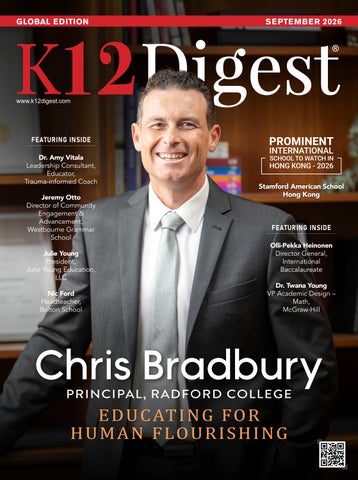
GLOBAL EDITION
SEPTEMBER 2026
www.k12digest.com
FEATURING INSIDE Dr. Amy Vitala Leadership Consultant, Educator, Trauma-informed Coach Jeremy Otto Director of Community Engagement & Advancement, Westbourne Grammar School Julie Young President, Julie Young Education, LLC Nic Ford Headteacher, Bolton School
Stamford American School Hong Kong
FEATURING INSIDE Olli-Pekka Heinonen Director General, International Baccalaureate Dr. Twana Young VP Academic Design – Math, McGraw-Hill
Chris Bradbury PRINCIPAL, RADFORD COLLEGE
E D U C AT I N G F O R HUMAN FLOURISHING
K12 Digest September 2026
1
2
K12 Digest September 2026
K12 Digest September 2026
3
September 2026
Managing Editor Sarath Shyam
Vol - 7 Issue - 9
Free Subscription
Consultant Editors Dr. John Andrews Naomi Wilson Emma James Stanly Lui Andrew Scott Joseph Alex
Art & Design Charlie Jameson
Sales & Marketing Jennifer Anderson Monica Davis Alice Smith Anna Elza
SEPTEMBER 2026
Free Subscription
www.k12digest.com
International Partnerships Americas Europe Middle East & Africa Asia-Pacific admin@K12digest.com
Follow Us On
www.linkedin.com/company/ k12digest www.facebook.com/K12Digest
4
K12 Digest September 2026
K12 Digest www.k12digest.com is a global knowledge sharing digital platform published by Connecta Innovation Private Limited. All rights reserved. The opinions expressed in the content and pictures provided are those of the authors. They do not purport to reflect the opinions or views of Connecta Innovation Private Limited or any of its members and we do not assume any responsibility. The publisher does not assume any responsibility for the advertisements, its content, pictures, and all representation of warranties made in such advertisements are those of the advertisers and not of the publisher. K12 Digest www.k12digest.com is a Free Subscription and Free-to-read digital platform strictly not for sale and has to be strictly for internal private use only. Publisher does not assume any responsibility arising out of anyone modifying content and pictures, printing a copy of this digital platform in any format and in any country and all matters related to that.
MANAGING EDITOR’S NOTE
Preparing for a Future We Cannot Predict
T
he most difficult question in education may no longer be, “What should students know?” It may be, “What will they need to know when the world changes again?” A student entering school today could graduate into careers that barely exist yet. Technologies will evolve, industries will shift, and the skills valued by employers will continue to change. The World Economic Forum’s Future of Jobs Report 2025 estimates that 39% of workers’ core skills will change by 2030, while resilience, flexibility, agility, creative thinking, curiosity, and lifelong learning are all expected to grow in importance. This reality has made adaptability an educational priority. I often think about how different the world looks to students compared with the one their parents entered as young adults. We can give students excellent textbooks, carefully designed curricula, and strong academic foundations, yet none of us can provide a reliable map of the world they will inherit. What we can do is help them become confident navigators. This is where the September issue’s cover story, Educating for Human Flourishing, by Chris Bradbury, Principal of Radford College, becomes particularly significant. Bradbury presents education as a preparation for meaningful lives, placing wellbeing, purposeful achievement, and character alongside academic learning. His emphasis on adaptive problem solving, ethical competence, curiosity, and understanding the world offers a compelling framework for educating students amid uncertainty and rapid technological change. The challenge extends beyond schools. Universities, employers, policymakers, and families all have a role in creating learning environments where young people can question, experiment, recover from setbacks, and remain curious when the answers are unclear. The Organisation for Economic Cooperation and Development (OECD), which studies education systems and future-ready skills across countries, has increasingly emphasized the competencies students need to navigate a changing world. As you explore this issue of K12 Digest, you will find other thought-provoking articles, interviews, and perspectives examining the changing landscape of education and the people shaping it. The future may remain uncertain. That is precisely why education must give students something more enduring than a set of answers: the confidence, character, and curiosity to keep learning when the questions change. Enjoy Reading.
Sarath Shyam
K12 Digest September 2026
5
10
COVER STORY
Chris Bradbury PRINCIPAL, RADFORD COLLEGE
6
K12 Digest September 2026
E D U C AT I N G F O R HUMAN FLOURISHING
20 STAMFORD AMERICAN SCHOOL HONG KONG Where Curious Minds Learn to Lead
MENTOR’S MANTRA
32
FROM THEORY TO ACTION: A NEW IB COURSE SEES STUDENTS TACKLE THE WORLD’S MOST COMPLEX PROBLEMS Olli-Pekka Heinonen, Director General, International Baccalaureate
K12 Digest September 2026
7
EMPOWERING YOUNG MEN TO MAKE A DIFFERENCE FOR GOOD
64 50 PRIORITIZING TEACHER WELLBEING: 4 TAKEAWAYS FOR SCHOOL LEADERS Dr. Amy Vitala, Leadership Consultant, Educator, & Trauma-informed Coach
8
K12 Digest September 2026
BEST PRACTISES
ACADEMIC VIEW
Nic Ford, Headteacher, Bolton School
ADMIN PERSPCTIVE
TRANSFORMING SCHOOL ADVANCEMENT INTO HUMAN CONNECTIONS Jeremy Otto, Director of Community Engagement & Advancement, Westbourne Grammar School
44
INDUSTRY PERSPCTIVE
38
EMPOWERING EVERY LEARNER BEYOND CLASSROOM WALLS INTO GLOBAL ACCESS Julie Young, President, Julie Young Education, LLC
THE UNTAPPED POWER OF TEACHER AND STUDENT SELF-EFFICACY Dr. Twana Young, VP Academic Design – Math, McGraw-Hill
56
K12 Digest September 2026
9
Chris Bradbury PRINCIPAL, RADFORD COLLEGE
E D U C AT I N G F O R HUMAN FLOURISHING Chris Bradbury, Principal at Radford College, is a distinguished and visionary educational leader whose dynamic contributions have elevated school leadership, teaching excellence, and student achievement in many school contexts. Throughout his career as a Principal and systems leader, Chris has championed improvements in academic outcomes, student wellbeing and inclusive educational practices. Chris has a genuine commitment and passion for the growth of young people to achieve their personal best through instilling a love of learning. An award-winning teacher of History, Legal Studies and Politics, his leadership was recognised by the Teacher’s Guild of New South Wales with an Honorary Fellowship Award exemplifying integrity, service and transformative leadership in education. His commitment to learning has seen him earn a diverse range of qualifications both in Australia and internationally at Harvard and Oxford.
10
K12 Digest September 2026
K12 Digest September 2026
11
I
n contemporary education, schools face a profound challenge: how do we prepare young people not only to achieve academic success, but also to live meaningful, purposeful and fulfilling lives? At a time when student wellbeing, resilience, mental health, character development and future readiness
12
K12 Digest September 2026
dominate educational conversations, many schools are re-examining the very purpose of education. Across the educational landscape, this challenge has become a defining priority. Rather than viewing academic performance as the sole measure of success, many progressive
schools have embraced a broader vision centred on human flourishing - a philosophy that seeks to nurture the intellectual, emotional, social, physical and ethical dimensions of every young person. This vision provides a comprehensive framework for educating students to thrive in an increasingly complex world.
The concept of human flourishing is not simply another wellbeing initiative. It is a comprehensive philosophy of education that recognises that schools have a responsibility to develop the whole person
Flourishing as the Purpose of Education The concept of human flourishing is not simply another wellbeing initiative. It is a comprehensive philosophy of education that recognises that schools have a responsibility to develop the whole person. Human flourishing is the cultivation of a life characterised by purpose, meaning and wellbeing. It involves helping young people become emotionally intelligent, socially capable, mentally and physically healthy, and equipped to contribute positively to society. Students are encouraged to discover their strengths, pursue their passions, develop self-
K12 Digest September 2026
13
Education for Human Flourishing extends the OECD Education 2030 Learning Compass by placing purpose at the centre of learning, addressing the opportunities and risks of AI, and defining the competencies needed for individuals and societies to flourish in an uncertain future worth and build the skills necessary to navigate life with confidence and resilience. The OECD’s Education for Human Flourishing – A Conceptual Framework reimagines the purpose of education in response to the profound social, technological and environmental challenges facing humanity. Drawing on Aristotle’s conception of a flourishing life, the framework argues that education should enable young people to pursue happiness, meaning, positive relationships and
14
K12 Digest September 2026
accomplishment over the course of their lives. It goes beyond academic success by emphasising both student well-being in the present and a broader ethic of care for others, informed by traditions such as Ubuntu, Confucianism and Buddhism. This responsibility extends not only to fellow human beings but also to the natural world and future generations. A key motivation for the framework is the rapid advancement of artificial intelligence. The OECD argues that AI presents significant
risks to human meaning, agency and security, and may ultimately challenge humanity’s future. Education for human flourishing seeks to respond by strengthening uniquely human capabilities, helping individuals find purpose, act ethically and contribute to a fairer and more sustainable society. At the centre of the framework are five interconnected competencies. The core competency, Acting in the World, focuses on helping learners identify their purpose, form intentions and take meaningful action. Supporting this are Adaptive Problem Solving and Ethical Competence, which equip individuals to navigate complex challenges responsibly. Alongside these are Understanding the World, which encourages reconciliation of different perspectives and worldviews, and Appreciating the World, which develops an awareness of beauty, nature and the sublime. Together, these competencies foster meaning, agency and lifelong flourishing. These capabilities rest upon a strong educational foundation. The framework
emphasises the continued importance of core literacies in mathematics, science and reading, alongside social and emotional skills such as collaboration, emotional regulation, openmindedness and engagement with others. Student well-being, including psychological health, agency and belonging, is also viewed as essential. Human flourishing is therefore not a “soft” educational goal, but one built upon rigorous knowledge, skills and character development. The framework also has important implications for teaching, leadership and system design. Learning environments should value disciplinary knowledge, encourage student agency and promote critical reflection on technology. Active learning is supported through experiential learning and purposeful teacher guidance. Educational leaders are called to rethink educational purpose, champion equity, foster innovation and build learner agency, while teachers require expertise in deep learning, curriculum co-design, assessment and digital literacy.
K12 Digest September 2026
15
Ultimately, Education for Human Flourishing extends the OECD Education 2030 Learning Compass by placing purpose at the centre of learning, addressing the opportunities and risks of AI, and defining the competencies needed for individuals and societies to flourish in an uncertain future. The Three Pillars of Flourishing Flourishing does not diminish the importance of academic excellence. Rather, it expands the purpose of education beyond examination results and university entrance scores. The underlying belief is that intellect, character, leadership and wellbeing are not competing priorities, but mutually reinforcing dimensions of a flourishing life. A commitment to flourishing is often connected to a rich history of values-based education, combining academic excellence with community service, personal development and spiritual or ethical growth. At Radford College, we have developed a holistic educational model for human flourishing built around three interconnected pillars: present flourishing, academic achievement and character skills. These pillars operate together to support the whole child, equipping them to not only succeed, but to make a positive contribution to their communities and the wider world. 1 Present Flourishing: Wellbeing as the Foundation The first pillar recognises that student wellbeing is not peripheral to learning; it is fundamental to it. Research demonstrates the reciprocal relationship between wellbeing and academic performance. Students who feel safe, connected
16
K12 Digest September 2026
and supported are more likely to engage, persist and succeed. Holistic wellbeing encompasses emotional, social, mental and physical health. Schools strive to create environments where students experience belonging and connection while developing the skills to manage challenges. Key priorities include resilience, social and emotional learning, positive relationships, digital citizenship, healthy lifestyles and mental health education, giving young people the competencies to navigate uncertainty and build healthy relationships. 2 Academic Achievement: Excellence with Purpose While wellbeing provides the foundation, academic achievement remains a critical component of flourishing. Excellence is defined not merely by grades, but by the development of intellectual rigour, curiosity and a lifelong love of learning. Effective schools emphasise critical thinking, problem-solving and the ethical use of knowledge. Students are encouraged to become active learners who adapt and engage thoughtfully with complex issues. Supporting this vision requires exceptional professional practice, including high-quality teaching, expert educators, rigorous curriculum design, personalised support and strong partnerships with parents—ensuring that flourishing students are supported by flourishing educators. 3 Character Skills: Preparing Students for Life The third pillar focuses on character development, cultivating integrity, ethical behaviour, respect and personal responsibility.
K12 Digest September 2026
17
Integrating wellbeing, academic achievement, character development and leadership within a coherent educational framework prepares young people not just for examinations, careers or university, but for life itself
Students develop a strong moral compass and understand the impact of their decisions on themselves and others. Character is intentionally developed through experiences, reflection and action across diverse programs, including mentoring, wellbeing education, goal setting, the arts, sport, outdoor education, entrepreneurship and STEM initiatives. In an era where technical knowledge quickly evolves, character strengths like adaptability, resilience, ethical judgement and empathy remain invaluable. Leadership as a Natural Outcome of Flourishing A distinctive aspect of this philosophy is the emphasis on leadership development, viewed not as a position held by a few, but as a responsibility exercised by many. Students develop communication skills, teamwork, initiative and the capacity to inspire positive change through authentic contexts like student
18
K12 Digest September 2026
leadership initiatives, community festivals, collaborative programs and social responsibility projects. By connecting leadership with service, schools develop graduates who are both capable and compassionate. As schools continue to respond to rapid social, technological and cultural change, the question of what constitutes a meaningful education is paramount. Academic success remains essential, but it is no longer sufficient on its own. Integrating wellbeing, academic achievement, character development and leadership within a coherent educational framework prepares young people not just for examinations, careers or university, but for life itself. Ultimately, flourishing is about helping students become the fullest version of themselves: intellectually curious, emotionally resilient, ethically grounded and socially responsible - the enduring purpose of education itself.
K12 Digest September 2026
19
20
K12 Digest September 2026
STAMFORD AMERICAN SCHOOL HONG KONG Where Curious Minds Learn to Lead
A
t Stamford American School Hong Kong, a student’s journey begins with curiosity. In the early years, children build strong foundations in literacy, mathematics and design thinking, while discovering the pleasure of asking questions and finding their own answers. As they move into Middle School, the focus widens. Students deepen their academic understanding, strengthen language skills and begin to shape their identity as learners and young people. By High School, those experiences come together through pathways designed to prepare them for university and life beyond it. Graduates leave with more than academic credentials. They carry confidence, adaptability and a global outlook. Founded in 2017, Stamford set out to create a learning community where strong academics, innovation and character could meet in
K12 Digest September 2026
21
Andrew Noakes, Head of School, Stamford American School Hong Kong
With over two decades of experience in education, Andrew Noakes joined Stamford American School Hong Kong in January 2025, bringing a strong record of leadership from prestigious schools in the UK, UAE and Singapore. He previously established Brighton College (Singapore), a fellow Cognita School, as Head Master, and has led four schools across the UK and the Middle East, including 15 years of headship experience in all-through schools serving children from 18 months to 18 years. Andrew was drawn to Stamford by its vibrant, supportive community and its commitment to helping every student grow in confidence and reach their potential. He believes education should empower students with the abilities, skills and knowledge they need to thrive both academically and personally.
22
K12 Digest September 2026
Today, Stamford American School Hong Kong has grown into a K12 through-train school that brings together rigorous American standards and inquiry-based learning
a genuinely personalised experience. Today, it has grown into a K12 through-train school that brings together rigorous American standards and inquiry-based learning. Its senior students can pursue several graduation routes, including the Stamford American High School Diploma and International Baccalaureate Diploma Programme options. The School’s values, integrity, courage, innovation, compassion and scholarship, are felt in everyday moments. They guide how students work through a difficult problem, support a classmate, take creative risks and reflect on their responsibilities to others. Stamford also places real emphasis on wellbeing and globalmindedness, encouraging students to see how their learning connects with the world around them. For Andrew Noakes, Head of School, staying responsive is central to that promise.
K12 Digest September 2026
23
“We are committed to continuous innovation and professional growth,” he says. Stamford’s educators engage in ongoing professional learning, exchange ideas with colleagues around the world and draw on emerging research to keep their practice relevant and thoughtful. That spirit also guides the School’s curriculum. It is regularly reviewed against global standards while making room for the capabilities students will need in a changing world: digital literacy, design thinking, entrepreneurship and sustainability. “This ensures our students are prepared not just for today’s challenges, but for tomorrow’s opportunities,” Noakes says. A Young School with a Growing Story Stamford opened its doors in September 2017 with 345 students and 74 staff members. Its ambition was clear from the outset: to develop future-ready young people with innovative minds, without losing sight of the essential building blocks of literacy and numeracy. Since then, that vision has developed across a full K12 journey. The community has grown
24
K12 Digest September 2026
to nearly five times its original size, while its programmes have broadened to include student leadership, real-world career exploration and an increasingly robust university-preparatory experience. STEAM education has been a defining thread in that growth. Stamford received the Bronze Award for Best STEAM Initiative at the 2019 EduTECH Awards and was named Best School, STEM at the inaugural Hong Kong Education Awards in 2021. In 2026, it also received the Public Choice STEAM Award at the GBA School Awards, organised by 21CLHK. Beyond
the trophies, the work is visible in students’ ideas, prototypes and problem-solving. The School’s robotics team, Eggs on Kruh, earned the opportunity to represent Hong Kong at the VEX V5 Robotics World Championship in St Louis, Missouri. Academic foundations have strengthened alongside this spirit of exploration. Stamford achieved joint CIS and WASC accreditation and IB Diploma Programme authorisation in 2021, only four years after its founding. Its successful re-accreditation in 2026 marked another important moment for the School community.
Stamford achieved joint CIS and WASC accreditation and IB Diploma Programme authorisation in 2021, only four years after its founding
K12 Digest September 2026
25
The first Grade 12 cohort graduated in 2023, beginning a promising new chapter for the School. Since then, Stamford students have recorded IB results above the world average, with the Class of 2026 producing the School’s first perfect 45 point IB score. The Spirit of Stamford Scholarship Programme, launched in 2021, has also helped recognise high-achieving students and welcome talented learners into the community. Physical growth has followed. An annex was added to the original Ho Man Tin campus in 2021, and in October 2025, Stamford opened its second campus in West Kowloon. Designed as a pre-university-style High School, the new setting gives older students room to work with greater independence and purpose. It illustrates a school that is still young, yet already clear about the kind of future it wants its students to craft. Learning with Purpose What distinguishes Stamford is the way academic rigour is paired with learning that looks ahead. From Pre-Primary to Grade 12, students follow a connected journey shaped by personalised support, hands-on projects and opportunities to discover what genuinely interests them. STEMinn, Stamford’s signature science, technology, engineering and mathematics programme, is infused throughout the curriculum from the early years. Students explore how things work, then learn to design, test and improve their own solutions. Sustainability and social responsibility remain key elements of STEMinn, prompting young people to consider not only what they can create but also why it matters.
26
K12 Digest September 2026
Through practical projects and interdisciplinary units, Stamford students build skills that will travel with them into any field: leadership, analytical thinking, communication and complex problem-solving
Through practical projects and interdisciplinary units, students build skills that will travel with them into any field: leadership, analytical thinking, communication and complex problem-solving. A classroom idea can become a model, a debate, a research question or a team challenge. The learning feels active because students are expected to take part in it fully. That same sense of ownership extends beyond the classroom. A broad curriculum and co-curricular programme introduce students to a range of disciplines, interests and communities. Student leadership opportunities give students a platform to speak up, take responsibility and help shape school life. For older students, the Cornerstones Programme brings the world of work closer.
The structured career education experience allows High School students to explore real professional environments before choosing subjects for their final IB Diploma Programme years. It gives an important question practical weight: what kind of future does each student want to pursue? “Students have the space and opportunity to find their passion and pursue their own version of success,” says Noakes. That belief guides Stamford’s three graduation pathways, helping each learner move towards tertiary education in a direction that reflects their strengths and aspirations. Seen, Supported and Challenged At Stamford, high expectations are matched by close attention to the individual learner. The School’s approach rests on three connected
priorities: academic rigour, personalised support and holistic development. Students are challenged to aim high, while teachers work to ensure that challenge is meaningful. Learning is not treated as a onesize-fits-all experience. Through differentiated instruction, educators adapt classroom teaching to meet students where they are and help them take the next step with confidence. “Personalised pathways and differentiated instruction ensure that every learner is appropriately supported and stretched,” Noakes explains. It is an approach that recognises that progress can look different for every child and that achievement includes the confidence to persevere when learning becomes demanding. The curriculum brings together American standards, inquiry-based learning, crosscurricular connections and project-based
K12 Digest September 2026
27
experiences. Students are encouraged to investigate, question and apply what they know. A topic explored in one subject can surface again in another, giving learning greater relevance and helping students see patterns across ideas, cultures and disciplines. Global awareness is part of this daily experience. Classroom conversations and projects regularly draw on perspectives from around the world, encouraging students to listen carefully, think critically and consider the impact of their choices beyond their immediate surroundings. From a student’s first day, teachers track both attainment and growth through assessments, observations and data-informed planning. That insight helps staff respond early and thoughtfully, whether a student needs additional challenge, language support, counselling, enrichment or learning support services. The result is a learning environment where students are known as people, not simply
28
K12 Digest September 2026
as grades. As they grow in confidence and capability, they are better placed to make the most of the opportunities that follow.
Life at Stamford extends well beyond academic lessons
Finding Their Voice Beyond the Classroom Life at Stamford extends well beyond academic lessons. Across student leadership, clubs, house activities, service learning and enrichment programmes, young people are encouraged to try new things, contribute to a team and discover where their interests may lead. For some, that may mean taking on a leadership role or organising a school initiative. For others, it may begin with joining a club, creating something with peers or taking part in a service project. These experiences give students space to build confidence, practise responsibility and understand the value of showing up for a wider community. The School’s broad co-curricular offering supports this process of self-discovery. Students can explore academic interests alongside the arts, innovation, service and leadership, while
K12 Digest September 2026
29
personal support helps them make sense of their strengths. The aim is not to prescribe one definition of success, but to help each learner find a path that feels purposeful. In the Elementary School, virtual reality has become a thoughtful part of the learning experience. It is approached as a tool for inquiry, carefully connected to classroom objectives rather than presented as a distraction or novelty. Teachers receive training in content alignment, lesson design and transdisciplinary learning, so a virtual experience has a clear place within the curriculum. An “Ethics of Access” protocol guides the selection of VR content, with safety and ageappropriateness carefully considered. Students, too, learn how to use the technology responsibly.
They receive guidance on digital citizenship and physical safety, enter each virtual environment with a specific learning goal and reflect afterwards on what they have witnessed and gleaned. By calling VR a “teaching tool” rather than a game, Stamford sets a purposeful tone. The technology becomes a way to prompt questions, deepen understanding and make learning feel vividly present. This balance of aspiration and care is reflected in the School culture as a whole. Diversity is celebrated, open dialogue is encouraged and mutual respect is expected. “We want every student to leave with curiosity, resilience, compassion and purpose. They should also have the confidence to contribute meaningfully to their community and the wider world,” says Noakes.
By calling VR a “teaching tool” rather than a game, Stamford sets a purposeful tone. The technology becomes a way to prompt questions, deepen understanding and make learning feel vividly present
30
K12 Digest September 2026
Looking Ahead with Purpose As Stamford enters its 10th anniversary year in the 2026/27 academic year, there is a strong sense of momentum across the School community. The years since its founding have brought growth, new campuses, academic milestones and a clearer expression of what the School hopes to offer young people in Hong Kong. The next chapter is focused on deepening that work. Personalised learning remains a priority, alongside expanded innovation and STEM pathways, stronger university preparation and a continued commitment to a vibrant, inclusive community. Stamford is also exploring opportunities to broaden its Middle School offering, with feasibility studies under way to consider how best to meet the needs of students in those formative years. For Noakes, the direction is guided by a simple and enduring purpose. “Our long-term
vision is to keep empowering students to thrive academically, personally and socially, while preparing them to meet the challenges of the future with integrity and compassion,” he says. That ambition reaches beyond results or destinations. Stamford wants to be known for academic excellence, certainly, but also for nurturing principled and compassionate leaders who can navigate complexity with confidence and use their learning to create positive change. “We aspire to cultivate generations of learners who are curious, courageous and committed to lifelong learning. They should leave our campus ready to shape a better future for their communities and the world,” Noakes explains. It is an ambitious vision, grounded in the everyday work of a school: a thoughtful question in class, a student finding their voice, a teacher offering timely encouragement. As Stamford looks towards its next decade, those small moments will continue to define its larger purpose.
K12 Digest September 2026
31
MENTOR’S MANTRA
From Theory to Action: A New IB Course Sees Students Tackle the World’s Most Complex Problems Olli-Pekka Heinonen, Director General, International Baccalaureate
T
he issues that will define this generation do not sit neatly within classic school subjects. Climate change is not only a geography problem. Inequality is not only a politics problem. The effects of technology on democracy are not only a computer science problem. Each one is a systems problem: one in which causes and consequences are spread across disciplines, institutions, and borders, and where acting on one part of the system invariably affects everything else.
Secondary education has been aware of this for some time. The response, in most models, is to teach systems thinking at the edges. What has been missing is the willingness to commit fully to this kind of learning and to treat it with the same rigour we apply to mathematics or literature. That is why in May the IB’s Board of Governors approved the next step for Systems Transformation, a new IB Diploma Programme course now moving from a small pilot toward a wider early adopter phase in 2028 before a planned global offering in 2030.
Systems thinking has been embedded in university programmes and professional practice for decades 32
K12 Digest September 2026
Olli-Pekka Heinonen has served as Director General of the International Baccalaureate (IB) since 2021, advancing its mission to develop inquiring, knowledgeable, and caring students. Mr. Heinonen served as Director General of the Finnish National Agency for Education from 2016-2021. He was State Secretary to the Finnish Prime Minister from 2012–2016, and Director of Yle, Finland’s national public broadcaster, from 2002 to 2012. A graduate of the University of Helsinki with a Master of Laws, Mr. Heinonen earlier served as Minister of Education and Science, Minister of Transport and Communication, and as a Member of Parliament.
K12 Digest Seeptember September 2026
33
Systems Transformation is a significant addition to the DP. It emerged from a question the IB has been sitting with since 2019: what else might students in their last years of secondary school need that the DP can provide? This question prompted a careful review of the IB’s offering for the 16-18 age group, shoring up what works and identifying where new opportunities could take root and grow. The DP itself has been an evolving fixture of the IB since 1968, and is one of the most rigorous and respected pre-university qualifications in the world. The review eventually presented us with two opportunities for new course offerings: engaging with data, which will be addressed through a companion course currently in development, and systems thinking, which Systems Transformation is here to meet head on. Systems Transformation is not just about systems thinking in the academic sense. It is important that students understand how systems work, but they also go beyond this by putting that learning into action. Students are designing and carrying out interventions in systems which are very much real. Students learn to map stakeholders, trace how a change in one part of a system ripples through others, and work in teams to test their ideas. They learn to embrace complexity over simple solutions, take greater ownerships of their learning, and ultimately, to act. The course is transdisciplinary by design: the problems it addresses do not respect subject boundaries, and no single subject can claim clear ownership. In another first for the DP, Systems Transformation counts for two standard-level
34
K12 Digest September 2026
Systems Transformation will take its place among this broad academic offer, with every diploma awarded reflecting the diverse and exciting ambitions of the graduating IB student
courses in the IB’s six-course requirement, carrying 14 of the 45 available points (double the usual seven). In place of traditional exams, students are assessed through a range of authentic formats that reflect the action-oriented nature and real-world focus of the course. In the pilot, this has included tasks based on projects, portfolios and case studies. Four schools are currently piloting the course: UWC Atlantic in Wales, UWC Southeast Asia in Singapore, Upper Canada College in Toronto, and Mulgrave International School in Vancouver. This May, 100 pilot students sat the formal assessment for the first time. The work they have produced spans subject disciplines as well as geographical locations, from the next town over to the other side of the world. One student is tackling energy poverty in Kinshasa, converting food waste from local restaurants, farms and educational institutions into biogas, then running workshops to teach communities how to sustain the system themselves. Another is working with one of Nepal’s first community seed banks to run workshops for farmers and high school students on alternatives to chemical fertilisers and imported seeds. One Systems Transformation student worked with a group of elderly migrant women in Malmö, Sweden, to address the isolation that comes with discrimination, language barriers and exclusion from community life. And in northeast Brazil, one student designed a sticker album for children in the semi-arid biome of Caatinga, with cards of increasing rarity featuring more endangered species. The student hopes that, if children feel they belong to the biome, they may be more likely to protect it.
K12 Digest September 2026
35
These projects vary in scale and subject matter. Each student has identified a system with which they have a sincere connection, studied it carefully, and then found a point of genuine intervention. That combination of analysis and action, of rigour and real-world consequence, is precisely what Systems Transformation is designed to produce. From 2028, more early adopter schools will offer the course, drawn from a wider
36
K12 Digest September 2026
range of contexts spanning countries, languages, and state-maintained schools. We hope to achieve mainstream availability in 2030, with the first mainstream cohort graduating in 2032. We expect growth to be gradual, and will offer professional learning opportunities to support teachers in shifting to this focus on systems. Nearly 4,000 schools around the world offer the DP, each offering their own combination of diverse
Systems Transformation is not just about systems thinking in the academic sense. It is important that students understand how systems work, but they also go beyond this by putting that learning into action
DP subjects. Systems Transformation will take its place among this broad academic offer, with every diploma awarded reflecting the diverse and exciting ambitions of the graduating IB student. Systems thinking has been embedded in university programmes and professional practice for decades. It is how policymakers, ecologists, and business leaders have learned to approach problems too complex for single-discipline
solutions. What has been missing is a recognised secondary-school route into this kind of learning, within a qualification universities already understand. Systems Transformation will provide that route, giving students a recognised path to do what the world will soon demand of them: understand complexity, act with judgement, and contribute to meaningful change.
K12 Digest September 2026
37
INDUSTRY PERSPECTIVE
The Untapp e d Power of Teacher and Student Self-Efficacy Dr. Twana Young, VP Academic Design – Math, McGraw-Hill
D
istrict leaders across the country are searching for ways to improve mathematics achievement. In many places, students have not returned to the achievement levels that existed pre-pandemic. Schools have invested heavily in curriculum, intervention programs, assessments, and professional development, yet many students continue to struggle in mathematics. While standards, resources, and instructional initiatives are important, one critical factor is often overlooked in school improvement conversations: student self-efficacy and teacher self-efficacy. Albert Bandura’s work on social cognitive theory identified self-efficacy as a major influence on motivation, perseverance, and behavior. Self-efficacy is a person’s belief that they can be successful with a given task. Self-efficacy is task-specific, not subject-specific. For example, a student may have high selfefficacy in whole-number addition but low self-efficacy in fraction addition. Self-efficacy is more than feeling confident. A student can feel nervous and still have high self-efficacy because they believe, “I can learn this if I persevere.” This belief is evident when we see students engage in playing video games. No matter how many times they fail, they persist because they believe they will succeed in the end. Every challenge students faced in gameplay, they saw as an opportunity to learn and grow in their understanding. Self-efficacy is not so much about what students know as it is about whether they will engage long enough to learn. When students have high self-efficacy, they are more likely to
38
K12 Digest September 2026
Twana Young, Ph.D., is Vice President of Academic Design, Mathematics at McGraw Hill, leading development of engaging, high-quality K–12 math curriculum for students and teachers. She has served as a teacher, instructional coach, district leader, and product leader, with expertise in curriculum and assessment development, professional learning, instructional design, educational leadership, product development, and research. Dr. Young is dedicated to improving mathematics education and creating impactful instructional resources. A national thought leader, she frequently presents research and insights across the country. She holds degrees from Nicholls State University, Ashland University, and Liberty University, focused on education, curriculum and achievement.
K12 Digest September 2026
39
attempt challenging tasks, persist when learning becomes difficult, engage in productive struggle, recover from mistakes, and demonstrate motivation and resilience. These are skills that students demonstrate when they believe that their effort and thinking can lead to success. Teachers are another important factor in student success. They are instrumental in building student engagement and supporting students in constructing knowledge. It is also important to consider teacher self-efficacy in school improvement efforts. Teacher selfefficacy is an educator’s belief in their ability to successfully teach so that students will learn. Teacher self-efficacy is complex and futuristic. It is a product of what teachers think they are capable of teaching, based on their perceptions and interpretations of their past experiences of success and failure. A teacher’s self-efficacy is also influenced by beliefs about the content they have learned and the content they believe they can effectively teach to students. The implications for student achievement and students’ own development of self-efficacy are substantial. Teacher self-efficacy directly influences instructional decisions, classroom climate, and student opportunities to learn. Teachers with high self-efficacy tend to provide richer mathematical experiences, encourage productive struggle, and support deeper student engagement. Students in these classrooms are more likely to perceive their teachers as supportive and to develop confidence in their own mathematical abilities. In many ways, teacher self-efficacy becomes contagious. When teachers believe students can succeed, students begin to believe it too.
40
K12 Digest September 2026
As a curriculum designer, I see this as a place where instructional resources can play a transformative role. High-quality instructional materials (HQIM) should not only support student learning but also support teacher learning. When this happens, it allows for teacher self-efficacy support at scale. My team and I are committed to creating educative curriculum materials that intentionally include guidance to help teachers strengthen their content knowledge, pedagogy, and instructional decision-making during lessons. These supports may include things like teacher questioning strategies, sample student responses, guidance on differentiation, instructional videos, explanations of mathematical concepts, and information on common misconceptions. When instructional materials function as embedded professional learning, teachers experience something powerful: mastery experiences. Bandura identified mastery experiences as the strongest source of self-efficacy. Mastery experiences are experiences of success with overcoming challenges or completing tasks. Teacher self-efficacy increases when teachers successfully implement instructional strategies and see positive student outcomes. When teachers see students grasp concepts, improve their skills, show confidence in learning, and have “a-ha” moments it strengthens their own confidence and willingness to implement rigorous instructional practices. Confidence becomes sustainable when teachers experience authentic success supported by strong systems, meaningful collaboration, and practical instructional resources.
For district leaders, a focus on students’ self-efficacy and teacher selfefficacy provides an opportunity The future of mathematics achievement depends not only on what students believe about themselves, but also on what teachers believe about their own ability to make a difference. Therefore, improving mathematics achievement cannot focus solely on student interventions and accountability measures. It must also include intentional efforts to strengthen student selfefficacy and teacher self-efficacy. The good news is that self-efficacy is not static. It changes as students and teachers assess and reassess their capabilities. It changes as new skills are learned and can vary by topic. Teacher selfefficacy grows when
teachers experience success, gain clarity, and have opportunities to reflect on their practice. Before teachers can cultivate confidence in students, schools must first create conditions where teachers themselves experience success, growth, and efficacy. That may be the most overlooked and most powerful strategy for improving student outcomes. Bandura found four sources that are important to improving self-efficacy. Mastery experiences are past experiences in similar situations. Vicarious experiences, which refer to teachers’ experiences observing and learning from others in similar situations. Verbal Persuasion, which refers to the feedback, encouragement, and messages teachers receive from leaders, colleagues, and systems around
In many ways, teacher self-efficacy becomes contagious. When teachers believe students can succeed, students begin to believe it too
K12 Digest September 2026
41
Self-efficacy is not so much about what students know as it is about whether they will engage long enough to learn
them. Physiological and Emotional States, which refer to how stress, anxiety, workload, and emotional conditions influence teachers’ beliefs in their capabilities. Addressing these areas improves self-efficacy. Four Strategies for Educational Leaders to Improve Teacher Self-Efficacy: 1. Operationalize Successful Mastery Experiences - Instead of large initiatives, create short-cycle initiatives that deliver quick wins,
42
K12 Digest September 2026
set small, measurable implementation targets, and establish quick feedback loops so successes can be celebrated and shared. 2. Normalize Visible Practice - Create opportunities for teachers to observe effective instruction in authentic classroom settings through peer observations, co-teaching, demonstration classrooms, lesson study, or video-based learning. Highlight examples from educators with similar student populations, content areas, or experience levels so teachers can more easily envision success in their own classrooms. 3. Amplify Evidence of Impact - Create “instructional impact snapshots” to highlight teacher moves that resulted in student thinking and engagement. Highlight short student testimonials about “a-ha” moments when learning clicked. Create opportunities for peerto-peer feedback that lead to instructional wins. The goal is to create an environment where teachers regularly hear credible evidence that their work is making a difference and that growth is expected, supported, and achievable. 4. Lower Cognitive Load - Reduce unnecessary cognitive and emotional strain by creating annotated lessons for concepts that are traditionally challenging for teachers to teach. Establish instructional routines. The repetitive nature brings feelings of familiarity, purpose, and connection. Building teacher self-efficacy is not an isolated initiative. It is foundational to instructional improvement, effective curriculum implementation, and long-term student success. When teachers believe they can make a difference, they teach with greater clarity, persistence, creativity, and purpose, and students are positively impacted.
K12 Digest September 2026
43
ADMIN PERSPECTIVE
Transforming School Advancement into Human Connections Jeremy Otto, Director of Community Engagement & Advancement, Westbourne Grammar School
Jeremy Otto is a relational leader who believes community is built one meaningful moment at a time. An experienced educator and senior leader, he has held roles including Deputy Principal, Director of Teaching and Learning and international IB consultant, advancing student centred approaches in schools across the world. Jeremy is currently Director of Community Engagement and Advancement at Westbourne Grammar School, a Graduate of the Australian Institute of Company Directors, and an MBA candidate at Melbourne Business School. Guided by kindness, authenticity and trust, he is committed to creating cultures where people feel connected, supported and proud to belong together. Schools are increasingly being judged not by the sophistication of their marketing, but by the quality of the relationships they build. In an era shaped by AI, shifting parent expectations and growing competition, authentic community connection has become one of a school’s most valuable assets. For Jeremy Otto, that connection is not created through campaigns alone, but through hundreds of everyday interactions that shape whether people feel welcomed, known and valued. In an exclusive interview with K12 Digest, Jeremy reflected on the future of school community engagement, the ethical role of AI in admissions, and why trust will define the strongest school brands in the years ahead.
Hi Jeremy. Your portfolio spans Admissions, Marketing, Communications, Events, Scholarships, Archives, and Philanthropy. What moment showed you that community engagement is the true engine of a school’s future? For me, it was the realisation that a family’s connection to a school begins well before the
44
K12 Digest September 2026
first day of class. It might begin on a school tour, in a conversation with an admissions colleague, through the warmth of a welcome at an event, or even through the way an alumnus talks about their time at the school years after leaving. Those moments can feel small at the time, but together they shape trust. They help families understand not only what a school offers, but what it feels like to belong there. That is where
A school’s future is not built by one campaign or one moment of communication. It is built through relationships that are tended to over time.
K12 Digest Seeptember September 2026
45
community engagement becomes much more than a set of functions or a department. It becomes the thread that connects enrolment, reputation, philanthropy, alumni, storytelling and culture. A school’s future is not built by one campaign or one moment of communication. It is built through relationships that are tended to over time. When people feel known, welcomed and part of something meaningful, they are far more likely to contribute to the life of the school and advocate for its future. Five years from now, what will separate schools that built true community from those that just ran campaigns? The difference will be trust. A campaign can create attention, but community creates commitment. Schools that have only invested in campaigns may be able to point to strong
46
K12 Digest September 2026
visuals, polished messages and moments of visibility. Schools that have built true community will have something deeper, relationships that continue well beyond an enrolment decision or a fundraising appeal. Families will feel the difference between being processed and being genuinely heard. Staff will know whether they have been included in the story being told. Alumni will know whether their connection is valued beyond nostalgia. Students will know whether the values on the website are visible in the everyday culture of the school. In five years’ time, the strongest schools will be those where the external promise and the internal experience feel aligned. Their communities will not just receive communication. They will participate, contribute and advocate. That is the difference between running a campaign and building something people feel proud to belong to.
How do we make sure AI used in admissions and parent outreach helps scholarship families apply, not screens them out? We have to be very clear about the purpose of AI. In admissions and scholarships, it should be used to reduce friction, not to make final judgements about people. It can help families understand a process, translate information, receive reminders, complete forms more easily and know what support is available. Used carefully, it can make schools more accessible, particularly for families who may not already understand the language or expectations of independent school admissions. The danger comes when AI is used to rank, filter or make assumptions about a family’s capacity, commitment or potential. A scholarship application is never just a data set. It carries context, aspiration, complexity and often a great deal of courage. If we allow technology to narrow our view of a family, we risk excluding the very people scholarships are designed to support.
For me, the answer is to keep human judgement at the centre. Schools need clear ethical guardrails, transparency about how technology is being used and regular checks for bias. Most importantly, families must always be able to speak with a real person who can listen properly, understand their circumstances and advocate where needed. AI should widen the doorway, not become the gatekeeper. Marketing is moving from broadcast to community. What will be the hallmark of school brands that families trust in the coming years? The hallmark will be consistency. Families are increasingly discerning. They quickly sense when there is a gap between what a school says and what people experience. A beautiful prospectus or a polished campaign matters far less if the tone of the enrolment process, the school tour or the everyday interactions do not reflect the same values.
The difference will be trust. A campaign can create attention, but community creates commitment
K12 Digest September 2026
47
The schools that earn trust will be the ones that tell the truth about who they are and then live that truth consistently. Their stories will be grounded in real people, real experiences and real evidence of values in action. They will listen as much as they speak. They will understand that brand is not simply what is published. It is what is felt. In the coming years, families will trust schools that are clear, human and authentic. The strongest school brands will not just ask families to believe a promise. They will allow them to experience it. Leaders are shaped by ideas they return to. What book on leadership, community, or innovation has the most notes in your margins, and which insight shows up in your work daily? A book I often return to is Leaders Eat Last by Simon Sinek. The idea that has stayed with me is that leadership is fundamentally about creating the conditions where people feel safe enough to contribute, take risks and bring their best selves to the work. That idea has shaped the way I think about teams, community and the responsibility leaders have to the people around them. In a school context, this matters deeply. People need to feel trusted before they can truly engage. Families need to feel that they are entering a community that will know and value their child. Staff need to feel that their work is recognised and that they are part of something purposeful. Alumni need to feel that their connection to the school continues to matter. That insight shows up in my work every day. Whether I am leading admissions,
48
K12 Digest September 2026
Admissions is not about filling places; it is about beginning relationships
communications, events, scholarships or philanthropy, I try to focus first on trust. Processes are important, but they only become meaningful when they are grounded in care, clarity and genuine human connection. For me, leadership is about making people feel that they belong and then building the systems that help that belonging endure. Every leader keeps a non-digital anchor. What physical object in your office reminds you why people come before process? I keep handwritten cards and notes from students, colleagues and families. They are not elaborate objects, but they are the things I find myself returning to. They remind me that behind every process, timeline and strategy there is a person with a story. In a role that spans admissions, communications, events, scholarships and advancement, it is easy to become absorbed in systems. Systems matter, of course. They help us be clear, fair and organised. But those notes remind me that the work only has meaning if the process serves people well. A handwritten card captures something very human. It usually marks a moment when someone felt encouraged, supported, welcomed or understood. That is a powerful reminder. People may not remember every step in a process, but they remember how a school made them feel. If you could project one sentence onto the wall of every admissions office, what would it say? Admissions is not about filling places; it is about beginning relationships.
K12 Digest September 2026
49
BEST PRACTISES
Prioritizing Teacher Wellbeing: 4 Takeaways for School Leaders Dr. Amy Vitala, Leadership Consultant, Educator, & Trauma-informed Coach
Teacher Attrition & Retention In my last K12 Digest article, written almost two years ago, I discussed teacher attrition and retention. The article examines the data surrounding teacher satisfaction (or lack thereof), high attrition rates, and potential strategies for retaining our early-career educators. We understand from the research, for instance, that new teachers are 250% more likely to quit than their tenured colleagues, and nearly half of all educators vacate their position in the
first few years. Alternatively-certified teachers are even more likely to resign. With over half of our educators considering a resignation earlier than originally planned, it’s critical to reflect on the drivers of attrition and intentionally address teachers’ needs around resources, support, and work environment. After a few years of focusing on why teachers were dissatisfied in their roles and how to combat teacher attrition, I began looking at the issue from another angle. I grew curious
Research has shown for years that having even just one close friendship at work has a tremendous impact on employee wellbeing 50
K12 Digest September 2026
Amy Vitala is a leadership consultant, long-time educator, and trauma-informed coach who supports both individuals and organizations. A former teacher, district trainer, and edtech startup executive, Amy is passionate about educator satisfaction, employee wellness, and workplace culture. Amy holds a doctorate in Teacher Leadership and has spent more than a decade working with leaders and educators across the U.S. to affect positive change in K12.
K12 Digest Seeptember September 2026
51
about the teachers out there who are thriving and began considering what we might learn from educators who are genuinely satisfied with their jobs? Teacher Happiness I decided to pose a few questions to thousands of educators and heard back from over two hundred of them who expressed satisfaction in their roles. Why are they happy in their roles? Why do they remain at their schools? What keeps them going? I read every word teachers shared and analyzed their responses, wondering which factors might be influenceable by school and district leadership. While exact quotes and all identifying information will be protected, this
article will share conclusions drawn from those responses and identify four core, actionable themes that emerged from the data. Insights for Building Leaders Some of the reasons teachers cited as contributors to their satisfaction are simply out of our control as K12 leaders, such as having a short commute, a desirable district calendar, rockstar students, or membership to a strong union. Perhaps surprisingly, several classroom teachers cited pay as a primary reason they stay. Unfortunately, most leaders don’t have much say in teacher salaries or the district calendar. So what is it that K12 leaders can do when it comes to ensuring the wellbeing of their teachers? Four clear themes emerge when
I once had a (now former) principal tell me it ‘wasn’t her job’ to be a cheerleader or make the teachers feel good about their work. With all due respect, I wholeheartedly disagree. And the data does as well
52
K12 Digest September 2026
we examine teacher responses, offering some guidance when it comes to fostering teacher satisfaction. Let’s take a look at the ‘happiness’ factors that are more readily influenced by educational leaders. Community Many respondents cited enthusiasm around a sense of community and belonging. Some mentioned feeling supported by the parent community, while others mentioned what an honor it was to contribute to their immediate community. But the key highlight from this theme was immediately evident: coworker relationships can make or break the teaching experience. Research has shown for years that having even just one close friendship at work has a tremendous impact on employee wellbeing. Gallup Poll results suggest those who have close coworking relationships are seven times more likely to be engaged at work. Researchers also concluded the best predictor of higher wellbeing & engagement at work is not what people are doing – it’s with whom they are doing it. Responses from teachers supported this, with references to eating lunch with coworkers daily, spending time together outside of work, and having each others’ backs. There were even references to colleagues as ‘family’. A leader might believe they can’t control teacher-to-teacher relationships, but they can think about ways they can set the stage for informal teacher collaboration, both on and off campus. Rather than a jam-packed teacher workday, for instance, administrators may consider how to create spaces and opportunities for unstructured teacher time. During new teacher orientations, in addition to school
policies and pedagogical training, perhaps activities can also include those aimed at relationships and staff bonding. This might sound ‘fluffy’ to some, but this recommendation is supported in my dissertation research as well. The data is clear: teachers want unstructured, informal time to be together. Culture & Mindset These two themes went hand-in-hand. Rather than a culture of overworking and competition, happy teachers referenced school cultures centered around collaboration, support, respect, and healthy work boundaries. Some mentioned former workplace situations that were less desirable, with one teacher saying her previous school environment was ‘every person for themselves’. Topics of helping one another out and coming together to support their community arose multiple times when discussing why teachers remain at their current schools. Several educators indicated their satisfaction stemmed from a culture of respect, where they felt ‘heard’ by their leaders and treated like ‘human beings’ as opposed to just another employee. Numerous respondents referenced work-life balance and prioritizing mental health as reasons they were thriving. Some mentioned self-imposed mental health priorities, while others credited their administrators as cultivating a mindset of leaving work at school. Autonomy One of the most common words that appeared in the responses was ‘alone.’ Where support from leaders is crucial, especially for early-career staff, satisfied teachers appreciated the leaders who give them space. Administrators received praise for being present when needed, but happy
K12 Digest September 2026
53
Dozens of teachers credited building administrators with making them feel safe and supported
teachers said they felt trusted as professionals. They have the freedom to be themselves, teach how they want (within reason,) and guide their own professional learning. This lack of micromanagement from superiors was a driving theme for educators when reporting why they stay at their schools. Administration Administration (technically ‘admin’) was mentioned 138 times, the most frequentlyoccuring word by far. While there were certainly glimpses of administrative involvement in the above sections on community, culture, and autonomy, I feel the impact of administrator behavior on teacher happiness deserves a section of its own. Dozens of teachers credited building administrators with making them feel safe and supported. They commented on how their leaders have their backs, regularly show
54
K12 Digest September 2026
empathy, assist struggling teachers, and offer advice without condemnation. A handful of respondents said administrators take an interest in who they are as people, with one sharing that her admin was like a parent to her, and the top reason why she stayed at the school. Love and respect from administration appears to be valued tremendously by happy educators. The little things In addition to the core four themes shared above, it’s worth mentioning that the small things add up. When sharing why they are satisfied in their roles, several teachers cited reasons you might not immediately expect: staff taking collective pride in their clean buildings, administrators who are intentional with teacher scheduling, and leaders who show they care for their staff in little, thoughtful ways. I once had a (now former) principal tell me it ‘wasn’t her job’ to be a cheerleader or make the teachers feel good about their work. With all due respect, I wholeheartedly disagree. And the data does as well. Reflection Questions: Retaining Happy Teachers What are the “little things” you already do or could do for teachers and staff? How do you / might you communicate and model work-life balance and boundary-setting to help prevent teacher burnout? Are there authentic ways you can help foster community-building, such as facilitating teacher-teacher activities? Do your teachers feel safe and empowered as qualified educators? Trusted as professionals? How do you show up for your teachers in both good times and challenging ones?
75
Amazing Opportunity for Teachers and School Leaders to enhance their knowledge through FREE Teachers Academy masterclasses from international education experts !!! For more details and registration www.teachersacademy.com
Higher EducationK12 Digest Digest November 2021 September 2026
55
INDUSTRY PERSPECTIVE
Emp owering Ever y Learner Beyond Cla ssro om Walls into Global A ccess Julie Young, President, Julie Young Education, LLC
Hi Julie. You founded Florida Virtual School in 1997 when “online school” was barely a concept, laying the groundwork for an entire industry. Looking back, what was the moment you realized virtual learning could be more than an experiment — it could be a movement? Honestly, it happened gradually and then all at once. In the early days at Florida Virtual School, we were operating on a $200,000 grant with 77 students and a whole lot of faith. But there was a particular moment when students who had struggled in traditional settings started thriving, not just passing courses but genuinely coming alive as learners, because they could move at their own pace and access content on their own terms. When parents started calling not to complain but to say “my child finally loves school,” I knew this wasn’t an experiment anymore. It was a glimpse of what education could look like for every student, not just the lucky ones. The movement was already happening. We were just building the road beneath it. You helped normalize virtual school before Zoom classrooms existed. What’s one trend in digital learning today that you believe is being underestimated, but will define the next 5 years? Mastery-based progression. Everyone is talking about AI tools and personalized content, which matter, but the deeper opportunity is what happens when you stop organizing school
56
K12 Digest September 2026
Julie Young is an edupreneur, educator, innovator, and visionary leader renowned for her expertise in school design for diverse educational models, including virtual, blended, and technology-enhanced learning. She is also an author. She co-wrote Virtual Schools, Actual Learning with the Pioneer Institute for Public Policy Research and recently authored Say Yes: How Virtual Became Reality, sharing insights and lessons from decades of leadership in digital education. Today, Young channels her decades of leadership experience into executive coaching, management consulting, and strategic advisement for organizations navigating the evolving landscape of innovative education. Drawing on a career defined by building transformative institutions from the ground up, she partners with leaders and organizations to design bold, student-centered strategies that drive meaningful change. Recently, in an exclusive interview with K12 Digest, Julie shared insights into how virtual learning evolved from a $200,000 grant experiment with 77 students into a global movement after parents reported their children “finally love school.” She underscored that mastery-based progression, not just AI tools, will define the next five years as education shifts from seat time to demonstrated learning, and predicted cross-border K-12 online programs will gain mainstream credibility by 2030 through rigorous accreditation and university pathways. On AI, Julie urged leaders to lead with courage not compliance, embracing AI for targeted academic content and teacher support while remaining cautious about student-facing chatbots, insisting that innovation must be guided by discernment, purpose, and the conviction that growth is still possible for every learner. The following excerpts are taken from the interview.
K12 Digest September 2026
57
around seat time and start organizing it around demonstrated learning. When a student proves they know something, they move forward. When they don’t, they get more time and support, not a grade that follows them forever. That shift, away from the Carnegie unit and toward competency, is where the real transformation lives. Most of the ed-tech conversation is still about delivery. The bigger question is whether we’re willing to change what we accept as proof of learning. That answer will define the next five years. What’s your prediction for how crossborder, online K–12 education will evolve in reach and credibility? It will become far more normalized and far more credible, but only if the institutions leading it hold the line on rigor. My experience at ASU Prep Digital and through my consulting work with GEMS Education in Dubai confirmed something I had suspected for years: families around the world are hungry for high-quality, flexible, accredited education that doesn’t require uprooting their lives. The world is shrinking. The question is no longer whether cross-border online learning works. The question
is who earns the trust to deliver it. Accreditation frameworks will have to evolve, and so will the mindset of higher education institutions that still view online transcripts skeptically. By 2030, I believe we’ll see far more seamless pathways from globally delivered K-12 programs directly into recognized university admissions. The credibility gap is closing. Trailblazers need rituals that keep them grounded amid constant change. What’s your favorite way to start a day when you know you’ll be making highstakes decisions? I start quietly, and I mean that literally. Before a high-stakes presentation, I need to be completely alone with my own thoughts. I don’t rehearse with others on the day of, and I don’t want feedback in those final hours. What I need is stillness and space to go inward. That’s where my best preparation happens. And when I’m in that quiet, I’m not thinking about myself. I’m thinking entirely about my audience. Who are they? Where are they in their own journeys? What do they need to hear, not just what I want to say? What is the thing they
Most of the ed-tech conversation is still about delivery. The bigger question is whether we’re willing to change what we accept as proof of learning
58
K12 Digest September 2026
came into that room hoping someone would finally put into words? Great presentations, in my experience, are not performances. They are answers to questions the audience has been carrying. High-stakes meetings require a different kind of preparation, though the same instinct for stillness applies. Before I walk into a room that matters, I do my homework on the people across the table. I think carefully about what I’m hoping we walk away with, what the significant hurdles are likely to be, where the resistance will come from, and just as importantly, where our interests genuinely intersect. Those points of intersection are where trust gets built and where real progress becomes possible. If you haven’t found them before you sit down, you’re already behind. After nearly three decades in this work, I’ve learned that clarity doesn’t come from noise. It comes from knowing your audience, knowing your purpose, and giving yourself enough silence to find both.
by a one-size-fits-all, age-graded system: students in rural areas with limited course offerings, working students who need flexibility, and students who learn differently. But I want to name another group that doesn’t get talked about nearly enough: the young people who are currently forced to choose between pursuing their passion and pursuing their education. Our young golfers, actors, musicians, and athletes who are training and competing at serious levels shouldn’t have to make that choice. The idea that a 15-year-old with a professional trajectory in sport or the arts has to walk away from their education, or walk away from their calling, because we haven’t built a system flexible enough to hold both, is one of the quiet failures of traditional schooling. Merged pathways, done right, give those students their lives back. The risk is that these new pathways become available only to families who know how to navigate them. The work of equity is making sure the design is intentional from the start, not bolted on later.
The line between K–12 and higher ed is blurring fast. How do you see “high school, college, and career” pathways merging by 2030, and who stands to benefit most? The lines are already dissolving, and that’s a good thing. What I hope to see by 2030 is a genuinely seamless system where a motivated 16-year-old can earn college credit, explore a career pathway, and demonstrate mastery in real-world contexts, all without waiting for a diploma that says they’re finally ready to start life. The students who stand to benefit most are the ones who have always been poorly served
You co-wrote Virtual Schools, Actual Learning and recently authored Say Yes: How Virtual Became Reality. Beyond your own work, what’s one book that fundamentally shifted how you think about education or leadership? Carol Dweck’s Mindset is one of those books that reframes something you thought you already understood. Her research on fixed versus growth mindsets didn’t just influence how I thought about students. It changed how I thought about institutions, school boards, legislators, and the adults who hold the keys to whether innovation lives or dies.
K12 Digest September 2026
59
One of the hardest parts of building Florida Virtual School wasn’t the technology or the funding model or even the politics, though there was plenty of all three. It was convincing people that a fundamentally different kind of learning was not only possible but worthy of their trust. I sat across from superintendents, lawmakers, and education leaders who had spent their careers within a system with a very fixed idea of what school was supposed to look like. A building. A bell schedule. A teacher at the front of a room. Anything outside that shape wasn’t just unfamiliar to them. It felt illegitimate. That, I came to understand, was a fixed mindset operating at an institutional scale, and it is one of the most powerful forces working against progress in public education. I encountered that same fixed mindset in a different form when I moved to Arizona State University to help build ASU Prep Digital. President Michael Crow and our leaders, Jim Rund and Beatriz Rendon, were firm believers from the start, and that kind of leadership support is rarer than people realize. But within a large research university, there were plenty of skeptics who simply didn’t believe that high school students could do genuine post-secondary work. Our goal was never dual enrollment, Advanced Placement, or International Baccalaureate. Those models, as valuable as they are in their own right, still operate under the traditional assumption that post-secondary learning is something students enter at a prescribed age and stage. We believed something different. We believed that any student who was academically ready, regardless of age, deserved a real shot at being challenged by post-secondary coursework, and that the university ought to be the place that made that possible.
60
K12 Digest September 2026
So we did what innovators have always had to do. We proved it. We showed them. We placed academically ready students in rigorous postsecondary coursework and watched them rise to meet it. And over time, the skepticism gave way to evidence. Today, it is mainstream at ASU Prep for students to begin their college experience not at eighteen because a calendar says it’s time, but when they are academically ready. That shift, from “we don’t think they can” to “of course they can,” is exactly what Dweck is writing about. It doesn’t happen through argument. It happens through results. Dweck’s work gave me both language and compassion for that resistance. She helped me understand that people don’t dig in because they’re obstinate. They dig in because they genuinely believe that what exists is what’s possible. The most transformative thing a leader can do, whether you’re working with a struggling ninth grader or a skeptical university dean, is create the conditions for someone to believe that growth is still available to them. That conviction carried me through seventeen years at FLVS and into everything we built at ASU. Believe it’s possible. Then help everyone around you believe it too. You’ve hired and mentored hundreds of educators and leaders. What’s one non-negotiable skill you look for in professionals who want to innovate in education? Intellectual curiosity that survives disappointment, and a genuine love for students that makes the extra effort worth it. I know the question asks for one thing, but in my experience, these two qualities are inseparable. You cannot have one without the other and truly move education forward.
The leaders who will matter most in the next decade are the ones who hold two things simultaneously: deep conviction about what education is for, and genuine discernment about how new tools get used. Compliance will not carry you through this moment
Anyone can be curious when things are going well. The professionals who genuinely move education forward are the ones who hit a wall, a policy barrier, a skeptical board, a failed pilot, and instead of retreating, they ask why. They stay genuinely interested in the problem, even when it resists them. But curiosity alone can become an intellectual exercise. What keeps innovation honest, what keeps it human, is caring deeply about the students on the other end of every decision you make. Innovation in education is hard work. It takes more effort, more patience, and more resilience than most people anticipate. The leaders who sustain that effort over time aren’t doing it for the idea. They’re doing it because they cannot stop thinking about the kid who isn’t being reached by what already exists. I’ve hired a lot of talented people over the years, and the ones who made the biggest difference were rarely the most credentialed. They were the ones who couldn’t stop thinking about the question even when they went home at night, and who woke up the next morning still caring about the answer because a student somewhere needed it. Where do you see yourself in the next 5 years? I see myself doing exactly what I’m doing now, but with more intention and probably more joy. I’m advising organizations I believe in, including GEMS Education and the Cox Science Center and Aquarium, through a partnership with ASU. I’m coaching leaders who are navigating the same kinds of complex, high-stakes decisions I faced for decades. And with Say Yes now published, I’m hoping to shape conversations in colleges of education and entrepreneurship
K12 Digest September 2026
61
about what it actually takes to build something that has never existed before. I don’t need a title or an institution to do meaningful work. What I need is the right question and the right people to think alongside. I have both. Your work proves that bold leadership creates new realities. What’s your core message to education leaders about leading with courage, not just compliance, through the AI shift? Don’t wait for permission. I’ve watched too many talented leaders slow down at exactly the moment they needed to accelerate, because they were waiting for policy clarity, or board approval, or a pilot study that would finally make the case. AI is not a future problem. It’s a present reality, and your students are already living inside it. That said, leading through this moment requires real discernment, not just enthusiasm. I am cautious, and I think appropriately so, about AI in direct interaction with students. We don’t yet know enough about how to ensure that the technology serves the student rather than the other way around. A chatbot that a young person turns to for guidance, feedback, or connection carries risks we haven’t fully mapped out, and I don’t think moving fast and figuring it out later is acceptable when children are involved. Where I do see tremendous and immediate promise is in how AI can deliver highly targeted academic content, serving each student precisely what they need at exactly the right moment in their learning. That is the “any time, any place, any path, any pace” philosophy taken to a new level of precision. I also believe AI’s power to support teachers, giving them faster, richer feedback on student progress so they can
62
K12 Digest September 2026
When parents started calling not to complain but to say “my child finally loves school,” I knew this wasn’t an experiment anymore. It was a glimpse of what education could look like for every student, not just the lucky ones
intervene earlier and more effectively, is one of the most underutilized opportunities in front of us right now. The leaders who will matter most in the next decade are the ones who hold two things simultaneously: deep conviction about what education is for, and genuine discernment about how new tools get used. Compliance will not carry you through this moment. Courage will. And part of that courage is being willing to say, not yet, when the stakes involve students.
K12 Digest September 2026
63
ACADEMIC VIEWS
Empowering Young Men to Make a Difference for Good Nic Ford, Headteacher, Bolton School
Hi Nic. Your leadership journey spans Whitmore, Pleckgate, and Bolton School, with OFSTED turning “outstanding” and “special measures” into progress. Looking back at your first leadership role, what moment convinced you that transforming teaching and learning was your calling? I believe education has the ability to change lives, it is an agent for social mobility. I spent the early part of my career as a teacher learning the different ways to help students learn, to enable them to make progress in my own subject and got good results in public examinations but also from engagement and interest in my subject. The opportunity to scale that across a whole school was an exciting leadership challenge that could make a difference to many, many more students. That’s how I knew it was what I wanted to do. What do you love the most about your current role? I work in a very good school that has a fantastic community; parents, students and teachers all
64
K12 Digest September 2026
working together towards the same goals – to produce young men who will go on to make a difference for good in their lives and the lives of others. Data and tracking have moved from accountability tools to learning tools. By 2030, what will separate schools that use data to deepen understanding from those that use it to monitor performance? I think we are already seeing this transformation, data can significantly help teachers and leaders identify learning gaps and transform outcomes. However, as systems for analysing data become more sophisticated, the importance shifts from collecting lots of data to collecting the right data. Schools that collect mass data for monitoring will not be able to see the wood for the trees, with competing information creating confusion. The most successful schools will have more strategic data collections across a variety of knowledge and skills based criteria.
Nic Ford is the Head of Bolton School Boys’ Division, one of the UK’s leading independent schools. Prior to headship, he was academic deputy head in two schools, and he is recognised for his commitment to academic excellence, pastoral care and educational innovation. A Geography graduate from University College London, he completed his PGCE at the Institute of Education and has spent nearly three decades in teaching and leadership roles across the state and independent sectors. Nic is particularly known for championing technology-enhanced learning and developing opportunities that help pupils realise their full potential while contributing positively to the wider community beyond school. Recently, in an exclusive interview with K12 Digest, Nic shared insights into how education as an agent for social mobility has shaped his leadership, turning both “outstanding” and “special measures” OFSTED outcomes into progress. Looking to 2030, he argued that schools using data to deepen understanding will be separated from those merely monitoring performance by their discipline in collecting the right data, not mass data, because strategic collections across knowledge and skills criteria cut through noise and transform outcomes, while indiscriminate tracking creates confusion. If he could put one sentence on every staff room wall, it would be “what you do matters,” a simple reminder that teaching and learning transforms lives, especially at the start or end of a six-period day. The following excerpts are taken from the interview.
K12 Digest September 2026
65
Innovation in education often cycles quickly through new tools and initiatives. In five years, what will distinguish schools that innovate sustainably from those chasing trends? Schools that chase trends usually find innovations fade and old practices remain. The key thing is understanding the ‘why’, fcusing on change for the right reasons. Too mnay schools innovate with a product or an idea rather than a clear sense of why . The schools that plan more strategically will see intiatives become embedded and part of normal practice those that focus on a particular tool will see nothing change.
66
Teaching is the best job in the world when the culture is right
Recruitment and retention remain the biggest constraint on school quality. Five years from now, what will the most effective schools do differently to grow, keep, and honor great teachers? Workload and wellbeing are key for retention. Creating the right culture, away from high stakes accountability, is key. Teachers need to feel safe and trusted to teach, and that is a key part of ensuring staff want to stay in a school. The next challenge is professional development, training staff to lead, and then creating opportunity for teachers to remain curious and follow their interests and ideas. Teaching is the best job in the world when the culture is right.
intelligence. This is what I try to do in my schools, prioritize people over systems.
Books shape how leaders think about learning and systems. What book has the most notes from your years in senior leadership, and what idea from it shows up in your schools? Probably ‘Leaders eat last’ by Sinek. Leadership is about people, and good leaders have emotional
If you could put one sentence on the wall of every staff room, what would it say and whose words are they? Something simple like ‘what you do matters’… just a reminder that teaching and learning transforms lives. It can be hard to remember this sometimes at the start or end of a six period day.
K12 Digest September 2026
Rest fuels sustainable leadership. What hobby or ritual helps you return to school on Monday ready for data, deployment, and dialogue? I run. Being in nature, running gives me the emotional fuel to get up on Monday mornings Where do you see yourself in the next 5 years? Who knows. I love my job, am happy doing what I am doing right now. I have learnt over the years that opportunity finds you if you do a good job.
K12 Digest September 2026
67
68
K12 Digest September 2026