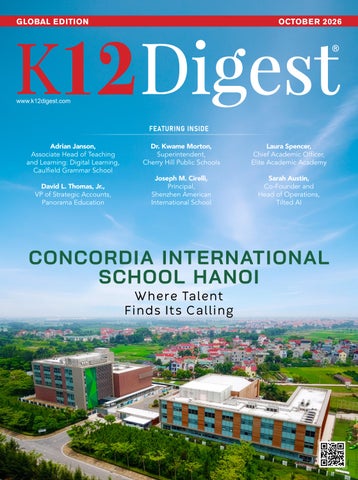
OCTOBER 2026
GLOBAL EDITION
www.k12digest.com
FEATURING INSIDE Adrian Janson, Associate Head of Teaching and Learning: Digital Learning, Caulfield Grammar School David L. Thomas, Jr., VP of Strategic Accounts, Panorama Education
Dr. Kwame Morton, Superintendent, Cherry Hill Public Schools
Laura Spencer, Chief Academic Officer, Elite Academic Academy
Joseph M. Cirelli, Principal, Shenzhen American International School
Sarah Austin, Co-Founder and Head of Operations, Tilted AI
CONCORDIA INTERNATIONAL SCHOOL HANOI Where Talent Finds Its Calling
K12 Digest October 2026
1
2
K12 Digest October 2026
K12 Digest October 2026
3
October 2026
Managing Editor Sarath Shyam
Vol - 7 Issue - 10
Free Subscription
Consultant Editors Dr. John Andrews Naomi Wilson Emma James Stanly Lui Andrew Scott Joseph Alex
Art & Design Charlie Jameson
Sales & Marketing Jennifer Anderson Monica Davis Alice Smith Anna Elza
OCTOBER 2026
Free Subscription
www.k12digest.com
International Partnerships Americas Europe Middle East & Africa Asia-Pacific admin@K12digest.com
Follow Us On
www.linkedin.com/company/ k12digest www.facebook.com/K12Digest
4
K12 Digest October 2026
K12 Digest www.k12digest.com is a global knowledge sharing digital platform published by Connecta Innovation Private Limited. All rights reserved. The opinions expressed in the content and pictures provided are those of the authors. They do not purport to reflect the opinions or views of Connecta Innovation Private Limited or any of its members and we do not assume any responsibility. The publisher does not assume any responsibility for the advertisements, its content, pictures, and all representation of warranties made in such advertisements are those of the advertisers and not of the publisher. K12 Digest www.k12digest.com is a Free Subscription and Free-to-read digital platform strictly not for sale and has to be strictly for internal private use only. Publisher does not assume any responsibility arising out of anyone modifying content and pictures, printing a copy of this digital platform in any format and in any country and all matters related to that.
MANAGING EDITOR’S NOTE
Asia’s Education Shift
F
or decades, an international education often meant looking west. Today, that assumption is changing. Across Asia, international schools are attracting families seeking globally recognised qualifications, cultural exposure, and pathways to universities around the world. The region is no longer simply sending students abroad in pursuit of opportunity. It is building educational destinations of its own. What interests me about this shift is how schools are redefining educational excellence. Parents want institutions that combine academic rigour with personal development, cultural awareness, and the skills needed to navigate an interconnected world. Meeting these expectations requires more than adopting an international curriculum. Schools must understand the communities they serve while preparing students for opportunities beyond their national borders. Asia’s expanding international school sector reflects this changing demand. Yet growth brings significant challenges, from recruiting experienced teachers and maintaining academic standards to balancing international expectations with local cultures. Schools must also consider how to prepare students for a future in which adaptability, independent thinking, and cross-cultural understanding will be increasingly valuable. This changing landscape brings us to Concordia International School Hanoi, featured in this issue of K12 Digest as a Prominent International School to Watch in Asia – 2026. Founded on the vision of bringing a world-class, student-centered American education to Vietnam, Concordia draws on the educational heritage of the Lutheran Church-Missouri Synod, a network with more than 150 years of experience. Its presence in Hanoi offers an interesting perspective on how established educational traditions can serve the aspirations of a new generation of globally minded students. Beyond the cover story, this issue features thought-provoking articles, interviews, and insights exploring the people, institutions, and ideas influencing education today. Asia’s emergence as a global learning destination invites us to reconsider where educational excellence can flourish. The region’s schools have an opportunity to build learning environments that respect local identities while opening doors to global possibilities. As you explore this issue, I hope you will discover fresh perspectives on the institutions and ideas shaping the future of education. Enjoy Reading.
Sarath Shyam
K12 Digest October 2026
5
COVER STORY
CONCORDIA INTERNATIONAL SCHOOL HANOI Where Talent Finds Its Calling
6
K12 Digest October 2026
28 48 EMPOWERING SYSTEMS THAT SERVE EVERY CHILD Dr. Kwame Morton, Superintendent, Cherry Hill Public Schools
ADMIN ADMIN PERSPECTIVE PERSPECTIVE
Joseph M. Cirelli, Principal, Shenzhen American International School
ADMIN PERSPECTIVE
EMPOWERING STUDENTS TO NAVIGATE THEIR OWN FUTURE
K12 Digest October 2026
7
INDUSTRY PERSPECTIVE
INDUSTRY INDUSTRY PERSPECTIVE PERSPECTIVE 8
K12 Digest October 2026
BUILDING BETTER FUTURES THROUGH EARLY STUDENT SUCCESS David L. Thomas, Jr., VP of Strategic Accounts, Panorama Education
36 54 WHY THE FUTURE OF EDUCATIONAL TECHNOLOGY MAY INVOLVE FEWER SCREENS AND MORE CONVERSATION Sarah Austin, Co-Founder and Head of Operations, Tilted AI
44 60 CULTIVATING CLASSROOMS WHERE LEARNING LEADS TECHNOLOGY Adrian Janson, Associate Head of Teaching and Learning: Digital Learning, Caulfield Grammar School
ACADEMIC ACADEMIC VIEW VIEW
Laura Spencer, Chief Academic Officer, Elite Academic Academy
ACADEMIC VIEW
BEFORE YOU BUY THE NEXT TOOL, ASK THESE FOUR QUESTIONS
K12 Digest October 2026
9
C O V E R
10
K12 Digest October 2026
S T O R Y
WHERE TALENT FINDS ITS CALLING
K12 Digest October 2026
11
C
oncordia International School Hanoi may have opened its doors in 2011, but its story began long before that. The school is part of the Lutheran Church-Missouri Synod (LCMS) educational network, which boasts a rich educational tradition spanning over 150 years. From the very beginning, Concordia Hanoi was built on a clear vision: to bring a world-class, studentcentered American education to the heart of Vietnam. That vision was strengthened by close ties to two respected sister schools, Hong Kong International School and Concordia International School Shanghai. Sharing the same educational philosophy and commitment to excellence, the schools provided a strong foundation as Concordia Hanoi welcomed its first families and students. What started as a small but ambitious community soon gained momentum. Families were drawn not only to the school’s academic standards but also to the culture of care that surrounded them. As enrollment grew, so did the opportunities to expand what the school could offer. A defining moment came in 2016 with the opening of Concordia Hanoi’s purpose-built campus in Dong Anh. Designed specifically for learning, the campus echoes the school’s belief that environment matters. Sunlight streams into collaborative classrooms. Students move between advanced science and robotics labs, professional visual arts studios, and athletic facilities designed to encourage both performance and participation. The new campus allowed the school to broaden its Advanced Placement offerings, strengthen its arts and athletics programs, and welcome an increasingly
12
K12 Digest October 2026
diverse student population representing more than 45 nationalities. Yet growth has never been measured simply by numbers. Throughout its journey, Concordia Hanoi has remained focused on building something deeper: a community where students are known, supported, and prepared to make meaningful contributions to the world around them. Driving that commitment is a belief that academic success and student well-being should never exist in opposition. Across the international education landscape, achievement is often associated with pressure and stress. Concordia Hanoi has chosen a different path. “Our data proves that students achieve elite academic outcomes because they are supported. Our vision is to remain a place where student well-being, joy, and academic rigor coexist harmoniously,” says Dr. Doug Grove, Head of School. That philosophy is apparent in every aspect of school life. Concordia Hanoi’s identity is guided by a clear mission, four core values, and a commitment to nurturing the whole child. Student-Centered, Excellence, Community, and Service are not words displayed on a wall. They are principles that define daily decisions, classroom experiences, and relationships across campus. Being student-centered means recognizing that every learner arrives with unique strengths, needs, and aspirations. Excellence is viewed as a journey of growth rather than a destination. Students are encouraged to pursue high standards while developing resilience, creativity, and a lifelong love of learning. Community remains equally important, fostering meaningful connections among students, families, faculty,
Dr. Doug Grove, Head of School, Concordia International School Hanoi
Dr. Doug Grove is an educational leader with over 25 years of experience across international K-12 schools, university administration, and educational research. He currently serves as the Head of School at Concordia International School Hanoi, where he focuses on strategic growth, curriculum development, and community building. His leadership within the international school network includes previous roles at Concordia International School Shanghai as Interim Head of School and Senior Director of Business Development. In higher education, Dr. Grove served as Associate Provost and Vice President of Enrollment and Program Development at Concordia University, Irvine, where he managed student recruitment and academic program expansion. Alongside his institutional roles, Dr. Grove is an educational entrepreneur. He is the co-founder and president of Multi-Dimensional Education, Inc., and previously founded Continuous Improvement Associates. He also contributes to organizational governance, currently serving on the Board of Governors for AmCham.
K12 Digest October 2026
13
and the wider world. Service, meanwhile, is integrated throughout the educational experience, helping students develop empathy, responsibility, and an understanding of their role as global citizens. These values support what Dr. Grove describes as a transformational approach to education. Academic achievement remains important, but it is only one part of a student’s development. Intellectual growth is balanced with opportunities in athletics, the arts, leadership, and service. The goal is to prepare students not only for university success but also for purposeful and fulfilling lives. A key part of that process is the partnership between school and home. Concordia Hanoi believes that student growth is strongest when families and educators work together toward shared goals. “When we enroll a student, we enroll the whole family,” Dr. Grove explains.
14
K12 Digest October 2026
That sense of partnership can be felt throughout the campus. Parents are welcomed as active participants in their children’s educational journey, creating a supportive network that extends well beyond the classroom. In a competitive international school market, Concordia Hanoi’s greatest distinction may be its ability to combine exceptional academic outcomes with a deeply caring culture. Students are challenged to aim high, but they are never expected to navigate that journey alone. “We don’t believe students should have to choose between rigorous preparation for the world’s top universities and a joyful, balanced upbringing. While many international schools achieve high test scores through high-stress, high-pressure environments, our students excel because they are supported,” says Dr. Grove. It is a philosophy that has shaped Concordia Hanoi since its earliest days and continues to guide
In a competitive international school market, Concordia Hanoi’s greatest distinction may be its ability to combine exceptional academic outcomes with a deeply caring culture
its future. As the school looks ahead, its focus remains unchanged: creating an environment where students flourish academically, grow in character, and develop the confidence to lead lives of purpose and service. Where Every Student is Known, Challenged, and Supported Walk through the halls of Concordia Hanoi on any given day, and one thing quickly becomes clear: relationships matter here. Students greet teachers by name. Conversations continue beyond the classroom. Younger and older students interact naturally across grade levels. The atmosphere feels purposeful yet relaxed,
creating a sense of belonging that is often difficult to quantify but easy to feel. This culture is intentional. With small class sizes and strong teacherto-student ratios, Concordia Hanoi has built a learning environment where students are seen as individuals rather than numbers. Teachers serve as mentors, coaches, and trusted guides who invest deeply in both academic growth and personal development. Across the campus, learning is active and collaborative. Students debate current issues, design solutions to real-world challenges, conduct hands-on experiments, and work together on projects that encourage creativity
K12 Digest October 2026
15
and critical thinking. Curiosity is encouraged. Questions are welcomed. Discovery is celebrated. The school also recognizes that meaningful learning happens when students feel healthy, balanced, and connected. Physical activity, creative expression, and social-emotional development are woven into daily life rather than treated as extras. That commitment becomes especially important during the high school years, when academic expectations naturally increase. To ensure students receive the support they need, school counselors conduct weekly wellness check-ins with every high school student. These conversations help create a safety net that extends far beyond academics. Throughout the campus, students are equally engaged in service and leadership. Some are organizing community initiatives. Others are exploring environmental challenges or developing projects that support local and global causes. Service is not reserved for special events. It is part of the rhythm of everyday life, helping students develop empathy, responsibility, and a growing sense of purpose. That same intentionality shapes the academic experience. An American standards-based curriculum provides the foundation for learning across every grade level. The framework provides consistency while allowing teachers to meet students where they are academically, socially, and emotionally. In the Elementary School, classrooms are filled with exploration and wonder. Teachers focus on nurturing curiosity while building strong foundations in literacy, mathematics, science, and communication. Learning feels joyful because students are encouraged to ask
16
K12 Digest October 2026
Concordia Hanoi follows an American standards-based curriculum designed to support students from their earliest years through graduation
questions, investigate ideas, and discover connections for themselves. As students enter Middle School, the focus shifts to supporting one of the most transformative periods of their lives. Adolescence brings new academic demands alongside significant social and emotional changes. Teachers and counselors work closely with students as they develop independence, resilience, and the confidence to navigate increasingly complex challenges. By the time students reach High School, they are ready to take greater ownership of their learning. A wide range of Advanced Placement courses allows them to engage with universitylevel content while exploring subjects aligned with their interests and future goals. Dedicated counselors work closely with each student to design personalized pathways that reflect their talents, aspirations, and ambitions.
K12 Digest October 2026
17
Reflection remains a constant throughout this journey. Students are encouraged to regularly examine their work, consider their growth, and identify opportunities for improvement. Through this process, they learn to recognize patterns in their thinking, celebrate progress, and develop the self-awareness needed for lifelong learning. For Dr. Grove, academic excellence is about far more than grades or test scores. He says, “We believe that academic excellence does not mean rigid perfection or uniform compliance. Instead, we define academic excellence as the pursuit of personal growth, critical thinking, and the realization of our unique potential.” This philosophy influences every aspect of the school’s approach. Success is measured not simply by outcomes but by growth, engagement, and the development of each student’s unique strengths. The school rejects the idea that achievement must come at the expense of well-being. Instead, students are challenged within an environment designed to support them every step of the way.
18
K12 Digest October 2026
Dedicated English as an Additional Language specialists and Learning Support professionals provide targeted assistance, ensuring every learner has access to the resources needed to succeed. The same mindset shapes classroom instruction. Teachers embrace inquiry-based learning, encouraging students to explore complex questions, analyze evidence, and develop original solutions. Mistakes are treated as valuable learning opportunities rather than failures. By removing the fear of getting things wrong, students gain the confidence to experiment, take intellectual risks, and think creatively. True innovation begins with curiosity, and curiosity flourishes when students feel safe. At Concordia Hanoi, that sense of safety comes from knowing there is always someone paying attention, offering support, and believing in their potential. It is a culture that allows students to pursue excellence while remaining fully themselves, laying the foundation for the opportunities that await beyond graduation.
Preparing Students for a Future Yet to Be Written The future will demand more than academic knowledge. Tomorrow’s graduates will need adaptability, independence, critical thinking, and the ability to navigate an increasingly complex world. At Concordia Hanoi, preparing students for that reality begins long before they submit a university application. The school’s academic program is designed as a carefully structured developmental journey. Each stage equips students with the skills, habits, and experiences needed to thrive both at university and beyond. Advanced Placement courses play an important role in that preparation, but their purpose extends beyond earning university credits or strengthening applications. For Concordia Hanoi, the AP framework serves as a vehicle for teaching students how to learn independently. Students are challenged to manage demanding workloads, organize complex projects, synthesize information from multiple sources, and develop the study habits expected at leading universities. They learn to take ownership of their education while
building the confidence needed to succeed in increasingly autonomous environments. The flexibility of the school’s curriculum also allows students to explore pathways aligned with their future aspirations. A student interested in engineering might pursue advanced mathematics, robotics, and technology-focused coursework. An aspiring medical professional can engage in sophisticated scientific research using professional-grade laboratory facilities. Students are encouraged to tailor their academic experiences around their passions while maintaining a strong foundation across disciplines.
K12 Digest October 2026
19
That level of personalization is supported by a comprehensive university counseling program that begins as soon as students enter High School. Ninth-grade students focus on building the organizational and academic habits required for long-term success. By Grade 10, they begin exploring potential career pathways and examining how their interests connect with future opportunities. Grade 11 students strengthen their academic profiles while engaging directly with visiting university representatives from around the world. By senior year, preparation becomes even more focused. Students participate in a dedicated College Boot Camp, working alongside admissions professionals from leading universities. They also complete a yearlong Senior Seminar designed to prepare them for the realities of independent living. Topics range from personal finance and time management to cultural transitions and self-advocacy, helping students develop practical life skills that extend far beyond the classroom. Yet the school recognizes that some lessons can only be learned through experience. That
20
K12 Digest October 2026
belief is reflected in a distinctive internship program required for all rising seniors. During these placements, students step into professional environments aligned with their intended fields of study or career interests. Some shadow biomedical engineers. Others work alongside business leaders, data analysts, designers, or creative professionals. The experience allows students to test assumptions, gain practical insights, and begin building professional networks before they even graduate from high school. These experiences often bring classroom learning into sharper focus. Students return with new questions, deeper motivation, and a clearer understanding of how their studies connect to the world around them. The same real-world mindset shapes the school’s approach to innovation and technology. Rather than treating technology as a standalone subject, Concordia Hanoi integrates it across the curriculum as a tool for exploration, creativity, and problem-solving. Students are encouraged to move beyond consuming information and become creators, researchers, and innovators.
Rather than treating technology as a standalone subject, Concordia Hanoi integrates it across the curriculum as a tool for exploration, creativity, and problem-solving
Innovation, according to Dr. Grove, begins with a willingness to take risks. He shares, “We intentionally foster this across all grade levels. Our teachers cultivate classroom environments where mistakes are viewed as essential in the learning process.” This philosophy creates space for experimentation. Students learn to approach challenges with curiosity rather than fear, developing the confidence to explore unfamiliar ideas and pursue creative solutions. Technology supports that journey. Across classrooms and specialized learning spaces, students have access to tools and resources that mirror those found in universities and modern industries. From computer science and robotics to data analytics and advanced coding, learners engage with emerging technologies in meaningful and practical ways. Courses such as Big Data and advanced Robotics challenge students to think like engineers, analysts, and innovators. They write code, analyze information, build systems, and tackle increasingly sophisticated problems that require collaboration and persistence. Learning, however, extends far beyond campus walls. Experiential learning is deeply embedded throughout the Concordia Hanoi experience. Students regularly engage with the wider community through service initiatives, field studies, research projects, and hands-on learning opportunities. Elementary students may explore environmental stewardship through campus sustainability efforts. High school students often collaborate with local organizations to address community challenges and develop solutions with tangible impact.
K12 Digest October 2026
21
Throughout these experiences, Hanoi itself becomes part of the curriculum. The city, its people, and its communities serve as living classrooms where students learn to apply knowledge, develop empathy, and deepen their understanding of the world. By the time they graduate, Concordia Hanoi students leave with more than academic credentials. They leave with the confidence to navigate uncertainty, the skills to adapt to change, and the mindset to contribute meaningfully wherever their journeys take them. And in a world that continues to evolve at remarkable speed, those qualities may prove to be their greatest advantage. Every Student’s Journey, Uniquely Designed Concordia Hanoi’s student-centered approach begins with a simple belief: no two learners are exactly alike. Each student arrives with different strengths, interests, challenges, and aspirations. The role of the school is not to fit students into a predetermined mold, but to create pathways that allow them to thrive as individuals. That commitment is reflected in Concordia Hanoi’s intimate 8:1 student-to-teacher ratio. Small class sizes allow educators to know students deeply, understanding not only how they learn but also what motivates them, where they need support, and what dreams they hope to pursue. For students whose first language is not English, specialized support begins early. English as an Additional Language (EAL) specialists work closely with students to build confidence and fluency while ensuring they can fully engage with grade-level content. In the Elementary School, each grade level
22
K12 Digest October 2026
is supported by a dedicated EAL specialist who helps students develop the language skills needed to participate meaningfully in classroom discussions, collaborative projects, and academic inquiry. The same individualized attention extends to students with learning differences. Learning Support educators collaborate with teachers and families to develop accommodations and strategies tailored to each student’s needs. The goal is not to lower expectations but to ensure every learner has access to the same rigorous opportunities as their peers. This balance of high standards and personalized support is a defining feature of the Concordia experience. Despite its close-knit size, the school offers an impressive range of opportunities typically associated with much larger institutions. Students can choose from 27 Advanced Placement and university-level courses, allowing them to build academic programs that reflect their individual passions and future ambitions. Some students pursue advanced mathematics and science. Others immerse themselves in the arts, athletics, robotics, or international diplomacy through Model United Nations. Whatever path they choose, students benefit from the same level of personalized guidance and mentorship. That guidance becomes especially meaningful when students begin planning for life after graduation. At Concordia Hanoi, university counseling is not simply about gaining admission to prestigious institutions. It is about helping students discover environments where they will flourish academically, personally, and professionally. One of the school’s most distinctive practices is its annual “Happiness Engineering”
meeting. Each year, students, parents, and counselors spend up to two hours together exploring academic progress, career interests, course selections, wellness, and long-term aspirations. The conversations are thoughtful, comprehensive, and deeply personal. Rather than asking only where a student wants to go, the process focuses on who they want to become. The counseling team provides individualized guidance throughout all four years of high school, helping students navigate university systems across North America, Europe, Asia, Australia, and the United Kingdom. Students are encouraged to develop applications that reflect their authentic interests, experiences, and personal stories. Concordia Hanoi also nurtures a culture of original research and academic inquiry through the Concordia International Research Conference Hanoi (CIRCH). Hosted annually by the school, the conference brings together outstanding high school researchers from around the world to present independent research, exchange ideas, and engage with scholars and peers. For Concordia students, CIRCH provides an opportunity not only to showcase their work but also to participate in an international
academic community that values curiosity, innovation, and evidence-based thinking. Some spend their week inside medical laboratories. Others work with technology companies, creative agencies, businesses, or nonprofit organizations. The experience gives students the opportunity to test career assumptions, develop professional skills, and gain firsthand exposure to the realities of the workplace. In many cases, those experiences become defining moments. They help students confirm their ambitions, reconsider possibilities, or discover entirely new passions. A Community That Connects the World Students at Concordia Hanoi learn alongside classmates representing more than 45 nationalities and cultural backgrounds. With families from Vietnam, South Korea, North America, Japan, Europe, and many other regions of the world, diversity is not something the school promotes from afar. It is woven into everyday life. The result is a community where cultural curiosity develops naturally. Students grow up celebrating different traditions, hearing multiple languages, and learning how to engage respectfully with
Concordia Hanoi students can choose from 27 Advanced Placement and university-level courses, allowing them to build academic programs that reflect their individual passions and future ambitions
K12 Digest October 2026
23
viewpoints that may differ from their own. These daily interactions foster empathy, open-mindedness, and the interpersonal skills increasingly valued in a connected world. For many families arriving in Hanoi from abroad, that sense of belonging is one of the first things they notice. New students are welcomed quickly. Friendships form across cultures. Parents often describe the school as feeling like a second home long before they expected it would. Beyond the classroom, student life is equally vibrant. Concordia Hanoi views extracurricular experiences as essential extensions of learning. Whether students are pursuing athletic excellence, artistic expression, technological innovation, or community leadership, they are encouraged to discover passions that enrich their lives and shape their character. Athletics play a significant role in that journey. Across various sports, students learn the value of perseverance, teamwork, discipline, and
24
K12 Digest October 2026
resilience. As members of regional international school conferences, Concordia’s teams regularly compete against much larger schools while developing a strong sense of school pride and camaraderie. The arts hold an equally prominent place within campus life. Throughout the year, musicians perform in concert bands, orchestras, and vocal ensembles. Student actors bring stories to life through theatrical productions in the school’s Black Box Theater, while concert bands, orchestras, and vocal ensembles regularly perform in the professional auditorium at the Dong Anh Community Center. In bright studios across campus, artists experiment with painting, ceramics, sculpture, graphic design, photography, and film production. Annual exhibitions provide opportunities for students to showcase their creativity while celebrating the unique perspectives they bring to their work.
The school’s culture of empowerment extends beyond organized activities. Students are encouraged to take ownership of their interests and create opportunities where none exist. If a club or organization does not yet exist, students are invited to build it themselves. On any afternoon, the campus buzzes with activity. Robotics teams test new designs. Debate students prepare arguments. Model United Nations delegates discuss global issues. Chess players analyze strategies while digital media creators work on their latest projects. Leadership opportunities are equally accessible. Through Student Council, students play an active role in shaping school culture, organizing community events, and serving as a bridge between their peers and school
leadership. Their voices are valued, and their ideas often help shape the student experience. Underlying all of these opportunities is a shared commitment to service. Students regularly partner with charities, schools, and community organizations throughout Hanoi. They organize fundraisers, support environmental initiatives, teach English, and
participate in projects that create meaningful local impact. These experiences help students understand that leadership is not simply about influence. It is about responsibility. By engaging with real challenges and real communities, students learn that even small actions can create lasting change. They begin to see themselves not only as learners, but as contributors to a better world. Building a Society for the Future Confidence cannot be handed to a student. It grows through experience. Through responsibility. Through moments when young people discover that their ideas matter and their actions can make a difference. That belief sits at the heart of student leadership at Concordia International School Hanoi. Students are encouraged to move beyond participation and become creators of opportunity. Whether launching a new club, organizing a community initiative, producing digital content, or leading a fundraising campaign, they are given the freedom and trust to take ownership of their ideas. Along the way, they develop practical skills that will serve them long after graduation. They learn how to manage projects, collaborate with teams, solve problems, communicate effectively, and lead with purpose. Student Council provides another avenue for meaningful leadership. More than a student organization, it serves as an active link between the student body and school leadership. Students advocate for improvements, contribute ideas, and help shape the culture of the community they call home. That culture is built upon one of Concordia Hanoi’s most enduring strengths: community.
K12 Digest October 2026
25
For Dr. Grove and his team, education is fundamentally relational. Academic excellence flourishes when students, families, and educators work together toward a shared goal. That philosophy guides every aspect of campus life, with parents viewed as true partners in helping students thrive through a shared purpose between home and the learning environment. This philosophy extends far beyond admissions. Parents are active partners in school life, contributing their time, expertise, and energy through a wide range of initiatives. The Parent Support Organization helps organize events, fund student-centered programs, and strengthen connections across the community. Gatherings such as the Fall BBQ, Fall Carnival, and Christmas Fair create opportunities for families to build lasting friendships while celebrating the diversity that defines the school. The school also invests intentionally in parent learning. Through Parent Workshops, Coffee Mornings, and Town Hall discussions, families gain practical insights and strategies that help strengthen the partnership between home and school. These conversations create alignment around a shared objective: helping every child thrive. The strength of those relationships is reinforced by a highly experienced faculty. Concordia’s educators bring an average of 18 years of teaching experience, and the vast majority hold advanced degrees. Yet what distinguishes them most is not their credentials. It is their commitment to knowing students personally. Teachers serve as advocates, mentors, and trusted adults who celebrate successes, navigate challenges, and remain attentive to both academic and emotional well-being. Together,
26
K12 Digest October 2026
these relationships form a powerful support network that extends across the entire school community. Students know they have people who believe in them, encourage them, and stand beside them throughout their educational journey. As Concordia Hanoi looks toward the future, its focus is not on becoming bigger. It is on becoming better. The school continues to invest in innovative learning spaces, emerging technologies, and forward-thinking academic opportunities that will prepare students for a rapidly changing world. At the same time, leaders remain committed to preserving the close-knit culture that has defined Concordia since its earliest days. The future will require new skills, new knowledge, and new ways of thinking. Concordia Hanoi is determined to ensure its students are ready. Yet Dr. Grove believes one priority stands above all others. “As academic environments worldwide become increasingly high-stress, our priority is to prove that elite student outcomes can be achieved through wellness rather than anxiety.” It is a vision that reflects the school’s broader purpose. Academic achievement matters. Innovation matters. University success matters. But ultimately, Concordia Hanoi measures its success by something deeper. The goal is to remain a place where students feel known, families feel connected, and every child has the opportunity to grow into the best version of themselves. No matter how much the school evolves, that commitment remains unchanged: ensuring Concordia International School Hanoi always feels like a safe, supportive, and joyful second home for every family it welcomes.
K12 Digest October 2026
27
ADMIN PERSPECTIVE
Empowering Students to Navigate Their Own Future Joseph M. Cirelli, Principal, Shenzhen American International School
Joseph M. Cirelli is Principal and a Governing Board Member at Shenzhen American International School, with more than a decade across schools in Beijing, Wuhan, and Shenzhen. He leads K–12 institutional strategy, from academics to admissions and community engagement, and believes lasting leadership is measured by what continues after a leader steps away, reflected in his work leading IB PYP, OxfordAQA, and Cognia accreditation processes. He serves on Cognia’s accreditation review teams and holds credentials from IB and Harvard University. SAIS was recognized by Forbes China as Shenzhen’s leading primary school during his tenure. Joseph writes and speaks internationally on durable leadership, institutional culture, and student agency. Recently, in an exclusive interview with K12 Digest, Joseph shared insights into how his professional journey was shaped by personal experience with special education and a commitment to building schools where every child’s potential is recognized early. On the future of education, Joseph sees the biggest shift as moving from teaching students to follow a pathway to teaching them how to navigate when that pathway changes, emphasizing judgment, adaptability, and independent learning over rote content. His advice to future leaders is to lead with enough clarity to establish the standard, enough humility to share ownership, and enough courage to step back before you leave. The following excerpts are taken from the interview.
Hi Joseph. Every leader’s journey begins with a first step. What early experience or role first made you realize that education and school leadership was your calling? My path into education began at home. When I was young, my brother was diagnosed with ADHD and autism, and I watched my mother fight for years to get him the support he needed.
28
K12 Digest October 2026
I remember watching her in tears, trying to get people to recognize his potential. I did not understand the procedures, but I understood her pain, and the cost of a system that made families beg for understanding. That powerlessness slowly became responsibility. In special education in New York, I saw the same problem professionally: students made progress when adults adjusted the environment
The most lasting change will be the shift from curriculum as a map of content to curriculum as a sequence of experiences through which students use knowledge
K12 Digest October 2026
29
around them, not when we asked them to adapt. Inclusion was less a program than a measure of how thoughtfully a school had been designed, and I saw the limits of isolated effort. A teacher can change a life, but leadership builds the conditions for that change across a whole school. That purpose eventually took me to China, where my commitment to education met my curiosity about the world. The setting changed, but the question stayed the same: how do we build schools that recognize a child’s potential before it’s overlooked? As a school leader today, what part of your role brings you the most energy and why? What gives me the most energy is helping people grow and seeing good ideas create impact beyond one institution. Within a school, I remain accountable for direction, standards, and difficult decisions while giving teachers and
30
K12 Digest October 2026
emerging leaders room to develop judgment. When a colleague strengthens an idea or a team works through a complex problem, I see capacity growing. That same energy led me to give my keynote, What Remains When You Leave?, which extended the conversation beyond my immediate setting. It allowed me to share what I had learned, test those ideas in different contexts, and learn from leaders facing similar challenges. These exchanges are becoming an increasingly important part of my work. International educators often confront similar problems in very different settings, and we gain more when experience travels. Building relationships across schools and organizations can turn individual lessons into shared progress. That combination—developing people locally while contributing to a wider international community—is what energizes me most.
The schools that define the next five years will resist trying to map every career awaiting their students. They will help young people understand themselves, respond intelligently to change, and continue learning long after formal schooling ends.
A teacher can change a life, but leadership builds the conditions for that change across a whole school Education is evolving faster than ever. What do you see as the single biggest shift in K–12 education that will define the next 5 years? The biggest shift will be from teaching students to follow a pathway to teaching them how to navigate when that pathway changes. Schools were built around a stable promise: master content, earn qualifications, and enter a profession. Young people are now likely to change roles, work across cultures, and face decisions for which no textbook contains the answer. The central question for schools will expand from “What should students know?” to “What can they do when their knowledge is no longer enough?” Strong subject knowledge remains essential. It must be joined with judgment, adaptability, and the ability to learn independently. Students need opportunities to make meaningful choices, test ideas, recover from setbacks, and reflect on how they learn.
Curriculum design is moving beyond textbooks. What trends in teaching and learning do you believe will have the most lasting impact? The most lasting change will be the shift from curriculum as a map of content to curriculum as a sequence of experiences through which students use knowledge. Textbooks remain useful for building common foundations, but learning deepens when students must do something with what they know: investigate a question, weigh evidence, test a solution, and explain their reasoning to an audience beyond the teacher. Inquiry- and project-based learning will have staying power when they are deliberately designed rather than adopted as labels. Assessment must follow. If a curriculum values reasoning and application but measures mainly recall, students receive a conflicting message. Portfolios, exhibitions, performances, and sustained tasks allow students to make their thinking visible, respond to feedback, and improve. The teacher remains central. Strong curriculum uses professional expertise to identify essential knowledge, design purposeful experiences, and recognize when students need direct instruction. The lasting impact will come from making the textbook a starting point while ensuring that students can carry what they learn into unfamiliar situations.
K12 Digest October 2026
31
Teacher recruitment and retention is a global challenge. What changes do schools need to make to support and keep great educators? Teacher retention begins long before a contract renewal. It is shaped by the daily experience of working in a school. I am proud of the teacher-retention record in teams I have led because it reflects a culture built deliberately over time. I began my career as a teacher, so I still test leadership decisions against classroom reality: Is an expectation clear? Is the workload reasonable? Will a new requirement improve learning or simply add
32
K12 Digest October 2026
another task? Teachers notice when leaders understand that difference. Compensation and resources matter, but great educators also need professional trust. They should be able to question an idea, offer a solution, experiment thoughtfully, and receive useful feedback. When challenges arise, support has to be practical: remove unnecessary barriers, protect time, communicate honestly, and follow through. People stay where they are respected, able to grow, and connected to meaningful work. Retention is ultimately the accumulated result of daily leadership decisions. The strongest
recruitment message any school can offer is a community of excellent teachers who choose to remain. Leaders are also learners outside of work. What book, podcast, or idea has influenced you most recently and why? The idea influencing me most recently grew out of attending the World Leaders Summit on Sustainable Development in Foshan, a gathering focused on the United Nations Sustainable Development Goals. I met leaders from government and international organizations, including Kolinda Grabar-Kitarović, Croatia’s
The strongest recruitment message any school can offer is a community of excellent teachers who choose to remain
first woman president. Yet the scale of the discussion led me to a smaller, more practical question: What responsibility are we giving students now? We often call young people “future leaders,” which can imply that their contribution must wait. Schools can change that by giving students real work: investigating a local challenge, listening to the community, designing a response, measuring the result, and connecting the experience to global goals. In that process, sustainability becomes concrete and leadership begins before a title. The summit sharpened my belief that education should prepare young people to participate in the world before graduation. Knowledge matters, but it gains purpose when students are trusted to use it. Global change begins to feel possible when young people see that their actions can improve the communities around them. Mentorship matters at every stage. If you could have dinner with any educator, thinker, or leader from history, who would it be and what would you ask? I would choose Marcus Aurelius. I am drawn to the honesty of the private reflections he recorded in Meditations. Here was a person with immense authority repeatedly reminding himself to remain disciplined, useful, and alert to his own ego. I would ask him one question: How can a leader tell when conviction is serving responsibility and when it has become ego? The longer I lead, the more I see how authority can narrow the information reaching a leader. I would want to know how he protected his
K12 Digest October 2026
33
judgment when people around him had reasons to agree, and how he accepted what he could not control without allowing acceptance to become passivity. His answer would matter to me because school leadership often requires decisions amid emotion, competing expectations, and incomplete information. Systems and policies matter, but sound leadership also begins privately: examining your motives, listening for the criticism you would rather avoid, and acting in service of the people and institution you lead. Music, art, or hobbies can reveal a lot about a person. What is one personal passion outside of education that energizes you? One of my favorite family traditions is visiting the Metropolitan Museum of Art whenever I return to New York. We can spend hours there, moving between periods and cultures and stopping whenever something catches our attention. My sister and I have visited many times, yet the museum never feels quite the same. I notice something new because the collection is vast, but also because I have changed since the previous visit. What energizes me is the chance to enter another person’s way of seeing the world. A painting or artifact can reveal what people valued, feared, celebrated, and believed was worth preserving. Art makes history feel human rather than distant. That curiosity also shapes the way I travel. Museums teach me to slow down and observe carefully; travel reminds me that assumptions that feel natural in one place can look entirely different in another. I usually leave the Met
34
K12 Digest October 2026
with more questions than I brought—and that is one of the reasons I keep returning. Where do you see yourself in the next 5 years? In five years, I want to be leading at a broader strategic level across education while building a practical development program for young people approaching important transitions. The program would help them identify their strengths, values, interests, and patterns of behavior before making major choices about study, work, or service. Through guided reflection, mentorship, and real-world challenges, participants would test what they are learning about themselves. They would practice setting goals, adjusting plans, working with others, and applying their abilities to a community need. The purpose would reach beyond career guidance: helping young people become self-aware, adaptable, and capable of contributing locally while understanding how their actions connect to global challenges. By year five, I would want to see a model being used across different schools and communities, with educators and mentors equipped to adapt it to their own contexts. I also hope to use writing and speaking to share what the work teaches us. Success would mean young people making more purposeful decisions and taking meaningful action because they understand who they are and what they can contribute. If you could leave one sentence of advice on the desk of every future school leader, what would it say? Lead with enough clarity to establish the standard, enough humility to share ownership, and enough courage to step back before you leave.
K12 Digest October 2026
35
INDUSTRY PERSPECTIVE
Building Better Futures Through Early Student Success David L. Thomas, Jr., VP of Strategic Accounts, Panorama Education
Throughout your work with school districts, what have you found to be the biggest factors that put students at risk of not graduating, and why is early identification so critical? The factors are rarely a surprise. Chronic absenteeism, course failure, credit deficiency, and unmet well-being needs are consistently the most reliable warning signs that a student is drifting off track. What surprises most districts is how early those signals appear and how long they go unaddressed. That is why early identification is not just important. It is critical to student success. A ninth grader who fails a core course in the fall semester does not just have an academic problem, they have a trajectory problem. And if no one intervenes before spring, before summer, before sophomore year, the gap compounds. By the time a counselor catches it during a traditional transcript review, options have narrowed significantly. I have worked with districts where students were flagged for intervention in 11th grade for issues that were visible in 7th grade. That is not a student or teacher failure. That is a system failure. When we give educators the tools to see those patterns early and act on them quickly, we shift from reacting to a crisis to preventing one.
36
K12 Digest October 2026
David L. Thomas, Jr. is the National Vice President for Strategic Accounts at Panorama Education, where he partners with school districts, superintendents, and state education agencies to improve student outcomes through data-driven insights, student support services, workforce readiness solutions, and AI-powered tools. A recognized leader in education, business development, and strategic planning, he is known for building strategic partnerships and leading transformational change. Thomas is also the Founder and CEO of The Pinkney Group, LLC, a consulting firm specializing in business development, governmental relations, and community engagement for education, nonprofit, and public-sector organizations. Previously, he served as Executive Vice President of Business Development at RethinkEd and Accelify Corporation, contributing to Accelify’s acquisition by Frontline Education. Earlier, he held academic and administrative leadership roles in higher education. Thomas earned master’s and bachelor’s degrees in History and completed doctoral coursework in Instructional Design and Development. He remains active in civic, educational, and faith-based organizations. In an exclusive conversation with K12 Digest, Thomas talks about identifying at-risk students early and using real-time data to support proactive interventions. He highlights the importance of connected systems, reduced administrative burdens, and stronger counselorstudent relationships. Thomas also emphasizes the link between education, workforce readiness, and economic growth.
K12 Digest October 2026
37
How does continuous transcript monitoring change the way counselors support students, compared to traditional transcript reviews? Traditional transcript reviews are essentially a snapshot: you look at what a student has completed, identify gaps, and try to coursecorrect. The problem is that snapshot is often taken once or twice a year, which means a student can fall significantly behind before anyone raises a flag. Continuous transcript monitoring changes the entire dynamic. Instead of counselors hunting through records to find problems, the system surfaces them in real time. A missed credit, a failed course, a schedule that no longer aligns with a student’s graduation plan; those issues come forward automatically so counselors can respond while there is still time to act.
What that means in practice is that counselors spend less time auditing and more time counseling. Their caseloads are often enormous. Anything we can do to reduce the administrative burden and redirect that energy toward actual student relationships is a win. The counselor’s job is not data entry. It is to focus on the individual students in front of them. Continuous monitoring gives them back the time to do that job. What does the “critical window” for intervention look like, and how can schools spot students who are beginning to fall off track before it’s too late? The critical window is tighter than most people realize. Research consistently points to the transition years of 6th grade and 9th
When we give educators the tools to see those patterns early and act on them quickly, we shift from reacting to a crisis to preventing one
38
K12 Digest October 2026
grade as the moments where students are most vulnerable and where early intervention has the greatest impact. A student who fails two or more courses in 9th grade is far less likely to graduate on time, regardless of what happens after. That is a well-documented pattern. What schools need to be watching for are the leading indicators, not the lagging ones. Grades are a lagging indicator. Attendance, course enrollment patterns, credit accumulation pace, and engagement data are leading indicators. They tell you where a student is headed before the transcript reflects the impact. The schools doing this well are not waiting for a student to fail. They have built systems that generate alerts when a student’s trajectory begins to shift. Not when the semester ends. Not when a report is run quarterly. In real time, so the counselor or teacher who knows that student can reach out today, not six months from now. Can you share examples of how earlier intervention has helped schools improve student outcomes and graduation readiness? What I see consistently across districts is that the intervention itself is often straightforward once the identification happens. A student who needs to add a course, shift a schedule, enroll in credit recovery, or simply have a conversation with a counselor about what they are missing, those are solvable problems. It’s unfortunate when those problems are discovered too late to solve them. I have worked with districts that transformed their graduation rates not by overhauling their curriculum or adding massive new programs, but simply by getting better at knowing
which students needed help and acting on that knowledge faster. When a counselor can walk into a meeting with a student and their family with a clear picture of exactly where that student stands, what credits they have, what they still need, and what their options are, the conversation is more productive and the student feels seen. That sense of being seen matters enormously. Students who are falling behind often believe no one has noticed. When a system catches it early and a trusted adult follows up, that alone can change a student’s engagement. Graduation readiness is not only about credits. It is about students believing someone is paying attention and someone cares. In your view, what does truly connected student data look like, and how does it help educators better support students? Truly connected student data means a counselor, a teacher, or a school leader can look at one view of a student and understand the full picture such as academic progress, attendance patterns, engagement indicators, course history, and postsecondary plans without toggling between four different systems or running three separate reports. It also means that data is timely. Connected data that is six weeks old is not connected data; it is historical data. The power of integration is that it compresses the time between when something happens in a student’s experience and when an educator can respond to it. Beyond timeliness, connected data enables better conversations. When families come in for a meeting, educators should be able to speak to the whole student, not just one slice of their
K12 Digest October 2026
39
record. When a student transitions from middle school to high school, that history should travel with them so the receiving counselor does not start from zero. Connected data is about continuity of care, which is ultimately what students deserve. What are some of the biggest challenges schools face when student information is spread across multiple systems, and how can they overcome them? The most common challenge I hear from district leaders is time. When student data lives in disconnected systems, staff spend enormous amounts of time manually pulling reports, reconciling records, and building the kind of picture that should already exist in one place. That time cost is significant, and it comes directly at the expense of student-facing work. The second challenge is inconsistency. When different staff members are pulling data from different sources at different times, you get different answers to the same question. That creates confusion, erodes trust in the data, and leads to decisions that are made on incomplete information. Overcoming those challenges starts with a commitment to integration, not just as a technology goal, but as a fairness goal. Districts that invest in connected systems are investing in making sure every student gets the same quality of attention, regardless of which counselor they are assigned to or which school they attend. The solution is not more spreadsheets. It is giving educators one authoritative, real-time view of each student so they can focus on what they do best: building relationships and delivering support that moves students forward.
40
K12 Digest October 2026
Connected data is about continuity of care, which is ultimately what students deserve
You are passionate about the connection between education and workforce development. How do graduation outcomes influence local talent pipelines, economic growth, and future workforce readiness? I have always believed that education and workforce development are inseparable. The strength of a community’s workforce begins long before a student applies for a job; it begins in our classrooms. Graduation outcomes are among the most important indicators of a community’s future economic success. Every student who graduates represents a potential contributor to the local workforce, whether through college, military service, technical training, apprenticeships, or direct entry into a career. When more students graduate prepared for life after high school, communities build stronger talent pipelines that attract employers, support business growth, and drive economic development. From my perspective, graduation rates tell us more than whether students completed high school—they tell us whether we are creating pathways to opportunity. The question is not simply, “Did students graduate?” The question is, “Did they graduate ready?” Ready for college. Ready for a career. Ready to contribute to the economic vitality of their community. This is why districts must focus on indicators beyond graduation, including career pathway participation, industry certifications, dual enrollment, FAFSA completion, postsecondary enrollment, and workforce credentials. These measures help us understand whether students are developing the skills and experiences that today’s employers demand.
K12 Digest October 2026
41
In many ways, improving graduation outcomes is one of the most effective economic development strategies a community can pursue
Strong graduation outcomes also have a direct impact on economic growth. Communities with higher graduation rates typically experience lower unemployment, higher earnings, increased tax revenue, and greater economic stability. Businesses are more likely to invest in regions where they can find a skilled and reliable workforce. In many ways, improving graduation outcomes is one of the most effective economic development strategies a community can pursue. Most importantly, graduation outcomes are a fairness issue. Every student who falls off track represents unrealized potential— for that student, for their family, and for the broader community. When school systems
42
K12 Digest October 2026
can identify students who need support early and provide timely interventions, they are not only improving academic outcomes; they are strengthening the future workforce and expanding economic opportunity. The communities that will thrive in the future are those that intentionally connect education, workforce development, and economic growth. When educators, business leaders, higher education institutions, and community stakeholders work together to ensure students graduate with both a diploma and a plan, everyone benefits. Strong graduation outcomes create stronger talent pipelines, stronger economies, and a workforce that is prepared to meet the challenges and opportunities of tomorrow.
75
Amazing Opportunity for Teachers and School Leaders to enhance their knowledge through FREE Teachers Academy masterclasses from international education experts !!! For more details and registration www.teachersacademy.com
Higher EducationK12 Digest Digest November 2021 October 2026
43
ACADEMIC VIEWS
Before You Buy the Next Tool, Ask These Four Questions Laura Spencer, Chief Academic Officer, Elite Academic Academy
E
very tool you adopt makes something easier to do badly. Most schools find that out too late. Years ago, I bought clickers. Hundreds of them. Little remote-control-looking devices, one per student, so every child could punch in an answer to a question on the teacher’s display and I could watch the results come in live. I was certain they would change the classroom. Formative assessment, instant, for everyone, all at once. The only thing they changed was how much room I had left in the storage closet... which is to say, none, because nobody used them. They were not bad devices. They did exactly what the box promised. I had bought a capability and called it a strategy, and I never asked the questions that would have told me, before the purchase order, that the answer was no. Every
44
K12 Digest October 2026
school has a version of that closet. Twenty-six years in this work, classroom to cabinet, has taught me one thing about those closets. The problem is almost never the technology. It is the decision that came before it. I spend a fair amount of time off-road, and there is a rule out there you learn early. You read the terrain before you drive it. You stop, you get out, you walk the line, you look at what the ground will do under weight. The drivers who skip that step are the ones you spend your afternoon towing out. Adoption works the same way. Before a tool ever touches a classroom, or an office, four questions decide whether it strengthens the school or adds to the pile. They are not a scoring rubric (nobody needs another rubric). They are a conversation you have before the purchase order, with the people who will have to live with the choice.
Laura K. Spencer, Ed.D., is Chief Academic Officer at Elite Academic Academy, a nonclassroom-based public charter network in Southern California and a keynote speaker and consultant on technology, leadership, and AI adoption in schools. A U.S. Army veteran who learned to read terrain at nineteen, she has spent more than twenty-five years leading in K-12, from the classroom to the cabinet, and built a first-in-the-nation 1:1 take-home technology program. Her book, Read the Terrain: Leadership Under Real Conditions, arrives Winter 2026. Learn more at laurakspencer.com.
K12 Digest October 2026
45
What is it for? Start with the honest version, not the marketing version. Every product promises the same three things... save time, raise achievement, personalize learning. So ask instead what specific problem, in your building, this is meant to solve. Name it in a sentence a teacher would recognize. If you cannot, you are not solving a problem. You are acquiring a feature. Artificial intelligence has made this question harder, not easier. The tools are capable of almost anything, which is why “it can do so much” has become the most common nonanswer in the room. Capability is not purpose. A tool that does everything usually turns out to be for nothing in particular, and the schools that buy it end up organizing their work around the software instead of the other way around.
What does it strengthen? Good tools make people better at the work that matters. A reading platform should strengthen a teacher’s ability to see who is struggling and why, and to do something about it sooner. An assessment tool should strengthen a team’s ability to have an honest conversation about what students know. So ask what human capacity grows because this exists. Be specific about whose capacity, and at what. If the most honest answer is that the tool mostly strengthens a vendor’s dashboard, or an administrator’s ability to generate a report nobody reads, keep walking. Technology that strengthens the adults closest to students is worth the disruption. Technology that strengthens the system’s view of itself rarely is.
The danger is rarely that a school replaces the wrong thing. It is that a school replaces something valuable without ever noticing it was there
46
K12 Digest October 2026
What does it replace? Every adoption is a substitution, whether or not anyone says so out loud. Something has to leave to make room. Sometimes that something is a stack of paperwork, and good riddance. Sometimes it is a conversation, a judgment call, a moment of productive friction that was doing quiet work. The discipline here is simple. Name the thing being replaced, out loud, before you decide. Then choose, on purpose, whether you are willing to lose it. A grading tool might replace hours of low-value marking, which is a gift. It might also replace the moment a teacher notices a pattern in a student’s mistakes, which is not a gift. The danger is rarely that a school replaces the wrong thing. It is that a school replaces something valuable without ever noticing it was there. What does it allow to be done poorly? This is the question people skip, and it is the one that matters. Every tool lowers the cost of some behavior. That is the point of a tool. But it lowers the cost of the behaviors you do not want just as reliably as the ones you do. A feedback platform that makes comments instant also makes it effortless to send feedback no one will read. An AI writing assistant can strengthen a struggling writer who is stuck on a first sentence, and it can just as easily let a capable student skip the exact thinking the assignment existed to produce. I watched this happen with a real-time grade portal. The idea was transparency. Parents would see every score the moment it posted, no surprises. Hard to argue with. Within a semester, teachers had stopped entering the low formative grades. Not laziness... self-preservation. A 4 out of 10 on a Tuesday practice quiz now triggered a parent email by
dinner and a meeting by Friday, so the honest in-progress grades disappeared. The gradebook filled with the safe ones. The tool did exactly what it promised, and it also taught a whole staff to stop showing their work. Nobody decided that on purpose. By the time anyone traced it back to the portal, a year of grades had already lost their meaning. That is how this question fails you. Quietly, and after the fact. Which is why you ask it early. Name what the tool will let people stop doing well, and put the guardrail up before it ships, not in the meeting after it broke something. We put these questions to work on an AI pilot across the network where I serve. They did not tell us to say yes or no. That was never their job. They told us what to watch, what to protect, and what we would have to teach adults to do differently before the tool ever reached a student. The answer to “what does it allow to be done poorly?” shaped our training long before any results came in, and it is the reason I trust what we are building. That is the shift I would offer any leader staring at a demo and a discount that expires Friday. The technology is not the strategy. The thinking you do before you adopt it is. The vendor has done their homework on why you should buy. Your job is to do the homework on whether it belongs in your school, and the four questions are how you show your work. The tools will keep coming, faster than any adoption committee can meet. The schools that stay upright through the next decade will not be the ones with the biggest budgets or the newest platforms. They will be the ones that learned to stop at the edge, get out, and read the terrain before they drove onto it.
K12 Digest October 2026
47
ADMIN PERSPECTIVE
Empowering Systems that Serve Every Child Dr. Kwame Morton, Superintendent, Cherry Hill Public Schools
Dr. Kwame R. Morton is the Superintendent of Cherry Hill Public Schools in New Jersey and the 2021 NJ Visionary Principal of the Year. A systems thinker with 30 years of experience, he has served in leadership roles across New York City, Philadelphia, and Cherry Hill, including as a National Turnaround Specialist. He holds an EdD in Educational Leadership from NorthCentral University. A former standout basketball player at Clarion University of Pennsylvania, he was named the Basketball Times 1994 NCAA Division II Player of the Year. He and his wife April are the proud parents of 10 children and two grandchildren. Recently, in an exclusive interview with K12 Digest, Kwame shared insights into how his professional journey began with others believing in him as a 4th–8th grade math teacher in NYC, which propelled him from assistant principal to superintendent over 30 years. He sees AI as the biggest shift ahead for K-12, envisioning it as an adaptive tool that lets teachers differentiate learning at scale while redefining student success beyond test scores to critical thinking, creation, and collaboration. His words of advice for new educators: know your why and protect it — that purpose sustains you through hard days and keeps the work meaningful. The following excerpts are taken from the interview. Hi Kwame. Every leader’s path starts in a classroom. Looking back at your 10 years as a teacher and administrator in NYC, what moment made you realize education leadership was your calling? My journey into educational leadership was one rooted in others believing in me. I enjoyed every aspect of being a teacher at Public School 288 in District 21 of the NYC Department of Education, where I taught 4th grade and 6th through 8th grade mathematics.
48
K12 Digest October 2026
Our Superintendent of District 21, Mr. Donald Weber, was the first to communicate his belief in me as a future administrator. He was a legendary figure throughout the district, and along with my principal at the time, Mr. Bruce Wallach, he communicated to me that I embodied the qualities necessary to be a great administrator. Mr. Weber provided me with the opportunity to move to Public School 188, where I was ultimately appointed as assistant principal. It was a tremendous accomplishment, as I was
The rapidly growing capabilities of AI platforms suggest that there are ways it will impact teaching and learning that have not yet been fully realized
K12 Digest October 2026
49
someone who had grown up in that community and was now stepping into a leadership role within it. It was the first time something like that had happened there. Ultimately, having others believe in me confirmed my belief in myself and accelerated my movement into school administration sooner than I had anticipated. What do you love the most about your current role? I have served as an assistant principal at both the elementary and high school levels, as a principal of a PreK–8 building, a K–5 building, and at the high school level, and as an assistant superintendent. All of those roles have prepared me for where I stand today. As superintendent, I have the ability to create the conditions that help students succeed. I hold the greatest vantage point in the organization, one where I regularly interact with dynamic students, a dedicated faculty, and passionate families. Serving as
50
K12 Digest October 2026
Superintendent of Schools for Cherry Hill Public Schools is a genuine honor, one that allows me to make system-wide impact through a collaborative framework every single day. K-12 education is changing fast postpandemic. In the next five years, what will change most about how students learn and teachers teach? Undoubtedly, the emergence of AI as a viable avenue for teaching and learning will drive the most significant change in education. The rapidly growing capabilities of AI platforms suggest that there are ways it will impact teaching and learning that have not yet been fully realized. I envision a future where educators are utilizing AI as an adaptive learning tool, one that allows teachers to differentiate learning opportunities for students across the entire curriculum in ways that were previously impossible at scale.
The true measure of a great leader is not what they accomplish alone, but their ability to make those around them great
You’ve led curriculum and instruction PreK12. How will the definition of “student success” evolve beyond test scores by 2030? The emergence of AI and associated technological tools has prompted educators to redefine the role of the teacher, shifting from one who distributes knowledge to one who guides students in deciphering and applying the vast knowledge that already exists to solve complex, as-yet-unsolved problems. Consequently, the acquisition of knowledge and the demonstration of its recall will no longer be sufficient measures of success. The reality is that knowledge exists and is readily accessible and retrievable by all. By 2030, student success will increasingly be defined by how students interact with knowledge in new and innovative ways, including their capacity to think critically, create meaningfully, and solve problems collaboratively. Mental health and belonging are now central in schools. What capability will separate districts that support students well from those that struggle? Supporting students with mental health needs has become a prerequisite to learning. As such, a deep understanding of how the brain works and responds
K12 Digest October 2026
51
to trauma is essential for every educator. Understanding concepts such as the “amygdala hijack” and, more importantly, implementing strategies to prevent it from occurring is of critical importance. Districts that fail to build this capacity will struggle with lagging achievement outcomes and persistent challenges related to students’ sense of belonging. Those that invest in it will create the safe, stable environments where real learning can take place. You mentor aspiring leaders. What’s the most common gap you see in new administrators and how can they close it early? New administrators often believe that heroic leadership, the kind centered on one individual’s efforts and vision, is the preferred model for achieving sustained success. Experience has taught me otherwise. Heroic leadership may produce results in a given moment, but it rarely leads to systemic improvement that can be sustained in the leader’s absence. What matters far more is the ability to build sustainable, collaborative systems that empower others to lead as well. The true measure of a great leader is not what they accomplish alone, but their ability to make those around them great.
52
K12 Digest October 2026
School leaders need energy outside the building to sustain impact inside it. What book, not about education, has shaped how you think about people and leadership? Outliers by Malcolm Gladwell has had a profound impact on how I view people and leadership. Schools tend to sort and rank students in ways that create false presuppositions, suggesting that intelligence and success are innate, fixed qualities. Gladwell challenges that notion compellingly, arguing that there are very few true outliers in society and that success is, in most cases, a combination of opportunity and deliberate practice. This aligns beautifully with brain research on neuroplasticity and the capacity of individuals to continuously learn and grow. It is an outstanding book that I recommend not just to educators, but to anyone invested in understanding human potential.
Many leaders have a signature question before making big decisions. What’s the one question you ask yourself about kids before making a call? This one is simple and consistent for me: “How will this decision impact the health, wellness, and academic success of my students?” Every significant decision I make passes through that filter first. Where do you see yourself in the next 5 years? This year marks my 30th year in education, and I am as energized and committed today as I was when I started. Over the next five years, I see myself continuing to grow as a leader and expanding my impact on students, deepening the work of building systems that serve every child well and leaving a legacy that outlasts any single role or position.
Supporting students with mental health needs has become a prerequisite to learning
For aspiring teachers and principals entering education today, what one piece of advice would you give that you wish someone told you at the start? Know your why and protect it. My why has never changed across 30 years, from classroom teacher to assistant principal, principal, assistant superintendent, and now superintendent. I entered this profession because I love children and feel genuinely called to the purpose of helping them access the life they aspire to live and fulfill their deepest personal and family goals. That clarity of purpose is what sustains you through the hard days. When you are anchored in your why, the work never loses its meaning and watching students succeed never, ever gets old.
K12 Digest October 2026
53
INDUSTRY PERSPECTIVE
Why the Future of Educational Te chnolo gy May Involve Fewer Scre ens and More Conversation Sarah Austin, Co-Founder and Head of Operations, Tilted AI
F
or more than a decade, educational technology has been defined by a simple assumption: more access to digital tools will create better learning outcomes. Classrooms have become increasingly connected, students have gained access to unprecedented amounts of information, and schools have embraced platforms designed to personalize instruction, increase engagement, and improve educational equity. Yet as digital learning environments become more deeply integrated into everyday education, a new question is beginning to emerge among educators, researchers, parents, and technology leaders alike. How can schools steward technology to support human cognition rather than competing with it? This question sits at the center of a growing conversation surrounding student attention, mental fatigue, memory retention, and the long term developmental impact of increasingly screen intensive learning environments. Teachers across grade levels frequently describe students who appear constantly connected but increasingly distracted. Many report observing difficulties with sustained concentration, deep reading, information retention, and the ability to engage in focused cognitive effort for extended periods of time. While these challenges cannot be attributed to any single cause, they’ve prompted researchers to examine how digital environments influence the neuroscience behind how students process information, manage attention, and learn.
54
K12 Digest October 2026
Sarah Austin is a researcher, educator, and SDG advocate working at the intersection of education, artificial intelligence, and human centered technology design (HCI). A former Visiting Fellow at Stanford University and recipient of the University of Utah Faculty Award, she currently works alongside teachers and students on applied educational research focused on learning, cognition, and educational innovation. Austin is Co-Founder of Tilted AI, which supports research into HCI and student scholarship advancement. She has also been recognized by the United Nations as a Humanitarian Fellow in Artificial Intelligence and serves as an advisor and chairwoman to Model United Nations organizations and student leadership initiatives worldwide.
K12 Digest October 2026
55
As artificial intelligence accelerates the evolution of educational technology, researchers are increasingly exploring whether the next generation of learning systems should be designed not simply for engagement, but for what some are beginning to describe as cognitive sustainability. Educational technology has spent much of the last decade optimizing for engagement. The next decade may require optimizing brain cognitive sustainability. While engagement remains important, startup companies like Tilted, a space for AI learning and agentic loop management, are sponsoring research into educational tech interfaces that encourage sustained attention, meaningful reflection, memory formation, emotional regulation, and deeper forms of learning. EdTech success may no longer be measured solely by how frequently students interact with screens, but by how effectively AI supports the cognitive processes that underpin long term learning. For decades, educational innovation has often been evaluated according to what technology can do. Increasingly, researchers are asking a different question: what does technology do to the learner? Beyond academic performance metrics and completion rates, attention is turning toward cognitive resilience, executive function, emotional wellbeing, and the developmental effects of growing up in highly digital environments. This shift does not reject innovation. Instead, it reflects a broader effort to ensure that EdTech evolves in ways that align with the needs of developing minds. Neuroscience research offers important context for this discussion. Human attention is a finite resource. The brain continuously filters information, prioritizes stimuli, and determines
56
K12 Digest October 2026
what is worthy of deeper processing and memory storage. Learning is not simply the act of encountering information. When attention becomes fragmented, learning itself can become fragmented. With continuous updates, notifications, and frequent shifts in focus screen time becomes addictive. While these design principles can increase short term engagement, researchers have increasingly examined if constant stimulation may contribute to cognitive overload. Students frequently move between messaging platforms, educational applications, videos, social media environments, search tools, games, and AI systems throughout the day. The cumulative effect of these transitions may influence attention management, mental fatigue, and the ability to sustain focus on complex tasks like research. Students may appear mentally exhausted despite spending much of their day consuming information. They may struggle to engage in reading, maintain concentration during lectures, or retain information. Teachers report observing “brain fog” a state characterized by cognitive fatigue. While research sponsored by Tilted looks at the mechanisms underlying these experiences, interfaces must do more than deliver information. The research has found that AI can’t be the primary source of school work because it risks turning students into consumers of content. Rather interfaces must require that students create the work on their own first and only use AI to enhance their work or to revise their work. Tilted’s research has discovered that when AI is used in revisionist student workflows it encourages dialogue, inquiry, and active participation that can strengthen the very cognitive processes that support long term learning.
The research adopts an applied educational research framework grounded in authentic classroom practice rather than simulated learning environments. Through longitudinal observation of students and teachers operating within live instructional settings, the study investigates how voice first AI systems and conversational learning interfaces influence
Educational technology has spent much of the last decade optimizing for engagement. The next decade may require optimizing brain cognitive sustainability
learner engagement, cognitive load, verbal language development, classroom participation, and instructional effectiveness. Researchers are collecting both qualitative and quantitative evidence through classroom observation protocols, educator interviews, student feedback, learning analytics, and literacy focused assessment measures. The project is
informed by ethical educational technology principles and Sustainable Development Goal 4 (Quality Education), with particular attention given to educational equity, accessibility, teacher augmentation, and the responsible deployment of AI within underserved learning communities. By examining technology within the social and cultural realities of classrooms, the research aims to generate practical evidence capable of informing future educational policy, technology design, and pedagogical practice. This distinction may become increasingly important as schools adopt AI. Emerging AI systems, however, are beginning to support more conversational forms of learning. Rather than requiring students to navigate screens by menus, click through modules, or consume information passively, agentic conversational AI can engage learners through dialogue, questioning, explanation, and verbal reasoning. In many respects, these interactions resemble some of humanity’s oldest learning tradition, auditory learning between teachers and students. The growing interest in voice first learning environments reflects this shift. Advances in speech recognition, natural language processing, conversational AI, and agentic systems are making it possible for students to interact with educational technology through spoken language rather than exclusively through visual interfaces. Instead of relying on constant screen interaction, learners can increasingly ask questions, receive explanations, practice language skills, engage in verbal problem solving, and participate in guided educational experiences through conversation. This development is particularly interesting because human learning has historically been rooted in oral communication. Long before
K12 Digest October 2026
57
textbooks, tablets, or Google Classroom existed, knowledge was transmitted through storytelling, dialogue, mentorship, apprenticeship, and rhetoric. Children learn language through listening, debating peers, and speaking. They develop understanding through conversation. Researchers are also beginning to examine whether voice first interactions may help reduce certain forms of cognitive load associated with screen intensive learning environments. High visual digital experiences can dominate cognitive attention while reducing opportunities for auditory processing, listening comprehension, and verbal communication. Although the relationship between screen use and developmental outcomes remains complex, these findings have encouraged educators to explore learning models that place greater emphasis on speaking, listening, conversation,
and oral language development alongside traditional literacy instruction. This is particularly relevant in regions where access to qualified educators remains limited. Across many developing regions, including parts of rural country or isolated urban environments, schools may not exist or the ones that do continue to face significant shortages of trained instructors. English language acquisition remains a critical challenge for millions of learners. Emerging conversational AI systems such as Elsa Speak help address some of these gaps by providing students with opportunities to practice pronunciation, phonics, listening comprehension, and conversational language skills through interactive voice based experiences. While such systems cannot replace teachers, they may expand access to individualized practice and support.
The future of educational technology may be less about maximizing screen time and more about maximizing meaningful peer to peer interaction
58
K12 Digest October 2026
Another concept gaining traction within both education and technology is ambient computing. Unlike traditional software that demands continuous user attention, ambient technologies are designed to operate in the background, becoming available when needed without dominating the user’s experience. In educational settings, this philosophy aligns closely with the goals of cognitive sustainability. Rather than requiring students to remain continuously engaged with screens, ambient systems can support learning while preserving attention for teachers, peers, discussion, and original work. This broader movement reflects an important philosophical shift. For years, educational technology innovation often focused on increasing screen interaction. Today, some of the most interesting developments seek to reduce unnecessary interaction altogether. The objective is not to remove technology from learning environments but to make technology less intrusive, more natural, and more aligned with the ways students learn. Drawing from neuroscience, human computer interaction, developmental psychology, language acquisition research, and AI, Tilted’s sponsored research aims to better understand how educational systems can support attention, engagement, literacy development, and learner wellbeing in congruence with the United Nations Sustainable Development Goals. The significance of this research extends beyond any single technology platform. At its core, the work reflects a broader question facing educators globally. What should educational technology look like in an age of AI? If AI
becomes a permanent part of education then how can schools ensure that it strengthens human capabilities rather than diminishing them? How can technology encourage curiosity rather than distraction, participation rather than passivity, and understanding rather than information overload? The answers may ultimately lie not in eliminating screens, nor in embracing them uncritically, but in designing learning experiences that respect the realities of human cognition and original work because getting answers wrong is part of the learning process. Failing is part of learning. The future of educational technology may be less about maximizing screen time and more about maximizing meaningful peer to peer interaction. It’ll likely be less about delivering information and more about cultivating debate. As generative AI becomes increasingly capable, schools may need to place less emphasis on evaluating what students submit and greater emphasis on evaluating what students can explain, defend, and apply. While AI can cheat with homework, essays, and written assignments, it cannot easily replace a student’s ability to engage in debate, articulate reasoning, respond to challenges, or defend a position in class. This is driving renewed interest in assessment models rooted in oral examination, rhetoric, presentations, seminars, and programs such as Model United Nations, where understanding must be demonstrated through live discussion rather than simply handed in as written work. The future of assessment may be less about what students hand in and more about what they can defend.
K12 Digest October 2026
59
ACADEMIC VIEWS
Cultivating Classrooms Where Learning Leads Technology Adrian Janson, Associate Head of Teaching and Learning: Digital Learning, Caulfield Grammar School
Hi Adrian. What first drew you into education and digital technologies, and how did that shape the path you’ve taken so far? My passion for both education and digital technologies began when I was at high school. In Year 9 Computer Science, I learnt to program my own computer games and I was immediately hooked. There was something incredibly rewarding about creating something from nothing and solving problems through code. At the same time, I discovered that I genuinely enjoyed helping others learn these new skills. I became fascinated not just by technology itself, but by the different ways people learn and the satisfaction that comes from seeing someone grasp a concept they previously found challenging. I was quite a shy student, and digital technologies unexpectedly became a way for me to connect with others. Sharing what I had learnt gave me confidence, created friendships, and helped me find my place within the school community. Looking back, those experiences
60
K12 Digest October 2026
shaped not only my passion for technology but also my desire to become a teacher. Today, that same motivation continues to drive my work. I’m passionate about helping students see technology not simply as something they consume, but as a tool for creativity, problem-solving and innovation. If I can help students discover the same sense of curiosity and confidence that I found as a teenager, then I know I’ve made a meaningful difference. As a Digital Director, you sit between technology, teaching, and strategy. What part of your role energizes you the most every day? What energises me most is helping schools navigate the increasingly complex relationship between technology and learning. For much of my career, I have been an enthusiastic advocate for bringing more digital technologies into the classroom. Ironically, some of my work now involves encouraging teachers to use technology less or more intentionally.
Adrian Janson is an educator, author and digital learning leader with a passion for helping students and teachers thrive through purposeful use of technology. He has designed and led courses in coding, robotics, app development, web design, game development and senior IT, and has presented at education conferences across Australia and internationally. Adrian has authored several textbooks, led whole-school digital innovation initiatives, and is the co-host of the Teach, Tech, Lead podcast, where he explores evidence-informed teaching, educational technology and leadership with leading educators. Recently, in an exclusive interview with K12 Digest, Adrian shared insights into a career that began with coding games in Year 9 and grew into leading digital learning at Caulfield Grammar School. On AI and future trends, Adrian believes the next 5 years will bring a return to fundamentals — deep thinking, writing, and reflection — with AI reinforcing the need for process over product. He sees AI literacy and ethical use as essential life skills. Looking ahead, Adrian plans to keep working at the intersection of teaching, learning, and strategy on the Campus Leadership Team, supporting teachers and shaping school-wide practice so innovation always serves learning. The following excerpts are taken from the interview.
K12 Digest October 2026
61
Teaching is the best job in the world when the culture is right
Technology should never be used simply because it exists. The real question is always: Does it improve learning? Sometimes the answer is yes, and sometimes the best teaching happens without a screen in sight. Helping teachers make those decisions thoughtfully is one of the most rewarding aspects of my role. Being part of our Campus Leadership Team gives me the opportunity to influence not just the technology we adopt, but the culture around how it is used. That’s particularly important as AI rapidly reshapes education. Schools need leaders who can cut through both the hype and the fear, helping teachers and students understand where AI adds genuine value, where it doesn’t, and how we can use it ethically and responsibly. I find it incredibly rewarding to work at the intersection of technology, pedagogy and strategy. It’s a privilege to help shape a future where innovation serves learning - not the other way around.
62
K12 Digest October 2026
Blended and online learning have matured a lot. What do you see as the biggest evolution in how students will learn over the next 5 years? While AI and digital platforms will undoubtedly continue to become more sophisticated, I actually think the biggest evolution over the next five years will be a return to some of the fundamentals of learning. The Science of Learning has consistently shown us that deep thinking, reading, writing and retrieval practice are among the most powerful ways to build lasting knowledge. Rather than replacing these practices, I believe AI will reinforce their importance. As generative AI becomes increasingly capable of producing polished answers, schools will need to place greater value on the thinking that happens before the final product. This shift will have perhaps its greatest impact on assessment. Many tasks that were perfectly appropriate before the widespread
availability of AI no longer provide an accurate picture of what a student knows or can do. As a result, assessment needs to evolve. There needs to be greater emphasis on authentic, localised and personalised tasks that require students to document their thinking, justify their decisions and reflect on their learning throughout the process. In many ways, I think we’ll see the return of practices such as design journals, log books and process documentation as evidence of learning. AI may change what students can produce, but it also reminds us that education has never been about the product alone. It’s about developing the knowledge, judgement and thinking that sits behind it. Perhaps the biggest surprise is that the technology revolution may ultimately remind us of something we’ve always known: great learning has never been about the tools - it has always been about how students think. Cybersecurity and digital wellbeing are rising concerns. How can institutions balance innovation with student safety online? Innovation and student safety should never be viewed as competing priorities. In fact, the more innovative our technologies become, the more intentional we need to be about educating students to use them safely, ethically and critically. Cybersecurity and digital wellbeing are no longer just technical issues - they’re life skills. Young people are growing up in an always-connected world, yet many haven’t been explicitly taught how to manage their digital identity, recognise online risks, protect
their privacy or evaluate the information they encounter. Schools have a vital role to play in developing these capabilities alongside academic knowledge. One area that is particularly front of mind for me is AI literacy. While many adults are still learning to navigate generative AI themselves, students need more than access to these tools - they need to understand them. That includes knowing, at an age-appropriate level, how large language models are trained, why they can produce inaccurate or “hallucinated” information, how bias can appear in their outputs, and why responses should be treated as a starting point for thinking rather than the final answer. Just as importantly, we need to teach students how to have productive conversations with AI. Thoughtful prompt design, asking AI to explain its reasoning, cite evidence, consider alternative viewpoints or identify its own limitations can encourage students to engage more critically with the responses they receive. The goal isn’t blind trust or outright scepticism, but informed judgement. Ultimately, I believe the balance between innovation and safety comes down to education. Rather than shielding students from emerging technologies, we should equip them with the knowledge, habits and critical thinking skills to use those technologies confidently, responsibly and ethically throughout their lives. Looking ahead, what is one assumption about education today that you believe will be completely redefined by 2030? I believe one of the biggest assumptions to be redefined by 2030 is that more technology automatically leads to better learning.
K12 Digest October 2026
63
Over the past two decades, schools have embraced educational technology with enthusiasm. That period has brought remarkable innovation, but it has also taught us some important lessons. We’re now reaching a point where educators are asking – “Should we use technology in this learning context?”, and “Will it improve learning?”. I think we’ll see a much more deliberate and evidence-informed approach to technology integration. Digital tools will remain an essential part of education, but they’ll be chosen because they add value, not simply because they’re available or new. At the same time, I believe there will be a greater appreciation of the importance of literacy, numeracy and deep thinking. Research from the Science of Learning continues to
64
K12 Digest October 2026
demonstrate the value of reading, retrieval, discussion and writing in helping students build and retain knowledge. There is something very powerful about students processing new ideas, organising their thoughts and expressing their understanding in their own words. Ironically, AI may be the catalyst for this shift. As technology becomes increasingly capable of generating polished work, the skills that become most valuable are those that technology cannot replace so easily: critical thinking, sound judgement, creativity and genuine understanding. By 2030, I hope we’ll no longer see educational technology as the centrepiece of innovation. Instead, we’ll see it as one of many tools that great teachers use thoughtfully in the service of great learning.
Outside of work, what book, podcast, or creator inspires the way you think about learning and innovation? I am a big fan of Louis Theroux – his interview style is one in which he puts his guests at ease and while he may disagree with the views of those he interviews, he approaches questions with a view to understanding; yet doesn’t shy away from this. It’s a reminder that good questions are often more powerful than good answers. As educators, we spend a lot of time thinking about how we explain ideas, but perhaps we should spend just as much time thinking about how we ask questions. That’s something Louis Theroux demonstrates exceptionally well, and it’s a philosophy I’ve tried to bring into both my teaching and leadership. Digital tools are everywhere. What is one app, platform, or piece of tech you personally love using in your own life? Amongst the many Apps that I use for work and organizing my life, the Fitness App on iOS is one I use daily and is important to me. Together with my Apple Watch, I use this to monitor my steps, activity, sleep and to help me ensure that I am staying active. As our lives get busier, keeping a good balance with ensures we stay healthy and at our best. Where do you see yourself in the next 5 years? Over the next five years, I hope to continue working at the intersection of teaching, learning and digital innovation. While digital learning remains a significant part of my role, I’ve found it incredibly rewarding to contribute more broadly
to teaching and learning strategy as a member of our Campus Leadership Team. That’s where I feel I can make the greatest impact - supporting teachers, shaping educational practice and helping schools navigate change thoughtfully. Another exciting part of that journey has been co-hosting the Teach, Tech, Lead podcast. What began as a passion project has become one of the most valuable forms of professional learning I’ve experienced. Having conversations with educators, researchers and school leaders from around the world has continually challenged my thinking and introduced me to new perspectives that I can bring back to my own school. If you could have dinner with any innovator in education or technology, who would it be and what would you ask them first? Without hesitation, my answer would be Seymour Papert. Although he passed away in 2016, his ideas continue to shape the way I think about technology and learning. Papert was a pioneer in artificial intelligence, child development and educational technology, but what inspired me most was his belief that computers shouldn’t simply deliver information -they should empower children to create, experiment and solve meaningful problems. His Constructionist theory proposed that people learn most effectively when they are actively making and building things, an idea that remains just as relevant today. As a pre-service teacher at Monash University, my IT methods lecturer, Jeff Richardson, handed me a copy of Mindstorms: Children, Computers and Powerful Ideas and insisted I read it. It was one of those books
K12 Digest October 2026
65
that genuinely changes the way you think. It reinforced my belief that programming isn’t just about learning to code - it’s about learning to think, to solve problems and to express creativity. Those ideas have influenced my teaching ever since. What makes Papert’s work even more fascinating is that he helped lay many of the foundations for modern AI, yet he never lived to see the emergence of generative AI in classrooms. If I could have dinner with him, my first question would be: “Now that AI can generate ideas, write code and create content, how do we ensure students are still doing the thinking that matters?” I suspect his answer would remind us that technology is most powerful when it amplifies human curiosity and creativity rather than replacing it. Given today’s conversations about AI in education, I think his perspective would be more valuable than ever. For someone starting their career in educational technology today, what is the one piece of advice you wish you had received at the beginning? My advice might seem a little counterintuitive: don’t focus on becoming an expert in technology - focus on becoming an expert in learning. The tools will continue to change. Over the course of a career, you’ll see new devices, platforms and AI systems emerge, while others disappear. What endures is an understanding of how people learn. If you have a strong foundation in pedagogy, critical thinking and the Science of Learning, you’ll be able to
66
K12 Digest October 2026
Teaching is the best job in the world when the culture is right
evaluate any new technology through the lens of its educational value. I would also encourage new educators to invest in the skills that technology can’t replace. Knowing your students and building strong relationships is at the heart of great teaching. In addition, students still need strong literacy, writing and critical thinking skills if they are to navigate an increasingly complex digital world. Finally, AI literacy is becoming an essential capability. Students are encountering AI-generated content every day - often without realising it - through search engines, social media and digital platforms. They need to understand how these systems work, recognise that they can be inaccurate or biased, and develop the judgement to question, verify and think critically about the information they receive.
K12 Digest October 2026
67
68
K12 Digest October 2026