www.k12digest.com
FEATURING INSIDE
Dr. Carolyn Mason Parker Head of School, KIS International School
Denry Machin Governor, Destiny Education
Bright International SchoolAlgarve HEAD OF SCHOOL, INTERNATIONAL SCHOOL OF LOS ANGELES
www.k12digest.com
FEATURING INSIDE
Dr. Carolyn Mason Parker Head of School, KIS International School
Denry Machin Governor, Destiny Education
Bright International SchoolAlgarve HEAD OF SCHOOL, INTERNATIONAL SCHOOL OF LOS ANGELES
FEATURING INSIDE
Dr Matt Pitman Head of School (Senior), Catholic Regional College Caroline Springs
Heather Rhodes Founder & Principal, Highgrove Education
Kip Glazer Principal, Mountain View High School
Nick Casey Head of Primary, Dulwich College Suzhou


Managing Editor
Sarath Shyam
Consultant Editors
Dr. John Andrews
Emma James
Andrew Scott
Naomi Wilson
Stanly Lui
Joseph Alex
Art & Design
Charlie Jameson
Sales & Marketing
Jennifer Anderson
Alice Smith
Monica Davis
Anna Elza

K12 Digest www.k12digest.com is a global knowledge sharing digital platform published by Connecta Innovation Private Limited. All rights reserved. The opinions expressed in the content and pictures provided are those of the authors. They do not purport to reflect the opinions or views of Connecta Innovation Private Limited or any of its members and we do not assume any responsibility. The publisher does not assume any responsibility for the advertisements, its content, pictures, and all representation of warranties made in such advertisements are those of the advertisers and not of the publisher. K12 Digest www.k12digest.com is a Free Subscription and Free-to-read digital platform strictly not for sale and has to be strictly for internal private use only. Publisher does not assume any responsibility arising out of anyone modifying content and pictures, printing a copy of this digital platform in any format and in any country and all matters related to that.
There was a time when learning was associated with patience. Students spent hours inside libraries, professionals carried notebooks filled with observations, and conversations had room for pauses and reflection. Today, we live in a world that rewards speed. Quick answers, short videos, instant opinions, and endless notifications compete for our attention every minute of the day. Somewhere along the way, depth began losing ground to immediacy.
I was thinking about this recently while watching a group of students work on a project. The brightest among them was not the fastest student in the room. In fact, she was the quietest. She paused before answering, questioned assumptions, and connected ideas others overlooked. It struck me that in an age obsessed with acceleration, the real advantage may belong to those who can still think deeply.
Research continues to show that shrinking attention spans and digital distraction are affecting comprehension, creativity, and critical reasoning. The challenge for educators today is no longer access to information. Information is everywhere. The real challenge is helping young minds process it meaningfully.
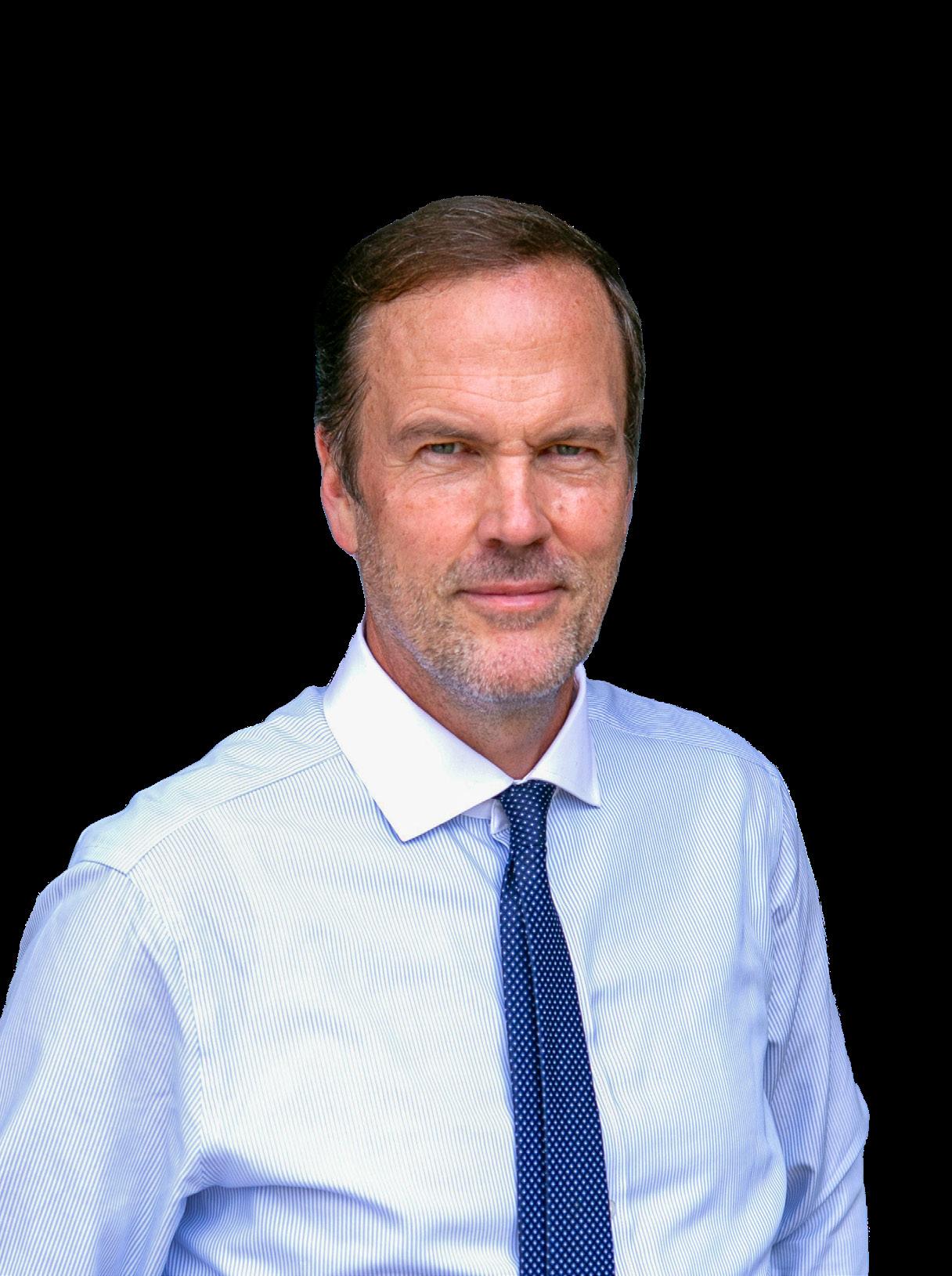
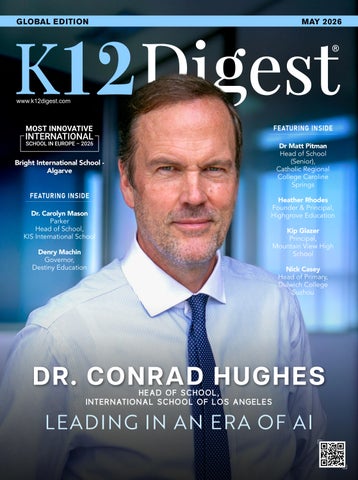
That is what makes our cover story with Dr. Conrad Hughes so timely and important. In this exclusive conversation, Hughes argues that education can no longer focus solely on delivering content. It must cultivate ethical judgment, creativity, critical thinking, and intellectual curiosity. His perspective on AI is particularly compelling. Technology, he says, should not replace thinking but deepen it. Before students can benefit from AI, they must first learn how to read carefully, write clearly, analyze sources, and question what they see.
This issue of K12 Digest explores these ideas from multiple angles through insightful interviews, expert perspectives, and thought-provoking stories from across the education landscape. Together, they reflect a shared realization that the future of education is not about producing faster learners, but wiser thinkers.
As you turn these pages, I hope this edition encourages you to slow down a little, reflect more deeply, and perhaps rediscover the value of thoughtful learning in a distracted world.
Enjoy Reading.

Sarath Shyam

HEAD OF SCHOOL, INTERNATIONAL SCHOOL OF LOS ANGELES
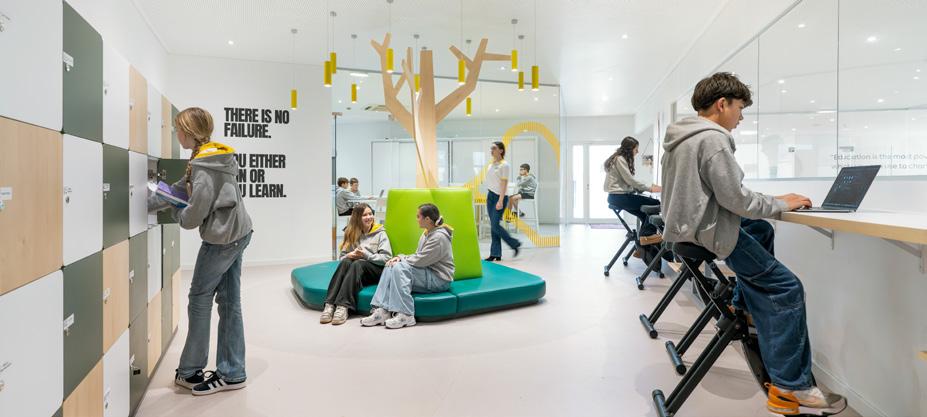
16 Where Joyful Learning Drives Natural Excellence
BRIGHT INTERNATIONAL SCHOOL - ALGARVE
INDUSTRY PERSPCTIVE
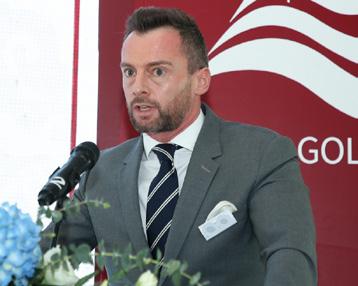
FROM IDEA TO DOORS
OPEN: MANAGING SCHOOL DEVELOPMENT PROJECTS
Denry Machin, Governor, Destiny Education
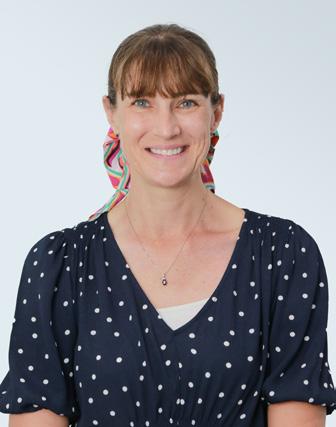
CLOSING THE LOOP: ALIGNING SCHOOLS, UNIVERSITIES, AND INDUSTRY IN A SKILLS-BASED WORLD
Dr. Carolyn Mason Parker, Head of School, KIS International School
30

64
THE REAL RISK IS COGNITIVE OFFLOADING: BUILDING CRITICAL THINKING IN THE AGE OF AI
Nick Casey, Head of Primary, Dulwich College Suzhou
BUILDING SCHOOLS WHERE PEOPLE FEEL SEEN AND LEARNING FOLLOWS
Dr Matt Pitman, Head of School (Senior), Catholic Regional College
Caroline Springs 36

48
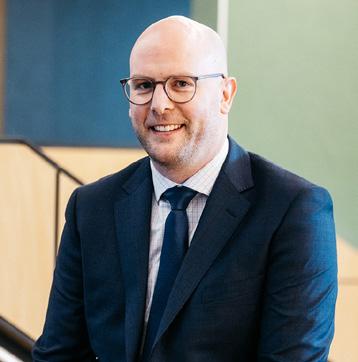
EMPOWERING SCHOOL LEADERS TO LEAD AI WITH COURAGE
Kip Glazer, Principal, Mountain View High School
TRANSFORMING ONLINE LEARNING FROM ACCESS TO ACADEMIC EXCELLENCE
Heather Rhodes, Founder & Principal, Highgrove Education 56
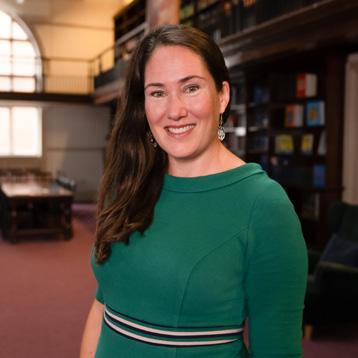
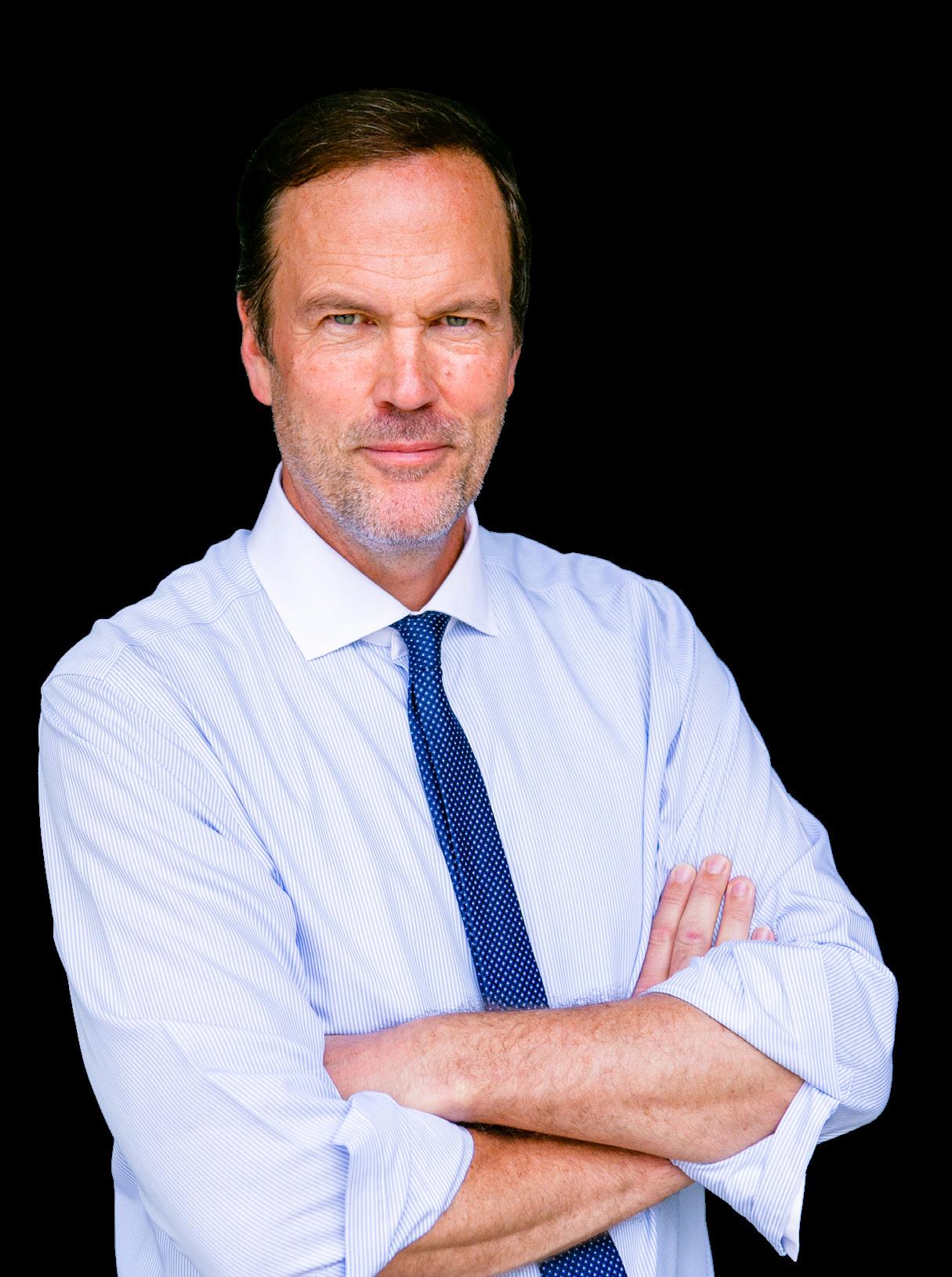

Hi Conrad. Your leadership spans three continents, from India to Switzerland to Los Angeles, with doctorates in both literature and critical thinking. Looking back at that global journey, what was the moment you realized education itself had to be redefined, not just delivered?
The six major global shifts I’ve lived through that have convinced me that profound educational reform could lead to a better world were the end of Apartheid in South Africa (I was lucky enough to vote in the first free and fair elections); the birth of Web 2.0 (I was in the Netherlands at the time); 9/11, which I experienced from India; the release of the iPhone; the 2008 crash and Covid (I was in Switzerland for those three). All of these historical turning points have influenced my research on how education can reduce prejudice, the centrality of critical thinking in an age of technological expansion in the knowledge economy, the importance of viewing schools as places of human exchange,
interaction and joy, and how we might design systems that allow multiple gifts to shine.
International schools are navigating AI, polarization, and new accountability demands all at once. Looking ahead, what part of the traditional K-12 model will be unrecognizable by 2030?
I tend to deconstruct these all-or-nothing approaches to the future. First, there will be multiple futures, not just one, depending on where you are; second, there are currently pockets of extraordinary innovation in some areas which could be described as 2030 already and very backward-looking projects in others where it feels more like the 1950s coming back. My guess is that whatever the future of education, it will be paradoxical. When we started looking at alternative transcripts during and just after Covid, it felt pretty groundbreaking, now the idea of tapping into multiple intelligences and different competencies is quite common, and it has been monetised by
K-12 leaders need to be what their students need to be: creative, ethical, critical
corporations. So I think that in 2030 we will be closer to a competency-based learning approach in most systems, although at the same time I think that excessive and aggressive testing to divide and sort students based on narrow metrics will exist alongside that: we’ve seen a doubling down on SATs, PISA test scores and statewide and nationwide testing. It will be the development of competence-based learning and the reinforcement of high stakes assessment at once.
However, ultimately, we don’t really know. Covid threw crystal ball gazing out the window: none of those writing about the future of education in 2018 could have guessed that a year later we would be wearing masks or all learning online, or not at all! This is why a great education, which goes beyond the classroom into the school of life, is about making individuals and groups ready for the unknown, and for that you need confidence, fortitude, a centre of meaning in your life, knowledge, skills in domains (even if they become obsolete, you will have a base from which you can transfer) and, perhaps most importantly, the right attitude.
You’ve authored work on critical thinking and now lead a school as AI enters every classroom. What is the single biggest mindset shift K-12 leaders must make to stay relevant in the AI era?
Technology is not where our thinking ends, it’s where it starts. K-12 leaders need to be what their students need to be: creative, ethical, critical. You have to line your ducks up in a row so that the basics are in place before you start accelerating and augmenting your work with AI. The foundations of reading and
writing, some sort of critical thinking ability and source analysis need to be consolidated before considering how AI might augment and accelerate knowledge production. Throwing someone who knows very little or nothing into an AI environment will not reap anywhere near the type of productivity and return you will find if that person is well educated to start with.
Wellbeing, safeguarding, and DEI are now core to accreditation. What does “student wellbeing” look like at scale when AI, social media, and geopolitics all enter the classroom daily?
There’s an abundance of negativity thrust onto young people today. They are described as the “anxious generation”, the “lost generation”, suffering from “brain rot” because of screen addiction and doomed to earn less than their parents. This type of thinking has to stop, because it is projecting negativity onto younger generations and in no way reflects the type of optimism and hope we should be generating as educators. Wellbeing is a subtle, fragile entity that comes from feeling loved and accepted in a community, not labelled and pitied.
I believe that a strong educational programme that is holistic in nature, encouraging participation in the arts and sports, community engagement and academics, along with a caring and supportive entourage, is what young people need to thrive. Most especially, we need to believe in them, set them up for success and respect the extraordinary capacities they have for creative thinking and new ways of navigating the world, ways that older generations perhaps do not quite understand. Adults need to lead the way by exposing young people to the beauty of ideas, the power of passion for learning, the

courage to stand up to bullies and the wisdom to be grateful for whatever they have, no matter how great or small. Educators should never forget to seek out gifts in young people, for they are there, and to recognise them and let the young person know, telling them “you can go far, you are special, I believe in you”.
Leaders are shaped by the ideas they return to. Is there one book, from literature or education, that sits on your desk year after year, and what line from it still guides your decisions?
I try to find different reflections on leadership in books not necessarily written for that purpose, because to me leadership is merely an extension
of your inner core outwards and should not be garnered in some sort of rigid leadership manual you keep coming back to. I’ve been reading AC Grayling’s History of Philosophy. Grayling is a mentor for me and the leadership lesson in his writing is less what he is describing and more how he describes it: precisely and authentically, without trying to take short cuts or shirk off complexities. The lesson I take from his writing is that when you are a leader, respect the people around you and don’t imagine you need to somehow dumb things down for them, on the contrary, have the humility to know that they might know much more than you and, therefore, express yourself earnestly and not “strategically”.
Educators
should never forget to seek out gifts in young people, for they are there, and to recognise them and let the young person know, telling them “you can go far, you are special, I believe in you”
You operate at the intersection of policy, philosophy, and people. When you need to disconnect and restore your own capacity for critical thinking, what is the one activity that brings you clarity?
I love to walk in the wild, whether it be the desert, by a shoreline, in the bush, a forest, in the mountains or in a valley. We have an ancient genetic connection with the wild and rekindling it heals us, giving us immense energy and clairvoyance. If you’re ever struggling with something in your life, go outside at night, find a quiet space, look at the stars and connect with your inner self, put things into perspective and thank the cosmos for its power and presence. Not long ago I was in a forest of Redwoods near Big Sur in California. Some of those trees are over 1000 years old. Just being in the presence of such an overwhelming primeval force immediately resonates within you, connecting you with something much bigger than yourself.
You empower learners to become agents of positive change. If you could give every K-12 leader one new metric to obsess over in the AI era that isn’t test scores or enrollment, what would it be and why?
Critical thinking because, if you think about it carefully, the one competency that sits under all others is that which pushes you to open your mind to new ideas, seek new information, know how to listen, understand what you can trust and what you cannot trust and, eventually, take a decision that is informed and your own. Critical thinking is much more than judgement, it’s about intellectual humility. I think that being creative, a lifelong learner, a good communicator and a team player are all important, but all of them can lead you down the wrong path without discernment, honesty and deep thought.
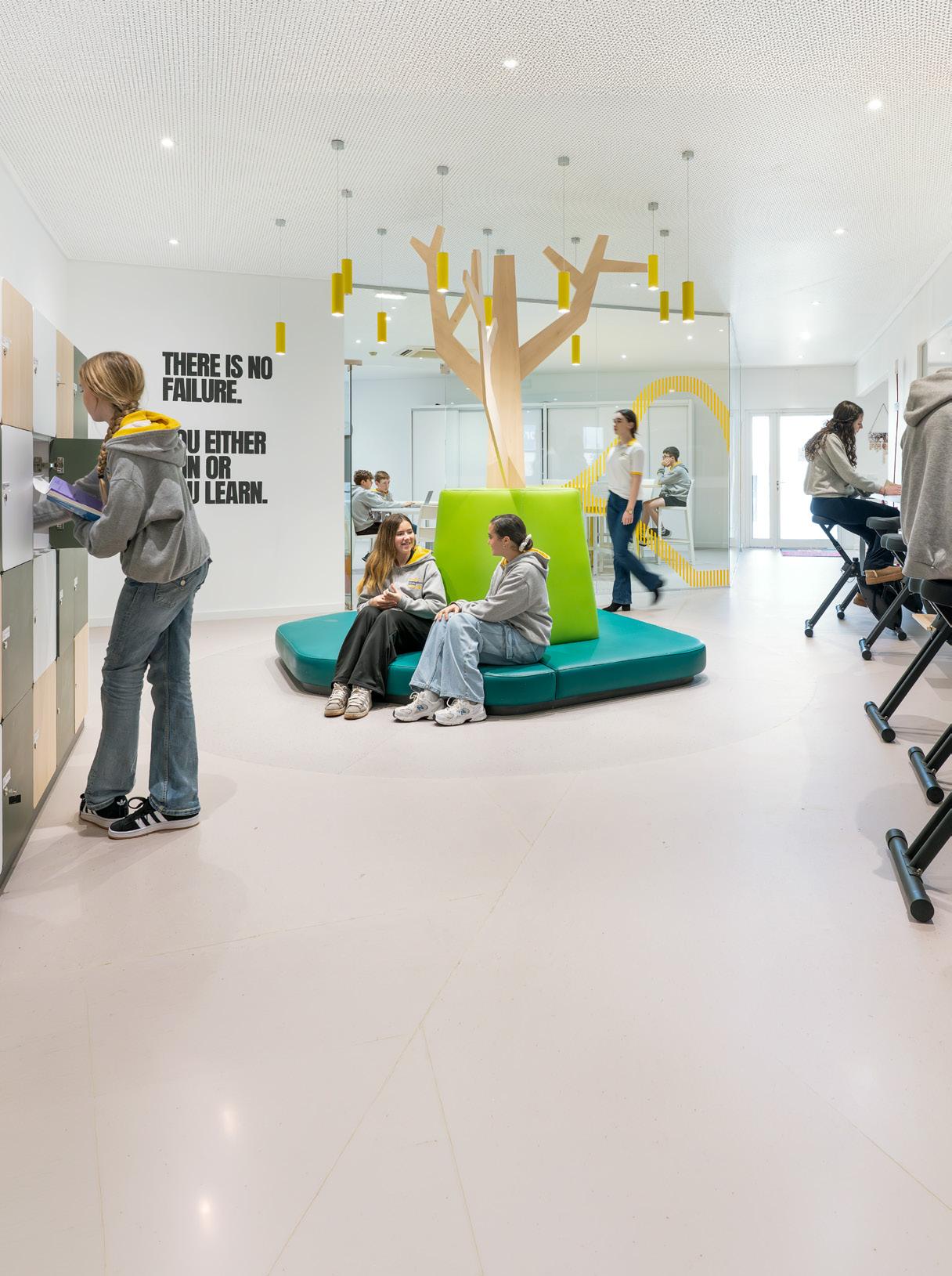

At Bright International School Algarve, learning begins with a feeling. There is a quiet sense of energy across the campus. Children move between thoughtfully designed spaces with confidence and curiosity. Conversations flow naturally. Ideas are explored openly. The school has built a culture where learning feels alive. That atmosphere is deeply intentional. For Tom Caston, Head of School, the values of “joyful learning” and “natural excellence” are not aspirational phrases placed on a wall. They influence the everyday life of the school and guide the decisions behind it. “Within their learning, our children feel curious and excited to learn, not pressured or passive. We want learning to be meaningful and emotionally safe, so children associate being here with pleasure and possibility,” he explains.
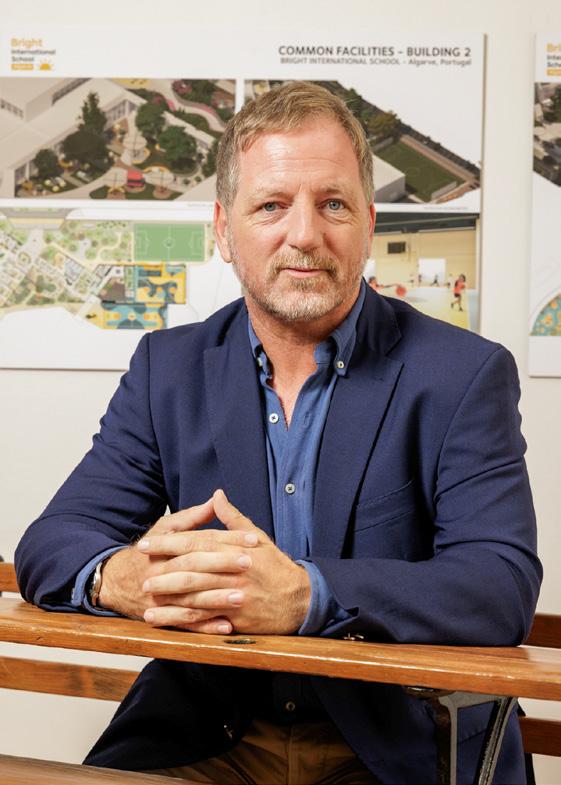
Tom Caston, Head of School, Bright International School – Algarve
Tom studied Geography at the University of Exeter and later obtained an MSc in Managing School Improvement from the University of Reading. Before embarking on his teaching career, he worked in investment banking.
In 1999, he began teaching at Shiplake College, where he later became Head of Lower School. He then held senior management positions in several independent schools across the United Kingdom, including Head of Staff Development at Ardingly College and, more recently, Deputy Head at Framlingham College.
Following these roles, Tom served as Head of Mander Portman Woodward, Cambridge, for four years before joining Bright International School in August 2024.
Those ideas can be felt in the rhythm of the classrooms. Students gather in small collaborative groups, discussing projects, solving problems, and sharing discoveries with ease. Teachers move alongside them as guides rather than lecturers. There is structure, but also freedom. The atmosphere remains calm and focused, even as creativity fills the room.
Bright International School’s philosophy is grounded in the belief that success should never be reduced to comparison. The school encourages children to grow into their own strengths, talents, and character at a pace that feels authentic and sustainable. Effort is recognised. Individuality is valued. Every learner is seen as more than a set of academic outcomes. “Excellence at Bright is not about pressure or comparison, but about growth, pride, and doing your best. Children are recognised for who they are, not who they compete against,” says Tom.
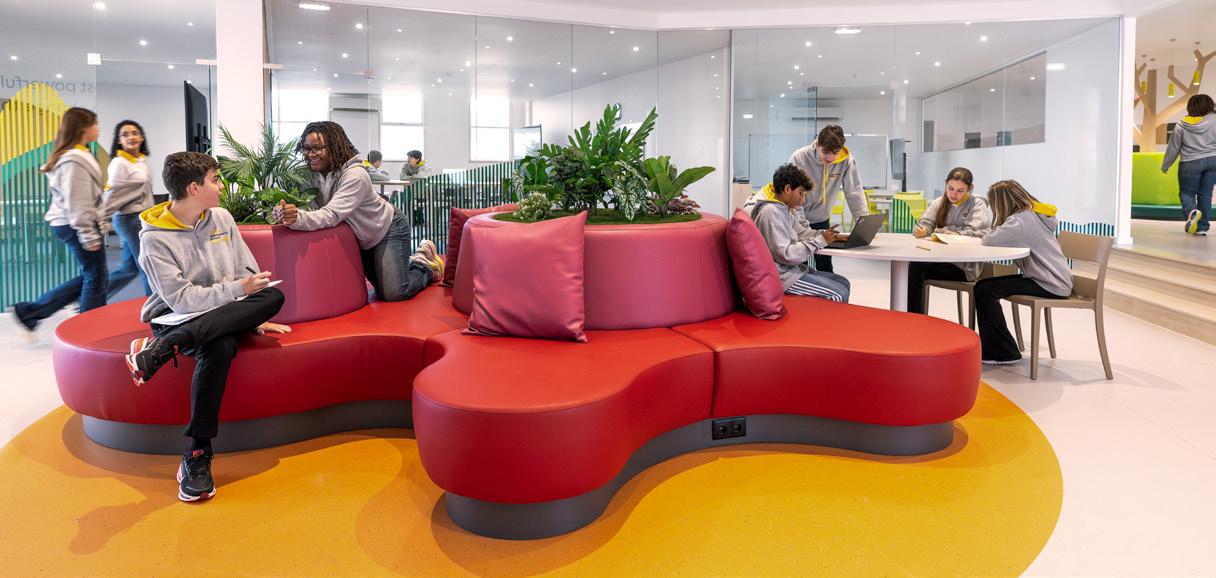
That same thinking influenced the design of the campus itself. The learning spaces were created by renowned Danish designer Rosan Bosch and her team at Rosan Bosch Studio,
who have collaborated with other schools within the Sharing Education Group. Their approach is built on a simple but powerful idea: environments shape behaviour, creativity, and the way children learn.
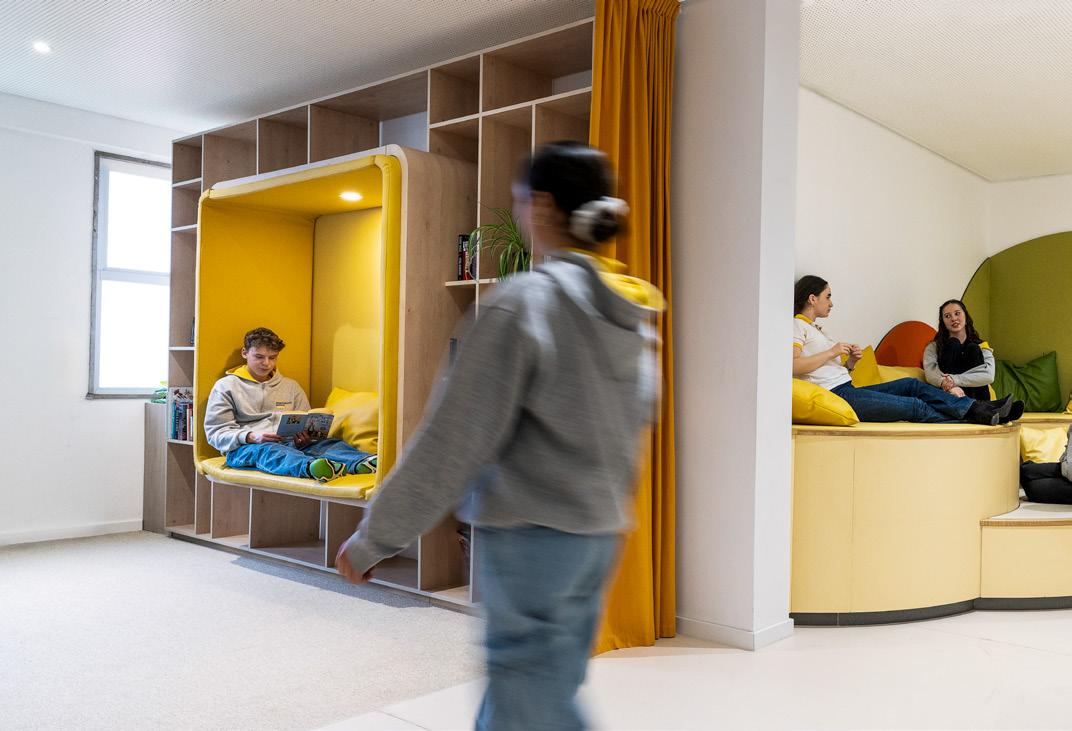
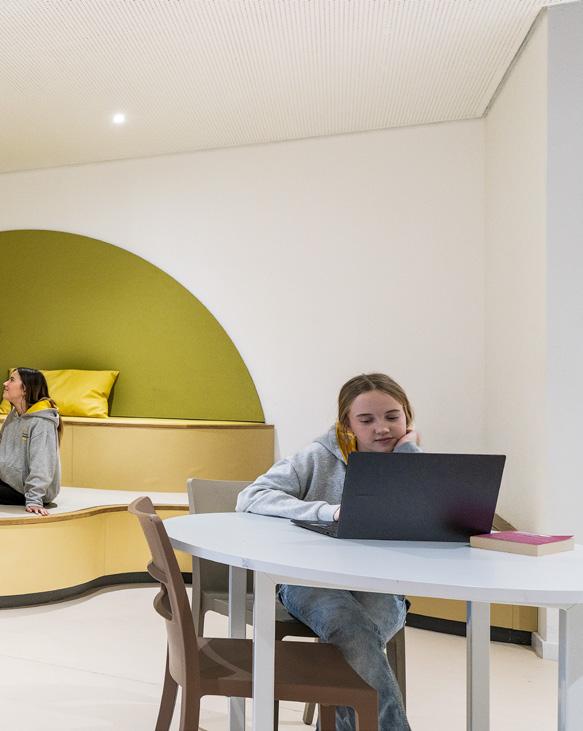
Traditional rows of desks are replaced with dynamic spaces that invite movement, communication, and exploration. Students read in quiet corners, brainstorm in open collaborative areas, and engage with lessons in ways that feel instinctive rather than forced. The result is a learning environment that encourages independence and critical thinking from an early age.
Having spent more than two decades teaching in conventional school settings, Tom sees the difference clearly. “The quality of the independent learning is far higher than I have experienced at any other time in my career. There is a calm but purposeful atmosphere throughout the school,” he says.
That sense of purpose continues to guide every part of Bright International School. It is visible not only in the architecture or the curriculum, but in the confidence of the students
themselves. Here, education is designed to nurture capable learners and grounded young people who enjoy the process of becoming who they are meant to be.
Inside the classrooms of Bright International School, learning rarely stays confined to a desk. Students move, build, question, test ideas, and collaborate with one another in ways that feel natural and purposeful. The school follows the Cambridge International curriculum, but its delivery is shaped by inquiry, creativity, and real-world engagement.
Lessons are designed to place students at the centre of the experience. Teachers encourage exploration rather than passive memorisation, creating opportunities for children to engage physically and intellectually with what they are learning. Whether through
discussion, experimentation, design projects, or collaborative challenges, the emphasis remains on participation and discovery.
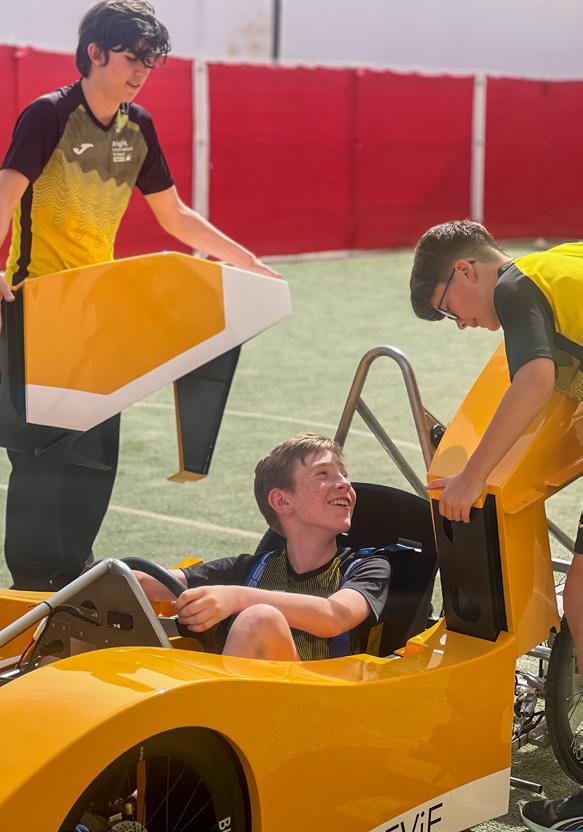
One of the clearest examples of this philosophy can be seen in the school’s partnership with Bufori and its EVIE initiative, short for Electric Vehicles in Education. Bright International School is one of only three schools in Portugal selected to participate in the project, alongside its sister school, International Sharing School. What began as an extracurricular opportunity has quickly become one of the school’s most exciting student-led experiences.
In one part of the campus, a team of students from Years 7 to 10 gathers around the framework of an electric vehicle, discussing engineering decisions and assembling components together. Nearby, another student team works on sponsorship proposals, branding ideas, and marketing campaigns to support the
project. The atmosphere feels closer to a startup environment than a traditional school activity.
Tom has watched the journey unfold with admiration. “This is the most wonderful real-life experience for the pupils. It has been a joy for staff to watch this from afar. They have shared moments of joy, frustration, breakthroughs and disillusion,” he says.
The initiative naturally connects multiple disciplines across the Cambridge curriculum. Students apply concepts from Science, Computing, Design and Technology, Art, and Global Perspectives while also developing an understanding of entrepreneurship, investment planning, branding, and teamwork. More importantly, they learn how ideas evolve through trial, collaboration, and persistence.
That same spirit of active learning extends into everyday classroom experiences. In Mathematics lessons, geometry often becomes
By making learning active and memorable, Bright International School helps students develop confidence alongside academic understanding
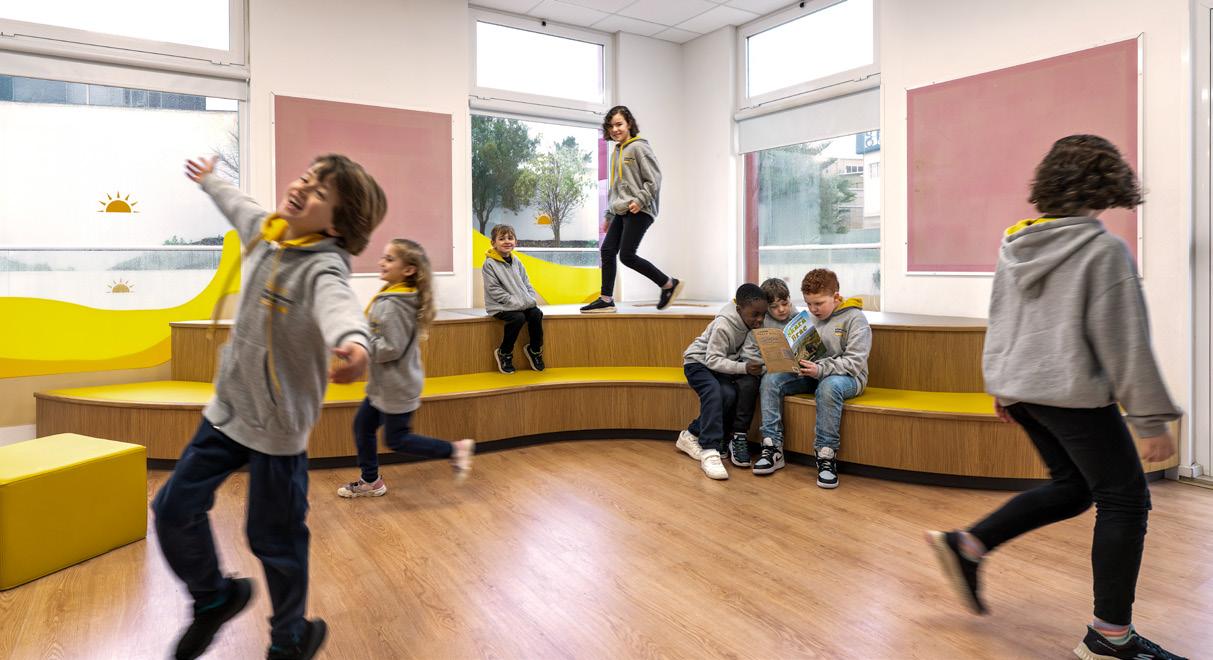
something students can physically see and feel. Angles are mapped out across classroom floors and tables using masking tape. Students build life-sized models, measure shapes through movement, and solve problems together in groups. Laughter and discussion fill the room as mathematical concepts become tangible rather than abstract.
The approach may look playful on the surface, but the intention behind it is deeply thoughtful. By making learning active and memorable, Bright International School helps students develop confidence alongside academic understanding. The process encourages them to think independently, communicate clearly, and remain curious long after the lesson ends.
The physical environment at Bright International School was designed to bring people together. Open, flexible classrooms encourage students to communicate, collaborate, and learn from one another from the earliest years through to iGCSE. The layout itself reflects the school’s belief that meaningful learning grows through interaction and shared thinking.
For Tom, those moments of student conversation are among the most rewarding parts of teaching. Despite leading the school, he continues to teach iGCSE Geography himself and remains closely connected to classroom life. “As a Geography teacher myself, the Holy Grail for each lesson is to be able to take a step back
At Bright International School, learning is designed to feel flexible, dynamic, and connected to the real world
and listen to the pupils talking between themselves about the subject,” he says.
That mindset influences academic planning across every age group. Teachers intentionally create opportunities for students to question, debate, analyse, and reflect together. The process is still evolving, but Tom believes each term brings a greater sense of confidence and natural collaboration for both teachers and pupils.
Inquiry-based learning sits at the centre of that journey. In Cambridge Science lessons, students investigate concepts through discussion, experimentation, and shared problem-solving. Questions often lead the lesson forward. Students are encouraged to challenge assumptions, test ideas, and explore different perspectives rather than simply search for the “right” answer.
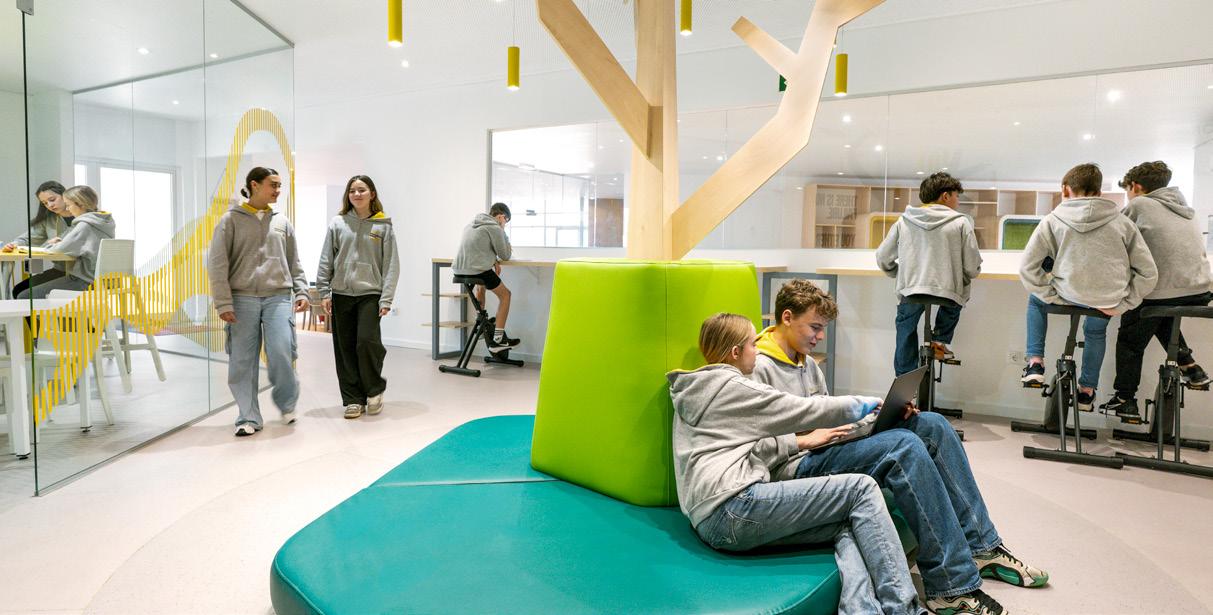
The same energy carries into Cambridge English classrooms, where communication and creativity take centre stage. On any given day, students might be recording podcasts, participating in debates, building collaborative stories, or moving between activity stations analysing texts and solving challenges together. The classrooms feel dynamic and alive, with learning unfolding through conversation and participation.
Underlying every lesson is a strong sense of emotional safety. Students are encouraged to express opinions openly, take intellectual risks, and learn through experimentation without fear
of failure. That atmosphere allows confidence to grow steadily over time. “We’re always looking to weave enquiry-based learning into our teaching because we believe this will generate the skills in our young people that they need for the future. Questioning will always be open, and pupils will always be made to feel safe to express their opinions and take risks in their learning,” Tom explains.
Traditional classroom routines rarely define the learning experience at Bright. “It is very rare, if ever, that you will see a teacher at Bright standing in front of the class with each student looking the same direction copying from the
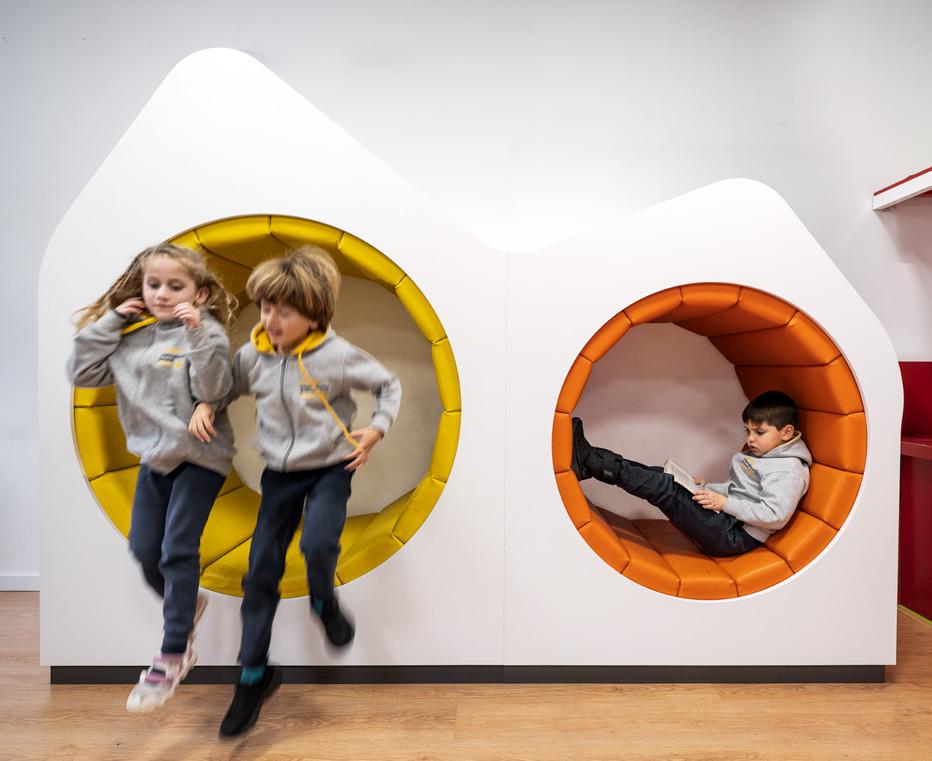
board,” Tom says. Instead, lessons are designed to activate higher-order thinking skills such as evaluation, synthesis, judgment, and modelling. He believes these experiences help knowledge stay with students in a deeper and more lasting way.
The result is a school culture where learning feels shared rather than delivered. Students are not simply absorbing information. They are learning how to think, question, communicate, and contribute with confidence. And in a rapidly changing world, those qualities may prove to be the most valuable lessons of all.
At Bright International School, learning is designed to feel flexible, dynamic, and connected to the real world. Students are encouraged to move through spaces with independence, collaborate naturally with classmates, and engage with lessons in ways that reflect how they learn best.
Classrooms rarely remain static for long. A group discussion may shift into handson experimentation. Independent research might evolve into collaborative problemsolving. Teachers create environments where students feel comfortable taking ownership of their learning, while still feeling guided and supported throughout the process.
Technology also plays a meaningful role across the curriculum. Rather than being taught as a separate skill, digital literacy is integrated naturally into everyday learning experiences. Students learn coding, multimedia design, online safety, and responsible digital communication through project-based activities that connect naturally with classroom subjects.
Presentations, digital campaigns, video storytelling, and interactive research projects have become familiar parts of school life.
Creativity flows through the campus just as naturally. In Cambridge Art & Design, students experiment across sculpture, painting, mixed media, and design thinking while often linking their work to themes explored in Science or English. The projects encourage students to think across disciplines and see creativity as something that belongs everywhere, not only in the arts classroom.
Yet some of the school’s most important learning moments happen beyond academic lessons altogether. For Tom, extracurricular life is where many of the school’s core values truly come alive. “The extracurricular activities are a hugely important part of what we do. It is in these moments that all the skills we talk about so regularly, communication, collaboration, creativity and critical thinking, are brought to the fore,” he says.
The programme caters to the diversity of student interests and personalities. Sports, music, drama, science and technology initiatives, and imaginative fantasy-based activities all give students opportunities to explore who they are outside formal academic expectations. There is freedom to experiment, make mistakes, and grow in confidence without the pressure that can sometimes accompany classroom assessment.
“This part of the Bright education builds those skills in a slightly different environment where failure might not seem quite so catastrophic. It also develops passions, individual and team excellence and provides the boys and girls with a great deal of fun,” Tom explains. One memory, in particular, still stands out for him. Earlier in the term, the school hosted its first
music recital. Families gathered together as students nervously stepped onto the stage, many performing publicly for the very first time. “It will remain one of my favourite memories of this school since joining,” Tom says.
Moments like these continue to shape the culture of Bright International School. They reveal a school community that values not only achievement, but joy, courage, and self-expression. As the school grows, its extracurricular programme is expected to expand alongside it, creating even more opportunities for students to discover what excites and inspires them.
Walk through the corridors of Bright International School and one thing becomes immediately clear. Relationships matter here. Students greet teachers comfortably. Older pupils pause to help younger children. Families gather naturally after school events, continuing conversations long after activities have ended. The sense of community feels visible in the smallest interactions.
Wellbeing and student voice sit at the centre of the school’s educational philosophy. Academic success is important, but so is emotional confidence, resilience, and the ability to feel heard. Through collaborative challenges, reflective learning activities, and leadership opportunities, students are encouraged to develop self-awareness alongside intellectual growth.
Tom frequently speaks about the school’s third core value: “Community Connections.” For him, the phrase represents something far deeper than organised events or school
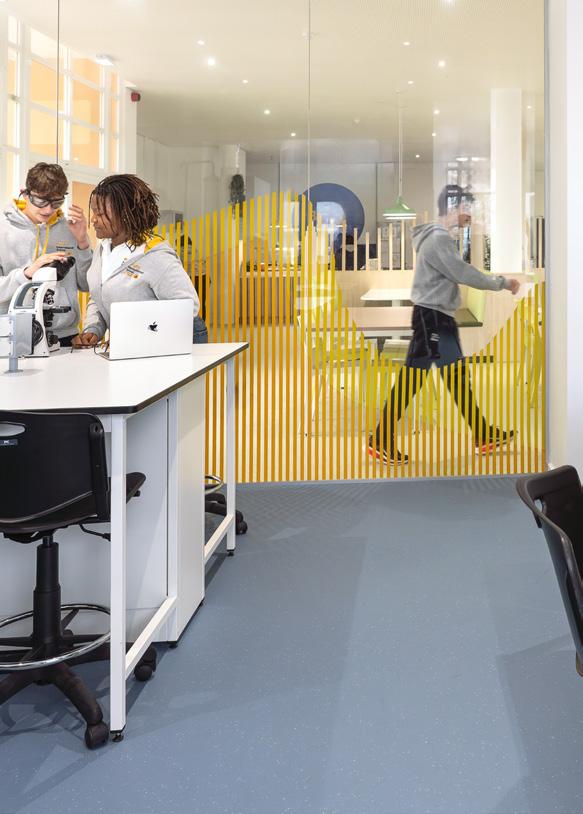
traditions. “At Bright, this is about being part of a supportive, inclusive and engaged community where relationships matter just as much as academics. Everyone feels they belong to the Bright community, whilst differences are welcomed and valued,” he explains.
That philosophy is reinforced intentionally each day. Kindness, respect, and contribution are not treated as abstract ideals. They are modelled consistently by staff and older students alike. Tom believes culture is created through everyday behaviour, particularly by the students younger children naturally look up to. “We often
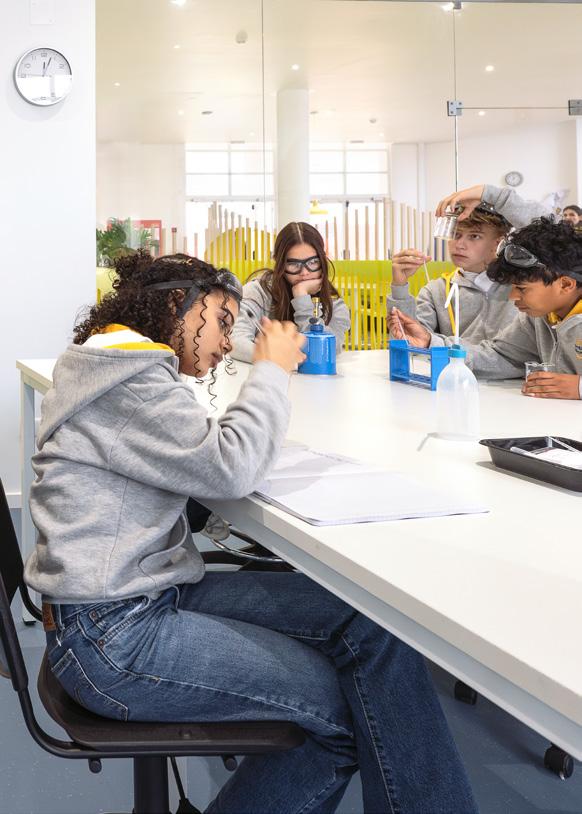
talk to the older pupils about their importance in creating a lasting culture of kindness here at the school. We have a lovely group of Year 9 and 10 pupils who can, and do, set a beautiful tone for all those younger ones who look up to them,” he says.
Strong pastoral care supports that culture behind the scenes. Staff are trained to recognise and respond thoughtfully to the needs of each child, while support systems are designed to provide guidance at the right moment and in the right way. Just as important is the emotional atmosphere the school works hard to maintain:
one where children feel safe, understood, and valued. “At Bright we always say that we are a family-owned school, for families,” Tom shares. That connection extends well beyond the classroom walls. Throughout the year, the school hosts community events that bring students, staff, and parents together in relaxed and meaningful ways. The Bright Run, Bright Wine & Cheese Evening, and Bright Watersports Day have all become important moments in the school calendar. A highly active Parent and Teacher Association also helps strengthen those relationships, creating opportunities for families to contribute directly to school life.
Tom believes this close partnership with parents plays an important role even during challenging moments. Trust, he says, allows conversations to remain open and constructive. “In moments where things might not be so perfect, our close engagement with the parents makes those discussions easier and more open, underpinned by an established level of trust.”
Bright International School is still evolving, but its direction feels clear. Across the campus, signs of growth are visible everywhere. New facilities are taking shape. Academic opportunities are expanding. Student ambitions are growing alongside the school itself.
A new sports field has just been completed. A world-class science laboratory now sits at the heart of the campus. Music continues to grow each term, while iGCSE Drama will soon join the curriculum. The student-built electric vehicle project is preparing for its next major milestone, and the school is set to introduce the The Duke of Edinburgh’s Award programme in the coming year.
That search for balance may ultimately define what makes Bright International School distinctive. The school embraces innovation while protecting human connection
For Tom, these developments are exciting, but growth has never been the goal on its own. Protecting the school’s sense of community remains just as important as expanding opportunities. “Our growth has been carefully managed. The most important thing is to not lose what makes the school so special, the sense of community,” he explains.
That balance between ambition and care seems to guide much of the school’s thinking. Bright International School continues to invest in new facilities and programmes while remaining deeply focused on the student experience. New staff joining the school are selected not only for their expertise, but for the values and energy they bring into the community.
Tom speaks enthusiastically about the team that will join the school in the coming academic year. “We have appointed some wonderful staff to add to our already brilliant group. I am incredibly excited to see the quality they will bring to our community,” he says.
Underlying every decision is a broader educational vision. The school often speaks about helping students “create their futures,” a phrase that reflects both independence and responsibility. Preparing young people for the future, however, does not mean abandoning balance or humanity in the process. “At Bright we are always seeking to find the right balance between the journey and the destination, between skills and knowledge, between technology and the written word and between rigour and wellbeing,” Tom says.
That search for balance may ultimately define what makes Bright International School distinctive. The school embraces innovation while protecting human connection. It encourages ambition while nurturing wellbeing. And as it continues to grow, it remains grounded in a simple but powerful belief: education works best when children feel inspired, supported, and genuinely excited about the future ahead.

Dr. Carolyn Mason Parker, Head of School, KIS International School
In recent years, there has been a noticeable shift across the K–12 education landscape. Schools are increasingly moving away from content-heavy models towards approaches that emphasise competencies such as critical thinking, collaboration, communication, and ethical decision-making. Classrooms are evolving, and with them, so too are the ways in which learning is designed, experienced, and assessed.
This shift is not happening in isolation. Across international education networks and professional conversations, there is growing agreement that academic success alone is no longer a sufficient measure of readiness for life beyond school. Instead, there is a broader recognition that students need to be equipped with the skills and dispositions required to navigate complexity, uncertainty, and change.
While schools are rethinking what learning looks like, universities and employers are not always moving at the same pace

Dr. Carolyn Mason Parker is an experienced international school leader with a background spanning the UK, USA, Middle East, and Africa. She currently serves as Executive Head of School, leading strategic development across multiple campuses and supporting innovation in teaching, learning, and school design. Her work focuses on aligning curriculum, assessment, and professional learning to better prepare students for an increasingly complex and interconnected world. She has a particular interest in competency-based education, future-focused learning environments, and the role of leadership in building coherent and sustainable school systems. Carolyn has contributed to a range of international education initiatives and regularly engages in professional dialogue around educational transformation, inclusion, and the evolving relationship between schools, universities, and industry. She is committed to evidence-informed practice and to supporting schools in developing approaches that balance academic rigour with the broader skills and dispositions students need for life beyond school.
And yet, despite this progress, a gap remains.
While schools are rethinking what learning looks like, universities and employers are not always moving at the same pace. Admissions processes and hiring practices continue, in many cases, to prioritise traditional indicators such as grades, examination results, and subject specialisation. These measures still hold value, but they do not always capture the full range of capabilities that students are developing during their school years.
The result is a growing misalignment at a critical point in a young person’s journey.
This is not the result of any single system falling short. Rather, it reflects the complexity of change across interconnected sectors. Schools, universities, and industry each operate within their own structures, expectations, and timelines. However, if the shared goal is to prepare students for an increasingly dynamic
world, then greater coherence between these sectors becomes essential.
In many schools, this evolution is already well underway. Students are engaging in interdisciplinary learning, applying knowledge in authentic contexts, and developing transferable skills through inquiry-based approaches. Assessment practices are also changing. Portfolios, project-based learning, and reflective processes are being used to provide a more holistic picture of student progress and achievement.
These developments are not theoretical. They are visible in everyday classroom practice and are shaping how students understand their own learning.
However, when students transition beyond school, they often encounter systems that continue to rely on more traditional forms of evidence. Universities may still focus heavily on examination outcomes, while employers
frequently report that graduates lack certain workplace skills, even when those skills have been an explicit focus of their education. This suggests that while innovation is taking place, it is not yet fully connected across the system.
Addressing this disconnect requires a shift in how different sectors communicate and collaborate.
One important step is the development of shared language. When schools, universities, and employers use terms such as “critical thinking” or “collaboration,” they do not always mean the same thing. Establishing greater clarity around these concepts—what they look like in practice, how they develop over time, and how they can be demonstrated—can support more meaningful alignment.
Equally important is the way in which learning is evidenced. Schools are increasingly able to present rich, evidence-based profiles of student achievement that extend beyond grades alone. These may include portfolios of work, extended projects, and demonstrations
of learning over time. Such approaches provide deeper insight into what students know and can do, but their value depends on wider recognition. For these forms of assessment to have impact, they need to be understood and trusted beyond the school context.
Partnerships offer another pathway forward. Where schools, universities, and industry engage in sustained collaboration, there is greater opportunity to build mutual understanding. Internship programmes, mentorship opportunities, and joint curriculum initiatives can help ensure that learning remains relevant and connected to real-world contexts. These partnerships are most effective when they are ongoing and reciprocal, rather than occasional or transactional.
Leadership plays a critical role in enabling this alignment. Those working across education and industry have the capacity to influence how systems evolve, both within their own organisations and through collaboration with others. By creating opportunities for dialogue,
By creating opportunities for dialogue, being open to new forms of evidence, and maintaining a focus on shared outcomes for young people, leaders can help bridge existing gaps
As education continues to evolve, the risk is not that schools are changing too quickly, but that other parts of the system are not yet fully aligned with that change

being open to new forms of evidence, and maintaining a focus on shared outcomes for young people, leaders can help bridge existing gaps.
It is important to recognise that this shift is not about reducing academic rigour. On the contrary, developing competencies such as critical thinking and problem-solving often requires deeper engagement with subject knowledge and more sophisticated application of learning. The challenge lies not in replacing traditional measures, but in broadening our understanding of what high-quality learning looks like and how it is recognised.
As education continues to evolve, the risk is not that schools are changing too quickly, but that other parts of the system are not yet fully aligned with that change. Without greater coherence, there is a danger that students will continue to navigate transitions between systems that do not fully recognise or build upon their learning.
Bridging this gap will take time and deliberate effort. It will require shared understanding, thoughtful collaboration, and a willingness to question established practices. However, the potential benefits are significant. Students will be better supported as they move from school to higher education and into the workplace. Their skills and capabilities will be more clearly understood and more effectively utilised. And the system as a whole will be better equipped to respond to the demands of a complex and rapidly changing world.
The work of alignment is already underway in many contexts. The next step is to ensure that these efforts connect, so that progress in one part of the system strengthens the whole.

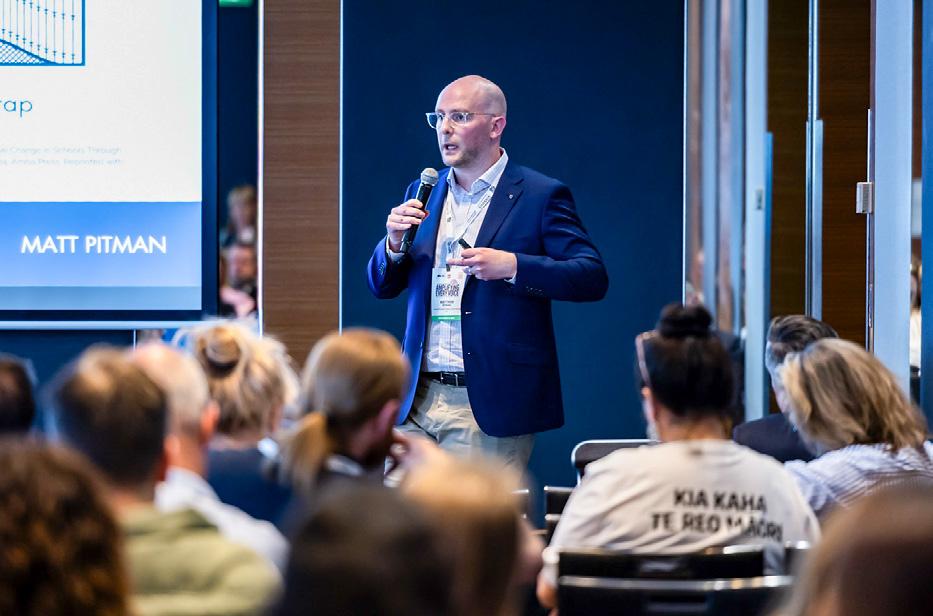
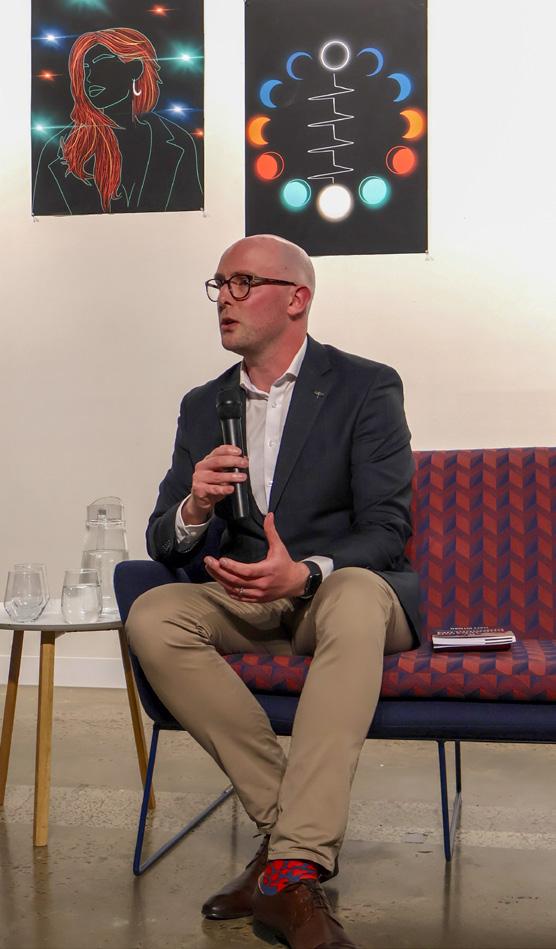
Dr Matt Pitman, Head of School (Senior), Catholic Regional College Caroline Springs
Dr Matt Pitman is an experienced educational leader and author passionate about researching connections across school communities. Matt’s experience is varied, from the leadership of curriculum teams and programs to student wellbeing, student improvement and community engagement portfolios. He has led Positive Education and student support programs and has a passion for working with students, parents, and staff to develop new understandings of the needs of young people in the 21st century. He is currently Head of School (Senior) at Catholic Regional College Caroline Springs, Australia.
In an exclusive conversation with K12 Digest, Dr Pitman talks about the central role of connection in shaping meaningful educational outcomes, the evolving challenges of secondary education, and the need for schools to remain grounded in purpose amid constant change. He shares how strong relationships influence student engagement, staff wellbeing, and long-term school improvement, while also reflecting on how values-based education and academic excellence go hand in hand. Dr Pitman also offers thoughtful perspectives on the growing impact of AI in classrooms, emphasizing the importance of preserving the human side of learning.
Your career in education has evolved through various roles. What key experiences have shaped your leadership approach today?
My leadership has been shaped less by any single role and more by what I’ve consistently seen across them. Early on, I was focused on teaching well and improving outcomes, which of course still matters. But over time, what became impossible to ignore was how much
those outcomes were dependent on the quality of relationships around them. Working across different contexts, particularly in wellbeing and leadership, I’ve seen what happens when people feel disconnected. Students disengage, staff burn out, and even the best-designed initiatives struggle to gain traction. On the other hand, I’ve also seen schools where there is a strong sense of connection, and the difference is significant. People commit more, they persist longer, and
A student who feels connected to their teachers and their peers is more willing to take risks in their learning, to persist when things are difficult, and to take responsibility for their own growth

they experience school as something they are part of, not just moving through. My doctoral work allowed me to step back and examine that more closely. It confirmed something I had felt for a long time that connection, beyond just knowing a name or hobbies, is foundational. That has shaped how I lead now and as a result, I’m far more intentional about culture, about relationships, and about the conditions we create for people to do their best work.
At Catholic Regional College Caroline Springs, how do you balance academic excellence with the development of values and character in students?
At Catholic Regional College Caroline Springs, we don’t approach this as a balance in the sense of trade-offs as in reality, academic excellence and character formation are deeply connected. The Catholic identity of the school gives the community a clear set of values, but the real work is in how those values are experienced day to day. For us, that means creating an
environment where students feel known and supported but also challenged to grow. When students feel that sense of belonging, they are far more likely to engage in their learning in a meaningful way. We place a strong emphasis on high expectations, but we’re working to ensure those expectations sit alongside a commitment to relationships. A student who feels connected to their teachers and their peers is more willing to take risks in their learning, to persist when things are difficult, and to take responsibility for their own growth. Ultimately, we want students to leave not only with strong academic outcomes but also have a really clear sense of who they are and how they can contribute to the world around them.
School education is undergoing rapid change. What do you see as the most pressing challenges facing secondary education today?
It won’t surprise anyone that knows me, but I believe one of the most significant and often
The quality of the relationships in a classroom still matters more than the sophistication of the tools we use. If anything, the rise of AI makes that even more important
overlooked challenges in secondary education is disconnection. While there are many competing pressures in schools such as wellbeing, curriculum demands, accountability, and now rapid technological change, underneath a lot of these is a growing sense of fragmentation. Students can feel disconnected from their learning, staff can feel disconnected from the systems they are working within, and schools can at times feel disconnected from the communities they serve. When that happens, it becomes very difficult to sustain improvement, no matter how strong the strategy might be. I think this is where education more widely sits at the moment. The challenge is not simply responding to change but doing so in a way that remains coherent and grounded. Schools need a clear sense of purpose and a shared understanding of what they value before they start on something new. Without
that, it is easy to move from one initiative to the next without building anything that lasts. Staff are all too familiar with this lack of continuation, so if we can strengthen connection at all levels of the school, we are in a much better position to navigate the complexity that defines education right now and stick with change when it is what will serve the whole community best.
How are AI and emerging technologies influencing teaching, learning, and administration in your school?
AI is already influencing how we think about teaching and learning, whether we are ready for it or not. AI tools have definitely challenged some of the assumptions that have traditionally underpinned assessment and knowledge acquisition. In my context, we are trying to approach this with both openness and a level
of professional responsibility. There is genuine potential here but we must accept that this is new work for all of us. It would be great if we could get ahead of the students, but we are all experiencing these innovations at the same time. AI has the potential to support more personalised learning, help reduce some of the administrative load on teachers, and provide new ways for students to engage with content but at the same time, it raises important questions that I am not sure we have the answers for yet. Like any new tool we need to think carefully about academic integrity, about how we continue to develop critical thinking, and about how students learn to use these tools ethically and effectively. What I think we need to be absolutely clear on is that technology should enhance the human aspects of education, not replace them. The quality of the relationships in a classroom still matters more than the sophistication of the tools we use. If anything, the rise of AI makes that even more important.
Can you share a key initiative or achievement at the college that you believe has made a meaningful impact on students or staff?
One of the most meaningful areas of work has been the deliberate focus on strengthening connection across the school. Rather than introducing a single program, we’ve worked to embed relational practice into the way the school operates. A practical example of this has been refining our consistency in lesson structure to create space for connection and relational learning. It is essential that every student is known well by at least one adult in the school, and that this isn’t left to chance. We’re supporting
staff to build more consistent relational and restorative practices in their classrooms, so that connection is not dependent on individual style but becomes part of our shared approach. Over time, we hope that this shifts the experience of school for both students and staff. We’ve seen stronger engagement from students and a greater sense of collective responsibility among staff so far which is fantastic. It hasn’t been a quick fix, but it has been meaningful because it has changed the underlying culture rather than just adding another initiative. Work in progress for sure.
Outside of your professional role, what personal interests or values continue to influence the way you lead and engage with your community?
I’ve always been interested in how people make meaning of the world around them, and that certainly extends beyond education. Interests like design thinking and storytelling have influenced how I approach both leadership and problem-solving. They encourage you to see things from different perspectives and to be more intentional in how you design experiences for others. I also value reflection quite highly. Taking the time to step back and think about what is actually happening, rather than just responding to what is urgent, is important in leadership. It creates space for better decisions. On a personal level, I try to stay grounded in the idea that leadership is ultimately about people. It’s easy to become focused on outcomes and structures, but what tends to stay with people is how they experienced a place and how they were treated within it. That’s something I’m constantly mindful of.
What advice would you offer to students and young professionals who are preparing to step into an increasingly complex and technologydriven world?
The pace of change can make it feel like you need to constantly chase the next skill or tool, but I think it’s more important to stay grounded in the qualities that don’t change as quickly. Curiosity, empathy, and the ability to work well with others will remain important regardless of how technology evolves. It’s
also important to become comfortable with uncertainty. There won’t always be clear answers, and the ability to keep learning, to adapt, and to respond thoughtfully in unfamiliar situations is critical. Finally, I would encourage young people to invest in connection. Not just networking in a superficial sense but building genuine relationships and having a clear sense of what matters to you. In a complex world, those things provide a level of stability and direction that is hard to replicate elsewhere.
Denry Machin, Governor, Destiny Education
Your career bridges UK state schools, boarding, universities, and complex international school launches across Asia. Looking back, what was the first moment you realized education and business operations couldn’t be separated, and how did that shape your path?
For me, it was a natural evolution rather than a single defining moment. By trade and passion I’m an economics and business studies teacher, with an undergraduate degree in business and an MBA. So, having spent my career in schools, it was perhaps inevitable that my thinking would coalesce around the ‘business of education.’ It probably came as no surprise to those who knew me that this became the focus of my PhD.
That background also made my career path an obvious one: moving from my role as Head of Upper School at Harrow Bangkok into a group new school development position with Asia International Schools Limited, the operator of the Harrow International schools across Asia.
Bringing together those two backgrounds, what I do now is help schools solve ‘business’ problems—making sure that an educational lens informs problem-solving.
What do you love the most about your current role?
Put simply, variety.
Whilst no two days in a school are the same, they are structured around routines—and, in the case of my time at
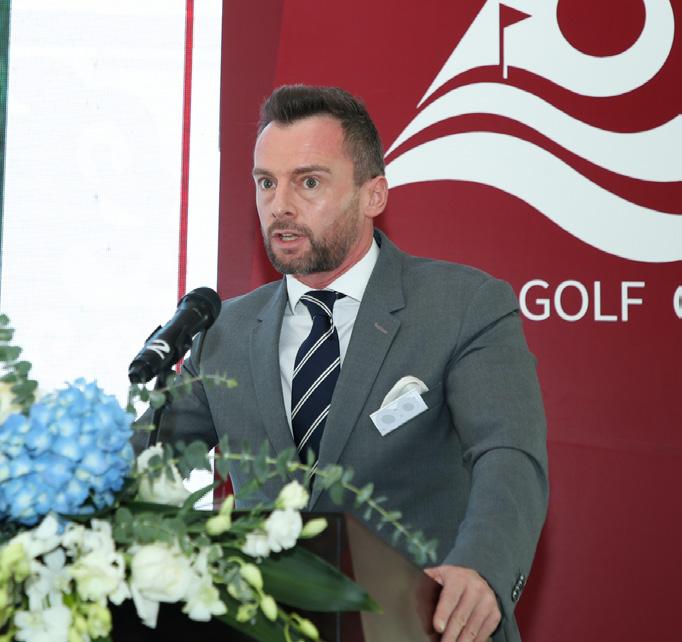
Dr Denry Machin’s diverse background spans international schooling, independent boarding, and the UK state sector. Formerly Head of Upper School at Harrow Bangkok and Associate Director of Special Projects for Harrow International Management Services, Denry now works on international school openings, upgrades, mergers and turnarounds. Focussed on the implications of business thinking within education, his PhD led to publications on the economics of international schooling, organisational psychology, and school marketing. He sits on the peer-review panel for the Journal of Research in International Education.
Denry currently supports the University of Warwick with their iQTS and PGCEi teacher training programmes, and previously lectured for Keele University on their MBA (Education), MA, and Doctoral programmes. He also serves on the Governing Body of a not-for-profit international school in Malaysia. He has written numerous books, including co-authoring the best-selling DK Business Book. His most recent book, International Schooling: A Teacher’s Guide, coauthored with Dr Stephen Whitehead, offers practical advice for teachers on the international adventure. Recently, in an exclusive interview with K12 Digest, Denry shared insights into how his path as an economics and business studies teacher with an MBA naturally evolved into focusing on the ‘business of education,’ culminating in a PhD that now informs his work solving ‘business’ problems for international schools through an educational lens. Writing International Schooling: The Teacher’s Guide with Dr Stephen Whitehead came from repeated questions from PGCEi, MA, and MBA students, and Covid provided the pause to turn those into a book for both newbies spotting red flags and old-hands recognizing themselves in real stories. He also shared his personal hobbies and interests, future plans, words of wisdom, and much more. The following excerpts are taken from the interview.
Harrow Bangkok, the regular chimes of a clock tower. As a consultant, in contrast, one works with different people, on different problems, often in different countries. That variety is what I thrive on.
Writing academic papers, business texts, and ‘International Schooling: The Teacher’s Guide’ shows a commitment to both scholarship and practice. What gap did you see in the market that made you write the book, and who is it really for?
As my co-author, Dr Stephen Whitehead, and I wrote in the dedication, the ‘Teacher’s Guide’ was written ‘for all the teachers who asked all the questions which led to everything in [the] book.’
At the time I was teaching on PGCEi, MA, and MBA (Education) programmes, and across all of them the same questions and conversations kept repeating. Some of the answers I wrote up as course content (modules on ‘for profit’ schooling, for example), others as blogs. Then Covid happened, giving us the chance to pull it all together into the book.
Who is it for? Newbies and old-hands alike. The hope is that any reader, whatever their level of experience, will take something from it. Newbies tell us they use it to inform their career decisions—and to spot red flags when applying to schools. Old-hands tell us they find themselves nodding along, recognising something of themselves in the stories we included to ensure the book represents real people and real experiences.
The academic papers, whilst less enjoyable to produce (the peer-review process can be… painful), were a natural extension of the PhD work. Doctoral research has little value gathering dust on a university shelf, so making it accessible and (a little more) digestible felt important.
International school corridors are full of student art, languages, and big questions. What’s the most memorable conversation you’ve had with a student or teacher that reminded you why this work matters?
The conversations that have stayed with me longest are not those which happened in
Bringing together those two backgrounds, what I do now is help schools solve ‘business’ problems—making sure that an educational lens informs problem-solving
classrooms. Over the years, students have sought me out to ask various questions about ‘life’; those questions covering pretty much every aspect of it. Those exchanges, evidenced by the fact that alumni often refer to them years later, had far more value than anything I ever taught in economics or business. Hearing little quips and nuggets of advice echoed back to me, often many years later, is a reminder of the impact we have.
I also recall reviewing an art teacher’s portfolio at interview. He’d clearly gone through a ‘phase’, with most of his work in various shades of blue. I commented on it, apparently revealing my artistic ignorance. I appointed him anyway, and he proceeded to tease me about the ‘blue’ comment for the entirety of his time at the school.
Both are a reminder that schools are about relationships; everything we do is built on relationships.
Leaders are shaped by what they read. Which one book — academic, business, or fiction — changed how you think about schools as organizations, and what line still stays with you?
That’s very difficult to answer—I read a lot, and I’m known for pressing books on colleagues when related conversations come up.
Perhaps unsurprising, then, that I actually wrote a book collating wisdom from various things I’ve heard, seen, and read: The Wisdom of Heads.
But if I had to choose one book, I’m a fan of Danny Meyer’s Setting the Table. One of his central ideas is ‘pushing the salt’, an allegory for repetition. It’s saying the same thing in staff
briefings, repeatedly. It’s picking litter up in corridors when you see it, and picking up staff who don’t. It’s daily reminders. It’s standing at the school gate reinforcing rules. It’s about setting high standards, holding people accountable, and correcting them when those standards drift. Ultimately, it’s about accepting the infinite nature of leadership—that constant, gentle pressure is simply part of the job.
If you could travel anywhere in the world, where would you go and why?
I am very fortunate to have travelled for both business and pleasure—I’ve seen a lot of the world.
I like adventure, so travel is more about ‘what’ than ‘where’: I want to climb the Matterhorn and Mont Blanc. Why? Because, as Mallory said of Everest, they are there. I’d love to ski the route down from Piz Gloria in Switzerland, made famous in On Her Majesty’s Secret Service. I also want to visit Antarctica, though the prospect of seasickness through the Drake Passage does put me off somewhat.
What’s one thing you’re passionate about outside of education?
I like to stay fit. I’m a firm believer that staying fit allows one to bring more energy to projects and problems. I try to do something active and challenging most days; only rarely am I accused of resting!
Where do you see yourself in the next 5 years?
I’ve never been a fan of planning over such long horizons. Anything can, and as experience teaches us, usually does happen. Whilst project
Ultimately, it’s about accepting the infinite nature of leadership—that constant, gentle pressure is simply part of the job
management often requires forecasting over long periods, the fidelity of those plans is much higher over shorter timeframes.
I like what Jason Fried and David Heinemeier Hansson have to say here—and if we were meeting face-to-face I’d put a copy of their book Rework into your hands. Their argument is that long-term plans act as blinders. That had they rigidly followed a fiveyear plan, they would never have spotted the opportunity that became their most successful product. In schools, as in business, the most important decisions often emerge from circumstances you couldn’t have planned for. So rather than where I’ll be in five years, my focus is being well-positioned to recognise and respond to the next opportunity when it arrives.
Looking back on your career, what advice would you give to someone just starting out in school leadership?
Very much building on my last answer, two things: build a network and get a variety of experience.
It’s a truism that opportunities present themselves through people. The bigger the ‘surface area’ of your life, the bigger your network, the more opportunities you are likely to encounter.
Similarly, gaining experience across different types of schools, different curricula, and different roles within schools opens doors. It is all too easy in schools to end up on a defined track, which is fine if that is your passion and preferred path, but breadth of experience keeps more career paths and a greater variety of leadership posts available to you.


Kip Glazer, Principal, Mountain View High School
Dr. Kip Glazer is the principal of Mountain View High School in Silicon Valley. She is the author of Ready to Lead with AI: A Practical Guide for School Leaders, a Google Certified Innovator, and a CSTA Equity Fellow. She advises the EngageAI Institute and contributed to the U.S. Department of Education report “Artificial Intelligence and the Future of Teaching and Learning” in 2023. She holds an Ed.D. in Learning Technologies from Pepperdine University. Originally from South Korea, she is most proud of her two sons, both West Point graduates and Army officers.
Recently, in an exclusive interview with K12 Digest, Dr. Kip Glazer shared insights into how a paused district Chromebook rollout revealed her core conviction that tools have little impact if the leader of the building doesn’t believe in them. Her constant belief is that education exists to create an educated populace for the protection of democracy, a moral imperative she pursues by being the school leader she would want for her own children. She also shared her future plans, words of wisdom, and much more. The following excerpts are taken from the interview.
Hi Kip. Every leadership story has a first chapter that feels small at the time. Looking back at your earliest role in education, what moment made you realize you wanted to lead change, not just participate in it?
Imagine getting the news that you will be in charge of the Chromebook rollout for an entire district, only to be told that one of the site principals wants to wait until he is more confident about the timing. His decision paused
the plan for that particular school for a full year, while other schools embraced the pilot, and there was nothing I could do.
I was in that very situation when I was doing my favorite job as the District Instructional Technology Coach. I absolutely loved that role because it combined my two passions: teaching and technology. I was the person helping teachers, staff, and students with technology. But I could not move the agenda forward because the principal was not on board. As I write in
While I appreciate and respect our teachers and staff, I try to spend as much time as possible with our students.
After all, we are here for our students


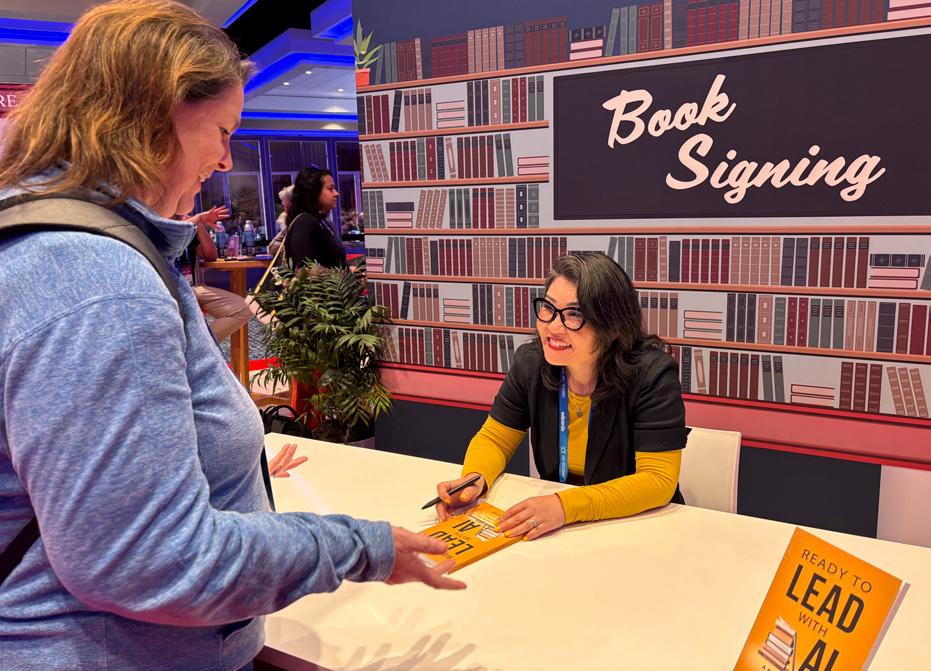
Ready to Lead with AI, tools, strategies, and plans have little impact if the person in charge of the building doesn’t believe in them.
Growing up, I never thought I would be an educator, let alone a school leader. But sometimes life opens a path that you did not know was open. I am so fortunate to have been an educator, and now a school leader who can support our staff and students.
What do you love the most about your current role?
Our students. I absolutely, positively love working with our students. They are funny, intelligent, and thoughtful. I learn so much from them, and I try to spend as much time with them as I can.
As a principal, it is not easy to maintain regular contact with students, which is why I started two student groups: the Principal’s Advisory Council (PAC) and the Principal’s Technology Internship. I meet with our PAC
students once a month to receive feedback from a wide variety of voices. I also meet with the Tech Internship leaders once a week to work on a range of projects. While I appreciate and respect our teachers and staff, I try to spend as much time as possible with our students. After all, we are here for our students.
Generative AI moved from novelty to classroom reality in under two years. Which AI trend in PreK–12 do you think is overhyped, and which one is dangerously underhyped?
Overhyped: the idea that AI systems can replace teachers, and in some versions of this fantasy, replace schools entirely. That conversation is loud right now, and it is built on a misunderstanding of what learning actually is. Even before OpenAI introduced ChatGPT to the world, I had been working with learning scientists on National Science Foundation(NSF) funded projects involving many different AI
systems, and one thing the research consistently shows is that learning is more than knowledge acquisition. Learning is fundamentally social. Any belief that AI can allow society to reduce the human workforce in schools is overhyped, and it gets the purpose of school wrong.
Underhyped: the workforce and societal transformation that generative AI is about to drive, and the leadership challenge that comes with it. Treating GenAI as just another technological tool in schools is a serious mistake. GenAI has the potential to hyperaugment and even hyper-automate mundane tasks, which will reshape the employment landscape our students are walking into. As an educator and school leader, I feel compelled to lead the transformation of the traditional education system rather than wait for it to
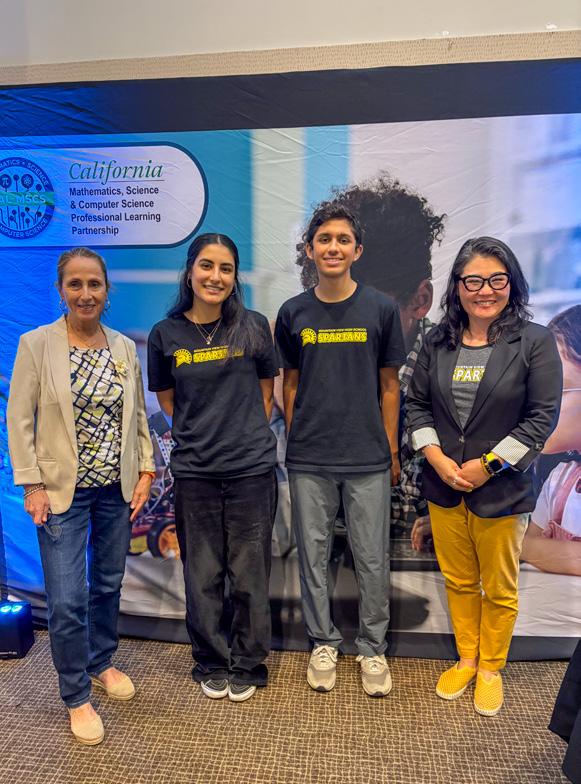
GenAI has the potential to hyperaugment and even hyper-automate mundane tasks, which will reshape the employment landscape our students are walking into

happen to us. Definitions matter here. A large language model is not the whole of artificial intelligence, and conflating the two leads us to make decisions about both the technology and our students’ futures with the wrong mental model. Educators and school leaders must act now rather than waiting for someone else to lead this work, which is exactly why I wrote my book.
Writing ‘Ready to Lead with AI’ signals deep conviction in this topic. What personal or professional experience convinced you that school leaders needed that book right now?
I became a high school principal in July of 2019. Before I had even finished a full year in the role, I had to close the school due to the
pandemic in March of 2020. When I first started the job, I had a long list of people to call for advice. Experienced and wise school leaders were ready, willing, and able to support me. Once the pandemic hit, however, there was no one to call. In fact, I became one of the leaders other people called, because of my background in technology.
The introduction of generative AI felt extremely similar. School leaders do not have many experienced site leaders they can call when they need help with AI. Because I remember how it felt not to know where to start when the pandemic hit, and how much I wished there were someone with a bit more experience on the other end of the line, I decided to share whatever knowledge I had.
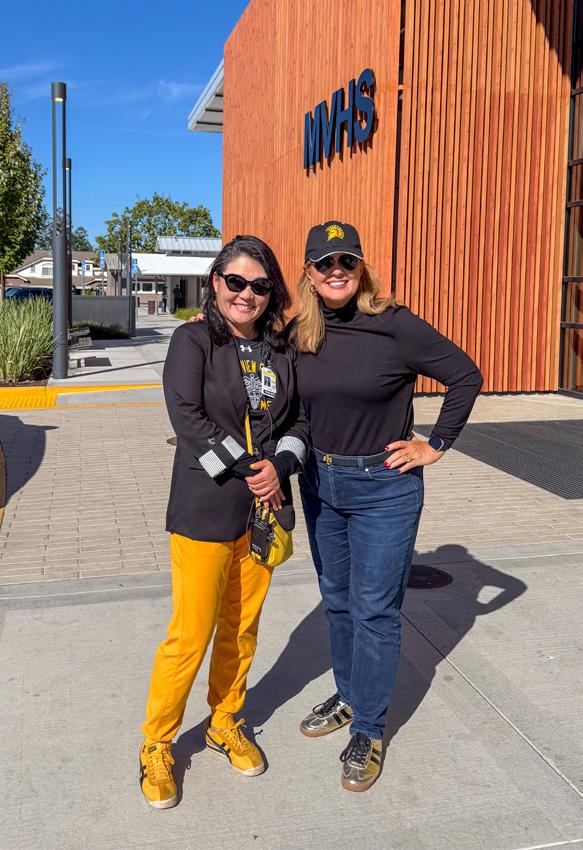
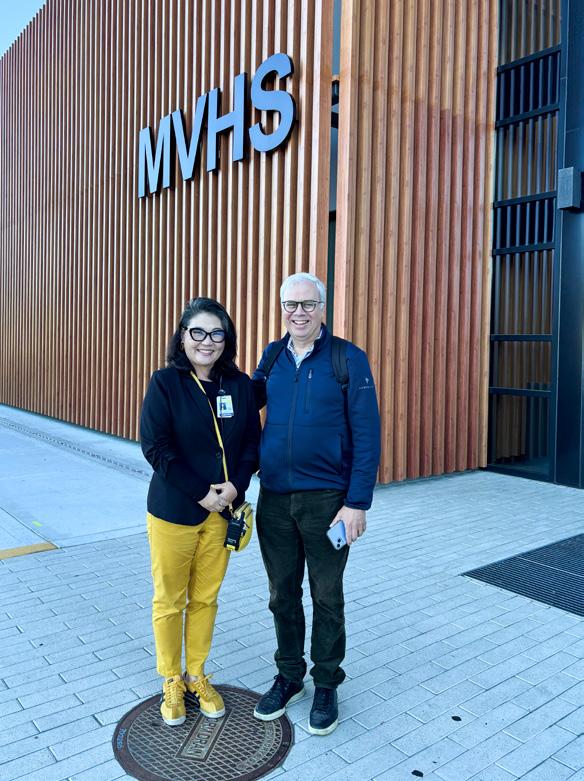
Many former and current educators can support classroom teachers with AI, but the practitioner perspective from school leaders working at the intersection of learning science, technology, and AI is still rare. As a Google Certified Innovator, a CSTA Equity Fellow, and a practitioner advisor for EngageAI, I wanted to write an accessible book that gives educators and school leaders a real starting point.
The book includes many stories of successes and struggles as I have figured out how to work with our District, our teaching staff, our nonteaching staff, our students, our parents, and the learning science field. Rather than a book focused on theory, I wanted a practical guide that is easy to read, so that anyone picking it up can gain basic knowledge about AI and the confidence to lead this work as an educator and a school leader. I hope I succeeded.
From your first day in PreK–12 to authoring a book and advising companies, what belief about education has stayed constant for you?
I believe the purpose of education is to create an educated populace for the protection of democracy. Creating an educated populace, in my humble opinion, is a moral imperative that any civilized society should pursue relentlessly. That foundational belief has never changed, and I work hard to be the educator and the school leader I would want for our own children. I also believe in pursuing excellence in everything I do, even if I do not always achieve it.
Every leader has a go-to tool that isn’t software. What physical object on your desk keeps you grounded or creative during long strategy days?
I keep a favorite pen on my desk and a journal nearby. Reflection is the tool that keeps me grounded, and writing is how I do it. I find it important to think carefully about the day I had and the decisions I made, and writing slows me down enough to do that well. I also like to take a walk very early in the morning so I can start the day with a clear mind.
Inspiration often comes from people we’ll never meet. Which historical figure or contemporary thinker do you wish you could invite to a faculty meeting? Oprah Winfrey. Hands down. I find her fascinating and inspirational, and I deeply respect her ability to communicate with clarity, warmth, and authority. Those are the qualities school leaders need right now, especially when we are talking with our communities about something as new and uncertain as AI. I would
want her in the room to remind us that how we say things matters as much as what we say.
If you could put one quote on the wall of every school leadership office, what would it say and whose words are they?
“Do what you can, with what you have, where you are.” Theodore Roosevelt, from his 1913 autobiography.
I have leaned on that line through every hard decision I have made as a principal. There is no
perfect moment. There are no perfect resources. There is only the building you lead, the people in it, and the day in front of you. School leaders who internalize that sentence stop waiting for permission and start doing the work.
Where do you see yourself in the next 5 years?
This is a tough one. Because I love being a high school principal, I can see myself doing the same job in five years. But I also want to


There is no perfect moment. There are no perfect resources. There is only the building you lead, the people in it, and the day in front of you
make a significant impact on the education field. So if there is an opportunity that lets me work with educators and leaders across the country and beyond, continue speaking and writing, and contribute to the field at a larger scale, I would be very open to it. And whatever else changes, I am certain I will write a couple more books. I have three in the works already!
If you could give one charge to every K–12 leader reading this, what would you ask them to commit to this school year regarding AI and human flourishing?
Don’t wait for the perfect moment to learn and innovate. Iterate, learn from what does not work, embrace the uncertainty, and share your struggles and successes now. Loudly. Publicly. So the people in your organization receive permission to follow.
Heather Rhodes, Founder & Principal, Highgrove Education
Heather Rhodes is the founder and Principal of Highgrove Education, an online British secondary school for academically ambitious pupils who want to achieve their potential outside the traditional school environment. She has been a pioneer in online education for over ten years, previously running Harrow School Online, the world’s most academically successful online sixth form. She is also a trustee at Svitlo Education, an online extra-curricular school for Ukrainian students impacted by the war. Heather is particularly interested in the potential of online education for building global communities of learning and increasing the accessibility of exceptional education.
Recently, in an exclusive interview with K12 Digest, Heather shared insights into her decade-long journey pioneering online education, revealing that digital learning not only matches but often outperforms in-person teaching because it offers an “insider view” of student thinking through real-time data, shared whiteboards, and closer face-toface interaction on screen. As founding Principal of Harrow School Online, she challenged elite education’s reliance on supervision by embracing flipped learning, where 60% of study time was independent and students carried responsibility for their education, a model that produced A-level results surpassing Harrow School itself and proved that removing oversight and “giving students the chance to fail” drives stronger outcomes. She also shared her personal hobbies and interests, future plans, words of wisdom, and much more. The following excerpts are taken from the interview.
Hi Heather. Pioneering online education for over a decade means you’ve seen skepticism turn into momentum. Thinking back to your earliest work in online tutoring for international students, what moment convinced you that digital could deliver not just access, but excellence?
To be quite honest, when I started out I was surprised to discover that digital learning could
outperform in-person teaching. I first set up an online tutorial school through Harrow School Enterprises in 2014, and at the time I was also working for Harrow School as head of English as an additional language. I took on much of the initial online tutoring myself, and because I was also teaching English for Harrow School, I was constantly switching between delivering lessons in person and online. Prior to launching
Teaching online gives you a wealth of data from a student’s self-study work and real time insights into how they think as they compose written work on a shared whiteboard directly in front of you

the online provision, I had the idea that distance would be likely to dilute the learning a little, but that something was better than nothing. What I found was the complete opposite.
I found online lessons to be more intense and cover more ground in a shorter time, and my online students consistently made more progress than those I taught in person. Even more surprisingly, I found I got to know my online students faster. Teaching online gives you a wealth of data from a student’s self-study work and real time insights into how they think as they compose written work on a shared whiteboard directly in front of you. Added to that, you spend a lot of time looking into your students’ faces. When I was giving online lessons, it felt like I had an insider view of the learning, rather than looking on from the outside. That’s what did it for me – the realisation that distance learning could actually give you a closer insight into your students.
Becoming the founding Principal of Harrow School Online was a historic first for British independent schools. What was the hardest assumption about “elite education” you had to challenge to make it work online?
Our remit at Harrow School Online was to replicate an elite independent school education, but with an alternative mode of delivery. There was, however, one really significant change. Education at top UK schools generally involves high levels of supervision. At Harrow School, even your homework time is supervised. For us to make learning work online, we had to rely on students working independently.
Before I ever got involved with online schooling, I was a huge fan of flipped learning.
That’s an approach which involves students learning materials independently prior to attending a lesson with their teacher, then using class time to consolidate and apply their knowledge with their teacher on hand to support and give feedback. It flips the traditional approach of teachers presenting content in class then students practising it for homework.
At Harrow School Online, we went all in with this approach. Around 60% of study time was independent, with students working through interactive self-study materials prior to attending their lessons. We only had a couple of live lessons per subject per week, then ensured teachers had time for additional oneto-one support if needed. We taught students study skills and gave them weekly individual coaching to help them adjust to this approach, but ultimately, the responsibility for their education sat squarely on their shoulders.
It’s a very different pedagogical approach to traditional schooling, but I was quietly confident it would work. All the same, I was as

Building schools in the virtual world might look great visually in marketing materials, but it adds an unnecessary and slightly clunky layer between teachers and students, and I can only see a very limited number of useful applications for it
shocked as everyone else when our first set of A level results came out and we had outperformed Harrow School. It was the same year after year, and we’re now looking at similarly strong academic results from flipped learning with my new school, Highgrove Education. My takeaway from this is that some assumptions are worth challenging. We got better results than one of the most famous schools in the world by taking away the supervision and giving students the chance to fail.
We achieved success by taking away the supervision and giving students the chance to fail.
Online schooling moved from niche to normal after 2020. Which trend in online K–12 do you believe is here to stay, and which one was pandemic hype?
There’s been a lot of unsubstantiated hype around the power of edtech to transform learning. A prime example is virtual reality. Building schools in the virtual world might look great visually in marketing materials, but it adds an unnecessary and slightly clunky layer between teachers and students, and I can only see a very limited number of useful applications for it. Demonstrating science experiments, sure. Spending each day cloaked in an avatar, not particularly convincing. Until you see clear evidence that something produces better outcomes, it’s sensible to be dubious about the hype.
Flipped learning, however, is a trend which I think is here to stay – and one which has power to transform education beyond online schooling. As well as being incredibly powerful for academic progress, it helps pupils develop as strong independent learners, and puts them in the driver’s seat for their education. There’s no reason this approach has to be confined to online schools. Highgrove Education showcases just how powerful flipped learning is when it’s done well. My hope is that will inspire others leading more conventional schools to give pupils more agency in their education.
you’re most determined to remove in the next three years?
One of the most exciting programmes we’re working on at the moment is a partnership with
a school in the Himalayas Valley in India, where Highgrove Education will be providing the full academic programme and our local partner will be providing onsite care and support. This is a relatively remote, rural area, where students will be learning from a team of outstanding teachers. We’re setting out to prove that location is no longer a barrier to quality of provision –that wherever you live in the world, you can access a first-class education. We see this as a gamechanger for international education, where one of the key challenges has long been teacher recruitment. Hybrid partnerships make that a thing of the past, offering the best of flipped learning, but with onsite socialising and support.
Many educators want to move into online leadership. What’s the first skill they should build if they’ve only taught in physical classrooms?
Build up your online teaching practice first. Online teaching needs a different pedagogical
approach and delivery, and unless you’ve developed your own expertise, you’ll struggle to effectively lead others. If you’re eying up an online leadership position in the long term, you might therefore need to take a step back into a teaching role in the short term to build up your own practice. Choose a reputable school with a strong induction and training programme, and take a look at the profile of other teachers at the school to consider who your colleagues will be and how much you’ll learn from them. Peer observation is a great way of accelerating through the learning curve.
Books often shape how we design learning experiences. What book lives on your desk and influences how you think about community, pedagogy, or technology?
One of the books I’ve been most influenced by is Thinking, Fast and Slow, by Daniel Kahneman. While it’s not a direct dive into

pedagogy, it breaks down the processes of thought and decision-making, which are of course fundamental to learning and education. Understanding how prone we are to making short cuts with our thinking is one reason I’m so keen on explicitly teaching metacognitive skills. The more we develop our self-reflection and self-control, the better learners – and thinkers – we become. For me, that’s at the heart of education.
Rest fuels resilience for founders. What hobby, ritual, or weekend activity helps you return to Monday ready to build?
Exercise is non-negotiable for me. It’s my magic trick for getting rid of stress and decluttering my mind. Most weekends follow the same pattern: a 6km run through the woods on Saturday morning, then a 3km swim on Sunday. I’m a far stronger swimmer than runner, so I get overtaken regularly on my run, then comfortably lap most people in the pool. I’m always exhausted by the time I finish my swim, so I sit and stretch for a bit in the sauna until I’m up to walking home. I swim at Highgrove Pool and walk back through Highgrove woods – and yes, Highgrove Education was named after the pool.
If you could put one sentence on the login screen of every online school, what would it say and why?
“It’s good to see you!”
Students choose online school for all sorts of reasons; sometimes after a difficult experience elsewhere, sometimes simply because they want more from their education than their local school can offer. When they log on,
regardless of what pushed them towards online schooling, they’re choosing to show up. We’re in direct competition with Netflix for our students’ attention. When they show up all the same, wanting to learn, the least we can do is make them feel welcome.
Legacy matters to builders. Ten years from now, what do you hope a Highgrove graduate says about how online school shaped their life?
I decided to take a fairly significant personal risk in launching Highgrove Education because I see our school as lifechanging. We take in teenagers from across the world who have struggled to find an education that meets their needs, and we deliver them on to top universities. When they get there, our alumni tell us they feel streets ahead of their peers because they’ve already learnt how to manage their time and stay on top of their workload. That journey from struggling with finding the right educational fit to thriving at life is transformational. I’m looking forward to finding out from our graduates ten years down the line what they’ve gone on to do. The best legacy would be hearing that Highgrove set them up to be catalysts for change.
For an aspiring edtech founder who cares about pedagogy, what three mistakes should they avoid that you learned the hard way?
Firstly, the illusion that having institutional backing gives you security. Edtech founders often look for corporate investment. I learnt the hard way that when Pearson owned Harrow School Online, I had no control over the future of the school or its closure. Having
We’re in direct competition with Netflix for our students’ attention.
When they show up all the same, wanting to learn, the least we can do is make them feel welcome
seen the risks, when I started up Highgrove, I did it the hard way, without institutional backing. It’s been worth all the long hours and the financial risk I took on personally to have a thriving school where I have control of future direction.
Secondly, the presumption that most people outside the world of edtech understand what you’re talking about. If your whole working life revolves around online education, it’s easy to forget that some people don’t know online schools exist. It might be tempting to talk about synchronous vs asynchronous provision, or the value-added scores you’ve achieved with flipped learning, but only a handful of people will care. It’s important to step out of the bubble and articulate
clearly what you offer and who will benefit. Ultimately, parents want to know how you can help their child.
Thirdly, the idea that because you have an excellent solution for a problem, it will be the right solution for every child. We once had a child enrol with us who we later found out had a gaming addiction. With the best will in the world, an online school is not the right solution for a child addicted to gaming. It’s important to be able to identify and articulate who you can help, and equally to recognise who isn’t a good fit for your provision. For us at Highgrove, that means making clear we offer online schooling for pupils who are academically ambitious and are keen to take on agency in their education.
Nick Casey, Head of Primary, Dulwich College Suzhou
Acentral task of education is to develop thinking. Yet students now have access to tools that can complete many traditionally cognitive tasks, including drafting essays, solving equations, generating code, and summarising texts, with little more than a prompt. What began as a technological novelty has, in a short time, has quickly become embedded in everyday educational practice.
Unsurprisingly, early debate focused on academic integrity. If high-quality work can be produced instantly, how do we prevent misuse? But cheating is not the most significant risk facing schools. The deeper challenge is cognitive offloading: the gradual outsourcing of thinking to intelligent systems.
For decades, researchers have observed how humans rely on tools to reduce mental effort. Calculators changed how we approach
When students retrieve information, wrestle with ideas, and work through uncertainty, learning becomes stronger and more durable
Nick Casey is Head of Primary at Dulwich College Suzhou, with over 15 years of leadership experience across Australia and international contexts. A CIS-trained evaluator, he brings deep expertise in whole-school strategy, curriculum design, assessment systems, and professional learning. Having served as Deputy Head, Dean of Primary, and Whole College Director of Teaching and Learning, Nick offers a broad, systems-level perspective on school improvement. He champions relational leadership, evidence-informed practice, and high-performance cultures, and is recognised for driving sustainable improvement through strong community partnership and organisational coherence.


arithmetic. Search engines transformed how we access information. GPS reshaped spatial navigation, quietly replacing printed street directories, or, as we called them in Australia, the Refidex.
Research in cognitive psychology reminds us that effort matters. When students retrieve information, wrestle with ideas, and work through uncertainty, learning becomes stronger and more durable. When thinking is done for them, understanding is often shallow and short lived. Educational thinker Guy Claxton writes about building “learning power,” the capacity to persist, question, and think independently. These habits develop when students grapple with complexity and navigate challenge.
Artificial intelligence operates at a higher level than previous technologies. It does not simply retrieve information. It can construct arguments, summarise complex ideas, and generate interpretations in seconds. If students rely on AI to do this higher level thinking without questioning, refining, or challenging what it produces, they may complete tasks more quickly, but they miss the very process that builds analytical strength
Used deliberately, AI can deepen learning. It can help students test ideas, compare perspectives, and refine drafts. It can accelerate feedback and broaden exposure to viewpoints.
But when AI begins to perform the core reasoning itself, learning shifts away from the student. Efficiency increases, yet intellectual growth does not. Critical thinking develops through analysing evidence, weighing interpretations, and justifying conclusions. When that reasoning is displaced, those habits weaken.
Parents, as partners in education, need to understand how and why AI is being used so they can reinforce habits of questioning and intellectual ownership at home
The risk, then, is not the presence of AI in classrooms, but the gradual erosion of cognitive engagement if its use goes unexamined. Critical thinking has never been about speed. It requires time, ambiguity, and disciplined reasoning. In a world where answers are immediate, discernment becomes even more important. Students must learn not only how to use intelligent systems, but how to question them. They need to recognise that coherence does not guarantee accuracy, and that confidence in tone does not ensure credibility.
Increasingly, schools and international organisations are acknowledging that the rapid development of artificial intelligence demands principled and coordinated responses. The Council of International Schools has launched a Taskforce on Emerging Technology to help shape ethical and future-focused guidance for schools navigating this terrain. I am encouraged by this work and look forward to seeing how these frameworks support schools in aligning innovation with their core educational values.
That alignment only matters if it is visible in classroom practice. Students do not automatically treat AI as a thinking partner. They will often treat it as a shortcut unless we explicitly teach otherwise. The difference lies in how we frame its use and what we require students to do with its output.
Increasingly, schools are investing time in teaching students how to use AI tools effectively. While these skills have practical value, they are not sufficient. Equal attention must be given to helping students understand what AI is, how it generates responses, and where its limitations lie. Without that foundation, students may mistake fluency for authority and coherence
for truth. A curriculum that addresses both the mechanics of use and the critical evaluation of outputs ensures that students remain thinkers first and users second.
This clarity must extend beyond the classroom. Parents, as partners in education, need to understand how and why AI is being used so they can reinforce habits of questioning and intellectual ownership at home.
The cultivation of critical thinking has always depended on deliberate practice. Students learn to analyse by analysing and to reason by reasoning. A student might explain why a character feels left out, pointing to specific moments in the story. Another might analyse how an author’s perspective shapes what is revealed and what is withheld. In both cases, the thinking lies in selecting the relevant moments, inferring what they reveal, and judging how perspective guides interpretation, not in assembling a fluent response.
In an environment where AI can simulate these processes, schools must ensure that learners still experience them firsthand. This does not require rejecting innovation, but designing for intellectual engagement and asking, in every subject area, whether the selecting, inferring, and judging illustrated above remain with the student rather than being displaced by the tool.
If critical thinking is to remain central in an AI rich environment, it has to be cultivated deliberately over time. It is shaped gradually through repeated expectations about how ideas are handled.
From the earliest years of schooling, students are encouraged to explain their reasoning. They are asked not only for answers, but for the thinking behind them. They learn to
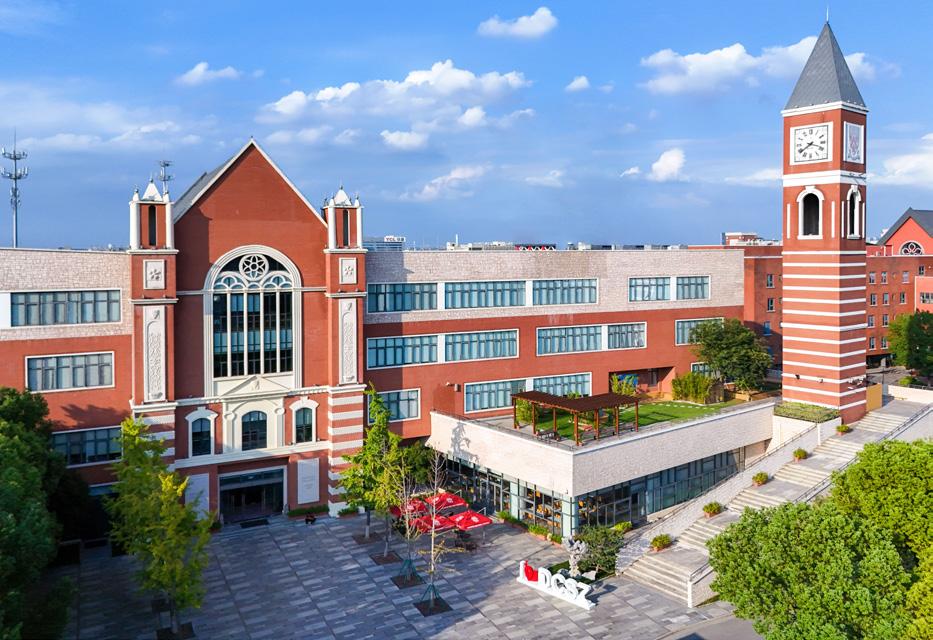
notice when something feels unclear and to ask questions rather than accept statements at face value.
As digital tools become more sophisticated, those habits are extended rather than replaced. When students encounter AI generated responses, the expectation is not passive acceptance but active evaluation. They are invited to consider what might be missing, how a perspective has been framed, and whether alternative interpretations exist. In doing so, they begin to understand that technology can produce language fluently, but judgment remains human.
Over time, that expectation matures into accountability. Older students are expected to demonstrate ownership of the reasoning attached to their work. If they use AI to explore an idea or refine a draft, they must be able to articulate how it shaped their thinking and where they chose to diverge from it. The emphasis shifts from what was produced to how it was examined.
Throughout this progression, productive struggle remains protected. Students continue to read deeply, draft independently, and sit with complexity before seeking assistance. AI is positioned as a tool that can extend thinking after effort has occurred, not a mechanism that replaces it.
In this way, the presence of intelligent systems does not dilute our educational purpose. It sharpens it. Each stage of learning reinforces the same underlying message: reasoning belongs to the learner.
In the end, the question is not whether students will use AI. They will. The question is what habits of mind we cultivate alongside it. If intelligent systems make answers easier to produce, then our responsibility is to make questioning more deliberate, more visible, and more valued within our classrooms.
In an age of intelligent systems, preserving the habit of questioning may be one of the most important responsibilities we hold as educators.