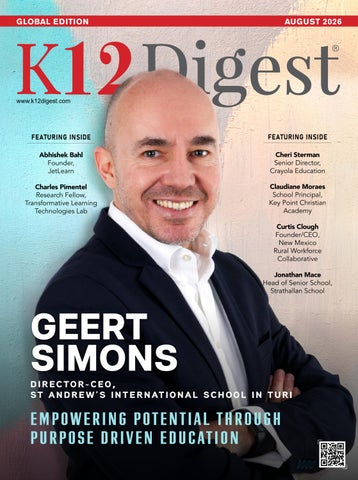
AUGUST 2026
GLOBAL EDITION
www.k12digest.com
FEATURING INSIDE
FEATURING INSIDE
Abhishek Bahl Founder, JetLearn
Cheri Sterman Senior Director, Crayola Education
Charles Pimentel Research Fellow, Transformative Learning Technologies Lab
Claudiane Moraes School Principal, Key Point Christian Academy Curtis Clough Founder/CEO, New Mexico Rural Workforce Collaborative Jonathan Mace Head of Senior School, Strathallan School
GEERT SIMONS
D I R E C TO R - C E O , S T A N D R E W ’ S I N T E R N AT I O N A L S C H O O L I N T U R I
E M P O W E R I N G P OT E N T I A L T H R O U G H P U R P O S E D R I V E N E D U C AT I O N K12 Digest August 2026
1
2
K12 Digest August 2026
K12 Digest August 2026
3
August 2026
Managing Editor Sarath Shyam
Vol - 7 Issue - 8
Free Subscription
Consultant Editors Dr. John Andrews Naomi Wilson Emma James Stanly Lui Andrew Scott Joseph Alex
Art & Design Charlie Jameson
Sales & Marketing Jennifer Anderson Monica Davis Alice Smith Anna Elza
AUGUST 2026
Free Subscription
www.k12digest.com
International Partnerships Americas Europe Middle East & Africa Asia-Pacific admin@K12digest.com
Follow Us On
www.linkedin.com/company/ k12digest www.facebook.com/K12Digest
4
K12 Digest August 2026
K12 Digest www.k12digest.com is a global knowledge sharing digital platform published by Connecta Innovation Private Limited. All rights reserved. The opinions expressed in the content and pictures provided are those of the authors. They do not purport to reflect the opinions or views of Connecta Innovation Private Limited or any of its members and we do not assume any responsibility. The publisher does not assume any responsibility for the advertisements, its content, pictures, and all representation of warranties made in such advertisements are those of the advertisers and not of the publisher. K12 Digest www.k12digest.com is a Free Subscription and Free-to-read digital platform strictly not for sale and has to be strictly for internal private use only. Publisher does not assume any responsibility arising out of anyone modifying content and pictures, printing a copy of this digital platform in any format and in any country and all matters related to that.
MANAGING EDITOR’S NOTE
The Skills
Machines Cannot Master
F
or generations, schools have been built around a simple proposition: learn more, remember more, and you will be better prepared for the world ahead. Artificial intelligence is forcing us to reconsider that proposition. A student can now ask a machine to explain a complex concept, write an essay, analyse information, or generate ideas in seconds. The question for schools is no longer whether students can access knowledge. It is whether they know what to do with it. I find this shift particularly important because education has always been about more than producing correct answers. Some of the most valuable lessons students carry into adulthood come from failure, collaboration, difficult conversations, curiosity, responsibility, and learning to make decisions when there is no obvious answer. The workplace is already reinforcing this reality. The World Economic Forum’s Future of Jobs Report 2025 found that 39% of workers’ existing skill sets are expected to change or become outdated by 2030. While AI and big data are among the fastest-growing skills, employers also rank resilience, flexibility, leadership, creative thinking, empathy, and lifelong learning among the skills that matter most. This is where our cover story with Geert Simons becomes particularly relevant. As Director-CEO of St Andrew’s International School in Turi and an experienced international education leader, Geert sees the future of education as a movement from knowledge transfer toward human judgement. His philosophy of “Channelling Passion into Purpose” places character, leadership, creativity, empathy, and international-mindedness alongside academic excellence. His perspective raises a fundamental question for every school: If technology can increasingly teach, calculate, generate, and predict, what should teachers and schools deliberately protect and strengthen? The answer may lie in helping young people become thoughtful decision-makers rather than efficient information processors. This issue explores that question from several angles, bringing together thought-provoking articles, interviews, and perspectives from educators and education leaders navigating a rapidly changing world. The future will certainly belong to those who understand technology. But it may belong even more to those who know when to question it, how to use it wisely, and when human judgement must take the lead. That is the human advantage. And perhaps it is the most important lesson schools can teach. Enjoy Reading.
Sarath Shyam
K12 Digest August 2026
5
10
COVER STORY
6
K12 Digest August 2026
TRANSFORMING EDUCATION FROM TRADITION TO PURPOSEFUL IMPACT
18
46
BEST PRACTISES
ACADEMIC VIEW
Claudiane Moraes, School Principal, Key Point Christian Academy
WHY CHILDREN NEED BREADTH BEFORE DEPTH Jonathan Mace, Head of Senior School, Strathallan School
K12 Digest August 2026
7
INDUSTRY PERSPECTIVE EMPOWERING CRITICAL DATA LITERACY IN K12 CLASSROOMS Charles Pimentel, Research Fellow, Transformative Learning Technologies Lab
22
28 CULTIVATING RURAL WORKFORCE PATHWAYS FROM PREK TO CAREERS Curtis Clough, Founder/CEO, New Mexico Rural Workforce Collaborative
K12 Digest August 2026
Cheri Sterman, Senior Director, Crayola Education
36
42 8
UNDERSTANDING CREATIVE STYLES
TRANSFORMING EDTECH FROM WORKSHEETS TO WORLD CHANGING PROJECTS Abhishek Bahl, Founder, JetLearn
K12 Digest August 2026
9
COVER STORY
10
K12 Digest August 2026
GEERT SIMONS
D I R EC TO R - C EO , S T A N D R E W ’ S I N T E R N AT I O N A L S C H O O L I N T U R I
E M P O W E R I N G P OT E N T I A L T H R O U G H P U R P O S E D R I V E N E D U C AT I O N Geert Simons is a Belgian international education leader and Director-CEO of St Andrew’s International School in Turi, Kenya, who will shortly take up the leadership of ICS Paris. He has led schools and educational organisations across Europe, Africa and the Middle East, combining educational vision with strategic and organisational leadership. His philosophy, “Channelling Passion into Purpose,” reflects his belief that schools should recognise and nurture the potential within every student and colleague. Geert advocates academic excellence alongside character, leadership, adventure and international-mindedness. A systems thinker with an entrepreneurial outlook, he is particularly interested in school culture, sustainable growth and the future of education. Outside school, he is a keen mountaineer and rock climber. Recently, in an exclusive interview with K12 Digest, Geert shared insights into a career shaped by “Channelling Passion into Purpose.” On the future of education, Geert sees the biggest shift as moving from knowledge transfer to developing human judgement, with schools teaching students to work with AI while cultivating empathy, creativity, integrity and leadership that technology cannot replace. Looking ahead, he plans to lead an ambitious international school community in Europe, grounded in strong culture, sustainable growth and relationships. His advice to future leaders is to see potential in your people, give clarity and purpose, and build a culture where possibility becomes reality. The following excerpts are taken from the interview.
K12 Digest August 2026
11
Hi Geert. Every leader’s path starts with a moment of clarity. What was the earliest experience that made you realize education was where you wanted to shape lives and futures? I do not think there was one dramatic moment. It grew partly from my own experience as a student in the Belgian education system. At the time, the system seemed primarily designed around the average student, with a rather uniform approach to learning that relied heavily on listening. Those who wanted to explore further, learn differently, or truly excel could easily become disappointed. I often found education more restrictive and predictable than inspiring. That experience made me want to help improve education from within. I chose to become an educationalist because I believed schools could do much more than bring everyone towards the same average level. They could recognise individual potential and give young people different ways to discover what they are capable of achieving. What attracted me was the opportunity to see potential before it is always visible to the person themselves. Young people already possess curiosity, talent and passion. Our responsibility is to recognise those qualities, nurture them and help give them purpose. That belief eventually became my leadership philosophy: channelling passion into purpose. It continues to shape how I lead schools and how I think about education. As Director-CEO, you hold both educational and organizational leadership. What part of the role brings you the most energy and why? I am most energised by bringing people together around a compelling direction and
12
K12 Digest August 2026
I chose to become an educationalist because I believed schools could do much more than bring everyone towards the same average level
then turning that vision into something tangible. Educational ambition is only meaningful when the organisation has the culture, people, systems and resources to deliver it. I enjoy working at that intersection. I can move from discussing the experience of an individual student to considering school culture, academic strategy, financial sustainability, governance or future growth. These are not separate conversations. Every organisational decision should ultimately create better conditions for students and teachers to flourish. The most rewarding moments are when a school community begins to believe more strongly in what is possible. Once people share a clear sense of purpose, energy grows, confidence returns and meaningful change becomes achievable.
The purpose of school is being redefined. What do you see as the single biggest shift in how international schools will educate students over the next 5 years? The biggest shift will be from primarily transferring knowledge to developing human skills and human judgement. Artificial intelligence has made access to information, analysis and content creation almost instantaneous. Consequently, knowing something will no longer be enough, academic excellence will no longer be enough. Students must learn how to question information, evaluate evidence, recognise bias, make ethical decisions and use technology intelligently: they need to learn how to become the ‘human differentiator’ in a fast-developing technological society.
K12 Digest August 2026
13
Students must learn how to question information, evaluate evidence, recognise bias, make ethical decisions and use technology intelligently: they need to learn how to become the ‘human differentiator’ in a fast-developing technological society This does not make knowledge less important. Good judgement is impossible without a strong foundation of knowledge. However, schools will need to combine academic rigour with curiosity, creativity, collaboration, character and real-world problem-solving. So, leadership development through character formation becomes even more essential.
14
K12 Digest August 2026
The most successful schools will not compete with artificial intelligence. They will help students understand how to work with it while developing the distinctly human qualities technology cannot replace: empathy, courage, integrity, imagination, creativity, critical judgement, relationships and a sense of responsibility towards others.
Boarding and residential life are changing. How do you see the role of boarding schools evolving to meet the needs of families and students by 2030? By 2030, the strongest boarding schools will be understood less as places where students simply live and more as intentionally designed communities for growth. Their greatest advantage is the luxury of time. Learning, relationships, leadership, wellbeing, adventure and character development can continue beyond the classroom. Families will rightly expect boarding schools to provide outstanding safeguarding, highly personalised pastoral care and strong mental-health support. At the same time, students need more than protection. They need opportunities to develop independence, resilience and confidence. The challenge is to create an environment that offers both security and meaningful responsibility. Boarding will also become more flexible, with full, weekly and short-term options meeting different family needs. Its enduring value, however, will lie in genuine human connection. In an increasingly digital and sometimes isolating world, belonging to a diverse, purposeful community may become more valuable than ever.
practices that may have worked well in the past. They will need the confidence to use technology without allowing technology to determine the purpose of learning. They must know when artificial intelligence can deepen learning and when students need to struggle, discuss, create or think independently. That requires professional judgement rather than simply technical competence. Relationships will remain at the heart of excellent teaching. Students learn best when they feel known, challenged and supported. Teachers will therefore need emotional intelligence, cultural awareness and the ability to create belonging in increasingly diverse communities. Above all, they must retain high expectations and genuine optimism about what every young person can become. Teachers will also need to identify the uniquely human skills connected to their subjects and understand how subject content can help students become the human differentiator in a technology-rich world. This will require them to select the knowledge that is truly essential and design ways for students to engage with their subjects that technology cannot reproduce. Across all disciplines, learning should develop critical thinking, creativity, ethical judgement and the ability to consider how knowledge, ideas and decisions affect people and society.
Teachers are navigating more complexity. What skills and mindsets will educators need most to thrive in the future of schooling? Future educators will need to be confident learners themselves. Subject expertise will remain essential, but teachers must also be curious, adaptable and willing to reconsider
Leaders are shaped outside the office too. What book, talk, or idea has influenced your thinking about education and leadership most recently? Milan Kundera’s book The Unbearable Lightness of Being has profoundly shaped my philosophy of life. The novel explores
K12 Digest August 2026
15
the tension between lightness and weight, freedom and commitment, and the search for meaning in a life that can only be lived once. It encouraged me to see that passion and freedom are important, but that they gain meaning when connected to responsibility, commitment and purpose. This thinking lies at the heart of my leadership philosophy, “Channelling Passion into Purpose.” Passion provides energy, but purpose gives that energy direction and allows it to make a lasting difference. More recently, I have been reflecting on the idea that a healthy culture must often come before sustainable strategic improvement. Leaders naturally focus on structures, targets, programmes and measurable outcomes. These matter, but even the best strategy struggles in a culture where trust is weak, expectations are unclear or people no longer believe that improvement is possible. Culture is created through repeated daily experiences. It is shaped by what leaders pay attention to, what they tolerate, how decisions are made and whether words are followed by action. This has reinforced my belief that leadership begins with listening and clarity, but it must lead to consistency. People do not judge a school’s values by what appears on the wall. They judge them by what they experience every day. Everyone has a way to recharge. What hobby or passion outside of school energizes you and helps you return with clarity? Mountaineering and rock climbing give me energy and perspective. In the mountains, daily distractions disappear and your attention becomes very focused. You assess the conditions,
16
K12 Digest August 2026
My focus will be on building a strong and distinctive school culture, creating sustainable growth and ensuring that educational innovation remains grounded in genuine human relationships
trust your preparation, make decisions with incomplete information and remain aware of the people around you. There are clear parallels with leadership, although that is not why I climb. I value the physical challenge, a little bit of suffering, the landscape and the simplicity of concentrating completely on the next movement or the next stage of a route. The mountains also encourage humility. Ambition matters, but conditions can change quickly and no summit is guaranteed. Knowing when to continue, when to change course and when to turn back is as important as determination. I usually return physically tired but mentally clearer. Travelling gives me a different kind of energy. Experiencing unfamiliar cultures, landscapes and ways of living challenges my assumptions and reminds me that there is rarely
only one way to understand the world. Reading offers a similar journey without requiring me to leave home. It creates space for reflection, introduces me to ideas and perspectives beyond my own, and often helps me return to leadership questions with greater clarity and curiosity. Where do you see yourself in the next 5 years? I see myself leading an ambitious international school community in Europe while continuing to contribute to the wider conversation about the future of education. After many rewarding years in Africa, my family and I are returning to Europe, and I will soon begin the next chapter of my career in France at ICS Paris. My focus will be on building a strong and distinctive school culture, creating sustainable growth and ensuring that educational
innovation remains grounded in genuine human relationships. I am particularly interested in how schools can combine academic excellence, international-mindedness, leadership and character development, and intelligent use of technology. In five years, I hope to see a school community that is stronger, more confident and more clearly recognised for the value it brings to students and families. For me, meaningful leadership is ultimately measured by what continues to flourish beyond the leader. If you could leave one sentence of advice on the desk of every future school leader, what would it say? See the potential in your people, give them clarity and purpose, and build a culture in which they have the courage to turn possibility into reality: ‘Channelling Passion into Purpose’.
K12 Digest August 2026
17
ACADEMIC VIEWS
Transforming Education from Tradition to Purposeful Impact Claudiane Moraes, School Principal, Key Point Christian Academy
With over two decades shaping young minds and leading school communities, your journey reflects deep commitment to education. Could you share what first drew you to a career in education management, and when you knew this was your calling? My journey into education was never just about teaching, it was about transformation. From early on, I recognized that schools have the power to shape not only academic outcomes, but the confidence, identity, and future trajectory of every child. As I moved
18
K12 Digest August 2026
into leadership, I realized the exponential impact I could have by influencing systems, culture, and vision. That was the defining moment. Education became my calling when I understood that strong leadership could elevate not just individual students, but entire communities. What do you love the most about your current role? What I value most is the ability to build a culture where excellence, innovation, and care coexist. Every day, I have the opportunity to
Claudiane Moraes is a distinguished educator with a rich background spanning over 30 years, primarily as a devoted school principal. As the visionary founder and principal of Key Point Academy for a decade, Claudiane has demonstrated an unwavering dedication to nurturing a learning community characterized by child-centered experiences, trust, respect, and active community involvement. Her leadership has been pivotal in shaping KPCA into a thriving educational institution that prioritizes holistic development and student empowerment. Claudiane’s legacy is not only in the institutions she has helped build but also in the countless lives she has touched and inspired along the way. Recently, in an exclusive interview with K12 Digest, Claudiane shared insights into how her 30-year journey in education, inspired by her mother in Brazil, evolved from teaching to transformative leadership focused on elevating entire communities through systems, culture, and vision. She predicted the next five years will bring a full shift to personalized, data-driven learning ecosystems that replace one-sizefits-all instruction with precision learning centered on higher-order thinking and real-world application. Claudiane urged schools to urgently integrate AI, digital literacy, financial literacy, and applied problemsolving, but stressed that critical thinking, adaptability, and collaboration will define future success more than memorization. Her core message for the AI era is to lead with intention not fear, shaping technology responsibly through strong educational values and making decisions that prioritize student growth even when the path is unfamiliar. The following excerpts are taken from the interview.
K12 Digest August 2026
19
influence how students experience learning, how teachers grow professionally, and how families feel connected to a larger purpose. It is incredibly fulfilling to lead a community where we are not just educating students, but actively preparing them to navigate and lead in a rapidly changing world. The classroom of 2030 will look very different from today. From your vantage point, what’s one major shift you see redefining K-12 education in the next 5 years? The most transformative shift will be the full transition to personalized, data-driven learning ecosystems. The traditional model of delivering the same instruction to every student is no longer sustainable. In the next five years, we will see education evolve into a model where technology enables precision learning, and educators focus on higher-order thinking, creativity, and real-world application. This shift will redefine not only how students learn, but how success is measured. Early Childhood Education sets the foundation for all future learning. What emerging trend in ECE do you believe will have the biggest impact on student outcomes soon? The integration of social-emotional development with academic instruction will be the most impactful shift. Early childhood is where we build resilience, confidence, and self-awareness. When these competencies are intentionally developed alongside literacy and numeracy, we create learners who are not only capable, but adaptable. This is critical for longterm success in an unpredictable world.
20
K12 Digest August 2026
Curriculum can no longer be static in a fast-changing world. What subjects or skills do you believe schools must urgently integrate into curriculum in the next 5 years? Schools must move decisively toward integrating future-focused competencies such as artificial intelligence, digital literacy, financial literacy, and applied problem-solving. However, the true urgency lies in developing critical thinking, adaptability, and collaboration. The future will not reward memorization, it will reward those who can think, innovate, and respond to change. Curriculum must reflect that reality. Leaders often have routines that ground them before a demanding day. What’s your favorite way to start your morning before stepping into the role of principal? I begin each day with intention. Taking a moment to center my thoughts and align my priorities allows me to lead with clarity and purpose. In a role where every decision carries impact, starting grounded ensures that I remain focused, composed, and aligned with the mission of the school. Words can anchor us during tough decisions. Do you have a favorite quote or motto that you live by as an educator and leader? A quote that consistently guides me is, “People will never forget how you made them feel.” It is a powerful reminder that leadership is not only about strategy and outcomes, but about human connection. The environment we create defines the experience of every student, teacher, and family.
Where do you see yourself in the next 5 years? I see myself continuing to lead and shape innovative educational environments that challenge the traditional model of schooling. My goal is to expand impact, strengthen academic excellence, and contribute to the development of systems that truly prepare students for the realities of the modern world. Education must evolve, and I intend to be part of that transformation.
Education became my calling when I understood that strong leadership could elevate not just individual students, but entire communities
Schools are ecosystems of growth, not just buildings. If you had to describe your school in one powerful sentence to a new family, what would you say? Key Point Academy is where innovation meets purpose, a dynamic learning environment that challenges students to think critically, grow confidently, and lead in a world that is constantly evolving. Real leadership in the AI era is about conviction, not just adoption. What’s your core message to fellow educators about leading with clarity and courage through this shift? My message is simple: lead with intention, not fear. AI and emerging technologies are powerful tools, but they must be guided by strong educational values. The role of educators is not to resist change, but to shape it responsibly. Clarity comes from knowing your mission, and courage comes from making decisions that prioritize student growth, even when the path forward is unfamiliar.
K12 Digest August 2026
21
INDUSTRY PERSPECTIVE
Emp owering Critical Data Literacy in K 12 Cla ssro oms Charles Pimentel, Research Fellow, Transformative Learning Technologies Lab
Hi Charles. Your work sits at the intersection of STEM, Data Science, and Computer Science. What gap in traditional schooling first convinced you that Data Science belongs in K-12, not just University? The gap lies in how schools still have not kept pace, in teaching and learning, with a society increasingly shaped by data and its impact on daily life. Today, data influences media, business, politics, and the labor market, yet students are rarely taught how to engage with it mindfully, critically, and responsibly. In my work as a researcher and educator, data becomes the fuel for STEM and design-based projects, where students develop and prototype solutions to real-world problems but they also collect, work with, analyze, and argue with data as part of the learning process. I see how this approach makes learning more meaningful and helps students connect their ideas and productions with the world around them. Data also creates opportunities for transdisciplinary learning, allowing students to understand how different areas of knowledge interact to address real challenges. That is why building a culture of data literacy must start in K-12, not at the university level. Your focus on Critical Data Literacy is timely in an age of misinformation. What real-world event or classroom experience made you decide to research this topic for your Ph.D.? My focus on Critical Data Literacy emerged from a classroom moment during AI workshops I taught in 2019 as part of
22
K12 Digest August 2026
Charles Pimentel is a Research Fellow at the Transformative Learning Technologies Lab (TLTL) at Columbia University, where he investigates the use of sensors, microcontrollers, and Internet of Things applications in schools to support Data Science education. He is also a doctoral candidate at the Federal University of Rio de Janeiro, researching Data Literacy in K-12 education. In addition, Charles is a Design and Technology educator whose work explores how technology can promote social impact and student empowerment in schools. Recently, in an exclusive interview with K12 Digest, Charles shared insights into bringing Data Science and Critical Data Literacy into K-12 classrooms. For AI in classrooms, he believes the next five years hinge on whether schools teach students to understand and question AI, not just use it, with teachers guiding judgment, ethics, and responsibility while tools like MIT Day of AI and Google Teachable Machine make the “black box” accessible. To include girls, neurodivergent, and low-income students, he designs safe, democratic classrooms where students use tech to explore community issues and see themselves as creators, not just consumers. His advice to early-career EdTech teachers is to study always, stand on the shoulders of giants like Papert and Freire, and lead with collaboration, vulnerability, and lifelong learning, because we must practice the change we want students to embrace. The following excerpts are taken from the interview.
K12 Digest August 2026
23
my Master’s research. Through the FRANKIE platform, which I developed to teach machine learning concepts through educational robotics, students trained a robot to recognize images and interact with its environment. During one activity, a student asked who is responsible when a machine controlled by an AI algorithm makes a mistake: the owner, the developer, or the institution regulating its use. That question shifted the lesson from technical work to a discussion about ethics, bias, and real cases involving the misuse of data in media and politics. It made clear to me that students must not only use data, but also question it and understand how it shapes different areas of society. AI tools are now in students’ pockets. What trend will determine whether AI in classrooms empowers learning or deepens inequality in the next five years? The key trend will be how schools prepare students to understand and question AI, not
just use it. AI can be a powerful support tool, but without strong foundations and guidance, it risks reinforcing superficial learning. The role of the teacher becomes even more important, not only to teach content, but to develop judgment, ethics, and responsibility. When students also learn how AI works, they are better equipped to use it critically rather than passively. Initiatives such as MIT Day of AI, Google Teachable Machine, and MIT App Inventor help make AI concepts more accessible by allowing teachers with different levels of experience to explore the fundamentals behind the “black box” of AI through practical and creative activities. Accessibility and sustainability are central to your tech-for-good projects. How will EdTech need to evolve to genuinely serve neurodiverse and under-resourced learners? EdTech needs to move beyond access and the assessment of isolated skills, focusing instead on differentiation and a more holistic understanding of the teaching and learning process. Students
Data also creates opportunities for transdisciplinary learning, allowing students to understand how different areas of knowledge interact to address real challenges
24
K12 Digest August 2026
with different abilities and backgrounds need flexible pathways in process, assessment, and complexity to have meaningful opportunities to learn. At the same time, teacher training and professional development opportunities are essential so technology is not reduced to tools or resources. Approaches such as no-code and unplugged activities show that meaningful learning about technology can happen through reflection, discussion, and purpose, always keeping human needs at the center. With AI, VR, and robotics converging, what will a “future-ready” middle school classroom look like five years from now? As a Research Fellow at the Transformative Learning Technologies Lab, I have had the opportunity to follow initiatives that help schools respond to a rapidly changing society. I believe future-ready classrooms will integrate data exploration, robotics, and AI through accessible, transdisciplinary and hands-on experiences, not isolated subjects. Technologies like the microcontroller GoGo Board help democratize this process by allowing educators and students from different backgrounds to explore coding, and automation, developing creativity thinking, critical thinking, and problem-solving skills in meaningful and active ways. This future is also strengthened by partnerships between universities and K-12 education. In my Ph.D. research at the Federal University of Rio de Janeiro, I seek to connect university research with society through approaches that help prepare students to become informed and responsible citizens in a world increasingly shaped by technology and data.
Climate and social challenges demand interdisciplinary learning. How should STEM, Design, and Data Science merge in school to prepare students for real problems? The world is interdisciplinary, and schools need to reflect that reality. My research in Data Science seeks to connect different areas of knowledge so that the integration between science, technology, engineering, and mathematics goes beyond technological innovation and also includes fields such as humanities and languages. I believe that elective subjects like Design and Technology play an important role through integrated projects that help students understand real-world challenges and how different fields can collaborate to solve them. Great educators often have influences beyond their field. What book, film, or thinker outside Education has most shaped how you teach? I am guided by the idea often attributed to Isaac Newton, that we see further by standing on the shoulders of giants. Seymour Papert, in Mindstorms: Children, Computers, and Powerful Ideas, shaped how I see learning as something students actively build, while Mitchel Resnick, in Lifelong Kindergarten, reinforced the importance of creativity and exploration. Leo Buscaglia, in Living, Loving and Learning, influenced my belief that teaching is fundamentally about human connection, and from Rubem Alves, I carry the idea that curiosity drives learning. These authors have deeply influenced my journey, but I am also shaped by the educators I work with every day, teachers committed to creating meaningful learning
K12 Digest August 2026
25
system where everyone matters, regardless of gender, special needs, or social background. Designing tech-for-good projects and Ph.D. research is demanding work. What activity or ritual helps you disconnect, reset, and return with fresh ideas? Academic and professional life can be intense, so I value moments of creative boredom and slowing down. Activities like biking, exercising, watching series, reading topics unrelated to my work, and spending time with my family help me disconnect and return with fresh ideas. Many insights emerge precisely in these moments when the mind has space to breathe and reflect. environments and who have contributed to my growth throughout my career. You’re passionate about inclusion in STEM. What’s one practice you use to ensure girls, neurodivergent, and lowincome students see themselves in tech? I believe the classroom must be a safe and democratic space where students feel their voices and experiences matter. In my projects, students use technology to explore issues connected to their communities and realities, and their personal contributions help shape the development of the learning experience. When students prototype their ideas, collect and analyse data, develop solutions, and present their ideas to others, they begin to recognize themselves as capable creators, not just consumers of technology. In this process, students understand that they are part of a larger
26
K12 Digest August 2026
If you could mentor one early-career teacher passionate about EdTech tomorrow, what’s the first lesson you’d teach them about leading with purpose, not just tools? I would advise them to always study and be open to changes. Much like the idea I mentioned earlier, often attributed to Isaac Newton, I learned to see further by standing on the shoulders of giants. The works of Seymour Papert, José Armando Valente, Paulo Freire, Paulo Blikstein, and Mitchel Resnick are guides in my journey, and exploring academic articles and publications like K12 Digest continues to shape my development as an educator. Collaboration, sharing, openmindedness, and the willingness to take risks without fear of showing vulnerability or being a lifelong learner are fundamental. If we want students to embrace change, teamwork, and continuous learning, we must believe in these values and practice them ourselves.
K12 Digest August 2026
27
INDUSTRY PERSPECTIVE
Understanding Creative Styles Cheri Sterman, Senior Director, Crayola Education
1. What is Creativity? At Crayola, we define creativity as putting imagination into action. It’s an empowering definition—especially for students and educators—because it makes an abstract concept concrete and says, “Whatever you imagine, you can create!” There are, of course, many definitions of creativity. Many emphasize originality (generating novel ideas) and fit (curating ideas to find those most appropriate for a given context). Rather than debating the “one right” definition, ask students, parents, and colleagues what they think it means and encourage them to reflect on how creativity shows up in everyday life. Realizing that creativity involves solving problems and expressing ideas helps people see that it isn’t rare or a mysterious abstraction. With practical examples, like illustrating poems, drawing innovative solutions, and sketching historical scenes, they will see how simple creative moments can deepen learning. 2. Why Does Creativity Matter? Creativity is essential for everyone at every age. It empowers individuals to reach their full potential and adapt to change. Consider how creativity influences every aspect of life—from how we make decisions to how we respond to situations or opportunities. Creativity affects how people work, parent, and connect with others. For educators, there is an additional responsibility: creative teaching requires openness to students’ originality
28
K12 Digest August 2026
Cheri Sterman helps educators understand creativity and boost their creative confidence. She provides professional learning workshops, podcasts, and keynotes on Creative Leadership and The Power of Art to Reverse Stereotypes. Cheri and her colleagues worked with Dr. Gerard Puccio, Chair and Professor at the Center for Applied Imagination, SUNY Buffalo, to develop a tool that helps educators see how creativity impacts the way they Think, Perceive, and Engage. Cheri and her colleagues also founded Crayola Creativity Week, the free, standards-aligned global celebration of creativity. Collaborating with world-renowned talent, the annual program engages 20 million students and 1.3 million educators from 146 countries in memorable creative experiences.
K12 Digest August 2026
29
while intentionally fostering can-do mindsets. Teachers instill creative confidence in students by responding to curiosity, encouraging learnerdriven discovery, and demonstrating that mistakes are learning opportunities. 3. Common Creativity Myths and How Educators Can Dispel Them Research conducted by Crayola with the Ad Council shows that 94% of parents believe creativity is essential for their child’s long-
30
K12 Digest August 2026
term success, yet 64% report they do not have the creative confidence to nurture their child’s creativity. This disconnect is rooted in common creativity myths and misunderstandings. Educators can help dispel the myths. Below are three common myths to watch for in your learning community and facts you can use to correct misconceptions. Myth #1. Creativity is a rare talent that only a few lucky people are born with. You either have it or you don’t. FACT: Everyone is
creative, in their own way. Creativity shows up whenever people solve problems, express ideas, and make decisions. When someone doubts their creativity, ask them, “How did you modify a recipe, plan a celebration, decorate your home, or decide what to wear if you aren’t creative?” Remind students and adults that being creative doesn’t mean being a Picasso. Just be yourself and lean into your interests and ideas.
Myth #2. People outgrow creativity as they age, and most of it is lost after childhood. FACT: Creativity is alive and well at every age. It flourishes when nurtured with consistent encouragement to express new ideas and create in personally meaningful ways. Creativity is not limited to childhood. It is something we carry with us and use during our entire lifetime. Negative messages and self-criticism
Research conducted by Crayola with the Ad Council shows that 94% of parents believe creativity is essential for their child’s long-term success, yet 64% report they do not have the creative confidence to nurture their child’s creativity
K12 Digest August 2026
31
32
K12 Digest August 2026
can suppress creativity, while encouragement can bring it back to life. Establishing creative confidence helps people approach challenges with resilience and flexibility throughout life. At Crayola, we say, “Creativity doesn’t expire and it doesn’t retire.” Myth #3. Creativity is only needed in artsrelated careers. FACT: Creativity is essential
Since no two people express their creative behaviors in the same way, understanding your personal creative style is an important aspect of self-awareness and creative confidence
in every field. Studies by the World Economic Forum and LinkedIn show that employers across industries view creativity as a top priority in evaluating job candidates. Creativity fuels problem-solving, innovation, collaboration, and new ways of seeing familiar situations. NASA agrees. They partner annually with Crayola Education on Creativity Week to help students
see that creativity is essential for everyone working on space missions. 4. Creativity Boosts Learning and Prepares Future-Ready Students A growing body of research shows that creativity is a critical life skill—one that can be taught and strengthened over time. Individuals who have a variety of creative experiences report greater job satisfaction, regardless of the work they do. Research also shows that the five key creative behaviors 1. being curious, 2. keeping an open mind, 3. learning from mistakes, 4. flexibly adopting other perspectives, and 5. seeking new opportunities—can be nurtured through simple, everyday creative moments. For example, neuroscientists have found that when students actively draw the information they are learning, it significantly improves their understanding. Hands-on visual representation helps learners connect prior knowledge with new ideas, deepening comprehension and engagement. 5. Discover Your Creative Style Since no two people express their creative behaviors in the same way, understanding your personal creative style is an important aspect of self-awareness and creative confidence. Crayola developed the Creative Styles Tool, with Dr. Gerard Puccio, so we could offer educators and parents an evidence-based resource that helps people discover how creativity naturally shows up in the ways they Think, Perceive, and Engage. This free, validated self-assessment tool is not a test. There are no wrong answers. It does not measure how creative anyone is. Instead, it provides personalized insights on each individual’s creative strengths and preferences.
K12 Digest August 2026
33
6. Understanding the Continuum of Think, Engage, Perceive Styles What makes the Crayola Creative Styles model unique is that it does not limit the focus to creative thought. Instead, it leverages decades of research that shows creativity operates across three connected dimensions. Within each dimension, people’s preferences exist along a seven-style continuum. The Think dimension describes how people generate and respond to ideas, ranging from Divergent (expansive, broad) to Convergent (focused, curated). The Perceive dimension reveals how individuals see and make sense of the world, ranging from a preference for Distinction (nuances, stand-alone, differences)
34
K12 Digest August 2026
to Connection (interwoven, integrated). The Engage dimension interprets how people respond to and participate in experiences, ranging from Reflection (remembering, anticipating) to Transformation (doing, actively experiencing). Every preference on the continuum is as important and creative as the others. Learning communities need diverse styles to help balance decision-making and invite a full range of perspectives and approaches. 7. Using Creative Style Insights to Increase Collaboration with Colleagues Knowing your work colleagues’ and life partners’ creative styles strengthens
collaboration—especially when people use this common language to describe their preferences and understand the different ways they react to new ideas, address problems, and view change. This tool empowers teams to appreciate each other’s unique creative strengths and contributions. Creative Style insights can reduce misunderstandings, calm emotional reactions, and improve communication. Instead of wondering, “Why do they always resist my new ideas?” and “Why do they jump in without a clear plan?,”
colleagues will realize their team tensions are not personal affronts. Some people (such as Doers and Explorers) are willing to “fly the airplane while building it” while others (like Deliberators and Incubators) prefer that a plan be finalized before jumping on board. Strong teams need representations across the entire continuum—for example, those who generate many ideas (Freethinkers and Brainstormers), those who curate and focus the strongest ideas (Realists and Logicals), and the styles in between.
K12 Digest August 2026
35
INDUSTRY PERSPECTIVE
Cultivating Rural Workforce Pathways from PreK to Care ers Curtis Clough, Founder/CEO, New Mexico Rural Workforce Collaborative
Hi Curtis. With twenty-plus years across secondary and postsecondary education, you’ve seen systems from multiple angles. What moment early in your career convinced you that “positive dialogue” with all stakeholders was the real work of leadership? This concept started early in my career through various activities and discussions with peers and administrators that influenced me. I cannot say it was one moment but a series of moments that helped shape my perspective on this issue. Whether it was working on bond campaigns for new buildings or operational funds or sitting at workforce roundtables discussing the needs of our students to be career ready, understanding that different perspectives are of value and need to be part of the conversation and dialogue for continuous improvement are necessary and essential to the operations of
36
K12 Digest August 2026
Curtis Clough is a veteran educator and administrator with more than 35 years of experience across nearly every level of public education. He currently works with nine rural districts in New Mexico to redesign workforce pathways that strengthen transitions from PreK through adult education. His career has included service as a teacher, high school principal, athletic director, assistant superintendent, superintendent, and state-level administrator. Clough also served as Alaska’s state administrator for career and technical education, leading efforts to align K–12 curriculum with workforce demands across the state’s diverse regions. He now brings that expertise to advancing rural education and workforce development in New Mexico. Recently, in an exclusive interview with K12 Digest, Curtis shared insights into the real work of educational leadership after 35 years across classrooms, districts, and state systems. Now leading the New Mexico Rural Workforce Collaborative, he finds the most reward in uniting 7 to 9 rural districts with higher education and industry partners to redesign career pathways so geography is no longer a barrier to high-quality, highdemand opportunities, replacing one-size-fits-all plans with frameworks that prioritize local and regional needs. Looking ahead five years, he believes districts that thrive will be those using data to align programming and financial decisions with educational outcomes, not just compliance, as resources grow scarce. On AI, Clough argues leaders must teach it as a tool that supplements thinking, not replaces it, by instilling independent analysis, critical thinking, and decision-making from Pre-K because AI is only as good as its inputs. The following excerpts are taken from the interview.
K12 Digest August 2026
37
Resources are becoming scarce in tough budgetary times so maximizing efficiency and effectiveness will be important for years to come with schools and districts
38
K12 Digest August 2026
the numerous systems that influence education then and now. Keeping the focus on the future and not reliving past mistakes or issues is also an important part of the dialogue as some great historians have said you cannot relive the past but you are destined to repeat it without understanding the past impacts on today, or something along those lines. Without understanding that we are where we are at with the complete experiences of everyone involved and past performance is not an indicator of future success, it is important to focus on future actions for success and not dwell on the past for positive change to occur for student success. What do you love the most about your current role? In my current position, I wma working with 7 to 9 districts to address rural workforce needs for students and districts so that all students have access to high quality, high demand careers. I am working with workforce partners, higher education partners and individual districts to create career pathways that fit both local and state needs. The rural workforce redesign has long been needed in our state so geographic location is not a barrier to student success and access to careers that they desire to pursue. Being able to collaborate and bring all relevant stakeholders together for conversations and action plans has been instrumental in opening doors that have long been inaccessible for rural students in our state. Being able to create common frameworks of understanding and prioritizing local and regional needs o er a one size fits all plan is critical to our work and having our partners invest time and resources into this strategy has been very rewarding and exciting for the future generations of our students in the state.
Research-based, data-driven instruction is central to your leadership. Five years from now, what will distinguish districts that use data to deepen learning from those that use it for compliance? Districts that use that data to drive programming and financial decisions to align expenditures and operations to educational outcomes will be the most effective. Resources are becoming scarce in tough budgetary times so maximizing efficiency and effectiveness will be important for years to come with schools and districts. How should K–12 leaders prepare students to use AI for future success without outsourcing their thinking? In my opinion, the best approach is to teach AI as a tool or resource to supplement a student’s thinking is the best approach. Instilling in our youth starting in Pre-K, independent thinking and analysis skills will be essential for student success as AI cannot replace human thinking without putting in the right inputs to maximize the human thought that went into it. AI is only as good as its inputs so without teaching critical thinking, problem solving and decision making early in a student’s career, using AI would be ineffective and inefficient for student growth and learning. Books shape how leaders think about systems and people. What book has the most notes from your twenty years in education, and what idea from it shows up in your schools? Simon Sinek “Start with Why” and Covey “Seven Highly Effective Habits” are two of my go to books. Being organized, committed and connective is a theme of those books, and
K12 Digest August 2026
39
we have to display all of those attributes int today’s educational world. That is the basic tenet of leadership is connecting and building the necessary relationships so your schools and districts are successful and can address issues in a constructive, positive way. Rest fuels sustainable leadership. What hobby or ritual helps you return to school on Monday ready for dialogue and data? I try to be active and physical on weekends to refuel whether I am on a golf course with friends or hiking or waling trails in the area. Also, try to commit time to my family activities as there seems to be no down time in today’s educational world, but it is essential to stay
I am working with workforce partners, higher education partners and individual districts to create career pathways that fit both local and state needs
40
K12 Digest August 2026
connected with family and friends to keep me stable and grounded. If you could put one sentence on the wall of every staff room, what would it say and whose words are they? I have always been driven by Simon Sinek’s “Star and Connect to Your Why!” Everyone has a deeply personal, driven purpose so understandably what that is and how it can impact others is important as we are in a relationship business and those relationships deeply impact who you are and how your purpose can have such an important impact on others, when others may not be supported n their goals and passions in life. Where do you see yourself in the next 5 years? I am in the closing years of my career so I am hopeful that I am retired, sitting on a beach somewhere enjoying the fruits of my career, but I know I will still be involved in education in some way either consulting or being a mentor to new administrators. I could even see myself suing my experience and expertise to run for some type of political office to impact workforce and educational opportunities for all, possibly. What advice would you give to someone just starting their career in educational leadership? The best advice I can give is to stay true to yourself and your beliefs that brought you to that point. Changing who you are to fulfill other expectations is very challenging and stressful in your career. Find your “North Star” and stay true to you and your beliefs to have success in your career.
75
Amazing Opportunity for Teachers and School Leaders to enhance their knowledge through FREE Teachers Academy masterclasses from international education experts !!! For more details and registration www.teachersacademy.com
Higher EducationK12 Digest Digest November 2021 August 2026
41
INDUSTRY PERSPECTIVE
Transforming Edte ch from Workshe ets to World Changing Proje cts Abhishek Bahl, Founder, JetLearn
Hi Abhishek. With robotics and AI delivered in a fun, personalized way, you’re reimagining STEM. What was broken in traditional tech education for kids that JetLearn set out to fix? Traditional tech education for kids has been stuck in a few limiting patterns for years. First, it was passive - focused on theory and syntax rather than building real things. Kids were learning about technology, not how to think with it. Second, it was one-size-fits-all. Every child learns differently, but classrooms move at a fixed pace, leaving some behind and others unchallenged. Third, it was outdated. With AI evolving so quickly, most curricula simply can’t keep up. At JetLearn, we flipped this. Learning is hands-on, personalized, and relevant. Kids don’t just use technology - they build with AI, solve real problems, and develop the confidence to navigate an AI-first world. You’re teaching AI to kids at global scale. Five years from now, what will separate edtechs that transformed learners from those that just digitized worksheets with AI? Five years from now, the difference will be simple. Most edtechs will use AI to digitize and automate learning - better worksheets, faster feedback, more scale. But the core experience won’t change.
42
K12 Digest August 2026
Abhishek Bahl is the Founder of JetLearn, a fast-growing online AI academy for kids and teens. JetLearn empowers the next generation with future-ready skills in Artificial Intelligence and Robotics, delivered in a fun, personalized, and inspiring way that encourages learners to use technology as a force for good. With students across continents—and dedicated programs for girls and neurodiverse learners—JetLearn’s mission is to ensure an equitable AI-first world. An alumnus of IIT Kharagpur and INSEAD, Abhishek’s career spans more than two decades across Silicon Valley, Europe, and India, where he has led global product innovation, expansion, and advanced technology initiatives. He holds patents in Artificial Intelligence, has scaled three global startups, and serves as an educator and mentor at INSEAD. Through JetLearn, Abhishek is on a mission to spark curiosity, confidence, and creativity, helping the next generation unlock the superpowers of AI—regardless of geography or background. Recently, in an exclusive interview with K12 Digest, Abhishek shared insights into how JetLearn is reimagining STEM by fixing what’s broken in traditional tech education for kids. Looking five years ahead, he believes the real divide in edtech will be between platforms that simply digitize worksheets with AI and those that rebuild learning around creation, deep personalization, and teaching kids how to think. Equity drives JetLearn’s mission, and Abhishek stresses that AI narrows gaps only when implemented intentionally: personalized pacing for neurodiverse learners, access paired with mentorship, and inclusion designed in from day one. If every JetLearn student saw one sentence at login, it would be “Don’t just use AI—build with it,” inspired by Richard Feynman’s belief that creation drives understanding. The following excerpts are taken from the interview.
K12 Digest August 2026
43
The ones that truly transform learners will rebuild learning around AI - focused on creation, deep personalization, and teaching kids how to think, not just use tools. At JetLearn, we believe AI should make kids more capable, not just more efficient. The real divide will be between platforms creating users of technology and those shaping creators of it. Equity drives JetLearn. How should school leaders ensure AI narrows learning gaps for neurodiverse and underserved students, instead of widening them? Equity with AI has to be intentional-it won’t happen by default. JetLearn has partnered with UK charity Skylarks to design programs for learners with additional needs - these program have been recognized with multiple awards in the UK. First, use AI for true personalization, adapting to each child’s pace and learning style, especially for neurodiverse learners. Second, ensure access with support - not just tools, but guidance and mentorship.
44
K12 Digest August 2026
Third, design for inclusion from day one, with multiple ways to learn beyond text. Done right, AI can narrow gaps. Done passively, it widens them. The difference is in how it’s implemented. Girls’ participation in tech is a priority for you. How should K–12 leaders use AI to strengthen agency and STEM identity for girls without reinforcing bias? If you walk into most classrooms, girls are using technology - but not always seeing themselves as builders of it. That’s the gap. It starts by shifting girls from users to creators - building with AI, not just consuming it. Then, ensuring what they see reflects diverse role models, not stereotypes. Add to that early confidence through small wins and personalization, and the impact compounds. And importantly, teach them to question AI, not just use it. Because this isn’t just about participation it’s about helping girls see themselves as the ones shaping technology.
Most edtechs will use AI to digitize and automate learning - better worksheets, faster feedback, more scale. But the core experience won’t change
Founders are shaped by what they read. What book on technology, learning, or human potential has the most notes in your margins, and which idea from it lives in JetLearn’s pedagogy? One book that has had a lasting influence on me is Mindset by Carol Dweck, because it fundamentally changed how I think about learning and potential. The idea that stayed with me is that intelligence is not fixed — it expands through effort, experimentation, and persistence. That belief is deeply embedded in JetLearn’s pedagogy. We want children to see challenges not as proof of limitation, but as part of the learning process. So instead of optimizing for memorization or perfect answers, we focus on building, iteration, and creative problem-solving. Whether students are creating AI apps, games, or robotics projects, they learn to debug, adapt, and keep improving. In a world where technology evolves constantly, teaching kids how to learn — and how to stay curious through difficulty — is far more important than teaching static knowledge alone.
Many professionals want to build in education and AI. What skill do aspirants consistently undervalue until they try to teach kids? The most undervalued skill is the ability to engage. When you teach kids, especially in something as complex as AI, you realize very quickly—if you can’t make the content and delivery engaging, it won’t lead to learning outcomes. In today’s world, where content generation has become easier and faster, what really matters is the ability to engage which leads to motivation which in turn leads to learning. If you could put one sentence on the login screen of every JetLearn student, what would it say and whose words are they? “Don’t just use AI—build with it.” It’s a line we often repeat internally, but it’s inspired by the spirit of Richard Feynman—what I cannot create, I do not understand.
K12 Digest August 2026
45
BEST PRACTISES
Why Children Need Breadth Before Depth Jonathan Mace, Head of Senior School, Strathallan School
I
n their early teenage years children are asked to make decisions that can play a significant determining role in their future. Parents themselves also feel this pressure intenselythe right nursery, the right school, the right subjects, the right results. Education can begin to resemble a narrowing corridor, each decision closing off another door. In such a climate, breadth is increasingly treated as an indulgence.
This anxiety feels modern but the currents behind it are not. When Strathallan School was founded in 1912, it was built on a different understanding of education: that young people should first be widened before they are narrowed. Pupils were to be known as individuals, to enjoy their learning, and to discover talents not yet visible to themselves or others. More than a century
Once we move beyond the initial anxiety surrounding this technology and shifting landscape, we can begin to lead with clarity 46
K12 Digest August 2026
Jonathan Mace is currently Head of Senior School at Strathallan School in Scotland- a leading co-educational day and boarding school. Prior to moving into this promoted role he held the position of Senior Deputy Head and Head of Boarding. Before moving to Scotland in 2022 Jonathan held a number of pastoral and academic management positions in a range of UK independent schools. Jonathan graduated in Economics from the University of Durham before commencing his teaching career at St Edwards’ School Oxford.
K12 Digest August 2026
47
later, those founding principles feel not oldfashioned, but quietly radical. Modern schooling systems, shaped heavily by measurable outcomes, often reward early specialisation. Examination pressure, league tables and economic uncertainty encourage schools and parents alike to prioritise efficiency: focus early, choose quickly, optimise where possible. Breadth can appear expensive, risky, distracting or, indeed, not possible. Increasingly, however, the evidence suggests the opposite. Analysis by scientists at RPTU Kaiserslautern in Germany, examining the development of elite performers across multiple disciplines, found that early prodigies are rarely the individuals who ultimately achieve the greatest long-term success. Those who excel later in life more commonly follow broader developmental paths. David Epstein, in Range, describes these individuals as “T-shaped”: people who explore widely before eventually developing depth. Their advantage lies not simply in accumulated knowledge, but in adaptability, judgement and the ability to connect ideas across disciplines. This matters profoundly in schools. Children do not develop evenly. Curiosity appears unpredictably and sometimes unexpectedly. Confidence arrives at different times. One pupil discovers intellectual independence through debating; another through the economics society; drama production; coding club; or music recital. Potential often remains dormant until the right opportunity, teacher or experience reveals it. Schools that genuinely know their pupils understand this instinctively. They recognise
48
K12 Digest August 2026
that education is not merely the transmission of information, but the gradual uncovering of identity, the formation of character and the awakening of a love of learning. Reading sits at the heart of this process. A reading culture within a school is not simply about literacy outcomes or examination performance, important though those are. Reading widens the inner life. It allows pupils to inhabit different perspectives, wrestle with uncertainty, encounter complexity and develop empathy. In an age increasingly dominated by immediacy and certainty, reading teaches reflection, questioning and intellectual humility. Critically, reading also resists the narrowing tendencies of modern education. A pupil may study physics and discover philosophy through science writing; another may begin with sports biographies and develop an interest in history, psychology or politics. Books create intellectual cross-pollination and intellectual adventures. In the National Year of Reading in the UK, and one that we are actively celebrating at Strathallan, the words of Dr Rudine Sims Bishop strike a chord “Books are sometimes windows, offering views of worlds that may be real or imagined… They are also doors.” They encourage the very breadth of thought that modern education systems often unintentionally suppress. This is why school culture matters so deeply. Culture is not built primarily through slogans or strategic plans. It emerges from what a school consistently signals to children about what matters. A culture of breadth says: your value is larger than simply your next grade. It says that music, art, sport, service, outdoor
Examination pressure, league tables and economic uncertainty encourage schools and parents alike to prioritise efficiency: focus early, choose quickly, optimise where possible
education and reading are not decorative extras, but central components of human development. It says that enjoyment in learning is not evidence of insufficient rigour, but often a precondition for sustained excellence. Many teachers recognise this intuitively. Pupils who feel known as individuals are more willing to take risks. Those encouraged to explore broadly often become more resilient when difficulty arrives. Enjoyment, contrary to caricature, is not the enemy of achievement. Motivation is not simply the reward for success; it is one of its causes. School leadership therefore carries a particular responsibility. Leadership in education is often discussed in operational and financial terms, increasingly so in the UK independent sector: outcomes, targets, KPIs, inspection frameworks and performance indicators. These matter. Schools must be academically ambitious. But leadership also involves protecting a philosophy of education against pressures that constantly threaten to narrow it. That requires confidence. It is easier, particularly under external pressure, to reduce education to what can be most easily measured. Breadth can appear vulnerable when budgets tighten or accountability intensifies. Yet the schools that leave the deepest mark on young people are rarely those that treated childhood as a production line towards predetermined outcomes. They are the
K12 Digest August 2026
49
In an age increasingly dominated by immediacy and certainty, reading teaches reflection, questioning and intellectual humility
schools that created the conditions in which young people could discover themselves gradually, widely and well. This is not a soft vision of education. It is a demanding one. A holistic education requires faith in long-term development rather than shortterm optimisation. It requires leaders willing to defend space for reading, creativity, conversation, cross subject pollination, exploration and reflection- even when such things cannot always be immediately quantified. Above all, it requires belief
50
K12 Digest August 2026
in young people themselves: belief that flourishing cannot be rushed. The responsibility of schools is not to rush children towards certainty, but to create the conditions where they can flourish. Parents: take heart. A holistic education is not a soft option. It’s a confident one. It reflects belief in young people and faith in the long game. The strongest futures are rarely built by racing towards the goal. They are built by young people who were allowed to grow wide before they grew deep.
K12 Digest August 2026
51
52
K12 Digest August 2026