K12 Digest www.k12digest.com is a global knowledge sharing digital platform published by Connecta Innovation Private Limited. All rights reserved. The opinions expressed in the content and pictures provided are those of the authors. They do not purport to reflect the opinions or views of Connecta Innovation Private Limited or any of its members and we do not assume any responsibility. The publisher does not assume any responsibility for the advertisements, its content, pictures, and all representation of warranties made in such advertisements are those of the advertisers and not of the publisher. K12 Digest www.k12digest.com is a Free Subscription and Free-to-read digital platform strictly not for sale and has to be strictly for internal private use only. Publisher does not assume any responsibility arising out of anyone modifying content and pictures, printing a copy of this digital platform in any format and in any country and all matters related to that.
Beyond the Report Card
There is a quiet shift happening in education, though you wouldn’t always notice it by looking at a report card. Grades are still high, rankings still matter, and the race for achievement continues at full speed. But beneath that, a more important question is beginning to surface: Are we raising high performers, or are we shaping good human beings?
I’ve often found myself reflecting on conversations with educators who admit, sometimes reluctantly, that students today are more accomplished on paper than ever before, yet not always better equipped to handle failure, uncertainty, or ethical dilemmas. A recent global survey on education outcomes pointed out that while academic scores have steadily improved in many regions, indicators of student well-being and resilience have not kept pace. That gap tells a story we can no longer ignore.
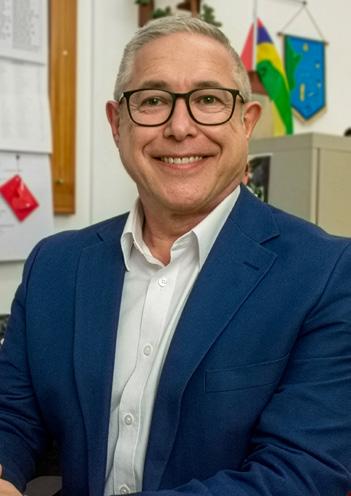
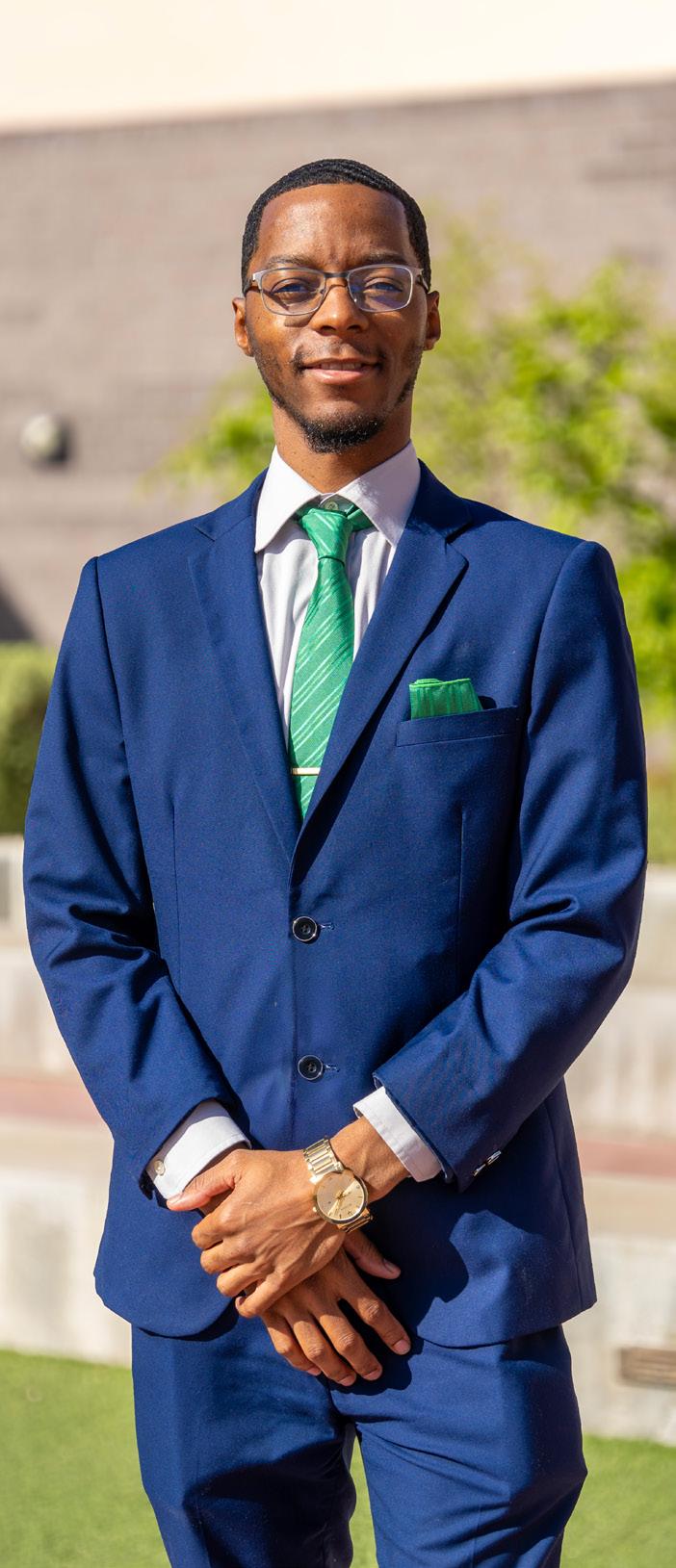
This brings us to this month’s cover story featuring Gavin Kinch, Principal at ACS International, Singapore. His perspective is both timely and necessary. What stands out is not just his focus on academic excellence, but his insistence that schools must nurture character, empathy, and a sense of purpose. Having worked across diverse international environments, he speaks with clarity about the responsibility schools carry in preparing students for a world that is complex, interconnected, and often unpredictable. His belief is simple but powerful: education must move beyond performance and toward meaningful contribution.
In this issue of K12 Digest, we continue this conversation through a range of voices and viewpoints. From educators rethinking classroom practices to leaders exploring the future of learning, each piece adds a layer to this evolving narrative. Together, they reflect a shared understanding that education is not just about what students achieve, but who they become.
As you turn these pages, I invite you to pause and reflect on your own definition of success. Because in the end, the true measure of education may not lie in how far students go, but in how well they stand, think, and contribute when they get there.
Enjoy Reading.
Sarath Shyam
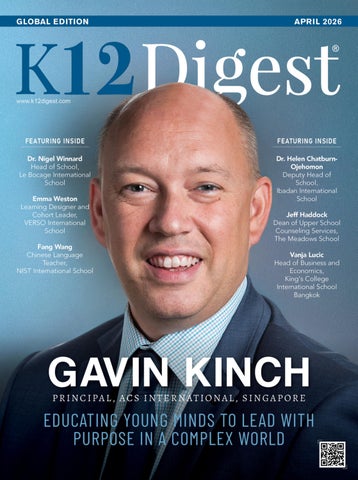
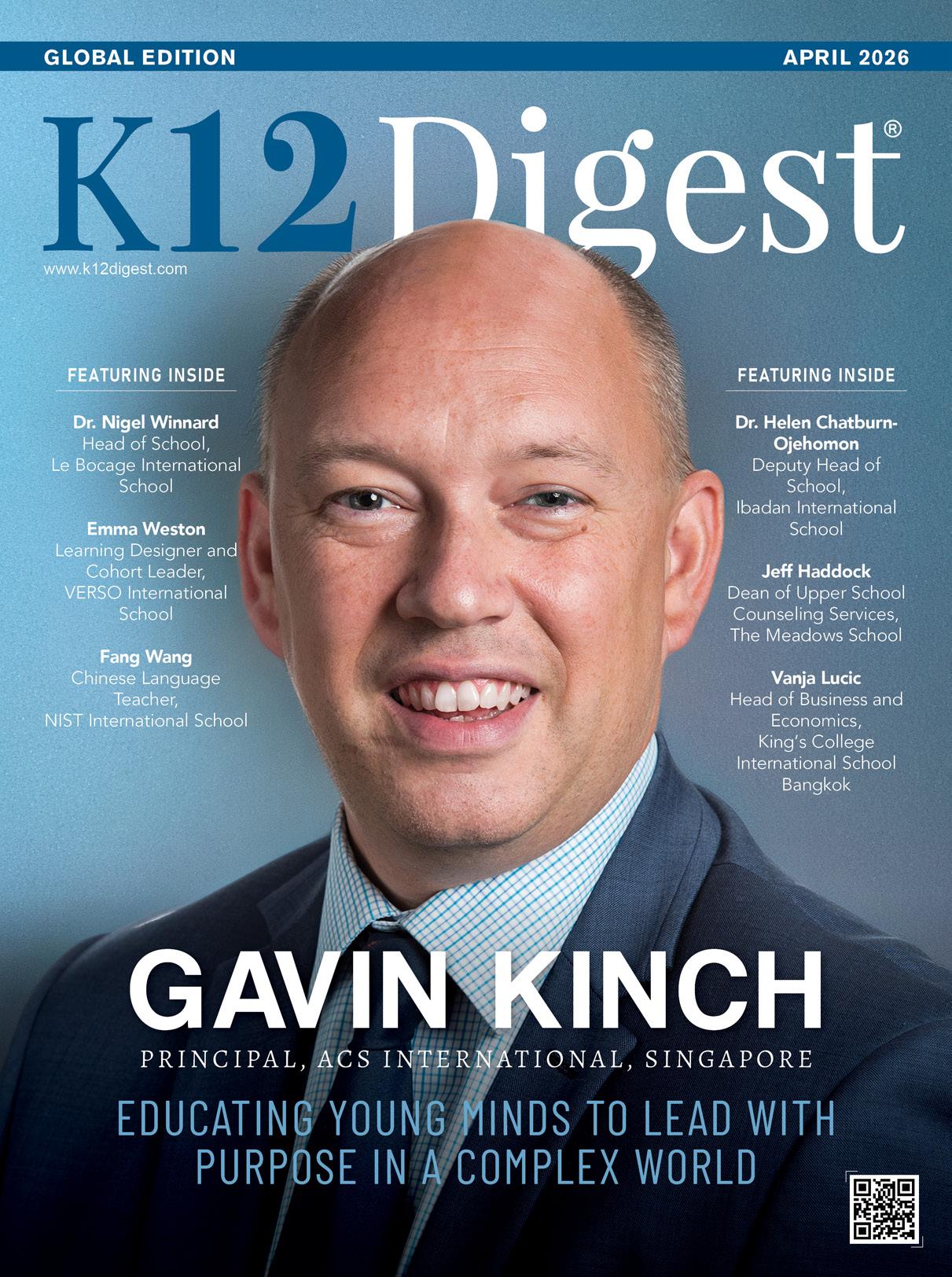
GAVIN KINCH
PRINCIPAL, ACS INTERNATIONAL, SINGAPORE
EDUCATING YOUNG MINDS TO LEAD WITH
PURPOSE IN A COMPLEX WORLD
BEST PRACTISES
ADMIN PERSPECTIVE
THE HONOUR OF BEING YOURSELF: AUTHENTIC LEADERSHIP IN INTERNATIONAL SCHOOLS
Dr. Nigel Winnard, Head of School, Le Bocage International School
40
TEACHING ECONOMICS THROUGH CURIOSITY DEBATE AND REAL-WORLD THINKING
Vanja Lucic, Head of Business and Economics, King’s College International School Bangkok
18
44
FROM FAILURES TO FORWARD MOTION: RESILIENCE IN EDUCATION
Jeff Haddock, Dean of Upper School Counseling Services, The Meadows School
TEACHING MANDARIN THROUGH CULTURE, CURIOSITY AND REALWORLD LEARNING
Fang Wang, Chinese Language Teacher, NIST International School
24
34
DESIGNING LEARNING THAT PREPARES STUDENTS FOR LIFE
Emma Weston, Learning Designer and Cohort Leader, VERSO International School
RETHINKING SCHOOL LEADERSHIP THROUGH TEACHER AGENCY AND HUMAN CENTERED LEARNING
Dr. Helen Chatburn-Ojehomon, Deputy Head of School, Ibadan International School
50
GAVIN KINCH
PRINCIPAL, ACS INTERNATIONAL, SINGAPORE
EDUCATING YOUNG MINDS TO LEAD WITH PURPOSE IN A COMPLEX WORLD
Gavin Kinch is the Principal of ACS International Singapore and a global education leader known for championing purposeful, values-driven leadership. With extensive experience across international school environments, he is recognized for building school cultures that combine academic excellence with character development, global citizenship, and systems thinking.
Beyond his role at ACS International, Gavin actively contributes to global education dialogue. He serves as Chair of the IB School Leadership Council, helping shape discussions that influence the direction of IB schools worldwide. He is also Chair of the Singapore International Schools Principals Network, where he promotes collaboration and shared learning among school leaders across the region. Gavin also hosts The Global Ed Podcast, an award-recognized platform that amplifies diverse voices in education and shares stories from leaders working in complex educational contexts.
In an exclusive conversation with K12 Digest, Gavin Kinch talks about the experiences that shaped his leadership philosophy and the deeper purpose that should guide modern education. He reflects on how working across international school environments strengthened his belief that schools must prepare students not only for academic success but also for meaningful contribution within complex global systems. He also discusses the evolving landscape of international education, the growing importance of competencies such as ethical judgement and intercultural understanding, and the opportunities and cautions surrounding artificial intelligence in schools.
You have built your career across international school settings. What key experiences have most shaped your leadership philosophy today?
One of the most formative moments in my leadership journey came when I was asked which educational leaders inspired me most. The expectation was that I would reference prominent educational thought leaders or prominent voices in the education space. Instead, I found myself speaking about school leaders working in the most demanding contexts, those serving displaced communities, operating in fragile environments, or committing themselves to students who have historically been underserved.
Those leaders have shaped my philosophy far more than any published framework. They embody moral courage, clarity of purpose, and a deep belief in the transformative power of education. Their work reminds me that leadership is ultimately about service and about holding steady when conditions are complex or uncertain. I have sought to learn from them, to support their work where possible, and to draw lessons from their resilience and moral clarity into my own context.
Leading in international settings has further reinforced the importance of perspective. When a school community represents multiple cultures, languages, and worldviews, leadership demands humility and global awareness. Education cannot exist in isolation. Schools must be outward-looking, engaged in conversations about access, sustainability, well-being, and the ethical use of technology. I have found real professional fulfilment in contributing to these wider discussions and, importantly, in encouraging colleagues within my own school
to see themselves as participants in a broader educational ecosystem rather than practitioners confined within their own school walls.
Another defining influence has been a growing conviction that we must move beyond a narrow framing of learning as individual success alone. Academic excellence matters deeply, but education cannot stop at personal attainment. If we want meaningful change, we must help young people understand how systems operate and how decisions ripple across communities, economies, and environments. Real impact is rarely achieved by isolated individuals. It is achieved by those who understand systems, who can work within them, reshape them, and build better ones.
This requires students to develop principled judgment about how policies, markets, technologies, and institutions affect people and the planet. It means teaching them to think structurally, to see interdependence, and to recognise that their influence can scale when they collaborate, build partnerships, and engage constructively with complex systems. When learning is reframed in this way, schools become places where contribution, not just competition, is cultivated.
Ultimately, my leadership philosophy is anchored in the belief that schools exist to shape more than successful individuals. They exist to shape contributors to society. When schools are clear about their moral purpose, outward in their partnerships, and ambitious in how they prepare young people to understand and influence systems, their impact extends far beyond academic outcomes into the ways students engage with communities, institutions, and the complex challenges of our time. That is where leadership, learning, and responsibility converge in meaningful ways.
If we want meaningful change, we must help young people understand how systems operate and how decisions ripple across communities, economies, and environments
As Principal of ACS International Singapore, what milestones or achievements are you most proud of since taking on the role?
One of the things I am most proud of is the way the school has lifted its gaze beyond its own boundaries. We have intentionally strengthened partnerships with industry, higher education, and community organisations so that learning connects to authentic pathways and real-world contexts. These partnerships have expanded opportunities for internships, mentoring, enrichment, and sporting development, ensuring that students see how their education translates into meaningful contributions.
Within the school, we have broadened access to leadership and participation. Additional student leadership roles have been introduced so that influence is distributed rather than concentrated, and participation in co-curricular activities has grown, particularly in sport, service initiatives, and interest-based groups. When students commit to a team, a service project, or a creative pursuit, they develop resilience, collaboration, and a sense of responsibility that strengthens both character and community.
On a personal level, I have been honoured to serve the wider profession through leadership roles within the Singapore Network
of International Principals and the IB School Leadership Advisory Council, including election to vice chair and chair positions. These roles have provided opportunities to contribute to broader conversations about quality, access, and the future direction of international education, while also bringing a global perspective back into our own school.
What matters most to me, however, is the growth of people. I have seen teachers elevate their practice, engage more confidently in professional dialogue, and step into leadership beyond their classrooms. I have seen students surpass expectations, secure university destinations they once thought unattainable, and develop a deeper belief in their own capacity. Most significantly, I have seen young people who arrived uncertain of where they fit discover belonging, purpose, and direction. Those transformations are the clearest measure of progress and the most meaningful affirmation of the work we do.
International education is evolving rapidly. What do you see as the biggest challenges and opportunities facing K–12 schools today?
International education is evolving at an extraordinary pace. The greatest challenge for
schools is not simply keeping up with change, but preparing young people to navigate complexity with competence and integrity.
We are moving from an era in which education was primarily about knowledge acquisition to one in which competencies matter just as much, if not more. Knowledge remains essential, but the differentiator now is the ability to think critically, collaborate across cultures, communicate with clarity, and exercise principled judgement in uncertain situations. Schools must therefore shift from asking what students know to asking what they can do, how they reason, and how they contribute.
One of the defining challenges is equipping students to engage in difficult conversations. Issues such as environmental sustainability, cultural identity, inequality, technological disruption, and resource allocation are now lived realities for many. Students need the confidence to sit with discomfort, to listen across difference, and to speak thoughtfully into complex debates. Intercultural competence and ethical reasoning should not be optional additions in international education; they should be foundational.
At the same time, the rapid advancement of artificial intelligence and digital tools presents a remarkable opportunity. Barriers that once limited creativity are being lifted thought he development of new tools. Students can now express ideas through writing, design, music, coding, film, and visual storytelling with a sophistication that was previously inaccessible. Technology is lowering technical barriers and amplifying voice, allowing young people to articulate their thinking more clearly and to share their message at scale.
Yet this scaling of influence is a double-edged sword. The same tools that empower can also be used to distort, inflame, or misrepresent. The speed and reach of digital platforms mean that individual and collective choices now carry amplified consequences. This is
The greatest challenge for schools is not simply keeping up with change, but preparing young people to navigate complexity with competence and integrity
why schools must place renewed emphasis on ethics, discernment, and systems thinking. Students need to understand how personal decisions, group dynamics, and intentional narratives shape communities, influence public discourse, and create real consequences for people and the planet.
The opportunity before K–12 schools is therefore profound. We have the chance to educate a generation that understands both the power and the responsibility that come with influence. If we can help young people develop sound judgement, intellectual courage, and a deep awareness of how systems function, they will not simply adapt to a rapidly changing world; they will be equipped to improve it.
How are AI and emerging technology influencing teaching, learning, and leadership within your school? Where do you see the greatest potential and the greatest caution?
Artificial intelligence is accelerating questions that education has been moving toward for some time. It is forcing schools to reconsider what truly matters. If knowledge is increasingly accessible, then the differentiators become judgment, creativity, ethical reasoning, and the ability to think independently.
Within our school, AI is already influencing teaching and learning in practical ways. Teachers are using it to streamline planning, generate formative tasks, and provide more responsive feedback. Students are using it to test ideas, refine their writing, explore alternative perspectives, and express their thinking with greater clarity. The real potential lies in removing technical barriers so that more time and energy can be directed toward deeper
reasoning, stronger communication, and more ambitious creative work.
For leadership, emerging technologies offer clearer insight into learning patterns and operational processes, enabling more informed decisions and more intentional use of resources.
The greatest caution, however, is not technical but human. Powerful tools can encourage superficial learning if students rely on them to think on their behalf. They can blur authorship, weaken academic integrity, and amplify misinformation when ethical boundaries are unclear. Increasingly, AI is embedded in physical systems such as autonomous vehicles, infrastructure, and security technologies, which means that flawed judgment, bias, or misuse can carry consequences not only in digital spaces but in the physical world. When influence extends across information networks and real-world systems, the stakes are significantly higher.
The task for schools is therefore cultural rather than technical. We must be explicit that AI is a tool to strengthen human thinking, not replace it. That requires clear expectations, ethical grounding, and deliberate cultivation of discernment. If we maintain that balance, these technologies can expand human capability while preserving human responsibility.
ACS International emphasizes both academic excellence and character development. How do you ensure these two elements remain balanced?
At ACS International, we do not see academic excellence and character development as competing priorities. We see them as mutually reinforcing. Academic rigour without character can produce capability without responsibility. Character without intellectual stretch can
produce good intentions without impact. The task of leadership is to hold both in deliberate balance.
That balance begins with clarity of purpose. Our guiding statements and IGNITE values are not peripheral to the academic programme. They are embedded within it. Our definition of High Quality Learning requires students to engage in inquiry, critical thinking, reflection, and real-world application. In doing so, we are developing both intellectual competence and dispositions such as integrity, resilience, and courage.
Structurally, we reinforce this integration. Academic outcomes are tracked carefully and supported with targeted intervention and enrichment, but pastoral care, the House system, service initiatives, and co-curricular participation are equally intentional. Leadership roles are expanded, so students practise responsibility, not simply achieve grades. Reflection is built into learning so that students consider not only what they know, but who they are becoming.
We also speak explicitly with students about contribution within systems. Success is not framed solely as individual attainment, but as the
capacity to use one’s learning in principled and constructive ways. When students understand that their knowledge carries responsibility, academic ambition becomes anchored in purpose.
Ultimately, balance is not achieved by dividing time evenly between academics and character. It is achieved by integrating them so fully that they are inseparable. When excellence is pursued with integrity, and character is strengthened through intellectual challenge, the two elevate each other. That is the culture we work intentionally to cultivate.
Outside of your professional responsibilities, what personal interests or values influence the way you lead?
Being the father of three teenagers has probably shaped my leadership more than any formal training programme ever could. Each of my children is very different. One is academically driven and intellectually curious in a highly structured way. Another finds his energy and identity through sport, competition, and physical challenge. The third is drawn to drama and music, thriving in creative expression and performance. Watching them grow has
Success is not framed solely as individual attainment, but as the capacity to use one’s learning in principled and constructive ways
reinforced a simple but profound truth. Human beings respond to the world in very different ways.
There is a saying that the same boiling water that softens the potato hardens the egg. The environment may be constant, but the response is not. That has been deeply instructive for me. As parents, we quickly learn that what motivates one child may discourage another. What challenges one may overwhelm another. What feels like structure to one may feel restrictive to someone else. You cannot lead them all in the same way. You have to understand how they think, how they process, and what brings out their best.
That perspective carries directly into school leadership. It is tempting in institutions to design environments that assume uniformity. Yet students and staff are not uniform. They bring different strengths, anxieties, ambitions, and ways of engaging. If we expect everyone to respond identically to the same structures, we will inevitably miss the individual.
For me, leadership therefore requires attentiveness. It requires creating a school culture broad enough and rich enough that different personalities can find their place. That means offering diverse pathways, varied co-curricular opportunities, strong pastoral support, and multiple forms of leadership and expression. It also means leading staff with the same awareness, recognising that teachers, too, are motivated and stretched in different ways.
Ultimately, my children have reminded me that education is not about producing a single type of graduate. It is about creating conditions in which different kinds of young people can discover where they flourish. When schools honour that diversity of response, they become environments not of conformity, but of growth.
What advice would you offer to students preparing for university and to young educators aspiring to leadership roles in international schools?
For students preparing for university, my advice is simple but not always easy to hear. Do not focus only on the entry. Focus on trajectory. University is not just the next academic milestone. It is an opportunity to deepen your thinking, broaden your networks, and clarify how you want to contribute.
Develop the habits that will matter long after grades fade. Learn to reason carefully. Learn to listen across differences. Be comfortable with complexity. Seek experiences beyond your lecture hall through service, internships, research, sport, or creative pursuits. The world does not reward narrow excellence for long. It rewards those who can apply their learning thoughtfully within real systems.
Most importantly, recognise that your education carries responsibility. The knowledge and opportunities you access should equip you to strengthen the communities and institutions you will one day influence. Aim not only for personal success, but for meaningful contribution.
For young educators aspiring to leadership in international schools, start by mastering your craft. Leadership credibility is grounded in excellent teaching and authentic care for students. Once that foundation is secure, seek opportunities to contribute beyond your classroom. Join collaborative projects, initiate new ideas, support colleagues, and engage with wider professional networks. Stretch yourself deliberately and consistently, and allow your influence to grow through contribution rather than position.
Teaching Economics Through Curiosity Debate and Real-World Thinking
Vanja Lucic, Head of Business and Economics, King’s College International School Bangkok
Vanja Lucic is an educational leader and published economist with over a decade of experience advancing teaching innovation, faculty development, and student achievement in international schools across Asia and Europe. She is currently the Head of Business and Economics at King’s College International School Bangkok.
She designs concept and inquiry-driven curricula that promote cognitive challenge, analytical depth, and meaningful engagement, while integrating digital tools to strengthen critical thinking, creativity, and analytical confidence. Vanja has led departments and whole-school professional development initiatives, fostering collaborative cultures built on shared inquiry and continuous improvement.
She believes education should inspire a genuine love of learning, creating intellectually vibrant classrooms where students think independently, take academic risks, and grow into reflective, capable, and globally aware individuals. In an exclusive conversation with K12 Digest, Vanja talks about her journey from university-level economics educator to leading Business and Economics at an international school, and how that experience shaped her teaching and leadership philosophy. She discusses the importance of maintaining intellectual depth in an age of instant information, encouraging students to analyze real-world economic developments and think critically.
Can you share the key milestones in your journey from economics educator to Head of Business and Economics at King’s College International School Bangkok, and what lessons you’ve learned along the way?
My professional journey began in higher education, where I taught at university level and was actively engaged in academic research and scholarly discussion. What I valued most were
the debates with students, challenging economic theories and guiding their independent inquiry. That experience sharpened my thinking and left me with a lasting conviction that economic models only matter when they are argued, challenged, and applied critically.
When I transitioned into international education, I faced a different challenge. I saw how easily Economics could feel abstract or exam-driven for younger students. I wanted
One of the most significant challenges in delivering robust Business and Economics programmes today is maintaining intellectual depth in an age of speed
If students leave our classrooms more analytical, more questioning, and more confident in interpreting a changing world, then we are using technology in the right way
them to experience the same intellectual curiosity I had valued and to develop a genuine love of learning the subject. Our classes often open with recent economic developments such as policy decisions, shifts in trade, or technological change examined through an international lens. Students connect ideas across topics, analyse real data, and debate policy responses. Over time, they begin to approach discussions like economists rather than simply preparing for assessments.
As I stepped into leadership roles, my focus widened beyond my own classroom to the culture we build together as educators. I have come to see leadership as modelling curiosity, encouraging thoughtful innovation, and creating environments where professional growth feels shared and purposeful. When teachers feel inspired to keep learning, students feel it too.
What are some of the most significant challenges schools face today in delivering robust Business and Economics programmes, and how are you addressing them?
One of the most significant challenges in delivering robust Business and Economics programmes today is maintaining intellectual depth in an age of speed. Students are surrounded by constant information, short-form media, and instant answers. There is a real risk that subjects like Economics become reduced to simplified explanations or exam technique rather than rigorous analytical thinking. For me, the answer lies in restoring purpose to the classroom.
This requires moving beyond superficial case studies and engaging instead with live developments, authentic data, competing viewpoints, and conversations that do not stop
when the lesson ends. When students debate current business decisions or analyse economic shifts unfolding around them, the subject feels alive. We integrate digital and AI tools thoughtfully, not as novelty, but as a way to deepen inquiry and allow students to present ideas creatively.
The goal is not simply strong examination results. It is to develop curiosity, resilience, and the confidence to question. When students leave the classroom still discussing an economic issue, you know you are building something that goes beyond the syllabus.
How do you see artificial intelligence and emerging technologies reshaping how economics and business concepts are taught and learned at the school level?
Artificial intelligence is reshaping Economics and Business education in two very clear ways: it is changing what students learn and how they learn it.
On the content side, AI and emerging technologies are transforming the economy in real time. Labour markets, productivity, inequality, regulation, even ethical decisionmaking are being reconsidered because of technological change. That makes our subject incredibly relevant. Students are not discussing distant theories; they are analysing shifts that are unfolding right now. Economics is built on questioning assumptions and testing ideas against data, and AI simply makes that process more immediate and visible.
In terms of learning, technology allows us to raise expectations rather than lower them. Students can work with real data sets, explore simulations, receive more personalised
feedback, and experiment with different outcomes. When used thoughtfully, and it does require thoughtful implementation, AI can deepen inquiry and open up more creative ways for students to question, present and defend their ideas.
For me, the key is balance. I believe in embracing the opportunities AI offers, but always with the intention that it strengthens thinking rather than replaces it. If students leave our classrooms more analytical, more questioning, and more confident in interpreting a changing world, then we are using technology in the right way.
King’s College International School Bangkok emphasises global readiness. How do you embed realworld economic thinking and global awareness into your curriculum?
Although King’s College International School Bangkok is rooted in a British educational tradition, we are ultimately preparing global citizens. Our students will study, work, and live across different countries and cultures, so global readiness is not an add-on to the curriculum; it is central to it.
In Economics and Business, students explore businesses, markets, and policy decisions from around the world. They examine how different governments respond to similar economic challenges and how cultural, political, and institutional contexts shape outcomes. They learn that in a globalised and highly interdependent world, events on one side of the globe can create ripple effects elsewhere, sometimes positive, sometimes disruptive.
An international school environment makes this even more meaningful. Our classrooms bring
together students with diverse backgrounds and lived experiences, and that diversity strengthens discussion. When students see how the same economic policy may affect societies differently, they begin to understand that there is rarely one universal solution. Context matters.
Ultimately, embedding global awareness is about preparing students to think beyond national borders, engage respectfully with complexity, and understand their responsibility in an interconnected world.
What leadership principles guide your work with teachers and students, and how have these evolved over your career?
My leadership is guided by a belief in modelling what we expect from others. If we want students to be curious, reflective, and resilient, we must demonstrate those qualities ourselves. The same applies to teachers. Leadership in education begins with visible passion for learning and a willingness to keep growing.
Over time, I have come to understand that strong standards are sustained by strong culture. I value a culture of sharing, collaboration, and mutual support. When teachers feel trusted and safe to exchange ideas, experiment, and refine their practice, improvement becomes collective rather than individual. Emotional awareness plays an important role here. Understanding different perspectives and responding thoughtfully allows teams to grow with confidence rather than pressure.
I also believe leadership requires clarity and integrity. It means being consistent in expectations and empowering others to take ownership of their work. Strong leadership is not about control, but about building capacity
Whether through thoughtfully designed materials or occasional unexpected tasks and formats, I enjoy creating moments that make learning feel dynamic and memorable
in others. The leaders who influenced me most inspired through example. They encouraged curiosity, supported risk-taking, and made professional growth feel meaningful. That is the kind of environment I aim to build.
Outside of your professional work, what personal interests or values influence how you approach education and leadership?
Outside of my professional role, living and working in different countries has shaped me deeply. Experiencing different cultures, languages, and ways of thinking has strengthened my belief that perspective matters. It has made me more aware of how background influences interpretation and how much we gain when we listen carefully to views different from our own. That awareness influences how I lead and how I design learning environments.
On a more personal level, being a parent has also influenced my leadership. It reminds me that schools are not only academic institutions, but environments that shape confidence, resilience, and identity. That perspective encourages me to balance rigour with humanity and to lead with both high expectations and empathy.
I am also a strong believer in creativity. I have always been drawn to art and visual expression, and I try to bring that spirit into my teaching. Whether through thoughtfully designed materials or occasional unexpected tasks and formats, I enjoy creating moments that make learning feel dynamic and memorable.
What advice would you offer to students considering a future in economics, business studies, or related fields, especially in an increasingly interconnected world?
I would encourage students to choose Economics or Business if they are naturally curious and enjoy asking “why.” These subjects reward those who look beyond simple answers and are willing to explore complexity. Develop strong analytical and data skills, but also cultivate the confidence to question assumptions and examine ideas critically.
In an interconnected and rapidly changing global economy, the ability to think carefully and adapt thoughtfully matters more than memorising formulas. As John Maynard Keynes famously observed, “When the facts change, I change my mind.” That openness to evidence and intellectual flexibility will serve students far beyond the classroom.
ACADEMIC VIEWS
Teaching Mandarin Through Culture, Curiosity and Real-World Learning
Fang Wang, Chinese Language Teacher, NIST International School
You have spent over two decades teaching Chinese across different IB programs and international schools. What first inspired you to pursue a career in language education, and how has your journey evolved over the years?
This question takes me back to the year of 1999. Becoming a language teacher was not my childhood dream. When I was young, I imagined myself becoming a writer because I loved reading and writing.
During my final year of graduate school, my professor suggested that I visit Beijing No.
55 Middle School, the first school in China to implement the IB Middle Years Programme. I followed her advice and met the principal, Ms Wang Hong, who played a pioneering role in introducing IB education to China.
We had a conversation in a small storage room that Ms Wang Hong used as a quiet and temporary workspace away from distractions. The meeting felt both formal and relaxed. She asked whether I had heard about the IB before. I have always been curious by nature, so her question immediately captured my attention. I listened as she spoke passionately about the IB philosophy, and by the end of our conversation,
Today, the classroom landscape has changed dramatically. Many students are highly engaged with digital tools and language games, and they often show great excitement when learning through online platforms
Fang Wang is a dedicated Chinese Language Teacher in the World Languages Department at NIST International School, Thailand. She brings over twenty-six years of experience as an IB educator across the PYP, MYP, and DP programmes. Her career has taken her to IB World Schools in Beijing, Hong Kong, Jakarta, and Bangkok, shaping a rich perspective on international education and culturally responsive teaching.
Beyond the classroom, Fang is an experienced IB workshop leader who facilitates both foundational training and specialised workshops for the IB programmes and for IB programmes and the wider education community. She also contributes actively to the IB community as a School Visit Team Leader, consultant, and IB field representative. Fang believes that collaborative learning and ongoing professional growth are essential for inspiring creativity, purposeful curriculum planning, and meaningful teaching and learning.
In an exclusive conversation with K12 Digest, Fang talks about her journey into international education and the experiences that shaped her philosophy as a Mandarin educator. Drawing from more than two decades of teaching across IB schools in different countries, she reflects on how language learning has evolved from traditional classroom practices to technology influenced environments. She shares her perspective on helping students overcome the fear of learning Mandarin by building cultural connections and encouraging inquiry based learning.
I had signed the contract to begin my journey as an IB educator.
My academic background also shaped this path. I majored in literature as an undergraduate and later focused on bilingual education in graduate school. My thesis was based on field research in a rural town in Xinjiang, where I spent a month living with a Kazakh family and visiting local bilingual schools while interviewing their principals. Those experiences strengthened my belief that language education can build meaningful bridges between Mandarin and its rich cultural heritage.
Looking back, three conceptual lenses have consistently guided my growth as an educator: cultural intelligence, international-mindedness, and the courage to unlearn. I grew up in Yunnan Province until the age of seventeen and then moved to Beijing for university, where I lived for eighteen years. These two places shaped my identity in profound ways. I am also half Miao on my father’s side, which may explain why curiosity about different cultures, openness to
new perspectives, and a willingness to explore have always been part of who I am.
The opening lines of Daniel Caesar’s song Streetcar often stay with me:
“Let me know, do I still get time to grow?”
To me, growth should never stop with age. It should be like a tree, always reaching for sunlight, welcoming the rain, and embracing the changes, challenges, and blessings that life brings.
Having worked in international schools across several countries, what key differences have you observed in how students approach language learning today compared to earlier in your career?
Living and teaching in different cities has given me many unforgettable memories. Each place carries its own cultural rhythm, and these environments naturally become an extended language-learning platform for both my students and me. My journey as an educator has taken me through different communities and cultures, and those experiences continually reshape how I see language teaching and learning.
In the earlier years of my teaching career, classrooms looked very different from today. There were no smartphones or iPads, and students relied largely on handwriting and more traditional ways of learning. I still remember the beautiful moments when my students would read Chinese poems aloud in class and then share their personal thoughts and feelings about the verses. Those moments of quiet reflection, listening, and expression created a special learning atmosphere.
Today, the classroom landscape has changed dramatically. Many students are highly engaged
with digital tools and language games, and they often show great excitement when learning through online platforms. The rapid development of technology—and now artificial intelligence—has reshaped how students interact with language. Attention spans can be shorter, learners are easily drawn to interactive experiences, and visual texts often replace long passages of deep reading.
These shifts are inevitable, and they constantly remind me of the importance of “unlearning” certain habits from my earlier teaching experiences while continuing to explore new ways to approach teaching and learning. Perhaps even more importantly, they encourage me to rethink how I communicate and connect with my students in a world that is constantly evolving.
At the same time, I try to maintain a sense of balance rather than simply chasing every new trend in education. In moments of reflection, I return to a fundamental question: What is my identity as an educator? I often ask myself whether I can clearly articulate my teaching philosophy, my Why, my How, and my What. These questions help me stay grounded while continuing to grow alongside my students in a rapidly changing world.
Mandarin is often considered one of the most challenging languages to learn. What strategies or classroom approaches have you found most effective in making the learning experience engaging and meaningful for students?
Why do we often believe that learning Mandarin is challenging? Have we ever paused to ask ourselves why we feel this way about the language?
I encourage students to become inquirers by doing simple research about Mandarin, exploring its structure, its cultural roots, and the stories behind the language
I tend to approach questions like this by stepping outside my comfort zone and looking at them from a different perspective. For many students, Mandarin does not belong to their familiar linguistic or cultural world. Learning it can feel a little like trying sticky tofu for the first time. Unless you already have a memory or connection with the taste, it may seem strange or even intimidating at first. The same might be said for century eggs, delicious to those who know them well, but mysterious to others. Often, what makes something difficult is not the thing itself, but the unfamiliarity we feel toward it. When a language seems distant from our daily lives, it can be harder to approach with confidence.
One of my key strategies as a teacher is to help students shift their mindset. I encourage
them to become inquirers by doing simple research about Mandarin, exploring its structure, its cultural roots, and the stories behind the language. At the same time, I guide them to make meaningful connections between Mandarin and their own languages, cultures, and learning experiences. When students begin to see these connections, the language becomes less distant and more approachable.
In my teaching, I also like to imagine an “invisible learning skills net” woven through every lesson. Behind each activity, I want to clearly see which skills students are developing. This approach helps me reflect honestly on my teaching and ensures that classroom time is purposeful rather than simply filling the schedule.
At the beginning of each lesson, I always share the structure of the class with my students. I explain why the lesson is designed in a particular way so that they can see the bigger picture of their learning. When students understand the purpose behind each activity, they are more aware of the skills they are developing and more motivated to practise and improve them.
Ultimately, my goal is not only to help students learn Mandarin, but also to help them become confident learners who are willing to explore new languages, cultures, and perspectives.
Artificial intelligence and digital tools are rapidly entering classrooms. How do you see AI and emerging technologies transforming language learning and the role of teachers in the coming years?
This question often leads me to a bold provocation: Do we still need language teachers
Rather than focusing only on classroom instruction, language educators may increasingly guide students into reallife contexts where language is naturally lived and experienced
in a world where advanced technologies and AI assistants are increasingly integrated into schools?
If language teachers do not reflect on this question, we may risk being unprepared for the changes that are already reshaping language teaching and learning. Like many educators, I am still in the learning phase when it comes to AIintegrated classrooms. At this stage, I approach the technology thoughtfully rather than rushing into it. I do not want human curiosity, initiative, and critical thinking to be replaced by the quick responses that AI can generate.
Currently, I use AI mainly as a supportive assistant in my professional practice. It helps me with planning lessons, brainstorming new
ideas, designing reflection questions, and refining ways to communicate more effectively with my students. In this sense, AI becomes a helpful partner in the background, while the human connection between teacher and student remains at the center of learning.
At the same time, it is difficult to answer the future of AI in education with complete certainty. Language teaching is only one part of a much larger educational system. I am curious to see how the broader “engine” of education, policies, school systems, and teaching practices, will evolve to adapt to these changes. As an educator, my responsibility is to stay open to learning, follow emerging guidelines thoughtfully, and continue to practise and refine my teaching so that I can support my students in a rapidly changing world.
My own prediction is that the role of language teachers in an AI-integrated classroom may gradually extend beyond the traditional classroom space. Rather than focusing only on classroom instruction, language educators may increasingly guide students into real-life contexts where language is naturally lived and experienced.
This could mean designing language field trips, learning through city tours, or creating opportunities for travel and exchange programmes where students can use the target language in authentic situations. In these environments, language becomes more than a subject to study, and becomes a bridge to culture, communication, and human connection.
In this sense, a language teacher’s role may evolve from being primarily a classroom instructor to becoming a learning designer and cultural guide who helps students experience language in the real world.
You have contributed to IB workshops and curriculum initiatives as a consultant and workshop leader. What leadership lessons have you learned through these experiences, and how have they influenced your approach in the classroom?
This question often leads me to reflect on the true purpose of leadership. When I think back to my previous leadership responsibilities, I remember that the role sometimes brought a great deal of pressure. Those experiences gave me valuable time and space to reflect and to redefine my professional goals. At this stage of my career, becoming a principal is not on my list. Senior leadership positions can sometimes bring stress and a sense of loneliness, and I have come to realise that I prefer a more organic approach to leadership, one that allows me to experience the joy of facilitating, crafting, guiding, and learning alongside others.
In my work as an IB field representative, I collaborate with workshop leaders and invest significant time in planning our faculty
meetings. My planning philosophy is to cocreate psychological safety within the team and to design thoughtful inquiry questions that help workshop leaders discover their voice and strengthen their identity as educators and facilitators. I believe that what truly motivates professional growth is not settling for comfortable standards, but embracing a mindset that reminds us: there is no best, only better.
My leadership philosophy is rooted in service. I believe in leading with a growth mindset and modelling continuous learning. I also enjoy designing workshops that introduce new ideas and perspectives. Whenever I attend conferences or workshops myself, I try to understand the thinking behind the design, the why behind the experience. This curiosity has contributed greatly to my development as a workshop leader. My long-term goal is to become a master trainer, and I see this as an ongoing learning journey.
Ultimately, my understanding of leadership always connects back to the purpose of education and holistic learning. I often ask myself what
For teachers like me who have been in the classroom for more than twenty-six years, it is important to have the courage to unlearn
my lessons are preparing my students for in the future. I do not want to teach simply to add another grade to their transcripts. Instead, I hope to help students discover the purpose of learning Mandarin and begin to imagine how they might use this language to contribute meaningfully to the world around them.
International schools bring together students from many cultural and linguistic backgrounds. How do you create an inclusive environment where students feel confident experimenting with a new language?
Cultural intelligence is not something that develops overnight, and it grows gradually through experience and reflection. I still remember feeling lonely and overwhelmed when attending international conferences as a young teacher, especially when English was the main working language and I was not strong in speaking English at that time. Those moments challenged me in many ways, but they also helped me better understand how some of my students might feel when they are learning and communicating in a new language.
These experiences encouraged me to develop greater empathy and to intentionally train myself to notice cultural cues that were unfamiliar to me. In the IB leadership training, one of the workshops focuses specifically on cultural intelligence. Through those discussions and reflections, I was able to explore both the opportunities and the challenges that come with navigating different cultural perspectives.
Learning about cultures sometimes feels like navigating a cultural map. As we explore new cultures and perspectives, I believe it is equally important to remain aware of where we come
from and what we represent. It can be easy to follow the loudest voices in a conversation, but it is far more meaningful, and sometimes more challenging to engage in dialogue that builds shared understanding and mutual respect across cultures.
With this mindset, I encourage my students to share their ideas openly in the classroom. I also choose teaching materials that offer culturally responsive perspectives. Together, we co-create our classroom norms, and through these conversations students begin to see how values and expectations can be shaped by different cultural backgrounds. These moments often lead to thoughtful discussions and deeper understanding among the students themselves.
Outside the classroom, what interests
or passions keep you inspired as an educator, and what advice would you give to students or young professionals who are interested in careers in education or language studies?
I enjoy connecting with thoughtful ideas in education and beyond. If we imagine that all the walls around us disappeared, we might naturally see the whole world as our learning space. In that sense, connecting with educators from different schools, regions, and cultures becomes both natural and inspiring. These exchanges often open new perspectives and remind me that education is a shared global journey.
In the past, I was quite active on social media. Over time, however, I began to reflect more carefully on how I used that space. I started asking myself what my posts were truly contributing. Were they meaningful, reflective, or inspiring? Gradually, I chose to post less frequently and focus more on sharing ideas that
might provoke thought or encourage reflection rather than promoting myself.
Because I value my time and energy, I like to begin each new year by choosing three words that capture my focus for professional learning. These words guide my growth throughout the year. This year, the three words I have chosen are self-discipline, resilience, and curiosity. I try to align my learning, reading, and reflections with these themes as I continue developing both personally and professionally.
For students or young professionals who are considering careers in education or language studies, my first piece of advice is simple: choose this path because you truly love it, not because it seems like an easy way to earn a paycheck. Teaching should never be a last choice. It is a profession that requires passion, commitment, and mastering the art of teaching with a strong purpose to build a better world collectively.
At the same time, educators need to stay connected to the real world. We should remain aware of what is happening around us and
approach change with an open mind. Education is filled with new trends and ideas, but it is important to maintain critical and independent thinking rather than following every new movement uncritically.
Finally, I believe that teachers must protect time for reading, thinking, and reflection. This can be difficult because teaching is often busy and demanding. Still, even setting aside thirty minutes a day to read research-based educational articles or thoughtful writing can provide inspiration and nourish our professional growth.
For teachers like me who have been in the classroom for more than twenty-six years, it is important to have the courage to unlearn. From time to time, we need to “clean our lockers,” letting go of both visible habits and invisible assumptions that no longer serve our students or our learning. Ultimately, what matters most is that we continue to enjoy teaching and remain fully present in the learning journey with our students, working with purpose, curiosity, and wholehearted participation.
Designing Learning That Prepares Students for Life
Emma Weston, Learning Designer and Cohort Leader, VERSO International School
You have been deeply involved in learning design at VERSO. What initially drew you toward curriculum innovation, and what milestones in your journey have most shaped your educational philosophy?
My path toward curriculum innovation actually began at the very start of my career during my degree at the University of Chichester. It is one of the few universities to offer a specialization in Primary Education combined with Global Citizenship. That dual focus fundamentally
shaped my belief that education cannot just be about passing standardized tests; it must be about developing thoughtful, active citizens.
A major milestone was transitioning from the UK system (after 4 years in London) to international environments in Taipei and then Bangkok. Adapting to diverse, multicultural classrooms highlighted the limitations of a rigid, “one-size-fits-all” curriculum. When I became a Campus Principal at Garden International School, and later a Cohort Leader at VERSO, I realized that true curriculum innovation—
I firmly believe that academic rigor and student well-being are not mutually exclusive; in fact, true agency promotes well-being
Emma Weston is an innovative educational leader with over 15 years of international experience across London, Taipei, and Bangkok. She holds a degree in Primary Education and Global Citizenship from the University of Chichester and a Master’s in Educational Leadership. Deeply passionate about Early Years and Primary education, she collaborates with experts such as Erin Kent Consulting to strengthen literacy instruction and empower teaching teams. Known as a “marigold” leader who helps others thrive, Emma focuses on instructional coaching, capacity building, and trust. While embracing AI as a supportive co-pilot for teaching, she champions hands-on learning, play, and strong community connections in education.
In an exclusive conversation with K12 Digest, Emma Weston talks about her journey into curriculum innovation and how international teaching experiences shaped her philosophy of learner centered education. She shares insights into balancing academic rigor with student wellbeing through project-based learning and explains how interdisciplinary learning labs connect classroom learning with real world impact. Emma also reflects on the evolving challenges in K12 education, particularly the need to develop future ready skills in an age of rapid technological change.
like Design Thinking—allows us to build the curriculum around the learner. My Master’s research focus on Student Agency further solidified my philosophy: when students have ownership and relevance in their learning, the depth of their understanding increases exponentially.
As a Cohort Leader, how do you balance academic rigor with student well-being and agency in a projectbased environment?
I firmly believe that academic rigor and student well-being are not mutually exclusive; in fact, true agency promotes well-being. The key to balancing them in a project-based environment lies in the architecture of the curriculum. I
rely heavily on the Understanding by Design (UbD) framework. By starting with the end in mind—identifying the rigorous, standardsbased learning goals we need to hit—we create a secure academic framework.
Once that rigorous framework is in place, Design Thinking provides the vehicle for delivery. It allows students the agency to choose how they engage with those concepts. For example, a student might struggle with traditional literacy assessments but thrive when asked to prototype a solution and pitch it verbally. Because we differentiate by design, students feel seen and supported, which drastically reduces anxiety and boosts their well-being, all while meeting high academic standards.
The biggest challenge facing K-12 education today is that our traditional models of schooling are struggling to keep pace with the realities of the future
learners investigate local community needs and then actually go out into Bangkok to partner with a local organization. When students see that their design-thinking prototypes or fundraising efforts have a tangible impact on real people, it transforms the learning experience. It takes the abstract concept of “Global Citizenship” that I studied at university and turns it into a lived, early-childhood reality.
School education is evolving rapidly. From your perspective, what are the biggest challenges and opportunities facing K–12 education today?
The biggest challenge facing K-12 education today is that our traditional models of schooling are struggling to keep pace with the realities of the future. The world is evolving rapidly, particularly with the exponential development of AI, and education is often left playing catchup.
VERSO is known for its interdisciplinary Learning Labs (LeLABs). What have been some of the most meaningful or transformative learning experiences you have helped design?
Some of the most transformative LeLABs I’ve helped design are those that bridge the gap between the classroom and the real world. In my role as Trip Leader for Early Years and C1-4 (Lower Primary), I ensure we facilitate at least one off-campus learning experience every half term.
One of the most meaningful aspects of these LeLABs is how we link them directly to charity, service, and our school philosophy. For instance, designing a LeLAB where young
We need to be aggressively teaching and developing “future-ready” skills—like complex problem solving, adaptability, empathy, and technological fluency. However, a major hurdle is that our formal schooling and standardized assessments are not designed to measure these skills. We are still largely assessing rote memorization in an era where information is instantly accessible.
The opportunity here is for schools to rethink their purpose. We need to invest heavily in our teachers, giving them the time, training, and professional development required to shift their pedagogy. By embracing models like design thinking and inquiry, we have the opportunity to transform schools from places of compliance into incubators of innovation, ensuring our
students are not just prepared for tests, but prepared for life.
How are AI and other emerging technologies influencing your work as a Learning Designer? Where do you see the greatest potential, and where do you exercise caution?
As a Learning Designer, I view AI as a powerful co-pilot. The greatest potential lies in its ability to support differentiation and teacher capacity. AI can help us instantly adapt reading levels for EAL students, generate tailored scaffolding for neurodiverse learners, or brainstorm diverse entry points for a new inquiry unit.
Furthermore, AI can serve as a powerful tool for generating rapid, personalized formative feedback on student work. By streamlining these processes, AI actually enhances human interaction; it buys teachers time—time that can be redirected away from administrative tasks and grading, and back into facilitating targeted, one-on-one coaching conversations and building deeper relationships with students. My caution, particularly in Early Years and Lower Primary, is ensuring that technology never replaces the fundamental human elements of learning. Education is inherently relational. I am cautious of tech being used as a passive pacifier rather than an active tool for
We must ensure that hands-on play, sensory experiences, and face-to-face peer collaboration remain the non-negotiable core of early learning
creation. We must ensure that hands-on play, sensory experiences, and face-to-face peer collaboration remain the non-negotiable core of early learning.
Leadership in innovative schools often requires navigating ambiguity and change. How would you describe your leadership style, and what principles guide your decisions?
A former line manager once described me as a “marigold”—someone who makes those around her shine brighter. I hold onto that deeply. My leadership style is highly relational, empathetic, and focused on capacity-building.
Navigating ambiguity requires trust. In an innovative environment like VERSO, where we iterate and prototype constantly, staff need to feel psychologically safe to take risks and sometimes fail. My guiding principle is always: Does this serve the whole child? When we are faced with difficult, ambiguous decisions, anchoring back to our core values—wellbeing, inclusion, and student agency—clears the fog. I lead by getting into the trenches with my team, modeling instructional practices, and coaching them through challenges so they feel empowered.
Outside of your professional role, what personal interests or values help you stay grounded and inspired? What advice would you offer to young educators or students aspiring to make a difference in education?
Living internationally—from London to Taipei to Bangkok—has instilled in me a deep love for cultural immersion and travel, which keeps my perspective broad and fuels my passion for global citizenship. I stay grounded by staying connected to the local communities I live in.
My advice to young educators is twofold. First: be a marigold. Find the positive, collaborative people in your school and grow alongside them; education is a team sport. Second: never lose sight of the student’s perspective. It is easy to get caught up in curriculum documents, data, and administration. But if you constantly ask yourself, “What does it actually feel like to be a child in my classroom?” you will intuitively design learning experiences that are engaging, inclusive, and deeply meaningful.
The Honour of Being Yourself: Authentic Leadership in International Schools
Dr. Nigel Winnard, Head of School, Le Bocage International School
“The highest honor on Earth that you will ever have is the honour of being yourself.”
–
Oprah Winfrey
At first glance, Oprah’s statement feels disarmingly simple, almost sentimental. But in the lived reality of international education, it becomes something altogether more
demanding. The honour of being oneself, as she puts it, is not bestowed easily. It is earned through daily calibration, a balancing of moral integrity and contextual awareness that rarely sits still.
In schools that are outwardly global but internally fragmented, linguistically, culturally, politically, authenticity is never a naturally
Leading across cultures demands a kind of composed adaptability, the ability to remain recognisably oneself
while shifting between hybrid contexts
Dr Nigel Winnard is an experienced international school educator, leader, researcher, and consultant with more than 20 years of headship experience. He founded Sudan’s first IB World School and served as Head of the American School of Rio de Janeiro, leading its transition to a two-campus IB World Continuum School. He is currently Head of School at Le Bocage International School, the oldest IB World School in Mauritius.
To lead authentically is not to meet a transcendental standard but to hold one’s ground in practical ways: to speak truthfully, listen carefully, and act in ways that others can count on
occurring state. It is a practice. In the research of Walumbwa, Avolio, Gardner and Wernsing (2008), authentic leadership is defined by consistency between internalised values and external behaviour. This is what enables trust to take root: people begin to recognise a dependable moral rhythm in how their leaders act, speak, and decide. In my experience, that reliability is what communities cling to most firmly when uncertainty rises.
Yet international school leadership is a continual test of that reliability. Leading across cultures demands a kind of composed adaptability, the ability to remain recognisably oneself while shifting between hybrid contexts. Kulophas and Hallinger (2019) call this moral clarity coupled with cultural literacy: the capacity to act from conviction without
becoming culturally tone-deaf. This duality becomes the fine print of authenticity abroad. It is knowing where one must hold firm, and where one must listen harder before speaking. I have lost count of the number of times a well-meaning leader has equated authenticity with unfiltered self-expression. There is a certain managerial mythology around being “real,” as though transparency alone guarantees trust. But the literature on psychological safety (Edmondson, 2019) suggests otherwise: authenticity without discernment can be destabilising. Some truths should land gently, not abruptly. There is no moral failure in timing a message carefully, no hypocrisy in moderating one’s emotional exposure. Prudence, in this sense, is not the enemy of authenticity, it is its bodyguard.
Every international context adds its own semantic hazards. A show of candor that feels refreshing in one community can be seen as arrogance in another. As Gannon and Pillai (2010) demonstrate in their analysis of cultural metaphors, perception shifts radically across national and social boundaries. The challenge, then, is not to dilute one’s integrity but to interpret it correctly in the local idiom. The authentic leader must become an interpreter, turning inner values into gestures that different communities can recognise and to which they can respond.
That translation work takes a toll. To remain consistent while being flexible, to stay truthful but not obstinate, is psychologically exacting. Like many school leaders, I have found the idea of boundaries to be a kind of quiet salvation. Boundaries allow for coherence. They let us decide what of ourselves is available to the public world and what must remain private. Without such containment, authenticity can tip into exhaustion, or worse, into self-erasure.
This is why I resist the notion that authenticity is purely personal. It is also systemic. The organisation’s structures and culture either allow leaders to be ethically steady or incentivise inauthentic performance. Shapiro and Stefkovich (2016) remind us that moral decision-making is inseparable from context: schools that reward compliance over conviction push leaders toward a performative version of selfhood. The healthier environments are those that expect adults to exercise ethical judgment rather than simply execute directives. If there is a heart to this idea of authenticity in international leadership, it lies in predictability rather than personality. Communities can
forgive mistakes, but they struggle to forgive inconsistency. There is quiet leadership power in being described as reliable, someone whose actions align, however imperfectly, with stated principles. As banal as that sounds, it is the resource that keeps complex institutions stable.
When I think about colleagues who exemplify this steadiness, none would claim to have “found” their authentic selves. Instead, they treat authenticity as an evolving discipline. They interrogate their own assumptions, adapt when context demands it, and resist the urge to perform sincerity for its own sake. What they share is a commitment to congruence: ensuring that their decisions, instincts, and relationships belong to the same moral ecosystem.
And perhaps that is all that can reasonably be expected of any of us. To lead authentically is not to meet a transcendental standard but to hold one’s ground in practical ways: to speak truthfully, listen carefully, and act in ways that others can count on. But the paradoxes remain: transparency and restraint; conviction and diplomacy; vulnerability and authority. To live those tensions honestly and with some measure of grace may be the most that integrity can ask of leadership.
In the end, Oprah’s phrase resonates differently today than it did years ago. The honour of being oneself is not a romantic destination; it is the ongoing discipline of self-scrutiny in community. It means staying intelligible to the people one leads while remaining accountable to one’s inner compass. It means choosing steadiness over exhibition. In the international school sector, where everything shifts except the need for trust, that quiet steadiness might be as close as any of us get to authenticity.
From Failures to Forward Motion: Resilience in Education
Jeff Haddock, Dean of Upper School Counseling Services, The Meadows School
Jeff Haddock is an experienced educational leader focused on building resilient, studentcentered learning environments that prepare students for academic success and life beyond school. With a background in counseling, student support, and leadership in independent schools, he brings a systems-level approach to strengthening culture, accountability, and student growth. Currently the Dean of Upper School Counseling at The Meadows School, he emphasizes embedding resilience, reflection, and ownership into daily school life. On July 1, 2026, he will become Assistant Head of Middle School at Davidson Day School, where he will lead faculty development, student programs, and strategic initiatives. His approach centers on clarity, consistency, and equipping students to both perform and persevere.
Afifth grader erases her math work three times because it “has to be perfect.” A seventh grader shuts down after one low quiz grade. A ninth grader receives a B and calls it failure.
If you work in K-12 education, this is not surprising. It is familiar.
Students are capable, bright, and often deeply motivated. Yet increasing numbers struggle with something foundational: recovering when things do not go as planned.
esilience, the ability to adapt, reflect, and move forward after difficulty, is not a fixed trait but a skill developed through repeated
and supported practice. If we want confident graduates and future leaders, we cannot wait until college or the workforce to teach recovery. We must design classrooms now where productive struggle is expected, structured, and safe.
This is not a call for lowering standards. It is a return to what strong education has always included: challenge, reflection, and growth.
Maintain High Expectations with High Support
Resilience is not built by lowering standards. It is built by pairing challenge with structure.
Resilience, the ability to adapt, reflect, and move forward after difficulty, is not a fixed trait but a skill developed through repeated and supported practice
High expectations without support create panic. Low expectations with heavy support create dependency. High expectations with structured support create growth.
I once met with a student who had missed multiple deadlines and was asking for yet another extension. The easy decision would have been to adjust the timeline again. Instead, I asked a different question: “What is your plan to fix this?” The student outlined a plan, followed through, and completed the work on time without the extension. It was not flawless, but it was earned, and weeks later that same student navigated another setback independently without asking to be rescued.
Decades of research on social-emotional skill development demonstrate that strengthening emotional competencies enhances rather than weakens academic performance. Students rise when we expect them to, especially when they
When students feel safe taking intellectual risks, they are more willing to attempt, revise, and try again. That cycle builds durable confidence
are given tools to practice, reflect, and revise along the way.
Start Small
Building a resilient classroom culture does not require a schoolwide overhaul.
It may begin with adding reflection after the next assessment. It may mean building revision into one major project. It might involve rewriting syllabus language about mistakes or sharing one personal story of recovery. Small, intentional shifts compound and reshape classroom culture.
Create Classrooms Where Risk Feels Safe
Resilience cannot grow in fear.
Many students hesitate to participate because being wrong feels unsafe. When classrooms prioritize speed and correctness over exploration, students learn to stay quiet.
Intentional structures can reduce that fear. Using think-pair-share before whole-class discussions allows students to test ideas in a lower-stakes setting. Rotating discussion leaders distributes ownership. Offering written responses gives reflective learners space to process before speaking.
Inclusive classroom routines create psychological safety. When students feel safe taking intellectual risks, they are more willing to attempt, revise, and try again. That cycle builds durable confidence.
Normalize Mistakes Early and Often
Many students quietly believe strong learners never struggle. When they encounter difficulty, they interpret it as proof that they do not belong.
That belief can be interrupted from the first day of school. A simple statement such as, “In this classroom, mistakes are expected.
They help us learn,” establishes psychological safety. Reinforcing that message matters. Reviewing incorrect answers as a class without embarrassment, praising effort and strategy instead of only accuracy, and sharing personal academic or professional setbacks model intellectual humility.
Students are more calm in rigorous programs when they understand that difficulty is part of the design. When adults normalize imperfection, students begin to internalize resilience.
Teach Reflection, Not Just Content
In fast-paced academic environments, reflection is often the first element removed. After a test or major assignment, it’s tempting to move immediately to the next unit.
However, pausing to ask students what strategies they used to prepare, what challenged them the most, and what they might try differently next time shifts the focus from “What grade did I get?” to “How did I approach this?”
Large scale research on social emotional learning has shown that structured reflection improves both academic performance and emotional regulation. More recent school based resilience interventions have demonstrated measurable gains in persistence and problem solving when reflection is embedded into instruction. Even brief written responses or short discussions can strengthen students’ ability to think about their thinking.
Metacognition is not automatic. Students need guided practice to develop it.
Coach Instead of Rescue
Educators often feel pressure to fix problems quickly. Extensions are granted, assignments
are modified, and grades are negotiated. While support is sometimes necessary, constant rescue prevents growth.
Coaching invites ownership. Asking, “What is your plan?” or “What is one step you can take first?” shifts responsibility back to the learner. When students generate solutions, even imperfect ones, confidence increases.
Research on autonomy supportive parenting and schooling consistently shows that students who navigate manageable challenges develop stronger coping skills and lower anxiety over time. Schools can mirror that approach by pairing guidance with accountability rather than replacing effort with accommodation.
Design Assessments That Allow Recovery
When everything is graded as final, school feels like judgment rather than development. Students start protecting their image instead of strengthening their skills.
Building structured opportunities for revision changes that narrative. Turning a major assignment into a draft, feedback, and revision cycle reinforces the idea that learning is iterative. Allowing quiz corrections that require explanation rather than simple answer changes promotes metacognition. Breaking larger projects into checkpoints with feedback along the way shifts the emphasis from performance to progress.
Rigor does not disappear with revision. It becomes developmental. Students who experience guided recovery stop viewing mistakes as identity threats and begin seeing them as information.
Partner with Families on Productive Struggle
Families want their children to succeed. Many understandably equate success with smoothness and high grades. When schools intentionally design for productive struggle, communication becomes essential.
We can design learning environments where setbacks become instruction rather than identity threats
Hosting conversations about resilience, clearly explaining grading and revision policies, and sharing examples of how setbacks led to growth can build alignment. When families understand the purpose behind structured-challenge, they are more likely to reinforce it at home.
The message must be consistent: struggle is not a signal of failure. It is part of development.
Model Recovery as an Adult
Students constantly observe how adults respond to frustration. When technology fails, when a lesson does not land, or when plans shift unexpectedly, narrating your adjustment teaches adaptability in real time.
“That did not work the way I expected. Let me try another approach.”
Beyond Grades
Recent employer surveys consistently report that problem-solving and collaboration rank among the most valued workplace competencies, often above technical proficiency. Those skills require resilience. They require individuals who can adapt, persist, and collaborate through uncertainty.
Resilience does not begin in the workplace. It begins in the classrooms and sport fields where students are allowed to struggle, reflect, and recover without shame.
We cannot eliminate difficulty from students’ lives, nor should we. We can design learning environments where setbacks become instruction rather than identity threats.
If we want graduates who can lead, innovate, and endure, we must stop rescuing them from every stumble. Failure is not fatal. When handled well, it’s formative.
Those moments communicate flexibility more powerfully than any formal lesson on resilience. Students absorb what they see modeled.
ACADEMIC VIEWS
Rethinking School Leadership Through Teacher Agency and Human Centered Learning
Dr. Helen Chatburn-Ojehomon, Deputy Head of School, Ibadan International School
Your career in education spans leadership, research, and community engagement. Could you share the key moments that shaped your journey toward becoming Deputy Head of School at Ibadan International School? My career in education has evolved through a combination of classroom practice, international collaboration, and leadership development. Early in my career, I taught Grade 6 at Ibadan International School and was part of the faculty team that led the school to become the first
International Baccalaureate (IB) authorized Primary Years Programme (PYP) world school in Nigeria. At the time, inquiry-based learning was still unfamiliar in many contexts, and the experience of building that programme shaped my professional identity as an educator. I was part of a team of incredibly talented educators – all women by the way – who were dedicated to developing a deep understanding of the IB’s educational frameworks. We were all strongly motivated by the belief that education can make the world a better place. When the opportunity
In Nigeria, several UK franchises have recently entered the market, and we are in a unique opportunity for international schools to redefine themselves completely
Dr. Helen Chatburn-Ojehomon is an educational leader and researcher focused on international school leadership, teacher agency, and the growth of international education in emerging markets. She serves as Deputy Head of School at Ibadan International School, Nigeria, providing leadership across Pre-School, Junior, and Senior School while supporting academic development and student wellbeing. She holds a Doctorate in Education from the Ontario Institute for Studies in Education (OISE), University of Toronto. Her research explores how school leaders foster teacher autonomy in private international schools in Nigeria, contributing to evolving leadership practices in expanding education sectors.
Dr. Chatburn-Ojehomon is also an IBEN workshop leader and co-founder of the IB Schools Association of West Africa, the region’s first IB-recognized network. Through her work, she actively shapes conversations around leadership, teacher professionalism, and the systems that enable educators and students to thrive.
In an exclusive conversation with K12 Digest, Dr. Chatburn-Ojehomon talks about the evolving role of school leadership in today’s complex education landscape, highlighting the importance of teacher autonomy, student wellbeing, and community-driven learning environments. She reflects on her journey through international education, the challenges of managing diverse school ecosystems, and the growing need to balance academic excellence with mental health support. She also shares her perspective on how artificial intelligence is reshaping teaching practices, urging educators to adopt technology in ways that enhance critical thinking rather than replace it.
arose, I became the school’s IB Coordinator, and this springboarded me into the world of International Baccalaureate Educators’ Network (IBEN). As an IBEN Workshop Leader, Evaluation Leader, and Consultant, I travelled across the IB Africa, Europe, and Middle East Region training teachers, visiting, evaluating, and authorizing schools. This had a major impact on my career and outlook. The idea-borrowing and transplanting that goes on through IBEN is incredibly powerful. I was always particularly passionate about independent international schools who are choosing to run the IB in Africa, where initial teacher training typically does not support inquiry-based and student centred learning. After achieving a certification in adult learning from Humber College in Canada, I was eager to further develop my leadership and became the Deputy Head of School at Ibadan International School. I grew
further in this position, achieving my Master’s degree and most recently my Doctorate in Education at the University of Toronto. During this time, my professional network expanded greatly, and I became active in the international school leadership communities within Nigeria and Africa more broadly. My research focused on my current passions – the practice of school leadership in international schools in Africa and how these school leaders promote teacher professional autonomy in their schools.
As an educational leader in an international school setting, what are some of the most significant challenges and opportunities you see in school education today?
I think international schools and public schools face some similar challenges in the present day – managing increasing student diversity in terms
of languages, cultures, socio-economic contexts, and learning needs; planning in a world that is rapidly changing due to technology; considering how to best prepare young people for the future while balancing the structural restrictions of the present. The kind of independent international schools I’m most passionate about also face some unique challenges, including balancing social justice commitments and the reality of elitism in many international schools, economic imperatives, and maintaining legitimacy in their communities. There are incredible opportunities in international education today, especially in emerging markets such as Nigeria and other African countries where international schools have the opportunity to redefine schools as they define the kind of services and education that they will offer. In Nigeria, several UK franchises have recently entered the market, and we are in
a unique opportunity for international schools to redefine themselves completely. It’s an exciting time for international school leadership.
Your work has highlighted the importance of teacher autonomy and professional development. How can school leaders create environments where teachers feel empowered to innovate and grow?
We know that school leaders determine the culture of their schools, but their impact on student learning is largely mediated through the everyday work of teachers in their classrooms –and that usually happens behind closed doors. School leaders’ practice in developing teacher professional autonomy in their schools is critical to creating school cultures where responsibility for learning is shared. The days when a hero
School leaders’ practice in developing teacher professional autonomy in their schools is critical to creating school cultures where responsibility for learning is shared
leader came in to save the school are gone, if they ever truly existed at all, so the question is how do school leaders empower teachers, raise their self-efficacy, and develop their professional autonomy? School leadership is expressed in everyday practices, and in my work I’ve documented several promising practices that school leaders in international schools in Nigeria use to promote teacher professional autonomy. Practices vary from developing formative teacher appraisal systems, to creating highly structured school policy environments that drive the school leader’s vision for the school culture, but I think the most important things that school leaders can do to create those environments is to ensure they offer opportunities to develop teacher self-efficacy through modelling agency and letting teachers see their decision-making in real time, offering opportunities for teachers to gain full mastery of teaching as a profession, providing feedback that is real and timely, and creating a psychologically and physically safe environment for teachers and students in their schools.
You have been actively involved in promoting mental health awareness within the school community. Why do you believe mental wellbeing has become such a critical part of modern education?
Schools across the world have to work harder than ever to create safe spaces for all their staff and students. In addition, the school, and this is especially true in international schools, has become the centre of life for many young people and their families. With parents working longer hours, school hours have also become longer, and children seem to spend more time in school
As school leaders, we need to lead the technology, even though many times it feels like the tech is leading us!
than ever before. In some cases, the school is the safest place for children, and sometimes the only place where there are playgrounds and opportunities for children to interact with peers. Schools are central to the ecosystem of life for young people. For these reasons, there is a deep need for schools to focus on mental health as an intrinsic part of children’s education. In many ways, it makes sense for children and their parents to access social services like mental health services at schools, especially in contexts where these services are difficult to access or when there are cultural barriers, but in practice this does place a significant burden on schools.
That said, the real reason that mental wellbeing is a critical part of modern education is that it is an essential component of a person’s overall health. Students cannot learn if they are not healthy. At Ibadan International School, we often emphasize that the purpose of our school is learning, but no one can learn if they are not healthy and safe, so a big part of the job of the school leader is to create those school environments where students and teachers are healthy and safe, because students will be unable to learn and teachers will be unable to teach if those conditions are not met.
As technologies such as artificial intelligence begin to influence classrooms and school operations, how do you see these tools reshaping the role of educators and school leaders?
I see huge potential for AI in education –especially in terms of shifting teachers’ workloads and deepening their practice. A low hanging fruit of AI is in developing teachers’ differentiation practices, and I don’t think it’s being fully utilized for that purpose yet, but I am
sure there is a lot of change on the horizon and great opportunities await. I think school leaders should transparently model their own uses of AI to help teachers explore appropriate ways of adopting the technology. A critical challenge is to promote active not passive use of AI and to use it in ways that promote critical thinking, not replace it.
The key shift is in accelerating the trend we have been seeing in teaching for years – which I believe is now at a tipping point – and the role of the teacher is no longer to be a master of their subject area, but rather for them to master teaching as a professional practice. AI shifts teaching from being a profession about content delivery to being a profession about teaching practices. This is an easy shift for PYP teachers, and probably much easier for early years and elementary school teachers in general, but for subject teachers and secondary school teachers, it really represents a point of no return where school communities will no longer accept subject knowledge as the most important quality of a teacher. Education is a fundamentally human endeavour. We can already see the impact of excessive screen time on language and social development in young people, and as ethical educators, it’s time for us to bring the research into our practice and ensure we are promoting environments that focus on human development. Intentional use of technology to take some of the administrative load of education off teachers’ and school leaders’ plates is a great development. AI can also accelerate the adoption of best practices in education in all kinds of contexts. AI can be leveraged in truly innovative and positive ways in the classroom, but schools also need to put a lot more focus on human interactions and
developing the skills that teachers and students need to use technology for human-centred ends. As school leaders, we need to lead the technology, even though many times it feels like the tech is leading us!
Outside your formal role in school leadership, you have been involved in community initiatives and advocacy work. How have these experiences influenced your perspective on education and leadership?
I operate across a wide range of networks when it comes to advocacy and community building. Bringing those different worlds together to create something new is something I find extremely energizing and joyful. My favourite thing about being human is sharing an experience of community with others. If I can do that professionally by creating ecosystems for human flourishing in schools, I feel very satisfied. If I can do that personally by deepening connections and entering into community with others, I feel very happy. I think at its core, school leadership is a deep act of advocacy – for our students, for their families, for our teachers, and also for ourselves.
Looking ahead, what advice would you give to students and young professionals who aspire to build meaningful careers in education and leadership?
Education is about building systems, shaping cultures, and navigating change. I cannot think of another profession that is so closely connected to the human condition than education. When interacting with young people about their future plans, I often ask them to reflect on
Mary Oliver’s question from her poem “The Summer Day”, where she asked, “Tell me, what is it you plan to do with your one wild and precious life?”. If a life of human engagement, often full of surprises and problems to solve, is something you desire, education certainly has a lot to offer.