GLOBAL EDITION
OCTOBER 2026
www.highereducationdigest.com
FEATURING INSIDE
FEATURING INSIDE
Andrew Woon Senior Lecturer, Monash University Malaysia
Dr. Steve Taylor Senior Fellow, Economic Mobility, Stand Together
Danielle Logan-Fleming Senior Advisor Learning and Teaching, Centre for Teaching, Learning and Scholarship, Torrens University Australia Dr. Jithin K Sreedharan Department Head and Senator, University of Manitoba
Professor Ian Rouse President and Vice-Chancellor, University of Puthisastra Roscoe Hastings Director of Teaching Excellence and Student Experience, University of Exeter
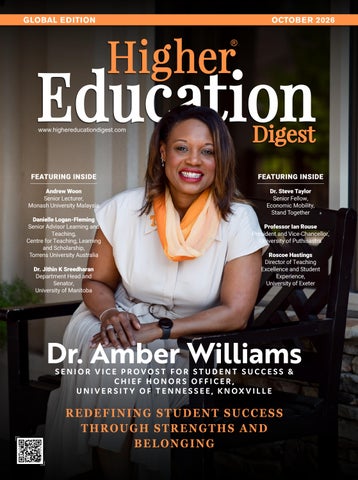
Dr. Amber Williams SENIOR VICE PROVOST FOR STUDENT SUCCESS & CHIEF HONORS OFFICER, U N I V E R S I T Y O F T E N N E SS E E, K N OX V I L L E
REDEFINING STUDENT SUCCESS THROUGH STRENGTHS AND BELONGING Higher Education Digest October 2026
1
2
Higher Education Digest October 2026
3
Higher Education Digest October 2026
October 2026
Managing Editor Sarath Shyam
4
Consultant Editors Dr. John Andrews Naomi Wilson Emma James Stanly Lui Andrew Scott Joseph Alex Creative Consultants Charlie Jameson Edwards Gonzalez Branding & Marketing Partnerships Jennifer Anderson Lucy Jones Alice Smith Anna Elza
Free Subscription
Higher Education Digest October 2026
Vol - 8 Issue - 10
Free Subscription www.highereducationdigest.com International Partnerships Americas Europe Middle East & Africa Asia-Pacific
admin@highereducationdigest.com
Follow Us On
www.linkedin.com/company/ highereducationdigest www.facebook.com/HigherEducationDigest
Higher Education Digest www.highereducationdigest.com is a global knowledge sharing digital platform published by Connecta Innovation Private Limited. All rights reserved. The opinions expressed in the content and pictures provided are those of the authors. They do not purport to reflect the opinions or views of Connecta Innovation Private Limited or any of its members and we do not assume any responsibility. The publisher does not assume any responsibility for the advertisements, its content, pictures, and all representation of warranties made in such advertisements are those of the advertisers and not of the publisher. Higher Education Digest www.highereducationdigest.com is a Free Subscription and Free-to-read digital platform strictly not for sale and has to be strictly for internal private use only. Publisher does not assume any responsibility arising out of anyone modifying content and pictures, printing a copy of this digital platform in any format and in any country and all matters related to that.
MANAGING EDITOR’S NOTE
The Opportunity After Admission
A
university acceptance letter can change a young person’s life. It can bring pride to a family, reward years of hard work, and open doors that once seemed out of reach. Yet the real test begins after the celebrations end. Can the student afford to stay? Will they find the guidance they need? Will they graduate with the confidence and skills to build a fulfilling career? These questions deserve as much attention as admission itself. For many students, the path through college is complicated by financial strain, gaps in academic preparation, family responsibilities, and the challenge of finding their place in an unfamiliar environment. According to the National Student Clearinghouse Research Center, the six-year completion rate for students who began college in fall 2018 at four-year institutions in the United States reached 64.7 percent. The figure offers a sobering reminder that entering college and completing a degree remain two different milestones. Universities must therefore look beyond enrolment figures. They need to ask whether students have the resources, relationships, and direction to make the most of their education. Sometimes, the difference lies in a timely conversation with an adviser, a mentor who recognises a student’s potential, or a support system that helps them
navigate a difficult semester. Small interventions can have lasting consequences. This month’s cover story brings these questions into focus through our conversation with Dr. Amber Williams, Senior Vice Provost for Student Success and Chief Honors Officer at the University of Tennessee, Knoxville. Since joining the university in 2020, she has championed initiatives that help students navigate college with greater confidence and purpose. During her tenure, first-year retention reached 93.1 percent, while the four-year graduation rate rose to 71.4 percent. Her experience, including her earlier work with first-generation scholars, offers valuable lessons on what institutions can do once students walk through their doors. This issue of Higher Education Digest also brings together thought-provoking articles, interviews, and perspectives from across the education sector. Each offers a different lens on the decisions, ideas, and responsibilities shaping higher education. A university’s success should be measured by what happens to its students after they arrive. Every student deserves a fair chance to learn, grow, and complete the journey they began. We invite you to explore this issue and consider how institutions can make that promise a reality. Enjoy reading.
Sarath Shyam
Higher Education Digest October 2026
5
CONTENTS
6
Dr. Amber Williams SENIOR VICE PROVOST FOR STUDENT SUCCESS & CHIEF HONORS OFFICER, U N I V E R S I T Y O F T E N N E SS E E, K N OX V I L L E
REDEFINING STUDENT SUCCESS T H RO U G H S T R E N G T H S A N D B E LO N G I N G
Higher Education Digest October 2026
10 COVER STORY
MENTOR’S MANTRA
20
EMPOWERING COMMUNITIES TO BREAK THE CYCLE OF POVERTY Dr. Steve Taylor, Senior Fellow, Economic Mobility, Stand Together
ACADEMIC VIEW
TRANSFORMING TEACHING EXCELLENCE THROUGH HUMAN CENTERED INNOVATION Roscoe Hastings, Director of Teaching Excellence and Student Experience, University of Exeter
36
7
28
REDEFINING WORKFORCE RESILIENCE FOR THE FUTURE Professor Ian Rouse, President and Vice-Chancellor, University of Puthisastra
Higher Education Digest October 2026
CONTENTS ACADEMIC VIEW
46
8
BEYOND PROMPT ENGINEERING: DEVELOPING HUMAN–AI COLLABORATION THROUGH THE ART OF THE CONDUCTOR Andrew Woon, Senior Lecturer, Monash University Malaysia
THE QUESTION ISN’T AI. IT’S WHAT COUNTS AS EVIDENCE OF LEARNING Danielle Logan-Fleming, Senior Advisor Learning and Teaching, Centre for Teaching, Learning and Scholarship, Torrens University Australia
60
Higher Education Digest October 2026
54
TRANSFORMING ALLIED HEALTH EDUCATION THROUGH INNOVATION AND COMPASSION Dr. Jithin K Sreedharan, Department Head and Senator, University of Manitoba
9
Higher Education Digest October 2026
Dr. Amber Williams SENIOR VICE PROVOST FOR STUDENT SUCCESS & CHIEF HONORS OFFICER, U N I V E R S I T Y O F T E N N E SS E E, K N OX V I L L E
REDEFINING STUDENT SUCCESS T H RO U G H S T R E N G T H S A N D B E LO N G I N G
10
Dr. Amber Williams, senior vice provost for student success and chief honors officer at University of Tennessee, Knoxville, leads initiatives that help students feel known, supported, and prepared to thrive. Since joining UT in 2020, she has advanced programs aligned with removing barriers and building the conditions students need to grow with confidence, community, and purpose: the New Vol Experience, Vol Success Teams, Rocky Top Scholars, University Honors, support for veterans, and career readiness. During her tenure, first-year retention has risen to a record high of 93.1 percent and the four-year graduation rate has risen to 71.4 percent. She is a national speaker, author, and advocate for student flourishing. Recently, in an exclusive interview with Higher Education Digest, Dr. Williams shared insights into how her journey from Wichita, Kansas to becoming Senior Vice Provost for Student Success and Chief Honors Officer at UT Knoxville was shaped by early admissions work at the University of Nebraska-Lincoln and founding the Nebraska College Preparatory Academy for first-generation scholars, reinforcing that access alone is not enough. On trends and AI, she believes universities must become more relevant, present and responsive, integrating critical thinking, responsible AI use, and career and life readiness from day one, not just senior year. Her future goal is to help UT reach and sustain an 80% six-year graduation rate while shaping a new Student Success Center, scheduled to open in fall 2027. Her advice to aspiring leaders is to not wait for a title to lead, focus on environment over metrics, and speak both the language of empathy and strategy. The following excerpts are taken from the interview.
Higher Education Digest October 2026
COV
E
R
ST
ORY
11
Higher Education Digest October 2026
Hi Dr. Williams. Reflecting on the beginning of your journey, what was the defining moment early in your career that made you realize student success was your calling? As a young woman growing up in Wichita, Kansas, I don’t know that I ever imagined my purpose and journey would lead me to empowering young people. In hindsight, though, I believe that path was always spiritually written for me. From my earliest leadership experiences at Northeast Magnet High School to my time at the University of Kansas, and later the University of Nebraska-Lincoln, that positive, forward-thinking student success lens was already there, even before I had a name for it.
12
Higher Education Digest October 2026
That calling became clearer early in my admissions career at Nebraska. I recruited scholars to campus and kept thinking about them long after they enrolled. I couldn’t hand them an admission letter and simply walk away. So I hired some of those same students to work in our office where I could stay connected, mentor them, and help them find their footing. Later, leading the Nebraska College Preparatory Academy and working closely with firstgeneration, low-income scholars, the work became personal. I saw that access alone wasn’t enough. Students also needed high expectations, genuine care, and a campus willing to walk alongside them. That experience confirmed that I wanted to spend my career building institutions
The universities that lead will listen, adapt, and act. They’ll treat scholars as emerging leaders and prepare them to feel seen, challenged, and ready for careers that will keep changing
where every admitted scholar has the support and confidence to reach graduation. As the inaugural Vice Provost, you built a Division whose mission is simple: ensure every scholar is seen, supported, and ready to lead. What excites you most about your role today? I’m most excited by the chance to help a large flagship university care for students in a personal, human way. I’m proud of the progress we’ve made, but I also know the work is never finished. We have to keep listening, learning, and asking whether students experience the care we intend to provide. Higher education often operates with a defined choice between serving thousands of students and knowing each one as a person. Though I know we don’t always get it right, I don’t believe that’s true. Our goal is to make support easier to find and more anticipatory, so students aren’t left to navigate a maze of offices alone. Through our Vol Success Teams, each scholar has an academic advisor, an academic coach, and a financial counselor, placed to
support them before a problem arises. Just as important is student feedback and the need to keep improving how those supports work together. Some of my favorite moments are the simple ones that keep me close to students. I love delivering orange snacks in Hodges Library to scholars we “catch” studying during Orange Dash, eating lunch with students at Vol Voices and hearing their honest feedback, or dancing with new students during New Vol Fest at orientation. Those moments remind me that leadership isn’t only about programs, plans, and outcomes. It’s also about showing up, listening, and being willing to learn from the students we serve. I’m fortunate to work with a team that knows our scholars, believes in them, and cares about who they become. Together, we’re helping students earn degrees while building the confidence, self-awareness, and purpose they’ll carry into their communities and careers. The students are the reason for the work, and they continue to teach me what meaningful support looks like.
Higher Education Digest October 2026
13
14
Higher education is navigating enrollment shifts, workforce needs, and changing student expectations all at once. What is the most significant trend you believe will redefine student success in the next five years? The biggest shift will be toward a university that is more relevant, present, and responsive to students. Universities can no longer set the terms and expect students to navigate the system alone. Students and employers expect honesty, accountability, and a faster response to their needs. A degree remains valuable when institutions stay connected to both. Student success also must shape the whole university, not sit in one office as a safety net. At a recent luncheon, 30 leading employers told us they need graduates who can think critically, ask better questions, use AI responsibly, communicate clearly, and keep learning. I shared their feedback with our academic leaders, and we’re exploring how to integrate those needs in students’ classrooms and co-curricular experiences. Staying relevant requires listening to employers and students, then examining the policies and practices that help or hinder growth. The universities that lead will listen, adapt, and act. They’ll treat scholars as emerging leaders and prepare them to feel seen, challenged, and ready for careers that will keep changing. The conversation around the value of a college degree is evolving rapidly. How do you envision the future of higher education proving its relevance in terms of career readiness and life readiness? Higher education proves its value when career and life preparation begin early, not during a
Higher Education Digest October 2026
student’s final semester. Strong coursework is essential, but I’ve seen that students also need help connecting what they learn to who they are and how they want to contribute. Employers often tell us that graduates know their fields but struggle to explain their strengths, solve problems with others, and navigate complex workplaces. Programs like Vol Edge give our scholars repeated opportunities to connect classroom learning, research, internships, and leadership experiences to real skills. After participating in these high-impact experiences, students need time to reflect and find the language to tell their own stories. We can’t prepare them only for the first job. I want them to leave us ready to adapt, build healthy networks, face uncertainty, and lead with integrity throughout their lives. When graduates leave with both a strong education and a clear sense of themselves, they understand the lasting value of their degree. Honors education and leadership development are under pressure to stay innovative. How do you think academic curriculum will need to evolve to prepare students for jobs that don’t yet exist? I don’t believe an honors education should be about exclusivity or simply assigning more work. Prestige alone doesn’t help students grow. If we’re preparing scholars for industries and technologies that change quickly, the curriculum must teach them how to solve problems, work across disciplines, and adapt. That’s why I’m so excited about the way our faculty redesigned UT’s University Honors curriculum with Gen Alpha in mind. These students will arrive with deep experience in digital spaces, but they’ll also want honesty, relevance, and opportunities to apply what they learn. Our
15 challenge labs bring students from engineering, the humanities, agriculture, business, and other fields together to work on real community and societal problems. I love watching them learn to handle uncertainty, weigh different perspectives, ask better questions, and try again when an idea doesn’t work. Software and job titles will keep changing. Students who can think across boundaries and lead with empathy will be ready for work we can’t yet imagine. Many congratulations on being recognized as one of VIP Knoxville Magazine’s 50 Under 50 leaders. Our readers would love to know the secret mantra behind your success. Thank you. I’m truly grateful for the recognition. Any recognition I receive immediately makes
me think about the people beside me. Achieving the historic gains in retention and graduation rates in such a short period comes only from an entire campus community that cares. If I had to name one guiding belief, it would be to focus on the environment and trust that strong outcomes will follow. I’ve learned to put people first, priorities second, and projects third. It’s easy for leaders to reverse that order and get lost in deadlines, dashboards, and metrics. But I’ve seen again and again that people move institutions forward. When we invest in their strengths, build trust, and create room for new ideas, priorities become clearer and projects gain momentum. When we face a challenge, I don’t ask what’s wrong with the people. I look at the conditions around them and ask what we can improve together.
Higher Education Digest October 2026
16
Transformational leaders are often shaped by powerful stories and ideas. What is a favorite book, podcast, or speech on leadership or human potential that you return to again and again? I don’t return to one podcast or a standard leadership bestseller. I return to ideas that remind me why I chose this work and how I want people to feel in the spaces I help create. When I teach leaders, I often start with Gallup’s four needs of followers: hope, trust, stability, and compassion. Those four needs give me a simple but powerful way to think about leadership. People need to believe there is a path forward. They need to trust the people guiding
Higher Education Digest October 2026
the work. They need enough stability to do their best thinking, and they need compassion from leaders who see them as whole people. I am also a believer in the potential of every person. That belief is why all of my staff and our students take CliftonStrengths. I don’t see it as a label or a box. I see it as a shared language that helps people name what is strong in them and use those strengths with more confidence and purpose. Through a student success lens, I think of myself as a student of human flourishing. I regularly return to Joseph Kitchen’s ecological validation model and Martin Seligman’s PERMA framework for well-being. Ecological validation
is why we do the work. It reminds us that students should experience affirmation, belonging, and support across the whole campus environment, not only in one office or one encouraging conversation. PERMA is how we do the work, with a focus on positive emotion, engagement, relationships, meaning, and accomplishment. CliftonStrengths is one practical tool within that larger philosophy. It helps us focus on what’s possible, build environments where people can flourish, and lead in ways that affirm the dignity, talent, and potential of the people in our care.
My biggest goal is to help UT reach and sustain a six-year graduation rate of at least 80 percent while ensuring that progress reaches every scholar
Your work is about empowering others to lead, which requires immense energy. What is your favorite personal practice or ritual that helps you recharge and stay centered? I stay centered by caring for my faith, my family, and my health. I can’t give my best to others if I’m running on empty. My faith is the quiet anchor beneath everything I do. It brings me back to humility, gratitude, and purpose, especially on demanding days. My husband and our children bring me joy and perspective. They remind me to be fully present, love generously, and help build a world worthy of their curiosity and hopes. One of my favorite parts of the day is walking through the front door, setting the title aside, and simply being Mom and wife. I also start each morning at 4:30 a.m. in our home gym. That quiet time belongs to me. It clears my mind, strengthens my focus, and gives me the energy to lead well. What is your biggest goal? Where do you see yourself in 5 years from now? My biggest goal is to help UT reach and sustain a six-year graduation rate of at least 80
Higher Education Digest October 2026
17
The advice I wish someone had given me early in my career is simple. Don’t wait for a title to start leading, and don’t lose touch with the students you’re here to serve
18
percent while ensuring that progress reaches every scholar. That goal is about more than a number. It represents thousands of students earning degrees, creating new possibilities for themselves and their families, and leaving the university prepared to build meaningful lives and careers. Five years from now, I hope I’m still doing work that opens doors, strengthens institutions, and creates environments where people can flourish. I trust my faith in guiding the exact path, but I know I want to keep using my gifts to help students and the people who serve them succeed. For young professionals who aspire to lead in student affairs and enrollment management, the path can feel unclear. What advice would you give to those just beginning their journey in higher education leadership? The advice I wish someone had given me early in my career is simple. Don’t wait for a title to start leading, and don’t lose touch with the students you’re here to serve. Early in your career, it’s easy to think leadership lives in titles, organization charts, and executive meetings. In reality, strong leaders
Higher Education Digest October 2026
grow by paying attention to the work in front of them. Find the problems no one owns. Notice where a confusing process or a poor handoff makes life harder for students, then help close the gap. Thoughtful solutions to real problems will build trust faster than a new title ever could. Look for both mentors and sponsors and know what each one does. A mentor talks with you and helps you reflect, grow, and understand how higher education works. A sponsor talks about you and uses their influence to bring your name into rooms where opportunities are discussed. Build real relationships with leaders you respect, do excellent work, and give people a reason to speak up for you when you aren’t in the room. Learn to speak the language of empathy and the language of strategy. You need the heart to listen to a student, honor their experience, and walk beside them. You also need to understand data, budgets, and institutional priorities so good ideas can last. I’ve needed both in every leadership role I’ve held. Keep people at the center, surround yourself with people who will challenge and support you, and take the next right step as it comes. You don’t have to see the whole path to begin.
19
Higher Education Digest October 2026
MENTOR’S MANTRA
Empowering Communities to Break the Cycle of Poverty Dr. Steve Taylor, Senior Fellow, Economic Mobility, Stand Together
Dr. Steve Taylor is a national leader at the intersection of education and workforce policy and practice, with more than two decades of experience. He serves as Policy Director and Senior Fellow for Economic Mobility at Stand Together Trust, a national social impact philanthropy, and in 2024, Taylor was appointed by Virginia Governor Glenn Youngkin to serve a 4-year term on the State Council of Higher Education for Virginia (SCHEV), the Commonwealth’s coordinating body for higher education. In 2025, he was appointed by U.S. Secretary of Education Linda McMahon to the National Advisory Committee on Institutional Quality and Integrity. Recently, in an exclusive interview with Higher Education Digest, Steve shared insights into a career built on connecting education to real economic mobility. He also shared how his latest book ‘Together We Climb’ maps the stages of moving from poverty to prosperity and calls on employers, communities, and everyday people to help others climb. His advice to early-career professionals is to get close to the problem, build genuine relationships, and pair data with the human stakes. Looking ahead, Steve hopes to build something of his own that expands opportunity, strengthens human agency, and helps more people climb out of poverty. The following excerpts are taken from the interview.
20
Higher Education Digest October 2026
Hi Steve. Please tell us about your background and what drew you to economic mobility and education reform. I’ve spent more than two decades working at the intersection of education and workforce policy, starting at the American Council on Education, where I led national initiatives on teaching and learning, nondegree pathways, and higher education quality. In 2019, I founded ED2WORK to work directly with states, companies, and nonprofits on strengthening education and skills pathways for adult and working learners, and I currently serve as Policy Director and Senior Fellow for Economic Mobility at Stand Together Trust. What’s drawn me to this work is a simple observation I kept running into across all these roles: we’ve built an education and workforce system that too often measures the wrong things, tracking enrollment and credit hours instead of whether people actually end
up in good, stable jobs. Fixing that mismatch, so that a credential reliably translates into real economic mobility, is the throughline across everything I’ve worked on. What’s most rewarding about the work you’re doing at the intersection of education? It’s watching the moment when a policy or a program actually translates into someone’s life changing, not just on paper, but in quality of life. I think about Virginia FastForward, a workforce credential program I’ve watched up close, where the state only pays colleges in full if a student actually completes their program and lands an industry credential. In one recent year, students in that program saw their median wages jump by 50 percent within twelve months of certification. That’s the difference between choosing between rent and groceries and being able to cover both. What’s rewarding
By 2030, I expect the advantage won’t belong to people with a single static credential, but to people who’ve built the capacity to learn, adapt, and reskill continuously through short, stackable pathways that connect directly to real jobs
Higher Education Digest October 2026
21
is being part of the work that connects good policy design to that kind of real, measurable movement in someone’s life. You’ve spent your career at the intersection of higher education and workforce development. How do you see that relationship evolving — and what needs to change for it to actually work for learners? For a long time, higher education and workforce development operated as if they were solving
22
Higher Education Digest October 2026
different problems, when in reality they’re serving the same person trying to build a better life. I think we’re finally seeing federal policy catch up to that reality. The One Big Beautiful Bill Act redirects a meaningful share of federal loan dollars away from an unconditional bet on four-year degrees and toward shorter-term, workforce-aligned credentials. For the first time, it ties a college’s continued eligibility for federal loans to whether its graduates actually out-earn similarly aged workers without those credentials. That’s a
significant shift, from a system that rewarded enrollment to one that has to answer for outcomes. It matters because the mismatch has become too large to ignore: nearly four in ten undergraduates never finish their degree, and among those who do, roughly half end up in jobs that never required one in the first place. What needs to change next is making sure we’re building in real evidence at the program level, the way Colorado has done by partnering with researchers to track outcomes through actual state wage records instead of relying on
anecdote. If we want this relationship to actually work for learners, both the credential and the aid behind it have to be judged by whether people’s lives measurably improve. Accreditation is a perennial topic in higher ed reform conversations. What’s your take on where the system stands today and what meaningful reform could look like? Accreditation was built to protect quality, and that mission still matters. But the system as it stands today still ties access to public investment almost entirely to traditional, accredited institutions, and that’s increasingly out of step with where good outcomes are actually being produced. Meaningful reform means shifting our definition of quality away from inputs like seat time and toward outcomes like completion, employment, and wage growth, while building legitimate pathways for high-performing, nontraditional providers to be recognized without lowering the bar on rigor. That’s a needle we can thread, but it requires accreditors, states, and the federal government to actually agree on what evidence of quality looks like. How will AI reshape workforce development by 2030? AI is already changing how work gets done faster than our education systems can adjust to it, which strengthens the case for shorter, more adaptable learning pathways. A four-year credential becomes a much bigger bet when an entire industry can look different by the time someone graduates. By 2030, I expect the advantage won’t belong to people with a single
Higher Education Digest October 2026
23
static credential, but to people who’ve built the capacity to learn, adapt, and reskill continuously through short, stackable pathways that connect directly to real jobs. At the same time, I think we have to be honest about a risk on the other side of this: as AI gets more humanlike, there’s a real danger that we start substituting synthetic interaction for real human connection, whether that’s an AI coach standing in for an advisor or an AI companion standing in for a mentor. The technology can help someone build a resume, but it can’t sit with them through a hard moment or tell them they’re capable when they don’t believe it themselves. Workforce development in 2030 has to pair AI-era skills with intentional investment in the human relationships, mentorship, and social capital that actually move people forward.
24
What’s your vision for economic mobility through education — and where do you see the biggest gaps between where we are and where we need to be? My vision is a system where a credential reliably leads somewhere: to a real job, a real wage, and a real path forward, regardless of whether that credential came from a traditional four-year institution or a shorter workforce-aligned program. The evidence for why this matters keeps stacking up: we’ve spent decades subsidizing a system built on the assumption that borrowing for a four-year degree was almost always worth it, even as tuition climbed and the connection between a degree and a good job weakened. Meanwhile, research shows millions of Americans without a bachelor’s degree already have the skills to succeed in high-wage work, but a “paper ceiling” of degree requirements has kept them locked out.
Higher Education Digest October 2026
Policy alone can become hollow if it loses sight of the people it’s meant to serve, but good intentions without the power to actually change systems don’t scale either. You need both
We’ve built a lot of separate, disconnected programs and policies, some rewarding enrollment, some rewarding completion, some rewarding neither, that each do good work in isolation but rarely add up to durable economic mobility for the people they’re meant to serve. We need policy that’s honestly evaluated by whether it produces that kind of mobility, and systems that stay accountable to people across their whole career. You have a new book coming out this October — Together We Climb: A Community-Driven Approach to Break the Cycle of Poverty and Build Prosperity, co-authored with Jason Janz from Cross Purpose. Can you tell us about the book — what’s the central argument, and what do you hope readers take away from it? Together We Climb argues that poverty in America isn’t a single problem with a single fix, and it isn’t a personal failure. It’s a complex climb shaped by broken systems, disconnected supports, and unclear pathways, and solving it requires both better policy and a different posture from communities. Jason and I bring two different vantage points to this: his years building CrossPurpose alongside families in Denver, and my work reforming education and workforce policy at the state and federal level. Together, we lay out two frameworks. The Mountain Model maps the actual stages of the climb from poverty to prosperity and explains why each stage requires a different kind of support. The Navigation Approach is the solution: a relational strategy built on proximity, possibility, and pathways that anyone, not just program leaders, can use to help someone else climb.
What I hope readers take away is that this isn’t only a job for policymakers or nonprofits. It’s a job for employers, communities, and everyday people willing to build real relationships with people trying to get ahead. What is your favorite quote? “Far and away the best prize that life offers is the chance to work hard at work worth doing.” Theodore Roosevelt, a 1903 Labor Day address to the New York State Agricultural Associatio What are some of your passions outside of work? I’m a total dog dad, so most of my social life is dictated by things we can do to involve our very energetic five-year old Black Mouth Cur mix. I enjoy swimming or kayaking on the lake, wine tasting in my hometown in California or my current home in Charlottesville, Virginia. And I enjoy international travel, having now set foot on four continents. What is your biggest goal? Where do you see yourself in five years? I want my life to expand what’s possible for other people and to leave behind something worth carrying forward. This is a reflection of how my mom lived her life and the legacy she left behind through her service, compassion, and relationships. This is why it was so important to write Together We Climb, to provide a useful framework that others could use to amplify their impact in communities across this country. In five years, I see myself having built something of my own that gives me greater freedom and independence. I want to spend more time with the people I love and travel while I have my
Higher Education Digest October 2026
25
26
health and use my independence to shape the institutions and ideas that expand opportunity, strengthen human agency, and enable more people to climb out of poverty. Success to me would be having both: the freedom to live life on my own terms and the ability to use that freedom to make a meaningful difference. What advice would you give to earlycareer professionals looking to make a positive impact in higher education and workforce development? Get close to the problem before you try to solve it. Some of the best policy ideas I’ve seen didn’t
Higher Education Digest October 2026
start in a legislative hearing room; they started in a classroom, a workplace, or a community program, where someone was close enough to see the real barrier and creative enough to try something new. My advice is to spend real time in proximity to the people your work is meant to serve, build genuine relationships rather than transactional ones, and hold onto both the data and the human stakes of this work. Policy alone can become hollow if it loses sight of the people it’s meant to serve, but good intentions without the power to actually change systems don’t scale either. You need both.
27
Higher Education Digest October 2026
ACADEMIC VIEW
Transforming Teaching Excellence Through Human Centered Innovation Roscoe Hastings, Director of Teaching Excellence and Student Experience, University of Exeter
28
Roscoe is the Director of Teaching Excellence & Student Experience at the University of Exeter. Roscoe is responsible for delivery of the University’s education and student experience in support of the University’s 2030 strategy including responsibility for the TEF and NSS. His remit includes delivery of key education and academic services including Registry, Library, Careers, Student Administration, Exams and Timetabling. Roscoe has held several senior positions in higher education administration. Roscoe is currently the Deputy Chair of Trustees at Sheffield Students’ Union, Secretary of Exeter Pride and Editorial Board Member for the journal Perspectives: Policy and Practice in Higher Education. Recently, in an exclusive interview with Higher Education Digest, Roscoe shared insights into how his journey from a Psychology degree and Masters in Public Policy through five universities shaped his belief that professional services can be transformative, not just administrative. On trends, he identified Generative AI as the most significant force redefining teaching excellence, arguing it forces universities to rethink the very purpose of a degree beyond knowledge transmission to judgement, critical thinking and adaptability. Looking ahead, Roscoe shared his goal of deepening his impact on how universities translate strategy into action as he embarks on a DBA in Higher Education Management at Bath, while championing authentic, boundaryspanning leadership and advising aspiring leaders not to wait until they feel completely ready. The following excerpts are taken from the interview.
Higher Education Digest October 2026
29
The part of my role that energises me most is the opportunity to turn institutional ambitions – that sometimes begin as germs of ideas into things that actually make a difference to students and staff
Higher Education Digest October 2026
30
Hi Roscoe. Your journey began with a Psychology degree and a Masters in Public Policy, leading you through five universities. What was the defining moment that made you realise higher education professional services was where you wanted to build your career? I don’t think there was one single lightbulb moment. It was more a gradual realisation that I could have an impact through a career in higher education – one that was aligned with my values and that gave me opportunities that could be explored in many different ways through different roles and universities. My Psychology degree initially gave me an interest in people and how they think and behave, while my Masters in Public Policy developed my interest in how institutions make
We need to stop thinking of student voice as a mechanism for improving services and start seeing students as partners in the design and governance of their educational experience
Higher Education Digest October 2026
decisions and how policy translates into practice. Higher education brought those two things together in a really interesting way. Universities are incredibly complex organisations: they are places of learning and research, but they are also communities, employers, public institutions and increasingly organisations operating in a very competitive and complex environment. Having worked across five universities, I’ve had the opportunity to see very different organisational cultures and approaches to change. What has kept me in higher education is the sense that professional services can have a genuinely transformative role working alongside and with academic colleagues and students. We aren’t simply there to administer what academics and students do; we can help create the conditions in which excellent education and research happens.
The defining moment, therefore, was probably realising that I wanted to be someone who helped shape how universities work, rather than simply working within the systems they had already created. That combination of strategy, people, policy and ultimately improving the experience and outcomes of students is what has kept me here. As Director of Teaching Excellence and Student Experience, your role sits at the intersection of strategy, policy, and student outcomes. What part of your current portfolio energizes you the most and gives you the deepest sense of purpose? The part of my role that energises me most is the opportunity to turn institutional ambitions – that sometimes begin as germs of ideas into things that actually make a difference to students and staff. I’m particularly interested in finding ways to support the personalization of learning for students – which in an increasingly mass higher education context can be difficult – but is so important to ensure that students are learning and developing their disciplinary knowledge and wider skills in the way that best supports their needs. That also connects strongly to my work around student voice and engagement. I’m a big believer that students shouldn’t just be viewed as recipients of an education designed by other people. They have expertise in their own experience, and universities are better organisations when they create meaningful ways for that expertise to influence decisions. I probably get the greatest sense of purpose when I can bring different perspectives
together – students, academics, professional services and senior leaders – and help move a conversation from ‘this is difficult’ towards ‘this is what we can actually do about it’. In a sector experiencing enormous change, that feels increasingly important Higher education is at an inflection point globally with changing student expectations and funding pressures. In your view, what is the single most significant trend that will redefine teaching excellence and student experience in the next five years? For me, it is generative AI, but perhaps not in the way that we currently talk about it. The obvious conversation is about AI and assessment: how do we prevent misuse, how do we redesign assessment and how do we maintain academic standards? Those questions matter, but I think the bigger issue is that AI is going to force universities to reconsider what we believe a degree is actually for. If students can increasingly access tools that can generate text, analyse data, code, translate languages and provide highly personalised tutoring, then simply transmitting knowledge becomes a much less distinctive part of the university experience. The value of higher education increasingly has to be in developing judgement, critical thinking, creativity, collaboration, disciplinary identity and the ability to apply knowledge in complex and uncertain situations. That has significant implications for pedagogic practice. We need to move from asking ‘how do we teach in an AI world?’ to ‘what should an excellent education look like in an AI world?’
Higher Education Digest October 2026
31
I also think this will change student expectations. Students will increasingly expect education to be personalised, responsive and connected to the world beyond the university. The institutions that respond most successfully won’t necessarily be those that adopt the most technology; they’ll be those that are clearest about where technology adds value and where the human relationships at the heart of education matter most.
32
Student engagement and student voice are moving from consultation to genuine partnership. How do you believe universities must rethink their approach to student engagement to meet the expectations of Gen Z and Gen Alpha learners? I think the biggest shift is from asking students for their views to giving students genuine influence. Consultation is relatively easy. We can run a survey, hold a focus group, invite students to a meeting and say that we have listened. Partnership is much harder because it requires universities to be prepared to change their minds. For me, meaningful engagement starts with being much clearer with students about where they have influence, what decisions have already been made and what is genuinely open for discussion. It also means closing the feedback loop. Students are much more likely to engage when they can see what happened as a result of their contribution, including when the answer is ‘we listened, but we couldn’t do that because…’ I don’t think this is simply a generational issue, either. Gen Z and increasingly Gen Alpha may have different expectations
Higher Education Digest October 2026
around immediacy, transparency and digital communication, but the underlying principle is universal: people want to know that their voice matters; and in a world where lifelong learning is going to also define how universities can be places that learners return to throughout their careers, it wont just be those in the 1821 year old category that we will need to be partnering with – we need to think about how engagement is effective and impactful with learners who are online, distance, completing CPD, undertaking degree apprenticeships or may be studying internationally through Transnational partnerships. The challenge for universities is therefore cultural as much as technological. We need to stop thinking of student voice as a mechanism for improving services and start seeing students as partners in the design and governance of their educational experience. That is a much more powerful proposition. We are seeing a growing focus on graduate outcomes, skills, and employability rather than just degree attainment. What shift do you think universities need to make to ensure student success is measured more holistically? I think we need to become much better at distinguishing between what is easy to measure and what actually matters. Degree attainment remains important, but it is only one part of the story. A successful university experience should also be about what students are able to do, who they have become, the opportunities they have accessed, the relationships and networks they have developed and what happens to them after graduation.
That means thinking much more seriously about skills, graduate outcomes, confidence, agency, belonging and social mobility alongside traditional academic measures. It also means being careful about the language of ‘employability’. We shouldn’t reduce the purpose of higher education to producing employees. Rather, universities should equip graduates with the knowledge, capabilities and adaptability to navigate a rapidly changing world and make a meaningful contribution to it.
Good leadership isn’t just about having the right answer. It’s about understanding people well enough to create the conditions in which good decisions and good work can happen
I’m particularly interested in the role of data here. We have more information about students and their experiences than ever before but having more data doesn’t automatically mean making better decisions. The challenge is to use data intelligently alongside professional judgement and, importantly, student voice. Ultimately, I would like us to define success not simply as ‘did the student get a degree?’ but ‘what did their higher education experience enable them to become and to do?’. Not an easy question to answer but is one that matters.
Leadership books often shape how we think about people and policy. Is there a book on psychology, policy, or leadership that you have returned to multiple times and that has left a lasting imprint on your approach? One book – well two - I’ve returned to are Align and Re:Align by Jonathan Trevor because I got to work closely with him when I was the Director of Academic Services at Saïd Business School, University of Oxford and I was able to learn from some wonderful academic colleagues at the cutting edge of leadership and management research. What has stayed with me isn’t necessarily a particular leadership technique, but the way it made me think differently about people, organisations and decision-making. One of the things I’ve learned throughout my career is that organisational problems are very rarely purely organisational. They are usually about people: how people perceive change, how they respond to uncertainty, what motivates them and how they interpret the decisions being made around them. That perspective has been particularly useful in higher education, where change can be intellectually and emotionally complex. Universities are communities of highly skilled people with strong professional identities, so you can’t simply announce a strategy and expect it to happen. You have to understand the people who will make it real. I think that’s probably the lasting lesson I take from the book: good leadership isn’t just about having the right answer. It’s about understanding people well enough to create the conditions in which good decisions and good work can happen.
Higher Education Digest October 2026
33
34
You are passionate about strategy and governance, which requires deep focus. What is your favourite way to disconnect, recharge, and find clarity outside the fast-paced world of higher education? One of the things I value most outside work is having time where I don’t have to solve anything. Higher education leadership can be quite cognitively demanding because you’re constantly moving between the strategic and the immediate: thinking about a five-year institutional ambition one minute and dealing with a very practical problem about the timetable the next. I’ve found that the best way to get perspective is often to step away from that completely. For me, that means getting some time in the gym and also a lot of running. I particularly value the fact that it gives me some mental distance from work. Quite often I’ll find that a problem I’ve been turning over in my head suddenly becomes much clearer when I’m not actively trying to solve it. I think there’s a lesson in that for leadership too. We can sometimes equate being busy with being productive, when actually some of our best thinking happens when we create enough space to think properly. What is your biggest goal? Where do you see yourself in 5 years from now? My biggest goal is probably less about reaching a particular job title and more about having a meaningful impact on how higher education organisations work. I’m fascinated by the relationship between strategy, leadership, governance and
Higher Education Digest October 2026
organisational effectiveness. In five years, I’d like to have developed that further – both through my professional leadership and through deeper academic thinking about higher education management. I’m just about to embark on a Doctorate in Business Administration in Higher Education Management at the University of Bath and so being able to apply some of my practice into academic thought and inquiry is really exciting. I’m particularly interested in the question of how universities use performance measures and targets to translate strategy into action. Metrics can be incredibly powerful, but they can also create unintended behaviours if we don’t think carefully about what we measure
Some of the most valuable career opportunities I’ve had have come from being prepared to step into something that wasn’t necessarily in my job description
and why. That’s an area I’d like to explore much further. I’d also like to continue developing as a leader who can operate across organisational boundaries rather than being defined by a single professional-service discipline. The issues facing universities increasingly cut across traditional structures, so I think the leaders who can connect strategy, education, students, people, data and governance will be particularly valuable. So, in five years, I hope I’m doing something that is challenging me intellectually, gives me the opportunity to lead people well and, most importantly, allows me to make a tangible contribution to improving higher education.
For aspiring leaders, especially women and young professionals looking to enter higher education leadership, what is the most honest and practical piece of advice you would offer that you wish someone had given you earlier in your career? The advice I wish someone had given me earlier is that you don’t have to wait until you feel completely ready to take the next step. I think particularly for people who are conscientious and care about doing a good job, there can be a tendency to believe that you need to have mastered your current role before you are entitled to aspire to something bigger. In reality, leadership is largely about learning to operate in situations where you don’t have all the answers. I’d also say: don’t confuse being good at your job with being visible for the right reasons. Build relationships, understand how your organisation actually works, develop a reputation for being someone people can trust and be willing to take on difficult problems. Some of the most valuable career opportunities I’ve had have come from being prepared to step into something that wasn’t necessarily in my job description. And finally, particularly for women, LGBTQ+ and other people who may not always see themselves represented in senior leadership, don’t make yourself smaller to make other people comfortable. You can be collaborative without being passive, empathetic without avoiding difficult decisions and ambitious without apologising for it. You don’t have to adopt somebody else’s version of leadership to be a good leader. The most effective leaders I’ve worked with have been authentic, curious and willing to keep learning. I’d encourage aspiring leaders to concentrate on becoming that person rather than trying to look like a stereotypical senior leader.
Higher Education Digest October 2026
35
ACADEMIC VIEW
Redefining Workforce Resilience for the Future Professor Ian Rouse, President and Vice-Chancellor, University of Puthisastra
36
Professor Ian Rouse is President and Vice Chancellor of the University of Puthisastra, Cambodia. An epidemiologist and higher education leader, he has more than 35 years’ senior leadership experience across universities, government, health systems and international development in Australia and the Asia-Pacific. His previous roles include Acting Vice-Chancellor of Fiji National University and senior academic leadership positions at Victoria and Curtin Universities. His career has encompassed public health, health information, research, ICT, workforce development and education. He is passionate about people-centred leadership, using evidence for decision-making, and empowering the next generation to improve health, education and their communities. Recently, in an exclusive interview with Higher Education Digest, Prof Rouse shared insights into how his journey from biochemistry and nutritional epidemiology to a PhD and postdoctoral work at Harvard shaped his belief that evidence alone does not change systems, people do, a philosophy that guided his 35+ year leadership across health systems, government, and universities. He discussed empowerment as giving people the time and permission to think, the transformative convergence of AI, data, digital health and competency-based education, and the need for e-learning to move from access to measurable outcomes. On his landmark MoU with the Cambodian Cerebral Palsy Network, he highlighted its impact through registry, multidisciplinary education and research. His future focus is on developing Cambodian leaders who are globally confident and locally committed, building resilient workforces through strategic capability development, and leaving a legacy where institutions remain strong after he leaves. The following excerpts are taken from the interview.
Higher Education Digest October 2026
37
You can demonstrate leadership as a student, nurse, lecturer, researcher, administrator or clinician. If you see something that can be improved and bring people together to improve it, you are already leading
Higher Education Digest October 2026
38
Your career uniquely bridges Higher Education and the Health Industry across Australia and the Asia-Pacific. What was the initial spark that made you want to connect these two seemingly distinct worlds? Interestingly, I never set out with a career plan to connect higher education and health. The connection evolved naturally. I began as a scientist, completing firstclass honours in biochemistry and then a PhD in nutritional epidemiology. Later, as a postdoctoral fellow at Harvard Medical School and the Harvard School of Public Health, I became increasingly interested in epidemiology, population health and the power of evidence to improve health decisions. As my career developed, however, I realised that evidence alone does not change systems. We need people who can understand evidence, translate it into decisions and have the confidence to lead change. That became particularly clear during my years in the Western Australian health system. I moved from research into leadership of epidemiology, statistics and health information, ultimately managing strategic information resources. We were already working with data linkage, population health information and decision support - issues even more important today. Higher education became part of the same journey. I found myself asking not only, ‘What does the evidence tell us?’ but also, ‘How do we develop people capable of using that evidence to improve health?’ and ‘How can we justify spending vast amounts on collecting health information if it is not used to improve health for everyone?’
Higher Education Digest October 2026
My subsequent career across universities in Australia, Fiji and Cambodia has reinforced my belief that education and health are not separate worlds. Universities develop the
people, knowledge and innovation on which effective health systems depend. That has been the common thread throughout my career.
Your passion for empowerment of people is evident across your roles. What does empowerment truly mean to you when working with a frontline health worker versus a senior university executive? For me, empowerment means helping people recognise that they have both the capacity and the responsibility to make a difference, whatever their position in an organisation. I have worked with researchers and statisticians, frontline health professionals,
Universities develop the people, knowledge and innovation on which effective health systems depend. That has been the common thread throughout my career
middle managers, academics, professional staff and senior executives. I have also spent many years delivering leadership and management development programs across the Asia-Pacific. I have learned that empowerment is remarkably similar at every level. A frontline health worker needs the competence and confidence to recognise a problem, decide appropriately and advocate for a patient. A senior university executive may be responsible for thousands of students,
hundreds of staff and substantial resources, but the principle is the same: understand your responsibilities, make evidence-informed decisions, take ownership and be accountable. One phrase I often use is that people need both the time and permission to think. Highly hierarchical organisations can unintentionally teach people to refer all decisions upwards. Senior leaders then become bottlenecks while talented people elsewhere in the organisation stop developing. My role as a leader is not to make every decision. It is to establish a clear vision and expectations, put good people around me, give them opportunities to succeed, challenge them to extend themselves, and support them when things do not go perfectly. I gain far more satisfaction from watching someone grow into a leader and make a significant contribution than from being recognised personally for something the organisation has achieved. Both higher education and healthcare are at an inflection point globally. What do you believe will be the most transformative convergence between education and health sectors in the next five years? I believe the most transformative convergence will occur around AI, data, digital health and competency-based education. Information and technology have been part of my career for decades. Long before today’s discussion about AI, I was working with health information systems, data linkage, decision support and population data to improve health planning. Later, in universities, I became involved in ICT leadership, flexible learning
Higher Education Digest October 2026
39
40
and digital education. The technology has changed dramatically, but the fundamental question remains: how do we turn information into better decisions? In health professional education, AI creates extraordinary possibilities for personalised learning, simulation, immediate feedback and clinical decision support. At the same time, competency-based education is moving us away from measuring education predominantly by time spent in classrooms and towards what graduates can actually demonstrate they can do. Universities cannot prepare tomorrow’s health professionals using yesterday’s educational model. However, technology itself is not transformation. The test is whether it improves learning, clinical decision-making, research productivity or health outcomes. That is our approach at the University of Puthisastra. We are enthusiastic about AI, but equally serious about governance, ethics and professionalism, and about ensuring that technology empowers people rather than replaces human judgement. e-Learning programs have exploded since the pandemic but quality remains uneven. Where do you see the next frontier for e-Learning moving beyond access to actual empowerment and measurable outcomes? We sometimes forget that e-learning existed long before COVID-19. A quarter of a century ago, I was involved in flexible learning, telehealth and online education, including advising the Fiji School of Medicine’s Flexible Learning and Telehealth Unit. The pandemic dramatically accelerated adoption but also exposed an important
Higher Education Digest October 2026
distinction: online delivery is not necessarily good online learning. Putting a lecture on a learning management system provides access; it does not tell us whether students learned anything. The next frontier must therefore be personalised, active and measurable learning. Students should solve problems, practise skills, receive rapid feedback, collaborate and see their progress towards clearly defined competencies. AI offers opportunities that were unimaginable when I first became involved in e-learning. We can provide individualised support to thousands of students, identify those struggling earlier, and enable academics to spend less time on repetitive activities and more on education’s human aspects mentoring, discussion, critical thinking and professional development. But my epidemiology background prompts me to ask a simple question: where is the evidence? Did students learn more? Did weaker students improve? Did competency improve? Was faculty time used more effectively? The future of e-learning should not be measured by the amount of content online. It should be measured by what students can do now that they could not do before. Workforce shortages in both health and education are a global concern. What fundamental shifts in leadership development and HR management will be required to build resilient, futureready workforces? My experience in many countries has convinced me that we cannot simply recruit our way out of workforce problems.
I have led organisations through restructuring, financial pressure, rapid growth, mergers and significant change. One lesson remains constant: sustainable organisations invest in the capabilities of the people they already have. This became particularly evident in Fiji. As Dean, I worked not only with one institution but with health workforce needs across Pacific Island countries. We developed programs, strengthened research and worked with governments and international partners. The College secured approximately FJD50 million in external development, research and training funding, but its purpose was to build regional capability. HR must therefore move from personnel administration towards strategic workforce development. We should identify emerging leaders before they receive leadership titles. Give them projects, opportunities to chair committees, and exposure to budgets, strategy and difficult decisions. Mentor them but allow them to make mistakes. I tell creative staff that if they have ten ideas and several fail, the organisation will still support them.
We also need to rethink the capabilities future professionals require. Digital and AI literacy, adaptability, communication, interdisciplinary teamwork and the ability to manage change will increasingly complement traditional professional expertise. Most importantly, people need purpose. Talented people at every level are more likely to stay when they believe their work matters, see opportunities to grow and feel that their contribution is valued. Many congratulations on the landmark MoU between the University of Puthisastra and the Cambodian Cerebral Palsy Network (CCPN). What inspired you to formalize this partnership at this moment, building on CCPN’s remarkable journey, and how do you see it benefiting children and adults living with cerebral palsy, their families, and UP students through registry, research, and multidisciplinary education? What attracted me to the Cambodian Cerebral Palsy Network is that this is not simply an
The technology has changed dramatically, but the fundamental question remains: how do we turn information into better decisions?
Higher Education Digest October 2026
41
42
The future of e-learning should not be measured by the amount of content online. It should be measured by what students can do now that they could not do before
institutional partnership. It addresses a very real need for Cambodian children, adults and families. Cerebral palsy requires multidisciplinary care, yet in many lower-resource settings services, information and research remain fragmented. CCPN has developed an important network and vision for changing that in Cambodia. For UP, the question was: what can a university contribute that genuinely adds value? We can contribute education, research capacity, and students and faculty from multiple
Higher Education Digest October 2026
health disciplines, while developing evidence to improve services. The emerging registry is vital because good policy and services require good data. Understanding who is affected, their needs, services and outcomes provides a foundation for research, advocacy and better planning. There is also enormous educational value. Our medical, nursing, pharmacy, dentistry and other health science students must understand that people do not experience healthcare as separate disciplines. A child with cerebral palsy and their family may interact with many
professionals. Bringing students together around real needs develops multidisciplinary thinking early in their careers. Most importantly, the partnership must benefit people living with cerebral palsy and their families. Universities should not conduct research simply to produce publications. Research, education and service should ultimately translate into better lives. This reflects something I have believed throughout my career: universities should not stand apart from the communities they serve. Some of the most valuable partnerships bring universities, health services, community organisations and families together around real human need. A background in epidemiology and public health often comes with a deep curiosity about human stories. Is there a favorite book, research study, or thinker that has profoundly influenced your worldview on empowerment? Earlier in my career I encountered James Belasco’s Flight of the Buffalo, and its central leadership idea has stayed with me. The metaphor is simple but powerful. A herd of buffalo follows its leader, so if everything depends on that leader, the organisation becomes vulnerable. The alternative is an organisation in which people throughout the system can think, take responsibility and lead. That resonated enormously with me. I also attended a full-day workshop with Edward de Bono and was attracted to his work on creative thinking. Later, as my interest in leadership and management developed, John Kotter’s Leading Change became another favourite.
Over many years of leading universities, health organisations and teams, I have seen how easily senior leaders can unintentionally create dependency. If every significant decision has to reach the President, Vice-Chancellor, Dean or Director, that is not strong leadership; it is an organisational weakness. I increasingly ask: how do we create more leaders rather than followers? My background in problem-based learning reinforces this idea. A good educator does not simply provide answers. We give students meaningful problems, support them and challenge them to discover solutions. Leadership works similarly. Empowerment means creating an environment in which people have the confidence, capability and permission to think for themselves - and then helping them do the same for others. Looking forward, how would you like to continue contributing to leadership development and the empowerment of people in the next chapter of your career? At this stage of my career, I increasingly think about legacy not in terms of positions I have held, but in terms of people and institutions that are stronger because I was there. I have worked in Australian health systems, universities, international development projects and institutions across the Pacific and Southeast Asia. I have led research organisations, faculties and universities, and worked with health professionals and managers across many countries. My career spans more than 35 years of senior leadership and has been shaped by around 20 countries and cultures.
Higher Education Digest October 2026
43
44
But for me, experience only has value if you pass it on. At UP, one of my top priorities is developing Cambodian leaders - academics, researchers, clinicians, professional staff and emerging executives - who are confident operating internationally while remaining deeply committed to Cambodia. I want younger colleagues to lead projects, undertake research, develop international partnerships, and experiment with AI and new educational approaches. They must also be allowed occasionally to get things wrong and learn. For me, the ultimate test of leadership often comes after I leave. If an organisation remains strong, people continue developing and the next generation of leaders achieves things I could never have achieved myself, that is a legacy worth having. Many talented people in health and education struggle to be seen as leaders. What practical advice would you give them on challenging themselves and stepping into leadership even without a formal title? Do not wait to be appointed a leader before you start leading. My own career was neither straight nor typically academic. I began in biochemistry and nutritional research, moved into epidemiology, health information and government management. Then came ICT, university research leadership, executive deanships, international health education and, eventually, Vice-Chancellor and President roles. Many of the most important transitions involved accepting responsibilities for which
Higher Education Digest October 2026
I did not necessarily have the conventional background. That taught me several things. Take responsibility for problems rather than walking past them. Move beyond your professional comfort zone. Learn from people who know more than you do. Use evidence rather than ego. When something does not work, acknowledge it quickly, learn and move forward. I also encourage younger professionals not to confuse leadership with status. You can demonstrate leadership as a student, nurse, lecturer, researcher, administrator or clinician. If you see something that can be improved and bring people together to improve it, you are already leading. Perhaps most importantly, help other people succeed. The leaders I admire most are not necessarily those with the biggest titles. They are the people whose presence causes others to become better.
45
Higher Education Digest October 2026
ACADEMIC VIEW
Beyond Prompt Engineering: Developing Human–AI Collaboration Through the Art of the Conductor Andrew Woon, Senior Lecturer, Monash University Malaysia
46 Dr Andrew Woon is a Senior Lecturer at Monash University Malaysia. Before returning to Malaysia, he held academic appointments in the UK at Queen Mary University of London, London South Bank University, and the University of Greenwich. His research focuses on student wellbeing, collaborative learning, and studentcentred learning. Andrew has a keen interest in the Scholarship of Teaching and Learning (SoTL), and his writings have been featured in the Higher Education Policy Institute, AACSB Insights, the Chartered Association of Business Schools, Times Higher Education, and the British Educational Research Association.
Higher Education Digest October 2026
47
Teaching static prompt templates risks preparing students for an evolving interface rather than the deeper challenge of working effectively with AI
Higher Education Digest October 2026
J
48
ust a year ago, educational discourse on Artificial Intelligence (AI) was dominated by prompt engineering, with workshops and guides teaching formulaic techniques to elicit better responses. This approach treated AI as a technical lock and the prompt as its key. However, rapid advances in generative AI have changed this landscape. With stronger reasoning, multimodal capabilities, and increasingly agentic workflows, AI can now infer context, intent, and goals with less reliance on carefully engineered prompts. While prompt engineering remains useful, it is better understood as an elementary AI literacy skill rather than the defining capability of human–AI collaboration. Teaching static prompt templates risks preparing students for an evolving interface rather than the deeper challenge of working effectively with AI. The real challenge is no longer simply generating content, but evaluating, refining, and directing AI outputs. Pedagogy must therefore shift from prompt syntax to epistemic judgement: the ability to ask meaningful, domain-informed questions, critically evaluate AI-generated knowledge, and determine when and how its outputs should be trusted and applied. Preparing students for this reality requires cultivating critical inquiry, disciplinary expertise, and sound judgement. The orchestral conductor offers a useful analogy for conceptualising this shift. 1. The User as Conductor: Scope, Dynamics, and Interpretation A generative AI model is like an orchestra: capable of sophisticated performances, yet
Higher Education Digest October 2026
requiring human direction to transform its capabilities into a coherent whole. Like an orchestra, AI can generate complexity and variation, but cannot independently determine the purpose, meaning, or significance of its output. The user therefore assumes the role of conductor, not by producing every note, but by providing direction, interpretation, and judgement. Effective AI users do not simply ask for answers; they guide, evaluate, and refine AI outputs towards a purposeful objective. Setting the Tempo: Defining Scope A conductor establishes the tempo and pulse, providing structure for the performance. In human–AI collaboration, this means defining the task’s scope, objectives, constraints, and desired outcomes. Without clear purpose, AI responses can become generic, unfocused, or unnecessarily verbose. Effective AI use therefore begins not with “What can AI produce?” but “What problem am I trying to solve?” Shaping the Dynamics: Directing Attention A conductor adjusts the dynamics, bringing particular sections to the foreground while others recede. Similarly, effective AI collaboration requires directing the model’s attention to the most relevant aspects of a problem. Whether supporting narrative writing, research analysis, or strategic decisionmaking, users must determine where the emphasis should lie—character motivation, emotional nuance, theoretical interpretation, methodological rigour, or practical implications.
Rather than passively consuming AIgenerated content, students must become active conductors who question, evaluate, and refine AI outputs
49 The quality of AI outputs depends not only on the model’s capabilities, but also on the user’s ability to direct its analytical focus. Interpreting the Score: Domain Literacy Most importantly, a conductor cannot lead an orchestra without understanding the musical score. The conductor interprets the composer’s intentions before communicating them to the musicians. Likewise, effective AI use depends on domain expertise, not prompting techniques alone. The “score” represents the disciplinary knowledge that gives meaning and direction to the task. Understanding this score requires core academic capabilities: literacy, critical analysis,
synthesis, contextual understanding, and clear communication. Without these, users may struggle to judge whether AI-generated outputs are accurate, meaningful, or appropriate. Ultimately, the conductor’s expertise lies not in producing the music, but in orchestrating it. The future of AI literacy lies less in mastering prompt syntax and more in developing the judgement, disciplinary expertise, and intellectual leadership needed to direct AI towards meaningful and trustworthy outcomes. 2. From Prompting to Judgement: The Art of Asking Questions Generative AI produces probabilistic outputs, but their value depends less on sophisticated
Higher Education Digest October 2026
prompts than on the user’s critical judgement. Modern AI can infer context and intent from simple instructions, but cannot independently judge whether its responses are accurate, meaningful, ethical, or appropriate. Prompting initiates the interaction; judgement determines the quality and trustworthiness of the outcome.
50
Developing effective AI collaborators therefore requires moving beyond prompt engineering to cultivate intellectual judgement. Rather than passively consuming AI-generated content, students must become active conductors who question, evaluate, and refine AI outputs. This transformation requires developing four interconnected dimensions of judgement:
Dimension of Judgement
Operational Role in Human-AI Interaction
Domain Knowledge
Provides the disciplinary foundation needed to recognise hallucinations, identify subtle inaccuracies, and detect missing contextual nuances.
Critical Evaluation
Challenges AI-generated claims by examining evidence, verifying information through credible sources, and assessing logical coherence.
Epistemic Self-Awareness
Recognises one’s own assumptions and cognitive biases to avoid leading prompts that reinforce AI sycophancy or confirmation bias.
Structural Inquiry
Uses iterative questioning to move beyond superficial summaries towards deeper analysis, multiple perspectives, and more sophisticated insights.
Collectively, these dimensions shift AI literacy from a technical skill to an intellectual capability. The goal is no longer to write better prompts, but to think critically, ask meaningful questions, and exercise informed judgement when collaborating with AI.
Higher Education Digest October 2026
3. Educational Implications: Reframing AI Literacy As generative AI becomes more sophisticated, AI literacy must move beyond “how to ask” towards higher-order capabilities to evaluate, critique, and refine AI-generated outputs.
A conductor establishes the tempo and pulse, providing structure for the performance. In human–AI collaboration, this means defining the task’s scope, objectives, constraints, and desired outcomes
This shift learning up Bloom’s Taxonomy from applying prompting techniques to analysis, evaluation, and creation. The educational challenge is therefore not teaching students to communicate better with AI, but to exercise judgement over knowledge produced through human–AI collaboration. Students should therefore be positioned not as passive AI users, but as conductors who exercise intellectual oversight. This requires them to: • Formulate clear hypotheses before engaging with AI, ensuring queries are purposeful rather than allowing AI to define the problem. • Interrogate AI-generated responses through critical follow-up questions, challenging assumptions, reasoning, limitations, and biases. • Cross-examine AI outputs against credible sources, including peer-reviewed literature, empirical evidence, and disciplinary knowledge, to assess accuracy, relevance, and validity. AI Literacy, Employability, and Future Skills Beyond academic capability, this reframing of AI literacy has important implications for employability and future skills. The workforce will increasingly need “AI conductors” professionals who combine technological fluency, critical thinking, domain expertise, ethical awareness, and the ability to turn AI-generated possibilities into responsible decisions. AI literacy should therefore be viewed not as a narrow technical skill, but as a core graduate capability for navigating uncertainty, solving complex
Higher Education Digest October 2026
51
Students must learn not only to communicate with AI, but to question, evaluate, and take responsibility for knowledge produced through human–AI collaboration
52 problems, and creating value in AI-augmented workplaces. Universities must prepare students not only to use emerging technologies, but to shape their application. Graduates who thrive in an AIenabled economy will not necessarily be those who know the most prompts, but those with the judgement to ask better questions, evaluate possibilities, and make responsible decisions alongside intelligent systems. Conclusion The quality of AI-assisted work is ultimately constrained by the critical judgement of the person directing it. As generative AI becomes more autonomous, the human role is shifting
Higher Education Digest October 2026
from executing routine tasks to providing strategic direction, evaluation, interpretation, and ethical oversight. AI literacy education should therefore move beyond prompt-writing to cultivate rigorous enquiry, epistemic judgement, disciplinary expertise, and reflective thinking. The future of AI literacy is not about producing better prompts, but developing better thinkers. Students must learn not only to communicate with AI, but to question, evaluate, and take responsibility for knowledge produced through human–AI collaboration. The goal is not simply to teach students to command AI, but to conduct it with precision, accountability, and purpose.
53
Higher Education Digest October 2026
ACADEMIC VIEW
The Question Isn’t AI. It’s What Counts as Evidence of Learning Danielle Logan-Fleming, Senior Advisor Learning and Teaching, Centre for Teaching, Learning and Scholarship, Torrens University Australia
54 Danielle Logan-Fleming is Senior Advisor, Learning and Teaching at Torrens University Australia and a Senior Fellow of Advance HE. She is an academic leader and scholar in educational innovation, specialising in assessment and Assurance of Learning. Over more than a decade, she has led initiatives translating educational scholarship into curriculum, assessment and institutional practice in Australia and internationally. Danielle pioneered Interactive Oral Assessments in 2015, an approach now adopted or adapted by more than 35 higher education institutions across eight countries, and her work has been recognised through national awards for teaching and learning excellence. She co-leads ASCILITE’s Contextualising Horizon initiative and leads research at Torrens examining Assurance of Learning in the age of AI. Her current work explores how universities can respond to technological and educational change while generating credible evidence of learning and developing the judgement and capabilities graduates need in a changing world.
Higher Education Digest October 2026
55
As artificial intelligence moves further into learning and professional practice, the challenge is increasingly one of connection: between what universities value, what students experience and what our assessment evidence allows us to claim
Higher Education Digest October 2026
F
56
or the past several years, higher education has devoted significant energy to anticipating the future. Through initiatives such as ASCILITE’s Contextualising Horizon project, my colleagues and I across Australasia have scanned technological, social, economic, environmental and political trends to anticipate what may lie ahead for our universities, professions and graduates. Artificial intelligence has featured prominently in those discussions, moving rapidly from emerging technology to everyday reality in teaching, assessment and professional practice. In our 2025 scan, we described artificial intelligence as having moved “from experimentation to integration”. However, as artificial intelligence has moved from prediction to practice, I have found myself asking a different question. The challenge facing universities is no longer simply forecasting the future. It is determining how we will know that our graduates are prepared to succeed within it. Much of the debate about artificial intelligence in higher education has focused on academic integrity, acceptable use, assessment security and institutional policy. These discussions matter, but they risk overlooking a more fundamental issue. The real question is not simply whether students are using artificial intelligence. It is what evidence gives us confidence that they can think, exercise judgement, communicate effectively and perform in professional contexts where artificial intelligence is increasingly part of everyday work. One of the critical roles of a university is to provide credible evidence that graduates have
Higher Education Digest October 2026
developed the knowledge, skills and judgement needed to navigate a rapidly changing world. Moving beyond the artificial intelligence debate As artificial intelligence moves further into learning and professional practice, the challenge is increasingly one of connection: between what universities value, what students experience and what our assessment evidence allows us to claim. Technology is evolving quickly. Many of the human capabilities we value in graduates, including judgement, communication, adaptability, problem-solving and ethical decision-making, remain important, but artificial intelligence is changing the contexts in which they are exercised. If anything, it makes them more important. Why tolerance matters Through my EchoExperience 2025 keynote, ACODE 95 workshop and ASCILITE 2025 Community Fellow provocation, I have introduced and tested a proposition: our tolerance for artificial intelligence in assessment is fluid. Educators, disciplines, professions and institutions can reach very different positions on acceptable AI use, even when considering the same scenario. These differences often reflect varying tolerance of risk, readiness and responsibility, and can change over time. Greater tolerance is not always better. What appears cautious in one context may be responsible stewardship in another. What matters is recognising that these decisions have educational consequences. They influence what students are expected to do, how
we design learning and what evidence institutions ultimately collect about graduate capability. The debate therefore extends beyond technology. It becomes a question of educational design. Artificial intelligence and assessment One of the challenges presented by artificial intelligence is that polished outputs are no longer reliable indicators of learning on their own. A well-written report may reflect substantial student capability. It may also demonstrate effective use of artificial intelligence. Increasingly, it may reflect both. This does not mean traditional assessment is suddenly invalid. However, it does require us to think more carefully about the claims we make based on the evidence we collect.
If universities want confidence that graduates can analyse information, defend decisions, solve problems and exercise professional judgement, then those capabilities need to be observable. We need assessment approaches that make student thinking and judgement visible. What counts as credible evidence? For me, Interactive Oral Assessments offer one example of how this challenge can be addressed. I have worked with Interactive Oral Assessments since pioneering the approach in 2015. In an Interactive Oral Assessment, students participate in an authentic, twoway professional conversation that evolves in response to what they say and do. The interaction is dynamic and unscripted, so what happens next depends on the student and how the conversation unfolds.
Strategically placed across a degree, Interactive Oral Assessments can contribute to programmatic assurance by generating evidence of capability as students progress
Higher Education Digest October 2026
57
The value is not that this somehow eliminates artificial intelligence from the assessment process. Rather, the conversation generates richer evidence of capability. Students make their reasoning, judgement and application of knowledge visible as they listen, respond, adapt and synthesise in context. Strategically placed across a degree, Interactive Oral Assessments can also contribute to programmatic assurance by generating evidence of capability as students progress.
58
From forecasting to confidence This is where the challenge presented by artificial intelligence becomes a larger institutional question. Recent responses across the sector have included new policies, revised assessment practices and renewed discussions about graduate attributes. Yet these initiatives are not always connected within an approach to Assurance of Learning that gives institutions confidence in what their graduates know and can do. When a university awards a degree, it is making a claim. It is signalling to employers, professions and society that a graduate has achieved a particular standard. The credibility of that claim depends on the quality of the evidence that supports it. For several years, higher education has invested considerable effort in anticipating what is coming next. That work remains essential. But forecasting is only useful if we do something deliberate with what we can see. The institutions that navigate this transition most successfully will not necessarily be those that adopt artificial intelligence most quickly. They will be those that remain clear about
Higher Education Digest October 2026
The challenge facing universities is no longer simply forecasting the future. It is determining how we will know that our graduates are prepared to succeed within it
what they value, deliberate about how students develop and demonstrate those capabilities, and rigorous about the evidence on which they base their claims. Artificial intelligence will continue to change what learning, work and professional practice look like. Our responsibility is to ensure that the meaning of a university qualification keeps pace. Confidence will not come from controlling every use of artificial intelligence. It will come from being able to stand behind our graduates and the capabilities their qualifications represent.
Want to Sell or find Investors for your Business? 59
Higher Education Digest Digital First Magazine October August 2026 2021
ACADEMIC VIEW
Transforming Allied Health Education Through Innovation and Compassion Dr. Jithin K Sreedharan, Department Head and Senator, University of Manitoba
60
Dr. Sreedharan is an Allied Health educator, researcher, and academic leader with extensive international experience across India, Singapore, Saudi Arabia, the Middle East, and Canada. He currently serves as Head of the Department of Respiratory Therapy at the University of Manitoba and as a member of the University Senate. His work spans curriculum transformation, accreditation, simulation-based education, competency-based learning, and global professional mobility. A clinician by training, he has contributed to the development and modernization of undergraduate and graduate Allied Health programs internationally. He is passionate about people-first leadership, inclusive education, innovation, and developing the next generation of healthcare professionals and leaders. Recently, in an exclusive interview with Higher Education Digest, Dr. Sreedharan shared insights into how his journey began in 2008 as a Respiratory Therapist at Amrita Institute and evolved from clinical practice to designing four-year bachelor’s and master’s degrees in respiratory care and regularizing allied health programs. On trends and AI, he highlighted the shift from discipline-centered education to adaptive, competencybased and technology-enabled ecosystems leveraging simulation, immersive learning and AI-supported assessment, while advocating for a Global Allied Health Competency and Mobility Framework. Sharing his future vision, he aims to build innovative, globally connected and equitable education systems, take on broader academic leadership, and measure success by the growth of the people he mentors and the sustainability of the systems he builds. The following excerpts are taken from the interview.
Higher Education Digest October 2026
61
Having worked across different countries, cultures, healthcare systems, and educational environments, I have learned that diversity is an extraordinary strength when people genuinely feel respected and empowered to contribute
Higher Education Digest October 2026
62
Hi Dr. Sreedharan. Could you take us back to the beginning of your journey and share what drew you towards clinical practice, academia and eventually leadership in Allied Health Education? What first drew me to respiratory therapy was the opportunity to combine science, technology, and direct patient care in a profession where our decisions can make an immediate difference in a patient’s life. I began my career in 2008 as a Respiratory Therapist at Amrita Institute after completing my 4 years undergraduate education through Rajiv Gandhi University of Health Sciences, with training at Bangalore Medical College and the Jayadeva Institute of Cardiovascular Sciences. Those early years in clinical practice gave me a strong foundation in patient care and, equally
Higher Education Digest October 2026
importantly, sparked my interest in how we educate and prepare the next generation of healthcare professionals. My journey into academia and leadership evolved naturally from clinical practice. I progressed to lead Respiratory Care Services at Amrita Hospital in India, and subsequently completed my postgraduate and doctoral education. One of the most formative opportunities in my career was designing a four-year bachelor’s degree and a twoyear master’s degree in respiratory care at Amrita. At the same time, I was involved in efforts to regularize 12 allied health sciences programs offered by the institution. That experience introduced me to curriculum design, educational governance, program development, and the broader possibilities of leadership in allied health education.
My career then became increasingly international. I had the opportunity to work at Singapore General Hospital and later in Saudi Arabia, where my academic leadership responsibilities included simulation and laboratory education, curriculum modernization, clinical training, and NCAAA accreditation initiatives within the Ministry of Defense. I also contributed as an associate consultant to respiratory care program development at Khawarizmi International College (now Liwa University) in Dubai. Each experience exposed me to a different healthcare and educational system and reinforced my belief that high quality allied health education must continually evolve alongside clinical practice. In 2023, I joined the University of Doha for Science and Technology as Head of the Respiratory Therapy program. One of the significant projects I had the privilege of leading was the transition of the program from a diploma to a four-year degree and its journey through Accreditation Canada. This resulted in a Canadian accredited respiratory care program outside Canada an experience that further strengthened my commitment to competency based education, quality assurance, and international standards in health professions education. Beyond institutional roles, professional service has also shaped my leadership journey. I have served as Governor for India with the International Council for Respiratory Care, General Secretary of the Indian Association of Respiratory Care, and contributed to curriculum development and advisory work associated with India’s Ministry of Health and Family Welfare. These experiences taught me that advancing a profession requires more than educating
Leadership is not about the position we occupy, it is about developing people, remaining humble enough to keep learning, and leaving the institution stronger than we found it
63 individual students; it requires contributing to standards, policy, professional identity, and the systems that support the profession. Today, I have the privilege of heading the Department of Respiratory Therapy at the University of Manitoba, while also serving as a member of the University Senate and on the Board of Directors of the Manitoba Lung Association. At this stage of my career, I see leadership not as a departure from clinical practice or teaching, but as an extension of both. Clinical practice taught me whom we serve; education taught me how we prepare others to serve; and leadership has given me the opportunity to build the systems in which both can flourish. That connection continues to motivate my work in allied health education.
Higher Education Digest October 2026
64
As Head of Department and a transformational leader, your role goes far beyond administration. What part of your current role energizes you the most and gives you the deepest sense of purpose? What energizes me most is the opportunity to create an environment where people can succeed not only academically or professionally, but as individuals. I believe transformational leadership begins with compassion. Before we are students, educators, clinicians, or administrators, we are human beings, and everyone brings a different story, experience, strength, and challenge to the workplace or learning environment. I try to lead with humility and accessibility. Leadership, to me, is not about having all the answers or being the most important person in the room. It is about listening carefully, recognizing the strengths of others, creating opportunities for them, and being willing to learn alongside the people you lead. Some of the most meaningful moments in my role are seeing a student who once struggled become confident, watching a faculty member develop an innovative idea, or seeing a team come together around a shared purpose. Equity, diversity, inclusion, and belonging are also central to how I approach leadership. Having worked across different countries, cultures, healthcare systems, and educational environments, I have learned that diversity is an extraordinary strength when people genuinely feel respected and empowered to contribute. Equity is not about treating everyone identically; it is about recognizing that people may need different opportunities, resources, or support to reach their potential. I want our students and
Higher Education Digest October 2026
colleagues to know that their voices matter and that their backgrounds and perspectives enrich our collective work. What gives me the deepest sense of purpose, therefore, is developing people and building sustainable systems around them. Programs will evolve, curricula will change, and technologies will advance, but the culture we create and the people we empower can have an impact for generations. If my leadership can help someone feel valued, discover their potential, become a compassionate healthcare professional or educator, and eventually create opportunities for others, that is the kind of transformation that matters most to me. I often remind myself that leadership is not measured by how many people follow you, but by how many people grow because you were willing to walk alongside them. The global landscape of Allied Health Professions is evolving rapidly. In your view, what is the most significant shift that will redefine Allied Health education in the next five years? I believe the most significant shift in Allied Health education over the next five years will be the movement from traditional, discipline centered education toward adaptive, competency-based and technology enabled learning ecosystems. Through my research, publications, and work on books related to Allied Health education, I have become increasingly convinced that simply adding more content to already crowded curricula is not the answer. Our focus must shift toward preparing graduates who can think critically, collaborate across professions, use emerging technologies and AI responsibly, interpret evidence, adapt to uncertainty, and
remain compassionate in increasingly complex healthcare environments. My experience developing and modernizing Allied Health programs across different countries has also taught me that innovation cannot be separated from equity. The future curriculum should become more personalized, flexible and inclusive, using simulation, virtual and immersive learning, AI-supported education, interprofessional learning, and
We need deeper partnerships built around shared competency frameworks, internationally aligned accreditation, collaborative clinical education, research networks, and meaningful pathways for professional mobility
meaningful workplace-based assessment to meet learners where they are while maintaining rigorous professional standards. We also need to move beyond measuring education primarily through hours, courses, and examinations toward demonstrating what a learner can actually do safely and effectively in practice. Perhaps the greatest opportunity is to rethink Allied Health education as a continuum rather than a degree. Universities, healthcare systems,
regulators, professional organizations, patients, and communities should increasingly co-design education, with undergraduate preparation connecting seamlessly to micro credentials, continuing professional development, advanced practice, research, and leadership. The institutions that lead this transformation will not simply produce graduates for today’s workforce; they will develop lifelong learners capable of shaping the healthcare workforce of tomorrow. International collaboration is at the heart of your recent thought leadership. Why do you believe now is the critical moment for universities, healthcare systems and professional communities to move beyond traditional boundaries? I believe we have reached a point where healthcare challenges are global, but education and regulation remain largely confined by national boundaries. Workforce shortages, ageing populations, chronic disease, rapid technological change, and increasing dependence on internationally educated professionals mean that no university or healthcare system can address future workforce needs in isolation. Traditional international partnerships based primarily on exchanges or memoranda of understanding are no longer enough. We need deeper partnerships built around shared competency frameworks, internationally aligned accreditation, collaborative clinical education, research networks, and meaningful pathways for professional mobility. I see enormous potential in dual degrees, cross border credentials, collaborative campuses, shared simulation environments, and AI enabled competency assessment. Instead
Higher Education Digest October 2026
65
66
of asking graduates to navigate complicated equivalency processes after completing their education, universities and regulators can work together to design programs that anticipate multiple jurisdictions from the beginning. This shifts international education from reactive credential recognition to proactive global workforce design. Most importantly, collaboration should not become a mechanism for simply moving healthcare professionals from one country to another. It should strengthen educational capacity on both sides, encourage circular exchange of knowledge and expertise, expand research collaboration, and create more equitable opportunities for learners. The universities that move beyond institutional and geographic boundaries today have an opportunity not merely to respond to the global healthcare workforce crisis, but to help design a more connected, resilient, and internationally competent health workforce for the future.
Higher Education Digest October 2026
Professional mobility is becoming a key aspiration for Allied Health graduates. What systemic changes do you think are needed to make qualifications, skills and talent truly global? Professional mobility will require us to move from recognizing where someone was educated to recognizing what that person is demonstrably competent to do. At present, Allied Health qualifications remain highly jurisdiction specific, and internationally educated professionals can face repeated education, assessment, and licensing processes even when substantial competencies are equivalent. Research on professional mobility supports greater use of competency-based assessment and mutual recognition mechanisms while retaining strong safeguards for patient safety and professional standards. There are models we can learn from. The European Qualifications Framework and Bologna recognition principles, for example,
create a common language for comparing qualifications and learning outcomes across countries; other professions have developed mutual recognition agreements and competency based pathways to facilitate mobility. I believe Allied Health needs a similar Global Allied Health Competency and Mobility Framework: internationally agreed core competencies, comparable accreditation standards, portable digital competency portfolios, and mutualrecognition agreements among regulators. Local requirements; such as legislation, language, culture, and health system knowledge could then be addressed through focused bridging rather than repeating an entire qualification. The goal should not be to lower standards, but to make them transparent, comparable and transferable. If universities, accreditation bodies, regulators, professional associations, and healthcare systems can agree on what a globally competent Allied Health professional should know and be able to demonstrate, professional mobility can become safer, faster and more equitable while helping countries respond more intelligently to healthcare workforce shortages. Every leader is shaped by the books and ideas they consume. Is there a book, research paper or philosophy that has profoundly influenced your approach to education and leadership? Several books and philosophies have shaped how I think about education and leadership. One is HBR at 100, particularly its enduring idea of “Managing Oneself” by Peter Drucker; the importance of understanding our strengths, values, ways of working, and where we can make the greatest contribution. That principle has influenced me to view leadership less
as directing people and more as creating the conditions in which people understand their potential, take ownership, and contribute meaningfully. That connects closely with StrengthsFinder 2.0 by Tom Rath and Gallup. Completing the strengths exercise reinforced something I have carried into my leadership practice: people develop more effectively when we identify and build upon what they naturally do well rather than focusing only on their deficiencies. In education, this has encouraged me to recognize that students and colleagues bring different talents, perspectives, cultures, and ways of learning and that good leadership creates space for those differences to become collective strengths. More recently, I have deliberately invested in understanding and evaluating my own leadership through structured professional development tools, including the Work of Leaders Profile, facilitated by R.V. Rhodes, and the WorkPlace Big Five Profile Trait Report. These experiences have encouraged deeper reflection on how personality, communication, vision, alignment, and execution influence leadership effectiveness. I have also found The First 90 Days by Michael Watkins particularly relevant when entering new leadership environments. Its emphasis on listening, learning the organizational culture, building relationships, identifying priorities, and creating early alignment has been valuable as I have transitioned across institutions, countries, and leadership roles. I am also deeply influenced by the philosophy of Chanakya, particularly the principle that leadership requires wisdom, foresight, selfdiscipline, and responsibility toward the
Higher Education Digest October 2026
67
larger good. One idea often associated with Chanakya’s teachings is that a leader’s success ultimately lies in the well being and success of the people they serve. That resonates strongly with me. Whether I am leading a department, developing a curriculum, or mentoring a student or colleague, I try to remember that leadership is not about the position we occupy, it is about developing people, remaining humble enough to keep learning, and leaving the institution stronger than we found it.
68
Beyond your professional titles, you identify as a people-first leader. What is your favourite way of connecting with students, colleagues and young professionals outside of formal roles? My favourite way of connecting with people is through simple, genuine conversations beyond formal meetings and titles, over a coffee, during a walk through the department, at student activities, or through an informal checkin. I enjoy listening to students and young professionals talk about their aspirations, challenges, and ideas, and sharing lessons from my own journey when they may be helpful. I believe people connect best when leadership is approachable, compassionate, and human. Often, a brief conversation, a word of encouragement, or simply taking the time to listen can have a greater impact than a formal meeting. What is your biggest goal? Where do you see yourself in 5 years from now? My biggest goal is to create a lasting impact on Allied Health education that extends beyond any one institution or country. I want to contribute to building education systems
Higher Education Digest October 2026
that are innovative, globally connected, equitable, and responsive to the changing needs of healthcare, while developing the next generation of clinicians, educators, researchers, and leaders. Five years from now, I hope to be taking on broader academic and health-professions leadership responsibilities, while continuing to teach, mentor, research, write, and contribute internationally. I do not define that aspiration by a particular title. For me, progress means having a greater opportunity to influence education, policy, professional standards, and healthcare workforce development. Most importantly, I hope that five years from now I can look back and see people I mentored becoming leaders themselves, programs I helped build continuing to flourish, and ideas we initiated creating opportunities for others. That would be the most meaningful measure of success. For young professionals entering Allied Health today, the career paths are more diverse than ever. What honest and practical advice would you give to someone who wants to build a meaningful career like yours? My advice would be: do not chase titles; chase learning, purpose, and opportunities to contribute. At the same time, invest in people and protect your values. Competence may open the first door, but humility, integrity, compassion, adaptability, and the way you treat people will determine how far your inf luence travels. Keep learning, contribute to your profession rather than simply working within it, and bring others with you as you grow.
69
Higher Education Digest October 2026
70
Higher Education Digest October 2026