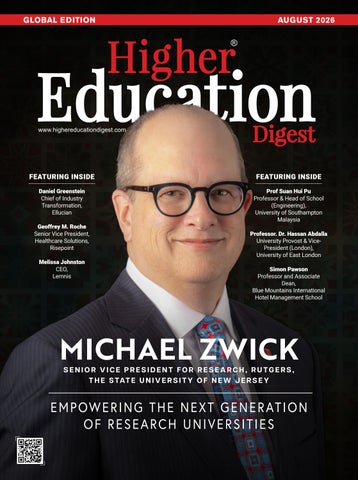
GLOBAL EDITION
AUGUST 2026
www.highereducationdigest.com
FEATURING INSIDE
FEATURING INSIDE
Daniel Greenstein Chief of Industry Transformation, Ellucian
Prof Suan Hui Pu Professor & Head of School (Engineering), University of Southampton Malaysia
Geoffrey M. Roche Senior Vice President, Healthcare Solutions, Risepoint Melissa Johnston CEO, Lemnis
Professor. Dr. Hassan Abdalla University Provost & VicePresident (London), University of East London Simon Pawson Professor and Associate Dean, Blue Mountains International Hotel Management School
MICHAEL ZWICK SENIOR VICE PRESIDENT FOR RESEARCH, RUTGERS, T H E S TAT E U N I V E R S I T Y O F N E W J E R S E Y
E M P OW E R I N G T H E N E X T G E N E R AT I O N OF RESEARCH UNIVERSITIES Higher Education Digest August 2026
1
2
Higher Education Digest August 2026
3
Higher Education Digest August 2026
August 2026
Managing Editor Sarath Shyam
4
Consultant Editors Dr. John Andrews Naomi Wilson Emma James Stanly Lui Andrew Scott Joseph Alex Creative Consultants Charlie Jameson Edwards Gonzalez Branding & Marketing Partnerships Jennifer Anderson Lucy Jones Alice Smith Anna Elza
Free Subscription
Higher Education Digest August 2026
Vol - 8 Issue - 8
Free Subscription www.highereducationdigest.com International Partnerships Americas Europe Middle East & Africa Asia-Pacific
admin@highereducationdigest.com
Follow Us On
www.linkedin.com/company/ highereducationdigest www.facebook.com/HigherEducationDigest
Higher Education Digest www.highereducationdigest.com is a global knowledge sharing digital platform published by Connecta Innovation Private Limited. All rights reserved. The opinions expressed in the content and pictures provided are those of the authors. They do not purport to reflect the opinions or views of Connecta Innovation Private Limited or any of its members and we do not assume any responsibility. The publisher does not assume any responsibility for the advertisements, its content, pictures, and all representation of warranties made in such advertisements are those of the advertisers and not of the publisher. Higher Education Digest www.highereducationdigest.com is a Free Subscription and Free-to-read digital platform strictly not for sale and has to be strictly for internal private use only. Publisher does not assume any responsibility arising out of anyone modifying content and pictures, printing a copy of this digital platform in any format and in any country and all matters related to that.
MANAGING EDITOR’S NOTE
Can Universities Become Agile Without Losing Their Soul?
H
igher education has always been a careful business. Universities are built on traditions, processes, academic freedom, peer review, and decisions that are rarely made overnight. But the world outside the campus is moving at a very different pace. In my conversations with educators and academic leaders, I have often noticed an interesting tension. They want universities to innovate faster, collaborate more freely, and respond to emerging challenges, yet they also understand that education cannot become just another race for speed. The real challenge is not choosing between tradition and transformation. It is knowing what to preserve and what must change. The scale of change is difficult to ignore. U.S. higher education institutions reported $117.7 billion in research and development expenditures in FY 2024, an 8.1% increase over the previous year. Behind those numbers lies a larger question: Can institutions built around 20th-century structures effectively manage the complexity of 21st-century discovery, technology, talent, and public expectations? That question makes our cover story with Michael E. Zwick, Senior Vice President for
Research at Rutgers, The State University of New Jersey, particularly timely. As the university’s Chief Research Officer, Zwick oversees a research enterprise approaching $1 billion in sponsored awards. Yet his perspective extends beyond funding and research output. He speaks about streamlining processes, developing leaders, encouraging collaboration, and creating an environment where faculty, students, and staff can do their best work. His message points to something larger. The university of the future will not necessarily be the one with the most buildings, the biggest budgets, or the longest history. It may be the one that can bring people, ideas, disciplines, and resources together with greater purpose and less friction. This issue explores that transformation from several perspectives, bringing together thoughtprovoking articles, expert interviews, and insights on the forces reshaping education, leadership, innovation, and academic life. The future of higher education will demand both courage and judgment. Universities must evolve, but they must also remember why they exist. The institutions that master both may well define what learning and discovery mean for the next generation. Enjoy Reading.
Sarath Shyam
Higher Education Digest August 2026
5
CONTENTS
6
10 COVER STORY Higher Education Digest August 2026
INDUSTRY PERSPECTIVE
REDEFINING WHAT LIMITLESS EDUCATION CAN LOOK LIKE
50
Melissa Johnston, CEO, Lemnis
MENTOR’S MANTRA
7 TRANSFORMING POSTSECONDARY EDUCATION INTO A BRIDGE TO OPPORTUNITY Daniel Greenstein, Chief of Industry Transformation, Ellucian
40
16
CULTIVATING SMART SUSTAINABLE UNIVERSITY ECOSYSTEMS Professor. Dr. Hassan Abdalla, University Provost & Vice-President (London), University of East London
Higher Education Digest August 2026
CONTENTS ACADEMIC VIEW
22
8
TRANSFORMING HEALTHCARE EDUCATION FROM SEATS TO OUTCOMES AND VALUE Geoffrey M. Roche, Senior Vice President, Healthcare Solutions, Risepoint
EMPOWERING THE NEXT GENERATION OF GLOBAL HOTEL LEADERS Simon Pawson, Professor and Associate Dean, Blue Mountains International Hotel Management School
34
Higher Education Digest August 2026
28
EMPOWERING ENGINEERS FOR A FUTURE SHAPED WITH AI AND DESIGN Prof Suan Hui Pu, Professor & Head of School (Engineering), University of Southampton Malaysia
9
Higher Education Digest August 2026
C O V E R S T O R Y
10
Higher Education Digest August 2026
MICHAEL ZWICK SENIOR VICE PRESIDENT FOR RESEARCH,RUTGERS, T H E S TAT E U N I V E R S I T Y O F N E W J E R S E Y
E M P OW E R I N G T H E N E X T G E N E R AT I O N OF RESEARCH UNIVERSITIES Michael E. Zwick, Ph.D., is the Senior Vice President for Research at Rutgers, The State University of New Jersey, a Professor of Genetics at Rutgers-New Brunswick, and a fellow of the American Association for the Advancement of Science (AAAS). As Rutgers’s Chief Research Officer, he oversees a university-wide research enterprise with nearly $1 billion in sponsored awards. He leads the Office for Research (300 staff, $80 million budget) and serves as Rutgers’ chief research officer and institutional official for the Human Research Protection Program (HRPP) and Institutional Animal Care and Use Committee (IACUC). His people-focused leadership centers on cultivating emerging leaders who bring strategic clarity, operational rigor, and partnership skills to transform 20th-century research universities into agile, innovative 21stcentury institutions. Together, the teams he leads foster a culture of purpose, accountability, and achievement that aligns with the university’s tripartite mission of teaching, research, and public service, empowering faculty, students, and staff to reach their highest potential. Recently, in an exclusive interview with Higher Education Digest, Michael shared insights from his journey as an adoptee whose early curiosity about nature and heredity led him to genetics, and now as Senior Vice President for Research at Rutgers, where he oversees a nearly $1 billion research enterprise. On the future of research, Michael emphasized that institutions that streamline processes, measure contributions across teaching, research and service, and create space for collaboration will attract top talent. His advice to emerging scholars is leadership is a skill built through training and experience, and the greatest joy comes from enabling others’ research and ensuring no one is left behind as we redefine the research university together. The following excerpts are taken from the interview.
Higher Education Digest August 2026
11
Hi Michael. Every research leader’s path starts with a question that refuses to let go. What early scientific or human question first pulled you into genetics and research, and how has it evolved into your mission today? My curiosity fueled my path to a career in genetics research and arose as a confluence of two distinct influences. The first is that I am an adoptee. All adoptees, to some extent, feel that they are a natural experiment in the interplay between nature and nurture. For me, a natural curiosity about nature and the processes of heredity was the outcome. The second was a belief developed in high school that genetics would be an important area of future discovery. I remember a strong desire to be involved, and this shaped my academic pursuits.
12
What part of your role as Chief Research Officer gives you the deepest sense of purpose today? Our shared core values of the Office for Research team, respect, simplicity, collaboration, and excellence, underlie everything that we do.
We view ourselves as a key member of every Rutgers faculty member’s team. Together with Rutgers faculty, we seek to generate knowledge and solve problems that impact the everyday lives of our neighbors in New Jersey and
Catalyzing an environment where successful collaborations can thrive brings me a deep sense of purpose
Higher Education Digest August 2026
operational excellence will have more time to establish and enrich key relationships. These are the institutions that will thrive in the 21st century. Open science, data sharing, and reproducibility are reshaping norms. What practice in research conduct will be unrecognizable five years from now, and why? The practice of scientific research has always required data sharing and reproducibility. Reproducibility is best achieved by testing novel hypotheses or predictions that arise from prior research. At present, the practices and publication delays associated with scientific publication hamper progress. A revolution in scientific publication could radically transform the nature of open science and the generation of knowledge. beyond. Catalyzing an environment where successful collaborations can thrive brings me a deep sense of purpose. Research universities are being asked to be more agile without losing academic rigor. What structural change will define whether institutions thrive or stall by 2030? Lasting success comes from relationships, not transactions. Yet research is a highly regulated process, and when done at scale, it requires an enormous number of transactions throughout the research lifecycle. Collaboration between researchers, trainees, and staff is essential for success. Those institutions that can perform transactions efficiently in a collaborative environment that embraces simplicity and
The next generation of faculty and researchers have different expectations of work and impact. What cultural or operational shift will universities need to attract and retain top research talent? Public universities need to embrace their tripartite mission more consciously: they teach, pursue research to generate new knowledge, and provide public service. The convergence among these parts of their tripartite mission provides opportunities and challenges. Impact should be assessed through contributions to teaching, research, and public service. Universities need to develop improved, streamlined approaches to measuring faculty contributions without burning out their faculty and staff. Deliberate experimentation and
Higher Education Digest August 2026
13
14 innovation are needed if we are to evolve the very old structure of a university to meet the challenges of the 21st century. Universities that simplify processes, measure outcomes, and provide room for experimentation will be the ones that succeed in attracting and retaining top research talent and most effectively meet their tripartite mission. Leaders are shaped by what they read when no one is watching. What book has most influenced how you think about discovery, uncertainty, or leadership, and why do you return to it? I have been most influenced by Getting to Yes: Negotiating Agreement Without Giving In. Emphasizing interests over positions and aiming
Higher Education Digest August 2026
for win-win outcomes reinforces the idea that lasting success comes from relationships, not transactions. I return to it because it speaks to my vision for how universities need to build teams to pursue their most important endeavors. If we cannot succeed together, we will fail separately. These ideas in this book fuel my motivation to ensure that we succeed together and do not leave anyone behind. The intensity of research leadership demands mental space to reset. What personal ritual or habit helps you step back, gain perspective, and return with clarity? Regular exercise is essential for me to be at my best. I enjoy running, especially along the
Delaware & Raritan Canal. A run not only gives me time to reset but also often lets me imagine novel solutions that elude me at work. What is your biggest goal? Where do you see yourself in 5 years from now? As an academic and former naval officer, I have drawn on my unique career path and lived experiences to prepare myself for the most complex leadership roles. I enjoy leadership roles where I can work with fantastic teams that collaborate to achieve excellence. Five years from now, I plan to continue in challenging leadership roles with teams that are redefining the 21st-century research university.
Universities that simplify processes, measure outcomes, and provide room for experimentation will be the ones that succeed in attracting and retaining top research talent and most effectively meet their tripartite mission
If you could give one message to a postdoc or assistant professor wondering if leadership is for them, what would you tell them about the responsibility — and joy — of enabling others’ research? I advise them that leadership is a skill developed through training, contemplation, and lived experience. Seeking opportunities to develop their leadership skills will benefit their personal academic and research activities. In the process of improving their leadership, they will identify mentors and role models who can help them develop their academic and research careers. These mentors and role models will help them explore if they seek greater responsibility and desire to enable others’ research. If the answer is yes, then they will be well prepared to pursue the opportunities that will surely arise during the course of their career.
Higher Education Digest August 2026
15
MENTOR’S MANTRA
Transforming Postsecondary Education into a Bridge to Opportunity Daniel Greenstein, Chief of Industry Transformation, Ellucian
Daniel Greenstein, Ph.D., is Chief of Industry Transformation at Ellucian, where he leads higher education system strategy and collaboration to accelerate transformation across the global education landscape. Dan has extensive experience in public higher education and philanthropy, most recently serving as Chancellor of Pennsylvania’s State System of Higher Education (PASSHE), where he led a bold system redesign improving access, affordability, and student outcomes across 10 universities. He also led Postsecondary Success at the Bill & Melinda Gates Foundation and was Vice Provost at the University of California Office of the President, advancing system-wide research initiatives, online learning, and data analytics. Recently, in an exclusive interview with Higher Education Digest, Dan shared insights into how his journey from classrooms to boardrooms shaped his mission as Chief of Industry Transformation — why inertia, not AI, is higher ed’s biggest threat, and his advice for leaders: get close to the work, move between altitudes, and redesign credentials to signal competence. The following excerpts are taken from the interview.
16
Higher Education Digest August 2026
You began as a teacher and faculty member before moving into system leadership. What did the classroom teach you about higher education that boardrooms and policy tables never could? The reach and impact. You don’t see it from a policy table. You see it in a classroom. Whether it was 300 students in an intro history lecture at Glasgow, ten around a seminar table, or 1-on-1 in a tutorial, you watch in real time what higher education does to a life. Not just intellectually. In the way people come to understand themselves and what’s possible for them. Being present with students, available to them, connecting with them; that’s the “product”. Those moments are what ultimately shape student success. It’s the magic of higher education. Multiply that interaction across faculty, across the country or the world – make assumptions about the quality of interactions, the training and support available to faculty – and you’re looking at one of the most powerful instruments of human and social development ever built. I still teach today. Mostly mid- and senior -career professionals, in conferences, at invited talks, in occasional training programs for higher ed leaders. I love
it, and am convinced I learn more from the “students” than they learn from me. Boardrooms can tell you whether the system is working or not. “Classrooms” – however constructed – tell you why it matters. What do you love about your current role? I’m 65. The runway behind me is a lot longer than the one in front, and I’ve become deliberate about where I spend the time I have left. Higher education changes lives. I’m pretty sure it saves some. It’s also facing significant headwinds, and historic opportunities. And since I don’t want my grandchildren growing up in a world without a high-functioning post-secondary sector, the question for me is where I can be most useful right now. How can I help support, evolve, refresh, and enliven the industry I love and am passionate about? How can I help higher ed leaders identify, address, and manage their greatest challenges and realize their most significant opportunities so their institutions continue to serve students and their communities? What I love about being Chief of Industry Transformation is that it lets me scale.
Higher education changes lives. I’m pretty sure it saves some. It’s also facing significant headwinds, and historic opportunities.
Higher Education Digest August 2026
17
Ellucian’s technology is genuinely best-ofbreed – Gartner’s Magic Quadrant agrees. But technology only delivers if leadership engages with it as an agent of change. That means doing business, governing, and leading differently. Sitting at the intersection of leadership support, strategy, and the power of technology, data, and AI has been one of the most productive periods of my professional life. I get to be close to the work while operating at altitude at the same time.
18
Demographic shifts, AI, and value skepticism are colliding. What’s the single biggest threat to public regional universities in the next five years — and the opportunity hidden inside it? Inertia. That’s the threat. Demographics, AI, and skepticism are among the forces bearing down on us, creating both challenge and opportunity. Inertia is what makes us slow to respond to them. Since the middle of the twentieth century, US higher education has expanded dramatically. We opened our doors to the baby boomers and their children. We changed the face of our student body as women’s and civil rights advanced. We swelled in size, enrollment, programmatic breadth, and research portfolio thanks to prodigious public investment. And we performed. We advanced research and produced the skilled workforce the nation needed to remain competitive. Public funding flowed, students kept showing up, and even as state per capita appropriations started to slip, perhaps in the 1990s, enrollment growth and tuition increases masked it. By 2010, the mask came off. Demographic, financial, and increasingly, political pressures required a new
Higher Education Digest August 2026
Demographics, AI, and skepticism are among the forces bearing down on us, creating both challenge and opportunity. Inertia is what makes us slow to respond to them
discipline. We had to learn to “sell”, to “hustle” for enrollment, for investment, for public support. We had to learn to grow into new areas by dialing back in ones that had become unproductive; to work by trade-off rather than by addition. And while we certainly have learned, we were slow to do so. That is what is showing up today: financial and operational distress that is increasingly widespread and in decline, with public support. Regional publics got hit particularly hard, in part because the demographics are so unfavorable; the costs so fixed, and the opportunities to diversify revenues so relatively limited. That’s even more reason to move with greater alacrity. And yet, ask any regional public to introduce and scale a new credentialing program, strategic enrollment management
plan, or wrap-around student supports. The answer is typically measured in years. In a labor market that re-prices skills every twelve months, that’s not slow, that’s structurally noncompetitive. And it’s at the heart of the value skepticism we keep complaining about. The opportunity hidden inside this is enormous. There’s a 50-year-old who’s been laid off and needs to get competitive again. There’s a credential gap for first-gen and underserved students that nobody is closing. And when it comes to AI, most institutions are asking how to integrate it. Wrong question. The right question is how to build the institution around it. The schools that figure that out get to reach populations we’ve never reached. The ones that don’t will keep losing ground to organizations that aren’t waiting on our committees. By 2030, what will the credential mix look like for students seeking economic security? The mix in 2030 will look a lot like today’s: degrees on one side, a growing layer of nondegree credentials stacked alongside them as people move through their working lives engaging in “lifelong learning”. What needs to change isn’t the shape of the mix. It’s the signals that credentials within it send. Right now, non-degree credentialing is the Wild West. Anyone can issue one. The Burning Glass Institute recently published some pretty sobering research, showing how few non-degree credentials deliver a real wage bump. Students increasingly need credentials that clearly connect learning to workforce outcomes. By 2030, I hope we will have coalesced more around “credentials of value” - that is, credentials that the labor market recognizes as evidence of
mastered competence. I also hope that we will do the same with degrees. A BA in history tells an employer where you went, not what you can do or what you know. We need transcripts that say something meaningful about competence, and degrees that are transparent about what’s actually inside them. If we get that right, the credential becomes information again rather than just a signal. Career paths in higher education aren’t linear anymore. Should aspiring leaders plan to move between institutions, systems, and philanthropy? I like to say careers are made in retrospect. Mine was, anyway. Looking back on it, it’s possible to tell a story about how the different roles connected in some logical, purposeful way. The advice I give to young professionals is the same advice I wish I’d given my younger self – pursue the work that matters to you – pursue your north star – do it well, with energy, and optimism, and let the moves come. For me, it has been important to move between roles operating at different altitudes. Sometimes on the ground, sleeves rolled up, building and improving organizations that serve students and their communities. Sometimes operating with a national purview, looking across the landscape, and learning through the experiences of others. The combination has been powerful. When I built things, I built them better because I’d seen the broader picture. When I worked at altitude, I had sharper instincts because I’d been close to the ground. Aspiring leaders should consider that movement, perhaps more than the sequencing of particular industry roles.
Higher Education Digest August 2026
19
20
What book on education, history, or leadership has the most underlining? Anything by Brené Brown. Dare to Lead and Rising Strong are the two I keep coming back to, and they’re heavily marked up. I’m an academic by training and technocrat by reflex. It’s very easy for me to retreat into that side of my brain in a leadership role. Brené Brown’s work on courage, vulnerability, and trust is what reconnects me with the human side of leadership. I have a North Star. I see it clearly. Brené Brown helps me navigate toward it in a way that’s open, humane, and team-centered. Someone once told me a leader’s job is to create the space for people to do their best work. I’ve amended that over the years to include building a team of people that do their best work together, investing in each other’s success. That’s the higher-leverage leadership style and the one with the greatest impact. It’s arguably also the hardest to pull off, which is why I keep returning to Brené Brown. Philanthropy has shaped postsecondary reform for 20 years. What role should foundations play in the next chapter — and what should they stop doing? I’m in awe of philanthropy, and not just because I worked at Gates. Philanthropy can do things no one else in the higher ed ecosystem can. It can stand above the fray. Convene the difficult yet vital conversations. Ask the hardest questions. It can fund experimentation, build an evidence base under, and drive adoption of tools, processes, and approaches that improve student and institutional outcomes. And because it can put its dollars to work patiently, without
Higher Education Digest August 2026
worrying about a dollar return on investment, it can explore impact in areas that others won’t even see potential in, let alone try. A small example. In 2020, PASSHE began exploring whether, by integrating several low-enrolled institutions, it could sustain and hopefully grow opportunities for their students. The ECMC Foundation funded the work. I don’t remember the grant size, but the signal it sent was ten times its dollar value. It told PASSHE constituencies, the Board, Pennsylvania’s General Assembly, and the field that the hard questions we are asking about the viability (or should we say inviolability) of historic organizational constructs were nationally significant, potentially critical to the future of a thriving postsecondary sector, and worth taking seriously. Foundations create that kind of lift. In the next chapter: the hard questions involve higher education’s organizational and governance models – are they appropriate for the current environment? Do they operate with the right clock speed?, and the broken or strained business models, how they can be “fixed” so that quality, careerrelevant postsecondary education is available to all, irrespective of zipcode? Technology, data, and of course artificial intelligence will have a significant role to play – helping institutions operate more efficiently while improving the student experience. So will policy innovation at state and national levels. These are all areas where philanthropy is and I hope will continue to be active. And philanthropy is uniquely positioned to keep asking who’s being left behind. In a moment of neo-tribalism and retreat into
ideologically tight communities, somebody has to hold the long view on lifting up the people we’re forgetting.
me reach more higher ed professionals, more boards, more state policymakers globally, – those are the folks carrying the heaviest loads.
What is your biggest goal? Where do you see yourself five years from now? The older I get, the less ambitious I become in the conventional sense. What I think about now is how much I can leave on the field in the time I have left. The goal is impact, and I define impact through institutional success: accessible, affordable, sustainable, career-relevant, highquality post-secondary education that expands opportunity and changes lives for the better. The framing I used at Gates still holds for me – ensuring that post-secondary education remains a bridge to opportunity for all. In five years, I want to have scaled the strategic and analytical work I do in support of change agency and change leadership in higher education – through any platform that lets
If a 25-year-old told you, “I want to make colleges work better for firstgen students,” what would you tell them to do this year? Get in the game. I cut my teeth in a classroom. That was right for me, but it’s not the only door. Student affairs, financial aid, a startup building AI-powered student supports or transfer tools or cost transparency – any of these put you close enough to the work that you can feel two things at once: the real impact of a well-functioning higher education system on a first-gen student’s life, and the real inertia that keeps us from delivering it more often. Until you’ve felt both, you don’t understand the problem you’re trying to solve. Pick a spot on the ground. Start this year.
Higher Education Digest August 2026
21
ACADEMIC VIEW
Transforming Healthcare Education from Seats to Outcomes and Value Geoffrey M. Roche, Senior Vice President, Healthcare Solutions, Risepoint
22
Geoffrey M. Roche is Senior Vice President, Healthcare Solutions at Risepoint, where he leads strategies that expand access to high-quality healthcare education and strengthen the future workforce. Known as the “Heart Leader,” and “Son of a Nurse,” he is recognized for combining empathy, innovation, and results-driven leadership across healthcare and higher education. Geoffrey is a national speaker, thought leader, and advocate for workforce transformation, apprenticeships, and affordable pathways into healthcare careers. Above all, he is a devoted father who believes leadership begins with serving others. Recently, in an exclusive interview with Higher Education Digest, Geoffrey shared insights into how leading with heart became his core strategy after watching talented people leave organizations because they felt unseen, not unskilled. His mandate to higher ed is to treat health systems as strategic co-architects with continuous dialogue, shared data, and regular curriculum refresh cycles, because relevance now requires living partnerships built on mutual accountability to patient care and workforce sustainability. A devoted father, he believes leadership begins with serving others, and legacy is built decision by decision. The following excerpts are taken from the interview.
Higher Education Digest August 2026
23
In healthcare and education, where people carry heavy responsibilities, leadership rooted in empathy builds trust, perseverance, and discretionary effort
Higher Education Digest August 2026
24
Hi Geoffrey. You call yourself the “Heart Leader” and champion empathy alongside strategic innovation. When you first stepped into leadership across Eds and Meds, what was the moment you realized leading with heart wasn’t soft — it was the strategy? Early in my career, I watched talented people leave organizations not because they lacked skill, but because they felt unseen, unsupported, and disconnected from purpose. That was a defining lesson for me. I realized culture is not separate from performance; it drives performance. In healthcare and education, where people carry heavy responsibilities, leadership rooted in empathy builds trust, perseverance, and discretionary effort. Leading with heart is not soft. It is one of the most practical strategies available because when people feel valued, they contribute at their highest level. You build workforce-aligned healthcare programs that start in higher ed. How should university presidents and deans rethink health sciences curricula when AI is reshaping both classrooms and clinical practice? University leaders must move from static curriculum models to adaptive learning ecosystems. AI is changing diagnostics, documentation, imaging, and administrative workflows, so graduates need both technical proficiency and human capability. Curricula should integrate AI literacy, data-informed decision-making, ethics, interdisciplinary teamwork, and patient communication. Just as important, institutions need deeper employer partnerships, so programs evolve in real time with market demand. The future belongs to
Higher Education Digest August 2026
universities that teach students how to learn continuously, not simply what to memorize once. Employers, academic partners, and industry leaders are co-creating with you. What will separate healthcare education providers that truly align with workforce needs from those that just add more seats? The difference will be outcomes versus optics. Adding seats may increase enrollment, but it does not automatically solve workforce shortages. Providers that truly align with workforce needs will co-design programs with employers, create seamless clinical pathways, support retention, and measure graduate readiness. They will understand local labor market realities and respond with agility. Those that focus only on volume may fill classrooms, but those focused on value will help rebuild the workforce. You expand access to high-quality, affordable healthcare education. What will students demand from a nursing or health sciences degree in 2029 that isn’t on most institutions’ roadmaps now? Students will demand flexibility, speed to value, and clear return on investment. They will expect stackable credentials, hybrid learning models, employer-connected experiences, and transparent pathways to advancement. They will also seek personalized support services that fit the realities of working adults balancing careers and family life. In 2029, students will not just ask if a degree is respected. They will ask whether it accelerates opportunity, mobility, and purpose.
You champion access and affordability in healthcare education. What is one AI-era policy universities must adopt to ensure generative tools don’t widen equity gaps for first-gen or working adult learners? Every institution should adopt an AI access and readiness policy that guarantees all learners equitable exposure, training, and
support. Too often, technology advantages those who already have time, confidence, and resources. Universities must provide guided instruction on responsible AI use, embedded tutoring support, and access to approved tools regardless of income level. Equity cannot be an afterthought. If AI becomes essential to learning, then inclusive access must become essential to policy.
In 2029, students will not just ask if a degree is respected. They will ask whether it accelerates opportunity, mobility, and purpose
25
Higher Education Digest August 2026
26
Legacy is built decision by decision. What skills will separate heart leaders from traditional administrators in the next decade? Heart leaders will stand apart through emotional intelligence, courage, adaptability, and the ability to build authentic relationships across difference. Traditional administration often centers process, while heart leadership centers people and purpose without sacrificing accountability. The next decade will reward leaders who can navigate change while preserving trust. Those who listen deeply, communicate clearly, and inspire shared ownership will create lasting impact. Workforce alignment is your mandate. What advice would you give higher ed leaders on partnering with health systems to keep degrees relevant when clinical protocols change annually? Treat employers as strategic co-architects, not occasional advisors. The strongest partnerships involve continuous dialogue, shared data, and
Higher Education Digest August 2026
What I believe for the future of manufacturing is a stronger focus on remanufacturing, recycling, and waste reduction along the production lines
regular curriculum refresh cycles. Leaders should invite health systems into competency design, simulation strategy, clinical placement planning, and faculty development. Relevance is no longer maintained through periodic updates every few years. It requires living partnerships built on mutual accountability and a shared commitment to patient care and workforce sustainability.
27
Higher Education Digest August 2026
ACADEMIC VIEW
Empowering the Next Generation of Global Hotel Leaders Simon Pawson, Professor and Associate Dean, Blue Mountains International Hotel Management School
28
Simon Pawson is a Professor and Associate Dean at Torrens University Australia, leading the Blue Mountains International Hotel Management School (BMIHMS) — the largest hotel school in Australia and consistently ranked #1 in Oceania. His career has been defined by building bridges between higher education, industry, and community, with a focus on creating world-class student experiences and driving innovation in hospitality and tourism education. As an academic leader, he has successfully guided large-scale strategy development and curriculum reform, achieved outstanding student retention and progression outcomes, and strengthened BMIHMS’s global reputation through strategic engagement with industry and accreditation bodies. Simon is passionate about mentoring emerging scholars and fostering a culture of research excellence; under his leadership, Torrens University Australia’s Tourism and Hospitality Research Cluster has been recognised at “world standard.” Beyond the university, he has contributed actively to the profession as Deputy Chair of THE-ICE, and through leadership roles at national and international forums such as CAUTHE and AHICE. His long-standing work in Cambodia on sustainable tourism and social justice reflects his belief in leadership with purpose — advancing education while supporting communities, conservation, and cultural heritage. With foundations in five-star hospitality and a career in academia since 2004, he brings both practical insight and scholarly expertise to university leadership. His interests span adaptive and values-driven leadership, curriculum innovation, sustainability, and the future of global hospitality and tourism education. Recently, in an exclusive interview with Higher Education Digest, Simon shared how his journey from a family zoo to five-star hotels shaped a calling to develop global hotel leaders at BMIHMS. He argues that by 2030, AI will transform hotel operations but human interaction will remain irreplaceable in luxury experiences. True sustainability, he says, must be embedded across all hotel functions by 2028, not limited to green policies. BMIHMS scales AI by co-creating curriculum with industry so graduates are job-ready and AI-proficient. Inspired by adaptive leadership, he champions mobilizing teams through uncertainty and leading with purpose beyond the organization to advance social and environmental justice. The following excerpts are taken from the interview.
Higher Education Digest August 2026
29
What gets me out of bed every morning is knowing that my team and I will be developing the next generation of global hotel leaders, and in my book, that’s a privilege
Higher Education Digest August 2026
30
Hi Simon. Your career bridges five-star hospitality and academic leadership, from industry practice to Associate Dean. Thinking back to your first role in hospitality, what was the moment you realized education — not just service — was your calling? It actually started long before my first role in hospitality, which was back in 1988 at Pelican Shores Resort in Port Macquarie. My parents opened a zoo in Port Macquarie in 1979, Kingfisher Park and from a young age I helped out on the zoo. My love of working with other people and working in tourism stemmed from there, and after completing my year 10 work experience at a motel in port Macquarie, I knew this is what I wanted to do. I also know my experience at The Armidale School in the 1980’s taught me about the importance and value of service to others, and this has remained with me throughout my career. What do you love the most about your current role? I have been exceedingly lucky to have a wonderful career. This industry has provided me with so many fabulous opportunities. What gets me out of bed every morning is knowing that my team and I will be developing the next generation of global hotel leaders, and in my book, that’s a privilege. Hospitality and tourism were reshaped by the pandemic and are now being reshaped by AI, sustainability demands, and Gen Z travelers. By 2030, what part of the traditional hotel experience will be unrecognizable? It depends what you mean by traditional experience. Artificial intelligence is reshaping
Higher Education Digest August 2026
the workforce, but what it can’t do is replace service through human interaction in our hotels. Sure, the industry is leveraging AI to improve how we utilize data and develop strategy across multiple functions such as revenue, sales, marketing etc but I don’t believe traditional
Australia has a significant opportunity to strengthen its position as a premium global study destination by ensuring student migration settings support both integrity and long term sector growth
hotel experience will be lost. We are already seeing rapid growth and demand for luxury hospitality experiences and increased hotel investment in key markets such as Japan where experience through human interaction remains paramount.
Sustainability is moving from CSR to core operations. What will separate hotel brands that truly embed sustainable tourism from those that greenwash by 2028? By 2028, I would argue that sustainability will no longer be a differentiator simply because you have a recycling policy, bathroom towel reuse cards or remove plastic straws. What the real differentiator will be is whether sustainability is visibly embedded in how a hotel operates, leads, employs people and makes decisions every day. In other words, how you can demonstrate sustainable practice in all facets of hotel operations. It’s similar to our hospitality curriculum. Do you have sustainability as a standalone subject or do you embed it across all subjects as it applies to that particular component of hotel management? International education and global mobility remain critical for hotel schools. What is one policy or geopolitical shift you’re watching that could most disrupt or accelerate hospitality education? Australia has a significant opportunity to strengthen its position as a premium global study destination by ensuring student migration settings support both integrity and long-term sector growth. The government’s focus on lifting standards and addressing concerns around migration practices is an important step toward protecting the reputation of Australian education. At the same time, it is essential that these measures continue to enable high-quality international students to choose Australia with confidence. Institutions such as Blue Mountains
International Hotel Management School, one of the country’s leading premium providers, play a critical role in developing the skilled talent that supports Australia’s hospitality and tourism industries — particularly in regional areas. We are hearing from key markets that prospective students are becoming hesitant to apply for visas due to concerns about higher refusal rates and the potential loss of their $2,000 application fee. This signals an opportunity for closer collaboration between government and the sector to ensure that genuine students are not discouraged from choosing Australia. A balanced, well-communicated approach will protect Australia’s reputation, support quality providers, and ensure a strong pipeline of future talent for industries that rely on international graduates. Australia’s education and tourism futures are closely linked — and with continued partnership, both can thrive. Many schools are stuck in AI pilot mode. What separates academic leaders who scale AI for student impact from those who stay in experimentation? The strength of BMIHMS is its ability to cocreate its curriculum and teaching practice with its industry partners. The School’s focus is understanding industry applications of AI and then ensuring students are being trained on how AI is utilized in the specific context. The School has just renewed it’s undergraduate and postgraduate curriculums and the focus has been embedded industry AI applications in the relevant subjects. This all comes down to delivering job ready graduates to industry – something that BMIHMS has done very effectively for the past
Higher Education Digest August 2026
31
35 years. The school trains for its graduates to move into management roles, where AI competency is now expected. We need to be agile in terms of AI advancement otherwise we run the risk of our graduates not being equipped with the knowledge and skills required to be successful leaders in the hospitality industry – and this now included AI proficiency.
32
Leaders in hospitality live and breathe experience design. Is there a book, film, or travel experience that sits on your desk or in your mind and still shapes how you think about service and leadership? Several, there are people and literature that continue to inspire and perhaps too many for this article! Anthony Bourdain, has always been a source of inspiration. His passion for storytelling about food, destinations and culture remains infectious – and these are experiences. Kevin McCloud and his passion toward house design have often helped my think how I talk about careers in the hotel industry. I have also had the privilege to train under some outstanding hotel general managers, Ted Wright from the Regent Sydney, Patrick Griffin from Orient Express’s Observatory Hotel Sydney – who taught me so much about service and luxury accommodation, Peter Tudehope from Radisson Hotels, all have inspired and shaped my leadership and abilities to develop our next generation of hoteliers. I want to also comment further on leadership. Back in 2006 I started teaching with Dr Jill McRae – who has now become a close friend. Dr McRae is a Harvard Kennedy School graduate who introduced Professor Ronald Heifetz’s research and teachings on adaptive leadership. Relating
Higher Education Digest August 2026
Heifetz’s work to my career and reflections on how I may have approached leadership challenges differently inspired me to become a practitioner of adaptive leadership. Applying adaptive leadership continues to help my team and the School navigate complex challenges where solutions are not immediately clear and cannot be solved through simply applying known technical expertise. For me effective leadership is less about providing answers and more about mobilizing the smarts of my team to adapt, learn, shift behaviors, and confront difficult realities in times of uncertainty and change – and in our sector there continues to be plenty of uncertainty. I also respect that central to adaptive leadership practice is your distinction between problems which can be solved with existing knowledge, and adaptive challenges, which require new thinking, collaboration, and transformation – and this is the space I enjoy leading in. Luxury, sustainability, and education intersect in your work. Is there a hotel, destination, or community project you’ve visited that, for you, embodies the future of hospitality? Again, so many. The innovation in both the industry and hospitality research is electric at the moment. Here at Torrens and BMIHMS our tourism and hospitality researchers are pioneering work in the area of sustainable luxury and it’s very exciting to see this cutting-edge research come to life. I also want to comment on Australia as a destination. Our uniquely relaxed Australian take on experience, service and luxury has differentiated us from the rest of the world and for many years has made Australia a highly desirable country to
Our uniquely relaxed Australian take on experience, service and luxury has differentiated us from the rest of the world and for many years has made Australia a highly desirable country to visit
visit. Australian trained hoteliers who embody this ‘Australian hospitable mindset’ are now sought after worldwide for these traits and their operational excellence. I honestly believe the work we are doing and the innovation in our tourism sector and hospitality education sector embodies the future of the industry. Many professionals want to move from industry into academic leadership. What three capacities should they be building in hotels today if they want to lead a school tomorrow? Firstly, and understanding and passion toward the importance of training and development is critical. Experiences are created and delivered by people, and training remains a key component of this. Secondly, developing a genuine intent for wanting to help others
become their best selves and ensure they have opportunities to grow. Finally, and this is something I remain absolutely convinced of. As a leader it’s important to have a demonstratable purpose beyond just the organization itself. Leaders have remarkable opportunities not to just do good for their organizations, but to also do good in society, for communities or for the environment. To truly secure stakeholder trust, and to inspire followership, leaders must demonstrate their ability and active contribution toward social / environmental justice causes and corporate social responsibility (CSR) initiatives. It’s also critical we are helping our future leaders understand the importance of leading with a higher purpose, and the best way to do that is by ensuring we are lead with a higher purpose.
Higher Education Digest August 2026
33
ACADEMIC VIEW
Empowering Engineers for a Future Shaped with AI and Design Prof Suan Hui Pu, Professor & Head of School (Engineering), University of Southampton Malaysia
34
Professor Suan Hui Pu is currently Head of School of Engineering at the University of Southampton Malaysia (UoSM). Professor Pu has extensive experience in academic leadership especially in the context of transnational education. He has provided leadership over various foundation, undergraduate and PhD programmes in engineering. He has chaired several institution committees, including the Student-Staff Liaison Committee and the Special Considerations Board. Professor Pu is the leader of the Smart Manufacturing and Systems Research Group (SMSRG) and his current research interests include flexible electronics and sensors, wearable sensors for health monitoring, and electronics packaging.He is also the UoSM School of Engineering’s AI Champion. Recently, in an exclusive interview with Higher Education Digest, Professor Pu shared insights into what it means to be an “engineer” in the 21st century, and how higher education should evolve to reflect that identity. The following excerpts are taken from the interview.
Higher Education Digest August 2026
35
Engineering, at its core, is about solving real-world problems, and education plays a central role in shaping how future engineers approach those problems
Higher Education Digest August 2026
36
Hi Professor Pu. What drives your passion for engineering education, and what do you love most about your current role? What has sustained my interest in engineering education over the years is the opportunity to contribute to something that is both intellectually rigorous and deeply practical. Engineering, at its core, is about solving realworld problems, and education plays a central role in shaping how future engineers approach those problems. In my current role, what I value most is the ability to work closely with colleagues and students to co-create the future of the School of Engineering. We are looking into new innovative project spaces that support our programmes and also student-led competitions. I find it particularly rewarding to support academic staff in their development, whether in teaching, research, or engagement, and to see students grow in confidence and capability over the course of their studies. How do you see the future of engineering education evolving in view of the AI revolution, and what opportunities do you see for universities to adapt and thrive? Engineering education is entering a period of significant transformation. One of the most visible drivers is the rapid advancement of AI and automation. Tools that can solve complex problems almost instantly are already changing how engineers work, and this inevitably raises questions about how we teach. In my view, this does not diminish the importance of foundational knowledge. On the contrary, a strong understanding of first
Higher Education Digest August 2026
principles becomes even more important when students are using powerful tools. They need to be able to interpret results, question assumptions, and exercise judgement—skills that cannot be outsourced to technology. There is an opportunity for universities to rethink how learning takes place. Rather than focusing solely on procedural problem-solving, we are placing greater emphasis on design, systems thinking, and open-ended challenges, where AI becomes a tool that enhances, rather than replaces, learning. At the University of Southampton, we have launched an AI skills training programme for all undergraduates, equipping them with AI skills, ethics and creativity. This goes beyond basic prompting skills to ensure they are fluent in using AI tools effectively and responsibly within their domain of expertise. What do you think is the most important thing that universities can do to train industry-ready engineers? Engineering education must not exist in isolation, and our programmes must reflect the realities of professional practice. This goes beyond occasional consultation. It involves establishing structured mechanisms—such as advisory panels, collaborative projects, and input into curriculum design—that allow industry perspectives to inform what we teach. My own experience in our Industry Advisory Council has been particularly valuable in ensuring that programme outcomes remain aligned with emerging trends and workforce needs. At the same time, our academic staff benefit from these interactions, as they are inspired to steer their teaching and research directions.
That said, industry readiness is not only about technical skills. Employers consistently highlight the importance of communication, teamwork, adaptability, and ethical awareness. Universities are well placed to develop these attributes through carefully designed modules and courses. Ultimately, the goal is to produce graduates who are able to grow and lead the way in any technological revolution of the future over the course of their careers. How do you think universities can work to create a more inclusive and equitable environment for students? One important element is recognising that students come from different educational and socio-economic backgrounds, and that these differences can influence access to opportunity. Contextual admissions can play a role here, by allowing universities to consider achievement within the context of a student’s circumstances, rather than relying solely on standard metrics. However, access is only the first step. We must also ensure that students feel supported
throughout their studies. This includes inclusive teaching practices, effective personal academic tutoring, and pastoral support structures that recognise the varied challenges students may face. In my own roles—whether as a senior tutor or through involvement in special considerations processes (extenuating circumstances)—I have seen firsthand how important it is to approach each case with empathy and careful judgement. Creating an inclusive environment is not about lowering standards; it is about ensuring that all students have a fair opportunity to succeed. What is your biggest goal in leading your School, and what are your immediate priorities? My overarching goal is to build a School that is academically strong, forward-looking, and wellconnected to both industry and society. In the immediate term, this involves consolidating the delivery of recently introduced programmes while seizing the opportunity that new programmes present for rethinking how we structure curricula and to introduce innovations that reflect current and future needs.
Looking ahead, I am particularly interested in developing innovative programmes and regional partnerships that build on our strengths as an international campus of a UK university in Malaysia
Higher Education Digest August 2026
37
Creating an inclusive environment is not about lowering standards; it is about ensuring that all students have a fair opportunity to succeed
38
Looking ahead, I am particularly interested in developing innovative programmes and regional partnerships that build on our strengths as an international campus of a UK university in Malaysia. There is significant potential to collaborate with industry, government, and academic partners across the region to address shared challenges and create new opportunities for our students and staff. At the same time, people remain at the centre of everything we do. Supporting staff development, fostering collaboration, and maintaining a positive working environment are all essential to achieving our longer-term goals. What advice would you give to earlycareer professionals looking to make a positive impact in engineering education? My advice would be to approach your career with passion, curiosity and intentionality. You have to ask yourself why you aspire to be an academic and what positive change do you want to make in that role.
Higher Education Digest August 2026
First, focus on building a strong foundation in your discipline. Credibility in engineering education is grounded in subject expertise, and this underpins both teaching and research. At the same time, be open to developing your approach to teaching. Student cohorts are changing, and there is increasing scope for teaching innovation, whether through new pedagogical approaches, the use of technology, or more experiential forms of learning. Small, thoughtful changes can have a significant impact on student engagement. In terms of research, I would encourage early-career academics to think about how their work can be both academically rigorous and impactful. This may involve interdisciplinary collaboration or engagement with industry and external stakeholders. Finally, pursue your career in an institution that projects values consistent with your own and seek out opportunities to contribute to your academic community. Leadership and service roles, even at an early stage, provide valuable insights into how institutions function and how change can be implemented.
39
Higher Education Digest August 2026
MENTOR’S MANTRA
Cultivating Smart Sustainable University Ecosystems Professor. Dr. Hassan Abdalla, University Provost & Vice-President (London), University of East London
Professor Hassan Abdalla is the Provost and Vice-President at the University of East London and a globally recognized higher education leader with expertise spanning academia, research, industry partnerships, and innovation-led transformation. His work focuses on smart and sustainable cities, immersive learning environments, green technologies, AI-enabled education, and research innovation. He has led major European projects worth several million euros, published over 200 internationally refereed publications, and serves on several international advisory boards, government, Journals, winners of several international awards. Under his leadership, the university achieved national recognition for teaching quality, student success, social impact, and global partnerships driving economic growth and sustainable development. Recently, in an exclusive interview with Higher Education Digest, Prof Abdalla shared insights into how his career began with a frustration that brilliant research stayed trapped in journals while industry and communities faced real problems. That disconnect drove him to bridge academia, industry, and government, turning universities into engines of economic growth and social mobility. As Provost & Vice-President at University of East London, he now leads major projects in smart cities, green tech, and AI-enabled immersive learning. On AI, he believes by 2030 data-heavy tasks like literature reviews and simulations will be AI-assisted, but curiosity, ethics, and judgment must stay human. His advice to leaders: build curricula that teach graduates to work with AI using critical thinking and empathy, and design technology that enhances humanity rather than diminishes it. The following excerpts are taken from the interview.
40
Higher Education Digest August 2026
Hi Dr. Abdalla. Your career spans research, academia, industry, and policy. Looking back to your earliest research project, what problem made you realize academia could directly shape industry and society, and what did you do next? One of the earliest moments that shaped my belief in the power of academia to transform industry and society came during my early research work in engineering and technologydriven innovation. I became increasingly aware that many brilliant research outcomes remained confined to laboratories and academic journals, while industries and communities continued to struggle with very real challenges that those discoveries could help solve. What struck me most was the disconnect between knowledge creation and practical implementation. I realised that universities should not exist as isolated intellectual spaces; they must become engines of economic growth, social mobility, innovation, and public impact. That understanding fundamentally changed the direction of my career. From that point onward, I became deeply committed to building bridges between
academia, industry, government, and society. I focused not only on research excellence, but also on creating ecosystems where research could translate into tangible outcomes whether through skills development, innovation partnerships, entrepreneurship, policy influence, or applied technologies that improve lives and address the grand challenges humanity are facing! This philosophy has shaped every leadership role I have undertaken since. I have worked to expand university-industry collaborations, develop employability-focused education models, immersive learning environment that stimulates creative and critical thinking, support start-ups and social enterprises, and establish international partnerships that widen access to opportunity and innovation. I strongly believe that universities have a responsibility to prepare graduates not just for today’s jobs, but for solving tomorrow’s global challenges. What inspires me most is seeing how higher education can transform entire communities. When universities align their applied research, professional education, and innovation with societal needs, they become powerful catalysts for national development, economic resilience,
When universities align their applied research, professional education, and innovation with societal needs, they become powerful catalysts for national development, economic resilience, and social progress. That is the vision that continues to drive me today
Higher Education Digest August 2026
41
and social progress. That is the vision that continues to drive me today.
42
What do you love the most about your current role? What I value most about my current role is the opportunity to create meaningful impact at scale - transforming lives through education while helping reimagining the future direction of higher education itself. As a university leader, I have the privilege of working with talented students, academics, professional staff, industry leaders, politicians, and international partners who are all united by a shared purpose: to make education a force for opportunity, innovation, public values, and social progress. Seeing students from diverse (over 160 nationalities at our university) and often underrepresented backgrounds (over 50% are first generation in their families to go to Higher Education) succeed, gain confidence, and go on to become leaders in their professions is incredibly rewarding. I also enjoy the strategic dimension of the role - building sustainable growth, driving innovation, developing global partnerships, and creating educational models that respond to the rapidly changing needs of society and the economy. Higher education is undergoing significant transformation, particularly with advances in disruptive technologies, artificial intelligence, and evolving workforce demands. I find it exciting to help position universities not only to adapt to these changes, but to lead them as the powerhouse of innovation. What motivates me every day is the belief that universities have the power to change individual lives, strengthen communities, and contribute directly to national and global
Higher Education Digest August 2026
development. Being able to combine academic excellence with real-world impact is what I love most about my role. AI is reshaping how research is done, from literature review to lab work. What part of the scientific method will be fully AI-assisted by 2030, and what must remain human? By 2030, I believe many aspects of the scientific process will become significantly AI-assisted, particularly those involving data-intensive and repetitive tasks. AI will transform literature reviews, automate large-scale data analysis, accelerate simulations, optimise experimental design, identify hidden patterns in complex datasets, and even help generate new research hypotheses. In fields such as healthcare, engineering, climate science, and materials research, AI will dramatically reduce the time between discovery and application. We are already witnessing the early stages of this transformation. In healthcare, for example, AI systems are helping researchers analyse thousands of medical images and patient records to detect diseases such as cancer earlier and more accurately than ever before. During the COVID-19 pandemic, AI-supported research accelerated vaccine development by rapidly modelling virus behaviour and analysing global datasets. In climate science, AI is being used to predict extreme weather events, optimise renewable energy systems, and support sustainable urban planning. In engineering and manufacturing, AI-driven simulations are enabling researchers to test new materials digitally before creating physical prototypes, saving both time and resources.
In my own leadership journey, I have seen firsthand how emerging technologies can bridge the gap between research, education, and real-world societal impact. One example was the development of an advanced simulated healthcare training hub powered by AI, augmented reality (AR), and virtual reality (VR). The vision was to create an immersive learning environment where healthcare professionals and students could practise the latest clinical techniques, emergency responses, and noninvasive treatment procedures in highly realistic scenarios without risk to patients. This approach not only enhanced the quality of training, but also accelerated workforce readiness, supported continuous professional development, and improved patient safety outcomes. Another example has been developing strategic partnerships with global industry
leaders such as the blue-chip company Siemens to accelerate innovation in decarbonisation and green energy solutions. Through these collaborations, universities can combine academic research with industrial expertise to develop practical solutions in renewable energy, smart infrastructure, sustainable engineering, and low-carbon technologies. This demonstrates how AI, advanced analytics, and interdisciplinary research can directly contribute to addressing one of the world’s most urgent challenges: achieving a sustainable and resilient future. By the end of this decade, AI-assisted research environments and autonomous laboratories may become standard in many disciplines. Imagine a laboratory where robotic systems conduct experiments 24 hours a day, AI analyses the results in real time, and
Higher Education Digest August 2026
43
44
researchers focus their energy on interpretation, innovation, and strategic decision-making. This has the potential to transform not only the speed of research, but also its accessibility and global collaboration. However, the most important elements of the scientific method must remain deeply human. Curiosity, ethical judgment, creativity, critical thinking, empathy, and the ability to ask meaningful questions cannot be delegated entirely to machines. AI can analyse patterns, but it does not possess human values, social responsibility, or contextual understanding of the broader implications of research. For example, AI may help identify a highly effective genetic treatment, but humans must decide how that technology is used ethically, who has access to it, and how society protects privacy and fairness. Similarly, AI can generate policy scenarios for climate change, but leaders and researchers must make difficult decisions that balance economics, sustainability, and human wellbeing. Science is ultimately about improving the human condition. Decisions around research priorities, ethical boundaries, societal impact, sustainability, and public trust require human wisdom and accountability. The role of researchers will therefore evolve - from being primarily processors of information to becoming strategic thinkers, ethical leaders, and interdisciplinary innovators who leverage and work alongside AI rather than compete with it. The future of research will not be about humans versus AI; it will be about how human intelligence, and artificial intelligence together can solve challenges that neither could address alone. The universities and research institutions
Higher Education Digest August 2026
that succeed in this new era will be those that combine technological capability with humancentered leadership, creativity, and purpose. Graduate skills for economic growth is a focus in Westminster debates. What skill will employers demand most from graduates in 2030 that most curricula still ignore today? One of the most critical capabilities employers will seek in graduates by 2030 is the ability to work confidently and intelligently alongside artificial intelligence and other disruptive technologies, while bringing uniquely human strengths to the table - including critical thinking, creativity, ethical judgment, emotional intelligence, cognitive agility, and sound decision-making. As automation increasingly takes over routine and predictable tasks, the real value
In engineering and manufacturing, AIdriven simulations are enabling researchers to test new materials digitally before creating physical prototypes, saving both time and resources
of future graduates will lie not in competing with technology, but in complementing it. The workforce of the next decade will require individuals who can interpret complexity, challenge assumptions, lead with empathy, innovate responsibly, and make decisions that balance technological advancement with human and societal needs. In many ways, the ability to combine technological fluency with deeply human capabilities will become the defining workforce skill of the 2030 economy. Most curricula today still focus heavily on knowledge acquisition and traditional disciplinary content, but the future economy will increasingly reward graduates who can solve complex real-world problems, adapt quickly to change, interpret data intelligently, collaborate across disciplines, and innovate in uncertain environments. Technical knowledge alone will no longer be enough because AI will automate many routine analytical and administrative tasks. The graduates who thrive in 2030 will be those who combine digital fluency with distinctly human capabilities - critical thinking, emotional intelligence, communication, leadership, entrepreneurship, ethical reasoning, and cultural adaptability. Employers will look for individuals who can ask the right questions, not simply provide the right answers. For example, in healthcare, future professionals will work with AI-assisted diagnostics and robotic systems, but patients will still value empathy, trust, communication, and ethical care from human practitioners. In engineering and green energy industries, graduates will need to integrate sustainability, innovation, and systems thinking to solve increasingly complex environmental challenges.
In business and public policy, leaders will need the ability to make strategic decisions in rapidly changing technological and geopolitical environments. This is why universities must rethink the purpose of higher education. We should not only educate students for specific jobs; we must prepare them for lifelong adaptability and continuous reinvention. Curricula must become more interdisciplinary, industry-connected, and focused on experiential learning. Students should graduate having worked on live industry projects, entrepreneurial challenges, digital simulations, and collaborative problemsolving activities that mirror the complexity of the real world. In my own experience, partnerships between universities and industry have shown how transformative this approach can be. Through collaborations with organisations such as Siemens, we have explored how students can engage directly with decarbonisation, smart technologies, and sustainable innovation challenges. Similarly, AI and simulationpowered healthcare training environments are helping students develop not only technical competence, but also decision-making, resilience, teamwork, and professional confidence in high-pressure scenarios. I believe the universities that succeed in the coming decade will be those that move beyond traditional teaching models and become engines of innovation, employability, entrepreneurship, and societal transformation. The ultimate goal is not simply producing graduates who can find jobs, but developing graduates who can create solutions, lead change, global citizens, and contribute meaningfully to economic growth and social progress.
Higher Education Digest August 2026
45
46
Leaders need perspective beyond data. What piece of art, music, or architecture inspires you, and what does it remind you about the human side of technology and progress? One piece of architecture that deeply inspires me is the great Islamic architectural heritage represented in landmarks such as the Holy Mosque in Mecca, the Alhambra in Spain, and the Sheikh Zayed Grand Mosque in Abu Dhabi. What fascinates me is how these extraordinary spaces combine advanced engineering, mathematical precision, artistic creativity, spirituality, and human-centered design into timeless expressions of civilisation. The Holy Mosque in Mecca, in particular, represents something profoundly powerful to me. Every year, millions of people from different cultures, languages, and backgrounds gather in one place in a remarkable demonstration of unity, humility, purpose, and human connection. The scale, organisation, and continuous evolution of the site reflect not only architectural and engineering excellence, but also the importance of designing systems and spaces that serve humanity with compassion, inclusivity, and resilience. When you stand within these spaces, you realise that true progress is not only about technical achievement; it is about creating environments that elevate the human experience. The intricate geometric patterns, the mastery of light and space, and the harmony between art, science, and culture demonstrate that innovation has always been at its best when it serves humanity rather than overshadows it. This is particularly relevant today as we navigate the age of artificial intelligence and rapid technological disruption. Technology can
Higher Education Digest August 2026
process information at extraordinary speed, but it cannot replace human meaning, empathy, imagination, ethics, or cultural identity. The lesson these architectural achievements remind us of is that the most enduring advancements are those that combine scientific excellence with human values and purpose. I often reflect on the fact that many of the world’s greatest periods of innovation whether during the Islamic Golden Age or the Renaissance - emerged when societies successfully integrated knowledge, creativity, philosophy, and human development. That balance is something we must preserve in the modern era. As leaders, especially in higher education and innovation, we have a responsibility to ensure that technology enhances humanity rather than diminishes it. AI, data, and digital transformation should ultimately help us build healthier societies, more sustainable economies, greater inclusion, and better opportunities for future generations. Progress without humanity is incomplete. For me, architecture like this serves as a powerful reminder that the future should not only be smarter - it should also be wiser, more inclusive, and more deeply connected to the human spirit. If you could host a dinner with three thinkers from any era to discuss knowledge, ethics, and technology, who would you invite, what would you ask them, and what assumption would you want challenged? If I could host a dinner with three great thinkers from across history to discuss knowledge, ethics, and technology, I would invite Ibn
Sina (Avicenna), Leonardo da Vinci, and Alan Turing. Each of them represents a defining moment in humanity’s relationship with knowledge, innovation, and the future. Ibn Sina would bring the perspective of a philosopher-scientist who believed deeply in the integration of knowledge, ethics, medicine, and human wellbeing. His work reminds us that scientific advancement must always remain connected to moral responsibility and the improvement of society. I would ask him: How do we ensure that rapid technological progress strengthens human dignity rather than weakens it? Leonardo da Vinci fascinates me because he embodied limitless curiosity and interdisciplinary thinking long before the modern world began speaking about innovation ecosystems. He moved effortlessly between art, engineering, anatomy, architecture, and science, demonstrating that creativity often emerges at the intersection of disciplines. I would ask him: Have modern education systems become too specialised, and are we losing the power of imagination by separating science from creativity and humanity?
Alan Turing would be essential to the conversation because his ideas laid the foundations for artificial intelligence and modern computing. Yet his life also reminds us of the ethical and societal challenges that often accompany transformative innovation. I would ask him: As AI becomes more powerful, how do we ensure that humanity remains in control of the values and decisions that shape civilisation? The assumption I would most want challenged during that dinner is the modern belief that technological progress alone automatically equals human progress. History shows us that societies advance not simply because they become more technologically sophisticated, but because they apply knowledge wisely, ethically, and inclusively. I believe the future will belong not to those who develop the most powerful technologies alone, but to those who can combine innovation with wisdom, ethics, empathy, and a deep understanding of humanity. That is the conversation I would hope to have around the table - not only about what we can create, but about what kind of world we want those creations to serve. What is your biggest goal? Where do you see yourself in 5 years from now? My biggest goal is to help shape a higher education ecosystem that is globally connected, socially impactful, technologically advanced, and deeply focused on transforming lives through opportunity, innovation, and knowledge. I believe universities have a critical responsibility not only to educate students, but also to drive economic growth, social mobility, sustainability, and solutions to some of the world’s most pressing challenges.
Higher Education Digest August 2026
47
48
As technologies such as artificial intelligence reshape every sector, universities must evolve from traditional teaching institutions into agile engines of innovation, entrepreneurship, and lifelong learning Over the next five years, I see myself continuing to lead transformational change at institutional and international levels - building stronger bridges between academia, industry, government, and society. I am particularly passionate about advancing innovation-driven education, AI-enabled learning, high-impact research ecosystems, global partnerships, and skills development models that prepare graduates for the rapidly evolving future economy. I also hope to contribute more significantly to international policy discussions around the future of higher education, research, digital transformation, and workforce development.
Higher Education Digest August 2026
As technologies such as artificial intelligence reshape every sector, universities must evolve from traditional teaching institutions into agile engines of innovation, entrepreneurship, and lifelong learning. I want to play a meaningful role in helping shape that transformation globally. At a personal level, success for me is not defined only by institutional growth or rankings, but by lasting impact - seeing students from disadvantaged backgrounds succeed, supporting communities through education and innovation, creating opportunities for future generations, and helping build more sustainable and inclusive societies.
Five years from now, I hope to look back knowing that I helped create educational systems and partnerships that did not simply respond to change but actively shaped a better future. Aspiring researchers often chase “hot topics.” What is your advice for a young academic who wants to build a 25-year career with lasting impact, not just citations? My advice to young academics is simple: do not build your career around trends alone - build it around purpose, curiosity, and meaningful impact. “Hot topics” will always change. Research areas that dominate headlines today may become less relevant in five years. However, the researchers who leave a lasting legacy are those who focus on solving important problems that genuinely matter to society. A successful 30year academic career is not measured only by the number of citations or publications, but by the lives improved, industries transformed, policies influenced, students inspired, and knowledge advanced for future generations. I would encourage young researchers to ask themselves three questions early in their careers: What problem am I passionate about solving? Why does it matter to society? How can my work create real-world value beyond academia? The most impactful academics are often those who combine deep expertise with interdisciplinary thinking, resilience, and longterm vision. Some of the greatest breakthroughs happen at the intersection of disciplines where engineering meets healthcare, AI meets sustainability, or social sciences meet technology and policy.
I also believe young academics should actively engage beyond the university environment. Work with industry, collaborate internationally, contribute to policy discussions, support communities, and understand the practical challenges facing society. Research becomes far more powerful when it is connected to real human needs. In my own experience, some of the most meaningful initiatives were not necessarily the ones that produced immediate academic recognition, but those that created tangible societal impact - such as developing AI- and simulationpowered healthcare training environments to improve professional practice and patient safety or building partnerships with organisations such as Siemens to accelerate innovation in sustainability, green energy, and decarbonisation. These projects demonstrated how universities can become catalysts for innovation, economic growth, and social transformation. Another important lesson is to remain adaptable. The future academic leader will need to continuously evolve, learn new technologies, and work across global and cultural boundaries. Artificial intelligence, digital transformation, and emerging technologies will reshape every discipline, but human qualities such as integrity, creativity, empathy, leadership, and ethical judgment will become even more valuable. Most importantly, never lose sight of why knowledge matters. Research should not only advance careers; it should advance humanity. If you stay focused on creating value for society, maintain intellectual curiosity, and continue learning throughout your journey, the citations and recognition will follow naturally - but the real legacy will be the positive difference you leave behind.
Higher Education Digest August 2026
49
INDUSTRY PERSPECTIVE
Redefining What Limitless Education Can Look Like Melissa Johnston, CEO, Lemnis
50
Hi Melissa. Lemnis takes its name from “lemniscate,” the infinity symbol representing something unlimited and without bound. Why did that concept feel like the right anchor for a public charity focused on learning, and what does “limitless” mean to you in practice? While many things in our future are unknown, when we were forming Lemnis, we wanted to ensure that we did not constrain what was possible for learners. We wanted our name to reflect the optimism and expansiveness in thinking required for the future of learning. At Lemnis, we believe that every learner must be seen, supported, and connected. The lemniscate felt like a natural expression of that because it
has no beginning and no end, and it resists the idea that any single milestone achieved in a learner’s journey is the final one. That felt true to how we think about learning itself. In practice, it means we aspire to not just improve existing systems incrementally, but ask what it would look like to wholly reimagine them. Lemnis focuses on young people between the ages of 10 and 26—a period when identity, belonging, and future pathways are still taking shape because that’s where we believe investment can have the most lasting impact. And it means we hold ourselves accountable to the learners who have historically been left out of the conversation, because “limitless” isn’t meaningful if it only applies to some learners.
One of the things that science makes clear is that you can’t separate academic performance from human connection
Higher Education Digest August 2026
Melissa Johnston is the founding CEO of Lemnis, driven by a passion for an equitable, limitless future for all learners. Prior to Lemnis, she served as Chief Strategy Officer and EVP for Partnerships at NWEA, where she played a key role in NWEA’s asset sale to HMH. Before NWEA, she spent over 14 years at the Council of Chief State School Officers as Deputy Executive Director. Melissa holds a BA from Miami University and an MA from the University of Chicago. She is an ex-officio board member of Lemnis and serves on the board of the CASEL and Care Solace. Recently, in an exclusive interview with Higher Education Digest, Melissa shared insights into her professional journey from 14 years at the Council of Chief State School Officers and Chief Strategy Officer to founding Lemnis. She spoke about reimagining learning systems for youth ages 10–26, with Lemnis now backing organizations to connect learners to human support at scale. On AI, Melissa said the key signal for 2030 is whether technology becomes a bridge to human connection or a substitute for it, and stressed guardrails rooted in evidence, bias reduction, and human-in-the-loop design. Her advice to learners and leaders: move from “data as a report card” to “data as a conversation,” and remember that durable human skills like navigating uncertainty and building belonging will only grow more valuable as the world changes. The following excerpts are taken from the interview.
51
Higher Education Digest August 2026
52
You talk about learners being “fully embraced by their communities.” What’s one current or upcoming Lemnis initiative that specifically strengthens the connection between a learner, their school or institution, and their broader community? Earlier this year, we welcomed two organizations that have made a substantial, measurable impact on college access and persistence as divisions of Lemnis: InsideTrack and Mainstay. InsideTrack has spent 25 years connecting learners to coaches who help them navigate the path from enrollment through to degree completion and beyond. Mainstay uses artificial intelligence and sophisticated student engagement technologies that proactively meet students where they are and extend the reach of human support on campus. These are perfect examples of activating the larger community to build connections and drive outcomes for learners—and based on need, it can look like 1:1 coaching support, connecting learners to needed resources in the community, building social capital, or connecting them to careers or work-based experiences. AI, policy, and pedagogy are colliding. What’s one signal you’re watching today that will tell us whether technology widens or narrows opportunity gaps by 2030? The signal I’m watching is seeing if AI is becoming a bridge to human connection or a substitute for it, and if learners are thriving as a result. That shows up in whether youth isolation begins to reverse. By 2030, the clearest indicator will not just be access to AI tools, but whether those tools strengthen
Higher Education Digest August 2026
By 2030, the clearest indicator will not just be access to AI tools, but whether those tools strengthen belonging, relationships, and agency for the learners who have historically been least well served
belonging, relationships, and agency for the learners who have historically been least well served. The work ahead is less about adopting AI and more about shaping how it is used. That means grounding it in evidence of what actually improves learning, holding ourselves collectively accountable to real human outcomes, and deeply understanding whether learners build the lifelong skills that withstand automation. We champion AI that extends human support, minimizes bias, and responds dynamically to student needs, ensuring a human-in-the-loop is a deliberate design choice that fosters purpose and belonging. We also see Lemnis playing a pivotal role in supporting organizations to shape AI governance, policy, and trust frameworks, creating space for learners themselves to have a say in how their futures are protected. The institutions that get this right will be the ones that ensure AI expands opportunity, which is the core bet Lemnis is making: building a learning ecosystem where technology strengthens human relationships so every young person is seen, supported, and connected to meaningful opportunity. Data is abundant, but insight is scarce. How should school and state leaders rethink their relationship with data to actually improve learning for every young person? I think the most important shift is moving from data as a report card to data as a conversation. One of the things that science makes clear is that you can’t separate academic performance from human connection. Leaders who want to use data to actually move the needle for every
child need to be looking at the whole picture— like what motivates and inspires a learner, what subjects and activities they’re interested in, and what helps them feel like they belong—not just test scores. That’s a harder analysis to run and a harder conversation to have. But it’s the only one that leads somewhere meaningful. Your mission calls for learning that’s “adaptable in a fast-moving world,” and AI is the fastest-moving force in education right now. What guardrails is Lemnis setting for how AI shows up in the solutions you invest in? Sal Khan recently made the case that while AI will help, our biggest lever is really investing in the human systems. I couldn’t agree more. AI should enhance human connection— this is a principle we take seriously in every acquisition, grant, and investment we make. When we brought Mainstay into Lemnis, it was precisely because their model understands that AI-powered outreach works best when it’s in service of human relationship, like identifying a student asking how to drop a class and connecting them to a counselor who can have a real conversation about why. Beyond that, we’re focused on whether the AI being deployed in a given solution is evidence-based and has a long track record of supporting learners. Lemnis envisions learners “empowered to pursue fulfilling work and a life of purpose.” What would you say to a 16-year-old today who feels the system wasn’t designed for them, and how is Lemnis part of changing that? I’d start by telling them they’re right. The system was largely designed in a different era
Higher Education Digest August 2026
53
The organizations we work with know that we’re not going anywhere, that we’re invested in their long-term success, and that we’re thinking in decades, not grant cycles
54
for a different world, and it has been far too slow to adapt. But I’d also want them to know that the durable skills they’re building right now, like the ability to navigate uncertainty and collaborate effectively, are exactly what the world is going to need more of, not less. As AI accelerates the automation of routine tasks, the uniquely human capabilities are only increasing in value. What Lemnis is trying to do is make sure that more young people have someone in their corner as they figure out their path and that the technology they encounter is designed to open doors, not close them. Leaders often carry invisible anchors that keep them steady. What reminds you daily why you do this work? My two kids. They are my most honest and daily reminder of why this work matters and how much urgency it demands. They’re growing up at the center of everything Lemnis is trying to address: the AI era, the shifting nature of work, the question of what it means to be prepared for a future that no one can fully predict. When the work gets hard, or when the pace of change
Higher Education Digest August 2026
feels overwhelming, I don’t have to look far for my “why.” They’re sitting across from me at the dinner table. You sit at the intersection of policy, practice, and technology. Where do you see Lemnis playing the most unique role that no one else in the ecosystem can? Lemnis’ structure enables a kind of patient, flexible, long-term capital that almost no one else in this space can offer. We’re a public charity, which means we can deploy capital across the full spectrum: grants, equity investments, and acquisitions. We’re not driven by the return expectations of private equity. That lets us show up for organizations that are doing work the market won’t fund fast enough and that traditional philanthropy can’t fund deeply enough. The organizations we work with know that we’re not going anywhere, that we’re invested in their long-term success, and that we’re thinking in decades, not grant cycles. In a field that so desperately needs systemic change, that kind of patient, committed capital is the rarest thing we can offer.
55
Higher Education Digest August 2026
56
Higher Education Digest August 2026