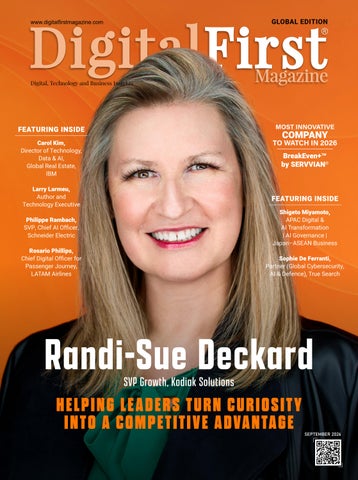
GLOBAL EDITION
www.digitalfirstmagazine.com
Digital, Technology and Business Insights
FEATURING INSIDE
MOST INNOVATIVE
Carol Kim, Director of Technology, Data & AI, Global Real Estate, IBM
TO WATCH IN 2026
COMPANY
BreakEven+™ by SERVVIAN®
Larry Larmeu, Author and Technology Executive
FEATURING INSIDE Shigeto Miyamoto, APAC Digital & AI Transformation | AI Governance | Japan–ASEAN Business
Philippe Rambach, SVP, Chief AI Officer, Schneider Electric Rosario Phillips, Chief Digital Officer for Passenger Journey, LATAM Airlines
Sophie De Ferranti, Partner (Global Cybersecurity, AI & Defence), True Search
Randi-Sue Deckard SVP Growth, Kodiak Solutions
HELPING LEA DERS TURN CURIOS ITY I N TO A C OMPETITIVE ADVANTAG E
SEPTEMBER 2026
Digital First Magazine September 2026
1
First Magazine 2 Digital September 2026
Digital First Magazine September 2026
3
www.digitalfirstmagazine.com
September 2026
Vol - 7 Issue - 9
Managing Editor
Free Subscription
Sarath Shyam
www.digitalfirstmagazine.com
Consultant Editors
International Partnerships
Dr. John Andrews Emma James Andrew Scott Sabrina Samson
Naomi Wilson Stanly Lui Steve Hope Keith Alexander
Americas Europe Middle East & Africa Asia-Pacific admin@digitalfirstmagazine.com
Creative Consultants Charlie Jameson Louis Bernard Shirley David
Follow Us On www.linkedin.com/company/ digitalfirstmagazine www.facebook.com/digitalfirstmagazine
Branding & Marketing Partnerships Jennifer Anderson Monica Davis Jessica Edword Rachel Roy Anna Elza Stephen Donnell Cathy Chen
Free Subscription
First Magazine 4 Digital September 2026
Digital First Magazine www.digitalfirstmagazine.com is a global knowledge sharing digital platform published by Connecta Innovation Private Limited. All rights reserved. The opinions expressed in the content are those of the authors. They do not purport to reflect the opinions or views of Connecta Innovation Private Limited or any of its members or associates. The publisher does not assume any responsibility for the advertisements and all representation of warranties made in such advertisements are those of the advertisers and not of the publisher. Digital First trademark is owned by DFG Digital First Infotech Pvt Ltd. and Connecta Innovation Pvt Ltd. has permission to use Digital First brand name. Digital First Magazine www.digitalfirstmagazine. com is a Free Subscription and Free-to-read digital platform strictly not for sale and has to be strictly for internal private use only. Publisher does not assume any responsibility arising out of anyone modifying content and pictures, printing a copy of this digital platform in any format and in any country and all matters related to that.
The Organizations That Learn, Lead
T
he most dangerous sentence in a fast-changing organization may be: “This is how we have always done it.” It sounds practical. It reflects experience. It protects processes that once worked. But when technology, markets, customer expectations, and skills change faster than businesses can update their playbooks, yesterday’s expertise can quickly become tomorrow’s limitation. The organizations that thrive will not necessarily be those with the biggest technology budgets or the longest track records. They will be those capable of learning faster than circumstances change. They will question assumptions, experiment, learn from failure, and turn new knowledge into better decisions. We see this tension in everyday work. A team can spend years refining a process, only to discover that new technology has made part of it unnecessary. The instinct is often to add another tool or automate the workflow. Yet the smarter
question may be: What have we learned, and what should we do differently now? The challenge is becoming more urgent. The World Economic Forum’s Future of Jobs Report 2025 estimates that 39% of workers’ existing skill sets will be transformed or become outdated between 2025 and 2030. Learning, therefore, cannot remain an occasional training exercise. It has to become part of how organizations operate. That idea connects naturally with this month’s cover story featuring Randi-Sue Deckard, SVP Growth at Kodiak Solutions. With more than two decades of experience translating vision into execution, Randi-Sue brings a practical perspective to growth, change, and organizational evolution. Her belief that people often underperform because of a lack of clarity and courage, rather than talent, is especially relevant in an age of constant change. Her perspective on AI adds another important dimension. Before automating a process, leaders must understand whether it works in the first place. Otherwise, technology simply helps a broken process fail faster. This issue of Digital First Magazine carries that spirit forward through thoughtprovoking articles, interviews, and perspectives on technology, leadership, people, and the evolving workplace. The future may not belong to organizations that have all the answers. It may belong to those willing to keep asking better questions. We invite you to explore this issue and discover ideas that could shape what comes next. Enjoy reading.
Sarath Shyam
Digital First Magazine September 2026
5
CONTENTS
10
SVP Growth, Kodiak Solutions
First Magazine 6 Digital September 2026
COVER
STORY
John Bonfiglio, Founder of SERVVIAN®
16
BreakEven+™ by SERVVIAN®
The Price Floor Behind Every Bid Digital First Magazine September 2026
7
26
LEADER’S INSIGHTS
42
54
60 First Magazine 8 Digital September 2026
Connecting the Dots Carol Kim,
Director of Technology, Data & AI, Global Real Estate, IBM
Empowering Sustainable Outcomes with Purpose Driven AI Philippe Rambach,
SVP, Chief AI Officer, Schneider Electric
Transforming the Passenger Journey with Data and AI Rosario Phillips,
Chief Digital Officer for Passenger Journey, LATAM Airlines
Leveraging AI for Accessible Healthcare Shigeto Miyamoto,
APAC Digital & AI Transformation | AI Governance | Japan–ASEAN Business
Sophie De Ferranti, Partner (Global Cybersecurity, AI & Defence), True Search
36
EXPERT OPINION
CONTENTS
AI Guardrails and Leadership: Why the Chief AI Officer Matters in an EU AI Act World
What Technology Leaders Get Wrong About Organizational Change Larry Larmeu,
Author and Technology Executive
48
Digital First Magazine September 2026
9
RANDI-SUE DECKARD SVP Growth, Kodiak Solutions
HELPING L EADERS T URN CURIOS IT Y INTO A C OM PET IT IVE ADVA NTAGE Randi-Sue Deckard helps organizations grow, build strong teams, and lead through change. With over twenty years of experience, she translates big-picture goals into daily action, helping companies, from startups to $150M enterprises, build effective, lasting strategies. Randi-Sue bridges the gap between vision and execution, ensuring teams don’t just grow, but evolve. Her work focuses on fostering clarity and courage, empowering leaders to build cultures where people can do their best work. Whether speaking or leading, she is dedicated to helping professionals approach their work with confidence, purpose, and a mindset of continuous improvement. Recently, in an exclusive interview with Digital First Magazine, Randi shared insights into how 20 years translating vision into execution across startups to $150M enterprises shaped her belief that people underperform from lack of clarity and courage, not talent. She sees AI as a tool, not a strategy, and warns leaders to “know what works before you automate it” because broken processes just fail faster. Her advice: build teams that learn faster than the market by treating experimentation as an operating system, not a campaign. The following excerpts are taken from the interview.
First Magazine 10 Digital September 2026
CO VE R ST O R Y Digital First Magazine September 2026
11
Hi Randi. You’re passionate about helping others unlock potential. What’s the core belief about people and performance that drives your coaching? I believe most people are operating far below their potential: not because they lack talent, but because they lack clarity, confidence, or the courage to take action. Performance isn’t about pushing harder; it’s about removing the obstacles that keep people from being who they are capable of becoming. The best leaders don’t just create followers; they build environments where people can think bigger, take ownership, and grow into strengths they did not know they had. My role is to help people see possibilities they cannot yet imagine and provide the tools and support to turn that potential into reality. GTM is evolving from funnels to flywheels. Five years from now, what do you believe will be the single biggest shift in how companies go to market? The biggest shift in go-to-market over the next five years will be the move from linear, rigid planning to continuous learning. The future belongs to organizations that treat their strategy as a living, breathing model. AI and customer data allow us to understand needs faster than ever, but technology is just a tool. The real advantage comes from how quickly we turn those insights into action. The most successful teams are relentlessly curious; they test assumptions, experiment, and refine their approach daily. Growth isn’t about having the perfect strategy; it’s about building a team that learns
First Magazine 12 Digital September 2026
and improves faster than anyone else in the market. In many ways, the future of GTM isn’t about selling better - it is about learning better. Customer experience is now the differentiator. What trend will define “customer-centric” companies in the next 5 years? True customer-centricity means shifting from simply responding to service requests to anticipating needs before they become issues. The companies that stand out won’t just solve problems quickly; they will provide insights that help customers achieve better outcomes
MY ROLE IS TO HELP PEOPLE SEE POSSIBILITIES THEY CANNOT YET IMAGINE AND PROVIDE THE TOOLS AND SUPPORT TO TURN THAT POTENTIAL INTO REALITY
before they even ask for help. While data and AI enable this, technology is not the differentiator. The true advantage is trust. The most customer-centric companies will make customers feel understood and supported long before they reach out for support. What’s your personal ritual that helps you reset and bring clarity before tackling a big challenge? I start by creating space before creating solutions. When I’m facing a significant challenge, I disconnect from the noise and give myself time to think. That often means taking a walk with my dogs, grabbing a coffee, journaling, or simply asking myself a few powerful questions: What problem are we really trying to solve? What assumptions am I making? What would success look like a year from now? I’ve learned that clarity rarely comes from working faster. It comes from stepping back long enough to see the bigger picture. Once I have clarity, execution becomes much easier.
Experimentation is your mantra. How will the tools and culture around testing need to evolve for companies to stay competitive? Companies need to stop treating experimentation as an occasional activity and start treating it as an operating system. The organizations that stay competitive will create cultures where curiosity is encouraged, assumptions are challenged, and learning happens continuously. Every initiative, campaign, customer interaction, and strategic decision becomes an opportunity to gather insights and improve. The goal isn’t simply to run more tests. The goal is to increase learning velocity. Teams need to move beyond asking, “Did it work?” and start asking, “What did we learn, and how do we refine from here?” The companies that thrive will be those that build repeatable systems for experimentation, reflection, and refinement. In a rapidly changing environment, the ability to learn and adapt is becoming more valuable than the ability to execute a fixed plan.
Digital First Magazine September 2026
13
THE LEADERS WHO GROW THE MOST AREN’T THE ONES WITH ALL THE ANSWERS; THEY’RE THE ONES ASKING THE BEST QUESTIONS
You champion a growth mindset. What book, podcast, or mentor shaped how you think about learning and reinvention most? Adam Grant’s Think Again reinforced something I’ve learned throughout my career: curiosity is a competitive advantage. The leaders who grow the most aren’t the ones with all the answers; they’re the ones asking the best questions. I’ve never felt pressure to be the smartest person in the room. I’d rather be the most curious. Curiosity helps us challenge assumptions, understand people more deeply, uncover opportunities, and adapt in a world that’s constantly changing. For me, growth isn’t about certainty; it’s about staying open to learning and refining what you think you know.
First Magazine 14 Digital September 2026
If you could set one rule for every GTM leader adopting AI today, what would it be to protect both innovation and customer trust? My rule is simple: know what works before you automate it. Too many organizations rush to implement AI without first understanding the processes they are trying to scale. AI is powerful, but it does not replace strategy, judgment, or strong foundations. If your process is broken, AI will only help you make mistakes faster. Before applying new technology, leaders need a repeatable system that produces the desired outcomes. Use AI to enhance efficiency and uncover insights, not to patch up gaps. The goal is to scale excellence, not to compensate for its absence.
Digital First Magazine September 2026
15
MOST INNOVATIVE
COMPANY TO WATCH IN
2026
BreakEven+™ by SERVVIAN®
The Price Floor Behind Every Bid
F
or a labor-intensive contractor, putting a price on a project can involve far more than calculating quantities and labor hours. A single job may bring together multiple labor activities, materials, subcontractors, production assumptions, direct costs, and the less visible expenses required to keep the business running. Traditionally, an estimator might calculate those inputs, add material and subcontractor costs, apply standard markups, and arrive at a bid. The challenge begins when management needs to understand what is actually driving that price. That is the problem John Bonfiglio set out to address. As the Founder of SERVVIAN® and creator of BreakEven+™, John recognized that
First Magazine 16 Digital September 2026
estimating and pricing required a deeper view of the economics behind the work. A contractor may know how many hours a project requires and what its materials will cost, yet still struggle to account for labor burden, fringe costs, overhead, general and administrative expenses, support functions, and the level of profit the business needs to sustain. SERVVIAN®, founded in 2017, was built around a straightforward idea: contractors should have greater visibility into those financial mechanics before committing to a price. That idea became the foundation for BreakEven+™, a Cost Intelligence and Pricing Strategy Platform designed for laborintensive businesses.
John Bonfiglio, Founder of SERVVIAN®
Digital First Magazine September 2026
17
Rather than treating estimating as a simple exercise in applying markups to direct costs, John wanted to give businesses a clearer view of how their costs come together and how those costs should inform pricing decisions. “Better pricing decisions begin with better cost intelligence,” John says. BreakEven+™ brings that thinking into the estimating process. A contractor can begin with the company’s established labor and indirect-cost structure, then build a project using quantities, labor hours, production rates, materials, subcontractors, other direct costs, and applicable pricing assumptions. As those elements come together, the platform provides visibility into how they affect the economics of the work. That visibility matters because the final bid is only one part of the decision. Management also needs to understand the assumptions behind the number, how costs are being recovered, and where the economics of a project may change. Through FALIB®, SERVVIAN’s reporting
First Magazine 18 Digital September 2026
framework, that information can be presented at different levels for company, project, production, and management needs. John explains, “The objective is not to tell a contractor what price to charge. It is to provide better information so management can make that decision with greater visibility.” His work with SERVVIAN® has since expanded BreakEven+™ beyond conventional estimating functionality. The platform incorporates labor economics, fringe and burden analysis, overhead and G&A cost recovery, production assumptions, profitability analysis, change orders, and operational workflows. Underlying these capabilities is John’s broader effort to make sophisticated cost and pricing concepts practical for organizations operating across construction, public works, municipalities, government contracting, industrial services, and other labor-intensive sectors. The thinking behind the platform is ultimately less complicated than the financial
structures it helps businesses examine. John believes companies make stronger pricing decisions when they understand the full cost of delivering their work, rather than looking only at what they hope to charge. That belief has guided SERVVIAN® from its early days and continues to define the direction of BreakEven+™. When the Numbers Stop Connecting For a contractor, the information behind a project estimate rarely lives in one place. Accounting systems hold financial data. Estimating applications contain project details. Production records track output, while employee information, pricing worksheets, spreadsheets, and operational reports fill other parts of the picture. Each system may work well on its own, but the assumptions created in one place do not always carry cleanly into the next.
SERVVIAN®, founded in 2017, was built around a straightforward idea: contractors should have greater visibility into those financial mechanics before committing to a price
That disconnect can create a subtle problem. An estimator may be working with accurate project quantities and labor hours while relying on financial assumptions that do not fully reflect the company’s current cost structure. John’s approach to this problem is to bring those pieces into a connected environment. BreakEven+™ links cost intelligence with estimating, production assumptions, pricing strategy, change orders, reporting, customer and vendor information, and other operational data. The objective is to create continuity between the financial information established by the business and the decisions made at the project level. Labor is a good example of why that continuity matters. A wage rate is only one component of the cost of employing someone. Fringe benefits and payroll-related expenses can add substantially to the actual cost of labor. The business must also account for expenses such as supervision, facilities, insurance, technology, vehicles, administration, and other support functions. Those costs have to be recovered somewhere. The conventional response is often to apply a markup. The problem is that a percentage can conceal the assumptions underneath it. Two contractors could apply the same markup to similar direct costs while carrying very different labor, overhead, or administrative structures. BreakEven+™ gives businesses a way to establish their break-even requirements from those underlying costs and then consider profit separately. This allows an estimator to see what a proposed price needs to recover rather than treating the markup itself as the answer. “BreakEven+™ developed from the realization that estimating and financial cost
Digital First Magazine September 2026
19
recovery are often treated as separate disciplines. A business might know what it pays an employee per hour and have a general idea of its overhead, yet still struggle to determine what an hour of productive labor actually needs to recover when all applicable costs are considered,” John explains. The platform’s development followed that principle. Its capabilities expanded from break-even and cost-recovery analysis into estimating, production assemblies, change orders, reporting, pricing analysis, workforce information, customer and vendor management, and operational workflows. FALIB® became an important part of that development. SERVVIAN’s reporting framework allows financial and pricing information to be presented according to the needs of different users and business situations. A management team may need a broad view of company economics, while a project team may need detailed job, production, or pricing information. The result is a more connected view of the numbers moving through a contracting business. John sees that connection as particularly relevant to organizations where labor and indirect costs play a significant role in project economics, including construction, public works, municipalities, government contracting, industrial services, coatings, facility services, and maintenance operations. Contractors face the daily challenge of ensuring the information used to price work matches the business that must deliver it. That leads to the next question. Even when the cost structure is clear, how much work can actually be completed with those resources? “Our objective is not simply to help someone produce an estimate. It is to help them understand the economics behind the estimate,” John says.
First Magazine 20 Digital September 2026
BreakEven+™ gives businesses a way to establish their break-even requirements from those underlying costs and then consider profit separately
Where Cost Meets Production A project can look financially sound on paper and still miss its target if the production assumptions are unrealistic. Consider a crew expected to complete a defined quantity of work within a certain number of labor hours. The labor cost may be calculated correctly, yet the estimate can still fall short if the production rate assumes more output than the crew can reasonably deliver. Time, labor, materials, site conditions, and the nature of the work all influence what is possible. This is why John treats production as part of the pricing equation rather than as a separate operational concern. BreakEven+™ allows cost structure and production assumptions to be considered together. Labor economics provide one side of the calculation. Production rates indicate
how that labor is expected to translate into completed work. The relationship works in both directions. “A labor rate may be financially sound, but an unrealistic production assumption can still undermine an estimate. Conversely, an accurate production rate cannot compensate for a labor rate that fails to recover the company’s applicable costs,” John says. By bringing cost structure and production assumptions together, BreakEven+™ helps management evaluate both sides of the equation before establishing the final price. John views technology not as a replacement for human experience but as a tool that makes information clearer, more consistent, and easier for business leaders to use. “BreakEven+™ is built around structured data so that labor, production, estimating, cost recovery, pricing, and reporting can be connected rather than
existing as isolated information,” he explains. Automation can remove repetitive steps from those workflows. Analytics can give management different ways to examine estimates, production assumptions, cost structures, and project results. The next layer is artificial intelligence. John sees opportunities for AI to help users identify patterns, find relevant information, explore scenarios, and interact with increasingly complex business data. His approach, however, is measured by the demands of the industries SERVVIAN® serves. “AI also presents interesting opportunities, but our approach is deliberate. In cost and pricing environments, particularly those involving government contracting or regulated work, explainability and traceability matter. An answer is considerably more useful when management understands where the underlying numbers came from,” John adds.
Digital First Magazine September 2026
21
That principle will remain important as BreakEven+™ incorporates more intelligent tools. AI can help users work with information, but the underlying calculations and source data still need to remain visible and traceable. For John, this is where technology becomes genuinely useful. It can take on repetitive work, surface information that might otherwise remain buried, and help people examine complex scenarios without taking the decision itself out of their hands. As BreakEven+™ continues to evolve, that balance between automation and human judgment will remain central. Technology can make information easier to access and analyze. The responsibility for deciding what to do with it still belongs to the people running the business.
First Magazine 22 Digital September 2026
Built by Listening to the Work One of the most important moments in SERVVIAN’s development came when John began looking beyond the traditional definition of estimating software. Estimating remained central to BreakEven+™, but it no longer described the problem he was trying to solve. The larger focus was cost intelligence and pricing strategy. That shift influenced how the platform developed. Rather than building a collection of tools around estimating, John began looking at the broader journey a contractor takes from understanding its financial position to preparing a price and managing the work that follows. The development of FALIB® became an important part of that journey. “It gave us a framework
for connecting financial analysis, labor economics, indirect-cost recovery, job-level pricing, production information, and reporting while allowing different audiences to see the appropriate level of information,” John shares. The expansion into public works, municipalities, industrial services, and government contracting brought another layer of perspective. These environments placed greater emphasis on traceability, documentation, labor requirements, cost treatment, and disciplined pricing. Each presented different operating realities, yet they reinforced the same underlying lesson for John: financial information becomes more useful when it stays connected to the work being performed. “Those developments helped clarify our direction: BreakEven+™ should sit between financial cost structure and operational execution and help businesses connect the two,” John says. The platform’s evolution has also been shaped by people using it in the field. Contractors often encounter situations that are difficult to anticipate from a software development environment. A workflow that appears logical during development may look very different when someone is using it to prepare an estimate, review pricing, manage employees, organize customers, or move a project through an organization. John pays close attention to those moments. Customer feedback can reveal where a process needs fewer steps, where users need more flexibility, or where information would be easier to understand if it were presented differently. Those observations become part of the development process, but they do not automatically become new features.
That distinction matters. John does not want BreakEven+™ to become a collection of individual solutions built around every request that comes in. Instead, he looks for the business problem behind the request and asks whether solving it can strengthen the platform for a wider group of users. “Listening closely while maintaining a coherent financial and operational architecture is an important part of how BreakEven+™ continues to evolve,” John adds. Rethinking a Familiar Pricing Habit For decades, markup-based pricing has offered contractors a familiar way to turn an estimated cost into a selling price. It is straightforward. Estimate the work, apply a percentage, and arrive at a number. The difficulty begins when that number needs to answer a more important question: does the price actually recover the company’s cost structure? John has found that changing this way of thinking requires more than giving contractors another calculation tool. The people making pricing decisions need to understand why different costs matter, how production assumptions affect the result, and where profit enters the equation. “We have learned that transparency is important. Users need to be able to follow the numbers rather than simply receive an answer from a black box. That philosophy has influenced the development of BreakEven+™ and FALIB® considerably,” explains John. The objective is not to make pricing more complicated. It is to make the underlying financial concepts practical enough to use when an actual project is on the line. “Looking ahead, we see a significant opportunity to make cost intelligence a more
Digital First Magazine September 2026
23
SERVVIAN intends to continue connecting financial information with estimating, production, pricing, reporting, and execution, while giving organizations greater control over how information is presented to different people inside the business
fundamental part of how labor-intensive businesses price and manage work,” John shares. That approach also points toward where he sees the broader opportunity. Construction, public works, municipalities, government contracting, industrial services, maintenance, and related fields operate under different commercial and regulatory conditions. Yet businesses in these sectors share the need to understand the costs supporting the work they take on. The future direction of BreakEven+™ follows that thinking. SERVVIAN® intends to continue connecting financial information with estimating, production, pricing, reporting, and execution, while giving organizations greater control over how information is presented to different people inside the business. The questions John wants management teams to ask are more useful than a simple markup percentage. What does the work actually cost? What does the business need to recover? Do the
First Magazine 24 Digital September 2026
production assumptions support the estimate? What level of profitability is being targeted? Can the organization explain how it arrived at the proposed price? Those questions shift the conversation from a calculation to a management decision. That is ultimately where John sees the value of cost intelligence. A pricing decision becomes stronger when the people making it can see the assumptions behind the number, understand what the business needs to recover, and explain why the proposed price makes sense. For SERVVIAN®, the work ahead is about making that kind of visibility practical across the many environments where labor, production, and cost recovery determine the economics of a contract. And as the platform continues to evolve, John’s central idea remains remarkably grounded: better decisions begin with knowing what the numbers actually mean.
Want to Sell or find Investors for your Business?
Digital First Magazine September August 2026 2021
25
LEADER’S INSIGHTS
Connecting the Dots Carol Kim, Director of Technology, Data & AI, Global Real Estate, IBM
Hi Carol. Organizations have invested heavily in AI over the past few years. In your view, what separates companies that are truly transforming their business with AI from those that are simply experimenting with the technology? One thing I’ve noticed is that the organizations creating the greatest impact rarely start by talking about AI. They start by talking about people. Every organization has work that feels unnecessarily hard. Employees spend time
searching for information, reconciling conflicting reports, navigating disconnected systems, or waiting for approvals. Those moments may seem small on their own, but together they create enormous friction across a business. The organizations making the biggest strides with AI don’t ask, “Where can we deploy AI?” They ask, “Where are we making work harder than it needs to be?” That’s a very different conversation. At IBM Global Real Estate, we’ve found that AI creates the most value when it quietly
Technology should do the heavy lifting so people can focus on judgment, creativity, and collaboration
First Magazine 26 Digital September 2026
Carol Kim is Director of Technology, Data and AI for IBM Global Real Estate, where she leads global strategy for AI, enterprise data, intelligent workplace technologies, and digital transformation across one of the world’s largest corporate real estate portfolios. As IBM’s Client Zero, she helps transform emerging technologies into practical solutions that improve employee experience, operational performance, and sustainability. A CPA turned technology executive, international keynote speaker, and award-winning leader, Carol believes technology’s greatest purpose is empowering people to make better decisions. She is passionate about connecting business, technology, and human potential to create workplaces that are smarter, more sustainable, and more human. Recently, in an exclusive interview with Digital First Magazine, Carol shared insights into her professional journey from CPA to Director of Technology, Data and AI for IBM Global Real Estate, where she leads AI and digital transformation for one of the world’s largest corporate portfolios as IBM’s Client Zero. Carol believes the future of work belongs to organizations that combine artificial intelligence with human judgment, empathy and curiosity, and her advice is to collect experiences before titles and use technology to eliminate unnecessary work so people can focus on creativity and decision-making. The following excerpts are taken from the interview.
Digital First Magazine September 2026
27
removes those everyday obstacles. As IBM’s Client Zero, we use our own technologies before asking clients to adopt them. That means our employees become our first customers, our toughest critics, and often our best innovators. They’ll quickly tell us whether something genuinely improves their work or whether it’s simply an interesting demonstration. One example is condition based maintenance. Imagine it’s the hottest day of summer and your office air conditioning keeps running without interruption. Most people never think twice about it, and that’s exactly the point. AI recognized subtle changes in equipment performance long before anyone noticed a problem, allowing our facilities teams to act proactively instead of reactively. Success isn’t always visible. Sometimes success is the disruption that never happened. The same principle applies well beyond buildings. Whether someone is evaluating a
First Magazine 28 Digital September 2026
real estate portfolio, responding to a workplace issue, or planning future investments, people shouldn’t have to spend half their day gathering information before they can begin thinking. Technology should do the heavy lifting so people can focus on judgment, creativity, and collaboration. For me, that’s the real opportunity with AI. Technology should become less noticeable while people become more capable. Corporate real estate is undergoing one of its biggest transformations in decades. How do you envision AI, connected buildings, and intelligent workplaces changing the way organizations operate over the next five to ten years? Every building has a story. For years, we’ve filled buildings with sensors, building management systems, work orders, occupancy data, energy
The leaders who ask thoughtful questions, challenge assumptions, and bring together different perspectives will continue to outperform those who simply have access to better technology
meters, environmental controls, and maintenance records. The information has always been there. What has changed is our ability to understand what those millions of signals are telling us. I’ve always admired experienced building engineers because they have an incredible intuition. They can walk through a mechanical room, pause for a moment, and say, “Something doesn’t sound right.” That’s knowledge built from years of experience. Technology is helping us scale that intuition. Today, AI can recognize patterns across thousands of assets simultaneously, connecting operational data with financial, sustainability, and workplace information in ways that simply weren’t possible before. Instead of opening multiple dashboards and trying to piece together the story yourself, imagine asking one question: “Which buildings need my attention today?” Or, “Where can we reduce energy while maintaining a great employee experience?” Instead of overwhelming us with more information, intelligent buildings will increasingly help us prioritize what matters most. I also believe corporate real estate is becoming one of the most exciting places to apply AI because it sits at the intersection of people, places, technology, sustainability, and business strategy. Every workplace decision affects employees, customers, operational costs, and environmental impact. That’s a wonderful opportunity to connect data across disciplines instead of managing each function independently. One lesson I’ve learned throughout my career is that the most valuable insights often emerge when different perspectives come together. That’s exactly what’s happening with intelligent workplaces. Buildings are no longer
Digital First Magazine September 2026
29
just physical spaces. They’re becoming active participants in helping organizations operate more efficiently, more sustainably, and with a better employee experience. I don’t think the future belongs to the smartest buildings. I think it belongs to the organizations that learn how to listen, connect the dots, and turn insight into action. Many organizations have more data than ever before, yet leaders still struggle to make timely decisions. What do you believe is preventing organizations from becoming truly datadriven, and how can AI help bridge that gap? Every organization is trying to become data driven. The organizations making the greatest progress have realized that data alone isn’t the goal. Confidence is. Some companies genuinely struggle with data quality, governance, and accessibility. Others have years of trusted information, but it’s spread across dozens of systems, owned by different teams, and wrapped
in institutional knowledge that only a handful of people know how to navigate. Both situations create the same experience for employees. We’ve all been there. Someone asks a simple question during a meeting. Suddenly everyone opens SharePoint, Teams, email, dashboards, and spreadsheets. Five minutes later someone says, “I think I have the latest version...” Everyone laughs because it’s true. The challenge isn’t that organizations lack data. The challenge is turning information into confidence. One of the best pieces of advice I received early in my finance career was, “Never confuse precision with accuracy.” That lesson has become even more relevant in the age of AI. Technology can generate an incredibly polished answer in seconds. That doesn’t automatically make it the right answer. That’s why governance, data quality, lineage, and context are becoming strategic advantages rather than technical requirements. Trusted data creates trusted AI. Trusted AI creates confident decisions. When that foundation exists, something interesting happens. People stop spending their time
I don’t think the future belongs to the smartest buildings. I think it belongs to the organizations that learn how to listen, connect the dots, and turn insight into action
First Magazine 30 Digital September 2026
gathering information. They start spending their time asking better questions. That’s where innovation begins. To me, AI creates the greatest value when it transforms information into understanding, and understanding into action. Technology is increasingly shifting from automating tasks to augmenting human decision-making. How do you see the relationship between human expertise and AI evolving, particularly in complex business environments? The future belongs to organizations that combine artificial intelligence with human wisdom.
Each brings something different to the table. Technology processes information at incredible speed. It recognizes patterns, summarizes knowledge, identifies risks, and explores possibilities that would take people days or even weeks. People contribute something equally important. Judgment. Empathy. Ethics. Experience. Context. One of the analogies I like to use is an orchestra. Every musician may be incredibly talented, but creating something extraordinary requires everyone playing together with purpose. Technology helps every instrument perform at its best. Leadership brings the music to life. Business works the same way. Technology can help us understand what is happening. People decide what should happen. That’s why I actually believe curiosity becomes even more valuable as AI advances. When everyone has access to information, the competitive advantage shifts from knowing more to wondering more. The leaders who ask thoughtful questions, challenge assumptions, and bring together different perspectives will continue to outperform those who simply have access to better technology. Technology will continue becoming smarter. Leadership will become even more human. Across industries, leaders are under pressure to deliver innovation while controlling costs and managing risk. How can organizations create a culture that encourages experimentation without compromising governance and trust? The most innovative organizations I’ve worked with all have one thing in common. People know it’s safe to think differently. Innovation doesn’t come from removing every rule. It comes from
Digital First Magazine September 2026
31
creating clarity. Employees need to understand where experimentation is encouraged, how decisions are made, and what responsible risktaking looks like. When those expectations are clear, people spend less time wondering whether they’re allowed to innovate and more time solving problems. One of my favorite leadership principles is simple. Fail fast. Learn faster. Notice the emphasis isn’t on failing. It’s on learning. At IBM, our Client Zero culture reinforces that every day. Because we use our own technology first, employees give us incredibly candid feedback. Some of my favorite conversations begin with, “This is close...” “...
First Magazine 32 Digital September 2026
but here’s what’s still frustrating.” Most people hear criticism. I hear possibility. Those conversations often become the catalyst for our next improvement because they’re grounded in real experiences from people doing real work. Think about some of the best products you use every day. They probably weren’t perfect the first time you opened them. They improved because someone listened. Innovation follows the same path. The organizations that build trust aren’t the ones that avoid mistakes. They’re the ones that learn quickly, improve continuously, and make employees part of the journey. That’s how experimentation becomes part of the culture instead of something people are afraid to try.
Throughout your career, you’ve successfully navigated finance, operations, technology, data, and AI leadership. Looking back, what experiences have most shaped your leadership philosophy, and what advice would you give professionals building careers in an era of constant technological change? If there’s one theme that has shaped my career, it’s curiosity. People sometimes assume my career followed a carefully planned roadmap. The truth is, it was much more of an exploration than a blueprint. I started as a CPA, and if someone had told me twenty years ago that I’d be leading Technology, Data and AI for IBM Global Real Estate, I probably would have smiled and said, “That sounds exciting...but I’m not sure how I’d get there.” Looking back, every meaningful opportunity started with a simple question: “What can I learn from this?” That question took me from finance into operations, from operations into technology, and eventually into data and AI. At the time, each move felt like a leap outside my comfort zone. Looking back, I realize I wasn’t changing careers. I was building perspective. Finance taught me how organizations measure value. Operations taught me how work actually gets done. Technology taught me how to scale ideas. Data connected those worlds. AI is helping us unlock them in ways we couldn’t have imagined just a few years ago. That cross functional perspective has become one of the greatest advantages of my career because business challenges rarely arrive labeled “finance,” “technology,” or “operations.” They arrive as opportunities that require people with different experiences to solve them together.
If I could offer one piece of advice, it would be this: Collect experiences before you collect titles. Titles describe where you sit. Experiences shape how you think. Technology will continue to evolve. Industries will continue to change. Curiosity, empathy, adaptability, and the willingness to keep learning will always remain relevant. One thing I’ve learned is that connecting dots is often more valuable than staying inside them. When you bring together different perspectives, that’s usually where the most meaningful innovation begins. Imagine we’re having this conversation in 2035. What do you hope will have changed about the way people work, make decisions, and experience the workplace because of advances in AI and intelligent technologies? I hope we look back and realize this wasn’t simply the decade when AI became smarter. It was the decade when people became more empowered. When people ask what excites me most about the future, they often expect me to talk about the next breakthrough model, autonomous agents, robotics, or technologies that haven’t even been invented yet. Those innovations are exciting. What excites me even more is what they make possible for people. Imagine a new employee contributing with the confidence of someone who’s spent twenty years with the company because knowledge is finally accessible. Imagine a facilities manager preventing disruptions before employees ever notice there’s a problem. Imagine leaders spending less time debating whose spreadsheet is correct and more time discussing ideas that move the business forward.
Digital First Magazine September 2026
33
I believe we create better outcomes when we first eliminate unnecessary work, simplify what remains, and then use technology to help people do their best work
And yes, imagine getting back the hours we spend every week in meetings that probably could have been a two-minute summary. I don’t think anyone is going to miss those. Technology has always promised productivity. I believe its greatest promise is potential. One principle has guided me throughout my career: Eliminate. Simplify. Automate. Too often organizations jump straight to automation. I believe we create better outcomes when we first eliminate unnecessary work, simplify what remains, and then use technology to help people do their best work. That’s where AI becomes
First Magazine 34 Digital September 2026
transformational. Not because it replaces people. Because it elevates them. I hope AI gives us more time to mentor. More time to create. More time to build relationships. More time to solve problems that matter. More time to think. At the end of the day, technology will continue to evolve. Human potential is what truly changes the world. If AI helps us unlock more of that potential, then I believe history won’t remember this era because of the technology we built. It will remember it because of what people were able to accomplish with it. To me, that’s a future worth building.
Digital First Magazine September 2026
35
EXPERT OPINION
AI Guardrails and Leadership: Why the Chief AI Officer Matters in an EU AI Act World Sophie De Ferranti, Partner (Global Cybersecurity, AI & Defence), True Search
A
rtificial intelligence has moved from experimental pilots to the operational core of most organisations. For cybersecurity and defence technology businesses, AI now shapes threat detection, intelligence fusion and mission-critical decision-making. As this shift accelerates, one uncomfortable truth becomes clear: technical brilliance alone is no longer enough. Without clear guardrails and accountable leadership, AI will quietly amplify risk and dilute resilience, and it is here where ‘human-in-the-loop becomes ever more critical.
From a vantage point of being in Global Executive Search at True, and in my role as Governor for the Global Council for Responsible AI, three themes increasingly define the conversation across executive leadership teams: 1. AI guardrails must be designed in from the outset, not retrofitted. 2. Leadership responsibility for AI can no longer be diffused across the organisation – it requires ownership and stewardship 3. Regulation – especially the EU AI Act – is turning these principles from good practice into hard requirements, with significant consequences for those who fail to comply.
Without clear guardrails and accountable leadership, AI will quietly amplify risk and dilute resilience, and it is here where ‘human-in-the-loop becomes ever more critical
First Magazine 36 Digital September 2026
Sophie De Ferranti is a partner in True’s Cybersecurity & Defence Tech Practice, and a member of the London and New York offices. Sophie has market-leading expertise in placing C-suite executives in cybersecurity, AI, digital transformation and information security for high-growth tech, consumer, defense and aerospace businesses at all stages from Series A through publicly traded companies. Highly entrepreneurial in her approach, Sophie is passionate about promoting diverse leadership in cybersecurity and technology. Sophie works closely with C-suite executives and board members to strengthen their organization’s cyber and AI risk posture from a people advisory perspective and helps build diverse and inclusive teams. Beyond her professional work, Sophie is an appointed governor for the Global Council of Responsible AI, a Board Advisor and semi-professional women’s polo player.
Digital First Magazine September 2026
37
From experimentation to accountability In the early days of AI adoption, organisations often treated AI like any other piece of technology: something to be owned by IT, explored by data science teams, and “leveraged” by the business. Models were built, proofsof-concept were launched, and success was measured in accuracy, speed, or efficiency. That era is ending. AI systems now make and shape decisions that have a direct impact on people’s employment, reputations and rights – and ultimately people’s livelihoods. • AI operates inside complex, interconnected systems – cyber defence platforms, autonomous systems, critical infrastructure – and where failure modes are non-linear and remain hard to predict. It learns from data in ways that can embed bias and create opaque risk pathways. The result: a governance gap. Traditional structures – CIO, CISO, CTO and even Chief Data Officers – are necessary but in a world of increasing geopolitical risk, are insufficient. Each sees a piece of the puzzle: infrastructure, security, data, but none is explicitly mandated to own AI as a ‘system of risk’. The rise of the Chief AI Officer The emergence of the Chief AI Officer (CAIO) reflects an attempt to close that gap. And it’s not just another title in the alphabet soup of C-suite roles. Properly defined, the role signals a structural shift in executive leadership teams: AI is treated as a strategic capability and a risk domain that demands its own accountable owner. But there is no ‘one size fits all’ when it comes to understanding how to position the CAIO leadership function. From what we see
First Magazine 38 Digital September 2026
in conversations with Boards, CEOs and hiring teams, the most effective CAIO mandates share a few characteristics: • Enterprise-wide scope: AI is not confined to a single product, business unit or function. The CAIO oversees how AI is conceived, architected, deployed and maintained across the organisation – from experimentation to production. • Dual lens of value and risk: The CAIO is responsible both for exploiting AI’s upside (innovation, efficiency, new offerings) and for identifying and mitigating its downside (ethical, legal, operational, reputational). • Strong regulatory literacy: In an EU AI Act environment, the CAIO must understand classification (minimal, limited, high-risk, prohibited), documentation and compliance obligations, and ensure these are translated into practice. • Deep partnership with CIO, CISO, CDO, CTO and the Board: AI cannot, and must not, be managed in isolation. The CAIO must work horizontally, aligning architecture, data strategy, security, and business objectives. In practical executive search terms, this means the ideal CAIO profile is not simply “the smartest data scientist in the room”. Instead, organisations are increasingly looking for: • A senior leader who has launched and scaled AI programmes in regulated contexts. • Someone who can read a board pack as easily as a model card. • A person trusted by security, legal, and business stakeholders – able to say “no” when governance is weak, and “yes” when guardrails are strong.
Guardrails: from concept to operating reality “Guardrails” has become an all too popular term in the AI debate. It is often used so loosely however that it risks losing meaning. In a serious, regulated environment, AI guardrails should be understood as a structured set of constraints, controls, and practices designed to: • Prevent predictable harm; • Detect emerging risk; • Create transparency for oversight and accountability; • Define cultural expectations that encourage challenge and dissent when AI outputs look wrong or ethically questionable.
For boards, the practical takeaway is clear: when appointing a Chief AI Officer or reshaping leadership around AI, the job description must move beyond technical proficiency to institutional stewardship
• And so, the reality is that a Chief AI Officer’s credibility rests on their ability to articulate and operationalise these guardrails, a conversation that must start in the Boardroom, to ensure AI is embedded, used responsibly and is auditable - top down. The EU AI Act: raising the regulatory bar The EU AI Act crystallises many of these expectations into law. It categorises AI systems into risk tiers, imposes obligations on providers and users, and introduces enforcement mechanisms – including significant fines – for non-compliance.
Digital First Magazine September 2026
39
AI systems now make and shape decisions that have a direct impact on people’s employment, reputations and rights – and ultimately people’s livelihoods
If we AI in a leadership context, for example, several important implications stand out: 1. Classification becomes a strategic decision • How an organisation classifies its AI use cases (high-risk vs limited-risk) determines the intensity of obligations: documentation, oversight, human-in-the-loop requirements, transparency. • Decisions about classification can no longer be left to individual teams; they require a central view, typically led or coordinated by the CAIO in partnership with legal and compliance, and interaction with the Board. 2. High-risk systems demand demonstrable governance • For high-risk AI (e.g. safety-critical, law enforcement, certain employment or financial decisions), the EU AI Act requires
First Magazine 40 Digital September 2026
risk-management systems, data and technical documentation, logging, transparency and human oversight. • This dovetails directly with a CAIO’s mandate: they must ensure that high-risk systems are identifiable, traceable, and governed, and that evidence of compliance is always within reach. 3. Board-level accountability intensifies • Regulation makes AI risk a board topic, not a departmental concern. Boards will need to show they understand how AI is used, where high-risk systems sit, and how guardrails function – so arguably this will also disrupt conventional boardroom composition to remain future-proof. • A well-structured CAIO role becomes the board’s “single throat to choke” for AI governance, and the key interface between regulatory expectations and operational reality.
4. Vendor and supply-chain risk expands • Many organisations use third-party AI models, platforms and tools. Under the EU AI Act, responsibility may extend into these relationships. • The CAIO must help define procurement criteria, due-diligence processes and contractual safeguards aligned with AI risk – particularly when sourcing from global vendors outside the EU. For Critical National Infrastructure and specifically defence tech organisations, these implications are further amplified. AI systems may intersect with surveillance, targeting, critical infrastructure controls, and national security. Even when use cases fall outside the strictest EU categories (for example in national security cases), the reputational and ethical stakes demand similar discipline. Leadership qualities for an AI-native world So what does this mean in reality for leadership selection and assessment when it comes to emerging AI functions? A few traits consistently separate effective AI leaders from merely technical ones: • Systems thinking – seeing AI not as a tool, but as part of a wider socio-technical system involving people, processes and regulations. • Risk literacy – comfort discussing AI in the language of risk appetite, control frameworks, assurance, and trade-offs, rather than just efficiency and output. • Multi-stakeholder fluency – the ability to bridge engineers, ethicists, regulators, security professionals and business leaders, translating jargon into priorities. • Moral courage – willingness to slow or halt deployments that are exciting technologically
but weak in guardrails, even under commercial pressure. • Curiosity and humility – recognition that AI’s behaviour can be non-intuitive and that ongoing scrutiny is not optional. For boards, the practical takeaway is clear: when appointing a Chief AI Officer or reshaping leadership around AI, the job description must move beyond technical proficiency to institutional stewardship. Well-designed guardrails and robust AI leadership are sometimes framed as friction – something that slows innovation. The reality, however, especially in cyber and defence contexts, it’s the opposite. Organisations that have clear, empowered ownership for AI tools are better placed to scale AI capabilities with confidence instead of hesitation. They build trust with regulators, customers, partners, and employees. Over time, that trust becomes a competitive advantage. The emergence of the Chief AI Officer, therefore (similar to the CISO function a few decades ago), and the guardrails demanded by frameworks like the EU AI Act, are not administrative burdens. They are signals that AI has arrived where it belongs: in the realm of serious and resilient leadership. So the question is no longer whether to appoint such leadership, but how quickly and in a race to tap into a ‘qualified’ talent pool. In the meantime, we’re actively watching the AI migration upward - but still with baited breath. Expect AI fluency to increasingly be specified inside CEO, CFO and COO mandates rather than carved out — a trend already visible in 2026 board selection. At True we are on hand to help shape what that trend should look like.
Digital First Magazine September 2026
41
LEADER’S INSIGHTS
Empowering Sustainable Outcomes with Purpose Driven AI Philippe Rambach, SVP, Chief AI Officer, Schneider Electric
Hi Philippe. Industrial AI is moving fast. What trend in AI for energy management and automation do you think will surprise people most in the next 3 years? The trend I think will catch people off guard is how quickly agentic AI moves from a concept into the fabric of daily industrial operations. We talk a lot about AI generating insights, producing reports, flagging anomalies. That’s already happening. What’s coming next is AI that acts. It takes autonomous steps inside business processes rather than simply presenting information for a human to review. At Schneider Electric, we recently launched Sera, an AI agent that changes how operators interact with environmental data. Instead of navigating rigid dashboards or static reports, users can have a genuine conversation with
their systems, ask complex questions in natural language, get explanations, investigate what they’re seeing in real time. That shift, from software that presents data to software that interprets it on demand, is already underway. But here’s what I think will actually surprise people - it won’t be the capability itself. It will be how much more important governance becomes as a result. When AI is generating outputs for a human to review, a mistake is visible and correctable. When AI is taking actions autonomously, the governance problem becomes substantially harder. Organizations that treat responsible deployment as a design principle rather than a compliance exercise will be the ones that scale agentic AI confidently. The ones that don’t will hit walls they didn’t see coming.
Organizations that treat responsible deployment as a design principle rather than a compliance exercise will be the ones that scale agentic AI confidently
First Magazine 42 Digital September 2026
Philippe Rambach is the SVP, Chief Artificial Intelligence Officer of Schneider Electric. His mission is to drive AI innovation at scale, both internally and for customers, to provide greater overall efficiency and sustainability through data-based insights. Philippe is a graduate of Ecole Polytechnique in France and joined Schneider Electric in 2010 from AREVA. He has more than 20 years of experience in strategy, innovation, and business responsibility in many industries. He held various leadership roles in Energy Management and Industrial Automation. Most recently, as SVP Industrial Automation Commercial, where he led the commercial organization. Recently, in an exclusive interview with Digital First Magazine, Philippe shared insights into how his 20+ year journey from Ecole Polytechnique to SVP, Chief AI Officer has shaped his approach to scaling AI with purpose. He believes the most surprising trend will be agentic AI moving from insight to autonomous action inside industrial operations, making governance a design principle rather than an afterthought. His advice is to treat AI as additive to classical models, anchor every use case in measurable business outcomes, and never outsource values or critical thought. The following excerpts are taken from the interview.
Digital First Magazine September 2026
43
The single most important skill we’re developing isn’t technical. It’s the habit of asking: where did this answer come from, and does it hold up?
One more thing worth saying: agentic AI doesn’t replace the classical AI we already depend on, the forecasting, the anomaly detection, the optimization models that handle real industrial physics. It adds to that foundation. The organizations that understand Gen AI as additive, rather than one generation replacing the last, will be far better positioned than those chasing novelty for its own sake. Leaders often fear AI will replace human judgment. What role do you believe purpose, values, and human intuition still play when AI is in the room? I think the fear itself is worth examining, because it tends to collapse two very different things into one. There’s a legitimate question about where human judgment remains essential, and there’s a separate anxiety about what happens to the people doing that judging. Those are not the same conversation, and mixing them up makes both harder to have clearly.
First Magazine 44 Digital September 2026
On the first question: human judgment becomes more important as AI scales, not less. AI systems are, most of the time, unreliable components. Not useless, not ineffective, but unreliable in a technical sense: the output is not guaranteed to be correct. What good engineers have always known is that you can build reliable systems from unreliable components if the architecture is designed for it. A plane is reliable even though, at any moment, some component on it has failed. It is engineered so no single failure brings it down. Human oversight is part of that architecture. In our customer service AI, for example, the system generates a response and a human agent reviews it before it reaches the client. That’s not a limitation we’re working to remove - it’s a deliberate design choice. On purpose and values: these matter more than most technical leaders are comfortable admitting. We have an external Trust Charter for AI that makes explicit what we will and will not do. One decision I made early is that
Schneider Electric will not use facial recognition technology. That’s a values-based choice, not a technical one. Publishing that kind of commitment before regulatory pressure forces the conversation signals something important to employees, customers, and partners: that responsible deployment is a design principle, not an afterthought. The framing I’d gently push back on is “intuition.” What organizations actually need is critical thinking, not gut feeling, but the discipline to interrogate an AI output rather than accept it. We’ve built that habit into our “AI for all” training program, which carries the same institutional weight as our safety and anticorruption training. The single most important skill we’re developing isn’t technical. It’s the habit of asking: where did this answer come from, and does it hold up? Edge AI + IoT are reshaping factories and infrastructure. What will “intelligent infrastructure” look like for customers 5 years from now? Five years from now, I think the most significant shift will be that infrastructure stops being something you monitor and starts being something that monitors itself, and increasingly, acts on what it finds. To understand what that means in practice, it helps to be clear about why the edge matters. The decision between running AI at the edge versus in the cloud isn’t a philosophical one. It comes down to two things: data sovereignty and speed. In many industrial environments, cybersecurity requirements mean data cannot leave the facility. That’s a hard constraint. The second driver is latency. In automated visual inspection, when a machine is producing output
every ten milliseconds, you simply don’t have time to send data to the cloud, run the analysis, and receive a response. The physics of the problem dictates local intelligence. What five years of progress on edge hardware and AI models will produce is infrastructure capable of far more sophisticated reasoning locally. Not just anomaly detection, but predictive maintenance that accounts for how equipment interacts across a system. It will optimize energy in real time based on load patterns, grid signals, and the specific demands of what’s running. For customers in energy management, that means grids and buildings that don’t just respond to problems but anticipate them. For industrial customers, it means factories where the AI understands the production context, not just the sensor reading. The infrastructure becomes a participant in the operation, not a passive observer. The honest caveat I’d add is that this only works if the governance architecture is built alongside the technical one. Intelligent infrastructure that makes autonomous decisions in environments where a mistake can disrupt a supply chain or compromise a grid requires very clear answers to the question of where human judgment stays in the loop. That architectural work is happening now, and it will determine a great deal about what “intelligent infrastructure” actually looks like at scale. The skills needed in industry are shifting fast. What 3 skills should young professionals build today to thrive in AI + industrial operations tomorrow? The first is critical thinking, and I mean that precisely, not generically. As AI tools become
Digital First Magazine September 2026
45
more capable, the risk of blind belief grows alongside them. People either accept AI outputs without scrutiny, or reject AI entirely because they don’t trust it. Neither is useful. What organizations need are people who can engage with an AI answer thoughtfully: check the sources, understand where the model is drawing its reasoning from, identify where the output might be wrong or partially wrong. We’ve built that habit into our “AI for all” training, which carries the same institutional weight as our safety and anti-corruption training. Without it, better AI tools just amplify mistakes faster. The second is domain knowledge, genuine and deep understanding of the physical systems and business processes that AI is being applied to. The value of an AI output in industrial operations is almost always determined by whether the person interpreting it understands the context. A model that flags an anomaly in a production line is only useful if the operator understands what that anomaly means for the specific equipment involved. Generalist AI skills without industrial grounding are much less powerful than people currently assume. It’s why, inside Schneider, we don’t hand AI to the AI specialists alone. We put it in teams that pair AI skill with deep domain knowledge, because one without the other underdelivers. The third is what I’d describe as business fluency: the ability to connect an AI capability to a measurable business outcome. This is the discipline our entire AI strategy is built around. We never start from the technology and ask what we can do with it. We start from a business problem and ask whether AI can help. Young professionals who can think that way, who can translate between what a model does
First Magazine 46 Digital September 2026
and what a business actually needs, will be genuinely scarce and genuinely valuable. The technical implementation will keep getting easier. The judgment about where to apply it, and whether it’s actually working, will not. Sustainability is central to your mission. Outside of work, what’s one sustainable choice or passion you’ve embraced in your personal life? Living in France, I find it’s easier than in many parts of the world to make choices that are a little lighter on the planet, whether that’s taking the train instead of flying for shorter trips across Europe, buying locally, going by bicycle to the office, or being more intentional about energy use at home. If I’m being honest - I don’t think any of us who work in this space can claim perfection in our personal lives. But I think that’s actually the point. The energy transition isn’t about waiting for the perfect solution. It’s about making better choices with the options you have today, and being willing to keep improving. That’s the same philosophy we apply at Schneider, and it’s something I try to carry into how I live as well. AI work is intense and long-horizon. What’s your go-to small ritual or daily habit that keeps you grounded? I travel a great deal, and the routines that I find survive travel are the ones that I believe should really matter. I read a lot, fiction and non-fiction, and wherever I go I never travel without the book I am currently reading. It gives me a sense of continuity. It also reminds me that the difference between a good book, an excellent one and a bad one is very hard to define. It sits beyond technique.
We never start from the technology and ask what we can do with it. We start from a business problem and ask whether AI can help
I am a great admirer of Tolkien and while many writers have worked in his spirit, none have ever been as good as the master. AI can already produce prose that “looks like Tolkien,” and it will keep getting better at it. But like the human imitators, I do not believe it will ever bring the same pleasure as a true artist, a true innovator like John Ronald Reuel. That keeps us humble, and grounded, about the progress of AI. Innovation often comes from unexpected places. What’s a non-tech field — art, sport, music, science — that you find most inspiring right now? Science and more precisely Mathematics works in the world of theory, without any practical
application in mind. And yet one day, for reasons no one could have foreseen, a pure theoretical result became instrumental when solving a very practical matter. The mathematicians who developed linear algebra, vectorial space concept and matrix computation in the 19th and early 20th century never planned or even thought of using it for Artificial Intelligence in the early 21st century. But now, without their theories and formal concepts, no Artificial Intelligence would exist today! So let us continue to work on fundamental sciences, core development and research. If we keep using our brains across these domains, one day something as new and as exciting as Artificial Intelligence will come out of it.
Digital First Magazine September 2026
47
EXPERT OPINION
What Technology Leaders Get Wrong About Organizational Change Larry Larmeu, Author and Technology Executive
T
echnology leaders like solving technical problems. We break complex challenges into manageable pieces, create delivery plans, define governance, and measure progress through milestones. It is a mindset that has served our industry well. The problem is that the hardest part of organizational change is rarely the technology. Whether the initiative is an AI rollout, a cloud migration, a new operating model, or a major platform replacement, the same obstacles appear with surprising consistency. People
question what the change means for them. Teams become protective of the systems and processes they have built. Rumours spread faster than official updates. Leaders discover that technical implementation is often the easiest part of the programme. No environment exposes these dynamics more clearly than a merger or acquisition. I’ve spent much of my career involved in mergers and acquisitions, first as an engineer integrating systems and later leading large-scale technology and transformation programmes. What struck me over time was that mergers don’t
The most successful transformations spend more time understanding the problem than selecting the solution
First Magazine 48 Digital September 2026
Larry Larmeu is a technology and transformation executive who has spent over twenty years leading teams through largescale technology programs, integrations, and organizational change in financial services. He has led global technology practices at major consulting firms and built delivery organizations from the ground up, navigating the politics, culture clashes, and late-night crises that come with the territory. Originally from New Orleans, Larry lives in London with his family. He is the author of subMERGED: A Business Novel on Leading Through Change, currently available on Amazon and other major and independent bookstores.
Digital First Magazine September 2026
49
introduce new organizational challenges. They simply compress every challenge that exists in any transformation into an unforgiving timeline. A digital transformation might allow years for people to adapt. An acquisition rarely offers that luxury. Investors expect synergies. Customers expect continuity. Employees expect answers that leaders often don’t yet have. Decisions that would normally unfold over months have to be made in weeks, while the organization continues serving customers and running day-to-day operations. That pressure reveals something many organizations underestimate: technology doesn’t determine whether a transformation succeeds. People do. One of the first mistakes leaders make is assuming people are primarily concerned with the strategy. They aren’t. Their first question is almost always personal.
First Magazine 50 Digital September 2026
What does this mean for my role? Will my team still exist? Will the work I’ve spent years building still matter? Until those questions are answered, it’s difficult for people to fully engage with the broader vision. In the absence of clear communication, they create their own narrative, and that narrative is almost always worse than reality. I’ve seen talented people begin looking for new opportunities within days of a major announcement, not because they knew something everyone else didn’t, but because nobody knew anything at all. Silence is rarely interpreted as reassurance. The second challenge emerges once organizations begin making decisions. This is where many transformations unintentionally become competitions rather than collaborations. In a merger, two teams compare platforms, each convinced theirs is the better solution. During a digital transformation, process owners defend established ways of working against automation or standardization. The discussion appears to be about technology or process, but underneath it sits a far more human concern. If my solution isn’t chosen, what does that say about me? Leaders often make this worse by framing conversations around winners and losers. Which platform should survive? Which team has the better process? Which operating model should everyone adopt? Those questions invite people to defend what already exists. A more productive question is different: what combination of people, process, and technology gives the organization the strongest outcome in the future?
That subtle shift changes the nature of the discussion. Instead of asking individuals to justify past decisions, it invites them to help design something better. It doesn’t eliminate disagreement, but it creates space for constructive debate rather than territorial defence. Another lesson I’ve learned is that organizations are rarely as self-aware as they believe they are. Ask almost any team to assess the maturity of its processes, and the initial answer is usually positive. Everything works. Customers are being served. Incidents are manageable. The process is considered successful because people have become exceptionally good at navigating its weaknesses. The distinction that matters is whether the process works consistently or whether experienced individuals have simply learned how to compensate for its flaws. Every organization has people who quietly hold everything together. They know the undocumented workarounds, the manual checks, and the conversations that happen outside formal processes. These individuals are enormously valuable, but they can also mask systemic problems. What appears to
be operational excellence is sometimes just institutional knowledge preventing the system from failing. Real improvement begins when organizations are honest enough to distinguish between those two realities. Technology presents a similar temptation. Many transformation programmes begin by selecting a platform, implementing new capabilities, and then encouraging the business to adopt them. The assumption is that if the technology is good enough, the organization will naturally change around it. In practice, the opposite approach tends to produce better outcomes. The most successful transformations spend more time understanding the problem than selecting the solution. They validate whether the problem actually exists, involve the people closest to it, and only then decide what technology, if any, is required. Technology becomes an enabler rather than the starting point. Moving faster in the wrong direction is still moving in the wrong direction. Culture is perhaps the least tangible element of transformation, yet it consistently has the greatest influence on whether change lasts.
No governance framework can manufacture trust, and no project plan can force collaboration
Digital First Magazine September 2026
51
I’ve seen talented people begin looking for new opportunities within days of a major announcement, not because they knew something everyone else didn’t, but because nobody knew anything at all
First Magazine 52 Digital September 2026
Culture isn’t defined by values written on office walls or presented during town halls. It’s revealed by everyday behaviour. It’s whether people raise problems early or quietly work around them. Whether teams share knowledge or protect their territory. Whether leaders welcome uncomfortable information or unconsciously discourage it. Those behaviours become especially visible during periods of uncertainty. No governance framework can manufacture trust, and no project plan can force collaboration. Those qualities develop through consistent leadership, honest communication, and decisions that reinforce the behaviours an organization wants to encourage. They also take considerably longer to build than most transformation plans acknowledge. Perhaps that’s why mergers remain such a valuable leadership test. They demand that organizations integrate technology while redesigning processes, retaining talent, aligning leadership teams, managing customers, and building a shared culture—all at the same time. Every weakness becomes more visible, and every strength becomes more important. The leaders who navigate those environments successfully are rarely the ones with the most detailed project plans. They are the ones who communicate honestly when they don’t yet have every answer, create clarity where they can, and recognize that organizational change is experienced one person at a time. Technology will always remain a critical part of transformation. But technology has never persuaded someone to trust a new direction, embrace uncertainty, or believe in a future they cannot yet see. People do. The sooner technology leaders recognize that, the more successful their transformations are likely to become.
Digital First Magazine September 2026
53
LEADER’S INSIGHTS
Transforming the Passenger Journey with Data and AI Rosario Phillips, Chief Digital Officer for Passenger Journey, LATAM Airlines
Looking back at the start of your career, what moment or decision first pulled you toward blending business with technology in retail and airline sectors? After returning from an international experience studying and working abroad, I led the revenue management integration team, following the LAN–TAM merger. One of the biggest challenges was to create a revenue optimization ecosystem that could handle the complexity
of the newly merged network, which at the time transported around 60 million passengers across South America each year. I noticed that the biggest wins weren’t coming from better commercial decisions or better technology in isolation — they came from the moment those two things met. That was when I realized my value wasn’t going to be as a pure technologist or a pure business leader, but someone who could align the two — and airlines, with
If there’s one habit I’d encourage young professionals to build early, it’s this: spend more time understanding the problem than designing the solution
First Magazine 54 Digital September 2026
Rosario Phillips is Chief Digital Officer for Passenger Journey at LATAM Airlines, where she leads the company’s digital agenda across the full passenger journey — driving transformation through data, technology, and innovation to elevate customer experience and commercial performance. She brings more than 20 years of experience in the airline industry, spanning both commercial and technology leadership roles. Throughout her career, she has led large-scale digital transformation initiatives focused on modern retailing, digital commerce, customer experience, loyalty, and operational efficiency. With a strong combination of business strategy and technology expertise, Rosario has played a key role in accelerating LATAM’s digital evolution, helping position the airline at the forefront of customer-centric innovation in the aviation industry. She also serves as chair of the board at ATPCO. Recently, in an exclusive interview with Digital First Magazine, Rosario shared insights into her 20+ year professional journey blending business strategy with technology across commercial and digital leadership roles at LATAM Airlines. On the future of aviation, she believes AI will redefine the passenger journey by moving from “self-service” to “no-serviceneeded” through proactive, personalized, and stress-free experiences, and by equipping frontline teams with real-time data to make better decisions. Her advice to aspiring professionals is to fall in love with the problem first, embrace blameless learning, and develop the discipline to pair urgency with evidence as we learn to harmonize with AI. The following excerpts are taken from the interview.
Digital First Magazine September 2026
55
their brutal operational complexity and thin margins, are one of the few industries where that translation actually determines whether the business survives. You’ve called yourself an activator. When you think about your current role, what part of it feels most like “activation” and why does that energize you? What energizes me most about activation is creating something out of nothing — taking a problem that has no clear shape yet, no obvious owner, no established path, and pushing until it becomes real, together with the right people. A few years ago, the idea of LATAM becoming a truly platform-driven company didn’t have a
clear form yet. There was no playbook for it, no team built around it. I partnered closely with my leader and others who shared that same conviction, and we pushed for it together. Today we have entire areas doing real work that’s changing how the digital teams will orchestrate the customer journey across different channels. Knowing that none of it would exist if we hadn’t pushed for it together—that’s what keeps me motivated. But that same instinct has a shadow side, and requires self-awareness. The people I work with are generous enough to be honest with me about what happens when that instinct runs unchecked. An activator without guardrails doesn’t just move fast — it creates chaos with
Dependability is a core value. We have to honor our commitments in a world where AI agents will increasingly be customer-facing
First Magazine 56 Digital September 2026
good intentions. So I’ve deliberately built a small circle of people I trust to tell me ‘not yet’ before I move, not after — and I’ve had to learn to actually listen when they do, not just hear it. The airline customer journey is being rewritten end to end. Looking five years ahead, what single shift in passenger expectations do you think will most redefine how airlines operate? If I had to define success in five years, it would be this: passengers getting answers instantly, resolved on the first contact, without ever having to think about how that happened. Whether it’s a human, a virtual agent, or some combination neither of us has fully imagined yet — the passenger shouldn’t have to know or care. What they should feel is that the airline already knew what they needed, and simply took care of it. That’s the real test: not how sophisticated the technology behind it is, but whether the passenger experiences less friction, less waiting, and more trust — with a level of care and resolution as good as, or better than, the best human interaction today. If the industry gets there, that’s success. Not because it’s fast or modern, but because it’s dependable, and because the passenger never had to think about the plumbing behind it. Frontline crew defines the in-themoment brand. What trend will most transform how airlines equip and empower cabin, ground, and ops teams by 2030? Empowerment comes down to giving our frontline teams the right data to exercise good judgment. In operations, we constantly ask
people to make fast, high-stakes decisions — but often without the full picture. The customer context, the real state of the operation, usually exists somewhere in the company, just not in front of the right person at the right moment. That gap only becomes visible afterward, in a post-mortem, when we realize: “if the person on the ground had known this, they would have made the right call.” By 2030, the biggest shift will be turning that “if” into a default reality — bringing data to the moment of decision, not after it. This is exactly where AI can make an extraordinary difference. Trust is the new currency in an AIdriven world. What do you believe leaders must do differently today to maintain trust with teams and customers as AI decisions scale? It’s inevitable that working with AI will produce situations that don’t go well. How well we prepare for that, and how we react when it happens—both with customers and with our own teams—will define trust going forward. Dependability is a core value. We have to honor our commitments in a world where AI agents will increasingly be customer-facing. That means putting the right guardrails in place, taking accountability when something goes wrong, and being prepared to respond while keeping our promise to users and customers. Inside the organization, the concept of blameless post-mortems, a structured review of an incident focused on learning what happened and improving the system rather than assigning individual blame, has never been more important. It’s how teams learn and improve while navigating something new and inherently uncertain.
Digital First Magazine September 2026
57
Leaders are shaped by what they consume. What book, podcast, or thinker outside your industry has most influenced how you approach problems today, and why did it stick with you? I consume new ideas almost every day — articles, papers, industry analysis — because standing still for even a few weeks means falling behind right now. Inside LATAM’s IT team we’ve built almost a reading club around ways of working, technology, leadership, and architecture. It’s helped us evolve together and stay ahead of what’s coming. Something that blew my mind recently is that sometimes the sharpest idea is fifty years old. There’s an old book, The Mythical Man-Month, that still explains something about software — and about AI — better than almost anything written since. Its author noticed something simple: some problems are hard because the problem itself is hard. No tool fixes that. Other problems are hard only because our tools and processes get in the way — and those, better tools can fix them. AI is incredibly good at solving the second kind of problem. It writes code, drafts documents, does in seconds what used to take days. But it doesn’t touch the first kind — knowing what’s actually worth building, and why. The tools got dramatically better. This resonates deeply with the challenges companies are facing today. Inspiration often comes from unexpected places. When you need to reset your thinking, what personal ritual, place, or activity reliably sparks your best ideas? I don’t have one specific ritual, and for better or worse, ideas follow me all day — I find it hard to shut the door on them. Because of that, I always keep a place to write things down.
First Magazine 58 Digital September 2026
Some of my best thinking happens in the quiet moments while putting my kids to sleep. But I also actively seek out environments that spark those connections — through conferences, training, and reading. It’s one of the things I enjoy most. What is your biggest goal? Where do you see yourself in 5 years from now? I’m not sure I’d call it my biggest goal, but I do have a clear ambition for the next five years. I want to develop a deep understanding of how to lead organizations where AI and humans work together effectively. I think we’re only at the beginning of understanding what that really looks like, and I certainly don’t expect to master it. But I do want to develop better judgment around those trade-offs and apply them in real business environments. Through my role at LATAM and on ATPCO’s board, I have the opportunity to see these challenges from different perspectives, and I’d like to contribute to shaping how our industry adopts AI in a way that creates real value for customers and businesses. Aspiring professionals need roadmaps, not platitudes. What’s one unglamorous skill in loyalty, customer care, or ops that you wish more young talent would master early? The one skill I wish more young talent mastered early is falling in love with the problem before chasing the solution — spending real time understanding what the actual pain point is, asking the questions first, and only then going to implement something. Too often it’s the other way around: people grab data quickly and use it to justify a solution they’d already settled on,
If I had to define success in five years, it would be this: passengers getting answers instantly, resolved
instead of using it to understand the problem itself. I remember Marty St. George, when he was Chief Commercial Officer at LATAM, opening almost every meeting with the same question: “What problem are we trying to solve?” It sounds almost too simple to matter. But I’ve seen how often smart teams skip that question and jump straight to solutions—and how much time and money that costs later. I still ask myself that question before moving almost anything forward. If there’s one habit I’d encourage young professionals to build early, it’s this: spend more time understanding the problem than designing the solution. Understand what the user truly needs, challenge your assumptions, test and discard hypotheses, and only then decide what to build.
Digital First Magazine September 2026
59
LEADER’S INSIGHTS
Leveraging AI for Accessible Healthcare Shigeto Miyamoto, APAC Digital & AI Transformation | AI Governance | Japan–ASEAN Business
Hi Shigeto. You’re recognized as a top digital transformation consultant and keynote speaker. Looking back, what moment made you realize your work was shaping the future of patient care, not just marketing? The moment came when I realized that digital transformation in healthcare is not really about technology or marketing—it is about reducing the distance between patients and better outcomes. Before joining the healthcare industry, I spent many years in the IT sector, helping organizations across industries adopt software and digital technologies. What struck me when
I entered healthcare was that the same digital capabilities could have a far more meaningful impact. Digital solutions could help physicians access information faster, support better decision-making, and enable patients to navigate their healthcare journey more effectively. When a physician told me that a digital solution helped them spend less time searching for information and more time focusing on patients, I understood that our work was contributing to care itself. Since then, I have viewed digital transformation not as a business initiative, but as a way to improve the healthcare experience and outcomes for patients, providers, and society.
One of the most important shifts will be the rise of AI agents embedded into everyday healthcare operations and patient engagement processes
First Magazine 60 Digital September 2026
Shigeto Miyamoto is APAC Digital & AI Transformation | AI Governance | Japan– ASEAN Business and a recognized leader in healthcare digital transformation. He has been named one of the Top 25 Digital Transformation Consultants and Leaders and is an international keynote speaker on AI, digital health, and patient engagement. With extensive experience across Asia-Pacific, he helps healthcare organizations accelerate innovation through data, technology, and human-centered design. Shigeto is passionate about leveraging AI to improve healthcare accessibility, patient outcomes, and organizational transformation. Recently, in an exclusive interview with Digital First Magazine, Shigeto shared insights into how his professional journey moved from IT and software adoption to healthcare, where he realized digital solutions could reduce the distance between patients and better outcomes. On trends and AI, he believes agentic AI embedded in healthcare operations will operationalize personalized engagement at scale, but stresses that accountability must remain human with transparency and clear oversight. His words of advice for teams are to shift from executing tasks to orchestrating workflows, build data literacy, and make critical thinking and empathy the strategic advantage as AI automates execution. The following excerpts are taken from the interview.
Digital First Magazine September 2026
61
Digital health is evolving faster than policy can keep up. What trend in healthcare delivery or patient engagement will fundamentally change outcomes in the next 5 years? I believe one of the most important shifts will be the rise of AI agents embedded into everyday healthcare operations and patient engagement processes. The idea of personalized engagement is not new. Dynamic segmentation, personalized communication, content modularization, and continuous optimization have been discussed for years. The challenge has never been the concept itself. The challenge has been operational complexity. What is different today is our ability to operationalize these ideas at scale. Agentic AI can coordinate complex workflows, continuously learn from interactions, and execute tasks that previously required significant manual effort. As a result, organizations can focus less on managing complexity and more on making decisions and driving meaningful outcomes. Over the next five years, I believe AI will help healthcare become more proactive, personalized, and scalable, enabling organizations to engage patients more effectively while allowing healthcare professionals to focus on highervalue activities. Trust is fragile in healthcare AI. How should leaders ensure transparency and accountability when algorithms influence patient care? Trust cannot be delegated to technology alone. While AI capabilities continue to improve, accountability must remain human.
First Magazine 62 Digital September 2026
Leaders should build systems where AI supports decision-making while maintaining clear human oversight. Transparency is important—not only regarding data sources and model performance, but also in ensuring that healthcare professionals understand the reasoning behind recommendations. Healthcare decisions often involve context, ethics, and judgment that extend beyond what algorithms can evaluate. AI can process information at scale and identify patterns that humans might miss, but humans remain responsible for validating recommendations, considering broader circumstances, and making final decisions. AI can scale intelligence, but accountability cannot be delegated. Trust is built when people know that AI is assisting experts rather than replacing them. The workforce is changing. What skills will healthcare marketing and operations teams need that they don’t have today? The most important skill may not be using AI itself, but effectively working alongside AI. As AI agents become capable of executing increasingly complex tasks, many operational activities that once required significant human effort will become automated. The role of healthcare professionals will gradually shift from executing tasks to orchestrating workflows, validating outputs, and making informed decisions. Data literacy will remain important, but critical thinking, judgment, and communication will become even more valuable. Teams will need to understand how to frame the right questions, evaluate AI-generated recommendations,
The organizations that succeed will not necessarily be those with the most advanced AI, but those that best combine AI capabilities with human expertise, empathy, and decision-making
and ensure that technology is being applied responsibly. In a world where information is abundant and execution is increasingly automated, human judgment becomes a strategic advantage. The organizations that succeed will not necessarily be those with the most advanced AI, but those that best combine AI capabilities with human expertise, empathy, and decision-making. Even transformation leaders need inspiration. What book, podcast, or speaker has most influenced how you think about healthcare and human behavior? One book that has significantly influenced my thinking is Being Mortal by Atul Gawande.
The book explores a simple but profound idea: healthcare is not only about extending life, but also about improving the quality of life and preserving human dignity. It challenges the assumption that more intervention always leads to better outcomes and encourages us to focus on what truly matters to patients. As healthcare becomes increasingly datadriven and AI-enabled, I believe this perspective is more important than ever. Technology can help us make better decisions, but it should never distract us from the human needs, values, and aspirations behind those decisions. The book reinforced my belief that successful healthcare innovation starts not with technology, but with a deep understanding of what matters most to people.
Digital First Magazine September 2026
63
My goal is to help create a future where high-quality healthcare becomes more accessible, scalable, and humancentered, allowing people to receive the right support at the right time regardless of where they live
First Magazine 64 Digital September 2026
Music, film, or art often teaches us about empathy. What piece of media has changed how you design patient or provider experiences? One of the most influential works for me is the film Ikiru by Akira Kurosawa. The story follows an individual searching for meaning while facing a serious illness, and it highlights the emotional realities that often exist behind healthcare interactions. The film reminded me that patients are not simply cases or data points; they are individuals with fears, hopes, families, and personal aspirations. When designing healthcare experiences, I try to remember that every interaction should respect the human story behind the clinical journey. Empathy begins when we see people as people rather than processes. What’s the one problem in healthcare you’re most driven to help solve next? I am most driven to address the growing gap between the increasing complexity of healthcare and the limited capacity of healthcare systems and professionals. Demand is rising, populations are aging, and medical knowledge continues to expand faster than any individual can absorb. At the same time, healthcare professionals face increasing administrative burdens and resource constraints. I believe AI can help bridge this gap by augmenting human capabilities and enabling more timely, personalized, and scalable support for both patients and healthcare professionals. My goal is to help create a future where highquality healthcare becomes more accessible, scalable, and human-centered, allowing people to receive the right support at the right time regardless of where they live.
Digital First Magazine September 2026
65
First Magazine 66 Digital September 2026