www.digitalfirstmagazine.com
GLOBAL EDITION
Digital, Technology and Business Insights
FEATURING INSIDE
MOST INNOVATIVE
Amit Bajoria Chief Financial Officer, Virtusa
TO WATCH IN 2027
Cristina Dolan NetWitness, LATAM Managing Director, Head of Americas Channel and Global Alliances, RSA Security & Author
COMPANY Dialfire
FEATURING INSIDE
Henrik Parkkinen Information Security Officer, WirelessCar
Ken Elliott Chief Data & Analytics Officer, The Friedkin Group
Ivana Nikolik CGO - Business Development Data & AI, Atos
Wilson Chow Global & China TMT Industry Leader, PwC China
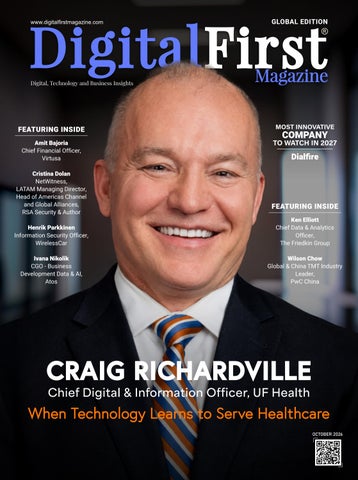
CRAIG RICHARDVILLE Chief Digital & Information Officer, UF Health
When Technology Learns to Serve Healthcare OCTOBER 2026
Digital First Magazine October 2026
1
First Magazine 2 Digital October 2026
Digital First Magazine October 2026
3
www.digitalfirstmagazine.com
October 2026
Vol - 7 Issue - 10
Managing Editor
Free Subscription
Sarath Shyam
www.digitalfirstmagazine.com
Consultant Editors
International Partnerships
Dr. John Andrews Emma James Andrew Scott Sabrina Samson
Naomi Wilson Stanly Lui Steve Hope Keith Alexander
Americas Europe Middle East & Africa Asia-Pacific admin@digitalfirstmagazine.com
Creative Consultants Charlie Jameson Louis Bernard Shirley David
Follow Us On www.linkedin.com/company/ digitalfirstmagazine www.facebook.com/digitalfirstmagazine
Branding & Marketing Partnerships Jennifer Anderson Monica Davis Jessica Edword Rachel Roy Anna Elza Stephen Donnell Cathy Chen
Free Subscription
First Magazine 4 Digital October 2026
Digital First Magazine www.digitalfirstmagazine.com is a global knowledge sharing digital platform published by Connecta Innovation Private Limited. All rights reserved. The opinions expressed in the content are those of the authors. They do not purport to reflect the opinions or views of Connecta Innovation Private Limited or any of its members or associates. The publisher does not assume any responsibility for the advertisements and all representation of warranties made in such advertisements are those of the advertisers and not of the publisher. Digital First trademark is owned by DFG Digital First Infotech Pvt Ltd. and Connecta Innovation Pvt Ltd. has permission to use Digital First brand name. Digital First Magazine www.digitalfirstmagazine. com is a Free Subscription and Free-to-read digital platform strictly not for sale and has to be strictly for internal private use only. Publisher does not assume any responsibility arising out of anyone modifying content and pictures, printing a copy of this digital platform in any format and in any country and all matters related to that.
The Real Measure of Innovation
A
new technology can make headlines, attract investment, and promise extraordinary results. Yet the real test begins after its launch, when people start using it and leaders must answer a simple question: Was it worth it? I have often found that the most interesting part of technological advancement is what happens after the initial excitement fades. A new system may look impressive during a demonstration, but its value becomes clear when it solves a persistent problem, saves time, or makes someone’s work easier. The distance between a promising idea and a worthwhile investment is where leadership earns its credibility. The stakes are considerable. According to McKinsey’s 2025 global survey on AI, 88% of respondents reported that their organizations regularly used AI in at least one business function, yet only about one-third said their organizations had begun scaling AI programs. This gap raises an important question: Are organizations
measuring progress by the technologies they acquire or by the improvements they deliver? This question takes on particular significance in healthcare, where technology decisions influence clinical workflows, patient experiences, data security, and the time professionals spend caring for people. Our cover story features Craig Richardville, Chief Digital & Information Officer at UF Health, whose work spans digital strategy, AI, analytics, and cybersecurity. His approach emphasizes secure, practical technology that serves the needs of patients and professionals alike. His perspective reminds us that successful digital leadership requires sound judgment, collaboration, and accountability. The same principle applies across industries. Businesses must assess whether technology improves productivity and customer experience. Educational institutions must ask whether digital tools strengthen learning and expand access. Professionals must consider how emerging technologies change their work and the decisions they make. The real test lies in the difference technology makes to everyday practice. This October issue of Digital First Magazine brings together thought-provoking articles, interviews, and insights on technology, leadership, and the choices shaping organizations. Innovation will continue to advance. The responsibility lies with leaders to ensure it serves a clear purpose. As you explore this issue, consider one question: What has technology genuinely made better in your world? The answer may be the most useful measure of all. Enjoy Reading.
Sarath Shyam
Digital First Magazine October 2026
5
CONTENTS
10
COVER
STORY
CRAIG RICHARDVILLE Chief Digital & Information Officer, UF Health
When Technology Learns to Serve Healthcare First Magazine 6 Digital October 2026
Wolfram Gürlich, CEO
18
Dialfire
Helping Businesses Have Better Customer Conversations
Digital First Magazine October 2026
7
LEADER’S INSIGHTS
28
34
42 First Magazine 8 Digital October 2026
Transforming Government Cybersecurity for the AI Era Dan Lohrmann
Field Chief Information Security Officer (CISO) for Public Sector, Presidio
The Network That Refuses to Stand Still Dawid Kuchta
CEO, Co-Founder, Microamp
Empowering Healthcare with a Human First Approach Dr. Myriam Fernández Martín
Head of Health Innovation, EMEA, Amazon Web Services (AWS)
Christine Huang
Director, Data Privacy & Management, Edwards Lifesciences
Transforming Enterprise Relationships Through Systems Thinking Carolina Tenca
VP Client Services, Nortal
50
58 LEADER’S INSIGHTS
CONTENTS
Transforming Data Ecosystems for Better Patient Outcomes
Transforming Energy Consumption Through Intelligent Innovation Dr. Elena Morettini
Chief Solutions Officer For Energy and Telecommunications AI Studio - Globant
64 Digital First Magazine October 2026
9
First Magazine 10 Digital October 2026
CRAIG RICHARDVILLE Chief Digital & Information Officer, UF Health
When Technology Learns to Serve Healthcare Craig Richardville, MBA, CHCIO, CDH-E, is senior vice president and chief digital and information officer for the UF Health clinical enterprise, leading digital strategy, information technology, data and analytics, artificial intelligence, and cybersecurity. He partners with clinical, academic, research, and administrative leaders to advance healthcare through secure, innovative, high-performing digital capabilities. With more than 30 years of healthcare technology and digital transformation experience, including nearly two decades in chief information and digital leadership roles, Richardville has led major technology and operating transformations across complex health systems. At UF Health, he helped lead enterprise technology initiatives, including Epic modernization, operational improvements and enhanced collaboration across the organization. These initiatives create the backbone for UF Health to responsibly harness AI to transform the system and advance the academic mission of teaching, healing and discovery. His leadership experience also includes Atrium Health, SCL Health, and Intermountain Health. Richardville has received four CIO of the Year honors, including the 2015 John E. Gall Jr. National CIO of the Year Award and three ORBIE honors. His philosophy centers on clinically and operationally led, technology-enabled transformation, with a focus on measurable improvements in patient care, workforce experience, operations, research, and education, alongside responsible AI, cybersecurity, strong data foundations, and peoplecentered technology. In an exclusive conversation with Digital First Magazine, Craig talks about the evolving role of digital transformation in healthcare, the responsible use of AI, and the importance of connecting technology investments to meaningful outcomes. He shares his views on building secure and intelligent healthcare experiences, reducing administrative burden, strengthening data and cybersecurity, and helping teams navigate change. He also reflects on the leadership principles that have shaped his career, the value of listening and collaboration, and the qualities young professionals need to succeed in healthcare technology.
Digital First Magazine October 2026
11
Looking back on your career, what experiences have had the greatest influence on your leadership style, and what lessons have stayed with you throughout your journey? The experiences that have influenced me most have been leading teams through complex transformations in healthcare environments where the stakes are high and the work directly affects people’s lives. Throughout my career, I have learned that successful transformation is rarely about the technology alone. It depends on trust, relationships, clear communication, disciplined execution, and a shared understanding of the outcome we are trying to achieve.
First Magazine 12 Digital October 2026
WHEN PEOPLE UNDERSTAND THE PURPOSE, PARTICIPATE IN THE PROCESS, AND SEE HOW THE CHANGE IMPROVES CARE OR MAKES WORK BETTER, ADOPTION BECOMES MUCH MORE SUSTAINABLE
I have also learned the importance of listening before leading. The people closest to the work often have the most valuable insights into the problems that need to be solved. My role as a leader is to create clarity, bring the right people together, remove barriers, and help translate ideas into measurable results. The lesson that has stayed with me is simple: technology should never be implemented to physicians, teammates, or patients. It should be thoughtfully designed with them and implemented for them. When people understand the purpose, participate in the process, and see how the change improves care or makes work better, adoption becomes much more sustainable. Healthcare is evolving rapidly through digital transformation. What do you believe are the biggest opportunities and challenges that healthcare organizations will face over the next five years? The greatest opportunity is to create a healthcare experience that is more connected, intelligent, accessible, and personalized. Digital platforms, advanced analytics, automation, artificial intelligence, virtual care, and modern clinical systems can help improve outcomes, reduce administrative burden, expand access, and make healthcare easier to navigate for both patients and caregivers. The challenge will be turning that potential into meaningful and sustainable value. Healthcare organizations must modernize aging technology, strengthen cybersecurity, improve data quality, and develop the workforce skills needed for a more digital future. At the same time, we must avoid implementing technology simply because it is new or available.
Digital First Magazine October 2026
13
The organizations that succeed will connect digital investment to clear clinical and operational priorities. Transformation must be clinically and operationally led and technology enabled. Equally important, healthcare leaders must manage the human side of change by involving users early, communicating the purpose clearly, measuring outcomes, and supporting people throughout the transition. Artificial intelligence is reshaping every industry. How do you see AI transforming healthcare, and where do you believe it will create the greatest value for patients, clinicians, and health systems? Artificial intelligence has the potential to become one of the most consequential tools in healthcare, but its value will depend on how responsibly and thoughtfully it is applied. The
First Magazine 14 Digital October 2026
goal should not be to introduce AI for its own sake. The goal should be to solve meaningful problems and improve the experience of patients, clinicians, researchers, and teammates. For clinicians, AI can reduce documentation and administrative burden, improve access to relevant information, and support more timely and informed decisions. For patients, it can help create a more personalized and responsive experience, improve access, and make it easier to navigate care. For health systems, AI can strengthen forecasting, resource management, operational efficiency, research, and our ability to identify opportunities for earlier intervention. At UF Health, our responsibility is to scale innovation while maintaining strong governance, privacy, security, transparency, and human oversight. AI governance is still evolving, which makes disciplined processes, education, and open dialogue especially important. AI should augment human expertise rather than distance people from one another. The greatest value will come when AI gives clinicians more time to care, helps patients participate more fully in their health, and enables organizations to make better decisions. As a leader responsible for both technology and innovation, how do you encourage your teams to embrace change while staying focused on delivering meaningful outcomes? I begin by connecting change to purpose. People are more willing to embrace transformation when they understand why it matters, how it supports the organization’s mission, and what improvement it will create for patients, clinicians, researchers, or teammates.
I encourage our teams to remain curious, challenge traditional assumptions, and experiment responsibly. At the same time, innovation must be accompanied by accountability. We establish clear priorities, define the outcomes we expect, measure progress, and make adjustments when the evidence tells us something is not delivering the intended value. I also believe strongly in creating an environment where people can ask questions, raise concerns, and contribute ideas. Change can be difficult, particularly when it affects
established workflows or responsibilities. Walking people through a new process and inviting open discussion can create understanding more effectively than simply distributing a new framework. Ultimately, innovation is meaningful only when it improves care, strengthens the workforce, advances discovery, or makes the organization more effective. My role is to give our teams the clarity, support, and permission to move forward while keeping those outcomes at the center.
THE GREATEST VALUE WILL COME WHEN AI GIVES CLINICIANS MORE TIME TO CARE, HELPS PATIENTS PARTICIPATE MORE FULLY IN THEIR HEALTH, AND ENABLES ORGANIZATIONS TO MAKE BETTER DECISIONS
Digital First Magazine October 2026
15
Outside of your professional responsibilities, what personal interests or values help you stay motivated, balanced, and inspired? What keeps me grounded is spending meaningful time with family and friends and creating space to step away, reflect, and recharge. Leadership in healthcare is rewarding, but it also requires sustained energy and perspective. Staying connected to the people who matter most reminds me that balance is not separate from leadership. It helps make better leadership possible. I also place a high value on personal wellness. Regular exercise and strength training are an important part of my routine. Lifting weights helps me stay physically healthy, manage stress, and maintain the energy needed to lead in a fast-paced environment. It provides time to think, reflect,
HELPING OTHERS SUCCEED AND CONTRIBUTING TO SOMETHING LARGER THAN MYSELF IS WHAT CONTINUES TO INSPIRE AND MOTIVATE ME EVERY DAY
First Magazine 16 Digital October 2026
and reset, which often leads to some of my clearest thinking. I am naturally curious and motivated by continuous learning. I enjoy exploring new ideas, meeting people with different experiences, and understanding how other organizations and industries approach transformation and innovation. Curiosity has been a constant throughout my career, and it continues to challenge me to grow and see opportunities from new perspectives. Above all, I am guided by gratitude, humility, and a commitment to service. No significant accomplishment in healthcare is achieved by one person alone. Progress is built through strong teams, trusted partnerships, and people working together toward a shared purpose. Helping others succeed and contributing to something larger than myself is what continues to inspire and motivate me every day.
On a lighter note, if you could instantly master any skill that has nothing to do with healthcare or technology, what would it be and why? If I could instantly master one skill, it would be golf. I’ve always appreciated that golf is a game of discipline, patience, strategy, and continuous improvement. No matter how experienced you become, there is always something new to learn and another opportunity to get better. What appeals to me most is the balance it requires between mental focus and physical execution. Success comes from preparation, consistency, and the ability to stay composed when things don’t go exactly as planned. In many ways, those same qualities are valuable in leadership. Golf also provides an opportunity to spend time with family, friends, and colleagues while enjoying the outdoors and stepping away from the pace of everyday responsibilities. It’s a game that can be both competitive and relaxing, and one that you can enjoy throughout your life. If I could master any non-healthcare, nontechnology skill overnight, golf would definitely be at the top of the list. What advice would you offer to young professionals who aspire to build successful careers in healthcare technology and digital leadership? My advice is to stay curious, build strong relationships, and learn the business of healthcare rather than focusing only on technology. The most effective digital leaders understand clinical care, operations, finance, research, and the patient experience. That broader perspective allows them to connect technical capabilities to the outcomes that matter most.
Seek assignments that stretch you, including those where the answer is not immediately clear. Be willing to listen, ask thoughtful questions, and learn from people at every level of the organization. Find mentors, but also build a diverse network of colleagues who will challenge your thinking and offer different perspectives. Develop strong communication skills. A good idea creates little value if you cannot explain its purpose, earn trust, and bring people with you. Finally, lead with integrity and humility. Healthcare technology affects people at vulnerable moments in their lives, so the responsibility is significant. A successful career is not defined only by the positions you hold, but by the people you help, the teams you develop, and the lasting value you create.
Digital First Magazine October 2026
17
MOST INNOVATIVE
COMPANY TO WATCH IN
2027
Dialfire Helping Businesses Have Better Customer Conversations
D
ialfire began with a challenge familiar to contact centre professionals: technology was failing to keep pace with the evolving needs of their work. Wolfram Gurlich, Founder and CEO of Dialfire, recognised these limitations and set out to build a better solution, starting with a smart predictive dialler designed to make calling operations more effective. That early decision established a principle that continues to guide the company. Dialfire aims to give businesses the tools to build their own processes, adapt technology to their needs, and retain control over how their operations run. Today, Dialfire offers cloud-based call centre software that supports everything
First Magazine 18 Digital October 2026
from straightforward calling campaigns to customised, multi-step workflows. Its platform allows businesses to configure campaigns according to their requirements, without being confined to a fixed set of processes. The company’s journey began with onpremise software. “Moving towards a cloudbased Software-as-a-Service platform meant businesses could benefit from sophisticated contact centre technology without needing to maintain the underlying infrastructure themselves. That led to the development of Dialfire as the cloud contact centre platform we know today,” says Lisette Miller, Team Lead of Customer Success & Operations, Dialfire.
Wolfram Gürlich, CEO
Digital First Magazine October 2026
19
Lisette Miller,
Team Lead of Customer Success & Operations, Dialfire
Since then, the platform has grown beyond its original predictive dialling capabilities. It now brings together inbound and outbound campaign management, international telephony, integrations, workflow automation, AI-powered call analysis, and AI Voice Agents. Despite this expansion, the company has maintained its focus on flexibility. “We’ve always wanted to give businesses powerful tools without unnecessarily restricting how they use them. And we’ve always believed in looking beyond the immediate requirement to consider what might be needed next,” explains Lisette. Understanding the Customer’s Business Dialfire works with businesses across industries, countries, and markets, each with its own contact centre requirements. Some manage large outbound operations with complex campaign
First Magazine 20 Digital October 2026
structures. Others focus on inbound customer service, appointment scheduling, or specialised communication processes. This diversity calls for an approach that accounts for the specific needs of each business. “We work with businesses around the world, supported by international telephony and carrier partnerships across different regions,” says Lisette. Language, customer expectations, local regulations, and telephony requirements can vary considerably from one market to another. The team’s ability to communicate across languages and understand local market conditions helps it address these differences when working with customers. This understanding also influences how Dialfire handles customer requests. Rather than moving straight to implementation, the team first seeks to understand the problem a customer wants to solve. A requested feature may be the
Dialfire offers cloud-based call centre software that supports everything from straightforward calling campaigns to customised, multistep workflows
right answer, but there may also be a simpler configuration, an alternative workflow, or a factor the customer has not considered. The distinction matters because a technical solution must work within the customer’s actual operations. A change to a campaign or configuration can affect agents, customers, and connected processes. Discussing these implications before proceeding helps both sides
determine whether the proposed solution will achieve its intended purpose. The conversation often begins with a simple question: why does the customer need a particular feature? Understanding the objective gives the team a clearer basis for discussing possible approaches. “Sometimes the original request turns out to be exactly the right solution. Other times, the conversation leads somewhere completely different,” adds Lisette. Dialfire also recognises that customers have different levels of technical knowledge and different preferences for working with software. Some want to explore the settings themselves and build their own configurations. Others prefer to discuss their requirements with someone who can help them evaluate the options. The company accommodates both approaches, without expecting every customer to become an expert in contact centre technology. For Dialfire, supporting customers means combining their knowledge of their own operations with the team’s understanding of contact centre technology. The aim is to help businesses make informed decisions and find solutions that fit the way they work, rather than simply delivering a requested feature without examining the need behind it. “We’ve seen so many different contact centre environments that we can often identify possibilities or potential
Digital First Magazine October 2026
21
complications that aren’t immediately obvious to someone looking at a single operation,” says Lisette. Turning Flexibility into Measurable Results For Dinamic Objetivos, the decision to move campaigns to Dialfire came with considerable time pressure. Migrating contact centre operations involves more than transferring software. Existing processes must be recreated, data managed, agents prepared, and essential operations kept running throughout the transition. Despite these demands, the customer moved four campaigns to Dialfire within a short period. The benefits became clearer after the migration. “The customer reported that around half of their previously manual tasks could be automated and that the time required to train agents was reduced by half. Those are meaningful changes because they affect the daily experience of the people running the operation,” says Lisette.
The example also illustrates why flexibility matters in contact centre technology. Businesses rarely operate in exactly the same way. A workflow suited to one organisation may not work for another, and separate teams within the same company may require different campaign configurations. Dialfire’s platform is designed to accommodate these variations rather than force customers into a single operating model. Supporting that flexibility requires several technical components to work together reliably. Dialfire combines intelligent predictive, progressive, and preview dialling with inbound call handling, configurable workflows, APIs, and automation. Its in-house development expertise allows the company to work on the technology behind these capabilities and consider how changes to one component may affect the wider platform. Artificial intelligence is another area of development, particularly through Dialfire’s AI Voice Agent technology. “We’re exploring how conversational AI can become a useful part of everyday business communication,
For Dialfire, supporting customers means combining their knowledge of their own operations with the team’s understanding of contact centre technology
First Magazine 22 Digital October 2026
Sylvia Hartinger,
Head of Business Development
whether that’s handling enquiries, automating routine conversations, or supporting existing contact centre processes,” explains Lisette. The emphasis is on practical applications rather than adopting AI for its own sake. Any new capability needs to address a genuine requirement and fit the way businesses already operate. That practical outlook is closely linked to the company’s approach to innovation. “Wolfram, our founder and CEO, has a remarkable ability to think several steps ahead. He doesn’t simply look at what customers are asking for now. He’s already considering what they might need in the future. That way of thinking influences the whole team,” shares Lisette. A discussion about a specific feature can lead to broader questions about emerging requirements, potential challenges, and the longer-term consequences of a technical decision. This forward-looking approach is particularly relevant to AI Voice Agents, where
advances in voice quality, response speed, language capabilities, and reasoning can expand the range of tasks conversational systems may handle. Dialfire follows these developments and evaluates how they could improve the technology available to its customers. Yet keeping pace with new developments does not mean adopting every promising tool immediately. Reliability, usability, and the demands of real contact centre environments remain important considerations. A capability may be technically possible, but that alone does not establish its value to a business. Learning, Adapting, and Sharing Knowledge Dialfire’s development has brought lessons that extend beyond technology. One of the most important concerns flexibility itself. While the company has long encouraged customers to configure their own processes and make changes
Digital First Magazine October 2026
23
independently, it has learned that not everyone wants the same level of involvement. Some customers enjoy exploring the software and building their own solutions. Others prefer to work with someone who understands their requirements and can help them evaluate the options. Recognising this difference has influenced the support Dialfire provides. “From the beginning, self-service and flexibility were fundamental to our philosophy. We wanted businesses to have the ability to configure their own processes and make changes without constantly depending on a software provider,” says Lisette. International telephony has presented another challenge. Regulations vary between countries and change over time, requiring businesses to adapt their calling processes to local requirements. Dialfire has developed additional configuration options to help customers accommodate these differences. The task is to give businesses room to manage their communication operations while respecting the rules that apply in their markets. These lessons have reinforced the value of retaining core principles while adjusting how they are put into practice. Flexibility and customer independence remain central to Dialfire’s approach, but delivering them effectively requires an understanding of the different circumstances in which customers operate. “The technology has developed enormously, but flexibility, independence, and understanding the customer have remained central throughout,” adds Lisette. That willingness to learn extends to the company’s own team. Dialfire has colleagues who have worked with the technology for many years, bringing an understanding of its development and the reasoning behind earlier technical decisions. This continuity helps the team draw
First Magazine 24 Digital October 2026
Dialfire combines intelligent predictive, progressive, and preview dialling with inbound call handling, configurable workflows, APIs, and automation
connections between the platform’s history and the requirements it must address today. “I’ve personally worked with Dialfire technology for around thirteen years, including seven years directly with the company, and I’m still learning. That says something about
Hans-Georg Liebezeit,
Customer Success & Onboarding Manager
the environment,” shares Lisette. She points to Wolfram Gurlich, the founder and CEO, as someone who takes technical discussions well beyond the immediate question. His explanations often cover the reasoning behind a decision, its wider implications, and alternative approaches worth considering.
Knowledge sharing is part of the team’s everyday work. Colleagues bring different specialisms and backgrounds to complex customer requirements and new technical questions. They consult one another, examine possible approaches, and challenge ideas when necessary. Long-standing working relationships provide continuity, while open discussion gives people room to question established thinking. For Dialfire, that combination matters. Familiarity with the technology helps the team understand why it works as it does, but curiosity keeps established ideas open to scrutiny. “I don’t think innovation comes from having a room full of people who always agree. It comes from having people who are interested enough to ask why, experienced enough to recognise potential problems, and open enough to learn from one another. That’s very much the environment I associate with Dialfire,” explains Lisette. Preparing for Change The COVID-19 pandemic forced contact centres around the world to rethink how their teams operated. For many businesses, working from home shifted from an occasional arrangement to an operational necessity, placing new demands on the technology supporting customer communication. “Because Dialfire was already cloud-based, the technology was well suited to remote working. But that didn’t mean the situation was without challenges,” says Lisette. Customer requirements changed quickly, demand increased, and businesses had to adapt under considerable pressure. The experience demonstrated the practical value of having technology in place that could support different ways of working before circumstances made them essential.
Digital First Magazine October 2026
25
International telephony regulations present a different kind of challenge. Requirements vary across countries and can change significantly, creating technical and operational demands for a platform serving customers in multiple markets. Dialfire has responded by developing additional configuration options that help businesses adjust their calling processes to the rules applicable in their regions. Artificial intelligence brings another set of questions. “AI is changing the possibilities for customer communication at extraordinary speed. It’s exciting, but it also raises important questions about reliability, expectations, and how human and automated interactions should work together,” adds Lisette. New capabilities need to function in real operating environments, where consistency and practical usefulness matter as much as technical potential. These experiences point to a consistent approach at Dialfire: respond to change without losing sight of what customers need from the technology. The company cannot predict every disruption or development, but it can continue to build adaptable systems and maintain a team capable of evaluating new demands as they arise. “I think the biggest lesson is that being prepared for change doesn’t mean knowing exactly what’s going to happen. It means building a company, a team, and technology that are capable of responding intelligently when it does,” says Lisette. Developing AI for Real-World Contact Centres Dialfire’s next phase of development centres on bringing AI Voice Agents into everyday business communication while continuing to strengthen the contact centre capabilities
First Magazine 26 Digital October 2026
customers already rely on. The company is exploring how conversational AI can handle enquiries and routine conversations, and how these agents can work alongside existing contact centre processes. “Improvements in speech technology, response times, and reasoning mean businesses can begin to rethink which conversations need direct human involvement and which can be handled through automation,” says Lisette. For Dialfire, the challenge is to translate those advances into solutions that work in actual contact centre environments. A convincing demonstration is one thing; a system that meets operational requirements and serves customers reliably is another. The company does not view AI Voice Agents as a replacement for the entire contact centre operation. Human agents remain important when conversations call for judgement, empathy, or experience. Instead, Dialfire is exploring how businesses can decide which interactions are suitable for automation and which are better handled by people. The right balance will depend on each organisation’s requirements. This approach also places importance on how AI fits into the wider technology environment. Dialfire’s platform already brings together intelligent dialling, inbound and outbound campaign management, international telephony, configurable workflows, APIs, and automation. Developing AI Voice Agents alongside these capabilities gives the company a way to explore conversational AI within the context of established contact centre operations, rather than treating it as a separate tool. International requirements remain part of that work. Dialfire serves businesses across different markets, where languages, telephony
Dialfire continues to develop its technology while considering the people who use it, the processes they need to manage, and the problems they want to solve
requirements, and regulations vary. As voice automation develops, the company must consider these differences when assessing how new capabilities can be used by its customers. Alongside AI development, Dialfire intends to maintain the platform’s existing strengths. Reliable telephony, flexible campaign management, and integration with other systems remain important to contact centre operations. The company also plans to continue helping customers understand their options, recognising that access to sophisticated technology does not always make implementation straightforward. For Dialfire, the direction is clear: develop AI Voice Agents that address practical communication needs while preserving the
flexibility that allows customers to configure their own operations. The company is continuing to assess new developments in conversational AI, with attention to how they can improve its platform and serve businesses in real working conditions. That work follows the approach that has guided Dialfire since its early days. The company continues to develop its technology while considering the people who use it, the processes they need to manage, and the problems they want to solve. Its future plans centre on making new capabilities useful to customers without losing sight of the operational foundations on which their contact centres depend.
Digital First Magazine October 2026
27
LEADER’S INSIGHTS
Transforming Government Cybersecurity for the AI Era Dan Lohrmann, Field Chief Information Security Officer (CISO) for Public Sector, Presidio
Hi Dan. You began your career in national security and went on to lead cybersecurity at government, federal, and enterprise levels. Looking back over 30+ years, what early experience first made you realize the power of security and technology to protect people? While I was not a ‘digital native’, I did major in computer science. Receiving my bachelor’s degree at Valparaiso University and masters degree at Johns Hopkins University helped me
see how technology was key to every business and government innovation. While working at NSA, one motto was: security is our middle name.” The importance of protecting information was key to enabling the technology to accomplish needed missions. I found the same thing to be true while working for Michigan state Government – especially after the September 11, 2002 attack on the World Trade Center buildings in New York and the Pentagon in Washington D.C.
While “zero trust” and NIST guidelines and frameworks will still apply, the world be dramatically different as attack and defend will be mostly done using AI in autonomous ways
First Magazine 28 Digital October 2026
Dan Lohrmann has led global cyber organizations in the public and private - receiving numerous awards including: CSO of the Year from SC Magazine, Public Official of the Year from Governing Magazine and Computerworld Premier 100 IT Leader. Dan currently serves as Field Chief Information Security Officer (CISO) at Presidio. He is also a Senior Fellow at the Center for Digital Government. Starting at the National Security Agency (NSA), Dan served as the first state government CISO in the USA while in Michigan State Government. Dan later served as the Michigan CTO and CSO. He has authorized three technology books, with Cyber Mayday and the Day After becoming a bestseller on Amazon. Recently, in an exclusive interview with Digital First Magazine, Dan shared insights into a 30+ year journey that began at the NSA and led him to become the first state government CISO in the USA, later serving as Michigan’s CTO and CSO, and now as Field CISO for Public Sector at Presidio. He foresees a future where AI-enabled tools will automate attack and defense, pushing security from perimeter to identity and data-centric models with continuous, context-aware access. But Dan stressed that AI is a force multiplier, not a replacement for human judgment. His advice to leaders is to master the fundamentals, govern non-human identities and AI data, and lead with influence and trust. The following excerpts are taken from the interview.
Digital First Magazine October 2026
29
We’re moving from perimeter security to identity and data-centric security. What will “secure” look like for most organizations five years from now? The majority of network and system security will move to AI-enabled tools. While “zero trust” and NIST guidelines and frameworks will still apply, the world be dramatically different as attack and defend will be mostly done using AI in autonomous ways. Nevertheless, human oversight, ethics and directions will still be imperative. To bridge the identity and data focus, standard security will rely on continuous context-aware access, evaluating user behavior and device health in real time, not just at login. Expect passwordless authentication and datalevel micro-encryption to become essential baseline requirements alongside automated AI defense. You’ve said security must enable the business. How can CISOs use AI to free up their teams to focus on empathy and strategy rather than alerts? To truly enable the business, security leaders must move their teams from reactive firefighting to strategic partnership. AI isn’t here to replace security professionals; it’s here to offload the relentless noise causing severe alert fatigue. By automating routine triage and threat correlation, CISOs clear the operational fog. This reclaimed bandwidth allows analysts to shift from screen-watching to relationship-building. They can sit down with business unit leaders, listen to operational friction, and practice genuine empathy. When AI handles the tactical heavy lifting, your team evolves from “the department of NO” into proactive strategists who build trust, streamline
First Magazine 30 Digital October 2026
workflows, and safely accelerate innovation across the entire organization. What’s one trend you believe is overhyped today, and one trend that isn’t getting enough attention? The Overhyped Trend: Fully autonomous AI defenses. Right now, vendors are selling the dream of “set-it-and-forget-it”. AI that will
replace your SOC analysts and magically fix enterprise risk overnight. Don’t fall for the hype. AI is a force multiplier, not a replacement for human judgment, ethics, and governance. When organizations rush to deploy autonomous security without solid fundamentals, they often just end up automating bad processes and creating a false sense of security. The Underrated Trend: Managing nonhuman identities & AI data governance. While everyone is talking about deepfakes and AI phishing, few are quietly addressing the explosion of non-human identities—the service accounts, API keys, and autonomous AI agents integrating into enterprise workflows. If you don’t know what data your AI models and thirdparty agents are accessing, or who owns those
digital footprints as personal and professional lives blur, you’re building your house on sand. Data hygiene and identity governance for AI agents are where the real battles will be fought. Leaders are shaped by what they consume. Which book, speaker, or thinker outside of tech has most influenced how you approach problem solving? I’ll give you 2: Stephen Covey’s The 7 Habits of Highly Effective People fundamentally reshaped how I approach cybersecurity leadership. Early in my career, I realized tech problems are rarely just about technology—they are about people, alignment, and trust. Covey’s principle of “seeking first to understand, then
to be understood” became my golden rule when working with executive boards and business units. By starting with empathy and focusing on mutual goals, security shifts from an obstacle to a trusted business enabler. Equally influential are John Maxwell’s timeless works on leadership, particularly Leadership 101. Maxwell famously reminds us that “leadership is influence—nothing more, nothing less.” In cybersecurity, where positional authority only gets you so far, true success hinges on building intentional relationships and pouring into your team. Maxwell’s focus on servant leadership taught me that solving complex organizational challenges starts with empowering people, fostering character, and continuously developing the next generation of leaders around you.
Digital First Magazine October 2026
31
Data hygiene and identity governance for AI agents are where the real battles will be fought
When you’re not securing systems, what activity or passion helps you stay creative and energized? Blogging including researching cuttingedge topics like AI and quantum computing. I write the award-winning ‘Lohrmann on Cybersecurity’ blog. If you could have dinner with any historical figure to discuss leadership or security, who would it be and what would you ask? Without hesitation, I’d sit down with Winston Churchill. Few leaders in history have navigated existential crisis, relentless adversity,
First Magazine 32 Digital October 2026
and the crushing weight of strategic decisionmaking with such resolve and communication mastery. Churchill understood that leadership in wartime wasn’t just about tactical defense; it was about inspiring hope, building alliances, and maintaining steadfast morale under constant threat—principles that resonate deeply for security leaders navigating today’s threat landscape. I’d ask him: “How did you balance the urgent demands of daily survival with the long-term vision needed to win the war, and how did you keep your people resilient when crisis felt continuous?” His insights on grit and communication are timeless lessons for us all.
Want to Sell or find Investors for your Business?
Digital First Magazine October August 2026 2021
33
LEADER’S INSIGHTS
The Network That Refuses to Stand Still Dawid Kuchta, CEO, Co-Founder, Microamp
Microamp recently received major support from the European Innovation Council. What does this achievement mean for you and your team, and how will it help shape the company’s future? Receiving support from the European Innovation Council is an important milestone for Microamp and a strong validation of the work we have been doing in 5G mmWave. It rewards the team for being the first in the world to commercialise 5G mmWave networks successfully and marks the culmination of our contribution to the advancement of this field. The €6.5 million in funding and strategic support will accelerate the development of our
Any-G mmWave AI-RAN wireless platform. This fully reconfigurable, software-defined system enables seamless adaptation across evolving 3GPP standards, frequency bands, network modes and 6G features. Our Any-G mmWave solution will deliver exceptional flexibility whilst unlocking future 6G-native features, such as Integrated Sensing and Communication (ISAC) and Non-Terrestrial Networks (NTN), within a single architecture. Looking ahead, mmWave will be the highway of the industrial AI revolution. The funding puts Microamp in pole position to ensure European sovereignty in this crucial domain. Our longterm vision is to build a European leader in
Real innovation goes beyond abstract claims about changing the world – it requires tackling concrete, complex challenges and advancing civilisation by delivering solutions that perform 100 times better than legacy infrastructure
First Magazine 34 Digital October 2026
Dawid Kuchta, PhD, is a leader, entrepreneur and inventor in the wireless industry, focused on delivering 5G mmWave networks to enterprises and telco operators. He is a co-founder of Microamp - the first company to successfully commercialise 5G mmWave networks supporting applications that require deterministic performance and high-uplink throughput, in both the commercial and defence sectors, where resilience, security and jamming resistance are crucial. As the CEO of Microamp, he is responsible for overseeing the organisation’s growth and implementing Microamp’s overall vision. He is currently involved in developing next-generation 6G and Any-G networks, providing highly adaptable, future-proof connectivity designed to evolve alongside future technological demands. Before co-founding Microamp, Dr. Kuchta gained extensive experience in both commercial and military sectors, specialising in advanced radar and RF systems. He holds a PhD in Electrical and Electronics Engineering focused on 5G and radar technology, and earned degrees in Telecommunications and Applied Physics from the National University of Singapore and Warsaw University of Technology. Dr. Kuchta is a frequent speaker at international defence and technology conferences and has authored numerous publications in the field of RF and 5G. In an exclusive conversation with Digital First Magazine, Dawid Kuchta talks about, how reconfigurable 5G mmWave networks are shifting wireless infrastructure away from costly hardware refreshes and toward adaptable software defined platforms built for the industrial AI era. He discusses the significance of recent European innovation support in advancing an Any-G AI-RAN architecture that can evolve with standards frequencies and 6G capabilities.
Digital First Magazine October 2026
35
5G/6G mmWave solutions, delivering secure communication systems across both civilian and defence domains. Your career has been centered around innovation in wireless communications. What inspired you to co-found Microamp, and what has been the most rewarding part of the journey so far? My co-founder, Marcin Góralczyk, and I met 17 years ago at the university, where we studied Wireless Communications and Applied Physics. Our close partnership and complementary strengths gave us the persistence and confidence to build extraordinary things. Having designed advanced RF and radar systems for US defence primes, alongside gaining experience at the National University of Singapore and Brookhaven National Laboratory, we developed deep technical expertise in high-frequency architectures. By 2019, as 5G was emerging as a primary connectivity layer, we saw legacy incumbents attempting to deploy mmWave bands through traditional methods that failed to commercialise the spectrum effectively. Knowing we could execute it properly from the ground up, we co-founded Microamp as a global enterprise. We set out to redefine wireless communications by delivering a 5G mmWave solution that solves fundamental infrastructure challenges across commercial and defence sectors worldwide. The most rewarding part of this journey has been seeing this vision turn into reality. Microamp became the first company in the world to successfully commercialise 5G mmWave networks. Today, our 5G mmWave solutions are deployed globally across sectors like logistics, manufacturing or defence. Being
First Magazine 36 Digital October 2026
Our long-term vision is to build a European leader in 5G/6G mmWave solutions, delivering secure communication systems across both civilian and defence domains
selected for the prestigious NATO DIANA programme and validating our 5G mmWave tactical system in major NATO exercises have been incredible achievements for our team. It is deeply fulfilling to know that our 5G mmWave networks actively solve critical operational challenges whilst contributing directly to European digital sovereignty. The world is moving quickly toward smarter and more connected technologies. What are some of the biggest changes you expect to see in 5G and 6G over the next few years? The telecommunications sector is undergoing a profound paradigm shift. Over the next few years, the biggest change will be the transition from rigid, costly legacy systems to fully reconfigurable, software-defined architectures. Our Any-G mmWave wireless platform
Digital First Magazine October 2026
37
exemplifies this trend, allowing operators to upgrade networks through software updates or swappable RF modules rather than full infrastructure replacement. Furthermore, we will see the rise of 6G-native features integrated directly into standard deployments. Chief among these is Integrated Sensing and Communication (ISAC), which transforms our 5G mmWave network into a high-resolution sensor. This allows the system to transmit data and sense the environment simultaneously, providing unprecedented situational awareness, localisation and positioning accuracy. Finally, the convergence of terrestrial and non-terrestrial networks (NTN) will accelerate. By integrating satellite communication layers
First Magazine 38 Digital October 2026
At Microamp, we address this transformation through our Any-G mmWave AI-RAN wireless platform. By deploying AI-accelerated compute platforms, our 5G mmWave solution moves away from rigid legacy hardware. This software-defined architecture ensures that network features and larger AI models scale continuously without full infrastructure replacements. Ultimately, AI-driven 5G and 6G mmWave wireless platforms will form the foundation of the industrial AI era, turning spectrum into a self-optimising highway for critical operational intelligence.
directly with our 5G mmWave system, we can deliver continuous and secure communications in contested or remote areas, which is a foundation for future defence, industrial and scientific missions. Artificial intelligence is transforming almost every industry today. How do you see AI influencing the future of wireless communications and the work Microamp is doing? Artificial intelligence and next-generation networks are deeply symbiotic. The telecommunications sector is undergoing a shift from networks that merely carry traffic to AI-native systems that dynamically adapt, self-optimise and evolve at software speed rather than hardware cycles. As AI becomes the dominant workload across industries, mobile infrastructure must power real-time industrial applications.
As CEO, what leadership values have helped you build a strong team and drive innovation in such a fast-changing industry? Driving innovation in deep tech requires a leadership strategy centred on cultivating A-Player talent and embracing cultural diversity. We began by recruiting exceptional Polish engineers, who are among the finest in the world, to build our core platform capabilities. However, scaling an enterprise is fundamentally a cultural challenge rather than merely a technical one. Inspired by my early career in Singapore, where I worked within a highly diverse, multinational team, I recognised that cross-cultural perspectives are essential for solving complex operational problems. Microamp was established to be a global enterprise from day one, and today our 5G mmWave solutions serve customers across Europe, North and Central America, and Asia-Pacific. To support this footprint, our management team is international, allowing us to deeply understand and address the specific operational requirements of customers
Digital First Magazine October 2026
39
worldwide. My personal background backpacking around the world gave me a strong appreciation for cross-cultural dynamics, which helps us scale our business effectively while empowering our team to push the boundaries of 5G and 6G mmWave wireless platforms. When you’re not thinking about technology or business, how do you like to spend your free time? Is there a hobby or interest that helps you recharge? Building Microamp and advancing 5G mmWave networks is my life, so I am working almost exclusively, all the time. When I do take a brief moment to step away from business and engineering, I recharge by swimming. Spending time in the water provides a complete mental reset from the daily operational demands of scaling a deep-tech company. The focus of swimming allows me to disconnect entirely and return to leading Microamp with fresh energy and a sharp perspective.
First Magazine 40 Digital October 2026
By integrating satellite communication layers directly with our 5G mmWave system, we can deliver continuous and secure communications in contested or remote areas, which is a foundation for future defence, industrial and scientific missions
What advice would you give to young professionals and entrepreneurs who want to build a successful career in technology and innovation? Follow your passion, work hard and remain relentless in chasing your vision. Real innovation goes beyond abstract claims about changing the world – it requires tackling concrete, complex challenges and advancing civilisation by delivering solutions that perform 100 times better than legacy infrastructure. Formulating an ambitious
dream is simple, but execution is demanding and challenging. To navigate that reality, build a rocksolid foundation in your technical field. Whether in software, semiconductors or applied physics, a deep, fundamental understanding is irreplaceable. Combine that deep technical mastery with hard work, genuine passion and extensive global travel to understand diverse cultures. Gaining international experience gives you the perspective required to execute complex ideas and scale a company globally.
Digital First Magazine October 2026
41
LEADER’S INSIGHTS
Empowering Healthcare with a Human First Approach Dr. Myriam Fernández Martín, Head of Health Innovation, EMEA, Amazon Web Services (AWS)
Hi Myriam. You’ve guided organizations through complex transitions for over two decades. What belief about healthcare has stayed constant throughout your career? Health is the most precious treasure any human being can have, and our systems must transform or they simply will not survive. We are living longer, yes, but the question is whether we are living better. Healthcare cannot just extend life; it must nurture it. It must help people thrive, not
merely exist with mounting chronic conditions and fragmented care. If we do not reimagine how health and care work together, resiliently, proactively, around the person, the systems we depend on will buckle under their own weight. That conviction has never wavered for me. I started as a bedside nurse in Spain, and honestly, that never leaves you. Not when I was leading transformation teams across Europe, not when I relocated to the United States, and not now at AWS. The tools change, the conversations
If we do not reimagine how health and care work together, resiliently, proactively, around the person, the systems we depend on will buckle under their own weight
First Magazine 42 Digital October 2026
Dr. Myriam Fernández Martín is the Head of Health Innovation for EMEA at Amazon Web Services (AWS), where she guides healthcare organisations and partners in leveraging cloud and AI to deliver personalized, outcomesoriented care. A registered nurse with a PhD in Health Sciences and executive leadership experience spanning two decades across Europe, Middle East & Africa and the United States, she bridges clinical insight with technological innovation. Named one of the Most Admired Women in Digital Health (2024), Dr. Fernández is an inspirational keynote speaker and a professor of digital health, championing a vision where technology amplifies, never replaces, human care. Recently, in an exclusive interview with Digital First Magazine, Myriam shared insights from a 20+ year journey that began at the bedside as a nurse in Spain and now leads as Head of Health Innovation for EMEA at AWS. She spoke about a future where healthcare shifts from treating averages to truly personalized, outcomes-oriented care powered by cloud and agentic AI that anticipates illness instead of reacting to it. For Myriam, AI is not the goal, it is the means to amplify human care, sharpen clinical instinct, and unlock the 97% of health data trapped today. Her advice to leaders is to start with the problem not the technology, invest in people before platforms, and redesign systems around the person. The following excerpts are taken from the interview.
Digital First Magazine October 2026
43
get more sophisticated, the acronyms multiply, but the moment you forget there is a person at the centre of all of this, you have lost the plot. Behind every data point there is a heartbeat: a diagnosis, a family waiting, a life that matters. I became a nurse to care for people. I moved to the cloud to make sure millions more could be cared for too. That is not a slogan I came up with for a keynote; it is the lens I carry every single day. Healthcare transformation is not optional, it is the only path to a future where our children and our parents can access care that is sustainable, equitable, and genuinely human.
First Magazine 44 Digital October 2026
Personalized health is now a strategic priority for systems worldwide. How do you see “outcomes-oriented care” evolving between now and 2030? Let me share something that still surprises people: only ten percent of diabetics are clinically similar to each other, and only eleven percent of patients with depression resemble one another. Yet our systems were designed to treat them in averages. It can take two to three years just to find the right therapy for someone with hypertension. Two to three years of trial and error, for one of the most common conditions on the planet.
Healthcare data doubles every two years, yet ninety-seven percent of it remains trapped in formats nobody can act on
By 2030, I believe three forces will have reshaped outcomes-oriented care. The first is the person themselves, no longer a passive recipient of care but an active co-author of their health story. Digital should never be the goal; it must be the means. The second is data finally becoming useful. Healthcare data doubles every two years, yet ninety-seven percent of it remains trapped in formats nobody can act on. Cloud-native architectures and agentic AI, systems that can reason, plan, and act autonomously, will change that. Imagine a system that does not wait for you to deteriorate but anticipates it, coordinates your care across providers, and surfaces the right evidence to your clinician at the right moment. The third force is trust. Europe in particular is writing a powerful next chapter: leading with
values, sovereignty, and the insistence that innovation must coexist with control. The real question for leaders is not whether to pursue this. It is whether they have the courage to redesign around the person rather than the institution. Cybersecurity and trust are critical as health moves to the cloud. What’s one misconception leaders still have about securing health data? That keeping data on premises is inherently safer. I hear it all the time. And I understand the instinct, it feels like you are in control when the servers are down the hall. But the numbers tell a different story: cyberattacks on healthcare grow by sixty percent year over year, and many legacy
Digital First Magazine October 2026
45
environments lack the continuous patching, encryption management, and real-time threat detection that a hyperscale cloud provider invests billions to maintain. When I sit with a hospital CIO, I often reframe the conversation: the real risk is not moving to the cloud, it is standing still. A sovereign-by-design approach gives you control over where data resides, who touches it, and how every access is audited, all while enabling the innovation your patients and clinicians are asking for. Trust is not built by avoiding technology. It is built by embedding security, transparency, and accountability into every layer from day one, and then proving it, over and over. Many leaders feel pressure to “have an AI strategy” immediately. What’s your advice for leading with clarity instead of reacting to hype? Start with the problem, not the technology. Full stop. I have seen too many organisations rush to deploy generative AI because the board asked for a strategy, and they end up with disconnected pilots, unmeasured outcomes, and exhausted teams. That is not innovation. Be clear about the problem you are solving. If you cannot explain it to a nurse on a ward in thirty seconds, go back and sharpen it. Second, stop treating digital transformation as an IT project. It needs to be strategic, multidisciplinary, and clinically led. AI does not replace a clinician’s instinct, it sharpens it. Early detection, pattern recognition, precision that saves lives, those are outputs of a culture, not a procurement process. Third, and I feel strongly about this, invest in people before platforms. The leaders of the future will be those who develop emotional
First Magazine 46 Digital October 2026
intelligence alongside technical competencies. Human wisdom augmented by AI. Be stubborn in the vision, flexible in the details, and patient with the journey. Healthcare and tech can be intense fields. What book, podcast, or thinker helps you reset and find perspective? Honestly, my best reset is not always a book, it is people. My spouse and my daughters above all. They are my “why” every single day, the reason I push through the hard moments and the first people who celebrate when something meaningful happens. They remind me what truly matters when the noise gets loud, and they are my biggest supporters whenever I fall. Their unconditional love is the backbone that keeps me standing. My parents, too, set an incredibly high bar on values like kindness, integrity, humility, and passion. And conversations with clinicians still at the bedside remind me what the daily reality looks like. All of them ground me in ways no podcast can. When it comes to thinkers, I draw from several wells. Simon Sinek and the golden circle, starting with “why“, resonates deeply with how I approach every initiative. Jean Watson’s philosophy of Caring Science proved that compassion belongs at the centre of leadership, not at the margins. Christie Watson, in The Language of Kindness, shows beautifully how kindness is the quiet force that holds entire systems together. And Brené Brown’s work on how empathy fuels connection and is the backbone of trust reminds me that vulnerability is not weakness, it is courage. Their collective message is clear: purpose and human connection can be found even in the most difficult circumstances. That speaks to me
when the pace feels relentless. Purpose is the antidote to overwhelm. And when I need energy rather than calm, travel is my other great teacher — immersing yourself in a different culture forces you out of assumptions and reminds you how beautifully varied the human experience is. I come back to my work sharper and more curious every time.
Healthcare transformation is not optional, it is the only path to a future where our children and our parents can access care that is sustainable, equitable, and genuinely human
Many leaders have a mantra they return to under pressure. What quote or line keeps you grounded? “We are all patients, or going to be patients, someday in our lives.” I say this often, and I mean it literally. It cuts through every difficult decision, whether I am prioritising one programme over another, challenging a partner to move faster, or pushing through an uncomfortable organisational change. When I remember that the system we are building today is the one my children, my parents, and I will rely on tomorrow, the noise quiets and the purpose becomes clear. That thought has a way of making courage feel less optional. I also live by a personal equation: reflect first, prepare, combine discipline with flexibility, execute, and then do it all over again. Because success is rarely linear. It is the ability to stand up after you fall, pivot when life demands it, and never lose sight of why you started. If you could write the headline for healthcare in 2030, what would it say, and what needs to happen today to get there? “Healthcare finally knows you — and cares for you before you ask.” That headline describes a world where fragmentation has been replaced by intelligent continuity. Where an elderly person no longer
Digital First Magazine October 2026
47
The question is no longer whether healthcare goes digital. It is whether we have the courage to make it humanfirst
navigates seven physicians across four practices alone, because an interconnected care network has already anticipated and coordinated the journey. Where health systems are proactive, personalised, and crucially compassionate. What needs to happen today? Leaders need the courage to move from reactive to proactive — investing in platforms that unlock the vast majority of data currently going unused, not in five-year roadmaps but in tangible first steps this quarter. Trust must be built by design:
First Magazine 48 Digital October 2026
sovereignty, security, and responsible AI cannot be nice-to-haves; they are the foundation on which citizens will grant consent. And perhaps most importantly, we need to keep reminding ourselves that sooner or later, every one of us becomes a patient. When that moment comes, the system should be ready, resilient, and worthy of our trust. The question is no longer whether healthcare goes digital. It is whether we have the courage to make it human-first.
Digital First Magazine October 2026
49
LEADER’S INSIGHTS
Transforming Data Ecosystems for Better Patient Outcomes Christine Huang, Director, Data Privacy & Management, Edwards Lifesciences
Hi Christine. You’ve built a career across regulation, privacy, and emerging tech, and you’re now applying that expertise in healthcare. What inspired you to make that move into the healthcare industry? One of the defining characteristics of my career has been the opportunity to work across diverse industries, from telecommunications, emerging technologies, software and hardware to now healthcare. I see privacy discipline doesn’t belong to just a single domain; in fact, the application of privacy principles is essential to organizations navigate periods of transformation where technology, regulation, and trust converge.
Early in my career, privacy was largely viewed as a legal/compliance function, focused on meeting regulatory obligations and reducing legal risk. As organizations embraced cloud computing, digital platforms, and large-scale data ecosystems, privacy evolved into something much more strategic and operational. It became a key enabler of digital transformation, helping organizations innovate responsibly while building trust with customers and regulators. Today, AI is driving another fundamental shift. The questions we’re tackling are no longer just about whether we can collect or process data, but how we govern it responsibly, ensure
Healthcare represents one of the most meaningful applications of technology because every innovation ultimately has the potential to improve or save a patient’s life
First Magazine 50 Digital October 2026
Christine Huang is a seasoned leader in privacy, governance, and digital transformation, with cross-industry experience spanning telecommunications, cloud computing, enterprise technology and medical technology. Throughout her career, she has helped global organizations navigate technological transformation by turning complex privacy, governance, and regulatory challenges into practical strategies that enable innovation with confidence. Today, she focuses on building trusted data ecosystems and digital governance that enable responsible innovation. Christine believes the future of privacy extends beyond compliance, it’s about creating trust, accountability and collaboration that endure technology advancement and empower organizations to innovate with confidence. Recently, in an exclusive interview with Digital First Magazine, Christine shared insights into a career spanning telecommunications, cloud, and MedTech, where she has turned complex privacy and governance challenges into strategies that enable responsible innovation. Christine believes the future of data isn’t about volume, but “decision confidence” knowing what data you have, why you have it, and how it drives outcomes at scale. Her advice to aspiring professionals is to start with real problems, master the fundamentals, and stay curious across disciplines. Looking ahead, Christine is focused on enabling innovation that improves patient outcomes while keeping trust and accountability at the core. The following excerpts are taken from the interview.
Digital First Magazine October 2026
51
transparency, and create confidence in AI-driven decisions. Having worked across multiple highly regulated industries, I’ve learned that while the technologies change, the principles remain the same: trust must be designed into innovation from the beginning. Trust is the hardware layer. This journey naturally led me to healthcare. Healthcare represents one of the most meaningful applications of technology because every innovation ultimately has the potential to improve or save a patient’s life. What particularly resonates with me about my current company is its commitment to putting patients first. When patient outcomes are the North Star, privacy, security, ethics, and AI governance aren’t simply compliance requirements, they become essential enablers of delivering better care and maintaining the trust that patients place in us. For me, that’s incredibly motivating. I wanted to bring the lessons I’ve learned across highly regulated sectors to an industry where trusted innovation has one of the greatest opportunities to make a positive impact on people’s lives. What do you love the most about your current role? This is a hard choice, as I love every aspect of my work. If I have to pick one, it would be solving problems that don’t come with a manual. Fun fact, I am the worst when it comes to reading any instruction manual. I am very grateful that at my current role, I have the opportunity to bring together people who think completely differently. On any given day, I could be working with engineers, product managers, cybersecurity teams, R&D, compliance, and business leaders. They each have different priorities, different vocabularies,
First Magazine 52 Digital October 2026
and sometimes different definitions of what “good” looks like. I genuinely enjoy helping connect those dots. That’s honestly what makes this space so fascinating and with AI, of course, that accelerates human intelligence to a new height. One thing I’ve learned throughout my career is that the market isn’t short of ambitious legal frameworks, complex governance models, or never-ending policies. The challenge is turning, harmonizing, and even simplifying them into something operational, scalable, and practical in the real world. I’m probably happiest when someone challenges me in the practicality aspect of an idea or when teams leave the table aligned on a practical solution that is grounded in governance principles, supports innovation, and avoids unnecessary bureaucracy. You’ve seen telecom monetization models evolve, and now you’re building data ecosystems in MedTech. Five years from now, what do you believe will be the single biggest shift in how industries treat data as an asset? We have spent a lot of time talking about trust in data, and that conversation matters. But I believe trust alone isn’t enough to move the needle when measuring the success of an innovation or growth of a company. For years, organizations have been able to get by with storing large volumes of data and worrying about the clean up later. I think the biggest shift over the next five years won’t be just about the volume of data. It will be decision confidence, whether organizations can transform data into trustworthy decisions, in real time, at scale, while regulations continue
to evolve, and AI becomes embedded in every business process. In MedTech, the stakes are fundamentally different. Data is collected essentially to support clinical/product decisions, improve patient outcomes, accelerate innovation, and ultimately help save and improve lives. That means the quality, governance, and integrity of data become just as important as the AI models built on top of it. The organizations that succeed won’t be ones with the most data, they will be the ones who can prove they know exactly what they have, why they have it, what risks they would owe if something went wrong and where the “kill it” switch is. Ultimately, the competitive advantage will come from having the highest confidence in the decisions your data enables. In the age of AI, organizations will compete on the most liquid, governed and interoperable data fabric where governance isn’t a cage, but the operating system that makes high velocity innovation possible across jurisdictions. This is not just a trust story, it’s an infrastructure story, that is very exciting.
Consumers and patients are demanding more transparency. What trend will define “digital trust” for the next generation? I believe transparency is about to evolve from a legal obligation into a user experience, a verifiable digital trust. As many of you may have already seen some popular social platforms are starting to give users the control over how algorithmic decisions shape the users experience. We have spent decade handling privacy notices that nobody reads and consent banners that everyone clicks through. The next generation does not separate the product or digital experience from the trust experience. I think of it as an “algorithmic receipt.” Just as we expect to understand every financial transaction, people will increasingly expect to understand significant AI-assisted decisions that affect them. We’ll want to know not only who accessed our data, but how it influenced an outcome and how we remain in control. In MedTech, that’s especially important because trust extends beyond the patient. Clinicians need confidence in the
Ultimately, loyalty in the AI era will come from giving people confidence that those algorithms are working for them, not simply on them
Digital First Magazine October 2026
53
recommendations they receive; developers need confidence in the data they’re building on; and regulators need confidence that organizations can explain and stand behind their AI-enabled decisions. Transparency isn’t just about individual rights, it’s about confidence across the entire healthcare ecosystem. Digital trust will have go beyond what companies promise, but demonstrate how users, as participants of the data ecosystem and decision making, understand where their data flows and why and if a tangible undo is part of the users control. Ultimately, loyalty in the AI era will come from giving people confidence that those algorithms are working for them, not simply on them. The next generation will expect a living relationship with their digital self and to be active participants in their own algorithmic lives. With AI, cloud, and global regulation colliding, what skill do you think every future data leader must master that isn’t taught in textbooks? If I had to pick one capability that future data leaders need, it would be developing what I call “governance residency.” Take medicine as an example since doctors are very smart and they are very closely related to the domain that I am in, some are even my colleagues - not all the heroes wear white coats. Graduating from medical school doesn’t make someone an experienced physician. That’s why residency exists. It’s where doctors learn to apply principles under pressure, with incomplete information, changing circumstances, and real consequences for patients. I think our profession is benefiting from real world experience, this is how you build real judgment not just theoretical knowledge.
First Magazine 54 Digital October 2026
The goal is never to know everything, but to connect the dots, help each other move forward, and together make better decisions
You can study the GDPR, the EU AI Act, HIPAA, cybersecurity frameworks, and every emerging standard. Those are essential foundations. But no certification prepares you for sitting in a room where an AI engineer wants to deploy a foundation model, a clinician is focused on patient outcomes, cybersecurity is worried about adversarial attacks, legal is interpreting evolving regulations, quality is thinking about safety, and product leadership wants to launch in six weeks. Those situations don’t have textbook answers. What matters is the ability to take enduring principles such as fairness, transparency, accountability, patient safety, privacy by design, so on and so forth, and apply them pragmatically to novel problems. That’s where experience compounds. Our job isn’t to be the person with every answer. It’s to help diverse teams develop a shared understanding of the problem, make informed decisions with the information available today, and build governance that can evolve as technology and regulations inevitably change tomorrow. And judgment isn’t learned in a classroom. Like many professions, it’s developed through practice, working across disciplines, solving real problems, learning from outcomes, and building the confidence to make sound decisions when there isn’t a perfect answer. We all need inspiration beyond work. What’s your “energy source”, art, sport, music, nature that brings you back to center? Outside of work, travel is what resets me. There is something deeply grounding about being
dropped into a place where the language, the rhythms, and the unspoken rules are nothing like my own. It’s a forced does of humility and reality check, you stop being an expert in everything, and just become a learner again. You also start to notice and compare places that you have visited. Let’s start with airports, the least favorite part of any journey, yet they are full of characters and emotions and always fascinating to see how different airports handle the same challenges can create a completely different experience. In one, thousands of people move effortlessly through immigration. Staff remain calm, travelers naturally queue, information is clear, technology works seamlessly, and even small details, like passengers changing into airport slippers through security or quietly respecting shared spaces, create a sense of comfort and mutual respect. Then you experience another airport where the technology may be let’s just say, antiquated, the facilities aren’t well maintained, communication is inconsistent, staff are visibly frustrated, passengers crowd the gate before boarding is announced, and the entire experience feels chaotic. The difference rarely comes down to one factor alone. If you have great technology but unclear processes, people become frustrated. If you have excellent processes but people aren’t empowered or aligned, the experience breaks down. Even with exceptional people, outdated systems create unnecessary friction. Of course, the culture aspect is important too, as that shapes behavior far more effectively than rules alone. Therefore whether it’s an airport, a city, or an organization, the best synergy is where
Digital First Magazine October 2026
55
people understand their role, trust one another, where the process feels intuitive rather than forced, and the choice of technology is outcome driven rather than investing into the buzz. It’s the combination of people, process, and technology working together. That’s why travel energizes me, to really pause, observe and connect with reality. That’s probably why I enjoy working across different disciplines and different cultures. I learn something from every place I visit, and many of those lessons end up influencing how I approach leadership, collaboration, and building trust back at work. It is always the experience that stays. And experience is what happens when people, process, and technology are designed to work together. What’s a small, unexpected joy in your day that readers might not expect from someone deep in privacy and AI governance? One thing people are often surprised by is that I enjoy cooking from scratch. For me, it’s a chance to slow down and be creative in a different way. I enjoy trying different cuisines I’ve discovered while traveling and understanding why certain flavors and techniques work together. I don’t usually follow cookbooks, that’s why I don’t bake, or do anything too complicated, that’s what chefs are for. I like learning from people who have mastered a dish or recreate from a local flavor that I have tried. Once I understand the fundamentals, I enjoy making it my own, maybe adjusting the ingredients based on what’s in season or adding a twist inspired by somewhere I’ve traveled.
First Magazine 56 Digital October 2026
My family are adventurous eaters and wonderful cooks. That is probably why it’s an enjoyable experience without responsibility and pressure :) What is your biggest goal? Where do you see yourself in 5 years from now? Honestly I don’t actually think in terms of job titles anymore. Here is why. Ten year ago, “Data Privacy Officer” was not a job title. It didn’t exist, nobody was studying for it, nobody was hiring for it, nobody put it on a career roadmap, because the roadmap itself hadn’t been drawn yet. The profession emerged because the world created a problem large enough that is eventually had to be under the responsibility of a role. Technology is evolving so quickly that the most interesting roles probably don’t exist yet. Just five years ago, very few organizations had enterprise AI governance leaders. Now we are watching a profession being born in real time, even though the job titles are inconsistent, the frameworks are provisional, the regulatory ground shifts quarterly. Many people who are in this field or will lead this space can’t fully describe what this role actually entails. I’ve spent my career moving toward increasingly complex and novel problems because that’s where I’ve learned the most. If I look five years ahead, this data ecosystem will keep inventing new job titles as AI evolves. I hope to be in that room where ideas turn into impact, where people who are passionate about working together solve real-world problems, and where I can keep learning, contribute to something bigger than myself. To me, that’s a career worth building.
The organizations that succeed won’t be ones with the most data, they will be the ones who can prove they know exactly what they have, why they have it, what risks they would owe if something went wrong and where the “kill it” switch is
Aspiring professionals often ask how to break into privacy or data governance. What’s the first concrete step you’d tell them to take this year? For anyone interested in privacy, AI governance, or data leadership, my advice is simple: don’t start by trying to master every regulation or chase every new technology. Both will keep changing faster than you can keep up. Start with the problem in front of you. Get close to real work where technology, people, and governance meet, whether that’s implementing AI, fixing broken data, modernising legacy systems, or enabling safer data sharing. That’s where you learn what actually works, not just what looks good on paper. At the same time, build your foundations properly. The principles of privacy, ethics,
security, and data management don’t change nearly as fast as the tools do. If you understand those well, you can adapt to almost anything else. And stay curious in a very practical way. Sit with folks outside your lane, such as engineers to understand how systems really behave. Spend time with product teams to see how decisions are made under pressure. Listen carefully to regulators to understand what problem they are actually trying to solve. That’s where real judgment is built. The goal is never to know everything, but to connect the dots, help each other move forward, and together make better decisions. Lastly, don’t be afraid to step into uncomfortable waters, as that’s often where the biggest growth happens.
Digital First Magazine October 2026
57
LEADER’S INSIGHTS
Transforming Enterprise Relationships Through Systems Thinking Carolina Tenca, VP Client Services, Nortal
Your foundation is in international relations and political science. How did that early training in diplomacy and systems thinking shape how you approach enterprise client relationships today? I started in international relations because I was fascinated by one simple question: how do you get results when you don’t actually control the other side? That’s diplomacy in a nutshell, and honestly, it’s enterprise client management too. Studying the brilliant ideas of characters such as Thucydides and Morgenthau taught me that decisions are rarely driven only by what
people say out loud. Interests, incentives, fears, politics... that’s usually where the real story is. Today, when I’m working with an enterprise client, I’m not just managing the next statement of work. I’m trying to understand the entire ecosystem. Who influences decisions? Who needs a quick win? Who’s worried about the budget season? Who’s quietly championing the project? Why? That systems thinking has probably been my biggest advantage. It helps me build relationships that aren’t dependent on one executive or one project, but on understanding how the whole organization works.
Technology should do the heavy lifting so people can focus on judgment, creativity, and collaboration
First Magazine 58 Digital October 2026
Carolina Tenca is VP of Client Services, Americas, at Nortal, where she leads a Customer Success team managing a portfolio of enterprise accounts across the Americas. Based in Buenos Aires, Argentina she brings a distinctive lens to client strategy, drawing on classical political philosophy and strategic thought, alongside game theory and MEDDIC, as anchors for action and negotiation. Her career spans across marketing, city government, Argentina’s national government, and the British Council, before she moved into customer success leadership within technology. Recently, in an exclusive interview with Digital First Magazine, Carolina shared insights from a career that moved from international relations, city and national government, and the British Council into VP of Client Services at Nortal. On AI, Carolina sees the shift from “what can AI do” to “is it creating value,” predicting consolidation of CX infrastructure, orchestrated journeys, and tougher ROI discipline. She also believes accountability cannot be automated, making junior talent and judgment essential. Her advice to the next generation of CX leaders is to earn the standing to say the hard thing by being reliably honest on small things first. The following excerpts are taken from the interview.
Digital First Magazine October 2026
59
As VP of Client Services, you own the bridge between sales, delivery, and outcomes. What part of that mandate energizes you most right now? Right now, what energizes me most is the translation work. Sales sells a vision, delivery builds the thing, and client services is the only seat at the table, outside of the technology folks, with a view of both the promise and the proof. In practice, that means I orchestrate the dinner table: who sits, what gets said, and to what end. Not everyone needs the same story. The CTO needs proof points. The CFO needs the compounding-revenue math. The sponsor who’s about to walk into their own leadership meeting needs a narrative they can defend as their own. My job is to take something like a platform migration or an AI workstream and reframe it, as compounding revenue, as structural embeddedness, as de-risked exposure, depending on who’s listening and what they need to walk away with. AI is moving from pilot to production in the enterprise. How will AI-driven marketing and customer experience infrastructure evolve as buyers demand measurable ROI? I’ve watched the AI conversation from two very different seats. A few years ago I was involved in discussions around AI policy through a Davos spin-off event and through Women20, where the focus was governance, regulation, and international collaboration in an age where AI was approaching but not fully there just yet. Today I spend my days helping organizations actually implement these technologies. It’s been fascinating to watch the conversation mature.
First Magazine 60 Digital October 2026
I believe we’ve gone from asking, “what can AI do?” to ask instead, “should we do this, and is it creating value?” I think we’ll see three major shifts in CX and Martech. Companies will consolidate infrastructure instead of running dozens of disconnected pilots. AI will become much more orchestrated across entire customer journeys instead of isolated use cases. And executives are going to demand much tougher ROI conversations. The companies that succeed won’t necessarily be the ones experimenting with the most AI. They’ll be the ones disciplined enough to know which initiatives deserve investment and brave enough to stop the ones that don’t. Data privacy and regulation are diverging across the Americas. How should global companies design CX and platform strategies that stay compliant yet agile? I love this question because it’s really a geopolitical problem disguised as a technology problem. Across the Americas, every country is moving at its own pace. Brazil has LGPD, the US has an increasingly fragmented state-bystate approach, Canada has PIPEDA, Argentina has its own framework... trying to force one rigid model across all of them would probably create more problems than the ones it would actually solve. I think the answer is building resiliency into the architecture from day one. Keep the core as identity, governance, consent, and make local policy configurable. It’s actually very similar to diplomacy. You keep your principles consistent, but you adapt your execution to local realities. The organizations
The leaders who ask thoughtful questions, challenge assumptions, and bring together different perspectives will continue to outperform those who simply have access to better technology
treating compliance as an architectural decision instead of a last-minute legal review are the ones moving much faster today and the ones that will be more resilient as data privacy and regulations evolve across the region. The talent gap in cyber and AI is widening. How will organizations need to rethink hiring, upskilling, and delivery models? I think we’re at the start of the AI bubble correcting itself. Costs are rising, and a lot of what got deployed over the last two years isn’t as efficient or as smart as it was sold to be once you push past the demo. That correction is good news for talent, not bad news, because it’s forcing organizations to confront something they tried to skip past: you cannot make AI accountable for a decision. A model can produce an output, but accountability requires a person who can be asked why, who can explain a judgment call to a client, and who bears the consequence of being wrong. That’s not a capability you can automate away, which means
junior talent, the people you can actually train into that kind of judgment, is more essential going forward, not less. Organizations need to stop treating hiring and upskilling as a cost center to trim whenever AI adoption headlines look good, and start treating bench strength and junior development as the actual insurance policy against a market realizing AI alone can’t carry accountability. The winners in this next phase will be the ones who rebuilt delivery models around blended teams, AI for scale and speed, humans for judgment and accountability, rather than the ones who bet everything on replacement and are now quietly rehiring. What’s shaped how you lead through complexity I come back to a strange mix of sources, and I think that’s the honest answer. Aristotle gave me the idea that practical wisdom, phronesis, is a distinct skill from raw intelligence, the ability to judge well in a specific, messy situation rather than apply a rule mechanically, and that’s most
Digital First Magazine October 2026
61
of what client leadership actually is. Pericles’ funeral oration is the clearest example I know of a leader making people feel the stakes of a collective project without ever talking down to them, a skill I think about constantly when framing a client narrative for an executive audience. Hannah Arendt reframed power for me as something relational, held only because a network of people continues to grant it, never something you simply accumulate alone, which is exactly how influence works inside a large account. Cynthia Enloe’s re-reading of international relations teaching me to look for where power actually operates, in the overlooked, undervalued roles, not just where it’s officially announced, which has made me a better reader of who really drives decisions inside a client organization. And yes, Harry Potter belongs on this list too, unapologetically. I’m a child of the nineties, and the idea that you can find light in the darkest of times isn’t a children’s lesson, it’s a leadership discipline. Complexity doesn’t get less complex because you’re tired of it, and the leaders worth following are the ones who can hold steadiness and hope inside real difficulty, not just in the easy moments. With global clients and time zones, balance is critical. What is one daily ritual that helps you reset and show up fully? I tend to wake up and start running at 100 miles an hour, so I’ve become a big believer in rituals. First things first: I make my bed. Every. Single. Day. No exceptions. Then comes mate. Argentinians are slightly obsessed with it and somehow one thermos keeps us fueled for hours. My most important ritual, though, is actually how I end the day. Working from home has
First Magazine 62 Digital October 2026
made switching off much harder, so I’m very intentional about it. Laptop closed. Phone down. Gadgets away. Then I take a shower, religiously. For some reason it feels like I’m washing the workday off my body. After that, it’s whatever helps my brain change gears: a long walk, music, a class, reading, or, if it’s been one of those days in which nothing works, a ridiculously long bath with absolutely zero technology. Biggest goal, five years out I want to be known as someone who is part of an organization that has built a genuinely impactful way of understanding how client services operate in complex, multi-market enterprise accounts, not as a support function that reacts to delivery, but as the strategic layer that reads the whole board and moves the account forward with intention. Concretely, that means growing the anchor accounts I’m building now into structurally embedded, multi-year partnerships that aren’t vulnerable to a single champion leaving or a single budget cycle. A message for the next generation of CX leaders Earn the standing to say the hard thing before you need it. Too many leaders wait until a crisis to try to tell a client or a stakeholder, and most specially our own internal leadership stakeholders at the company we work for, an uncomfortable truth, and by then they haven’t built the credibility for it to land. The leaders I respect most, in this industry and in the history I read for fun, spent years being reliably honest about small things so that when the big, difficult thing needed saying, they’d already earned the right to say it and be heard.
Digital First Magazine October 2026
63
LEADER’S INSIGHTS
Transforming Energy Consumption Through Intelligent Innovation Dr. Elena Morettini, Chief Solutions Officer For Energy and Telecommunications AI Studio - Globant
Elena, your career spans energy R&D, EU policy, and now leading sustainable business initiatives. What moment made you realize science and technology had to work together to solve climate change? Science and tech have to work together always if we want to exploit innovation to tackle new and ancient problems! Science brings the understanding, tech the solution. Diversity and ESG the only possible way of successful work! Green IT is moving from “nice to have” to board-level priority. What shift in how tech companies measure energy consumption do you expect by 2030? A substantial shift, because electricity consumption is growing exponentially now driven by AI consumption. We are saying this
First Magazine 64 Digital October 2026
now since 2020…. 6 years to get heard. We need to move faster finding energy savings solutions! Every industry is being asked to decarbonize, not just energy. Which sector do you think is most unprepared for its emissions accountability and why? I like this question as it somehow reveals a paradox. It may sound illogic, but the most polluting industries since Kyoto 1997 are the ones to have calculated emissions first. The ones to have modelled emissions trading schemes, the ones to have proposed decarbonization roadmaps are the ‘hard-to-abate’ ones. So all this is done. And done first by heavy industry. Now frameworks need to oblige implementation, which is not always evident.
Dr. Elena Morettini is a PhD Geoscientist, Energy and Sustainability strategist and innovator. She is Chief Solutions Officer for the AI- Energy and Telecommunication Studio in Globant, expert in energy, energy transitions and climate scenarios’ modelling. Pioneer of Diversity & Inclusion best industry, Elena has always been engaged in shaping the European scientific area, fostering academia-industry cooperation. Now actively impacting AIsolutions to accelerate energy optimization and energy addition, working together with a multidisciplinary team of young data scientists and engineers. Recently, in an exclusive interview with Digital First Magazine, Elena shared insights into a professional journey that spans energy R&D, EU policy, and now leading as Chief Solutions Officer for Energy and Telecommunications at Globant. On AI, Elena analysed the exponential growth in electricity consumption and its consequent demand for immediate action — with modern tech leaders becoming “climate-conscious, measuring carbon budgets per operation and accelerating energy-saving solutions. Her advice is rooted in integration, empathy, and strategic thinking, with a clear future focus on driving innovation that makes impact measurable, ethical, and unavoidable at board level. The following excerpts are taken from the interview.
Digital First Magazine October 2026
65
You also lead sustainable technology initiatives while AI adoption accelerates. What does it mean to be a “climate-conscious” tech leader in 2026? On one side it means to be an ethical and timely leader. On the other it means to calculate and solve, calculate and solve, calculate and solve the numerical challenge of CO2 budgets for each and every activity. Again, we are talking about carbon budget per operation since 2020. How long does it take to act on those numbers? When you’re not shaping sustainable business strategy, how do you like to spend an ideal day off? Talking to my kids and reasoning with them by a Mediterranean shore. Possibly with a Peroni!!
Science and tech have to work together always if we want to exploit innovation to tackle new and ancient problems!
First Magazine 66 Digital October 2026
With years in R&D and consulting, learning never stops. What’s one book, paper, or talk on sustainability that completely shifted your thinking? The 2004 report by Kofi Annan WHO CARES WINS. You work across climate policy, carbon management, and Green IT. If you had to pick one thread that ties it all together, what would it be? In a world that is been revolutionized under many human aspects, talking about good energy is very relevant! Good energy is a valid concept from a human centric perspective and from a natural and technological viewpoint. Good energy means intelligent, real time and realistic energy. So together with transitions we need to think about addition. Lorenzo Simonelli from Baker Huges- a great innovator in transitions-declares open the era of energy addition. Personally I have always been convinced that no energy wins alone. Complementariety is a strong and positive message for humans. From Odisseus Times onwards!!
Digital First Magazine October 2026
67
First Magazine 68 Digital October 2026