Gérôme Billois Partner – Cybersecurity & Digital Trust, Wavestone
Gwellyn Daandels SVP and Global Head, AI Solutions & Platforms, Virtusa
Jair Ribeiro
Global AI and Analytics Leader
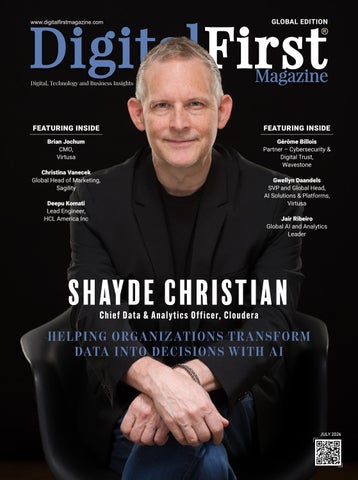
SHAYDE CHRISTIAN
Chief Data & Analytics Officer, Cloudera
Managing Editor
Sarath Shyam
Dr. John Andrews
Emma James
Andrew Scott
Sabrina Samson
Keith Alexander Consultant Editors
Naomi Wilson
Stanly Lui
Steve Hope
Shirley David Creative Consultants
Charlie Jameson
Louis Bernard
Branding & Marketing Partnerships
Jennifer Anderson
Monica Davis
Jessica Edword
Rachel Roy
Anna Elza
Stephen Donnell
Cathy Chen
Free Subscription
Free Subscription www.digitalfirstmagazine.com
International Partnerships
Americas Europe
Middle East & Africa Asia-Pacific
admin@digitalfirstmagazine.com
Follow Us On www.linkedin.com/company/ digitalfirstmagazine www.facebook.com/digitalfirstmagazine
Digital First Magazine www.digitalfirstmagazine.com is a global knowledge sharing digital platform published by Connecta Innovation Private Limited. All rights reserved. The opinions expressed in the content are those of the authors. They do not purport to reflect the opinions or views of Connecta Innovation Private Limited or any of its members or associates. The publisher does not assume any responsibility for the advertisements and all representation of warranties made in such advertisements are those of the advertisers and not of the publisher. Digital First trademark is owned by DFG Digital First Infotech Pvt Ltd. and Connecta Innovation Pvt Ltd. has permission to use Digital First brand name. Digital First Magazine www.digitalfirstmagazine. com is a Free Subscription and Free-to-read digital platform strictly not for sale and has to be strictly for internal private use only. Publisher does not assume any responsibility arising out of anyone modifying content and pictures, printing a copy of this digital platform in any format and in any country and all matters related to that.
The New Currency of Competitive Advantage
There was a time when organizations believed that having more data automatically meant having more power. Every dashboard, every database, and every digital initiative promised a clearer picture of the business. Yet, as I speak with executives across industries, one realization keeps surfacing: data alone has never been the destination. The real value lies in the quality of the decisions it enables. Today, organizations generate more data than ever before, but studies continue to show that only a fraction of enterprise data is actively used for decision-making. The challenge has shifted from collecting information to transforming it into timely, confident action. This marks the arrival of what I believe is the Intelligence Economy. In this new era, competitive advantage will not belong to the organizations with the largest data lakes or the most sophisticated algorithms. It will belong to those that consistently make better decisions. AI has made advanced analytics more accessible than ever, but technology alone cannot replace judgment, trust, or strategic thinking. Businesses
that combine reliable data with human insight will move faster, adapt more effectively, and create lasting value.
That perspective makes this month’s cover story especially relevant. In our conversation with Shayde Christian, Chief Data & Analytics Officer at Cloudera, he shares how years of advising Fortune 500 organizations and leading enterprise data initiatives shaped his mission of turning information into measurable business outcomes. His insights reflect a broader shift taking place across industries. AI is moving beyond experimentation, and success now depends on trusted data, meaningful execution, and a relentless focus on delivering real business impact rather than technological novelty. His advice to embrace AI early, communicate with it naturally, and build practical solutions offers an important roadmap for the next generation of technology professionals.
Beyond our cover feature, this edition of Digital First Magazine brings together a diverse collection of interviews, expert perspectives, and thought-provoking articles exploring the technologies, leadership strategies, and innovations shaping the future of business. Each story offers a unique lens on how organizations are navigating an increasingly intelligent world.
As the pace of change accelerates, the organizations that thrive will not necessarily know the most. They will learn the fastest, decide the wisest, and act with the greatest confidence. I hope this issue inspires you to look beyond data and discover the true competitive advantage that comes from transforming intelligence into meaningful action.
Enjoy Reading.
Sarath Shyam
COVER STORY
SHAYDE CHRISTIAN
Chief Data & Analytics Officer, Cloudera
HELPING ORGANIZATIONS TRANSFORM DATA INTO DECISIONS WITH AI
Redefining Security from Prevention to Organizational Resilience
Gérôme Billois, Partner – Cybersecurity & Digital Trust, Wavestone
LEADER’S INSIGHTS
Building Reliable AI Systems in the Presence of Feature Drift
Deepu Komati, Lead Engineer, HCL America Inc
Leaders are Finally Understanding: AI Governance is not about Control. It Is about Scale
Jair Ribeiro, Global AI and Analytics Leader
The Productivity Paradox: Are CMOs Trading Impact for Speed?
Brian Jochum, CMO, Virtusa
From Expertise to Curiosity: Leading Through AI Without Having All the Answers
Christina Vanecek, Global Head of Marketing, Sagility
Managing Your AI Colleagues
Gwellyn Daandels, SVP and Global Head of AI Solutions & Platforms, Virtusa
SHAYDE CHRISTIAN
Chief Data & Analytics Officer, Cloudera
HELPING ORGANIZATIONS TRANSFORM DATA INTO DECISIONS WITH AI
Shayde Christian is the Chief Data and Analytics Officer at Cloudera where he leads data-driven cultural transformation to help organizations realize maximum value from data and AI. Shayde works with customers to optimize their Cloudera investments and build high-value use cases that deliver measurable business impact. Before joining Cloudera, Shayde served as a principal consultant advising Fortune 500 companies on data strategy and enterprise information management.
Recently, in an exclusive interview with Digital First Magazine, Shayde shared insights into how his path from Fortune 500 data consultant to Fortune 200 healthcare leader shaped his mission to turn data into business outcomes. He sees AI moving from experimentation to execution, with trust in data and measurable ROI now the real barriers to scale. His advice to new tech talent: use AI immediately, learn to direct it with natural language, and build something practical. The following excerpts are taken from the interview.
What was your career pathway to becoming a Chief Data & Analytics Officer?
I started my career as a consultant helping Fortune 500 companies develop data strategies and, in some cases, helping data organizations recover when programs were not delivering the expected outcomes. From there, I moved into enterprise leadership roles, eventually leading data and analytics for a Fortune 200 healthcare company. Today, I serve as Chief Data & Analytics Officer at Cloudera.
The common thread throughout that journey has been helping organizations turn data into business outcomes. The technology has changed dramatically over the years, but the challenge has remained largely the same: helping leaders make better decisions, move faster, and create measurable value from their investments.
What is the top trend you are seeing in data and analytics today?
The biggest trend I see is the shift from AI experimentation to AI execution.
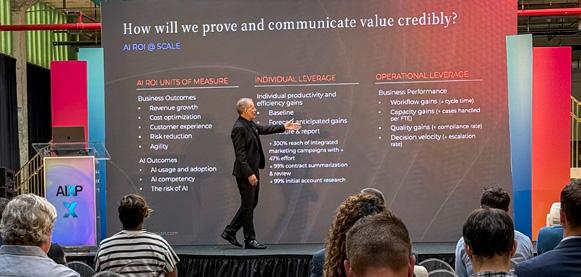
For the last several quarters, nearly every executive conversation has centered on AI agents, AI at scale, and AI ROI. Most organizations have already proven that AI can work. The question now is whether it can deliver meaningful business value beyond a handful of pilots and proofs of concept.
Customers are increasingly focused on operationalizing AI, embedding it into workflows, and measuring outcomes such as revenue growth, cost optimization, customer experience improvements, and risk reduction. The conversation is becoming much less about the technology itself and much more about measurable business results.
MOST ORGANIZATIONS HAVE ALREADY PROVEN THAT AI CAN WORK. THE QUESTION NOW IS WHETHER IT CAN DELIVER MEANINGFUL BUSINESS VALUE BEYOND A HANDFUL OF PILOTS AND PROOFS OF CONCEPT
What are the biggest barriers to achieving AI at scale?
Trust remains one of the biggest barriers. Organizations need confidence in both the data being supplied to AI systems and the reliability of the outputs those systems generate. If users do not trust the answers, they will not use the solution. If leaders do not trust the outcomes, they will not scale the investment.
Another challenge is data readiness. AI performs best when business context is clear, data is well organized, definitions are consistent, and governance practices are in place.
Many organizations also struggle with selecting the right use cases. Not every AI project deserves enterprise-scale investment. Success usually starts by identifying opportunities that solve real business problems and produce measurable outcomes.
How does AI trust connect to AI scale and ROI?
Trust, scale, and returns are tightly connected. Organizations typically begin by establishing trust through strong data foundations, governance, and human oversight. As trust increases, they become comfortable applying AI to more important business processes.
That creates opportunities to scale successful use cases across additional teams and workflows. As adoption grows, organizations begin generating measurable business outcomes and can demonstrate return on investment.
When value is proven credibly, leaders are more willing to continue investing. That investment improves capabilities, expands adoption, and creates additional value. In my experience, organizations rarely achieve AI at scale without first establishing trust in the
underlying data and outcomes. Without scale, returns tend to hit a ceiling.
What interesting AI solutions is your team developing at Cloudera?
One solution I am particularly excited about is our Natural Language Querying, or NLQ, platform. NLQ allows employees to ask business questions using everyday language and receive insights, visualizations, and dashboards without requiring deep technical expertise. Historically, many employees depended on data analysts and reporting teams, which often created lengthy queues and delays.
By enabling self-service access to insights, we are dramatically reducing the time required to answer business questions while expanding access to data-driven decision making across the organization. Time to insight has dropped over 90% for natural language speakers.
THE FUTURE WILL NOT BELONG ONLY TO PEOPLE WHO CAN CODE. IT WILL ALSO BELONG TO PEOPLE WHO CAN EFFECTIVELY DIRECT AI, EVALUATE ITS OUTPUTS, GOVERN ITS USE, AND APPLY IT RESPONSIBLY TO REAL BUSINESS PROBLEMS
The results have been significant internally, and we believe the same approach can help our customers accelerate insight generation and improve decision velocity within their own organizations.
What advice would you give someone entering technology today?
Use AI immediately and use it often. One of the best learning exercises is to identify tasks from a role you have already performed and use AI to automate portions of that work. Build something practical. Experiment. Improve it. Break it and fix it.
The future will not belong only to people who can code. It will also belong to people who can effectively direct AI, evaluate its outputs, govern its use, and apply it responsibly to real business problems. Learning how to collaborate with AI through natural language is becoming an essential professional skill. The sooner you start developing that skill, the better positioned you will be.
Wa n t t o S e l l o r fi n d
I nve s t o rs f o r yo u r
B u s i n e s s ?
Leaders are Finally Understanding: AI Governance is not about Control. It Is about Scale
Jair Ribeiro, Global AI and Analytics Leader
Over the last few years, there has been no shortage of enthusiasm around AI. Executives are asking for pilots, teams are experimenting with new tools, employees are discovering unexpected use cases, and vendors are promising revolutions.
At the same time, another reality is emerging. Projects get delayed because nobody owns the data. Similar solutions appear in different parts of the organization. Legal concerns surface
late, prompting business leaders to ask difficult questions about accountability, trust, and ROI.
In my career as an AI leader, one lesson keeps resurfacing: scaling AI is rarely limited by technology. More often, it is limited by the absence of governance. But unfortunately, governance has developed an image problem. For many people, the word immediately brings to mind bureaucracy, approvals, and restrictions. Some fear that governance will slow innovation, while others believe it is
When AI initiatives struggle, the root cause is often not the model itself but the environment surrounding it
Jair Ribeiro is an AI and Data executive with more than 15 years of international experience leading analytics, artificial intelligence, and digital transformation across global organizations. He specializes in helping business leaders translate AI into practical business value by combining strategy, governance, data, and organizational change. Jair has led enterprise initiatives spanning AI adoption, responsible AI, data governance, analytics, and executive enablement. He is passionate about building trusted AI capabilities that scale beyond pilots and become part of how organizations operate. His work focuses on the intersection of leadership, technology, and business transformation in the age of AI.
something to consider later, once value has already been proven.
Interestingly, the opposite tends to be true. The organizations that struggle most with AI are rarely the ones with too much governance. More often, they are the ones with too little.
Launching a pilot is relatively easy. Teams can experiment with public tools; enthusiastic employees can uncover valuable use cases, and early prototypes often generate excitement and promising results. Scaling is where complexity begins. Questions quickly emerge around
ownership, acceptable data sources, quality evaluation, accountability, regulations, and the growing number of similar solutions appearing across the organization.
These are not technology questions. They are governance questions that determine whether AI remains in a pompous collection of isolated experiments or really becomes an organizational capability.
One observation that I like to share during many of my interactions, which continues to surprise many leaders, is that AI rarely creates
A robust and well-adopted AI Governance steadily proves that AI value does not come from the number of pilots. It comes from the ability to repeat success
organizational problems. Instead, it exposes the ones that were already there. Disconnected data, fragmented processes, competing priorities, and unclear ownership suddenly become visible. When AI initiatives struggle, the root cause is often not the model itself but the environment surrounding it.
In many ways, AI acts like a mirror. It reveals organizational complexity that was always present but easier to ignore. This is one reason serious AI conversations need to quickly move beyond algorithms to topics such as operating models, accountability, data ownership, and cross-functional collaboration.
In my view, the biggest misconception surrounding AI governance is the belief that control and innovation are opposing forces. In reality, uncertainty slows organizations down far more than governance does. When employees do not know which tools are approved, they hesitate. When legal and compliance teams become involved only after deployment, projects stall. When responsibilities are unclear, ownership disappears.
Good governance removes ambiguity. It creates common principles, shared language, and clear boundaries. It allows teams to experiment safely while giving leadership confidence that innovation is happening responsibly. Governance is not about saying no. It is about creating the conditions that allow organizations to say yes more often.
Leadership teams are under increasing pressure to demonstrate value from AI investments. Boards want results, business units want productivity gains, employees expect access to new capabilities, and competitors are moving quickly. Under those conditions, speed becomes tempting. Yet speed without clarity often creates friction later.
Over the years, I’ve seen one clear pattern in the AI ecosystems that I have the opportunity to advise: sometimes, companies can spend months discussing technologies while dedicating very little attention to ownership, priorities, or success criteria. Eventually, those unanswered questions return, usually at the worst possible moment. Technology decisions can often be reversed. Trust problems are much harder to repair.
In practice, the challenge is rarely a lack of ideas. Most organizations have the opposite problem. Different functions explore similar use cases, multiple tools are introduced, capabilities are duplicated, and resources become fragmented. What begins as innovation gradually turns into complexity. And without visibility, leaders struggle to understand where investments are happening, which initiatives create value, and where opportunities for reuse exist. And that’s where AI Governance brings focus. It helps leaders prioritize, create reusable patterns, and direct resources toward initiatives that can scale rather than multiplying isolated solutions.
A robust and well-adopted AI Governance steadily proves that AI value does not come from the number of pilots. It comes from the ability to repeat success.
Of course, compliance is an important part of the picture, but reducing governance to regulations misses the bigger opportunity. Effective AI governance connects business strategy, technology, data, security, legal, and people. It brings together business leaders, IT teams, data specialists, risk professionals, and operational owners because AI does not
As AI becomes an integral part of how businesses operate, I believe governance will increasingly be seen not as a constraint, but as a strategic capability
belong to one department, and neither should its governance.
From what I have observed, the organizations making the greatest progress treat governance as a cross-functional capability rather than a control mechanism owned by a single function. They understand that AI requires shared ownership and continuous collaboration.
But still, many leaders assume they need a perfect governance model before moving forward. I believe this is one reason some initiatives become unnecessarily complicated. Teams do not need perfection on day one. They need clarity. Basic guardrails, clear ownership, defined responsibilities, and visibility over use cases are often enough to get started.
As adoption grows and AI becomes more deeply embedded into operations, governance naturally matures. Exploration and scale do not require the same level of control, but they do require a path connecting the two. And this path, of course, involves people, because another great lesson that continues to stand out in my career is that technology alone does not create responsible AI. People do.
Interestingly, some of the most successful AI adopters are not necessarily the most technical. In conversations with peers and business leaders in several different international companies, one characteristic appears again and again: judgment. These teams understand when to trust the answer, when to challenge it, and where human expertise still matters.
Which means that AI literacy is not about turning everyone into data scientists. It is about helping people work responsibly with increasingly intelligent systems. Without that capability, policies remain in documents. With it, AI governance becomes AI-driven culture.
AI is bringing all of us into a transformational phase of society, and history suggests that every major technology eventually requires standards, operating models, and shared practices, and this time will be no different. The winners in the coming years are unlikely to be those with the highest number of AI pilots. They will be the organizations that learn how to scale AI with trust, because trust creates adoption, adoption creates value, and value creates competitive advantage.
We are still in the early stages of understanding what AI governance really means. Over the past few years, I have noticed a gradual evolution in how organizations approach it. Many still see governance as something to introduce once AI has proven its value and reached scale. I have gradually come to believe the relationship works the other way around.
Governance is not what comes after scale. It is what makes scale possible.
The encouraging news is that this mindset is changing. More leaders are beginning to recognize that governance is not about slowing innovation but about creating the confidence, clarity, and trust that allow innovation to spread across the organization. As AI becomes an integral part of how businesses operate, I believe governance will increasingly be seen not as a constraint, but as a strategic capability.
Perhaps that is why the most mature organizations that I know are not necessarily those with the largest budgets or the highest number of pilots. They are the ones that have learned how to combine innovation with trust.
Because trust scales. And organizations that build trust today will be the ones best positioned to capture AI’s full potential tomorrow.
Redefining Security from Prevention to Organizational Resilience
Gérôme Billois, Partner – Cybersecurity & Digital Trust, Wavestone
Hi Gérôme. You’ve turned cyber risk into strategic resilience for global firms. What’s the core belief about trust that drives your work every day?
For me, trust is not the absence of risk. Trust is the confidence that an organization can continue operating, even when something unexpected happens. Too often, cybersecurity has been presented as a technical discipline whose objective is to prevent every attack. That is clearly unrealistic. Every organization will eventually face incidents, whether they come
from cybercriminals, geopolitical tensions, AI misuse, or simple human mistakes.
My role is therefore not to promise perfect security, but to help organizations build confidence in their ability to anticipate, withstand, respond to, and recover from disruption. When boards understand that resilience is ultimately about preserving business value and customer confidence, cybersecurity stops being viewed as a cost center and becomes a strategic capability. That shift in perspective is what motivates me every day and it has been for more than 20 years.
As AI becomes embedded into business processes, a manipulated recommendation or an incorrect autonomous action may become as damaging as a traditional cyberattack
Gérôme Billois is Partner in Cybersecurity & Digital Trust at Wavestone, where he advises major international organizations on cyber resilience, digital trust, and AI security. With more than twenty-five years of experience, he is recognized as one of Europe’s leading cybersecurity advisors. Gérôme is a board member of Campus Cyber and CLUSIF, contributes to national and international cybersecurity initiatives, and regularly speaks at leading industry conferences, including RSA Conference. He is also the author of several books and publications on cybersecurity and is a frequent commentator in international media on cyber risk, resilience, and emerging technologies.
Recently, in an exclusive interview with Digital First Magazine, Gérôme shared insights into how his 25+ years in cybersecurity evolved from technical defense to building strategic resilience for global firms. On AI, Gérôme sees the biggest shift as moving from securing systems to securing decisions — protecting AI models, data, and agents themselves — with success depending on governance, human oversight, and continuous verification. His advice to young professionals is to build the habit of turning complex technology into clear business risks and options for decisionmakers, because the best advisors bridge engineering and the boardroom. The following excerpts are taken from the interview.
AI is accelerating both attacks and defenses. Five years from now, what do you believe will be the single biggest shift in how cyber risk is managed?
The biggest shift will not be that AI attacks become faster. That is already happening. The real transformation will be that cybersecurity will increasingly focus on protecting decisions rather than simply protecting systems.
Today, we secure identities, networks, endpoints, and cloud environments. Tomorrow, organizations will also need to secure the AI models that make decisions, the data they rely on, the agents acting on their behalf, and the integrity of the results they produce. As AI becomes embedded into business processes, a manipulated recommendation or an incorrect autonomous action may become as damaging as a traditional cyberattack.
At the same time, defenders will rely heavily on AI to automate risk management, detection, investigations, and response. We are therefore entering a world where AI will defend against AI. The organizations that succeed will not necessarily be those deploying the most AI, but those that establish clear governance, use efficient AI, maintain human oversight where it matters, and continuously verify that AI systems remain trustworthy over time.
Digital trust is now a board-level priority. By 2030, what capability will every CEO be expected to understand that they don’t today?
By 2030, every CEO will need to understand how to govern AI with the same discipline they currently apply to finance or production.
Today, most executives ask whether an AI solution works. Tomorrow, they will need to
We spend a great deal of time discussing how AI creates new cyber threats, but far less time discussing how we can establish confidence in AI systems themselves
ask whether they can trust it. Where did the model come from? Has it been tampered with? Can its decisions be explained? What happens if it fails? Who remains accountable when an autonomous agent makes a mistake?
Digital trust will become inseparable from business strategy because organizations will increasingly delegate decisions to intelligent systems. CEOs will not need to become AI engineers, but they will need to understand the principles of AI governance, model assurance, identity, resilience, and accountability. These questions will become as fundamental as financial reporting or regulatory compliance are today.
You contribute to initiatives on sustainability. What’s one small environmental choice you personally stick to, even with a busy schedule?
The choice I stick to is actually one that sits right at the intersection of my professional expertise and sustainability: making cybersecurity itself more environmentally responsible.
It may sound surprising, but cybersecurity is a significant consumer of resources. We run security scans that generate massive amounts of network traffic, we deploy monitoring agents on every endpoint consuming energy around the clock, we store terabytes of logs “just in case,” and we often do all of this without ever asking whether there is a more efficient way.
I presented research on this exact topic at RSA Conference this year, work we conducted jointly with Campus Cyber in France. We studied how organizations can deliver the same level of security while consuming less by rethinking rules, processes, and architectural approaches. We collected field data from about
ten organizations and developed a methodology to measure and reduce the carbon footprint of cybersecurity operations. The response was remarkable, even in the United States, where I honestly expected less interest in the topic.
On a personal level, this has changed how I think about the solutions I recommend to clients. Before suggesting a new tool or another layer of monitoring, I now systematically ask whether it is truly necessary or whether we are simply adding complexity and energy consumption out of habit. The most sustainable security measure is often the one that simplifies rather than adds. That mindset is the small choice I try to carry into every engagement.
Mentorship matters in security. Who was one person early in your career who believed in you before you believed in yourself?
That person was Frederic Goux, one of my managers when I first started working in cybersecurity consulting. What he did was deceptively simple but had a profound impact on my career: he encouraged me to look beyond the boundaries of our company.
At a time when consulting firms typically expected their people to focus almost exclusively on client delivery, Frederic encouraged me to join external community initiatives, participate in industry working groups, contribute to professional associations, and invest time in activities that had no immediate commercial return.
That decision required trust. It meant accepting time spent outside billable projects and believing that building relationships across the cybersecurity ecosystem would eventually create value. He understood something many
managers overlook: expertise does not grow in isolation. By engaging with practitioners, researchers, public authorities, and industry leaders, I developed a broader perspective than I could ever have gained by remaining inside one organization.
In the long run, that investment benefited both my own career and Wavestone. The network, knowledge, and credibility built through those early engagements became a source of partnerships, insights, and opportunities for our practice.
You’ve authored reference books and shaped policy. What topic do you feel the industry still isn’t writing or talking about enough?
We spend a great deal of time discussing how AI creates new cyber threats, but far less time discussing how we can establish confidence in AI systems themselves.
This has been a recurring theme throughout my work. I contributed to the Hub France IA initiative First Steps Toward Trustworthy AI, which explored the foundations of trustworthy AI from governance, technical, and organizational perspectives. More recently, my research has focused on the cybersecurity dimension of that challenge: how can we verify that an AI model has not been manipulated, that it continues to behave as expected after deployment, and that the results it produces remain trustworthy?
As organizations increasingly adopt openweight models, autonomous agents, and AIdriven decision-making, we need stronger methodologies to verify model integrity, monitor behavioral drift, and continuously assess the trustworthiness of AI outputs.
We have decades of experience assessing the integrity of software, but we are only beginning to build equivalent practices for AI.
This will require much closer collaboration between cybersecurity, machine learning, software engineering, and governance. I believe the next major discipline in cybersecurity will be AI assurance: combining technical verification, continuous monitoring, and governance to ensure that AI systems deserve the trust we place in them.
If a 22-year-old told you, “I want to advise boards on cyber like you do”, what habit would you tell them to build starting today?
Learn to translate. Translate complex and technical topics into understandable risks and concrete options for decision-makers.
Early in your career, it is tempting to focus exclusively on becoming technically stronger, and technical credibility is essential. But the people who ultimately advise boards are those who can bridge the gap between technology and business.
Every time you learn a new technology or analyze a cyber incident, ask yourself three questions: Why does this matter to the business? What decision should an executive make? How would I explain this in two minutes without using technical jargon?
The best cybersecurity advisors are not simply experts in technology. They are interpreters between engineers, executives, regulators, and customers. Building that translation habit early, while remaining curious and continuously learning, is probably the most valuable investment a young professional can make.
The Productivity Paradox: Are CMOs Trading Impact for Speed?
Brian Jochum, CMO, Virtusa
The greatest threat to the modern Chief Marketing Officer is not a lack of tools, but a crisis of bandwidth. Over the past few years, the marketing ecosystem has been fundamentally upended by an explosion of generative platforms and automated engines. Suddenly, tasks that used
to require weeks of creative development— drafting multi-channel campaign copy, iterating ad variants, generating visual assets—can be executed in a matter of seconds. On paper, this looks like an unprecedented golden age of productivity. In reality, it has laid a dangerous psychological trap for marketing leadership.
We must step off the execution treadmill and transition our teams from reactive operational micromanagers of processes and tasks into deliberate architects of brand equity
As Virtusa’s Chief Marketing Officer, Brian Jochumleadsglobalmarketing,definingbrand value propositions and driving go-to-market sales enablement across all technology domains. With 25 years of experience, he uniquely bridges consumer brand-building with enterprise tech growth. His IT services pedigree includes marketing leadership roles at Accenture and Tata Consultancy Services - the world’s two largest IT services firms. Previously, he spent over a decade in brand management at Procter & Gamble and led direct-to-consumer sales for iconic brands like Craftsman at Sears Holdings. Brian is a Notre Dame graduate based in the Chicago area.
By confusing raw processing speed with strategic progress, many marketing organizations have inadvertently transformed themselves into high-speed content factories. We are pumping out an unprecedented volume of assets, dominating digital real estate, and microtargeting consumers with relentless precision. Yet, despite this hyper-efficient output, a quiet anxiety is creeping through the C-suite. Brands are beginning to look alike, sound alike, and blur into a sea of algorithmically optimized mediocrity. If AI transformation stops at productivity gains, then the true competitive advantage from marketing is missed, and the purpose of marketing as a function is limited to a content-and-task factory that can be automated to irrelevance over time. We are moving faster than ever, but we are risking our most valuable corporate asset: true market distinction.
To survive this transition and drive genuine, long-term business growth, CMOs must undergo a profound mindset shift. We must step off the execution treadmill and transition our teams from reactive operational micromanagers of processes and tasks into deliberate architects of brand equity.
The Illusion of the Content Factory
When a technology lowers production costs to near zero, the natural corporate impulse is to increase output volume. This creates a powerful illusion of marketing velocity as the goal. Dashboards light up with engagement metrics, impression counts, and optimization cycles. This may well help a marketing department lower costs, achieve greater efficiency with vendor partners, or scale up production without growing headcount. These are real benefits that
Breaking
free from the velocity trap, while still reaping its rewards, requires a conscious reengineering of the marketing organization’s DNA
will help in the short term, but they should not be mistaken for the enterprise’s actual marketing purpose: market differentiation.
CMOs must not fall into the trap of mistaking operational efficiency for strategic efficacy. When marketing becomes entirely focused on feeding the automated content machine, the collective mindset shifts from what we should say to how much we can say. The focus shifts entirely to the pipeline’s plumbing rather than the customer and the message they are receiving.
The danger of this content factory mindset is that it treats marketing as a purely transactional service center. If our teams spend their days merely prompting tools, tweaking automated copy, and monitoring platform metrics in pursuit of “more, faster”, they lose focus on the true purpose of our function, relevance, and the strategic thinking required to achieve it.. True market differentiation does not happen in the high-speed acceleration of asset variants; it happens in the quiet, rigorous spaces of market positioning, audience empathy, and long-term brand narrative.
The Mindset Pivot: From Execution to Agency
Breaking free from the velocity trap, while still reaping its rewards, requires a conscious re-engineering of the marketing organization’s DNA. CMOs must establish marketing roles and goals that realize the benefits of both automated execution and human strategic agency.
Strategic agency is the ability to look beyond immediate optimization metrics and ask foundational business questions: What problem are we solving for the customer? What unique space do we own in the buyer’s mind? Are we solving an authentic human friction point, or are we just generating digital noise? Does this campaign build long-term brand salience, or does it just capture a momentary click?
To cultivate this mindset, marketing leaders must intentionally decouple strategy from raw production speed. This means resetting how we evaluate our teams. If a creative director’s value is measured by how many campaign variants they oversee per quarter, they will inherently
AI is an extraordinary tool for handling the heavy lifting of asset generation, distribution, and marketing operations, but it cannot define a company’s value proposition and mission to serve its customers
lean into automation for automation’s sake. If, instead, they are evaluated on the clarity, depth, and market disruption of a singular positioning strategy, they are given the cognitive space to do what machines cannot: exercise taste, cultural intuition, and visionary storytelling. This is where a CMO must ensure a balanced marketing scorecard that includes KPI’s around relevance and differentiation, as well as operational efficiency and sales efficacy. The art and science of marketing coming together without one overtaking the other.
Redefining the CMO Mandate
In the AI era, a CMO must not only be a steward of execution but also be a driver of corporate enterprise value. This means we must blend productivity-based metrics, such as aggregate digital impressions or content subscribers, with business and customer outcomes. In a B2B context, we can demonstrate the business impact of driving market differentiation with KPIs such as sole-source pipeline, win rate,
pipeline quality, and retention, as well as client perceptions of key attributes in our annual NPS or brand surveys. Metrics like these capture the resilience of our brand premium in a highly commoditized market. When a brand possesses deep equity, it creates an economic moat that protects the business from shifting algorithms and competitor pricing pressure. That is where the true value of market distinction is realized.
AI is an extraordinary tool for handling the heavy lifting of asset generation, distribution, and marketing operations, but it cannot define a company’s value proposition and mission to serve its customers. Making technology work for marketing does not mean automating every human touchpoint until the brand feels sterile; it means using automation to free our human talent from tactical drudgery so they can focus entirely on strategic market leadership. The future belongs to the CMOs who refuse to let speed cannibalize substance and choose to build brands that don’t just echo market noise but fundamentally change the conversation.
From Expertise to Curiosity: Leading Through AI Without Having All the Answers
Christina Vanecek, Global Head of Marketing, Sagility
Last year, I asked my marketing team to do something that made many of them uncomfortable. I asked them to become beginners again.
At first glance, that may not sound particularly challenging. But marketing is a profession built on expertise. We spend years learning our craft.
We develop instincts. We create processes. We become known for what we know and how effectively we execute. Then AI arrived and changed the conversation. Suddenly, some of the skills we had spent years mastering could be accelerated,
Most successful marketers built their careers by being right. AI requires us to become comfortable being wrong on the way to becoming better
Christina Vanecek is Vice President and Global Head of Marketing at Sagility, where she leads enterprise-wide marketing strategy, driving growth and measurable business impact. Christina brings two decades of experience leading award-winning marketing programs at top professional services firms, including PwC and Accenture, where she spearheaded brand launches, digital transformations, and industry-first solutions. She is passionate about mentoring, innovative marketing strategies, and positioning organizations as thought leaders in complex, evolving markets.
augmented, or reimagined: content creation, campaign development, research, personalization, analytics, proposal support, and search optimization. Virtually every aspect of marketing was being reshaped by technology that seemed to evolve every week. The challenge wasn’t simply learning new tools. It was becoming comfortable with not being the expert anymore.
The irony is that I was asking my team to do something I hadn’t asked of them before. Not just learn a new skill but learn it publicly. Experiment publicly. Fail publicly. That’s uncomfortable for high performers. Most successful marketers built their careers by being right. AI requires us to become comfortable being wrong on the way to becoming better.
As the global marketing leader at Sagility, I quickly realized that the biggest obstacle to becoming an AI-led team wasn’t technology. It was uncertainty. And to be honest, that
uncertainty wasn’t limited to my team — I felt it too.
Like many leaders, I had built my career on having answers. My role was often to provide clarity, direction, and confidence. Yet here we were entering a period where nobody had a complete playbook. The technology was changing too quickly. Best practices were emerging in real time. Even the experts disagreed on what the future would look like.
For perhaps the first time in my career, I wasn’t leading from expertise.
I was leading from curiosity.
That shift changed how I thought about leadership.
Over the past year, we’ve been transforming our organization into an AI-led marketing team. We’ve challenged ourselves to rethink how content is created, how campaigns are orchestrated, how insights are generated, and how we engage prospects and clients.
Empathy is recognizing that growth is uncomfortable and helping people move through that discomfort rather than around it
We’ve tested new workflows, adopted new technologies, and questioned assumptions that had gone largely unchallenged for years.
I’ve had conversations with marketers who wondered whether the skills they spent years developing would still matter. Others questioned whether they could keep pace with the rate of change. At the same time, I found myself pursuing executive education in AI fundamentals and workflow orchestration, attending CMO roundtables, and comparing notes with peers who were wrestling with the same questions. None of us had the answers. We were all learning in real time. I dug in and accelerated my education, applied it in real time, and learned while doing — it has been one of the most fulfilling periods of my career. But that doesn’t mean I haven’t been nervous that I’m doing everything wrong.
When people are asked to change the way they work, they’re not simply evaluating a new process. They’re evaluating what that change means for their identity, their confidence, and their future. That’s why I’ve become convinced that empathy is one of the most important
leadership skills during transformation. Not because it makes change easier, but because it makes change possible.
Empathy isn’t lowering expectations. It isn’t avoiding accountability. It isn’t protecting people from discomfort. Empathy is recognizing that growth is uncomfortable and helping people move through that discomfort rather than around it.
The most creative ideas, the most meaningful innovation, and the most transformative breakthroughs rarely come from people operating from fear. They come from people who feel trusted enough to take risks and supported enough to learn from the outcome.
When we first began experimenting with AI, there wasn’t a roadmap. We didn’t know exactly how our workflows would evolve or which use cases would ultimately create the most value. Like many organizations, we were building the plane while flying it. I challenged my team with the unknown and asked them to fail, pivot, and try again. They tested ideas. They challenged assumptions. They tried new approaches and paid attention to what happened next.
Not every experiment worked.
In fact, some of our most valuable lessons came from initiatives that failed. We’ve tested AI-driven workflows that created more complexity than efficiency. We’ve explored processes that looked promising in theory but didn’t scale in practice. We’ve invested time in ideas that ultimately led us in a different direction. None of those efforts were wasted; every one of them taught us something. They revealed flawed assumptions. They exposed gaps in our processes. They showed us where to focus our energy and where not to. One weekend after putting my daughters to bed, I sat down and started building a small language model (SLM) for Sagility. I wasn’t entirely sure what it would become. I simply wanted to see whether we could capture institutional knowledge and make it more accessible to our teams. What started as an experiment to help my team create content more efficiently quickly evolved into something bigger. Today, the model helps shape and govern content, accelerate message development, and capture institutional knowledge across our goto-market teams. We’re now expanding it across the enterprise, a reminder that some of the most impactful innovations begin as imperfect experiments.
But the greatest benefit wasn’t operational efficiency. It was confidence. Over time, I’ve come to believe that one of the most important responsibilities of a leader is creating an environment where people can fail intelligently, not recklessly or repeatedly, but through thoughtfully testing ideas, learning quickly, and applying those lessons to the next challenge.
AI transformation requires something different. It requires curiosity over certainty. Learning over perfection. Adaptability over
expertise. That doesn’t mean standards become lower. If anything, the expectations become higher. We move faster. We challenge assumptions more frequently. We hold ourselves accountable for outcomes. Looking back, I’m proud of how our team embraced the discomfort of change. We didn’t get everything right, but we learned faster, adapted earlier, and ultimately transformed the way we work.
The organizations that will thrive over the next decade won’t be the ones that perfectly predict every change. They’ll be the ones that learn faster than change occurs. That’s the capability I’m trying to build within my team. Yes, we’re developing AI skills. But more importantly, we’re developing the ability to adapt, to stay curious, and to remain resilient when the path forward isn’t entirely clear. Those qualities will matter long after today’s technology has evolved into something new.
When I look back on this transformation journey, the most important lesson hasn’t been about AI at all. It’s been about people. About helping talented professionals become comfortable being beginners again. About creating an environment where experimentation is expected, learning is celebrated, and failure becomes part of progress rather than proof of inadequacy. Because in a world changing as quickly as ours, confidence doesn’t come from having all the answers. It comes from knowing you can figure out what’s next. Perhaps that’s the real lesson of AI. The organizations that thrive won’t be built by experts protecting what they know.
Last year, I asked my team to become beginners again.
Looking back, it may have been the most important thing I’ve ever asked them to do.
Building Reliable AI Systems in the Presence of Feature Drift
Deepu Komati, Lead Engineer, HCL America Inc
What is another major challenge organizations face when deploying AI systems at scale?
Beyond latency, one of the most critical challenges is feature drift, where the data used by models in production gradually diverges from the data they were trained on.
In financial systems, this is particularly common because user behavior, transaction patterns, and external conditions evolve continuously. Models that perform well during training can degrade over time without obvious
signals, leading to inconsistent or unreliable predictions.
Can you describe a real-world scenario where this becomes a problem?
In one implementation involving fraud detection, the model was trained on historical transaction patterns that reflected relatively stable user behavior. Over time, shifts in transaction channels and user activity introduced new patterns that were not represented in the training data.
Without monitoring how individual features evolve, it becomes difficult to identify when drift is occurring and what is driving it
DeepuKomatiisanAIandMachineLearning practitioner specializing in financial services, with experience building and deploying intelligent systems for fraud detection, risk management, collections optimization, and enterprise decision-making. His work focuses on helping organizations operationalize AI in regulated environments through scalable, explainable, and governance-driven solutions. In addition to his industry contributions, he has authored technical articles, reviewed research for international conferences, and frequently shares insights on AI governance, model reliability, decision intelligence, and the future of AI in financial services. He holds a Master’s degree in Data Analytics Engineering from George Mason University.
In an exclusive conversation with Digital First Magazine, Deepu talks about the hidden challenge of feature drift and its impact on the reliability of AI systems in production. Drawing on his experience in financial services, he explains how changing data patterns can gradually reduce model effectiveness and shares practical strategies for monitoring, adapting, and maintaining AI performance over time. Deepu also highlights why observability, automated retraining, and system resilience are becoming essential as organizations scale their AI initiatives.
While the model continued to generate predictions, its effectiveness gradually declined. In this case, detection performance dropped by approximately 15–20% over a few months, without any explicit system failure.
The issue was not immediately visible because the system lacked mechanisms to monitor feature-level changes in real time. As a result, emerging fraud patterns were not being flagged effectively, and the degradation went unnoticed until it began impacting downstream workflows.
Why is feature drift so difficult to detect and manage?
Feature drift is challenging because it often happens incrementally rather than abruptly.
Organizations typically monitor model performance at an aggregate level, which may not capture subtle shifts in underlying data distributions. Additionally, training and inference pipelines are often loosely coupled, making it difficult to maintain consistency in feature definitions.
Another limitation is the lack of visibility into feature-level behavior in production. Without monitoring how individual features evolve, it becomes difficult to identify when drift is occurring and what is driving it.
How have you approached solving this problem in practice?
Addressing feature drift requires building observability into the AI system.
In practice, this involved introducing monitoring layers that track feature distributions in real time and compare them against baseline training data. This allowed early detection of
deviations before they significantly impacted performance.
We also implemented automated retraining triggers based on drift thresholds, enabling the system to adapt to changing patterns without relying solely on periodic retraining cycles.
Additionally, a centralized feature layer was introduced to ensure consistency between training and inference pipelines, reducing discrepancies across environments.
As a result, model performance stabilized, and detection accuracy improved by approximately 10–15% compared to premonitoring levels, particularly in identifying newer and previously unseen patterns.
What kind of impact does this have on system performance and business outcomes?
Proactively managing feature drift significantly improves system reliability and decision quality.
In the fraud detection use case, improved monitoring and retraining mechanisms reduced false negatives associated with emerging fraud patterns, while also lowering false positives. This contributed to a more consistent detection pipeline and reduced unnecessary manual investigations.
Operationally, this translated to an estimated 20–25% reduction in reactive investigation efforts, as issues were identified and addressed earlier in the lifecycle.
More importantly, the system became more resilient to changing data conditions, which increased confidence among business stakeholders and improved adoption of AIdriven decisions.
As organizations scale AI adoption, the focus is moving from model development to system reliability and lifecycle management
What should data leaders do differently to manage this challenge?
One of the key shifts is to treat data quality and feature stability as first-class concerns.
Data leaders should invest in:
• Real-time monitoring of feature distributions
• Strong alignment between training and inference pipelines
• Automated retraining and validation mechanisms
AI systems should be designed as continuously evolving systems rather than static deployments.
How does this relate to the broader evolution of AI systems in enterprises?
As organizations scale AI adoption, the focus is moving from model development to system reliability and lifecycle management.
Challenges like feature drift highlight the importance of building AI systems that can adapt to changing environments. Monitoring, adaptability, and resilience are becoming just as critical as model accuracy.
What is the long-term takeaway for organizations building AI systems?
The long-term takeaway is that AI systems must be designed for change.
Data is dynamic, and models cannot remain effective without continuous alignment with evolving patterns. Organizations that build systems with builtin observability and adaptability will be better positioned to maintain performance and deliver consistent value over time.
Managing Your AI Colleagues
Gwellyn Daandels, SVP and Global Head of AI Solutions & Platforms, Virtusa
Organizational design when your headcount includes AI agents
Nearly every enterprise has now hired its first agents. They just haven’t admitted it on the org chart.
Throughout 2026, the data has been nearunanimous: almost all executives report deploying AI agents this year, yet only a fraction can point to significant ROI. The capability is real, but the returns are missing. And the reason is rarely the model.
Most companies dropped a new class of worker into a structure built for humans, asking it to perform without a manager, a job description, or a place in the hierarchy. Recent research captures the gap: roughly half of organizations introduced AI without redesigning the roles it sits within, and only one in eight rebuilt their operating model around it. Adoption is now table stakes; Redesign is the differentiator. The leaders pulling ahead have stopped treating agents as software to install and started treating them as colleagues, a workforce to be managed.
An agent without an owner is an action without accountability. It leaves leaders unable to answer the board’s most pressing question: Who is responsible when this goes wrong?
Mrunal Gangrade is an award-winning technology leader, researcher, and speaker serving as Vice President of Engineering at JPMorgan Chase. She specializes in artificial intelligence, cybersecurity, explainable AI governance, and identity and access management within highly regulated environments. Her work focuses on building secure, transparent, and trustworthy AI systems that balance innovation with governanceandoperationalresilience.Mrunal has contributed to industry and academic discussions through international speaking engagements, research publications, judging panels, peer review activities, and advisory roles. She has received international recognition for her contributions to AI leadership, cybersecurity, innovation, and responsible technology adoption.
The org-chart mismatch
A tool sits quietly within an existing process, whereas a worker is someone you onboard, supervise, and develop over time. Agents behave like the second. They take actions, make judgment calls, produce work others depend on, and fail in ways that need a manager to answer for. Yet enterprises keep procuring them like simple tools.
The result is “workslop”: agents bolted onto pre-AI process maps that generate more activity, a heavier review burden, and increased risk, without moving the needle on outcomes. Automating a broken process just makes the brokenness faster.
One widely cited estimate suggests that roughly three-quarters of current roles will need to be reshaped when AI colleagues join the team. This is not a story about job loss; it is a story about organizational design. Run new agents on yesterday’s org chart, and the best case is an asset you’re underusing. The worst case is an ungoverned agent acting with real consequences and no one accountable for it.
The Silicon Workforce Lifecycle
The most useful reframe is also the simplest: manage agents through the same lifecycle you apply to any employee. Five stages turn “AI strategy” into a concrete discipline.
1. Provisioning and onboarding. Before an agent touches a live workflow, it needs a role definition outlining scope, access, and limits. Skip this, and you get agents with sprawling, undocumented access: an employee who was never told what their job is.
2. Supervision and reporting lines. Every agent needs a named human owner. This is the single most important governance decision
most companies must make, and it raises an important question: Should an agent report to the business function it serves, or to a centralized orchestration team?
There is no universal right answer, only the right answer for where your organization is today. Embedding agents within business functions provides speed and context, while embedding them within a central team provides consistency and control. Most companies start with the business function, then centralize once agent sprawl becomes the primary risk. The mistake is picking an operating model ideologically rather than matching it to your maturity level. Ultimately, an agent without an owner is an action without accountability. It leaves leaders unable to answer the board’s most pressing question: Who is responsible when this goes wrong?
3. Performance and accountability. Agent output should meet the same quality and risk standards as human work. The standard isn’t merely “Did the agent complete the task?” It is “Did the work meet the bar, and who answers if it didn’t?” Accountability cannot be delegated to the software.
4. Professional development. This is the stage most organizations miss, and is where compounding advantage lives. Agents are improvable, not static. Every correction caught in review is a training signal. The organization that captures it, gets an agent that improves; the one that doesn’t pays for the same mistake indefinitely.
The clients who pull ahead build this feedback loop on purpose. When a human corrects an agent, that correction is worth money, but only if you capture it. Corrections should flow back into model refinement automatically, establishing
an explicit performance bar that an agent must clear before earning more scope. Treat it like a promotion track: the agent suggests, earns the right to co-pilot, and eventually graduates to execute more independently.
5. Decommissioning. Workers leave; so should agents. As processes evolve, agents must be retired or retrained rather than left running on old business logic. The real risk is the orphaned agent, still running, but with no human watching it, quietly applying stale assumptions nobody remembers to question.
Redrawing Roles and Spans of Control
The addition of AI to the workforce impacts the humans around it. New roles are emerging: agent orchestration, oversight, and exception handling, with no precedent on the org chart. The hardest adjustment is the span of control. Management math assumes a leader oversees a specific number of people. What happens with a team of six people and twenty agents, all requiring supervision, review, and escalation?
Traditional ratios quietly break. Designing them deliberately, rather than discovering them through team burnout, is now a core leadership mandate.
The Operational Payoff
The companies converting productivity wins into bottom-line impact aren’t the ones with the best models. They’re the ones that executed the organizational design: clear ownership, aligned incentives, and a lifecycle that treats agents as a managed workforce.
The moment a client stops asking, “What tool should we install?” and starts asking, “How do we manage this workforce?”, something opens up. Agents transform from scattered IT experiments into scalable capacity. But the biggest upside isn’t a cost line; it’s that the organization regains its confidence. When people can clearly see who owns each agent and how it is governed, they collaborate with it instead of bracing against it. That is when productivity stops leaking and starts compounding.
The
addition
of AI to the workforce
impacts the humans around it. New roles are emerging: agent orchestration, oversight, and exception handling, with no precedent on the org chart
The question for leaders in 2026 is no longer whether to deploy agents. Nearly everyone has. The question is whether you’re structured to manage what you already “hired”
That cultural dividend matters. Much of the friction around AI adoption stems from a governance vacuum, and people naturally resist what has no owner. Structure is what allows human and AI colleagues to work side by side.
Start This Quarter
The question for leaders in 2026 is no longer whether to deploy agents. Nearly everyone has. The question is whether you’re structured to manage what you already “hired”. That can’t wait, because every ungoverned agent running now is compounding value or risk while you decide.
Four moves, none requiring new technology, will put you ahead within a single quarter:
- Take attendance. Inventory every agent currently operating, including the unsanctioned, shadow-AI ones. You can’t manage a workforce you can’t see.
- Assign an owner to every agent. No exceptions. If an active agent has no named human accountable for its outcomes, close that gap immediately. It is the first thing a board will ask about.
- Stand up one feedback loop. Pick a single high-volume agent and capture every human correction. Prove the compounding effect on one specific workflow, then use it as your enterprise template.
- Redesign one role around the work, not the software. Choose one team where agents have landed, and deliberately rebuild the roles and span of control.
The organizations that win the agentic era won’t be the ones with the most agents. They will be the ones who decided early and on purpose to manage them as part of the workforce. Start this quarter, and the returns will follow.