www.digitalfirstmagazine.com
GLOBAL EDITION
Digital, Technology and Business Insights
FEATURING INSIDE
FEATURING INSIDE
Amit Bajoria Chief Financial Officer, Virtusa
Ivana Nikolik CGO - Business Development Data & AI, Atos
Cristina Dolan NetWitness, LATAM Managing Director, Head of Americas Channel and Global Alliances, RSA Security & Author Henrik Parkkinen Cybersecurity Leader
Ken Elliott Chief Data & Analytics Officer, The Friedkin Group Wilson Chow Global & China TMT Industry Leader, PwC China
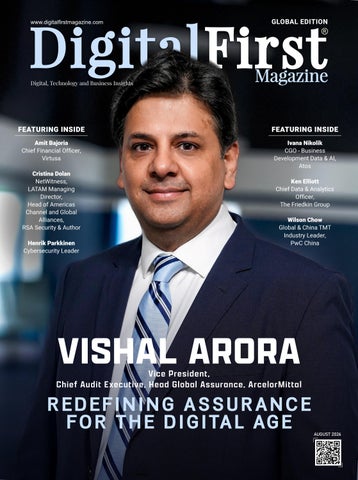
VISHAL ARORA
Vice President, Chief Audit Executive, Head Global Assurance, ArcelorMittal
REDEFINING ASSURANCE FOR THE DIG ITAL AGE
AUGUST 2026
Digital First Magazine August 2026
1
First Magazine 2 Digital August 2026
Digital First Magazine August 2026
3
www.digitalfirstmagazine.com
August 2026
Vol - 7 Issue - 8
Managing Editor
Free Subscription
Sarath Shyam
www.digitalfirstmagazine.com
Consultant Editors
International Partnerships
Dr. John Andrews Emma James Andrew Scott Sabrina Samson
Naomi Wilson Stanly Lui Steve Hope Keith Alexander
Americas Europe Middle East & Africa Asia-Pacific admin@digitalfirstmagazine.com
Creative Consultants Charlie Jameson Louis Bernard Shirley David
Follow Us On www.linkedin.com/company/ digitalfirstmagazine www.facebook.com/digitalfirstmagazine
Branding & Marketing Partnerships Jennifer Anderson Monica Davis Jessica Edword Rachel Roy Anna Elza Stephen Donnell Cathy Chen
Free Subscription
First Magazine 4 Digital August 2026
Digital First Magazine www.digitalfirstmagazine.com is a global knowledge sharing digital platform published by Connecta Innovation Private Limited. All rights reserved. The opinions expressed in the content are those of the authors. They do not purport to reflect the opinions or views of Connecta Innovation Private Limited or any of its members or associates. The publisher does not assume any responsibility for the advertisements and all representation of warranties made in such advertisements are those of the advertisers and not of the publisher. Digital First trademark is owned by DFG Digital First Infotech Pvt Ltd. and Connecta Innovation Pvt Ltd. has permission to use Digital First brand name. Digital First Magazine www.digitalfirstmagazine. com is a Free Subscription and Free-to-read digital platform strictly not for sale and has to be strictly for internal private use only. Publisher does not assume any responsibility arising out of anyone modifying content and pictures, printing a copy of this digital platform in any format and in any country and all matters related to that.
The Enterprise That Bends, Not Breaks
A
business does not usually discover how resilient it is when everything is going well. Resilience reveals itself when a cyberattack brings systems down, a geopolitical event disrupts a supply chain, an unexpected regulation changes the rules, or a new technology suddenly makes yesterday’s assumptions obsolete. In recent years, this has become less a theoretical concern and more a boardroom reality. The 2026 Allianz Risk Barometer ranks cyber incidents as the world’s top business risk, with 42% of respondents identifying them as a major concern. Artificial intelligence has emerged as the fastest-rising risk, reaching second place at 32%. I have often felt that the real test of a company is not how confidently it plans for the future, but how quickly it can rethink those plans when the future refuses to cooperate. The
strongest organizations are not necessarily those that predict every disruption. They are the ones that can absorb a shock, learn from it, and move forward without losing their sense of purpose. That is what makes our cover story with Vishal Arora particularly relevant. As Chief Audit Executive and Head of Global Assurance at ArcelorMittal, Vishal has witnessed the evolution of assurance from a compliance function into a strategic capability. His perspective on continuous risk sensing, data-driven insight, human judgment, resilience, and technology offers a compelling lesson: organizations must learn to see around corners rather than simply inspect the damage afterward. This issue of Digital First Magazine explores that broader shift. Across our interviews, features, and thought-provoking perspectives, we examine how businesses and professionals are navigating technological change, emerging risks, leadership challenges, and the growing expectations of a rapidly changing world. The future will not reward organizations simply for being efficient. It will reward those capable of adapting without losing their direction. That is the real meaning of resilience. Not avoiding disruption, but becoming better equipped for whatever comes next. Enjoy Reading.
Sarath Shyam
Digital First Magazine August 2026
5
CONTENTS
10
First Magazine 6 Digital August 2026
COVER
STORY
Wilson Chow
Global & China TMT Industry Leader, PwC China
Leading the AI Revolution: Empowering Global Growth at Scale Ivana Nikolik
CGO – Business Development Data & AI, Atos | Founder & CEO, IN Global Advisory
Empowering Finance to Drive Strategic Business Transformation Amit Bajoria
Chief Financial Officer, Virtusa
18
24 LEADER’S INSIGHTS
Empowering Clients To Build Connected Digital Ecosystems
56 Digital First Magazine August 2026
7
40
50 First Magazine 8 Digital August 2026
Henrik Parkkinen
Cybersecurity Leader
Light Speed: Governing a Financial System that No Longer Waits for Consensus Cristina Dolan
Entrepreneur, Public Company Board Director, Cybersecurity Governance Expert and Columbia University Faculty Member
The Dawn of the Agentic Enterprise Ken Elliott
Chief Data & Analytics Officer, The Friedkin Group
CONTENTS
EXPERT OPINION
32
Building Cybersecurity Strategy That Actually Works
Digital First Magazine August 2026
9
COVER STORY
VISHAL ARORA
Vice President, Chief Audit Executive, Head Global Assurance, ArcelorMittal
REDEFINING ASSURANCE FOR THE DIG ITAL AGE Vishal Arora is a seasoned assurance and risk executive with nearly three decades of experience spanning industry and Big4 professional services. He currently serves as Chief Audit Executive and Head of Global Assurance at ArcelorMittal, one of the world’s leading steel and mining companies, where he leads a globally integrated assurance function encompassing Internal Audit, Fraud Investigation, SOx Testing, Risk & Resilience, Security and Safety Assurance. Known for his collaborative and transformational leadership style, Vishal is passionate about developing high-performing teams and leveraging digitalization, data analytics and emerging technologies to enhance assurance effectiveness. A trusted advisor to senior leaders, he is recognized for translating complex risks into practical strategies that strengthen governance, resilience and business performance. Beyond his corporate responsibilities, Vishal is deeply committed to giving back to the profession and advancing the global governance, risk and assurance community. He actively collaborates with leading international professional associations and contributes to thought leadership initiatives that shape professional practices worldwide. Recently, in an exclusive interview with Digital First Magazine, Vishal shared insights into a nearly three-decade journey spanning Big4 advisory and global industry, now as Chief Audit Executive and Head of Global Assurance at ArcelorMittal. He spoke about how assurance has evolved from compliance validation to a forward-looking driver of value, resilience and trust in a world of AI, cyber threats and geopolitical uncertainty. For Vishal, the future of audit lies in agility, continuous risk sensing, and combining data analytics with human judgment. His focus is on building technology-enabled, peoplefirst assurance functions that align with strategy and empower teams. His advice to the next generation: embrace change, stay curious, invest in people, and remember that your legacy is not what you achieve, but what you enable others to achieve. The following excerpts are taken from the interview.
First Magazine 10 Digital August 2026
Digital First Magazine August 2026
11
Hi Vishal. You’ve spent nearly 3 decades moving between Big 4 advisory and large-scale industry. What was the first moment you realized assurance could be a driver of business value, not just compliance? My first realization came quite early in my career when I was working on risk and control reviews that were initially seen by management as compliance exercises. What struck me was that the most valuable conversations were never about whether a control existed, they were about why a process was failing, where risks were emerging and how the business could perform better. I remember seeing situations where an assurance review helped management streamline processes, improve decision-making or avoid significant operational risks. In those moments, assurance was not simply validating the past, it was helping shape better outcomes for the future. That changed my perspective completely. Over the last three decades, working across both Big Four advisory and industry, I’ve witnessed the role of assurance evolve dramatically. Data analytics, automation and now AI have transformed the business landscape. Organizations operate in far more complex and fast-moving environments than they did when I started my career. What has remained constant, however, is the need for trust. The difference today is that assurance can no longer be limited to compliance and historical validation. It has to be forward-looking, helping organizations navigate uncertainty, embrace innovation responsibly and create confidence among stakeholders. That’s what continues to excite me about the profession, the opportunity to position assurance as a driver of value,
First Magazine 12 Digital August 2026
resilience and sustainable business performance rather than just a compliance function. You lead both second- and third-line functions globally. What part of that integrated mandate energizes you most right now? What energizes me most is the opportunity to connect risk, assurance and business performance in a way that creates real value for the organization and the ability to see the bigger picture and help connect the dots across the organization. Leading both second and third line functions give me a unique perspective and vantage point across the enterprise. I can see the risks that are emerging, understand how management is responding to them and assess whether the organization is truly building the resilience needed for the future. What I find particularly exciting today is helping the organization navigate an increasingly complex environment shaped by digital transformation, cybersecurity threats, artificial intelligence, geopolitical uncertainty and evolving stakeholder expectations. In this context, assurance is no longer just about providing comfort over controls and cannot simply look backward. It needs to help organizations anticipate what is coming next and make better decisions with confidence. I particularly enjoy bringing together teams with different expertise, whether in Risk & Resilience, Internal Audit, Fraud Investigation or Safety & Security Assurance. While each has a distinct role, they all contribute to a common objective, helping the business succeed in a sustainable and responsible way. One of the most rewarding parts of my role is creating that alignment and ensuring we focus on the risks and opportunities that matter most.
STATIC ANNUAL AUDIT PLANS ARE GIVING WAY TO MORE DYNAMIC APPROACHES THAT ALLOW US TO RESPOND QUICKLY TO WHAT MATTERS MOST AT ANY GIVEN POINT IN TIME
What gives me the greatest satisfaction is seeing assurance play a meaningful role in strategic conversations. When our insights help management navigate uncertainty, seize opportunities or strengthen stakeholder trust, that is when I know we are creating real value. Being part of that journey and helping shape how assurance evolves in a rapidly changing world, is what continues to motivate me every day. Risk is moving faster than traditional audit cycles. How do you see the role of internal audit evolving to stay relevant in a real-time world? I believe the biggest challenge and opportunity for internal audit today is that risk is moving much faster than traditional audit cycles. The risk landscape is becoming increasingly dynamic, driven by rapid technological advances, cyber threats, geopolitical uncertainty and evolving regulatory expectations. Organizations must be prepared
to respond to changes that can materialize and escalate in a very short period of time. To remain relevant, internal audit must become more agile, continuously reassessing risks and adapting its focus as conditions change. Static annual audit plans are giving way to more dynamic approaches that allow us to respond quickly to what matters most at any given point in time. In my view, the future of internal audit lies in combining independence with foresight. Technology, data analytics and continuous monitoring are enabling auditors to move beyond periodic reviews and provide more timely insights. But relevance is not just about technology, it is also about mindset. Internal auditors need to understand the business, anticipate emerging challenges and provide perspectives that help management and boards navigate uncertainty. The most effective audit functions will be those that not only assess what has happened, but also help organizations prepare for what comes next.
Digital First Magazine August 2026
13
ESG, safety, and operational risk are converging. Which area will stakeholders demand the most assurance on in the next 5 years? I believe stakeholders will increasingly seek assurance over organizational resilience rather than any single risk area. The boundaries between ESG, safety, operational risk, cybersecurity, AI and business continuity are becoming increasingly blurred and stakeholders want confidence that organizations can manage these interconnected risks while delivering sustainable performance. In my experience, this requires moving beyond siloed assurance activities toward a more integrated view of risk, controls and organizational resilience. As assurance leaders, our role is to help prepare the organization for this reality. That means bringing together insights from across risk and assurance functions, leveraging data and technology to identify emerging risks earlier and providing stakeholders with a holistic view of how well the organization is positioned to respond to disruption. Over the coming years, I expect the greatest demand will be for integrated assurance that goes beyond compliance and gives stakeholders confidence in the organization’s ability to protect its people, adapt to change, meet its commitments and remain resilient in an increasingly complex and fast-evolving environment. Data is now the primary evidence source for assurance. What skills will future auditors need that they don’t have today? Data is becoming the foundation of assurance, but I don’t believe the future auditor will be defined by technical skills alone. While
First Magazine 14 Digital August 2026
MY BIGGEST GOAL IS TO BUILD TRULY WORLD CLASS ASSURANCE, RISK AND RESILIENCE FUNCTIONS THAT ARE TECHNOLOGY DRIVEN, PEOPLE-ORIENTED AND RECOGNIZED AS STRATEGIC ENABLERS OF BUSINESS SUCCESS
capabilities in data analytics, AI, automation and digital technologies will become increasingly important, the real differentiator will be the ability to combine those insights with business judgment, critical thinking and an understanding of organizational strategy and business risks. Future auditors will need to be comfortable interpreting large volumes of data, challenging assumptions, identifying emerging risks and translating complex information into meaningful insights for management and stakeholders. At the same time, I have always believed that assurance is fundamentally a people business. Throughout my career, keeping people first has been a top priority because technology may generate insights, but it is people who ask the right questions, build trust, influence decisions and drive change. That is why continuous training and development are critical to success. The pace of change in areas such as AI, cybersecurity, sustainability and digital transformation means that learning can no longer be an occasional activity. Organizations must invest in developing curious, adaptable and multidisciplinary professionals who continuously expand their skills. In my view, the most successful auditors of the future will be those who combine technological fluency with strong communication skills, business acumen and a commitment to lifelong learning. Leaders in assurance operate in highstakes environments. What book, mentor, or experience gave you a framework for staying calm under pressure? Over the last three decades, I’ve been fortunate to learn from a wide range of people, senior leaders who taught me the importance
of perspective and judgment, peers who challenged my thinking and team members, often much younger than me, who brought fresh ideas and different ways of solving problems. The many challenges and transformations I have experienced throughout my career have reinforced one key lesson, in high-pressure situations, leaders create the most value when they remain objective, focus on the facts and bring clarity to complexity. I’ve also always believed in putting people first and investing in continuous learning and development. Strong teams, built on trust, diverse perspectives and a commitment to learning, provide the foundation for resilience. Ultimately, staying calm under pressure is not about having all the answers, it’s about drawing on the collective wisdom of those around you, trusting your team and making decisions grounded in sound judgment and values. Assurance can be seen as serious work. What hobby or activity helps you reset and bring fresh energy back to your teams? I have always believed that to lead effectively, you need to create space to step back and recharge. For me, that comes through spending time with my family and friends, traveling and exploring different cultures and perspectives. I’m naturally curious and always eager to learn new things, whether it’s about emerging technologies, different industries or new ways of thinking. I find that some of the best insights come when you’re away from the day to day routine. Those experiences help me return with fresh energy, a broader perspective and new ideas that I can bring back to my teams and the work we do.
Digital First Magazine August 2026
15
believe there is still tremendous opportunity to leverage technology, data and innovation more effectively to enhance assurance, strengthen resilience and provide deeper business insights. Personally, I hope to continue shaping the future of assurance and risk management, developing the next generation of leaders and contributing to the profession.
What is your biggest goal? Where do you see yourself in 5 years from now? My biggest goal is to build truly world class assurance, risk and resilience functions that are technology driven, people-oriented and recognized as strategic enablers of business success. I want every function under my leadership, to be fully aligned with leading standards and best practices, while continuously evolving to meet the needs of a rapidly changing world. Just as importantly, I want our teams to feel valued, empowered and inspired to grow, because exceptional outcomes are always delivered by exceptional people. Over the next five years, my objective is to further transform these functions into modern, technology-enabled and insight-driven capabilities that deliver measurable value to the organization, empower stakeholders to make better decisions and contribute to sustainable business success. While we have already made significant progress on this journey, I
First Magazine 16 Digital August 2026
If you could leave one message for the next generation of audit and risk leaders, what would it be? Looking ahead, I believe the most successful audit and risk leaders will be those who combine technical expertise with an insatiable desire to learn and a genuine appreciation for people. The technology will continue to evolve, but curiosity, empathy and sound judgment will remain timeless leadership qualities. I would also encourage future leaders to embrace change rather than fear it. The most successful audit and risk professionals will be those who continuously learn, challenge conventional thinking and look beyond compliance to create value. Remember that trust is your greatest asset and leadership is ultimately about empowering and enabling others to succeed. Invest in your people, embrace diverse perspectives, and focus on helping organizations become stronger, more resilient and better prepared for the future. If you do that consistently, your contribution will extend far beyond audits and risk assessments, creating lasting value for both your organization and the profession. Your legacy is not what you achieve, but what you enable others to achieve. Disclaimer: These interview responses convey his personal perspective and should not be interpreted as representing any organization.
Want to Sell or find Investors for your Business?
Digital First Magazine August 2026 2021
17
LEADER’S INSIGHTS
Empowering Clients To Build Connected Digital Ecosystems Wilson Chow, Global & China TMT Industry Leader, PwC China
The lines between technology, media, and telecom are blurring faster than ever. Where do you see the biggest convergence opportunity that most companies are still underestimating today? The most underestimated convergence opportunity today is the digitisation of physical experiences. For years, companies have treated live events, venues, and out-of-
home environments as analogue endpoints in an otherwise digital value chain. That is now changing. Our Global Entertainment & Media Outlook 2026–30 shows that consumers are gravitating toward “shared reality” experiences — live entertainment, sports, trade events, and public media environments — because they offer scarcity, community, and social relevance. In an era of infinite digital content, that makes physical experiences more, not less, valuable.
Our 2026 AI Jobs Barometer, based on analysis of more than one billion job postings globally, points to exactly this shift: as AI changes work, the premium on distinctly human capabilities rises
First Magazine 18 Digital August 2026
Wilson Chow leads PwC’s global TMT industry practice and serves as TMT and AI Leader for Chinese Mainland and Hong Kong. Based in Shenzhen, he brings over 34 years of experience in public accounting and advisory across the region. He drives PwC’s global network to deliver integrated solutions in Assurance, Tax, and Advisory, helping clients navigate transformation and reinvent business models. With AI’s rapid evolution, he leads the expansion of PwC China’s AI practice, transforming internal service delivery and offering innovative client solutions. He is a fellow member of HKICPA, CICPA, and ACCA, and serves on committees for China’s Digital Union, Shenzhen AI Association, and Shenzhen Drones Association. Recently, in an exclusive interview with Digital First Magazine, Wilson shared insights from a 34-year journey leading PwC’s global TMT practice and expanding its AI capabilities across China and Hong Kong. On AI, Wilson argues we’re shifting from information abundance to insight scarcity, so competitive advantage will come from intelligent layers that turn data into decisions. His advice for future leaders is to stop optimizing for speed alone and start teaching critical thinking, ethical judgment, problem framing, and stewardship of trust, because in an AI-native world, human perspective becomes the differentiator. The following excerpts are taken from the interview.
Digital First Magazine August 2026
19
What most companies still miss is that these moments should no longer be viewed as standalone events. They should be designed and monetized as connected platforms. When telecom networks, AI-driven data layers, content ecosystems, commerce infrastructure, and advertiser demand are integrated, a live event becomes a continuously optimizable media environment: personalized in real time, measurable end-to-end, and monetizable far beyond the ticket sale. That opens the door to entirely new economics — dynamic sponsorship models, contextual advertising, premium second-screen experiences, real-time commerce, immersive overlays, and richer audience insight that extends well beyond the venue itself. The strategic mistake many companies are making is still organizing around industry boundaries — telecom, media, technology — when the consumer no longer experiences those boundaries at all. The winners will be the companies that build the operating model, partnerships, and data architecture to connect them. The metaverse, Web3, and spatial computing saw hype cycles. Which of these “next internet” concepts do you believe will deliver real enterprise value before 2030, and how? Among all 3 “next internet” initiatives, I believe spatial computing will deliver the greatest enterprise value before 2030. In the near term, we will be seeing enterprises embedding the technology into practical workflows. For example, engineering firms can have their field service technicians using AR glasses to overlay repair instructions onto physical machines; retail
First Magazine 20 Digital August 2026
brands could deploy spatial analytics to redesign store layouts based on real-time foot traffic data. Our Outlook highlights that AI-powered hyperpersonalisation is a key growth driver across advertising and content, and spatial computing is the natural interface for that personalisation in the physical world. The enterprise value will come from augmenting human capability in real-world contexts, not from escaping into a virtual one. By 2030, I expect spatial computing to be as commonplace in logistics, healthcare, and manufacturing as cloud computing is today. Trust is the new currency in a digital economy. What will separate the TMT companies that earn consumer and regulatory trust from those that lose it over the next 5 years? The dividing line will be transparency of intent. The companies that earn trust will be those that proactively explain not just what data they collect, but why they collect it, how it creates value for the user, and what safeguards are in place. They will treat trust as a product feature, not a compliance checkbox. For example, as AI-driven advertising becomes the fastest-growing revenue segment as highlighted in our Outlook, the trusted players will give users meaningful control over how their data fuels personalization, and they will audit their algorithms for bias and fairness publicly. In a world where generative AI can create hyper-realistic and synthetic contents at scale, the ability to prove authenticity and provenance will become a competitive moat. The companies that invest in verifiable digital identity and content watermarking today will be the ones consumers and regulators trust tomorrow.
The strategic mistake many companies are making is still organizing around industry boundaries — telecom, media, technology — when the consumer no longer experiences those boundaries at all
Every leader has tools they can’t live without. What technology or innovation in your own life has become indispensable, and what does it reveal about where the industry is headed? For me, the most indispensable technology is a simple one: a real-time collaborative AI assistant that helps me synthesize vast amounts of data, generate useful client conversation cues, and suggest actionable insights. It is not about replacing judgment, but about compressing the time between information and understanding. What this reveals about where the industry is headed is profound. We are moving from an era of information abundance to an era of insight scarcity. The value will no longer be in having access to data, but in the speed and accuracy with which you can turn that data into a decision. For TMT companies, this means the competitive advantage will shift from owning the most content or the fastest network to owning the most intelligent layer that connects contents, network, and user context. The future belongs to platforms that can anticipate needs before they are expressed, and that requires a seamless integration of AI, real-time data, and human intuition. Innovation requires creative energy. What do you personally do to stay curious and recharge when you’re not solving complex TMT challenges? Innovation does indeed demand creative energy, and I have found that the best way to sustain that energy is to step outside the industry entirely, i.e. to give my mind a completely different kind of challenge and release. For me, that outlet is oil painting. I have been practicing it for years, and my work spans a wide range of subjects, flowers, landscapes, animals, and even Chinese cultural performances. What I love most is the process itself: the mixing of colors, the interplay of different strokes and brushes. Through these tools, I can express darkness and brightness, joy and sorrow, stillness and movement.
Digital First Magazine August 2026
21
By 2030, I expect spatial computing to be as commonplace in logistics, healthcare, and manufacturing as cloud computing is today
There is no single ‘right’ way to paint and every artist brings their own style and preferences. That freedom is incredibly liberating. When I paint, I have to be fully present and focused. It is a form of meditation that allows me to disconnect from the hustle and complexity of TMT challenges. And because there are no fixed rules, I can be bold, experimenting, taking risks, and making creative ‘acts’ without fear of failure. That mindset often carries back into my work, reminding me that innovation thrives when we give ourselves permission to explore without constraints. So, in short: I recharge by immersing myself in a world where there are no right answers but only endless possibilities. And that, I believe, is the same spirit that drives breakthrough thinking in technology, media, and telecom. The next generation of leaders will be AI-native. What should we stop teaching future leaders about management, and what should we start teaching instead? In an AI-native world, machines will increasingly outperform humans at optimization, pattern recognition, and processing vast amounts of information. That means the traditional value of leadership shifts. The leader of the future will not
First Magazine 22 Digital August 2026
be the person with the fastest answer, but the one who can frame the right question, apply judgment, and make decisions that are not just intelligent, but responsible. Our 2026 AI Jobs Barometer, based on analysis of more than one billion job postings globally, points to exactly this shift: as AI changes work, the premium on distinctly human capabilities rises. So what we should start teaching is critical thinking, problem framing, ethical judgment, adaptability, and the ability to lead through ambiguity. We should also place much greater emphasis on how leaders work with AI, not just how they deploy it. That means understanding where AI can accelerate decision-making, where it can introduce bias or false confidence, and when human intervention is essential. Just as importantly, future leaders must know how to build teams and cultures that are diverse, inclusive, and resilient, because in a world shaped by AI, human perspective becomes even more valuable, not less. Ultimately, leadership in the AI era is less about control and more about stewardship — of trust, judgment, and human values. The best AInative leaders will not be those who simply use the technology most aggressively, but those who know when to rely on it, when to challenge it, and how to align it with a broader sense of purpose.
SlimYoo
slimyoo.com
23
Digital First Magazine istockphoto.com/DanielBendjy August 2026
LEADER’S INSIGHTS
Leading the AI Revolution: Empowering Global Growth at Scale Ivana Nikolik, CGO – Business Development Data & AI, Atos | Founder & CEO, IN Global Advisory
Hi Ivana. You’re part of the Growth leadership team driving global expansion. What part of that mission energizes you most every morning? What mostly energizes me is definitely working with organizations around the world to solve complex business challenges through AI, data, and digital transformation. Every client, every industry and every market has different ambitions, so no two days are ever the same. Our clients span the public sector, European institutions and global private enterprises,
which gives me a unique perspective on how AI is transforming industries at different speeds. I especially enjoy connecting people, ideas, and innovation across different markets and cultures while helping clients unlock new growth opportunities. In my experience, there’s nothing more rewarding than seeing a strategy evolve from a vision into measurable business impact. That same purpose defines everything I do - whether in my official role at Atos or as Founder & CEO of IN Global Advisory, helping organizations
AI will move beyond productivity gains and become a true business capability that drives growth and creates entirely new business models
First Magazine 24 Digital August 2026
Ivana Nikolik is CGO – Business Development Data & AI at Atos and Founder & CEO of IN Global Advisory, where she advises organizations and executive leaders on business strategy, AI adoption, digital transformation and sustainable growth. With nearly two decades of international leadership experience, she is passionate about helping businesses scale innovation while bridging technology, leadership and business impact. She has been recognized as a 40Under40 Top Business Leader in Europe, Tech Leader of the Year 2025, and Global Leader of the New Era. A passionate advocate for diversity and female leadership in technology and AI, Ivana also serves as a President of STEM Women in the Netherlands and G:100 Country Chair Netherlands in IT Services & Innovation. As a global Ambassador for Women in Tech and Women in AI, she is dedicated to empowering the next generation of leaders while accelerating innovation through AI, automation and digital transformation. Recently, in an exclusive interview with Digital First Magazine, Ivana shared insights into how her professional journey has been defined by connecting people, ideas, and innovation across global markets to solve complex challenges with AI, data, and digital transformation. She believes the biggest AI shift by 2030 will be Agentic AI fully embedded into operations, working alongside people to drive growth, not just productivity — and that true leaders will win by combining tech with business vision, strong data foundations, and responsible governance. Her advice to professionals is to prioritize adaptability, continuous learning, and curiosity, connecting technology to real business value, and to say “yes” to challenges before feeling 100% ready because growth begins where comfort ends. The following excerpts are taken from the interview.
Digital First Magazine August 2026
25
transform ambitious ideas into measurable business outcomes through innovation, AI and strategic leadership. That’s what motivates me every morning. AI and Agentic AI are moving from pilot to production across enterprises. What shift in how Fortune 500s use AI do you expect to see most by 2030? I believe the biggest shift will be that AI becomes fully embedded into the way organizations operate, rather than existing as a collection of isolated projects. We’ll increasingly see Agentic AI working alongside people—supporting decisionmaking, automating complex workflows, and helping organizations innovate faster. AI will move beyond productivity gains and become
First Magazine 26 Digital August 2026
a true business capability that drives growth and creates entirely new business models. Working with organizations across both the public and private sectors, I already see this shift happening. The conversation is moving away from “Should we adopt AI?” towards “How do we scale AI responsibly and create measurable business value?” That’s a very different discussion than we were having just a few years ago. I also believe the organizations that will truly stand out are those that combine innovation with trust. Responsible AI, strong governance, and keeping humans at the center will be just as important as the technology itself. The future is definitely not about humans versus AI, but humans and AI working together.
Cloud and Automation have become table stakes, not differentiators. What comes next that will separate true leaders from followers? I would say the next differentiator is the ability to combine technology with business vision. Technology is becoming increasingly accessible, so simply adopting the latest platform won’t be enough anymore. The real advantage will come from organizations that build strong data foundations, create an AI-first culture, and empower their people to embrace change. Across the organizations I work with globally, regardless of industry or geography, the common challenge is no longer access to technology. It’s about bringing together data, people, governance, and business strategy to create lasting impact.
In my view, the winners won’t necessarily be the companies with the most advanced technology, but those that know how to create the greatest business value from it. That’s where leadership really makes the difference. You champion women in AI and mentorship globally. How can leaders create cultures where diverse voices actually shape AI strategy, not just implement it? I strongly believe diversity has to be built into decision-making—not treated as a separate initiative. Leaders need to make sure diverse talent is present where strategy is defined, investments are made, and priorities are set. But representation alone isn’t enough. People also need to feel safe to challenge ideas, contribute
Curiosity, resilience, and the willingness to continuously reinvent yourself are probably the best investments anyone can make for a successful international career
Digital First Magazine August 2026
27
different perspectives, and genuinely influence outcomes. I’ve seen throughout my career that the strongest innovation comes from teams with different backgrounds, experiences, and ways of thinking. If we want AI to work for everyone, then the teams building it should reflect the diversity of the society it serves. Having worked at the intersection of business growth, AI, and digital transformation, what capability do you believe professionals should prioritize to remain relevant and create impact in the AI era? If I had to choose one capability, I would definitely say adaptability combined with continuous learning.
Technology is evolving at an incredible pace, and while technical skills remain important, they can quickly become outdated. What really differentiates professionals today is their willingness to continuously learn, unlearn, and reinvent themselves. I also believe it’s no longer enough to simply understand technology but you need to understand how technology creates business value. The professionals who will have the greatest impact are those who can connect technology, business strategy, and people. They don’t just know how AI works; they know how to apply it responsibly to solve real business challenges and create meaningful outcomes. That philosophy also underpins the work we do at IN Global Advisory, where the main focus is on helping leaders turn emerging technologies into sustainable business growth and long-term competitive advantage. For me, curiosity has always been one of the biggest drivers of growth. I genuinely enjoy learning, exploring new ideas, and challenging myself to keep evolving. In the AI era, I believe curiosity, adaptability, and the ability to connect disciplines will be far more valuable than mastering any single technology. Beyond your executive roles, you also serve as President of the Netherlands Chapter of STEM Women. Why is this mission so important to you? This is honestly one of the causes closest to my heart. While my professional career is focused on helping organizations grow through AI and digital transformation, I also believe we have a responsibility to invest in the people who will shape the future of these technologies.
First Magazine 28 Digital August 2026
If we want AI to work for everyone, then the teams building it should reflect the diversity of the society it serves
As President of the Netherlands Chapter of STEM Women, together with an incredible team of ambassadors and volunteers, our goal is to continue growing a strong and inclusive community that inspires more people to pursue careers in STEM. We focus especially on encouraging girls and young women from an early age to see science, technology, engineering, and mathematics as exciting and achievable career paths. But our mission goes beyond gender—we want to support people from all backgrounds and create opportunities across every demographic because innovation is strongest when everyone has a seat at the table. I truly believe representation matters. When young people see role models they can relate to, they begin to believe those careers are possible for them too. If through our work we can inspire the next generation of scientists, engineers, AI
experts, entrepreneurs, and leaders, then we’re not just building careers—we’re helping shape a better future for society. You’ve travelled extensively and have a deep appreciation for nature. Which destination or landscape has inspired you the most, and why has it stayed with you? I feel incredibly fortunate that my career has allowed me to travel the world and experience almost 60 countries across different continents. Every destination has offered something unique, whether it’s a culture, a landscape or a perspective that has shaped the way I see the world. If I had to choose one place, it would definitely be Hawaii. What captivated me first were its long sandy beaches, crystal-clear
Digital First Magazine August 2026
29
elsewhere, it has encouraged me to embrace an active outdoor lifestyle in new ways. I regularly spend time playing tennis, running, cycling and enjoying outdoor sports. Being outdoors helps me recharge, clear my mind and maintain balance in a fast-paced professional life. No matter where I am in the world, nature reminds me to slow down, stay curious and keep a sense of perspective. Those moments of connection often become the source of my greatest creativity, resilience and inspiration.
waters and breathtaking ocean views. There is something so calming about standing at the edge of the Pacific, watching the waves and feeling completely connected to nature. Beyond its stunning coastline, Hawaii’s dramatic volcanic landscapes, lush rainforests and waterfalls create a rare combination of beauty and raw natural power. It is one of those places that reminds you how magnificent and resilient our planet truly is. At the same time, I continue to be inspired by the beauty of the Netherlands, where I live. The landscapes are completely different, but there’s something very calming about the changing seasons, the coastline and the way nature is part of everyday life. While it doesn’t offer the mountainous hiking trails I enjoy
First Magazine 30 Digital August 2026
Aspirants often ask how to break into international B2B and board-level roles. What’s the first habit they should develop to get noticed for growth leadership? I would say the first habit is to stay genuinely curious. Don’t limit yourself to your own role. Learn about your customers, your industry, different markets, and how businesses actually create value. Early in my career, I realized that asking questions, taking on challenges outside my comfort zone, and building relationships across different countries and functions opened doors that technical expertise alone never could. I also believe growth leaders never stop learning. Curiosity, resilience, and the willingness to continuously reinvent yourself are probably the best investments anyone can make for a successful international career. And one final piece of advice: don’t wait until you feel 100% ready before taking the next step. Some of the biggest opportunities in my career came from saying “yes” to challenges that initially felt beyond my comfort zone. Growth begins where comfort ends.
Digital First Magazine August 2026
31
EXPERT OPINION
Building Cybersecurity Strategy That Actually Works Henrik Parkkinen, Cybersecurity Leader
I
n today’s digital economy, organizations invest billions in cybersecurity technologies, yet many continue to suffer costly breaches, operational disruptions, and reputational damage. The reason is rarely the lack of security tools. More often, it is
the absence of a clear cybersecurity strategy that aligns security initiatives with business objectives. A long term plan for how those security investments and activities support the business objectives and long term strategic goals.
One of the most common mistakes organizations make when developing a cybersecurity strategy is allowing technology to drive strategy
First Magazine 32 Digital August 2026
Henrik Parkkinen is a globally recognized cybersecurity leader from Sweden with more than 20 years of experience. He has a broad and deep understanding of today’s digital ecosystem, emerging technologies, security universe, and threat landscape. Henrik’s knowledge is a product of experience collected from a defensive and offensive security perspective through technical hands-on assignments to management and leadership roles.
Digital First Magazine August 2026
33
A cybersecurity strategy is much more than a collection of security controls, policies, or compliance requirements. It is a long-term plan that provides direction, establishes priorities, and supports an organization to make informed decisions about where and how to invest in security. Without such a strategy, organizations risk becoming reactive and constantly responding to the latest threats, trends, industry buzz instead of building sustainable cyber resilience built on the needs from the business organization. Start with the Business, Not the Technology One of the most common mistakes organizations make when developing a cybersecurity strategy is allowing technology to drive strategy. New security products, annual threat reports, and vendor presentations often become the foundation for security planning. While these sources provide valuable insights, they should never determine the strategic direction. Every organization is unique. Its business objectives, risk appetite, regulatory obligations, digital transformation initiatives, operating environment, and culture differ from those of every other company. Therefore, a successful cybersecurity strategy must be built around the organization’s own needs rather than external trends or competitors. The essential question is not, “What are other organizations doing?” Instead, security leaders should ask, “What does our organization need to achieve its business goals and how and in what way can cybersecurity support the organization to achieve these goals over the next several years?”
First Magazine 34 Digital August 2026
When security supports business objectives instead of competing with them, it does what it’s intended to do. To support the organization in achieving its business objectives and long term strategic goals, i.e. creating value.
An effective cybersecurity strategy recognizes that resilience begins with strong fundamentals
Understand Your Current Reality Before defining the future, organizations must understand their current position. An honest assessment of existing security capabilities, governance, processes, technologies, and organizational maturity provides the baseline for strategic planning. This assessment should identify strengths, weaknesses, capability gaps, and the organization’s most significant risks. This is often also known as a “bottom-up” security assessment. Equally important is understanding the organization’s operating context. A rapidly growing technology company faces different challenges than a manufacturing business or a healthcare provider. Strategy must reflect these realities rather than follow a generic template. This form of assessment is often spoken about as a top-down assessment. Developing a strategy without understanding the current state is similar to planning a journey without knowing your starting point. Build Strong Foundations First Many organizations become attracted to advanced security capabilities such as artificial intelligence, zero trust architectures, or sophisticated threat intelligence programs. While these initiatives may create value, they rarely compensate for weak security fundamentals.
Digital First Magazine August 2026
35
If an organization struggles with asset management, identity management, vulnerability management, patching, backup procedures, or incident response, these foundational capabilities deserve priority. An effective cybersecurity strategy recognizes that resilience begins with strong fundamentals. Advanced capabilities should complement but not replace basic security hygiene. A useful analogy is repairing a leaking boat. Investing in a more powerful engine makes little sense if the hull still contains holes. The leaks must be repaired before additional improvements create meaningful value. Strategy Is About Direction, Not Detail Another misconception is that a cybersecurity strategy should describe every technical implementation or operational activity. It should not.
A strategy defines where the organization wants to go, why that direction matters, and the principles that guide decision-making. Tactical plans, roadmaps, projects, and operational procedures translate the strategy into execution. This distinction is critical. Organizations often produce impressive PowerPoint presentations describing ambitious security visions. Unfortunately, documents alone do not improve security. Execution does. A strategy without implementation remains an aspiration rather than a business capability. And the mission for security is to support the business to achieve its objectives and strategic goals. Execution is key. Avoid the Most Common Strategy Pitfalls Experience shows that organizations repeatedly fall into several predictable traps when developing cybersecurity strategies.
Developing a successful cybersecurity strategy is ultimately about creating clarity
First Magazine 36 Digital August 2026
One misconception is that only large enterprises require a strategy. In reality, every organization depends on digital assets and therefore benefits from long-term security planning. The scale may differ, but the need does not. Organizations also frequently believe that purchasing security services means outsourcing their strategy. This is impossible. Technology implementation and operational services may be outsourced, but accountability for protecting the organization always remains with its leadership. Accountability for security can not be outsourced. Finally, many organizations assume that having a cybersecurity strategy automatically prevents cyber incidents. It does not. No strategy can eliminate cyber risk entirely. The objective is to improve resilience, strengthen decision-making, prioritize investments, and prepare the organization to prevent, withstand, respond to, and recover from incidents more effectively. Basically, improve the organization’s security posture and resilience and at the same time support the organization to achieve its business objectives and long term strategic plan. Adapt Theory to Reality Academic models and industry frameworks provide valuable guidance for strategic planning. However, reality rarely follows textbooks or powerpoint presentations. Some organizations begin strategy development after experiencing a significant cyberattack. Others start during mergers, digital transformation initiatives, regulatory changes, or periods of rapid business growth.
Each situation demands a different approach. In some organizations, governance and policies already exist, while technical controls require improvement. In others, operational security capabilities are well developed, but strategic direction is missing. Sometimes political realities, limited budgets, or organizational resistance influence what can realistically be achieved. An effective security leader understands that strategy is not about rigidly applying theory. It is about adapting principles to the organization’s circumstances while maintaining focus on longterm value creation. Reality requires adaptability and flexibility. The cybersecurity strategy powerpoint will only be as powerful as its translation of execution in reality. Think Beyond Compliance Compliance remains important, but compliance should never become the strategic objective. Meeting regulatory requirements demonstrates that minimum expectations have been fulfilled. Cybersecurity strategy aims significantly higher. Organizations should aspire to build resilience, protect critical business capabilities, support innovation, enable digital transformation, strengthen stakeholder trust and generate value. Security becomes far more valuable when it contributes directly to organizational success instead of merely satisfying auditors. Being compliant should be the result of being secure. Security Is a Continuous Journey One of the most important lessons is that cybersecurity strategy is not a one-time project.
Digital First Magazine August 2026
37
Unfortunately, this is how many organisations approach it. Business priorities evolve. Technologies change. Threat actors adapt. Regulations emerge. New business models create new risks. Consequently, the strategy must also evolve. Successful organizations regularly review their strategic objectives, measure progress, learn from incidents, reassess priorities, and adjust their direction as circumstances change. A cybersecurity strategy should therefore be viewed as a living instrument rather than a static document. Successful organisations understand how to ensure their cybersecurity strategy becomes an integrated part of their daily, weekly, quarterly and yearly operating model.
First Magazine 38 Digital August 2026
Final Thoughts Developing a successful cybersecurity strategy is ultimately about creating clarity. It establishes where the organization is today, where it intends to go, and how security will support that journey. Rather than chasing every emerging threat or purchasing every new technology, organizations should focus on building strong foundations, aligning security with business objectives, executing consistently, and continuously improving over time. Technology will continue to evolve. Threats will continue to change. A well-developed cybersecurity strategy provides the stable direction that enables organizations to navigate both with confidence.
Digital First Magazine August 2026
39
EXPERT OPINION
Light Speed: Governing a Financial System that No Longer Waits for Consensus Cristina Dolan, Entrepreneur, Public Company Board Director, Cybersecurity Governance Expert and Columbia University Faculty Member
W
hy Stablecoins, Blockchain, AI, Sanctions, Quantum Risk, and Geopolitics are rewriting fiduciary duty in real time For years, directors could tell themselves a reassuring story about technology. It came in waves First the internet. Then E-Commerce. Then Cloud. Then mobile. Then data. Then AI. Each wave had time to mature. Management had time to experiment. Boards had time to learn the language, hire the experts, build the dashboards, and ask better questions. That world is gone The financial system is now being rebuilt at the speed of software, but with the consequences of money, markets, national security, and law. Stablecoins are moving from Crypto-Native trading instruments toward regulated payment infrastructure. The GENIUS Act created the
First Magazine 40 Digital August 2026
first comprehensive U.S. Federal framework for payment Stablecoins, while the clarity act continues through the senate process as policymakers work to define the broader digitalasset market structure. At the same time, fintech and digital-asset firms are pursuing national trust-bank and special-purpose banking structures. The OCC has proposed GENIUS Act implementation rules and reporting requirements for permitted Payment Stablecoin Issuers, while treasury and Fincen have proposed rules that would bring Stablecoin Issuers Deeper into Bank Secrecy Act, AML, sanctions, and customeridentification obligations. This is the environment Cyberfiduciary was written for. Not because cybersecurity belongs in the back office, but because the line that used to separate “Cyber Risk” from “The Rest Of The Balance Sheet” has dissolved.
Cristina Dolan is an award-winning entrepreneur, technology executive, engineer, MIT alumna, public company board director, and Columbia University faculty member specializing in Cybersecurity, AI, Blockchain infrastructure, digital assets, and technology governance. Her new book, Cyberfiduciary, releasing July 11, 2026, examines why boards and executives must understand cyber risk, defense, and remediation as core fiduciary responsibilities in an era of accelerating technological and regulatory change.
Digital First Magazine August 2026
41
The old model was sequential. The new model is simultaneous: Stablecoins, AI-Agent Payments, Sanctions, Digital Money, Bank Charters, Quantum Risk, and Geopolitical Realignment are moving into the same governance cycle.
When money, identity, AI DecisionMaking, Sanctions Compliance, Data Integrity, and Geopolitical conflict all move across programmable rails, a board that only asks about firewalls is asking the wrong question. The old model was one wave at a time. The new model is all waves, all at once. When One Transaction is Five Events Historically, companies adopted technology in sequence. They assessed a new capability, integrated it, governed it, and then moved on to the next one. That rhythm is gone. A single Stablecoin transaction can now be a payment event, an AI-agent decision, a sanctions-screening event, a treasury-demand data point, and a geopolitical signal. Pull one thread and the others move. Look at the Layers now Converging. The money layer has changed first. Stablecoins are no longer just a crypto-market
First Magazine 42 Digital August 2026
instrument. They are increasingly being discussed as payment, settlement, and liquidity infrastructure. Brookings, citing EY-Parthenon estimates, has noted that Stablecoins could be used for 5% to 10% of cross-border payments by 2030, equal to $2.1 trillion to $4.2 trillion in value. Visa’s on-chain analytics work also shows why the numbers must be handled carefully: Raw on-chain volume can be large, but adjusted volume is needed to filter out bots, high-frequency trading, internal smart-contract movements, and other non-payment activity. The reserve layer matters just as much. The GENIUS Act requires payment stablecoin issuers to maintain high-quality reserves, and implementation is now focused on reserve quality, reporting, AML obligations, and sanctions controls. This means Stablecoin growth is not only a crypto story. It is also a treasury-market story, a bank-deposit story, a liquidity story, and a financial-stability story. Citi has modeled a 2030 base case of $1.9 trillion in Stablecoin supply and a $4 Trillion
One programmable payment can trigger multiple governance events at once: payment execution, AI authorization, sanctions screening, reserve implications, and geopolitical exposure. bull case, while BIS research has examined how Stablecoin flows can affect short-term U.S. Treasury yields. The intelligence layer is arriving quickly. AI agents need payment rails that can move value programmatically, in small amounts, across borders, and with policy controls embedded into the transaction path. Coinbase’s X402 protocol is designed to enable instant Stablecoin payments directly over http, allowing Apis, apps, and AI agents to transact programmatically. Coinbase has also announced X402-Related integrations with AWS, including on-chain USDC settlement and compliance screening. The instrument layer is expanding faster than traditional categories can absorb. Tokenized treasuries, tokenized deposits, private credit, stablecoin settlement, real-world asset markets, and perpetual futures are not
separate trends. They are early expressions of a programmable financial stack. The regulatory layer is catching up, but unevenly. Public companies must disclose material cybersecurity incidents on form 8-k within four business days after determining materiality, and they must provide annual cybersecurity risk-management, strategy, and governance disclosures. The EU AI act entered into force in 2024 and applies in phases. DORA has applied to EU financial entities since January 17, 2025. DAC8 rules entered into force on January 1, 2026, expanding tax transparency to crypto-asset transactions. NIST finalized its first three postquantum cryptography standards in 2024 and has urged organizations to begin migration planning. A decade ago, any one of these developments would have been the defining story in its sector. Today, they all belong in the same board packet.
Digital First Magazine August 2026
43
The financial stack is being rebuilt simultaneously. Stablecoins, Tokenized Assets, AI Agents, Reserve Requirements, Settlement Velocity, and Regulated Banking Rails are converging into one programmable architecture. For boards and executives, the risk is no longer isolated to one system or vendor: A failure in one layer can cascade across payments, markets, liquidity, compliance, and trust.
First Magazine 44 Digital August 2026
Geopolitical responses are diverging: some jurisdictions are modernizing incumbent money, others are building alternative rails, some are exploring private dollar stablecoins, and sanctioned actors are seeking paths around controllable systems. Sanctions in a world with too many rails This leads to the uncomfortable question beneath the entire story: does sanctions enforcement still work when value can move through so many rails? The honest answer is complicated. it works best on systems designed to be controllable. The Iran Case makes that clear. chainalysis reported that tether collaborated with U.S. Law Enforcement to freeze $344 Million in USDT linked to Iran-Related activity after OFAC Updated Central Bank of Iran Identifiers. TRM labs similarly reported that tether coordinated with OFAC and U.S. Law Enforcement to freeze approximately $344.2 million across two wallets. That kind of action is possible because USDT is centrally issued. Tether can freeze addresses. It can block movement. With the
right legal and compliance process, funds can be immobilized. Bitcoin does not work that way. nor do all digital-asset systems offer the same control points. That distinction matters. The more useful and programmable a digital dollar becomes, the more governable it may be. The actors most determined to escape that governance will look for non-custodial assets, alternative stablecoins, offshore venues, mixers, bridges, or jurisdictional gaps. Enforcement agencies are winning some battles. they can force freezes on centralized Stablecoin rails, update sanctions lists, identify wallets, pressure exchanges, and isolate sanctioned assets from compliant liquidity venues. But each successful intervention also teaches illicit actors how to adapt.
Digital First Magazine August 2026
45
This is why the board-level question cannot be limited to: “Are We Using Blockchain?” Or “Are We Exposed To Crypto?” The better question is: Which rails does our value move on, who controls those rails, which jurisdictions can reach them, and how quickly can our access change? The rail is not neutral. It determines who can freeze funds, who can redirect them, who can inspect them, who can subpoena records, and who can deny access in a crisis. Regulators are moving fast. Innovation is moving faster. It is tempting to say regulators are behind. In some areas, they are. In others, they are moving faster than many boards realize. The SEC’s cybersecurity disclosure rules have already changed the expectations for public-company governance. A material cyber incident is no longer just an operational matter. Once materiality is determined, it becomes a disclosure event with a four-business-day clock. The GENIUS Act has created a federal framework for payment Stablecoins, and treasury has proposed rules to treat permitted payment stablecoin issuers as financial institutions for bank secrecy act purposes, with AML and sanctions compliance obligations. fincen and federal banking agencies have also proposed customer-identification program requirements for stablecoin issuers. The CLARITY Act remains pending. Reuters reported that the senate banking committee advanced the bill on may 14, 2026, but also noted ongoing debates over AML obligations, conflicts, and Stablecoin reward or yield provisions that banks fear could draw deposits away from the traditional banking system.
First Magazine 46 Digital August 2026
Then add the EU AI Act, DORA, GDPR, Mifid II, DAC8, CARF, OFAC, SEC Disclosure Rules, NIST Post-quantum standards, state banking regulators, occ rulemaking, and privatesector compliance standards. A single institutional stablecoin transaction can now touch payments law, securities law, commodities law, banking regulation, sanctions compliance, AML controls, tax reporting, data protection, ai governance, operational resilience, and cyber disclosure. Most of those regimes were written by different bodies, in different years, for different purposes. The technology does not care. It converges anyway. The Fiduciary Question: Do we understand the Architecture? A fiduciary model built for one technology at a time cannot govern an environment where six technologies converge at once. Boards do not need to become blockchain engineers. They do not need to write smart contracts. They do not need to become PostQuantum Cryptographers. But they do need to understand the architecture well enough to ask better questions, document those questions, and demand evidence-based answers. Which rails does our value move on? Who can freeze, reverse, delay, redirect, or inspect those transactions? Which vendors, liquidity providers, custodians, wallets, exchanges, apis, models, bridges, and data feeds sit inside the transaction path? Where does AI enter the decision chain? If an AI Agent Initiates a payment, who authorized the policy? who set the spending limits? who
regulators are moving quickly, but innovation continues to outrun static governance models. not every charter milestone is the same. These firms were at different stages: some had only applied, some had conditional approval, and final approval requires additional OCC Sign-Off.
monitors drift, manipulation, poisoned data, or adversarial prompts? If a Stablecoin issuer, exchange, validator, custodian, bank, or counterparty is sanctioned tomorrow, what happens to our funds, our customers, our reporting obligations, and our ability to operate? If cryptographic standards change because of quantum risk, which assets, identities, signatures, certificates, wallets, or archives are exposed? And perhaps most important: Can we prove, through minutes, dashboards, tabletop exercises, incident records, and remediation plans, that we considered these questions before an incident forced us to? That is the discipline. Risk. Defense. Remediation.
Know what can go wrong. build controls for the architecture you actually run, not the one you think you have. And have a tested plan for what happens when part of that fast-moving stack fails. Annual cyber reviews were not designed for this world. Five-Year technology strategies were not designed for this world. Even traditional enterprise risk management can struggle in this world, because the risk does not sit inside one department. It crosses product, finance, treasury, legal, compliance, cybersecurity, data governance, AI, vendor management, and public disclosure. That is why the board’s role has changed. oversight is no longer about approving innovation from a safe distance. It is about understanding how innovation changes the
Digital First Magazine August 2026
47
company’s legal, financial, operational, and geopolitical exposure. The opportunity is enormous. So is the responsibility. None of this is an argument for slowing down innovation. The opposite is true. We are living through one of the most exciting industrial transformations in modern history. The financial system is becoming programmable. AI Agents are becoming economic actors. Tokenized assets are turning static records into executable instruments. Stablecoins are forcing the world to rethink money movement. Post-Quantum Cryptography is pushing institutions to inventory the Cryptographic Assumptions beneath their systems. Satellite Communications, IoT, Edge Computing, and Machine-To-Machine commerce are expanding the surface area of the economy itself. The Opportunity is Extraordinary. Cerulli projects that $124 trillion in wealth will transfer through 2048, with $105 Trillion expected to flow to heirs. Much of that capital will move into the hands of generations that are more comfortable with digital assets, programmable platforms, mobile interfaces, automated advice, private markets, and selfdirected financial tools. The next generation of financial infrastructure will not look like the last one. But speed without accountability is not strategy. It is fragility. The same programmability that allows a compliant stablecoin to settle quickly can also allow illicit actors to route value through new paths. The same AI that optimizes treasury operations can act on corrupted data. The same tokenized system that compresses settlement
First Magazine 48 Digital August 2026
can create new dependencies on smart contracts, private keys, oracles, bridges, and off-chain governance. The same regulatory clarity that unlocks new business models also raises the evidentiary burden for boards and executives. The companies that win this decade will not be the ones waiting for the dust to settle. The dust is not settling. The winners will be the institutions that can innovate with discipline. They will understand the architecture. They will build controls at the speed of the business. They will test their assumptions before the market, regulators, plaintiffs, counterparties, or adversaries test them first. They will be able to say, credibly and with evidence: • We understood the risk. • We built the defense. • We had a remediation plan. That is the Cyberfiduciary moment. Not a compliance checkbox. The job itself.
Digital First Magazine August 2026
49
EXPERT OPINION
The Dawn of the Agentic Enterprise Ken Elliott, Chief Data & Analytics Officer, The Friedkin Group
T
he organizational models that run our businesses today are outdated. They were designed for a world where humans were the only available processors of information, a model born from the industrial era that shaped 80 years of management thinking, organizational design, and even our educational systems.
Today, people are deployed as white-collar assembly lines, moving information from one hand to the next. In nearly every company, every floor, every department, every function was designed to do what only humans could do: process information, make sense of data, and turn it into action. Agentic AI has disrupted this model. Not gradually. Not partially. Entirely.
In an Agentic Enterprise, a company’s best practices are retained as a corporate asset, encoded, version-controlled, and compounding
First Magazine 50 Digital August 2026
Henrik Parkkinen is a globally recognized cybersecurity leader from Sweden with more than 20 years of experience. He has a broad and deep understanding of today’s digital ecosystem, emerging technologies, security universe, and threat landscape. Henrik’s knowledge is a product of experience collected from a defensive and offensive security perspective through technical hands-on assignments to management and leadership roles.
Digital First Magazine August 2026
51
Something truly revolutionary happened in the last 24 months – we witnessed the birth of Agentic AI. As Marc Benioff puts it, “We are at the beginning of the Agentic Era, the most significant transformation of work in history. For the first time, machines can perform not only repetitive tasks, but cognitive work once reserved for humans. These AI agents - which can reason, adapt, and act on their own - are already reshaping thousands of companies and will ultimately touch every job and every person.” (Benioff, 2026) McKinsey agrees that “AI is bringing the largest organizational paradigm shift since the industrial and digital revolutions.” (McKinsey, 2025a) So why all the fuss? We’ve had smart computers since the 1950s. We’ve seen computers used for everything from putting us on the moon to decoding the human genome. This is fundamentally different. Agentic AI systems can now understand complex language and information, reason over that information, decide the best course of action (under our direction), interact with our systems to act upon those decisions, orchestrate multiple steps within complex business processes, and learn and adapt for continuous improvement. Capabilities previously reserved for humans.
First Magazine 52 Digital August 2026
The Agentic Enterprise Imagine an organization where all routine business processes are run by AI agents operating under the direction of company experts. Employees are no longer consumed by repetitive tasks. They have stepped out of the white-collar production line and onto it, where they manage exceptions, monitor performance, and continuously tune the agents to make them better. The work is faster, higher quality, more consistent, and lower in cost than anything we can achieve today. In this world, competitive advantages become managed and enduring assets of the company. Best practices are automated through AI Agents. A company’s “secret sauce”, their unique experience, decisions, values, direction, are all captured and managed within AI Agents. It will be as if the most experienced expert in every department is handling every interaction, every decision, and every transaction consistently, without fatigue, without drift. Moreover, this is how companies will secure institutional longevity. Employees come, go, and retire. When they do their expertise leaves with them. In an Agentic Enterprise, a company’s best practices are retained as a corporate asset, encoded, version-controlled, and compounding.
This is not about replacing people. It is about shifting the burden of work. It is about aligning work better suited for AI to AI and work better suited for humans to humans. Employees evolve from serving as cogs in a process to managing outcomes. Becoming an Agentic Enterprise The most critical success factors for successfully transitioning into an agentic enterprise are not technical. While technical factors such as agentic platforms, software engineering, and agent development are required to support the agentic enterprise, they pale in comparison with the business factors. These include business strategy, business process reengineering, workforce transformation, business knowledge management, and business data stewardship. Business Strategy. Becoming an Agentic Enterprise is first and foremost a business strategy. It represents one of the most consequential decisions a company can make. As such, it is imperative that the vision and conviction start at the top with the company shareholders and executive business leaders - supported by, but not led by, the Chief Information Officer or Chief Data Officer. Business Process Reimagination. Early adopters of agentic AI find a consistent pattern. Independent AI projects produce incremental gains, but the full value of agentic AI is realized only when organizations reimagine entire value streams. According to McKinsey, “Capturing the AI opportunity requires a fundamental rewiring of business units and functions around a scalable AI backbone. This includes redesigning end-toend processes, modernizing data and technology infrastructure, embedding AI into decisionmaking and operations, and reshaping roles,
governance, and ways of working. Leading organizations are not just experimenting with AI; they are rebuilding how the business runs so that AI can scale across functions and continuously improve performance.” (Montard et al., 2026) A portfolio of projects aimed at individual steps will feel productive but becoming an agentic enterprise demands a broader ambition: redesigning end-to-end value streams rather than optimizing isolated tasks within them. This will require business strategists with proven experience in business process reengineering. Bottom line: Don’t jump to implement agentic AI until you have first conducted a diligent business process reimagination effort. Workforce Transformation. By design, the agentic enterprise will transform a significant number of business processes and as a result change how people work. Roles will change, people will need to be retrained to operate agents, and even performance goals will have to be rethought once agents absorb routine tasks. “Just about everybody in the workforce is going to need a new job description in the next two to three years. Most roles won’t go away, but they’ll be reshaped. Seventy-five percent of roles need fundamental reshaping right now.” (Krivkovich, 2026). This requires organizational design and workforce transformation expertise often lacking in our organizations. It is the piece most often underestimated, and the one most likely to derail the effort if we get it wrong. Bottom line: There is no more important time to be in HR than now – supporting the most significant shift in the nature of work in our lifetimes.
Digital First Magazine August 2026
53
By design, the agentic enterprise will transform a significant number of business processes and as a result change how people work
Business Knowledge Management. Teaching an AI Agent to complete a business process is much like how we train employees today. We provide training, business terminology, operating manuals, business glossaries, call scripts, objectives, rules and guidelines. As we shift the burden of work to AI Agents, we need to provide them with all the “business context” they need to behave precisely how we want them to. That requires the collation of business knowledge, documentation, editing, managing, continuously improving. In most organizations this “business knowledge”, if it exists, is scattered across the organization in numerous documents and folders. Bottom line: The agentic enterprise will require business subject matter experts, supported by knowledge management systems, to curate and manage business information as an asset. Business Data Stewardship. AI agents are only as good as the data they have access to. An Agentic Enterprise depends on agents that can find, trust, and act on information across
First Magazine 54 Digital August 2026
the organization. For too long, our human agents have worked around data issues. We have layers of teams who ‘prepare’ reports and personal Excel macros that ‘clean’ the data we get before we report it. In a world where AI Agents are helping us run our business operations, good, clean, complete data is more important than ever. Bottom line: We now have new technology, and a renewed purpose, for business data stewards to work with their IT counterparts to finally resolve our data availability and quality issues. In Conclusion The operating models that built today’s companies will not be the ones that will carry them forward. Tomorrow’s market leaders will be those who adapt quickly and reimagine themselves as agentic enterprises. McKinsey puts it plainly: “Agentic AI is not an incremental step. It is the foundation of the next-generation operating model… The time for exploration is ending. The time for transformation is now” (McKinsey, 2025b).
Digital First Magazine August 2026
55
LEADER’S INSIGHTS
Empowering Finance to Drive Strategic Business Transformation Amit Bajoria, Chief Financial Officer, Virtusa
Hi Amit. Looking back at your early days as a Chartered Accountant, what first sparked your interest in moving beyond accounting into business leadership? When I qualified as a Chartered Accountant, my focus was on the core disciplines of the profession - financial reporting, compliance, controls, and understanding the numbers. But one habit that CA training instilled in me, and which has stayed with me throughout my career, is the discipline of staying curious and validating assumptions with facts. It teaches you to look
beyond the surface, ask the right questions, and understand the business drivers behind the numbers rather than simply accepting them at face value. The turning point came early in my career when I was given the opportunity to become the CFO of a small overseas business that my organization had recently acquired. It was my first role that extended well beyond finance. I worked closely with business leaders, customers, employees, and the parent organization to integrate the business, navigate
Experience and intuition matter, but they are most effective when grounded in evidence, thoughtful analysis, and a deep understanding of the business
First Magazine 56 Digital August 2026
Amit Bajoria is the Chief Financial Officer at Virtusa, overseeing global business finance, controllership, and internal audit. With over 21 years of experience in financial leadership, Amit is an expert in deal structuring, M&A integration, and driving operational margins. Before joining Virtusa, he spent 15 years at Wipro, most recently as Senior Vice President and Global Controller, where he managed SEC reporting and financial controls for the global organization. A qualified Chartered Accountant and graduate of St. Xavier’s College, Amit is a strategic leader focused on fiscal discipline and scaling robust financial processes for global growth. Recently, in an exclusive interview with Digital First Magazine, Amit shared insights into how his journey evolved from Chartered Accountant to CFO by embracing curiosity and fact-driven leadership, with a pivotal CFO role at a small overseas acquisition showing him finance’s power to enable business transformation. He sees the CFO role by 2030 shifting from scorekeeper to strategist, as real-time data and AI embed finance into continuous decision support, predictive insights, and capital agility. His advice to young finance professionals is to build deep contextual business empathy because AI can process data, but judgment, trust, and translating numbers into strategic action remain distinctly human. The following excerpts are taken from the interview.
Digital First Magazine August 2026
57
cross-border challenges, and align everyone around a common objective. That experience showed me how finance can be a powerful enabler of business transformation. I saw firsthand that a CFO could create value not just through financial stewardship, but by helping different stakeholders make better decisions, balancing risk with growth, and building the foundations for long-term success. It fundamentally changed my perspective. I realized that finance isn’t just about recording what happened yesterday - it can actively shape what happens tomorrow. That realization sparked my interest in broader business leadership. Even today, whether I’m evaluating investments, allocating capital, managing risk, or assessing growth opportunities, I believe the best decisions come from combining curiosity with analytical rigor. Experience and intuition matter, but they are most effective when grounded in evidence, thoughtful analysis, and a deep understanding of the business. That philosophy has guided my journey from Chartered Accountant to CFO and business leader. Of all your responsibilities — business finance, controllership, internal audit — which gives you the most energy and why? I don’t see these as competing priorities— they are all equally important, and each plays a critical role in creating a strong, sustainable organization. As CFO, my responsibility is to ensure that all three functions work together seamlessly. Robust controllership provides the foundation of trust through accurate financial
First Magazine 58 Digital August 2026
reporting and disciplined financial management. Internal audit strengthens governance, risk management, and organizational resilience. Without these, sustainable growth simply isn’t possible. That said, if I were to talk about where I derive the most personal energy, it would be business finance because it allows me to work at the intersection of strategy and execution. In a fast-moving digital engineering company like Virtusa, our finance teams partner closely with sales, delivery, and business leaders to design commercial models that create value for our clients while delivering healthy margins and strong cash flows. What energizes me is helping solve complex business problems - structuring deals, optimizing resource allocation, and finding the financial levers that enable profitable growth. But that is only possible because it is built on the strong foundation of controllership and governance. To me, these aren’t separate responsibilities they are complementary pillars of an effective finance organization, and driving excellence across all of them is what defines the role of a CFO. Finance is no longer just backwardlooking. As real-time data becomes the norm, how will the CFO’s role shift from scorekeeper to strategist by 2030? By 2030, the CFO’s role will have evolved significantly, but its foundation will remain the same. Stewardship, governance, and financial discipline will always be at the core of what a CFO does. What will change is the amount of time spent looking backward versus looking forward,
Internal audit strengthens governance, risk management, and organizational resilience. Without these, sustainable growth simply isn’t possible
As real-time data, predictive analytics, and enterprise AI become embedded in every business process, finance will no longer be primarily focused on reporting what happened. Much of that will be automated. The real value of the CFO will lie in interpreting insights, anticipating change, and helping the business make better decisions faster. At Virtusa, as we progress toward our ambition of becoming a five-billion-dollar enterprise, we are transforming finance from a periodic reporting function into a continuous decision-support capability. Instead of simply explaining quarterly results, finance is increasingly helping business leaders evaluate strategic trade-offs, optimize capital allocation, model different growth scenarios, and identify
risks and opportunities before they fully materialize. The CFO of 2030 will therefore be far more than a scorekeeper. They will be a strategic partner who combines financial discipline with data-driven insights, technology, and business judgment to shape the company’s future. In IT services and consulting, what will separate companies that protect profitability from those that struggle in the next 5 years? Over the next five years, the defining shift in IT services and consulting will not be framed as “growth versus profitability” but rather as the effective balance firms strike between sustained investment in future capabilities and disciplined
Digital First Magazine August 2026
59
financial performance. As enterprises accelerate AI and digital transformation, continued investment in talent, innovation, and new capabilities becomes essential. Winners will be companies like Virtusa that successfully decouple revenue growth from linear headcount expansion. We are building non-linear operating models powered by AI, automation, platform-led delivery, and reusable engineering assets that significantly increase output per unit of talent. This shift enables growth without proportional increases in costs and is central to protecting long-term margins. Firms like Virtusa that embed deep domain specialization, engineering-first delivery, and proprietary platforms will be able to command premium pricing and move away from commoditized execution. At the same time, operational excellence – optimizing global delivery networks for utilization, velocity, and economic efficiency – ensures that every resource contributes maximum value. Outside of spreadsheets and audits, what activity or ritual helps you reset and think clearly? For me, clarity comes less from any single activity and more from a small set of simple routines that help reset both mind and energy. A morning treadmill run or gym session is one of the most reliable ways to reset – it brings a kind of physical discipline that clears mental clutter and helps sharpen focus for the day ahead. I also find winding down with family and friends equally important, as those conversations naturally shift you away from work constructs and bring a broader perspective on what really matters.
First Magazine 60 Digital August 2026
Finance will be more embedded in product, technology, and operational decisions, effectively coowning outcomes rather than functioning primarily as a governance or review layer
Watching sports over the weekend is another simple but powerful reset. It takes you out of analytical mode and into something more fluid and unpredictable, where outcomes aren’t fully controlled or forecasted. Is there one book on business, economics, or leadership that you revisit when making tough calls? I wouldn’t say there’s a specific book I go back to when making tough calls. For me, decisionmaking has been shaped much more by realworld experience – situations I’ve handled over the years - and the perspectives I’ve gained from colleagues, mentors, and former bosses. What I’ve found is that the most valuable learning comes from reflecting on past decisions: what worked, what didn’t, and why. Over time, that builds an internal playbook around judgment, especially in areas like capital allocation, risk-reward trade-offs, and stakeholder management. That said, I do occasionally draw on frameworks I’ve picked up along the way, but I rely more on applied experience and people’s lessons than on any single book. If you had to make one call about the future of finance that most CFOs would disagree with today, what would it be? Rather than calling this a contrarian view, I would frame it as a few areas where I believe finance will naturally evolve over the coming years. First, ESG will increasingly move from being a standalone reporting or compliance exercise to being embedded directly into core financial decision-making. Today, it often sits as a parallel track, sometimes perceived as a cost
or disclosure requirement. Over time, I believe it will be fully integrated into P&L management and capital allocation, because ESG factors are already clearly influencing revenue, cost structures, risk, and ultimately enterprise value. Second, the role of finance will shift from being predominantly backward-looking and reporting-driven to becoming far more forwardlooking and predictive. Third, finance will shift from a fixed planning-and-control mindset to a more dynamic capital-allocation model. Annual budgets will become less rigid, and resource allocation will be adjusted more continuously in response to performance signals and changing business priorities. Finally, the boundary between finance and business will continue to blur. Finance will be more embedded in product, technology, and operational decisions, effectively co-owning outcomes rather than functioning primarily as a governance or review layer. What is your biggest goal? Where do you see yourself in 5 years from now My goal over the next five years is to help architect the financial and operational foundation that enables Virtusa to scale into a highly profitable, multi-billion-dollar global enterprise. That means strengthening capital allocation discipline, maintaining strong cash flow and margin resilience, and ensuring we continue investing in talent, innovation, and AI-led capabilities critical to long-term client value. Five years from now, I see myself continuing to lead a strong finance and corporate operations organization that is not only focused on financial
Digital First Magazine August 2026
61
For a young finance professional today, the most important capability to build – one that is far harder for AI to replicate - is deep, contextual business empathy
outcomes but also enables disciplined growth, strong governance, and sustainable value creation through this industry transformation. For a young CA or finance professional starting today, what’s the one skill they should build that AI can’t replace? One habit that has stayed with me throughout my career is the discipline of staying curious and consistently validating assumptions with facts. Chartered accountancy training instills the ability to look beyond the surface, question underlying drivers, and understand what the numbers are truly signaling rather than accepting them at face value. For a young finance professional today, the most important capability to build – one
First Magazine 62 Digital August 2026
that is far harder for AI to replicate - is deep, contextual business empathy. This is the ability to move beyond financial statements and truly understand how a business operates on the ground: the constraints of an engineering team, the realities clients face, and the operational bottlenecks that shape performance. AI can efficiently process data, identify variances, and even suggest patterns, but it cannot replace the judgment that comes from sitting across the table with business leaders, building trust, and translating financial insights into a clear, actionable strategic narrative. The real value lies in becoming a strategic advisor who combines rigorous financial discipline with grounded operational intuition - that is where human impact remains distinctly irreplaceable.
Digital First Magazine August 2026
63
First Magazine 64 Digital August 2026