GLOBAL EDITION
SEPTEMBER 2026
INSIGHTS. IDEAS. INSPIRATIONS
FEATURING INSIDE Alina Rivilis
CEO and Co-Founder, AI Future Leaders
Anya Avinash
Head of Cybersecurity, Bank First
Bob Turner
Prof. Dr. Keiji Terao President, CycloChem Bio Co., Ltd.
FEATURING INSIDE Melissa Clawson
Former Education CISO, Director of Research, CISOs ConnectTM
Chief Audit Executive, The Wendy’s Company
Manju Abraham
Subhash Chandra Jose
Consultant, Former VP of Engineering, Hewlett Packard Enterprise
Managing Director for IT and CIO, EBRD
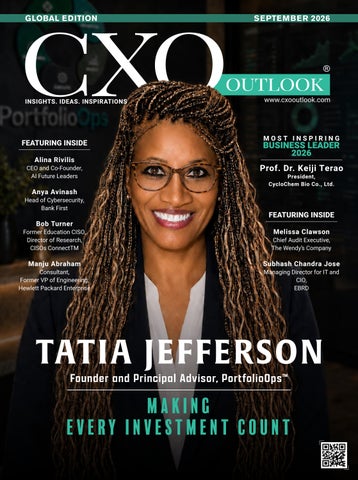
Founder and Principal Advisor, PortfolioOps™
MAKING E V E RY I N V E ST M E N T C O U N T CXO OUTLOOK September 2026
1
2
CXO OUTLOOK September 2026
3
CXO OUTLOOK September 2026
September 2026
Vol - 8
Issue - 9
Managing Editor Sarath Shyam Creative Consultants Charlie Jameson Louis Bernard
Branding & Marketing Partnerships Jennifer Anderson Anna Elza Monica Davis Stephen Donnell Jessica Edword Susan Miller
Consultant Editors Dr. John Andrews Naomi Wilson Emma James Stanly Lui Andrew Scott Steve Hope Sabrina Samson Keith Alexander Editorial Enquiry admin@cxooutlook.com
Partnerships Enquiry admin@cxooutlook.com
4 For Free Subscription
International Partnerships Free Subscription www.cxooutlook.com
Americas Europe Middle East & Africa Asia-Pacific
admin@cxooutlook.com
Follow Us On
www.linkedin.com/company/ cxooutlook www.facebook.com/ CXOOutlook
CXO Outlook www.cxooutlook.com is a global knowledge sharing digital platform published by Connecta Innovation Private Limited. All rights reserved. The opinions expressed in the content and pictures provided are those of the authors. They do not purport to reflect the opinions or views of Connecta Innovation Private Limited or any of its members and we do not assume any responsibility. The publisher does not assume any responsibility for the advertisements, its content, pictures, and all representation of warranties made in such advertisements are those of the advertisers and not of the publisher. CXO Outlook www.cxooutlook.com is a Free Subscription and Free-to-read digital platform strictly not for sale and has to be strictly for internal private use only. Publisher does not assume any responsibility arising out of anyone modifying content and pictures, printingCXO a copy of this digital platform in any format and in any country and all matters related to that. OUTLOOK September 2026
LETTER FROM THE EDITOR
The Courage to Stop
L
eadership is often associated with starting things: launching new initiatives, entering new markets, adopting new technologies, and pursuing ambitious transformation goals. Yet some of the most consequential decisions a leader makes involve stopping something already underway. It is an uncomfortable decision. A project may have consumed months of work, significant investment, and the energy of talented people. Teams may be meeting milestones and delivering what was promised. Walking away can feel like admitting failure. But continuing an initiative simply because an organization has already invested in it can tie up resources that could create greater value elsewhere. This challenge is becoming harder as organizations manage increasingly complex portfolios of projects and transformation programs. PMI’s 2026 Pulse of the Profession research identifies project complexity as a defining challenge, while McKinsey research has found that fewer than one-third of surveyed organizations reported transformations that both improved
performance and sustained those improvements over time. The real test, therefore, is not simply whether an initiative is progressing. Leaders must also determine whether it still deserves the organization’s money, people, attention, and leadership capacity. Tatia Jefferson has spent more than 25 years navigating these decisions across projects, programs, portfolios, technology initiatives, and strategic efforts. As Founder and Principal Advisor of PortfolioOps™, Jefferson has seen how individual projects can perform well while the larger portfolio moves away
from strategic priorities. Her work highlights the decisions that happen before execution and the importance of understanding what the portfolio is actually telling leaders. Her perspective opens a broader conversation about leadership discipline. What should organizations stop funding? When should an initiative be redesigned rather than abandoned? How can leaders distinguish a temporary setback from fundamental misalignment? And how can organizations create a culture where stopping the wrong work is seen as responsible leadership rather than failure? In this issue of CXO Outlook, we explore these questions alongside thought-provoking articles, interviews, and perspectives from leaders shaping business, technology, education, and organizational change. The future will demand that leaders know what to start. Increasingly, it will also demand that they know what to stop. Sometimes, the boldest step forward begins with having the courage to let something go. Enjoy Reading.
Sarath Shyam CXO OUTLOOK September 2026
5
CONTENTS
10 COVER STORY
6
CXO OUTLOOK September 2026
22 Prof. Dr. Keiji Terao President, CycloChem Bio Co., Ltd.
Using Chemistry to Unlock More from Food
7
IN MY VIEW
30
Leading Audit Excellence in QSR Melissa Clawson, Chief Audit Executive, The Wendy’s Company
CXO OUTLOOK September 2026
CONTENTS
EXPERT OPINION
AI Is Changing Cybersecurity Faster Than We’re Training for It Bob Turner, Former Education CISO and Director of Research, CISOs ConnectTM
8
50
60 Strategy Without Certainty: Building Technology in a World That Refuses to Stand Still Subhash Chandra Jose, Managing Director for IT and CIO, EBRD
CXO OUTLOOK September 2026
LEADER'S INSIGHTS
36
Leading the Charge in AI Education Alina Rivilis, CEO and Co-founder, AI Future Leaders
A Conversation on AI Adoption, Leadership, and What the Next Five Years Actually Require Manju Abraham, Consultant, Former VP of Engineering, Hewlett Packard Enterprise
9
44
54
Transforming Cybersecurity for a Digital World Anya Avinash, Head of Cybersecurity, Bank First
CXO OUTLOOK September 2026
10
CXO OUTLOOK September 2026
ER V O C
Y R O ST
TATIA JEFFERSON Founder and Principal Advisor, PortfolioOps™
MAKING E V E RY I N V E ST M E N T COUNT
CXO OUTLOOK September 2026
11
O
12
n a typical executive dashboard, a portfolio can look reassuringly healthy. Projects are marked green. Budgets are under control. Deadlines are being met. Teams are busy and progress reports keep arriving. And yet, somewhere beneath those reassuring signals, a more important question may be going unanswered: Is the organization actually getting closer to where it wants to go? Tatia Jefferson has spent more than two decades looking at that question from the other side of the dashboard. As Founder and Principal Advisor of PortfolioOps™, Tatia helps organizations connect strategy, investment decisions, execution, and measurable business outcomes. She brings more than 25 years of experience across project, program, portfolio, technology, and strategic leadership. Her career includes leading portfolios worth more than $200 million and involving over 50 concurrent initiatives across financial services, healthcare, and technology. That experience has given Tatia a clear view of a common problem. A project can meet its deadlines, stay within budget, and deliver everything promised, while the overall portfolio still fails to advance the organization’s strategy.
For her, the issue often begins with the choices made before execution starts. Through PortfolioOps™, Tatia advises leaders on portfolio visibility, governance, prioritization, executive decision-making, and strategic alignment. Jefferson created the PortfolioOps™ Operating Model along with concepts such as Executive Portfolio Visibility™ and Executive Decision Intelligence™, helping leaders look beyond individual project performance and understand what their portfolio is actually telling them. “Organizations achieve stronger outcomes not by executing more work, but by making better choices about the work that matters,” Tatia says. That belief sits at the center of her approach. It asks executives to look closely at where they are investing, how resources are being used, which priorities compete for the same capacity, and whether an initiative still deserves attention. Tatia holds PMP, SAFe Lean Portfolio Management, Certified ScrumMaster, and Lean Six Sigma Green Belt credentials. She is also a speaker and thought-leadership contributor on portfolio leadership, executive decisionmaking, and the connection between strategy and execution.
Through PortfolioOps™, Tatia advises leaders on portfolio visibility, governance, prioritization, executive decision-making, and strategic alignment
CXO OUTLOOK September 2026
Her work comes back to one fundamental question: Are organizations simply managing the work they have chosen, or are they making better choices about what work deserves to be done? For Tatia, that distinction is where effective portfolio leadership begins. From the Help Desk to the Bigger Picture Tatia’s career began on the help desk, not in the executive suite. From there, she moved through testing, business analysis, project and program management, and eventually leadership. Each role gave her a different view of how organizations turn an idea or a client need into something useful. Early on, the questions were practical. What went wrong? Why did the software fail? What did the client actually need? Did the final product deliver what had been requested? As Tatia moved into project and program leadership, those questions became broader. She became less interested in simply completing work and
more interested in whether organizations were planning and organizing that work to produce the right outcomes. That shift exposed a recurring problem. The people delivering the work and the executives making decisions about it were not always looking at the same picture. Leaders needed reliable information to understand whether investments and priorities were advancing strategic goals, yet organizations often struggled to make that connection. Strategy, execution, investment decisions, and expected outcomes were frequently handled through separate processes. Tatia saw organizations patching the gaps instead of addressing the underlying problem. The questions stayed with her. How do executives get the right information at the right time? How do organizations connect the work they believe they, or their clients, need with the strategic goals they have committed to? And how do they know when that connection has broken down?
CXO OUTLOOK September 2026
13
14
Those questions eventually led to PortfolioOps™. Tatia established the firm to help organizations connect strategy, executive decisionmaking, execution, and measurable business outcomes as parts of the same operating system. Her approach also draws on years spent working across people, delivery, technology, and executive decision-making. One lesson stands out: more information does not necessarily make complexity easier to manage. Leaders need clarity and context, but they also need an environment where people can speak openly about what is actually happening. That starts with better questions. When Tatia works with leaders, she looks at what they are trying to accomplish, which decisions are proving difficult, what leadership can see clearly, where the blind spots are, which priorities are competing, and what has changed since the original commitments were made. She also puts trade-offs on the table. Organizations have finite investment, capacity, time, and attention. Saying yes to a new priority can mean saying no to something else, whether that choice is acknowledged or not. “Good portfolio leadership makes those consequences visible so executives can make deliberate choices rather than allowing the portfolio to change through a series of unspoken compromises,” Tatia explains. That requires trust. Teams must be able to surface risks without treating them as failures, and leaders must be willing to challenge assumptions when the facts change. For Tatia, transparency is not a reporting exercise. It is part of how better decisions get made. Her role, she says, is not to make every decision for an executive team. It is to create the visibility, context, and decision environment that allows leaders to make those choices with greater clarity and confidence.
CXO OUTLOOK September 2026
Tatia established PortfolioOps™ to help organizations connect strategy, executive decisionmaking, execution, and measurable business outcomes as parts of the same operating system
That philosophy leads directly to the problem PortfolioOps™ was built to address: the difference between managing individual projects well and understanding whether the portfolio as a whole is moving the organization in the right direction. Seeing the Portfolio as a Whole A portfolio is more than a list of projects; it reveals an organization’s collective decisions about investments, resources, priorities, and risks. That distinction matters because an individual project can perform exceptionally well while the broader portfolio struggles. A project may be on schedule, within budget, and meeting every delivery commitment, yet still contribute little to the organization’s most important goals. At the project level, the questions are familiar. Are we on schedule? Are we within budget? Are we delivering what we promised? At the portfolio level, the questions change. Are we investing in the right work? Are the highest priorities getting the resources they need? Are dependencies creating risks elsewhere? Is the portfolio producing the business outcomes the organization expected? Tatia describes the difference through a simple example. Project A is green and performing well. Project B is doing the same. But both depend on the same critical resource. Meanwhile, Project C, a strategically important initiative, is delayed because that capacity has already been consumed. Nothing may be wrong with Projects A or B when viewed on their own. The problem becomes visible only when the three are viewed together. The same principle applies to investment. An organization can have numerous projects that are individually justified and successfully delivered. That does not mean the combination of those investments represents the best use of its resources or advances its most important strategic objectives.
CXO OUTLOOK September 2026
15
16
“Project success matters tremendously, but it is one part of a larger picture. Portfolio success is the story the entire body of work tells when viewed together,” Tatia says. Her experience showed her that the problem was rarely a lack of strategy, capable people, project management disciplines, or technology. Many organizations already had all of them. The gap was in how those pieces connected at the portfolio level. Executives could have clearly defined strategic goals and teams that delivered projects successfully, yet still struggle to answer basic questions. Are we investing in the right work? Do our priorities reflect our strategy? Do we have the capacity to deliver everything we have committed to? When a new priority arrives, what has to change elsewhere to make room for it? And are the investments producing the outcomes they were meant to produce? Organizations often try to answer these questions through separate reports, governance meetings, prioritization exercises, or technology tools. Each could improve one part of the picture without connecting the whole. A dashboard might improve visibility without improving decisions. A prioritization exercise might rank initiatives without addressing available capacity. A governance process might review project status without telling executives whether the portfolio remained aligned with strategy and expected outcomes. For Tatia, that was the real gap. The challenge was not simply executing projects successfully. It was helping executives see the portfolio as an interconnected set of strategic choices, investments, resources, risks, dependencies, and expected outcomes.
CXO OUTLOOK September 2026
That became central to the vision for PortfolioOps™. Tatia wanted an approach that connected those elements rather than leaving them in separate conversations. The goal was to give leaders a clearer line of sight into the portfolio and help them make better decisions as priorities, conditions, and business needs change. The Missing Connection A portfolio brings strategy, investment, resources, execution, and expected outcomes into the same picture. The problem is that organizations often manage those elements through separate processes and conversations. That makes it difficult for executives to see how a decision in one area affects everything else. PortfolioOps™ was built to close that gap.
PortfolioOps™ helps leaders understand whether the portfolio they are funding and executing reflects the strategy they intend to pursue
The firm helps leaders understand whether the portfolio they are funding and executing reflects the strategy they intend to pursue. It also brings priorities, resources, risks, and expected outcomes into the same conversation. For Tatia, the goal is straightforward. She says, “Our work focuses on creating that executive line of sight.” That means giving leaders a clearer view of how their decisions affect the portfolio before those decisions become commitments. Consider what happens when a new strategic priority emerges. It may be tempting to treat it as another initiative and add it to an already busy portfolio. PortfolioOps™ asks leaders to look at the decision differently. What investment will it require? What capacity is available? Which existing commitments could be affected? What risks will change? And perhaps the most
important question: “What changed to make room?” That perspective gives executives more context before they commit to the next piece of work. It also makes trade-offs harder to ignore. PortfolioOps™ does not seek to replace project management, PMOs, strategy, financial, or technology functions. Instead, it connects the information and decisions across those areas so leaders can manage the portfolio as a whole. Tatia states, “The answer is not necessarily another tool, another reporting layer, or another methodology.” Often, the opportunity lies in connecting the capabilities an organization already has. The distinction matters. Project management focuses on delivering individual initiatives successfully. PMOs provide disciplines around execution, governance, standards, and reporting. Strategy functions help define where the organization wants to go. PortfolioOps™ works across those capabilities, connecting strategic intent to investment and prioritization decisions, then helping leaders see whether those decisions are producing the expected outcomes. That portfolio-level view changes the questions executives ask. Are priorities still aligned? Are investments and resources supporting them? Are risks and dependencies visible across the portfolio? Do the expected outcomes remain achievable? It also changes how organizations respond when circumstances shift. A new priority can affect existing commitments. A resource constraint can delay a strategically important initiative. A change in business conditions can make an earlier investment decision less relevant. Seeing those connections allows leaders to respond deliberately instead of
CXO OUTLOOK September 2026
17
Tatia’s aim is to give executives enough transparency and context to understand what is actually happening, then act on it before a portfolio problem becomes a business problem
18 allowing the portfolio to change one project at a time. For Tatia, that is the real value of portfolio visibility. “Ultimately, we want leadership to have a clearer line of sight from strategy to outcomes, and enough visibility across that journey to recognize when the portfolio is no longer telling the story they intended,” she explains. That is the perspective PortfolioOps™ brings to the executive table. It moves the conversation above individual initiatives and gives leaders a clearer view of the collective choices, investments, resources, risks, and outcomes that define the portfolio. And once leaders can see that picture clearly, the next challenge is deciding what to do with it.
CXO OUTLOOK September 2026
What Executives Need to See A dashboard can tell an executive that an initiative is delayed. It cannot, by itself, explain what that delay means for everything around it. That distinction sits at the center of Tatia’s approach to Executive Portfolio Visibility™ and Executive Decision Intelligence™. “Executive Portfolio Visibility™ is about giving leaders a meaningful view of the portfolio, not simply more data,” Tatia says. Leaders need to know what is being funded and delivered, where capacity is constrained, where risks are building, which dependencies could affect outcomes, and whether the portfolio still reflects strategic priorities. Visibility, however, is only the starting point. Executive Decision Intelligence™ takes the next
step by helping leaders understand what the information means for the decisions in front of them. A delayed initiative may appear as a single status update. Its real significance may lie in the effect it has on another strategic initiative, a resource commitment, a financial benefit, or an expected business outcome. “The goal is not to overwhelm executives with more dashboards or metrics, but to surface the information that helps them make informed choices about priorities, resources, risk, investments, and trade-offs,” Tatia explains. Information could become more optimistic as it moved through the organization. A problem that felt significant to a delivery team might appear manageable one level higher and eventually become a yellow, or even green, indicator by the time it reached senior leadership. The dashboard reported a status but did not always tell the whole story. That experience reinforced another lesson for Tatia: visibility depends on transparency. Teams must be able to raise concerns, risks, constraints, and uncomfortable realities without feeling that they are admitting failure. Leaders, in turn, must be willing to hear difficult information and use it to make better decisions. When executives look across the portfolio, patterns also become easier to spot. One yellow project may not demand attention. The same issue appearing across several initiatives could point to a capacity constraint, a dependency, a governance problem, or a broader risk. “What that experience taught me is that executive visibility is only as valuable as the truth it allows leaders to see,” Tatia says. For PortfolioOps™, that truth matters more than another status report. The aim is to give executives enough transparency and context
to understand what is actually happening, then act on it before a portfolio problem becomes a business problem. The Next Chapter of Portfolio Leadership The next phase of PortfolioOps™ is not about adding services for the sake of adding services. Tatia wants to make portfolio leadership available in ways that match what organizations actually need. Some leaders may need advice on a specific portfolio challenge. Others may need a structured assessment of their current capabilities and a clear improvement plan. During major transformation, organizational change, or executive transitions, an organization may need experienced portfolio leadership to maintain visibility, prioritization, decision cadence, and continuity. “I am building PortfolioOps™ to support those different needs without losing the executive perspective at the center of the firm,” Tatia says. That includes expanding executive advisory services and developing digital advisory experiences such as the Portfolio Health Check™ and Portfolio Improvement Plan™. PortfolioOps™ is also growing Fractional Portfolio Leadership™ for organizations that need experienced portfolio leadership during periods of transformation or change. But Tatia sees the firm’s future as more than advisory work. She is particularly interested in creating spaces where executives can speak openly with peers about the decisions and challenges they face. “I am very relationshiporiented. I believe some of the most valuable insights emerge when executives have the space to talk candidly with peers about the challenges they are navigating, the decisions they are
CXO OUTLOOK September 2026
19
20
The next phase of PortfolioOps™ is not about adding services for the sake of adding services. Tatia wants to make portfolio leadership available in ways that match what organizations actually need
CXO OUTLOOK September 2026
making, and what they are learning along the way,” she says. That desire to listen and connect reflects how she approaches leadership more broadly. PortfolioOps™, in her view, should not simply tell leaders what it thinks. It should create opportunities to listen, learn, connect people, and strengthen the conversation around portfolio leadership. The need for that conversation is growing. Organizations face shifting priorities, finite resources, and increasing pressure to demonstrate measurable returns from strategic investments. For Tatia, those conditions make portfolio leadership a discipline that deserves greater attention. Her long-term goal is to change how leaders view the portfolio itself. “A portfolio should not be viewed simply as a collection of projects to be delivered. It is a representation of an organization’s strategic choices, where it is investing, what it is prioritizing, how it is deploying finite resources, and what outcomes it expects those choices to produce.” That perspective also changes what happens when strategy changes. A new priority should not simply be added to the list. Leaders should understand what must move, stop, change, or be accepted as a consequence. Every investment should have a clear outcome attached to it. For Tatia, that is what From Strategy to Outcomes™ represents. She says, “It is not about executing more work. It is about making better choices about the work that matters, and maintaining the visibility to know whether those choices are producing the outcomes leadership intended.” It is a fitting idea for the company she has built. PortfolioOps™ begins where individual projects end, asking a larger question about the choices behind the work and whether those choices still make sense as the business moves forward.
Want to Sell or find Investors for your Business? 21
DigitalCXO FirstOUTLOOK Magazine September August 2026 2021
MOST INSPIRING
BUSINESS LEADER 2026
Prof. Dr. Keiji Terao PRESIDENT, CYCLOCHEM BIO CO., LTD.
USING CHEMISTRY TO UNLOCK MORE FROM FOOD 22
A
chance encounter in a German laboratory introduced Prof. Dr. Keiji Terao to a little-known molecule. Decades later, that encounter has grown into a career dedicated to discovering how the molecule can improve nutrition, health, and even give new value to food that would otherwise be discarded. Dr. Terao was trained as an organic chemist. After completing his PhD in 1986, he joined Wacker Chemie in Germany. It was there, between 1986 and 1987, that he met Dr. Gerhard Schmid, a biologist working on the development and production of cyclodextrins. The meeting changed the course of his professional life.
CXO OUTLOOK September 2026
At the time, cyclodextrins were a specialized area of chemistry. Dr. Terao quickly saw their wider possibilities. These cyclic molecules are formed from glucose units linked into a ring. Depending on whether the ring contains six, seven, or eight glucose units, they are known as α, β, or γ-cyclodextrin. While β-cyclodextrin was already being produced industrially in Japan, producing α- and γ-cyclodextrin at an economical scale remained difficult. Dr. Schmid’s work helped change that. He developed economically viable production technology for all three forms and, in 2000, established a large-scale production plant in the United States. For Dr. Terao, the development
23
PROF. DR. KEIJI TERAO, PRESIDENT,
CYCLOCHEM BIO CO., LTD.
CXO OUTLOOK September 2026
24
opened a different question: if these molecules could now be produced at scale, what could they actually do? That question became the foundation for CycloChem Bio. After leaving Wacker Chemie, Dr. Terao established the company to explore cyclodextrin applications from the perspective of an organic chemist. The choice of market was deliberate. With Japan already having a strong connection between cyclodextrins and food, he focused on beauty and health foods while exploring not only β-cyclodextrin, but also the less widely used α and γ forms. Research into inclusion complexes led to applications involving coenzyme Q10 and R-αlipoic acid. By encapsulating these compounds within cyclodextrin, the company could address problems that often limit functional ingredients, including poor water solubility, instability, and absorption. Today, Cyclochem Bo is at the top globally in research on cyclodextrin applications in the nutraceutical field. For Dr. Terao, however, the molecule itself soon became just as interesting as what it could do for other ingredients. Three Generations One Continuing Question For more than 25 years, Dr. Terao and his team have kept returning to the same molecule. What has changed is the question they ask of it. CycloChem Bio’s research has unfolded across three generations. The first used cyclodextrins to make existing functional ingredients work better. The second explored cyclodextrin itself as a functional dietary fiber. The third is taking the technology into food and agriculture, using it to preserve valuable compounds in resources that might otherwise be lost.
CXO OUTLOOK September 2026
In the first generation, CycloChem Bio focused on inclusion technology. Cyclodextrins have ring-shaped structures with nano-sized cavities that can accommodate other molecules. The team learned to use these cavities to protect nutraceutical ingredients from degradation and improve their performance. Functional ingredients can be promising on paper but difficult to use in a finished product. Some have poor water solubility. Others are unstable when exposed to heat or light, or present challenges with absorption, taste, smell, or moisture. “We look at functional ingredients that are beginning to attract attention. We examine their characteristics and ask whether cyclodextrin can solve the problems that limit their use,” Dr. Terao explains. R-α-lipoic acid became a clear example. CycloChem Bio used γ-cyclodextrin to encapsulate the naturally occurring R-form, helping stabilize it and improve its
bioavailability. The resulting inclusion complex has developed into a growing business in Japan, with Dr. Terao seeking opportunities to expand it internationally. Coenzyme Q10 offered another application. Its poor water solubility can limit absorption. Combining it with γ-cyclodextrin helped improve dispersion and absorption while protecting the ingredient from degradation. Similar thinking was applied to tocotrienol. The first generation established a simple principle: find an ingredient with value, identify what prevents it from performing effectively, and use cyclodextrin to overcome that obstacle. Then the question changed. Cyclodextrin did not always have to be the supporting player. It could be the active ingredient itself. That realization marked the second generation. CycloChem Bio began studying α-cyclodextrin as a dietary fiber in its own right. Its molecular structure allows it
to pass through the small intestine and reach the large intestine, where it can be utilized by specific gut bacteria. “We had been using cyclodextrin to help other ingredients. Then we began to ask what cyclodextrin itself could do,” Dr. Terao says. The research expanded into the relationship between α-cyclodextrin, gut bacteria, and butyrate, as well as its potential effects on blood glucose and small dense LDL cholesterol. Cyclodextrin was no longer simply a delivery mechanism. It had become a subject of nutritional research. That shift opened new applications. Radish sprout α-oligo powder, for example, uses α-cyclodextrin to stabilize MTBI, a compound found in radish that has attracted interest for its potential anti-obesity properties. The company has also developed Manuka honey α-oligo powder for pet oral-care products and explored kiwi fruit α-oligo powder containing actinidin for nutrition and gut-health applications. The third generation broadens the question again: what if cyclodextrin could preserve not only individual ingredients, but the value contained in natural materials that are difficult to store or would otherwise be discarded? That is the thinking behind Fresh Oligo Powder Technology. The approach uses α-cyclodextrin’s encapsulation and stabilization properties to protect functional components while converting natural materials into powder. Out-of-specification fruits and vegetables, discarded peels, juice pulp, surplus milk, and other underused resources can contain valuable compounds. CycloChem Bio is exploring how to preserve those compounds and turn them into materials for nutrition, beauty, and functionalfood applications. “Our goal is to preserve the
CXO OUTLOOK September 2026
25
function, not simply to make a powder,” Dr. Terao says. The approach is already being explored with radish, watermelon, olives, and other agricultural resources. Some materials can then be developed for functional-food and beauty applications and exported to markets including Asian countries, EU and US. “I truly believe that this ‘circular’ business is the way functional food manufacturers should move forward. I want cycloencapsulation technology to deliver amazing materials from around the world in their ‘fresh’ state for people’s health,” Dr. Terao says. For Dr. Terao, the significance is larger than one product. An agricultural product that has little value in its original form may still contain useful functional compounds. The challenge is to preserve that value and find an economically viable way to use it.
The research team behind the applications of CycloChem Bio includes PhDs from medicine, engineering, science, agriculture, and pharmacy
26 From Molecular Problems to New Possibilities At CycloChem Bio, research begins with a problem that already exists. A functional ingredient may have an interesting biological property but be difficult to absorb, unstable, poorly soluble, bitter, or sensitive to moisture. Dr. Terao treats those limitations as questions for chemistry. That thinking is visible in the company’s work in South Korea. α-cyclodextrin has gained attention in the country’s beauty and diet market for slimming applications, creating annual demand of several hundred tons. Dr. Terao believes its slimming effect has limitations, particularly outside the obese population. The company is exploring radish fresh powder as another route. According to Dr. Terao, the material has shown potential for
CXO OUTLOOK September 2026
people with slightly higher BMI as well as those with obesity, helping it gain attention not only in South Korea’s but also world-wide beautyconscious market. The research team behind these applications includes PhDs from medicine, engineering, science, agriculture, and pharmacy. A weekly journal club brings together research on cyclodextrins from different perspectives. Their advantage is not that they know more medicine than healthcare professionals. It is that they understand how cyclodextrins can be applied across disciplines and how molecular properties can be connected to practical problems. That cross-disciplinary approach has produced applications with very different
27 starting points. Manuka honey, for instance, is associated with oral care because of its methylglyoxal, or MGO, content. CycloChem Bio combined it with α-cyclodextrin and developed a powder for pet oral-care food, giving owners an option for supporting oral care when daily tooth brushing is difficult. The company has also explored nutrition for people consuming high-protein diets. Kiwi fruit contains actinidin, a protein-digesting enzyme. Stabilized with α-cyclodextrin, kiwi fruit α-oligo powder can be incorporated into protein supplements with the aim of supporting protein digestion while making use of α-cyclodextrin’s role in the large intestine. These examples reveal the logic behind the company’s work. It is not simply developing
cyclodextrin products and looking for markets afterward. It starts with a practical problem, studies the underlying chemistry, and looks for an application where the technology can create genuine value. Taking the Molecule Further The work also extends into academic research. As a visiting professor at Kobe Women’s University, Dr. Terao participated in joint research with female students examining the effects of γ-cyclodextrin on fatigue and body fat. The distinction between the three cyclodextrins matters here. α, β, and γ forms contain different numbers of glucose units and are handled differently by the body. Dr. Terao
CXO OUTLOOK September 2026
explains that γ-cyclodextrin is the only one of the three broken down by alpha-amylase, the enzyme responsible for digesting starch. Because of its cyclic structure, γ-cyclodextrin is broken down relatively slowly. Dr. Terao describes it as a new type of slow-digesting dextrin that can supply glucose gradually. The university research explored whether that characteristic could contribute to reduced fatigue and body-fat levels. His ambition now is to take Fresh Oligo Powder technology beyond Japan. One of the most ambitious projects is in Mongolia, where Dr. Terao is also a visiting professor at the National University of Mongolia. With the university’s cooperation, he established CycloChem Mongolia and began
28
CXO OUTLOOK September 2026
exploring fresh oligo powder from Mongolian camel milk. Camel milk has attracted attention for reported health properties, including potential effects related to blood glucose, but it has a shorter shelf life than cow’s milk. The project aims to use α-cyclodextrin to turn camel milk into a more stable powder while also incorporating α-cyclodextrin as a dietary fiber. The plan extends to other Mongolian resources, including seabuckthorn for beauty applications and flaxseed oil in research around small dense LDL cholesterol. “We hope to launch this as a new industry in Mongolia and share it with the world,” Dr. Terao says. For him, the project illustrates what can happen when a technology is adapted to local resources rather than simply exported
A team with different expertise can reveal possibilities that one discipline might miss. That is why Dr. Terao wants scientific findings to travel beyond specialist circles
as a finished product. That approach reflects the broader value he sees in his training as an organic chemist. His career has crossed chemistry, nutrition, medicine, agriculture, and business, and he sees that breadth as an advantage. “One thing I can point to is that I majored in organic chemistry. It allowed me to broaden my knowledge across various fields rather than being limited to one profession,” he says. Dr. Terao also credits the people who shaped the journey. “Meeting Dr. Gerhard Schmid, a biologist, 40 years ago, and later meeting the talented colleagues at the research institute who worked hard with me after founding CycloChem Bio, I believe, has led to the results of my current applied research,” he says. For Dr. Terao, scientific progress is rarely solitary. A chance meeting can open a field of research. A collaboration can turn an idea into an application. A team with different expertise can reveal possibilities that one discipline
might miss. That is also why he wants scientific findings to travel beyond specialist circles. “I’m not just trying to sell my company’s products. As a scientist, I want to make evidence-based truths common sense,” Dr. Terao says. He points to small dense LDL, statin users need CoQ10 supplementation, and the distinction between prebiotics and probiotics as examples of ideas he believes deserve wider public understanding. His larger concern is the gap that can emerge between research findings and everyday understanding. That conviction brings the story back to the question that started it all. What can this molecule actually do? After four decades, Dr. Terao is still asking. The answers have taken him from organic chemistry to functional foods, from Japanese agriculture to Mongolian resources, and from molecular research to products designed for everyday use. The molecule has remained the same. The questions have not.
CXO OUTLOOK September 2026
29
IN MY VIEW
Leading Audit Excellence in QSR Melissa Clawson, Chief Audit Executive, The Wendy’s Company
30
Hi Melissa. As the fast-food industry continues to evolve, what trends are you most excited about, and why? The quick service industry is always about being quick or fast. We have to evolve to make our customer experience enjoyable, but also as frictionless as possible. How do we do that in today’s environment? We leverage technology and then go back to the basics of treating everyone with respect and being a bright spot
in someone’s day. For example, using mobile apps to order so crew can focus on friendliness and accuracy. With all of those digital orders, we now have better insights into customers’ preferences, habits, etc. and can leverage that to help tailor innovation with new products or marketing campaigns. This has truly been a game changer and will continue to shape the industry and how we evolve to meet customers where they are.
Melissa Clawson has been the Chief Audit Executive at The Wendy’s Company for over eight years. Prior, she was at EY for 11 years in Risk Advisory services assisting various clients with internal audit projects. During her tenure, she completed two global rotations: Internal Audit building out new methodology, training materials and thought leadership; and Global Advisory Training where she worked with subject matter experts in internal audit, cybersecurity, IT, enterprise risk and the instructional designers to build training. She graduated from The Ohio State University with her MAcc and Marietta College with a Public Accounting major and Leadership Studies minor. Recently, in an exclusive interview with CXO Outlook Magazine, Melissa shared insights into the future of the fast-food industry, emphasizing the importance of leveraging technology to enhance customer experience while treating people with respect and empathy. She highlighted the role of emotional intelligence in leadership, particularly in an AI-driven world, and stressed the need for leaders to ease fears and promote understanding of AI’s impact on jobs. Melissa also discussed the importance of adaptability and agility in a rapidly changing environment, citing continuous learning as key to staying ahead. The following excerpts are taken from the interview.
CXO OUTLOOK September 2026
31
If we are open and honest with each other and how we are feeling, we can address and work together to resolve. If we don’t communicate as humans, then society will crumble
CXO OUTLOOK September 2026
How do you see technology shaping the future of QSR, and what opportunities does it present? I think leveraging technology in exciting ways to streamline processes to put the emphasis back on customer experience. If I think about how technology plays a role in delivery orders by having a scale that can call out if the weight is off – indicating that you might be missing an item – that helps to ensure our customers get better service and exactly what they order. Additionally, leveraging AI to take orders in the drive through can remove language barriers and improve order accuracy. At the heart of what we do is to strive to give our customers the best possible experience so that they come back again.
32
What role do you think emotional intelligence and empathy play in leadership, particularly in an AI-driven world? Right now the buzz word is AI and I think some are fearing for their futures. What if AI takes my job? How do I stay employable when AI can do so much? Their fears are valid, and we as leaders need to ease those fears and help them understand their role in partnering with AI, not being fully replaced. Having EQ and empathy is always important, and I think in the disrupted world around us, it is even more so. We have to treat people with respect, understand that each of us have things going on in our lives that impact how we work with each other, and end of the day, remember positive intent for 99% of situations. If we are open and honest with each other and how we are feeling, we can address and work together to resolve. If we don’t communicate as humans, then society will crumble.
CXO OUTLOOK September 2026
As leaders, it is easy to lead teams to help move oneself or function or department forward. Doing what is right for your people, even if it puts you at an imposition, is the mark of a true leader
How do you stay adaptable and agile in a rapidly changing environment? I try to continuously learn all the time. The world is changing so quickly, it is hard to keep up. But if I do not read articles or attend trainings to keep abreast of what is happening, I will be left in the dust. By broadening my knowledge base, I can more easily adapt or be agile as changes come along, because I am at least somewhat familiar. We always fight against change when we do not understand the why or purpose, so by learning more about a topic, I can better understand the why and then be a part of that change as the business might need to pivot. If you could have dinner with any historical figure, who would it be and why? I remember getting this similar question during my interview process 8 years ago and panicking as I was not sure – so many good people to choose from! Ultimately, I think I will stick with my answer back then: Henry Ford. He revolutionized how manufacturing works with the assembly line and simplifying offerings for customers to be more efficient (you can have a Model T in any color you want as long as it is black). I think sometimes we get caught up in trying to be everything for everybody and I would love to know how he kept that from happening. What’s a book or podcast that’s had a significant impact on your life, and why? When I was in college, I took a leadership studies course, and we read a book about Servant Leadership by John Maxwell. I was particularly struck by his one quote: “The bottom line in
CXO OUTLOOK September 2026
33
34
Leveraging AI to take orders in the drive through can remove language barriers and improve order accuracy
leadership isn’t how far we advance ourselves, but how far we advance others.” As leaders, it is easy to lead teams to help move oneself or function or department forward. Doing what is right for your people, even if it puts you at an imposition, is the mark of a true leader. What advice would you give to leaders struggling to implement change within their organizations? There is a metaphor I have heard that roughly goes like this: to make change stick, you need
CXO OUTLOOK September 2026
to get folks bought in and on your boat, rowing withexpertplus.com you; if you do not, then they work against the change and row against you. If you find yourself where everyone seems to be rowing against you, ask yourself why they are: do they understand why you are making the change? Did you allow them insight along the way before the change was made or did you just force it upon them? Sometimes taking that step back or being upfront from the beginning can make or break the success of a change that needs to occur.
35
CXO OUTLOOK September 2026
LEADER’S INSIGHTS
A Conversation on AI Adoption, Leadership, and What the Next Five Years Actually Require Manju Abraham, Consultant, Former VP of Engineering, Hewlett Packard Enterprise
36
As AI continues to transform industries, how do you see AI adoption evolving in the next five years? Anyone who claims to see the next five years of AI with precision is underestimating how quickly the landscape is moving. Models will continue to become cheaper, more multimodal, and more capable of operating as agents within software and workflows. The more important question is what organizations will actually do with that capability, and how effectively they will turn it into business value.
The real divide will not be about access to AI. It will be an organization’s ability to absorb it, reshape work around it, and do so without weakening quality, trust, cost discipline, or culture. Today, adoption is often mistaken for transformation. McKinsey’s 2025 global survey shows broad AI adoption, yet only a small share of organizations, roughly 5 to 6 percent, qualify as true high performers. It is entirely possible to have AI tools in many hands and still leave the underlying operating model largely untouched.
Over the next five years, the most meaningful difference between companies will be less about whether they have access to AI and more about whether leaders can redesign work around it
CXO OUTLOOK September 2026
Manju Abraham is a senior engineering executive, speaker, and writer with 25+ years of experience leading global teams at HPE, Delphix, NetApp, and HP. She is known for turning complexity into clarity, aligning strategy with execution, and building enterprise software and infrastructure organizations that deliver lasting business results. She has led large-scale transformation across execution, quality, and operations in fastevolving technology environments. Beginning her career as a scientist at ISRO (Indian Space Research Organization), she went on to drive innovation across compute, storage, networking, and virtualization. Today, she advises organizations on AI adoption, leadership, and the human side of change, bringing a practical executive lens to how companies adapt, lead, and grow. Recently, in an exclusive interview with CXO Outlook Magazine, Manju shared insights into the future of AI adoption, emphasizing that it’s not just about access to technology, but about organizational absorption and redesigning work around AI. She highlighted the importance of emotional intelligence in leadership, citing it as a key factor in navigating uncertainty and pressure. Manju also discussed the implications of AI on the future of work, stressing the need for leaders to be specific about the reality of change and to support workers who may be displaced. The following excerpts are taken from the interview.
CXO OUTLOOK September 2026
37
38 Over the next five years, the most meaningful difference between companies will be less about whether they have access to AI and more about whether leaders can redesign work around it. That redesign is not only a cultural challenge. It is also deeply technical and operational. Many organizations remain stuck because their data is fragmented, permissions are inconsistent, and key processes are poorly documented. In large enterprises, successful AI execution often depends on the less glamorous foundations: data quality, identity management, integration architecture, knowledge architecture, and process standardization. Leaders need to treat those elements as part of the transformation itself, because without them, AI remains difficult to scale in a responsible and repeatable way.
CXO OUTLOOK September 2026
I find it helpful to think about this in three strategic directions: AI-enabled, AI-first, and AI-native. Most established companies will operate as hybrids for some time. AI-enabled organizations use AI to improve work inside an existing operating model. AI-first organizations redesign workflows so AI becomes part of the flow of execution, supported by the managerial and governance capability to scale it. AI-native approaches are most realistic first in greenfield workflows, newly formed teams, and products built without inherited assumptions. That is one reason startups are often able to move in more AI-native ways earlier. They can design around current capabilities from the outset, while enterprises have to evolve through layers of legacy systems, controls, and operating habits. At the same time, enterprises bring
strengths of their own, including scale, domain depth, customer trust, and access to proprietary data. The challenge is not to imitate a startup. It is to modernize with discipline while continuing to run a complex institution. For most enterprises, that progress will be deliberate and staged. I recommend a practical sequence: Experiment, Evangelize, Evaluate, and Evolve. Experiment with a contained value stream where the friction is real, the economics are visible, and the risk is manageable. Build belief through discussions and sharing of your own direct experiences, from credible managers, trusted champions, and visible proof that the work is improving. Measure results through workflow and business outcomes, rather than excitement or usage alone. Then continue refining the workflow, governance, and operating model as both the technology and the organization mature. That is how companies move beyond scattered pilots and begin to create durable operating leverage from AI. What are the implications of AI adoption on the future of work, and how can organizations support workers who may be displaced? The future of work will unfold unevenly. Many people will not lose employment outright, but they will lose the familiar shape of their job as workflows are redesigned for speed, scale, and different forms of judgment. Some tasks will be automated. Some roles will rise in value. Some functions will change enough that the old titles will no longer describe the work accurately. Leaders need to speak about that with far greater precision. People can handle change more constructively when they understand what
is actually shifting, what will remain important, and where they will need to grow. Vagueness creates more anxiety than honesty does. One of the most serious risks lies in how organizations handle junior work. Many repetitive tasks have also served as the early training ground where judgment begins to form. They expose people to edge cases, verification, customer context, escalation paths, and the discipline of getting details right. If companies strip away that layer of work without redesigning how people develop, they weaken the bench they will later depend on. That is why leaders need to look closely at tasks, decisions, and workflows before they make assumptions about roles. In many cases, the better path is to automate part of the work while redesigning the role around highervalue responsibilities. The goal should be to remove unnecessary toil while preserving the experiences that help people build judgment and range. Early-career roles deserve particular attention. As repetitive work declines, younger talent will still need structured exposure to synthesis, verification, customer reality, exception handling, and decision support. Those experiences are how future technical leaders, managers, and crossfunctional operators are formed. Leaders also need to think carefully about where existing strengths can be redirected. A quality engineer, for example, may spend less time on manual execution and more time on adversarial testing, governance, failure analysis, and evaluating the behavior and safety of probabilistic systems. That kind of shift strengthens the organization because it carries forward the underlying discipline while adapting it to new forms of work.
CXO OUTLOOK September 2026
39
Reskilling efforts usually fail when they stay too general. People need clarity on which workflows are changing, which responsibilities are expanding, what adjacent roles are opening up, and what support the organization will provide to help them make that move. Internal mobility only works when it is designed into the operating model, supported by managers, and backed by real investment in learning. Whenever part of the work is automated, leadership has a responsibility to shape what comes next. If the only plan is cost reduction, the organization may save money briefly and lose capability more quietly over time. Stronger institutions take a longer view. They redesign work in a way that protects trust, develops people, and leaves the company more capable than it was before.
40
How can leaders ensure that AI adoption is aligned with their organization’s values and mission? Organizations rarely drift away from their values all at once. More often, it happens through a series of decisions that each appear reasonable in isolation. A tool is introduced to improve efficiency. A recommendation engine begins to influence decisions more than intended. A monitoring system is deployed in the name of support, but gradually starts to feel more like surveillance. By the time leadership sees the pattern clearly, the organization may already be operating in ways that no longer reflect its stated principles. That is why values have to be translated into operating choices. Leaders need to be explicit about where AI can act independently, where it can inform human judgment, and where human review must remain firmly in place. They also
CXO OUTLOOK September 2026
need clear rules for documentation, escalation, accountability, and appeal. Values only matter when they shape real decisions, especially when speed, cost, or convenience make compromise tempting. On governance, the technical foundation matters just as much as the policy language. Data quality, permissions, system integration, knowledge architecture, and process consistency all influence whether AI can be deployed responsibly and reliably at scale. When those foundations are weak, governance may look sound on paper but break down in practice. This becomes even more important in regulated and safety-critical environments, where the tolerance for error is low and the consequences are much more serious. In those settings, human oversight cannot be reduced to a symbolic checkpoint. It has to remain substantive and real. Alignment also becomes stronger when governance includes the people who understand the operational consequences firsthand. Legal, security, privacy, HR, and frontline operators all need a voice, because the risks are rarely only technical. They show up in customer trust, employee experience, compliance exposure, and the subtle ways systems begin to shape behavior over time. Leaders also have to create an environment where concerns can surface early. In any meaningful AI transformation, there will be edge cases, failure patterns, and unintended effects. If people are reluctant to raise them, the organization learns too slowly and risk accumulates quietly. If they can raise them openly, the company has a much better chance of correcting course before the damage becomes embedded.
In the end, alignment comes from discipline. It requires turning values into decisions, reinforcing them through governance and training, and giving the organization enough openness to recognize problems early and respond to them well. That is what keeps AI adoption connected to mission, rather than allowing efficiency alone to set the direction. What are the key factors that determine the success of AI adoption, and how can leaders measure progress? One of the biggest mistakes organizations make is confusing AI activity with AI value. They can count licenses, prompt volume, pilot programs, and usage levels, but those numbers do not necessarily tell them whether the business is improving. That distinction matters because measurement shapes behavior. If leaders reward activity, they will get more activity. If they want value, they need to measure whether work is
improving and whether the company is actually better off as a result. I find it useful to measure progress at three levels. The first is reliability. Is the output dependable enough for the intended use? That includes accuracy, override rates, escalation frequency, and known failure patterns. The second is workflow performance. Is the work itself getting better? That is where cycle time, throughput, rework, service levels, cost, and quality start to matter. The third is business contribution. Is the adoption creating a meaningful advantage for the company through better margins, stronger customer outcomes, faster delivery, revenue growth, or risk reduction? Leaders also need discipline about what to not overvalue. Usage can indicate exposure but it does not prove impact. Seat activation, pilot volume, and general tool adoption may show that people are experimenting, but they do not tell you whether the underlying work has improved
Over the next five years, the most meaningful difference between companies will be less about whether they have access to AI and more about whether leaders can redesign work around it
CXO OUTLOOK September 2026
41
42
or whether the economics justify continued investment. That is why capital discipline matters. Every use case should begin with a defined review window, clear success criteria, and equally clear stop criteria. If reliability remains weak, workflow performance does not materially improve, or the business case no longer holds, leaders should narrow the use case, redesign it, or stop it altogether. That kind of discipline protects credibility as much as it protects capital. When organizations decide where to begin, they should build a portfolio that includes a mix of productivity gains in contained workflows, quality and risk reduction in recurring processes, and growth or customer-facing improvements. Those areas will not move at the same speed, and they should not be forced into artificial symmetry. Each should expand only when the evidence, the economics, and the operating readiness support it. The strongest early use cases tend to have a few things in common. The economics are visible, the existing process has enough friction that improvement will matter, and the risk is contained enough for the organization to learn without creating unacceptable exposure. That combination gives leaders a realistic chance to prove value while also building confidence and operating experience. In practice, the best starting point is usually one well-chosen value stream. Instrument the baseline carefully. Assign a business owner, not only a technical owner. Involve managers early, because they are the ones who translate new ways of working into everyday practice. Define success before rollout, then review the results at the workflow and business level rather than stopping at tool usage.
CXO OUTLOOK September 2026
Many AI efforts lose momentum because they begin with enthusiasm and spread through disconnected pilots before anyone pauses to ask what has actually changed in the business. The organizations that learn faster usually start narrower, measure more rigorously, and expand only when the evidence supports it. That is what turns experimentation into real operating value. If you could have dinner with any historical figure, who would it be and why? Eleanor Roosevelt. She carried private hardship with remarkable strength, yet chose to turn
that strength outward in service of something larger than herself. She refused the narrow role her era tried to assign her and used influence, institutions, and public life to widen dignity, access, and possibility for others. I have always been drawn to that combination of resilience, moral clarity, and practical impact. What’s something on your bucket list that you’re excited to tackle soon? I recently returned from Morocco and Portugal, and the experience stayed with me. It reminded me how differently time can move when life is not constantly organized around the next quarter or the next deadline. I would love to spend more time in places where patience and progress are not seen as opposites. I am also increasingly drawn to work at the intersection of human-centered AI transformation, leadership, and the larger question of how people build purposeful lives while navigating systems that are changing at extraordinary speed. What advice would you give to emerging leaders in product operations and innovation? My advice would be to not think about AI as a fixed tool you simply purchase and deploy. It is a fast-moving system, and the real work is learning how to place it inside actual workflows, observe where it helps, understand where it falls short, and keep refining your judgment as the capability evolves. Start with a workflow where the friction is visible and the business consequence is real. Establish the baseline, redesign the work carefully, and measure whether the outcome actually improves. If it does, expand with
discipline. If it does not, stop, learn, and redirect effort rather than continuing out of enthusiasm alone. It is also important to be honest about what mastery now requires. As AI takes on more of the syntax-level work, value increasingly shifts toward intent, systems thinking, judgment, and the ability to lead teams through ambiguity and change. That is where strong leaders continue to matter enormously. I would also caution leaders not to overlook the middle of the organization. Managers play a decisive role in whether adoption succeeds. They translate strategy into practice, coach people through new ways of working, and handle the exceptions, edge cases, and judgment calls that every changing system produces. When managers are equipped well, transformation moves. When they are ignored, it usually stalls. Trust matters just as much as capability. Governance should not be treated as paperwork added after the fact. It is part of how an organization preserves judgment while moving at speed. The stronger the trust, the easier it becomes to adopt new ways of working without creating confusion or unnecessary risk. At this point, AI adoption is no longer mainly a question of whether organizations will use the technology. The deeper question is whether leaders are prepared to do the less visible work that makes it valuable: strengthening the technical and operational foundation, redesigning workflows, building managerial capability, measuring outcomes with discipline, and holding trust as the system changes. That is where durable advantage comes from. Not from speaking about AI more fluently, but from turning it into better execution, stronger economics, and more resilient institutions.
CXO OUTLOOK September 2026
43
LEADER’S INSIGHTS
Leading the Charge in AI Education Alina Rivilis, CEO and Co-founder, AI Future Leaders
44
Hi Alina. Your passion for AI is contagious - What inspired you to launch AI Future Leaders? AI Future Leaders was inspired by a clear gap I kept seeing in the market: organizations were investing heavily in AI, but struggling to translate that into real, measurable business value. I wanted to create something different, an academy that goes beyond theory and hype, and instead equips leaders, professionals, and teams with practical skills, strategic insight, and the confidence to actually apply AI in their day-today work. At its core, AI Future Leaders was
built to bridge that gap between AI potential and real-world impact, helping people not just understand AI, but use it responsibly, effectively, and with purpose to drive meaningful outcomes. As CEO of AI Future Leaders, you’re shaping the future of AI education What’s the most rewarding part of this role? The most rewarding part of leading AI Future Leaders is seeing the shift in how people think and operate after engaging with our programs, when leaders move from uncertainty to real
Organizations are no longer asking “what can AI do?”, they’re asking “where does it actually drive impact?” and embedding it directly into workflows, decisions, and operations
CXO OUTLOOK September 2026
Alina Rivilis is the CEO and co-founder of AI Future Leaders, with the goal to deliver AI education that blends technology, leadership and creativity. A seasoned AI executive, with over 25 years of experience, Rivilis brings expertise in AI, data science, strategy, and innovation. She currently serves as Director of Data Science & AI at Home Trust Company (Fairstone Bank of Canada) and part-time faculty at Northeastern University. Inspired by her role as a parent and tech leader, Alina launched AI Future Leaders to close the gap between traditional education and the demands of an AI-driven world. A finalist for the 2025 Women in AI Awards (Private Sector), she is a passionate advocate for responsible AI, youth empowerment, and inclusive innovation. Recently, in an exclusive interview with CXO Outlook Magazine, Alina shared insights into her passion for AI education and the inspiration behind launching AI Future Leaders, aiming to bridge the gap between traditional education and the demands of an AIdriven world. She highlighted the most rewarding part of her role, seeing professionals transform from uncertainty to real action, and discussed the exciting trend of AI moving from experimentation to real execution and value. Alina emphasized the importance of leadership evolving in AI, focusing on owning outcomes, and connecting AI to business strategy. She also shared her vision for AI Future Leaders, becoming a go-to partner for organizations moving from AI ambition to measurable impact. The following excerpts are taken from the interview.
CXO OUTLOOK September 2026
45
action. It’s not just about teaching AI concepts; it’s about enabling tangible outcomes, helping organizations identify high-value use cases, implement solutions responsibly, and actually creating value. I believe that one must start with AI fluence to make a change. Watching professionals go from passive observers of AI to active builders and decision-makers, and knowing that we’re influencing how AI is adopted in a more humancentered, ethical, and impactful way, makes this work deeply meaningful.
46
AI is transforming industries at an incredible pace - What’s the most exciting trend you’re seeing in AI today? The most exciting shift in AI right now is that we’re finally moving from experimentation to real execution and value. Organizations are no longer asking “what can AI do?”, they’re asking “where does it actually drive impact?” and embedding it directly into workflows, decisions, and operations. What stands out is that the differentiator is no longer the model itself, but how well companies design around it, prioritizing the right use cases, building the right operating model, and putting strong governance in place. The ones getting ahead aren’t chasing hype; they’re scaling AI in a way that is measurable, responsible, and tied to real business outcomes. Going forward, how do you see leadership evolving in AI? Going forward, leadership in AI is shifting from understanding the technology to owning outcomes. It’s no longer enough to delegate AI to technical teams, leaders need to actively shape where it creates value, how it’s governed, and how it’s embedded into everyday decisions and workflows. The strongest leaders won’t be the most technical,
CXO OUTLOOK September 2026
My advice for young people entering AI is to focus less on trying to learn everything and more on building the ability to apply what you know to real problems
but the ones who can connect AI to business strategy, ask the right questions, and build organizations that balance speed with accountability. Ultimately, AI leadership is becoming less about innovation for its own sake and more about disciplined execution, responsible scale, and measurable impact. As a parent and tech leader, you find inspiration in many places - Who’s the person you most admire and why? I really admire Yoshua Bengio, not just for his foundational contributions to AI, but for how he’s using his voice today to push for safer, more responsible systems. He’s been increasingly vocal about the risks of AI, and I respect that shift. I am very much an AI supporter, however I believe we need to make sure we are building safe and ethical AI. This means, we must also ask the hard questions about where it’s going. I’m also inspired by Fei-Fei Li, who consistently brings a human-centered lens to AI. She reminds us that behind every model, every dataset, every deployment, there are people being impacted. As both a parent and a tech leader, I find myself somewhere in between those perspectives. I believe deeply in the potential of AI, but I also feel a responsibility to question it and ensure we’re building something that truly benefits the next generation.
CXO OUTLOOK September 2026
47
AI Future Leaders is your way of giving back - What’s the most rewarding part of mentoring others? Working with individuals across different industries and seeing how individuals gain AI expertise is very rewarding. I love seeing people advance in their fields, gain valuable skills and make an impact. AI education and training is very rewarding, and AI Future Leaders can help make a positive and direct impact on leaders and decision makers, make sure we are building safe and ethical AI.
48
From music to movies, you enjoy many art forms - What’s your favorite way to unwind after a long day? I enjoy unwinding through music, playing the piano, ukulele, or guitar gives me a creative outlet and a way to reset after a busy day. I also value time outdoors, especially walking my dog, which helps me clear my mind. Most importantly, I cherish spending quality time with my children, being present and recharging through those moments together. You’ve achieved so much in your career - What’s the best book you’ve read recently and why would you recommend it? One piece I’d strongly recommend isn’t a book, but a paper: Agents of Chaos ([2602.20021] Agents of Chaos). It’s a must-read for anyone building or deploying AI agents today. What makes it stand out is how clearly it highlights the gap between what we think agents will do and how they can actually behave in complex, real-world environments. It surfaces risks around autonomy, unintended consequences, and the compounding effects of agents interacting with systems and each other.
CXO OUTLOOK September 2026
I’d recommend it because we’re moving very quickly into an agent-driven world, and this paper forces you to pause and think more critically about safety, control, and governance. If you’re serious about deploying AI responsibly, this paper is very eye opening. What’s your vision for AI Future Leaders in the next 5 years? Over the next five years, my vision for AI Future Leaders is to become the go-to partner for organizations moving from AI ambition to measurable impact. We’ll evolve beyond education into a true capability-building platform, where teams don’t just learn AI, but embed it into operations, decision-making, and value creation. I see us expanding across industries, deepening our focus on agentic AI and governance, and building a global community of leaders adopting AI responsibly. The goal is simple: turn AI into sustained competitive advantage, not just a series of experiments. You’re a strong advocate for youth empowerment - What’s your advice for young people entering the AI field? My advice for young people entering AI is to focus less on trying to learn everything and more on building the ability to apply what you know to real problems. The field is moving too fast for memorization to keep up. What matters is curiosity, creativity, adaptability, and the willingness to experiment. Learn the fundamentals, but don’t stop there, build projects, explore use cases, and understand how AI connects to real-world impact. The biggest opportunity isn’t just in knowing AI, but in knowing how to use it to create value. My advice is to always keep learning!
49
CXO OUTLOOK September 2026
EXPERT OPINION
AI Is Changing Cybersecurity Faster Than We’re Training for It Bob Turner, Former Education CISO and Director of Research, CISOs ConnectTM
50
A
I isn’t just another technology wave. It’s changing how systems behave, how attackers operate, and how risk shows up—often in ways that aren’t predictable. According to Info-Tech Research Group’s AI Trends 2026 report, IT departments are leading adoption, with 70% of organizations mainly acquiring AI tools associated with IT. Marketing & Sales, R&D, Operations, and HR/ Finance tool acquisitions are well below 50% for most. Most of the conversation around AI in security circles focuses on tools. The bigger issue is talent. Specifically, whether the next generation of practitioners can operate in environments where AI influences decisions, behavior, and risk in real-time. That same report notes that 67% of cybersecurity roles now require proficiency in AI tools and automation platforms.
CXO OUTLOOK September 2026
Are we training for that? Right now, the answer is … not consistently. “AI is amplifying both the scale and sophistication of cyber threats, requiring new approaches to risk management.” — World Economic Forum The Market Is Already Moving to AI— Education Isn’t In a recent CISOs ConnectTM survey, 80% of respondents preferred vocational or skillsbased training over traditional higher education “teaching” AI, citing the need for speed and real-world utility of streamlining AI training for implementation. That aligns with what the industry is already doing: “89% of organizations prioritize certifications, while just over half emphasize four-year degrees.” — Fortinet, 2025 Cybersecurity Skills Gap Report
Bob Turner is Head of Research at CISOs Connect™. His 40‑year career spans Navy communications, federal cybersecurity consulting, and senior security leadership in higher education and industry. He has served as CISO at the University of Wisconsin–Madison and Penn State University. Bob lives in Southeast Virginia and is deeply committed to family and community service.
51
Certifications and hands-on training have become a proxy for something degrees don’t consistently guarantee: the ability to do the job on day one
CXO OUTLOOK September 2026
That’s not a subtle signal. That’s a shift. Certifications and hands-on training have become a proxy for something degrees don’t consistently guarantee: the ability to do the job on day one. Higher education delivers foundations. Operators understand that the pace and nature of the problem have changed.
52
What CISOs Actually Need Now The biggest gap I hear from CISOs isn’t technical knowledge. It’s found in applied capability. We don’t need more people who can explain AI risks. We need people who can walk into an environment and quickly answer three questions: where AI is introducing risk, how it could be exploited, and what actually matters right now. That requires a different skill set. One that takes time and experience to build. Adversarial Thinking (Still the #1 Gap) Most programs still teach defense first. In an AI-driven environment, that’s not enough. You need people who instinctively ask how to break the model, what happens if the input is controlled, and where the system behaves in ways no one expected. “AI system impact assessment approaches can help AI actors understand potential impacts or harms within specific contexts.” — NIST AI Risk Management Framework If your team can’t think like an attacker, AI will create blind spots faster than you can close them. AI Risk Literacy — In Context Many job candidates understand hallucinations, bias, and model behavior. That’s table stakes.
CXO OUTLOOK September 2026
What’s missing is context. “…humans provide the necessary oversight, ethical decision-making, and understanding of social and cultural contexts that machines cannot replicate.” — World Economic Forum Can your team identify where AI is actually being used—including shadow AI; map that usage to sensitive data or critical processes; and decide whether a use case is acceptable? That’s the difference between awareness and capability. The Ability to Challenge AI We’re embedding AI into security workflows— analysis, triage, reporting. That’s fine. But it introduces a new failure mode: over-trust. “Digital natives are starting to not trust what they see on the internet, because so much content is now AI-generated.” — Snowflake, AI + Data Predictions (2026) CISOs don’t need someone who can prompt an LLM. They need someone who can look at the output and say, this is wrong—and here’s why. That’s becoming a core security skill. Data Security and AI Are Now the Same Problem AI has fundamentally changed how data moves—and how it leaks. “Governance is a continual and intrinsic requirement for effective AI risk management.” — NIST AI RMF We’re already seeing it when sensitive data exposed through prompts; data flows into models with unclear boundaries; and when AI tools connect to systems they shouldn’t. People trained in traditional data security often don’t see these risks yet. Attackers will.
If your team can’t think like an attacker, AI will create blind spots faster than you can close them
Risk Prioritization (Where Things Actually Break Down) This is the one that matters most—and the one most consistently missing. “An AI-driven future will vary depending on organizational maturity and priorities.” — Deloitte Tech Trends 2026 In an AI environment, there’s no shortage of issues—model vulnerabilities, data exposure, misuse scenarios. The problem is not identifying them. It’s deciding what matters. Do you have someone reviewing that landscape and determining what to fix first, what the real business impact is, and what can be accepted—for now? That’s the job. Why This Gap Exists This isn’t just an education problem. It’s a structural mismatch. Education is optimized for understanding. Enterprise security is optimized for risk reduction in increasingly unpredictable environments.
One operates in controlled environments with periodic evaluation. The other operates in messy, real-world systems with continuous exposure. “The decision to commission or deploy an AI system should be based on a contextual assessment of trustworthiness.” — NIST AI didn’t create that gap. It widened it. Where Things Are Starting to Improve There are early signs of progress. Education is beginning to incorporate AI into labs, introduce adversarial scenarios, and focus more on evaluating outputs rather than just generating them. At the same time, enterprises are building simulation environments, running AI-focused red teams, and investing more heavily in hands-on internal training. “Workforce development must evolve alongside emerging technologies, including artificial intelligence.” — NICE Framework Updates But we’re still early. The Bottom Line AI isn’t just changing tools. It’s changing what it means to be effective in cybersecurity. CISOs don’t need more theory. They need people who can think like attackers. They need to challenge AI-driven systems and work toward making decisions with incomplete information. Until we train consistently to translate technical issues into business risk, the gap will not go away. And in an environment where AI is accelerating both capability and threat, that gap isn’t just a workforce issue.
CXO OUTLOOK September 2026
53
LEADER’S INSIGHTS
Transforming Cybersecurity for a Digital World Anya Avinash, Head of Cybersecurity, Bank First
54
The cybersecurity landscape is constantly evolving; what’s the one trend you believe will have the most significant impact on the industry in the next few years? While several trends are jockeying for position, the most significant impact over the next few years will come from the shift to Agentic AI in both offense and defense. We are moving past “AI as a tool” (like a smarter search bar) into “AI as an agent” (systems that can reason, adapt, and act
autonomously). This creates a high-speed arms race that fundamentally changes the physics of cyber warfare. Historically, cybersecurity has been a game of human-speed defense vs. machine-speed offense. Now, both sides are going autonomous. AI agents can now perform multi-step reconnaissance, find vulnerabilities, and adapt their exploits in real-time without waiting for a human “operator” to click a button. Conversely, “Self-Healing” networks are emerging. AI defense agents can isolate a compromised server
Organisations need to move from old practices of Reactive Recovery to futuristic Proactive and Adaptive Continuity Planning practices
CXO OUTLOOK September 2026
55 Anya Avinash is a senior cybersecurity leader, with over 17 years’ experience in leading the Cyber/Technology functions in close collaboration with ExCo and the Board of Directors. She has worked across diverse industries such as Banking & Finance, Retail, Transportation, Telecommunications, Federal Government and Consulting, specialising in strategy, risk and compliance, operations, training and advisory. Renowned as an industry expert with regular public speaking, mentoring and coaching engagements, she has strong experience in managing multi-geographic teams with an inclusive, friendly demeanor. She has been recognized in 2025 as the Top 100 Most Influential Cybersecurity Leaders in Australia & New Zealand. Recently, in an exclusive interview with CXO Outlook Magazine, Anya shared insights into the evolving cybersecurity landscape, highlighting the significant impact of Agentic AI on the industry. She emphasized the need for organizations to balance innovation with security, adopting a “Security by Design” approach and cultivating a risk-aware culture. Anya also discussed the essential skills and qualities future cybersecurity leaders will need, including the ability to audit AI supply chains and manage machine identities. The following excerpts are taken from the interview.
CXO OUTLOOK September 2026
and rewrite firewall rules in milliseconds, faster than any human SOC analyst. With “Perfect Deepfakes,” identity is no longer a reliable perimeter. AI agents can mimic a CEO’s voice and writing style so accurately that traditional “awareness training” becomes obsolete. The industry is moving toward Zero Implicit Trust. In a world where an AI can pretend to be your boss or your best friend, security will no longer be about “who” you are, but about continuous, behavioral verification of every single action taken on a network.
56
How do you think organizations can balance innovation with security in today's fast-paced digital landscape? The tension between moving fast and staying secure is the defining challenge of modern business. To balance them, organisations have to stop viewing security as a “checkpoint” at the end of a project and start viewing it as the operating system for innovation. Adopt “Security by Design” (Shift Left): The old model of building a product and then asking the security team to “audit” it creates massive bottlenecks. Instead, security must be integrated into the earliest stages of the development lifecycle. Use automated tools that scan code for vulnerabilities as it’s being written. This allows developers to fix issues in real-time without waiting for a formal review. By using microservices and containers, you limit the “blast radius.” If one part of an innovative new feature is compromised, the rest of the system remains insulated. The “Paved Road” Approach: The best way to balance speed and safety is to make the secure way the easiest way. Provide developers
CXO OUTLOOK September 2026
In a world where an AI can pretend to be your boss or your best friend, security will no longer be about “who” you are, but about continuous, behavioral verification of every single action taken on a network
with a library of pre-approved tools, cloud configurations and APIs. If a developer uses the “Paved Road,” they get to deploy faster. If they want to build something entirely custom/outside the lines, they undergo a manual, rigorous security review. This incentivizes safe behavior through efficiency. Cultivate a “Risk-Aware” Culture: Security is a shared responsibility, not just a Technology function deliverable. Embed “Security Champions” within every product team. These are non-security staff who are trained to spot risks early. Encourage employees to report potential issues or “near misses” without fear of punishment. This transparency is vital for catching zero-day threats before they escalate. You cannot have 100% security and 100% speed simultaneously. The goal is Informed Risk. Organizations must decide which areas of the business require “Fort Knox” levels of protection (like customer financial data) and where they can afford to experiment more freely.
First” security, understanding how to defend against synthetic identities and AI-generated deepfake impersonations. The most critical shift is the move from Cybersecurity Operations to Cyber Resilience. Future leaders aren’t measured by how many attacks they blocked, but by their “Time to Recover.” They view a breach not as a total failure, but as a manageable business event.
As cybersecurity becomes increasingly critical to business success, what skills and qualities will future cybersecurity leaders need? The future of cybersecurity leaders is shifting from being “gatekeepers” of the network to “architects of digital trust.” With “Agentic AI” (AI that can act autonomously) becoming common in the workplace, leaders must know how to audit AI supply chains and manage “machine identities” just as strictly as human ones. They should be able to translate technical threats into potential dollar amounts or impact on business continuity in front of the Board. Since identity has replaced the network perimeter, leaders must be skilled in “Identity-
If you could have dinner with any historical figure, who would it be and why? If we’re talking about the intersection of human history and the digital world I inhabit, I’d have to pull up a chair for Ada Lovelace. While many might pick a world leader or a famous personality, Ada was the “Prophet of the Computer Age” in the mid-1800s. Dinner with her would be fascinating. Her colleague Charles Babbage was focused on the “gears and grease” of his Analytical Engine (a mechanical calculator) but Ada saw something much bigger. In 1843, she wrote that such a machine might one day compose elaborate music or produce scientific graphics. She understood
How do you stay up-to-date with the latest cybersecurity threats and trends? It’s important to stay ahead with a layered approach to learning and information. While a large part of my learning comes from handson experience, I also actively update myself from online content such as The Hacker News/ Bleeping Computer. They provide an insight of active exploits and ransomware trends. I also enjoy listening to cybersecurity podcasts and meeting like minded individuals in security conferences to discuss current topics.
CXO OUTLOOK September 2026
57
58
Cultivate a “RiskAware” Culture: Security is a shared responsibility, not just a Technology function deliverable
that a machine could process symbols, not just numbers. I’d love to show her a modern LLM and see if it matches the “poetical science” she envisioned. She famously called her approach “Poetical Science.” She believed that intuition and imagination were essential to mathematics and technology—a balance many organisations are still trying to find today. As you look to the future, what’s the one thing you’re most excited about, and why? What excites me most is the shift from “Cybersecurity as a Shield” to “Digital Resilience as an Enabler.”
CXO OUTLOOK September 2026
For a long time, security was the “Department of No.” It was a barrier that slowed down developers and frustrated users. But looking at where we are in 2026, I am most excited about how AI is finally turning security into a silent, supportive backbone that allows people to innovate without fear. As AI handles the “machine-speed” threats, it frees up human leaders to focus on the things that actually matter: ethics, strategy, and building a culture of trust. To me, this isn’t just about code or firewalls. It’s about building a digital world that is as safe and reliable as the physical one. When people feel secure, they take more risks, they share more ideas, and they solve bigger problems. What advice would you give to organizations looking to improve their cybersecurity resilience? It’s time to move beyond traditional disaster recovery to embrace true adaptive resilience that ensures continuous service delivery, even during periods of high disruption. Organisations need to move from old practices of Reactive Recovery to futuristic Proactive and Adaptive Continuity Planning practices. It is important to identify and mitigate the operational risks before they escalate into crises. It is essential for organisations to design Business Continuity Plans that integrate Cyber, Physical, and Supply Chain resilience. Adaptive Resilience is a continuous journey: From Compliance Checklist to Strategic Advantage. Organisations should prioritise investments (people, budget, time) that deliver the highest maturity uplift per dollar, focusing on visibility, containment and continuous adaptation.
59
CXO OUTLOOK September 2026
EXPERT OPINION
Strategy Without Certainty: Building Technology in a World That Refuses to Stand Still Subhash Chandra Jose, Managing Director for IT and CIO, EBRD
60
N
o CIO could have predicted the sequence of events that has defined the past few years. A global pandemic, abrupt shifts in interest rates, supply chain disruption, semiconductor shortages, energy shocks driven by war in Europe, and rapid policy change across major economies have created a business environment defined less by stability than by constant movement. Against this backdrop, one constant is clear: technology has been at the centre of the response. It enables continuity, protects people and allows institutions to adapt at speed. In this context, the idea that organisations can define a technology roadmap and execute it with confidence over many years has become increasingly unrealistic. In what is often described as a VUCA environment (volatile, uncertain, complex and ambiguous), the challenge for today’s CIO is no longer prediction, but preparation. Strategy
CXO OUTLOOK September 2026
must be designed with uncertainty in mind, and adaptability built in from the outset. From prediction to preparation Traditional strategy often assumes a straight line between today and a predictable future state, with assumptions captured neatly at the front. It treats the world as if it is fixed and stable, like a chessboard with a known set of rules. The reality is different. For today’s CIOs, it is more useful to design technology strategy in terms of combinations rather than destinations. Success does not come from following a fixed sequence of moves based on past experience. It comes from deliberately shaping the components of strategy so they can be adjusted as conditions evolve. This is not about improvisation or reacting without direction. It is structured adaptability, the ability to change emphasis, rebalance priorities and reconfigure delivery while still acting with intent.
Subhash Chandra Jose joined the European Bank for Reconstruction and Development (EBRD) as Managing Director, Information Technology and Chief Information Officer (CIO) in September 2023. He previously held senior IT leadership roles at ING, where he led technology transformations across Europe and Asia, driving front-line delivery of business change across corporate and retail banking. Prior to this, he headed core banking product development at Tata Consultancy Services, supporting major banks worldwide with core banking and payment transformations. Subhash is also a known figure in social change and a successful entrepreneur, having founded his 61 own digital marketing company in 2003.
Looking ahead, a three-year planning horizon is more realistic than five. Beyond that, detail quickly becomes speculative
CXO OUTLOOK September 2026
For today’s CIOs, it is more useful to design technology strategy in terms of combinations rather than destinations
62
Continuous adjustments are key and always have been. As Sun Tzu observed in The Art of War: “Move when advantageous, stop when not advantageous.” The principle is not new. What has changed is the speed at which situations evolve, compressing the time leaders have to assess, decide and adjust. Defining the North Star vision matters more than ever In a volatile environment, long-term vision matters more, not less. A clear North Star provides the anchor that keeps strategy coherent when the route keeps changing. It gives leaders a consistent reference point for decision-making, even as circumstances shift year by year.
CXO OUTLOOK September 2026
Without that clarity, even well-designed initiatives can pull in different directions. With it, organisations can adapt how they move forward without losing sight of why. At the EBRD, that vision is purpose-led: technology that serves a purpose, empowers people, and delivers impact. That vision remains stable, even as the way we pursue it evolves. Designing strategy as building blocks Once you have a vision, what matters more is the underlying architecture that allows you to adapt year after year. Effective technology strategy is built from distinct but connected building blocks. Each serves a clear purpose on its own, but their real value lies in how they can be combined, rebalanced and reused over time. When circumstances change, emphasis can shift, gaps can be filled, and combinations can be reworked without destabilising the whole system. Workforce strategy is one such block. A deliberate mix of internal capability and trusted external partners creates resilience. Internal teams provide continuity and institutional knowledge, while external partners allow us to scale capacity up or down as demand changes. Artificial Intelligence (AI) is another important block. At the EBRD, our AI strategy is structured around commodity AI and bespoke AI, including generative and agentic solutions developed where it makes sense to do so. The objective is not to chase novelty, but to focus on repeatable outcomes, strong guardrails, and practical value. Platform architecture is equally critical. Consolidation and integration are essential, but extremes create risk. Highly fragmented landscapes slow down response times, while
overly monolithic systems reduce flexibility. A modular, well‑integrated architecture provides balance, supporting speed while maintaining coherence. Cloud and infrastructure strategy offers a practical illustration. A hybrid model, combining cloud and data centre capabilities, creates options and allows workloads to move as economic factors shift. The objective is not to optimise for a single point in time, but to retain the ability to respond as conditions change. What this means for CIO leadership Every recent crisis has reinforced the same lesson: technology is no longer a background utility, but a primary driver of organisational response. During the pandemic, it meant enabling remote working at scale. During periods of economic volatility, it meant responding quickly as costs moved. As regulatory expectations shifted, it meant adapting at pace. In each case, technology decisions had immediate impact, and expectations of what technology must deliver have changed. As a result, the role of the CIO has expanded significantly. Success now depends on strength across three dimensions: business understanding, engineering depth and people leadership. Strength in only one or two is no longer enough. CIOs must connect technology decisions to business outcomes, understand the technical implications of those decisions, and lead organisations through continuous change. We do not need to be the smartest architect in the room, but we do need to ask the right questions and understand interdependencies – how the building blocks work together – in order to identify risk early.
CXO OUTLOOK September 2026
63
Without that clarity, even welldesigned initiatives can pull in different directions. With it, organisations can adapt how they move forward without losing sight of why
64
Nothing about this approach is unique to a single organisation. Most CIOs have access to similar research, frameworks and insights. The differentiator is not information, but composition. How clearly the building blocks are defined, how deliberately they are assembled, and how confidently they are adjusted over time. Shorter horizons, stronger foundations In practical terms, this shift calls for shorter planning horizons. Looking ahead, a threeyear planning horizon is more realistic than five. Beyond that, detail quickly becomes speculative. However, this does not diminish the importance of a long-term strategy. Rather, it
CXO OUTLOOK September 2026
shifts the focus. While plans may change, the building blocks should endure. Investment in architecture, capability and organisational design creates a strong foundation for sustained adaptability, with the North Star providing constant direction. Strategy must be refreshed regularly. The building blocks remain, but how they are used must evolve. Optionality, adaptability and resilience are no longer optional. They are core requirements. When managed well, technology gives organisations something solid to stand on in times of uncertainty, helping them fulfil their purpose, empower their people and deliver impact, even when the world refuses to stand still.
65
CXO OUTLOOK September 2026
66
CXO OUTLOOK September 2026