GLOBAL EDITION
OCTOBER 2026
INSIGHTS. IDEAS. INSPIRATIONS
FEATURING INSIDE
FEATURING INSIDE
Aby Rao,
Jagan Ramachandran,
Deputy CISO, FinTech Company
Senior Partner – Consulting, Healthcare, Cognizant
Alan Rencher,
Juliana Cen,
CTO, Henry Schein One
President Director, HP Indonesia
Fatema El-Wakeel,
Tanmay Patani,
Data Strategy and Emerging Technologies Thought Leader & Researcher, University of Cambridge
Managing Director, Blue Cross Blue Shield Association 1
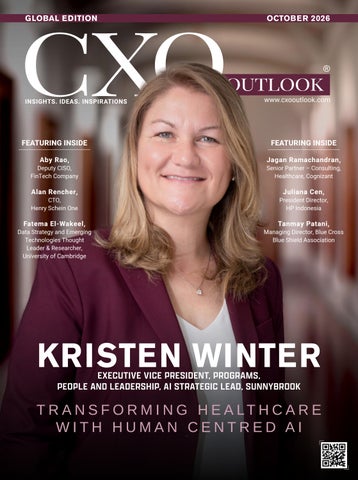
KRISTEN WINTER EXECUTIVE VICE PRESIDENT, PROGRAMS, PEOPLE AND LEADERSHIP, AI STRATEGIC LEAD, SUNNYBROOK
T R A N S F O R M I N G H E A LT H C A R E WITH HUMAN CENTRED AI CXO OUTLOOK October 2026
2
CXO OUTLOOK October 2026
3
CXO OUTLOOK October 2026
October 2026
Vol - 8
Issue - 10
Managing Editor Sarath Shyam Creative Consultants Charlie Jameson Louis Bernard
Branding & Marketing Partnerships Jennifer Anderson Anna Elza Monica Davis Stephen Donnell Jessica Edword Susan Miller
Consultant Editors Dr. John Andrews Naomi Wilson Emma James Stanly Lui Andrew Scott Steve Hope Sabrina Samson Keith Alexander Editorial Enquiry admin@cxooutlook.com
Partnerships Enquiry admin@cxooutlook.com
4 For Free Subscription
International Partnerships Free Subscription www.cxooutlook.com
Americas Europe Middle East & Africa Asia-Pacific
admin@cxooutlook.com
Follow Us On
www.linkedin.com/company/ cxooutlook www.facebook.com/ CXOOutlook
CXO Outlook www.cxooutlook.com is a global knowledge sharing digital platform published by Connecta Innovation Private Limited. All rights reserved. The opinions expressed in the content and pictures provided are those of the authors. They do not purport to reflect the opinions or views of Connecta Innovation Private Limited or any of its members and we do not assume any responsibility. The publisher does not assume any responsibility for the advertisements, its content, pictures, and all representation of warranties made in such advertisements are those of the advertisers and not of the publisher. CXO Outlook www.cxooutlook.com is a Free Subscription and Free-to-read digital platform strictly not for sale and has to be strictly for internal private use only. Publisher does not assume any responsibility arising out of anyone modifying content and pictures, printingCXO a copy of this digital platform in any format and in any country and all matters related to that. OUTLOOK October 2026
LETTER FROM THE EDITOR
The Readiness Test: Is Your Organization Prepared for What Comes Next?
O
rganizations rarely run short of ideas for change. They have strategies to modernize operations, investments in new technologies, plans to enter new markets, and ambitions to build stronger teams. Yet, turning these ambitions into reality remains a difficult task. The real test of leadership often begins after the strategy is announced. One observation has become increasingly clear: organizations that adapt successfully are often those that recognize their limitations, prepare their people, and address internal challenges before they slow progress. Change requires more than a decision at the top. It calls for readiness across the organization. The World Economic Forum’s Future of Jobs Report 2025 found that 63% of employers identify skills gaps as a major barrier to business transformation between 2025 and 2030. Organizational culture and resistance to change follow at 46%. These findings point to a familiar challenge. While businesses are eager to move forward, their people, processes,
and existing structures do not always move at the same pace. As artificial intelligence, automation, and new business models change how organizations operate, leaders must rethink how they prepare their workforce. Technology can improve productivity, but its value depends on whether employees have the skills, confidence, and support to use it effectively. This also requires leaders to question established practices and create a culture of continuous learning.
This month’s cover story brings an important perspective to this conversation. In an exclusive interview, Kristen Winter, Executive Vice President, Programs, People & Leadership, and AI Strategic Lead at Sunnybrook Health Sciences Centre, shares insights from her two-decade journey in healthcare leadership. Her belief that even the best strategies and technologies succeed only when people come along offers a valuable lesson for organizations across industries. This issue also features thought-provoking interviews, articles, and perspectives from business leaders and professionals examining the challenges and opportunities facing their industries. As organizations prepare for what comes next, perhaps the most important question is not how quickly they can change, but how well they are prepared to do so. I invite you to explore this issue and consider what readiness means for your organization. Enjoy Reading.
Sarath Shyam CXO OUTLOOK October 2026
5
CONTENTS
10 COVER STORY
6
CXO OUTLOOK October 2026
IN MY VIEW
Leading the Charge Toward a Connected & Intelligent Future of Work
20
Juliana Cen, President Director, HP Indonesia
EXPERT OPINION
7
The Decision-Centric Data Model: Why Most Data Strategies Fail Before Technology Even Begins Fatema El-Wakeel, Data Strategy and Emerging Technologies Thought Leader & Researcher, University of Cambridge
48
34
Stop Buying. Start Building. AI Has Redefined the Equation Aby Rao, Deputy CISO, FinTech Company
CXO OUTLOOK October 2026
CONTENTS LEADER’S INSIGHTS
Revolutionizing Member Experience in Healthcare Jagan Ramachandran, Senior Partner – Consulting, Healthcare, Cognizant
8
26
38
54 The Boardroom Has
Reimagining Dental Care with AI and Data Analytics Alan Rencher, CTO, Henry Schein One
CXO OUTLOOK October 2026
a New Blind Spot expertplus.com
Tanmay Patani, Managing Director, Blue Cross Blue Shield Association
9
CXO OUTLOOK October 2026
10
CXO OUTLOOK October 2026
KRISTEN WINTER EXECUTIVE VICE PRESIDENT, PROGRAMS, PEOPLE AND LEADERSHIP, AI STRATEGIC LEAD, SUNNYBROOK
T R A N S F O R M I N G H E A LT H C A R E WITH HUMAN CENTRED AI Kristen Winter is an accomplished healthcare executive and Executive Vice President, Programs, People & Leadership at Sunnybrook Health Sciences Centre. With more than two decades of experience across healthcare and the broader public and private sectors, Kristen is recognized for her leadership in organizational transformation, workforce strategy, leadership development and innovation. She is passionate about creating high-performing, people-centred organizations where leaders and teams can thrive. Kristen leads Sunnybrook’s AI strategy, championing responsible adoption of technology while keeping people and patient care at the centre of transformation. She holds a Master of Arts in Leadership and Education and is a Canadian Human Resources Executive. Recently, in an exclusive interview with CXO Outlook, Kristen shared insights into how her two-decade journey in healthcare has been driven by a simple belief that even the best strategy and technology only succeeds when you bring people with you. On trends, she noted that the biggest shift redefining academic health sciences will be the fundamental redesign of work itself, where AI and automation augment human capability rather than replace it. Her future vision is to help Sunnybrook lead in responsible, human-centric AI adoption while developing the next generation of leaders and building workplaces where technology makes work better and patient care stronger. The following excerpts are taken from the interview.
CXO OUTLOOK October 2026
11
12
Hi Kristen. Your journey spans over two decades in shaping people strategy at Canada’s largest academic health systems. Looking back at where it all began, what first drew you to the intersection of healthcare, people, and organizational transformation? I have always been drawn to work where the outcome matters to people. Healthcare is incredibly complex, but at its heart, it is about people caring for people. Early in my career, I realized that even the best strategy, technology or clinical innovation will only succeed if you can bring people with you. That is what drew me to the intersection of healthcare, people and organizational transformation. I became increasingly interested in the question of how you create the conditions for people to do their very best work, particularly in an environment as complex and mission-driven as healthcare. Over time, that evolved from a focus on people strategy into a much broader understanding of organizational transformation, leadership, culture and, now, technology and AI.
CXO OUTLOOK October 2026
What has kept me in healthcare for more than two decades is that there is always an opportunity to make things better. There is always another challenge to solve, another barrier to remove and another way to improve the experience of both the people who deliver care and the people who receive it. As an Executive Vice President leading Programs, People & Leadership, your role is both strategic and deeply human. What part of your current portfolio energizes you the most today? What energizes me most is the opportunity to connect the big picture with the human experience. I have the privilege of working across programs, people, leadership and increasingly AI, and those things are much more connected than they might appear. I am particularly energized by the opportunity to think differently about how we work. Healthcare has tremendous expertise and incredibly committed people, but we also have processes, systems and ways of working
I don’t see AI simply as a technology initiative. I see it as an organizational transformation opportunity
that have evolved over decades. I believe we need to be much more courageous about asking ourselves what we should stop doing, what we should redesign and what technology can help us do better. Our work in AI is a great example. I don’t see AI simply as a technology initiative. I see it as an organizational transformation opportunity. If we do it well, it can help our clinicians, researchers, educators and operational teams spend more time on the work that requires human judgment, creativity, empathy and expertise. That is enormously exciting to me. At the same time, I never want transformation to become so focused on the future that we lose sight of the people who are living the reality of today. Balancing those two things is what makes the work interesting. Healthcare is at an inflection point globally. From your vantage point, what is the single most significant workforce trend that will redefine academic health sciences in the next five years? I believe the biggest workforce shift will be the fundamental redesign of work itself. We have
CXO OUTLOOK October 2026
13
14
spent a lot of time talking about workforce shortages, but I think the more important question is: how do we change the work so that we need to do less of it manually, differently and inefficiently? AI and automation will be a major part of that. But I don’t think the future is about replacing people with technology. It is about augmenting people with technology and redesigning roles around what humans do best. That will require a significant shift in leadership. We will need leaders who can navigate technology and data while also understanding human behaviour, change management and culture. We will need to continuously reskill our workforce, rethink roles and create new ways for people to contribute. The organizations that thrive will not necessarily be the ones with the most technology. They will be the ones that are best at combining technology with human capability. True leadership is often measured not by answers given, but by barriers removed and clarity created. In your experience, what does it take to create an environment where people feel genuinely seen, supported, and empowered to do their best work? For me, it starts with listening. And I mean genuinely listening, not listening while preparing your response. People know very quickly whether a leader actually wants to understand their experience. The second piece is clarity. People cannot do their best work if they don’t understand where the organization is going, why it matters, what is expected of them and how their work contributes. Leaders have a responsibility
CXO OUTLOOK October 2026
to create that clarity, particularly when the environment is uncertain. And finally, you have to create psychological safety. People need to be able to tell you when something isn’t working, challenge an idea, admit a mistake or bring forward a different perspective without fear of being dismissed. I also believe empowerment requires leaders to give up some control. If you hire talented people and then make every decision for them, you haven’t really empowered them. My job as a leader is not to have all the answers. It is to create the conditions in which the best answers can emerge from the organization.
Leaders have a responsibility to create that clarity, particularly when the environment is uncertain 15
People want to know that they matter, that their contribution matters and that their leader has their back. Those things sound simple, but they are incredibly powerful. Emotional intelligence and compassion are increasingly recognized as core leadership competencies, not secondary traits. Why do you believe these humancentered skills are now essential for driving high performance and resilience in complex organizations? Because complexity increases the need for humanity; it doesn’t diminish it.
When people are working under pressure, navigating uncertainty or experiencing significant change, technical competence alone isn’t enough. Leaders need to understand what people are experiencing, recognize how their own behaviour affects others and be able to have difficult conversations with empathy and honesty. I also think there is a misconception that compassion and high performance are somehow in tension. I believe the opposite. You can have very high expectations and still be deeply compassionate. In fact, people are often willing to stretch further for a leader who they believe genuinely cares about them.
CXO OUTLOOK October 2026
Don’t look for one mentor who has all the answers. Build a personal board of directors
16
For me, emotional intelligence is not about avoiding difficult conversations or making everyone happy. It is about understanding people well enough to lead them effectively. Sometimes compassion means listening. Sometimes it means giving someone an opportunity. Sometimes it means holding someone accountable because you believe they are capable of more. The best leaders I have worked with have combined humanity with high standards. That combination builds trust, and trust is one of the most important currencies an organization has. Leadership can be all-consuming, yet personal grounding is essential. What is your favorite way to disconnect and recharge outside the high-pressure world of healthcare? For me, it is getting away from the pace of work and spending time with family and friends. I especially love being up north, where everything slows down a little. There is something about being outside, being on the water, having a long conversation over dinner and not looking at a screen that completely resets me.
CXO OUTLOOK October 2026
I also value the simple things. A good meal, a glass of wine, a long drive, being outside or just having time where nobody needs anything from me. I have learned that disconnecting isn’t a luxury. It is part of being effective. You cannot continuously operate at full intensity and expect to make your best decisions. Sometimes stepping away is exactly what allows you to come back with a clearer perspective. Books often leave a lasting imprint on how we lead. Is there a book on leadership, resilience, or humanity that you found yourself returning to again and again? Two books that have stayed with me are Dare to Lead by Brené Brown and Unreasonable Hospitality by Will Guidara. They approach leadership from very different angles, but together they capture a lot of what I believe about leading people. Dare to Lead resonated with me because of its focus on courage, vulnerability and the importance of showing up authentically as a
leader. Leaders sometimes feel they need to have all the answers or project certainty all the time. I believe the opposite can be true. Being willing to say “I don’t know,” ask for help, listen to another perspective and have difficult conversations with honesty and empathy takes real courage. Unreasonable Hospitality reinforced another lesson that I think is incredibly relevant to healthcare: the experience we create for people matters. It is about going beyond what is expected and thinking deeply about what someone needs,
not simply what the process says we should provide. While the book is rooted in hospitality, I think that philosophy translates beautifully into healthcare, leadership and culture. For me, the two books come together around a simple idea: leadership is fundamentally about people. It is about how you make people feel, the trust you build, the standards you set and the experience you create for the people around you. You can have the strategy, the title and the authority, but if people don’t trust you or don’t feel valued, you won’t get very far.
17
CXO OUTLOOK October 2026
And I hope that along the way I have helped develop the next generation of leaders. That, to me, is one of the most meaningful measures of a career.
18
What is your biggest goal? Where do you see yourself in 5 years from now? My biggest goal is to have made a meaningful difference in how healthcare organizations work and how people experience working in them. Over the next five years, I would love to look back and know that I helped Sunnybrook become an organization that was genuinely ahead of the curve in how we use technology and AI, while remaining deeply human and focused on our people and our patients. I also want to continue growing as a leader. I am increasingly interested in the intersection of people, leadership, technology and system transformation, and I see enormous opportunity there. I don’t necessarily define my five-year goal by a particular title. I define it by impact. If I can help build organizations where talented people want to work, where leaders are developed intentionally, where technology makes people’s jobs better rather than harder, and where ultimately patients receive better care, I will feel that I have done something worthwhile.
CXO OUTLOOK October 2026
Mentorship is rarely about one perfect guide, but about learning from different people at different stages of life. What advice would you offer to emerging leaders on building a diverse circle of mentors? Don’t look for one mentor who has all the answers. Build a personal board of directors. Find people who are ahead of you and can help you see what is possible. Find people who are different from you and will challenge your assumptions. Find people who know things you don’t know. And don’t underestimate the value of people who are beside you on the journey. I have learned something different from almost every person I have worked with. Some people taught me how to lead. Others taught me what not to do. Some gave me opportunities before I was completely ready for them. Others challenged me when I needed to hear something difficult. I would also encourage emerging leaders not to make mentorship transactional. The best relationships develop naturally when you are genuinely curious about someone and interested in learning from them. And finally, don’t wait until you feel like a leader to start acting like one. Seek out experiences that stretch you, take on things that are bigger than what you have done before, and be willing to be uncomfortable. Some of the most important growth in my career has happened when I said yes before I knew exactly how I was going to do it.
Want to Sell or find Investors for your Business? 19
DigitalCXO FirstOUTLOOK Magazine October August 2026 2021
IN MY VIEW
Leading the Charge Toward a Connected & Intelligent Future of Work Juliana Cen, President Director, HP Indonesia
20
Hi Juliana. HP Imagine 2026 was recently held in New York, focused on “Reimagining the Future of Work”. How does HP’s vision of a connected, intelligent ecosystem aim to simplify complex work environments, and what benefits can businesses expect from this approach? We are at a pivotal moment in how work is defined. Today, work is no longer tied to a
single location, device, or even a fixed set of processes. It is increasingly fluid, distributed, and shaped by AI and data. While this creates new opportunities, it also introduces complexity that many organizations are still trying to navigate. At HP, our approach is to simplify that complexity through a connected, intelligent ecosystem that brings everything together. We demonstrated this vision at HP Imagine 2026
Juliana Cen is the President Director of HP Indonesia, leading the company’s strategy to drive growth, innovation, and digital transformation in one of Southeast Asia’s most dynamic markets. With over two decades of experience in the technology industry, she has held senior leadership roles at various organizations where she built strong partner ecosystems and expanded market leadership. Known for her people-centric and values-driven leadership, Juliana is passionate about inclusive innovation. She is committed to advancing digital equity and empowering businesses and communities across Indonesia through technology that is secure, intelligent, and future-ready. Recently, in an exclusive interview with CXO Outlook Magazine, Juliana shared insights into HP’s vision for reimagining the future of work through a connected, intelligent ecosystem that simplifies complexity across fluid, distributed, and AI-shaped workplaces. She detailed how HP IQ serves as the workplace intelligence layer that unifies AI-powered devices, data, and experiences so they operate as one cohesive system, enabling smarter workflows with context-aware automation and HP NearSense spatial intelligence for seamless device-to-device collaboration. For businesses in fast-growing digital economies like Indonesia, she explained, this reduces digital friction, frees employees from repetitive tasks, and gives IT teams stronger visibility, control, and security to drive productivity and growth. Looking ahead, Juliana said HP will measure success by customer value, while continuously refining its approach through real-time insights, customer feedback, and partner collaboration to stay ahead of evolving workplace demands. The following excerpts are taken from the interview.
CXO OUTLOOK October 2026
21
According to the HP 2025 Work Relationship Index, access to the right tools and technology is a key enabler of employee experience, and greater access to AI tools improves knowledge workers’ relationship with work
CXO OUTLOOK October 2026
through HP IQ, where we bring together AIpowered devices, data, and experiences so they work as one cohesive system, rather than as isolated components. Our aim is to help businesses and individuals thrive in an AIdriven future of work. For businesses, including markets like Indonesia where digital transformation is accelerating rapidly, a connected, intelligent ecosystem enables employees to move seamlessly across locations and devices, while IT teams gain better visibility, control, and security. It allows organizations to reduce
22
operational friction and focus on productivity, innovation, and growth. What is HP IQ, and how does it enable smarter workflows across devices? Specifically, what benefits can businesses expect to gain from adopting HP IQ and its connected ecosystem? HP IQ is HP’s new workplace intelligence layer designed to coordinate experiences across HP devices and systems by bringing together local, on‑device AI and proximity-based connectivity.
Our focus is to help organizations move from reactive to futureready security, ensuring their print environment remains a secure and trusted part of the broader IT ecosystem
CXO OUTLOOK October 2026
Instead of users having to constantly switch apps and devices manually, HP IQ turns employees’ HP devices into context‑aware partners that can surface relevant information, automate routine tasks, and support collaboration in the moment. In addition, HP IQ introduces HP NearSense, a spatial intelligence layer that allows nearby HP devices to discover and connect with one another. This enables easier movement of work between devices—such as one‑click joining of meeting rooms. According to the HP 2025 Work Relationship Index, access to the right tools and technology
is a key enabler of employee experience, and greater access to AI tools improves knowledge workers’ relationship with work. By deploying solutions like the HP IQ, it enhances employee productivity, reduces digital frictions and downtime, and enables a more proactive approach to IT management. In fast-growing digital economies like Indonesia, where businesses are scaling quickly, this level of intelligence is critical to maintaining both efficiency and competitiveness, as the workforce can free their time from mundane, repetitive tasks to focus on delivering highvalue work and impactful business outcomes. Can you tell us about how HP TPM Guard provides hardware-level security, and what kind of protection does it offer against physical data attacks? Security today must start at the most fundamental level, the hardware itself, and PCs and printers are at the heart of modern, hybrid work, with vast amounts of sensitive information stored in them. As work becomes more mobile and distributed, endpoints are increasingly exposed and vulnerable to more sophisticated attacks. The industry has traditionally relied on BitLocker to safeguard data when a device is lost or stolen, but vulnerabilities in recent years can enable attackers with physical access to a device to bypass the protection and extract data. HP TPM Guard is designed to address this challenge by protecting sensitive data directly at the hardware level. It secures cryptographic keys and credentials within the device, ensuring that even if there is physical access or tampering, critical data remains protected. This is especially relevant in hybrid environments, including across Indonesia,
CXO OUTLOOK October 2026
23
where devices are used across diverse locations and networks. By embedding security at the core, we help organizations build a stronger foundation of trust without adding complexity for users.
24
What drives the need for local compute power in AI workloads, according to HP? What makes HP’s next-gen AI PCs suitable for productivity and AI-driven tasks? AI is fundamentally changing not only how work is done, but where it happens. We are seeing a clear need for local, on-device computing as organizations demand faster responsiveness, stronger data control, and more reliable performance. While the cloud remains essential, it cannot address every use case. Real-time processing, privacy-sensitive workloads, and environments with inconsistent connectivity require AI to run directly on the device. This is particularly relevant for organizations and sectors that handle highly sensitive data, operate in remote environments, or require instantaneous decision-
making, such as healthcare providers, financial services, and manufacturing / industrial IoT. With integrated AI capabilities and advanced processors, HP’s AI PCs enable users to run complex workloads locally without compromising performance or security. This allows AI to become part of everyday workflows, automating tasks, generating insights, and enhancing collaboration in real time. It marks a move toward more intelligent, responsive systems that work alongside people. How does HP’s Quantum-Safe security technology enhance printer security? As quantum computing continues to advance, security risks are evolving, and HP is building protections designed to help organizations prepare for future threats, including those posed by quantum‑enabled attacks. However, print infrastructure is often an overlooked part of the workflow. At HP Imagine 2026, we announced the new HP LaserJet Pro 4000/4100 Series and the HP LaserJet Enterprise 5000/6000 Series with quantum‑resistant protection built directly
AI is fundamentally changing not only how work is done, but where it happens. We are seeing a clear need for local, on-device computing as organizations demand faster responsiveness, stronger data control, and more reliable performance
CXO OUTLOOK October 2026
into the devices. This includes tamper‑resistant firmware and hardware‑level protections, helping prevent malicious modification of printers. When combined with HP Wolf Enterprise Security, our internal analysis suggests that it can reduce cyberattack exposure by up to 80%. Our focus is to help organizations move from reactive to future-ready security, ensuring their print environment remains a secure and trusted part of the broader IT ecosystem. Looking ahead, what are the key metrics or benchmarks that HP will use to measure the success of its connected ecosystem strategy, and how will it adjust its approach to stay ahead of the curve? For us, success is defined by the value we create for our customers. This starts with how effectively we help organizations improve productivity, strengthen security, and simplify
workflows and tasks across increasingly complex environments, so that they are empowered to do their best work. We also look at how well our connected ecosystem reduces friction. This includes seamless experiences across devices, improved workflow efficiency, and the ability for employees to work consistently regardless of location. Another important measure is how organizations are able to scale and adapt using our solutions. Adoption rates, user experience, and reductions in IT complexity are key indicators of whether we are delivering meaningful impact. At the same time, we place strong emphasis on understanding our customers’ evolving tech demands and keeping abreast to trends that are shaping the workplace. Real-time insights, customer feedback, and close collaboration with our partners allow us to refine our approach and stay aligned with these evolving needs.
CXO OUTLOOK October 2026
25
LEADER’S INSIGHTS
Reimagining Dental Care with AI and Data Analytics Alan Rencher, CTO, Henry Schein One
26
Hi Alan. As dental technology continues to evolve, what emerging trend do you think will have the most significant impact on patient care? As dental technology continues to evolve, one of the most important trends shaping the future of patient care is the shift toward integrated, cloud-based platforms that connect the entire workflow of the practice. Dentistry depends on multiple systems working together, clinical documentation, imaging, scheduling, billing, and patient communication. Historically, many
of these functions lived in separate applications that did not easily share information. When systems are disconnected, it creates friction for both staff and patients. Teams spend time transferring data between systems and managing administrative tasks that slow the practice down. That complexity can affect the patient experience through longer check-ins, delayed follow-ups, or less time for clinicians to focus on care. Unified, cloud-based platforms change that dynamic. When scheduling, clinical records,
Organisations need to move from old practices of Reactive Recovery to futuristic Proactive and Adaptive Continuity Planning practices
CXO OUTLOOK October 2026
27 Alan Rencher is the Chief Technology Officer, for Henry Schein One, leading the architecture, security, and engineering behind the organization’s Dentrix and Dentrix Ascend technology platforms. With more than 20 years of experience, he focuses on building scalable, secure systems that solve real customer problems while keeping complexity low. He holds degrees in engineering and computer science and is passionate about designing systems that simply work. He lives in Highland, Utah with his wife and four children and enjoys triathlons, road biking, and time outdoors. Recently, in an exclusive interview with CXO Outlook Magazine, Alan shared insights into the future of dental technology, emphasizing the shift towards integrated, cloud-based platforms that enhance patient care and operational efficiency. He highlighted AI’s role in automating routine tasks and streamlining workflows, cautioning against treating AI as a feature rather than part of the platform architecture. Alan also stressed the importance of systems thinking, emotional intelligence, and pragmatic innovation in leadership, sharing his vision of making dental software “disappear” by reducing friction and complexity in dental practices. The following excerpts are taken from the interview.
CXO OUTLOOK October 2026
imaging, and billing operate within a single architecture, information moves automatically across the practice. This reduces manual work and helps teams operate more efficiently while ensuring accurate, consistent data. Operational efficiency directly improves the patient experience. When technology works seamlessly, appointments run more smoothly, communication improves, and administrative processes become faster and more reliable. Patients benefit from easier scheduling, clearer information during visits, and faster resolution of insurance and billing questions. This integrated foundation also allows new capabilities, particularly artificial intelligence, to support everyday workflows. When AI is
28
CXO OUTLOOK October 2026
embedded within the platform rather than layered onto disconnected systems, it can automate routine tasks and streamline operations. For example, eligibility verification can occur automatically before a patient arrives. Imaging tools can help identify potential findings and link them directly to the patient record. Documentation can be streamlined within the clinical workflow, and claims can be validated before submission to reduce delays. These improvements reduce administrative burden and help practices run more efficiently. Importantly, these technologies are designed to support clinicians, not replace them. Dentistry will always depend on professional judgement and the provider–patient relationship. Modern
When AI is embedded within the platform rather than layered onto disconnected systems, it can automate routine tasks and streamline operations
platforms remove operational friction so clinicians can focus on diagnosis, treatment planning, and patient care. For patients, the benefits are clear: fewer delays, better communication, and a smoother experience from scheduling through treatment and follow-up. For dental teams, integrated technology means less time managing systems and more time delivering care. What role is AI playing in the future of dentistry? As the technology is deployed, what are the pitfalls the industry must avoid? Artificial intelligence is going to play an important role in the future of dentistry, but the real story isn’t about algorithms alone. It’s about how AI fits into the systems that run modern healthcare organizations. Dental practices, like many service businesses, operate through hundreds of interconnected workflows every day. Scheduling patients,
verifying insurance eligibility, documenting care, managing imaging, submitting claims, and coordinating follow-ups all have to work together. Historically, those processes have often been managed across multiple disconnected software systems. When systems don’t integrate well, teams end up spending time moving information between platforms, reconciling data, and manually coordinating tasks that technology should handle automatically. AI has the potential to change that dynamic, particularly when it’s embedded directly into the operational platforms organizations already use to run their businesses. AI is increasingly being integrated into cloudbased practice management platforms such as Dentrix Ascend. When AI capabilities are built into the underlying platform, they can support real operational workflows, automating routine processes, assisting with documentation, helping verify insurance eligibility, and improving the efficiency of revenue cycle management. For CIOs and technology leaders, the architectural foundation is the critical factor. AI delivers the most value when it operates inside a unified platform where key systems, clinical documentation, imaging, scheduling, billing, and analytics, are connected through secure connections. In that environment, data can move freely across workflows, allowing AI to support the actual work of the organization rather than acting as a standalone tool. In other words, the real value of AI emerges when it is embedded within the infrastructure of the business. This architectural approach is particularly important in healthcare environments, where data integrity, security, and operational reliability
CXO OUTLOOK October 2026
29
30
are essential. A modern platform must be designed with interoperability, scalability, and strong security controls built into its foundation. Without that, AI initiatives risk becoming fragmented add-ons that increase complexity rather than reducing it. That leads to some of the pitfalls the industry needs to avoid. One of the most common mistakes is treating AI as a feature rather than as part of the platform architecture. Many early AI implementations across industries have focused on isolated tools that generate insights or automate a narrow task. While those tools can deliver incremental value, they often introduce another system that teams must manage. When AI capabilities are disconnected from the systems that run the business, they rarely produce meaningful operational improvements. Another challenge is governance. Healthcare organizations manage large volumes of sensitive patient and financial data. Any AI capability must operate within a framework that prioritizes data security, transparency, and responsible use of information. CIOs increasingly need to think about AI not just as a technology initiative, but as part of a broader governance model that includes data stewardship, compliance, and risk management. There is also the issue of workflow design. Technology leaders sometimes underestimate how easily new tools can increase cognitive load for frontline professionals. This is particularly true when systems are built by the bolt-on method. If AI requires clinicians or staff to navigate additional interfaces, it can slow down the very processes it was intended to improve. The most effective implementations are often the least visible, automating routine work in
CXO OUTLOOK October 2026
the background while allowing professionals to stay focused on the task at hand. Ultimately, the future of AI in dentistry, and in many operationally complex industries, will depend less on the sophistication of individual models and more on the strength of the underlying platform architecture.
Emotional intelligence is what enables leaders to diagnose and improve the human system—not just the technical one
Organizations that invest in integrated platforms will be able to introduce AI capabilities in ways that enhance workflows rather than disrupt them. Those platforms create the foundation for continuous innovation, allowing new capabilities to be added without fragmenting the system.
When implemented thoughtfully, AI becomes less about hype and more about operational performance. It helps teams spend less time managing systems and more time focusing on the work that actually drives value, whether that’s delivering patient care, serving customers, or running a more efficient organization. What’s the most important skill for a dental technology leader to possess, and how do you cultivate it? The most important skill for a dental technology leader is systems thinking—the ability to understand how clinical workflows, financial outcomes, and technology platforms are interconnected. Dentistry is a tightly coupled ecosystem. A change in scheduling, billing, or clinical documentation doesn’t stay isolated—it ripples across the entire practice. Effective leaders recognize those interdependencies and manage them intentionally, rather than optimizing in silos. At the same time, the industry is entering a period of rapid change, particularly as AI reshapes how users interact with software. That requires a second capability: pragmatic innovation. Leaders must move quickly where technology creates real value, while remaining disciplined in areas that demand trust, accuracy, and stability. As a leader in dental technology, what’s the one thing that sparks your creativity and inspiration? What consistently drives my thinking is encountering a process and asking, why is this still so hard? Whether it’s insurance workflows,
patient intake, or something as fundamental as scheduling, those friction points are signals. They highlight where systems are not aligned with how work actually gets done. Rather than viewing that friction as a frustration, I see it as an indicator of opportunity. Not to incrementally improve the existing process, but to step back and rethink the system more fundamentally. Many of our strongest ideas start there— with a clear view of where complexity persists, and a disciplined approach to removing it. What’s the importance of emotional intelligence in leadership, and how can leaders cultivate it? Emotional intelligence is what enables leaders to diagnose and improve the human system— not just the technical one. In engineering, when something breaks, you look for root cause. In organizations, that root cause is rarely the code. It’s more often communication gaps, misaligned incentives, or a lack of trust. Emotional intelligence allows you to see those underlying dynamics clearly and address them directly. It also sets the operating tone for the team. I often describe leaders as either thermometers or thermostats. Thermometers react to the environment. Thermostats shape it. Effective leaders take responsibility for the environment they create—and adjust it intentionally. Like any system, emotional intelligence improves through feedback and iteration. That means listening more than you speak, asking better questions, and being willing to adjust your approach. Over time, you become more effective at reading situations and responding in ways that bring out the best in your team.
CXO OUTLOOK October 2026
31
If you could have dinner with any historical figure, who would it be and why? There are many figures from history I would value the opportunity to meet, but if I had to choose one, it would be George Washington. What stands out is his ability to lead through sustained uncertainty while maintaining trust and stability. He was often operating with incomplete information, high stakes, and evolving conditions—challenges that, in a different form, leaders continue to face today. I would be interested in understanding how he approached decision-making in those moments— how he balanced risk, timing, and confidence when there was no clear path forward. And I would be equally interested in whether, at times, he felt like he was working through ambiguity in real time—because that remains a consistent reality of leadership.
32
Ultimately, the future of AI in dentistry, and in many operationally complex industries, will depend less on the sophistication of individual models and more on the strength of the underlying platform architecture
CXO OUTLOOK October 2026
What’s something on your bucket list that you’re excited to tackle soon? One of my long-term goals is to make dental software effectively disappear. Not in a literal sense, but in how it’s experienced. Today, too much of the day in a dental practice is spent navigating systems rather than focusing on patient care. That’s a signal that the technology is still too visible in the workflow. With advances in AI and automation, there is a clear opportunity to reduce that friction and shift more of the operational burden to the system itself. The objective is not to add features, but to remove unnecessary interaction and complexity. It’s an ambitious goal. If done well, the technology becomes largely invisible—and the work simply gets done. That’s the outcome we should be designing toward.
33
CXO OUTLOOK October 2026
EXPERT OPINION
The Decision-Centric Data Model: Why Most Data Strategies Fail Before Technology Even Begins Fatema El-Wakeel, Data Strategy and Emerging Technologies Thought Leader & Researcher, University of Cambridge
34
O
rganisations invest heavily in data and AI, yet struggle to improve decisions. The missing piece is how decisions are designed, owned, and governed. Over the past decade, organisations have invested heavily in data. Platforms have been modernised, dashboards have multiplied, and AI has moved from experimentation to boardroom priority. And yet, a fundamental question persists: Why are data investments not consistently leading to better decisions? The answer is not a lack of capability. Most organisations today have more data, more tools, and more technical expertise than ever before. The issue is more structural. Most organisations have not designed their data strategy for the decisions they are trying to improve.
CXO OUTLOOK October 2026
From Data Investment to Decision Impact In many organisations, data strategy still begins with infrastructure, tools, and a heavy investment in enterprise data platforms. The focus is on platforms, tooling, and architecture. Only later, if at all, does the conversation turn to how decisions are made. This creates a disconnect. Data becomes more available, more accessible, more advanced. But decision-making does not evolve at the same pace. Reports are produced but not acted on. Models are developed but not embedded. Insights exist, but do not travel. There is an implicit assumption that better data will naturally lead to better decisions. In practice, it rarely does. Because decisions are not a by-product of data. They are a product of how organisations are structured, governed, and aligned.
Fatema El-Wakeel is a Data Strategy Evangelist, global data practitioner, and researcher at the University of Cambridge, shaping how organisations translate data and emerging technologies into longterm strategic advantage. She focuses on helping organisations design decisioncentric approaches to data and AI that deliver real business impact. With over 15 years of experience across companies such as ARM, Unilever, Jaguar Land Rover, and HP, she has led enterprise-wide data and analytics transformations. Fatema is a recognised speaker and thought leader in the global data and technology community. Fatema also serves as a Global Assembly Member at the University 35 of Manchester and is a recognised speaker and author in the global data strategy and tech community.
The organisations seeing the greatest impact from AI are not necessarily those with the most advanced models, but those that have been deliberate about where those models sit within decision-making
CXO OUTLOOK October 2026
36
When Progress Creates New Problems This gap becomes even more visible as organisations scale their data capabilities. Recently, I spoke with an organisation that had moved exceptionally fast on its data journey. They had invested heavily in self-service, empowered teams across the business, and scaled data capabilities at pace. On paper, the results were strong. But as the organisation grew, a different pattern began to emerge. Data definitions started to diverge. Reports are no longer aligned. Multiple versions of the same metric coexisted. What had initially enabled speed and autonomy began to create fragmentation. This was not a failure of capability. In fact, it was a consequence of success. The organisation had scaled data faster than it had scaled alignment. And at the centre of that misalignment was a missing foundation: governance. Governance as a Scaling Mechanism Governance is often misunderstood as something that slows organisations down. In reality, it is what allows organisations to scale without losing coherence. Without governance, self-service becomes self-interpretation. Autonomy becomes inconsistency. Speed accumulates into technical and organisational debt. With governance, the opposite happens. Data becomes trusted. Teams move with shared understanding. Scale becomes sustainable rather than fragile. The key is not to introduce governance after fragmentation occurs, but to build it alongside growth. Because speed only creates value when it is aligned.
CXO OUTLOOK October 2026
The Real Gap: Decisions, Not Data What this ultimately points to is a deeper issue. Most organisations have focused on scaling data, but not on designing decisions. At the core of every organisation is a set of decisions that determine performance, strategic, operational, and increasingly automated. Yet these decisions are rarely defined with the same rigour applied to systems and architecture. Instead, they remain fragmented, inconsistently owned, and unevenly supported by data.
Without governance, selfservice becomes selfinterpretation. Autonomy becomes inconsistency. Speed accumulates into technical and organisational debt
This is the missing layer. Before investing further in data or AI, organisations need to ask: • What are the decisions that drive value? • Who is accountable for them? • What information would materially improve them? • Where are they currently breaking down? Without this clarity, even the most advanced capabilities struggle to translate into impact.
A Decision-Centric Approach to Data Strategy To address this gap, organisations need to reframe how they think about data strategy. Not as a technology problem, but as a design problem. A decision-centric approach can be understood through four interconnected elements: Decision Clarity Identify and prioritise the decisions that matter most. Not all decisions carry equal weight, yet many organisations fail to distinguish between them. Decision Ownership Establish clear accountability. Decisions without ownership tend to slow down, fragment, or default to hierarchy. Decision Support Align data, analytics, and AI to improve specific decisions. This shifts the focus from building capability to enabling action. Decision Governance Create the structures and standards that ensure decisions remain consistent, trusted, and scalable over time. What differentiates high-performing organisations is not whether these elements exist, they usually do, but how deliberately they are connected. Rethinking the Role of Leadership This shift has important implications for leadership. Data does not sit within a single function. It is embedded across the organisation. As a result, the role of a data leader is not to own data, but to enable better decisions.
This requires: aligning business and technology around decision priorities clarifying ownership and accountability ensuring governance supports action rather than constrains it creating environments where data is both trusted and used In practice, this is less about control and more about organisational design. Where AI Fits In The same principle applies to AI. The question is not how advanced a model is, but what decision it improves. If that connection is unclear, AI remains peripheral. If it is clear, AI becomes embedded within decision systems supporting, augmenting, or automating decisions in a way that creates measurable value. The organisations seeing the greatest impact from AI are not necessarily those with the most advanced models, but those that have been deliberate about where those models sit within decision-making. Designing for Decisions Becoming data-driven is often described as a destination. In reality, it is a design choice. A choice to organise around decisions rather than systems. A choice to prioritise clarity over complexity. A choice to focus on impact rather than activity. Because ultimately, data does not create value. Decisions do. And until organisations design explicitly for those decisions through clarity, ownership, support, and governance, the gap between investment and impact will persist, regardless of how advanced the technology becomes.
CXO OUTLOOK October 2026
37
LEADER’S INSIGHTS
Revolutionizing Member Experience in Healthcare Jagan Ramachandran, Senior Partner – Consulting, Healthcare, Cognizant
38
The fifth Voice of the Member survey report was released recently. Can you share some of the most surprising findings in the report, and how do you think they will impact the healthcare industry? The fifth Voice of the Member survey is our most ambitious edition yet, we expanded from 2,400 to 7,500 respondents across more than 166 health plans, surveyed over seven weeks in mid-2025. The scale alone gave us a far richer, more granular picture of what members actually experience versus what health plans believe they deliver. Several findings genuinely surprised us. Core processes are still a source of challenge. Despite years of investment, 58% of Commercial
members and 55% of Medicaid members reported issues with prior authorization, and 65% of Commercial members faced difficulties when appealing a denial of coverage. The top complaints remain the same: it takes too long, involves too much paperwork, and lacks clear explanation. Meanwhile, 29% of members still wait more than two weeks for a PCP or specialist appointment. These are not edge cases, they suggest systemic friction that erodes trust and delays care. Provider directory accuracy is alarmingly low. Our survey found that 91% of members rate the ability to search for providers and compute out-of-pocket expenses as highly important, yet satisfaction scores on provider directories
Our Voice of the Member survey confirms that no plan with poor Essential scores achieved high marks in any other category. This means investing in process redesign, not just automation
CXO OUTLOOK October 2026
Jagan Ramachandran is Senior Partner – Consulting at Cognizant, where he leads the Healthcare Payer consulting business and advises leading US payers and providers on strategic transformation, AI-enabled operating models, and new business creation. Ranked #2 among the Top 25 Strategy Consultants and Leaders of 2025 by The Consulting Report and featured in The CXO Magazine and CIO Times, he is recognized for translating innovation into measurable improvements in access, cost, quality, and experience. Before joining Cognizant, Jagan served as Managing Partner at Gartner’s Healthcare Consulting practice, leading strategic engagements for National Plans, Blues, and Regional Plans. He created Cognizant’s Voice of the Member research, now in its fifth edition surveying 7,500 US health plan members, which has become an industry benchmark for understanding member expectations and guiding payer digital strategy. Across platform selections, M&A integrations, and new venture launches, Jagan consistently closes the Strategy–Execution gap through clear, outcome-focused roadmaps and transparent trade-offs across technology, financial returns, operations, and people. He builds trust with C-suites and boards by aligning on non-negotiable outcomes, such as STAR ratings, medical cost trend, digital NPS, and regulatory readiness, and by using outcome-driven governance, executive-friendly dashboards, and structured change management to steer complex, high-stakes programs. Recently, in an exclusive interview with CXO Outlook Magazine, Jagan shared insights into the findings of the fifth Voice of the Member survey, revealing surprising gaps in healthcare experience, including issues with prior authorization, provider directory accuracy, and cost transparency. He emphasized the need for healthcare leaders to prioritize member experience, leverage AI for operational efficiency, and invest in wellness ecosystems. Jagan also discussed the importance of empathy, human-centered design thinking, and AI literacy in healthcare professionals, and advised startups to solve real member pain points exceptionally well. The following excerpts are taken from the interview.
CXO OUTLOOK October 2026
39
40
are strikingly poor, as low as 1.6 out of 5 for Commercial members. CMS has now introduced rules requiring Medicare Advantage plans to attest to directory accuracy, with potential fines of up to $25,000 per beneficiary. This regulatory pressure, combined with member concerns, is likely to drive a fundamental overhaul of how plans maintain and present provider data. Cost transparency remains more promise than reality. While 95% of Commercial members and 94% of Medicare members say understanding procedure costs is important, only 25% report that the estimate they received was close to the actual cost. Three out of four members get inaccurate estimates, a finding that should concern every payer executive, especially as price transparency regulations continue to tighten. Members increasingly expect insurers to be wellness partners. The share of members wanting their health plan to play a role in their overall well-being has climbed from 57% in 2021 to 83% in 2023 and now 85% in 2025. This is not a marginal preference, it signals a fundamental shift in the payer-member relationship. Yet 34% of members are still unaware of or not using their plan’s wellness features, pointing to a significant awareness and engagement gap. The industry impact is clear: health plans that continue to treat member experience as a back-office function risk losing members to competitors and increasingly to digital health disruptors, who deliver transparent, personalized, and wellness-oriented experiences. The survey reinforces what I have long advocated: payers must evolve from claims processors to partners in health and well-being, focusing on health span rather than just lifespan.
CXO OUTLOOK October 2026
What are some key takeaways from the survey of 7,500 U.S. health plan members? The most important structural insight from this survey is what we call the Experience Hierarchy, the idea that member experience operates in three distinct layers: Essentials, Enhancements, and Delights. Essentials come first, and they are nonnegotiable. These include core processes such as prior authorization, referrals, appeals, claims, and provider directories. Our data shows that no health plan with poor Essential scores managed to score well on Enhancements or Delights. In other words, you cannot compensate for broken basics with innovative add-ons. One in four members called member services simply to understand their benefits and eligibility, and roughly 30% are not confident they understand their plan benefits at all. A large national payer’s virtual assistant handled over 65 million inquiries in 2024 alone, an indication of the sheer volume of confusion that exists. Enhancements differentiate but require segment-specific thinking. Chronic condition management programs, cost transparency tools, and SDOH services fall into this layer. The survey reveals that satisfaction with chronic condition programs is disappointingly low, counseling and programs for healthy weight scored only 1.9 out of 5. For Medicaid members, SDOH gaps are demography-specific: 67% of Black Medicaid members value childcare support more highly, while 56% of Hispanic members prioritize language and translation assistance. A one-size-fits-all approach will not work. Delights build loyalty and lifetime value. This layer includes wellness management
tools, spend management dashboards, and personalized shopping experiences. The demand is clear,95% of Commercial members rate spend management tools as important, yet only 50% report they are available. For Medicare, availability drops to just 11%. Shopping journeys also need to be tailored: side-by-side plan comparison is the number one demand across all segments, but Medicare members prefer guided and simplified flows, while Dualeligible members place the highest overall value on digital features[1].
Three out of four members get inaccurate estimates, a finding that should concern every payer executive, especially as price transparency regulations continue to tighten
The digital adoption gap is not about ability. Perhaps the most striking takeaway is that while only 47% of Medicare members have downloaded their health plan’s app, nearly 55% of those same members actively use their bank’s digital tools. The gap is not a technology literacy issue, it is a promotion and user experience issue. Health plans can learn from other industries, particularly property and casualty insurance and banking, which have achieved significantly higher digital adoption rates.
In your opinion, how can healthcare leaders prioritize member experience in their transformation strategies? In my experience leading transformation programs for some of the largest health plans in the country, I have found that the most successful organizations follow a business-led, experience-first approach. Successful healthcare transformations are business-led, experiencecentric, and execution-minded ,rather than technology-first initiatives. Start by fixing the Essentials. Before pursuing innovation, leaders must ensure that core processes, prior authorization, referrals, appeals, claims, and provider directories, work reliably. Our Voice of the Member survey confirms that no plan with poor Essential scores achieved high marks in any other category. This means investing in process redesign, not just automation. For example, the CMS Interoperability and Prior Authorization Final Rule now sets strict decision timeframes and requires FHIR APIs, teams that redesign policy and workflow before automating see faster, more transparent decisions and lower administrative burden. Listen to members and design around their journeys. Start with real signals. Our research shows one in four members wait more than two weeks for appointments, and nearly half struggle with transparency in prior authorization, referrals, and appeals. Use these insights to map end-to-end journeys for members, providers, brokers, and patients. Produce personas, journey maps, process models, and business solution designs that translate directly into product backlogs and execution roadmaps, avoiding “shelfware”. Adopt a business-led digital transformation discipline. The business, not IT, should own
CXO OUTLOOK October 2026
41
AI-driven cost savings in administrative and clinical processes can be strategically reinvested in comprehensive wellness ecosystems, attracting and retaining healthier populations
42
strategy and design end to end. Start upstream with clear outcomes, access, transparency, satisfaction, efficiency, and health outcomes, then translate capability maps and customer journeys into execution-ready deliverables. Every strategy deliverable should bridge the chasm between strategy and execution. In our work, this approach has lifted broker engagement by approximately 30%, cut member churn by approximately 20%, and raised provider satisfaction by approximately 25%. Include provider and staff experience. Experience must extend to the people delivering care. Provider burnout and administrative load degrade quality, leading to poorer patient experience and outcomes. Reducing friction with clear journeys, proactive communication, and supportive tools ,including virtual care and AI for routine tasks, lifts both staff and patient experience, creating a durable competitive edge. Prove value with small pilots, then scale and reinvest. Use an innovation mindset, Think Big, Start Small, Fail Fast, to show early wins and build organizational confidence. Reinvest savings into features people actually use, such as digital self-service and proactive notifications. Measure and govern what matters using updated dashboards that surface both progress and problems with equal prominence.
CXO OUTLOOK October 2026
How can healthcare companies balance member expectations with operational realities? This is one of the most pressing challenges I see with my clients. Member expectations are being shaped by their experiences with Amazon, their bank, and their P&C insurer, not by what healthcare has historically delivered. Yet payers operate in a uniquely complex, highly regulated environment with legacy systems and fragmented ecosystems. The answer lies in structured innovation within guardrails. Use data to prioritize. Not every gap can be closed simultaneously. The Voice of the Member survey provides a clear framework: plot member needs across importance and availability, and invest first where importance is high and availability is low. In our 2023 survey, we identified 28 digital features members want; most payers offered fewer than half. The 2026 survey deepens this by showing that 75% of cost estimates are inaccurate and that 34% of members are unaware of wellness features, these are high-impact gaps that leaders can address with focused investment. Leverage AI to reduce operational costs and reinvest in experience. The highest returns from automation come from high-volume, rulesbased decisions. Auto-adjudication and pre-
payment analytics reduce manual work, speed payments, and cut errors, industry benchmarks suggest that many plans still process 15–20% of claims manually. AI-driven cost savings in administrative and clinical processes can be strategically reinvested in comprehensive wellness ecosystems, attracting and retaining healthier populations. Design for segment-specific needs, not one-size-fits-all. Our survey data makes clear that Commercial, Medicare, and Medicaid members have fundamentally different priorities. Commercial members seek “health 360” super apps with self-service capabilities. Medicare Advantage members gravitate toward condition and care-management tools. Medicaid members expect mobile-first access to community and SDOH services,68% turn to websites first for information, and many want add-on services like transportation and housing accessible through a single app. Duals place the highest overall value on digital features across all segments. Payers must customize digital investments for these groups rather than toggling features by login ID. Balance agility with compliance through innovation hubs. Innovation must advance within guardrails that protect quality, compliance, and patient outcomes. Establishing dedicated innovation programs provides a safe space for experimentation. In my work leading an innovation program for a large client, 80% of the ideas being developed use GenAI and Agentic AI-based technologies. Controlled pilots enable organizations to test new models under real-world conditions without jeopardizing ongoing operations, and strong data governance ensures privacy compliance and secure data integration.
Can you predict any shifts in healthcare policy or regulations that companies should anticipate? Healthcare policy is entering a period of accelerating change, and I see several shifts that organizations should be preparing for now. Interoperability and data access will intensify. The CMS Interoperability and Prior Authorization Final Rule (CMS-0057-F) already sets strict decision timeframes for prior authorization and mandates FHIR APIs. I expect these requirements may expand, more data types, more use cases, and stricter enforcement. FHIRbased interoperability is bridging siloed data and creating unified ecosystems where patient records flow Plans should anticipate similar requirements extending beyond Medicare Advantage seamlessly, potentially saving billions in redundant costs. Organizations that treat interoperability as a compliance checkbox rather than a strategic enabler will fall behind. Provider directory accuracy and transparency will face regulatory teeth. A September 2025 CMS rule requires Medicare Advantage plans to attest to directory accuracy and update within 30 days, with potential fines of up to $25,000 per beneficiary. Given that our survey shows provider directory satisfaction as low as 1.6 out of 5 for Commercial members, this regulatory pressure will only grow. Plans should anticipate similar requirements extending beyond Medicare Advantage to all lines of business. AI governance and ethical AI scrutiny will become table stakes. As AI is deployed across claims processing, prior authorization, risk adjustment, and member engagement, regulators will demand transparency in how algorithmic decisions are made. Health plans will need robust AI governance frameworks
CXO OUTLOOK October 2026
43
44
,not just for compliance, but for member trust. Our research shows that when members do not understand how decisions are made, it erodes confidence in the plan. Value-based care and whole-person models will accelerate. The transition to value-based care continues to gain momentum, rewarding outcomes over volume and pushing providers and payers toward shared accountability. I expect further policy support for multi-payer ACOs, global budgets, and integrated medicalbehavioral-social models, particularly for Dual-eligible and Medicaid populations. States with strong SDOH programs, like Medi-Cal in California, are already using waivers and managed care levers to push these models, and this will expand nationally. The well-care universe will attract regulatory attention. A parallel digital health ecosystem is emerging where consumers manage their health through wearables, at-home devices, and directto-consumer services. As wellness companies expand into diagnosis and medication through subscription models, regulators will need to establish guardrails for this space. Forwardthinking payers should shape this conversation proactively rather than react to it. Looking ahead, what skills or talent will healthcare leaders need to prioritize in the future? The healthcare industry is at a pivotal crossroads, and the talent requirements are evolving accordingly. Based on my experience building and leading high-performing consulting teams and advising health plan executives, I see several critical areas. Empathy and human-centered design thinking. In today’s healthcare consulting
CXO OUTLOOK October 2026
and leadership landscape, empathy is the critical skill. Understanding and respecting the perspectives and emotions of patients and healthcare workers builds trust and rapport, the foundation for successful collaboration and patient-centered solutions. Our Voice of the Member survey consistently shows that the biggest frustrations, “took too long,” “too much effort,” “lack of explanation”, are fundamentally human experience failures, not technology failures. Deep healthcare specialization. Healthcare is a unique industry, and a generalist approach or extending expertise from other consumer industries will not work. Leaders and their teams need a high degree of specialization within healthcare, whether in a specific segment (Payer, Provider, Pharmacy), a specific function (Claims, Enrollment, Care Management), or a specific line of business (Commercial, Medicare, Medicaid). The complexity of the healthcare ecosystem, the interplay between payers, providers, regulators, pharmacies, and technology partners, demands professionals who understand it intuitively. AI literacy and governance competence. As AI rewires everything from prior authorization to risk adjustment, leaders need professionals who can evaluate AI capabilities, set governance frameworks, and make responsible deployment decisions. This is not about everyone becoming a data scientist, it is about leaders understanding how AI creates value, where it introduces risk, and how to balance both. Organizations need cross-functional execution skills because this is not just an IT agenda; it requires product thinking, operating-model redesign, and the ability to align clinical, administrative, and digital teams around a common member promise.
Understanding and respecting the perspectives and emotions of patients and healthcare workers builds trust and rapport, the foundation for successful collaboration and patientcentered solutions
Strategy-to-execution bridging. The biggest challenge in healthcare transformation is not developing a strategy, it is executing it. Leaders who can bridge the strategy-execution chasm, holding simultaneous focus on the strategic horizon and operational reality, will be indispensable. They need sharp analytical skills to evaluate complex clinical, financial, and operational datasets, combined with the structured problemsolving ability to develop practical, actionable, and evidence-based recommendations. Adaptability and continuous learning. Healthcare is undergoing massive transformation through digital advancements, value-based care, and consumer-driven models. Professionals who anticipate these changes and guide clients through transitions will distinguish themselves. Building a learning organization, one that fosters disciplined curiosity, structured feedback loops, and a culture of experimentation, is essential. I created the Voice of the Member research precisely for this purpose: to give our teams real signals on what members value and turn those insights into repeatable offerings, not one-off projects. What advice would you give to startups or new entrants in healthcare innovation? Healthcare innovation is one of the most consequential and rewarding spaces to work in, but it is also one of the most unforgiving for those who underestimate its complexity. Here is my advice based on decades of working at the intersection of strategy, technology, and healthcare delivery. Solve one real member pain point exceptionally well before trying to do everything. Our Voice of the Member survey consistently identifies the biggest frustrations: inaccurate cost estimates (75% of estimates miss the actual cost), long appointment wait times (29% wait over two weeks),
CXO OUTLOOK October 2026
45
46
and confusing prior authorization processes (58% of Commercial members report issues). The biggest opportunities are in simplifying transactions, making costs understandable, supporting wellness, and reducing friction between payers and providers. Pick one of these and deliver a solution that members and health plans can immediately trust. Understand the two universes and position accordingly. The healthcare industry is splitting into two parallel worlds: a “sick care” universe focused on managing complex episodes for the highest-cost cohort, and a fast-growing “well care” universe centered on wearables, subscription models, digital fitness, and wellness. The strategic game is to bridge and monetize both. Startups that win will position themselves at this intersection ,helping traditional payers evolve from claims processors to partners in health and well-being, or building direct-toconsumer wellness platforms that can integrate with the traditional ecosystem. Build for trust and integration, not just novelty. In healthcare, trust and utility matter more than novelty. Products that are simple, integrated, and outcomes-oriented will have the strongest staying power. Payers are looking for partners who create tangible value for both the member and the health plan, not just a good-looking front end. This means designing for interoperability from day one (FHIR APIs, standards-based data exchange), building with privacy and compliance as core architecture principles, and demonstrating measurable impact on outcomes such as satisfaction, retention, or cost reduction. Invest in deep healthcare domain knowledge. The complexity of the healthcare ecosystem, the interplay between payers, providers, regulators,
CXO OUTLOOK October 2026
Controlled pilots that demonstrate measurable value under real-world conditions will earn trust and open doors for scale
pharmacies, and technology partners, means that teams without deep domain expertise will struggle. Build an understanding of how different lines of business operate (Commercial, Medicare, Medicaid, Duals), how regulatory requirements shape product design, and how the member journey differs across segments. The startups that succeed are those that combine technical innovation with genuine healthcare fluency. Start with controlled pilots and let data guide scaling. Apply a Think Big, Start Small, Fail Fast approach. Healthcare organizations are riskaverse for good reason, lives and livelihoods are at stake. Controlled pilots that demonstrate measurable value under real-world conditions will earn trust and open doors for scale. Strong data governance and interoperability, along with partnerships with technology firms and academic institutions, can further accelerate innovation and share risk.
47
CXO OUTLOOK October 2026
EXPERT OPINION
Stop Buying. Start Building. AI Has Redefined the Equation Aby Rao, Deputy CISO, FinTech Company
48
T
he title may sound a bit dramatic—but the spirit holds true. For over four decades, enterprise security has followed a predictable cycle: identify a security, or compliance gap, rush to evaluate vendors, procure a platform, and integrate it into an ecosystem that only grows more complex over time—until you find yourself back in the market for yet another tool. This vendor-driven cycle has created a fragmented and bloated cybersecurity ecosystem—where tool sprawl is often mistaken for capability, procurement outweighs operational effectiveness, and overlapping solutions drive redundant spend. In short, complexity without clarity—a stack of tools capable of solving the same problems, at a higher cost.
CXO OUTLOOK October 2026
The Build Mindset Isn’t New—It’s Just Been Out of Reach For Most Today, that model is under pressure. The most agile technology organizations— companies like Amazon, Google, Netflix, and Meta—have long avoided over-reliance on offthe-shelf solutions for their core capabilities. Instead, they invest deeply in understanding their own systems, risks, and workflows, and build solutions tailored to their needs. This isn’t ideology. It’s efficient. It’s control. It’s innovation. It’s independence. Historically, most enterprises didn’t have this option. Building internal tools required specialized engineering talent, long development cycles, and sustained investment. The safer path was to buy—even when the fit was imperfect.
Aby Rao is the Deputy Chief Information Security Officer at a FinTech Company, where he leads teams driving initiatives in cloud security, identity management, AI security, and governance. With over two decades of experience spanning user experience design, application development, and cybersecurity, he has held leadership roles at MetLife and KPMG. He was honored with the DC100 Award by CISOs Connect™ for his leadership as Deputy CISO. Beyond his corporate role, Aby serves on various industry advisory boards, mentors graduate students at Duke University, and coaches cybersecurity and AI talent. 49
The most agile technology organizations have long avoided overreliance on off-the-shelf solutions for their core capabilities. Instead, they invest deeply in understanding their own systems, risks, and workflows, and build solutions tailored to their needs
CXO OUTLOOK October 2026
AI Has Accelerated Problem Solving AI-assisted development—what many call vibe coding—is enabling security teams to build functional, targeted solutions with significantly lower effort and faster turnaround. The barrier to entry has dropped. The speed of iteration has increased. And most importantly, the distance between identifying a problem and solving it for your needs has narrowed. This does not mean replacing enterprise platforms wholesale. It means being precise about where building creates advantage.
50
Where AI-Assisted Development Actually Works Today There are clear, repeatable use case patterns where AI-assisted development is already proving as a viable solution: 1. Repositories: Risk registers, control libraries, incident logs, playbooks—structured but evolving datasets that benefit from customization and quick updates. 2. Documentation: Automated generation of incident reports, risk assessments, audit responses, regulatory surveys, and repeatable presentations. 3. Analysis and Visualization: Risk heatmaps, trend analysis, anomaly detection, signalversus-noise filtering, and pattern recognition across security datasets. 4. Monitoring and Orchestration: Using custom dashboards for control effectiveness, alerts for policy violations, tracking IAM drift, third-party risk signals, or cloud misconfiguration trends. The data supports this shift. As of early 2026, the ecosystem of public repositories for AI-assisted cybersecurity tools has expanded
CXO OUTLOOK October 2026
to over 500 distinct projects. When accounting for the inevitable surge in private, proprietary development, it is clear that the industry is no longer just talking about building—it is already doing it. Recognizing the Current Limits of AIAssisted Development AI-assisted development has not yet matured to a point where it can be fully trusted for highstakes, sensitive, or safety-critical environments. Regulatory expectations, reliability concerns, and auditability requirements still impose real constraints. But that’s not the domain we’re addressing here. We are talking about systems that improve the effectiveness and efficiency of security functions. These are control-activating systems and not business critical transaction-processing engines. Failure of these AI driven systems can be mitigated by existing backup processes, ensuring they function purely as a business enhancer, not a limiting constraint. From Rigid Platforms to Adaptive Systems Consider Governance, Risk and Compliance (GRC), where many organizations still rely on spreadsheets or expensive platforms that require heavy configuration and ongoing support. The promise of integration often comes at the cost of flexibility. With AI-assisted development, a security team can build a tailored solution aligned to how risk is actually assessed in their organization. They can integrate selectively, iterate quickly, and evolve continuously—without waiting
In an AI-enabled world, the organizations that move fastest will not be the ones with the most tools—they will be the ones with the clearest understanding of their problems, and the willingness to solve them
51 for vendor roadmaps or incurring additional licensing costs. The same applies across identity governance, third-party risk management, and internal audit workflows. What’s Holding Organizations Back Isn’t Technology Yet, despite the widening availability of these tools, many organizations remain anchored to the long procurement cycle, hesitant to embrace the independence that internal development offers. This hesitation usually stems from three distinct categories of inertia: fear of operational failure, fear of uncontained costs, and fear of regulatory friction.
While these concerns are rooted in historical reality, they are increasingly becoming legacy constraints that can be managed through disciplined planning and a shift in expectation. Modern development approaches allow for controlled experimentation, clear scoping, and incremental deployment. Solutions can be built for internal use, tested against defined controls, and governed within existing risk frameworks. In many cases, a well-designed internal tool provides greater transparency and auditability than a heavily customized external platform. The Mandate for CISOs and CIOs The role of the CISO—and by extension the CIO—is to determine where this shift creates leverage.
CXO OUTLOOK October 2026
Not everything should be built. Standardized, off-the-shelf capabilities will continue to be served effectively by vendors. But high-friction, high-context areas—where business logic is unique and constantly evolving—are strong candidates for internal innovation.
52
AI-assisted development has not yet matured to a point where it can be fully trusted for high-stakes, sensitive, or safety-critical environments. Regulatory expectations, reliability concerns, and auditability requirements still impose real constraints
Applying First-Principles Thinking to Reduce Cyber Risk This shift also unlocks something more fundamental: first-principles thinking. This is the practice of breaking down a system or problem to its core, essential truths, and then building solutions from that foundation, rather than reasoning by analogy or historical patterns. When teams are no longer constrained by vendor-defined workflows, they can rethink how risk is continuously identified, measured, and managed. They can simplify processes, eliminate legacy assumptions, and build systems that reflect their actual operating environment. Cyber risk, in this model, becomes less about tool management and more about problem solving. And that is a meaningful shift to derive long term returns. The Bottom Line Stop waiting for vendors to solve your problems. Start building the solutions your organization actually needs - now and in future. In an AI-enabled world, the organizations that move fastest will not be the ones with the most tools—they will be the ones with the clearest understanding of their problems, and the willingness to solve them.
CXO OUTLOOK October 2026
53
CXO OUTLOOK October 2026
LEADER’S INSIGHTS
The Boardroom Has a New Blind Spot Tanmay Patani, Managing Director, Blue Cross Blue Shield Association
54
Based on exclusive insights from a cybersecurity executive with 25 years leading Fortune 100 enterprise security programs April 2026 · Statistics drawn from CrowdStrike, Google, IBM, Microsoft, PaloAlto, Proofpoint, industry research (2025–2026) Your organization is running a workforce it never hired, never vetted, and cannot name. Most boards are not in position to produce a defensible answer when asked what their AI agents are authorized to do — or what happens if one is compromised. That silence is the new (insider) threat.
The Blind Spot Is Not the Attack — It Is the Trust Architecture AI Risk conversations easily pivots immediately to external threats; The blind spot is inside. Most boards have approved AI deployments across finance, operations, and legal without enforced governance frameworks, without clearly defining what those agents are authorized to do, and without naming who can shut one down. Research published by CrowdStrike, Google, IBM, Microsoft, PaloAlto, Proofpoint, between 2025 and 2026 consistently shows material gaps in AI governance, elevated remediation costs for AI-related incidents, and limited visibility
The greatest insider threat of this decade will not be a disgruntled employee. It will be an ungoverned AI agent — and the discovery will come too late, in a courtroom, not a boardroom
CXO OUTLOOK October 2026
55
Tanmay Patani is a seasoned cybersecurity and AI threat management leader with over two decades of diverse global experience. He has built cyber and digital forensics programs from the ground up, led investigations across borders, and shaped M&A cyber diligence and AI-driven defense strategies. Trusted by Fortune clients as well as startups, Tanmay develops high-performing teams to deliver solutions that drive resilience and innovation. A Best-Selling author, Rising Star Leadership Award recipient, DEI advocate, and sought-after speaker, he brings foresight, empathy, and precision to the evolving landscape of cybersecurity—where trust is built through strategy and collaboration.
CXO OUTLOOK October 2026
into GenAI and agentic workloads already operating inside enterprise environments. The problem is not a lack of investment. It is a lack of architecture. This is not a hypothetical. North Korealinked synthetic identity operations have placed AI-generated professionals into organizations through legitimate hiring processes, where they operated undetected for extended periods and exfiltrated sensitive data. The attack exploited a single assumption: that identity can be trusted because it appears real. That assumption no longer holds.
56
CXO OUTLOOK October 2026
The Workforce You Did Not Hire Autonomous agents already outnumber human employees in many enterprise environments. Major security vendors now report orders of magnitude more non-human identities than human users operating across corporate networks. These agents were never onboarded by HR, reviewed by legal, or provisioned with least-privilege access. Many have no named owner, no defined scope, and no off-boarding process. The insider threat has always required three conditions: access, opportunity, and
a gap in accountability. AI agents carry all three by default. Proofpoint research shows that enterprise AI copilots routinely inherit over-permissioned file shares, unclassified documents, and outdated access rules — and act on them at machine speed. In many cases, the risk is not malicious. It is architectural — and the board approved it without visibility. Seeing Is No Longer Believing In 2025, deepfake-driven financial fraud surfaced globally as employees were deceived by synthetic executives on video calls. One such incident resulted in a $499,000 wire transfer authorized by employees who believed they were speaking with their CFO. Industry reporting shows deepfake voice and video fraud increased more than 1,600% in Q1 2025 alone. That number has not plateaued. The more dangerous evolution, however, requires no human adversary at all. A compromised AI agent embedded inside the organization can issue the same instruction internally — trusted by default, unchallenged, and invisible to perimeter-based controls. This is not an attack on the organization from outside. It is a betrayal from inside a system the organization itself built and trusted. The Conditions the Board Creates — Often Without Knowing It Three conditions reliably precede insider incidents: workforce disruption, AI-assisted espionage, and organizational change events such as mergers or restructurings that leave ownership unclear. Boards produce all three — often without intending to — through routine operating decisions. A restructure that dissolves a business unit also dissolves
its security ownership. An acquisition that accelerates growth also absorbs an unknown agent inventory. What AI changes is not motivation, but velocity and invisibility. An agent with broad access can aggregate and exfiltrate sensitive datasets in seconds. Research shows that most organizations still analyze identity events, behavioral signals, and technical anomalies in isolation — preventing the pattern from being assembled until well after damage has occurred. By the time the alert fires, the data is already gone. What the Board Must Own — Not Delegate Only the board can create the governance mandate required for it to work at scale. Three non-delegable responsibilities now sit at board level. First, AI deployment must be treated as a formal risk decision — not a technology approval. Every agent approved is a privileged insider approved. Second, boards must demand clarity on agent authority and shutdown procedures, with named human accountability at every node. Third, they must require rehearsals — not reviews — of incident response involving synthetic identities and autonomous agent compromise. The distinction between a review and a rehearsal is not semantic. A review confirms that a plan exists. A rehearsal reveals whether the plan works under pressure. Most boards have reviewed their AI risk posture. Almost none have rehearsed it. The 90-Day Board Test The most damaging incidents are rarely the result of a single bad actor. They are sequences
CXO OUTLOOK October 2026
57
58
The adversary did not find a weakness in organization’s program. They walked through the front door with credentials their own hiring process handed them — attached to a person who never existed
of reasonable, defensible decisions that combine into outcomes nobody intended. AI has learned to exploit that architecture of trust — operating within the seams between policy, technology, and accountability. Three questions deserve an honest answer. Can you enumerate every AI agent in the organization and the precise scope of its authority? Does your financial control model prevent a single agent or deepfake instruction from acting without human confirmation?
CXO OUTLOOK October 2026
And when did your leadership team last rehearse a live insider scenario involving agent compromise — not on paper, but in real time? Any question that cannot be answered immediately is the blind spot. The goal is not to eliminate AI from the enterprise — that moment has passed. The goal is to govern it with the same rigor applied to any other privileged workforce: with identity, accountability, defined authority, and the ability to act decisively when trust is broken.
59
CXO OUTLOOK October 2026
60
CXO OUTLOOK October 2026