Anupama Hatti Head of Programme Delivery (Digital, Data and Technology Services), NHS Blood and Transplant
Bryan Throckmorton Managing Director, Global AI & Digital Strategy Leader, Protiviti
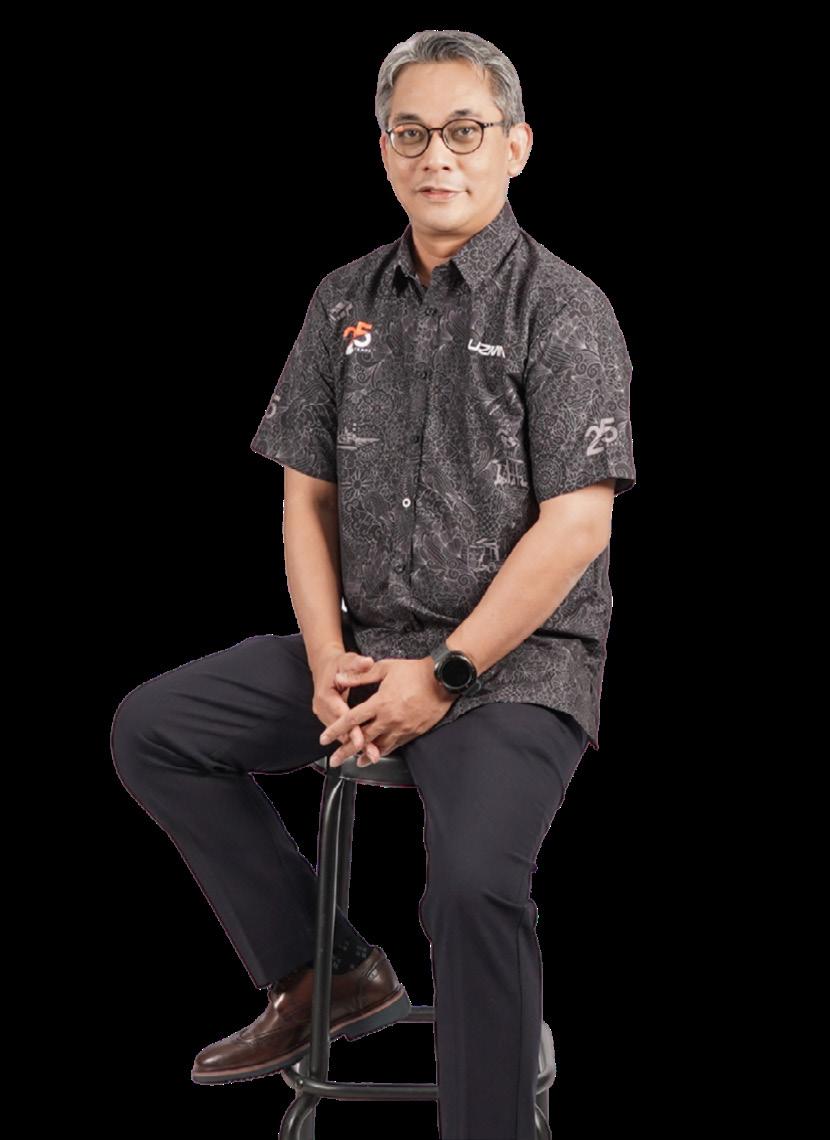
Dr. Ahmad Khalid CTIO, Uzma Group
FEATURING INSIDE
Dipalli Bhatt Marketing Leader, AI/IoT Product
Gabriel Vernalha Ribeiro
Data Governance, Analytics, IA and Innovation Executive, DASA
Geoffrey Allars Head of Customer Engagement, Bayer
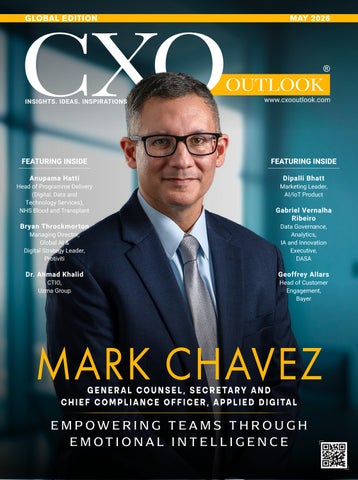
MARK CHAVEZ
GENERAL COUNSEL, SECRETARY AND CHIEF COMPLIANCE OFFICER, APPLIED DIGITAL
EMPOWERING TEAMS THROUGH EMOTIONAL INTELLIGENCE
May 2026
Creative Consultants
Charlie Jameson
Louis Bernard
Managing Editor
Sarath Shyam
Branding & Marketing Partnerships
Jennifer Anderson
Monica Davis
Jessica Edword
Consultant Editors
Dr. John Andrews
Emma James
Andrew Scott
Sabrina Samson
Editorial Enquiry admin@cxooutlook.com
Naomi Wilson
Stanly Lui
Steve Hope
Keith Alexander
Anna Elza
Stephen Donnell
Susan Miller
Partnerships Enquiry admin@cxooutlook.com
Asia-Pacific International Partnerships admin@cxooutlook.com
CXO Outlook www.cxooutlook.com is a global knowledge sharing digital platform published by Connecta Innovation Private Limited. All rights reserved. The opinions expressed in the content and pictures provided are those of the authors. They do not purport to reflect the opinions or views of Connecta Innovation Private Limited or any of its members and we do not assume any responsibility. The publisher does not assume any responsibility for the advertisements, its content, pictures, and all representation of warranties made in such advertisements are those of the advertisers and not of the publisher. CXO Outlook www.cxooutlook.com is a Free Subscription and Free-to-read digital platform strictly not for sale and has to be strictly for internal private use only. Publisher does not assume any responsibility arising out of anyone modifying content and pictures, printing a copy of this digital platform in any format and in any country and all matters related to that.
The Cost of Always Being “On”
There was a time when being busy was worn like a badge of honor. Long hours, packed schedules, late-night emails, and back-toback meetings were seen as signs of ambition and commitment. Today, however, something feels different. The pressure has intensified, but the energy behind it has changed. Across industries, leaders and teams are operating in a constant state of urgency, making decisions faster than ever while carrying the invisible weight of uncertainty, disruption, and emotional exhaustion.
A recent workplace study revealed that burnout is no longer limited to overworked employees at the entry or middle levels. Increasingly, senior executives themselves are reporting fatigue, decision overload, and mental strain. That reality says something important about the modern workplace: productivity without sustainability is a short-lived victory.
Over the past few months, I have had conversations with professionals from different sectors, and one theme repeatedly surfaced.
People are not necessarily afraid of hard work. What drains them is the feeling of being permanently switched on, with little room to pause, reflect, or simply think clearly. In the race to build highperforming organizations, many companies are beginning to realize that resilience cannot be demanded from people without being intentionally supported.
That is why our cover story this month feels especially timely. In our conversation with Mark Chavez, General Counsel, Secretary and Chief Compliance
Officer at Applied Digital, he shares a refreshingly grounded perspective on leadership in high-pressure environments. With more than two decades of experience across legal, technology, and energy sectors, Mark highlights the growing importance of emotional intelligence, adaptability, and human connection in navigating complexity. His insights remind us that the strongest leaders today are not just strategic thinkers, but people who understand people. Beyond the cover story, this issue of CXO Outlook brings together a diverse collection of interviews, expert perspectives, and thought-provoking features exploring leadership, innovation, workplace culture, and the evolving realities of modern business.
As you turn these pages, I hope this edition encourages you to rethink success not as constant motion, but as the ability to grow, lead, and thrive without losing the human side of the journey.
Enjoy Reading.
Sarath Shyam
MARK CHAVEZ
GENERAL COUNSEL, SECRETARY AND CHIEF COMPLIANCE OFFICER, APPLIED DIGITAL
EMPOWERING TEAMS THROUGH EMOTIONAL INTELLIGENCE
EXPERT OPINION
Leading in the Age of AI: Why Leaders Must Evolve Faster Than Technology
Anupama Hatti, Head of Programme Delivery (Digital, Data and Technology Services), NHS Blood and Transplant
28
44
Leading at the Speed of Change: How My Leadership Evolved in an Agile Organisation
Geoffrey Allars, Head of Customer Engagement, Bayer
LEADER'S INSIGHTS
Shaping the Future of Marketing Innovation
Empowering Businesses with AI Innovation
16 Bryan Throckmorton, Managing Director, Global AI & Digital Strategy Leader, Protiviti`
22 Dipalli Bhatt, Transitioned to Leading Marketing for AI/IoT Product for a Multi-billion-Dollar Conglomerate
32 Dr. Ahmad Khalid, CTIO, Uzma Group Leading the Charge in Renewable Energy
Transforming Data into Strategic Value
38 Gabriel Vernalha Ribeiro, Data Governance, Analytics, IA and Innovation Executive, DASA
MARK CHAVEZ
GENERAL COUNSEL, SECRETARY AND CHIEF COMPLIANCE OFFICER, APPLIED DIGITAL
EMPOWERING TEAMS THROUGH EMOTIONAL INTELLIGENCE
Mark Chavez is General Counsel and Chief Compliance Officer of Applied Digital Corporation (NASDAQ: APLD), where he leads legal, HR, compliance, and risk strategy for a publicly traded technology company operating at the intersection of high‑performance computing, AI infrastructure, and digital assets. He brings more than 22 years of experience gained at an Am Law 100 firm and in senior in‑house roles across the energy and technology sectors, including ExxonMobil, World Fuel Services, and PBF Energy. Mark is known for his business‑focused approach to complex regulatory, transactional, and operational challenges and for advising executive teams through periods of rapid growth and transformation.
Recently, in an exclusive interview with CXO Outlook Magazine, Mark shared insights into his passion for navigating complex regulatory landscapes, driven by his love for challenges and adaptability. He emphasized the importance of emotional intelligence (EQ) in identifying and addressing burnout in teams, and how investing in "people skills" like EQ can drive excellence in high performance legal departments. He also shared his personal hobbies and interests, future plans, words of wisdom, and much more. The following excerpts are taken from the interview.
Hi Mark. As a leader in energy and technology law, what drives your passion for navigating complex regulatory landscapes?
I like a challenge. I have never been particularly interested in predicable environments. I don’t shy away from difficult or complex matters. Rather, I am drawn to situations that require creativity, judgment and a willingness to step out into the unknown. Throughout my career, working in the energy and technology sectors has consistently placed me in a position to work on matters touching on evolving regulatory and operational challenges. Those environments demanded constant learning and adaptability. Working in such environments has always brought out the best in me.
What do you love the most about your current role?
Applied Digital has experienced extraordinary growth over the past year, and I expect that pace to continue to accelerate. In this environment, it is vital that I, as the General Counsel and Chief Compliance Officer, respond quickly to these issues while drawing on my experience to assess and mitigate risk thoughtfully. I find it deeply rewarding to work on matters that directly impact the trajectory of my company and leverage the full breadth of my professional experience.
In what ways can EQ help leaders identify and address burnout in their teams, and what strategies can be employed to mitigate it?
Burnout can be difficult to identify, particularly among high performers. Leaders with strong emotional intelligence are better positioned to recognize subtle changes that may suggest someone is reaching their limit. In such instances,
Leaders with strong emotional intelligence are better positioned to recognize subtle changes that may suggest someone is reaching their limit
it is incumbent upon the leader to address this issue by providing appropriate resources to the team. Personally, I am constantly checking in with my team in order to evaluate whether they are reaching the limit of their capacity. If so, I respond quickly to get the appropriate resources in place to alleviate that issue.
How can investing in "people skills" like EQ drive excellence in high-performance legal departments?
People skills are often a key differentiator in highperforming teams. There are countless attorneys that are technically sound; however, many lack the people skills that allow them to foster partnerships with their internal clients and effectively deal with counterparties. While having strong technical skills can get you an adequate result, combining that with a high EQ drives a legal department to the next level by allowing them to execute solutions that have further a company’s overall strategy.
What role has mentorship played in your professional journey, and how do you mentor others?
Mentorship has not been a consistent part of my career, and that has shaped how I approach leadership today. Because of that experience, I made the conscious decision to invest my time in mentoring those who work for me, as well as other young attorneys. I have started internship programs at multiple companies, participated in mentoring programs with various organizations throughout my career and maintain strong relationships with a number of my former mentees. As a senior leader in my organization, and in the legal field, I feel that it is incumbent upon me to share my experiences with those coming up the ranks and to help them where I can, even though, in many instances, my prior leaders chose not to do that for me.
What are some of your passions outside of work? What do you like to do in your time off?
My primary passion outside of work is music. I was a professional musician for several years and, in fact, that is how I paid for college and law school and I will likely go back to that when the day comes that I retire from the practice of law. Music gives me a great deal of joy and the two highlights of my musical career were playing at the White House as a member of the Army’s Musical Escort to the President and performing with my daughter at her senior college recital.
What is your favorite quote?
“Failure is not an option.” I don’t accept failure. While things may not always go the way I
anticipate, I do not accept anything short of success. I was a United States soldier, and it was drilled in us that we complete our missions and that remains with me today. Now, while success has not always looked like I had anticipated, I have always found a way to find success.
Where do you see yourself in the next 5 years?
I plan on remaining with Applied Digital for the rest of my career. This has been by far my favorite place to work and I want to see how far we can take this company.
What advice would you give to emerging leaders in law who want to prioritize EQ and people skills in their career development?
I think prioritizing EQ starts with selfawareness. You need to know how you react in various high-pressure situations and work on strategies to manage those reactions in a way that is productive. This involves thinking before you react in order to avoid reacting to situations in an emotional way that is counterproductive. Once you get past this hurdle, you can then start working on your team, which begins with listening. You can’t listen to your team with the goal of responding. You have to let them express their concerns and experiences to you and think of how to effectively address them. Lastly, a leader needs to learn how to give feedback in a constructive manner that doesn’t cause your employee to feel defensive. The goal should always be to be providing advice in a way that enables the employee’s success and development. If you frame the feedback in that way, it will be much better received.
Wa n t t o S e l l o r fi n d
I nve s t o rs f o r yo u r
B u s i n e s s ?
LEADER’S
Empowering Businesses with AI Innovation
Bryan Throckmorton, Managing Director, Global AI & Digital Strategy Leader, Protiviti
Hi Bryan. As a leader in AI and digital transformation, what drives your passion for driving business growth and innovation?
The nature of business competition has always fascinated me, in terms of trying to understand who is winning in a particular market and why. Clearly companies who have best integrated business and technology typically have an edge. But that alone isn’t enough…you must continually push on innovation in order to keep winning. I’ve had the good fortune to be on the
front lines of AI-powered transformation over the last 10 years and find it both fascinating and challenging! Helping clients reimagine what is possible in different areas of their business and explore how to take an idea and turn it into reality… to me, that’s always been the most fun.
How is AI transforming businesses, and what are the key opportunities and challenges?
The short story is AI is transforming every aspect of business….every business process,
Enterprise platforms are building new capabilities into their platforms all the time, new companies are emerging to tackle discrete tasks, and LLM models and agents are becoming more available and increasingly easy to build and manage
Bryan Throckmorton is a Managing Director at Protiviti and leads the AI & Digital Strategy practice, and for the last 25+ years has leveraged data and technology to help clients drive innovation and improve their performance. He has 11+ years experience in selling and delivering AI solutions, where his work included cutting edge uses of AI for some of the world’s largest companies. At Protiviti, his work includes helping clients develop their AI Strategy, determine the best AI use cases, and accelerating the Idea to Prototype to Production process to improve the impact of AI on their business processes.
Recently, in an exclusive interview with CXO Outlook Magazine, Bryan shared insights into the transformative power of AI in business, highlighting its impact on every aspect of business processes, decision-making, and workforce dynamics. Bryan discussed the implications of AI on jobs and the workforce, stressing the need for AI literacy, re-skilling programs, and acceptable usage policies. He also advised organizations to set explicit ambitions for AI efforts, build operating rhythms, modernize AI governance, and prioritize people development. The following excerpts are taken from the interview.
enhancing every business decision, and changing how people actually do their work. Plus, it is coming to grips with new “colleagues”, Agents (aka digital workers) who can help in a variety of ways. What is powerful now, is that no matter the business process you look at – from front office (how can I create new campaigns based upon my target market – including creative), through middle office opportunities in supply chain, all the way to back office areas such as Finance and HR, opportunities abound for AI to make a material impact. Enterprise platforms are building new capabilities into their platforms all the time, new companies are emerging to tackle discrete tasks, and LLM models and agents are becoming more available and increasingly easy to build and manage. Challenges continue around leveraging data and getting it ready for AI. You
As with any technology, some roles will start to go away, but new ones will be created and the exciting part is, it should unlock human creativity at a level we haven’t seen before
must have trusted data before you can have trusted decisions, and this remains a challenge for many. Modernizing AI Governance is also a challenge, as AI Governance has largely not kept up with AI technical capability, so how to manage areas like agent-to-agent interaction needs to be addressed. Finally, many companies are struggling to generate ROI, and are realizing that the “individual productivity bucket” may not be the magic ROI elixir they thought it was. So how does a business find and capture the true high ROI opportunities? The challenges are many, but these are just a few of the ones I see the most often.
What are the implications of AI on jobs and the workforce, and how can organisations mitigate these risks?
Super hot topic in the AI world right now. I do think a couple of the soundbites out there will
definitely hold true, in terms of the AI-augmented human will have a significant advantage and be more valuable than the non-AI-augmented human. Given this, if you are looking at your workforce, you have to ensure that you are doing a few things: A) Ensure your people are building AI literacy and understand the tools available to them. B) Have the freedom to suggest potential changes to business processes based upon the potential of AI C) Offer reskilling programs to continually build the skills in and around AI that can help them contribute to broader areas of the business and D) Understand the acceptable usage policies and governance around their AI programs. There is no doubt that the future workforce will be a combination of digital workers/agents, and human workers leveraging AI. Organizations are going to have to start looking from the “bottom up” in terms of specific tasks and job roles to understand what
combination of those offer the best performance, but also how to manage and govern them over time. As with any technology, some roles will start to go away, but new ones will be created…. and the exciting part is, it should unlock human creativity at a level we haven’t seen before. For example…….I can barely draw a stick figure, but with AI I can design incredible creative. Or even though it has been some time since I’ve written code, I can create my own prototypes in tools like Lovable. It’s giving folks with creative and critical thinking skills super powers.
What’s the most important quality you look for in a team member or colleague?
People overuse the term, but I think the “growth mindset” is extremely important. Technology and AI in particular are moving so fast, you have to learn as much as you can, but also be continually seeking knowledge. Adaptability is a branch of this same tree, how fast can you move when a situation changes? I also look for people who really press to understand the value behind a technology or business decision. Finally, the ability to work within a team is more important than ever. It is usually taking an integration of disciplines to truly achieve a business transformation – people who understand what they know, what they don’t know, and how to engage and value others to fill those gaps – those are the ones I love to have on my team.
If you could have dinner with any historical figure, who would it be and why?
Ha, it’s hard to come up with 1 answer! I would have to say Mark Twain. He’s from
the South part of the United States, just like me. I’m always impressed by people who can combine insight with simplicity—Twain had this knack for exposing what’s true about people and systems in a way that was easy to understand, and doing it in a way that disarms you rather than offends you. He also knew how to integrate humor to make his points clear and his story more compelling. Humor utilized
the right way can be extremely powerful. One of my favorite quotes is attributed to him –“Always do right - it will gratify some people and astonish the rest” which I always try to stand by. I’d love to ask him how he decided what was worth saying versus what was just clever; and second, would love to share about the world today and compare with how he thought it might turn out.
What’s something on your bucket list that you’re excited to tackle soon?
I love the outdoors. I spend so much time inside, that whenever I get a chance to go outside, I take it. Hence, while I’ve traveled the globe many times, I have still never went to a place that has been on my list for a while……Alaska! However, we are in the process of planning either a trip there or a cruise or maybe both. I’ve seen so many beautiful videos, I’m ready to see it for myself.
What advice would you give to organisations looking to leverage AI to drive innovation and growth?
First, I would advise that it is really important to set an explicit ambition for your AI efforts, some might call that having an AI Strategy. It clearly outlines where the highest value of opportunities are, and what it will take to capture that value. Second, I would encourage them to build some operating rhythms around how to intake ideas, prioritize them, turn them into well-designed prototypes, and ultimately taking them into production. Production implementation is where all of the ROI lives, but many organizations haven’t built the muscle memory yet to do this consistently and repeatably. Third, I think you have to modernize your AI Governance processes. Too many organizations look at this after they’ve already built something, when the reality is things go much smoother if these types of considerations are identified on the front end. Finally, I would say the people component is critical…..ensuring your organization is continuously building AI literacy, understands the tools available to them and ways to build skills, are very important in terms of having employees be active contributors to AI powered transformation.
Shaping the Future of Marketing Innovation
Dipalli Bhatt,
Transitioned to Leading Marketing for AI/IoT Product for a Multi-billion-Dollar Conglomerate
Hi Dipalli. As AI and IoT continue to transform industries, what emerging trends should marketers prioritize to stay competitive?
What’s changing most rapidly is that marketing is no longer just about influencing decisions, it’s about participating in operations. With AI and IoT, products themselves are becoming active communication channels. A serialized product, a connected asset, or a sensor-enabled shipment is now generating signals that can trigger marketing, service, and supply chain actions in real time.
Marketers need to prioritize what I call “decision adjacency.” Instead of building campaigns that sit outside the business, they need to embed themselves where decisions happen—on the shelf, in the warehouse, at the point of consumption. The future isn’t more personalized ads; it’s context-aware interactions driven by real-world events.
Another major shift is the rise of agentic systems. AI is moving from analysis to action— autonomously optimizing pricing, inventory flows, or customer engagement. Marketers
We’re entering a phase where data is no longer just something we analyze, it’s something we negotiate with
Dipalli Bhatt is a visionary marketing leader with over 20 years of experience across B2B and D2C sectors with companies like Disney, TD Canada Trust to name a few. She is an AI practitioner who was previously the Head of Marketing, Asset Management at AssetWorks Inc. and is currently at another conglomerate bringing AIoT products to market. She drives scalable growth through strategic product marketing, storytelling, and customer-centric innovation. A Forbes Communications Council member and Marketo Fearless 50 honoree, Dipalli is a passionate mentor and advocate for women in tech. She’s known for transforming complex tech into compelling narratives and building highperforming teams that drive commercial success. Recently, in an exclusive interview with CXO Outlook Magazine, Dipalli shared insights into the rapidly changing marketing landscape, emphasizing the importance of “decision adjacency” and embedding marketing into business operations. She highlighted the rise of agentic systems, where AI moves from analysis to action, and stressed the need for marketers to understand and guide these systems. Dipalli also discussed the role of data and analytics in shaping marketing decisions, advocating for “living data ecosystems” that enable real-time decision-making. The following excerpts are taken from the interview.
Marketers need to understand how business systems connect, how a transaction flows, how a product moves, how a signal is generated and acted upon. This systemslevel thinking is becoming critical
who understand how to shape and guide these systems, rather than just consume their outputs, will have a significant edge.
What role should data and analytics play in shaping marketing decisions, and how can organisations leverage these insights effectively?
We’re entering a phase where data is no longer just something we analyze, it’s something we negotiate with.
The next frontier is what I call “living data ecosystems.” Instead of static dashboards and periodic insights, data becomes continuously
active—streaming, evolving, and influencing decisions in real time. AI models don’t just interpret data; they interact with it, challenge it, and even generate synthetic scenarios to test decisions before they’re made.
The real leverage comes from moving beyond integration to data orchestration. It’s not about connecting systems anymore. It’s about enabling data to flow, adapt, and trigger actions autonomously across them. For instance, when AI can simulate demand shifts based on external signals like weather, geopolitics, social sentiment, you move from predictive analytics to pre-emptive strategy.
Organizations that win will treat data less like an asset to store and more like a dynamic environment to operate within. The question is no longer “What happened?” but “What should we simulate, test, and act on next?”
What are the key skills required for future-ready marketing professionals, and how can organizations develop these skills?
The future marketer is part strategist, part systems thinker, and part translator.
It’s no longer enough to be creative or analytical in isolation. Marketers need to understand how business systems connect, how a transaction flows, how a product moves, how a signal is generated and acted upon. This systems-level thinking is becoming critical.
Equally important is the ability to translate complexity into clarity. With AI, the challenge isn’t lack of insight—it’s overload. The best marketers will be those who can take complex, multi-layered data and turn it into simple, compelling narratives that drive action.
Organizations can develop these skills by breaking traditional boundaries. Rotate marketers through product, operations, or even customer support functions. The closer they are to how the business actually runs, the more effective they become.
What’s the most important quality you look for in a team member or colleague?
Intellectual curiosity, but with a bias for action.
In a world that’s evolving this quickly, no one has all the answers. What matters is the willingness to question assumptions, explore
new ideas, and then actually do something with those insights.
I value people who don’t wait for perfect clarity. They are comfortable operating in ambiguity, testing ideas, and learning fast. That combination of curiosity and execution is what drives real progress.
If you could have dinner with any historical figure, who would it be and why?
I would choose Leonardo da Vinci.
Not just because of his brilliance, but because of how he thought. He didn’t see boundaries between disciplines—art, science, engineering, anatomy—they were all interconnected in his mind.
That way of thinking feels incredibly relevant today. As we move into an era shaped by AI, IoT, and complex systems, the ability to connect seemingly unrelated domains is becoming one of the most valuable skills.
What’s something on your bucket list that you’re excited to tackle soon?
I’m very interested in exploring what I would call a “Cognitive Enterprise Twin.”
We’ve seen digital twins in manufacturing and supply chains, but the next evolution is creating a real-time, AI-powered replica of how an organization thinks and makes decisions. Imagine a system that mirrors not just operations, but strategy—one that can simulate market moves, pricing decisions, customer reactions, and even internal trade-offs before they happen.
This isn’t just about efficiency, it’s about decision foresight. Leaders could test multiple futures in parallel and understand second-
As we move into an era shaped by AI, IoT, and complex systems, the ability to connect seemingly unrelated domains is becoming one of the most valuable skills
and third-order impacts before committing resources.
It’s still early, but I believe this will fundamentally change how organizations plan, compete, and innovate. Instead of reacting to the market, they will be able to rehearse it.
What advice would you give to organisations looking to drive scalable revenue engines and commercial growth strategies in a rapidly changing marketing landscape?
Most organizations are still trying to scale outcomes. The real shift is to scale decision velocity.
In an AI-driven landscape, growth doesn’t come from doing more campaigns or reaching more people, it comes from making faster, better, and more context-aware decisions at every point in the business. That requires building systems where intelligence is embedded directly into workflows, not layered on top of them.
The companies that outperform are those that design for continuous adaptation. They don’t lock into fixed strategies; they build architectures that allow strategy to evolve in real time based on signals from customers, markets, and operations.
This also means rethinking ownership. Growth is no longer the responsibility of marketing alone, it’s distributed across product, operations, finance, and AI systems working in tandem.
In the next phase of competition, the advantage won’t be who has the best message. It will be who has the most responsive, selfimproving system for turning signals into action.
Leading in the Age of AI: Why Leaders Must Evolve Faster Than Technology
Anupama Hatti, Head of Programme Delivery (Digital, Data and Technology Services), NHS Blood and Transplant
Artificial intelligence is no longer the story of tomorrow. It’s here, it’s accelerating, and it’s reshaping the way organisations think, act, and compete. But the biggest disruption AI brings isn’t technological at all, it’s human. And the leaders who thrive in this new era will be the ones who recognise that the leadership playbook itself needs a rewrite.
Across sectors, AI is transforming the rhythm of work. It’s taking on routine tasks, revealing insights in seconds, and opening doors to new ways of delivering value. Yet while the technology races ahead, leadership behaviours often stand still. That gap between AI’s speed and organisational readiness is where the real risk lies. The companies that succeed won’t necessarily be the ones with the most advanced algorithms, but those with leaders who adapt quickly, think differently, and create
conditions where AI can be used responsibly and confidently.
Today’s leaders don’t need to become AI engineers. But they do need to understand enough to ask better questions, make smarter decisions, and nurture a culture that can embrace intelligent transformation.
AI Isn’t Just Changing Business, It’s Changing Leadership
In previous waves of digital transformation, much of the heavy lifting sat with IT or specialist teams. AI has blown past those boundaries. Its influence touches every corner of the organisation: from operations and customer experience to risk, governance, and innovation. It has become too integral, too strategic, and too consequential to be delegated away. Traditional leadership models were built for a world of predictability, hierarchies, and linear
Anupama Hatti is Head of Programme Delivery at NHS Blood and Transplant, with over 22 years of experience across Telecom, Aerospace, Defence, Digital, and Healthcare sectors. A recognised digital leader and IT Leaders 100 honouree, she has led complex national transformation programmes and champions diversity, equity, and inclusion. Anupama is also a practicing artist, STEM Ambassador, and passionate mentor, combining creativity with a mission to drive meaningful change in public service through technology and leadership.
As AI becomes more embedded in everyday work, employees’ expectations of leadership intensify. Excitement and anxiety coexist
decision-making. AI operates on speed, scale, and complexity generating content instantly, surfacing insights in real time, and challenging long-held assumptions about how work gets done.
This demands a new style of leadership: adaptive rather than rigid, exploratory rather than certain, and ironically more human than ever.
Curiosity: The New Core Competency
For decades, leaders were rewarded for having the answers. In the age of AI, the leaders who stand still those who assume they already know enough will quickly fall behind.
Curiosity is now a strategic capability.
The leaders who ask the right questions unlock opportunity.
Where can AI remove friction?
Where could it elevate quality or speed?
Where are the ethical guardrails needed?
Where must human judgment remain irreplaceable?
These aren’t technical questions. They’re leadership questions.
And when leaders role-model curiosity openly learning, experimenting, and acknowledging what they don’t yet know, they give others permission to do the same. That is how cultures of responsible innovation take shape.
The More Advanced the Technology, the More Human Leadership Must Become
As AI becomes more embedded in everyday work, employees’ expectations of leadership intensify. Excitement and anxiety coexist.
People wonder: What does this mean for my job? Will my skills still matter? How fast will things change?
Introducing AI as merely a productivity tool misses the human experience entirely and risks fuelling resistance.
Leaders need to ground AI conversations in honesty, clarity, and purpose. They must involve people early, not after decisions are locked in. They must invest in skills, not assume people will “figure it out.” And they must recognise that AI transformation is not only operational, but also emotional.
The organisations that flourish will be those that combine technological intelligence with human empathy.
Ethics and Governance: Leadership’s Non-Negotiables
As AI adoption grows, the spotlight on responsible use becomes sharper. Issues like bias, privacy, transparency, and security are no longer “nice to have.” They’re board-level priorities.
Leaders don’t need to code models, but they do need to ensure that strong guardrails, clear policies, and ethical standards guide how AI is used. Moving fast is not always the right answer. Sometimes the most responsible leadership choice is to pause, ask harder questions, and ensure trust is not sacrificed for speed.
In sectors dealing with sensitive data, vulnerable communities, or life-impacting decisions, this responsibility becomes even more profound. Power without accountability is a risk no organisation can afford.
Rethinking Talent: Building AI Confidence Across the Workforce
AI is changing not only how work is done, but what skills matter. While technical AI expertise is crucial, the broader workforce also needs foundational AI awareness, digital confidence, and critical thinking.
Forward-thinking organisations won’t rely on pockets of expert capability. They will elevate understanding across the entire workforce equitably, practically, and at scale.
Upskilling and reskilling are no longer optional. They are central to organisational resilience.
Balancing Vision and Pragmatism
Conversations about AI often swing between hype and fear. Strong leaders resist both extremes. They hold a clear vision of how AI can unlock growth and open new possibilities, but they stay grounded in real use cases, real problems, and real value.
Not everything needs AI. Not every shiny tool drives impact. Leadership today is about clarity: What problem are we solving? Why? And is AI truly the right answer?
Thoughtful, purpose-led decision-making will separate the noise from the meaningful.
Leadership Must Evolve Before the Organisation Can
The future will reward leaders who are willing to evolve.
Those who embrace curiosity over certainty. Those who stay deeply human in their leadership.
Those who champion responsible innovation.
Those who create cultures built on learning, experimentation, and trust.
AI will keep advancing, that much is guaranteed. The real question is whether leadership will advance with it. Because ultimately, this is not a test of technological maturity. It is a test of leadership relevance.
In a world transformed by intelligent systems, leaders must adapt faster than the technology, not because they need to outsmart the machines, but because they are responsible for guiding the people, decisions, and consequences that surround them.
And that is the true leadership challenge of our time.
Leading the Charge in Renewable Energy
Dr. Ahmad Khalid, CTIO, Uzma Group
Hi Dr. Khalid. The energy landscape is rapidly evolving - What emerging trends do you believe will have the most significant impact on the industry? It’s great to be speaking with Digital First Magazine. Personally, I’ve always been driven by curiosity figuring out how things work and how we can make them better. That same mindset applies to the energy sector today. Having spent much of my career in both the technology and energy sectors, I’ve seen how these two industries are now converging
in very powerful ways. On one side, there’s a strong global push towards cleaner and more sustainable energy, particularly renewables. At the same time, digital transformation is becoming a game-changer. Technologies like Artificial Intelligence and IoT are helping us optimize operations, make energy systems smarter, and improve safety across the board. But what excites me most is that this convergence of technology and energy is giving us the chance to reshape the future. As Reid Hoffman once said, “An entrepreneur
In energy, those who dare to innovate, challenge the norm, and lead with purpose are the ones who will drive real, lasting impact
After graduating from the University of Pennsylvania in 1995 with a bachelor’s degree in electrical engineering, he started as an electronic engineer in Penang, Malaysia. He then worked at multinational corporations like Motorola, Hewlett-Packard, Agilent, and Broadcom, concurrently pursuing master’s and doctoral degrees in management from Universiti Utara Malaysia. In 2010, he joined MIMOS Berhad, under the Ministry of Science, Technology and Innovation (MOSTI) as a senior manager of technology ventures.
Later, in 2018, he became CEO of the Renewable Energy Division at Uzma Berhad, a publicly listed company, eventually rising to Chief Technology and Innovation Officer.
During his CEO tenure, Uzma secured its first 70MWdc under Malaysia Large Scale Solar project, the first for oil and gas company in Malaysia to secure this size . His mission involves integrating AI into traditional oil and gas operations with renewable energy needs to optimize energy output.
Recently, in an exclusive interview with CXO Outlook Magazine, Dr. Khalid shared insights into the emerging trends shaping the energy industry, emphasizing the convergence of technology and energy, and the importance of innovation in driving real impact. He also discussed his approach to innovation, citing the book “Freakonomics” as a key influence, and shared his pride in leading Uzma’s transition into renewable energy. The following excerpts are taken from the interview.
is someone who jumps off a cliff and builds a plane on the way down.” In energy, those who dare to innovate, challenge the norm, and lead with purpose are the ones who will drive real, lasting impact.
Energy access is a pressing concernHow do you believe the industry can address energy poverty and ensure universal access?
Energy access is something I genuinely care about. To me, it’s not just about turning on a light or powering a business it’s about giving people the tools and opportunities to improve their lives. In my experience, the best way to tackle energy poverty is by combining practical solutions with smart technology. For instance, Malaysia government had launched National Energy Transition Roadmap, or NETR, in 2023. NETR is a strategic plan to accelerate the nation’s effort toward a sustainable and low-carbon economy to achieve net-zero greenhouse gas emissions by 2050. This roadmap outlines actionable initiatives across six key levers such as renewable energy, energy efficiency and green mobility to drive environmental sustainability and simultaneously boosting economic growth and job creation.
I’ve also seen how much more impact we can create
when people work together. Governments, companies, and local communities all need to be part of the conversation, because a solution that works for one place may not work for another. For me, the most exciting part is when technology meets purpose not just providing energy, but opening doors, creating new possibilities, and helping communities grow in ways they couldn’t before. That’s when innovation feels real and meaningful.
The shift to renewable energy requires new skills - What capabilities do you believe energy professionals need to succeed in this new landscape?
The shift to renewable energy isn’t just about technology, it’s about people evolving with the industry. As I always say, “technology may drive change, but people enable transformation.”
First, the technical side matters. You need to understand renewable systems, energy storage, and digital tools like data analytics. That’s how you make operations smarter and more sustainable. But that’s only part of the story.
Second, adaptability is everything. The industry is moving fast. The truth is, what worked yesterday might not work tomorrow. Can we stay curious? Can we keep learning and step outside our comfort zones? Those who do are the ones who’ll thrive.
Finally, collaboration and strategic thinking make all the difference. This energy transition isn’t something any single player can do alone. Governments, tech innovators, industry, we all need to move together. The real insight? The people who connect technology, strategy, and execution and can work across disciplines are the ones shaping the future.
At the end of the day, it comes down to combining knowledge, curiosity, and teamwork. That’s how we actually make the energy transition happen.
Your educational background is quite impressive - What’s the most inspiring book or resource that’s shaped your approach to innovation?
Thank you, I really appreciate that. Over the years, I’ve been inspired by many books and research on innovation and leadership, but what really sticks with me is the idea that innovation often starts with curiosity asking questions, challenging assumptions, and looking at problems from a fresh perspective.
One of the books that really shaped how I think about innovation is “Freakonomics” and “SuperFreakonomics” by Steven Levitt and Stephen Dubner. What I loved about them is that they show innovation isn’t always about grand, genius ideas. Often, it’s about seeing the world differently, noticing patterns others might miss, and understanding the incentives that really drive people.
And remember what I mentioned earlier about curiosity? That’s exactly what these books reinforced for me. Personally, they changed the way I approach problems. Instead of just following the obvious solutions, I try to ask, “Why are people really doing this? What’s
behind the behavior we, see?” That mindset has helped me uncover practical, sometimes unexpected solutions in both technology and energy solutions that actually make a difference in people’s lives.
As you look back on your career, what accomplishment are you most proud of, and why?
Looking back on my career, it’s hard to choose just one accomplishment, because every step has shaped the journey. But what I’m most proud of is leading Uzma’s transition into renewable and new energy. Moving from a traditional oil and gas services company to one that embraces clean energy and innovation was no small task.
Completing our first 50 MW solar project stands out not just because of the numbers, but because it proved that bold ideas could become reality. Seeing the impact, it will have on reducing CO₂ emissions made it incredibly rewarding.
I’m equally proud of the partnerships and collaboration we’ve built. At the end of the day, it’s not just about projects, but about people, ideas, and working together to make a real difference.
And the truth is, reflecting on these accomplishments reminds me that the journey doesn’t stop here. Continue to learn and innovate. Sky is the limit.
If you could have dinner with any historical figure, who would it be and why?
If I could have dinner with any historical figure, I would choose Nikola Tesla. What strikes me about him is not just his brilliance
Roles may change, industries shift, and even networks or reputations can evolve over time.
But what you’ve learned and the skills you’ve developed will always stay with you
but his fearless imagination and unwavering belief in possibilities that no one else could see. He dreamed of a world powered in ways people at the time thought impossible, and yet he kept working, experimenting, and pushing boundaries despite skepticism, setbacks, and even personal sacrifices.
What hits me personally is how much that mirrors the journey of anyone trying to innovate today. There have been moments in my own career where, taking a bold idea forward felt daunting, where the path was not clear, and doubts were everywhere. It makes me wonder, how did he keep believing in his ideas when everyone else doubted him? What gave him the courage to persist when the odds were against him? Thinking about that reminds me that true progress often comes from persistence, curiosity, and a willingness to challenge the ordinary, even when it is uncomfortable.
If I had the chance to sit with him, I would want to ask those questions, and also understand the sparks of inspiration that kept him going. For me, that dinner is not just about history. It is about learning from someone who dared to dream bigger than anyone else and finding the courage to do the same in my own work, developing solutions that make a real difference for people and communities.
What’s something on your bucket list that you’re excited to tackle soon?
That’s a great question. To be honest, something that’s always been on my personal bucket list is continuing to grow and challenge myself, especially as the energy industry evolves so quickly. I’ve always enjoyed exploring new ideas whether it’s emerging technologies, different ways of solving problems, or simply understanding how things can be done better.
Lately, I’ve been inspired by a concept from The Diary of a CEO by Steven Bartlett that really stuck with me the idea of “Fill Your 5 Buckets”: Knowledge, Skills, Network, Resources, and Reputation.
Over the years, I’ve come to realise that while all five are important, knowledge and skills are truly the foundation. Roles may change, industries shift, and even networks or reputations can evolve over time. But what you’ve learned and the skills you’ve developed will always stay with you.
So for me, it’s about continuously building those first two buckets, learning, sharpening my thinking, and finding new ways to apply that knowledge in meaningful ways. That process of growth is something I genuinely enjoy, and it’s something I hope to keep pursuing for many years to come.
Transforming Data into Strategic Value
Gabriel Vernalha Ribeiro, Data Governance, Analytics, IA and Innovation Executive, DASA
Hi Gabriel. As a seasoned Data & Analytics professional, what do you enjoy most about working in the field of data science and AI?
In the field of Data Science and AI, what fascinates me most is the ability to transform the raw potential of data into strategic value and tangible impact. It’s about designing an architecture that allows data to be turned into a clear and actionable narrative for the organization. It’s not just about building models or optimizing algorithms; it’s about uncovering
hidden patterns, predicting future trends, and fundamentally empowering decision-making with intelligence and precision.
It is incredibly rewarding to witness the journey of an insight, which often begins as a hypothesis or a data anomaly, evolving into a transformative business initiative. Whether optimizing operational processes, personalizing the customer journey, or identifying new market opportunities, the impact is direct and measurable. Furthermore, the constantly evolving nature of data science and AI ensures
To successfully navigate the constantly changing landscape, leaders must look beyond the hype and focus on trends that offer strategic leverage and long-term resilience
Gabriel Vernalha Ribeiro graduated in Electrical Engineering, MBAs and Executives certifications in Project Management, Business intelligence, Finance, Leadership, Data Science and IA in many institutions. He has always worked in the Data and Analytics field, over 20 years, since EDS at GM in Detroit, through HP and later as COO of a portuguese consultancy, responsible for planning, managing and deploying data projects in many big companies in several industries like finance, retail, education, health and telecom, until returning to the healthcare market in 2018, where he had the opportunity to create and lead a data team from scratch at Unimed Nacional, the largest cooperative system in the world, with more than 20 million clients, for over 6 years, and recently accepted the challenge of restructuring the data area of the largest diagnostics company in Latin America and the fourth largest in the world, DASA in Brazil. Regarding his volunteer work, Gabriel served at PMI Brazil for 7 years, since Project Manager till Director and also Governance Council until the end of 2024, and since then he is dedicated to DAMA Brazil volunteering as Director as well, In January of this year, he began serving on the Dama International Board of Directors.
Recently, in an exclusive interview with CXO Outlook Magazine, Gabriel shared insights into his passion for transforming data into strategic value and tangible impact. He emphasized the importance of emerging trends like Generative AI, Data Fabric, and Responsible AI, and highlighted the need for leaders to foster a culture of data-driven innovation within their teams. Gabriel also discussed his admiration for Leonardo da Vinci’s interdisciplinary approach and curiosity, and stressed the importance of curiosity, business translation, resilience, and ethics in emerging leaders. He shared his excitement about structuring a data governance workshop focused on Data Owners and offered advice to emerging leaders in data and analytics. The following excerpts are taken from the interview.
a continuous learning environment. Each new challenge presents an opportunity to explore new technologies, methodologies, and approaches, keeping the mind engaged and creativity flowing. It is a field where curiosity is not only encouraged but essential for success.
As data and analytics continue to transform industries, what emerging trends should leaders prioritize to stay competitive?
To successfully navigate the constantly changing landscape, leaders must look beyond the hype and focus on trends that offer strategic leverage and long-term resilience. The crucial areas are:
Generative AI & LLMs:
Generative AI represents a leap in the ability of machines to create, synthesize, and interact, increasing human creativity and productivity. Leaders should prioritize controlled experimentation and business applications, creating safe environments (sandboxes) for teams to explore the potential of LLMs. The focus should be on high-value use cases, such as content automation, developer assistance, customer experience improvement, and product innovation. It is equally crucial to establish specific governance and ethics for Generative AI, developing clear policies for responsible use, transparency, and auditability, given the complexity of authorship, bias, and intellectual property.
Data Fabric & Data Mesh
With the increasing distribution and volume of data, traditional architectures become bottlenecks. Data Fabric, which integrates data from various sources, and Data Mesh,
a decentralized approach that treats data as products, are crucial for scalability and agility. They enable data decentralization and ownership, empowering domain teams to manage their own data and reducing central dependency. They promote self-service and democratization, providing intuitive platforms for business users to access and utilize data independently. Finally, they ensure standardization and interoperability through rigorous rules, ensuring that data is easily discovered and consumed throughout the organization.
Responsible AI and Ethics
As AI becomes ubiquitous and impacts critical decisions, responsibility and ethics are no longer optional but a strategic imperative. Leaders must prioritize the construction of AI governance frameworks, establishing policies and processes to mitigate risks such as algorithmic bias and privacy. Inclusive design and bias mitigation are fundamental, ensuring representative training data and rigorous testing. Transparency and explainability (XAI) are essential to explain how models make decisions, building trust. Finally, privacy by design must be incorporated from the outset, protecting sensitive information with advanced techniques.
How can leaders foster a culture of data-driven innovation within their teams?
Fostering a data-driven innovation culture is a challenge that requires more than just investment in technology; it demands a cultural and organizational transformation. The key is to create an environment where data is seen as a strategic asset and curiosity is encouraged. The most effective strategies include:
Clear
communication of vision is essential, articulating how data and AI will drive business strategy, engaging teams, and demonstrating the impact of their work
Democratization of Access and Data Literacy
It’s not enough to have data; people need to know how to access, interpret, and use it. This involves providing intuitive self-service platforms (such as interactive dashboards and BI tools) that allow business users to explore data independently, without constantly relying on data and IT teams. In parallel, data literacy programs are essential to develop the analytical skills of the entire workforce, from basic concepts to understanding AI application. Furthermore, establishing open communication channels (forums, communities of practice) fosters a sense of community and collective learning, where insights are shared and collaboration is stimulated.
Encouraging Experimentation and Continuous Learning
Innovation is born from experimentation. Leaders must create an environment where intelligent failure is seen as a learning opportunity, not a mistake to be punished. This translates into a Test & Learn culture, encouraging hypothesis formulation and
experimentation (A/B testing, proofs of concept) to validate ideas and document results, whether successes or failures, for knowledge sharing. Allocating time for innovation is also crucial, dedicating part of team time to exploratory projects, such as hackathons or innovation days. Finally, recognition and reward should celebrate not only successes but also significant learnings, reinforcing that the innovation process is as important as the final outcome.
Leadership by Example and Strategic Vision
Data culture starts at the top: leadership must be the primary advocate and user of data. This manifests in data-driven decision-making, where leaders consistently demonstrate the use of analytics to inform their strategies, making the question “What do the data tell us?” the norm. Clear communication of vision is essential, articulating how data and AI will drive business strategy, engaging teams, and demonstrating the impact of their work. Finally, continuous investment in people, technology, and training for data and AI initiatives demonstrates a longterm commitment to data-driven transformation.
If you could have dinner with any historical figure, who would it be and why?
My choice would be, without hesitation, Leonardo da Vinci. He was a genius who transcended the boundaries between art and science, engineering, and philosophy, seeing knowledge as an interconnected universe. This perspective is incredibly relevant to current data science, which requires a fusion of technical skills, creativity, and deep business understanding. I would invite him to explore his methodology of thought and observation. How would he approach the complexity of modern data? I believe he would be fascinated by the ability to process and analyze information on a scale he could only imagine. His empirical approach, dedication to experimentation, and relentless pursuit of the ‘why’ are qualities every data and AI professional should seek. Furthermore, his ability to communicate complex ideas through drawings and detailed annotations is a valuable lesson in the art of visual communication and data storytelling. In short, a dinner with Leonardo da Vinci would be a masterclass on how to integrate different forms of knowledge, cultivate curiosity, and apply an analytical and creative mind to solve complex challenges, the backbone of innovation in Data and AI.
What’s the most important quality you look for in a team member or colleague?
In the dynamic and constantly evolving landscape of Data and AI, where tools and technologies change rapidly, the most important quality I seek in a team member or colleague is unwavering curiosity. This characteristic goes
beyond specific technical skills and becomes the fundamental driver for individual growth and collective success. Curiosity is vital because it drives continuous learning, this area of data and AI does not allow for stagnation, and a curious colleague actively seeks new knowledge and stays updated. It also fosters creative problemsolving, leading to deep questions and the identification of the root cause of anomalies, developing innovative solutions. Furthermore, it promotes data exploration, where the professional delves deeper, seeking patterns and insights that a superficial approach would miss, seeing data as stories waiting to be told.
What’s something on your bucket list that you’re excited to tackle soon?
I’ve been structuring a data governance workshop focused on Data Owners. The goal is transforming the perception of bureaucracy in data management activities into business value, engaging leaders in the management of their data assets, formalizing existing responsibilities, and connecting them to human and strategic purpose.
What advice would you give to emerging leaders in data and analytics?
For emerging leaders in data and analytics, the core advice centers on three fundamental pillars for lasting impact: mastering business translation to connect technical insights with tangible business value; cultivating resilience and adaptability to navigate the field’s constant evolution; and prioritizing ethics and governance from the outset to build trust and ensure responsible AI. Ultimately, leaders are reminded that they are not just building models, but shaping the future with purpose, intelligence, and integrity.
Leading at the Speed of Change: How My Leadership Evolved in an Agile Organisation
Geoffrey Allars, Head of Customer Engagement, Bayer
Over the past three years, my leadership has undergone a profound transformation—far more significant than any shift I experienced earlier in my career. The change was not driven by a new business process, a structural adjustment, or an agile framework. Instead, it began with a deep commitment to self-awareness and an honest examination of how I was showing up as a leader. In an agile organisation, where adaptability, empowerment, and rapid learning define success, this internal evolution became essential.
For much of my working life, I led from a place of logic, clarity, and business outcomes. I believed that strong leadership meant providing direction, diagnosing problems quickly, and ensuring execution. I prided myself on being a capable coach—someone who developed talent
and helped others grow. What I did not realise at the time was that my coaching often operated at the surface level. I was listening to respond, not listening to understand. I was waiting for the moment to be understood, rather than creating the space for others to feel heard first.
This imbalance became more visible as the organisation shifted further into agile ways of working. Agile environments thrive when people feel empowered to contribute, experiment, and take ownership. They require psychological safety, real connection, and leaders who demonstrate curiosity as much as clarity. My natural strengths—decisiveness, pace, structure—were still valuable, but when overplayed, they could overshadow the very conditions an agile team needs. Clarity became control, pace became pressure, and coaching slipped into correcting.
Geoff Allars is the Head of Customer Engagement with over two decades of experience leading high-performing commercial teams in the pharmaceutical industry. Passionate about coaching, capability building, and customer-centric transformation, Geoff has spent the past three years deeply committed to evolving his leadership to better support agile ways of working. His journey has focused on strengthening self-awareness, balancing logic with empathy, and building cultures grounded in trust, psychological safety, and shared ownership.
In an agile organisation, leaders are not simply responsible for driving results; they are accountable for creating an environment where results can be delivered through empowered teams
The most pivotal moment in my journey came when I began actively seeking feedback from colleagues, leaders, and team members. I made a deliberate choice not to defend, explain, or soften the feedback. I simply absorbed it. That discipline— sitting with the discomfort— revealed blind spots I would never have uncovered alone. I realised that even with the best intentions, my impact was not always aligned to what people needed from me. Instead of pausing to understand the context or the emotions behind a conversation, I was often moving too quickly to the solution.
In the dynamic and constantly evolving landscape of Data and AI, where tools and technologies change rapidly, the most important quality I seek in a team member or colleague is unwavering curiosity
From there, the work became about interrupting my old leadership patterns. I learned to short-circuit automatic responses by introducing small but intentional habits: pausing before offering an opinion, asking an additional question to truly understand the underlying issue, and reflecting back what I heard before shaping a decision. These seemingly simple practices created a profound shift. They helped me lead not only with my head, but also with my heart. They also helped rebuild moments of connection and trust that are critical in agile teams trying to move at pace.
Over time, I began to see the difference this balance made. People contributed more openly. Problem-solving became faster because assumptions were surfaced earlier.
Alignment improved because individuals felt part of the conversation, not passengers in it. Empathy did not dilute performance; it strengthened it. By understanding people more deeply—their motivations, their pressures, their strengths—I became better able to support them in delivering outcomes sustainably.
Today, my leadership is more grounded and more balanced. I still value clarity and strong execution, but I pair them intentionally with curiosity, empathy, and a willingness to adapt. I no longer see vulnerability or openness as distractions from performance—they are prerequisites for it. In an agile organisation, leaders are not simply responsible for driving results; they are accountable for creating an environment where results can be delivered through empowered teams.
This evolution is ongoing. I am still learning to recognise when my strengths begin to tilt into overuse and adjusting accordingly. I continue to seek feedback and use it as a catalyst for growth. What has changed most is the belief that leadership is not about having the answers—it is about enabling others to find the best path forward together. Leading with both head and heart has made me more effective, more connected, and more aligned with the type of leader an agile organisation requires today and in the future.