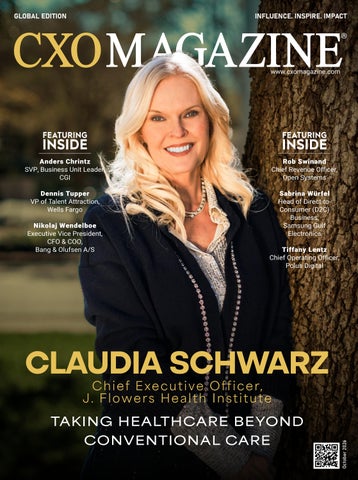
GLOBAL EDITION
INFLUENCE. INSPIRE. IMPACT
FEATURING
FEATURING
INSIDE
INSIDE
Anders Chrintz SVP, Business Unit Leader, CGI
Rob Swinand Chief Revenue Officer, Open Systems
Dennis Tupper VP of Talent Attraction, Wells Fargo
Sabrina Würfel Head of Direct-toConsumer (D2C) Business, Samsung Gulf Electronics
Nikolaj Wendelboe Executive Vice President, CFO & COO, Bang & Olufsen A/S
Tiffany Lentz Chief Operating Officer, Polus Digital
CLAUDIA SCHWARZ C h i e f E x e c u t i v e O f f i c e r, J. Flowers Health Institute
CONVENTIONAL CARE CXO MAGAZINE, OCTOBER 2026
1
October 2026
TAKING HEALTHCARE BEYOND
BS FR CR EE IB E
SU
October 2026
Vol - 04 Issue - 10
Managing Editor
Sarath Shyam
Consultant Editors
Dr. John Andrews Emma James Sabrina Samson Naomi Wilson Andrew Scott Kwith Alexander
Editorial Enquiry: admin@cxoomagazine.com
Art & Design
Charlie Jameson Louis Bernard Shirley David
Branding & Marketing Partnership
Jennifer Anderson Monica Davis Rachel Roy Anna Elza
Sales Enquiry: admin@cxoomagazine.com
2
Free Subscription www.cxomagazine.com
International Partnerships Americas Europe Middle East & Africa Asia-Pacific admin@cxoomagazine.com
Follow Us On www.linkedin.com/company/cxomagazinepage www.facebook.com/CXOMagazinePage
CXO Magazine www.cxomagazine.com is a global knowledge sharing digital platform published by Connecta Innovation Private Limited. All rights reserved. The opinions expressed in the content and pictures provided are those of the authors. They do not purport to reflect the opinions or views of the Connecta Innovation Private Limited or any of its members and we do not assume any responsibility. The publisher does not assume any responsibility for the advertisements, its content, pictures, and all representation of warranties made in such advertisements are those of the advertisers and not of the publisher. CXO Magazine www. cxomagazine.com is a Free Subscription and Free-to-read digital platform strictly not for sale and has to be strictly for internal private use only. Publisher does not assume any responsibility arising out of anyone modifying content and pictures, printing a copy of this digital platform in any format and in any country and all matters related to that.
CXO MAGAZINE, OCTOBER 2026
THE HUMAN COST OF MOVING FORWARD
E
very new technology promises to make something easier, faster, or more efficient. Yet, as organizations adopt artificial intelligence, automate decisions, and turn data into strategy, an important question remains: Are we paying enough attention to the people affected by these changes? I often think about this when reading stories of organizational success. A company reports record productivity, a university introduces advanced learning technologies, or a hospital improves operational efficiency. These are worthwhile achievements. Still, numbers rarely tell the whole story. Does the employee find meaning in work? Is the student learning to think independently? Does the patient feel heard and understood? These questions may be harder to measure, but they matter just as much. The scale of change makes this conversation urgent. The World Economic Forum’s Future of Jobs Report 2025 estimates that 39% of workers’ existing skill sets will be transformed or become outdated between 2025 and 2030. Preparing people for this transition requires more than new systems and technical training. It calls for an understanding of how people learn, adapt, and respond to uncertainty. Our cover story on Claudia Schwarz, Chief Executive Officer of J. Flowers Health Institute, offers a compelling perspective on this responsibility. Drawing on decades of clinical experience and a deep understanding of patient needs, Schwarz combines scientific expertise with individualized care. Her approach offers a valuable lesson for leaders across industries: sound decisions begin with an understanding of the people they affect. This issue of CXO Magazine brings together thought-provoking articles, interviews, and insights on leadership, innovation, organizational growth, and the challenges facing modern enterprises. Each contribution offers a different perspective on the choices leaders face and the responsibilities that accompany them. Progress demands ambition, investment, and a willingness to change. But its value ultimately depends on what it delivers to people. As we explore the ideas and experiences featured in this issue, I invite you to consider a simple question: As we move forward, what must we preserve? The answer may determine whether the progress we celebrate today leads to a better experience for everyone tomorrow. Enjoy Reading.
Sarath Shyam
CXO MAGAZINE, OCTOBER 2026
3
MOST STRATEGIC
CEO
TO FOLLOW IN 2026
CLAUDIA SCHWARZ C h i e f E x e c u t i v e O f f i c e r, J. Flowers Health Institute
08 4
TAKING HEALTHCARE BEYOND
CXO MAGAZINE, OCTOBER 2026
CONVENTIONAL CARE
18 Redefining D2C Through Personalized Experiences
32
24 INTERVIEW
Sabrina Würfel, Head of Direct-to-Consumer (D2C) Business, Samsung Gulf Electronics
Tiffany Lentz, Chief Operating Officer, Polus Digital Empowering Purpose and Profit in One Operating System
36
Nikolaj Wendelboe, Executive Vice President, CFO & COO, Bang & Olufsen A/S
Dennis Tupper, VP of Talent Attraction, Wells Fargo
Transforming Financial Discipline into Operational Excellence
Redefining Talent Attraction Through Authentic Brands
CXO MAGAZINE, OCTOBER 2026
5
42
Rob Swinand, Chief Revenue Officer, Open Systems Empowering Teams to Drive Long Term Customer Value
INTERVIEW
48
Anders Chrintz, SVP, Business Unit Leader, CGI Transforming Digital Operations into Goal Driven Autonomous Ecosystems
6
CXO MAGAZINE, OCTOBER 2026
CXO MAGAZINE, OCTOBER 2026
7
8
CXO MAGAZINE, OCTOBER 2026
MOST STRATEGIC
CEO
TO FOLLOW IN 2026
CLAUDIA SCHWARZ C h i e f E x e c u t i v e O f f i c e r, J. Flowers Health Institute
TAKING HEALTHCARE BEYOND CONVENTIONAL CARE
CXO MAGAZINE, OCTOBER 2026
9
H
ealthcare looks different when you are the person sitting on the other side of the examination room. Claudia Schwarz knows that difference firsthand. Her career has taken her from neuroscience research to clinical practice, from nearly two decades of running a private therapy practice to executive leadership at an integrative medicine healthcare organization. Along the way, she has worked with families, supported complex cases, advised clients and professionals, and built teams around a simple idea: healthcare should never lose sight of the person receiving it. That conviction comes from her own experience. Several deeply difficult and tragic
10 C X O M A G A Z I N E , O C T O B E R 2 0 2 6
circumstances in Claudia’s own life placed her in the role of a patient. For a healthcare professional accustomed to caring for others, being on the receiving end of care offered a different view of the system. She experienced the extraordinary difference made by providers who brought empathy, compassion, and genuine human connection into the room. She also experienced what happens when those qualities disappear and care becomes clinical in the narrowest sense of the word. The contrast stayed with her. “People are always more than their diagnosis, their circumstances, or the role they occupy,” Claudia says. That belief would eventually become one of the defining principles of her leadership.
A Board Certified, Licensed Marriage and Family Therapist, Claudia spent decades working across diverse mental health settings, managing successful therapy practices, advancing nationwide mental health initiatives, and educating other leaders in the field
A Board Certified, Licensed Marriage and Family Therapist, Claudia spent decades working across diverse mental health settings, managing successful therapy practices, advancing nationwide mental health initiatives, and educating other leaders in the field. Her academic background includes a bachelor’s degree in Clinical Psychology from Willamette University in Salem, Oregon, and a graduate degree in Marriage and Family Therapy from California State University, Sacramento. As a professional clinical member of IECA, she has also drawn on her experience as a Therapeutic and Educational Consultant to support its mission of providing world-class healthcare options for those in need. However, Claudia’s professional journey was never a straight line. She began with an interest in neuroscience research before moving toward direct client care as a Marriage and Family Therapist. She later expanded her work into therapeutic and educational consulting and eventually moved into executive leadership. Each transition added another layer to the way she understood healthcare.
For almost two decades, Claudia owned and operated a successful private practice, working across family therapy and forensic settings. Managing a busy practice gave her an early lesson in leadership that would later prove just as relevant at a much larger healthcare organization. The responsibilities changed, the number of people increased, and the decisions became more complex. Yet the fundamentals remained remarkably familiar. “Running a busy family therapy practice is, in many ways, not all that different from leading a much larger healthcare organization. The scale may change, the complexity may grow, but at the heart of both are people and the relationships we build with them,” she says. That perspective has influenced the way Claudia builds organizations. She does not see leadership as a position from which influence is automatically granted. It has to be demonstrated in the decisions a leader makes, the standards a leader sets, and the way that leader shows up when conversations become difficult. “My greatest influence as a leader does not come from my title. It comes from being
CXO MAGAZINE, OCTOBER 2026
11
clear about what I value, authentic in what I communicate, and fully present in the conversations and relationships that matter,” Claudia explains. There is a practical discipline behind that philosophy. Claudia believes people quickly recognize the difference between values displayed on a wall and values demonstrated in everyday behavior. For her, creating a patientcentered culture requires more than saying the right things. It requires leaders and teams to consistently act on them. That principle is particularly relevant at J. Flowers Health Institute (JFHI), where clients often arrive after navigating complicated healthcare journeys and searching for answers that have remained out of reach. The organization works with clients whose needs can be complex, making the treatment process demanding both medically and emotionally. Claudia’s objective is to make sure those clients do not feel reduced to a diagnosis or left to navigate the system on their own. “At JFHI, our clients feel heard, cared for, treated with arms wrapped around them from the moment they walk through our doors,” she says. For Claudia, that experience matters because complex healthcare is rarely resolved with a single appointment, diagnosis, or treatment recommendation. The answers may take time. The care plan may evolve. And the relationship between the healthcare team and the client becomes an important part of the journey itself. “The care plan is not the end. It is just the beginning for our clients,” Claudia says. From a Leap of Trust to the CEO’s Office In 2020, a colleague introduced Claudia to JFHI, which was still in its early days. She
12 C X O M A G A Z I N E , O C T O B E R 2 0 2 6
was working with a complex client who could not access the treatment he needed during the pandemic. Under normal circumstances, she would have visited a program herself before making a recommendation. COVID-19 made that impossible. She had to rely on what she had heard and trust that JFHI could help. The decision proved consequential. The organization not only helped her client, but, in Claudia’s words, “saved his life.” Soon after, Dr. James Flowers, JFHI’s founder, approached Claudia about joining the organization in Business Development. The role came with an important distinction. JFHI was a highly clinical organization, and Dr. Flowers believed its Business Development function needed someone who understood clinical care, not simply marketing or sales.
The institute brings together professionals from different areas of healthcare to understand the full picture of a patient’s needs, a model Claudia believes has helped establish JFHI as a leader in comprehensive diagnostic evaluations and personalized wellness care
Claudia accepted the opportunity and approached it with the mindset of a learner. She was willing to take a lower salary to understand the organization from the ground up. Over the next several years, she took on different responsibilities, learned the business from multiple perspectives, and gradually moved into the CEO role. “I started at the bottom. I was willing to take a lower salary to learn about this unique program,” Claudia says. That decision became one of the most important investments of her career. By working across different functions, Claudia gained a close understanding of how JFHI operates, from its clinical model and patient experience to its business and people. The experience also reinforced a lesson she had learned throughout her career: effective leadership requires knowing the work before attempting to lead it. JFHI was founded by Dr. James Flowers, along with co-founders Robbin Mooney and Michael Beard, around a straightforward concern in healthcare: patients often enter treatment without a sufficiently complete understanding of what is driving their health challenges. Its model brought together comprehensive diagnostic evaluations and individualized treatment recommendations, drawing on Dr. Flowers’ longstanding work in mental health, chronic pain, addiction, and behavioral healthcare. Six years after Claudia first encountered the organization, JFHI looks considerably different. The team has grown, the program has expanded, and the organization continues to operate as a doctor-owned healthcare institute. Its concierge model allows care to be tailored to the individual rather than forcing every client into the same structure.
“‘Pivot’ is our middle name. We have to do so on a daily basis,” Claudia says. That flexibility has become part of the organization’s operating culture. Growth has brought its own challenges, but it has also strengthened the team. Many employees have now been with JFHI for five years or more, creating a level of continuity that Claudia considers one of the organization’s greatest strengths. The organization is also extending its reach beyond its core model. Its new 501(c) (3) foundation is intended to help people who otherwise could not afford quality care. At the same time, JFHI has introduced MCI (Motherhood Continuum Institute), designed to support mothers experiencing postpartum depression while allowing them to receive treatment alongside their babies.
CXO MAGAZINE, OCTOBER 2026
13
For Claudia, these initiatives reflect a larger responsibility. Growth is meaningful only when it allows an organization to serve more people and respond to needs that traditional healthcare may overlook. Her own journey from a trusted referral to the CEO’s office has given her a particularly close view of how that responsibility can evolve. Leading with Humanity JFHI’s model was built on the belief that complex healthcare requires more than a single clinical perspective. The institute brings together professionals from different areas of healthcare to understand the full picture of a patient’s needs, a model Claudia believes has helped establish JFHI as a leader in comprehensive diagnostic evaluations and personalized wellness care. The strength of that model, however, depends on something less tangible and far more human: how people are treated. Claudia has made compassion a central part of her professional mission. In her view, understanding the person being served is as important as understanding the treatment itself. Clinical expertise remains essential, but exceptional care also requires curiosity, empathy, respect, and the willingness to listen. Over time, Claudia realized that principle had to extend beyond patients. It had to include the people delivering the care. Her leadership philosophy starts with a simple belief: employees are not their job titles. They have families, ambitions, challenges, strengths, and difficult days that do not disappear when they walk into the workplace. Claudia has seen what happens when organizations expect people to give endlessly without giving them the support
14 C X O M A G A Z I N E , O C T O B E R 2 0 2 6
The future of healthcare, in Claudia’s view, will depend on getting that balance right. Technology may help providers see more, analyze faster, and make better-informed decisions
or trust they need in return. Those experiences changed how she leads. She believes people need to know that their voices matter. Leaders should provide clear direction without controlling every decision, set high expectations without removing autonomy, and trust capable professionals to do the work they were hired to do. “It’s so important to empower talented professionals rather than trying to control them,” she says. That approach has become central to the culture Claudia wants to build at JFHI. Leadership, in her view, is not simply about managing performance or overseeing an organization. It is about creating the conditions for people to do difficult, meaningful work without losing sight of their own humanity. The connection between employee experience and patient experience is clear to her. A healthcare organization cannot ask its people to deliver compassion while failing to extend that same compassion internally. When employees feel seen, heard, trusted, and valued, Claudia believes they are better positioned to bring their full attention to the people who depend on them. That creates a culture where care is not simply a promise made to patients. It becomes part of how the organization operates. Looking ahead, Claudia sees another challenge emerging for healthcare leaders: balancing rapid technological progress with the human connection at the heart of care. Technology and artificial intelligence are already changing diagnostics, data analysis, precision medicine, and the way clinicians identify and treat complex conditions. “These innovations have the potential to fundamentally
CXO MAGAZINE, OCTOBER 2026
15
improve the way we deliver care. However, progress also requires discernment,” she says. The question is not whether healthcare should embrace technology. It is how leaders can use it without allowing efficiency to replace empathy or data to replace understanding. The future of healthcare, in Claudia’s view, will depend on getting that balance right. Technology may help providers see more, analyze faster, and make better-informed decisions. But the patient will still need someone who listens, understands, and remembers that there is a person behind every diagnosis. The Leadership Legacy that Matters Claudia’s leadership philosophy rests on a simple distinction: empathy and high standards can coexist. “I see that empathy is not the absence of strength, compassion is not the absence of rigor, and our capacity to understand people, to listen deeply, to recognize complexity, and to lead with humanity does not diminish our authority; rather, it can profoundly strengthen it,” she says. That belief starts with competence. Claudia expects leaders to know their field, understand the business, ask difficult questions, and recognize when someone else has greater expertise. Good leadership, in her view, also requires the confidence to listen, make difficult decisions, and hold people to high standards. But competence alone is not enough. Claudia believes leaders need to know what they stand for before circumstances test those principles. “It is important to know your values before you are asked to compromise them; know what you stand for before circumstances test you,” she says. Over time, she believes, consistency between those values and everyday decisions is what builds credibility and trust.
16 C X O M A G A Z I N E , O C T O B E R 2 0 2 6
Her leadership philosophy also extends beyond her own performance. Claudia wants the people around her to grow into their own capabilities. That means mentoring them, advocating for them, creating opportunities to develop their expertise, and giving them a meaningful voice in important decisions. She is particularly focused on creating those opportunities for women. A leader can open the door, but Claudia believes the responsibility goes further. People need to know that their perspective matters and that they have earned their place at the table. That idea also changes how Claudia thinks about legacy. Leadership is not only about what a person accomplishes while holding a position. It is also about what remains when the position is no longer theirs. “I don’t want my legacy to be defined solely by an organization I helped build or by a title I held. I want it to be reflected in what continues because we were here,” Claudia says. For Claudia, that means an organization capable of enduring without losing its commitment to people, a standard of healthcare that refuses to separate scientific excellence from human compassion, and a generation of women prepared to lead with confidence, intellect, integrity, and empathy. “If that is what remains, I will consider that a legacy worth leaving,” she adds. After a career that has taken her from clinical practice and consulting to business development and the CEO’s office, Claudia’s leadership story comes back to the same principle that has guided her throughout: expertise matters, but how a leader uses it matters just as much. At JFHI, that principle continues to inform how she leads the organization and prepares it for what comes next.
CXO MAGAZINE, OCTOBER 2026
17
I N T E R V I E W S
Redefining D2C Through Personalized Experiences Sabrina Würfel heads the Direct to Consumer (D2C) Business at Samsung Gulf Electronics across its operational markets: UAE, Qatar, Bahrain, Kuwait and Oman. In her role, Sabrina is responsible for driving Samsung Gulf’s direct-to-consumer business, overseeing regional P&L, platform strategy, product localization, payments, and customer experience. Her work focuses on scaling digital commerce platforms and translating global capabilities into commercially successful experiences tailored to consumers across Samsung Gulf’s markets. With more than 12 years of experience across MENA and Europe, including over seven years in senior leadership roles, Sabrina brings extensive experience across digital commerce, D2C, go-to-market strategy and customer experience. Recently, in an exclusive interview with CXO Magazine, Sabrina shared insights from 12+ years leading digital commerce across MENA and Europe, and her current role as Head of Direct-to-Consumer Business at Samsung Gulf Electronics. She spoke about scaling D2C across UAE, Qatar, Bahrain, Kuwait and Oman by turning product innovation like the Galaxy Z Series into hyper-personalized, omnichannel experiences. On trends, Sabrina sees AI and direct channels as key to removing friction and helping consumers discover the right device for how they live, work and create. She believes the future of D2C is about building relationships and lifetime value, not just transactions, through flexibility in payments, services like Samsung Care+, and truly localized journeys. Her advice to the next generation is to stay relentlessly focused on the consumer and make technology more intuitive, useful and personal. The following excerpts are taken from the interview.
18 C X O M A G A Z I N E , O C T O B E R 2 0 2 6
Sabrina Würfel Head of Direct-to-Consumer (D2C) Business, Samsung Gulf Electronics
CXO MAGAZINE, OCTOBER 2026
19
Samsung has been shaping the foldable smartphone category for several generations. With the recent launch of the Galaxy Z Series, how are you seeing consumer expectations around foldables evolve, and what role does D2C play in bringing these innovations closer to customers? Samsung has been iterating on foldables for years, and what’s changed now is the mindset on the consumer side. People are no longer just intrigued by the form factor; they expect it to make a difference in how they live, work, and create every day. The Galaxy Z Series reflects that shift, with three clearly defined experiences built around real usage needs: the Galaxy Z Fold8 for immersive content consumption, the Galaxy Z Fold8 Ultra for deeper productivity, and the Galaxy Z Flip8 for a more expressive, on-the-go lifestyle.
20 C X O M A G A Z I N E , O C T O B E R 2 0 2 6
For D2C, our role is to help consumers understand and experience that innovation in a way that feels relevant to them. Through our omnichannel touchpoints, we can bring technology closer to customers, offer more personalized journeys, and help them find the Galaxy experience that best fits their lifestyle. Buying directly from Samsung also gives customers added peace of mind, with access to Samsung Care+ and the wider support and services that come with purchasing directly from the brand. You lead eStore and D2C across 5 markets. What part of that mandate energizes you most right now? What excites me most is how quickly the relationship between brands and consumers is growing. D2C today is about much more than a transaction; it allows us to understand what
customers need and create experiences around those expectations. For us, that means helping consumers navigate the choices available to them and understand what best fits the way they work, create, and connect. That ability to turn product innovation into a hyper-personalized customer experience is one of the most exciting parts of D2C today. D2C is maturing beyond acquisition. How do you see direct-to-consumer models evolving as brands focus on retention and lifetime value? The next phase of D2C is about building relationships rather than optimizing individual transactions. Consumers expect brands to understand their needs across the entire journey, from discovery and purchase to service, upgrades and their next interaction with the brand. For Samsung, our omnichannel approach allows us to create that continuity across e-commerce, the Samsung Shop app and our physical stores. When someone enters our
unique ecosystem, the opportunity is to continue delivering relevant experiences and value well beyond the initial purchase. That also means giving customers greater flexibility around how they upgrade and pay, while creating added value through exclusive services and benefits available when purchasing directly from Samsung. Personalization is moving from segments to individuals. What does “great product localization” look like across a diverse region like the Gulf? The Gulf is an incredibly diverse market, so localization cannot simply mean taking one global experience and applying it everywhere. It requires understanding how consumers in different markets discover, evaluate and purchase technology, and then create experiences that reflect those behaviors. D2C channels give us the flexibility to make those user journeys increasingly relevant. With different products and experiences designed around different ways of living, personalization becomes particularly important. The goal is
D2C today is about much more than a transaction; it allows us to understand what customers need and create experiences around those expectations
CXO MAGAZINE, OCTOBER 2026
21
ultimately to connect each customer with the experience that is most relevant to them. Hence, we are not talking about customer journeys anymore but look at it holistically as a brand and for D2C more specifically buying experience – which extends to aftersales as well. AI is increasingly shaping how consumers discover and engage with products. How do you see the role of a commerce leader evolving as AI becomes a bigger part of the customer journey? AI is changing both the products consumers use and the way they expect to interact with brands. For commerce leaders, that means moving beyond making products available and thinking more deeply about how technology can remove friction, personalize discovery, and make the overall journey more intuitive. We see the same philosophy reflected in the 8th iteration of the Galaxy Z Series, where Galaxy AI is becoming more contextual and proactive across the foldable experience. For D2C, the opportunity is similar: using technology intelligently to understand what customers need and help them move from discovery to the right experience with fewer unnecessary steps. Samsung’s D2C strategy has changed beyond online retail towards a broader omnichannel experience. What does a great customer journey look like today? A great journey is one where the customer does not have to think about the channel. They might discover a product online, explore it through our digital platforms, experience it physically and ultimately purchase through whichever touchpoint is most convenient for them.
22 C X O M A G A Z I N E , O C T O B E R 2 0 2 6
Our D2C strategy is built around being where our consumers are, giving them more choice in how they discover, experience and purchase our products. That choice extends to how they purchase as well. Let’s take Galaxy Z Fold8 for example, if you are buying directly from S.com, you can benefit from 0% bank instalment plans for up to 24 months, flexible Buy Now Pay Later (BNPL) payment options with Tabby and Tamara, Samsung Care+ with unlimited repairs, global coverage at a flexible subscription model as well as trade-in savings of up to AED 3,737. This becomes particularly significant as we couple affordability with peace of mind, bringing a suite of solutions that are designed to get our consumers Samsung’s latest products and innovations through the channel of their choosing, and more importantly, with the best added value. As consumers increasingly move between online and offline touchpoints, how is Samsung using its direct channels to create more personalized and meaningful experiences? Direct channels allow us to create a much closer relationship with our consumers. Through our eCommerce platforms, Samsung ShopApp, live commerce and physical experiences, we can support customers at different stages of their journey while learning more about what information and experiences are most useful to them. The new Galaxy Z Series is a good example of why that matters. Z Fold8, Z Fold8 Ultra and Z Flip8 offer distinctly different experiences, so helping consumers discover the right device is not about presenting the same message
Our D2C strategy is built around being where our consumers are, giving them more choice in how they discover, experience and purchase our products
to everyone. It is about making the journey relevant to how each person wants to work, create, consume content or express themselves.
product innovation, AI and richer omnichannel experiences to build deeper and impactful customer relationships.
As digital commerce continues to evolve across the Gulf, where do you see the biggest opportunities for Samsung’s D2C business over the next few years? The Gulf is one of the most digitally connected and innovation-driven regions in the world, and consumers here are quick to embrace new technologies and experiences. That gives us a real opportunity to evaluate how we engage with consumers and create experiences that better reflect how they shop today. Consumers are looking for technology that adapts more naturally to different lifestyles, and our direct channels allow us to bring those experiences to life in more relevant ways. Going forward, I see enormous potential in combining
If you could leave one message for the next generation leading commerce in MENA, what would it be? Stay relentlessly focused on the consumer. Technology, platforms and shopping behaviors will continue to change, but understanding what adds real value to people’s lives will remain fundamental. The most exciting innovations are not necessarily those that add complexity, but those that make experiences more intuitive, useful and personal. That is something we continue to focus on at Samsung, from the evolution of our D2C experience to the way we continue to innovate across our ecosystem. The opportunity for the next generation of commerce leaders is to keep connecting those two worlds.
CXO MAGAZINE, OCTOBER 2026
23
I N T E R V I E W S
Empowering Purpose and Profit in One Operating System Tiffany Lentz transforms organizations by translating strategy into systems that enable execution. At Pariveda, she reports to the CEO and Board, building the Purposeful Profit Office to connect values, strategy, and operations into systems that drive performance. At ThoughtWorks, she scaled a global business unit to $15M in revenue with 30% margins, growing a 300-person team across five continents, serving clients like UNICEF and Doctors Without Borders. She later served as North America COO, accountable for a $450M portfolio and 1.5x regional growth. Across these roles, Tiffany has built a track record of turning strategic ambition into sustainable growth. Recently, in an exclusive interview with CXO Magazine, Tiffany shared insights into building operating systems that turn strategy into sustainable growth. On the future of business, she sees strategy and execution merging into continuous experimentation, with AI and responsible data governance becoming core to both values and revenue. Her advice to aspiring leaders: focus on storytelling, design thinking, and human-centricity. Enterprise systems are just micro systems at scale, and the leaders who thrive will be those comfortable with uncertainty, learning fast, and building teams that believe in the future they are creating. The following excerpts are taken from the interview.
24 C X O M A G A Z I N E , O C T O B E R 2 0 2 6
Tiffany Lentz Chief Operating Officer, Polus Digital
CXO MAGAZINE, OCTOBER 2026
25
Hi Tiffany. Every builder starts with a first system. What was the earliest role or problem that made you realize your gift was translating strategy into operating systems? In my first global role, I was given the goal of building a self-sufficient business unit around a software product that would serve healthcare systems in the rural communities of developing countries. Starting with a $3 million seed investment, my leadership team and I grew it into a $15 million business in three years, entirely through organic growth. Creating and growing this particular business unit came with layers of complexity well beyond building the standard sales, operations, and delivery functions. We were building an international team across six countries, navigating time zone, language, and cultural differences while also coordinating staffing, communications, and technology with our larger enterprise. I also made deliberate choices about how I wanted to build the team, aligning our internal systems with the same impact goals we were pursuing externally. That included, for example, building a leadership team that was more than 50% women, well above the roughly 30% industry norm. That was probably the first time I recognized that taking a strategic goal and building the operating system required to achieve it was something that came pretty naturally to me. You translate strategy into operating systems. What part of that work energizes you most and why? The most energizing work for me, across industries and internal systems, is when a leader says, “It can’t be done.” I actually find
26 C X O M A G A Z I N E , O C T O B E R 2 0 2 6
that phrase alone pretty energizing because I like a challenge, but I also have a natural curiosity about why something is believed to be impossible. My automatic response is always, “Why not?” And after years of pursuing the answers to that question, I’ve noticed a pattern: typically, the piece parts of the system have not yet been viewed from enough different angles or analyzed with the right questions in mind to reveal other possible solutions.
D2C today is about much more than a transaction; it allows us to understand what customers need and create experiences around those expectations
This is one reason I enjoy the challenge of purposeful profit so much. For a long time, we treated profit and purpose almost as separate systems, with corporations optimizing primarily for financial returns while broader social outcomes were left to nonprofits or organizations created specifically for social good. I think that is a design of the past.
To make it simple, the financial requirement does not go away. What changes is the number of outcomes and stakeholders you are designing for at the same time. Employees matter. Customers matter. Environmental and community impact matter. And the business still has to perform financially. The interesting systems problem is figuring out how to align those needs without compromising the financial health required to sustain the organization. That is the kind of challenge that energizes me. It is often less about changing the “what” than being thoughtful enough to redesign the “how.” Strategy is getting faster than operations can keep up. What do you see as the single biggest shift in how companies turn strategy into execution over the next 5 years? I think the biggest shift will be that strategy and execution can no longer operate as two separate phases. Historically, companies could develop a relatively fixed strategy, build an operating plan around it, and then spend the next several years executing. I do not think that model will work particularly well over the next three to five years. Strategy will increasingly need to be treated more like an experiment, where execution is constantly producing information that either validates the strategy or tells us where it needs to change. That means the operating systems underneath it have to be able to respond just as quickly. Many companies are still working within systems that were built for a different business environment, when markets, technology cycles, workforce expectations, and planning horizons
were more stable. Large, slow, highly layered systems will increasingly become liabilities when the environment around them is changing faster than the organization can make decisions. And the people running those systems matter just as much. Individuals from the top all the way down will need to become much more practically comfortable with uncertainty, experimentation, and risk. They will have to make thoughtful decisions with imperfect information, learn from what happens, and change direction without automatically treating that change as failure. To me, that is the difference between being reactive and being adaptive. The goal is not to chase every new technology or market shift. It is to know what should remain the same, particularly your purpose and values, while being willing to reconsider even your assumptions about the desired outcome and change the how pretty dramatically as the world around you changes. The companies that do this well will be the ones that can adapt quickly enough to remain relevant and competitive without losing sight of what they ultimately exist to accomplish. “Purposeful profit” is moving mainstream. How do you see the relationship between values, financial performance, and operations evolving? I think the biggest evolution will be moving beyond the idea that purpose and profit are two different things we somehow have to balance. The more interesting work is designing business models and operating systems where they actually reinforce each other. AI is a good example. Responsible AI and data privacy may sound like values or social-impact issues, but increasingly they are also business issues. If a client is hiring your
CXO MAGAZINE, OCTOBER 2026
27
company and giving you access to proprietary information, they need to trust that you are not exposing that information to a training model or using AI irresponsibly. Strong AI governance and privacy practices therefore become table stakes for winning and retaining business. At the same time, those exact systems advance broader goals around responsible AI. That is the kind of integration I think we will see much more intentionally. Rather than having one part of the company focused on profitability and another focused on purpose, businesses will increasingly build their values into the actual engines of how they operate, make decisions, serve customers, and generate revenue. Strong financial performance is still oxygen. Anyone who says it is not important has probably never run a business or a nonprofit. But the opportunity is to design systems where doing the responsible thing also strengthens the business, and where moving away from those values creates a financial or competitive consequence. That makes social washing and greenwashing much harder because purpose is no longer something sitting beside the business model. It is built into it. The talent market is shifting. What skills will operating leaders need most to scale organizations reliably? I believe the most essential and transferable skills for operating leaders going forward are storytelling, design thinking, and humancentricity. At its core, much of operational leadership today is really about managing rapid, continuous change, and managing change is fundamentally about managing people, not just technology or process.
28 C X O M A G A Z I N E , O C T O B E R 2 0 2 6
Design thinking matters because leaders increasingly have to solve problems where there is not an obvious or proven answer. You have to be able to understand the people affected by the system, look at the problem from different angles, experiment, learn, and adjust rather than assume the first solution will be the right one. Human-centricity is what keeps those systems usable as they scale. You can design an incredibly efficient process on paper that simply does not work if the people expected to use it do not understand it, trust it, or see how they fit into it. My approach has always centered on transparency, shared values, and clear communication, while drawing on a mix of data, experience, pattern recognition, and a genuine willingness to experiment. And that is where storytelling becomes essential. What I have learned over the years is that people embrace change far more readily when they understand the reasoning behind it and can see themselves in the future being built. Storytelling is what turns a strategic shift from something imposed on people into something they can actually understand, believe in, and envision themselves as part of. Those three skills together help leaders build systems that can change and scale without losing the people required to make them work. Leaders are shaped outside of work too. What book, thinker, or framework has most influenced how you design operating systems? Patrick Lencioni, CEO and Founder of The Table Group, is possibly the most impactful business author in my career. I regularly reference several of his books. He blends effective leadership and output with human-centricity, particularly the
idea that trust and organizational health are not soft additions to a business, but mechanisms for producing stronger results. His work has inspired my own writing. I quote him regularly in presentations and am referencing much of his wisdom in my upcoming book. The most impactful thinking is Dr Christopher Marquis, the Samuel C. Johnson Professor in Sustainable Global Enterprise and Professor of Management at the Cornell University Johnson College of Business and
D2C today is about much more than a transaction; it allows us to understand what customers need and create experiences around those expectations
author of The Profiteers and Better Business. Chris is a perpetual interlocutor of interrelated systems that are not obvious to others, typically crossing business, politics, and the environment. Another impactful thinker is Bruce Ballangee, the Founder of Pariveda Solutions. Bruce constantly challenges me and those he mentors to think broader than the solution, timing, implementation strategy, and system they are currently solving for, which ultimately offers a stronger solution to the problem one is
CXO MAGAZINE, OCTOBER 2026
29
currently facing. Bruce has a habit of responding to a problem I think I am solving with a question that makes me realize I have framed the problem too narrowly. I think of him as someone who is constantly broadening my aperture. Everyone needs a way to reset. What hobby or practice outside of business energizes you and helps you think in systems? I have many hobbies. I’m a writer, a pianist, and I love being outdoors. The simple complexity of nature is both therapeutic and instructive for me. The best complex systems are often surprisingly simple to see, use, understand, and experience, even when there is tremendous intricacy underneath them. You can observe that constantly in nature, whether it is the way birds build nests or the way mangrove trees thrive while sustaining the environment around them. I think being in nature reminds me that complexity does not have to feel complicated. Some of the best-designed systems are the ones where all of the pieces are working together so naturally that you barely notice the system at all. What is your biggest goal? Where do you see yourself in 5 years from now? I love helping people. That is ultimately why I became a consultant almost 25 years ago, and it is still the common thread in the work I find most fulfilling. In five years, I would love to have taken everything I have learned about building businesses, designing systems, and leading people and applied it to something that creates a very direct impact on improving the lives of those in need. I can see that taking the form of starting a nonprofit around a problem I believe
30 C X O M A G A Z I N E , O C T O B E R 2 0 2 6
I can approach differently and solve better than it has been tried before, particularly one where people have come to accept that meaningful change is impossible. I do not think I need to know exactly what that organization looks like yet. What matters most to me is that the next chapter of my career expands the scale at which I can have an impact and help others. I would like to be doing work where the measure of success is not only whether the organization itself is successful, but whether the systems we build are meaningfully improving outcomes for the people and communities they were designed to serve. What advice would you give to someone trying to move from delivery roles into enterprise systems leadership? I would tell others to think back to the most significant delivery work they have done, both the work where they succeeded and the work where they failed. Look for patterns. Focus on the stakeholders, the customer, and the measurable outcomes. Then ask yourself: What communication, strategy, or repeatable processes were at play? What worked, what didn’t, and what could have been changed to create a better, faster, or less expensive outcome? Let’s demystify this a little. Enterprise systems are simply micro systems that work at scale. Moving from delivery to enterprise leadership means understanding the pieces that made the smaller system work and then stress testing them for greater throughput, different conditions, more stakeholders, or different outcomes. Then add the complexity of an evolving world, with all of its uncertainty and unexpected variables, and that is where the real fun begins.
CXO MAGAZINE, OCTOBER 2026
31
I N T E R V I E W S
Transforming Financial Discipline into Operational Excellence Nikolaj Wendelboe is Chief Financial Officer and Chief Operating Officer at Bang & Olufsen, the iconic Danish luxury audio brand. As CFO & COO, he holds executive responsibility for the company’s financial and operational performance, with oversight spanning finance, strategy, IT, operations, manufacturing, and endto-end business processes. In his combined role, he helps lead the operational execution of Bang & Olufsen’s strategy, bringing together financial discipline and operational execution to strengthen performance, support long-term growth, and ensure consistent delivery across functions and markets. Nikolaj joined Bang & Olufsen in 2019 as CFO and a member of the Executive Management Board. In this role, he has played a central role in driving the company’s strategic and operational transformation from strategy to implementation, guiding the business through macroeconomic challenges and shifting global markets while stabilising and strengthening core operations and maintaining disciplined financial management to strengthen performance and support long-term, sustainable growth. From 7 January to 13 August 2026, he also held the position of interim CEO. Recently, in an exclusive interview with CXO Magazine, Nikolaj shared insights into how he began as an economics graduate expecting a career in finance, but shifted to business to understand real value creation, taking an early leadership role and learning that teams create magic that individuals cannot. On trends, he sees luxury as earned positioning built on heritage, desirability, pricing power and longevity, where Bang & Olufsen is uniquely placed in audio, and believes longevity itself is innovation. His five-year goal is to unlock Bang & Olufsen’s full potential and show the world they have unlocked the keys to the goldmine they are sitting on. The following excerpts are taken from the interview.
32 C X O M A G A Z I N E , O C T O B E R 2 0 2 6
Nikolaj Wendelboe Executive Vice President, CFO & COO, Bang & Olufsen A/S
CXO MAGAZINE, OCTOBER 2026
33
Hi Nikolaj. How did you start your professional journey, and what first drew you to finance and leadership? I was studying economics at the university and thought I was destined to work in the financial sector. During my studies I came to realize that real value creation, what makes societies prosper, was in the business sector. Creating jobs, adding value for clients and for shareholders with tangible products and services. I wanted to learn how a business works and as an economics major, going into the finance department was an obvious choice. I was so lucky that I got the opportunity to take a leadership position at a young age. I enjoy seeing how teams can move things much faster than individuals. I really can’t solve anything on my own, but with the right team we can create magic. In August 2026, you took on expanded COO responsibilities alongside CFO as part of a new executive team. What are you most curious to learn in this expanded mandate? I always think about how we can do things better. Nothing is ever perfect and while striving for perfection is not always what I do, I always want to understand where we can improve and where it is important that we improve our business. This is exactly what I want to understand and learn in my COO & CFO role. We have a strategy to execute; we have clients to serve – how can we operationally do this better tomorrow than yesterday. Luxury and technology are converging faster than ever. How do you see consumer expectations for premium products evolving by 2030? Luxury is positioning. It’s earned over time and carries some specific characteristics: Heritage,
34 C X O M A G A Z I N E , O C T O B E R 2 0 2 6
Nothing is ever perfect and while striving for perfection is not always what I do, I always want to understand where we can improve and where it is important that we improve our business
brand and product desirability, a specific distribution model, pricing power, and product- and brand longevity. And recently the ability to connect your brand to experiences. Technology companies can only become luxury if they carry these characteristics. This is why Bang & Olufsen is uniquely positioned in the audio space as the only true luxurypositioned company. We talk a lot about innovation, but less about longevity. How can brands build products and business models designed to last? It is a choice to design your products and business models to last. The key is creating timeless design and using craftsmanship that can stand the test of time. But longevity remains innovation. When we design products to last for decades, we must innovate how we work with technology to ensure the technology we use today is relevant and compatible for many, many years and generations from now. Leading through transformation is intense. What is one daily practice that helps you stay clear and grounded? I keep my daily routine no matter what my schedule says. Whether traveling or at home, I always do my morning exercise. Danish design is about less but better. How has that philosophy shaped not just products, but how you lead? Creating simple, yet beautiful design is about choices and compromises, seeing the beauty in simplicity. It is also about collaboration. Making a beautiful speaker with world class acoustics requires tight
collaboration – and sometimes tension – between disciplines. Leadership has many similar characteristics. If you could have dinner with any leader, past or present, who would it be and what would you ask them? My grandfather, whom I have had dinner with but never got to talk about leadership with before he passed. He was in the resistance during WWII; he led several corporations, and then he started his own business at the age of 60, probably before the word start-up was invented. I admire this kind of versatility in leadership and regret that we never got to speak about it. What is your biggest goal? Where do you see yourself in 5 years from now? I want to see Bang & Olufsen realize its full potential. We are sitting on a goldmine, and it is our responsibility to unlock this potential. Five years from now I want to have shown the world that we found those keys. This is what motivates me every day. If you could leave one message for the next generation of leaders about AI, what would it be? AI is a very powerful tool. It can’t solve everything, but it can play an important role in many things – some more than others. Educate yourselves, use it, understand its limitations, and have fun. I would advise young leaders to think about how AI changes the competences you need in our organization. The way we work is changing rapidly, and it is the responsibility of the leader to have the right people for the right task (nothing new there actually).
CXO MAGAZINE, OCTOBER 2026
35
I N T E R V I E W S
Redefining Talent Attraction Through Authentic Brands Dennis Tupper is a recruitment marketing and employer branding leader with extensive experience helping organizations attract top talent. His agency, consulting and direct corporate work has spanned leading employers including Amazon, CVS Health, Chewy and Wells Fargo. He is passionate about helping people find careers where they can thrive and builds authentic employer brands that accurately reflect the employee experience. Dennis holds certificates from Yale University in Leadership and from MIT in Marketing Analytics. His work has earned recognition as a ‘Top 100 Talent Acquisition Thought Leader’ by TAtech and a ‘Standout Recruitment Marketing Leader’ by Comparably. Recently, in an exclusive interview with CXO Magazine, Dennis shared insights into how his journey as a recruiter with a marketing background led him to champion authentic employer branding as a true competitive advantage in talent attraction. With extensive agency, consulting, and corporate experience spanning leading global employers, he discussed the evolving talent marketplace where purpose and flexibility now drive candidate decisions, and why the future lies in combining AI insights with genuine candidate empathy to keep experiences personal and authentic. Looking ahead, Dennis envisions a shift toward brand positioning, speed-to-market, and skills-based hiring, while continuing his mission of connecting people with meaningful opportunities and mentoring the next generation of employer brand leaders. The following excerpts are taken from the interview.
36 C X O M A G A Z I N E , O C T O B E R 2 0 2 6
Dennis Tupper VP of Talent Attraction, Wells Fargo
CXO MAGAZINE, OCTOBER 2026
37
Hi Dennis. Every leader’s path has a starting point. What was the first moment you realized recruitment marketing and employer branding was where you wanted to build your career? Being a recruiter with a marketing background, I realized quickly how competitive attracting top talent can be. And when highly sought-after candidates receive calls from five companies about the same role, they often respond to the employer with the strongest brand. That’s when it clicked. I wanted to help create that competitive advantage and make it easier for great companies and great talent to align with each other. Strategy meets execution every day. What part of driving talent attraction strategy energizes you the most right now? Connecting people with opportunity. A job allows someone to follow a dream, live in an attractive/safe place, provide for themselves and/or others, to do the things they enjoy and love. That result of the work we do is incredibly meaningful for me, and gives me a strong sense of purpose in the work that I do. The talent marketplace keeps shifting. What’s the biggest change you’ve seen in how candidates choose employers over the last few years? Purpose and flexibility have become major drivers of candidate decisionmaking.
38 C X O M A G A Z I N E , O C T O B E R 2 0 2 6
People want to work for organizations that make a positive impact, and they want careers that fit their lives. Whether it’s hybrid work, flexibility around caregiving responsibilities and commutes, or aligning with a company’s value, mission and philanthropic efforts, candidates are evaluating employers more holistically than ever before.
Craft your work from the outside in. Spend time understanding what candidates care about, what motivates them, and how they perceive your organization
Data and empathy can coexist. How can leaders use AI insights while still keeping candidate experience personal and authentic? Data is incredibly insightful but never paints an entire picture. Candidate feedback is invaluable and helps complete a great work of art. AI and analytics can help identify patterns and friction points, but conversations with candidates provide the context behind those insights. The best candidate experiences are built by combining data with insightful candidate feedback. Markets are getting tougher. What skills will talent acquisition teams need most to stay competitive over the next 5 years? Three areas stand out: brand positioning, speedto-market, and skills-based hiring. Organizations that clearly communicate who they are and why they matter will have an advantage. Candidates also expect a fast, transparent hiring process. It reflects on the company as a whole and staves off your competition from getting an offer to them first. Finally, employers that focus on capabilities and potential (skills-based hiring) rather than looking for perfect resume matches will have access to a broader, highly capable talent pool.
CXO MAGAZINE, OCTOBER 2026
39
People want to work for organizations that make a positive impact, and they want careers that fit their lives
Recognition is a reflection of consistent work. Being named a Top 100 Thought Leader is a prestigious honor — what did that recognition mean to you? It’s incredibly rewarding. As my peers well know, we keep our heads down and grind things out in a highly competitive, deeply complexed role and industry. When someone from the outside taps you on the shoulder to tell you that your work is seen as successful and impactful, it’s a very rewarding feeling. We all have anchors outside of work. What’s one book, podcast, or talk that has stayed with you and influenced how you think? A myriad of conversations with my father and also a mentor have guided me throughout life and a professional career. “Work hard, be honest, be true to yourself, do the right thing, always be learning and you will find yourself in the place that’s right for you.”
40 C X O M A G A Z I N E , O C T O B E R 2 0 2 6
What is your biggest goal? Where do you see yourself in 5 years from now? Professionally, I hope to continue helping connect people with opportunity, whether that’s through strategy, leadership, mentoring others, or advancing the employer brand profession. Personally, I want to provide my family with a happy and healthy life, provide them with great experiences and guide my kids to become kind, capable humans. What’s the single most important piece of advice you’d give to someone aspiring to lead in recruitment marketing and employer branding today? Craft your work from the outside in. Spend time understanding what candidates care about, what motivates them, and how they perceive your organization. Align who you are and what you offer to what they are seeking. Provide the proof points and you’ll become the brand magnet that attracts top-tier talent because of it.
Want to Sell or find Investors for your Business?
Digital First Magazine CXO MAGAZINE, OCTOBER 2026 August 2021
41
I N T E R V I E W S
Empowering Teams to Drive Long Term Customer Value Rob Swinand is Chief Revenue Officer at Open Systems, where he leads the company’s go-to-market sales, business development, and partnerships for its managed secure connectivity and cybersecurity services. He brings 15+ years in enterprise networking, connectivity, and cybersecurity, including Vice President of Sales at HCL Software, more than four years building the enterprise sales organization at Aryaka Networks, and a multi-Diamond-Club-award career serving major enterprise customers at AT&T. Rob is known for building high-performing teams around a simple belief: sustainable growth comes from empowered teams, shared ownership, and long-term customer value. Recently, in an exclusive interview with CXO Magazine, Rob shared insights into a career built on the belief that connectivity and security are the foundation of every business. On the future of the industry, he highlighted the biggest shift as moving from buying security products to buying accountable outcomes, accelerated by AI, regulation, and the talent shortage that is forcing a co-managed model. For Rob, sustainable growth comes from empowered teams, shared ownership, and long-term customer value. His advice to future leaders is simple: revenue is a trailing indicator of trust. Be relentless about customer outcomes and loyal to your people, and the number will take care of itself. The following excerpts are taken from the interview.
42 C X O M A G A Z I N E , O C T O B E R 2 0 2 6
Rob Swinand Chief Revenue Officer, Open Systems
CXO MAGAZINE, OCTOBER 2026
43
Hi Rob. Every career has a starting spark. What was the first role or project that made you realize you wanted to build your career in telecommunications, cybersecurity, and managed IT services? It started for me in enterprise sales at AT&T. I was working with some of the largest companies in the world, and what struck me early was that the network was never really about technology. It was the circulatory system of the business. When a global enterprise trusted us with its connectivity, we were being trusted with its revenue, its factories, its people. Earning Diamond Club awards there taught me that this industry rewards people who treat a customer’s infrastructure like their own P&L. Once you see connectivity and security as the foundation everything else in a business stands on, you never want to sell anything else. As CRO, you own the growth engine. What part of the role energizes you most and why? Without question, it is building teams and watching people outperform what they thought was their ceiling. The number takes care of itself when the team is right. My operating belief is that sustainable growth comes from empowered teams, shared ownership, and long-term customer value. The moments that energize me most are the ones where those three things collide. A seller runs a disciplined qualification, builds a real champion inside the account, and delivers an outcome the customer will renew on for a decade. Designing the engine is intellectually satisfying, but seeing a rep close the biggest deal of their career, and knowing the customer is better off for it, is the best part of my job.
44 C X O M A G A Z I N E , O C T O B E R 2 0 2 6
Security is no longer an IT problem, it’s a business problem. What do you see as the single biggest shift in how CISOs and business leaders buy cybersecurity solutions in the next 5 years? The single biggest shift is the move from buying products to buying outcomes. For twenty years the industry sold tools, and
Business and impact, at the end of the day, are both about getting a group of humans to believe in something together
enterprises accumulated dozens of consoles that their teams could not fully operate. That era is ending. Over the next five years, CISOs and boards will increasingly ask a different question: not “what does the platform do?” but “who is accountable for the result at three in the morning?” Three forces are accelerating this. First, consolidation, buyers want fewer
vendors carrying more accountability. Second, regulation and sovereignty frameworks have made resilience and data control board-level obligations, so where a provider operates from and who owns it now genuinely matters. Third, AI, attackers are using it, defenders need it, and most organizations cannot build that capability alone. Put those together and the winning model is a managed, outcome-based partnership where the vendor is measured on operational proof, response times, and customer trust rather than a feature checklist. That is exactly the bet Open Systems has made, and I believe the market is coming to us. The talent shortage isn’t going away. How will the gap in cybersecurity and cloud skills impact how organizations consume managed services versus building in-house? The math simply does not work for most enterprises anymore. Running a credible 24×7 security operation in-house means staffing multiple shifts of scarce, expensive engineers, keeping them trained on a threat landscape that changes weekly, and retaining them in the most competitive talent market in technology. A company might get a handful of hours of real coverage a day out of a heroic internal team; the adversary works around the clock. So I see the shortage permanently reshaping consumption toward a co-managed model. Organizations will keep strategy, risk ownership, and business context in-house and those should never be outsourced. Companies then will consume detection, response, and operations as a service from partners who can pool elite talent across hundreds of customers. The important nuance is that this is not abdication; it is elevation. When a
partner like Open Systems runs the operational layer through a 24×7 mission control, the internal team stops drowning in alerts and starts doing the work that actually moves the business: aligning security to revenue, to expansion, to resilience. The talent gap is painful, but it is forcing a division of labor the industry should have adopted years ago. Leaders are shaped outside of work too. What book, podcast, or speaker has influenced your thinking about leadership most recently? The book I keep coming back to is Bill Walsh’s “The Score Takes Care of Itself.” Walsh took over the worst team in football and built a dynasty, not by obsessing over the scoreboard but by installing a standard of performance for how every person in the building operated — down to how the phones were answered. That idea has shaped how I run revenue organizations. I do not manage to the number; I manage to the standard. If the qualification discipline is right, if the customer conversations are honest, if the team genuinely owns outcomes together, the forecast becomes a byproduct rather than a battle. It is also why I have invested so much in codifying how my teams sell, because a standard you cannot teach is just a personality trait. Walsh proved that culture, defined concretely and enforced kindly, is the most durable competitive advantage there is. Everyone needs a way to reset. What hobby or passion outside of tech energizes you and helps you come back sharper? Dogs and Philadelphia sports. My wife and I rescued three Pitbulls and will continue to
CXO MAGAZINE, OCTOBER 2026
45
rescue and foster more. They have shaped me more than most mentors ever did. Pit bulls get a reputation they do not deserve. The ones I have known have not had the best start to life, but they were strong, loyal and just wanted to always provide love. I ended up naming my personal sales methodology after them because those are exactly the qualities I want in a seller: grip the deal and never let go but stay loyal to the customer’s outcome the whole way. Time with dogs strips away the noise of the quarter like nothing else. And then there are Sundays in the fall. I am a die-hard Eagles fan, and watching that team is my weekly reminder that talent alone wins nothing it is preparation, buy-in, and a team that plays for each other win championships. Between a dog at my feet and a Birds game on the screen, I come back Monday sharp. Mentorship matters at every stage. If you could have dinner with three people to talk about business and impact, who would they be and why? First, Satya Nadella. He transformed one of the largest companies on earth by changing its culture before its product line. I would want to understand how he made empathy and partnership scale to hundreds of thousands of people. Second, Frank Slootman. Nobody in enterprise software has articulated the discipline of a revenue organization better. From raising standards, narrowing focus, to increasing urgency. I would happily spend a dinner pressure testing my own playbook against his. Third, Jason Kelce. He is Philadelphia royalty, but the reason he is at my table is what he represents about leadership: an undersized sixth-round pick who became the heartbeat of a
46 C X O M A G A Z I N E , O C T O B E R 2 0 2 6
championship locker room through preparation, authenticity, and showing up for his people every single day. Business and impact, at the end of the day, are both about getting a group of humans to believe in something together. Each of those three has done it at the highest level in a completely different arena. What is your biggest goal? Where do you see yourself in 5 years from now? My biggest goal is to make Open Systems the definitive name in sovereign secure connectivity. The company enterprises name first when they decide they want an outcome instead of another tool. We have a foundation most competitors cannot copy: Swiss ownership and sovereignty credentials, a 24×7 operations culture with customer loyalty scores most of the industry would not believe. In five years I want to have scaled that into a much larger global business, and just as importantly, I want to look around the leadership table and see people I hired and developed running major pieces of it. My honest measure of success has never been my own title; it is the number of leaders who outgrew what they thought they could do while working with me, and the number of customers still with us a decade after they signed. If I get those two things right, whatever seat I am sitting in five years from now will be the right one. If you could leave one sentence of advice on the desk of every future CRO, what would it say? Revenue is a trailing indicator of trust. Be relentless about your customers’ outcomes and loyal to your people, and the number will take care of itself.
CXO MAGAZINE, OCTOBER 2026
47
I N T E R V I E W S
Transforming Digital Operations into Goal Driven Autonomous Ecosystems Anders Chrintz is Senior Vice President and Business Unit Leader West & South at CGI Sweden, with 25+ years of leadership experience across technology, consulting and manufacturing at CGI, Accenture, ATOS, TechMahindra and ISG. He combines deep industry knowledge with a strong commercial and transformation focus, having led businesses both in Sweden and globally. Previously, he held global responsibility for Manufacturing at DXC Technology. At CGI, his focus is accelerating growth and client value through AI, business consulting, outcomebased services and strategic partnerships. His leadership style emphasizes customer proximity, empowered teams, collaboration and execution—connecting business strategy with technology to deliver measurable outcomes. Recently, in an exclusive interview with CXO Magazine, Anders shared insights into how 25+ years across global technology and consulting organizations has taught him to navigate technology cycles by focusing on patterns over hype. He finds joy in turning client overwhelm into relief through customer proximity and empowered teams. He believes the next five years will mark the shift from reactive digital transformation to goal-driven autonomy with Agentic AI powering selfhealing factories, predictive care ecosystems, anticipatory retail and frictionless public services. He stressed that real AI value comes not from saving 30 minutes a day but from operational compression that accelerates cash flow, and he advises young professionals to architect purpose intentionally. His future plan is to stay healthy, grow as a husband and father, while continuing to grow his organization and its clients as human beings and as a business. The following excerpts are taken from the interview.
48 C X O M A G A Z I N E , O C T O B E R 2 0 2 6
Anders Chrintz SVP, Business Unit Leader, CGI
CXO MAGAZINE, OCTOBER 2026
49
Hi Anders. With over 25 years in tech and consulting, you have witnessed multiple technology cycles. What has kept you motivated and curious to stay and grow in this fast-changing industry for so long? In a fast-changing Industry, longevity is often mistaken for standing still. But in tech, staying in one place for 25 Years requires constant motion! My motivation always comes from the unique vantage point that experience provides. When you’ve navigated multiple tech cycles, you stop fearing the ‘disruption’ and start looking for the patterns. Having that deep historical perspective allows me to cut through the hype of new cycles and focus entirely on sustainable value. I remain deeply curious because I’m not just watching the future happen—I get to help our clients and teams actively shape it. If you had to pick your favorite part of being a Business Unit Leader, what is the one moment in your day-to-day work that gives you the most genuine joy? My favourite moment of the day is the instant a client transitions from feeling overwhelmed to feeling deeply relieved. In our industry, we deal with a lot of noise, complexity, and rapid change. When my team and I can sit down with a client, cut through that noise, and map out a clear, structured path forward, you can physically see the tension leave their shoulders. That transition—where we go from being ‘vendors’ to true, trusted partners who bring peace of mind—is the absolute high point of my day. For me everything is a Team effort
50 C X O M A G A Z I N E , O C T O B E R 2 0 2 6
We are moving beyond digital transformation to intelligent transformation. In your view, what will be the most disruptive shift for industries like public, health, retail and manufacturing in the next 5 years? The Core Shift: From Reactive Systems to Goal-Driven Autonomy. The transition from digital to intelligent transformation is not just a technological upgrade—it is a fundamental paradigm shift. Digital transformation was about digitization and automation: moving from offline to online, connecting systems, and writing rules to speed up processes. Intelligent transformation is about autonomy and reasoning. We are moving away from reactive software that waits for human commands and stepping into the era of Agentic AI—autonomous, goal-driven systems that can plan, self-correct, and execute complex end-to-end workflows independently. Over the next 5 years, the most disruptive shift across key sectors will be the transition from humanmanaged operations to highly collaborative, self-optimizing ecosystems. Sector-by-Sector Disruption (Next 5 Years) Healthcare: Predictive & HyperPersonalized Care Ecosystems. Instead of reactive diagnosing, healthcare shifts entirely to autonomous predictive analytics. GenAI will act as specialized co-pilots handling intensive clinical documentation. Simultaneously, AI agents will continuously monitor patient telemetry, predict acute events before they occur, and automatically adjust personalized therapeutic plans in real time, enabling earlier intervention, more personalized care and ultimately better health outcomes for patients.
Manufacturing: The Autonomous, SelfHealing Factory Floor. We are shifting from predictive maintenance to fully self-optimizing plants. With AIOps and agentic robotics, factories will identify supply chain bottlenecks, predict machinery failures, automatically re-route logistics, and execute hardware adjustments without human intervention— slashing downtime by up to 75% and translating into more reliable product availability, shorter lead times and more consistent quality for customers. Retail: Hyper-Contextual, Predictive Commerce. Retail moves past basic search and targeted ads to anticipatory commerce. Multiagent ecosystems will negotiate, procure, and manage inventory dynamically by analyzing real-time social sentiments, local events, and macro-supply chain movements. Consumers will interact with agentic virtual personal shoppers that don’t just recommend products, but proactively source and purchase them based on the consumer’s daily habits, creating a more seamless and relevant shopping experience with the right products available when and where they are needed.
Public Sector: The Frictionless, AgentDriven Citizen Experience. Governments will shift from slow portal-based “e-services” to proactive, automated administration. Citizen services such as tax filing, permit approvals and welfare distribution will be run by autonomous “Agent-to-Agent” (A2A) workflows. Instead of filling out paperwork, a citizen’s personal agent will coordinate directly with government agency agents to process and approve requests instantly, giving citizens faster, simpler and more proactive public services with less administration and fewer delays. There is a lot of hype around AI, but real value creation is still a challenge. Where do you see the genuine, measurable value of AI emerging for clients over the next few years? There is a massive difference between productivity on paper and value on the balance sheet. Right now, the industry is littered with AI pilots that save an employee 30 minutes a day, yet that saved time never actually shows up in the company’s bottom line because it’s absorbed
I remain deeply curious because I’m not just watching the future happen—I get to help our clients and teams actively shape it
CXO MAGAZINE, OCTOBER 2026
51
back into the workday. Genuine, measurable value is emerging in operational compression. The clients seeing real ROI are those applying AI to highly repetitive, data-heavy bottlenecks with clear baseline costs—like customer support ticket resolution, automated compliance drafting, or contract ingestion. When you compress a process that used to take three days down to three minutes, you don’t just save time; you drastically accelerate your cash flow cycle. That is hard, measurable value a CFO can actually put in a forecast Leaders often have a book that fundamentally changed their thinking. Is there a book that has had a profound impact on you personally and professionally, and why does it stay with you? The Hard Thing About Hard Things: Building a Business When There Are No Easy Answers! Its one of my favourites, instead of offering generic management blueprints, Ben Horowitz offered a raw, brutally honest look at how to manage through crises, make painful decisions (like layoffs or pivoting a company), and handle the crushing psychological weight of leadership. Continuous learning is crucial in your field, but inspiration can come from outside work. What is your favorite way to unwind and recharge that helps you come back as a better leader? For me it is to make time for reflection, as a former army officer the time to reflect is also crucial. To better understand in what way I make decision, collect insights and act upon insight and intelligence. Spending time with my loved family, friends/colleagues and of course do some sport and training (Golf, Powerwalks with my wife, gym etc)
52 C X O M A G A Z I N E , O C T O B E R 2 0 2 6
Leadership is often shaped by role models. Who is a leader, from any field, that you personally admire the most and what is your favourite quality about them? To be a good leader for me is to showcase, honesty, responsibility, be present, build trust, great listener, take decision and stand with them. What is your biggest goal? Where do you see yourself in 5 years from now? To continue to be a great husband to Pernilla and father for my kids, Vilma and Valter. Alos to contribute to my organisation growth in many dimensions; As human beans, as an organisation, see our clients grow and take new steps together with us. Stay healthy! The next generation values purpose as much as paycheck. What would you say to young professionals who are trying to find purpose and growth in the tech consulting industry? My biggest piece of advice to the next generation is: Stop waiting for your firm to hand you a purposeful career. Actively architect it. Consulting firms are massive engines of opportunity, but they can be highly transactional if you remain passive. If you want your work to have a social or ethical impact, you have to be deliberate. Find the gaps in your firm—whether that is sustainability tech, accessibility design, or ethical AI governance—and build the skills to fill those gaps. Network intentionally, seek out mentors who share your values, and actively pitch yourself for projects where you can see the direct human impact of your work. The happiest consultants are the ones who treat their career as a startup and themselves as the CEO.
CXO MAGAZINE, OCTOBER 2026
53
54 C X O M A G A Z I N E , O C T O B E R 2 0 2 6