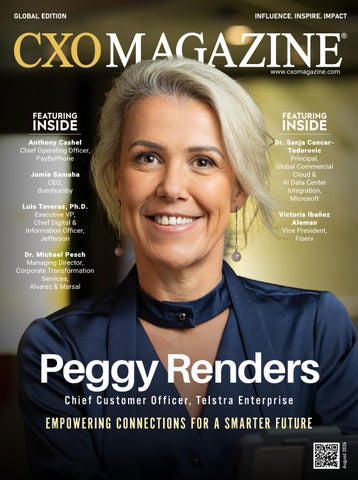
GLOBAL EDITION
FEATURING
INFLUENCE. INSPIRE. IMPACT
FEATURING
INSIDE
INSIDE
Anthony Cashel Chief Operating Officer, PayByPhone
Dr. Sanja CancarTodorovic Principal, Global Commercial Cloud & AI Data Center Integration, Microsoft
Jamie Samaha CEO, dunnhumby Luis Taveras, Ph.D. Executive VP, Chief Digital & Information Officer, Jefferson
Victoria Ibañez Aleman Vice President, Fiserv
Dr. Michael Pesch Managing Director, Corporate Transformation Services, Alvarez & Marsal
Peggy Renders C h i e f C u s t o m e r O f f i c e r , Te l s t r a E n t e r p r i s e
CXO MAGAZINE, AUGUST 2026
1
August 2026
EMPOWERING CONNECTIONS FOR A SMARTER FUTURE
BS FR CR EE IB E
SU
August 2026
Vol - 04 Issue - 08
Managing Editor
Sarath Shyam
Consultant Editors
Dr. John Andrews Emma James Sabrina Samson Naomi Wilson Andrew Scott Kwith Alexander
Editorial Enquiry: admin@cxoomagazine.com
Art & Design
Charlie Jameson Louis Bernard Shirley David
Branding & Marketing Partnership
Jennifer Anderson Monica Davis Rachel Roy Anna Elza
Sales Enquiry: admin@cxoomagazine.com
2
Free Subscription www.cxomagazine.com
International Partnerships Americas Europe Middle East & Africa Asia-Pacific admin@cxoomagazine.com
Follow Us On www.linkedin.com/company/cxomagazinepage www.facebook.com/CXOMagazinePage
CXO Magazine www.cxomagazine.com is a global knowledge sharing digital platform published by Connecta Innovation Private Limited. All rights reserved. The opinions expressed in the content and pictures provided are those of the authors. They do not purport to reflect the opinions or views of the Connecta Innovation Private Limited or any of its members and we do not assume any responsibility. The publisher does not assume any responsibility for the advertisements, its content, pictures, and all representation of warranties made in such advertisements are those of the advertisers and not of the publisher. CXO Magazine www. cxomagazine.com is a Free Subscription and Free-to-read digital platform strictly not for sale and has to be strictly for internal private use only. Publisher does not assume any responsibility arising out of anyone modifying content and pictures, printing a copy of this digital platform in any format and in any country and all matters related to that.
CXO MAGAZINE, AUGUST 2026
WHEN TECHNOLOGY HAS TO PROVE ITS WORTH
T
echnology has never been more deeply embedded into business. Yet the harder question is no longer what technology can do. It is what it can deliver. That question is becoming impossible for leaders to ignore. Organizations are investing heavily in AI, cloud, data, automation, and digital platforms, but investment alone does not guarantee transformation. PwC’s latest Pulse Survey found that 82% of technology leaders say their companies are struggling to realize value from technology investments. It is a familiar challenge. A new system arrives with ambitious promises. Teams spend months implementing it. Training follows. Dashboards light up. Yet, somewhere along the way, the original business problem can get lost. The technology works, but the organization is still waiting for the promised result. The real test of digital transformation, therefore, is not adoption. It is impact. This is where the story of Peggy Renders, Chief Customer Officer at Telstra Enterprise, becomes particularly relevant. Across 29 years in technology, Peggy has built her career around turning big ideas into measurable outcomes. Her approach puts customer proximity, collaboration, and authentic leadership at the heart of transformation. Her perspective reflects a larger shift taking place across the business world: technology leaders are increasingly expected to connect investments with tangible improvements in growth, resilience, efficiency, and customer experience. The challenge is also becoming more complex as AI moves from experimentation toward scale. KPMG’s 2026 Global Tech Report notes that organizations are shifting from experimentation to scale, while tech debt, cost pressures, talent shortages, and execution challenges continue to stand in the way. For today’s leaders, this means asking better questions. Are we solving the right problem? Are our people ready to use the technology? Can we measure the outcome? And, most importantly, are we creating value that customers and employees can actually feel? This issue of CXO Magazine explores these questions through a range of thought-provoking articles, interviews, and perspectives from leaders navigating change across industries. Technology will continue to evolve at extraordinary speed. The organizations that thrive, however, will be those that remain focused on something far more enduring: turning innovation into meaningful progress. The future belongs not simply to those who adopt technology first, but to those who make it matter. Enjoy Reading. Sarath Shyam CXO MAGAZINE, AUGUST 2026
3
08 4
CXO MAGAZINE, AUGUST 2026
22
Anthony Cashel, Chief Operating Officer, PayByPhone Transforming Global Operations For A Distributed World
34 Jamie Samaha, CEO, dunnhumby Spearheading the Next Chapter of Customer Intelligence
INTERVIEW
16
Dr. Michael Pesch, Managing Director, Corporate Transformation Services, Alvarez & Marsal Redefining Corporate Transformation For The AI Era
46 Victoria Ibañez Aleman, Vice President, Fiserv Empowering Financial Inclusion through Responsible Legal Innovation
CXO MAGAZINE, AUGUST 2026
5
28
Luis E. Taveras, PhD, Executive VP, Chief Digital & Information Officer, Jefferson How to Overcome the Top 10 AI Risks
OPINIONS
40
Dr. Sanja Cancar-Todorovic, Principal, Global Commercial Cloud & AI Data Center Integration, Microsoft AI as the Greatest Equalizer of Our Time
6
CXO MAGAZINE, AUGUST 2026
CXO MAGAZINE, AUGUST 2026
7
8
CXO MAGAZINE, AUGUST 2026
Peggy Renders C h i e f C u s t o m e r O f f i c e r , Te l s t r a E n t e r p r i s e
EMPOWERING CONNECTIONS FOR A SMARTER FUTURE Peggy Renders is the Chief Customer Officer at Telstra Enterprise, where she turns big ideas into measurable outcomes for industry and government. Her team partners with organizations to accelerate digital transformation— connecting people, platforms, and purpose—to unlock growth, resilience, and better customer experiences. Across 29 years in technology, Peggy has led highperforming teams in Enterprise Sales, Presales & Industry, and Professional Services. Before Telstra, she served as SVP for Customer Experience Solutions at SAP Asia Pacific Japan, scaling the Commerce and Digital Customer Engagement business across ANZ, Southeast Asia, Japan, Korea, and India. She mentors emerging talent, champions inclusion, and believes the next advantage comes from bold ideas and diverse voices working together. Recently, in an exclusive interview with CXO Magazine, Peggy shared insights into her passion for delivering measurable customer outcomes, driven by a desire to improve people’s lives through technology. She highlighted the importance of customer proximity, collaboration, and leadership authenticity in building a culture of innovation and customer-centricity. She also shared her love for sharing new experiences with her kids, future plans, words of wisdom, and much more. The following excerpts are taken from the interview.
CXO MAGAZINE, AUGUST 2026
9
Hi Peggy. As Chief Customer Officer, what drives your passion for delivering measurable customer outcomes? What drives me is a constant desire for progress and improvement. Technology is moving at extraordinary speed, and I’m most motivated when we use that momentum to genuinely improve people’s lives — not in abstract ways, but in ways that really matter. One example that stays with me is the scam indicator work we’ve done with the Quantium Telstra team. When you see how technology can help protect vulnerable people from being scammed — often at moments when they’re frightened, pressured or alone — the importance of measurable outcomes becomes very real. This isn’t about dashboards or metrics; it’s about stopping someone from losing their savings, their confidence, or their sense of safety. That’s why intent and measurement matter so much to me. Measuring outcomes keeps us honest about whether we’re actually making a difference. When technology is applied thoughtfully, it simplifies complexity, builds trust and creates protection where it’s needed most. Those are the moments that remind me why customer outcomes are not just a business priority, but a human one. What do you love the most about your current role? What I love most about my current role starts with working closely with customers. Technology for the sake of technology doesn’t excite me — it only matters if it genuinely helps solve real problems. Staying close to customers keeps me grounded in what they’re actually experiencing, not what we assume they need.
10 C X O M A G A Z I N E , A U G U S T 2 0 2 6
A moment that’s stayed with me was sitting down with a customer leader who was deeply frustrated — not with the technology itself, but with how hard it had become to make confident decisions. Their team had plenty of tools, but not enough clarity. Seeing how a more thoughtful, joined-up approach could remove that friction, simplify choices and give them momentum again was a powerful reminder of why customer proximity matters so much. That’s where you see how connectivity and insight can genuinely enable progress. I also get enormous energy from the people and leadership side of the role. Leadership comes very naturally to me, and I’ve had the privilege of watching leaders in my team step into bigger moments — sometimes tentatively at first — and grow into confident, decisive leaders over time. Being able to support that journey, set a clear direction and then coach and grow people is incredibly rewarding. Finally, I love creating clarity through structure, processes and clear accountability. When people understand what they’re on the hook for and how they fit into the bigger picture, teams can truly operate like a well-oiled machine. Combined with the diversity of the role — working with customers across government, defence and a wide range of industries — it keeps the work dynamic, challenging and deeply fulfilling. What are some of the most exciting developments in the field of customer experience, and how can organizations leverage them? What excites me most is the shift from simply responding to customer needs to genuinely anticipating them. I remember a conversation
with a CIO who said their biggest frustration wasn’t outages or incidents — it was that their team only ever found out about issues once customers were already feeling the impact. That moment really stuck with me. It highlighted how reactive models erode confidence, not just performance. That’s why I’m so excited about the move toward predictive, insight-led experiences. When organisations can anticipate issues, reduce uncertainty and act earlier, the experience fundamentally changes. It moves from firefighting to foresight, and from managing problems to enabling progress. Taking an industry-based approach allows organisations to benchmark customers against their peers and inspire them with what’s possible, rather than treating every challenge in isolation. Data and technology play a critical role in enabling this, but differentiation doesn’t come from insight alone. It comes from combining those insights with strong human judgment, clear accountability and a deep understanding
of customer intent. That’s how organisations move from being responsive providers to trusted partners — and how customer experience becomes a genuine source of competitive advantage. How do you see the role of the Chief Customer Officer evolving in the next few years, and what skills will be required to succeed in this role? We’re moving into a world where intelligence will be all around us, in abundance. With AI, we’ll be operating alongside billions of AI agents, and that will fundamentally change how work gets done. In customer environments, many tasks across the value chain will increasingly be handled by AI. But I don’t believe the future is simply about automating today’s tasks as they exist now — the work itself will need to be reconfigured. Leaders will increasingly be orchestrating work across teams made up of both humans and intelligent agents. That shifts leadership away from task management towards conscious
When people understand what they’re on the hook for and how they fit into the bigger picture, teams can truly operate like a well‑oiled machine
CXO MAGAZINE, AUGUST 2026
11
orchestration — deciding what should be done by humans, what should be done by agents, and how the two work together to create the best outcomes for customers. This will have a profound impact on how we define leadership. Those who thrive will need strong systems thinking, resilience and the ability to lead through ambiguity. Embracing uncertainty and approaching change with curiosity rather than fear will be critical. Equally important is emotional intelligence — the capacity to listen, challenge constructively and bring people with you through change. The future Chief Customer Officer will be as much a transformation leader as a customer champion. As someone who’s led high-performing teams in multiple organizations, what do you believe are the key factors in building a culture of innovation and customer-centricity? For me, it starts with leadership authenticity. Teams do their best work when leaders are genuine, transparent and, very importantly, consistent. That consistency is what builds trust. When people know what you stand for and see your actions consistently match your words, they feel safe — and that psychological safety is essential for experimentation and innovation. I also strongly believe that real innovation comes from spending time with customers. It’s about deeply understanding their challenges, listening without assumptions and then being creative in how technology is applied to solve real problems. When teams stay close to customers, innovation becomes purposeful rather than theoretical. Collaboration is another essential ingredient. The challenges organisations face today are
12 C X O M A G A Z I N E , A U G U S T 2 0 2 6
complex and interconnected, and they can’t be solved in isolation. I strongly believe that people who can collaborate — across teams, across organisations and even with competitors — will be the ones who will be celebrated for driving real progress. When trust, customer proximity and collaboration come together, innovation and customer-centricity reinforce each other naturally.
The future Chief Customer Officer will be as much a transformation leader as a customer champion
Can you share a book, podcast, or resource that has inspired you recently? One book that has really stayed with me is Born a Crime by Trevor Noah. What resonated deeply was not just the adversity he grew up with, but the way he chose to meet it — with curiosity, empathy and an ability to truly understand people and context. Growing up under apartheid, he learned early that if you want to survive and thrive, you have to listen, adapt and see the world through other people’s eyes. It reminded me how much leadership — and customer experience — is shaped by lived experience. You can have the best strategies or technologies in place, but real impact comes from understanding what life actually feels like for the people you’re serving. The book reinforced for me the importance of staying grounded in human reality, valuing connection, and choosing to live and lead fully, even when circumstances are complex or challenging. As a parent of two boys, what’s one thing you love doing with them that helps you unwind? What I love most doing with my boys is sharing new experiences with them. I feel most alive and present when I’m learning something new, meeting new people, taking a different road
CXO MAGAZINE, AUGUST 2026
13
or stepping into an unfamiliar situation — and being able to experience that sense of discovery together is incredibly special. A perfect example was our trip earlier this year to Tanzania to climb Mount Kilimanjaro. It was challenging, unpredictable, freezing cold and deeply rewarding, and sharing that journey together created memories and conversations that stay with us long after the experience itself. I value experiences more than objects. Where I feel that objects depreciate over time, experiences appreciate over time and I feel very lucky to have a whole collection of amazing experiences. Those shared adventures also remind me to stay curious, embrace discomfort and fully experience life rather than rush through it — lessons that matter just as much at home as they do in leadership. Living on the Gold Coast, what’s your favorite local spot or activity that you recommend to others? What I love most about living on the Gold Coast is the rhythm it gives my life, especially in the early mornings. Whether it’s an ocean swim at sunrise or a run, those moments create space to reset, breathe and gain perspective. I also feel very lucky to be part of some beautiful local communities. My ocean swimming group is brilliant — we all share a genuine love for the water, and it’s probably the highlight of my week. We have an amazing coach who continually pushes us, which creates a great mix of challenge, support and shared achievement. I’m also part of a local running club where we meet at 5 am a couple of times a week. What makes it special isn’t just the running, but the sense of belonging — the friendships, social catch-ups and even the celebrations outside of training.
14 C X O M A G A Z I N E , A U G U S T 2 0 2 6
That combination of nature, movement and community is what makes the Gold Coast so special for me. It’s a place that constantly reminds you to be present, connected and energised. What is your biggest goal? Where do you see yourself in 5 years from now? My biggest goal is to live a life that feels meaningful, balanced and deeply connected — to people, to community and to purpose. In five years’ time, I see myself contributing in ways that go beyond a role or title. I want to stay closely connected to people, working alongside diverse communities, teams and organisations where I can continue to share experience, learn from others and create positive impact. Diversity in what I do is important to me. I don’t see my future as one-dimensional — it will involve a mix of contribution, learning, mentoring and exploration. A sense of adventure will always be part of my life, whether that’s through travel, new experiences or stepping into unfamiliar territory. Above all, I’m seeking inner peace. That comes from alignment — knowing that how I spend my time reflects what I value most. If I’m contributing to my community, working with great people, embracing new experiences and feeling grounded and at peace with myself, I’ll know I’m exactly where I’m meant to be. As a mentor to emerging talent, what advice do you give to young professionals looking to build a career in technology and customer experience? The advice I give most often is to stay curious and be yourself — especially in the AI era we’re entering. Technology will continue to evolve at
What will truly differentiate people in the years ahead are skills like critical decision‑making, sound judgment and creativity
extraordinary speed, and AI will increasingly handle tasks, analysis and recommendations. What will truly differentiate people in the years ahead are skills like critical decision-making, sound judgment and creativity. Knowing how to ask the right questions, challenge assumptions and make thoughtful choices will matter far more than simply having access to information. I strongly encourage young professionals to spend time at the frontline with customers. It’s in those moments — working directly with customers, understanding their pressures, constraints and ambitions — that you really develop creativity and perspective. That’s where you gain a true understanding of an organisation’s opportunities and challenges, and
where technology moves from being theoretical to genuinely meaningful. I also remind them that careers are rarely linear. Some of the most meaningful growth comes from stepping into uncertainty, saying yes before you feel fully ready, and embracing new experiences. Finally, I encourage them to invest in relationships and community. Collaboration, trust and generosity become even more important as technology accelerates. If you combine curiosity, strong judgment, creativity and a genuine interest in people, you won’t just build a successful career — you’ll build one that remains relevant, meaningful and deeply fulfilling in an AI-driven world.
CXO MAGAZINE, AUGUST 2026
15
I N T E R V I E W S
Transforming Global Operations For A Distributed World Anthony Cashel is responsible globally for marketing, global operations and support, and partnerships. He is focused on optimizing operational excellence and enhancing processes to ensure PayByPhone is future-fit. He joined PayByPhone in 2017 and was previously Chief Client Officer. He was Managing Director of the UK and before that the UK Marketing and Operations Director, where he developed the multi-award-winning green initiative, Meters for Trees. Cashel holds a BA in Marketing from Greenwich University, London, England, and a Six Sigma Green Belt. He is based in the UK and is married with three daughters. Recently, in an exclusive interview with CXO Magazine, Anthony shared insights from a journey that began in UK marketing and operations and now leads as Chief Operating Officer of PayByPhone globally. He spoke about how AI is fundamentally rewriting the corporate operating model by removing administrative heavy lifting and freeing leaders to be proactive, data-driven, and faster. For Anthony, the future of operations lies in standardizing core systems globally while empowering distributed teams with autonomy, and in building a culture of shared ownership where failure is a path to growth. His advice to the next generation of COOs is to maximize technology but lead people through it, focus on clarity of purpose over control, and align teams around a Massive Transformative Purpose. The following excerpts are taken from the interview.
16 C X O M A G A Z I N E , A U G U S T 2 0 2 6
Anthony Cashel Chief Operating Officer, PayByPhone
CXO MAGAZINE, AUGUST 2026
17
Every operating leader starts by learning how to turn plans into results. What was the first assignment that taught you strategy only matters when it’s executed well? Early in my career, I managed an important rollout that looked flawless on paper but hit immediate and unexpected real-world challenges on the ground. It was a clear lesson that strategy is an abstract hypothesis until it meets the reality of the market. It also taught me that if your execution cannot translate corporate vision into a simple value for a customer, the strategy has failed. I learned then that successful execution requires bridging the gap between high-level strategic intent and ground-level tactical reality by focusing on the people delivering the strategy and the people using the service.
What do you love the most about your current role? I love the sheer scale of impact and the opportunity to solve intricate global challenges. Leading our global operations means my team, who sit across five countries and nine time zones, is responsible for optimizing journeys for not only our app users but also for our city and parking operator clients. I enjoy taking multiple variables—from global technical infrastructure to shifting municipal compliance and localized partnerships—and harmonizing them into a single, seamless operation. Ultimately, my passion lies in driving that kind of operational efficiency. Taking a highly complex international operation and making it run with absolute reliability across multiple markets for a wide spectrum of stakeholders is what makes this role so rewarding.
Next-generation COOs need to know how to maximize new technology while developing their people to work alongside it
18 C X O M A G A Z I N E , A U G U S T 2 0 2 6
Global operating models are being tested by volatility. What do you see as the single biggest shift in how companies will operate by 2030? The biggest shift is happening right now, and it is happening fast. AI is fundamentally rewriting the corporate operating model in real time. AI completely obliterates administrative heavy lifting and instantly transforms human capability. When you strip away the routine execution, it frees up leaders and teams to work at an entirely different level. It allows us to think more deeply, act with absolute speed, and become truly data driven. We can proactively rely on live insights to steer the business rather than reacting to yesterday’s news. The talent market for operating leaders is tightening. What capabilities will be most critical for the next generation of COOs? Next-generation COOs need to know how to maximize new technology while developing their people to work alongside it. Because of AI, we don’t need leaders who are just technical data experts. The technology already gives us the ability to dive into the finest details and fix operational issues immediately. The critical capability now is leadership - a COO who can successfully guide employees through this technological shift, ensuring the team is using these tools to think more deeply rather than just moving faster. Supply chains, talent, and customers are all more distributed. How should global operating models adapt to that reality? When your talent, vendors, and clients are scattered across different countries, a rigid,
one-size-fits-all approach simply fails. You must standardize core systems globally but give your distributed teams the autonomy to run them locally. The model must adapt by using centralized automation to handle the high-volume, routine operations. Technology handles the baseline, which gives your local talent the flexibility they need to manage regional supply chains and specific market demands without waiting on a central headquarters for every decision. Operating at scale requires clarity. What book has most shaped how you think about leadership, execution, or decision-making? Exponential Organizations by Salim Ismail changed the trajectory of my career. It made me to realize that traditional, linear management structures cannot keep pace with today’s techdriven world. It inspired me to completely reevaluate my approach to leadership and shift my focus toward hyper-growth, agile organizations. At PayByPhone, Ismail’s principles are a daily reality. True clarity at scale doesn’t come from heavy infrastructure or top-down control; it comes from aligning teams under a Massive Transformative Purpose (MTP) and giving them the algorithmic data and autonomy to move at exponential speed. We all need ways to reset from highpressure roles. What hobby or ritual helps you step back and see things simply again? For me, the ultimate reset is spending time with my family. My global day-to-day means my mind is constantly juggling complex business problems across different countries and time
CXO MAGAZINE, AUGUST 2026
19
zones. Changing gears to focus entirely on my family forces an instant, healthy reality check. It completely clears my mind, simplifies my focus, and reminds me of what matters outside of work. I can then return to PayByPhone with a completely fresh perspective and real clarity.
True leadership isn’t about maintaining an illusion of perfection; it is about establishing a foundation of absolute accountability, trust, and safety
20 C X O M A G A Z I N E , A U G U S T 2 0 2 6
What is your biggest goal? Where do you see yourself in 5 years from now? My goal is to continue leading PayByPhone’s operational growth and to establish us firmly as the global standard. We want to lead a fundamental category shift for municipalities, moving them away from legacy, rear-view reporting and empowering them to run their estates dynamically in real-time. By embedding AI-driven insights into municipal frameworks, we will ensure PayByPhone becomes the invisible, high-value operating layer for smart cities worldwide. If you could leave one message for the next generation of operating and commercial leaders, what would it be? That would be to build a culture of entirely shared ownership around wins and failures. In fast-moving global operations, mistakes and friction are inevitable. If you build an environment where people are terrified of failure, your organization will stagnate. True leadership isn’t about maintaining an illusion of perfection; it is about establishing a foundation of absolute accountability, trust, and safety. Use data and technology to optimize your systems but always design your culture around empowering your people to solve problems openly, to pivot quickly, and to grow stronger from every setback.
Want to Sell or find Investors for your Business?
Digital First Magazine CXO MAGAZINE, AUGUST 2026 August 2021
21
I N T E R V I E W S
Redefining Corporate Transformation For The AI Era Dr. Michael Pesch is a Managing Director with Alvarez & Marsal Corporate Transformation Services in Munich. He brings 25+ years of experience managing large-scale transformations and turnarounds for corporate clients, private equity sponsors, and financial stakeholders. Dr. Pesch’s primary areas of concentration include managing complex value creation programs and strategic, operational, and financial restructurings, both as an advisor and in Chief Transformation Officer (CTO) roles. In addition, he is a leading expert in corporate support function optimization as well as labor codetermination, including managing interactions with works councils and unions. Recently, in an exclusive interview with CXO Magazine, Michael shared insights from his 25+ year journey leading large-scale transformations and turnarounds as Managing Director at Alvarez & Marsal. On AI, Michael believes the real advantage comes not from productivity alone, but from using it to redesign operating models and reallocate capacity to innovation and growth. His advice to aspiring leaders is to seek out complex challenges, build experience under pressure, and create clarity and conviction that helps teams believe ambitious goals are achievable. The following excerpts are taken from the interview.
22 C X O M A G A Z I N E , A U G U S T 2 0 2 6
Dr. Michael Pesch
Managing Director, Corporate Transformation Services, Alvarez & Marsal
CXO MAGAZINE, AUGUST 2026
23
Hi Michael. Every advisor’s path starts with a single problem they couldn’t stop thinking about. What was the first business challenge that made you realize strategy, operations, and people were all connected? Strategy, operations, and people are indeed closely interconnected. The most successful leaders keep all three dimensions firmly in focus. One of the first client situations that shaped my thinking involved a company facing a significant decline in profitability. At first glance, the challenge appeared operational, while management discussions focused primarily on strategy. As we dug deeper, it became clear that the strategy itself was sound. The real issue was execution. Decision-making had become slow, priorities were unclear, and too much time was spent discussing rather than acting. As a result, operational performance suffered and employees lost confidence in the company’s direction. That experience taught me an important lesson: sustainable business performance happens when strategy, operations, and people are aligned. When the connection between those three dimensions breaks down, even the best strategy will fail to deliver results. You advise on some of the hardest problems companies face. What part of your current work energizes you most today? At Alvarez & Marsal, we are a results-driven firm. Success is not measured by presentations or recommendations, but by tangible improvements in performance and value creation.
24 C X O M A G A Z I N E , A U G U S T 2 0 2 6
Companies today face enormous challenges: rising costs, intense global competition, and increasing pressure from investors and lenders. Helping management teams tackle these issues, make bold decisions, and see the impact reflected in the business is what I enjoy most. There is nothing more rewarding than seeing a company regain momentum and strengthen its competitive position. Economic volatility and margin pressure are making restructuring more frequent. How will the approach to strategic and operational restructuring evolve over the next five years? I believe the next five years will bring more disruptive change to the German economy than many companies have experienced over the past two decades. Established business models will increasingly be challenged, and leadership teams will need to rethink how they create value, compete, and grow. As a result, restructuring will become much more than a cost-reduction exercise. Traditional restructuring focused on improving liquidity, reducing complexity, and lowering the cost base. Going forward, companies will increasingly need to rethink their business models while improving performance at the same time. A good example is the German machinery sector. For decades, success was built on engineering excellence and premium products. Today, AI, software, and data are beginning to change the rules of the game. Imagine a company selling highly sophisticated production equipment. Historically, customers paid for the machine itself. In the future, customers may be far more interested in paying for guaranteed uptime, output, or productivity, while AI
continuously optimizes performance. Suddenly, the source of value shifts from hardware to software, data, and services. The winners will not necessarily be those with the best products. They will be the companies that are willing to rethink how they create value for customers and adapt their business models accordingly. In that sense, future restructuring will be as much about reinvention and growth as it is about cost reduction.
Next five years will bring more disruptive change to the German economy than many companies have experienced over the past two decades
Technology is embedded in every transformation now. What role will data and automation play in making restructuring faster and more humane? I believe technology will fundamentally change the way we think about restructuring. First, advanced analytics and AI will significantly accelerate diagnostics and decision-making. What previously took weeks of data gathering and analysis can increasingly be done in a matter of days, allowing companies to identify issues and act much faster. Second, automation and AI will create entirely new ways of working. Many routine and analytical tasks will be performed more efficiently, leading to substantial productivity gains. At the same time, this will increase competitive pressure and force companies to continuously rethink how value is created. Third, restructuring will become more continuous rather than episodic. Datadriven performance management will make inefficiencies more transparent and enable organizations to address issues before they become critical. Most importantly, technology can make restructuring more humane. Better data and greater transparency allow leaders to make
CXO MAGAZINE, AUGUST 2026
25
more targeted decisions, reducing uncertainty and helping employees understand the rationale behind change. Looking ahead, what one trend makes you most optimistic about how companies can create sustainable value? The trend that makes me most optimistic is the opportunity to fundamentally reinvent how companies create value through AI. While AI will dramatically improve productivity, speed, and transparency, these benefits alone will not be a sustainable
advantage. The real winners will be those that use AI as a catalyst to redesign their operating model, accelerate decision-making, and rethink how work gets done. To bring this to life, a company with several hundred engineers may be able to automate a significant share of repetitive reporting, documentation, and analytical work. While the initial productivity gains can be substantial, the bigger opportunity lies in reallocating that capacity to innovation, customerfacing activities, and growth initiatives. The organizations that successfully combine AI adoption with operating model redesign can
The real winners will be those that use AI as a catalyst to redesign their operating model, accelerate decisionmaking, and rethink how work gets done
26 C X O M A G A Z I N E , A U G U S T 2 0 2 6
unlock productivity improvements that would have been difficult to imagine just a few years ago. Technology will be available to everyone. The ability to transform the business around it will be what sets leading companies apart. Strategy is analytical, but perspective often comes from outside work. What book, film, or piece of art has shaped how you think about leadership or change? I am a true Star Wars fan. What has always fascinated me is that the story is ultimately about leadership and change. Both the Jedi and the Sith draw on the same force, yet achieve very different outcomes because of their vision, values, and leadership approach. The lesson I take from that is that leadership is not about authority or resources. It is about creating a compelling vision, aligning talented people behind it, and maintaining conviction when the path forward is uncertain. In my experience, successful transformations usually come down to exactly that: creating clarity, building confidence, and helping people believe that ambitious goals can actually be achieved. When you need to think differently, where do you look outside of business? What field or discipline inspires your best ideas? I am a passionate mountaineer and skier. The mountains are where I get my best ideas. Not because I am actively searching for them, but because it is one of the few places where there are no emails, no calls, and no constant interruptions.
There is something powerful about spending a day outdoors, moving through nature with a clear goal in mind. Problems that looked complex in the office often become surprisingly simple. For me, thinking differently is less about finding new information and more about creating the space to see things from a different perspective. What is your biggest goal? Where do you see yourself in 5 years from now? My biggest goal is to continue being a trusted advisor to clients facing complex and highstakes business challenges. At this stage of my career, it is less about titles, but more about impact. I am passionate about helping organizations navigate transformation, improve performance, and create sustainable value. In five years, I hope to be known for the impact I have delivered for clients, as well as for developing talented professionals who will become the next generation of leaders in restructuring and transformation. You’ve seen what great leadership looks like under pressure. What advice would you give to aspiring professionals who want to lead complex change? My advice would be to leave your comfort zone and actively seek challenges. Like pilots who train extensively for worst-case scenarios, future leaders should take opportunities to work on unfamiliar and complex situations while learning from experienced mentors. Leadership under pressure is built through experience, preparation, and a willingness to continuously learn and grow.
CXO MAGAZINE, AUGUST 2026
27
O P I N I O N S
How to Overcome the Top 10 AI Risks Luis E. Taveras, PhD is a distinguished technology and digitaltransformation executive with more than four decades of leadership experience across healthcare, government, and enterprise IT. He currently serves as Executive Vice President and Chief Digital & Information Officer at Jefferson Health, where he leads system-wide digital strategy, technology modernization, cybersecurity, and data innovation for one of the nation’s largest academic health systems. Dr. Taveras has held multiple senior leadership roles, including CIO of Lehigh Valley Health Network, Barnabas Health, and the City of Buffalo, where he guided major modernization initiatives and helped shape early smart-city strategies. His work has consistently focused on building high-performing technology organizations, advancing digital health capabilities, and driving enterprise transformation. He is the author of the Amazon #1 bestseller The 90 Day CIO, and is widely recognized as a thought leader in IT governance, digital strategy, and organizational change.
28 C X O M A G A Z I N E , A U G U S T 2 0 2 6
Luis E. Taveras, PhD Executive VP, Chief Digital & Information Officer, Jefferson CXO MAGAZINE, AUGUST 2026
29
Executive Overview Artificial intelligence is now a central driver of business transformation, reshaping competitive advantage, operating models, and organizational design. For general managers, AI offers unprecedented opportunities to accelerate growth, improve efficiency, and unlock new value. Yet these benefits come with a distinct set of risks that, if unmanaged, can undermine strategy, erode trust, and expose the organization to operational and reputational harm. The top risks fall into three broad categories: strategic risks, where AI initiatives fail to align with business priorities; operational and technical risks, where data, cybersecurity, and model performance create vulnerabilities; and organizational and societal risks, where workforce disruption, ethical lapses, and stakeholder expectations demand thoughtful leadership. General managers must navigate these risks with a balanced approach—championing innovation while ensuring responsible governance. This requires clear strategic alignment, disciplined data and security practices, ethical oversight, and proactive workforce planning. It also demands vigilance as regulatory frameworks evolve and as AI systems become more deeply embedded in core operations. By understanding and addressing these ten risk areas, leaders can guide their organizations to harness AI’s full potential while protecting long-term competitiveness, customer trust, and organizational integrity. The companies that succeed will be those that pair technological ambition with strong managerial stewardship, ensuring AI becomes a source of sustainable advantage rather than unintended exposure.
30 C X O M A G A Z I N E , A U G U S T 2 0 2 6
1. Strategic Misalignment and Misuse of AI AI initiatives often fail not because of technical limitations but because they are misaligned with organizational strategy. When AI projects are launched without clear business objectives, measurable outcomes, or executive sponsorship, they can drain resources and create organizational confusion. General managers must ensure that AI investments directly support strategic priorities, customer value, and longterm competitiveness. 2. Data Quality, Governance, and Privacy Failures AI systems depend on high-quality, wellgoverned data. Poor data hygiene—such as inconsistent formats, missing values, or biased datasets—can lead to inaccurate predictions and flawed decision-making. Privacy risks also escalate as organizations collect and process more personal information. Organizational leaders must implement robust data governance frameworks, ensure compliance with privacy regulations, and invest in secure data infrastructure. 3. Cybersecurity Vulnerabilities and System Exploitation AI systems introduce new attack surfaces for cybercriminals. Threat actors can manipulate training data, exploit model weaknesses, or use AI-generated content for fraud and impersonation. As AI becomes embedded in critical operations, a single breach can disrupt entire business processes. General managers must prioritize cybersecurity investments, conduct regular risk assessments, and integrate AI-specific security protocols.
4. Ethical Risks, Bias, and Discrimination AI models can unintentionally reinforce societal biases, leading to unfair outcomes in hiring, lending, customer service, and other domains. Ethical lapses can damage brand reputation, trigger regulatory penalties, and erode stakeholder trust. Managers must champion the implementation of strong AI governance that emphasizes and is guided by ethical AI principles, ensure diverse data representation, and establish oversight mechanisms to detect and mitigate bias. 5. Workforce Disruption and Talent Gaps AI adoption reshapes job roles, skill requirements, and organizational structures. While automation can enhance productivity, it may also displace workers or create anxiety among employees. At the same time, organizations face shortages of AI talent, from data scientists to machine learning engineers. General managers must invest in workforce reskilling, foster a culture of continuous learning, and develop clear communication strategies around AI-driven organizational change.
6. Overreliance on AI and Loss of Human Judgment As AI systems become more capable, organizations risk overreliance on automated decision-making. Blind trust in algorithmic outputs can lead to errors, especially in ambiguous or high-stakes situations. General managers must reinforce the principle of human-in-the-loop oversight, ensuring that AI augments rather than replaces human judgment. 7. Vendor Dependence and Concentration of Power Many organizations rely on external vendors for AI tools, cloud infrastructure, and model development. This dependence can limit flexibility and expose the organization to vendor-specific risks. Additionally, the concentration of AI capabilities among a few large technology companies raises strategic concerns. Managers must evaluate vendor contracts carefully, avoid long term commitments, diversify technology partners, and build internal AI competencies where feasible.
General managers play a critical role in shaping how AI is deployed, ensuring that it enhances organizational performance while safeguarding employees, customers, and society
CXO MAGAZINE, AUGUST 2026
31
8. Regulatory Uncertainty and Compliance Challenges AI regulation is evolving rapidly across jurisdictions. Organizations face uncertainty around data protection laws, algorithmic transparency requirements, and sector-specific rules. Noncompliance can result in fines, operational disruptions, and reputational harm. General managers must stay informed about regulatory developments, collaborate with legal teams, and design AI systems with compliance in mind. 9. Operational Failures and Model Drift AI systems can degrade over time as real-world conditions change—a phenomenon known as model drift. Without continuous monitoring, retraining, and validation, AI outputs may become inaccurate or unreliable. Operational failures can disrupt supply chains, customer interactions, or financial forecasting. Managers must implement lifecycle management processes and allocate resources for ongoing model maintenance. 10. Reputational Damage and Loss of Stakeholder Trust AI-related failures—such as biased decisions, data breaches, or misleading content—can quickly escalate into public relations crises. Stakeholders expect organizations to use AI responsibly, transparently, and securely. General managers must proactively communicate AI policies, engage with stakeholders, and foster a culture of accountability. Conclusion AI is transforming the business landscape, offering unprecedented opportunities for
32 C X O M A G A Z I N E , A U G U S T 2 0 2 6
innovation and growth. However, these benefits come with significant risks that require thoughtful governance, strategic alignment, and ethical stewardship. General managers play a critical role in shaping how AI is deployed, ensuring that it enhances organizational performance while safeguarding employees, customers, and society. By understanding and addressing these top ten risks, and many others not covered in this brief document, leaders can position their organizations to harness the full potential of AI while navigating its complexities with confidence and responsibility.
CXO MAGAZINE, AUGUST 2026
33
I N T E R V I E W S
Spearheading the Next Chapter of Customer Intelligence Jamie Samaha is a global business leader with more than 25 years’ experience driving growth, innovation and transformation across customer intelligence, commerce media, loyalty, payments and consumer engagement businesses. Before joining dunnhumby, Jamie was CEO of Reward, where he led the business through a period of significant growth and expansion. Prior to this, he was Group CEO of Prezzee and spent more than a decade at Mastercard, including as Executive VP of Consumer Engagement Services. Recognised for combining strong commercial leadership with a people-first approach, Jamie has a track record of scaling businesses internationally and delivering growth in rapidly evolving markets. Recently, in an exclusive interview with CXO Magazine, Jamie shared insights into his 25+ year professional journey building and scaling businesses at the intersection of customer intelligence, loyalty, commerce media, and payments. He spoke about AI and the deprecation of cookies as catalysts for brands to get serious about privacy-first, permission-based personalization built on first-party data, with the goal of creating experiences that are genuinely useful, not just targeted. Looking ahead, his focus is on shaping dunnhumby’s next chapter by helping retailers and brands turn data into growth, while keeping customer value and trust at the center. His advice to aspiring professionals is that leadership is a mindset, not a title, and the future-proof skills are adaptability, judgment, and clear communication, all grounded in kindness. The following excerpts are taken from the interview.
34 C X O M A G A Z I N E , A U G U S T 2 0 2 6
Jamie Samaha CEO, dunnhumby
CXO MAGAZINE, AUGUST 2026
35
Hi Jamie. You’ve spent 25+ years leading in customer intelligence, commerce media, loyalty, payments, and tech-enabled growth. What first drew you into this space, and did you picture yourself becoming the leader you are today? I’ve always been drawn to businesses that sit close to the customer. Where data, technology and human behaviour come together to create something genuinely useful for people’s everyday lives. Early in my career, I saw the power of loyalty and engagement not simply as marketing tools, but as a way to build better relationships between businesses and the people they serve. That thread has run through much of my career, from helping scale Pinpoint across Asia Pacific, to working at Mastercard across more than 60 markets, to leading businesses such as Prezzee and Reward. Each step taught me something different about growth, complexity, culture and impact. Stepping into the CEO role at dunnhumby marks the start of a new chapter. What’s the first thing you’re most excited to build or shape in this next phase? dunnhumby has an exceptional heritage, strong track record and deep partnerships with many of the world’s leading retailers and brands. Retail and consumer markets are evolving rapidly, and few companies are better placed than dunnhumby to help clients navigate that change and unlock growth. I’ve only just landed in the business, but I have been really impressed by the exceptional talent and how proud they are to work here. I’m
36 C X O M A G A Z I N E , A U G U S T 2 0 2 6
Retail media can’t simply become another advertising channel that adds noise or cost. It has to improve the customer experience, protect trust and deliver measurable outcomes
looking forward to spending time with the full team, listening to our colleagues, clients and partners and moving forward as we shape the next chapter of dunnhumby’s growth. First-party data is becoming the new currency as cookies deprecate and privacy rules tighten. How do you see brands rethinking customer intelligence to stay both personal and privacy-first in the next 5 years? The importance of really understanding your customers and putting them at the centre of decision-making is not new. While some of the technology and regulation behind it is evolving, the best relationships between brands and customers will continue to be built on relevance and trust. Customers expect personalisation, but they also expect businesses to use their data responsibly. That means intelligence needs to be privacy-safe, permission-based and genuinely useful to the customer. The brands that succeed will be those that use first-party data to understand intent, context and need, not
CXO MAGAZINE, AUGUST 2026
37
I believe in building organisations, not just where people can do their best work but where people can be their best self
just to target more efficiently, but to create better experiences.
we risk undermining the very relationships that make the model powerful.
Commerce media is exploding as retailers and marketplaces turn their audiences into ad networks. What trend in retail media excites you most, and what risk do you think the industry is overlooking? The trend that excites me most is the convergence of commerce media, loyalty and customer intelligence. When done well, commerce media can create value for everyone: customers receive more relevant offers and experiences, brands can make smarter investment decisions, and retailers can build new, measurable growth channels. The risk is that the industry becomes too focused on media revenue and not focused enough on customer value. Retail media can’t simply become another advertising channel that adds noise or cost. It has to improve the customer experience, protect trust and deliver measurable outcomes. If we lose sight of that,
Young professionals are anxious about AI, automation, and job security. What 3 skills do you believe will be “futureproof” for any ambitious professional? The first is adaptability. Technology will keep changing, so the ability to learn, unlearn and stay curious is critical. I’ve said before that leadership is a constant evolution, and I think the same is true of careers, you have to keep adapting. The second is judgement. AI will make many things faster, but people will still need to ask the right questions, understand context, make trade-offs and apply ethics. In fast-moving businesses, focus matters and success often comes from knowing what to say no to, not just what to pursue. The third is connection through communication. Whether you’re working with AI, data, clients or teams, the ability to create clarity is invaluable. I’ve always believed
38 C X O M A G A Z I N E , A U G U S T 2 0 2 6
leadership is about clarity, integrity and communication, being transparent about where you’re going, consistent in how you lead, and being open to listen. Workplace diversity and gender equality are core to your leadership. Why is this passion non-negotiable for you? I believe that culture is not separate from performance, it enables it. I’ve been fortunate to work with leaders who showed me that performance and empathy can coexist, and that strong leadership is about empowering people as much as it is about delivering results. Businesses make better decisions when different perspectives are represented, heard and valued. One of the things I’m most proud of from my time at Reward, is the positive steps we took towards gender equality, female representation in leadership roles and becoming a Top 50 Great Place to Work in the UK. I believe in building organisations, not just where people can do their best work but where people can be their best self. That is good for individuals, good for culture and good for business. Beyond business, passion keeps leaders human. What hobby or creative pursuit do you love most when you get rare free time? I love spending time with my family, and we are quite competitive, so lots of cards and board games and attending sports matches on weekends. I get inspiration from the arts and classics and we attend lots of live performances. A perfect night would be dinner and a ballet, symphony or opera performance. In my
downtime, I love reading and am currently rereading the whole Hercule Poirot series authored by Agatha Christie. What is your biggest goal? Where do you see yourself in 5 years from now? My biggest goal is to build businesses that have lasting impact, for customers, colleagues, and shareholders. I’ve always been motivated by growth, but meaningful growth matters more. By that I mean growth that is purposeful, sustainable and rooted in clear value for the people a business serves. At dunnhumby, that means helping shape the next chapter of a company with an exceptional heritage and a very relevant future. The ambition is to strengthen dunnhumby’s role in helping retailers and brands make smarter decisions, navigate change and unlock growth. I’ll take my time over the next few months to work with the team to articulate our 3-5 year goals for dunnhumby, and it will be bold. Whatever the mission ends up being, how I made people feel will be central to it. I’m open to wherever dunnhumby and the Tesco group takes me. Aspiring professionals often ask: “How do I build a career like yours?” What’s the most important piece of advice would you give them? I would say… leadership is not a title, it’s a mindset. Everyone has the opportunity to demonstrate leadership qualities in their everyday work. And when you do, its impacts people and people notice, and ultimately, you’ll be entrusted with more. And most importantly, throughout your journey, just be a kind person.
CXO MAGAZINE, AUGUST 2026
39
O P I N I O N S
AI as the Greatest Equalizer of Our Time With over 25 years of leadership experience across the Telecom, Finance, and Tech sectors, Dr. Sanja Cancar-Todorovic is a seasoned business executive, published author, a keynote speaker, and an awardwinning leader. As a leader in Microsoft’s Cloud Operations + Innovation (CO+I) Global Supply Chain team, she leads global initiatives focused on sourcing capacity and demand planning for Commercial Cloud and AI Data Center Integration.
40 C X O M A G A Z I N E , A U G U S T 2 0 2 6
Dr. Sanja Cancar-Todorovic Principal, Global Commercial Cloud & AI Data Center Integration, Microsoft CXO MAGAZINE, AUGUST 2026
41
A
rtificial Intelligence (AI) has been around for decades, but only recently has it become part of everyday conversation. Some people are fascinated by its ability to transform how we work, learn, create, and solve problems. Others worry that it will replace jobs, diminish human value, or fundamentally change society in ways we cannot control. The reality is more complex: AI is undoubtedly reshaping industries, redefining roles, increasing productivity, and changing the skills that organizations value most. Like every major technological revolution before it, AI will transform the way we live and work. But I believe we are overlooking something far more profound: AI has the potential to become the greatest equalizer our society has ever seen. Not because artificial intelligence is inherently unbiased. Not because technology automatically creates equality. But because, for perhaps the first time in history, nearly everyone has the opportunity to help shape a technology
that will influence the future, and that has never happened before! For generations, many of the systems that govern our daily lives were built around the experiences of a relatively narrow segment of society. This was rarely the result of intentional exclusion. Rather, it reflected who was conducting the research, designing the products, leading organizations, writing policies, and making decisions. The consequences became embedded in the infrastructure we now take for granted. Medical research historically relied predominantly on male participants, meaning diseases that present differently in women were often diagnosed later or treated less effectively. Office buildings were designed using metabolic models based largely on the average male body, leaving many women uncomfortably cold throughout the workday. Vehicle safety testing traditionally relied on crash-test dummies modeled after male body dimensions, contributing to higher injury risks for women in
Unlike previous technological revolutions, the barriers to entry are remarkably low. You no longer need to be a software engineer, data scientist, or programmer to begin using AI effectively
42 C X O M A G A Z I N E , A U G U S T 2 0 2 6
certain types of collisions. Personal protective equipment frequently reflected male body proportions, while technologies such as voice recognition and wearable health devices have sometimes performed less accurately for women because of limitations in the data used to develop them. These examples are not about assigning blame. They demonstrate a simple reality that the people who build systems influence the people those systems ultimately serve. That is why AI presents such an extraordinary opportunity. Unlike previous technological revolutions, the barriers to entry are remarkably low. You no longer need to be a software engineer, data scientist, or programmer to begin using AI effectively. Today’s AI tools communicate through natural language. Anyone can ask questions, generate ideas, analyze information, improve productivity, or solve complex problems simply by having a conversation. This changes who gets to participate! Innovation is no longer reserved for those with specialized technical expertise. Teachers, nurses, artists, entrepreneurs, parents, students, researchers, business professionals, community volunteers, retirees, and small business owners all have the opportunity to explore how AI can improve their work and their lives, and perhaps even more importantly, they have the opportunity to influence how AI evolves… This is where women play an essential role. For decades, women have adapted to systems that were not always designed with their experiences in mind. Today, they have an opportunity to help shape a foundational technology while it is still being developed. Every woman who adopts AI, questions its outputs, identifies bias, contributes research,
builds AI-powered solutions, starts a business, educates others, or helps establish ethical standards brings perspectives that have too often been underrepresented in the technologies of the past. This is not about replacing one perspective with another. It is about ensuring that the future is built using the experiences, insights, and needs of all people. The most successful AI systems will not be those designed for one group. They will be those that reflect the diversity of the societies they serve. Better healthcare benefits families. Better workplace design improves productivity. More representative data produces better products. More inclusive technology creates stronger businesses, more resilient economies, and better outcomes for everyone. AI does not automatically become more inclusive simply because more people use it. Large language models do not continuously learn from every conversation. Instead, AI becomes better when diverse groups of people help design it, evaluate it, identify its limitations, improve its applications, and guide its responsible development. That responsibility belongs to all of us. Perhaps the most remarkable aspect of AI is that success no longer depends primarily on technical expertise. While programming remains valuable, the skills that increasingly matter are curiosity, creativity, critical thinking, communication, ethical judgment, and the ability to ask meaningful questions. These are profoundly human capabilities that exist across every profession, every community, and every generation. For the first time, a transformative technology is accessible to almost anyone with an internet connection and the willingness to learn… That makes this moment different.
CXO MAGAZINE, AUGUST 2026
43
My message is simple: Don’t let a lack of technical experience convince you that AI isn’t for you. Start exploring. Ask questions. Experiment. Learn
The next generation of innovation does not have to be built by a select few. If we collectively embrace AI, as users and contributors, innovators, educators, entrepreneurs, and responsible decision-makers, we have an opportunity to influence the algorithms, systems, and digital infrastructure that will shape our future. Perhaps then, we won’t have to wait another century, as current projections suggest, to achieve gender parity. Perhaps we will build technologies that recognize a broader range of human experiences from the very beginning instead of correcting for them decades later. That is why I believe AI has the
44 C X O M A G A Z I N E , A U G U S T 2 0 2 6
potential to become the greatest equalizer of our time - for the first time in history, almost everyone has a seat at the table where the future is being designed! My message is simple: Don’t let a lack of technical experience convince you that AI isn’t for you. Start exploring. Ask questions. Experiment. Learn. Use AI to amplify your knowledge, your creativity, your productivity, and your voice. The future will not be shaped by AI alone. It will be shaped by the people who choose to shape AI. The more diverse those people are, the better that future will be for all of us.
CXO MAGAZINE, AUGUST 2026
45
I N T E R V I E W S
Empowering Financial Inclusion through Responsible Legal Innovation Victoria Ibañez Aleman is Vice President and Head of Legal and Government Relations for Latin America at Fiserv. With nearly 15 years at the company, she has built her career within the legal function, joining Fiserv in 2011 as Regional Counsel for Latin America. Since October 2022, she has led Fiserv’s regional legal government relations, promoting competitive access to the market and supporting the continued development of the payments industry. She is a lawyer with extensive experience in payment regulations and payments businesses across Latin America. In her free time, she enjoys photography. Recently, in an exclusive interview with CXO Magazine, Victoria shared insights into how her 15-year journey from corporate lawyer to VP and Head of Legal and Government Relations for Latin America has been driven by curiosity at the intersection of law, finance, and technology. She sees AI fundamentally elevating the General Counsel role over the next five years, automating contract review and regulatory monitoring while shifting focus to strategic judgment, risk assessment, and enabling responsible innovation. For young women in regulated industries, her advice is to embrace complexity, have difficult conversations with confidence, never pigeonhole themselves, and build strong mentor networks. The following excerpts are taken from the interview.
46 C X O M A G A Z I N E , A U G U S T 2 0 2 6
Victoria Ibañez Aleman Vice President, Fiserv
CXO MAGAZINE, AUGUST 2026
47
Hi Victoria. You’ve spent 15+ years in legal and regulatory affairs across Latin America’s payment industry. What first drew you to this intersection of law, finance, and technology? What first drew me to this intersection of law, finance, and technology was curiosity— not only about the law itself, but about how businesses work, how industries evolve, and how innovation transforms the way people live and interact. From early in my career, I was fascinated by understanding what happens beyond the legal documents: how companies grow, make strategic decisions, respond to regulation, and create value for customers and society. I started my career in private practice as a corporate lawyer, advising companies on transactions, regulatory matters, and complex business issues. While I enjoyed the legal work, I found myself increasingly interested in how businesses actually operate, grow, and innovate. That curiosity led me to move in-house and eventually into the payments industry. Payments sit at a fascinating crossroads. They combine highly regulated environments with constant technological innovation and a direct impact on financial inclusion and how people and businesses participate in the economy. Very few industries evolve quickly or require you to think simultaneously about law, technology, public policy, competition, consumer protection, data privacy, and commercial strategy. Working across Latin America made it even more compelling. Every country has its own regulatory framework, financial inclusion agenda, market dynamics, and level of technological development, so you are constantly learning and adapting. I have always
48 C X O M A G A Z I N E , A U G U S T 2 0 2 6
enjoyed solving complex problems, and the payments ecosystem presents new challenges every day. Looking back, what has kept me engaged for more than 15 years is the opportunity to help shape the future of financial services while ensuring innovation happens responsibly and within an appropriate regulatory framework. Being able to contribute to both business growth and financial inclusion across the region has been incredibly rewarding. You lead legal and public policy initiatives across a dynamic region. What part of that responsibility energizes you most every day? What energizes me most is the opportunity to operate at the intersection of strategy, regulation, and innovation. In payments, legal and government relations are not just support functions, they are critical allies of business in their growth strategy. I particularly enjoy working on issues that have a broader impact on the payments ecosystem. Whether it’s engaging with regulators, contributing to policy discussions, fostering payments acceptance, supporting new products, or helping the company enter new markets, I find it rewarding to be part of conversations that can shape the future of financial services across the region. I am especially motivated by initiatives that help remove structural barriers, promote greater competition, and create more opportunities for innovation, consumer choice, and financial inclusion. Another part of my job that I love and energizes me is the diversity of Latin America and the opportunity to work collaboratively
across different functions. Each country presents different challenges, perspectives, and opportunities to learn. Leading regional initiatives requires balancing local realities with a broader strategic vision, and I find that both intellectually stimulating and professionally fulfilling. Also, some of the most interesting and impactful projects happen when business, sales, product, technology, and legal teams come together to solve complex challenges.
In payments, legal and government relations are not just support functions, they are critical allies of business in their growth strategy
I have always believed that the best solutions emerge from diverse perspectives, and I find it incredibly rewarding to partner with colleagues across the organization to turn ideas into reality. When we can help the business grow, strengthen trust with regulators, foster a more competitive and innovative ecosystem, and ultimately improve access to financial services for consumers and businesses, that is what makes the work meaningful to me.
AI is entering compliance, contract review, and regulatory monitoring at speed. As a legal leader in payments, how do you see AI changing the role of General Counsel in the next 5 years? AI will fundamentally change how legal departments operate, but I don’t believe it will replace the judgment, strategic thinking, and leadership that General Counsel brings to the table. Instead, it will elevate the role. Over the next five years, I expect AI to automate a significant portion of the work that has traditionally consumed legal teams’ time— contract review, regulatory monitoring, policy comparisons, due diligence, legal research, and the identification of compliance risks. Tasks that once required days of manual effort will increasingly be completed in minutes. As a result, General Counsel will spend less time acting as information processors and more time serving as strategic advisors to the business. Our value will increasingly come from interpreting complex situations, assessing risk, influencing decisions, navigating regulatory uncertainty, and helping organizations make responsible choices in rapidly evolving environments. In the payments industry, this shift will be particularly significant because we operate in highly regulated markets where innovation often moves faster than regulation. AI can help us monitor regulatory developments across multiple jurisdictions, identify trends, and provide faster insights, but human judgment will remain essential when balancing compliance obligations, business objectives, customer expectations, and public policy considerations. Ultimately, the most successful legal leaders won’t be those who simply understand the law
CXO MAGAZINE, AUGUST 2026
49
Across Latin America, we’re seeing technology create opportunities for small businesses, entrepreneurs, and underserved populations to participate more fully in the formal economy
or the technology independently—they will be the ones who understand how to combine both to create trust, enable innovation, and deliver business value. That’s what makes this moment so exciting for our profession. Financial inclusion is a core challenge. What trend gives you the most hope for expanding access through payments and technology? What gives me the most hope is that we’re seeing technology make financial services more accessible, affordable, and intuitive than ever before. Historically, access to financial services depended heavily on physical infrastructure— bank branches, extensive documentation, and lengthy onboarding processes. Today, digital payments, mobile technologies, real-time payment systems, digital wallets, and embedded
50 C X O M A G A Z I N E , A U G U S T 2 0 2 6
financial services are helping remove many of those barriers. What is particularly encouraging is that innovation is not only benefiting consumers in major urban centers. Across Latin America, we’re seeing technology create opportunities for small businesses, entrepreneurs, and underserved populations to participate more fully in the formal economy. For many individuals and merchants, a mobile phone has become the gateway to payments, commerce, and broader financial services, helping payments penetrate segments that only a few years ago were largely underserved. Domestic instant payment solutions are a great example of this. In Brazil, PIX has become one of the most successful payment innovations in the world. More than 170 million individuals and businesses have already used PIX, and the system moves more than R$3 trillion each
month. Its simplicity, low cost, 24/7 availability, and ease of use have accelerated digital payments adoption and brought millions of people more actively into the financial system. Argentina’s Pagos con Transferencia (PCT payment by transfer), developed under the Transferencias 3.0 framework, is another important example. By creating an interoperable QR ecosystem that allows consumers to pay from any bank account or digital wallet, regardless of the QR provider, it has promoted greater competition, expanded merchant acceptance, reduced reliance on cash, and lowered barriers to digital payments for both consumers and small businesses. The open and universal nature of the system is particularly valuable because it allows innovation and inclusion to advance simultaneously. At the same time, I believe the greatest progress will come from collaboration. Financial inclusion cannot be achieved by any single participant in the ecosystem. It requires partnership among regulators, financial institutions, fintechs, payment companies, and technology providers. The countries that have made the most progress are often those where innovation and regulation have evolved together with a shared focus on expanding access, fostering competition, and maintaining trust. Ultimately, what gives me hope is that financial inclusion is no longer viewed simply as a social objective - it is increasingly recognized as a business opportunity and an economic imperative. When innovation, sound regulation, industry collaboration, and open payment ecosystems come together, we can create a financial system that is more inclusive, more efficient, and more accessible for everyone.
Winning the Women in Payments Rising Star Award is a major milestone. What did that recognition mean to you personally, beyond the title? Winning the Women in Payments Rising Star Award was incredibly meaningful, not because of the title itself, but because of what it represented. For me, it was a moment to reflect on a journey that started far from where I am today. I moved from my hometown to Buenos Aires at a young age to pursue my legal studies, leaving behind my family, friends, and everything that was familiar. Like many people at the beginning of their careers, I had no idea where that path would eventually lead me. In fact, I certainly never imagined I would build a career in the payments industry. Back then, payments were nowhere near as visible, innovative, or exciting as they are today. Yet what began as an unexpected career choice ultimately became a passion, allowing me to contribute to an industry that touches millions of lives every day. The award was a reminder that growth is rarely the result of a single achievement. It reflects years of challenges, continuous learning, taking on stretch assignments, adapting to change, and having the courage to step outside your comfort zone. It also reflects the support of mentors, colleagues, leaders, and teams who invest in you and help you succeed along the way. But in the end it meant that after hard work and dedication, recognition comes and pays the price. Beyond the personal recognition, what made the award especially meaningful was being part of a community of talented leaders who are helping shape the future of payments and financial services. The industry has
CXO MAGAZINE, AUGUST 2026
51
made significant progress, but there is still tremendous value in highlighting diverse leaders and creating visibility for different career paths and experiences. If there is one thing I took away from that recognition, it is a sense of responsibility. Responsibility to continue growing, to contribute to the industry, and to support the next generation of professionals. Throughout my career, I have benefited from people who opened doors, offered guidance, and believed in my potential. Being recognized gave me an even stronger commitment to do the same for others. Ultimately, the award was less about reaching a destination and more about recognizing the journey—and the opportunity to continue making an impact through leadership, innovation, and service to others. Books and ideas shape how lawyers think. What’s one book you’ve recommended most often to colleagues or mentees? I’ve always loved books because they allow us to see the world through someone else’s eyes. Reading gives us access to experiences, perspectives, and lessons that we could never acquire on our own, and I believe that is especially valuable for lawyers and leaders. The more perspectives we understand, the better equipped we are to solve problems, build relationships, and make balanced decisions. One book I often recommend is My Life at the Limit by Reinhold Messner. Messner was the first mountaineer in history to climb all 14 of the world’s mountains over 8,000 meters, a remarkable achievement that required
52 C X O M A G A Z I N E , A U G U S T 2 0 2 6
extraordinary determination, discipline, and resilience. On the surface, the book tells the story of his adventures in some of the most extreme environments on Earth. But for me, it’s really a story about purpose, perseverance, and the power of dedicating yourself to a passion and a goal. What I find most inspiring is Messner’s unwavering commitment to what he believed was possible. He understood what he wanted to achieve, accepted the challenges and risks that came with that choice, and devoted years of effort to pursuing his vision. The book reminds us that meaningful accomplishments rarely happen overnight—they require consistency, continuous learning, courage, and the ability to keep moving forward through uncertainty and setbacks. That message has resonated with me throughout my own career. Whether in law, business, or life, success is often less about talent and more about having a clear objective, remaining curious, working steadily toward your goals, and maintaining resilience when things don’t go according to plan. It’s a book I recommend not only because of the extraordinary achievements it describes, but because it encourages readers to reflect on their own ambitions and the level of commitment required to achieve them. For anyone building a career or pursuing a meaningful goal, I think its lessons are truly timeless. Regulatory and legal work demands precision, so balance matters. What’s your favorite way to recharge when you’re not in “counsel mode”? My favorite way to recharge is spending time outdoors and hiking with my dog.
When innovation, sound regulation, industry collaboration, and open payment ecosystems come together, we can create a financial system that is more inclusive, more efficient, and more accessible for everyone
Legal and regulatory work requires a lot of analysis, attention to detail, and constant decisionmaking, so I find it important to occasionally step away from screens, emails, and meetings and reconnect with nature. Hiking gives me the opportunity to slow down, clear my mind, and gain perspective. There’s something very grounding about being outdoors, focusing on the trail, and simply enjoying the moment. And having my dog with me makes it even better—he’s a great reminder to appreciate the journey and not always focus on the next objective. I often return from a hike feeling re-energized, with a clearer mind and a fresh perspective. For me, it’s one of the best ways to disconnect from “counsel mode” and recharge batteries for the next challenge. What is your biggest goal? Where do you see yourself in 5 years from now? My biggest goal is to continue building a meaningful career while making a positive impact on the people and organizations around me. Looking five years ahead, I hope to continue growing as a leader and expanding my impact at the intersection of law, regulation, public policy, and innovation. The payments industry is evolving rapidly, and I am excited by the possibility of helping shape that transformation across Latin America and beyond. I also aspire to continue mentoring and developing the next generation of professionals. Some of the most influential moments in my career came from leaders who trusted me, challenged me, and invested in my growth. I would like to have that same impact on others. Personally, I hope to never lose the curiosity that brought me to this industry in the first place.
CXO MAGAZINE, AUGUST 2026
53
Whether in law, business, or life, success is often less about talent and more about having a clear objective, remaining curious, working steadily toward your goals, and maintaining resilience when things don’t go according to plan
Whether through new professional challenges, learning opportunities, travel, or my passion for reading and outdoors, I want to keep exploring, growing, and pushing my own limits. If I look back five years from now, I hope I can say that I remained true to my values, continued learning every day, helped build strong teams, and contributed to making financial services more accessible and innovative for the communities we serve. To me, that would be a meaningful measure of success. What advice would you give to young women who want to lead in regulated industries? My advice would be: don’t be afraid of complexity, friction, or difficult conversations. Regulated industries can sometimes seem intimidating, but that’s precisely what makes them so interesting. Some of the greatest opportunities for growth come from tackling problems that don’t have obvious answers and from navigating situations where multiple
54 C X O M A G A Z I N E , A U G U S T 2 0 2 6
stakeholders have different priorities and perspectives. Early in my career, I learned that leadership is not about avoiding difficult conversations, it’s about having them thoughtfully, respectfully, and with confidence. Whether you are engaging with senior executives, regulators, clients, or colleagues, your voice matters. Don’t underestimate the value of your perspective, and don’t be afraid to speak up, ask questions, or challenge assumptions. I would also encourage young women to never pigeonhole themselves. Careers are rarely linear, and some of the most rewarding opportunities often come from stepping outside your comfort zone. By being open to exploring your passions and potential, you’ll give yourself more chances to success. Finally, find mentors, build strong relationships, and support others along the way. Success is rarely an individual achievement. The people who challenge you, encourage you, and help you grow can have an extraordinary impact on your journey.
CXO MAGAZINE, AUGUST 2026
55
56 C X O M A G A Z I N E , A U G U S T 2 0 2 6