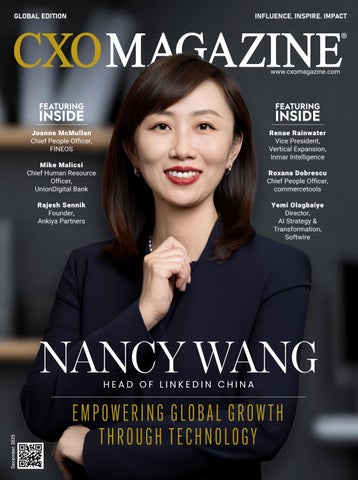
GLOBAL EDITION
INFLUENCE. INSPIRE. IMPACT
FEATURING
FEATURING
INSIDE
INSIDE
Joanne McMullan Chief People Officer, FINEOS
Renae Rainwater Vice President, Vertical Expansion, Inmar Intelligence
Mike Malicsi Chief Human Resource Officer, UnionDigital Bank
Roxana Dobrescu Chief People Officer, commercetools
Rajesh Sennik Founder, Ankiya Partners
Yemi Olagbaiye Director, AI Strategy & Transformation, Softwire
NANCY WANG December 2025
HEAD OF LINKEDIN CHINA
EMPOWERING GLOBAL GROWTH T H R O U G H T E C H N O L O GY CXO MAGAZINE, DECEMBER 2025
1
BS FR CR EE IB E
SU
December 2025
Vol - 03 Issue - 12
Managing Editor
Sarath Shyam
Consultant Editors
Dr. John Andrews Emma James Sabrina Samson Naomi Wilson Andrew Scott Kwith Alexander
Editorial Enquiry: admin@cxoomagazine.com
Art & Design
Charlie Jameson Louis Bernard Shirley David
Branding & Marketing Partnership
Jennifer Anderson Monica Davis Rachel Roy Anna Elza
Sales Enquiry: admin@cxoomagazine.com
2
Free Subscription www.cxomagazine.com
International Partnerships Americas Europe Middle East & Africa Asia-Pacific admin@cxoomagazine.com
Follow Us On www.linkedin.com/company/cxomagazinepage www.facebook.com/CXOMagazinePage
CXO Magazine www.cxomagazine.com is a global knowledge sharing digital platform published by Connecta Innovation Private Limited. All rights reserved. The opinions expressed in the content and pictures provided are those of the authors. They do not purport to reflect the opinions or views of the Connecta Innovation Private Limited or any of its members and we do not assume any responsibility. The publisher does not assume any responsibility for the advertisements, its content, pictures, and all representation of warranties made in such advertisements are those of the advertisers and not of the publisher. CXO Magazine www. cxomagazine.com is a Free Subscription and Free-to-read digital platform strictly not for sale and has to be strictly for internal private use only. Publisher does not assume any responsibility arising out of anyone modifying content and pictures, printing a copy of this digital platform in any format and in any country and all matters related to that.
CXO MAGAZINE, DECEMBER 2025
LEADING
BEYOND BORDERS
WITHOUT LOSING YOUR ROOTS
D
ecember often invites reflection. As the year winds down, many leaders find themselves asking a quieter question than usual. Not what did we achieve, but how far did we really travel. Not in miles or markets, but in mindset. I am reminded of a conversation with a founder who once told me that expanding globally was easier than earning trust abroad. The paperwork was simple. The people part was not. That challenge is becoming more common. According to recent global business surveys, more than half of companies expanding internationally stumble not because of strategy or capital, but because of cultural missteps and leadership blind spots. The lesson is clear. Scale today is less about speed and more about sensitivity. Leaders who succeed beyond their home markets learn to listen longer, speak with intention, and adapt without losing their core. This is where this month’s cover story finds its relevance. In our exclusive conversation with Nancy Wang, Head of LinkedIn China, we explore what it truly means to lead from one market while thinking for many. Her journey reflects a form of leadership that does not announce itself loudly. It is built on credibility, patience, and an understanding that global growth is sustained by relationships, not just results. Her perspective on AI, mentorship, and purpose offers a timely reminder that technology may open doors, but leadership decides what happens once you step inside. This issue of CXO Magazine brings together voices that examine leadership from multiple angles. From enterprise innovation to talent development, from academic insights to practical boardroom lessons, our contributors explore what it takes to build organizations that travel well across borders and generations. Each story, in its own way, reflects the evolving expectations placed on today’s decision-makers. As you turn these pages, I encourage you to read not in a rush, but with curiosity. Global leadership is not about becoming someone else. It is about becoming more aware of who you already are, and how that shows up in unfamiliar rooms. If this issue sparks a pause, a rethink, or a renewed sense of purpose, then it has done its job. Enjoy Reading.
Sarath Shyam
CXO MAGAZINE, DECEMBER 2025
3
COVER STORY
NANCY WANG HEAD OF LINKEDIN CHINA
08
EMPOWERING GLOBAL GROWTH T H R O U G H T E C H N O L O GY
CXO MAGAZINE, DECEMBER 2025
26
Yemi Olagbaiye, Director, AI Strategy & Transformation, Softwire Empowering Business Growth through AI Strategy and Innovation
32 Mike Malicsi, Chief Human Resource Officer, UnionDigital Bank Shaping the Future of Work through HR Innovation
INTERVIEW
16
Joanne McMullan, Chief People Officer, FINEOS Transforming Businesses through Talent and Culture
40 Rajesh Sennik, Founder, Ankiya Partners Harnessing the Power of Data for a Smarter Future
CXO MAGAZINE, DECEMBER 2025
46
Roxana Dobrescu, Chief People Officer, commercetools Empowering Workplace Strategies through Authentic Leadership
INTERVIEW
56
Renae Rainwater, Vice President, Vertical Expansion, Inmar Intelligence Transforming Businesses through Human Insights
CXO MAGAZINE, DECEMBER 2025
Want to Sell or find Investors for your Business?
Digital First Magazine CXO MAGAZINE, DECEMBER 2025 August 2021
7
RY O ST R VE
CO
NANCY WANG HEAD OF LINKEDIN CHINA
EMPOWERING GLOBAL GROWTH T H R O U G H T E C H N O L O GY Nancy Wang is the Head of LinkedIn China, leading strategy, sales, and customer success to help Chinese enterprises expand globally. With over two decades of experience in technology and business leadership, she was named one of Fortune China's Most Influential Businesswomen for 2024 and 2025, a 36Kr SHE POWER 2023 Influential Woman, and a recipient of the 2024 Forbes Chinese Elite Award. Nancy holds a degree in International Economics and Trade from Shanghai Jiao Tong University and is pursuing an Executive MBA to deepen her global business expertise. Recently, in an exclusive interview with CXO Magazine, Nancy shared insights into her leadership philosophy, innovation strategies, and vision for the future of B2B enterprise solutions, highlighting the importance of AI, mentorship, and purpose-driven leadership in driving business success and creating a more inclusive and sustainable future. The following excerpts are taken from the interview.
8
CXO MAGAZINE, DECEMBER 2025
CXO MAGAZINE, DECEMBER 2025
9
Hi Nancy. What drives your passion for leadership and innovation in the tech industry? Innovation is the lifeline of progress in a world defined by uncertainty. My passion comes from witnessing how technology transforms lives and creates opportunities that were once unimaginable. LinkedIn’s mission to create economic opportunity for every member of the global workforce is my compass. With global GDP growth projected at around 3% in 2025 and businesses facing supply chain disruptions and digital shifts, leadership in tech means turning volatility into vision. Technology is the enabler, but people are the heartbeat of progress. For me, every decision is about ensuring technology serves people. LinkedIn connects over 1.3 billion members worldwide, and every innovation we deliver is designed to turn that scale into meaningful impact. What do you love the most about your current role? Helping Chinese companies go global is more than a job—it is a mission. Chinese outbound investment reached $115.8 billion in 2024, with sectors like EVs and green tech leading the charge. My role allows me to not only witness but actively take on the role of driving force, guiding these companies in building international teams, strengthening global brands, and leveraging LinkedIn’s AI-powered insights to compete on the world stage. Watching businesses succeed globally and knowing LinkedIn played a role in that journey is deeply rewarding. Our data shows companies using LinkedIn for global hiring expanded their international talent pools by over 40% year-onyear, proving the power of connection.
10 C X O M A G A Z I N E , D E C E M B E R 2 0 2 5
LinkedIn connects over 1.3 billion members worldwide, and every innovation we deliver is designed to turn that scale into meaningful impact
What role do you think AI will play in shaping the future of B2B enterprise solutions? AI is no longer a trend—it is the backbone of modern enterprise strategy. It enables smarter decisions, personalized experiences, and predictive insights that redefine competitiveness. LinkedIn data reveals 88% of sales professionals use AI in their workflows, and those exceeding quotas are 2.5 times more likely to use AI daily. In China, AI is accelerating global expansion by matching talent and optimizing marketing strategies. As global supply chains prioritize resilience over cost, AI will be the differentiator that keeps businesses agile. LinkedIn’s AI-
driven tools process billions of data points daily to help companies anticipate market shifts before they happen. How do you stay connected to your purpose and values as a leader? Purpose is not a slogan—it is a daily practice. I stay grounded by aligning every decision with LinkedIn’s mission and by listening to people. Whether it is customers or my team, their voices guide me. In times of change, trust and transparency matter more than ever. I lead with empathy and inclusion, staying true to these values means ensuring that my leadership not only drives results but also inspires those around
CXO MAGAZINE, DECEMBER 2025
11
LinkedIn’s culture of trust and inclusion is why 94% of employees say they feel empowered to innovate, and that inspires me to lead with integrity
12 C X O M A G A Z I N E , D E C E M B E R 2 0 2 5
me to grow and thrive. LinkedIn’s culture of trust and inclusion is why 94% of employees say they feel empowered to innovate, and that inspires me to lead with integrity. What role has mentorship played in your career, and how do you mentor others? Mentorship is the bridge between potential and achievement. I’m deeply grateful to my mentors, who gave me confidence and opened my eyes to possibilities I had never imagined. One mentor encouraged me to shift my mindset from being a sales leader to becoming a business leader. At first, I questioned what that truly meant. Today, as the Head of LinkedIn Greater China, I’ve come to understand that a business leader focuses not just on hitting quotas, but on driving sustainable, consistent growth. Now, I strive to pay it forward. LinkedIn research shows that 91% of professionals involved in mentorship programs report higher job satisfaction—and I see that impact every day. True mentorship goes beyond the workplace: it’s about unlocking potential, building resilience, and providing guidance that shapes both careers and lives. Interestingly, LinkedIn Learning courses on leadership and mentorship have seen a 50% surge in global engagement, underscoring the growing need for meaningful guidance in an increasingly complex world. Can you share a book, podcast, or resource that has inspired you recently? Reid Hoffman’s latest book Superagency: What Could Possibly Go Right with Our AI Future is a powerful reminder that technology should
amplify human potential, not replace it. This perspective resonates deeply with LinkedIn’s vision. AI is not about diminishing human judgment—it is about enhancing human agency at scale. That idea inspires me to lead with optimism and responsibility as we embrace the future. What are some of your passions outside of work? What do you like to do in your time off? For me, time off is never just leisure—it’s an intentional investment in clarity, resilience, and long-term growth. Travel opens my mind and sharpens my perspective, whether I’m exploring the world or rediscovering my own country. This year, we ventured deep into China’s cultural and historical roots—completing the Gobi Desert Challenge with business school peers, an experience that tested endurance, teamwork, and leadership. We also retraced the ancient Hexi Corridor, reflecting on the Silk Road’s role in China’s golden age of trade and the lessons it offers for companies going global today. That same curiosity drives me to seek inspiration beyond our borders. Every year, we plan family trips abroad to experience cultural and geographic diversity. Next year, I’m excited to visit South America and witness the Amazon River—a lifelong dream and another step in broadening my global outlook. I also love reading about leadership and human behavior because understanding people is at the heart of sustainable strategy. Swimming, yoga, and fitness— complemented by mindfulness—anchor my daily routine. For me, yoga represents more than physical practice; it reflects a commitment to long-termism, patience, and resilience in both
CXO MAGAZINE, DECEMBER 2025
13
By leveraging LinkedIn’s unparalleled data and network intelligence, I aim to accelerate China’s role as a leading force in global talent mobility, ensuring companies can scale responsibly and competitively on the international stage
life and leadership. These habits help me stay grounded, foster inner strength, and maintain the focus needed to show up fully for my team and my family. What is your favorite quote? One of my favorite quotes from Reid Hoffman, LinkedIn’s co-founder, is: ‘Innovation comes from long-term thinking and iterative execution.’ This really resonates with me because true progress isn’t about quick wins— it’s about persistence and learning along the way. At LinkedIn, that mindset drives how we build solutions like AI-powered hiring and skills mapping. We focus on sustainable innovation that helps businesses and professionals thrive globally. What is your biggest goal? Where do you see yourself in 5 years from now? My overarching goal is to establish LinkedIn as the most trusted and indispensable strategic partner for Chinese enterprises navigating global expansion. This means not only providing tools and insights but shaping the
14 C X O M A G A Z I N E , D E C E M B E R 2 0 2 5
ecosystem where talent, technology, and opportunity converge. Five years from now, I see myself spearheading transformative initiatives that integrate artificial intelligence, sustainability, and talent mobility—creating frameworks that enable businesses to thrive in a world defined by complexity and interdependence. By leveraging LinkedIn’s unparalleled data and network intelligence, I aim to accelerate China’s role as a leading force in global talent mobility, ensuring companies can scale responsibly and competitively on the international stage. What advice would you give to women looking to pursue careers in tech and leadership? Confidence is your greatest asset—own it. Believe in yourself and take that first step without waiting for perfection. Build your network, find mentors, and keep learning. Gender-diverse leadership teams outperform peers by up to 35%, so your perspective matters. Use it to lead with authenticity and courage because that is what drives real change.
CXO MAGAZINE, DECEMBER 2025
15
I N T E R V I E W S
Empowering Business Growth through AI Strategy and Innovation Yemi Olagbaiye is Director of AI Strategy & Transformation at Softwire, a UK digital technology consultancy, and is also Director of their Media, Entertainment, Leisure, and Sport portfolio. He helps FTSE 350 and global brands turn AI from a technology story into production value and strategic business advantage; safely, ethically and at pace. As former sales leader turned AI strategist, he is known for his plainEnglish approach that fuses data, design and engineering to reduce ambiguity and unlock growth. Yemi advises boards on AI strategy and innovation, data foundations, and tech modernisation, and speaks regularly on agentic AI and humancentred transformation. Recently, in an exclusive interview with CXO Magazine, Yemi shared insights into his passion for technology and innovation, particularly in the realm of AI. He emphasized the importance of clarity in technology, stating that it reduces ambiguity and amplifies judgment. Yemi also discussed his role at Softwire, where he helps clients turn AI into strategic business advantages. He highlighted the potential of AI in various industries, including media, entertainment, leisure, and retail, and stressed the need for adaptability in a rapidly changing technology landscape. The following excerpts are taken from the interview.
16 C X O M A G A Z I N E , D E C E M B E R 2 0 2 5
Yemi Olagbaiye Director, AI Strategy & Transformation, Softwire
CXO MAGAZINE, DECEMBER 2025
17
I’m there to take a leadership narrative, ground it in data and design, shape it into a delivery path, and then make sure that the governance, safety and operating model aren’t afterthoughts
Hi Yemi. What drives your passion for technology and innovation, and how do you stay motivated in your role? I think the main thing that drives me is clarity. I’ve always been drawn to those messy, highstakes problems where it feels like the signal is buried deep underneath all the noise. For me, technology is at its best as a clarity engine. It reduces ambiguity,
18 C X O M A G A Z I N E , D E C E M B E R 2 0 2 5
amplifies judgement, and turns intention into outcomes. The great thing about AI is that it supercharged that promise. Done well, it’s less of a magic trick (as many businesses would love to believe), and more of an exoskeleton for decisionmaking. I see it as a way to help teams see sooner, decide faster and execute with more confidence. Aside from a longstanding and genuine passion for the bleeding
a lot of time for my own craft. That could be anything from writing thought leadership (which is essentially my learning process for upskilling in what’s going on), testing out tools & platforms with small hobby (or client) prototype projects, and generally just asking the slightly awkward “what would have to be true?” questions for a lot of the stuff around my role and responsibilities. I find that rhythm (customer reality, technical reality, personal discipline) a nice little trifecta for keeping me honest and energised.
edge of tech, most of my motivation comes from just staying close to the work. And by work, I mean both the business and technology side of things, because really, the technology is just an enabler for what the business is trying to do. Every week I’m spending time with one customer or another in some form, but also time with our product, design, and engineering teams. On top of all this though, I also make
What do you love the most about current role? The thing I’ve always loved the most is working at that intersection where board ambition meets engineering reality. When you work in that space, language really matters (which ironically was the basis of my academic career prior to my professional one). I see my job as part translator, part architect. I’m there to take a leadership narrative, ground it in data and design, shape it into a delivery path, and then make sure that the governance, safety and operating model aren’t afterthoughts. Currently at Softwire, I’m surrounded by people who care about craft and outcomes in equal measure. There’s a particular moment I chase the most which is when a client says, (directly or indirectly), “this isn’t a pilot any more, it’s how we work”. That shift from “theatre” to throughput is really addictive. What opportunities do you see for technology to drive growth and innovation in media, entertainment, leisure, and retail? In media and entertainment, the real unlock is the industrialisation of the content supply
CXO MAGAZINE, DECEMBER 2025
19
chain. Rights, metadata and creative assets are often trapped in brittle workflows; agentic AI can orchestrate ingest, tagging, compliance and versioning endtoend, so creatives spend time making, not managing. I think you’ll soon see personalisation moving beyond “next best” content and towards contextaware experiences that respect both attention and mood. When that happens, the metric will change from “minutes of screen time” to “minutes of meaning” as I call it. Leisure is also ripe for service excellence at scale. Think digital concierges that understand intent across channels, operations “autopilots” that smooth staffing and queueing in real time, and feedback loops that turn every interaction into product improvement. In that future, the ones that treat guest journeys like living
20 C X O M A G A Z I N E , D E C E M B E R 2 0 2 5
systems rather than a series of transactions will end up the real winners. I’ve also been doing more in retail over recent years and their advantage sits in the fusion of demand sensing and lastmile execution. You’ve got AI that can connect shelf, supply and shopper in nearreal time: fewer outofstocks, smarter assortment, associates augmented with tools that reduce cognitive load and returns triaged with intelligence. Unpopular opinion but I think most retailers don’t need another dashboard. What they need is decisions that move inventory and delight customers. Looking across the portfolio of sectors I deal with, across all the common pattern is the same though: strong data foundations, agentic orchestration across existing platforms, and governance that earns trust by design.
If you bake adaptability into how you design, deliver and decide, then change becomes a feature of the system, not a tax on it
Can you share your thoughts on the importance of staying adaptable in a rapidly changing technology landscape? Adaptability is less a personal trait and more a system property. You build it deliberately. Architecturally, that means decoupled platforms, clear data contracts, and evaluation harnesses so you can swap models and vendors without tearing out the plumbing. Organisationally, it means short timetotruth: evidencebased roadmaps, small bets with realworld exposure, and governance that’s progressive rather than paralysing. Culturally, that means having some narrative agility. You need leaders who can say “we’ve learned something new. Here’s what changes and here’s what doesn’t.” This is really critical in the world of AI because the halflife of any given model edge is short. If you bake adaptability into how you design, deliver and decide, then change becomes a feature of the system, not a tax on it. Can you share a book, podcast, or resource that inspires you, and why? There’s probably two books that you could say anchor opposite ends of my practice. CoIntelligence by Ethan Mollick is the pragmatic pole. It treats AI as a management discipline rather than theatre. The message is to start small, keep humans in the loop, measure what matters, and design workflows where judgement is amplified, not outsourced. That thinking shows up in my day-to-day at Softwire as evaluation harnesses, approval gates, clear data contracts and the idea that governance is part of the product, not paperwork after it. The counterweight that would be Donald Hoffman’s The Case Against Reality, which I
CXO MAGAZINE, DECEMBER 2025
21
only got on to very recently after watching his DOAC podcast episode. In the book he argues that our perceptions are a survival-tuned interface. More desktop icons than source code. Whether or not you buy every claim, it’s a powerful reminder that dashboards, KPIs and even model outputs are just icons. It pushes me to insist on observability, counterfactual tests and real-world feedback loops so we don’t mistake beautifully rendered metrics for truth. Together, the two books keep me grounded and curious: ship useful systems quickly, and never stop interrogating the interface. There’s also a third book I’d add to the mix by one of my favourite people to follow on LinkedIn: Jeremy Connell-Waite. He has a book called “The 109 Rules of Storytelling” is one of those leadership multipliers for me. Bite-
22 C X O M A G A Z I N E , D E C E M B E R 2 0 2 5
size constraints that force clarity, audience empathy and narrative momentum. It’s the craft I lean on to turn complex AI work into stories that align boards, unblock decisions and move teams from “interesting” to “approved”. Slightly different to the other two, but a real tenet of my evolving career: communicate so people can act. What are some of your passions outside of work? What do you like to do in your time off? Outside work, I’m a shameless gym bunny. People find it shocking when I tell them but most mornings I’m up and in the gym by 5am and lifting before my kids have even got up. To be clear, it’s not a performative thing. I see at as hygiene for both the body and the mind.
In AI work, it is dangerously easy to optimise for metrics while missing meaning. Insight is the test: did we reduce uncertainty for someone who needed to decide?
Movement early in the day is important in terms of setting the rhythm for the day and the peace of the gym at that time also gives me the quiet I need to line up the day’s decisions. I also make music. I used to produce semiprofessionally and still spend countless hours building tracks. Interestingly, I find it keeps my ear tuned to structure, texture, and timing, and these are the same instincts I rely on in product and organisational design. I’ve also got two young daughters now though so realistically a lot of favourite moments centre around them. I spend a lot of energy trying to bottle curiosity: taking apart ideas, toys and stories and getting them to question everything (sometimes much to my own undoing later). If I do one thing well, I hope it’s passing on that same thirst for learning in them.
What is your favorite quote? “The purpose of computing is insight, not numbers.” Richard Hamming’s line is a compass for me. In AI work, it is dangerously easy to optimise for metrics while missing meaning. Insight is the test: did we reduce uncertainty for someone who needed to decide? What is your biggest goal? Where do you see yourself in 5 years from now? My ultimate goal, ambitious as it may seem, is both to drive a movement of literacy around AI across both the professional and personal landscape, but also to help redefine what “transformation” means in the AI era. I’d hope that in 5 years, looking back, I’ll have a portfolio of organisations where AI isn’t a project or a “lab”, but a trustworthy part of their daily
CXO MAGAZINE, DECEMBER 2025
23
operations. Safer, faster and more human. To put that in more concrete terms, I see my true calling as being able to help dozens if not hundreds of executive teams move from narrative to numbers. That could be from publishing open playbooks others can build on, growing a diverse community of practitioners, or just scaling the role of whatever company I’m working for as a partner that turns modernisation and data foundations into durable competitive advantage. If you want a throughline to take from all that, it’s basically “less hype, more ‘shipped’ clarity”.
The leaders who thrive in AI can speak product, data, engineering, business, strategy, and risk, all with equal respect
24 C X O M A G A Z I N E , D E C E M B E R 2 0 2 5
What advice would you give to aspiring tech leaders looking to make a similar career journey? Taking from my own journey, my advice would be to go where there’s ambiguity and learn to translate. The leaders who thrive in AI can speak product, data, engineering, business, strategy, and risk, all with equal respect. They can connect a boardroom intent to a backlog that actually ships. Write more than you present. I find clear writing builds clear thinking. Optimise for teams, not heroes. It’s leadership 101 really but your job should be to create the conditions where good decisions are easy and bad ones are reversible. Measure yourself by outcomes in the wild, not applause in the room. The real work is done “out there” so to speak. And lastly, invest early in governance, safety and ethics as design constraints. Contrary to popular opinion, I don’t think they don’t slow you down; they actually make scale possible.
CXO MAGAZINE, DECEMBER 2025
25
I N T E R V I E W S
Transforming Businesses through Talent and Culture As Chief People Officer at FINEOS, Joanne McMullan is responsible for leading global Human Resources (HR), Learning and Development practices, and transformation programs across the organization. Her goal is to deliver an employee-oriented, high-performance culture, aligned to support the successful execution of the organizational growth strategy. Joanne has held senior HR positions since joining FINEOS in 2000. She was responsible for expanding the HR and learning and development teams and introducing global HR support procedures to support multiple international new countries. Prior to joining FINEOS, Joanne held several leadership and key roles across various industries including recruitment, insurance, and banking. Recently, in an exclusive interview with CXO Magazine, Joanne shared insights into her passion for HR and talent development. She believes people are the most powerful lever for business transformation and is driven by unlocking potential at individual and organizational levels. She also highlighted the importance of aligning talent strategy with business goals to accelerate growth, drive innovation, and build resilience. The following excerpts are taken from the interview.
26 C X O M A G A Z I N E , D E C E M B E R 2 0 2 5
Joanne McMullan Chief People Officer, FINEOS
CXO MAGAZINE, DECEMBER 2025
27
Hi Joanne. What drives your passion for HR and talent development? My passion for HR and talent development is rooted in the belief that people really are the most powerful lever for business transformation. I’m driven by the opportunity to try to unlock potential, both at an individual and organizational level, and to help shape an environment where people can thrive, perform at their best, and where they are fully aligned to contribute meaningfully to real strategic outcomes. Throughout my career, I’ve seen how aligning talent strategy with business goals can accelerate growth, drive innovation, and build resilience through change. Whether it's shaping leadership capability frameworks, embedding talent development into the core of the business strategy, fostering a 'one team' mindset, encouraging diverse thinking, and driving high levels of engagement, and augmenting agile workforce planning, I believe HR is now far beyond the traditional support function and a key strategic business partner to drive success. It’s about driving organisational health to gain competitive advantage and create a great place to work. Central to this is aligning people practices with the organisation’s values, ensuring that every aspect of the employee experience reflects and reinforces the culture we aspire to build. What aspects of your role do you find most rewarding, and why? What I find most rewarding is driving real business transformation through people, I love supporting people to see their potential and possibilities for growth that they sometimes don’t even see themselves, by encouraging and supporting people to lean-in, stretch themselves, get uncomfortable, and ultimately transform
28 C X O M A G A Z I N E , D E C E M B E R 2 0 2 5
not just their careers, but the business itself. That’s where magic happens, when people are empowered, engaged, and aligned with purpose, business performance follows. What do you believe are the most significant challenges facing HR leaders today? One of the most critical challenges and opportunities for all leaders today is navigating the rapid rise of AI. The pace of change requires us to evolve beyond traditional HR models and take a lead role in shaping a change readiness culture and leaders of transformation. What that means practically speaking is reimagining future roles, reskilling at scale, and embedding AI first mindset across the organisation. The real challenge isn’t just adopting AI, it’s integrating it in a way that enhances decision-making, drives efficiency, and builds agile, future-ready organisations where people and technology work in harmony to deliver sustainable performance. It also requires a strong ethical framework to manage the human and ESG impact, ensuring transparency, trust, and inclusion as we integrate technology into how people work and lead. Can you share your thoughts on the role of technology in HR and talent management? We’ve certainly come a long way from the days of paperwork and manual processes. For me, technology in HR and talent management is about being tech-powered and human-centric, by using smart tools to drive efficiency and effectiveness, but always keeping people at the heart of the experience. Leveraging technology such as AI and modern platforms allows us to make faster, more informed decisions, personalize
deliver that, it becomes a competitive advantage. It signals that we’re forward-thinking, agile, and serious about investing in our people and ultimately of course our customers. Ultimately, technology should enable us to have more time to create high-value, high-impact moments across the employee lifecycle, while shaping a future-ready workforce that’s equipped to lead through change.
The real challenge isn’t just adopting AI, it’s integrating it in a way that enhances decision-making, drives efficiency, and builds agile, future-ready organisations where people and technology work in harmony to deliver sustainable performance
development, and free up time to focus on what really matters: building capability, culture, and connection. It’s not just about doing things faster, but it’s about doing them better. Modern technology also plays a key role in attracting and retaining top talent. People expect intuitive, digital-first experiences, and when we
What were some key milestones or experiences that shaped your professional journey? Joining FINEOS in 2000 was a defining moment for me. I saw huge potential at my first introduction, not just for growth, but to help be part of shaping the culture and future of the organisation. What’s kept me inspired is the constantly changing landscape; no two days have ever been the same. There’s always been something new to learn, a challenge to navigate, or an opportunity to grow. Some of the most pivotal milestones have included expanding into new international markets, contributing to the successful execution of our IPO, and acquiring two organisations during the pandemic as part of the leadership team. Navigating COVID was especially transformative, not only professionally, but personally. Balancing work and home life with school age kids gave me a deeper empathy for colleagues facing similar challenges as well as dealing with a long-term family illness also strengthened my connection to the FINEOS vision, purpose, and values and reaffirmed my belief in the power of people to drive meaningful change for the greater good. Each of these experiences has shaped me as a leader, resilient, purpose-driven, and committed to
CXO MAGAZINE, DECEMBER 2025
29
creating environments where people can see the opportunity to thrive and grow. Can you share a book, podcast, or resource that inspires you and why? One book that has had a lasting impact is The Advantage by Patrick Lencioni, which was introduced to the leadership team by our CEO, Michael Kelly. It came at a pivotal time in our leadership journey and gave us the clarity and alignment we needed to operate as a truly cohesive team. What inspired me most was how it helped us articulate not just what we do, but why we exist, leading to the
creation of our internal FINEOS playbook that continues to guide our values, strategy, and leadership principles. It resonated with me because it reinforced the importance of organizational health as a strategic advantage. In a constantly evolving business landscape, having a clear sense of purpose and alignment across leadership is essential not just for performance, but for culture and engagement. Personally, it also helped me reflect on how I lead and show up for others. It reminded me that clarity, trust, and consistency are powerful tools in building high-performing teams.
I’m driven to lead purpose-led transformation that delivers high-impact outcomes, that make a meaningful difference not only to the business but also for the broader eco-system and the greater good
30 C X O M A G A Z I N E , D E C E M B E R 2 0 2 5
What are some of your passions outside of work? What do you like to do in your time off? Outside of work, I like to stay active by playing pickleball, which I absolutely love, it’s fast-paced, social, and a great way to unwind. Running has always been part of my routine, and while I’m working on getting back into it, it’s something that helps me to switch off and relax. I also enjoy listening to personal development audiobooks and diving into research that helps me grow both personally and professionally. Travel is another passion that I have, I love to experience different cultures which give me perspective, energy, and inspiration. I also volunteer as a board member for a local family community resource centre, which gives me a meaningful way to keep grounded and give something back to the community. What is your favorite quote? I have two to share one is “Growth and comfort do not coexist.” - Ginni Rometty, former CEO of IBM, and the second is “Fear and faith both demand you believe in something you cannot see. You choose.” - Bob Proctor What is your biggest goal? Where do you see yourself in 5 years from now? With the pace of change in today’s world, it’s difficult to predict exactly where we’ll be in five years, but what is clear is that having a change-ready mindset is essential. My biggest goal for now is to lead transformation through people, creating environments where talent, leadership, and culture are fully aligned to successfully executing the business strategy. As I mentioned at the beginning, I believe that people are the most powerful lever for
business transformation, even the best strategy, technology or work environment will fall short without a shared purpose, clear outcomes, and the behaviours that drive performance. Looking ahead, I am focused on growing as a strategic leader, expanding my impact and influence to help shape a resilient, future-ready organisation. I’m driven to lead purpose-led transformation that delivers high-impact outcomes, that make a meaningful difference not only to the business but also for the broader eco-system and the greater good. What advice would you give to aspiring HR leaders? Lean in. Especially when it feels uncomfortable. The most meaningful growth happens when you stretch beyond what’s familiar and trust your ability to lead through complexity. HR today is no longer just about policies and processes; it’s about shaping the future of the business through people. My advice is to stay curious, be confident, and believe in your capacity to influence at scale. Build deep business acumen, speak the language of strategy, and never underestimate the power of empathy and connection with others across the business. The ability to balance data-driven decisions with human insight is what sets great HR leaders apart. And most importantly, don’t wait for permission to lead. Step into the room, ask the hard questions, and be the voice that challenges, inspires, and transforms. The future of work needs leaders who are ready to lean into constant change and help others do the same.
CXO MAGAZINE, DECEMBER 2025
31
I N T E R V I E W S
Shaping the Future of Work through HR Innovation Mike Malicsi is a human resource leader and culture strategist, currently serving as Chief Human Resource Officer of UnionDigital Bank, the digital banking subsidiary of UnionBank of the Philippines. His extensive HR experience includes Head of People Experience & HR Business Partner for Goldilocks under SM Investments Corporation, HR Head of Chef Tony Brands, and Program Manager at the Philippines-Australia HR & OD Facility. Mike is an active educator and community leader. He also sits as an independent director of Century Savings Bank. Mike obtained a Master of Leadership from Monash University under an Australia Awards Scholarship. Recently, in an exclusive interview with CXO Magazine, Mike shared insights into his career journey, the challenges facing HR leaders today, and the importance of diversity, equity, and inclusion in the workplace. He also discussed the intersection of HR and technology, and how HR can drive digital transformation. The following excerpts are taken from the interview.
32 C X O M A G A Z I N E , D E C E M B E R 2 0 2 5
Mike Malicsi Chief Human Resource Officer, UnionDigital Bank
CXO MAGAZINE, DECEMBER 2025
33
With the influx of AI and the changing workplace landscape, HR leaders must ensure the relevance of talent and retention of employees especially in the technology, digital, and data-driven spaces
34 C X O M A G A Z I N E , D E C E M B E R 2 0 2 5
Hi Mike. Can you walk us through your career journey, and how you've progressed from an academic background to a CHRO role? My career journey has been quite interesting – non-linear actually. I finished an Education degree and undertook academe work for a decade. I then pivoted from being a full-time academic professional to a corporate HR practitioner. This was made possible through a role I landed with then the Philippines Australia Human Resource and Organizational Development Facility – an Australian Government project that worked with Philippine government agencies on HR and OD interventions. This was my initial foray into HR until I was invited to join a retail small and medium enterprise where I led HR transformational work for five years. I then joined SM Investments Corporation and was assigned as HR Business Partner and Head of People Experience to one of its portfolio companies – Goldilocks, the Philippines’s largest bakery chain. Expanding my industry experience, I transitioned to banking and joined UnionDigital Bank – the digital banking arm of UnionBank of the Philippines, the country’s 10th largest universal bank. I was Head of Talent and Culture until my appointment as Chief Human Resource Officer in February 2025. Even as I progressed from an academic background to a CHRO role, I continue to carry out my passion for teaching as a part-time lecturer at the Ateneo de Manila University and De La Salle University and I am grateful to my organizations – past and present – for allowing me to do so. My career journey has always been about people. I find sheer joy in educating, guiding, and leading them – whether in a corporate setting, academe, or in the communities I belong to.
What do you love the most about your current role? My HR leadership is anchored on a personal philosophy of “service to people, faith in people, and gratitude for people”. There is no better fulfilment that when their dreams take flight or their goals achieved, knowing that one way or another, may it be big or small, I am able to make an impact and contribution to their development and journey. What do you believe are the most significant challenges facing HR leaders today, and how do you stay ahead of the curve? I believe there are two foremost challenges being faced by HR leaders today: relevance and retention. With the influx of AI and the changing workplace landscape, HR leaders must ensure the relevance of talent and retention of employees especially in the technology, digital, and data-driven spaces. At UnionDigital Bank, we are implementing an AI Overarching Policy that serves as a blueprint for AI adoption and guide for the Bank’s AI strategy and roadmap, standards, and processes. This includes a key element on people in training and upskilling to enable them to complement and work with, and not compete against it. On retention, we are championing a workplace culture of flexibility, purpose, and well-being. The Bank’s young existence works to our advantage as it gives us the elbow room to be creative in this area but the challenge of retention remains that is why we are scaling our efforts to build career progression, facilitate talent mobility, and implement a dynamic rewards and well-being program for our people.
CXO MAGAZINE, DECEMBER 2025
35
Can you share your thoughts on the importance of diversity, equity, and inclusion in the workplace, and how you foster an inclusive culture? Diversity, equity, and inclusion remain significant in the changing world of work. DEI continues to matter. It impacts innovation, performance, and long-term sustainability. Our humble efforts in DEI and fostering an inclusive culture include espousing psychological safety, genuine support, and legacy building. We advocate safe spaces in our interactions because we believe this empowers our people to thrive where they can provide genuine support to uplift and make each other successful. In doing so, they can build a legacy through their purpose and for the Bank’s mission.
How do you think about the intersection of HR and technology, and what role do you see HR playing in driving digital transformation? There is a strong confluence between HR and technology and we are treading this intersection in the Bank. There are key areas where we put this into play: (1) Talent Acquisition: We use a tech-powered platform to help us source and connect with the right talents. It also allows us to screen and select with velocity by matching the job requirements and the role profile, (2) Learning: We developed an internal site where all e-learning programs are deployed. We also use an e-learning platform that provides employees democratized learning and the opportunity to create their learning pathways
I encourage HR practitioners and aspiring leaders to embrace HR as an intricate science, a delicate art, and an abstract diplomacy of human dynamics in the workplace. The work we do is extraordinary
36 C X O M A G A Z I N E , D E C E M B E R 2 0 2 5
towards progression in their current role or pivoting to a new one they are interested to pursue, and (3) HR Operations & Service Delivery: We maintain a site called “People Commons” where employees can access all the relevant HR information and updates as well as a self-service portal to request for employment documents. Altogether, this interplay between HR and technology helps us drive digitalization. Can you share a book, podcast, or resource that inspires you and why? Having taught literature back in the day, I can easily name “The Little Prince/Le Petit Prince” by Antoine de Saint-Exupéry as a book that inspires me. It is such a profoundly philosophical book about life in general, purpose, and meaning that also relate to work and career. What are some of your passions outside of work? What do you like to do in your time off? I continue to lecture in major universities in the Philippines where I teach strategic HR management, management principles, and organizational & business communication and render internship advisory. I engage in thought leadership & industry lectures, fora, and conferences. I am also active as founding convenor of Australia Alumni Communities Philippines – a network of Australia-educated Filipinos in various communities of practice and help locally run a US-based education start-up company in the country. In between all these, I love traveling by myself, with family and friends. Regularly having a good sweat at the gym also balances me.
CXO MAGAZINE, DECEMBER 2025
37
What is your favorite quote? It’s from the Little Prince which goes, “What matters most are the simple pleasures so abundant that we can all enjoy them. Happiness doesn’t lie in the objects we gather around us. To find it, all we need to do is open our eyes.” This quote resonates well with me especially in finding appreciation anywhere, everywhere. It also reminds me to be grateful for the work given to us which I hope also echoes to people, their role and purpose. What is your biggest goal? Where do you see yourself in 5 years from now? I’d like to believe that I have already attained my goal of shaping and advancing the work and mission of HR in my capacity as CHRO. While I am happy where I am now, perhaps in 5 years, I can see myself in an HR leadership role at an international or multi-national organization or in an academic or development setting. I also would like to pursue a personal
38 C X O M A G A Z I N E , D E C E M B E R 2 0 2 5
advocacy for the development and well-being of HR professionals. What advice would you give to aspiring HR leaders looking to make a similar career journey? I have often heard some say that HR is a thankless job. It is not – no job should be. After all, what is thankless about being able to make an impact in the lives of people and the work that they do? This impact may not always be palpable nor evident and at times, if not most, doing HR feels like being a punching bag. But we don’t always have to see our impact unfold right away because things may take time to percolate – we just have to remain faithful to our purpose and be there for people every single day, every step of the day. So I encourage HR practitioners and aspiring leaders to embrace HR as an intricate science, a delicate art, and an abstract diplomacy of human dynamics in the workplace. The work we do is extraordinary.
SlimYoo
slimyoo.com
39
C X O M A G Aistockphoto.com/DanielBendjy ZINE, DECEMBER 2025
I N T E R V I E W S
Harnessing the Power of Data for a Smarter Future Rajesh Sennik began his career writing open systems software before earning an MBA and joining Ernst & Young, where he co-founded the strategy practice. He later joined KPMG and advised on over 70 TMT transactions, followed by a leadership role at Accenture Strategy in India. In industry, he worked at Colt Technology Services advising the ELT and Board on major strategic issues. Most recently, Rajesh served as Equity Partner at KPMG, leading TMT Strategy and Data Centre Advisory. He now runs Ankiya Partners, a consultancy focused on building compute infrastructure. Rajesh leverages technical roots with strategy skillset to help accelerate human learning, creation and play. In an exclusive interview with CXO Magazine, Rajesh shared insights into the future of data centers, AI infrastructure, and his career journey. He discussed the impact of AI on data centers, emphasizing the need for innovative cooling solutions and massive investment. He also shared his personal mission to build resilient compute infrastructure and unlock human potential. The following excerpts are taken from the interview.
40 C X O M A G A Z I N E , D E C E M B E R 2 0 2 5
Rajesh Sennik Founder, Ankiya Partners
CXO MAGAZINE, DECEMBER 2025
41
Tell us about your background and areas of interest. I was born in Kenya and have Indian heritage. I studied electronic engineering and computer science at university, drawn to the elegance, logic, and precision of C and Unix. One formative experience involved jointly developing a text editor with three fellow students under intense time pressure. At the time, I didn’t realize its significance, but that collaboration taught me something profound: sharing codified information exponentially increases its utility, which in turn drives innovation. After university, I joined a software house and spent five rewarding years coding in C and Unix. Following my MBA, I entered consulting, working with investors and corporates in mobile, fixed, and IT services on strategic issues such as growth strategy, pricing, channel design, operating models, and M&A. It was an intellectually rich and privileged period, leading to leadership roles on landmark projects — including the largest LBO in European history at the time, and the launch strategy for what is now one of the world’s largest mobile operators. I learned how companies — and by extension, economies — function, or sometimes fail to. About 12 years ago, I began focusing more on the innovation imperative. While working in industry, I helped develop the growth strategy, operational plan, and funding structure for what has become one of Europe’s largest data centre operators. Today, inspired by that early university experience, I focus on helping humans innovate through sharing codified information — but now at industrial, global scale. It’s an exciting mission. I believe digital is destiny and infrastructure codifies intent. The nature and capacity of what I call “sovereign
42 C X O M A G A Z I N E , D E C E M B E R 2 0 2 5
compute” will determine competitiveness at personal, local, national, and international levels. Nations that invest in a well-architected strategic compute stack — encompassing data centres, compute, control, and purpose — will enjoy productivity growth, national competitiveness, and a higher quality of life. Being part of that transformation is what truly interests me. What do you love most about your current role? I recently retired as an Equity Partner at KPMG, where I had the privilege of working with an extraordinary team, IP, network, and platform. For example, I advised on approximately $5 billion in data centre-related transactions in 2025. I’ve since founded my own consultancy, driven by the belief that the data centre industry is entering the steep part of the S-curve and that we must craft layers of sovereign compute. What I love most is engaging with clients on knotty, ambiguous, and often contradictory challenges. Applying my consulting toolkit, industry experience, and business judgment can unlock transformative outcomes. For instance, how do we generate the massive amounts of power we need? Sometimes, one or two strategic choices can make or break a business’s future trajectory. How do you see AI transforming the data centre industry, and what opportunities or challenges do you foresee? We’re at a pivotal moment in technology history. The digitization of society, growth of enterprise cloud, rise of AI, and supportive regulatory shifts are driving a forecasted tripling of global data centre capacity — from around 70GW in 2025 to 220GW by 2030.
AI will undoubtedly reshape data centre demand and design. To train ChatGPT 4.5, we needed roughly 210 yottaFLOPs. For a ChatGPT 6 equivalent launching in 2027, we’ll need about 100 times that processing power — a staggering leap that will drive immense demand for compute and supporting infrastructure. However, the journey will be non-linear. While growth will likely be sustained for decades, we’ll see multiple dips due to supply-side constraints. Where will the data centres be located? How will we power and cool high-density AI data centres? Where will we source the necessary electrical and mechanical components such as generators and transformers? And how do we mobilize the human ingenuity required to solve these global challenges? These are fundamental questions being solved as we speak.
Moreover, we’ll need at least $2.3 trillion in global investment from now until 2030 to build the data centres — excluding CPUs and GPUs. For developers, operators, investors, and the entire value chain, the next few years represent unprecedented opportunities for growth and high returns — if these challenges can be effectively navigated. Can you share a mentor or role model who has shaped your career, and what advice they gave you? I’ve never had a single mentor. Instead, I believe in recognizing the strengths of every individual and integrating those qualities into my own leadership style. I’ve been fortunate to work with many exceptional leaders who’ve taught me the power of fact-based logic, the brilliance of pure intellect, the potential of
We’ll need at least $2.3 trillion in global investment from now until 2030 to build the data centres — excluding CPUs and GPUs
CXO MAGAZINE, DECEMBER 2025
43
people-centered leadership, the impact of charisma, and the importance of valuesbased decision-making. Ultimately, it’s my clients who’ve offered the most valuable career advice. One long-standing client encouraged me to move into industry to “really learn the business.” More recently, a client insisted my fees should be higher — a reminder of the value I bring.
Working on major strategic projects, conducting daily research, and analyzing hard data are essential. And yes — I use AI to stay current on AI
44 C X O M A G A Z I N E , D E C E M B E R 2 0 2 5
What new skills and expertise will be required to manage AI-driven infrastructure? AI data centres operate at much higher rack densities than traditional or cloud workloads. Cooling these facilities requires advanced liquidbased technologies such as direct-to-chip cooling, rear-door heat exchangers, or immersion cooling — air-based systems are no longer sufficient. We must determine the optimal cooling architecture and understand its implications for all electrical and mechanical components. Additionally, we need creative, non-legacy thinking to address the industry’s most pressing issue: the availability of the staggering amount of power required to run these data centres. For example, currently around 4% of the UK’s total power is used for data centres. At current forecast growth rates, that will rise to around 8%. This doubling of power demand is consistent across USA, APAC, Europe, MENA, and South America. Critically, political will and foresight are required to manage what is really a transition to sovereign compute. We urgently need a UK policy on data centres — similar to those in Norway or Singapore. Such a policy should look forward at least 30 years, determine the types of data centres needed to support multiple workloads (e.g.
Edge, Colo, Cloud, AI Inference, AI LLM), and outline the power sources and siting strategy for each category. Starting at the national level — before tackling local council complexities like planning permission — would build on London’s existing position in the FLAP-D markets and be a game changer for the UK economy. How do you stay current with AI advancements and their impact on infrastructure? It’s a challenge, given the pace of change and the scale of investment — including the recent $1 trillion commitments by leading firms. I rely on my experience base to separate signal from noise and understand what’s truly happening on the ground. Working on major strategic projects, conducting daily research, and analyzing hard data are essential. And yes — I use AI to stay current on AI. What are your passions outside of work? I stay active through golf, tennis, cycling, and yoga — all essential for mental and physical well-being. More recently, I’ve begun exploring ancient Indian civilization, which I find deeply fascinating. For example, during a visit to Florence — birthplace of the Renaissance — I learned that Fibonacci acquired the Aryabhata-developed Indian numeral system from Syria, where it was being studied. He brought it to Italy, influencing Medici banking innovations. It’s a beautiful illustration of global interconnectedness and the power of knowledge exchange. To honour those foundational exchanges, I named my consultancy “Ankiya,” which means “digital” in Sanskrit.
What is your favourite quote? I have several. “Right knowledge is the ultimate solution to all problems.” “He who conquers himself is the greatest of conquerors.” And “Speak what is true, speak what is pleasant, speak not what is true but unpleasant, nor what is pleasant but untrue.” All are from the Bhagavad Gita. And of course, my mother’s classic: “Just get on with it.” Her self-belief and positive mindset always inspired me. What is your biggest goal? Where do you see yourself in five years? As mentioned, I believe sovereign compute will underpin our future economy and define national competitiveness. These systems accelerate human learning, creativity, and play. My core mission is to help humans reach their full potential by playing a part in building such policy and infrastructure. I don’t set rigid five-year goals — the velocity of change is too high. Instead, I focus on doing meaningful work each day and trust that the outcomes will follow. What advice would you give to aspiring deal-makers or strategy consultants? The most successful peers I know made a few highly strategic choices about which sectors or functions to focus on — and adapted when the time was right. For instance, some chose postmerger integration during the consolidation wave of the late ’90s and built thriving careers. My advice: be intentional about where you spend your time. Choose sectors underpinned by secular growth drivers and ideally with multiple dimensions of impact — including at a national level.
CXO MAGAZINE, DECEMBER 2025
45
I N T E R V I E W S
Empowering Workplace Strategies through Authentic Leadership Roxana Dobrescu is the Chief People Officer at commercetools, where she leads global people strategy, advancing a scalable, people-first culture that supports growth and innovation. With two decades of HR and talent leadership experience, she is known for driving organizational transformation through responsible growth, equitable policies, and technology-driven solutions. Before joining commercetools, Roxana held senior leadership roles at Labster, Glovo, and Aspen Global, earning a reputation for crafting impactful talent strategies and fostering inclusive, high-performance environments. Recently, in an exclusive interview with CXO Magazine, Roxana shared insights into her passion for creating a positive and empowering work culture, the evolving role of HR, and her approach to leadership and transformation. She emphasized the importance of trust, clarity, and space for growth in driving business results and highlighted the need for HR leaders to think strategically and drive real impact. Roxana also discussed her personal growth journey, mentorship, and the value of calculated risk-taking, while emphasizing the need for HR professionals to stay adaptable, curious, and open to change. The following excerpts are taken from the interview.
46 C X O M A G A Z I N E , D E C E M B E R 2 0 2 5
Roxana Dobrescu Chief People Officer, commercetools
CXO MAGAZINE, DECEMBER 2025
47
Hi Roxana. What drives your passion for creating a positive and empowering work culture? Honestly? It’s not just about being “positive” for the sake of it. I’ve seen the business cost of poor culture: low accountability, missed opportunities, top talent walking out the door. I’ve also seen what happens when you get it right: people step up, stay longer, and are empowered to solve problems faster. You don’t have to chase performance - it shows up. I care about culture because it’s not decoration. It’s the infrastructure of results. The difference between a high-impact team and a group of well-meaning individuals often comes down to trust, clarity, and space to grow. When people feel seen, challenged, and supported to do their
48 C X O M A G A Z I N E , D E C E M B E R 2 0 2 5
best work, that effort fuels real results. That’s a win-win. What do you love the most about your current role? What I love is the leverage. When you're in a CPO seat, you're not just solving isolated issues; you’re shaping the operating model of how people work, lead, learn, and perform. I get to design the talent architecture that drives the business forward. The real thrill? Seeing someone rise, not because they changed, but because they were finally given room to shine. Watching a team go from “fine” to firing on all cylinders is more rewarding than you could ever imagine. Helping leaders lead better, not because they read it in a manual, but because they lived
it, coached it, and passed it on, that’s what keeps me inspired, what keeps me motivated. How do you see the role of HR evolving in the next 5-10 years? HR is evolving into one of the most forwardthinking functions in business—spotting trends, anticipating change, and shaping the future of work before it arrives. The “people person” stereotype is outdated. What’s needed now is commercial acumen, data fluency, systems thinking, and, honestly, guts. And by “guts,” I mean audacity—the courage to say what others won’t, to challenge leadership decisions when they misalign with values or long-term strategy, to call out inequities even when it’s uncomfortable, and to take bold bets on people and structures before the data is fully
perfect. Guts is what turns HR from a support function into a strategic engine. The HR function of the future is less about processes and more about foresight. Predicting talent gaps before they hurt. Building leadership pipelines before a crisis arises. Designing employee experiences that aren’t just “engaging” but truly productive and retentiondriving. We’ll have to operate like business strategists with a human lens—and back it up with data, not just gut feel. As technology reshapes the workforce, HR must also lead the conversation on reskilling, fairness, ethics, and inclusion—not as a compliance tick-box, but as a business-critical strategy. The organizations that win will be the ones who take people planning as seriously as financial planning.
As technology reshapes the workforce, HR must also lead the conversation on reskilling, fairness, ethics, and inclusion—not as a compliance tick-box, but as a business-critical strategy
CXO MAGAZINE, DECEMBER 2025
49
What are some key characteristics of successful organizational transformations? Real transformation isn’t a project. It’s a shift in how decisions are made and how behavior gets reinforced. That’s why most “big bang” transformations fail, they focus on structure and ignore mindset. In every transformation I’ve led, the turning point always came when leaders stopped waiting for permission and started modeling the new way forward. People don’t change because of slide decks; they change because they see someone they trust doing things differently and succeeding. Speed is also key. Show quick wins, adapt fast, and keep up the momentum. Wait too long, and fatigue sets in. You need to be ruthlessly clear on why you're changing. If people don’t buy the why, they won’t bother with the how.
People don’t change because of slide decks; they change because they see someone they trust doing things differently and succeeding
50 C X O M A G A Z I N E , D E C E M B E R 2 0 2 5
How do you stay current with the latest trends and advancements in HR and talent Management? The same way I stay sharp on the rugby field— through consistency, curiosity, and a healthy tolerance for discomfort. Playing rugby has taught me a lot about adaptability and reading the game as it unfolds; skills that translate directly into how I lead. You don’t wake up match-fit; you earn it through repetition, reflection, and resilience. HR is no different. I read widely—future-of-work research, organizational psychology, leadership trends— but theory only goes so far. Learning happens in motion. When something new looks promising, I test it. Run a pilot. See what works. Adjust fast. I also shadow colleagues across the business—from BDRs and engineers to sales enablement—to understand their reality, their
drivers, and their obstacles. No dashboard can tell you that. It’s empathy in action, and it keeps me grounded in the real pulse of the organization. And like in sport, I stay coachable. I unlearn when needed, and I shift tactics when the play isn’t working. Because in both rugby and leadership, staying still is the fastest way to fall behind. Can you tell me about a role model or mentor who has inspired you? I’ve often said publicly that I don’t have one singular hero. Instead, I’ve been uplifted by many people whose example and support have helped shape my path. However, if I look deeper, the person who has inspired me the most — and continues to do so — is my father. The older I get, the more I
CXO MAGAZINE, DECEMBER 2025
51
Whether I’m advocating for more inclusive hiring, pushing for equity across regions, or coaching others to find their voice, I’m passing on what my father gave me: a belief that you belong, and you decide how far you’ll go
realize how radical his support was. I grew up in a country and time where girls were not expected to speak up, dream big, or take up space. But my dad made sure I knew — early and often — that I could be anything. He gave me the gift of visualizing a future with no ceilings. He taught me that I set my own limits, on my own terms. Assertiveness, power, self-worth — these weren’t just concepts, they were modeled daily. He never told me to “be realistic.” He told me to claim my place in the world — and never settle. That mindset has been the compass guiding my leadership style. Whether I’m advocating for more inclusive hiring, pushing for equity across regions, or coaching others to find their voice, I’m passing on what my father gave me: a belief that you belong, and you decide how far you’ll go.
52 C X O M A G A Z I N E , D E C E M B E R 2 0 2 5
What were some key milestones or experiences that shaped your professional journey? There have been a few moments in my journey that have shaped not just my career path, but also how I see the world. One of the earliest came from a mentor who told me bluntly, “Go and work in another country. See how big the world is — and how small you are.” It wasn’t about humility alone; it was about perspective. That advice led me to take a leap early on, live and work abroad, and realize that being effective means learning fast, listening deeply, and never assuming you’ve got it all figured out. Another defining milestone was leading my first M&A. It taught me that culture is like concrete. Once it sets, trying to blend two distinct cultures is a mission of its own. You need patience,
intention, and the ability to read between the lines. The stakes are high, and there’s no shortcut. That experience fundamentally shaped how I approach transformation, integration, and people strategy during high-stakes transitions. And then there were the moments that really stretch your soul, like layoffs. Each one taught me something new, not just about care and compassion, but about strategy. How to think five steps ahead. How to plan in a way that makes those moments less frequent, less painful. And when I made the jump from the corporate world into the chaos and energy of startups and hypergrowth, I learned all over again. Founders move fast. The unknown is constant. But that’s where I built the muscle for speed, courage, and creativity under pressure. All of these experiences left marks. I carry them with me every time I walk into a boardroom,
build a new team, or make a people call with impact far beyond HR. What are some of your passions outside of work? What do you like to do in your time off? Outside of work, I travel and hike as much as I can — I love being in new places, surrounded by unfamiliar cultures, food, and ways of thinking. It’s how I reset and stay curious. But honestly, what really anchors me outside my role is rugby. I train three times a week, I compete and I still get that rush every time I step on the field. I love the adrenaline, the physicality, and the strategy behind the chaos. But more than that, it’s the team: strong, fearless women who have your back no matter what. It’s a bond built through sweat, bruises, and absolute trust. Rugby has
CXO MAGAZINE, DECEMBER 2025
53
Learn the business, understand how it makes money, where the risks are, and what keeps the CEO up at night. Then figure out how people strategy helps solve those problems
taught me more about leadership, resilience, and community than any book or course ever could. What is your favorite quote? One quote that really resonates with me is: “Life is change. Growth is optional. Choose wisely.” It’s a simple line, but it hits hard. Change is constant — in business, in teams, in life — whether you’re ready for it or not. The real question is: what are you going to do with it? For me, change has never been the enemy. It’s been the doorway. Every big step I’ve taken — leaving my home country, diving into tech, jumping headfirst from the predictability of corporate into the glorious chaos of hypergrowth — was basically me saying, “Well... let’s see what happens.” And yes, it was uncomfortable. Terrifying, even. But also the only way I’ve ever truly grown. Change doesn’t wait for you to feel ready. You just have to move, figure it out midair, and trust that you’ll land somewhere better — or at least with a good story. That’s how I try to lead too: eyes open, no autopilot, always in motion. What is your biggest goal? Where do you see yourself in 5 years from now? Honestly, my biggest goal is to keep leaning into the unpredictable. If I can look back and say, “Well, that escalated quickly… but in a good way,” then I’m exactly where I need to be.
54 C X O M A G A Z I N E , D E C E M B E R 2 0 2 5
Change never bothered me anyway. I’m way more afraid of getting too comfortable. In five years? I see myself still feeling uncomfortable, but in the best way. Still building, still learning, still working alongside bold people doing meaningful things. Whether that’s scaling another tech company, advising founders, or coaching the next generation of CPOs, I want to stay close to where change is happening and where I can help make it count. If I’m playing rugby on the weekends and still asking uncomfortable questions in boardrooms, I’ll know I’m in the right place. What advice would you give to aspiring HR leaders looking to make a significant impact? Learn the business, understand how it makes money, where the risks are, and what keeps the CEO up at night. Then figure out how people strategy helps solve those problems. Be bold. Don’t wait for a title or permission. Influence from where you are, ask better questions and challenge gently, but relentlessly. And for the love of people — don’t settle for surface-level. If you’re going to lead, really lead. Push for clarity, deliver value, grow others, and make sure you laugh along the way. This work is too important and too human, to do it with your guard up all the time.
CXO MAGAZINE, DECEMBER 2025
55
I N T E R V I E W S
Transforming Businesses through Human Insights Renae Rainwater is a dynamic business executive with over two decades of experience driving growth, innovation, and transformation across retail, marketing, sales, and technology. Currently serving as Vice President of Commercial Strategy and Development at Inmar Intelligence, she leads the New Verticals division, where she shapes go-to-market strategies, unlocks new channels, and forges partnerships that position Inmar at the forefront of commerce and data-driven solutions. Rainwater’s career reflects a consistent track record of turning complexity into clarity and vision into results. From leading retail marketing at Albertsons to building enterprise strategies at Bayer CropScience to shaping commerce innovation at The Mars Agency, she has developed and executed strategies that accelerate revenue, strengthen client trust, and pioneer change in highly competitive markets. Her leadership at Inmar has spanned retail strategy, AI commercialization, and MarTech expansion, always centered on one principle: aligning teams around growth through innovation and execution. Beyond her business acumen, Rainwater is recognized as a leader who empowers teams and cultivates future talent. She has mentored young professionals through the Boise Metro Chamber, served on the Idaho Youth Ranch board, and championed women in leadership and outdoor advocacy through SheJumps. Her ability to lead with both head and heart has earned her a reputation as a trusted advisor, collaborative partner, and change-maker. Colleagues and clients alike describe Rainwater as a visionary strategist with relentless optimism and a knack for creating momentum where others see roadblocks. She brings energy, creativity, and commercial rigor to every challenge, whether it’s scaling retail media platforms, building new verticals from the ground up, or reimagining how brands connect with shoppers and patients in a digital-first world. Recently, in an exclusive interview with CXO Magazine, Renae shared insights into her background and expertise in business development, innovation, and transformation. Renae emphasized the importance of humanizing technology, curiosity, courage, and clarity in leadership, and staying inspired by connecting cultural nuances and business priorities. She also highlighted the significance of transparency, trust, and humor in leadership and personal life. The following excerpts are taken from the interview.
56 C X O M A G A Z I N E , D E C E M B E R 2 0 2 5
Renae Rainwater Vice President, Vertical Expansion, Inmar Intelligence
CXO MAGAZINE, DECEMBER 2025
57
Please tell us about your background and areas of expertise. My background sits at the intersection of business development, innovation, and transformation. I lead vertical expansion at Inmar Intelligence, where my focus is on building and scaling new growth engines across sports, automotive, and healthcare. Each of these industries holds massive untapped potential for loyalty, media, and data-driven engagement — and my role is to turn that potential into measurable, sustainable business outcomes. In sports, I’ve helped shape partnerships that connect fan engagement with real marketing and sponsorship impact. In automotive, I lead strategies that help dealerships use first-party data and AI to transform service retention and loyalty. And in healthcare, I’m driving approaches that bring personalization and trustbased engagement to patients and providers. At the core, my expertise is about bridging technology, strategy, and human behavior — helping organizations modernize how they connect with people in ways that actually move the business forward.
people through that process. Watching someone grow in confidence and capability while tackling something hard — that’s the best part of leadership.
What do you love most about your current role? I love being in the business of possibility. Leading new verticals means constantly stepping into uncharted territory and building something that didn’t exist before. It’s an environment that demands curiosity, agility, and conviction. The most rewarding moments are when a partner realizes how innovation translates into measurable value — when a team in sports sees engagement turn into fan loyalty, or when a healthcare client sees trust transform into better outcomes. And honestly, I love developing
What do you believe are essential qualities for a leader driving business growth in today’s global marketplace? Curiosity, courage, and clarity. Curiosity keeps you learning; courage keeps you moving when the answers aren’t obvious; and clarity keeps your team aligned when things get complex. Leaders today have to balance data with instinct, speed with thoughtfulness, and ambition with empathy. The global marketplace doesn’t reward rigidity — it rewards adaptability. The best leaders I’ve worked with think like explorers, not managers.
58 C X O M A G A Z I N E , D E C E M B E R 2 0 2 5
What are your perspectives on leveraging digital tools and technologies for enhancing business growth and marketing effectiveness? Technology is only powerful when it’s humanized. The real opportunity isn’t in automation for its own sake, but in how we use data, AI, and digital tools to make relationships deeper and more personal. I think of digital innovation as an amplifier — it sharpens strategy and allows scale without losing connection. In automotive, it’s turning service data into predictive communication that keeps customers loyal. In sports, it’s translating fan engagement into smarter brand partnerships. And in healthcare, it’s creating trust through timely, relevant, and empathetic interactions. When technology aligns with human motivation, growth becomes natural — not forced.
The real opportunity isn’t in automation for its own sake, but in how we use data, AI, and digital tools to make relationships deeper and more personal
How do you stay inspired and motivated as a leader dealing with the complexities of international business? Perspective is everything. Complex doesn’t have to mean complicated — it often just means layered. I stay inspired by connecting those layers: cultural nuance, business priorities, and the shared human drivers that exist across every market. I also draw motivation from progress. Even small wins matter when you’re building
something new. And I’m intentional about surrounding myself with people who think differently — curiosity and diversity of thought keep the work alive and evolving. What is your favorite quote? “Truth over harmony.” It reminds me that real progress comes from honest, sometimes uncomfortable conversations. Transparency builds trust, and trust fuels performance. It was also a phrase coined by my lovely
CXO MAGAZINE, DECEMBER 2025
59
for me and reminds me how enormously beautiful life truly is. Humor is another big one — it’s how I stay grounded. The world is complicated, but laughter makes it enjoyable.
The people who make the biggest impact are those who stay learners, even after they’ve become experts
husband, Evan Rainwater, and now multiple fortune 100 companies use it as part of their north star and culture...one of the many reasons I'm proud of him. What are your passions outside of work? Adventure, laughter, and the outdoors. I spend a lot of time exploring with my family — hiking, road-tripping, and finding new places to get lost in. Being outdoors resets everything
60 C X O M A G A Z I N E , D E C E M B E R 2 0 2 5
Where do you see yourself in the next five years? In five years, I see myself continuing to build and lead global innovation initiatives — expanding Inmar’s presence across emerging verticals and unlocking growth in areas where technology and human behavior intersect. I'll be looking back at how New Verticals played an integral part of how Inmar Intelligence is now a $5B brand. I’m passionate about developing the next generation of leaders — people who are bold enough to challenge, humble enough to listen, and relentless about improvement. My focus will always be on creating businesses that balance innovation with impact. Looking back on your career, what advice would you give to someone aspiring to be a leader in international business and marketing like yourself? Lead with curiosity, and never lose sight of truth. Don’t chase titles — chase mastery. The people who make the biggest impact are those who stay learners, even after they’ve become experts. Find comfort in ambiguity; that’s where the magic happens. And remember, leadership isn’t about control — it’s about clarity and connection. When you communicate purpose, hold people accountable with respect, and create space for others to shine, you’ll not only lead well — you’ll build something that lasts.
CXO MAGAZINE, DECEMBER 2025
61
62 C X O M A G A Z I N E , D E C E M B E R 2 0 2 5