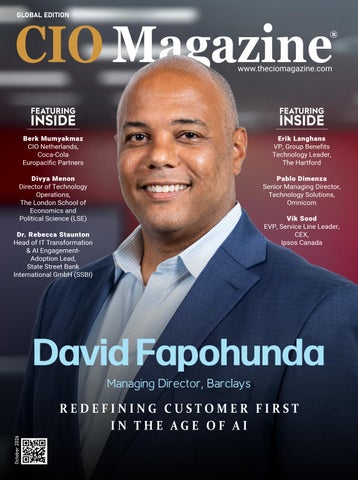
GLOBAL EDITION
FEATURING
FEATURING
INSIDE
INSIDE
Berk Mumyakmaz CIO Netherlands, Coca-Cola Europacific Partners
Erik Langhans VP, Group Benefits Technology Leader, The Hartford
Divya Menon Director of Technology Operations, The London School of Economics and Political Science (LSE)
Pablo Dimenza Senior Managing Director, Technology Solutions, Omnicom Vik Sood EVP, Service Line Leader, CEX, Ipsos Canada
Dr. Rebecca Staunton Head of IT Transformation & AI EngagementAdoption Lead, State Street Bank International GmbH (SSBI)
David Fapohunda Managing Director, Barclays
October 2026
REDEFINING CUSTOMER FIRST IN THE AGE OF AI CIO MAGAZINE
1
Oct. 2026
October 2026
Vol - 3 Issue - 10
Managing Editor Sarath Shyam
Consultant Editors
Dr. John Andrews Emma James Sabrina Samson Naomi Wilson Andrew Scott Kwith Alexander Editorial Enquiry: admin@thecioomagazine.com
Art & Design Charlie Jameson Louis Bernard Shirley David
Branding & Marketing Partnership Jennifer Anderson Monica Davis Rachel Roy Anna Elza Sales Enquiry: admin@thecioomagazine.com
Free Subscription www.thecioomagazine.com
International Partnerships Americas • Europe • Middle East & Africa • Asia-Pacific admin@thecioomagazine.com
Follow Us On www.linkedin.com/company/ciomagazine
CIO MAGAZINE
2
CIO Magazine www.theciomagazine.com is a global knowledge sharing digital platform published by Connecta Innovation Private Limited. All rights reserved. The opinions expressed in the content and pictures provided are those of the authors. They do not purport to reflect the opinions or views of Connecta Innovation Private Limited or any of its subsidiaries, its members or associates and we do not assume any responsibility. The publisher does not assume any responsibility for the advertisements. The content, pictures, and all warranties made in such advertisements are the sole responsibility of the advertisers. CIO Magazine www.theciomagazine.com is a Free Subscription and Free-to-read digital platform strictly not for sale and must be strictly for internal private use only. Publisher does not assume any responsibility arising out of anyone modifying content and pictures, printing a copy of this digital platform in any format and in any country and all matters related to that. “CIO Magazine www.theciomagazine.com“ and “The CIO Magazine www.theciomagazine.com“ trademarks are owned by Connecta Innovation Private Limited. Oct. 2026 Sept. Jul. Jun. May 2026 2026 2026
WHEN TECHNOLOGY DECIDES, TRUST MUST ANSWER
T
echnology can make a decision in milliseconds. Earning the trust of the person affected by it can take years. As artificial intelligence moves deeper into business operations, financial services, healthcare, and education, a critical question emerges: can organizations explain their systems’ decisions and take responsibility for their consequences? Consider a customer whose loan application is rejected by an automated system. The decision may be quick and consistent, but if the reasoning remains unclear, confidence in the institution can quickly erode. This is the challenge facing today’s leaders. Efficiency matters, but it cannot come at the expense of accountability. Trust must be built into technology from the beginning, not added after problems arise. The scale of AI adoption makes this responsibility increasingly urgent. According to IBM’s Global AI Adoption Index 2023, 42% of surveyed enterprise-scale organizations reported actively using AI in their business. Yet adoption alone does not guarantee responsible use. Transparency, data security, human oversight, and clear accountability must keep pace with technological progress. This issue of CIO Magazine explores these questions through our cover story featuring David Fapohunda, Managing Director at Barclays. Drawing on 26 years of experience across Citi, PwC, and Barclays, he offers insights shaped by global operations, technology transformation, and AI strategy. His belief that AI should enable empathy rather than replace it offers an important reminder: technology creates its greatest value when it strengthens human judgment and makes room for meaningful interactions. His emphasis on governance, transparency, and control underscores a fundamental leadership responsibility: innovation must be matched by accountability. Beyond the cover story, this issue brings together thought-provoking articles, interviews, and perspectives on the evolving relationship between technology, business, and people. Together, they invite readers to question established assumptions and consider what responsible progress should look like. Technology will continue to advance, and its decisions will increasingly shape our lives. The organizations that stand apart will be those that recognize trust is not a feature they can switch on. It is a responsibility they must earn, decision by decision. Enjoy Reading.
Sarath Shyam
CIO MAGAZINE
Oct. 2026
CONTENTS 08
OCTOBER 2026
COVER STORY
David Fapohunda Managing Director, Barclays
REDEFINING CUSTOMER FIRST IN THE AGE OF AI
CIO MAGAZINE
Oct. 2026
14
CIO INSIGHTS
Mumyakmaz 14 Berk CIO Netherlands,
Coca-Cola Europacific Partners Transforming Impact Through Business, Technology, And People
20
TECH TALKS
Rebecca Staunton 20 Dr. MSc., PMP, CSM, CSPO, MD,
Head of IT Transformation & AI Engagement-Adoption Lead, State Street Bank International GmbH (SSBI) Empowering Organizations to Scale AI Responsibly
CIO MAGAZINE
Oct. 2026
CONTENTS 28
36
44
52
TECH TALKS Langhans 28 Erik VP, Group Benefits
Technology Leader, The Hartford Empowering Innovation Through Scalable Technology
Dimenza 36 Pablo Senior Managing Director, Technology Solutions, Omnicom Transforming Governance for an Agentic AI Era
Menon Vik Sood 44 Divya 52 Director of Technology Operations, EVP, Service Line Leader, The London School of Economics and Political Science (LSE) Empowering People Through Simpler Technology
CIO MAGAZINE
Oct. 2026
CEX Ipsos Canada
Transforming Data into Human Behavior Insights
Want to Sell or find Investors for your Business?
7
Digital First Magazine Oct. 2026 CIO MAGAZINE August 2021
C OV E R S TO RY
David Fapohunda Managing Director, Barclays
REDEFINING CUSTOMER FIRST IN THE AGE OF AI David Fapohunda is a Managing Director at Barclays, where he leads operations, technology, and AI strategy across the Corporate, Consumer, and Payments businesses. Over 26 years in financial services, spanning Citi, PwC, and Barclays, he has led global operations of 6,000+ people, managed budgets exceeding $1.25B, and delivered platform modernizations that consolidated and migrated legacy systems to cloud-native platforms. A frequent speaker at Money20/20, BAI, and the American Bankers Association, and a trustee of The Putney School, he writes widely on AI governance, board accountability, fraud prevention, and servant leadership in the agentic AI era. He studied Finance and Information Systems at Pace University. Recently, in an exclusive interview with CIO Magazine, David shared insights into a 26-year journey that began at Citi with a global KYC rollout and evolved into leading operations, technology, and AI strategy across Corporate, Consumer, and Payments at Barclays. On AI, David believes the technology doesn’t replace empathy, it enables it, giving leaders the capacity to reinvest in human moments that matter while building governance, transparency, and control into every model. Looking ahead, he sees the next generation of leaders needing wisdom, business acumen, and the confidence to question and direct AI, not just operate it. His advice to aspiring professionals is to pair intellectual curiosity with the boldness to speak up, challenge, and learn from failure. The following excerpts are taken from the interview.
CIO MAGAZINE
8
Oct. 2026
CIO MAGAZINE
9
Oct. 2026
Looking back 25+ years, what moment or early role first showed you that technology and data could reshape financial services operations? It was 1999, at the very start of my career at Citi, and I was helping to coordinate the project management of a Know Your Customer application that was being rolled out globally, working from the development and engineering side. As someone just entering the industry, the world of financial crime, regulatory requirements, and client resolution was entirely foreign to me, and I loved learning it. The expectations of the bank and the regulatory demands together formed the problem statement I still find compelling today. How do we truly know who our customers are, and confirm that their behavior aligns with our understanding of them? How do we do that consistently across a global organization, for a global client base that interacts with the bank in dozens of different ways? The moment it truly clicked was when I understood how a global institution ran countless individual processes across every business line and every country, and how the consistent delivery of technology could bring them all together, creating a common data platform that unifies the customer to the bank and lays the foundation for a genuine 360-degree view. That was when I learned that delivering frictionless client service while adhering to a complex global footprint of regulation is one of the truly hard problems an institution faces, and that data and technology were the way through it. That problem became the throughline of the next twenty-six years of my career, from core banking and payments platforms to real-time fraud systems and, today, enterprise AI.
CIO MAGAZINE
10
Oct. 2026
When you think about your current role, what part of it do you genuinely love most, and why does it keep you motivated? I am a problem solver and a builder at heart. I have always enjoyed puzzles, taking things apart to understand how they work and then creating something new. What I love just as much is collaborating with others and finding the synergies that surface solutions I could never have arrived at on my own. It fulfills me to be in an environment where I am inspired and can, in turn, inspire others. As a leader, I feel a genuine excitement for success when I am working in the most detailed part of a project. That throughput of knowledge at the granular level, the problem, the solution, and the camaraderie of the people around me, is what makes me feel, at the end of the day, that I have actually accomplished something. What keeps me motivated is the hope that in the years ahead I can help develop innovative solutions at pace and scale that shape many different industries, each one its own puzzle to solve. Efficiency and empathy have to coexist. How will the definition of “customerfirst” evolve in financial services by 2031 as AI handles more interactions? I don’t believe the concept of customer-first will change over the next five years. It will still mean putting the customer at the center of everything you do, and seeking to delight and please them in every interaction. What changes with AI is our capability. We gain a far better understanding of our customers’ preferences, the foresight to see the challenges they will face, and the ability to offer them solutions, whether that means empowering them to solve a problem on their
Five years from now there will still be a need for genuine human interaction, and that will demand more robust EQ than IQ
own or putting a human beside them to help in the moments that truly matter. That, to me, is the essence of customer-first, and AI simply enables it. The real opportunity is that AI lets us reinvest our resources where they count most, so that more people are available to hold more of our customers’ and clients’ hands through the challenging times. Efficiency, done well, is what buys us the room to be more empathetic, not less. Data is the core asset, but trust is fragile. How should financial services leaders balance hyper-personalization with data privacy and ethics in the next five years? Having spent most of my career transforming infrastructure, systems, controls, and operations across people, process, and technology, I’d like to reframe this question with the lens of my career in mind. It isn’t really about how you deliver hyper-personalization while balancing privacy. It’s about understanding what the customer actually wants. If a customer wants a hyperpersonalized experience and feels comfortable sharing their private data to enable it, that is
perfectly fine; there is no ethical dilemma there. What matters is the framework around that choice: giving the customer transparency that it is happening, the option to decide when and how their data is used, and, ultimately, the lever to remove their data whenever and however they wish. I genuinely believe customers want to be heard and understood, and they enjoy a concierge experience, but they should never be forced to make privacy the price of admission. Get the consent, transparency, and control right, and personalization and trust reinforce each other rather than compete. What new roles or skill sets will be critical inside financial services firms five years from now that barely exist today? Five years from now there will still be a need for genuine human interaction, and that will demand more robust EQ than IQ. With AI, knowledge becomes abundant, so knowing when to apply that knowledge becomes the premium, and that is where wisdom comes in. We will need to reskill our workforce toward wisdom, business acumen, strategy, and leadership. The technical
CIO MAGAZINE
11
Oct. 2026
skills we hold will change in how they are used. An accountant, for example, will still need to know the technical craft of accounting, but may not practice it day to day; instead, that accountant may be responsible for ensuring an AI-enabled workflow is performing accurately, with precision and consistency. In effect, they become a leader monitoring an AI team, responsible for interacting with other leaders, sharing observations, cultivating innovative solutions, and thinking critically. I’m already seeing the early shape of this in my own work, embedding generative and agentic AI into production under a governance model, where the highest-value people are the ones who can direct, question, and govern the machine rather than simply operate alongside it. Those are the skill sets we need now, and will need increasingly over the next five years. Leaders are products of what they read and watch. What book, documentary, or thinker outside financial services has most shaped your approach to problem solving, and why? I love science fiction. I think of Asimov, and other science fiction writers, as something close to fortune tellers. The human element, the human condition, and the ethical questions we ask ourselves will always be with us, and engaging with them helps you become a more genuine person and a more genuine leader. On the technical side, I am an avid podcast listener, and my favorites are the ones that explore other industries and how they have evolved and grown. One I return to often is Acquired, which goes deep on companies well outside financial services: their origins, how they differentiate themselves, the challenges they have faced and
CIO MAGAZINE
12
Oct. 2026
The boldness of confidence, the hunger for knowledge, and those combined soft skills will make a real difference, both to a young professional personally and to the teams they work in
overcome, and how they reinvent and reimagine themselves. Looking left and looking right into other fields keeps me sharp in my own day-today work, and helps me think more broadly and expansively about the economy, government, and the social changes that may affect me both personally and professionally. Together, these shape the way I reason and the way I solve problems. When you need to reset your thinking on a complex problem, what personal ritual or place consistently gives you breakthrough ideas? I find my moments of clarity at five in the morning. Sometimes it is because I have been working a problem over unconsciously and simply wake up with a clear view of it; more often, that early hour gives me the space to step outside my normal thinking patterns and see things from a different perspective, which surfaces challenges and opportunities I hadn’t imagined. The other thing that resets me is going to the movies. I get completely engulfed in the story and the magic, and for those two hours I forget everything I’ve been carrying. I come out refreshed and energized to think and to solve. It gives me a moment to strip away my emotional attachment to a problem and start afresh, and that fresh start is often where the breakthrough lives. What is your biggest goal? Where do you see yourself in five years from now? In five years, I hope to be working in an environment with a strong and rich culture, surrounded by peers who are genuine and authentic, and teams that are innovative and
daring enough to disrupt normal thinking patterns and deliver solutions that make a meaningful difference in people’s daily lives. I’d like to think of myself as the quiet conductor: not necessarily seen, but heard through the collaborative alignment of the musicians who work together to create a passionate experience for others. It’s a bold and slightly philosophical way to put it, and in practice it may just as often mean solving simple, practical problems, but to my mind those carry the same effect, and the same worth, as the large and magnanimous ones. Aspiring leaders need real tactics. What’s one unglamorous skill in risk, ops, or transformation that you wish more young professionals would master early? This is a hard one to answer, because people naturally evolve with age. But if I had been more confident in myself as a younger professional, comfortable enough to speak up, ask questions, challenge my seniors, and help create an environment where I could thrive, I believe I would have made a greater impact in the roles I held. That same boldness is what allows you to take risks, to test and fail, and to learn from the failure. The other thing is an insatiable intellectual curiosity: wanting to understand how things work, how well a meeting actually went, what causes inefficiency, and how a journey truly feels for a customer as they move through it. That curiosity is the foundation for identifying problems, which in turn leads to creative solutions. The boldness of confidence, the hunger for knowledge, and those combined soft skills will make a real difference, both to a young professional personally and to the teams they work in.
CIO MAGAZINE
13
Oct. 2026
CIO MAGAZINE
14
Oct. 2026
Berk Mumyakmaz CIO Netherlands, Coca-Cola Europacific Partners
Transforming Impact Through Business, Technology, And People Berk Mumyakmaz is a global IT and digital transformation leader with extensive experience in FMCG and consulting. Currently he is the CIO of the Netherlands and AI lead of Northwestern Europe at Coca-Cola Europacific Partners. Previously, he led large‑scale digital transformations at companies such as The Kraft Heinz Company and Royal Friesland Campina, spanning factories, supply chains, and commercial organizations across multiple continents. He has lived in 6 countries and led transformation projects in 30+ countries. Berk holds a degree in Electronics Engineering and an MBA, combining deep technical foundations with business leadership. He lives in Amsterdam with his wife and 2 kids. Recently, in an exclusive interview with CIO Magazine, Berk shared insights from a global journey spanning FMCG and consulting, with transformations across 30+ countries and leadership roles at Kraft Heinz, Friesland Campina, and now as CIO Netherlands and AI Lead for Northwestern Europe at Coca-Cola Europacific Partners. Looking ahead, his goal is to keep building impact at the intersection of business, technology and people, and to be remembered for delivering change that lasts. His advice to the next generation is to stay curious, stay humble, build across borders and functions, and lead with clarity and purpose because the best builders create momentum and opportunities for others. The following excerpts are taken from the interview.
CIO MAGAZINE
15
Oct. 2026
Hi Berk. What was the moment you realized you wanted to build a career across borders, industries, and cultures? I do not think there was one single moment. It was more a gradual realization that the most interesting problems rarely sit neatly within one country, one function, or one industry. Early in my career, I found myself drawn to situations where different perspectives had to come together: commercial teams, technology teams, local markets, regional leadership, and external partners. That is where I felt I could add the most value. Working across borders and cultures teaches you to listen before you act, to adapt your style, and to find common ground without losing momentum. Over time, I realized that this combination of business, technology, and international collaboration was not just something I enjoyed, but the environment where I could make the biggest impact. You’ve said you’re a builder at heart. What excites you most about starting something new from zero today? What excites me most is the blank page. Starting from zero forces you to be very clear about the problem you are solving, the value you want to create, and the people you need to bring with you. There is no legacy mindset to hide behind. You have to shape the vision, build trust, make decisions with incomplete information, and create momentum step by step. I enjoy that phase because it combines creativity with discipline. Whether it is a new digital capability, a transformation initiative, or a new way of working, the real satisfaction comes when an idea becomes something tangible that people use, believe in, and improve over time.
CIO MAGAZINE
16
Oct. 2026
FMCG and Telco are both being reshaped by technology and consumer behavior. What do you see as the single biggest shift coming for these industries in the next 5 years? The biggest shift will be the move from digital enablement to intelligent, real-time decision-making. In both FMCG and Telco, companies have already invested heavily in digital channels, data platforms, automation, and customer engagement tools. The next wave will be about connecting those capabilities so that decisions become faster, more predictive, and more personalized. In FMCG, that means better execution in stores, smarter demand sensing, more responsive supply chains, and more relevant customer experiences. In Telco, it means more intelligent networks, proactive service, and highly personalized offerings. The winners will be the companies that can turn data into action quickly while keeping the human customer experience simple and trusted. Talent is becoming the true competitive advantage. How should multinational companies rethink how they develop and retain global leaders? Multinational companies need to move beyond traditional career paths and think more in terms of experiences, exposure, and adaptability. Global leaders are not developed only through classroom programs or title progression. They are developed by giving people real business challenges, cross-functional assignments, international exposure, and the opportunity to lead through ambiguity. Retention also depends on whether people feel they are growing, trusted, and connected to a meaningful purpose. The best global leaders are comfortable with
THE WINNERS WILL BE THE COMPANIES THAT CAN TURN DATA INTO ACTION QUICKLY WHILE KEEPING THE HUMAN CUSTOMER EXPERIENCE SIMPLE AND TRUSTED
complexity, but they are also humble enough to keep learning. Companies should create environments where talent can move across markets, functions, and industries of expertise, while still feeling anchored in a strong culture. Many employees fear AI will replace human judgment. How can leaders build a culture where AI augments people instead of replacing them? Leaders need to start by being honest about both the opportunities and the concerns. If AI
is introduced only as a productivity tool, people may naturally fear that it is mainly about cost reduction. But if leaders position AI as a way to remove friction, improve decision quality, and free people to focus on higher-value work, the conversation changes. The key is to involve employees early, show practical use cases, and build confidence through experimentation. AI should be seen as a colleague that helps with analysis, summarization, pattern recognition, and automation, while humans remain accountable for judgment, empathy, ethics,
CIO MAGAZINE
17
Oct. 2026
and context. A strong AI culture is not built by technology alone. It is built through trust, transparency, and responsible leadership. Leaders are often shaped by what they read and who they learn from. What is one book, mentor, or idea that has stayed with you throughout your career? One idea that has stayed with me is that leadership is ultimately about creating clarity in complexity. I have learned from different mentors and leaders that people do not expect you to have every answer, but they do expect direction, honesty, and consistency. In complex environments, especially across markets and
CIO MAGAZINE
18
Oct. 2026
cultures, clarity becomes a form of leadership. It helps teams understand what matters, why it matters, and how their work contributes to the bigger picture. That idea has influenced how I approach transformation, stakeholder management, and team development. Technology changes quickly, but the need for clear, human leadership remains constant. With so much travel and work, balance becomes essential. What is your favorite way to reset and recharge when you’re not building or negotiating? For me, resetting is about creating distance from the noise. Travel and work can be energizing, but they also require a lot of mental switching.
back with better energy. Balance is not always about doing less. Often, it is about being present in whatever you are doing.
WORKING ACROSS BORDERS AND CULTURES TEACHES YOU TO LISTEN BEFORE YOU ACT, TO ADAPT YOUR STYLE, AND TO FIND COMMON GROUND WITHOUT LOSING MOMENTUM
I recharge by spending quality time with family and friends, enjoying good food, discovering new places, and sometimes simply slowing down without a packed agenda. I also value moments where I can reflect, whether that is during a walk, while travelling, or over a quiet coffee. Those pauses help me reconnect with what matters, regain perspective, and come
What is your biggest goal? Where do you see yourself in 5 years from now? My biggest goal is to continue building impact at the intersection of business, technology, and people. I want to help organizations use technology not as a separate function, but as a true driver of growth, simplicity, and competitive advantage. In five years, I see myself continuing to lead transformation at a broader scale, working with diverse teams across markets, and helping shape how digital, data, and AI create value for customers, employees, and the business. Titles are important, but impact matters more. I want to be known as someone who builds strong teams, delivers meaningful change, and leaves behind capabilities that continue to grow after the initial vision is delivered. If you could leave one message for the next generation of global builders, what would it be? Stay curious, stay humble, and do not wait for perfect conditions to start building. The world is moving too quickly for leaders who only operate within their comfort zone. Global builders need to understand technology, but they also need to understand people, culture, business, and trust. Be willing to cross borders, industries, and functions. Learn the language of the people you work with, not only literally, but commercially and culturally. Most importantly, build with purpose. The best builders do not just create systems, products, or organizations. They create momentum, confidence, and opportunities for others to go further.
CIO MAGAZINE
19
Oct. 2026
T A L K S T E C H CIO MAGAZINE
20
Oct. 2026
Empowering Organizations to Scale AI Responsibly
Dr. Rebecca Staunton MSc., PMP, CSM, CSPO, MD, Head of IT Transformation & AI Engagement-Adoption Lead, State Street Bank International GmbH (SSBI)
Dr. Rebecca Staunton is a Managing Director and Head of IT Transformation - Strategic & Regulatory Affairs and AI Engagement and Adoption Lead at State Street Bank International GmbH. She is responsible for Technology Strategy & Transformation, enterprise AI engagement and adoption, Digitalization & Innovation, IT Material Change Control, and the SSBI IT Products domain, driving strategic change and governance across CTB, PTB, and RTB portfolios. She also leads the SSBI IT PMO and serves as the Netherlands Branch IT Lead. With more than 20 years of global leadership, she has held senior roles at Philips, Adobe, UBS, Barclays, J.P. Morgan, Royal Bank of Scotland, and Kaiser Permanente. Rebecca holds a Doctor of Business Administration, an MS in Technology Management, is PMP, CSM, and CSPO certified, and is currently pursuing the IAPP Artificial Intelligence Governance Professional (AIGP) certification. Recently, in an exclusive interview with CIO Magazine, Rebecca shared insights from her 20+ year journey leading technology transformation, innovation, and governance. She reflected on the leadership principles that have guided her career, the importance of balancing innovation with accountability, and the role of governance in enabling sustainable change. Rebecca also discussed responsible AI adoption, the value of continuous learning, and the need to create environments where people and organizations can thrive. Her advice to future leaders is to define success on their own terms, lead with character and judgment, and focus on the impact they have on others. The following excerpts are taken from the interview.
CIO MAGAZINE
21
Oct. 2026
Hi Rebecca. Every leader has a starting point that shapes them. What was the first experience or role that made you realize technology and transformation would be your career path? My career did not begin with a fascination for technology—it began with a fascination for solving complex business problems and helping organizations navigate change. Early in my career, I realized that technology was rarely the challenge in itself. The real challenge was helping people, processes, and organizations adapt to change in ways that created lasting business value. Whether introducing a new operating model, leading enterprise transformation, or navigating regulatory change, success was never determined solely by the technology. It was determined by leadership, trust, governance, and disciplined execution. Over time, my perspective evolved. I no longer see technology simply as an enabler. I see it as an enabler, a driver, a protector, and an accelerant. Technology enables organizations to achieve outcomes that were once unimaginable. It drives innovation and competitive advantage. It protects organizations by strengthening resilience, cybersecurity, governance, and trust. And it accelerates transformation by helping ideas move from vision to execution with greater speed and impact. That realization has shaped every role I have taken across financial services, healthcare, and global technology organizations. I have consistently been drawn to environments where transformation is strategically important and operationally complex because those are the moments when leadership has the greatest opportunity to create meaningful and lasting change.
CIO MAGAZINE
22
Oct. 2026
For me, technology is never the destination. It is the catalyst that enables people, strengthens organizations, and creates sustainable business value. The true measure of transformation is not the technology itself, but the positive outcomes it delivers for the business, its customers, and society. You sit at the intersection of technology, regulation, and innovation. What excites you most about that space right now? For much of my career, organizations tended to view innovation, regulation, and governance as separate conversations—sometimes even competing priorities. Today, I believe we’re witnessing a fundamental shift. The most successful organizations are recognizing that innovation and governance are not opposing forces; they’re mutually reinforcing. What excites me most is that trust has become a strategic capability. As AI becomes embedded in every aspect of business, organizations are discovering that responsible innovation isn’t simply about meeting regulatory expectations. It’s about creating confidence among customers, employees, regulators, boards, and society that technology is being developed and used responsibly. Artificial intelligence has accelerated this evolution. The question is no longer whether organizations should adopt AI. The real challenge is how to operationalize it at enterprise scale while preserving transparency, accountability, and human oversight. That requires far more than technology. It requires leadership capable of bringing together business strategy, governance, risk, ethics, and innovation into a single operating model.
The pace of change is accelerating. What do you see as the single biggest shift in how regulated industries will use technology over the next 5 years? I believe the biggest shift over the next five years won’t be AI itself—it will be the industrialization of trust. Historically, organizations-built technology first and then layered governance, security, compliance, and controls around it. That model isn’t sustainable in an environment where AI systems continuously learn, evolve, and influence business decisions.
THE TRUE MEASURE OF TRANSFORMATION IS NOT THE TECHNOLOGY ITSELF, BUT THE POSITIVE OUTCOMES IT DELIVERS FOR THE BUSINESS, ITS CUSTOMERS, AND SOCIETY
Going forward, governance will become part of the engineering process itself. Risk management, cybersecurity, compliance, model oversight, and accountability will be designed into technology from the very beginning rather than inspected at the end. The organizations that distinguish themselves won’t necessarily be those deploying the most AI. They’ll be the ones that consistently earn the confidence of customers, regulators,
investors, and employees because trust has become an intentional design principle rather than an afterthought. Talent is the bottleneck in transformation. What skill sets will be most scarce and most critical in financial services and healthcare by 2030? We often talk about technical skills, but I believe the greatest shortage by 2030 won’t be technical talent alone—it will be leadership judgment. Organizations can teach people new technologies. What is much harder to develop is the ability to navigate ambiguity, balance competing priorities, make ethical decisions, and bring diverse stakeholders together around a common objective. Future leaders will certainly need to understand AI, cybersecurity, data, regulation, and business strategy. But equally important will be their ability to communicate across disciplines—to explain complex technologies in language that boards, regulators, clinicians, customers, and employees can understand and trust. Throughout my career, I’ve learned that technical expertise may earn you a seat at the table, but judgment, credibility, and the ability to unite people around a shared vision are what sustain leadership over time. Sustainability is becoming a tech mandate. How do you see technology enabling both business growth and environmental responsibility in the coming years? I believe sustainability is ultimately a leadership question rather than a technology question.
CIO MAGAZINE
23
Oct. 2026
Technology gives us unprecedented visibility into how organizations consume resources, manage operations, and make decisions. AI, advanced analytics, and automation enable us to optimize everything from energy consumption and infrastructure to supply chains and operational processes. But the real opportunity extends beyond environmental efficiency. It’s about responsible stewardship—making decisions that create long-term value for customers, shareholders, employees, communities, and future generations. The organizations that will lead over the next decade won’t treat sustainability as a compliance obligation or a separate ESG initiative. They’ll embed it into operational excellence, innovation, and strategic decisionmaking because sustainable organizations are ultimately more resilient, more efficient, and better positioned for long-term growth. Books shape how we think. What book, fiction or non-fiction, has influenced your approach to leadership or decision-making the most? I am an avid reader and believe that continuous learning is one of the most important responsibilities of any leader. Over the course of my career, I’ve had the privilege of reading a significant body of leadership literature, and many authors have had an impact on my thinking and leadership philosophy. Patrick Lencioni is certainly among them: Books such as The Five Dysfunctions of a Team, The Advantage, The Motive, The Ideal Team Player, and Silos, Politics and Turf Wars have reinforced the importance of organizational health, trust, accountability, leadership
CIO MAGAZINE
24
Oct. 2026
alignment, and breaking down barriers that prevent teams from achieving shared outcomes. I’ve also appreciated the perspectives offered by John C. Maxwell on servant leadership and developing others, Gary Klein’s Streetlights and Shadows on executive decision-making in complex and uncertain environments, and Sheryl Sandberg’s Lean In, which offers thoughtful insights on leadership, resilience, and encouraging people to embrace opportunity. Collectively, these authors have reinforced lessons I’ve experienced throughout more than 25 years of leading transformation across financial services, healthcare, and global technology organizations. They all point to the same conclusion: successful transformation begins with leadership. Technology is a powerful enabler, driver, protector, and accelerant, but it is people, trust, organizational health, sound judgment, and a shared purpose that ultimately determine whether transformation delivers lasting value. Music, art, or sport often teaches lessons we don’t get at work. Which non-technical discipline inspires your problem-solving under pressure? It’s difficult for me to choose just one because music, art, and sport have each shaped how I think in different ways. Music has always been a part of my life. I enjoy almost every genre, although I often find myself gravitating toward instrumental music because it allows me to think, reflect, and focus. I’ve frequently used the analogy of an orchestra when describing leadership. An orchestra succeeds not because one musician plays louder than everyone else, but because every individual understands both their own
contribution and how it fits into something much larger. That’s exactly how I view enterprise transformation. Leadership isn’t about playing every instrument—it’s about creating the conditions where people can perform together in harmony toward a shared purpose. Art has influenced me in a very different way. I enjoy visiting museums and galleries, and several of our close friends are artists, so I’ve come to appreciate both classical and contemporary art, from paintings to sculptures. Art reminds me that two people can look at the same piece and see something entirely different. That has reinforced the importance of curiosity, listening, and valuing diverse perspectives— qualities that are just as important in leadership as they are in creativity. Sports have taught me something else entirely. I’m drawn to sports where the pace is fast and decisions matter—ice hockey, American football, soccer, and basketball, for example. They reinforce the importance of preparation, teamwork, adaptability, and making sound
decisions under pressure. In leadership, just as in sport, you rarely have perfect information. You rely on preparation, trust your team, adjust as circumstances change, and keep moving toward a common objective. When I step back, all three have shaped my approach to leadership in complementary ways. Music reminds me of the power of collaboration, art encourages me to seek different perspectives, and sport reinforces the importance of disciplined execution. Together, they’ve taught me that successful transformation isn’t driven by technology alone—it’s achieved when diverse people, ideas, and capabilities come together in pursuit of a shared vision. What is your biggest goal? Where do you see yourself in 5 years from now? If you’d asked me that question twenty years ago, I probably would have talked about the next promotion or the next leadership role. Today, my answer is very different.
WE OFTEN TALK ABOUT TECHNICAL SKILLS, BUT I BELIEVE THE GREATEST SHORTAGE BY 2030 WON’T BE TECHNICAL TALENT ALONE—IT WILL BE LEADERSHIP JUDGMENT
CIO MAGAZINE
25
Oct. 2026
What motivates me now is impact. I want to help shape how organizations navigate one of the most significant technological transformations in history. Artificial intelligence, emerging technologies, and digital innovation will redefine every industry, but technology alone won’t determine success - Leadership will. Whether I’m serving as an executive, advising boards, contributing to public policy, or mentoring the next generation of leaders, I want to help organizations build trust alongside innovation. My goal isn’t simply to help companies adopt new technologies—it’s to help them build the leadership, governance, and culture that enable those technologies to create lasting value. When I truly retire, I hope my legacy is not defined by position or authority, but by the opportunities I created, the people I developed, and the lives I influenced along the way. If I helped individuals, teams, and communities navigate change with confidence, integrity, and purpose, then I will have achieved something far more meaningful than any title could represent. If you could leave one message for the next generation of transformation leaders, what would it be? If I could leave the next generation of transformation leaders with one piece of advice, it would be this: define success on your own terms, not by someone else’s spotlight. Leadership isn’t about always standing in the brightest light. Sometimes leadership calls for a spotlight, but more often it calls for creating an environment where others can thrive. I’ve always been more comfortable with what I would describe as the “warm, inviting light”—
CIO MAGAZINE
26
Oct. 2026
the kind that brings people together, builds trust, encourages collaboration, and helps others succeed. In my experience, the most effective leaders aren’t focused on being the center of attention; they’re focused on creating the conditions for others to do their very best work. I’d also encourage leaders to be intentional about the careers they’re building. It’s easy to become consumed by promotions, titles, or climbing the corporate ladder, but every so often it’s worth pausing to ask yourself whether your ladder is leaning against the right building? Success achieved in pursuit of the wrong purpose rarely feels like success at all. Your technical expertise may open doors, but your character, integrity, judgment, and the way you treat people will define your leadership. Stay curious. Keep learning. Listen more than you speak. Have the courage to make principled decisions, even when they’re difficult. At the end of your career, people are unlikely to remember every project you delivered or every title you held. They will remember how you made them feel, whether they trusted you, whether you helped them grow, and whether you left your organization stronger than you found it. To me, that’s what leadership is truly about.
CIO MAGAZINE
27
Oct. 2026
T A L K S T E C H CIO MAGAZINE
28
Oct. 2026
Empowering Innovation Through Scalable Technology
Erik Langhans
VP, Group Benefits Technology Leader, The Hartford
Erik Langhans is Vice President of Employee Benefits Technology at The Hartford, leading large-scale digital transformation, AI-driven innovation, and cloud modernization initiatives. With more than 25 years of technology leadership across Fortune 100 financial services organizations, he has managed multimillion-dollar portfolios, delivered significant business growth and operational efficiencies, and spearheaded modernization programs that improved customer experiences, accelerated delivery, and reduced costs. A recognized leader in AI-first engineering, agile transformation, and business technology strategy, Erik is passionate about leveraging technology to drive innovation, scalability, and measurable business outcomes. Recently, in an exclusive interview with CIO Magazine, Erik shared insights into his journey from a mathematics student at Ohio University to Vice President of Employee Benefits Technology at The Hartford. Erik believes the future of group benefits is moving toward year-round, personalized, AI-enabled engagement that meets employees where they are, while emphasizing that the strongest approach pairs AI efficiency with human support. On leadership in the AI era, he champions a bias for action, continuous learning, and building giver cultures that empower the next generation of technology leaders to solve problems at the root level. The following excerpts are taken from the interview.
CIO MAGAZINE
29
Oct. 2026
Hi Erik. What first drew you into technology and business transformation, and how did that shape your path? My journey into technology was initially sparked during my sophomore year at Ohio University, where I was pursuing a degree in mathematics education and took a whim on enrolling in early programming courses. What started as an interesting course description evolved quickly into a genuine love for architecting, designing and building software. This excitement launched my career at Nationwide, where my natural curiosity pushed me to keep expanding my horizons. I constantly sought out more complex engineering and architecture challenges, building on that initial spark to shape my broader approach to technology leadership. As my career progressed, my focus expanded from purely technical problem-solving to larger scale business transformation. I realized early on that to drive true, lasting value, technology must be applied through a relentless customer lens. This realization fundamentally shaped my path, shifting my focus toward aligning technology with strategic business goals—empowering large, cross-functional teams to modernize complex legacy systems, navigate multimillion-dollar portfolios, and deliver innovative solutions at scale. Ultimately, my drive has always been to bridge the gap between technical execution and strategic vision, orchestrating meaningful, customer-centric change that moves the entire business forward. As an IT leader, you bridge business strategy and technology execution. What part of that role energizes you the most every day? What energizes me is the intellectual challenge of strategic problem-solving at the intersection
CIO MAGAZINE
30
Oct. 2026
MY DRIVE HAS ALWAYS BEEN TO BRIDGE THE GAP BETWEEN TECHNICAL EXECUTION AND STRATEGIC VISION, ORCHESTRATING MEANINGFUL, CUSTOMERCENTRIC CHANGE THAT MOVES THE ENTIRE BUSINESS FORWARD
of business vision, emerging technology, and data-driven analysis. I am deeply passionate about taking complex challenges and leveraging cutting-edge capabilities—like AI, advanced automation, and cloud platforms—to architect forward-looking solutions that deliver measurable business outcomes and enhanced customer experiences. However, technology and data are only part of the equation; real magic happens through people. At The Hartford, it’s incredibly energizing to work with business leaders who understand the importance of responsibly integrating transformative technology across our operations. This deep commitment to delivering strong performance through bold innovation fosters a high-performing culture where crossfunctional teams are driven by customerfocus, urgency, curiosity, accountability and a shared commitment to excellence. Bringing together diverse perspectives to tackle complex problems, aligning everyone around quantifiable metrics, and watching a united team execute on a strategic vision is what truly makes my role incredibly rewarding. Group benefits are at the intersection of HR, health, and finance. What do you see as the biggest shift in how employers will deliver benefits to employees over the next 5 years? Benefits enrollment is moving from once-a-year moment to a year-round benefits engagement strategy which, in turn, provides a better employee benefits experience for employees – from enrollment through benefits utilization. Additionally, Technology is moving benefits from disconnected products, systems, and annual touchpoints toward a more connected
experience. That experience will recognize an employee’s current life stage, anticipate changing needs, and bring in human support during complex situations such as claims and leave. AI can help enable that shift, but the data, integration, and experience need to be right. It also must make benefits easier for employees without creating more work for HR. Currently, multiple benefits providers are creating a strain on HR and resulting in disconnected employee experiences. The opportunity for AI is to simplify complex information, personalize guidance, and connect employees with relevant benefits during enrollment, life events, claims, or leave. The strongest approach will combine AIenabled efficiency with human support during more complex and sensitive moments. The workforce is more distributed and diverse than ever. How will group benefits technology need to adapt to serve gig workers, remote teams, and multi-generational employees? Benefits technology will need to become more flexible, personalized, and connected. As the workforce evolves, employees will expect benefits experiences that adapt to how they work and what they need. And employers want solutions that work with their existing HR systems, not another tool to manage. For multi-generational workforces, AIpowered tools will help explain coverage, give personalized benefits recommendations, and make benefits decision based on employees’ life stages and unique needs, from student loans and mental health support to family planning and retirement readiness. While mobilefirst platforms and human assistance remain important for distributed and nontraditional
CIO MAGAZINE
31
Oct. 2026
workers, who want benefits to follow them across jobs and potentially aggregate benefits from multiple income sources. Outside of work, what book, podcast, or thinker has influenced how you approach problem-solving and leadership? I regularly tune into Peter High’s Technovation podcast. It is an incredible resource for staying grounded in how technology executives are navigating modern leadership challenges, scaling digital and AI transformations, and structuring their IT organizations to deliver real business value. When it comes to team dynamics, I am heavily influenced by organizational psychologist Adam Grant. His books, particularly Think Again and Give and Take, have shaped my approach to leadership. From Grant, I’ve adopted two key principles: first, the practice of ‘rethinking’— constantly challenging my own assumptions and avoiding the trap of groupthink; and second, fostering a ‘giver’ culture within my teams. I believe that leaders who focus on helping others succeed and building collaborative, psychological safety-first environments ultimately drive the highest-performing organizations. For artificial intelligence, I closely follow Andrew Ng’s articles and updates. His pragmatic, builder-focused perspective on AI is invaluable. Specifically, his focus on the transition toward agentic workflows—moving from simple, single-prompt AI to multi-step, iterative AI agents—and his philosophy on Responsible AI have heavily influenced how I think about strategically deploying emerging technology to solve complex business problems safely and effectively.
CIO MAGAZINE
32
Oct. 2026
TECHNOLOGY IS MOVING BENEFITS FROM DISCONNECTED PRODUCTS, SYSTEMS, AND ANNUAL TOUCHPOINTS TOWARD A MORE CONNECTED EXPERIENCE
Technology leaders need ways to reset. What is one daily habit or ritual that keeps you focused and energized? To navigate the fast-paced, high-stakes demands of technology leadership, my essential daily anchor is a brief mindfulness meditation session every morning. Before diving into emails, metrics, or meetings, taking just ten to fifteen minutes to quiet the noise, focus on my breathing, and set a conscious intention for the day is incredibly grounding. This quiet space allows me to clear my mind, build mental resilience, and step into the day with a sense of calm and clarity.
laws of physics, and everything else is just a recommendation. Knowing his obsession with stripping away unnecessary constraints through his famous ‘five-step algorithm’ (questioning requirements, deleting steps, simplifying before ever optimizing or automating and accelerating cycle times), the first question I would ask him is: ‘When you are facing a massive, seemingly intractable problem, how do you mentally strip away the layers of institutional inertia, legacy requirements, and “the way it’s always been done” to ensure your team is solving the absolute root-level physical problem, rather than just optimizing a broken process?’ As an IT executive, bridging business strategy and technology often means tackling deeply entrenched legacy thinking. Discussing how to foster a culture of radical, unconstrained first principles thinking—and learning how to recognize when we are optimizing something that shouldn’t even exist—would make for an incredibly energizing conversation.
If you could have dinner with any technologist, business leader, or innovator, who would it be and what is the first question you would ask? Having recently read Walter Isaacson’s biography of Elon Musk, I would choose to have dinner with Elon. While he is undeniably a complex and polarizing figure, his ability to achieve what many deemed ‘impossible’—disrupting aerospace and automotive manufacturing simultaneously—is fascinating from a pure engineering and leadership perspective. Musk operates under the belief that the only real rules are those dictated by the
What is your biggest goal? Where do you see yourself in 5 years from now? My biggest goal is to remain an active, lifelong learner. In an era where technological paradigms like AI change almost weekly, the moment you stop learning is the moment you stop leading effectively. This philosophy aligns perfectly with our company culture, where integrity leads, performance matters, and learning is continuous. Living these values every day over the next five years, I see myself continuing to lead at the forefront of business transformation— executing large-scale, high-impact strategies that leverage emerging tech to solve complex enterprise problems, while delivering measurable excellence for our business and customers.
CIO MAGAZINE
33
Oct. 2026
Equally important to me, however, is where I see myself in relation to others. In five years, my goal is to continue to build a legacy of leadership development. I am deeply passionate about coaching, mentoring, and cultivating the next generation of diverse, high-performing IT leaders. Ultimately, success for me isn’t just about the systems we modernize or the metrics we hit; it is about the talent we develop. I want to look back in five years and see a thriving network of leaders I’ve had the privilege to guide, empower, and help elevate into key strategic roles.
I BELIEVE THAT LEADERS WHO FOCUS ON HELPING OTHERS SUCCEED AND BUILDING COLLABORATIVE, PSYCHOLOGICAL SAFETYFIRST ENVIRONMENTS ULTIMATELY DRIVE THE HIGHEST-PERFORMING ORGANIZATIONS
CIO MAGAZINE
34
Oct. 2026
For someone starting their career in IT or business transformation today, what is the one piece of advice you wish you had heard on day one? The single piece of advice I wish I had received on day one is to cultivate an unrelenting bias for action. In IT and business transformation, it is incredibly easy to fall into the trap of analysis paralysis—waiting for perfect data, flawless plans, or absolute consensus. But transformation is inherently messy, and momentum is your greatest asset. Early in your career, understand that taking decisive, calculated action—even in the face of ambiguity—is almost always superior to hesitation. By prioritizing speed, executing quickly, and being willing to course correct in real-time, you do more than just deliver results; you set the operational tempo for your entire team. As a leader, your energy and bias for action are contagious. If you move with urgency and a focus on progress over perfection, your team will mirror that pace, ultimately turning strategy into tangible execution far faster than the competition.
CIO MAGAZINE
35
Oct. 2026
T A L K S T E C H CIO MAGAZINE
36
Oct. 2026
Transforming Governance for an Agentic AI Era
Pablo Dimenza Senior Managing Director, Technology Solutions, Omnicom
Pablo Dimenza is Senior Managing Director at Omnicom, where he leads the Core Solutions Team, the strategic technology backbone of the group, which is a more interesting job than it sounds on paper. Named to the HotTopics Global CIO 100 in 2026, he has spent over 25 years in technology, starting in consulting where he delivered solutions across telecoms, media, finance, healthcare, and the public sector, before finding that advertising technology offered problems interesting enough to stay for a decade. He speaks on value-driven technology, AI governance and strategic agility, plays padel at an enthusiastic standard, and travels to places with poor mobile coverage by design. Recently, in an exclusive interview with CIO Magazine, Pablo shared insights into how a career built on “obstacle removal with a strategy attached” can outlast technology hype cycles. On AI, he argues it has exposed agile and ITSM as outdated rituals, predicting that real governance won’t come from incumbents but from outside the enterprise software world. He warns that the “best practice” of equating budget with advantage will be obsolete by 2030, since capability is now cheap and talent density wins. His advice to aspiring leaders is to get comfortable being wrong in public, optimize for exposure to hard problems over visibility, and obsess over whether something is worth building before you build it. The following excerpts are taken from the interview.
CIO MAGAZINE
37
Oct. 2026
Hi Pablo. What first drew you into technology 25+ years ago and made you stay for the long haul? I have a brain wired for logic and deeply uncomfortable leaving problems unsolved. Technology was the most efficient way I found to feed that particular affliction. You build something, it either works or it does not, and you find out immediately. No ambiguity. No committee. No “let us revisit this next quarter.” Just a result. For someone with my disposition, that is basically therapy. What I did not expect was how much the field would reward the other half of how I think, the part that gets bored with the known answer and starts looking for a better one somewhere nobody has looked yet. The logical mind is useful for navigating within a system. The interesting work is in questioning whether the system is the right one to begin with. Most people are good at one of those. Very few are comfortable with both. The ones who are tend to cause a disproportionate amount of useful trouble. What made me stay is simple: I never found the ceiling. Every time I thought I understood how this industry worked, it changed in a way that made my previous understanding look quaint. I expect that to keep happening until I retire, and I am in no hurry to test the theory. As a Senior Managing Director, Technology Solutions, you set vision, strategy, and execution. What part of that mandate energizes you most when you start your day? ----Execution. And I say that fully aware that strategy is the part everyone wants to talk about at conferences.
CIO MAGAZINE
38
Oct. 2026
Strategy is what you do in a room with good coffee, a whiteboard, and no immediate consequences for being wrong. I enjoy it. But enjoyment is not the same as challenge. The real test of whether any of it means anything happens on a Thursday morning when the strategy document is two weeks old, four teams have four different interpretations of what was agreed, and someone needs a decision before lunch. That is the interesting part. That is where technology leadership either quietly proves itself or quietly does not. I start most days thinking about the one or two decisions that will unblock the most people. Not the most visible decisions. Not the ones that make for good anecdotes at a CIO roundtable. The ones that, if not made, will cause twelve other people to stop moving. After a quarter of a century, I have concluded that the primary job of a technology leader is to be an obstacle removal service with a strategy attached. Technology cycles are accelerating. How do you see the role of agile and IT service management evolving as AI becomes the default layer? Let me say something that will not be popular in certain circles: agile, as most organisations practise it, was struggling before AI arrived. The two-week sprint, the daily standup where fifteen people confirm they are still doing what they said yesterday, the velocity chart everyone games. These became rituals organisations performed to feel organised rather than tools that helped them move. AI has not broken agile. It has made it impossible to pretend the current version is fit for purpose. With agentic AI, the problem becomes structural. An agent does not wait for sprint
THE PROFESSIONALS I HAVE SEEN PLATEAU ARE ALMOST UNIVERSALLY THE ONES WHO, AT SOME POINT, DECIDED THAT PROTECTING THE APPEARANCE OF COMPETENCE MATTERED MORE THAN DEVELOPING ACTUAL COMPETENCE
planning. It acts, triggers downstream processes, and produces consequences at a speed no current governance framework was designed to manage. Applying ITSM thinking to agentic systems is like managing a motorway using the highway code for horse-drawn carriages. Technically still a document about roads. Substantially not the point. What I find interesting is that the revolution might be so deeply structural that I do not think the solution will come from the people who built the current frameworks. Guy Kawasaki’s point about innovation applies precisely here: the next curve almost never comes from the incumbents on the previous one. They have too much invested in the model they built to be the ones who replace it. My honest expectation is that the new paradigm for governing AI-speed work will emerge from an industry that has nothing to do with enterprise software, and by the time the ITSM vendors catch up, the organisations that figured it out early will have lapped the field.
Best practices are shifting fast. What “best practice” today do you think will feel outdated by 2030? The belief that large organisations have a structural technology advantage over small ones. For decades, the assumption underlying almost every enterprise technology decision was that scale buys capability. If you had the budget, you got the tools. If you had the tools, you had the edge. That logic is collapsing faster than most large organisations would like to admit. A two-person startup today has access to AI, cloud infrastructure, and data tooling that would have required a dedicated team and a seven-figure budget five years ago. That barrier has not shrunk. It has essentially disappeared. Enterprise IT spent thirty years treating budget as a moat. The moat is now a puddle. By 2030, capability will be close to free, and what separates organisations will not be who can afford the tools, but who can think more clearly about what to do with them. Which is, inconveniently for most large enterprises, a
CIO MAGAZINE
39
Oct. 2026
question of talent density and decision quality rather than purchasing power. The uncomfortable implication is that the best practices built around technology being scarce and expensive will not merely feel outdated. They will actively disadvantage the organisations still following them while everyone else has moved on. I see both types of organisations from where I sit. The gap is already visible. By 2030 it will be a canyon. Congratulations on being recognized as one of the 2026 Global CIO 100. Our readers would love to know the secret mantra behind your success. Thank you, I am delighted. Which makes this an awkward moment to admit I am about to argue with the premise of your question. I do
not have a mantra, and I am mildly sceptical of anyone in this industry who does. In my experience, mantras are what people reach for when asked to summarise something that is actually disciplined common sense, because “I consistently ask whether things are worth doing before doing them” does not fit neatly on a slide. That is, though, genuinely what I do. I am, and colleagues who have worked with me will confirm this without being asked, borderline obsessive about validating that something is worth building before anyone starts building it. Not in a slow, bureaucratic, fourteenstakeholder-sign-offs way. In a “can someone explain to me in one sentence what problem this solves and for whom” way. That sentence either exists or it does not. You would be startled how often a six-month project cannot produce it.
AFTER A QUARTER OF A CENTURY, I HAVE CONCLUDED THAT THE PRIMARY JOB OF A TECHNOLOGY LEADER IS TO BE AN OBSTACLE REMOVAL SERVICE WITH A STRATEGY ATTACHED
CIO MAGAZINE
40
Oct. 2026
The reason this matters more than it sounds is that technology failure is almost never a technical problem. It is three priority problems stacked in a trenchcoat, pretending to be an engineering issue. The project that runs over budget and under-delivers was usually approved without anyone stopping to check whether the underlying question was right. I have sat in enough post-mortems to know that the question nobody asked at the start is almost always the answer at the end. The caveat, because I am aware this sounds like a blueprint for never shipping anything, is that I am equally obsessive about speed to market. These are not in conflict. Asking the right question for thirty minutes upfront is what allows you to move fast for the six months that follow. Skipping the question does not save time. It relocates the cost to a point where it is considerably more expensive to absorb. With a fast-paced, competitive environment, everyone needs a reset. What’s your go-to activity that helps you recharge and gain clarity? The honest answer is that my most reliable reset is not an activity, it is a person. My daughter is eleven and has recently discovered that she has opinions about everything and that I am no longer automatically right about any of them. This is, I am told, developmentally appropriate. I am finding it character-building in ways no leadership programme has managed to provide. Nothing recalibrates your sense of professional importance faster than losing an argument to someone who cannot yet legally open a bank account. Then there are my hobbies, which I will list while acknowledging upfront that they sound
exactly like the hobbies of a fictional senior technology executive in a magazine profile. I play padel, and I would like it noted that I was playing it in Argentina at university, decades before it became the mandatory sport of every professional with a LinkedIn account. I stopped for twenty years, it became globally fashionable without me, and I have returned at a level best described as committed but no longer dangerous to the opposition. I listen to a great deal of music, spanning a range considerably more interesting than my daughter will acknowledge in public. And I travel, with a strong preference for destinations that require planning to reach and do not have a gift shop in the arrivals hall. The version of travel I found most restorative was by motorcycle. The logic is simple: when you have only what fits in two panniers and no realistic way to be useful to anyone until the next town with a signal, a quality of thinking becomes available that is not accessible any other way. I keep meaning to get back to it. I have been saying that sentence for longer than I would like to admit, which is either a reflection of how busy things have been or a character flaw I have not fully diagnosed. Leaders need perspective beyond code and systems. What book, film, or story has shaped how you think about people and collaboration? I watched WarGames as a child, and it did something very few things have managed before or since: it made computers feel simultaneously dangerous and the most exciting objects in the world. Broderick’s character breaks into a military supercomputer from his bedroom using a home machine and a phone line. To an eleven-year-old in the early eighties, that
CIO MAGAZINE
41
Oct. 2026
was not alarming. It was the most compelling advertisement for a career in technology I have ever encountered. Not because I wanted to hack anything, a distinction I feel I should make clearly, but because it showed me that understanding how systems worked gave you access to a world most people could not see. I wanted to be in that world. What I missed at eleven, and have been coming to terms with ever since, is the other lesson in the film. The one nobody discusses. It is not about the machine. It is about Falken, the man who built it. After a personal catastrophe he decided the machine’s behaviour was inevitable and walked away. No sabotage, no dramatic exit. He simply stopped considering himself accountable for a system he had designed, moved to an island, and let it keep running without him. The machine was fine with this arrangement. Falken is not a villain. He is something more common and more dangerous: a builder who reclassified his own creation as weather. Something that happens, rather than something he decided. Which is where I think everyone misreads the film’s famous conclusion. “The only winning move is not to play.” Everyone quotes it. Almost nobody notices that Falken already tried it, years before the story begins, and the crisis nearly happened anyway. Non-participation did not remove him from the game. It removed the one person who understood the system from the room where the system was making decisions. Forty years later that reading has stopped being film criticism and started being a job description. We are now deploying systems that act autonomously, at scale, with real consequences, and the Falken position, “I built it, what it does next is inevitable”, is quietly
CIO MAGAZINE
42
Oct. 2026
becoming a respectable opinion in this industry again. It should not be. Autonomy in the system does not create absence of accountability in the builder. If you designed the system, you have skin in the game whether you acknowledge it or not. Falken’s tragedy is that he believed walking away removed his stake, and the film spends ninety minutes proving him wrong. A 1983 story about a teenager and a supercomputer worked that out before most current AI governance frameworks have. I also apply that as a hiring criterion. I would rather have someone who cannot stop asking what their work is for, and who considers themselves answerable for what it does, than someone brilliant who stopped asking years ago. The former is occasionally annoying. The latter is eventually expensive. What is your biggest goal? Where do you see yourself in 5 years from now? Doing work that is harder than what I am doing now, with people who make me feel like the least impressive person in the room at least some of the time. That is the honest answer. I find rooms where I am definitively the smartest person on the relevant subject both flattering and slightly depressing, because it means the problem has already been solved to the extent that I can see it clearly. The interesting problems are the ones I cannot fully see yet. More concretely: I want to be leading technology decisions with genuine business consequence at a scale that justifies the effort, and I am increasingly interested in contributing from the board level as well as the executive one. Non-executive board work is an area where technology governance is underpowered. Most boards have learned to ask about cybersecurity,
reorganise itself around you while you are busy executing the previous plan.
BY 2030, CAPABILITY WILL BE CLOSE TO FREE, AND WHAT SEPARATES ORGANISATIONS WILL NOT BE WHO CAN AFFORD THE TOOLS, BUT WHO CAN THINK MORE CLEARLY ABOUT WHAT TO DO WITH THEM
and that is roughly where the digital literacy ends. Someone who has actually run this kind of infrastructure adds something structurally difficult to find elsewhere. That is not a pivot. It is an expansion of where I think I can be useful. Five years is a long time in this industry, and I have learned not to be too specific about plans that far out. The field has a tendency to
Aspiring professionals often chase tools and titles. What mindset should they build first if they want a 25-year career with impact? Get comfortable being wrong in public and recovering from it without drama. The professionals I have seen plateau are almost universally the ones who, at some point, decided that protecting the appearance of competence mattered more than developing actual competence. That trade-off looks rational in the short term and is catastrophic over a twenty-five year horizon. The ones who go furthest figured out early that “I do not know, let me find out” is a power move, not an admission of weakness. It signals you are more interested in the right answer than in being seen to have the right answer. At senior levels, that distinction is visible to everyone in the room, and it separates people who are genuinely useful from people who are merely impressive. The other thing I would say, and this is more controversial than it sounds: stop optimising for visibility and start optimising for exposure to hard problems. The high-profile project where everything goes well and everyone gets photographed at the launch is fine. The operational disaster nobody wanted to own, that you volunteered to fix, where you spent six months learning how things actually fail and who actually keeps them running, that is the one that builds a career. Almost everything I know came from the assignments I initially did not want. The ones I was excited about at the start rarely taught me anything I did not already know.
CIO MAGAZINE
43
Oct. 2026
T A L K S T E C H CIO MAGAZINE
44
Oct. 2026
Empowering People Through Simpler Technology
Divya Menon
Director of Technology Operations, The London School of Economics and Political Science (LSE)
Divya Menon is Director of Technology Operations at The London School of Economics and Political Science (LSE), where she leads critical technology services and helps shape the institution’s digital direction. With more than 25 years’ experience across Higher Education, Further Education and the private sector, she believes technology works best when it makes life simpler for the people using it. Divya is known for building adaptable, high-performing teams grounded in collaboration, curiosity and trust. With a practical and people-centred approach, she helps organisations navigate change while keeping sight of the human impact behind every decision. In 2026, Divya was named one of the HotTopics Future CIO 100 winners. Recently, in an exclusive interview with CIO Magazine, Divya shared insights from a 25+ year journey across Higher Education, Further Education and the private sector, now leading as Director of Technology Operations at LSE. She spoke to a future where technology delivery becomes far more personalized, with central IT shifting from control to “controlled enablement”, providing secure toolboxes so people can choose what works for their roles. Her advice to the next generation is simple: technologies will come and go, so build teams that keep learning and can adapt. The following excerpts are taken from the interview.
CIO MAGAZINE
45
Oct. 2026
Hi Divya. Every leader starts with a belief that guides them. You say technology works best when it simplifies life — what early experience first taught you that lesson? An early example which I distinctly remember is the difference between life before and after mobile phones. Suddenly you had a freedom and sense of control in your everyday life which you never had before, and the world just opened up. Technology began becoming more and more integrated into our lives around then, and the internet started changing how we communicated, found information and managed routine tasks. It is all so normal now, but at the time it was really transformative. It was also around the time when I finished my University and entered the IT industry. These rapid changes all around me in those foundational years shaped this belief that has stayed with me, that the real purpose of technology is to make life simpler. When you compare all the life admin we had to do 20 years ago with how we manage them today, it is clear that technology has quietly taken away a huge amount of effort. In fact, the best examples are probably the ones we no longer even notice. The same principle is true to how IT operates within an organisation. Good technology should reduce friction, make it easier for people to do their jobs and free them to focus on the things that require human judgement and creativity. People have enough other problems as it is, technology should not become another one. What do you love the most about your current role? First and foremost, the people around me. I spend more time with my colleagues than
CIO MAGAZINE
46
Oct. 2026
with my family most days, so healthy working relationships really matter. I am fortunate to work in a leadership team where we speak openly, support one another and challenge each other constructively. I don’t have to think twice before I say something, it is a safe space, and that brings out the best in me. The second thing is the environment. The LSE campus is always buzzing with a vibrant energy. Students come from all over the world, and you are surrounded by some of the greatest minds, young as well as experienced, who all want to make a genuine difference to the world. Everyone you meet changes your thinking a little; and you come away feeling inspired from conversations. It keeps me curious and reminds me never to assume that I know better than the next person. I love that aspect; it reminds you that you are a student of life forever. The only constant is change. What do you see as the single biggest shift in how organizations will use technology over the next 5 years? My take is that the way we deliver technology within organisations will become much more personalised. For decades, IT teams have (and quite rightly so) focused on standardisation, consistency and control. But people increasingly expect technology to work naturally around their roles, needs and preferences. The challenge is to provide that choice without creating chaos. Rather than central IT trying to control everything, or treating every form of local innovation as shadow IT, I think we will move towards controlled enablement. Business areas will have greater freedom to solve their own problems, but within clear architectural, security and data guardrails.
The best technology functions will not be the ones that hold all the keys. They will be the ones that make it safe and easy for others to succeed and experiment and innovate. Our role is to provide a modern, well-managed toolbox, then give people the freedom to choose the right tools for their jobs and preferences. It is an incredibly exciting time to work in technology. I think we are at the start of the next major wave of how technology will change our lives, and everything is moving incredibly fast. Solving today’s problems while also thinking about the art of the possible is what makes it so exciting.
EVERYONE YOU MEET CHANGES YOUR THINKING A LITTLE; AND YOU COME AWAY FEELING INSPIRED FROM CONVERSATIONS.
Data is abundant but insight is scarce. What needs to change for leaders to turn information into confident action? We probably don’t need more dashboards for data insights! What we need is greater clarity about the questions we are trying to answer and the decisions we need to make. That means focusing on the decisions that really matter, making sure we can trust the baseline data available to us, and taking measures to genuinely help inform those decisions. But data alone will never be enough to make every decision. Leaders still need context and their own judgement, as well as the confidence to act without waiting for perfect information. Insight becomes valuable only when it changes what we do next. We also need to close the loop by going back and comparing the actual outcome of the decisions with what we expected, understanding what worked and what didn’t, and using that learning to improve both the data and future decisions.
CIO MAGAZINE
47
Oct. 2026
Education and industry are merging faster than ever. How do you see the relationship between Higher Education, Further Education, and employers evolving? The boundaries are already blurring in this space. Further Education is more closely connected to employers and local skills needs, while many students entering Higher Education also begin their studies with future employment in mind. I expect to see more employer-informed courses, microcredentials, online provision and lifelong learning across both FE and HE. Employers will also increasingly contribute to
CIO MAGAZINE
48
Oct. 2026
curriculum design, or co-design or co-deliver particular programmes as a way of developing future talent, particularly in areas where skills are changing quickly or in short supply. Colleges and universities will also develop more provision around particular sectors and regional needs. I also think learning will become much less linear. As industries and roles continue to change, people will increasingly move in and out of education throughout their working lives; building new skills, changing career direction or deepening their knowledge at different points in their careers. That will require more flexible
THE BEST TECHNOLOGY FUNCTIONS WILL NOT BE THE ONES THAT HOLD ALL THE KEYS. THEY WILL BE THE ONES THAT MAKE IT SAFE AND EASY FOR OTHERS TO SUCCEED AND EXPERIMENT AND INNOVATE
routes between FE, HE and employment, with qualifications and learning that can build on one another over time. There is also an opportunity for FE and HE to work more closely together, rather than competing to offer the same things. They each bring different strengths, and stronger partnerships could create clearer pathways for learners while better connecting technical education, advanced study, research and employment. But the wider purpose of education goes far beyond creating a talent pipeline for employers. Higher Education has a vital role in research, critical thinking and creating knowledge that may not have an immediate commercial application. The strongest relationship between education and employers will balance preparing people for the world of work with giving them the knowledge and confidence to change that world in the future.
Congratulations on being named a 2026 Future CIO 100 winner. Our readers would love to know the secret mantra behind your success. The thing I tell myself is that there are no shortcuts in life. Success stories often look effortless and neatly planned from the outside, but that’s because we don’t talk much about the long hours, mistakes, persistence and all the efforts that happens when nobody is watching. I am delighted by the Future CIO 100 recognition; it feels lovely to have your work acknowledged. It is also just the visible tip of the iceberg; underneath it is more than 25 years of hard work, opportunities I had the courage to take, good days, bad days, good decisions, a few questionable ones, and great many people who have each taught me something. So, if I have a mantra, it is “put in the work, accept that setbacks are normal, stay curious and try to have some fun along the way!”
CIO MAGAZINE
49
Oct. 2026
Music, sport, or art often teaches us about teamwork. Which non-work passion has shaped your leadership style the most? I have been practising Shotokan karate for more than 15 years and hold a 3rd Dan black belt. It has taught me that you never finish learning. However experienced you become, there is always room to improve, something you may need to unlearn and someone who can teach you more. You can try to read your opponent and anticipate their next move but sometimes they simply catch you out. It has also shaped how I think about teamwork. We sometimes go to competitions as a team, and you earn points based on how the whole team performs. Individual speed or flair means very little if you are out of sync with everyone else; success depends entirely on how well you perform together. Leadership is similar. You will not always have all the facts laid out in front of you, you need to read the situation, adapt and keep learning. You need to invest efforts in developing your own skills, but you also have a goal to make sure the whole team perform at its best. Leaders need sources of energy outside work. What book has most influenced how you think about people, change, or leadership? Never Split the Difference by Chris Voss. One of my key takeaways from this fabulous book is that understanding people matters more than winning an argument. The biggest opportunities and risks often sit in the things we do not know yet. It is crucial to develop your listening skills, ask the right questions and taking the time to understand what is really driving
CIO MAGAZINE
50
Oct. 2026
another person’s perspective. We will not have all the answers always; very often breakthrough happens when you uncover the information that changes how you see the situation. In leadership, especially during periods of change, such ability to understand people before trying to influence them is incredibly valuable. What is your biggest goal? Where do you see yourself in 5 years from now? Ah, this is always the difficult one. I will certainly be five years older and, hopefully, a little wiser. I will be a lot more chilled and worry a lot less about how everything will turn out. Of course I want to progress in my career in that timeframe, but I have stopped treating success as the next destination. I want to enjoy the journey and be thoughtful about the opportunities I choose along the way. In five years, I hope to be in a broader technology leadership role where I can shape organisational direction through technology; which is going back to my original principle of simplifying lives through technology. More than aspiring for a title alone, the environment, the people I work with, and the values of the organisation matter a great deal to me too. I want to be somewhere that energises me, challenges my thinking, helps me grow and allows me to remain true to myself. If you could leave one message for the next generation of technology leaders, what would it be? Technologies will come and go; build a team that keeps learning and can adapt to whatever comes next.
CIO MAGAZINE
51
Oct. 2026
T A L K S T E C H CIO MAGAZINE
52
Oct. 2026
Transforming Data into Human Behavior Insights
Vik Sood
EVP, Service Line Leader, CEX Ipsos Canada
Vik Sood is a customer experience, insights, and strategy leader who helps organizations transform customer understanding into business growth. With expertise in behavioral science and experience design, he has partnered with executive teams to solve complex challenges across industries. Passionate about the intersection of human behavior and emerging technologies, Vik is a thought leader on customer experience and the evolving experience economy. He prides himself on being a people first leader focused on building positive fun team cultures while delivering exceptional results. Recently, in an exclusive interview with CIO Magazine, Vik shared insights from a career that began with a psychology-rooted curiosity in marketing and an Analyst role found in the Boston Globe, to leading Customer Experience at Ipsos Canada. On trends, Vik sees the next 5 years shifting from understanding what customers did and why they behave the way they do to more of a behavioral scienced focused lens to anticipate needs and remove friction in real-time. Looking ahead, his goal is to influence how executives think about growth and experience design, and mentor the next generation. His advice to aspiring professionals is that success comes from asking better questions, not just building dashboards, because organizations don’t need more data, they need better decisions. The following excerpts are taken from the interview.
CIO MAGAZINE
53
Oct. 2026
Hi Vik. Looking back, what first drew you to insights, analytics and marketing strategy, and how did that early curiosity shape your path? As a junior in college, I did not have a clear sense of what I wanted to do beyond wanting to “be in business.” As such, I took on a number of internship roles and spoke with friends who had recently entered the “real world” about their experiences. That quickly led me to be curious about consulting and I developed an interest in
all things marketing, based in part on my courses in psychology and social sciences and conversations I’d had with my parents’ friends. In some ways, I stumbled upon my first job, finding an advertisement in the Sunday edition of the Boston Globe (back when people actually read newspapers), seeking candidates for an Analyst role at Marketing and Planning Systems – to this day, some of the brightest people I have had the fortune of working with and it set me up well for the remainder of my 20’s.
I LOVE TAKING A COMPLEX SET OF DATA POINTS, UNCOVERING THE HUMAN BEHAVIOR BEHIND THEM, AND HELPING ORGANIZATIONS SEE NOT JUST WHAT IS HAPPENING, BUT WHY IT’S HAPPENING AND WHAT THEY SHOULD DO NEXT
CIO MAGAZINE
54
Oct. 2026
As an insights and strategy leader, you sit between data, customers, and business decisions. What part of that role energizes you the most? What energizes me most is being the translator between what customers are experiencing, what the data is telling us, and what the business is trying to achieve. Data on its own doesn’t achieve meaningful business impact, nor do customer stories on their own. The real value comes from connecting those pieces in a way that gives leaders the confidence to make better business decisions. I’ve always believed that insights are only valuable if they lead to action. I love taking a complex set of data points, uncovering the human behavior behind them, and helping organizations see not just what is happening, but why it’s happening and what they should do next. What makes this especially rewarding is that great customer experience isn’t just about making customers happier, but also about creating better businesses. When organizations truly understand their customers, they innovate more effectively, build stronger brands, create better employee experiences, all of which ultimately drives the organization’s growth. Customer expectations are shifting faster than ever. What do you see as the biggest change in how brands will understand and serve customers in the next 5 years? For years, brands have been focused on understanding what customers did. Over the next five years, it will shift towards understanding why customers behave the way they do, and to using that understanding to shape experiences in real time.
AI will obviously play a role, but I don’t think AI is the story. Organizations will finally be able to combine behavioral science, predictive analytics, operational data, and customer feedback into a much richer understanding of human decision-making. We’ll move from looking at dashboards that tell us what happened yesterday to intelligent systems that help organizations anticipate needs, identify moments of friction before customers even report them, and then recommend the next best action. At the same time, I think the brands that win will be those that truly earn the greatest level of trust. As AI becomes more embedded in customer interactions, consumers will increasingly ask, “Does this brand understand me?” but also, “Can I trust this brand to use my data responsibly?” and “Am I deriving a benefit from this company’s use of AI?” The future of CX will be defined by organizations that combine technological intelligence with human empathy. The brands that can make customers feel understood, respected, and valued will set the bar for the next 5 years. CX is now a board-level topic. How do you see the definition of a great customer experience changing by 2030? By 2030, I think we’ll have a much broader definition of customer experience than we do today. For years, organizations measured CX by asking questions like, “Did we solve the problem?” or “Was the interaction easy?” Those aspects will always matter, but they won’t be enough to differentiate a brand. Great customer experiences will increasingly be defined by how customers feel, not just
CIO MAGAZINE
55
Oct. 2026
what they receive. The brands that stand out will be those that create experiences that are frictionless, emotionally engaging, and genuinely memorable – none of which is easy to achieve. That’s why I often talk about the shift toward the experience economy and “liquid expectations.” Customers are no longer comparing your experience to your competitors; they’re comparing it to the best experience they’ve had anywhere. Whether it’s a retailer, a hotel, a streaming platform, or a bank, every interaction shapes expectations for the next. Technology, notably AI, will make it easier to remove friction, predict needs, and personalize experiences at scale. However, technology alone won’t create loyalty. The organizations that succeed will be the ones that use technology to amplify empathy rather than replace it. By 2030, I think we’ll stop talking about customer experience as a department or a function. It will simply become the way successful organizations operate, and it will be embedded in strategy, product design, operations, employee experience, and leadership decisions. That’s why CX has become a boardlevel conversation, not because it’s another business initiative, but because it’s increasingly the lens through which long term growth can be created. Outside of work, what book, podcast, or thinker has most shaped how you see people, markets, and behavior? I’ve always been fascinated by behavioral science, that is understanding why people make the choices they do, often in ways that aren’t entirely rational. That way of thinking has fundamentally changed how I look at
CIO MAGAZINE
56
Oct. 2026
customers, markets, and even organizations. Data tells us what happened; behavioral science helps explain why. I’m also drawn to the work around the Experience Economy, particularly the idea that organizations increasingly compete on the quality of the experiences they create rather than just the products or services they deliver. More recently, I’ve been following the rapid evolution of AI and its implications for customer understanding. What’s most exciting isn’t the technology itself, but how it can help us uncover deeper human insights and enable organizations to deliver more relevant, empathetic, and personalized experiences at scale. If there’s one common thread across all of those influences, it’s that people don’t simply buy products or respond to data. They make decisions based on emotion, context, memory, and trust. The more we understand those human drivers, the better decisions we can make as business leaders. Music, film, and art influence culture. What is one piece of media that has stayed with you and informs your work? One piece of media that has stayed with me is Ted Lasso. On the surface it’s a comedy about soccer, but underneath it’s really a story about leadership, empathy, and human potential. One line in particular has always resonated with me. Walt Whitman is quoted as saying, “Be curious, not judgmental.” I think that’s one of the best pieces of advice anyone working in insights can receive. As researchers and strategists, it’s easy to jump to conclusions based on data. However, curiosity should push us to ask one more question.
SUCCESS FOR ME WON’T BE MEASURED BY A TITLE, BUT RATHER BY WHETHER I’VE HELPED BUILD STRONGER ORGANIZATIONS AND WHETHER I’VE HELPED DEVELOP GREAT LEADERS
That mindset influences how I approach customers, employees, and business problems. Rather than asking, “Why aren’t customers doing what we want?” I try to ask, “What are we missing about their experience?” That subtle shift often leads to much better insights and ultimately to better decisions. Ultimately, I think great leaders, great researchers, and great brands all have one thing in common: they’re relentlessly curious about people. That’s a lesson I took from a television show, and I’ve tried to carry it into my work since. If you could have dinner with any strategist, economist, or marketer — past or present — who would it be and what would you ask them first? Daniel Kahneman – Thinking Fast and Slow is a great read. His work has changed how we think of decision-making. He has challenged the
assumption that people are rational actors and showed us that our choices are rather shaped by emotion, context, mental shortcuts, and even bias. I think his ideas have influenced economics, but they’ve also challenged thinking in marketing, customer experience, and leadership. The first question I’d ask him is: “As AI becomes increasingly capable of making decisions alongside or even for leaders, which human biases and behaviors do you think organizations are still most likely to underestimate?” I think it’s an important question because while technology is advancing rapidly, human nature changes much more slowly. We spend a lot of time talking about how AI will transform business, but I think the bigger challenge is understanding how people will respond to AI, where they’ll place their trust, and how organizations can design experiences that appreciate and consider the way humans actually think and behave.
CIO MAGAZINE
57
Oct. 2026
What is your biggest goal? Where do you see yourself in 5 years from now? I’ve been fortunate to work with some incredible organizations across a range of industries, and what continues to motivate me is helping leaders make better decisions through a deeper understanding of people. That’s something I hope to keep doing at an even greater scale. Over the next five years, I see myself continuing to grow as a business leader, not just leading larger teams or more complex organizations, but by contributing more broadly to the conversation around customer experience, behavioral science, and AI. I’d like to be someone whose ideas help influence how executives think about growth, trust, and experience design. I also want to spend more time mentoring the next generation of insights professionals. I’ve benefited enormously from leaders who challenged and invested in me throughout my career, and I think there’s a real responsibility to do the same for others. It’s something that I enjoy. Ultimately, success for me won’t be measured by a title, but rather by whether I’ve helped build stronger organizations and whether I’ve helped develop great leaders. For someone starting in insights, analytics, or marketing strategy today, what is the one piece of advice you wish you had heard on day one? Early in your career, it’s easy to believe your value comes from producing analyses, building dashboards, or presenting findings. Those skills matter, but they’re not what organizations remember. The people who make the biggest impact are the ones who ask better questions.
CIO MAGAZINE
58
Oct. 2026
Great insights professionals are naturally curious. They don’t stop at what happened— they ask why it happened, why it matters, and what should we do differently because of it? That’s the point where analytics becomes strategy. I’d also tell someone starting out to spend as much time understanding people and businesses as they do learning analytical tools. AI will continue to automate many technical tasks, but curiosity, critical thinking, empathy, and the ability to connect insights to business decisions will become even more valuable. At the end of the day, organizations don’t need more dashboards. They need better decisions. If you can consistently help leaders make those decisions with confidence, you’ll always be valuable regardless of how technology evolves.
CIO MAGAZINE
59
Oct. 2026
CIO MAGAZINE
60
Oct. 2026