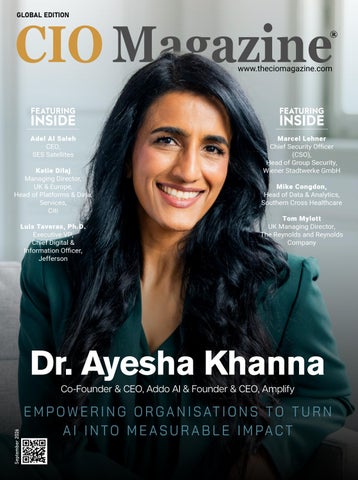
GLOBAL EDITION
FEATURING
FEATURING
INSIDE
INSIDE
Adel Al Saleh CEO, SES Satellites
Marcel Lehner Chief Security Officer (CSO), Head of Group Security, Wiener Stadtwerke GmbH
Katie Dilaj Managing Director, UK & Europe, Head of Platforms & Data, Services, Citi Luis Taveras, Ph.D. Executive VP, Chief Digital & Information Officer, Jefferson
Mike Congdon, Head of Data & Analytics, Southern Cross Healthcare Tom Mylott UK Managing Director, The Reynolds and Reynolds Company
Dr. Ayesha Khanna September 2026
Co-Founder & CEO, Addo AI & Founder & CEO, Amplify
E M P O W E R I N G O R G A N I S AT I O N S T O T U R N A I I N TO M E A S U R A B L E I M PA C T CIO MAGAZINE
1
Sept. 2026
September 2026
Vol - 3 Issue - 9
Managing Editor Sarath Shyam
Consultant Editors
Dr. John Andrews Emma James Sabrina Samson Naomi Wilson Andrew Scott Kwith Alexander Editorial Enquiry: admin@thecioomagazine.com
Art & Design Charlie Jameson Louis Bernard Shirley David
Branding & Marketing Partnership Jennifer Anderson Monica Davis Rachel Roy Anna Elza Sales Enquiry: admin@thecioomagazine.com
Free Subscription www.thecioomagazine.com
International Partnerships Americas • Europe • Middle East & Africa • Asia-Pacific admin@thecioomagazine.com
Follow Us On www.linkedin.com/company/ciomagazine
CIO MAGAZINE
2
CIO Magazine www.theciomagazine.com is a global knowledge sharing digital platform published by Connecta Innovation Private Limited. All rights reserved. The opinions expressed in the content and pictures provided are those of the authors. They do not purport to reflect the opinions or views of Connecta Innovation Private Limited or any of its subsidiaries, its members or associates and we do not assume any responsibility. The publisher does not assume any responsibility for the advertisements. The content, pictures, and all warranties made in such advertisements are the sole responsibility of the advertisers. CIO Magazine www.theciomagazine.com is a Free Subscription and Free-to-read digital platform strictly not for sale and must be strictly for internal private use only. Publisher does not assume any responsibility arising out of anyone modifying content and pictures, printing a copy of this digital platform in any format and in any country and all matters related to that. “CIO Magazine www.theciomagazine.com“ and “The CIO Magazine www.theciomagazine.com“ trademarks are owned by Connecta Innovation Private Limited. Sept.2026 Jul. Jun. May 2026 2026
THE CIO’S NEW OPERATING MAP
T
he most consequential AI question facing CIOs today may not be, “Which AI tool should we deploy?” It may be a more fundamental one: “Why does this workflow exist in its current form?” Enterprises have spent decades building processes around systems, approvals, organizational structures, and human handoffs. Technology has made many of these processes faster, but not necessarily simpler. An approval still waits for an approval. A customer issue still moves between departments. A manager still pieces together information from multiple systems before making a decision. AI introduces the possibility of changing that architecture. Recent McKinsey research found that nearly three-quarters of high-performing organizations reported fundamentally redesigning workflows around AI, up from 55 percent the previous year. For CIOs, this is more than another technology trend. It signals a change in the mandate of the technology function itself. The CIO’s role is increasingly moving beyond technology stewardship toward operating-model design. The challenge is no longer simply integrating AI into existing processes, but determining where AI can remove unnecessary handoffs, accelerate decisions, connect fragmented information, and allow people to focus on work requiring judgment, creativity, relationships, and accountability. That makes this month’s cover story with Dr. Ayesha Khanna particularly timely. As Co-Founder & CEO of Addo AI and Founder & CEO of Amplify, her two-decade journey from coder to AI transformation leader offers a grounded view of AI’s evolution from experimentation to execution. Her belief that AI only matters when it changes behavior and decisions captures the larger challenge facing technology leaders today: successful AI adoption must ultimately show up in how an organization operates. This issue looks beyond AI adoption to explore what happens when workflows become intelligent. How should CIOs and business leaders redesign processes? Where should human oversight remain essential? And how should enterprises govern systems that increasingly participate in decisions rather than simply execute instructions? Alongside the cover interview, this issue brings together perspectives on technology, leadership, innovation, transformation, and the changing workplace. The next phase of digital transformation may not be about adding another layer of technology. It may be about removing layers altogether. For CIOs, the workflow itself may be the new frontier. Enjoy Reading.
Sarath Shyam
CIO MAGAZINE
Sept. 2026
CONTENTS 08
COVER STORY
CIO MAGAZINE
Sept. 2026
SEPTEMBER 2026
32
CIO INSIGHTS
Taveras, Ph.D. 32 Luis Executive VP, Chief Digital & Information Officer, Jefferson
Transforming Care From Reactive To Proactive With AI
14
TECH TALKS
Al-Saleh 14 Adel CEO, SES Satellites
Transforming Satellite Networks with Multiorbit Intelligence
CIO MAGAZINE
Sept. 2026
CONTENTS 22
38
44
50
TECH TALKS Lehner 22 Marcel Chief Security Officer (CSO), Head of Group Security, Wiener Stadtwerke GmbH Transforming Security from Control Function to Business Enabler
Congdon 44 Mike Head of Data & Analytics, Southern Cross Healthcare
Empowering Organisations Through Trusted Data and AI
CIO MAGAZINE
Sept. 2026
Dilaj 38 Katie UK & Europe Head
of Platforms & Data, Services, Citi Helping Shape the Next Generation of Transaction Banking
Mylott 50 Tom UK Managing Director, The Reynolds and Reynolds Company
Redefining the Future of Automotive Retail
CIO MAGAZINE
7
Sept. 2026
Dr. Ayesha Khanna Co-Founder & CEO, Addo AI & Founder & CEO, Amplify
C OV E R S TO RY
E M P O W E R I N G O R G A N I S AT I O N S T O T U R N A I I N TO M E A S U R A B L E I M PA C T
CIO MAGAZINE
Dr. Ayesha Khanna is Co-Founder and CEO of Addo AI, a global artificial intelligence solutions firm, and Founder and CEO of Amplify, a media and education company helping leaders and professionals apply AI at work. One of the leading voices on AI as a handson tool for transformation, she has helped Fortune 500 companies and governments operationalize AI at scale, with clients including Visa, Telenor, Pfizer, Johnson & Johnson and Mercy Health, over the last two decades. She serves on the boards of Johnson Controls (New York Stock Exchange) and previously served on the Global Scientific Advisory Board of L’Oréal, Aveva (London Stock Exchange) and NEOM Tonomus in the Saudi Arabia. She was named Reuter’s 10 Trailblazing Women in Enterprise AI (2026), an honoree of the global 100WomeninAI (2026), Edelman’s Top 50 AI Creators (2025), Salesforce 16 AI Influencers to Know (2024) and Forbes featured her as one of Southeast Asia’s groundbreaking entrepreneur (2018). A graduate of Harvard, Columbia, and the London School of Economics, Dr. Khanna reaches more than 300,000 leaders and decision-makers across her platforms and newsletters. Her work has been featured in The New York Times, TIME, Harvard Business Review, and Forbes. Recently, in an exclusive interview with CIO Magazine, Ayesha shared insights into how her 20-year journey from coder to Co-Founder & CEO of Addo AI and Founder of Amplify has been driven by a belief that AI only matters when it changes behavior and decisions. She views AI as shifting from the “novelty phase” to the “operating phase,” where the real value comes from turning demos into dependable capabilities that redesign workflows and governance. For leaders, her advice is to build AI literacy not around tools, but around sharper questions, human judgment, and the courage to learn inside the flow of work. The following excerpts are taken from the interview.
8
Sept. 2026
CIO MAGAZINE
9
Sept. 2026
Every leader’s journey starts with a spark. What first pulled you into data and AI, and how did that early curiosity shape the path you took from coder to CEO? What first pulled me in was the realization that data is not just information; it is a way of seeing systems that are otherwise invisible. As a coder, I loved the discipline of making logic work. But as I moved deeper into enterprises, cities, finance, and public systems, I saw that the real challenge was not writing elegant code. It was helping large organizations make better decisions under uncertainty. That changed my path. Coding taught me precision and humility. Leadership taught me that technology only matters when it changes behavior, incentives, and outcomes. My journey from coder to CEO has really been a journey from building models to building the conditions in which models can create value. You describe yourself as an “Enterprise AI Operator” not just a founder. What does “operator” mean to you day to day, and what do you love most about that role? An operator is someone who lives in the reality between strategy and execution. In AI, that reality is messy. The data is incomplete, the workflows are political, the legacy systems are stubborn, and the business case must survive contact with the CFO, the regulator, the customer, and the frontline employee. Day to day, being an operator means asking: What decision are we improving? Who will use this? What happens if the model is wrong? How do we measure value? What needs to change in the
CIO MAGAZINE
10
Sept. 2026
process, not just the technology? What I love most is turning AI from an impressive demo into a new capability inside an organization. That is where the real magic is: not in the model alone, but in the operating change around it. Addo AI was featured in Forbes in 2017 as one of Asia’s leading AI firms. Looking back, what was the moment you realized Addo had moved from “startup” to “market leader” and what did that shift demand from you? The shift happened when clients stopped asking us, “What is AI?” and started asking, “Can you help us redesign how this business function works?” That was the moment I knew we had crossed from curiosity to trust. The recognition was meaningful because it validated that serious AI innovation was coming out of Asia, not just Silicon Valley. But for me, the real signal was repeat enterprise work, larger mandates, and conversations with boards and CEOs about AI as a strategic capability. That shift demanded more discipline from me. As a startup, you can win on brilliance and speed. As a market leader, you win on reliability, governance, talent density, and the courage to say no to shallow AI theatre. We had to become not just inventive, but dependable. This year, you launched Amplify to turn AI buzzwords into advantage. What’s one trend you see in how leaders need to learn and adapt that traditional education isn’t teaching yet? Traditional education still treats learning as something that happens before work, in a classroom, with a fixed curriculum. AI has
The most important skill is no longer memorizing frameworks; it is learning how to frame better questions, test assumptions, evaluate outputs, and redesign workflows around new capabilities
broken that model. Leaders now need to learn inside the flow of work, continuously, with live problems and fast feedback. The most important skill is no longer memorizing frameworks; it is learning how to frame better questions, test assumptions, evaluate outputs, and redesign workflows around new capabilities. AI literacy is not “knowing the tools.” It is knowing where human judgment must remain, where automation adds leverage, and where an organization’s decision-making architecture has to change. That is what Amplify is built around: practical intelligence, not performative vocabulary.
path into tech was a narrow computer science pipeline. AI is changing that. Some of the most powerful AI use cases will come from people who deeply understand healthcare, education, finance, law, retail, operations, public policy, and human behavior. Many women already lead in those domains. If we give them the right AI fluency, capital, sponsorship, and platforms, they will not just participate in the AI economy; they will shape it. By 2030, I hope we will stop talking about women “entering tech” and start recognizing that the future of tech depends on domain experts becoming AI-native leaders.
Women remain underrepresented in AI and tech leadership. What’s one trend or shift you’re optimistic about that will change that picture by 2030? I am optimistic because AI is widening the doorway into technology leadership. For too long, the industry acted as if the only legitimate
Leading AI firms, boards, and charities means constant pressure. What’s one non-work activity or ritual that helps you reset and come back with energy? My reset is deliberately simple: I step away from screens and move. A walk, especially without checking my phone, helps me clear
CIO MAGAZINE
11
Sept. 2026
the noise and reconnect the dots. AI is an intense field because everything is moving quickly and everyone feels they are behind. I need moments where I am not consuming more information but metabolizing what I already know. Some of my best strategic thinking happens after I have stopped trying to force it. The ritual is less about escape and more about creating mental space. You cannot lead transformation if your own attention is constantly fragmented. Books, talks, and mentors shape how we think. What’s one book, podcast, or speaker that fundamentally changed how you approach technology, leadership, or advocacy? One podcast I find consistently valuable is No Priors with Sarah Guo and Elad Gil. What I appreciate about it is that it stays close to the frontier without getting lost in hype. The conversations are not just about what AI can do in theory, but about who is building it, what is becoming commercially possible, where the bottlenecks are, and how quickly markets and organizations can absorb new capabilities. For me, that is the real leadership question. AI is not only a research story; it is a deployment story, a talent story, a governance story, and a business model story. No Priors sharpens how I think about the gap between invention and adoption. It reinforces a belief I have always held as an enterprise AI operator: the future does not belong to the people who can describe AI most dramatically. It belongs to the people who can translate it into useful systems, responsible decisions, and measurable advantage.
CIO MAGAZINE
12
Sept. 2026
My biggest goal is to help people and organizations move from anxiety about AI to agency with AI
What is your biggest goal? Where do you see yourself in 5 years from now? My biggest goal is to help people and organizations move from anxiety about AI to agency with AI. I want leaders to stop treating AI as a mysterious external disruption and start treating it as a practical capability they can understand, govern, and use responsibly. In five years, I see Amplify as a trusted global platform for AI capability-building, especially for professionals and women who need access to practical, career-changing AI skills. I also see myself continuing to work with enterprises and boards on AI strategy, because the next phase will be harder than the first. The novelty phase is ending. The operating phase is beginning. That is where I want to contribute. If you could guarantee one outcome from Amplify for every professional who completes it, what would that outcome be? I would guarantee confidence grounded in competence. Not vague excitement, and not fear disguised as caution, but the ability to look at a business problem and know how AI could help, where it could fail, and how to move from idea to implementation. A professional who completes Amplify should be able to ask sharper questions, identify useful use cases, work intelligently with technical teams, evaluate outputs, and communicate business value. Most importantly, they should feel that AI is not something happening above them or around them. It is something they can use, shape, and lead with.
CIO MAGAZINE
13
Sept. 2026
T A L K S T E C H CIO MAGAZINE
14
Sept. 2026
Transforming Satellite Networks with Multiorbit Intelligence
Adel Al-Saleh CEO, SES Satellites
With extensive senior management roles at leading IT and telecommunication companies, Adel Al-Saleh was appointed CEO of SES in February 2024. Adel joined SES from Deutsche Telekom, where he served as Board Member and CEO of T-Systems since 2018. Prior to that, he was the CEO for Northgate Information Solutions (NIS) Group from 2011-2018. Adel also held senior leadership roles at IMS Health and IBM for the first 25 years of his career. Adel graduated from Boston University with a Bachelor of Science in Electrical Engineering and holds an MBA from Florida Atlantic University. Recently, in an exclusive interview with CIO Magazine, Adel shared insights into his journey across tech, healthcare, telecom, and now space as CEO of SES. On trends, he sees multi-orbit + software-defined architectures accelerated by AI as the biggest shift ahead, turning satellite networks into one adaptive, real-time system. For the future, Adel is focused on repositioning SES as the leader in space solutions, launching faster through vertical integration, and building SES as a diplomatic bridge for global regulation. His advice to young leaders: build a strong tech foundation, stay close to innovation, keep the customer at the center, and develop a global mindset. The following excerpts are taken from the interview.
CIO MAGAZINE
15
Sept. 2026
Hi Adel. You’ve crossed tech, healthcare, telecom, and space. What pattern in complex systems did you notice early in your career that you now see everywhere, and how do you turn it into impact? In my experience, the following patterns have consistently emerged across the technologydriven industries I have crossed: 1. Technology is a game-changer for business performance: Even for non-technology organizations, technology enhances productivity, maximizes efficiency, and advances innovation. 2. Competition accelerates the speed of innovation: The more intense the competition, the more urgent it becomes to continuously innovate to ensure the business keeps pace. 3. Culture and alignment are critical: A strong, aligned team and the right culture make all the difference in the world and directly determine how successful a business will be.
Leading organizations recognize and embrace these patterns and remain consistently impactful by never allowing complacency to set it. They behave like challengers, even when they are leaders. They constantly question, experiment, challenge assumptions, and push boundaries. These approaches ultimately create real advantages, and it is the mindset we are implementing at SES. SES operates MEO and GEO fleets and is deploying next-gen systems. As CEO, what is the one strategic problem you are personally obsessed with solving right now? The problem that keeps me up at night is the state of the geopolitical and regulatory environment, and its impact on the global economy and supply chains. Allied nations are looking inwards and building walls instead of working together. Nationalism and protectionism are threatening
TECHNOLOGY IS A GAME-CHANGER FOR BUSINESS PERFORMANCE: EVEN FOR NON-TECHNOLOGY ORGANIZATIONS, TECHNOLOGY ENHANCES PRODUCTIVITY, MAXIMIZES EFFICIENCY, AND ADVANCES INNOVATION
CIO MAGAZINE
16
Sept. 2026
the free movement of goods. In the telecom and space sectors, convergence around standards has eroded. All of this has made it harder for businesses to operate. As a transatlantic leader with a deep presence in both the U.S. and Europe, SES is operating as a diplomatic bridge, engaging directly with global governments to help shape the future of secure global communications and space solutions - and to ensure the industry continues to operate within a coordinated, global regulatory framework rather than a fragmented one. Against this backdrop, the need to rethink how we innovate has become urgent. Navigating these challenges at SES means fundamentally changing the innovation model for our company and, more broadly, the satellite industry. We’re breaking the paradigm of long development cycles, where historically it has taken 5-7 years to design, build, and launch new satellite networks and technologies. Through partnerships with new space companies and by vertically integrating key technologies like payload development, we’re creating a model where we can launch,
iterate, and test in orbit on a much faster cadence – effectively every year – with less reliance on legacy supply chains. These shifts are essential if we want to stay relevant amid the rapidly changing digital and geopolitical landscape. Low Earth Orbit constellations, direct-todevice, and software-defined satellites are reshaping the space industry. Looking ahead five years, what shift in satellite architecture will be most underestimated by the market today? The real inflection point will be the convergence of multi-orbit architectures and software-defined capabilities, with AI helping to accelerate this dynamic. It’s no longer just about LEO versus MEO versus GEO; it’s about orchestrating them as a single, interoperable network. Combining multi-orbit with software-defined payloads, ground infrastructure, and orchestration unlocks the ability to dynamically adapt capacity, performance, and coverage in real time, enabling secure, resilient, high-performance applications across industries.
CIO MAGAZINE
17
Sept. 2026
Climate monitoring, IoT, defense, and media all rely on space infrastructure. Which vertical will drive the most unexpected demand for satellite services by 2030, and why? Defense and mobility will be the biggest drivers of satellite demand over the next several years. In the current geopolitical environment, governments are increasingly prioritizing sovereign, secure, and resilient space capabilities like never before. That demand is only accelerating. Another significant driver will be the push to establish a sustained human presence on the Moon and Mars. These missions will require significant investments in space infrastructure and create a new space economy. At the same time, mobility will continue to experience sustained growth, particularly
CIO MAGAZINE
18
Sept. 2026
within the commercial aviation sector. Airlines increasingly see connectivity as core to the passenger experience, and more are moving toward seamless, high-speed, and often free WiFi onboard. These and other sectors are reshaping demand for satellite connectivity in ways that go beyond what many expected just a few years ago. Leaders carry lessons from outside the boardroom. What book, technical or not, has the most notes in your margins, and what single idea from it do you revisit weekly? The book that has had the biggest impact on my career is “Leadership and Self-Deception,” authored by Jim Ferrell and The Arbinger Institute. It taught me very important lessons:
• See others as human beings with needs and ambitions, just like you. • The right mindset is the secret recipe for success. The “Art of War” by Sun Tzu is another great book that shares important lessons on how to compete strategically. Music, art, or sports often reveal how leaders think. What performer, team, or creator do you admire, and what about their craft resonates with how you lead? I love music and listen to a wide range of genres, each for a special time. Classical and jazz music each have incredible ranges of emotions. I’ve always admired elite sports teams that sustain performance over long periods - teams
IT’S NO LONGER JUST ABOUT LEO VERSUS MEO VERSUS GEO; IT’S ABOUT ORCHESTRATING THEM AS A SINGLE, INTEROPERABLE NETWORK
that reinvent themselves while staying true to their core identity. In soccer (or football), Real Madrid is a great example of a team that has managed to achieve sustained success. Manchester City is another, with 20 trophy wins over a 10-year period under former manager Pep Guardiola. Great teams like these achieve success by building a culture of trust, accountability, and continuous improvement. They don’t rely on individual brilliance alone - they create systems that enable their players to perform at their best every day. I think about leadership in very similar terms: people make it happen, and culture is what enables them to do it. If you could have dinner with three innovators from any era, living or historical, who would be at the table and what would you want to learn from each? I would choose Thomas Edison, Steve Jobs, and Elon Musk. From Edison, I’d want to understand the discipline behind turning ideas into scalable, repeatable innovations. From Jobs, it would be about the intersection of technology and human experience and how to create products and solutions that people don’t just use but truly connect with. And from Elon Musk, I’d focus on longterm vision, execution, and how anticipating major technology shifts, like AI, can position a company for decades of leadership. There would be so much to learn from all three about how to combine vision with execution and how to build an organization that continuously evolves and remains relevant.
CIO MAGAZINE
19
Sept. 2026
I THINK ABOUT LEADERSHIP IN VERY SIMILAR TERMS: PEOPLE MAKE IT HAPPEN, AND CULTURE IS WHAT ENABLES THEM TO DO IT
What is your biggest goal? Where do you see yourself 5 years from now? My biggest goal is to transform and reposition SES as the leader in space solutions and a critical enabler of global digital infrastructure. In five years, we will have achieved success if both our company and the industry are moving faster, innovating continuously, and delivering transformative connectivity solutions that truly make a difference for governments, enterprises, and society. If a 22-year-old said “I want to lead in space and telecom,” what should they do this year to start? First, build a strong foundation in technology, whether that’s engineering, data, network architecture, or, of course, AI. In the space
CIO MAGAZINE
20
Sept. 2026
industry, many technologies intersect. Technical understanding matters. Stay curious and close to innovation. Keep learning and never fall behind. Follow what’s happening in space, AI, connectivity, and quantum key distribution. Look for opportunities to get hands-on experience. Never forget about the customer. Understand what they need today and anticipate what they will need in the future. Be willing to take risks and choose courage over comfort. Don’t be afraid to fail, but learn with each failure. That’s how leaders are created. Finally, develop a global mindset. Space and telecom are inherently international industries. Gaining a deep understanding of different markets, cultures, and geopolitical dynamics will set you apart.
CIO MAGAZINE
21
Sept. 2026
T A L K S T E C H CIO MAGAZINE
22
Sept. 2026
Transforming Security from Control Function to Business Enabler
Marcel Lehner
Chief Security Officer (CSO), Head of Group Security, Wiener Stadtwerke GmbH
Marcel Lehner is Chief Security Officer and Head of Group Security at Wiener Stadtwerke, one of Austria’s largest infrastructure groups, spanning energy, mobility, and municipal services for the city of Vienna. He leads physical and digital security across critical infrastructure, overseeing NIS2 compliance, a 24/7 Security Operations Center, business continuity, and crisis management. Before joining Wiener Stadtwerke in 2024, he spent a decade building Group Security from the ground up at an international manufacturing company. He holds a BSc and an MSc in Security from the University of Hagenberg and an MBA in General Management from University of Warwick, alongside numerous international certifications, including CGEIT, CRISC, CISM, CISSP-ISSMP, AAISM,CISA, GICSP, CSSLP, CCSP, CBCP and CDPSE. His guiding principle: security as a driver of innovation, not a brake on it. Recently, in an exclusive interview with CIO Magazine, Marcel shared insights from his journey building Group Security from the ground up across industrial and critical infrastructure environments, and now leading physical and digital security for Wiener Stadtwerke, protecting essential services for 2 million people in Vienna. On AI, Marcel sees it as one of the biggest levers for defensive security, both a threat to manage and a tool to scale detection and response. His advice to the next generation is treat security as a quiet responsibility, build people not just controls, and focus on resilience, because when you do this work well, a city simply gets to live its day uninterrupted. The following excerpts are taken from the interview.
CIO MAGAZINE
23
Sept. 2026
Hi Marcel. What was the pivotal moment or early career choice that first drew you into the world of cybersecurity and critical infrastructure? Honestly, the fascination started when I was a kid. I got my first computer at eight, and by twelve I’d programmed my first virus, loosely a piece of ransomware, though I wouldn’t have called it that then. The internet was only just arriving, and the hacker films of that era had me completely hooked. What really got to me was realizing what you could actually do from that side of a keyboard back then; that alone told me this was the field I wanted to spend my life in. So I crossed over to the good side and committed myself to protecting IT systems instead of poking holes in them. What turned that early instinct into a real career was the years I spent working across different industrial and corporate environments, where the same thing kept showing up: the systems keeping a factory running or a network alive were far more fragile than anyone wanted to admit. I noticed the gap between how much we depended on these systems and how little serious attention their security got. The path to my CISO role opened in 2013 at an international industrial group running more than 70 sites around the world, from Chile to Vietnam. I was handed a blank page and asked to build Group Security from nothing: no SOC, no ISMS, no business continuity plan, none of it. Most people would see that as a burden. I saw it as the rare chance to design something the way it should be designed rather than patching over decisions someone else made a decade earlier. That’s when security stopped being a job for me and became a craft. Building an ISO 27001 program, a Security Operations
CIO MAGAZINE
24
Sept. 2026
Center, and a crisis capability from scratch taught me that security isn’t a control you bolt on at the end. It’s a design decision you make at the very beginning, or you pay for it later at a much worse price. Fairly early on I also pulled physical security into my remit, and that’s how I stepped into the CSO role and started treating security as one connected whole rather than a set of separate boxes. Critical infrastructure came into focus once I understood the stakes properly. When you secure a bank, you protect money. When you secure a paper mill or, now, an energy and mobility group like Wiener Stadtwerke, you protect whether a city keeps its lights on, its trains moving, and its power flowing. That responsibility is what kept me here.
Securing infrastructure means making decisions with real-world consequences. What part of your role today gives you the strongest sense of purpose? Two million people in Vienna rely on the services my colleagues and I help protect, most of them without ever knowing our team exists. That anonymity is the point. Nobody thinks about the security behind their tram ride or their heating until it fails, and my job is to make sure that day never comes. The strongest sense of purpose comes from the human side, not the technical one. I lead a central team of around 20 people, and for a dozen security officers across the group, I set the strategic cornerstones they work from. Watching
someone on that team grow into a decision they wouldn’t have trusted themselves to make two years ago gives me more satisfaction than any firewall rule ever could. Security is a team sport. My mantra, which my colleagues are probably tired of hearing by now, is “Gemeinsam in eine sichere Zukunft” - together into a secure future. I mean it literally. No single person defends a group this size. You build a culture where a thousand people make slightly better decisions every day, and that compounds into resilience. The other part is sitting at board level and being able to frame security as something other than a cost or a brake. When I can show the executive board that a security decision opened a door commercially instead of closing one, that’s the day the whole discipline earns its seat at the table. And there are really two things I’m arguing for at once: security as a genuine competitive advantage, and security as the guarantee that Vienna’s supply holds, that the power stays on and the trams keep running for two million people. When the board sees both at the same time, security stops being a line item and becomes strategy.
NOBODY THINKS ABOUT THE SECURITY BEHIND THEIR TRAM RIDE OR THEIR HEATING UNTIL IT FAILS, AND MY JOB IS TO MAKE SURE THAT DAY NEVER COMES
Critical infrastructure is becoming digital by default, not by exception. Where do you see the line between IT, OT, and physical operations blurring most dramatically in the next five years? The line is already gone in practice; we just haven’t finished admitting it organizationally. The old comfort of an air gap between the operational technology running a substation and the corporate IT network was mostly a story we told ourselves. Remote maintenance, predictive analytics, and cloud-connected sensors erased it years ago.
CIO MAGAZINE
25
Sept. 2026
Where it gets sharp over the next five years is in the convergence of physical and cyber into a single attack surface. Someone who compromises a building management system can unlock a door. Someone who unlocks a door can walk to a terminal that controls something operational. The attacker doesn’t respect the org chart that separates my physical security colleagues from my SOC analysts, so we can’t afford to respect it either. At Wiener Stadtwerke I deliberately sit across both physical and digital security for exactly this reason. Splitting them made sense when they were separate problems. They stopped being separate problems. The second blur is identity. In a converged world the most valuable thing isn’t a network boundary, because that boundary barely exists anymore. It’s knowing, with certainty, who or what is allowed to do a specific thing to a specific asset at a specific moment, whether that actor is a human engineer, a contractor’s laptop, or a machine talking to another machine. Identity becomes the real perimeter, and most organizations are nowhere near ready for how much rigor that demands. Supply chain risk now extends to software, hardware, and human dependencies. What emerging supply chain vulnerability worries you most for essential services? Concentration risk in the layers nobody can see. Everyone learned the word “software bill of materials” after the incidents of the past few years, and that’s genuine progress. But my real concern sits underneath that: the handful of components, libraries, and service providers that half the world quietly depends on without knowing it. When a single widely-
CIO MAGAZINE
26
Sept. 2026
embedded library has a flaw, the blast radius isn’t one company. It’s every essential service that unknowingly built on top of it. There’s a second layer that worries me more each year: how much of the software running essential services now comes from a small set of very large, mostly non-European vendors. When a city’s core systems sit on platforms we neither control nor could swap out quickly, that stops being a procurement question and becomes one of digital sovereignty. Keeping Vienna running shouldn’t hinge on the goodwill or the product roadmap of a company on another continent, and winning back real options there is one of the harder problems in front of us. Hardware worries me more than software, because you can patch software. You cannot patch a chip with a design weakness baked in at the foundry, and the semiconductor supply chain for critical systems runs through a geography and a set of vendors that’s alarmingly narrow. If geopolitics tightens around that chokepoint,
IDENTITY BECOMES THE REAL PERIMETER, AND MOST ORGANIZATIONS ARE NOWHERE NEAR READY FOR HOW MUCH RIGOR THAT DEMANDS
security becomes the least of anyone’s problems, and it becomes everyone’s problem at once. The dependency people talk about least is the human one. So much specialized knowledge about how a specific piece of operational technology actually works lives in the heads of a shrinking number of ageing engineers and a couple of vendor firms. When those people retire and that knowledge isn’t captured, you inherit a system you can no longer fully understand, let alone defend. That’s a supply chain vulnerability too, and it doesn’t show up on any bill of materials. The workforce gap in cyber-physical security is widening. What skill or role will be most scarce and most critical in securing infrastructure by 2030? The translator. By 2030 the scarcest and most valuable person won’t be the deepest technical specialist, though we’ll still badly need those.
CIO MAGAZINE
27
Sept. 2026
IF GEOPOLITICS TIGHTENS AROUND THAT CHOKEPOINT, SECURITY BECOMES THE LEAST OF ANYONE’S PROBLEMS, AND IT BECOMES EVERYONE’S PROBLEM AT ONCE
It’ll be the person who can stand in a room with an OT engineer who’s spent thirty years around turbines, a cloud security architect, and a board member who controls the budget, and make all three understand each other well enough to make one good decision together. We’ve overproduced narrow specialists and underproduced people who can span domains. The genuinely hard problems in critical infrastructure now sit precisely in the seams: between IT and OT, between the technical reality and the business consequence, between the regulation and the operational truth on the ground. NIS2 is a good example. It’s not solved by a firewall, it’s solved by someone who understands the legal obligation, the engineering constraint, and the executive’s risk appetite simultaneously. The role I’d fight hardest to hire is what I’d call a resilience engineer: someone who assumes the breach will happen and designs the system to keep the tram running and the grid stable anyway. Prevention will always matter, but a mature program spends at least as much energy on the question of how gracefully things fail. The people who can architect for graceful failure across cyber and physical systems at once are rare today. In four years they’ll be the ones everyone’s chasing. Leaders are sustained by what they read and learn outside the office. What book, fiction or non-fiction, has influenced how you think about responsibility, and why does it stay with you? Viktor Frankl’s Man’s Search for Meaning. It’s an unusual answer for a security executive, and it has nothing to do with technology, which is
CIO MAGAZINE
28
Sept. 2026
exactly why it stays with me. Frankl, an Austrian like me, wrote about surviving the concentration camps and arrived at a conclusion that reshaped how I think about my job: you don’t get to choose what happens to you, but you always keep the freedom to choose your response, and that response is where your real responsibility lives. In security we spend enormous energy trying to control what happens. Frankl’s insight is that control is mostly an illusion; the incident, the breach, the crisis will eventually arrive no matter how good you are. What defines you as a leader is the response you’re capable of when it does. That reframing pulled me away from a prevention-obsessed mindset and toward resilience and crisis leadership, which is where I’ve focused for years now. It stays with me for a harder reason too. Responsibility isn’t the same thing as blame. When something goes wrong on my watch, the useful question is never who to point at. It’s what we do next, and whether the people around me are steady enough to do it well. Frankl taught me that responsibility is forwardlooking or it’s worthless. Music, art, or sport can teach lessons that boardrooms cannot. What nontechnical discipline inspires your approach to problem-solving under pressure? Endurance sport, and I’ll be honest about why: it’s the closest civilian analogue I’ve found to managing a security crisis. When you’re deep into something long and physically hard and your body is telling you to stop, you learn that panic is a decision and pacing is a skill. Those are the two things that separate a manageable incident from a catastrophic one.
I follow a plant-based lifestyle and pay real attention to physical and mental conditioning, and that isn’t a side hobby I keep away from work. A crisis at 3am doesn’t care how brilliant your architecture is if the person running the response is exhausted, reactive, and burning through adrenaline. Composure under load is a physical capability before it’s a leadership one. You can’t fake calm to a team that’s watching you for cues. My second passion is photography, and it’s the artistic counterweight to the rest of what I do. Security work is loud and relentlessly analytical; photography is slow and quiet, and it asks for a kind of attention nothing else in my week does. You wait and watch until you catch the one detail in a scene that everyone else walked straight past. That habit of really looking carries back into the job, because most security failures hide exactly there, in the detail no one thought worth a second glance. Stepping out of the analytical headspace into something purely visual is also how I refill the tank, so there’s something left to draw on when the pressure comes. What is your biggest goal? Where do you see yourself in 5 years from now? I want to be part of moving the whole conversation around critical infrastructure security from reactive to genuinely resilient, and not just inside my own group. Vienna is a serious testbed. If we can prove that an energy, mobility, and municipal services group can be both highly secure and highly innovative at the same time, without security becoming the department that says no, that’s a model worth sharing well beyond one city. Personally, I spend a lot of my own time on artificial intelligence, and I’m convinced it’s one
CIO MAGAZINE
29
Sept. 2026
of the biggest levers we’ll have for security over the next few years: partly as a threat we’ll have to defend against, but mostly for the defensive work it can genuinely do for us once we learn to use it well. I’m also investing more energy into writing and speaking publicly about this field, because the shortage of clear, honest voices on infrastructure security is part of why the workforce gap exists in the first place. Five years out, I’d like to be doing more of the work that outlasts any single role: shaping how the next generation thinks about this discipline, contributing to European frameworks rather than only implementing them, and hopefully having built a security culture at Wiener Stadtwerke robust enough that it holds up fine whether I’m the one running it or not. The measure of a good security leader is what survives their absence. If you could leave one message for the next generation of defenders of essential services, what would you tell them about the responsibility and privilege of this work? You’ve chosen a strange and quiet kind of work: the better you do it, the less anyone notices you did anything at all. There are no headlines for the attack that didn’t happen, no applause for the outage the public never experienced. If you need recognition to feel motivated, this isn’t your field. The reward is knowing that a city you may never fully see went about its ordinary day because you and your colleagues did something extraordinary in the background. Hold onto the weight of it. When you secure essential services you’re not protecting data or systems in the abstract; you’re protecting the
CIO MAGAZINE
30
Sept. 2026
hospital that needs power, the family that needs heat in January, the person who needs the train to get to work. Never let it shrink into a purely technical exercise, because the moment it does, you start making decisions that are technically correct and humanly wrong. And build people, not just controls. The tools you learn today will be obsolete faster than you expect, but the judgment, the composure, and the culture you help create will outlast every one of them. Take the responsibility seriously and hold the privilege lightly. Defending the things a society quietly depends on is one of the few jobs where doing it well and doing good are the same act.
Want to Sell or find Investors for your Business?
31
Digital First Magazine Sept. 2026 CIO MAGAZINE August 2021
CIO MAGAZINE
32
Sept. 2026
Luis Taveras, Ph.D. Executive VP, Chief Digital & Information Officer, Jefferson
Transforming Care From Reactive To Proactive With AI Luis E. Taveras, PhD is a distinguished technology and digital-transformation executive with more than four decades of leadership experience across healthcare, government, and enterprise IT. He currently serves as Executive Vice President and Chief Digital & Information Officer at Jefferson Health, where he leads system-wide digital strategy, technology modernization, cybersecurity, and data innovation for one of the nation’s largest academic health systems. Dr. Taveras has held multiple senior leadership roles, including CIO of Lehigh Valley Health Network, Barnabas Health, and the City of Buffalo, where he guided major modernization initiatives and helped shape early smart-city strategies. His work has consistently focused on building highperforming technology organizations, advancing digital health capabilities, and driving enterprise transformation. He is the author of the Amazon #1 bestseller The 90 Day CIO, and is widely recognized as a thought leader in IT governance, digital strategy, and organizational change. Recently, in an exclusive interview with CIO Magazine, Luis shared insights into how a fourdecade career from mastering IBM’s 5280 in 1980 to leading digital transformation at Jefferson Health has been driven by embracing change before others do. He sees AI as the catalyst that will redefine care delivery by 2030, shifting healthcare from episodic and reactive to continuous and proactive through predictive medicine, patient consumerism, and AI-enabled wearables. His advice to future CIOs is don’t chase the title, focus on becoming valuable by aligning tech with business strategy, delivering outcomes, and leading teams. The following excerpts are taken from the interview.
CIO MAGAZINE
33
Sept. 2026
What was the first technology problem that made you think, “This is the kind of challenge I want to solve for the rest of my career”? In 1980, IBM introduced the 5280 Distributed Data System, a significant advancement over traditional data-entry methods such as keypunch processing. The technology enabled multiple operators to perform local data entry, formatting, and lookups in ways that were revolutionary at the time. Interestingly, very few people in my Manhattan branch office wanted to learn it, but I immediately recognized its potential. I immersed myself in understanding the system, became the local expert, and helped implement it for banks and insurance companies across New York City. That experience taught me an important lesson that has shaped my entire career: every new technology creates opportunities for those willing to embrace
CIO MAGAZINE
34
Sept. 2026
change before everyone else. From distributed computing to cloud, AI, and now quantum computing, I have always been drawn to innovations that fundamentally change how people work and solve problems. More than four decades later, I am just as excited about the possibilities ahead as I was when I first encountered the IBM 5280. What part of your current work energizes you most, and why does it matter more to you now than ever before? The aspect of my work that energizes me most is bringing innovation directly into care settings where it can improve lives. At Jefferson, our mission is centered on improving the lives of our patients, our students, and our health plan members, and technology has become one of the most powerful enablers of that mission.
Today, we are seeing technology help clinicians detect diseases such as cancer far earlier than ever before, significantly improving the likelihood of successful treatment and recovery. What excites me even more is what lies ahead. As artificial intelligence becomes increasingly integrated into medicine, we have the potential to move beyond diagnosing illness to predicting it, allowing for a more proactive approach to preventing disease. That shift from treating illness to preserving wellness has the potential to fundamentally transform healthcare. Being part of that transformation is both inspiring and deeply meaningful to me. What shift in data and AI will most redefine how care is delivered by 2030? For many years I have spoken about patient consumerism and the idea that individuals
AI WILL NOT SIMPLY ENHANCE OUR CURRENT DELIVERY MODELS—IT WILL REDEFINE HOW INDIVIDUALS ENGAGE WITH THEIR OWN HEALTH AND HOW HEALTHCARE ORGANIZATIONS SUPPORT THEM
would become active participants in their own healthcare. By 2030, I believe we will finally see that vision realized at scale. AI is already empowering patients to better understand symptoms, conditions, and treatment options before they ever meet with a clinician. As these technologies continue to improve, the patient-physician relationship will evolve into a more collaborative partnership, where informed patients work alongside clinicians who serve as trusted experts, advisors, and navigators. At the same time, AI-enabled wearables and connected devices will continuously monitor health indicators and provide real-time insights to patients, families, and care teams. The resulting data ecosystem will fuel increasingly personalized and predictive models of care. Ultimately, healthcare will shift from being episodic and reactive to being continuous and proactive. AI will not simply enhance our current delivery models—it will redefine how individuals engage with their own health and how healthcare organizations support them. What new roles or skills will be table stakes for technology organizations in 2030 that barely exist today? By 2030, AI will be fully embedded in both our personal and professional lives. Intelligent agents will help us perform clinical, operational, financial, and analytical tasks with a level of speed and efficiency that is difficult to imagine today. As AI democratizes technology development, the ability to create applications will no longer be limited to professional programmers. Much like spreadsheet skills became essential in the business world, software creation will become a broadly accessible capability. Many employees will build
CIO MAGAZINE
35
Sept. 2026
MY ADVICE IS SIMPLE: DON’T FOCUS ON BECOMING A CIO. FOCUS ON BECOMING VALUABLE
their own applications and workflows using AIassisted tools. As a result, the most valuable skills may not be coding itself but rather governance, critical thinking, risk management, and digital ethics. Organizations will need leaders who can ensure these powerful technologies are deployed responsibly, securely, and in alignment with organizational objectives. The technology organizations that thrive will be those that balance innovation with strong governance, particularly in a world where cyber threats are becoming increasingly sophisticated and relentless. What inspired you to distill your playbook into a book, and what surprised you most about how leaders used it? Throughout my career, I have been fortunate to have exceptional mentors, colleagues, and leaders who invested in my growth. I have also been blessed with a supportive family that encouraged me to pursue increasingly challenging opportunities. Writing The 90 Day CIO was my way of paying that support forward. I wanted to provide aspiring leaders with a practical framework for building high-
CIO MAGAZINE
36
Sept. 2026
performing organizations and cultures. Too often, leadership is discussed in theory. My goal was to share proven processes, lessons learned, and real-world approaches that leaders could immediately apply. On a personal level, I also wanted to demonstrate what is possible through perseverance. As an immigrant who came from very modest beginnings, I have always believed that success comes from recognizing opportunities, embracing challenges, and continually learning. If my story inspires someone else to pursue their own ambitions with confidence and determination, then the book has achieved its purpose. What book outside of technology has most influenced how you think about leadership and change? The book that has had the greatest influence on me is Who Moved My Cheese? by Spencer Johnson. Although it is a short and deceptively simple story, its message is remarkably powerful. The book explores how people respond to change and reminds us that success often depends on our willingness to adapt before circumstances force us to. In a world where technological
change is accelerating at unprecedented speed, that lesson is more relevant than ever. I have read the book multiple times throughout my career, and each time it reinforces the importance of staying curious, remaining flexible, and viewing change as an opportunity rather than a threat. Those principles have served me well as both a technology leader and a lifelong learner. What’s your favorite non-work ritual that helps you reset and return as a better decision-maker? For me, the answer is music. It has always been one of the most effective ways to disconnect from the demands of work and recharge. Whenever I can, I have music playing— whether I am driving, walking, relaxing on the porch, or simply unwinding after a busy day. Music has a unique ability to shift perspective, reduce stress, and create space for reflection. I also enjoy singing along, although I do so primarily when no one else is around. I often joke that I spare others from having to listen to my singing voice. Still, it is one of the simplest and most enjoyable ways I reset, and I always come back refreshed and ready to tackle the next challenge. What is your biggest goal? Where do you see yourself in five years? I have maintained a personal tradition for decades of reviewing and updating my fiveyear plan every New Year’s Day. It helps me remain intentional about both my personal and professional priorities. Over the next five years, I want to continue investing in my health and well-being every day because good health creates the foundation for
everything else. Professionally, I am excited about the possibility of introducing practical quantum computing applications at Jefferson that could help accelerate breakthroughs in healthcare and improve outcomes for the communities we serve. I also believe in maintaining financial discipline and stability, not simply as a goal in itself, but as a means of creating freedom and opportunities for my family and future generations. Most importantly, I want to continue making a positive difference in the lives of those around me. At this stage of my career, success is increasingly measured by the impact I have on others and the legacy I leave behind. What’s one piece of counterintuitive advice you give to a 25-year-old who says, “I want to be a CIO someday”? My advice is simple: don’t focus on becoming a CIO. Focus on becoming valuable. Many aspiring technology leaders spend years concentrating exclusively on technical skills, but the CIO role is ultimately a business leadership role. A strong technical foundation is important, but it is no longer sufficient on its own. The leaders who succeed learn how organizations create value, how to align technology with business strategy, and how to build exceptional teams. As you advance in your career, your impact will depend less on what you personally know and more on your ability to inspire others, develop talent, and drive organizational outcomes. Be technology savvy, learn the business, stay relentlessly focused on delivering value, and never stop learning. In my experience, those qualities are what define truly successful CIOs and values-driven leaders.
CIO MAGAZINE
37
Sept. 2026
T A L K S T E C H CIO MAGAZINE
38
Sept. 2026
Helping Shape the Next Generation of Transaction Banking
Katie Dilaj
UK & Europe Head of Platforms & Data, Services, Citi
Katie Dilaj is the Managing Director, UK & Europe Product Head of Platform & Data Services, overseeing digital products for Citi’s Services business. Since joining Citi in 2021, she has served as the Global Head of Product Marketing for Treasury and Trade Solutions and as the EMEA head of Market Management. Prior to Citi, Katie held various roles at Deutsche Bank, including Global Product Management in Client Connectivity Products and roles in Relationship Management and Programme Management in London and New York. Recently, in an exclusive interview with CIO Magazine, Katie shared insights into how her professional journey began in middle office and investment banking, shaped by regulations like Dodd-Frank and EMIR and client pain points in onboarding and KYC that made data quality and seamless design her north star. On trends and AI, she sees the next five years shifting platforms and data from bank-owned portals to client environments — like messaging apps which banks will connect to— delivering real-time, context-aware experiences, while data quality becomes the foundation as AI accelerates, anomaly detection, and decision-making. Her advice to aspiring professionals is to be curious, stay open to learning, and embrace that learning now flows both ways across generations. The following excerpts are taken from the interview.
CIO MAGAZINE
39
Sept. 2026
Hi Katie. Looking back to your early days in middle office and investment banking, what was the moment you realised technology and data would be your long-term focus? I’ve always been driven by sitting in the intersection between the build of products and managing client relationships. I’m fortunate enough that my early experiences have set me up to have a successful role leading complex digital organisations. In my early career, I spent a lot of time managing new regulations both in the US and UK impacting global markets, for example, Dodd-Frank & EMIR trade reporting. I then moved onto a relationship management role covering Non-Bank Financial Institutions which enabled me to see first hand the experiences that clients loved or frustrated them, particularly when it came to onboarding or managing KYC or Tax information. This enabled me to be much more client-centric when designing future solutions for clients within product roles that I would go on to. The common thread across all of these roles, was the importance of getting the data right and designing experiences that are seamless. As my career advanced, it became clear to me that roles across tech, data and client service were exciting focus areas for me. As UK & Europe Head of Platforms & Data, Services, what part of your mandate lights you up most each day? I love co-creating experiences with our clients that will truly delight them. When I first moved into transaction banking at Deutsche Bank, I led a global initiative to begin co-creating cash management solutions with clients, this need to create products that are relevant for clients and bringing them in early into the design phase
CIO MAGAZINE
40
Sept. 2026
has never left me, it’s part of my DNA. At Citi, I have been able to take it one step further with the team, where we run design thinking and innovation / co-creation workshops with clients on a number of topics, but most recently around Artificial Intelligence. While we know our clients well, we want their voice to help inform our roadmap to continue developing our products, and help ensure we know where to focus our efforts. Financial services are changing faster than ever. Five years from now, what do you believe will be the single biggest shift in how platforms and data create value for clients? I think we will see a greater shift in moving experiences to where clients want to be, when they want to be there, allowing them to do exactly what they need to do at that exact moment. Traditionally these experiences have sat in proprietary platforms of Banks, shifting into multi-banking platforms and APIs over time for certain use cases (for example in open banking), but in the future these experiences can potentially sit within the client’s own environment. For example, making a payment, or checking your balances for liquidity, this could potentially be done within the clients’ messaging platform as another channel for Banks to connect with our clients. Data is often called the “new oil”, but many firms still struggle with quality. What needs to change for data to truly become a strategic asset by 2030? The industry has talked about the importance of data for a long time, but at Citi we have spent the last few years significantly investing in our
WHILE WE KNOW OUR CLIENTS WELL, WE WANT THEIR VOICE TO HELP INFORM OUR ROADMAP TO CONTINUE DEVELOPING OUR PRODUCTS, AND HELP ENSURE WE KNOW WHERE TO FOCUS OUR EFFORTS
people and platforms in this space to elevate the quality and completeness of data which is the foundation to being able to truly offer leading banking solutions. The rise of Artificial Intelligence is truly expediting the pace that banks and our clients are cleaning up data so we can maximize the potential of utilizing AI for accurate and timely decision making. It is no easy task, but there are initiatives such as the shift to structured address data for ISO 20022 coming in November which are also forcing the industry to standardize and harmonize data. I also expect Artificial Intelligence is going to help the industry with understanding data anomalies and making recommendations on how to streamline.
Books and ideas shape how we lead. Which book, podcast, or thinker has influenced your mindset the most over the last few years? My go-to daily podcast is Bloomberg Daybreak, it’s really helpful to get digestible news on the commute in, or even out for a run. I read a lot of articles, so in terms of books I must confess that I spend my down-time reading fiction as a way to switch off and disconnect my brain before sleep; I recently read The Housemaid, which was excellent and exactly the type of dramatic story that I love to lose myself in! Beyond the boardroom, everyone needs ways to reset. What’s your go-to activity in London that helps you switch off and recharge? I am a huge foodie, so trying new restaurants (especially if there is a tasting menu or small plates so I get to try lots of different things), is always top of my to-do list. I also love to cook at home and try to make various dishes from scratch. I also have a little five-year old, who keeps my husband and I active on the weekends, so we are often playing tennis, or football or just generally trying to keep up with his endless energy! If you had to predict one “future-ready” capability every financial institution will need by 2030, what would it be? I think all banks are exploring the potential of Agents in the context of Artificial Intelligence. I think the “what” in this space will be somewhat homogenous as most banks will utilize the large technology providers, however, the “how” these are implemented are going to be game-changing. At Citi, having the scale to
CIO MAGAZINE
41
Sept. 2026
THE RISE OF ARTIFICIAL INTELLIGENCE IS TRULY EXPEDITING THE PACE THAT BANKS AND OUR CLIENTS ARE CLEANING UP DATA SO WE CAN MAXIMIZE THE POTENTIAL OF UTILIZING AI FOR ACCURATE AND TIMELY DECISION MAKING
deploy these consistent experiences across the 90+ markets that we operate in will truly help to enhance the experiences we offer for our clients across the spectrum of transaction banking interactions, from onboarding to day to day servicing, to sales processes. What is your biggest goal? Where do you see yourself in 5 years from now? Good question…! In five years, I hope to be helping shape the next generation of transaction banking, and I’m excited about what technology is still to come that we currently don’t know about! As digitalisation, real-time experiences and data-driven services continue to transform the industry, I’d like to be known for leading that change and providing thought leadership to our clients to support them through the transformative journey. I’d like to look back with pride on how I have led a talented team that have helped clients navigate a period of
CIO MAGAZINE
42
Sept. 2026
significant change within transaction banking and how we have built products that not only truly solve client current needs, but anticipate future needs. Aspiring professionals often ask how to break into platforms and data. What’s the first concrete step you’d tell them to take this year? Be curious! And extremely open to learn. The pace that technology is changing can be daunting, but just start to learn somewhere that interests you and expand from there. I think it’s also fine not to know everything, I enjoy learning from my team who can be more technically savvy than I am and I think that’s the beauty of the generational change in the workplace that we are seeing. Gone are the days when being junior meant that the learning was typically one way, now, the digitally native generations are able to bring new and exciting knowledge into the industry.
CIO MAGAZINE
43
Sept. 2026
T A L K S T E C H CIO MAGAZINE
44
Sept. 2026
Empowering Organisations Through Trusted Data and AI
Mike Congdon Head of Data & Analytics, Southern Cross Healthcare
Mike Congdon is Head of Data & Analytics at Southern Cross Healthcare and an internationally recognised Data, Analytics & AI leader with over 25 years of experience. He has led multiple greenfield data and analytics transformations across healthcare, finance, telecommunications, logistics, and shared services. Mike is an International Institute for Analytics Expert Network member, a two-time Corinium Global Top 100 Data & Analytics Innovator, a DataIQ Global Data & AI Leader of the Year finalist, and a HotTopics Global CDO 100 award winner. A passionate advocate for data literacy, governance, and responsible AI, he is a sought-after conference speaker and trusted advisor to executive leaders. Recently, in an exclusive interview with CIO Magazine, Mike shared insights from a 25-year journey leading greenfield data and analytics transformations across healthcare, finance, telecoms and more. On AI, Mike sees the next decade moving from retrospective reporting to embedded, autonomous decision support, with the real challenge being to balance speed and automation with governance, trust and human oversight. His advice to future leaders is to look beyond dashboards and models: focus on building trust, strong governance, data and AI literacy, and the ability to translate complexity into real business and people outcomes. The following excerpts are taken from the interview.
CIO MAGAZINE
45
Sept. 2026
Hi Mike. Every data leader starts with a moment where data clicked for them. What was the first problem you solved with data that made you realize its power to change business outcomes? Early in my career at UDC Finance, I was involved in building out business intelligence and data warehousing capabilities at a time when much of the organisation was still relying on fragmented reporting and intuition. What struck me was how often conversations changed once people could see a trusted, enterprise-wide view of performance. The first time I saw senior leaders move from debating the accuracy of numbers to discussing actions and outcomes, I realised the real value of data was not the information itself, but its ability to create alignment and drive better decisions. That experience shaped my career and convinced me that data, when managed well, can fundamentally change the trajectory of an organisation.
considering platforms, tools, or analytical techniques, I ask a simple question: what problem are we trying to solve, and how will success be measured? If an initiative does not clearly support a strategic objective, improve decision-making, enhance customer or employee outcomes, reduce risk, or create tangible business value, it is difficult to justify prioritising it. Once the desired business outcome is understood, I then focus on the technology, governance, processes, and organisational change required to enable success. Over the course of my career, I have learned that the most mature organisations are those that advance people, process, technology, and governance together. When these elements are aligned, organisations move beyond simply producing data and reports to creating trusted insights, driving informed decisions, and embedding data and AI into the way they operate every day.
As a CDAO, you sit at the intersection of tech, business, and culture. How do you prioritize when all three demand attention? I believe successful data leadership is about maintaining balance across three critical dimensions: technology, business, and culture. While technology often receives the most attention, technology alone rarely creates meaningful value. Equally, a strong data culture and engaged business stakeholders are essential, but without a scalable technical foundation they can only take an organisation so far. Sustainable success comes from recognising that none of these elements can succeed in isolation. My approach is always to start with business outcomes and work backwards. Before
Maturing D&AI capability is your specialty. What are the three signals you look for to know an organization is truly maturing? The first signal I look for is whether data has become embedded in everyday decisionmaking. In mature organisations, leaders increasingly ask for evidence, insights, and facts before making decisions. Conversations shift away from opinion-based debates and towards informed discussions grounded in trusted data. When this becomes the norm rather than the exception, it is a strong indicator that the organisation is progressing. The second signal is trust. Organisations with mature data and AI capabilities have confidence in their data because they have invested in
CIO MAGAZINE
46
Sept. 2026
governance, quality management, standards, and clear accountability. As a result, they spend far less time questioning the accuracy of reports and more time focusing on what the data is telling them and how they should respond. The third signal is ownership. In less mature organisations, data is often perceived as the sole responsibility of the data team. In mature organisations, business leaders understand they have a critical role to play in areas such as data quality, stewardship, governance, and outcomes. Data is viewed as an enterprise asset, owned collectively and managed collaboratively, rather than something that belongs to a single function or department. D&AI is moving from experimentation to core operations. What do you see as the single biggest shift in how organizations will use data by 2030? By 2030, I believe the biggest shift will be the move from retrospective reporting toward embedded and autonomous decision support. Historically, data has largely been used to explain what happened yesterday. Increasingly,
AI will help organisations determine what is likely to happen next and recommend the best course of action in real time. The real transformation will not be AI as a standalone capability, but AI embedded directly into business processes and workflows. Insights will be delivered at the point of decision, allowing organisations to act faster and more consistently. The challenge for leaders will be balancing this increased automation with strong governance, transparency, and human oversight. Data literacy is the new digital literacy. How will organizations need to upskill their workforce to stay competitive? The organisations that will thrive in the coming years will be those that view data and AI literacy as essential workforce capabilities rather than specialist skills reserved for analysts, data scientists, or technology teams. Just as digital literacy became a prerequisite for success in the modern workplace, data and AI literacy are rapidly becoming foundational skills for employees at all levels of an organisation. Individuals do not need to become technical
A STRONG DATA CULTURE AND ENGAGED BUSINESS STAKEHOLDERS ARE ESSENTIAL, BUT WITHOUT A SCALABLE TECHNICAL FOUNDATION THEY CAN ONLY TAKE AN ORGANISATION SO FAR
CIO MAGAZINE
47
Sept. 2026
experts, but they do need the confidence and capability to interpret information, challenge assumptions, understand risk, ask the right questions, and use data effectively to support decision-making. At the same time, the conversation is expanding beyond data literacy into AI literacy. As generative and agentic AI become more deeply embedded into business processes, employees must understand not only how to use these technologies effectively, but also their limitations, potential biases, ethical considerations, governance requirements, and associated risks. The ability to critically evaluate AI-generated outputs will become just as important as the ability to generate them. The workforce of the future will require a blend of data awareness, AI literacy, business acumen, critical thinking, and responsible decision-making. Organisations that invest early in building these capabilities and fostering a culture of continuous learning will be far better positioned to innovate, adapt to change, and maintain a sustainable competitive advantage in an increasingly AI-enabled world. Thought leaders need sources of inspiration. What book, paper, or thinker has most shaped how you view data, analytics, and AI? Over the years I have been influenced by a number of people and frameworks, but if I were to identify one major influence it would be Thomas Davenport. His work helped elevate analytics from a technical discipline to a strategic business capability. What resonates most with me is his consistent focus on organisational value rather than technology for technology’s sake.
CIO MAGAZINE
48
Sept. 2026
THE ABILITY TO CRITICALLY EVALUATE AI-GENERATED OUTPUTS WILL BECOME JUST AS IMPORTANT AS THE ABILITY TO GENERATE THEM
I have also drawn heavily from the principles contained within DAMA’s Data Management Body of Knowledge. It provides a practical framework for balancing governance, quality, architecture, and business outcomes. Together, these influences reinforced my belief that sustainable success comes from combining strong foundations with a relentless focus on delivering value. Music, art, or sport often teaches leadership lessons. Which non-work passion has influenced your leadership style the most? One of the biggest influences on my leadership style has been my long-standing passion for
weight training. I have been lifting weights for many years, and it has taught me lessons that apply just as much in leadership as they do in the gym. Progress is rarely dramatic or immediate; it comes from consistency, discipline, and a commitment to continuous improvement over a long period of time. Weight training also teaches accountability. Nobody else can lift the weight for you. Success is ultimately determined by the effort, discipline, and focus you bring each day. I believe the same principle applies in business. High performance is built through individual ownership, combined with a clear understanding of the goal you are working towards. Another lesson is that growth occurs when you are prepared to challenge yourself. In the gym, that means progressively increasing the demands placed upon you. As a leader, it means stretching people beyond their comfort zones, providing opportunities for learning and development, and supporting them as they take on new challenges. Over time, these experiences build resilience, confidence, capability, and ultimately high-performing teams capable of delivering exceptional results. What is your biggest goal? Where do you see yourself five years from now? My biggest goal is to continue helping organisations realise the full potential of data, analytics, and AI while ensuring these capabilities are implemented responsibly and sustainably. I am particularly passionate about building environments where data-driven decision making becomes part of the organisational DNA rather than a specialist activity. In five years’ time, I expect to still be operating in a senior leadership capacity,
leading and advancing organisational maturity in data and AI. I would also like to expand my contribution to the global analytics community through thought leadership, mentoring, speaking engagements, and advisory work. Developing the next generation of data and AI leaders is something I find deeply rewarding and would like to pursue even further. If you could leave one message for the next generation of data and AI leaders, what would it be? Remember that your role as a data and AI leader is not simply to build dashboards, data platforms, or AI models. Those are important enablers, but they are not the end goal. The real purpose of our profession is to create better outcomes for people, whether that means improving customer experiences, supporting employees, reducing risk, or helping organisations make better decisions. Technology will continue to evolve at an extraordinary pace, and the tools we use today will inevitably change. What will remain constant, however, are the fundamentals of good leadership. Focus on building trust. Prioritise strong governance. Never lose sight of the people who ultimately consume and benefit from your work. Develop the ability to communicate effectively with business leaders, understand organisational priorities, and translate technical complexity into practical business value. The most successful future leaders will be those who combine technical expertise with empathy, ethics, curiosity, and commercial acumen. If you can achieve that balance, you will create meaningful and lasting impact both within your organisation and beyond it.
CIO MAGAZINE
49
Sept. 2026
T A L K S T E C H CIO MAGAZINE
50
Sept. 2026
Redefining the Future of Automotive Retail
Tom Mylott
UK Managing Director, The Reynolds and Reynolds Company
Tom Mylott is Managing Director of Reynolds and Reynolds UK, where he leads the business through a period defined by AI and data in automotive retail. With a focus on turning insight into action, he champions the use of clear, unified data to help retailers make better decisions and build stronger customer relationships. Tom is particularly interested in how technology creates time for people to think, innovate, and deliver greater value. Known for his grounded, strategic approach, he believes successful leadership starts with purpose, with AI acting not as a driver, but as a powerful enabler of it. Recently, in an exclusive interview with CIO Magazine, Tom shared insights into how his journey to UK Managing Director at Reynolds and Reynolds shaped his view of leadership. He believes AI’s real value is creating time for people to think, innovate, and deliver greater value. Tom argues that data, not AI or automation, is the true foundation because unified data makes AI actionable and turns insight into revenue. His advice for leaders working alongside AI is to lean into it, but to understand their “Why” first, since purpose and values remain human while AI amplifies them. The following excerpts are taken from the interview.
CIO MAGAZINE
51
Sept. 2026
Hi Tom. Congratulations on your new role as UK Managing Director. What part of leading this next chapter are you most excited to dive into first? There is real momentum in our business right now, and my immediate focus is on channelling that into something transformative. I want to equip our people with the tools and mindset to be truly innovative. Not innovation for its own sake, but the kind that creates meaningful outcomes for our retailers and their customers. It is a daily occurrence that I hear of an associate who has optimised a process, tasks that once took five hours now taking thirty minutes. For me, that is not a story about efficiency. It is a story about the creation of time. Time to think, to develop, to serve customers better. That is the potential AI unlocks, and it is the vision I want to lead. You said the next few years will be defined by AI, automation, and data. Which of those three do you think will have the biggest impact on how dealers serve customers? Data. AI and automation are powerful, but they are ultimately in service of something more fundamental: the ability to use data in the right way. Clear, concise, and truly unified data across every touchpoint of a retailer’s operation. The transformation happens when a dealer can see their entire business through a single, coherent lens. AI and automation make that data actionable and scalable, but the foundation is always data integrity. Get that right, and everything else follows.
CIO MAGAZINE
52
Sept. 2026
AI AND AUTOMATION MAKE THAT DATA ACTIONABLE AND SCALABLE, BUT THE FOUNDATION IS ALWAYS DATA INTEGRITY. GET THAT RIGHT, AND EVERYTHING ELSE FOLLOWS
Sustainability and electrification are reshaping retail. What trend in that space will require the biggest mindset shift from dealers? The biggest shift will be recognising that electrification is not simply a product change. It is a fundamental reshaping of customer behaviour and the economics of retailing. Dealers need to understand the socioeconomic buying trends of their customer base, because those trends are driving the electrification conversation. The competitive edge will come from understanding where the most significant revenue creation lies in the aftersales market for electric vehicles, and from using technology to deepen the customer relationship across the entire ownership journey, not just at the point of sale. Talent is a constant theme in retail. How will the skills needed on dealership floors change over the next 5 years? We have already seen the crossover between electrical engineering and traditional mechanics accelerate, and that will continue. But the change I find most compelling is the emergence of the strategic thinker on the dealership floor. For the first time, data will be accessible and meaningful. AI can now surface it in ways that are relevant to both retailers and their customers. The next generation of dealership talent will need to ask a different question: how do we convert insight into new revenue streams? That requires commercial curiosity and a willingness to lead with data.
You lead with clarity and focus on the customer. Is there a book, quote, or story that still shapes how you think about simplicity? Simon Sinek’s Start With Why has stayed with me longer than most. His argument that great leaders inspire by starting with purpose, not process, is one I return to constantly. What I find enduring about it is this: AI will change almost everything about how we work and compete, but it will not change the reason why you want to lead. My advice to anyone navigating this era is simple, understand your Why, and allow AI to help you fulfil it at a scale that simply was not possible before. Outside of boardrooms and dealers, everyone needs something that resets them. What’s your favourite way to recharge after a demanding week? After many years playing rugby, my relationship with sport has evolved to less painful pursuits. These days I lean into running, golf, cricket and, more recently, padel. I recently completed a half marathon for charity, which I thoroughly enjoyed. I tend to be motivated by seemingly impossible targets, so the concept of Zone 2 running has never quite sat well with me, every run is a race. Outside of sport, I find myself reading opinion pieces and listening to podcasts about AI, which probably says something about where my head is even when I am supposed to be switching off. I am not entirely sure whether that counts as recharging…
CIO MAGAZINE
53
Sept. 2026
fascinates me across sectors. The convergence of technology and human behaviour makes it one of the most exciting spaces to be thinking about right now.
AI WILL INCREASE YOUR POTENTIAL, BUT IT WILL NOT SIMPLIFY EVERY DECISION. THAT PART REMAINS ENTIRELY HUMAN
Automotive retail connects people and products. If you weren’t in this industry, what other field would you be curious to lead in and why? I am genuinely passionate about what we do, but if I were to step outside of automotive retail, I would still be drawn to the world of retail and the connected customer. The question of how you build a lasting relationship between a brand and a person, not just a transaction, but a genuine connection,
CIO MAGAZINE
54
Sept. 2026
What is your biggest goal? Where do you see yourself in 5 years from now? In five years, I want Reynolds and Reynolds to have shaped the future of automotive retailing, to have built the foundation that creates the most informed and successful retailers and OEMs in the industry. On a personal level, I want to look back on this period and recognise it for what I believe it truly is: a defining chapter in our history. My goal is not simply to manage that transition well, but to come out the other side having genuinely accelerated our growth, with a business and a team that reflects what was possible when we got it right. If you could give one piece of advice to an aspiring leader who will spend their entire career working alongside AI, what would it be? Lean into it. AI has opened up an entirely new dimension of what human potential can look like, and the leaders who thrive will be those who embrace that rather than resist it. But here is what will not change: the reason why you want to lead. Your purpose, your values, the impact you want to have, AI cannot manufacture those. What it can do is amplify them. Understand your Why, and allow AI to help you fulfil it. Just be clear on your direction, back the people doing the work, and never lose sight of the customer. AI will increase your potential, but it will not simplify every decision. That part remains entirely human.
CIO MAGAZINE
55
Sept. 2026
CIO MAGAZINE
56
Sept. 2026