Dr Adam Hickman Vice President of Org Development at Partners FCU, The Walt Disney Company
Beth Freemal Partner, FBT Gibbons
FEATURING INSIDE
Dr. Tracy Brower, PhD Author, Critical Connections and VP Workplace Insights, Steelcase
Ravi Kumar Kappagantu Data and AI Architect Lead, Lloyds Technology Centre India
Somya Kapoor CEO, IFS loops
Vasanth Pandiaraj AI & Data Specialist Solutions Architect
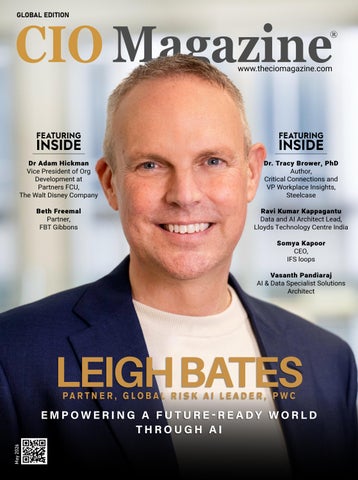
LEIGH BATES
RISK AI LEADER, PWC
EMPOWERING A FUTURE-READY WORLD THROUGH AI PARTNER, GLOBAL
admin@thecioomagazine.com
www.thecioomagazine.com
admin@thecioomagazine.com
www.linkedin.com/company/ciomagazine
CIO Magazine www.theciomagazine.com is a global knowledge sharing digital platform published by Connecta Innovation Private Limited. All rights reserved. The opinions expressed in the content and pictures provided are those of the authors. They do not purport to reflect the opinions or views of Connecta Innovation Private Limited or any of its subsidiaries, its members or associates and we do not assume any responsibility. The publisher does not assume any responsibility for the advertisements. The content, pictures, and all warranties made in such advertisements are the sole responsibility of the advertisers. CIO Magazine www.theciomagazine.com is a Free Subscription and Free-to-read digital platform strictly not for sale and must be strictly for internal private use only. Publisher does not assume any responsibility arising out of anyone modifying content and pictures, printing a copy of this digital platform in any format and in any country and all matters related to that. “CIO Magazine www.theciomagazine.com“ and “The CIO Magazine www.theciomagazine.com“ trademarks are owned by Connecta Innovation Private Limited.
WHEN INTELLIGENCE ISN’T ENOUGH
There was a time when conversations around artificial intelligence were driven almost entirely by capability. Faster systems. Smarter tools. Bigger models. Every conference stage and boardroom discussion seemed to revolve around one question: What can AI do next?
Today, the more important question feels very different: What are we willing to trust AI to do?
That shift says a great deal about where the world stands right now. Businesses are no longer impressed by experimentation alone. Employees want transparency. Customers expect accountability. Regulators are paying closer attention. According to recent industry reports, while AI investments continue to rise globally, many organizations still struggle to move projects beyond pilot stages because trust, governance, and clear ownership remain unresolved. Technology may move quickly, but confidence takes time to build.
I was reflecting on this recently during a conversation with a young professional who said something simple yet striking: “People don’t fear technology as much as they fear losing control.” That thought stayed with me. Perhaps the future of AI will not belong to the organizations with the loudest innovation stories, but to those that can create systems people genuinely believe in.
That is precisely why our cover story featuring Leigh Bates, Partner and Global Risk AI Leader at PwC, feels especially timely. With nearly three decades of experience in data, analytics, and AI, Leigh brings a balanced perspective that is often missing in today’s technology conversations. He speaks not only about innovation, but about responsibility. Not only about scaling AI, but about building it safely, ethically, and sustainably. His insights remind us that trust is becoming the true currency of the AI era.
This issue of CIO Magazine also brings together a range of thoughtful conversations, expert perspectives, and forward-looking insights from leaders across industries. Each story reflects the challenges and opportunities shaping the future of business, leadership, education, and technology.
As always, we hope these pages leave you informed, inspired, and perhaps even a little more curious about the road ahead. The future is being built now. The real question is whether we can build it in a way people are willing to trust.
Happy Reading!
Dr Adam Hickman
24 Vice President of Org Development at Partners FCU, The Walt Disney Company
Intelligence Without Instinct: Why Leadership Still Leads in the World of AI
42 24
Vasanth Pandiaraj
42 AI & Data Specialist Solutions Architect
Context as Infrastructure: Why Most LLM Production Systems Fail at Architecture, Not at Prompts
48
48 SVP/Chief Data and Analytics Officer, GE HealthCare
Ravi Kumar Kappagantu
The Missing Layer in Enterprise AI Architecture
Somya Kapoor 16 CEO of IFS loops
From Experimentation to Execution Redefining How Businesses Operate with AI
Dr. Tracy Brower 30 PhD, Author, Critical Connections and VP Workplace Insights, Steelcase
Empowering the Next Generation of Workplace Culture
Beth Freemal 36 Partner, FBT Gibbons
Redefining Law to Serve People First
LEIGH BATES
PARTNER, GLOBAL RISK AI LEADER, PWC
EMPOWERING A FUTURE-READY WORLD THROUGH AI
Leigh Bates is a Partner at PwC UK and Global Risk Leader for Artificial Intelligence, with nearly 30 years of experience in data, advanced analytics, and AI. He works with global institutions to embed AI safely, responsibly and at scale, helping organisations move from experimentation to measurable outcomes. With deep expertise in financial services, Leigh is passionate about combining innovation with governance, ensuring AI delivers trusted and sustainable value. He is also committed to developing future talent and strengthening the UK’s leadership in AI innovation, research, and skills. Leigh lives in London with his wife and three daughters.
Recently, in an exclusive interview with CIO Magazine, Leigh shared insights into his remarkable career journey, his passion for driving innovation in AI, and his vision for the future of technology. He also shared his personal hobbies and interests, future plans, words of wisdom, and much more. The following excerpts are taken from the interview.
Hi Leigh. Can you walk us through your career journey and what led you to become a leader in AI?
My passion for technology began in my early teens, learning to code on a Commodore 64 using BASIC to program simple games. I didn’t realise it then, but that curiosity would shape both my education and career.
Nearly 30 years ago, I started in professional services as a technical consultant, working with financial services and retail clients to deliver data and reporting solutions. It was the early era of business intelligence, and the work was hands-on with SQL, COBOL, Business Objects and Cognos. I was completely hooked. I loved the pace and pressure, but more importantly, I saw how well-structured data could materially improve business outcomes.
That’s when I became convinced data and technology weren’t just operational tools, they were catalysts for transformation. That belief led me to SAS, where I worked alongside exceptional talent on complex global challenges. Dr. Jim Goodnight’s focus on customers, innovation and people had a lasting influence on how I lead.
For the past 12 years at PwC, I’ve helped organisations move from AI experimentation to measurable outcomes embedding AI into core processes while balancing innovation with governance, ethics and change. Today, as our Global Risk Leader for AI, I support clients in deploying AI safely, responsibly, and with trust. Ultimately, what drew me into AI leadership was recognising that success doesn’t come from technology alone. It comes from connecting strategy, data, and people to ensure AI is scalable, trusted and solving real-world problems.
What do you love the most about your current role?
I get to build trusted relationships with clients around the world and work on challenges that genuinely matter. Turning ambition into real outcomes and seeing that translate into lasting organisational change is incredibly motivating.
A huge part of that is people. I work with exceptionally talented teams across PwC, our clients, and our technology alliance ecosystem. Bringing those capabilities together to deliver results is something I genuinely enjoy. I’m also deeply passionate about developing talent. Supporting individuals as they grow, stretch themselves and build confidence is one of the most rewarding aspects of leadership.
AI is evolving rapidly, which means constant learning and pushing boundaries. But at the heart of it all, I love transformation. Technology alone doesn’t deliver change. Real transformation happens when exceptional people align behind a clear ambition and execute with discipline and rigour. That combination of people, innovation and execution is what makes my role so fulfilling.
How do you see AI and ML evolving in the next 5 years?
Five years in AI is a long time, but several shifts are clear.
AI is moving from isolated use cases to being deeply embedded in core business processes and operating models. It will become “business as usual,” supported by reusable platforms, governance frameworks, and new ways of working.
Models will become even more capable, multimodal, and increasingly agentic, moving beyond drafting, summarisation
Real transformation happens when exceptional people align behind a clear ambition and execute with discipline and rigour
and search into decisioning and constrained automation. We will also see a shift toward more domain-specific models that drive higher reliability and precision. However, performance alone won’t be the differentiator. Trust will. Safe deployment, governance, resilience, transparency, monitoring, and clear accountability will determine which organisations scale successfully. Trust becomes the licence to operate, and the licence to scale.
The focus will increasingly shift from what AI can do to how it is deployed safely, securely, and ethically. Those who combine innovation with strong governance will unlock sustainable value. Those who don’t will struggle to move beyond pilots and narrow use cases.
Ultimately, AI will be a trusted business enabler. Embedded, governed, and aligned to real outcomes that benefit both organisations and society.
Can you share a book or resource that inspires you and why?
One book that has strongly influenced me is The Innovator’s Dilemma by Clayton Christensen. It explains why successful organisations often struggle during periods of disruption. A lesson highly relevant in the age of AI.
AI challenges established operating models and requires leaders to experiment thoughtfully. But innovation must be intentional and evidence-led. We’re not replacing human judgement, we’re scaling it. In AI, that means starting with low-risk augmentation, measuring outcomes, and only increasing autonomy when evidence supports it.
The book reinforces a principle I strongly believe in: breaking new ground doesn’t mean moving fast without care. Sustainable innovation requires trust, governance, and disciplined execution.
How do you mentor and inspire teams to drive innovation?
For me it starts with leading by example, being curious, open, and willing to challenge myself.
Clear communication is critical. People perform at their best when they understand the purpose behind their work and how it connects to a broader ambition. I emphasise autonomy, trust, and high standards. I encourage bold ideas and thoughtful experimentation, pushing boundaries while maintaining quality.
Bold innovation requires psychological safety. Not every initiative will succeed exactly as planned and that’s part of progress. The key is learning quickly, applying those lessons, and moving forward with greater insight.
Inspiration also extends beyond internal teams. Energising clients and leaders, helping them see what’s possible and turning ambition into action is equally important.
When people feel trusted and aligned, they’re far more willing to break new ground.
People perform at their best when they understand the purpose behind their work and how it connects to a broader ambition
What's a favourite quote or mantra that guides you?
“The best way to predict the future is to invent it” by Alan Kay, an American computer scientist.
It reflects how I think about leadership in AI. The future isn’t something that happens to us, it’s shaped by the choices we make today. But bold vision must be paired with discipline. As Jim Collins writes in his book, “Great by Choice,” sustained success combines ambition with consistency and evidence-led action.
In AI, that means experimenting boldly, but with strong guardrails, continuous assurance and clear accountability, so innovation scales safely.
What are some of your passions outside of work? What do you like to do in your time off?
Family time is my biggest priority. Life is busy, but spending time with my wife, our daughters, and our dog Bella keeps everything in perspective. I’m also a strong believer in staying active. Whether it’s the gym, tennis, hiking, or a quick Peloton session, exercise is as much about mental wellbeing as physical fitness. It’s how I reset and recharge.
I also enjoy cooking and the occasional DIY project, doing something completely different from my day-to-day role. Those moments help me stay grounded and bring fresh energy back into my work.
How do you stay motivated and inspired in a rapidly changing field?
It starts with a mindset of curiosity and continuous learning. As we know, AI continues to evolve every day, and I’m genuinely interested in understanding what’s emerging, what’s working in practice, and how it can be applied responsibly to deliver meaningful outcomes.
I draw a huge amount of inspiration from the people around me. Working alongside talented
If I can contribute to strengthening the UK’s position as a leading country for trusted AI innovation, talent and research, while helping others grow along the way, that would be something I’d be incredibly proud of
teams, engaged clients, and trusted partners who challenge my thinking. Beyond that, I’m fortunate to have a wide network of inspiring leaders and innovators who share ideas, experiences, and perspectives, which helps me stay open-minded and forward-looking.
Staying close to real-world impact keeps everything grounded. Seeing AI solve meaningful problems safely and ethically is what sustains motivation.
What is your biggest goal? Where do you see yourself in 5 years from now?
My biggest goal is to make a meaningful, lasting impact through client outcomes, developing people and contributing to society more broadly.
Over the next five years, I want to continue shaping how AI is applied at scale, pushing the boundaries of innovation while ensuring it is built on trust, safety and responsibility. Influencing how AI is used in ways that benefit not just businesses, but society more broadly, is something I care deeply about.
Giving back is increasingly important to me. I’m committed to supporting charities, communities and the next generation of talent, particularly school leavers, helping them build the skills and confidence needed for an AIenabled future.
Through initiatives such as our work at PwC with the UK Government to help upskill 7.5 million workers in AI by 2030, we are helping build national capability.
If I can contribute to strengthening the UK’s position as a leading country for trusted AI innovation, talent and research, while helping others grow along the way, that would be something I’d be incredibly proud of.
What advice would you give to professionals looking to make a mark in AI and tech?
My advice would be to stay curious and build strong fundamentals.
AI will continue to evolve, but understanding data, problem-solving, and how businesses operate will always matter. Don’t chase trends at the expense of outcomes.
Invest in people skills as much as technical skills. The biggest impact comes from collaboration and communication.
Experiment but do so responsibly. Learn quickly, maintain high standards and act with integrity.
Finally, design for trust from the start. At PwC, we call this “Trust by Design.” The most successful careers in AI will be built by those who combine curiosity, discipline, and purpose.
Wa n t t o S e l l o r fi n d
I nve s t o rs f o r yo u r
B u s i n e s s ?
From Experimentation to Execution Redefining How Businesses Operate with AI Somya Kapoor
CEO of IFS loops
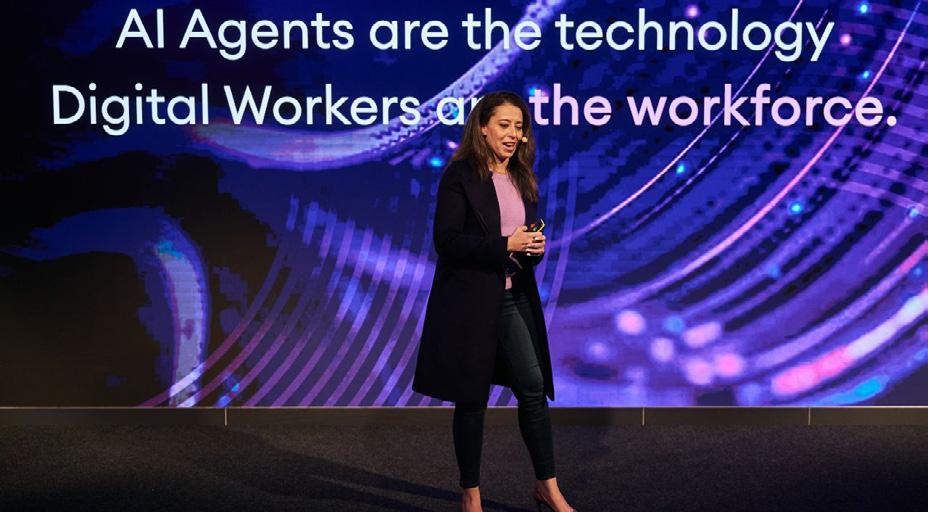
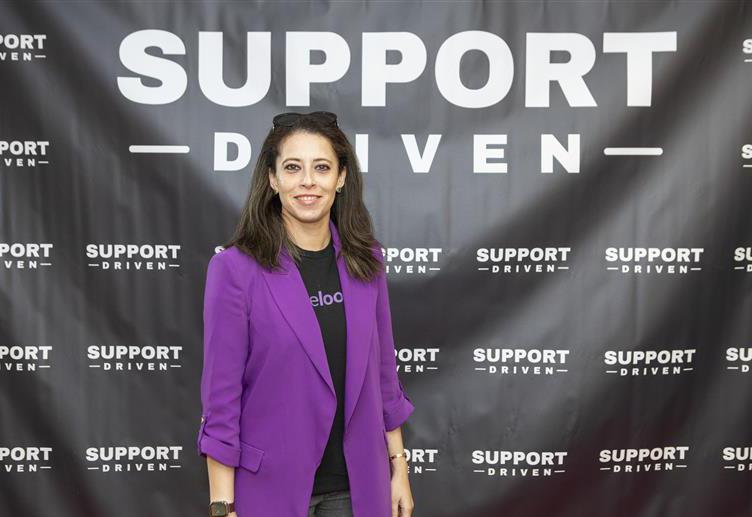
Somya Kapoor is CEO of IFS Loops, formed when TheLoops joined IFS in 2025. She’s spent her career leading technology strategy and enterprise transformation at global companies like SAP and ServiceNow, and at startups where speed and execution matter more than process.
Before IFS Loops, Somya co-founded TheLoops, an agentic AI platform built to solve real operational problems with measurable outcomes. She’s been building and deploying AI solutions since 2016, which gives her a concrete sense of what actually works in enterprise environments versus what sounds good in demos.
Her approach to agentic AI is grounded in practicality: governance matters, integration with systems of record matters, and deployment has to work in industries where failure costs millions. At IFS Loops, Somya focuses on helping enterprises move from AI experimentation to production-scale deployment. Digital Workers that improve productivity, consistency, and reliability in mission-critical operations. Not pilots. Production.
In an exclusive conversation with CIO Magazine, Somya talks about the shift from traditional automation to agentic AI, and how enterprises must move beyond experimentation to realworld execution. She shares insights on why change management remains the biggest hurdle in digital transformation, and how breaking down operational silos is critical for speed and efficiency. She also reflects on building technology that delivers measurable outcomes, the importance of governance in AI deployment, and why practical innovation always outperforms hype.
Your journey into leading IFS Loops is quite interesting. What were some of the defining moments that shaped your career path?
I’ve been an entrepreneur from the very beginning, even when I was inside large companies. At SAP and ServiceNow, I gravitated toward incubation roles, spinning out new products, building new teams, and taking ideas to market. I wasn’t climbing a ladder, I was building things. That was always what drove me.
Moving into startups was a natural progression. It gave me the freedom to go further, to identify a problem no one had fully solved and build something from the ground up to solve it. What I kept seeing was a gap in customer experience: companies were investing heavily in frontline CX, but the real friction lived in backend operations. Customers weren’t failing because of bad service reps, they were failing because the systems and context behind those reps couldn’t keep up. That insight became the foundation for Loops, a platform built to bring context and operational intelligence to the people and systems that actually resolve customer problems.
The validation came in a powerful way. IFS was a customer of Loops’ agentic platform, they were using it, and seeing its value firsthand, and that relationship led to Loops being acquired by IFS. That’s the kind of outcome that confirms you were solving a real problem for real customers.
At its core, my career has always been about that: find the problem, build the solution, get it in front of customers who need it, and then drive the momentum to scale it.
From your perspective, what are the biggest challenges organizations face today when trying to optimize their processes and systems?
The biggest challenge isn’t lack of technology. It’s change management.
Organizations have historically been very good at maintaining silos, defining processes around them, building teams to scale within them, and structuring data and systems to support that model. And for a long time, that worked. But that model is breaking down.
The pace at which technology is evolving means organizations can no longer afford to optimize in isolation. The silos that once created structure are now creating friction, between systems that can’t share context, teams that can’t move in sync, and processes that weren’t designed for the speed the market now demands.
That’s why change management has become the defining challenge. It’s not enough to deploy new technology and expect transformation. Organizations need to invest in upskilling their people, expanding their exposure to new ways of working, and building a culture that treats change as a capability rather than a disruption. The companies that will win aren’t the ones that adopt technology the fastest, they’re the ones that build organizations agile enough to absorb change and execute with confidence in an environment that will keep evolving.
AI is rapidly reshaping industries.
How do you see it influencing the way businesses approach automation and operational efficiency in your domain?
AI is evolving into Agentic AI, and that evolution is forcing a fundamental shift, not
just in how businesses operate, but in what automation actually means.
For the past decade, industrial automation meant either brittle RPA that broke with any process change, or AI co-pilots that suggested actions but left humans to execute. Both had real limitations. Neither solved the core problem: coordination delays and manual handoffs that quietly drain capacity and slow down the business.
What’s different now is agentic AI. Systems that can execute complete workflows autonomously, with the governance, auditability, and integration that industrial environments actually demand. This isn’t AI as an assistant. It’s AI as an operator.
The businesses moving fastest aren’t using AI to generate better recommendations. They’re deploying Digital Workers that own workflows end-to-end, procurement, inventory replenishment, dispatch coordination, order management. These aren’t suggestion engines
sitting alongside human processes. They are the process.
That’s the real shift. From AI that informs to AI that executes. From automation that assists to infrastructure that operates. And in domains like field service, supply chain, and asset management, that distinction is everything, because the cost of slow execution isn’t just inefficiency, it’s lost customers, missed SLAs, and compounding operational debt.
The organizations that understand this aren’t asking “how do we use AI?” They’re asking “what can we now hand off entirely?” That’s a fundamentally different question, and it leads to a fundamentally different business.
At IFS Loops, what are some key initiatives or milestones that you are particularly proud of?
Several things stand out.
The first is the speed at which we are developing and delivering, and doing it in
lockstep with customers. Every Digital Worker we deploy is co-developed with the customer it serves. Kitron, Ependion, Kodiak Gas, CDF and KLN Family Brands are running Digital Workers in live operations, delivering measurable results within weeks. Not pilots — production. That’s real validation in environments where failure costs millions.
That momentum is also changing the commercial motion. Sales cycles are getting faster, and customers are coming back for upgrades within the same quarter after seeing results. That doesn’t happen unless you’re solving real problems.
What underpins all of this is how we think about the Digital Worker itself. We start from outcomes they want to see: what does a specific
role need to drive to deliver value? From there, we rethink entire workflows, breaking beyond data silos to connect context, decisions, and actions across the organization.
And now with Agent Studio, we’ve put that power directly in our customers’ hands. They can adapt, test, and monitor their Digital Workers themselves through plain text-based instructions. No code, no developer bottlenecks. Just business knowledge translated directly into operational execution.
But what I’m most proud of is the team. Building technology, the right way, with governance, auditability, and reliability from day one requires real discipline. This team has that. And that’s what makes everything else possible.
THE TECHNOLOGY THAT LASTS IS THE TECHNOLOGY THAT WORKS WHEN IT’S LIVE, UNDER PRESSURE, IN A MESSY REAL-WORLD ENVIRONMENT. NOT
THE TECHNOLOGY THAT GETS THE MOST BUZZ
As a leader, how do you balance innovation with practicality, especially in an environment where new technologies emerge constantly?
I don’t think innovation and practicality are opposites. The most innovative solutions are often the most practical. The balance comes down to one question: does this solve a real operational problem that costs our customers money, time, or capacity?
Because customers don’t buy technology, they buy outcomes. If you can’t draw a straight line from the innovation to a business result, it’s not ready. Full stop.
That clarity matters more than ever right now. Technology moves so fast that it’s easy to chase capabilities instead of outcomes. We’ve been building AI since 2016, through multiple hype cycles. What I’ve learned is that speed of innovation means nothing without adoption. The most sophisticated technology that sits unused is just technical debt with good marketing.
And in industrial environments, there’s another dimension that most people
underestimate — governance. Innovation without governance isn’t innovation, it’s risk. The ability to audit, control, and trust what AI does is what separates deployable from theoretical. That’s not a constraint on innovation, it’s what makes innovation stick in production.
The technology that lasts is the technology that works when it’s live, under pressure, in a messy real-world environment. Not the technology that gets the most buzz.
Practical innovation wins. Every single time.
Outside of work, what interests or activities help you recharge and maintain perspective?
Movement is in my DNA. Growing up in India and the Middle East, studying in the U.S., and working globally, I’ve never stayed still for long. Travel isn’t just how I recharge, it’s how I think. New environments, unexpected conversations, different cultures navigating the same fundamental challenges, there’s no better way to stress-test your assumptions than putting yourself somewhere unfamiliar. Every trip
leaves me with a sharper perspective on what we’re building and why it matters.
At heart, I’m an obsessive technologist. I can’t help it. New tools, emerging solutions, the latest gadgets, I have to get my hands on them. There’s something about the moment you pick up a new piece of technology and immediately start imagining what it unlocks that never gets old for me. I was that person coding C++ in 10th grade, and honestly, not much has changed. That curiosity is what keeps me sharp. When you genuinely love technology, not just what it does, but how it thinks. You develop an instinct for what’s real versus what’s noise. In a world moving as fast as ours, that instinct is everything.
And then there’s the work I care most deeply about outside of IFS Loops: advancing women in enterprise technology and AI. I mentor, speak, and advocate actively in that space, not as an obligation, but because I’ve seen firsthand what diverse leadership unlocks. The best organizations aren’t just the most technically capable. They’re the most human. Keeping that front and center reminds me that what we’re building is always bigger than the product.
What advice would you offer to young professionals who aspire to build a career in technology and leadership?
Three things, and I mean these genuinely, not as platitudes.
First, go where the hard problems are. Don’t optimize for titles, visibility, or the most prestigious logo on your resume. Optimize for difficulty. Seek out the problems that actually matter to the business, the ones nobody has fully solved, the ones where failure is visible and success is measurable. That’s where real
expertise is built. And expertise, not positioning, is what opens doors that stay open.
Second, take risks while you’re young enough to absorb them. Change roles, change industries, change geographies if you have to. Don’t let comfort become a cage. Every time you step into something unfamiliar, a new function, a new domain, a new type of problem, you’re compounding your perspective in a way that specialists never do. The best leaders I know aren’t the ones who went deepest in one lane. They’re the ones who crossed enough lanes to understand how everything connects. Failure at this stage isn’t a setback. It’s tuition. Pay it willingly and move forward faster because of it.
Third, and this one I feel most personally, if you’re a woman in technology, stop apologizing for being good at what you do. Early in my career I thought I needed to soften my directness, make my ambition more palatable, and take up less space. I don’t anymore. The world doesn’t need more women who are good at technology and leadership but are hesitant to own it. Focus on execution. Deliver results. Build credibility through output, not optics. Don’t wait for permission or for someone to notice you’re ready.
The door was never locked. You just have to build your own key, and have the confidence to use it.
And look, this might sound cliché, but I always come back to Steve Jobs. Stay hungry. Stay foolish. It’s two sentences that have never stopped being true. The moment you think you’ve figured it out is the moment you stop growing. Stay curious enough to keep asking questions and bold enough to keep taking chances. That combination never goes out of style.
INTELLIGENCE WITHOUT INSTINCT: WHY LEADERSHIP STILL LEADS IN THE WORLD OF AI
Dr Adam Hickman
Vice President of Org Development at Partners FCU, The Walt Disney Company
Dr. Adam Hickman is a senior executive and organizational development leader focused on aligning culture, leadership, and business performance. As Vice President of Organizational Development at Partners Federal Credit Union, which serves The Walt Disney Company, he advises the senior leaders on human capital strategy, leadership capability, and workforce innovation. A former Gallup leader, Adam’s work is grounded in evidence-based approaches to engagement, manager development, and culture transformation. He has authored multiple books and more than 90 publications, and is a frequent international speaker. He helps organizations turn leadership into a measurable advantage.
In times of technological change, we often overvalue what is new and overlook what still matters most.
Artificial intelligence is no exception. It is powerful, evolving quickly, and already reshaping how work gets done. But the real story is not about AI replacing leadership. It is about whether leaders can rise to meet a more demanding version of their role.
The question is not whether AI and leadership can coexist. They will. The more important question is whether they can operate in harmony in a way that strengthens performance, sharpens decision-making, and builds trust across an organization.
That outcome is far from guaranteed.
What AI introduces is not just capability, but complexity. It gives leaders access to more information, faster insights, and broader reach than at any point in time. It also introduces new risks, new dependencies, and new expectations from employees who are watching closely to see how these tools are used.
In many organizations, the response has been uneven. Some leaders move quickly, adopting AI tools with the belief that speed alone creates advantage. Others hesitate, concerned about ethical implications, data security, or unintended consequences. Both instincts are understandable. Neither is sufficient.
What is required instead is discipline.
Leadership in the AI era demands clarity about how decisions are made. Not every decision should be treated the same. Some require the nuance of human judgment, particularly when they touch culture, values, or long-term risk. Others are better handled by systems that can process information at scale with consistency and speed.
The difference matters. When leaders fail to define where AI should inform versus where it should decide, they create confusion. Over time, that confusion erodes accountability. People begin to question not just the technology, but the leadership behind it.
The most effective organizations are not those that adopt AI broadly. They are the ones that adopt it intentionally. They are clear about where it adds value and equally clear about where it does not.
There is another challenge that is easier to overlook but just as important. As AI becomes more capable, it can take on tasks that once required significant expertise. It can draft communications, analyze trends, and even suggest strategic options. The risk is not that AI becomes too powerful. The risk is that leaders become too passive.
Leadership is not about reviewing outputs. It is about setting direction, applying judgment, and making decisions that carry weight. AI can support that work, but it cannot replace it. When leaders begin to defer too heavily to technology, they lose something critical. They lose the ability to think independently and to lead with conviction.
This is where many leaders make a subtle but consequential mistake. They begin to anthropomorphize the technology. They treat AI as if it understands context the way a human does, as if it can feel the implications of a decision, or carry the weight of its consequences. It cannot.
Do not give something that does not have a heartbeat a heart.
AI does not care about your people, your culture, or your reputation. It does not feel risk. It does not experience accountability. It
WHEN LEADERS BEGIN TO DEFER TOO HEAVILY TO TECHNOLOGY, THEY LOSE SOMETHING CRITICAL. THEY LOSE THE ABILITY TO THINK INDEPENDENTLY AND TO LEAD WITH CONVICTION
produces outputs based on data and probability, not meaning and responsibility.
Used correctly, however, it can be an exceptional thought partner. It can challenge assumptions, surface patterns that would otherwise go unnoticed, and expand the range of options a leader considers. It can make leaders better, faster, and more informed.
But it must remain a partner in the process, not the source of final judgment.
The organizations that are getting this right understand that distinction. They do not rely on AI to make decisions that require a human lens. They use it to sharpen their thinking, to test their logic, and to accelerate their ability to act. They keep ownership of the decision where it belongs, with leaders who are accountable for outcomes.
That is not a philosophical stance. It is a practical one.
In these environments, AI handles the mechanics. It accelerates analysis, identifies patterns, and reduces the burden of repetitive work. Leaders, in turn, focus on what matters most. They interpret, they prioritize, and they make decisions with a level of context that no system can fully replicate.
This is where the advantage begins to show. It is not in the technology itself, but in how it is used.
That shift has meaningful implications for the workforce. The skills that matter are evolving. It is no longer enough to know how to do the work. Employees must understand how to work alongside systems that are constantly improving. They need to be able to question outputs, to recognize limitations, and to apply insights in ways that are grounded in the reality of the business.
Organizations that invest in these capabilities will move faster and make better decisions. Those that do not will find themselves constrained, even if they have access to the same tools.
Trust sits at the center of all of this. Employees are not opposed to AI. They are paying attention to how it is introduced and how it affects them. If the use of AI feels opaque or inconsistent, trust will decline quickly. If it is introduced with clarity, fairness, and a clear connection to outcomes, it can strengthen confidence in leadership.
That responsibility cannot be delegated. It belongs squarely with leaders.
HARMONY BETWEEN AI AND LEADERSHIP IS NOT SOMETHING THAT HAPPENS ON ITS OWN. IT IS BUILT THROUGH A SERIES OF DELIBERATE CHOICES
It requires straightforward communication about what is changing, why it matters, and how decisions will be made. It requires visible accountability. And it requires a willingness to address concerns directly rather than assuming they will resolve themselves over time.
The organizations making the most progress share a common approach. They start with the business. They identify where AI can meaningfully improve performance, whether that is speed, quality, or cost. They align their efforts around those priorities rather than chasing every new capability. And they equip their managers to translate strategy into action, because that is where adoption either succeeds or fails.
This is not about perfection. It is about consistency.
Harmony between AI and leadership is not something that happens on its own. It is built through a series of deliberate choices. It requires leaders to stay engaged, to remain accountable, and to hold a clear point of view about how technology should serve the organization.
The leaders who will stand out are not the ones who move the fastest or the ones who move the slowest. They are the ones who move with intention. They understand what matters, they make clear decisions, and they bring their organizations with them.
AI will continue to evolve. That is certain. What will differentiate organizations is how their leaders evolve in response.
The opportunity is not to choose between human intelligence and artificial intelligence. It is to bring them together in a way that elevates both, while never confusing the role each one plays.
That is where real performance gains are found. And that is where leadership, done well, still makes the difference.
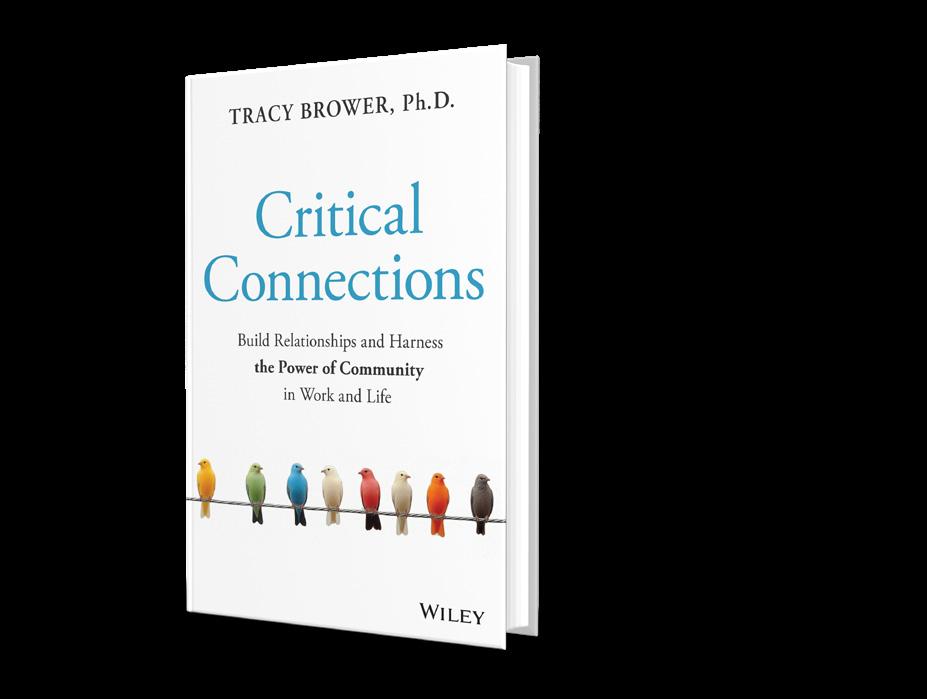
Empowering the Next Generation of Workplace Culture Dr. Tracy Brower
PhD, Author, Critical Connections and VP Workplace Insights, Steelcase
Dr. Tracy Brower is a PhD sociologist studying community, happiness and the future of work and life. She is a Global 50 Thinker and a Top 101 Experience Influencer as well as the award-winning author of three books: Critical Connections, The Secrets to Happiness at Work and Bring Work to Life. She is the vice president of workplace insights wit Steelcase and a senior contributor to Forbes and Fast Company. Tracy’s work has been translated into 25 languages and her TEDx talk has been viewed 8.6 million times. You can find her on at tracybrower.com, LinkedIn, or any of the other usual social channels.
Recently, in an exclusive interview with CIO Magazine, Tracy shared insights into how community has shifted from a “soft” concept to measurable business infrastructure, revealing that dense workplace networks directly drive retention, performance, and organizational citizenship behaviors like follow-through and commitment. She emphasized that while connection, purpose, and flexibility all top employee surveys, flexibility remains the hardest for leaders to deliver authentically due to role-based equity challenges and the proven benefits of face-to-face work for motivation, learning, and friendship. Looking beyond AI, Tracy placed her biggest bet on the evolving relationship between people and their work — noting that as AI reshapes the nature of value, organizations must rebuild community, integrate satisfaction with engagement and productivity, and design work that is both deeply human and high-performing. The following excerpts are taken from the interview.
Hi Tracy. You’re a Global 50 Thinker, VP of Workplace Insights, and a sociologist whose TEDx talk on happiness has reached 8.6 million people. When did you first realize that “community” wasn’t a soft concept but a measurable driver of performance and wellbeing?
With my first book, Bring Work to Life, I focused on how work can be (and should be) a fulfilling part of life. That led me to my second book, The Secrets to Happiness at Work in which I shared evidence for what creates joy in our work. Within that effort, connection and community kept emerging as utterly critical, not only for the wellbeing of people emotionally, physically and cognitively, but also for the benefit of business and organizations. This is the insight and inspiration I shared in Critical Connections.
The data is compelling. When people feel a sense of belonging and community, they are more likely to stay with the organization, more likely to perform at their best and less likely to miss work. And when people have dense networks across the organization, they are more likely to demonstrate ‘organizational citizenship’ behavior in which they follow up, deliver on their commitments and do their best for themselves, their teams and the organization as a whole.
Your new book, ‘Critical Connections’ lands in a post-pandemic world rethinking offices, AI, and belonging. What was the moment in your research when the data convinced you that connection is now a business-critical infrastructure, not a perk?
Our realities today drive the need for connection as a critical element of the work experience.
Connection is fundamental to our wellness, engagement and motivation.
Having two or three close friends is linked with everything from mental health to cardiovascular health, cancer, dementia and overall longevity. But we aren’t connecting outside of work as we did in the past. We’ve elevated convenience over connection: We don’t talk to the barista, we order on the app. And we don’t talk to the check out person, we get the delivery at our door. In the absence of these small but important points of connection, work becomes a center of gravity. Work creates the context within which we feel seen, known and connected with others. In fact, 69% of people crave connection at work.
The benefits of connection and community for people and for business are irrefutable and they drive a new imperative in terms of how we deliver on connected work experiences.
Connection, purpose, and flexibility keep topping employee surveys. Which of those three will be hardest for leaders to deliver authentically by 2028, and why?
Each of these is indeed a high priority. Leaders often struggle with delivering flexibility the most, because it is different for every job. For some jobs, flexibility is possible because the responsibilities aren’t customer-facing or time-bound in terms of when the work gets done. But for jobs that require client contact or work at key times of the day, flexibility is harder to provide. This introduces limitations for individual employees, but it can also create equity challenges in which people wonder why one person was able to take advantage of the perk while they were not.
And while flexibility and autonomy have measurable positive outcomes, it is also important to recognize that working face to face also has tremendous benefits in raising motivation, engagement, learning and growth, friendship and performance.
You advise on everything from real estate to math programs. Is there an industry or community outside your core work that you’re privately fascinated by right now?
I appreciate the diversity of the programs in which I serve a board advisory role. My involvement in one, helps me expand my perspective and apply new ideas with others.
I’m especially fascinated right now by my work with Gen Zs and Gen Alphas. They are
some of the most disconnected groups and they are struggling with mental health and wellbeing. I am interested in working with them as individuals and in groups. But I am also focused on the social dynamics that will need to change so that we are creating both nurturing and challenging opportunities for all generations going forward.
You sit on academic and industry boards. What three skills will be nonnegotiable for “workplace leaders” by 2029, whether they’re in HR, IT, or real estate?
Leaders are under a microscope today and leadership is more challenging than it has been in the past, because of the pressure, polarization and rapid rates of change.
THE BENEFITS OF CONNECTION AND COMMUNITY FOR PEOPLE AND FOR BUSINESS ARE IRREFUTABLE AND THEY DRIVE A NEW IMPERATIVE IN TERMS OF HOW WE DELIVER ON CONNECTED WORK EXPERIENCES
Leaders must be empathetic and they must be present and connect with others effectively. Leaders must also be curious and creative. The future won’t belong to the leader with all the best answers, but with better questions. Leaders must also be resilient. As soon they reach a level of stability with their skills or situations, things are sure to change, so adaptability will be another of the most critical skills.
Music, art, and place shape how we feel. Is there a city, building, or space that, for you, embodies “critical connection” in its design?
The Boccia Al Bosco trail in the Verzasca Valley region of Switzerland is a wonderful example. It is a hike that features chutes, pulleys and catapults that run alongside the paths. At the start of the trail, you obtain a wooden boccia ball and then as you’re hiking you can roll the ball down the troughs. You can adjust the ramps to create new pathways for the balls.
What is especially powerful is the interactive nature of the experience because it invites collaboration with other hikers to redesign the runs. It also empowers you to shape your surroundings, creating meaningful experiences. And it cements memories based on the relationships and the fun that arise from the experience.
But built experiences can be like this as well. Places that offer variety and choice as well as personal control empower us to select and affect spaces for our best performance. Those that offer opportunities for time alone as well as time together inspire us to think deeply, but also to collaborate, learn and build with others. And those with sightlines to leaders
and teammates remind us of how our work is connected, and how we are part of a community coming together to achieve a shared purpose.
If you had to place one big bet on a shift beyond AI that will redefine the future of work by 2030, what would it be and what signal are you watching today
AI is obviously the biggest factor because it’s not just changing how we work, it’s changing the nature of work and our relationship to our work. We are accustomed to providing certain value and we feel fulfilled as a result, but as work changes, the nature of the value we offer will also change. This will affect how we feel about our contributions, about the need for our talents and about our identity.
In addition to this, I’m watching signals in the global conversation we’re having about work. Years ago we showed up, we did the things and we didn’t think very hard about what we needed from our work experience. But today, we’re demanding more and we’re figuring out how work experiences must change.
We also have access to terrific evidence that drives solutions. In particular, there is conflation of elements like satisfaction, engagement and productivity in which one each of these drives the others. We’re realizing how integrated work and life are, and the extent to which we can do the right thing for people and in the process, we’re doing the right thing for business. I’m optimistic about where we can go and the outcomes we can drive toward work in which we rebuild relationships, create community and build belonging.
Redefining Law to Serve People First Beth Freemal
Partner, FBT Gibbons
Beth Freemal serves small to mid-sized private and family-owned businesses and high net worth individuals as a fractional general counsel and trusted advisor. She partners with leadership teams to protect assets, support succession planning, and align legal strategy with business goals. With over 20 years of experience, she brings a practical, businessfirst approach grounded in in-house leadership and complex transactions. Beth advises on governance, entity structuring, employment, vendor management, and contracts, creating guardrails that enable confident action. Known for her collaborative style and clear guidance, she helps clients identify risks, make informed decisions, preserve value, and drive longterm, sustainable growth.
Recently, in an exclusive interview with CIO Magazine, Beth shared insights into what fuels her work with private and family-owned businesses. She urged business leaders to rethink legal risk in the AI era not as something to avoid but to actively manage, noting that generative AI makes risk more visible yet fragmented across departments, so judgment and context remain irreplaceable for translating options into action. Looking ahead, she outlined three skills that will separate trusted advisors from traditional vendors: judgment under ambiguity, building context over time, and translating risk into executable choices that drive confidence. The following excerpts are taken from the interview.
Hi Beth. Helping businesses grow profitably and sustainably is your charge. What part of that work gives you the most energy because you see legacy and livelihood change in real time?
What gives me the most energy is watching leadership teams move from hesitation to confidence.
There’s a moment usually after we’ve clarified decision authority, cleaned up governance, and given managers a practical playbook to handle people and contract issues when everything starts to move faster. Leaders stop second-guessing themselves.
That’s when you see real impact—not just on the business, but on people’s livelihoods and legacy. The company becomes more stable, more credible, and more valuable. And the leadership team feels it immediately.
You advise companies where AI is already in contracts, HR, and ops. How should business leaders rethink “legal risk” when every department has a generative AI co-pilot?
First, Leaders need to shift from thinking about legal risk as something to avoid, to something that needs to be actively managed and translated into opportunity.
AI will make it easier to identify issues and generate options. But it also creates a false sense of clarity. Surfacing risk is not the same as understanding which risks matter for this business, in this moment.
With AI embedded across contracts, HR, and operations, legal risk becomes more visible, but also more fragmented. Every department now has inputs, but no one is stitching it together.
That’s where the role of a trusted advisor becomes even more important. Someone still has to say: Here are your options, here’s the upside and downside, and here’s what I recommend given your goals. AI can accelerate the work. It can’t replace that judgment.
Legacy is built deal by deal. What skills will separate trusted business advisors from traditional legal vendors in the next decade?
Three skills will separate advisors from vendors:
1. Judgment under ambiguity
The ability to guide decisions when the answer isn’t obvious. A situation when law, risk, and business objectives are all pulling in different directions.
2. Context building over time
Trusted advisors understand how the company makes money, where leadership is comfortable taking risk, and what actually matters. That context is what allows consistent, high-quality decisions.
3. Translating risk into action
Not identifying issues, but helping leaders move forward. Clear options, clear tradeoffs, and a recommendation.
The future isn’t about who can produce the best work product.
It’s about who helps businesses decide and execute with confidence.
Servant leaders carry anchors that keep them grounded. Is there a book, case study, or piece of legislation on your desk that reminds you why law must serve people first?
One anchor I come back to is Traction by Gino Wickman, especially the idea of “getting the
right people in the right seats.” It is a simple, clear reminder that structure and systems should support people and not the other way around.
That ties to how I think about the law. At its core, the law exists to serve the business. In practice, that means remembering that every “issue” is tied to real people, the owners building something meaningful, managers trying to do the right thing, and employees whose livelihoods are impacted.
When done well, legal structure creates clarity and stability. It removes friction and helps people move forward.
The mindset of law as a tool that enables people, not constrains them keeps me grounded. It reinforces my servant leadership mindset: the goal isn’t authority or control, but supporting and guiding others to do their best work and to achieve better outcomes.
If you could give every outside counsel one question to ask before giving advice, what would it be?
“What outcome do you want to achieve?”
Without that, advice tends to be technically correct but practically misaligned.
That question forces clarity around priorities: speed vs. certainty, revenue vs. protection, flexibility vs. control. Once that’s clear, the legal analysis becomes much more useful.
You talk about risk appetite, not just risk avoidance. What is one principle you refuse to compromise on, even when a client’s growth goals get aggressive?
No matter how aggressive the growth strategy, I won’t compromise on ensuring decisions are made transparently, by the right people, and in a way that can be stood behind with confidence. Acting ethically means decisions are responsible, documented, and defensible.
Organizations can and should take smart, calculated risks. But those risks must align with clear authority, sound judgment, and a willingness to be accountable for outcomes. When decision-making is vague or diffused, it creates confusion, erodes trust, and increases the likelihood of missteps.
Sustainable growth depends on principled leadership where doing the right thing is as important as moving quickly.
WITH AI EMBEDDED ACROSS CONTRACTS, HR, AND OPERATIONS, LEGAL RISK BECOMES MORE VISIBLE, BUT ALSO MORE FRAGMENTED
SUSTAINABLE GROWTH DEPENDS ON PRINCIPLED LEADERSHIP WHERE DOING THE RIGHT THING IS AS IMPORTANT AS MOVING QUICKLY
Listening is core to customization. What advice do you give GCs on cocreating solutions with leadership when founders feel the law slows them down?
Start by acknowledging the frustration. They are not wrong!
From leadership’s perspective, the law often shows up late, slows things down, and creates uncertainty. If that’s their experience, you have to meet them there first.
Then shift the conversation from “risk avoidance” to “getting to yes.”
And that starts with the same question: What outcome are you trying to achieve?
Once you’re aligned on that, the conversation changes.
Instead of saying “we can’t,” the conversation evolves to:
• Here are your options
• Here’s what each one gets you
• Here’s the risk
• Here’s what I recommend given your goals
And most importantly establish repeatable systems. When leadership sees that governance, contracts, and HR processes can actually help them move faster the relationship changes.
That’s when you stop being seen as a gatekeeper and start being trusted as a partner.
Of course, knowing “What outcome do you want to achieve?” is paramount to “getting to yes.”
CONTEXT AS INFRASTRUCTURE: WHY MOST LLM PRODUCTION SYSTEMS FAIL AT ARCHITECTURE, NOT AT PROMPTS
Vasanth Pandiaraj
AI & Data Specialist Solutions Architect
Vasanth Pandiaraj is a visionary AI & Data Specialist Solution Architect with over 16 years of experience spearheading digital transformation for global technology leaders. Having held pivotal roles at Snowflake, Dell Technologies, and Tata Consultancy Services,and bridges the gap between complex engineering and business value.His expertise spans the complete data evolution from the foundational design of robust, scalable architectures to the deployment of sophisticated, production-grade AI ecosystems. He is recognized for turning fragmented data landscapes into highperformance assets that drive competitive advantage.
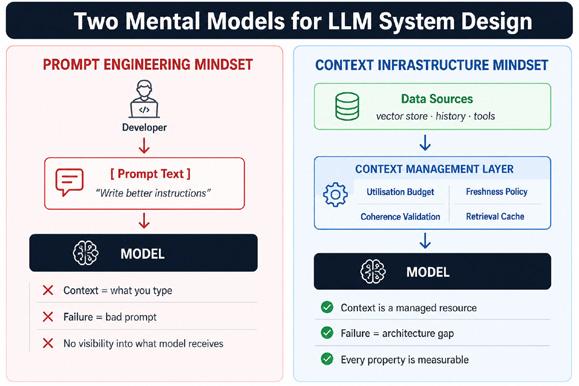
There is a pattern that emerges reliably in teams that have been running LLM systems in production for more than six months. Early results are strong. Demos are convincing. Then, somewhere between pilot and scale, things quietly break. Responses drift. Accuracy degrades. Latency spikes in ways that don’t map to model changes. Engineers reach for better prompts. They experiment with temperature settings and instruction formats. The problems persist.
The diagnosis is almost always the same: the system was designed around the model, not around the context.
This matters because the mental model most engineering teams carry into LLM system design is fundamentally wrong. They treat the context window as a configuration parameter — something you tune in the prompt. What it actually is, is a resource — one that needs to be architected, managed, and monitored the same
way you manage memory, I/O bandwidth, or database connections. The moment you make that shift, the entire failure surface of your system becomes visible.
The Reframe: Context Is a Resource Budget, Not a Text Box
In traditional software systems, engineers learned to reason about resource budgets under load. Memory is finite. I/O has throughput limits. Connections must be pooled. Designing around these constraints is not optional — it is what separates systems that scale from systems that collapse at 10x traffic.
The LLM context window is the same kind of resource. It has a hard capacity ceiling. Its contents directly affect output quality. What you put into it, how fresh that content is, and how coherent it is internally — these are architectural decisions, not prompt decisions. Yet most production architectures treat them as afterthoughts.
SYSTEMS WITH NO EXPLICIT UTILISATION MODEL TEND TO HIT CEILING ISSUES UNDER LOAD — AS CONVERSATIONS LENGTHEN OR RETRIEVAL RETURNS MORE CHUNKS, THE WINDOW FILLS AND EARLIER CONTENT IS SILENTLY TRUNCATED
Most production failures sit in the gap between these two views. The left model is common; the right model is what production reliability requires.
The Four Resource Properties of Context
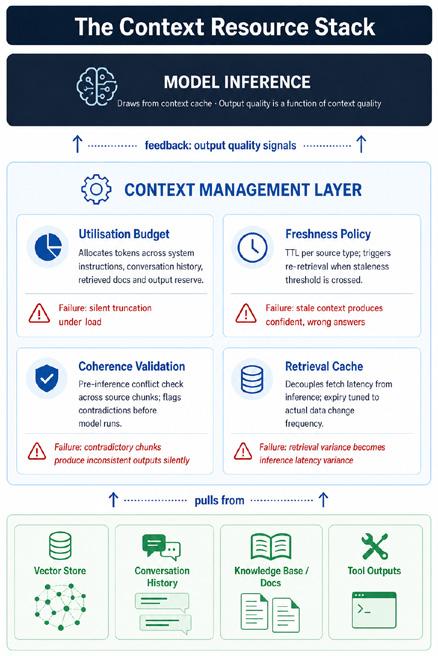
Just as memory is characterised by capacity, speed, and coherence, the context window in a production LLM system can be understood through four properties. Each has a corresponding failure mode.
1. Utilisation Rate
How much of the available context window is being used at inference time, and how is that budget allocated across instructions, retrieved documents, conversation history, and output space? Systems with no explicit utilisation model tend to hit ceiling issues under load — as conversations lengthen or retrieval returns more chunks, the window fills and earlier content is silently truncated. The model never errors. It simply loses access to information it was given three turns ago.
2. Freshness
Retrieved context has a validity window. A document retrieved at session start may be stale by turn five if the user has pivoted, the underlying data has changed, or the query intent has drifted. Systems that treat retrieval as a one-time event at session initialisation suffer from this consistently. The signal is not hallucination rate in aggregate — it is hallucination rate per retrieval age, which almost no team monitors.
3. Internal Coherence
When context is assembled from multiple retrieval sources — a knowledge base, user history, system instructions, tool outputs — contradictions are common. The model will attempt to reconcile them, often silently, producing plausible but incorrect outputs. This is the context collision problem, invisible to any metric measuring only final output quality.
4. Retrieval Coupling
Most retrieval-augmented implementations tie retrieval directly to inference. This creates a latency coupling that makes performance characteristics unpredictable under load. Decoupling these — treating retrieval as a precomputation step with its own caching and invalidation logic — is an architectural decision that dramatically changes system behaviour.
Each management layer component addresses a specific failure mode. Systems without this layer pass all four failure modes directly to the model.
What These Properties Reveal When You Measure Them
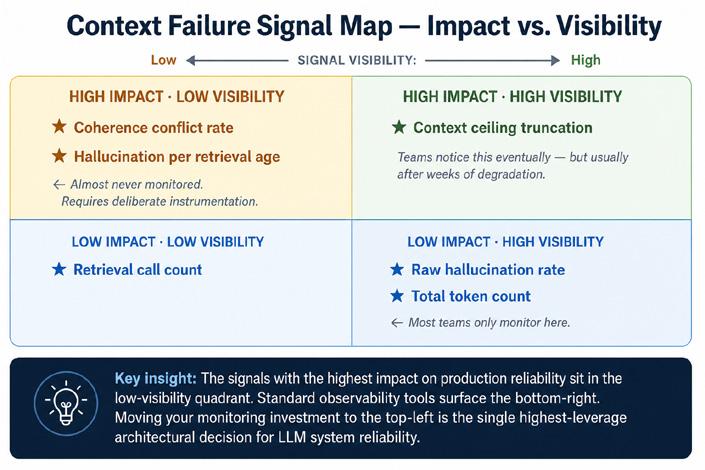
The derivative signals from context resource management expose root causes that output quality metrics alone cannot surface.
Hallucination density per retrieval age — not total hallucinations, but failures stratified by how old the retrieved context was at inference time. A rising slope tells you your freshness policy is the problem, not your model or your prompts.
Context utilisation variance across query types — if certain query patterns consistently consume 90%+ of the window while others use 30%, you have an allocation problem causing silent truncation of critical context.
Coherence conflict rate — the frequency with which two retrieved chunks contain contradictory claims. A lightweight preinference check here predicts answer inconsistency before the model ever runs.
Retrieval-to-inference latency ratio — when this exceeds ~0.4, tail latency is driven by retrieval variance, not model performance. Optimising the model at this point is misdirected effort.
Building the Architecture Around This
Treating context as infrastructure has concrete architectural implications.
First, the context assembly layer becomes a first-class system component — not a function in your inference pipeline, but a service with its own latency budget, caching strategy, and invalidation logic. It runs ahead of inference, not inline with it.
Second, you instrument it like infrastructure. Utilisation rate per query type, freshness age at inference time, conflict rate from multi-source retrieval — these go into your observability stack alongside CPU and memory metrics, not into a separate “AI evaluation” dashboard that nobody checks.
Third, retrieval and inference are decoupled by default. Retrieval pre-computes context candidates on a schedule or trigger, populates a context cache, and inference draws from that cache. The cache has an expiry policy tuned
Signal placement based on instrumentation complexity (visibility axis) and observed correlation with production output degradation (impact axis).
THE SHIFT FROM PROMPTCENTRIC TO CONTEXTINFRASTRUCTURE THINKING REQUIRES BUY-IN ABOVE THE TEAM LEVEL, BECAUSE IT CHANGES WHERE INVESTMENT GOES
to your data’s actual change frequency. This eliminates the latency coupling entirely.
Why This Is a Leadership Decision, Not an Engineering Detail
The shift from prompt-centric to contextinfrastructure thinking requires buy-in above the team level, because it changes where investment goes. Retrieval architecture, context caching, coherence validation — none of these show up in a model benchmark. They
are invisible improvements that surface in production reliability metrics months later. The teams that make this investment share one characteristic: they stopped measuring their LLM system by demo quality and started measuring it by the same operational standards they apply to any critical infrastructure. Context utilisation, freshness SLAs, coherence error rates — these are the metrics that separate AI systems that scale from AI systems that plateau.
THE MISSING LAYER IN ENTERPRISE AI ARCHITECTURE
Ravi Kumar Kappagantu
Data and AI Architect Lead, Lloyds Technology Centre India
Ravi Kappagantu is an Enterprise Architecture and AI Governance practitioner with over 30 years of experience designing and governing large-scale data and AI systems in regulated industries including financial services and insurance. His recent work focuses on the intersection of enterprise data governance, agentic AI architecture, and regulatory compliance. He is a prolific-inventor with over ten published patents. He also has published papers in the areas of Tech sustainability, quantum cryptography. He welcomes engagement from senior leaders, enterprise architects, and practitioners who are working on governed AI deployments.
Why does AI deliver outstanding results in some domains while falling short in others, even when using similar models? GitHub
Copilot generates reliable code in well-structured engineering environments, while compliance assistants built on comparable technology often cite outdated policies. AlphaFold transformed protein structure prediction, yet many enterprise decision-support systems still require constant human oversight. The difference is not simply model capability. It is the strength of the underlying knowledge architecture.
The AI Performance Paradox Enterprise conversations about AI readiness center on model capabilities, hallucination rates, and infrastructure costs. These matter, but they are second-order questions. The firstorder question is why the same model succeeds dramatically in one domain and underperforms in another.
The answer lies deeper, in the quality and structure of enterprise knowledge itself. When knowledge is clear, consistent, current, and structured for machines, AI becomes a powerful, reliable collaborator. When it is fragmented across documents, conflicting interpretations, and tribal expertise, AI struggles. It confidently averages the confusion.
This explains the gap between highperforming applications in software, scientific domains, and fraud detection versus inconsistent results in compliance, HR decisions, and complex advisory processes. The difference is not model sophistication. It is the strength of the knowledge foundation.
What most enterprises lack is a Governed Knowledge Layer, a disciplined approach to making critical business knowledge explicit, versioned, approved, and machine-ready. This layer sits between raw data and AI models, determining whether advanced reasoning produces trustworthy outcomes.
The challenge is not that enterprise investments in Data, APIs, microservices, cloud, or AI were misplaced, but that they evolved without a unified governed knowledge layer connecting them.
What a Governed Knowledge Layer Looks Like
A governed knowledge layer has five core characteristics:
Explicit and documented, moving beyond what lives only in experts’ heads.
Consistent across teams, regions, and business units.
Versioned with clear effective dates, so systems always know what applies when.
Approved by accountable owners, complete with audit trails.
Structured for direct AI and agentic system consumption, minimizing translation loss.
The goal is not merely better document management, but true semantic consistency across systems, workflows, policies, and decisions.
Software engineering offers the clearest example. Mature codebases use Git for immutable history, pull requests for named approvals, and automated systems for consistency and enforcement. Architecture decisions, standards, and tests are linked and version-controlled. When AI coding tools operate here, they reason
over a rich, governed foundation built over decades of engineering discipline. Use of AI succeeds here because the knowledge layer is solid.
Most other enterprise domains operate far differently. Policies live in multiple conflicting versions across SharePoint, emails, and wikis. Regional interpretations diverge without formal documentation. Judgment calls by experienced staff remain undocumented. Updates lag, and there is rarely a single authoritative source. Pointing advanced AI at this environment produce statistically plausible but often risky or noncompliant outputs. The model is simply reflecting the inconsistent inputs it receives.
Side-by-Side Reality Check
A major bank illustrates the contrast. Its fraud detection system relies on explicit, versioncontrolled rules in a governed engine. Changes require committee approval, and the system always knows which rule applies when. The AI agent (supported by these rules) delivers reliable, auditable performance. Improvements come mainly from updating rules, not retraining models.
Its KYC onboarding system tells a different story. Policies exist in several versions. Informal practices vary by region. Regulatory updates sit un-activated alongside older content. Senior judgment exists only in people’s heads. The AI mixes superseded policies, misses requirements, and fails to replicate nuanced decisions. Same bank, similar models but radically different results. The gap is the governed knowledge layer.
Why Knowledge Architecture Determines Outcomes
AI systems amplify the quality of the knowledge they operate within. They excel when the
THE AI INDUSTRY’S MASSIVE INVESTMENTS IN MODELS AND COMPUTE ARE VALUABLE BUT INCOMPLETE WITHOUT PARALLEL PROGRESS ON KNOWLEDGE ARCHITECTURE
foundation offers consistency, completeness, and currency. Without a governed layer, contradictions and gaps lead to inconsistent or outdated recommendations. Stronger models on weak foundations often produce more fluent versions of the same problems.
This matters more than ever. As enterprises shift from AI experimentation to autonomous and agentic workflows, weak knowledge foundations turn from a quality issue into an operational and compliance risk. Agentic AI amplifies not only intelligence but also inconsistencies, ambiguities, and policy gaps, at machine speed and scale.
Organizations investing heavily in models while neglecting this layer will see diminishing returns. Those who build a governed knowledge layer will extract far more value from the AI capabilities they already have.
Action Steps for CIOs
1. Diagnose first. Before major AI initiatives, assess the knowledge maturity of target domains. Identify gaps in explicitness, versioning, approval processes, and machine-readiness.
2. Prioritize high-stakes areas. Focus on compliance, risk, onboarding, and decision support where knowledge issues most limit value.
3. Borrow from software success. Apply version control, named approvals, effective dates, and automated consistency checks to policies and rules. Treat knowledge assets with the same rigor as code.
4. Build cross-functional ownership. Engage business, compliance, and domain leaders. Establish clear stewardship roles, mirroring the discipline applied to data governance over the past decade.
5. Set realistic expectations. In domains with weak foundations, plan foundational work first. Use AI for augmentation initially, then scale as the knowledge layer matures.
The Strategic Imperative
The AI industry’s massive investments in models and compute are valuable but incomplete without parallel progress on knowledge architecture. Organizations that master this layer will find that existing AI investments suddenly become more reliable, explainable, and scalable. Those that ignore it may continue adding more models and automation while amplifying the same operational inconsistencies.
Software teams created an effective knowledge environment organically through engineering practices. Scientific communities built rigorous repositories for the same reason. Business leaders now have both the opportunity and the urgency to do this intentionally.
The missing layer in enterprise AI architecture is the governed knowledge layer. In the coming era of autonomous and agentic systems, competitive advantage may belong less to organizations with the largest models and more to those with the most governed and operationally aligned knowledge. This governed knowledge layer ultimately becomes the operational knowledge fabric through which enterprise AI systems reason, coordinate, and execute.
AI readiness is, at its core, an enterprise knowledge architecture challenge. For CIOs navigating the AI agenda, building this layer may be the highest-leverage decision they can make.